Choosing the right IRS tax form can feel confusing at first, especially because the answer is not always one form. For many people, the right filing setup is really a combination of forms and schedules, depending on whether you earn wages, run a business, rent property, work as a freelancer, live outside the U.S., or need to amend a return later. The IRS also keeps separate forms for wages, estimated tax, extensions, and business entities, so the first step is knowing what kind of tax situation you actually have.
The good news is that the decision gets much easier when you break it into a few simple questions. Are you filing as an individual, a nonresident, a sole proprietor, a landlord, a farmer, a corporation, a partnership, or an estate? Are you reporting current-year income, making payments during the year, requesting extra time, or fixing an old return? Once you answer those questions, the form usually becomes obvious. This guide walks through that process in plain English, with examples, tables, and practical tips based on official IRS guidance.
Table of Contents
Why the right IRS form matters
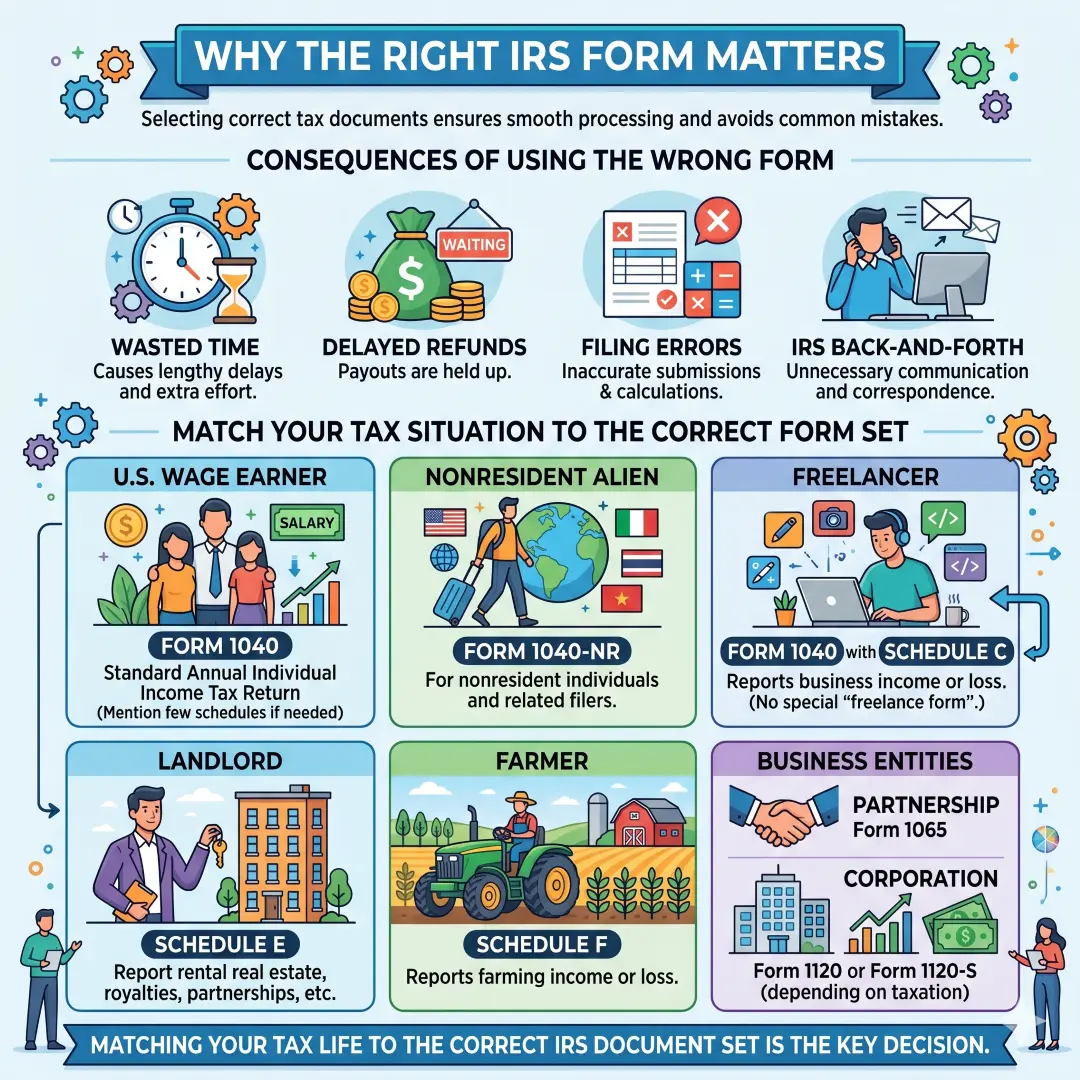
Using the wrong form can waste time, delay refunds, cause filing errors, or create unnecessary back-and-forth with the IRS. More importantly, some forms are tied to very specific tax situations. For example, Form 1040 is the standard annual individual income tax return for U.S. taxpayers, while Form 1040-NR is for nonresident alien individuals and certain related filers. A freelancer usually does not file a special “freelance tax form” by itself. Instead, they often file Form 1040 and attach Schedule C to report business income or loss.
That is why this decision is less about finding one magic form and more about matching your tax life to the correct IRS document set. A wage earner may only need Form 1040 and a few schedules. A landlord may need Schedule E. A farmer may need Schedule F. A partnership files Form 1065, while a corporation generally files Form 1120 or Form 1120-S, depending on how it is taxed.
The fastest way to choose the right form
Here is the simplest way to think about it.
If you are an individual taxpayer and you are filing a federal income tax return, your starting point is usually Form 1040. If you are 65 or older, Form 1040-SR is an optional alternative and uses the same schedules and instructions as Form 1040. If you are a nonresident alien with U.S. tax filing obligations, the main form is Form 1040-NR. If you are self-employed, rent property, or run a farm, you usually attach a business schedule to Form 1040 rather than replacing it.
For other situations, the right form depends on the task. Form W-4 helps your employer with withholding from wages. Form 1040-ES is for estimated tax payments when income is not subject to withholding. Form 4868 requests extra time to file. Form 1040-X is for amending a return. If you are filing for a separate business entity, you may need Form 1065, Form 1120, Form 1120-S, or Form 1041 instead of an individual return.
Main IRS form guide at a glance
| Situation | Most likely form | Who it fits | What it does | Helpful note |
|---|---|---|---|---|
| Annual federal individual income tax return | Form 1040 | U.S. taxpayers filing a normal individual return | Reports income, deductions, credits, and tax due or refund | This is the main form for most individual filers. |
| Senior individual return option | Form 1040-SR | Taxpayers 65 or older | Same filing purpose as Form 1040 | It uses the same schedules and instructions as Form 1040. |
| Nonresident individual return | Form 1040-NR | Nonresident alien individuals and certain related filers | Reports U.S. income tax for nonresident filers | Use this when your filing status is not the standard resident individual return. |
| Sole proprietor business income | Schedule C with Form 1040 | Freelancers, independent contractors, sole proprietors | Reports business profit or loss | The IRS says this is for a business you operated or a profession you practiced as a sole proprietor. |
| Rental income and royalties | Schedule E with Form 1040 | Landlords and some pass-through income recipients | Reports rental real estate, royalties, partnerships, S corporations, estates, and trusts | This is the usual place for rental income. |
| Farm income | Schedule F with Form 1040 | Farmers | Reports farm income and expenses | Use Schedule F for farming activity, not Schedule C. |
| Withholding from wages | Form W-4 | Employees | Tells an employer how much federal income tax to withhold | The IRS recommends reviewing it when your situation changes. |
| Estimated tax payments | Form 1040-ES | Self-employed people and others with untaxed income | Helps figure and pay estimated tax | Common for self-employment, interest, dividends, rents, and similar income. |
| Extra time to file | Form 4868 | Individuals needing more time | Requests an automatic extension to file | The extension is for filing, not for delaying payment. |
| Fixing an already filed return | Form 1040-X | Individual taxpayers correcting an error | Amends a filed return | It can now be e-filed for the current or two prior tax periods with software. |
| Partnership return | Form 1065 | Partnerships and many multi-member LLCs are taxed as partnerships | Reports income and passes information to partners | Partnerships generally do not pay tax on the return itself. |
| Corporate return | Form 1120 | Domestic corporations | Reports corporate income and figures tax liability | Used by corporations filing as C corporations. |
| S corporation return | Form 1120-S | Corporations that elected S corporation status | Reports income, deductions, credits, and more | The form is used only when the S corp election applies. |
| Estate or trust return | Form 1041 | Estates and trusts | Reports income for estates and trusts | An estate may be required if it has more than $600 in annual gross income. |
A step-by-step way to decide
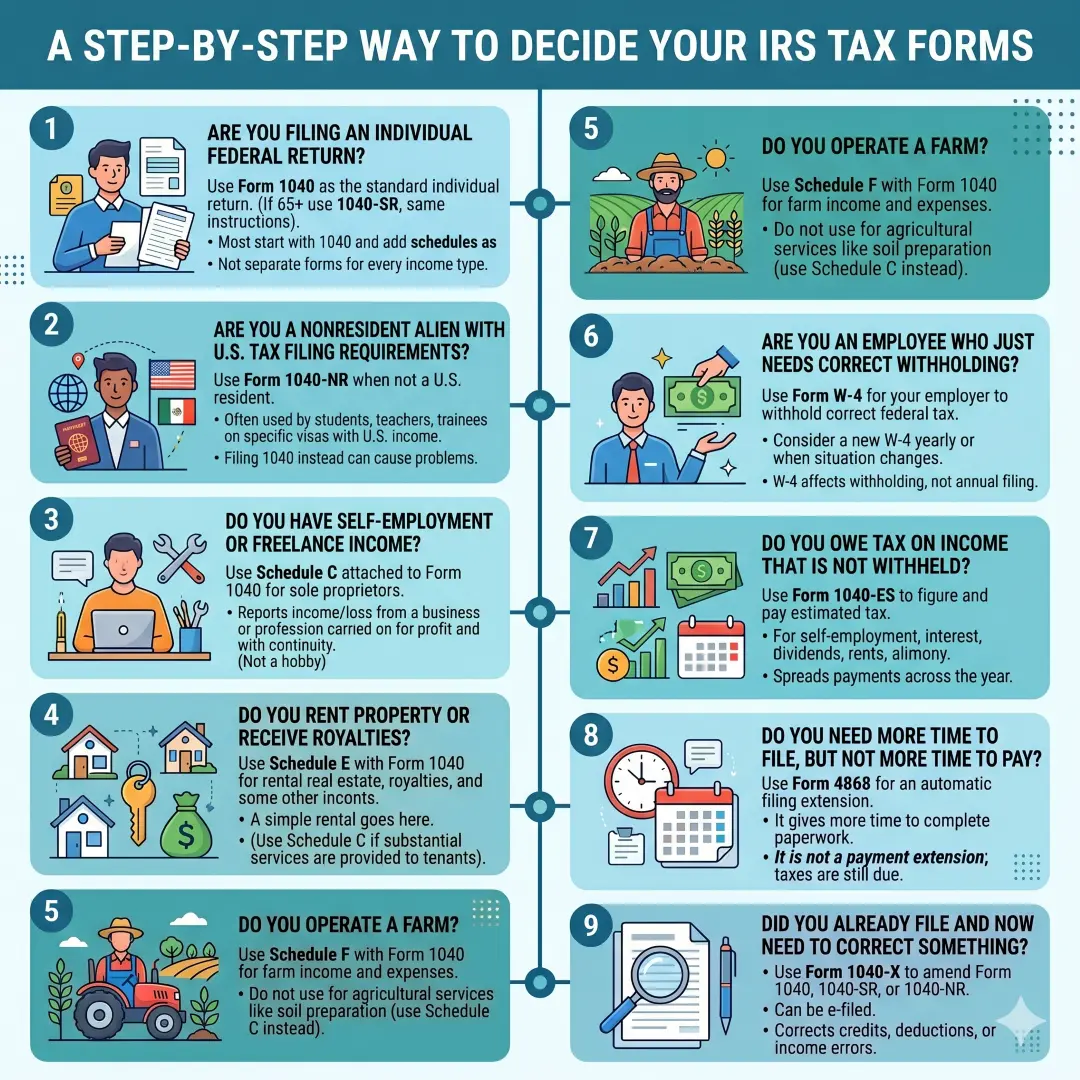
1. Are you filing an individual federal return?
If you are a U.S. taxpayer filing your annual federal income tax return, the first form to look at is Form 1040. That is the IRS’s standard individual return. If you are 65 or older, you may use Form 1040-SR instead, and the IRS says it uses the same schedules and instructions as Form 1040.
A common mistake is thinking there are separate forms for every type of income. There are not. Most individuals still start with Form 1040, then add schedules as needed. The IRS’s own guidance says the schedules you need depend on your specific situation.
2. Are you a nonresident alien with U.S. tax filing requirements?
If you are not a U.S. resident for tax purposes, the form changes completely. Form 1040-NR is the return used by nonresident alien individuals, and the IRS says nonresident aliens file it when they have income subject to U.S. tax. The IRS also notes that some nonresident students, teachers, and trainees on certain visas may need to file it if they have taxable U.S. income.
This is one of the biggest places where people get tripped up. Filing Form 1040 when Form 1040-NR is required can create problems, because resident and nonresident tax rules are not the same. The right form depends on your tax residency, not just on whether you live inside or outside the United States.
3. Do you have self-employment or freelance income?
If you operate as a sole proprietor, the usual IRS route is Schedule C attached to Form 1040. The IRS says Schedule C is used to report income or loss from a business you operated or a profession you practiced as a sole proprietor. It also says the activity must generally be carried on for income or profit, with continuity and regularity.
This matters because not every side activity is a business. A real business is different from a hobby or a one-off activity. If your work is regular and profit-driven, Schedule C is often the right fit. If you are instead part of a partnership, the return usually belongs to the partnership entity, not to your personal Form 1040.
4. Do you rent property or receive royalties?
If your income comes from rental real estate or royalties, the IRS generally points you to Schedule E with Form 1040. Schedule E is also used for certain partnerships, S corporations, estates, trusts, and REMIC income. The IRS topic page on rental income says rental real estate income and expenses are generally reported on Schedule E, unless the activity is really a business with substantial services for the tenant’s convenience.
This distinction matters for landlords. A simple long-term rental usually goes on Schedule E. But if you provide substantial services that are mainly for the tenant’s convenience, the IRS says you may need Schedule C instead. That is why two people with “rental income” can end up using different forms.
5. Do you operate a farm?
If your income is from farming, the IRS says to use Schedule F with Form 1040. Schedule F is specifically for farm income and expenses. The IRS also warns not to use Schedule F for some agricultural service income if the principal source of income is from providing services such as soil preparation, veterinary work, farm labor, or horticultural services. In those cases, the instructions point you back toward Schedule C.
This is a good example of why form choice is really about the nature of the activity. Two people may work in agriculture, but only the person running the farm itself would usually land on Schedule F. Someone providing agricultural services may be in a different filing lane.
6. Are you an employee who just needs correct withholding?
If you are an employee, the form you usually care about is Form W-4, not an income tax return. The IRS says Form W-4 is used so your employer can withhold the correct amount of federal income tax from your pay. The IRS also says you should consider completing a new W-4 each year and when your personal or financial situation changes.
A lot of people confuse payroll paperwork with tax filing paperwork. They are related, but they are not the same. W-4 affects withholding during the year. Form 1040 is the annual return you file later.
7. Do you owe tax on income that is not withheld?
If your income is not subject to withholding, the IRS says Form 1040-ES is the form used to figure and pay estimated tax. The IRS gives common examples such as self-employment income, interest, dividends, rents, and alimony, as well as other taxable income that is not fully covered by withholding.
This is especially important for freelancers, independent contractors, and people with income from investments or rental property. Instead of waiting until tax season and facing a large bill, estimated tax helps spread payments across the year. The IRS says you can use the worksheet in Form 1040-ES to figure your estimated tax.
8. Do you need more time to file, but not more time to pay?
If you cannot finish your return by the deadline, the form to use is Form 4868. The IRS says it gives individuals an automatic extension of time to file their U.S. individual income tax return. It is a filing extension, not a payment extension, and the IRS says taxes still need to be paid by the regular due date.
That detail matters a lot. Many people think an extension solves everything, but it does not. It gives you more time to complete the paperwork. It does not erase any tax owed.
9. Did you already file and now need to correct something?
If a return is already filed and you later find a mistake, the IRS form you usually need is Form 1040-X. The IRS says you can now e-file Form 1040-X with tax software to amend Form 1040, Form 1040-SR, or Form 1040-NR for the current or two prior tax periods.
People often wait too long to fix an error because they think amended returns are complicated. They can be annoying, yes, but the form is there for exactly that reason. If a credit, deduction, or income item was wrong, 1040-X is the clean correction route.
Where business owners fit in
The word business creates more confusion than almost anything else in tax filing. That is because the IRS does not treat every business the same way. A partnership files Form 1065, a C corporation files Form 1120, an S corporation files Form 1120-S, and an estate or trust usually files Form 1041. A single-member or multi-member LLC may be taxed differently depending on how it is classified.
| Business type | Typical IRS form | What the IRS says | Plain-English meaning |
|---|---|---|---|
| Partnership | Form 1065 | Partnerships file an information return to report income, gains, losses, deductions, and credits. The partnership itself does not pay tax on that income. | The partnership reports results, and partners pick up their shares. |
| Domestic C corporation | Form 1120 | Domestic corporations use this form to report income, gains, losses, deductions, credits, and figure tax liability. | This is the standard corporate income tax return. |
| S corporation | Form 1120-S | The form is used for a corporation or other entity for tax years covered by an S corporation election. | The business has elected pass-through treatment under S Corp rules. |
| Estate or trust | Form 1041 | Use Form 1041 to report the income of estates and trusts. The IRS says an estate may need to file if it has more than $600 in annual gross income. | This is not a personal return. It belongs to the estate or trust. |
| LLC | Depends on classification | The IRS says an LLC may file as a partnership or corporation, depending on its classification. | The LLC label alone does not tell you the tax form. |
The key lesson here is simple. Legal structure and tax structure are not always the same thing. An LLC is a perfect example. It is a business form, but it does not tell you the tax form all by itself. You still need to know how the IRS treats it.
Common form combinations people actually use
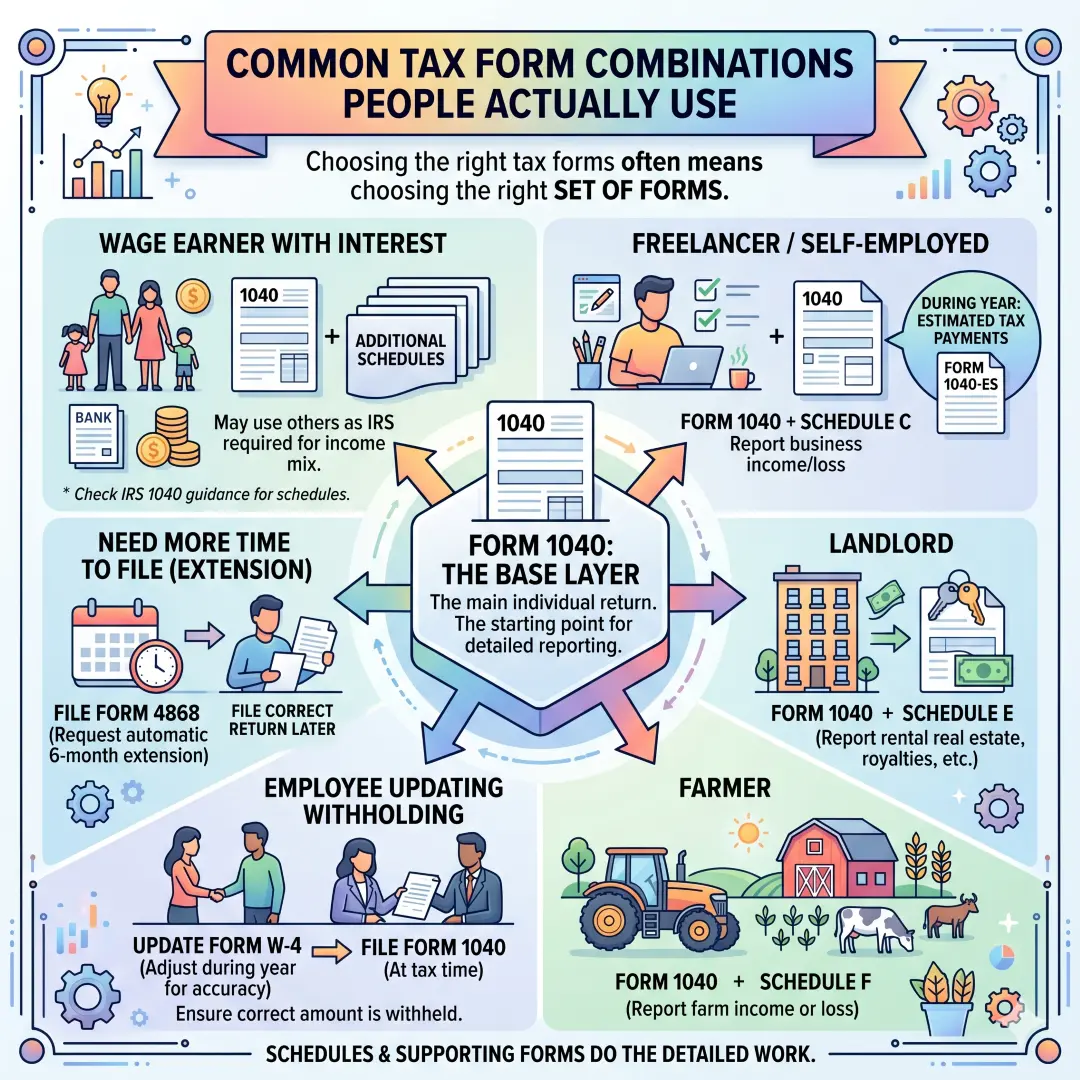
Many taxpayers need more than one form. That is normal.
- A wage earner with a few bank interest statements may file Form 1040 and possibly add the schedules the IRS requires for their income mix. The IRS’s 1040 guidance points taxpayers to the numbered schedules and the schedule overview page.
- A freelancer may file Form 1040 plus Schedule C, and may also need estimated tax payments through Form 1040-ES during the year.
- A landlord may file Form 1040 plus Schedule E.
- A farmer may file Form 1040 plus Schedule F.
- An employee who needs better withholding may update Form W-4, then later file Form 1040 at tax time.
- Someone who needs more time to file may use Form 4868, then still file the correct return later.
That is why “choosing the right tax form” often means choosing the right set of forms. For most people, the main return is just the base layer. The schedules and supporting forms do the detailed work.
Real-world examples
Example 1: a full-time employee with no side business
Priya works a salaried job, has wage withholding, and gets a W-2. Her basic filing form is usually Form 1040. If she is 65 or older, she may choose Form 1040-SR instead. If she has bank interest or dividend income, she may need additional schedules depending on her situation.
Example 2: a freelancer
Daniel designs websites as an independent contractor. His tax return usually starts with Form 1040, and his freelance profit or loss goes on Schedule C. Because some of his income is not withheld during the year, he may also need Form 1040-ES to make estimated tax payments.
Example 3: a landlord
Sara owns one rental apartment. Her rental income and expenses usually belong on Schedule E attached to Form 1040. If she provides substantial services to tenants, the IRS says the activity may need to be reported differently, which is why the facts matter.
Example 4: a nonresident alien with U.S. income
Hiro lives outside the United States but has U.S.-source taxable income. The IRS says this is the type of situation that can call for Form 1040-NR. That return is specifically for nonresident alien filers, and the IRS explains that it is used when the filer has U.S. income subject to tax.
Example 5: a business owner with a corporation
A domestic corporation generally files Form 1120. If that corporation has elected S corporation status, it generally files Form 1120-S instead. The form choice depends on the entity’s tax classification, not just the fact that it is a corporation in everyday language.
Mistakes to avoid when choosing a tax form
| Mistake | Why does it cause trouble | What to do instead |
|---|---|---|
| Using Form 1040 when you are really a nonresident alien | Resident and nonresident rules are different | Check whether Form 1040-NR is the correct return |
| Putting self-employment income on the wrong form | Sole proprietors usually need Schedule C | Attach Schedule C to Form 1040 |
| Reporting rental income as business income without checking the facts | Rental activity often belongs on Schedule E | Use Schedule E unless the facts point to business treatment |
| Thinking an extension means you can delay payment too | Form 4868 extends filing time, not payment time | Estimate and pay any tax due by the deadline |
| Treating W-4 like a tax return | It controls withholding, not annual filing | Use W-4 for payroll withholding and 1040 for the return |
| Using the wrong business return | Partnerships, corporations, S corporations, and estates use different forms | Match the form to the entity type |
A simple checklist before you file
Before you choose a form, ask these questions.
- Am I filing as an individual, a nonresident, a sole proprietor, a landlord, a farmer, or a separate business entity?
- Do I need Form 1040, 1040-SR, or 1040-NR?
- Do I need to attach Schedule C, Schedule E, or Schedule F?
- Am I just adjusting withholding through Form W-4?
- Do I need to pay estimated tax with Form 1040-ES?
- Do I need more time with Form 4868?
- Did I already file and now need Form 1040-X?
If you can answer those questions, the form choice usually becomes much easier.
How to file once you know the right form
The IRS says you can file your return electronically, and it notes that e-filing is faster, safer, and more accurate than mailing a paper return. The IRS also says taxpayers can use Free File or Free File Fillable Forms depending on their situation. Free File Fillable Forms is available for taxpayers comfortable preparing their own return, regardless of income, while the guided Free File option is based on provider eligibility rules.
That matters because the right form is only part of the job. The way you file can save time and reduce mistakes, too. If your return is accepted electronically, you also get confirmation in the process, which is a nice extra layer of confidence.
For people who want to check forms directly, the IRS maintains a current Forms, instructions, and publications page. That is usually the safest place to confirm the latest version of a form or instruction set before you file.
A practical way to think about tax forms
Think of the IRS form system like a filing map.
- Form 1040 is the main form for individual taxpayers.
- 1040-SR is a senior-friendly version of the same road.
- 1040-NR is the route for nonresident filing situations.
- Schedule C, E, and F are the side roads for business, rental, and farm income.
- W-4 handles paycheck withholding.
- 1040-ES handles estimated payments.
- 4868 buys more time to file.
- 1040-X fixes a return already filed.
- 1065, 1120, 1120-S, and 1041 belong to separate business or fiduciary entities.
That is the real secret. You are not just asking, “What is the tax form?” You are asking, “What is my tax situation?” Once that answer is clear, the right form usually follows naturally.
Final checklist before you press submit
Read the return one more time and confirm these basics.
- You picked the correct taxpayer type.
- You started with the right base form, usually Form 1040, 1040-SR, or 1040-NR.
- You attached the correct schedule for your income type.
- You used W-4 only for withholding and 1040-ES only for estimated payments.
- You did not rely on Form 4868 as a payment solution.
- You used 1040-X only when correcting a filed return.
- You checked the current IRS forms page for the latest version.
Choosing the right IRS tax form is much less intimidating once you slow it down and follow the facts. Start with your tax situation, match it to the right form, and then confirm the details on the official IRS pages before filing. That simple habit can save time, reduce stress, and help your return go through more smoothly.
Article’s References and Sources
- IRS Forms, Instructions, and Publications (Official IRS Library)
- About Form 1040, U.S. Individual Income Tax Return
- About Form 1040-NR, U.S. Nonresident Alien Income Tax Return
- About Schedule C (Form 1040), Profit or Loss From Business
- About Schedule E (Form 1040), Supplemental Income and Loss
- About Schedule F (Form 1040), Profit or Loss From Farming
- About Form W-4, Employee’s Withholding Certificate
- About Form 1040-ES, Estimated Tax for Individuals
- About Form 4868, Application for Automatic Extension of Time to File
- About Form 1040-X, Amended U.S. Individual Income Tax Return
- About Form 1065, U.S. Return of Partnership Income
- About Form 1120, U.S. Corporation Income Tax Return
- About Form 1120-S, U.S. Income Tax Return for an S Corporation
- About Form 1041, U.S. Income Tax Return for Estates and Trusts
- LLC Filing as a Corporation or Partnership (IRS Business Guidance)
- Electronic Filing (e-file) FAQs – IRS
- IRS Free File: Do Your Taxes for Free
- Rental Income and Expenses (Tax Topic No. 414)
- Get an Extension to File Your Tax Return – IRS
Also, Read these Articles in Detail
- IRS Tax Forms Explained for Beginners
- What Is an IRS Tax Form and How Does It Work
- Step-by-Step Guide to Filling Out IRS Tax Forms
- Types of IRS Tax Forms You Should Know
Frequently Asked Questions
FAQ 1: What is the right IRS tax form for most individual taxpayers?
For most people, the main federal tax return is Form 1040. This is the standard form used by individual taxpayers to report income, claim deductions, and calculate whether they owe tax or get a refund. If you earn wages, have bank interest, receive retirement income, or have other common types of personal income, Form 1040 is usually where everything starts.
Some taxpayers also qualify to use Form 1040-SR. This form is meant for people who are 65 or older, and it uses the same basic tax rules as Form 1040. The difference is mostly in the presentation. It is designed to be easier to read, especially for older filers who prefer a larger, clearer layout. But it is not a separate tax system. It is still the same individual return, just in a different format.
The main point is simple. If you are filing your personal federal tax return, Form 1040 is usually the form you need. Then you add other schedules only if your situation requires them. That is why it is smart to start with the main return first and then look at the details. For many taxpayers, the right form is not a mystery. It is the regular individual return with a few supporting forms attached.
FAQ 2: How do I know whether I need Form 1040, Form 1040-SR, or Form 1040-NR?
The right form depends on your tax status, not just where you live. If you are a U.S. taxpayer filing an ordinary individual return, you will usually use Form 1040. If you are 65 or older, you may choose Form 1040-SR instead. It works the same way as Form 1040 and is often easier to read.
Form 1040-NR is different. This form is for nonresident alien individuals who have U.S. tax filing obligations. That means the form is not based on age or convenience. It is based on whether you are considered a nonresident for tax purposes. This is important because resident and nonresident tax rules are not the same.
A lot of confusion comes from mixing up residence in the everyday sense with residence for tax purposes. Someone may live in one country, work in another, and still have U.S. taxable income. In that case, the filing form may be 1040-NR, not the regular 1040. So the best way to think about it is this. 1040 is the standard individual return, 1040-SR is the senior-friendly version, and 1040-NR is the return for nonresident filing situations.
FAQ 3: When should I use Schedule C with my tax return?
You should usually use Schedule C if you are a sole proprietor, a freelancer, an independent contractor, or someone who runs a business in your own name. This schedule is used to report the income or loss from a business you operated or a profession you practiced as a sole proprietor. In plain language, it is the form many self-employed people use to show how much they earned and what business expenses they had.
This is a very common form for people who work for themselves. If you do design work, consulting, writing, tutoring, online services, delivery work, or other independent work, Schedule C may be the right place to report that income. It usually gets attached to Form 1040, because the business profit or loss flows into your personal tax return.
But not every small activity qualifies. The IRS looks at whether the activity is carried on with continuity, regularity, and a real intention to make a profit. That means a real business is different from a random side task or a one-time project. If the work is ongoing and profit-driven, Schedule C is often the correct choice. And if you are not sure, that is a sign to slow down and look closely at the nature of the activity before filing.
FAQ 4: What is the difference between Schedule C, Schedule E, and Schedule F?
These three schedules are easy to confuse because they all deal with income outside of a regular wage job. But each one has a different purpose.
Schedule C is for business income from a sole proprietorship. That means self-employment income, freelance work, or a business you personally operate.
Schedule E is for rental income, royalties, and some other pass-through income items. Landlords often use this schedule to report rental property income and expenses. It is also used for certain income from partnerships, S corporations, estates, and trusts.
Schedule F is for farm income and expenses. If you run a farm, grow crops, raise livestock, or operate a farming business, this is the schedule that usually applies.
The difference really comes down to the type of activity. If you provide services as a self-employed worker, Schedule C is usually the right fit. If you earn income from a rental property, Schedule E is often the right fit. If your income comes from farming, Schedule F is the one to look at. This matters because putting income on the wrong schedule can lead to filing mistakes, and it can also make your tax return harder to understand.
FAQ 5: Do I need to file Form 1040-ES if I am self-employed or have side income?
You may need Form 1040-ES if you earn income that does not have enough tax withheld during the year. This is very common for self-employed people, freelancers, independent contractors, landlords, and others who receive income outside of regular payroll withholding. The form is used to figure and pay estimated tax.
The reason estimated tax exists is simple. If no one is withholding enough tax from your income during the year, you may owe a large amount later if you wait until tax season. Estimated tax helps spread payments across the year instead of making you pay everything at once. That is often easier on cash flow and helps reduce surprises.
A lot of people think estimated tax is only for business owners. It is not. It can also apply to people with interest income, dividends, rental income, and other taxable income that is not fully covered by withholding. So if you are earning money that is not being taxed through your paycheck, Form 1040-ES may be part of your tax routine. It does not replace your annual return. It supports it by helping you pay tax in advance.
FAQ 6: What is Form W-4, and how is it different from a tax return?
Form W-4 is not a tax return. It is a withholding form that you give to your employer so they know how much federal income tax to take out of your paycheck. That is a big difference. A tax return tells the government what happened during the year. A W-4 helps shape how much tax is withheld while the year is still going on.
If you start a new job, get married, have a child, take on a second job, or have other major life changes, it is a good idea to review your W-4. The goal is to have the right amount withheld so you do not owe too much later or give the government more than necessary during the year.
People often mix up W-4 and Form 1040, but they serve different jobs. W-4 affects your paycheck. Form 1040 is the return you file at tax time. In practice, both matter. A smart withholding setup can make your tax filing much smoother. A poor withholding setup can create a refund that is too small or a tax bill that is too large.
FAQ 7: What should I use if I need more time to file my taxes?
If you need more time to file your return, you usually use Form 4868. This form gives you an automatic extension of time to submit your tax return. But there is a very important detail here. It gives you more time to file, not more time to pay.
That means if you expect to owe tax, you should still estimate and pay as much as possible by the original deadline. Otherwise, you could face interest or penalties on the unpaid amount. Many people get this wrong and think the extension solves the whole problem. It does not. It only pushes back the paperwork deadline.
Form 4868 is useful when you are missing documents, need more time to organize records, or simply cannot finish the return on time. It is a practical safety net, not a way to skip the tax deadline. If used correctly, it can help you avoid filing a rushed or inaccurate return. That is often better than submitting something half-finished just to meet the date.
FAQ 8: How do I fix a tax return if I already filed it and found a mistake?
If you already filed your return and later realize something was wrong, you usually need Form 1040-X. This is the amended return form for individual taxpayers. It is used to correct mistakes, update income information, fix a missed deduction or credit, or change other items on an already filed return.
This is a common part of tax life, and it does not mean you failed. Sometimes people get a corrected form after filing. Sometimes they forget a document. Sometimes they notice a math error or realize they used the wrong filing detail. That is exactly why Form 1040-X exists.
The important thing is to correct the return properly instead of just guessing or sending another regular return. An amended return is its own process. It helps the IRS see what changed and why. If the error affects your refund or the amount of tax you owe, fixing it with 1040-X is the cleanest way to do it. The key is to be accurate, patient, and clear with the information you provide.
FAQ 9: How do I choose the right form if I own a business, partnership, corporation, or LLC?
Business tax forms depend on how the business is legally and tax-wise structured. This is one of the most confusing parts of tax filing because the name of the business does not always tell you the right form.
A partnership usually files Form 1065. A C corporation usually files Form 1120. An S corporation usually files Form 1120-S. An estate or trust usually files Form 1041. Those are separate from the personal Form 1040 that an individual uses.
An LLC can be especially tricky. An LLC can be taxed in different ways depending on how it is classified. It may be treated like a partnership or a corporation for tax purposes. So the fact that a business is called an LLC does not automatically tell you which return to file.
The safest way to think about this is to ask one question first. What is the business’s tax classification? That answer matters more than the brand name of the business structure. Once you know that, the correct form usually becomes much easier to identify.
FAQ 10: What is the easiest way to avoid choosing the wrong IRS tax form?
The easiest way is to work from your situation, not from the form name. Start by asking what kind of income you have and what kind of taxpayer you are. Are you filing as an individual, a nonresident, a freelancer, a landlord, a farmer, or a separate business entity? Once you answer that, the form usually becomes clear.
A simple habit can save a lot of trouble. Before you file, check whether you need just Form 1040 or whether you also need a schedule like Schedule C, Schedule E, or Schedule F. If you are adjusting payroll withholding, use Form W-4. If you need to make estimated payments, use Form 1040-ES. If you need more time, use Form 4868. If you already filed and need to correct something, use Form 1040-X.
It also helps to avoid guessing when your situation is not straightforward. For example, rental activity can sometimes be treated differently if you provide substantial services. A nonresident taxpayer may need Form 1040-NR instead of Form 1040. A business owner may need a return for the entity itself rather than a personal return. These details matter.
The best rule is simple. Match the form to the tax situation, not the other way around. That approach keeps things much cleaner, reduces errors, and makes tax filing feel far less intimidating.
Article Disclaimer
The information provided in this article, “How to Choose the Right IRS Tax Form,” is intended for general informational and educational purposes only. It is not meant to serve as legal, tax, or financial advice, and it should not be relied upon as a substitute for professional guidance. Tax laws and regulations can be complex, and they often change over time. While every effort has been made to present accurate and up-to-date information, there is no guarantee that all details remain current or fully applicable to every individual situation.
Every taxpayer’s circumstances are different. Factors such as income type, residency status, filing status, deductions, credits, and business structure can significantly affect which IRS tax form is appropriate. What works for one person may not apply to another. Because of this, readers are strongly encouraged to review their own situation carefully and consult a qualified tax professional, certified public accountant, or legal advisor before making any tax-related decisions or filing returns.
This article may reference common forms such as Form 1040, Form 1040-NR, Schedule C, Schedule E, Schedule F, Form W-4, Form 1040-ES, Form 4868, and Form 1040-X, but it does not cover every possible tax scenario or exception. Certain taxpayers, including those with international income, complex investments, or specialized business structures, may require additional forms or different filing approaches. Relying solely on general guidance without verifying your specific requirements could lead to errors, penalties, or delays in processing.
The content provided does not establish any professional-client relationship between the reader and the writer or publisher. Any actions you take based on the information in this article are done at your own discretion and risk. The author and publisher are not responsible for any losses, liabilities, or damages that may arise from the use or misuse of the information presented.
Readers are advised to consult official government resources and the most recent instructions for each IRS form before filing. Tax rules may vary based on jurisdiction, and additional local or state requirements may apply depending on your location. Staying informed through reliable and updated sources is essential for accurate tax compliance.
By reading this article, you acknowledge and agree that the content is provided “as is” without any warranties of completeness, reliability, or accuracy. Always seek professional advice when needed, and ensure that your final tax filing decisions are based on verified and current information relevant to your personal financial situation.
