The U.S. tax system runs on forms. Some forms help you report income, some help employers handle payroll, some track money paid to contractors, and some are used to correct mistakes or estimate future tax. The IRS keeps a large library of current forms and instructions, and some of the most common ones include Form 1040, Form W-4, Form W-2, Form W-9, Form 941, Form 1040-ES, and several 1099 forms.
For many people, taxes feel complicated because there is not just one form to learn. There is a whole family of forms, and each one serves a different purpose. Once you understand the main types, though, the system starts to make sense. An employee usually sees W-4 and W-2. A freelancer may see W-9, 1099-NEC, or 1099-K. A business owner may deal with 941, 944, 1065, 1120-S, or 1120. The IRS separates these forms by purpose, which makes the paperwork look bigger than it really is.
If you want to read tax forms like a pro, the trick is to stop thinking of them as random paperwork. Think of them as tools. One tool reports what you earned. Another tells an employer how much tax to withhold. Another summarizes what a business paid out. Another fixes a previously filed return. That is the real shape of the IRS form system.
Table of Contents
The Main IRS Tax Form Families
| Form family | Who usually uses it | What it does | Common examples | Why it matters |
|---|---|---|---|---|
| Individual income tax returns | Workers, retirees, self-employed people, and other individual taxpayers | Reports yearly income and calculates tax owed or refunded | Form 1040, Form 1040-SR | It is the main federal income tax return for individuals. |
| Individual schedules | Individuals who need extra details on deductions, business income, or self-employment tax | Adds detail to a personal return | Schedule A, Schedule C, Schedule SE | These schedules are attached to Form 1040 when a taxpayer has itemized deductions, a sole proprietorship, or self-employment tax. |
| Withholding forms | Employees and employers | Helps determine how much federal income tax is withheld from wages | Form W-4, Form W-2, Form W-3 | These forms connect payroll withholding with year-end wage reporting. |
| Information returns | Businesses, payers, and institutions that report payments | Reports payments made to people or entities, often without withholding tax | Form 1099-NEC, 1099-MISC, 1099-K, 1098, 1098-T, 1098-E | These forms help the IRS match reported income and other tax-related payments. |
| Business income tax returns | Partnerships, S corporations, and C corporations | Reports business income, deductions, and tax liability | Form 1065, Form 1120-S, Form 1120 | These are the core annual returns for many businesses. |
| Employment tax returns | Employers | Reports payroll taxes and employer tax obligations | Form 941, Form 944, Form 943 | These returns are used for payroll tax reporting, either quarterly or annually, depending on the employer. |
| Amended and corrected forms | Anyone who needs to fix an earlier filing | Corrects errors or updates a return already filed | Form 1040-X, Form W-2c, Form W-3c | Tax mistakes happen. The IRS has separate forms for corrections. |
| Supporting and transmittal forms | Businesses and payers | Collects identification details or sends paper returns to the IRS | Form W-9, Form 1096 | These are often behind the scenes, but they are essential in recordkeeping and paper filing. |
1. The IRS Forms Most Individuals Should Know
Form 1040, the main individual tax return
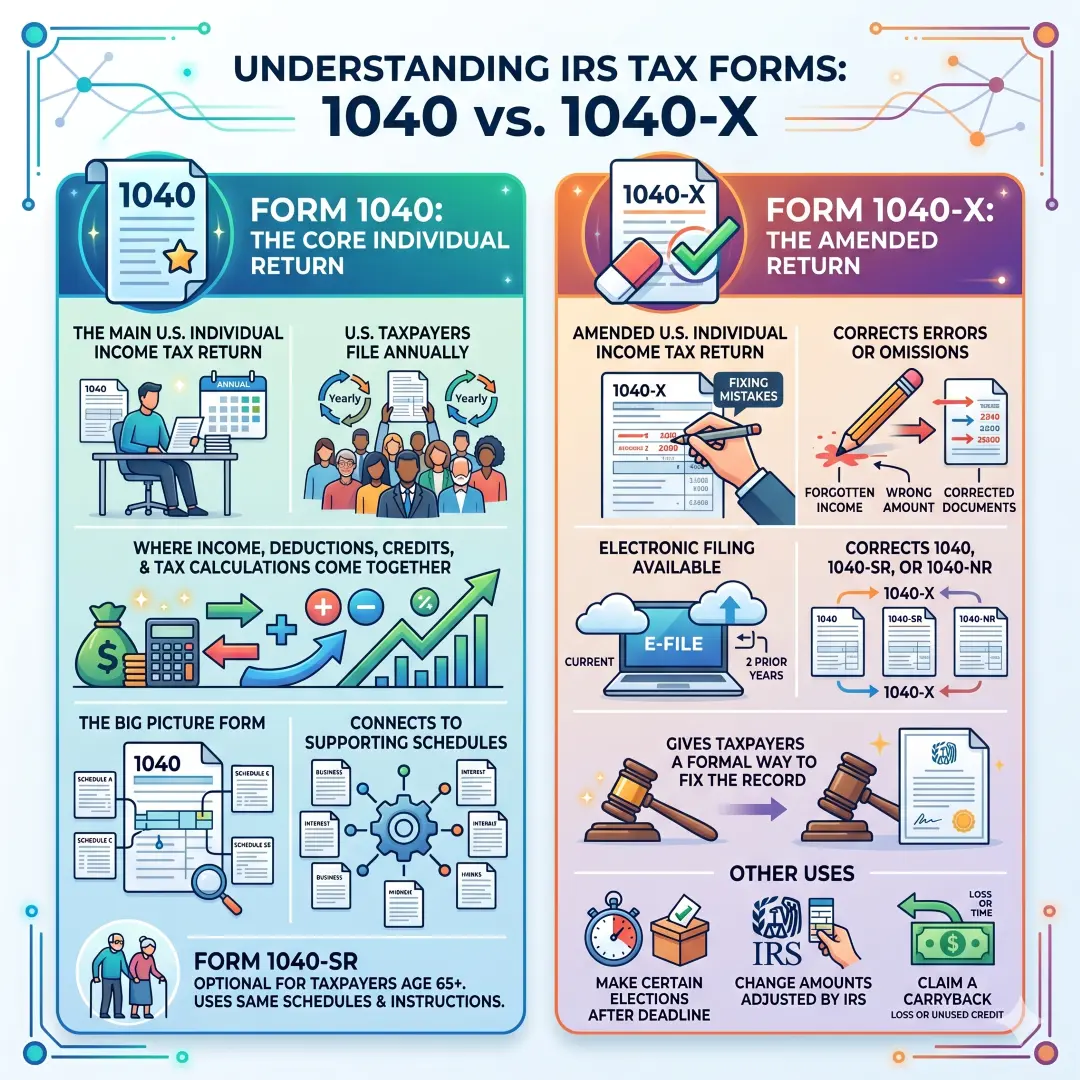
Form 1040 is the core U.S. individual income tax return. The IRS says it is used by U.S. taxpayers to file an annual income tax return. If you file taxes as an individual, this is the form that usually sits at the center of the process. It is where income, deductions, credits, and tax calculations come together. The IRS also offers Form 1040-SR as an optional alternative for taxpayers age 65 or older, and it uses the same schedules and instructions as Form 1040.
In simple terms, Form 1040 is the big picture form. It does not usually hold every little detail by itself. Instead, it connects to schedules and supporting forms. That is why many taxpayers hear phrases like Schedule A, Schedule C, or Schedule SE. Those extra pages give the IRS the detail that the main return cannot fit comfortably on its own.
Form 1040-X, the amended return
Mistakes happen. Maybe you forgot income. Maybe you entered the wrong amount. Maybe you later received a corrected tax document. In those cases, the IRS uses Form 1040-X, which is the amended U.S. individual income tax return. The IRS says you can now file Form 1040-X electronically with tax filing software for the current year or two prior tax periods, and you can use it to correct Form 1040, 1040-SR, or 1040-NR.
That matters because a tax return is not always final the first time you file it. Form 1040-X gives taxpayers a formal way to fix the record. It can also be used to make certain elections after the deadline, change amounts previously adjusted by the IRS, or claim a carryback because of a loss or unused credit. (irs.gov)
Schedule A, for itemized deductions
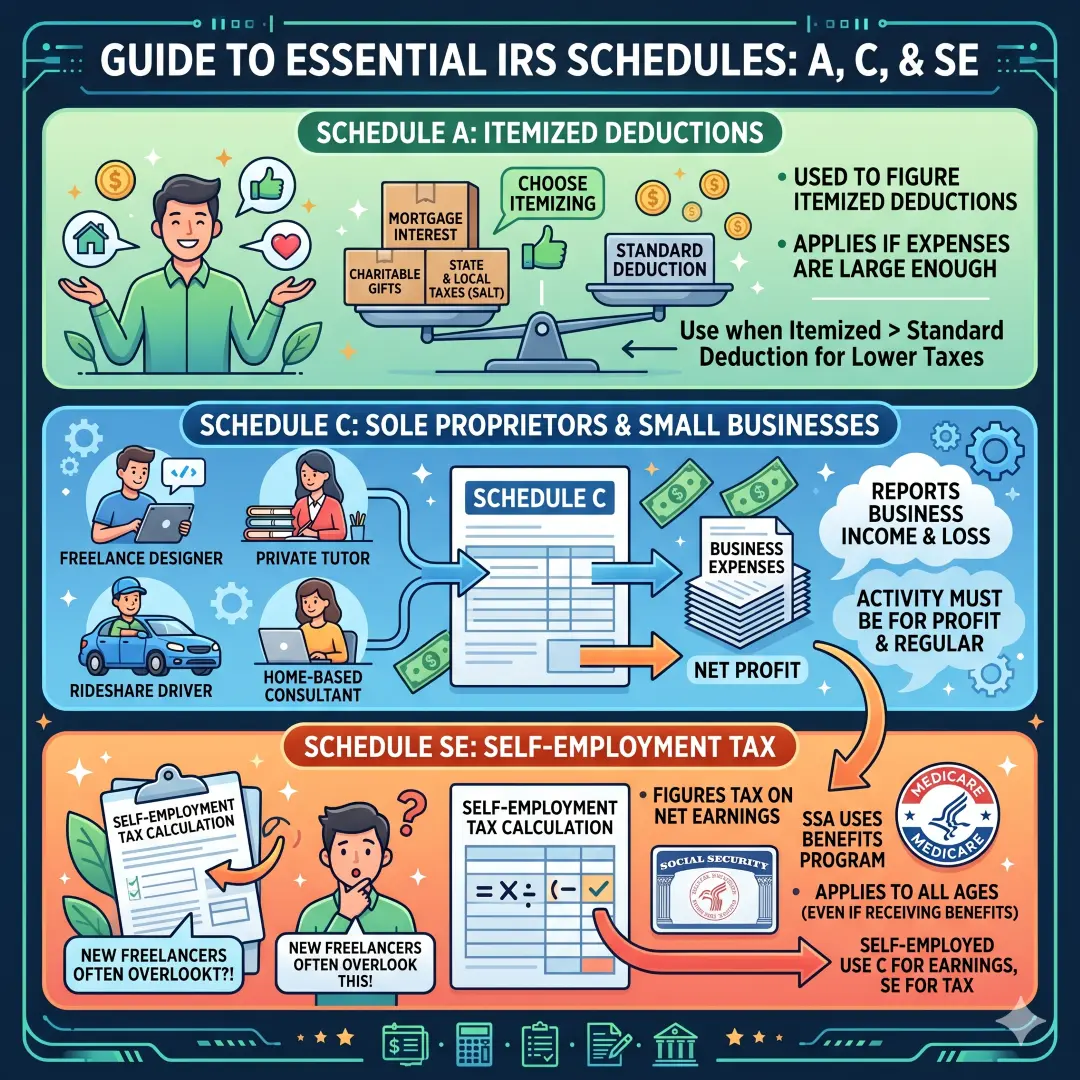
Schedule A is used to figure itemized deductions. The IRS says that in most cases, your federal income tax will be less if you take the larger of your itemized deductions or your standard deduction. That means Schedule A matters for taxpayers whose deductible expenses are large enough to justify itemizing instead of taking the standard deduction.
A simple example helps here. Imagine a taxpayer with significant mortgage interest, charitable gifts, and state and local taxes. That person may benefit from itemizing on Schedule A rather than using the standard deduction. Another taxpayer with lower deductible expenses might skip Schedule A completely.
Schedule C, for sole proprietors and small businesses
Schedule C is the form many freelancers, sole proprietors, and one-person business owners eventually meet. The IRS says it is used to report income or loss from a business you operated or a profession you practiced as a sole proprietor. An activity qualifies as a business if the main purpose is income or profit, and you are involved with continuity and regularity.
This is one of the most important forms for self-employed people because it ties directly to business income and deductible business expenses. A freelance designer, a private tutor, a rideshare driver, or a home-based consultant may all use Schedule C if they operate as sole proprietors.
Schedule SE, for self-employment tax
If Schedule C shows the business profit, Schedule SE helps figure the tax due on net earnings from self-employment. The IRS says the Social Security Administration uses the information from Schedule SE to figure benefits under the Social Security program, and the tax applies no matter how old you are, even if you already receive Social Security or Medicare benefits.
This is a form many newer freelancers overlook. They know about income tax, but they forget self-employment tax. The IRS also notes that self-employed individuals generally use Schedule C to figure net earnings and Schedule SE to calculate self-employment tax.
Form 1040-ES, for estimated tax payments
Not all taxes are withheld from paychecks. The IRS says Form 1040-ES is used to figure and pay estimated tax, which applies to income that is not subject to withholding, such as self-employment income, interest, dividends, rents, and alimony. It can also be used for other taxable income where withholding does not apply.
This is especially useful for freelancers, consultants, landlords, and investors. If no employer is withholding enough tax for you during the year, Form 1040-ES helps you pay in installments rather than facing a large tax bill later. The IRS estimated tax guidance says the worksheet in Form 1040-ES can be used to figure estimated tax for the year.
2. The Forms Employees See on Payroll
Form W-4, the Employee’s Withholding Certificate
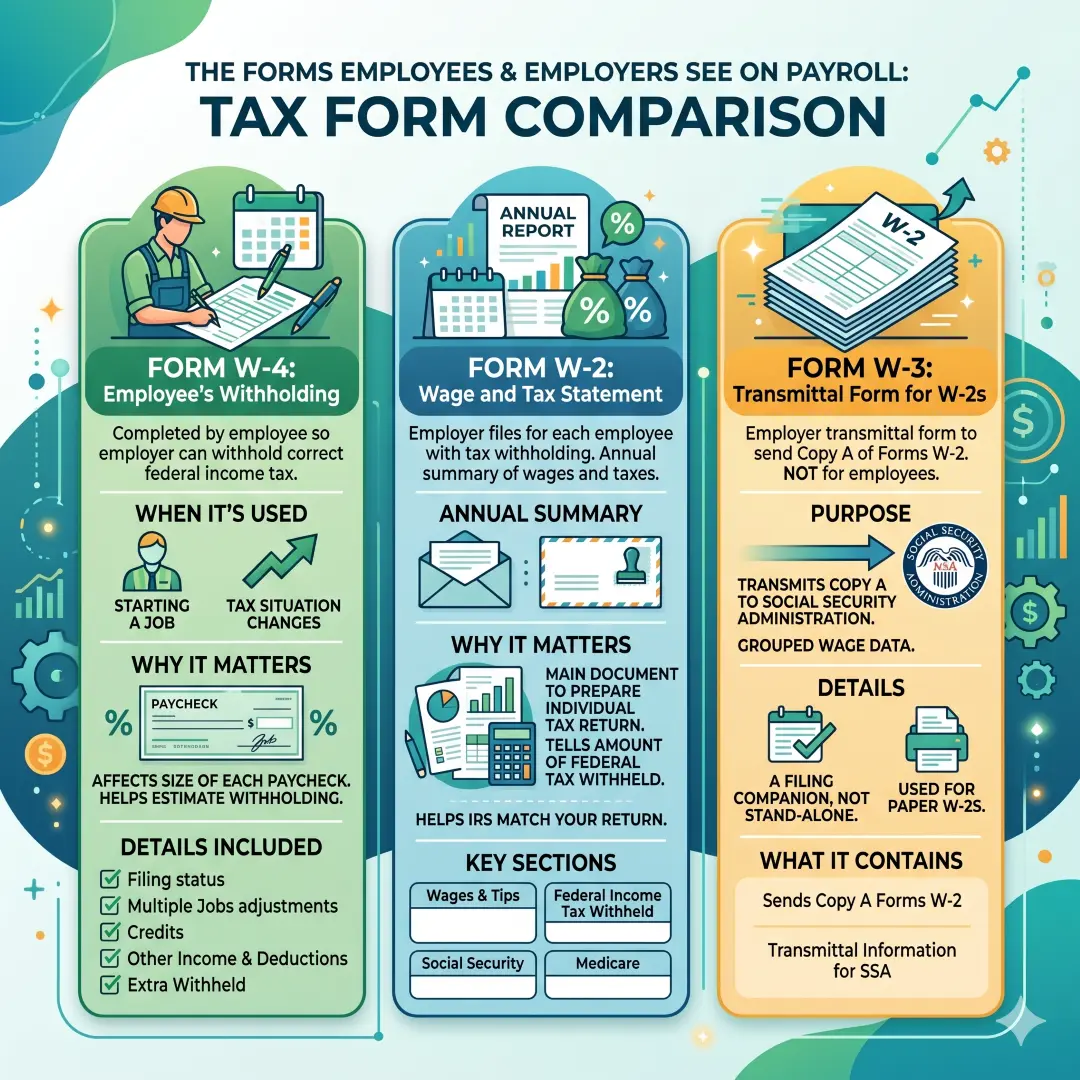
Form W-4 is the payroll form most employees sign when they start a job or when their tax situation changes. The IRS says you complete Form W-4 so your employer can withhold the correct federal income tax from your pay, and it is a good idea to review it each year or when your personal or financial situation changes.
This form matters because it affects the size of each paycheck. A properly completed W-4 helps an employer estimate withholding more accurately. The IRS also explains that the form asks for details such as filing status, multiple jobs adjustments, credits, other income, deductions, and any extra amount you want withheld.
Form W-2, the Wage and Tax Statement
At the end of the year, most employees receive Form W-2. The IRS says employers must file a W-2 for each employee for whom income, Social Security, or Medicare tax was withheld. In simple language, a W-2 is the annual summary of wages and tax withholding for employees.
This form is important because it is one of the main documents used to prepare an individual tax return. If your employer withheld federal tax during the year, Form W-2 tells you how much. It also helps the IRS match your return with payroll records.
Form W-3, the transmittal form for W-2s
Form W-3 is not a wage statement for an employee. It is the transmittal form that sends Copy A of Forms W-2 to the Social Security Administration. The IRS says to use Form W-3 to transmit Copy A of Forms W-2.
That means W-3 is a filing companion, not a stand-alone employee form. Employers use it when they file paper W-2s, and it helps transmit the wage data in a grouped format.
3. The Information Returns Businesses and Payors Should Know
Information returns are forms that report payments, interest, mortgage activity, tuition, or similar information. They usually do not work like a tax return. Instead, they help the IRS and the taxpayer see what was paid during the year. The IRS general instructions for information returns cover many forms, including 1097, 1098, 1099, 3921, 3922, 5498, and W-2G, and the IRS says that if you have 10 or more information returns, you must e-file.
Form W-9, the requester form for taxpayer identification
Form W-9 is one of the quiet heroes of the tax world. The IRS says it is used to request the correct name and Taxpayer Identification Number of the payee, and businesses should keep it in their files for four years in case of questions from the worker or the IRS.
You often see a W-9 before a 1099. For example, if a business hires an independent contractor, the first step is often to collect a W-9 so the payer has the contractor’s correct legal name and TIN. That is how the business reduces filing mistakes later.
Form 1099-NEC, for nonemployee compensation
The IRS says Form 1099-NEC is used to report nonemployee compensation. This is the form most people think of when they hear “1099 for freelancers.” It is commonly used for payments made to independent contractors, not employees.
A real-world example is simple. Suppose a company pays a freelance writer for several articles during the year. If the payment falls under the reporting rules, the company may issue Form 1099-NEC to report the amount paid. The IRS also says businesses generally must file Form 1099-NEC by January 31.
Form 1099-MISC, for miscellaneous reportable payments
Form 1099-MISC is the classic miscellaneous information return. The IRS says it should be filed for certain payments made during the year, and its instructions explain that it covers things such as rents, prizes and awards, and other reportable payments.
This form is easy to confuse with 1099-NEC, but the purpose is different. 1099-NEC is for nonemployee compensation. 1099-MISC covers several other payment types. That difference matters because filing the wrong form can create confusion for both the payer and the recipient.
Form 1099-K, for payment cards and payment apps
Form 1099-K reports payments processed through payment settlement entities, including payment cards and third-party network transactions. The IRS says a payment settlement entity must file Form 1099-K for reportable payment transactions for each calendar year.
This form has become much more familiar because people now get paid through apps and online platforms. The IRS also says that if you receive a 1099-K, you should use it with your other tax records when it is time to file your return. In practice, that means you should not treat the form as the only record of your income, but as one part of the overall picture.
Forms 1098, 1098-E, and 1098-T
Form 1098 reports mortgage interest of $600 or more received during the year in the course of a trade or business from an individual, including a sole proprietor.
Form 1098-E is used when a business receives student loan interest of $600 or more from an individual during the year in the course of its trade or business. The IRS says the filer must provide a statement or an acceptable substitute to the borrower as well.
Form 1098-T is filed by eligible educational institutions for each student they enroll and for whom a reportable transaction is made. That makes it an important education-related information form, especially for recordkeeping.
Form 1096, the paper transmittal form
Form 1096 is another behind-the-scenes form that matters a great deal when paper filing. The IRS says to use Form 1096 to transmit paper Forms 1097, 1098, 1099, 3921, 3922, 5498, and W-2G to the IRS, and it should not be used for electronic filing.
That means a business that files paper information returns may need 1096 even though the recipient only sees the attached 1099 or 1098. If you file electronically, the transmittal process is different.
4. Business Income Tax Forms You Should Recognize
Form 1065, for partnerships
The IRS says partnerships file Form 1065 to report income, gains, losses, deductions, and credits. The key point is that a partnership does not pay tax on its income in the same way a corporation does. Instead, it passes through profits or losses to its partners.
This matters because many business owners assume every business files the same kind of tax return. It does not. A partnership may file Form 1065, while the partners report their share on their own returns. That is a very different structure from a C corporation.
Form 1120-S, for S corporations
Form 1120-S is used to report the income, gains, losses, deductions, and credits of a domestic corporation or other entity for any tax year covered by an election to be an S corporation. The IRS also notes that the corporation files Schedule K-1 (Form 1120-S) to report a shareholder’s share of income, deductions, credits, and other items.
This structure is very common in small and mid-sized businesses. The business files the return, then the owner or shareholder receives a K-1 reflecting their share of the tax items. It is a pass-through system, not a simple employee-style wage system.
Form 1120, for C corporations
The IRS says domestic corporations use Form 1120 to report income, gains, losses, deductions, and credits, and to figure income tax liability. That is the standard corporate income tax return for many C corporations. (irs.gov)
The practical difference is that Form 1120 is a true corporate tax return, while Form 1065 and Form 1120-S are pass-through style returns. Once you know which business structure you have, the correct form becomes much easier to identify.
5. Employment Tax Forms Employers Need to Know
Form 941, the quarterly employment tax return
The IRS says employers use Form 941 to report federal income tax, Social Security tax, and Medicare tax withheld from employees’ paychecks, and to report the employer’s share of Social Security and Medicare taxes.
For many employers, Form 941 is one of the most important recurring filings in the payroll system. It helps the IRS track payroll taxes throughout the year rather than waiting until year-end.
Form 944, the annual return for the smallest employers
Form 944 is designed for the smallest employers, those whose annual liability for Social Security, Medicare, and withheld federal income taxes is $1,000 or less. The IRS says such employers file and pay these taxes only once a year instead of every quarter, but they must have official IRS notification that they are eligible.
This is a useful form for very small businesses because it reduces filing frequency. But it is not optional on your own. The IRS says employers cannot simply choose Form 944 without receiving the proper notice.
Form 943, for agricultural employers
The IRS says Form 943 is for employers who paid wages to one or more farmworkers and the wages were subject to federal income, Social Security, and Medicare taxes. In other words, this is the annual federal employment tax return for certain agricultural employers.
That makes Form 943 part of a very specific category. It is not a general substitute for 941 or 944. It is used where the employer fits the agricultural wage reporting rules.
The role of Form W-2 and Form W-3 in payroll reporting
Payroll reporting does not stop with the quarterly or annual employer return. Employers also use Form W-2 to report wages and taxes for each employee, and Form W-3 to transmit W-2 Copy A to the SSA. The IRS employment tax page confirms that these forms are among the forms commonly associated with employment taxes.
In a typical year, the employer files the payroll tax return, then sends each employee a W-2, and in some cases sends a W-3 with the W-2 copies. The paperwork may feel repetitive, but each form serves a different reporting function.
6. A Large Comparison Table for Quick Reference
| Form | Who uses it | Main purpose | Simple example |
|---|---|---|---|
| Form 1040 | Individuals | Annual federal income tax return | You file it after a year of wages, interest, and other income. |
| Form 1040-SR | Individuals age 65 or older | Optional alternative to Form 1040 | A retired taxpayer uses the same schedules as 1040. |
| Form 1040-X | Individuals | Amends a previously filed return | You fix a missed income item. |
| Schedule A | Individuals | Itemized deductions | You list deductible mortgage interest and gifts. |
| Schedule C | Sole proprietors | Reports business profit or loss | A freelance photographer reports business income and expenses. |
| Schedule SE | Self-employed people | Calculates self-employment tax | A consultant figures Social Security and Medicare tax on net earnings. |
| Form 1040-ES | Self-employed people and others with untaxed income | Estimates and pays tax during the year | A landlord makes quarterly estimated tax payments. |
| Form W-4 | Employees | Tells employer how much tax to withhold | A new employee fills it out at hiring. |
| Form W-2 | Employers and employees | Reports annual wages and withholding | An employee receives it in January for the prior year. |
| Form W-3 | Employers | Transmits Copy A of W-2 forms | The employer sends a package of W-2s to SSA. |
| Form W-9 | Payers and contractors | Requests TIN and legal name | A business collects it before paying a freelancer. |
| Form 1099-NEC | Businesses and payers | Reports nonemployee compensation | A company pays a contractor and reports it. |
| Form 1099-MISC | Businesses and payers | Reports miscellaneous reportable payments | A payer reports rents or prizes. |
| Form 1099-K | Payment processors and platform sellers | Reports card and app transactions | A marketplace reports payments it processed. |
| Form 1098 | Lenders and businesses | Reports mortgage interest | A lender reports mortgage interest of $600 or more. |
| Form 1098-E | Lenders and businesses | Reports student loan interest | A lender reports student loan interest of $600 or more. |
| Form 1098-T | Eligible educational institutions | Reports tuition-related transactions | A college files it for a student with a reportable transaction. |
| Form 1096 | Paper filers | Transmits paper information returns | A business mails paper 1099s with a 1096. |
| Form 1065 | Partnerships | Reports partnership income and deductions | A two-person business files a partnership return. |
| Form 1120-S | S corporations | Reports S corporation income and deductions | A small corporation files and issues K-1s. |
| Form 1120 | C corporations | Reports corporate income tax | A corporation calculates its tax liability. |
| Form 941 | Employers | Quarterly payroll tax return | An employer reports withheld payroll taxes each quarter. |
| Form 944 | Very small employers | Annual payroll tax return for eligible employers | A small employer files once a year if notified. |
| Form 943 | Agricultural employers | Annual payroll tax return for farmworkers | A farm business reports wages paid to farmworkers. |
7. How to Choose the Right IRS Form
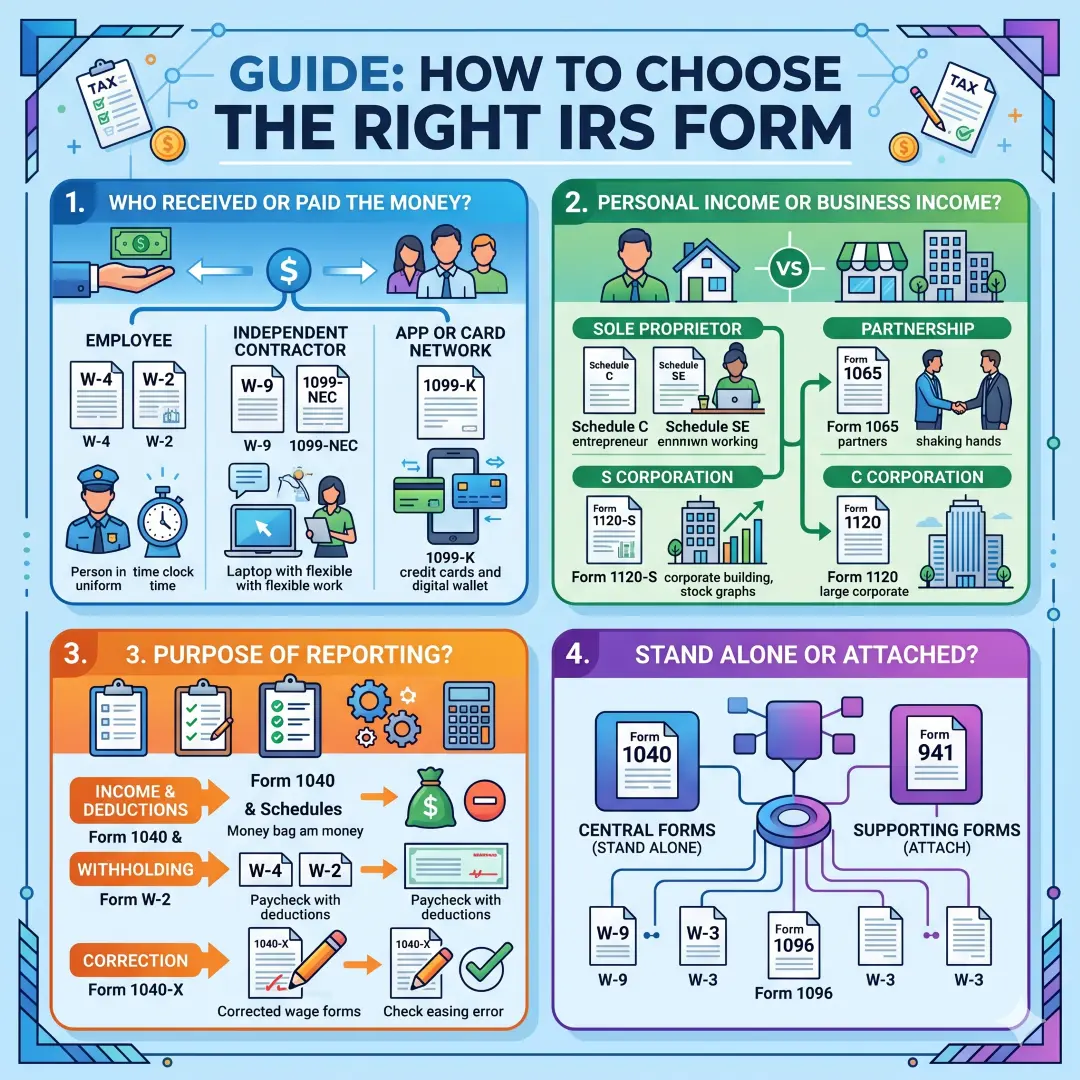
A simple way to think about IRS forms is to ask four questions.
Who received or paid the money? If the money went to an employee, payroll forms like W-4, W-2, and 941 usually matter. If it went to an independent contractor, W-9 and 1099-NEC often come into play. If a payment was processed through an app or card network, a 1099-K may be involved.
Is this personal income or business income? A sole proprietor usually looks at Schedule C and Schedule SE. A partnership may use Form 1065. An S corporation uses Form 1120-S. A C corporation uses Form 1120. That single question eliminates a lot of confusion.
Is the form reporting income, withholding, deductions, or a correction? Income and deductions tend to flow through Form 1040 and its schedules. Withholding usually involves W-4 and W-2. Correction work points to Form 1040-X or corrected wage forms.
Does the form stand alone or attach to something else? Some forms are central, like 1040 or 941. Others are supporting forms, like W-9, W-3, or 1096. That distinction helps a lot when you are sorting a stack of tax paperwork.
8. Common Mistakes People Make With IRS Tax Forms
One common mistake is mixing up W-4 and W-2. W-4 is filled out by the employee to set withholding. W-2 is issued by the employer at year-end to show wages and taxes withheld. They are related, but they do different jobs.
Another frequent mistake is treating 1099-NEC, 1099-MISC, and 1099-K as if they are the same thing. They are not. 1099-NEC is for nonemployee compensation, 1099-MISC covers other miscellaneous payments, and 1099-K reports payment card and third-party network transactions.
A third mistake is forgetting Schedule SE. Many self-employed people remember to report income on Schedule C but forget the self-employment tax side of the return. The IRS is clear that Schedule SE is used to figure tax due on net earnings from self-employment.
Another mistake is using the wrong filing route for information returns. The IRS says Form 1096 is for paper filing only, and the general information return instructions say that if you have 10 or more information returns, you must e-file. That means the filing method matters just as much as the form itself.
And for businesses, another easy error is using the wrong employment tax return. The IRS makes a clear distinction between Form 941 and Form 944. The smallest employers may file 944 only if the IRS notifies them that they are eligible, while 941 is the quarterly return used by many employers.
9. Real-Life Examples That Make the Forms Easier to Understand
A salaried employee with a regular job usually completes Form W-4 when hired, receives Form W-2 after year-end, and uses Form 1040 to file the annual return. If that employee has enough deductible expenses to itemize, Schedule A may also be part of the filing.
A freelance graphic designer might ask each client to complete Form W-9, then issue or receive Form 1099-NEC depending on the payment relationship. That designer would usually report the business on Schedule C, calculate self-employment tax on Schedule SE, and make quarterly estimated tax payments with Form 1040-ES.
A small corporation may file Form 1120-S or Form 1120, depending on its tax status. If it is an S corporation, shareholders may receive Schedule K-1 (Form 1120-S). If it is a C corporation, the company uses Form 1120 to figure its tax liability.
An employer with payroll responsibilities may need Form 941 each quarter, Form W-2 for each employee, Form W-3 to transmit W-2 Copy A, and, in some cases, Form 944 instead of quarterly filings if the IRS has notified the employer that it qualifies.
10. A Simple Checklist for Readers
Before you file or sort any IRS form, ask yourself these quick questions.
Is this form about income, withholding, deductions, estimated tax, business income, or employment taxes? The answer usually points you toward the right family of forms.
Is the form for an individual, an employee, an independent contractor, a business owner, or a payer? The IRS form set is organized by role, so knowing who the form belongs to saves time.
Does the form stand alone, or does it attach to another return? For example, Schedule C and Schedule SE attach to the personal return, while W-3 transmits W-2 forms, and 1096 transmits paper information returns.
Is the form current? The IRS updates form pages and instructions regularly, and the current revision always matters more than an old copy saved on a laptop from a few years ago.
11. Why These IRS Forms Matter Beyond the Paperwork
At first glance, tax forms look like paperwork. But they are really the language of the tax system. Form 1040 tells the IRS what an individual earned and owed. W-4 tells an employer how much to withhold. W-2 confirms what happened during the year. 1099 forms report money paid outside regular wages. 941 and 944 report payroll tax. 1065, 1120-S, and 1120 tell the IRS how a business is organized and taxed.
Once you understand that structure, the forms stop feeling random. They become a map. And that map is useful whether you are an employee, a freelancer, a landlord, a small business owner, or someone who just wants to understand how the U.S. tax system works.
For readers outside the United States, this is still worth knowing because many global businesses, contractors, students, and investors interact with U.S. tax documents at some point. The exact rules may differ by country, but the basic idea is familiar: wages, withholding, income reporting, business returns, and corrections all need their own forms. The IRS system simply shows that structure very clearly.
Final Thoughts
The best way to learn IRS forms is not to memorize everything at once. Start with the big ones. Know Form 1040. Know W-4 and W-2. Know the difference between 1099-NEC, 1099-MISC, and 1099-K. Know that Schedule C and Schedule SE matter for self-employed people. Know that businesses may use Form 1065, Form 1120-S, Form 1120, Form 941, or Form 944, depending on their structure. Once those pieces are clear, the rest becomes much easier.
Tax forms are not just forms. They are the record of how money moved during the year. And once you understand the main types, the whole tax process feels a lot less mysterious.
Article References and Sources
- IRS Forms and Instructions Library
- About Form 1040, U.S. Individual Income Tax Return
- About Form 1040-X, Amended U.S. Individual Income Tax Return
- About Schedule A (Form 1040), Itemized Deductions
- About Schedule C (Form 1040), Profit or Loss from Business
- About Schedule SE (Form 1040), Self-Employment Tax
- About Form 1040-ES, Estimated Tax for Individuals
- About Form W-4, Employee’s Withholding Certificate
- About Form W-2, Wage and Tax Statement
- About Form W-3, Transmittal of Wage and Tax Statements
- About Form W-9, Request for Taxpayer Identification Number
- About Form 1099-NEC, Nonemployee Compensation
- About Form 1099-MISC, Miscellaneous Information
- About Form 1099-K, Payment Card and Third Party Network Transactions
- Form 1099-K FAQs (IRS Guidance)
- General Instructions for Certain Information Returns (1099 Series)
- About Form 1096, Annual Summary and Transmittal
- About Form 1098, Mortgage Interest Statement
- About Form 1098-E, Student Loan Interest Statement
- About Form 1098-T, Tuition Statement
- About Form 1065, U.S. Return of Partnership Income
- About Form 1120-S, U.S. Income Tax Return for an S Corporation
- About Form 1120, U.S. Corporation Income Tax Return
- About Form 941, Employer’s Quarterly Federal Tax Return
- About Form 944, Employer’s Annual Federal Tax Return
- About Form 943, Employer’s Annual Federal Tax Return for Agricultural Employees
- Tax Topic 753, Form W-4 Employee’s Withholding Certificate
- Self-Employment Tax (Social Security and Medicare Taxes)
Also, Read these Articles in Detail
- IRS Tax Forms Explained for Beginners
- What Is an IRS Tax Form and How Does It Work
- Step-by-Step Guide to Filling Out IRS Tax Forms
Frequently Asked Questions
FAQ 1: What are the most important IRS tax forms everyone should know?
The most important IRS tax forms are the ones that show up again and again in everyday tax situations. For most people, the first form to know is Form 1040, which is the main federal income tax return for individuals. It is the form used to report yearly income, claim deductions, and figure out whether you owe tax or should receive a refund. If you have a regular job, you will also want to know Form W-4, which tells your employer how much federal income tax to withhold from your paycheck, and Form W-2, which you receive at the end of the year showing your wages and taxes withheld.
For freelancers, contractors, and self-employed people, other forms become very important. Form W-9 is often used at the start of a client relationship to collect your taxpayer information. Form 1099-NEC is used to report nonemployee compensation, which is the kind of income many independent contractors earn. If you are self-employed, Schedule C helps report your business income and expenses, and Schedule SE is used to calculate self-employment tax. Many self-employed people also use Form 1040-ES to make estimated tax payments during the year instead of waiting until tax filing season.
Businesses need another group of forms. Partnerships often use Form 1065, S corporations use Form 1120-S, and C corporations use Form 1120. Employers may also need Form 941 for quarterly payroll taxes or Form 944 for annual payroll tax reporting if they qualify. So when people talk about the most important IRS forms, they usually mean the forms that match their role in the tax system. The exact forms you need depend on whether you are an employee, self-employed, a business owner, or someone receiving certain types of income.
FAQ 2: What is the difference between Form W-4 and Form W-2?
Form W-4 and Form W-2 are both connected to payroll, but they do very different jobs. Form W-4 is filled out by the employee, usually when starting a new job or when tax circumstances change. It tells the employer how much federal income tax to withhold from each paycheck. In simple terms, W-4 helps shape your paycheck throughout the year. It does not report earnings. It only guides withholding.
Form W-2, on the other hand, is issued by the employer at the end of the year. It reports how much you earned and how much tax was withheld from your wages during the year. It is one of the most important documents you use when preparing your tax return. Your W-2 is basically the year-end summary of your pay and tax withholding, while your W-4 is the instruction form that helps your employer withhold the right amount during the year.
A lot of confusion comes from the fact that both forms deal with wages and tax withholding. But they are not interchangeable. One is completed by the employee before or during employment. The other is prepared by the employer after the year ends. If you remember one simple rule, remember this: W-4 controls withholding, and W-2 reports the final numbers.
FAQ 3: Who needs to use Form 1040, and why is it so important?
Form 1040 is the main federal income tax return for individuals in the United States. Most people who file a personal tax return use it in some form. It is important because it brings together your income, deductions, credits, and tax calculations in one place. Whether you are a salaried employee, a retiree, a freelancer, or someone with investment income, Form 1040 is usually at the center of your annual tax filing.
The form matters because it is where you tell the IRS your financial story for the year. It is not just about wages. It can also include interest, dividends, retirement income, business income, capital gains, and other types of income. Then you use the form to apply deductions and tax credits that may lower your tax bill. After all of that, Form 1040 helps determine whether you owe more tax or qualify for a refund.
Some taxpayers also use Form 1040-SR, which is an option for taxpayers age 65 and older. It works much like Form 1040 but is designed with readability in mind. In many cases, Form 1040 does not stand alone. It connects with supporting schedules like Schedule A, Schedule C, or Schedule SE. That is why it is often called the foundation of individual tax filing. Once you understand Form 1040, the rest of the personal tax system starts to make much more sense.
FAQ 4: What is the difference between Form 1099-NEC, Form 1099-MISC, and Form 1099-K?
These three forms are easy to confuse, but each one serves a different purpose. Form 1099-NEC is used to report nonemployee compensation. That usually means payments made to independent contractors, freelancers, or other self-employed people. If a business pays someone for services and that person is not an employee, a 1099-NEC may be the form used to report that income.
Form 1099-MISC is broader and covers various types of miscellaneous payments. It can be used for things like rents, prizes, awards, and some other reportable payments. It is not the main form for contractor pay anymore. That role belongs to 1099-NEC. So if you are paid for services as a contractor, 1099-NEC is usually the form you should expect, not 1099-MISC.
Form 1099-K is different again. It reports payments processed by payment cards or third-party payment networks. That means it is connected to payment platforms and transaction processors rather than direct contractor compensation. In practical terms, if you sell products or services through certain payment systems, you may receive a 1099-K showing those transactions.
The easiest way to remember the difference is this. 1099-NEC is for contractor compensation. 1099-MISC is for other miscellaneous payments. 1099-K is for card and platform payment transactions. Each one is a reporting tool, but they do not cover the same kind of income.
FAQ 5: Why do self-employed people need Schedule C and Schedule SE?
Self-employed people often need both Schedule C and Schedule SE because these two forms handle different parts of self-employment income. Schedule C is used to report the income or loss from a business operated as a sole proprietorship. It lists your business income, your business expenses, and the resulting profit or loss. In other words, Schedule C shows how much your business actually made after expenses.
Schedule SE is used to calculate self-employment tax. This tax covers Social Security and Medicare contributions for self-employed workers. Unlike employees, self-employed people do not have an employer splitting those payroll taxes with them, so they are responsible for both the employee and employer portions. That is why Schedule SE is so important. It calculates the tax on the net earnings reported from self-employment.
A good example is a freelance writer. The writer may receive payments from clients, report those earnings on Schedule C, deduct business expenses such as software or internet costs, and then use Schedule SE to figure the self-employment tax due on the profit. The two forms work together, but they do different jobs. One reports the business result. The other calculates the tax that comes from that result.
FAQ 6: What is Form W-9, and why is it so commonly requested?
Form W-9 is a request form used to collect a person’s correct name and Taxpayer Identification Number, usually a Social Security Number or Employer Identification Number. Businesses often ask for it when they hire an independent contractor, vendor, or other payee. The reason is simple. They need accurate information to prepare tax reporting forms later, especially Form 1099-NEC or other information returns.
Unlike W-4, which is used by employees for withholding, W-9 is usually used by people who are not employees. It does not take tax out of your pay. It simply gives the payer the information they need so they can report payments correctly. In many business relationships, the W-9 is one of the first forms collected before any payment is made.
The form may seem small, but it plays a big role in clean tax reporting. Without it, a business may have trouble preparing the correct year-end forms. Mistakes in names or taxpayer numbers can create filing problems and delays. That is why a W-9 is so common in freelance, contractor, and vendor relationships. It helps keep the reporting process accurate from the start.
FAQ 7: What are Form 941 and Form 944 used for?
Form 941 and Form 944 are both employment tax forms, but they are used by different kinds of employers and on different schedules. Form 941 is the quarterly employment tax return. Employers use it to report federal income tax withheld from employees’ paychecks, along with Social Security and Medicare taxes. It also reports the employer’s share of payroll taxes. This form is a regular part of payroll compliance for many businesses.
Form 944 is the annual employment tax return for the smallest employers. It is intended for employers whose yearly liability for Social Security, Medicare, and withheld federal income taxes is very low, usually $1,000 or less. But there is an important catch. Employers cannot just choose Form 944 on their own. They must be notified by the IRS that they qualify to file it.
So the difference is mostly about frequency and eligibility. Form 941 is for quarterly reporting and is used by many employers. Form 944 is for annual reporting, but only for those small employers that receive IRS approval to use it. Both forms are important because they help the IRS track payroll tax throughout the year. If you own a business and have employees, knowing which one applies to you is essential.
FAQ 8: What is the purpose of Form 1040-ES, and who should use it?
Form 1040-ES is used to figure and pay estimated tax. This is especially important for people whose income is not fully covered by paycheck withholding. That often includes freelancers, consultants, landlords, investors, and some other taxpayers with income that arrives outside regular employment. Instead of paying all the tax at the end of the year, estimated tax allows people to make payments during the year.
The form matters because tax obligations do not only apply when you have a regular job. If you earn money from self-employment, rental property, dividends, or similar sources, you may need to pay tax in installments. Form 1040-ES helps you do that in a structured way. It includes worksheets that help estimate what you owe so you can make timely payments.
A simple example is a freelance graphic designer who gets paid by several clients during the year. Since no employer is withholding tax from those payments, the designer may need to use Form 1040-ES to send estimated tax payments every quarter. That helps reduce the chance of a large bill at tax time. It also keeps the taxpayer closer to the amount due throughout the year.
FAQ 9: Why do business owners need different tax forms like Form 1065, Form 1120-S, and Form 1120?
Business owners need different tax forms because different business structures are taxed in different ways. Form 1065 is generally used by partnerships. It reports the business’s income, deductions, and other tax items, but the partnership itself usually does not pay income tax the same way a corporation does. Instead, the tax items pass through to the partners.
Form 1120-S is used by S corporations. This form reports the company’s income, losses, deductions, and credits, but the tax items pass through to shareholders. In many cases, shareholders also receive a Schedule K-1 showing their share of the company’s tax items. This makes the return different from a regular corporate tax return.
Form 1120 is used by C corporations. This is the standard corporate income tax return, and the corporation itself generally pays tax on its income. That is a very different system from partnerships and S corporations.
So the form you use depends on the legal structure of the business. That is why business owners need to know not just what the business does, but also how it is set up for tax purposes. A partnership, an S corporation, and a C corporation can all look like “businesses” in everyday language, but the IRS treats them differently. The tax form must match the business type.
FAQ 10: How can someone avoid confusion when dealing with IRS tax forms?
The easiest way to avoid confusion is to group IRS forms by purpose. Start by asking whether the form is about income reporting, withholding, estimated tax, business income, payroll tax, or information reporting. Once you know the category, the form usually becomes easier to identify. For example, if the issue is paycheck withholding, think about W-4. If it is annual wage reporting, think about W-2. If it is freelance income, think about 1099-NEC, Schedule C, and Schedule SE.
It also helps to remember who uses the form. Employees use some forms, employers use others, contractors use others, and business owners use another set. Form 1040 is for individuals. Form 941 is for employers. Form W-9 is often collected from nonemployees. Form 1065, Form 1120-S, and Form 1120 are tied to business entities. Once you connect the form to the person or business type, things become much clearer.
Another good habit is to check the current version of the form before filing. IRS forms and instructions can change, and using an old version can create avoidable mistakes. It is also smart to keep records organized throughout the year. Save your W-2s, 1099s, receipts, business expense records, and any prior-year filings. When tax season arrives, you will not be scrambling to piece things together at the last minute. And that makes the entire process less stressful and much more accurate.
Article Disclaimer
The information provided in this article, “Types of IRS Tax Forms You Should Know,” is intended for general informational and educational purposes only. While every effort has been made to ensure the accuracy and clarity of the content, tax laws, regulations, and filing requirements can change over time. Because of this, the details shared here may not reflect the most recent updates or specific situations that apply to every reader.
This article does not constitute professional tax, legal, or financial advice. Tax matters can be complex, and the correct forms and filing requirements often depend on your individual circumstances, including your income sources, residency status, business structure, and applicable deductions or credits. You should not rely solely on this content when making tax decisions or filing returns.
Readers are strongly encouraged to consult a qualified tax professional, certified accountant, or licensed advisor for personalized guidance tailored to their specific situation. Professional advice is especially important if you have complex financial arrangements, multiple income streams, international tax obligations, or business-related tax responsibilities.
Additionally, while references to official forms and processes are based on publicly available information, this article is not affiliated with, endorsed by, or officially connected to any government authority. For the most accurate and up-to-date information, always refer directly to official government resources and instructions related to the relevant tax forms.
By using this information, you acknowledge that the author and publisher are not responsible for any errors, omissions, or outcomes resulting from the use or interpretation of the content. Always verify important details independently and ensure that you are following the most current rules and requirements before taking any action.
