Understanding IRS tax forms can feel intimidating at first, especially if this is your first time dealing with U.S. taxes. The good news is that most people only need to learn a small group of forms to get started. Once you understand what each form does, the whole process becomes much easier to follow. The IRS keeps its current forms, instructions, and publications on its official forms page, and the main individual income tax return is Form 1040, with Form 1040-SR available as an option for taxpayers age 65 or older.
This guide is written for beginners, but it is also useful if you are helping a spouse, a parent, a freelancer, or a small business owner who is trying to make sense of tax paperwork. You will see the most common IRS tax forms, what each one is for, how they connect, and how to read them without getting lost in the details. The examples are practical, the language is simple, and the structure is designed to make the information easy to scan.
Table of Contents
What Are IRS Tax Forms?
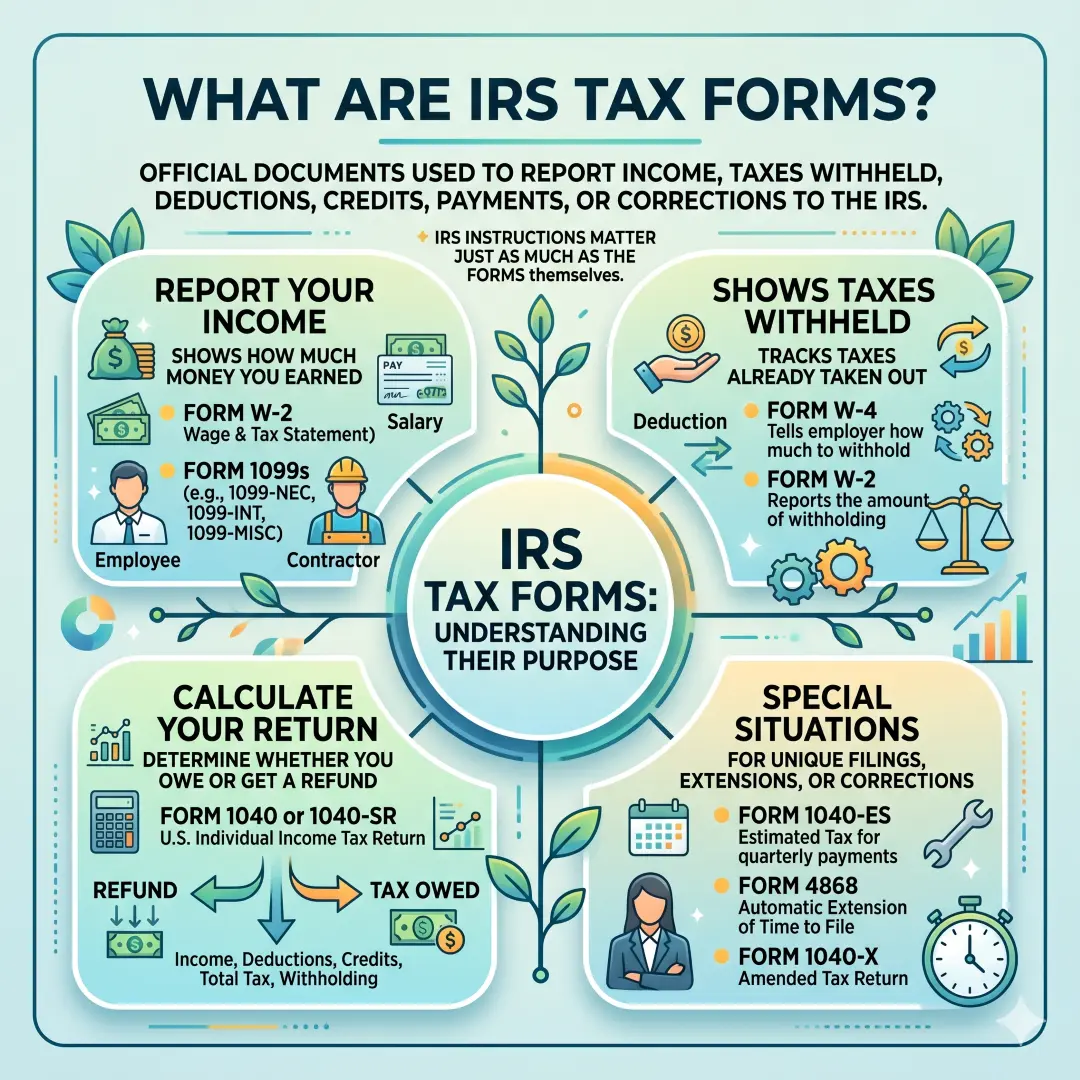
IRS tax forms are official documents used to report income, taxes withheld, deductions, credits, payments, or corrections to the Internal Revenue Service. Some forms are filed with the IRS, while others are given to employers, contractors, banks, or other businesses and are used to collect information for tax reporting. The IRS also provides instructions for these forms, and in many cases, the instructions matter just as much as the form itself.
For beginners, the easiest way to think about tax forms is this. Some forms tell the IRS how much money you earned, some forms show how much tax was already taken out, and some forms help calculate whether you owe more or should get a refund. Other forms are used for special situations such as estimated tax, extensions, or amended returns.
The Most Important IRS Tax Forms for Beginners
Here is a simple overview of the forms most beginners will see first.
| Form | What it is for | Who usually uses it | Why it matters | IRS source |
|---|---|---|---|---|
| Form 1040 | The main U.S. Individual Income Tax Return | Most individual taxpayers | This is the core form used to file a federal tax return | Reference Link: IRS |
| Form 1040-SR | A version of the individual tax return for taxpayers age 65 or older | Older taxpayers who want a larger-print style form | It uses the same schedules and instructions as Form 1040 | Reference Link: IRS |
| Form W-2 | Wage and Tax Statement | Employees | Shows wages and tax withheld from a job | Reference Link: IRS |
| Form W-4 | Employee’s Withholding Certificate | Employees | Tells an employer how much federal income tax to withhold from pay | Reference Link: IRS |
| Form W-9 | Request for Taxpayer Identification Number and Certification | Independent contractors and other U.S. persons asked for a TIN | Helps a payer collect the right taxpayer ID for reporting | Reference Link: IRS |
| Form 1099-NEC | Nonemployee Compensation | Independent contractors, freelancers, and self-employed people | Reports payments made to nonemployees | Reference Link: IRS |
| Form 1099-MISC | Miscellaneous Information | People receiving certain kinds of miscellaneous income | Reports items such as rent, prizes, and other listed payments | Reference Link: IRS |
| Form 1099-INT | Interest Income | People who earned interest from banks or similar payers | Reports taxable interest income | Reference Link: IRS |
| Form 1099-K | Payments received through payment cards or payment apps | Sellers and businesses receiving reportable payment processing income | Helps report payments for goods or services | Reference Link: IRS |
| Form 1040-ES | Estimated Tax for Individuals | Self-employed people and others without enough withholding | Used to figure and pay estimated taxes | Reference Link: IRS |
| Form 4868 | Application for Automatic Extension of Time to File | Taxpayers who need more time to file | Gives extra time to file, but not extra time to pay | Reference Link: IRS |
| Form 1040-X | Amended U.S. Individual Income Tax Return | Taxpayers correcting a filed return | Used to fix mistakes or update a return | Reference Link: IRS |
Form 1040: The Center of the Whole Tax Return
Form 1040 is the main federal income tax return for individuals. If you are filing a U.S. tax return as a taxpayer, this is usually the form you start with. The IRS says Form 1040-SR is an optional alternative for taxpayers age 65 or older, and it uses the same schedules and instructions as Form 1040.
Think of Form 1040 as the main container. It collects the big picture. Your wages, interest, self-employment income, tax withholding, tax credits, and final result all flow into this return. The supporting forms and schedules do the detailed work, and then the total numbers land on Form 1040. The IRS 1040 instructions also show that many taxpayers may need additional schedules depending on their income or deductions.
What usually goes with Form 1040
Common supporting forms and schedules include:
- Schedule 1 for additional income and adjustments to income.
- Schedule 2 for additional taxes.
- Schedule 3 for additional credits and payments.
- Other schedules depend on the kind of income, deductions, or credits involved. The IRS maintains a schedules page for Form 1040 and Form 1040-SR.
W-2: The Form Most Employees See First
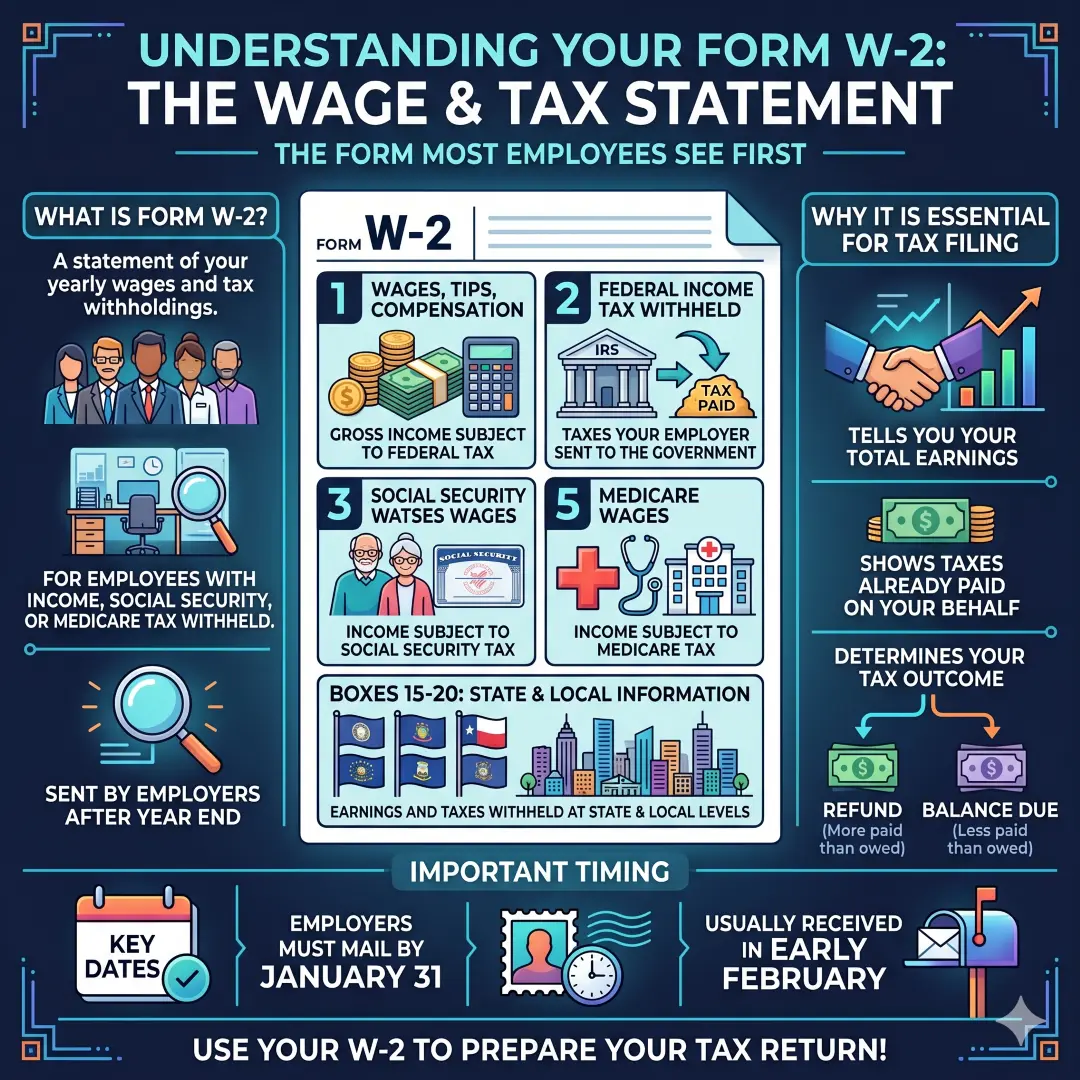
Form W-2 is the Wage and Tax Statement. Employers must file a W-2 for each employee from whom income, Social Security, or Medicare tax was withheld, and the form shows the employee’s wages and withholdings for the year. Employees use it to prepare their tax return.
If you work a regular job, your employer normally gives you a W-2 after the year ends. This form is one of the most important documents in tax filing because it shows how much you earned and how much tax has already been withheld on your behalf. That is why many people get a refund or owe only a small balance.
What to look for on a W-2
A beginner should pay attention to:
- Wages
- Federal income tax withheld
- Social Security wages
- Medicare wages
- State and local wage information, if applicable
These are part of the standard structure of the form and help you match your employer’s records to your tax return.
W-4: The Form That Controls Withholding
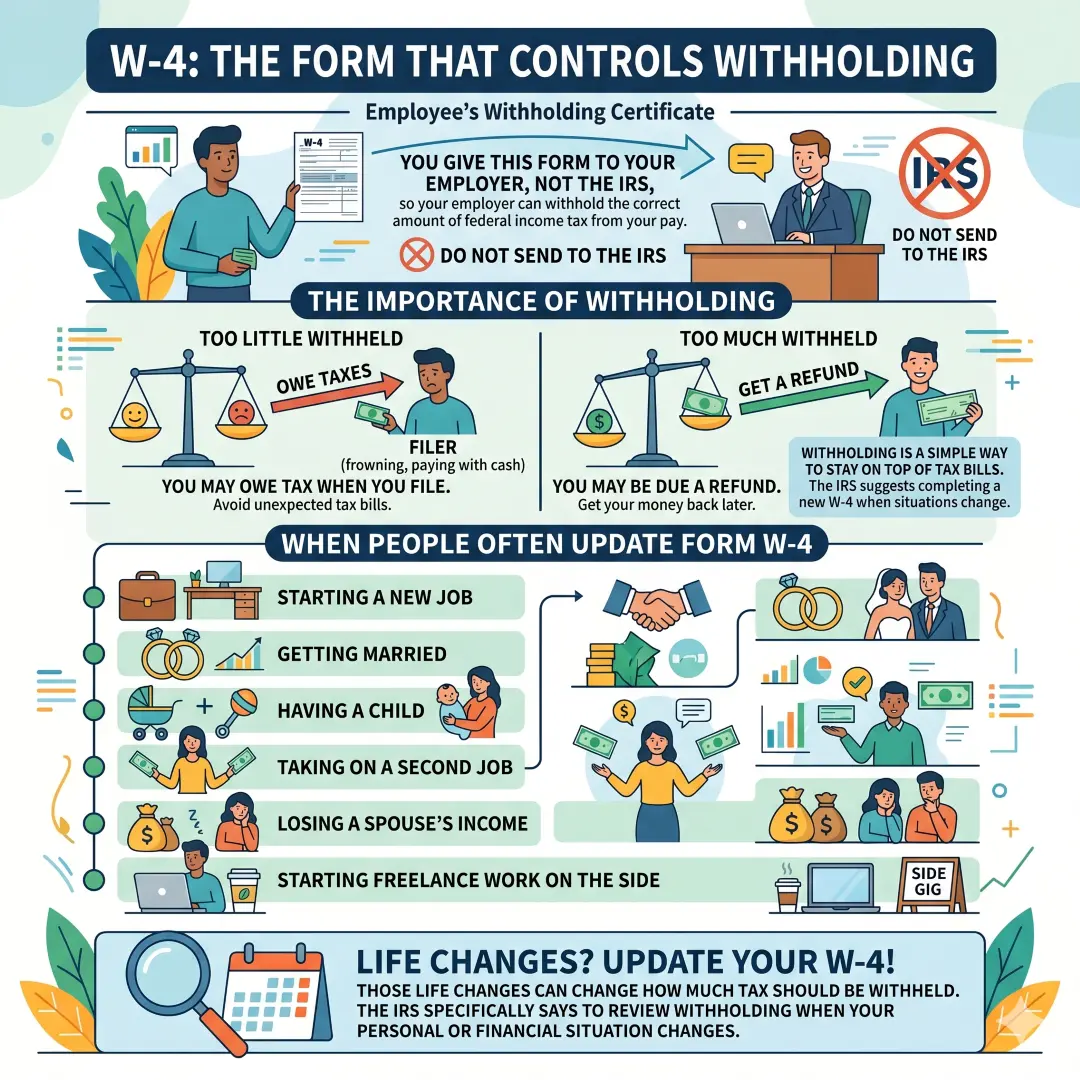
Form W-4 is the Employee’s Withholding Certificate. You give this form to your employer, not to the IRS, so your employer can withhold the correct amount of federal income tax from your pay. The IRS says you should complete a new W-4 when your personal or financial situation changes.
This form matters because withholding is one of the simplest ways to stay on top of tax bills during the year. If too little is withheld, you may owe tax when you file. If too much is withheld, you may be due a refund. That is straight from the IRS instructions.
When people often update Form W-4
- Starting a new job
- Getting married
- Having a child
- Taking on a second job
- Losing a spouse’s income
- Starting freelance work on the side
Those life changes can change how much tax should be withheld. The IRS specifically says to review withholding when your personal or financial situation changes.
W-9: The Form That Collects Your Taxpayer Identification Number
Form W-9 is used to provide your correct Taxpayer Identification Number or TIN to the person who needs to file an information return with the IRS. It is commonly used when someone pays you income and needs your details for reporting. The IRS also notes that the form may be used in contexts such as income paid to you, real estate transactions, mortgage interest, and other listed situations. (IRS)
For beginners, the key point is simple. A W-9 is usually a paperwork form between you and the payer. It is not usually mailed directly to the IRS by the person filling it out. It helps the other side prepare forms like 1099-NEC or other information returns correctly.
1099 Forms: The Forms That Report Non-Wage Income
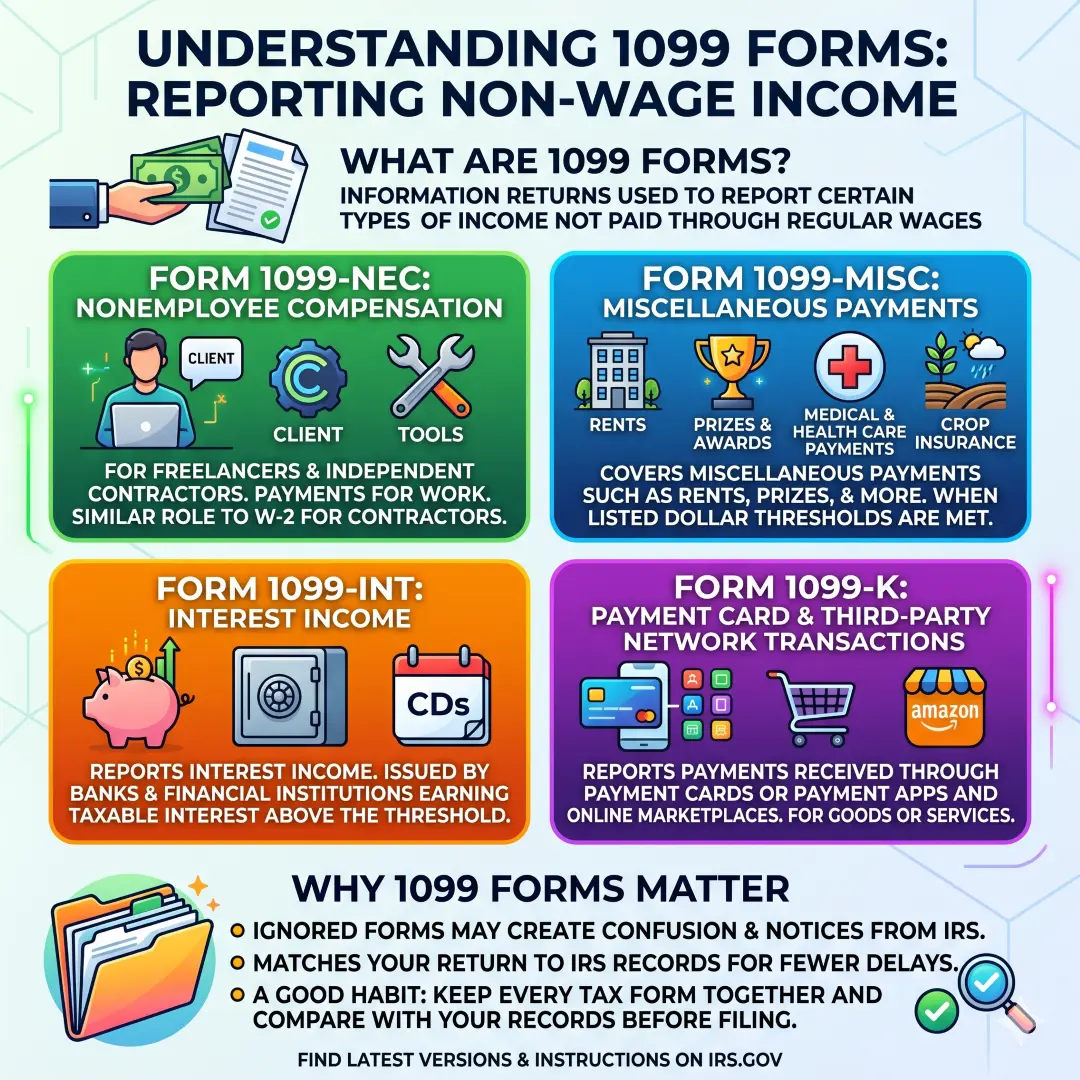
1099 forms are information returns used to report certain types of income that are not paid through regular wages. A beginner does not need to memorize every 1099 type, but a few matter a lot. The IRS lists current 1099-related instructions and form pages on its forms site.
Form 1099-NEC
Form 1099-NEC is used for Nonemployee Compensation. This is the form many freelancers and independent contractors see when a client pays them for work. If you are self-employed, this form often plays the same role for contract income that a W-2 plays for employee wages.
Form 1099-MISC
Form 1099-MISC covers a range of miscellaneous payments, including certain royalty payments and other specific categories. The IRS instructions say it is used for payments such as rents, prizes and awards, medical and health care payments, crop insurance proceeds, and certain other items when the listed dollar thresholds are met.
Form 1099-INT
Form 1099-INT reports interest income. Banks and similar institutions issue it when you earn taxable interest above the reporting threshold or when other reporting rules apply. This is common for savings accounts, certificates of deposit, and similar accounts.
Form 1099-K
Form 1099-K reports payments for goods or services received through payment cards or payment apps and online marketplaces. The IRS says you should use it with your other records to figure out and report taxable income.
Why 1099 forms matter
If you ignore a 1099, your tax return may not match the IRS records. That can create confusion, notices, or a delayed refund. A good beginner habit is to keep every tax form together and compare it with your records before filing. The IRS’s forms and publications pages are the best place to find the latest versions and instructions.
Form 1040-ES: Estimated Tax for People Who Don’t Have Enough Withholding
Form 1040-ES is used to figure and pay estimated tax. The IRS says estimated tax is the method used to pay tax on income that is not subject to withholding, such as self-employment income, interest, dividends, rents, and alimony, along with other taxable income in some cases. Individuals, including sole proprietors, partners, and S corporation shareholders, generally use Form 1040-ES.
This matters for freelancers, gig workers, and small business owners. If nobody is withholding tax from your income, you may need to make tax payments during the year instead of waiting until filing season. That is where Form 1040-ES comes in.
Form 4868: The Extension Form Beginners Always Hear About
Form 4868 is the form used to request an automatic extension of time to file your federal individual income tax return. The IRS says filing an extension gives you more time to file, but it is not an extension to pay. You still need to pay what you owe by the regular deadline to avoid possible penalties and interest.
This is one of the most misunderstood parts of tax filing. A lot of people think an extension means they can postpone everything. That is not how it works. The extension only delays the filing date, not the payment date.
Form 1040-X: When You Need to Fix a Filed Return
Sometimes you file your return and later realize that something was missing or wrong. Maybe you forgot a form, entered the wrong income, or need to correct a filing status or credit. In that situation, the IRS says to use Form 1040-X, the Amended U.S. Individual Income Tax Return. You can now file it electronically with tax software for the current or two prior tax periods, and paper filing is still allowed.
A beginner should remember this rule. Do not try to “edit” your original return after it has already been filed. Use the proper amendment form. That keeps the record clear and makes it easier for the IRS to track the change.
How IRS Tax Forms Fit Together in Real Life
Here is the simplest possible way to understand the flow.
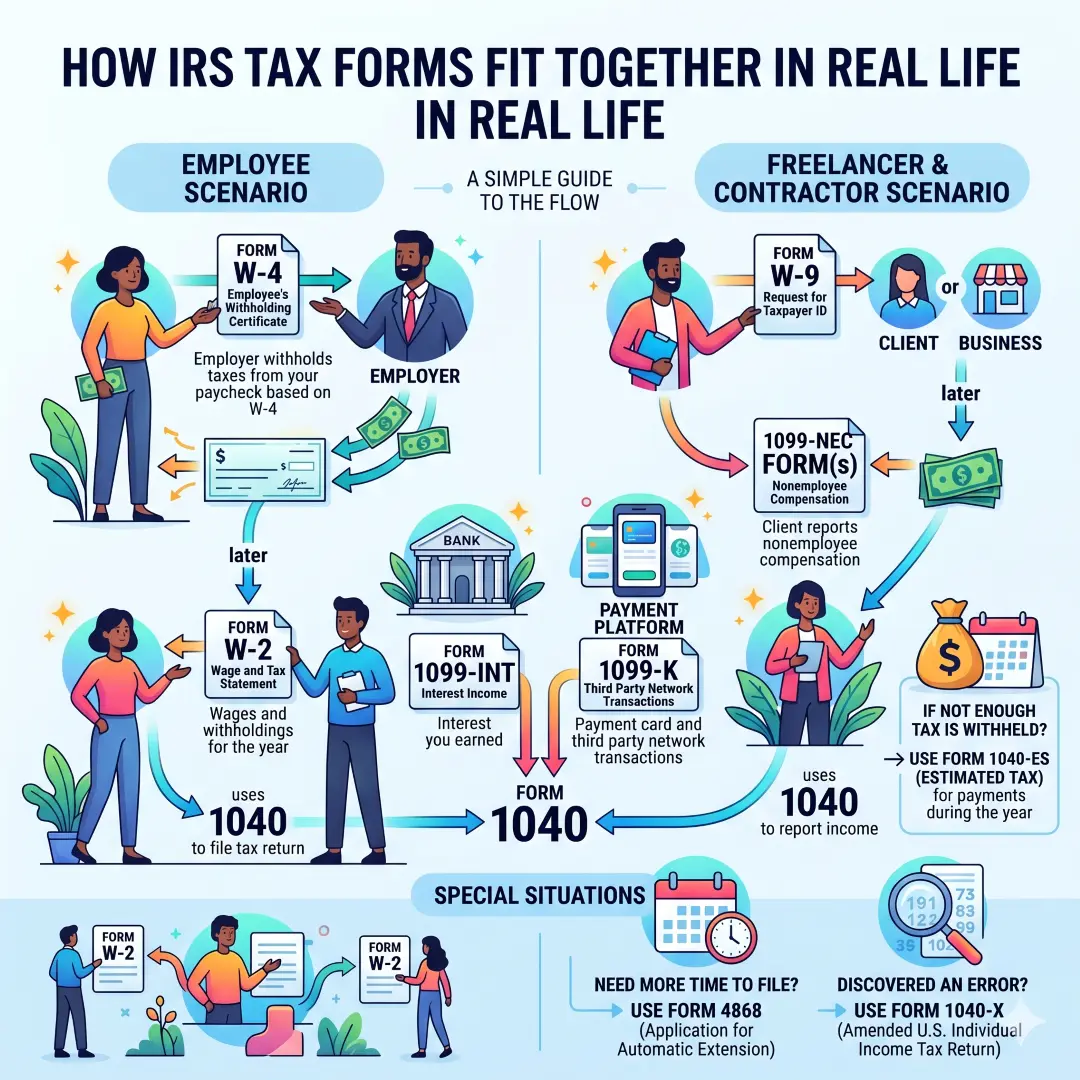
If you are an employee, your employer withholds taxes from your paycheck based on your W-4, and later gives you a W-2 showing the year’s wages and withholdings. You then use Form 1040 to file your tax return.
If you are a freelancer or contractor, you may give the client a W-9, receive 1099-NEC forms for income, and then use Form 1040 to report that income. If not enough tax is withheld, you may need Form 1040-ES payments during the year.
If you earn interest from a bank, you may receive a 1099-INT and include that information on your return. If you get paid through certain payment platforms for goods or services, 1099-K may also matter.
If you need more time to file, you may use Form 4868. And if you later discover an error, you use Form 1040-X.
A Beginner-Friendly Tax Filing Workflow
Here is a simple workflow that helps people stay organized.
- Collect every tax form you received.
- Match each form to your records so the numbers make sense.
- Check whether you need Schedule 1, 2, or 3 in addition to Form 1040.
- Review your withholding and any estimated tax payments.
- File before the deadline or request an extension if needed.
- Keep copies of your return and supporting forms.
The IRS says the filing deadline for most calendar-year filers is generally April 15, and if that date falls on a weekend or legal holiday, the due date shifts to the next business day. The IRS also notes that taxpayers can file for free in some cases and can request an extension to October 15 to file, though payment is still due by the April deadline.
Helpful order of review
- W-2 and 1099s first
- Then Form 1040
- Then supporting schedules
- Then, payments, credits, deductions, and final review
That order makes the process feel less random because you start with the forms that tell the story of your income.
Table: Common Tax Forms, Simple Meaning, and Beginner Notes
| Form | Simple meaning | Where it usually comes from | What beginners should check | Typical mistake to avoid | IRS source |
|---|---|---|---|---|---|
| 1040 | Main individual tax return | You prepare it | Income, credits, tax paid, refund, or balance due | Leaving off a needed schedule | Reference Link: IRS |
| 1040-SR | Alternate individual return for age 65 or older | You prepare it | Same core details as 1040 | Thinking it is a different tax system | Reference Link: IRS |
| W-2 | Wage statement | Employer | Wages and withholding | Entering the wrong employer copy numbers | Reference Link: IRS |
| W-4 | Withholding setup form | Employer process | Withholding choices | Not updating after life changes | Reference Link: IRS |
| W-9 | Taxpayer ID request | Client or payer | Name, TIN, certification | Giving the wrong TIN | Reference Link: IRS |
| 1099-NEC | Nonemployee compensation | Client or business payer | Amount paid for services | Forgetting contractor income counts as taxable income | Reference Link: IRS |
| 1099-MISC | Miscellaneous income | Payer | Rent, prizes, other categories | Mixing it up with wages | Reference Link: IRS |
| 1099-INT | Interest income | Bank or financial institution | Interest amount and tax withheld, if any | Ignoring small interest payments | Reference Link: IRS |
| 1099-K | Payment app or card reporting | Payment processor | Business or goods-and-services payments | Confusing personal transfers with taxable sales | Reference Link: IRS |
| 1040-ES | Estimated tax worksheet and payment form | You prepare it | Expected income and quarterly payments | Waiting until filing time to pay everything | Reference Link: IRS |
| 4868 | Filing extension request | You prepare it | Filing deadline relief only | Thinking it also extends the payment time | Reference Link: IRS |
| 1040-X | Amended return | You prepare it | Corrections to a filed return | Filing a new original return instead of amending | Reference Link: IRS |
Examples That Make the Forms Easier to Understand
Example 1: Full-time employee
Sara works for one employer all year. Her employer withholds federal tax from each paycheck, and she receives a W-2 in January. Sara uses Form 1040 to file her annual return. She may also need Schedule 1, 2, or 3, depending on her situation.
Example 2: Freelancer
David designs websites as a contractor. Clients ask him for Form W-9 before paying him. At year-end, he receives 1099-NEC forms. Since no employer is withholding enough tax from his pay, David uses Form 1040-ES to make estimated tax payments during the year.
Example 3: Small side income
Amina works a regular job and also sells handmade products online. Her job gives her a W-2, and her online platform may issue a 1099-K if reportable payment thresholds and rules are met. She combines all of this on her return and checks whether the income is fully reported.
Example 4: Mistake after filing
Jordan files his return and later realizes he left out a 1099-INT form from a savings account. Instead of sending a brand-new return, he uses Form 1040-X to amend the original return.
Common Beginner Mistakes With IRS Tax Forms
A lot of tax stress comes from small, avoidable mistakes. Here are the most common ones.
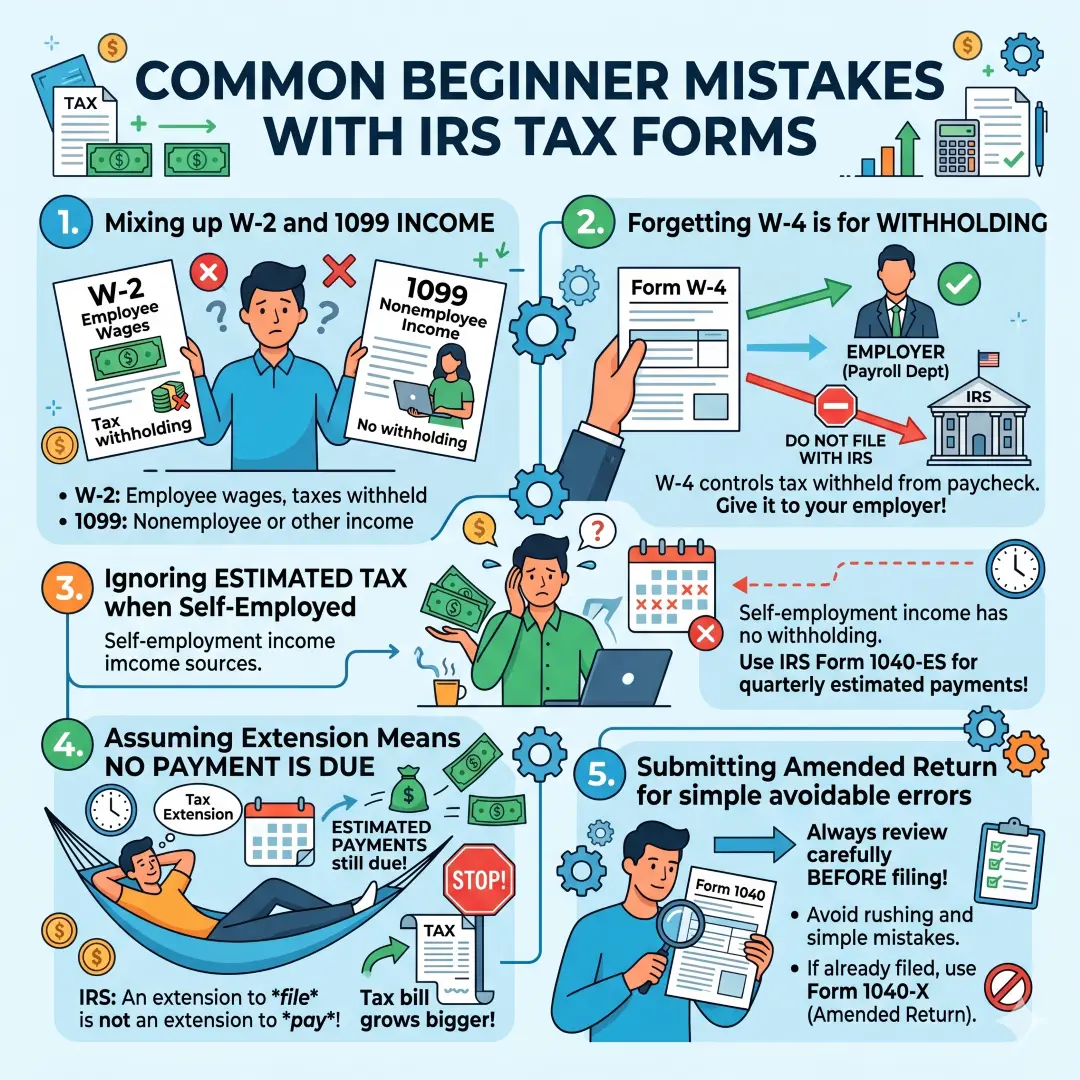
- Mixing up W-2 and 1099 income. W-2 income is employee wages. 1099 income is usually nonemployee or other reportable income.
- Forgetting that a W-4 is for withholding, not filing. You hand it to your employer, not the IRS.
- Ignoring estimated tax when self-employment income is involved. The IRS says 1040-ES is used for income not subject to withholding.
- Assuming an extension means no payment is due. The IRS says an extension is not an extension to pay.
- Submitting an amended return when the original return is still wrong in a simple way that could have been corrected before filing. Always review carefully before sending a return. If it is already filed, use Form 1040-X.
Where Beginners Should Get IRS Forms
The IRS says the latest versions of forms, instructions, and publications are available on its official Forms, instructions, and publications pages. It also offers forms by mail in some cases, and the agency provides online access to commonly used forms such as Form 1040, Form W-9, and Form 1040-ES.
A good beginner habit is to use only the current IRS version of a form. Tax forms can change from year to year, and the IRS posts revised versions and instructions regularly.
Practical Tips for Reading a Tax Form Without Panic
- Start with the title of the form. The title tells you the form’s purpose.
- Check who files it. Employee, employer, contractor, bank, or taxpayer.
- Look at the instructions, not just the form. The IRS instructions often explain the real rules.
- Match every number to a document you already have. That reduces mistakes.
- Keep copies of everything. If the IRS asks questions later, organized records help.
These habits are especially useful because the IRS forms system is built around matching information from multiple sources. That is why W-2, 1099 forms, and your return need to line up.
A Simple Beginner Summary
If you only remember a few things, remember these:
- Form 1040 is the main individual tax return.
- W-2 reports employee wages and withholding.
- W-4 controls how much tax your employer withholds from your paycheck.
- W-9 gives your taxpayer ID to a payer who needs it for reporting.
- 1099 forms report different kinds of non-wage income.
- 1040-ES is for estimated tax when withholding is not enough.
- 4868 gives extra time to file, not extra time to pay.
- 1040-X is for correcting a filed return.
Final Thoughts
For beginners, IRS tax forms become much less confusing once you understand the role each one plays. Form 1040 is the main return. W-2 and 1099 forms feed information into it. W-4 affects how much tax is taken out during the year. 1040-ES helps when tax is not withheld. 4868 buys more filing time. And 1040-X fixes mistakes after filing. That is the whole system in simple terms.
The IRS’s own forms and instructions pages are the best place to check current versions, because tax forms can change from year to year. For a beginner, that one habit alone can save a lot of confusion.
Also, Read these Articles in Detail
- IRS Form 1120S: The Comprehensive Guide to S Corporation Tax Filing for 2025 and Beyond
- A Comprehensive Guide to Filing IRS Form 1040 Schedule E in 2025 and Beyond
Article’s References and Sources
- IRS Forms, Instructions, and Publications
- Form 1040: U.S. Individual Income Tax Return
- Form 1040 Instructions (Complete Guide)
- Schedules for Form 1040
- Form W-2: Wage and Tax Statement
- Form W-4: Employee’s Withholding Certificate
- Form W-9: Request for Taxpayer Identification Number
- Form 1099-NEC: Nonemployee Compensation
- Form 1099-MISC: Miscellaneous Information
- Form 1099-INT: Interest Income
- Understanding Form 1099-K
- Form 1040-ES: Estimated Tax for Individuals
- When to File Taxes (Deadlines & Extensions)
- Form 1040-X: Amended U.S. Individual Income Tax Return
- IRS Guidance on Filing Extensions
Frequently Asked Questions
FAQ 1: What are IRS tax forms, and why do they matter?
IRS tax forms are the official papers used to report income, tax withheld, payments, deductions, credits, and other tax details. They help show the government how much money you earned during the year and whether you have already paid part of your tax through withholding or estimated payments. For most people, tax forms are the backbone of the yearly filing process. Without them, it would be very hard to figure out what you owe or what refund you should get.
The most important form for many individuals is Form 1040, which is the main federal income tax return. But Form 1040 rarely stands alone. It often works together with other forms such as W-2, 1099, W-4, 1040-ES, 4868, and 1040-X. Each one has a specific job. Some forms report wages, some report contract income, some control withholding, and others help with estimated tax, extensions, or corrections.
For beginners, the key is to stop thinking of tax forms as one giant, confusing system. Instead, think of them as a set of tools. One tool tells the story of your wages. Another tells the story of your contractor income. Another helps you pay during the year. And another fixes mistakes if something goes wrong. Once you understand that structure, the whole process feels far less overwhelming.
FAQ 2: What is Form 1040, and who needs to file it?
Form 1040 is the main U.S. Individual Income Tax Return. It is the form most people think of when they hear the phrase “file your taxes.” If you earn income in the United States and are required to file a federal return, this is usually the form you will use. It gathers your income, deductions, credits, tax withheld, and final tax result in one place.
This form is used by employees, freelancers, business owners, retirees, and many other taxpayers. Some people need only the basic form, while others need extra schedules attached to it. For example, if you have additional income, adjustments, or credits, you may need Schedule 1, Schedule 2, or Schedule 3. That does not mean the form is complicated by default. It just means your tax situation has a few more moving parts.
There is also Form 1040-SR, which is an alternative version for taxpayers age 65 or older. It uses the same rules, schedules, and instructions as Form 1040, but it is designed with larger print and a simpler layout. So if someone says they filed their “1040,” they usually mean the main individual tax return, even if they used a slightly different version of it.
FAQ 3: What is the difference between Form W-2 and Form 1099?
The difference between Form W-2 and Form 1099 is one of the first things beginners need to understand. Form W-2 is used for employees. It shows how much you earned as wages and how much tax your employer withheld from your paycheck. If you work a regular job where taxes are taken out automatically, you will probably receive a W-2.
Form 1099, on the other hand, is used for many kinds of non-wage income. The most common version for freelancers and independent contractors is Form 1099-NEC, which reports nonemployee compensation. There are also other 1099 forms, such as 1099-MISC for certain miscellaneous payments, 1099-INT for interest income, and 1099-K for payment card or payment app transactions in reportable situations.
A simple way to remember it is this. W-2 usually means you are an employee. 1099 usually means you are not an employee, or you received some other type of reportable income. The tax treatment can be different, and the recordkeeping can be different, too. That is why many people who receive both forms in the same year need to pay close attention when filing.
FAQ 4: What is Form W-4, and why should employees care about it?
Form W-4 is the Employee’s Withholding Certificate. You give this form to your employer so they can figure out how much federal income tax to take out of your paycheck. It does not go with your tax return. Instead, it helps shape your paycheck during the year.
This form matters because withholding affects whether you will owe money or get a refund when you file. If too little tax is withheld, you may end up owing at tax time. If too much is withheld, you may get a larger refund. Neither result is automatically good or bad. It depends on your personal preference and financial situation.
People should review Form W-4 when something important life changes. That could include getting married, having a child, taking a second job, losing a source of income, or starting side work. A lot of taxpayers leave their withholding untouched for years, then wonder why their tax bill changed. Updating the form at the right time can help keep things more accurate and avoid surprise balances later.
FAQ 5: What is Form W-9, and when is it used?
Form W-9 is used to give a payer your correct Taxpayer Identification Number, often called a TIN. It is a common form in contractor and business payments. If a company, client, or payer needs your tax details for reporting, they may ask you to complete a W-9 before paying you.
This form is especially important for freelancers, consultants, landlords, and other people who receive reportable income outside of a normal employee relationship. The form helps the payer prepare the right information return, such as a 1099-NEC or another 1099 type. In most cases, the form is kept by the payer and is not sent directly to the IRS by the person filling it out.
Beginners often confuse W-9 with W-4, but they serve different purposes. W-4 is for employees and withholding. A W-9 is for providing taxpayer information to someone who pays you and needs to report that payment. That difference is small on paper, but it matters a lot in real life.
FAQ 6: What is Form 1099-NEC, and why do freelancers receive it?
Form 1099-NEC stands for Nonemployee Compensation. It is the form most often used to report money paid to freelancers, independent contractors, and self-employed workers. If a client paid you for work and you were not treated as an employee, you may receive this form.
This form matters because it helps report income that is not covered by a W-2. Many beginners make the mistake of thinking only employee wages count as taxable income. That is not true. Contract work, freelance services, and side jobs can also create taxable income, and 1099-NEC is one of the main ways that income gets reported.
If you receive a 1099-NEC, you should compare it with your own records. Make sure the amount is correct and that you did not miss any other payments from the same year. If you are self-employed, this income usually goes on your tax return and may also affect whether you need to make estimated tax payments during the year. That is why recordkeeping is so important. A missing form or a wrong number can create avoidable trouble later.
FAQ 7: What is estimated tax, and who needs Form 1040-ES?
Estimated tax is a way of paying tax during the year instead of waiting until you file your return. It is most common for people whose income is not fully covered by withholding. That includes many freelancers, independent contractors, small business owners, investors, and people with side income. Form 1040-ES is the form used to figure and pay these estimated taxes.
The idea is simple. If nobody is taking tax out of your pay automatically, you may need to send payments yourself in parts during the year. This helps you stay current and avoid a big bill later. It also helps reduce the chance of underpayment issues. For beginners, this can feel strange at first, especially if you are used to a regular job where taxes are handled through payroll.
A very common situation is someone who has a full-time job and starts freelancing on the side. Their employer already withholds tax from the main paycheck, but the freelance income may not have any withholding at all. In that case, 1040-ES can help them stay on track. It is one of those forms that seems small but can make a big difference in avoiding tax-time stress.
FAQ 8: What is Form 4868, and does it give me more time to pay my taxes?
Form 4868 is used to request an automatic extension of time to file your federal income tax return. This form is helpful if you need more time to gather documents, check numbers, or finish your return properly. Many people use it when they are missing a form or simply need a little extra breathing room.
But here is the most important part. Form 4868 gives you more time to file, not more time to pay. That means if you owe tax, you should still pay by the normal deadline to avoid possible penalties and interest. This is one of the most misunderstood parts of tax season. People often think an extension means the whole tax deadline moves. It does not.
A practical way to think about it is this. The extension protects your filing deadline, not your payment deadline. So if you know you owe money, it is smart to estimate that amount as accurately as you can and pay what you expect to owe on time. That keeps the extension useful without creating extra cost later.
FAQ 9: What is Form 1040-X, and when should someone file it?
Form 1040-X is the Amended U.S. Individual Income Tax Return. It is used when you already filed a return and later realize that something needs to be corrected. That might include missing income, a wrong filing status, a forgotten deduction, a missed credit, or another error that changes your return.
Many beginners worry that filing an amended return will make things worse, but that is not the point of Form 1040-X. The purpose is to correct the record. If your original return was wrong, this form gives you a proper way to update it. It is better to fix a mistake than to leave it sitting there, especially if the error changes the tax you owe or the money you should receive.
A simple example helps. Suppose you filed your return and later discover that a 1099-INT form was missing. Instead of ignoring it, you can file Form 1040-X to adjust the return. That keeps your tax record accurate and reduces the chance of later confusion. For beginners, the main lesson is easy. If the return is already filed and something needs to change, 1040-X is the form to use.
FAQ 10: What is the easiest way for a beginner to understand IRS tax forms without getting overwhelmed?
The easiest way to understand IRS tax forms is to stop seeing them as one giant wall of paperwork. Instead, break them into smaller groups based on purpose. Some forms report income, some control withholding, some help you file, and some fix mistakes. Once you know the job of each form, the whole system becomes much less scary.
A beginner can start with just a few key forms. Learn Form 1040 first because it is the main return. Then learn W-2 because it shows employee wages. Next learn the most common 1099 forms, especially 1099-NEC, 1099-MISC, 1099-INT, and 1099-K. After that, understand W-4, 1040-ES, 4868, and 1040-X. That small list covers a large part of what most people encounter.
It also helps to follow a simple routine every year. Collect your forms early.
Compare them with your own records. Read the instructions before filling anything out. Keep copies of everything. And if your income changes during the year, update your withholding or estimated tax plan instead of waiting until the end. That kind of steady habit makes tax filing far easier than trying to figure everything out at the last minute.
And that is really the heart of it. Tax forms look complicated at first, but they become manageable when you know what each one does. The forms are not there to confuse you. They are there to organize your financial life in a way the tax system can understand.
Article Disclaimer
The information provided in this article, “IRS Tax Forms Explained for Beginners,” is intended for general educational and informational purposes only. It is designed to help readers understand common IRS tax forms, including Form 1040, W-2, 1099, and related documents, in a simplified way. This content does not constitute professional tax, legal, or financial advice, and it should not be relied upon as a substitute for guidance from a qualified professional. Tax laws, rules, and filing requirements can change over time and may vary depending on individual circumstances, location, and financial situation.
While every effort has been made to ensure the accuracy and clarity of the information, no guarantees are made regarding completeness or current applicability. Readers are encouraged to consult a certified tax professional, accountant, or financial advisor for advice tailored to their specific needs. Additionally, always refer to official government resources and the most recent instructions when preparing or filing any tax forms. The author and publisher are not responsible for any errors, omissions, or outcomes related to the use of this information.
