

Filling out an IRS tax form can feel intimidating at first, especially if you are looking at a stack of documents and a page full of numbered lines. But once you break the process into small steps, it becomes much easier to handle. For most people, the main return is Form 1040, and the IRS also offers Form 1040-SR as an optional version for taxpayers age 65 or older. The two forms use the same schedules and instructions. If you live outside the United States, the IRS still generally expects U.S. citizens and residents to file, and amounts reported on the return must be expressed in U.S. dollars.
The biggest mistake many people make is starting too early without their records in order. The better approach is simple. First, check whether you need to file. Then gather your documents. After that, choose the right form and schedules, enter your income, claim the deductions and credits you qualify for, and review everything before submitting. That is the basic flow the IRS itself follows in its step-by-step filing guide.
Table of Contents
1. First, check whether you actually need to file
The IRS says many U.S. citizens and permanent residents must file a tax return if their income is over the filing requirement, and self-employed people with more than $400 in net earnings from self-employment generally need to file as well. Filing rules also depend on your filing status, your age, and whether someone can claim you as a dependent.
For the 2025 tax year, the IRS lists these filing thresholds for most taxpayers. If you were under 65 at the end of 2025, the thresholds were $15,750 for single, $23,625 for head of household, $31,500 for married filing jointly when both spouses are under 65, $33,100 for married filing jointly when one spouse is under 65, $5 for married filing separately, and $31,500 for a qualifying surviving spouse. If you were 65 or older at the end of 2025, the IRS lists higher thresholds for several categories.
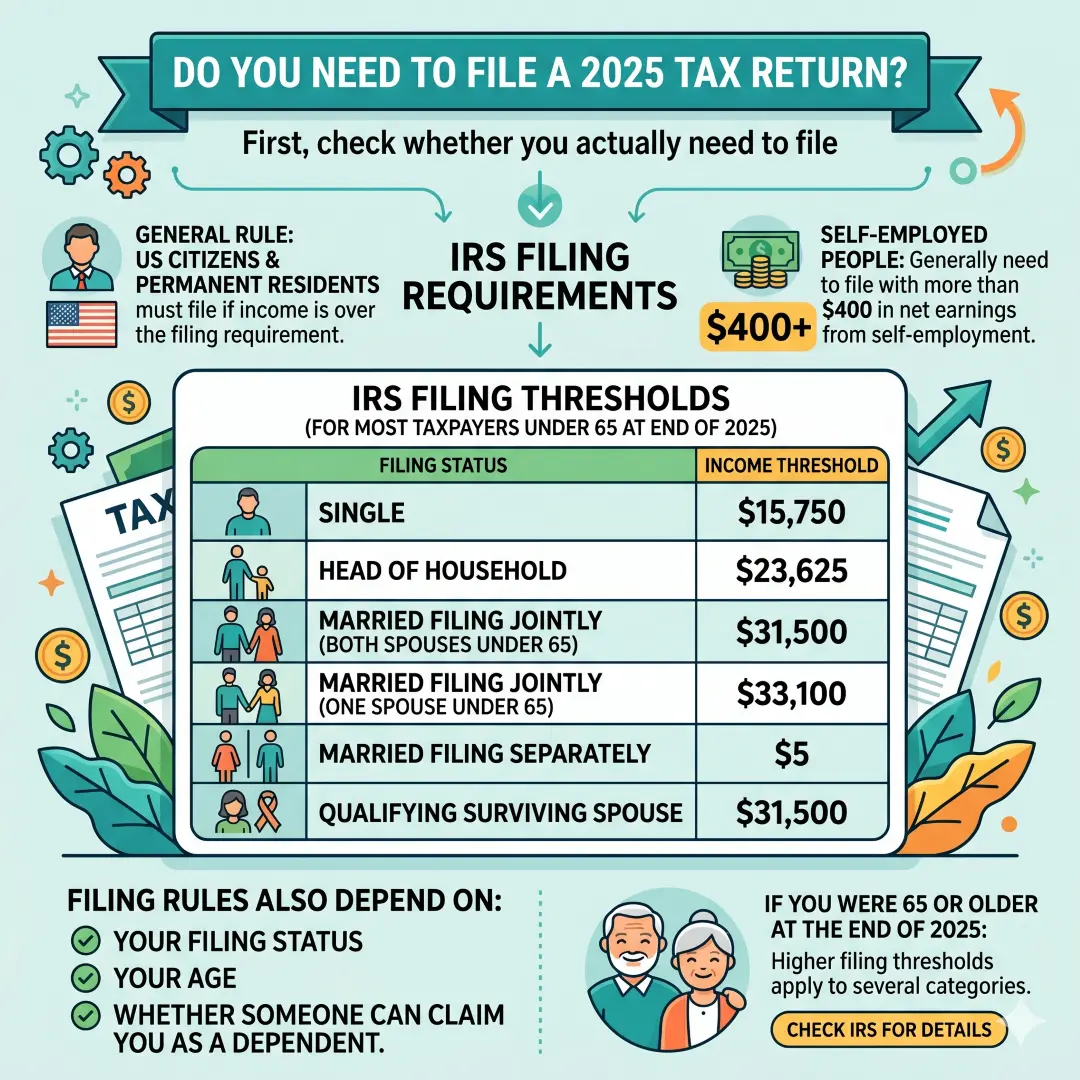
2025 filing requirement snapshot
| Filing situation | Under 65 at the end of 2025 | 65 or older at the end of 2025 | IRS note |
|---|---|---|---|
| Single | $15,750 or more | $17,550 or more | Gross income test. |
| Head of household | $23,625 or more | $25,625 or more | Gross income test. |
| Married filing jointly | $31,500 or more if both spouses are under 65 | $33,100 or more if one spouse is 65 or older, $34,700 or more if both are 65 or older | Gross income test. |
| Married filing separately | $5 or more | $5 or more | Special rule. |
| Qualifying surviving spouse | $31,500 or more | $33,100 or more | Gross income test. |
| Dependent | Separate rules apply | Separate rules apply | Depends on earned income, unearned income, and age. |
Even if you are below the filing threshold, you may still want to file. The IRS notes that you may be due a refund if your employer withheld federal tax from your paycheck, and dependents may still need to file to claim a refund or certain refundable credits. (Reference Link: IRS)
2. Gather your documents before you start
The IRS recommends keeping your tax documents in one place so you can prepare an accurate return, claim deductions or credits, and avoid errors that could delay your refund. At minimum, you will want your Social Security number or ITIN, your bank account and routing numbers if you want a refund by direct deposit or need to pay electronically, and your adjusted gross income (AGI) and exact refund amount from last year’s return if you filed one. If you e-filed last year, you may also need your self-select PIN. If the IRS gave you an IP PIN, keep that handy, too.
You should also watch for your income statements. The IRS says people or organizations that paid you during the year must send you the relevant information returns, usually in January or February. That includes documents like Form W-2 and other information returns that report income.
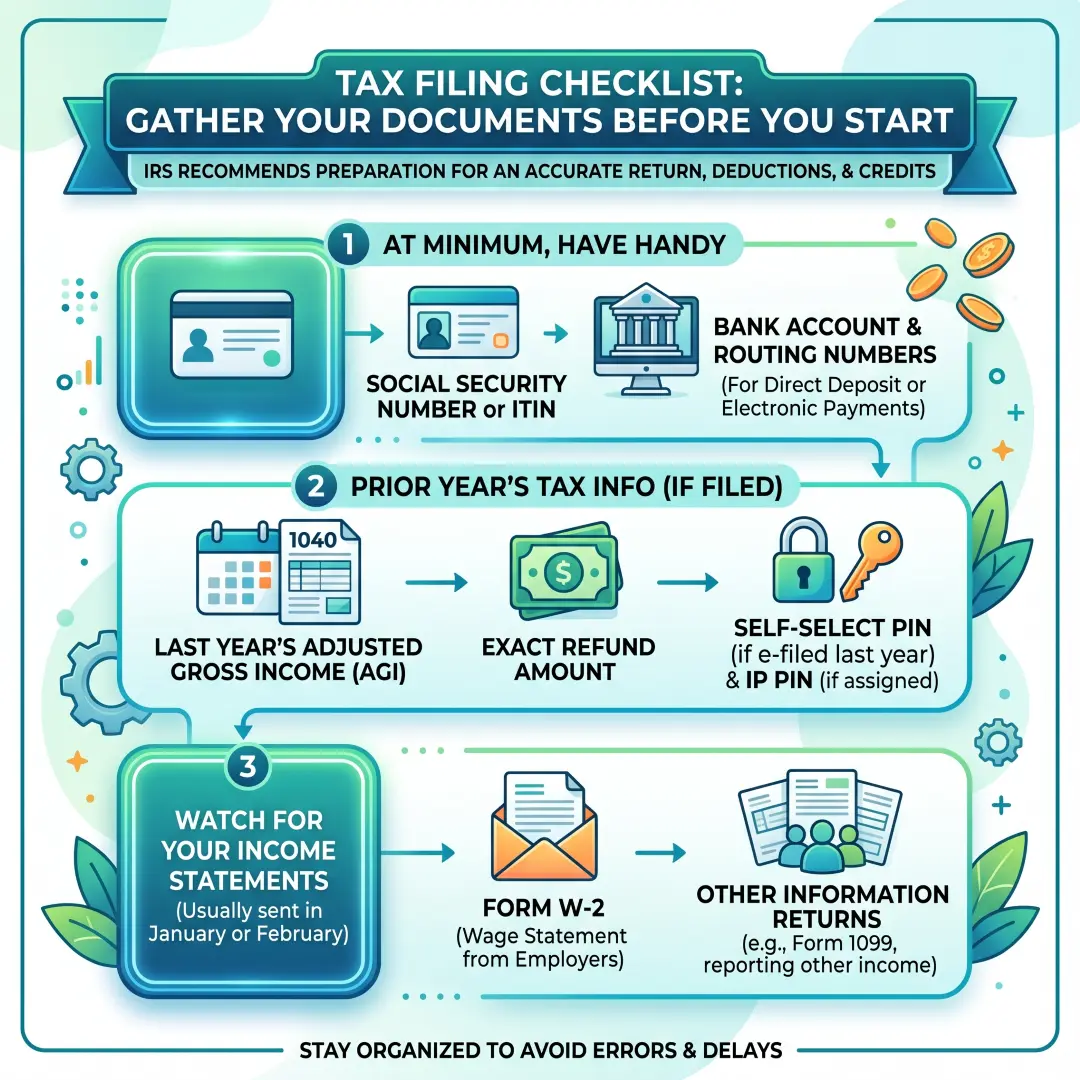
Document checklist
| Document or detail | Why it matters | IRS source |
|---|---|---|
| Social Security number or ITIN | Identifies you and anyone else on the return | Reference Link: IRS |
| Bank account and routing numbers | Needed for direct deposit or electronic payment | Reference Link: IRS |
| Last year’s AGI and refund amount | Helps verify your identity when e-filing | Reference Link: IRS |
| Self-select PIN | Maybe needed if you e-filed last year | Reference Link: IRS |
| IP PIN | Helps protect against tax-related identity theft | Reference Link: IRS |
| W-2 and other information returns | Report your income and withholding | Reference Link: IRS |
If you are filing from outside the United States, keep your foreign income records in order, too. The IRS says U.S. citizens and residents abroad generally still file in the same way as those living in the U.S., and they must convert foreign amounts into U.S. dollars on the return.
3. Choose the right IRS form and schedules
For most individual filers, Form 1040 is the main return. If you were born before January 2, 1961, you can also use Form 1040-SR, which uses the same schedules and instructions as Form 1040. The IRS also says that many filers only need Form 1040 or 1040-SR and no numbered schedules, but more complicated returns may require Schedule 1, Schedule 2, Schedule 3, or other schedules. If you e-file, the software usually figures out which schedules you need.
Common IRS forms and schedules at a glance
| Form or schedule | What it is for | When you may need it |
|---|---|---|
| Form 1040 | Main U.S. individual income tax return | Used by U.S. taxpayers to file an annual return. |
| Form 1040-SR | Alternative individual return for taxpayers age 65 or older | Optional if you are 65 or older, and it uses the same schedules and instructions as Form 1040. |
| Schedule 1 | Additional income and adjustments to income | Used for items such as unemployment compensation, prize or award money, gambling winnings, student loan interest deduction, self-employment tax, and educator expenses. |
| Schedule 1-A | Additional deductions | Used for certain deductions like qualified cash tips, qualified overtime, qualified vehicle loan interest, or the enhanced deduction for seniors. |
| Schedule 2 | Additional taxes | Used for taxes like self-employment tax, household employment taxes, additional tax on IRAs or other qualified retirement plans, AMT, or excess advance premium tax credit repayment. |
| Schedule 3 | Additional credits and payments | Used for credits such as foreign tax credit, education credits, general business credit, and for payments like an extension payment or excess social security tax withheld. |
| Form 1040-X | Amended return | Used to correct a return after it has already been filed, and it can now be e-filed with software for the current or two prior tax periods. |
| Form 4868 | Extension request | Used to request more time to file, but it does not extend the time to pay tax. |
4. Fill in your personal information carefully
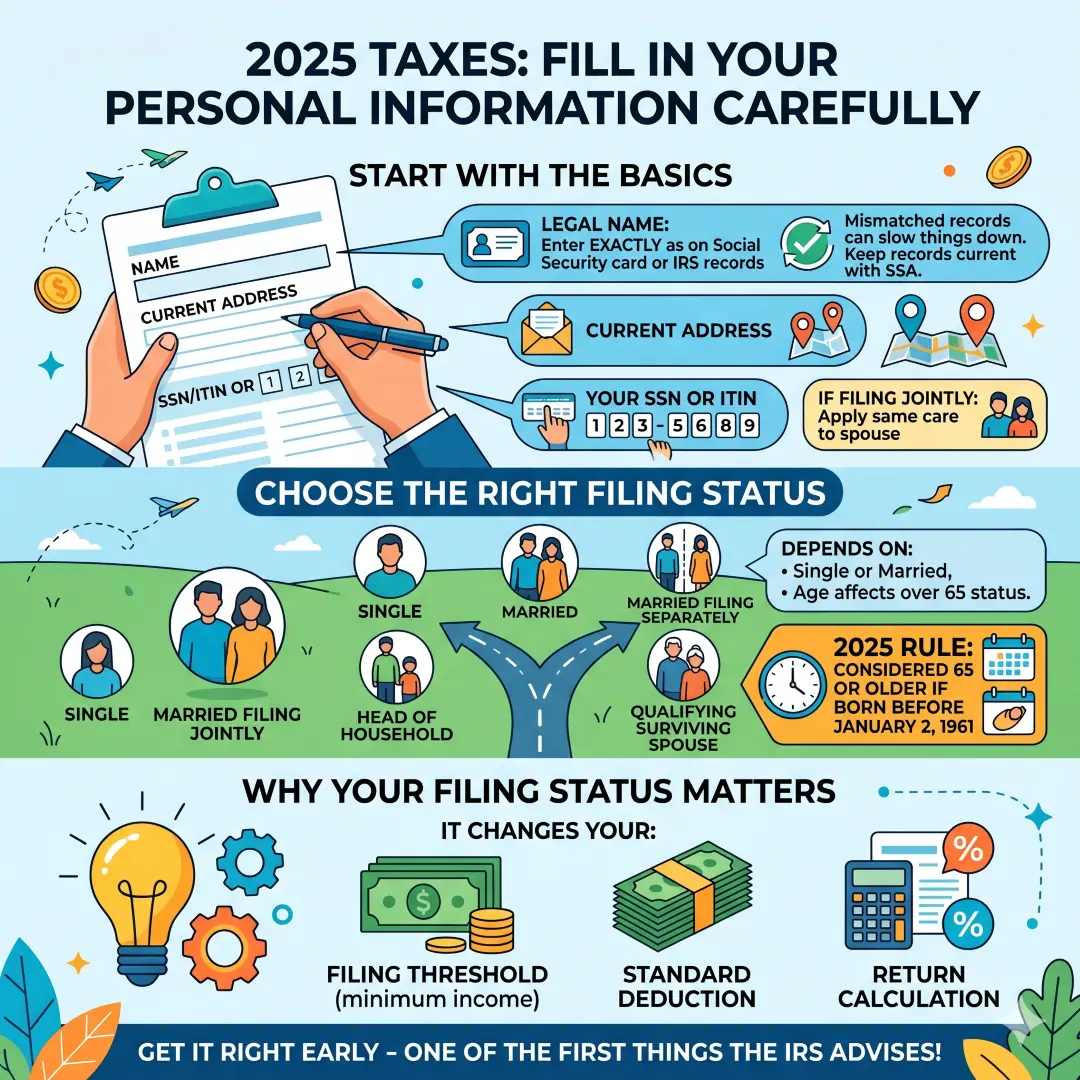
Start with the basics. Enter your name exactly as it appears on your Social Security card or IRS records, your current address, and your SSN or ITIN. If you are filing jointly, the same applies to your spouse. The IRS also tells taxpayers to keep their name on record with the Social Security Administration current if they have changed it, because mismatched records can slow things down.
Next, choose the right filing status. The IRS says your filing status generally depends on whether you are single or married, and age can affect whether you are considered 65 or older for tax purposes. For 2025, the IRS says you are considered 65 or older if you were born before January 2, 1961.
Your filing status matters because it can change your filing threshold, standard deduction, and the way your return is calculated. That is why the IRS treats it as one of the first things you should get right.
5. Report your income line by line
This is the part that feels scary, but it is mostly a matter of matching your tax forms to the right lines. On Form 1040, wages usually come from your W-2, and the form itself tells you to attach W-2 forms, plus W-2G and 1099-R if tax was withheld. The IRS also notes that if you did not get a W-2, you should see the instructions.
If you have income that does not fit neatly on the main front of Form 1040, the IRS uses the numbered schedules to move that information into the return. For example, Schedule 1 is where many types of additional income and adjustments to income go. That is also where the IRS places items such as unemployment compensation, prize money, gambling winnings, student loan interest deduction, self-employment tax, and educator expenses.
A simple way to think about income reporting is this.
- Put your wages and other main items on the main return where appropriate.
- Use Schedule 1 for extra income and adjustments.
- Use Schedule 2 when you owe other taxes.
- Use Schedule 3 when you are claiming credits or other payments that do not fit on the main form.
If you are self-employed, the IRS treats your filing responsibilities seriously. The agency says self-employed people must file if they have $400 or more in net earnings from self-employment, and the instructions also discuss self-employment tax in the schedule guide.
6. Claim deductions and credits without rushing
This is where many filers leave money on the table. Some deductions and credits are built into the main return, while others flow through the schedules. The IRS points out that Schedule 1 can include deductions such as student loan interest deduction and educator expenses, while Schedule 3 can include credits like the foreign tax credit, education credits, and general business credit.
The next big choice is standard deduction versus itemized deductions. The IRS instructions explain that most filers use the larger of the two. That means you do not itemize just because it sounds more advanced. You compare the numbers and choose the better result.
Here is the practical way to think about it.
- Use the standard deduction if that gives you the better outcome.
- Use itemized deductions only if your eligible expenses are higher than the standard deduction.
- If you are a dependent, or if special rules apply, the IRS may require a worksheet instead of the usual shortcut.
Deduction and credit flow chart
| Item | Where it usually appears | Why it matters |
|---|---|---|
| Standard deduction | Form 1040 or 1040-SR calculation area | Often, the simplest option is used by most filers. |
| Additional income | Schedule 1 | Keeps extra income items organized. |
| Additional taxes | Schedule 2 | Used when you owe specific extra taxes. |
| Credits and payments | Schedule 3 | Used for credits and certain payments not shown on the main form. |
| Special deductions | Schedule 1-A | Used for select deductions such as qualified overtime or the enhanced senior deduction. |
If you are a U.S. citizen or resident abroad, remember that income earned overseas still generally counts when determining whether you need to file, and the IRS says you may also have to consider other forms depending on foreign assets or foreign trusts.
7. Work out whether you owe tax or are due a refund
Once the income, deductions, and credits are entered, the return should show one of two things. Either you owe money, or you have overpaid and are due a refund. The IRS recommends direct deposit as the best and fastest way to receive a refund, and it can be split into one, two, or even three accounts. Even if you do not have a checking account, the IRS says there are other direct deposit options available.
If you want to check a refund after filing, the IRS says refund status is available 24 hours after you e-file a current-year return, 3 days after you e-file a prior-year return, and 4 weeks after you file a paper return. That makes electronic filing much easier to track.
If you owe tax, the IRS says the payment is due by the filing deadline, even if you file an extension. For the 2025 tax return, the deadline is April 15, 2026. The IRS allows payment online from your bank account, by card, or by mail. If you cannot pay in full, you can request a payment plan, but penalties and interest continue to grow until the balance is paid.
8. Review the return before you file
A careful review can save you a lot of trouble later. Double-check names, SSNs or ITINs, bank details, filing status, income entries, and any schedules attached to the return. The IRS says proper organization helps prepare an accurate return, claim deductions or credits, and avoid errors that could delay a refund.
Here is a clean final check before filing.
- Make sure every name matches IRS and Social Security records.
- Make sure every income form has been entered.
- Make sure deductions and credits are on the right schedule.
- Make sure your refund or balance due is correct.
- Make sure direct deposit details are accurate if you want a refund electronically.
If you are using tax software, let it catch the obvious math issues. The IRS says e-file software generally determines which schedules you need, which is one reason many people find electronic filing easier than paper filing.
9. File electronically or mail the return
The IRS strongly supports electronic filing through IRS Free File or other software options. The IRS says Free File is available through its official site, and eligible taxpayers can prepare and e-file a federal return at no cost through guided software. The IRS also says Free File Fillable Forms is available at no cost to all income levels. If you select guided tax software, eligibility depends on the partner’s rules, and the IRS does not endorse any individual partner.
If you e-file and your return is rejected, the IRS says that in most cases you can make corrections and resubmit before the deadline. That is a major advantage over paper filing, where a small mistake can take longer to fix.
Filing methods compared
| Method | Best for | Main advantage | IRS note |
|---|---|---|---|
| E-file with software | Most individual filers | Fast, convenient, and usually easier to correct | Software usually chooses the needed schedules. |
| IRS Free File | Eligible taxpayers and people who want free filing options | Free preparation and e-filing | Use the official IRS path, not a partner site directly. |
| Free File Fillable Forms | Comfortable filers who want no-cost electronic forms | Free for all income levels | Available through the IRS Free File system. |
| Paper filing | People who need or prefer paper | Traditional method | Mailing instructions and addresses can change by tax year. |
If you mail the return, use the IRS instructions and the current mailing address for that tax year. The IRS says the latest filing address is listed on its Where to file page and in the instructions for that year.
10. What to do after filing
After you file, keep copies of the return, your supporting documents, and any confirmations. If you are due a refund, check Where’s My Refund? after the return has had time to process. If you owe money, monitor your payment status and keep proof of payment. If you made payments throughout the year, the IRS also reminds taxpayers that estimated taxes may be needed for self-employment income or other income without withholding.
For many taxpayers, the most reassuring thing is simply knowing where they stand. The IRS account tools, refund tracker, and payment options are there to help you stay organized after filing.
11. If you need more time, request an extension
Sometimes you are missing a document, waiting on corrected forms, or dealing with life getting in the way. In that case, the IRS says you can request an automatic extension by the April filing due date. For most people, that gives you until October 15 to file. But the extension is only for filing, not for paying. You still need to pay what you owe by the original deadline.
That detail matters a lot. People often think an extension means a payment holiday. It does not. The IRS is very clear that interest and penalties can continue if you do not pay by the original due date.
12. If you make a mistake, fix it with an amended return
Tax returns can be corrected after filing. The IRS says you can file Form 1040-X to amend Form 1040, Form 1040-SR, or Form 1040-NR, and electronic filing is now available through tax software for the current or two prior tax periods.
The IRS also says amended returns generally take time to process. You can check the status of a Form 1040-X using Where’s My Amended Return?, and the IRS notes that processing can take 8 to 12 weeks in many cases and up to 16 weeks in some situations.
13. A simple example of how the process works
Imagine a taxpayer who has one W-2, no self-employment income, no special credits, and no itemized deductions. In that case, the return may be quite simple. The taxpayer gathers the W-2, fills in personal information, reports wages, checks whether the standard deduction is better, verifies the refund or amount owed, and files Form 1040. The IRS says many taxpayers need only Form 1040 or 1040-SR and no numbered schedules.
Now imagine a second taxpayer who has a W-2, some freelance work, and a few deductions. That person may still use Form 1040, but now Schedule 1 or Schedule 2 may be needed, depending on the details. A self-employed person with $400 or more in net earnings may also need to file because of the self-employment rule. The exact forms depend on the facts, which is why e-file software can be so helpful.
14. Common mistakes to avoid
A lot of tax stress comes from a few repeated mistakes. The good news is that most of them are easy to prevent.
- Mixing up gross income and adjusted gross income.
- Forgetting to attach the right schedules.
- Using the wrong filing status.
- Entering a wrong SSN, ITIN, or bank number.
- Filing late without an extension.
- Thinking that an extension also gives extra time to pay.
If you are outside the U.S., another common mistake is forgetting to convert everything into U.S. dollars. The IRS explicitly says foreign currency must be translated before it is reported on the return.
Final thoughts
Filling out IRS tax forms is much less about memorizing tax law and much more about following a clean process. First, decide whether you need to file. Then gather your documents. Then match your information to Form 1040 or Form 1040-SR, add any needed schedules, check the math, and file on time. If you need more time, request an extension. If you make a mistake, use Form 1040-X to correct it. That is the whole system in plain English.
The IRS keeps these tools and instructions updated, so it is always smart to check the current official pages before you file. That is especially true if you are filing from abroad, claiming special deductions, or dealing with a more complicated return. A careful return is usually a better return, and a careful return is easier to defend, easier to track, and less likely to cause stress later.
Article’s References and Sources
- Internal Revenue Service (IRS): About Form 1040, U.S. Individual Income Tax Return
- Internal Revenue Service (IRS): How to File Your Taxes
- Internal Revenue Service (IRS): Check if You Need to File a Tax Return
- Internal Revenue Service (IRS): Publication 501 (Dependents, Standard Deduction, and Filing Information)
- Internal Revenue Service (IRS): Gather Your Documents
- Internal Revenue Service (IRS): U.S. Citizens and Resident Aliens Abroad Filing Requirements
- Internal Revenue Service (IRS): Form 1040 Instructions (PDF)
- Internal Revenue Service (IRS): Form 1040 (PDF)
- Internal Revenue Service (IRS): About Form 1040-X (Amended U.S. Individual Income Tax Return)
- Internal Revenue Service (IRS): Get Your Refund Faster with Direct Deposit
- Internal Revenue Service (IRS): Refunds and Where’s My Refund Tool
- Internal Revenue Service (IRS): Pay Taxes on Time
- Internal Revenue Service (IRS): Free File: Do Your Taxes for Free
- Internal Revenue Service (IRS): Get an Extension to File Your Tax Return
- Internal Revenue Service (IRS): Where’s My Amended Return?
- Internal Revenue Service (IRS): Individual Tax Filing Overview
Frequently Asked Questions
FAQ 1: What is the first step in filling out IRS tax forms?
The first step is always to figure out whether you actually need to file a tax return. That sounds basic, but it saves time and stress. Your filing requirement depends on things like your filing status, your age, your gross income, and whether someone else can claim you as a dependent. In some cases, people with income below the filing threshold still file because they want a refund or need to claim a credit.
Once you know you need to file, the next step is to gather everything before you begin. That includes your Social Security number or ITIN, income forms such as W-2s or 1099s, and any records for deductions, credits, or payments you made during the year. It also helps to have your bank account details ready if you want direct deposit. Starting with incomplete documents is one of the fastest ways to make mistakes.
After that, choose the right form. For most people, that means Form 1040. If you are 65 or older, you may also use Form 1040-SR, which is designed as a simpler reading format but works the same way. From there, you can move through the form line by line with a lot more confidence.
FAQ 2: How do I know which IRS tax form to use?
For most individual taxpayers, the main form is Form 1040. That is the standard U.S. individual income tax return. If you are age 65 or older, you can also use Form 1040-SR. It follows the same rules and uses the same schedules and instructions, so there is no special, separate tax system hidden inside it. It is mainly there to make the form easier to read.
Some taxpayers need extra schedules. For example, Schedule 1 is used for additional income and certain adjustments to income. Schedule 2 is used for extra taxes. Schedule 3 is used for certain credits and payments. You do not choose these by guesswork. You use them when your tax situation includes items that do not fit on the main front page of Form 1040.
If your return is simple, you may only need Form 1040 or 1040-SR. If your return includes freelance income, self-employment tax, foreign tax credits, student loan interest, or other special items, then one or more schedules may be needed. The important thing is not to force everything onto one page. Tax forms are built to handle different situations in separate sections.
FAQ 3: What documents should I gather before filling out IRS tax forms?
Before you begin, gather every document that shows income, tax withheld, or expenses that might help you claim deductions or credits. At the very least, you should have your W-2, any 1099 forms you received, your Social Security number or ITIN, and your prior-year tax return if you filed one. If you are e-filing, your prior-year AGI may be needed to verify your identity.
You should also have your bank routing number and bank account number if you want your refund by direct deposit. If you use an Identity Protection PIN, keep that in front of you, too. The same is true for any records related to children, education, retirement contributions, business income, or medical expenses if those apply to your situation.
People often underestimate how much easier the filing process becomes when documents are organized first. When everything is sitting in one folder, the form starts to make sense. When records are scattered across emails, bank statements, and paper mail, even a simple return can feel overwhelming.
FAQ 4: How do I fill out personal information on Form 1040 correctly?
This section should be handled carefully because small errors can cause delays. Start by entering your full name exactly as it appears on your Social Security record. Then add your Social Security number or ITIN, your current address, and your filing status. If you are filing jointly, your spouse’s information must also be entered exactly as it appears on official records.
Your filing status matters a lot because it affects your standard deduction, filing threshold, and tax calculation. The most common filing statuses are single, married filing jointly, married filing separately, head of household, and qualifying surviving spouse. Choosing the wrong one can change the results of the entire return.
It also helps to make sure your address is current. While a wrong address usually will not break the return, it can make it harder to receive notices, refunds, or other important tax letters. Accuracy matters more than speed here. This is one part of the return where slowing down is worth it.
FAQ 5: How do I report income on IRS tax forms?
Income reporting is one of the main parts of the return, and it is usually easier than people expect once the forms are in front of them. Wages from a job are typically reported using Form W-2. That information is entered on the main return in the wages section. Other income, such as freelance earnings, retirement distributions, unemployment compensation, interest, dividends, or rental income, may go on the main form or on a supporting schedule.
A good rule is this. If the income fits neatly into the main return, enter it there. If it needs more detail, it probably belongs on a schedule such as Schedule 1. That schedule is used for additional income items and adjustments to income. Self-employment income is especially important because it can trigger self-employment tax, and in many cases, it also requires more than one form or schedule.
The biggest mistake people make is waiting to enter income until the end and then trying to guess where everything goes. It’s much better to match each document to the line or schedule it belongs on. That keeps the return accurate and makes the final totals much easier to trust.
FAQ 6: What is the difference between deductions and credits on IRS tax forms?
This is one of the most important tax ideas to understand. A deduction lowers the amount of income that is taxed. A credit lowers the actual tax you owe. That difference matters because credits often have a bigger direct effect on your final bill.
For example, the standard deduction reduces your taxable income in one simple step. You usually compare it with itemized deductions and choose whichever gives you the better result. On the other hand, a credit, such as an education credit or foreign tax credit, can reduce the tax itself. That is why credits are often more valuable dollar for dollar than deductions.
Some deductions and credits appear on supporting schedules. Schedule 1 is used for certain adjustments to income, such as student loan interest deduction. Schedule 3 is used for certain credits and payments. The important thing is to read the form carefully and not mix these two ideas. They are related, but they do very different jobs on a tax return.
FAQ 7: Should I take the standard deduction or itemize deductions?
Most taxpayers use the standard deduction because it is easier and often gives a better result. You simply compare it to your total itemized deductions and use whichever amount is larger. The IRS provides the rules for both, and the right choice depends on your actual expenses during the year.
Itemizing can make sense if you have a lot of deductible expenses, such as certain mortgage interest, state and local taxes, charitable gifts, or high medical costs that meet the rules. But itemizing is not automatically better just because it sounds more advanced. The standard deduction is there for a reason, and for many people it is the best option.
A practical way to think about it is this. If you have only a few deductible expenses, the standard deduction is likely the simpler path. If you kept detailed records and your eligible expenses are high, itemizing might save more money. The key is to compare both numbers before making a decision.
FAQ 8: How do I know if I need Schedule 1, Schedule 2, or Schedule 3?
These schedules are used when your tax return has items that do not fit on the main Form 1040. Schedule 1 is for additional income and adjustments to income. That can include things like unemployment compensation, prize money, gambling winnings, student loan interest deduction, and some other items that need extra space.
Schedule 2 is for additional taxes. You may need it if you owe self-employment tax, household employment taxes, Alternative Minimum Tax, or other special tax amounts. It is basically the place where extra tax items are collected before being moved to the main return.
Schedule 3 is for certain credits and payments. This may include the foreign tax credit, some education credits, and some payments, like an extension payment. If your tax situation is simple, you may not need any of these schedules. But if your return has more details, these forms help keep everything organized and clear.
FAQ 9: How can I get my IRS refund faster?
The fastest way to receive a refund is usually to file electronically and choose direct deposit. The IRS says direct deposit is the best way to get a refund quickly, and it can be split into one, two, or even three accounts. That means you do not have to wait for a paper check in the mail.
Filing electronically is also helpful because the system can catch some errors before the return is submitted. That lowers the chance of delays. If the return is accepted, you can then track your refund more easily through the refund status tool after the IRS has had time to process it.
A lot of refund delays come from preventable problems like wrong bank details, missing forms, or mismatched personal information. So the best way to get your refund faster is not just e-filing. It is also making sure the return is accurate the first time. Clean information moves faster than messy information.
FAQ 10: What should I do if I make a mistake after filing my tax return?
If you notice an error after filing, do not panic. The IRS provides Form 1040-X for amended returns. This form is used to correct a previously filed return. It can be used for many types of mistakes, including income errors, missing credits, or changes to filing status.
An amended return is not the same as a regular return. It is a correction. That means you should only use it when something important needs to be fixed. If the mistake is small and does not change the result, you may not need to amend. But if the error affects your tax due or refund, an amendment is usually the right path.
It is also important to be patient. Amended returns take longer to process than original returns. That is normal. The best approach is to file the correction carefully, keep a copy of everything, and monitor the status if needed. Mistakes happen. What matters is fixing them correctly and without rushing.
FAQ 11: How do I decide if I should file my tax return electronically or on paper?
For most people, electronic filing is the better choice. It is faster, easier to track, and usually less stressful. When you e-file, the return is submitted right away, and the system can catch a lot of common mistakes before the form goes out. That alone can save time and frustration. It also makes direct deposit much easier if you expect a refund.
Paper filing can still work, but it usually moves more slowly. There is more room for delays, especially if something is missing or hard to read. A paper return also takes longer to process after it is mailed. That does not mean paper filing is wrong. It just means it is usually the less convenient option unless you have a specific reason to use it.
A practical way to choose is this. If your return is simple and you are comfortable using tax software, e-filing is usually the smartest route. If your return is more complicated, software can still help because it often handles the calculations and schedules for you. Paper filing is mainly for people who prefer it, need it, or have a situation that makes electronic filing difficult.
FAQ 12: What is a filing status, and why does it matter so much?
Your filing status is one of the most important parts of a tax return because it affects how much tax you may owe, whether you qualify for certain credits, and how large your standard deduction is. The IRS uses filing status to sort taxpayers into different groups, and each group has its own rules. That is why this section should never be rushed.
The main filing statuses are single, married filing jointly, married filing separately, head of household, and qualifying surviving spouse. Each one has its own meaning. For example, someone who is unmarried and does not qualify for another status usually files as single. A married couple often files jointly, but in some cases, they may choose to file separately.
It matters because the wrong filing status can change your whole return. It can affect your tax bracket, your eligibility for tax benefits, and even whether you need to file at all. If you are unsure, it is worth checking the filing status rules carefully before you enter anything else. Getting this one piece right makes the rest of the return much easier.
FAQ 13: What should I do if I do not receive all of my tax forms on time?
Sometimes income forms arrive late, get lost in the mail, or are delayed by a payer. That can be frustrating, but it does not mean you should stop filing entirely. The first thing to do is check your records and see what you are missing. Then contact the employer, bank, or payer that was supposed to send the form. In many cases, they can reissue it or explain the delay.
If the missing form is a W-2, a 1099, or another income statement, you should not just guess the numbers. You need accurate information before filing. If the form still does not arrive, the IRS instructions explain what to do in that situation, and you may need to use your own records to estimate the income as carefully as possible. Still, it is always better to wait for the correct form when you can.
If the filing deadline is near and you still do not have everything, you may need to request an extension. That gives you more time to file, although it does not give you more time to pay what you owe. A little patience at the start can prevent a much bigger problem later. Filing with bad numbers is almost always worse than filing a little later with correct ones.
FAQ 14: How do I handle tax forms if I live outside the United States?
If you are a U.S. citizen or resident living abroad, you may still need to file a U.S. tax return. Living in another country does not automatically remove your filing responsibility. The IRS generally expects eligible taxpayers overseas to follow the same filing rules, and the same forms often apply. What changes is the way you gather and report your information.
One of the biggest differences is currency. If you earn income in another currency, it usually has to be converted into U.S. dollars before it goes on the return. That means you need clear records of what you earned, when you earned it, and what exchange rate or conversion method you used. This is especially important if you have wages, business income, bank interest, or other foreign sources of income.
It is also wise to keep foreign documents organized before you begin. That includes pay records, bank statements, proof of foreign taxes paid, and records related to any overseas accounts or assets that may need to be reported. International filing can feel more complicated, but the basic process is still the same. Gather your documents, choose the right form, enter the numbers carefully, and review everything before filing.
FAQ 15: What is the best way to avoid mistakes when filling out IRS tax forms?
The best way to avoid mistakes is to slow down and follow a routine. A tax return is much easier to complete when you handle it in the right order. Start with personal information, then move to income, then deductions, then credits, and finally review the return from start to finish. That simple flow catches many errors before they become a real problem.
Another good habit is to work from your documents rather than from memory. Tax forms should match your records, not your best guess. Use your W-2, 1099s, bank statements, and prior-year return as your guide. If you are not sure where something belongs, pause and check the instructions or the software guidance instead of guessing.
It also helps to look for the small things that people often miss. A wrong Social Security number, a missing signature, a bad bank account number, or the wrong filing status can all cause delays. The return does not need to be perfect in the sense of being fancy. It just needs to be accurate, complete, and carefully checked before it is sent.
FAQ 16: Do I need to attach every tax form and schedule when I file?
You do not attach every tax document you received, but you do need to attach or include the forms and schedules that are required with your return. For example, if your return calls for Schedule 1, Schedule 2, or Schedule 3, those schedules must be included. If you are filing paper forms, the instructions tell you what should be attached and what should be kept for your records.
Income forms such as W-2s are often attached to paper returns when required. The main idea is that the IRS needs the information necessary to process the return, but you should also keep copies of your supporting documents for your own records. That way, if a question comes up later, you have proof of what you reported.
If you are e-filing, the software often handles the attachment process digitally. You still need to enter the information correctly, but the system may not require the same paper attachments. Either way, the rule is the same. Include what is required, keep what is not, and never assume the IRS already has every form just because you received it.
FAQ 17: What is the standard deduction, and how does it affect my tax return?
The standard deduction is a fixed amount that lowers your taxable income. It is one of the simplest parts of a tax return because you usually do not need to list every deductible expense to claim it. Instead, you compare the standard deduction to your itemized deductions and choose the option that gives you the better result.
For many taxpayers, the standard deduction is the best choice. That is especially true if they do not have large deductible expenses. It keeps the return simpler and reduces the amount of detail you have to track. For people with bigger eligible expenses, itemizing may produce a better outcome, but that depends on the facts.
The key point is that the standard deduction is not a bonus or a trick. It is a normal part of the return, built into the tax system to make filing easier for many people. If you understand how it works, you can make a more confident choice and avoid overcomplicating the return.
FAQ 18: How do tax credits work on IRS forms?
A tax credit reduces the amount of tax you owe, which makes it very valuable. This is different from a deduction, which only lowers taxable income. A credit has a more direct effect on your final tax bill. That is why people pay close attention to credits when they fill out a return.
Some credits appear on the main form, while others are listed on Schedule 3. Common examples include certain education credits, the foreign tax credit, and some business-related credits. If you qualify, the credit can lower your tax bill significantly. In some cases, a credit may even help create or increase a refund.
The important thing is not to assume every credit applies to you. Each one has its own rules. Some depend on your income, some depend on your filing status, and some depend on expenses you actually paid during the year. A credit only helps if you meet the requirements, so it is worth checking the details carefully instead of guessing.
FAQ 19: What should I do if I owe taxes and cannot pay the full amount?
If you owe taxes but cannot pay everything right away, the worst thing to do is ignore the bill. The IRS offers payment options, and it is better to deal with the balance early than let penalties and interest build up. Even if you cannot pay in full, you should still file your return on time if possible. Filing late usually causes more trouble than filing with an unpaid balance.
One option is to pay what you can now and work on the rest through a payment plan. Another option is to make a partial payment and then contact the IRS about the remaining balance. The exact choice depends on how much you owe and your financial situation. The important part is to stay in contact and not let the problem sit untouched.
Also, remember that an extension to a file is not the same as an extension to pay. That confuses a lot of people. If you need extra time to file, that helps with paperwork, but it does not erase the original payment deadline. Those are two separate things, and it helps to keep them clearly apart.
FAQ 20: How long should I keep copies of my tax forms and records?
It is wise to keep copies of your tax return and supporting records for several years. That includes your filed return, income forms, receipts, and any papers connected to deductions or credits you claimed. If you ever need to prove what was reported, those records can save you a lot of trouble. They are also helpful if you file an amended return later.
Some records are more important than others. Keep anything connected to income, large deductions, retirement contributions, education expenses, business expenses, and anything else that could be questioned later. A neat folder, whether paper or digital, makes future tax seasons much easier. A little organization now can prevent a lot of stress later.
A practical habit is to keep your records long enough that you would feel comfortable answering a question about the return if asked. That does not mean you need piles of paper forever. It just means you should keep enough information to support what you filed. Good records are part of good tax filing, even after the return is already sent.
Article Disclaimer
The information provided in this article, “Step-by-Step Guide to Filling Out IRS Tax Forms,” is intended for general informational and educational purposes only. It is not meant to serve as legal, financial, or tax advice. Tax laws, filing requirements, and eligibility rules can change over time, and they may vary depending on your personal circumstances, income level, filing status, and country of residence. Because of this, the content in this article should not be relied upon as a substitute for professional guidance.
While every effort has been made to present accurate and up-to-date information based on publicly available guidance, there is no guarantee that all details are complete, current, or applicable to your specific situation. The process of filing IRS tax forms, including Form 1040, schedules, deductions, and credits, can involve complex rules that may not be fully covered in a general guide. Readers are encouraged to verify any information directly with official sources or consult the latest instructions and publications before making decisions.
This article does not create any professional relationship between the reader and the publisher or writer. For advice tailored to your individual situation, it is strongly recommended that you consult a qualified tax professional, certified public accountant (CPA), or licensed advisor who can review your financial details and provide personalized guidance. This is especially important if you have complex tax situations such as self-employment income, foreign income, investments, or multiple sources of earnings.
The publisher and author are not responsible for any errors, omissions, or outcomes related to the use of the information provided in this article. Any actions you take based on this content are done at your own risk. By using this information, you agree that you are solely responsible for ensuring the accuracy of your tax filings and compliance with applicable laws and regulations.
Always refer to official tax authorities or trusted professionals when preparing and submitting your tax return to ensure accuracy, compliance, and peace of mind.
