

Apple’s recent results show a company that is not just growing, but growing in a very controlled and repeatable way. In fiscal 2025, Apple reported $416.2 billion in total net sales, $109.2 billion in Services revenue, and 46.9% total gross margin. The company also said its installed base of active devices reached a new all-time high across product categories and geographies. That mix of scale, margin, and customer loyalty is the heart of Tim Cook’s profit playbook.
What makes this playbook so interesting is that it is not built on one lucky product cycle. It is built on system design. Apple keeps improving the hardware, but it also grows the ecosystem, expands subscription and digital services, protects gross margin, returns cash to shareholders, and keeps tightening operations. That is how Cook has helped turn Apple into a business that can stay profitable even when hardware markets slow or get noisy.
Table of Contents
Why Tim Cook’s approach stands out
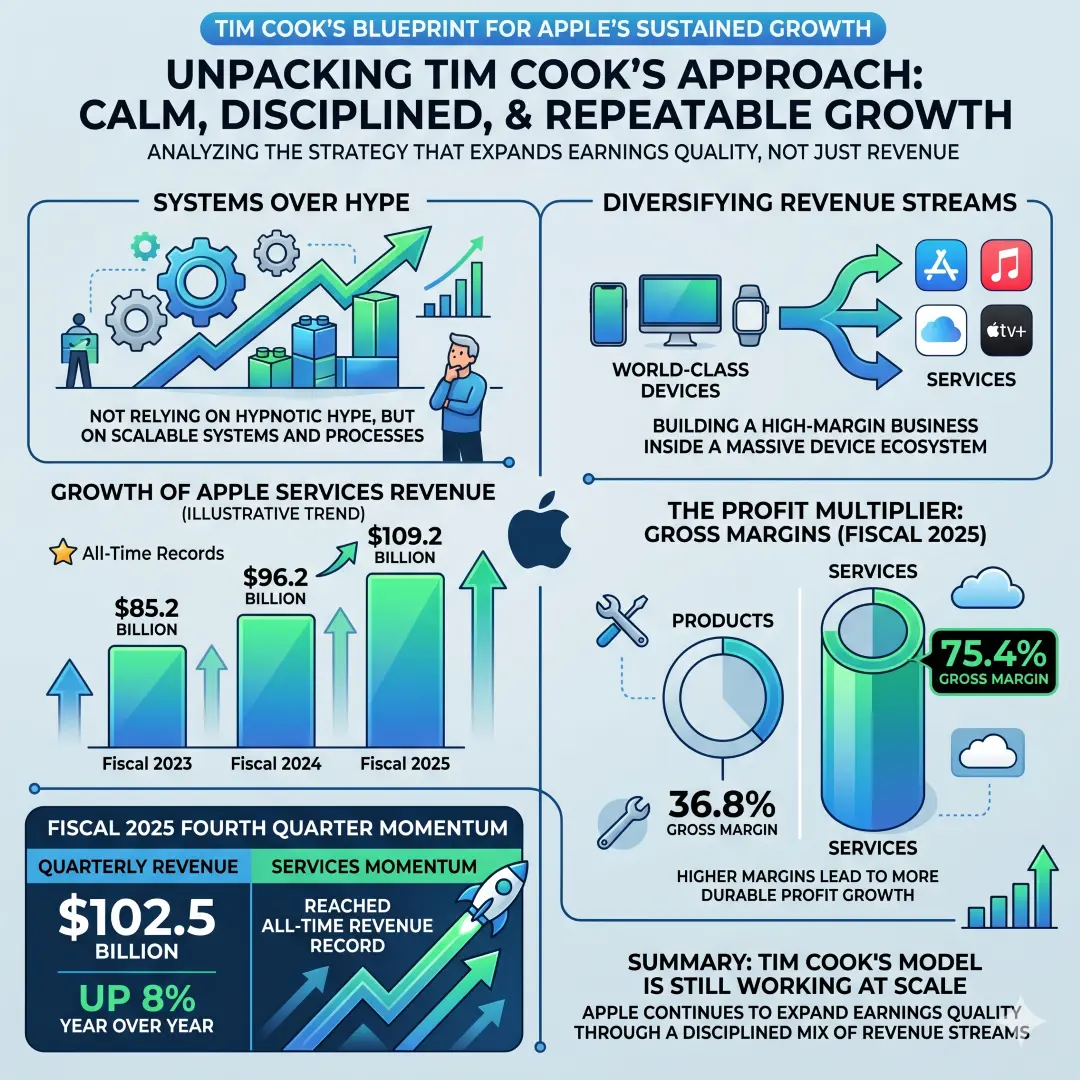
Tim Cook’s version of growth is calm, disciplined, and repeatable. He does not rely on hype. He relies on systems. Apple’s filings show a company that still sells world-class devices, but the bigger profit story now comes from a wider mix of revenue streams, especially Services, which grew to $109.2 billion in fiscal 2025, up from $96.2 billion in fiscal 2024 and $85.2 billion in fiscal 2023.
That matters because Services usually carry much higher margins than hardware. In fiscal 2025, Apple reported 75.4% gross margin for Services, compared with 36.8% for Products. When a company can grow a high-margin business inside a massive device ecosystem, profit growth becomes more durable. That is one of the clearest reasons Apple has been able to keep expanding earnings quality, not just revenue.
Apple also entered fiscal 2026 with real momentum. In the fiscal 2025 fourth quarter, the company posted $102.5 billion in revenue, up 8% year over year, and said it had reached an all-time revenue record for Services. That is a strong sign that Cook’s model is still working at scale.
The core idea behind the playbook
At its simplest, Tim Cook’s playbook says this: build a product people love, then build a business around repeat usage, trust, and lock-in without making the experience feel forced. Apple does that through hardware, software, services, payments, apps, and support. The company describes a long list of service lines, including App Store, AppleCare, Cloud Services, Apple Music, Apple TV, Apple Pay, and Apple Card.
That matters because each layer adds another reason to stay inside the Apple world. A person may start with an iPhone, but the relationship quickly expands to storage, music, app subscriptions, watch integration, wallet payments, support coverage, and content services. In other words, Apple is not just selling devices. It is selling continuity.
This is also why Apple’s business can feel stronger than the sum of its parts. In fiscal 2025, the company’s total net sales rose to $416.2 billion, up from $391.0 billion in 2024 and $383.3 billion in 2023, while Services kept growing much faster than the company as a whole. That is exactly the kind of pattern a long-term profit engine needs.
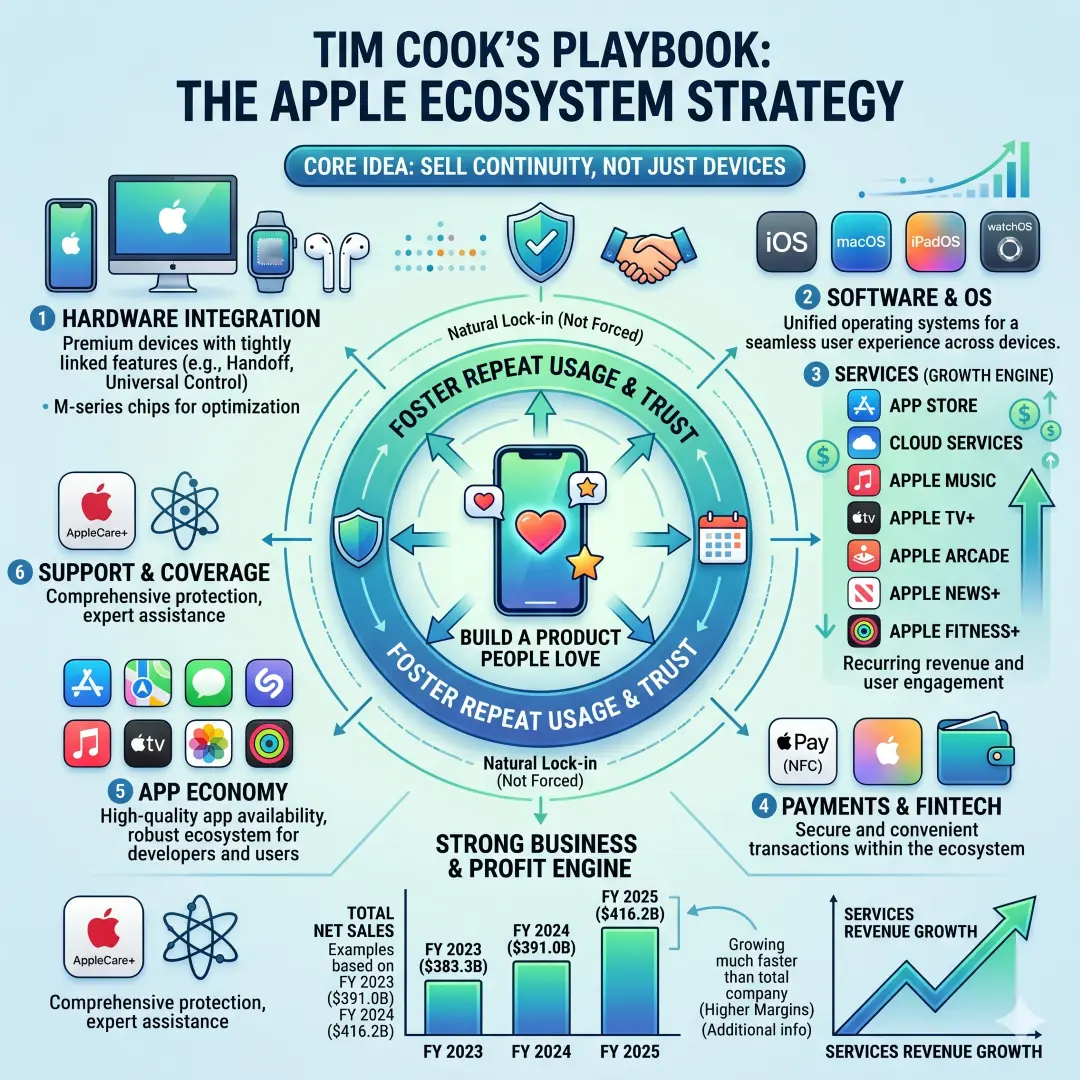
Table 1. Apple’s financial engine under Tim Cook
| Metric | Fiscal 2023 | Fiscal 2024 | Fiscal 2025 | Why it matters |
|---|---|---|---|---|
| Total net sales | $383.3B | $391.0B | $416.2B | Shows steady top-line expansion at a very large scale. |
| Services net sales | $85.2B | $96.2B | $109.2B | The highest-quality part of the revenue mix keeps getting larger. |
| Products gross margin | 36.5% | 37.2% | 36.8% | Hardware remains profitable even in a competitive market. |
| Services gross margin | 70.8% | 73.9% | 75.4% | High-margin services help lift overall profitability. |
| Total gross margin | 44.1% | 46.2% | 46.9% | A stronger margin profile means more profit from each dollar of sales. |
| Installed base of active devices | All-time high reported | All-time high reported | New all-time high reported | A larger installed base creates repeat sales and recurring service demand. |
The table tells the story clearly. Apple is growing, but more importantly, it is growing in the places that are hardest for rivals to copy. Devices can be matched. Ecosystems are much harder to replicate.
Pillar 1. Turn the installed base into a profit machine
One of Cook’s smartest moves has been treating the installed base of active devices as a strategic asset. Apple said that its installed base reached a new all-time high in fiscal 2025, across all product categories and geographic segments. That means more customers are already inside the ecosystem, using Apple devices daily.
A large installed base matters because it creates many forms of follow-on revenue. Users upgrade phones, buy accessories, pay for cloud storage, subscribe to content, use Apple Pay, and often stay in the ecosystem for years. That repeat behavior is what turns a one-time hardware sale into a longer profit relationship. Apple’s 10-K and financial statements show how services like App Store, Cloud Services, and subscription products continue to benefit from this base.
This is also why customer loyalty is so valuable. Apple itself connected the record installed base to “very high levels of customer satisfaction and loyalty” in its fiscal 2025 fourth-quarter release. In plain English, the company is not only selling products. It is keeping people inside a system they do not want to leave.
Pillar 2. Make Services the margin engine
Services is the quiet center of the Apple story. The company reported $109.2 billion of Services net sales in fiscal 2025, and it said Services gross margin reached 75.4%. That is a huge deal for sustainable profit growth, because it means Apple can make far more profit from Services than from hardware on a percentage basis.
The latest App Store ecosystem report adds even more context. It found that in 2024, the App Store ecosystem facilitated nearly $1.3 trillion in billings and sales worldwide, with more than 813 million weekly visitors on average. It also said Apple collected no commission on more than 90% of the $1.3 trillion in billings and sales facilitated by the ecosystem. That is a reminder that the Apple platform is much bigger than direct App Store commission alone. It is an economic layer that supports commerce across digital goods, physical goods, advertising, travel, food delivery, grocery, and more.
For readers trying to understand Cook’s playbook, this is the key insight. The money is not only in what Apple sells directly. The money is in the recurring activity that happens because millions of users keep interacting with the platform. That is what makes the model feel so durable.
Why Services is such a strong profit lever
- It generates recurring revenue instead of one-time revenue.
- It has a much higher gross margin than hardware.
- It benefits from a growing installed base.
- It deepens customer loyalty, which makes switching away from Apple less likely.
- It gives Apple more ways to grow even when the hardware cycle is uneven.
Table 2. How Tim Cook turns Apple into a recurring-revenue business
| Playbook move | What Apple does | Profit effect | Evidence |
|---|---|---|---|
| Grow Services | Expands App Store, cloud, payments, subscriptions, and support. | Raises margin and creates repeat revenue. | Services revenue reached $109.2B in fiscal 2025, with 75.4% gross margin. |
| Build ecosystem stickiness | Connects iPhone, Mac, iPad, Watch, AirPods, and software platforms. | Keeps customers inside the Apple ecosystem longer. | Apple describes a tightly linked hardware and services platform. |
| Use the installed base | Monetizes a record number of active devices. | Creates repeat purchases and service upgrades. | Apple said active devices hit a new all-time high in fiscal 2025. |
| Capture platform activity | Supports commerce through the App Store ecosystem. | Turns platform traffic into economic value. | App Store ecosystem facilitated nearly $1.3T in 2024. |
| Keep hardware premium | Sells high-end devices that feed the ecosystem. | Protects brand value and preserves pricing power. | iPhone remained Apple’s largest product line in fiscal 2025. |
| Balance growth and discipline | Keeps margins high while expanding scale. | Improves long-term earnings quality. | Total gross margin rose to 46.9% in fiscal 2025. |
Pillar 3. Keep hardware premium, not disposable
A lot of companies chase hardware volume. Apple usually chases hardware value. That is a very different game. In fiscal 2025, iPhone net sales were $209.6 billion, still the largest piece of Apple’s business, and Mac, iPad, and Wearables all contributed to the broader ecosystem. The hardware line remains vital because it is the entry point into the services world.
The important thing is that Cook has not turned Apple into a company that sells cheap devices just to drive unit growth. Apple’s 10-K shows that it competes in markets where rivals often have lower-priced products and large installed bases of active devices. Even so, Apple has stuck to a premium model and used that premium positioning to protect brand strength and margin quality.
This is a subtle point, but it matters. Premium hardware does two jobs at once. It keeps Apple financially strong now, and it gives Apple a pathway to Services revenue later. That means each device is not only a sale. It is a long-term relationship starter.
Pillar 4. Use capital allocation as a growth tool, not just a finance tool
Tim Cook’s Apple has also been aggressive and disciplined about returning cash to shareholders. In fiscal 2025, Apple’s quarterly results announcement said the company had reached a record fiscal year of $416 billion in revenue, and Apple’s board declared a $0.26 quarterly dividend per share. Reuters also reported that in May 2025, Apple authorized an additional $100 billion for share repurchases, while increasing its dividend by 4%.
This matters because buybacks and dividends are not separate from a growth strategy. At Apple’s scale, they are part of how management signals confidence, manages excess cash, and supports per-share returns. Reuters also reported that Apple’s cash-return moves came alongside concerns about tariffs and supply-chain costs, which shows how Cook balances shareholder returns with operational caution.
There is a deeper point here. Apple does not just chase growth for its own sake. It tries to convert growth into durable per-share value. That is one reason investors often view Apple less like a fast-moving cyclical hardware firm and more like a high-quality cash machine.
Pillar 5. Run the supply chain like a strategic asset
One of Cook’s most underrated strengths is operational discipline. Before Apple became famous for services and capital returns, Cook became famous for logistics, sourcing, and precision execution. That still shows up in the company’s risk management. Apple’s filings say the business depends heavily on outsourcing partners and that most manufacturing is performed in whole or in part by partners located primarily in China, India, Japan, South Korea, Taiwan, and Vietnam.
That global spread is not random. Reuters reported in May 2025 that Cook said the majority of iPhones sold in the U.S. that quarter would come from India, while most iPads, Macs, and Apple Watches would come from Vietnam. He also said Apple was building inventory to reduce exposure to tariffs and that having everything in one location carried too much risk.
This is how sustainable profit growth works in real life. It is not just about sales. It is about protecting the business from shocks that can crush margins later. A supply chain that is more diversified, more flexible, and more carefully managed can preserve profit even when the global environment becomes harder.
Pillar 6. Protect margins through mix, not just cost cuts
Apple’s margin story is not just about cutting costs. It is also about mix. In fiscal 2025, Apple said total gross margin rose to $195.2 billion, up from $180.7 billion in fiscal 2024, and total gross margin percentage improved from 46.2% to 46.9%. Services’ gross margin rose as Services sales grew, and the company specifically noted that the better margin came from higher Services net sales and a different mix of services.
That is important because it shows how Apple thinks about profitability. It does not simply slash spending and hope for better numbers. It shifts the revenue mix toward products and services that earn more per dollar. That is a healthier and more durable kind of margin expansion.
Apple’s fiscal 2025 results also show that even the product’s gross margin can stay strong at scale. The company reported 36.8% Products gross margin on products in 2025. So the story is not “hardware is bad, services are good.” The story is that Apple has built a model where both sides can work together, while Services increasingly lift the overall profit profile.
Table 3. The profit logic behind Apple’s mix shift
| Business area | Fiscal 2025 evidence | What it means |
|---|---|---|
| iPhone | $209.6B in net sales. | Still, the main gateway into Apple’s ecosystem. |
| Mac | $33.7B in net sales. | Keeps the ecosystem strong across computing. |
| iPad | $28.0B in net sales. | Adds another device touchpoint for services. |
| Wearables, Home, Accessories | $35.7B in net sales. | Reinforces daily usage and ecosystem habits. |
| Services | $109.2B in net sales and 75.4% gross margin. | The strongest profit engine in the mix. |
| App Store ecosystem | Nearly $1.3T in facilitated billings and sales in 2024. | Shows how large the platform economy around Apple has become. |
Pillar 7. Make sustainability part of the brand, not a side project
Tim Cook’s Apple does not treat sustainability as decoration. It is part of the company’s operating identity. Apple says its Apple 2030 goal is to become carbon neutral across its global footprint and aims to reduce greenhouse gas emissions by 75% compared with 2015, before balancing the rest. In April 2025, Apple said it had already surpassed a 60% reduction in global greenhouse gas emissions versus 2015.
That matters for profit growth in a very practical way. A company that can reduce material waste, increase recycled materials, and improve energy efficiency can often lower risk and improve trust at the same time. Apple said in 2025 that 99% recycled rare earth elements were used in all magnets and 99% recycled cobalt in all Apple-designed batteries.
This is not just good public relations. It is part of the long game. Brands that are trusted for privacy, quality, and environmental responsibility often hold customer loyalty better over time. Apple’s own values pages emphasize responsibility, ethics, privacy, and environmental progress as part of the company’s identity.
What sustainable profit growth really means at Apple
Sustainable profit growth is not the same as fast growth. Fast growth can fade when demand cools, competition rises, or costs jump. Sustainable profit growth is the ability to keep making strong profits even when the environment changes. Apple’s latest filings and results point to exactly that kind of model. Revenue is rising, Services is expanding, margins are strong, the installed base is at a record high, and the company is still returning capital to shareholders.
The beauty of the Cook model is that each part supports the other. Strong hardware creates a larger installed base. A larger installed base fuels Services. Services improve margins. Higher margins support cash returns, investment, and resilience. Resilience then helps Apple keep investing in the next product cycle. That is a very clean feedback loop.
Table 4. Tim Cook’s playbook, translated into plain business language
| Playbook principle | Simple meaning | Apple example |
|---|---|---|
| Sell a full ecosystem | Do not sell one item. Sell a connected experience. | iPhone, Watch, Mac, AirPods, iCloud, App Store, Apple Pay. |
| Grow repeat revenue | Make money more than once from the same customer. | Services revenue reached $109.2B in fiscal 2025. (Reference: CloudFront) |
| Protect margins | Focus on higher-profit products and services. | Services gross margin was 75.4% in fiscal 2025. (Reference: CloudFront) |
| Use cash wisely | Return cash, but keep enough flexibility for the future. | Apple raised its dividend and authorized major buybacks. (Reference: Apple Newsroom) |
| Reduce operational risk | Spread manufacturing and avoid fragile dependency. | Apple diversified production across India, Vietnam, and other locations. (Reference: Reuters) |
| Build trust | Protect the brand with quality and responsibility. | Apple’s environmental progress and privacy values are central to its identity. (Reference: Apple Newsroom) |
What other businesses can learn from Apple?
Apple’s model is not copy-and-paste for every company, but the logic is useful anywhere. A business does not need to be a trillion-dollar tech giant to learn from Cook’s discipline. The main lesson is that durable profit usually comes from a system, not a single product.
A few practical lessons stand out:
- Build something people return to often, not something they only buy once.
- Make sure the best-margin part of the business is also the part that scales.
- Treat operations as a source of profit, not just a cost center.
- Use cash with purpose, not emotion.
- Make trust and sustainability part of the brand promise.
These ideas sound simple, but Apple’s numbers show how powerful they can be when executed consistently. The company’s fiscal 2025 results, service performance, ecosystem scale, and capital returns all point to one conclusion. Sustainable profit growth is not an accident at Apple. It is the business model.
The risks behind the strategy
No playbook is perfect. Apple’s own filings warn about intense competition, rapid product transitions, regulatory pressure, supply-chain dependence, and the challenge of keeping new products and services successful in highly competitive markets. The company also says gross margins can face volatility and downward pressure.
Reuters also noted in May 2025 that Apple expected tariffs to add around $900 million in costs in the quarter, which shows how macro risk can still press on profitability even for a giant like Apple. That kind of pressure is one reason Cook’s focus on supply-chain flexibility and margin protection matters so much.
So the real strength of the Apple playbook is not that it eliminates risk. It is because it reduces the risk of damage it can cause. That is what sustainable growth looks like in a complicated world.
Final take
Tim Cook’s Apple playbook for sustainable profit growth is built on a few simple but powerful ideas. Keep the hardware premium. Expand Services. Grow the ecosystem. Protect the installed base. Use capital wisely. Diversify operations. And make trust part of the product. Apple’s latest numbers show that this model is still operating at an enormous scale, with $416.2 billion in fiscal 2025 revenue, $109.2 billion in Services revenue, a record active device base, and a 46.9% gross margin.
That is why Apple under Tim Cook remains such a powerful case study. It is not just a story about making money. It is a story about making money in a way that can last.
Also, Read these Articles in Detail
- Tim Cook’s Leadership Strategy at Apple
- How Tim Cook Built Apple Into a Financial Powerhouse
- Tim Cook and Apple’s Corporate Strategy
- The Business Model Behind Apple’s Success Under Tim Cook
Article’s References and Sources
- Apple Annual Report (Form 10-K): Fiscal Year 2025
- Apple Q4 2025 Earnings Report (Official Newsroom)
- Apple Global App Store Ecosystem Report (2025)
- Apple Environmental Progress and Sustainability Goals
- Apple Sustainability Progress Update (2025 Newsroom Release)
- Apple Investor Relations: Corporate Values
- Reuters Report on Apple’s Financial Strategy and Supply Chain (2025)
- Apple Supply Chain and Risk Disclosure (Form 10-K Section)
Frequently Asked Questions
FAQ 1: What is Tim Cook’s Apple playbook for sustainable profit growth?
Tim Cook’s Apple playbook for sustainable profit growth is a business strategy built on steady, long-term value instead of short-term hype. At the center of this approach is a simple idea. Apple should not depend on one product alone. It should grow through a connected ecosystem, strong premium hardware, fast-growing services, disciplined capital allocation, and careful supply chain management.
This playbook works because every part supports another part. For example, the iPhone brings people into Apple’s world. Then Mac, iPad, Apple Watch, AirPods, iCloud, Apple Music, Apple Pay, and the App Store keep them inside that world. Once a customer is deeply connected to the ecosystem, Apple can earn revenue again and again from the same user through upgrades, subscriptions, storage, apps, repairs, and payments.
The most important part of this model is that it is designed to last. Tim Cook does not rely on one huge product cycle to save the company. Instead, he focuses on building a business that can keep growing even when the hardware market becomes slower or more competitive. That is why this playbook is called sustainable. It is not only about making money today. It is about making money in a way that can continue for years.
Another major feature of this strategy is margin quality. Apple does not just want more revenue. It wants better revenue. Services are the clearest example of this because it usually carries much higher margins than hardware. That means Apple can turn a larger share of each sales dollar into profit. Over time, this creates a healthier business with more stability and less dependence on one product line.
Tim Cook’s approach also includes careful use of cash. Apple returns money to shareholders through dividends and share buybacks, while still keeping enough financial strength to invest in future products, software, chips, and operations. This balance between growth and discipline is a big reason Apple remains one of the most profitable companies in the world.
So, in simple terms, Tim Cook’s playbook is about building a business that is strong, connected, profitable, and hard to disrupt. It is a model based on loyalty, repeat usage, operational excellence, and long-term thinking. That is what makes Apple’s profit growth sustainable rather than temporary.
FAQ 2: Why are Services so important to Apple’s profit growth?
Services are one of the most important parts of Apple’s profit story because they bring in recurring revenue and very high margins. While hardware sales can rise and fall with product cycles, services create a more stable and predictable income stream. This includes things like App Store activity, iCloud, Apple Music, Apple TV, AppleCare, Apple Pay, and other digital offerings tied to Apple devices.
The biggest reason Services matters so much is profitability. Hardware requires design, production, shipping, inventory, and supply chain management. Services, on the other hand, can be delivered digitally to millions of users with much lower extra cost per customer. That means when Services grows, Apple can often keep a much larger portion of the revenue as profit.
Services also strengthen the Apple ecosystem. Once a customer pays for cloud storage, music subscriptions, app purchases, device protection, or digital payments, they are more likely to stay with Apple. This increases loyalty and makes switching to another brand less attractive. In other words, Services does not just make money on its own. It also helps support hardware sales and long-term customer retention.
Another reason Services is so valuable is that it grows from Apple’s installed base of active devices. The more people own Apple products, the more chances Apple has to sell subscriptions and digital services. That creates a powerful loop. More devices lead to more service usage. More service usage leads to stronger loyalty. Stronger loyalty leads to more future device sales.
This is one of Tim Cook’s smartest business moves. He understood that the future of Apple could not depend only on selling new phones every year. By building Services into the core of the company, Apple created a more durable source of profit that works alongside hardware instead of replacing it.
For investors, analysts, and business readers, this is a major lesson. A company becomes stronger when it creates revenue that customers keep paying over time. That is exactly why Services is one of the biggest engines behind Apple’s sustainable profit growth.
FAQ 3: How does Apple’s ecosystem help increase profits over time?
Apple’s ecosystem is one of the strongest reasons the company can keep growing profitably. The ecosystem is the connected world of Apple devices, software, services, and digital tools that all work smoothly together. This includes iPhone, Mac, iPad, Apple Watch, AirPods, iCloud, App Store, Apple Music, Apple Pay, and more.
The ecosystem increases profits because it makes customers more likely to stay with Apple. Once someone owns several Apple products, it becomes much easier to continue buying Apple products than to switch to another brand. Their photos, files, subscriptions, settings, and digital habits are already tied to Apple’s environment. That convenience creates loyalty.
This kind of loyalty has direct financial value. A loyal customer is more likely to upgrade devices, buy accessories, subscribe to services, and keep using Apple’s digital tools. This means Apple earns money from the same customer many times instead of only once. That repeated value is what makes the ecosystem so profitable.
The ecosystem also improves the user experience. Devices sync well with each other, data moves smoothly across products, and services feel built into daily life. When a company makes life easier for users, those users tend to stay. And when they stay, revenue becomes more stable.
Another important part of the ecosystem is trust. Apple has built a reputation for quality, privacy, and reliability. That reputation gives the brand more staying power than a company that competes only on price. People often pay more for Apple products because they believe they are getting more value, better integration, and a smoother experience.
From a business standpoint, the ecosystem is powerful because it lowers churn and raises customer lifetime value. That means each customer can become far more valuable over time. This is one of the clearest reasons Apple can keep growing profits without depending on constant reinvention.
So the ecosystem is not just a feature. It is the structure that holds Apple’s profit model together. It turns products into relationships, and relationships into long-term revenue.
FAQ 4: Why is Apple’s premium hardware strategy still so effective?
Apple’s premium hardware strategy remains effective because the company does not try to compete mainly on low price. Instead, it sells products that feel polished, reliable, and deeply connected to the rest of the ecosystem. That includes the iPhone, Mac, iPad, Apple Watch, and AirPods.
This strategy is powerful for several reasons. First, premium products usually carry better margins than low-cost products. That means Apple can earn more profit per unit sold. Second, premium devices strengthen the brand. When customers associate Apple with high quality, the company gains pricing power. That gives Apple more room to protect profits even in difficult markets.
Premium hardware is also important because it acts as the entry point to the broader Apple ecosystem. A customer may buy an iPhone first, but then they often buy extra services, accessories, cloud storage, and other Apple products later. So the hardware sale is only the beginning of the financial relationship.
Another reason the premium strategy works is that Apple carefully controls the experience from end to end. It designs the hardware, software, and many of the service layers. That gives Apple more control over performance, consistency, and customer satisfaction. The result is a product that often feels integrated and easy to use.
Apple’s premium approach also helps it avoid the kind of price competition that can damage profits in many consumer electronics markets. Instead of racing to the bottom, Apple focuses on value, design, ecosystem strength, and trust. That helps the company preserve both brand strength and margin quality.
In simple terms, the premium hardware strategy works because it does more than sell a device. It creates a high-value relationship with the customer. That relationship often leads to more purchases later, which is exactly why it supports sustainable profit growth.
FAQ 5: How does Tim Cook use capital allocation to strengthen Apple’s business?
Tim Cook uses capital allocation as a strategic tool, not just a financial routine. At Apple, that means deciding how to use cash in a way that supports long-term shareholder value, business stability, and continued innovation. The main tools are dividends, share buybacks, and investment in operations, technology, and product development.
One reason this matters is that Apple generates a huge amount of cash. Instead of letting that cash sit idle, the company returns a portion of it to shareholders and uses the rest to support the business. This helps create confidence in the company’s financial health while also reducing the number of shares outstanding through buybacks, which can improve earnings per share over time.
Buybacks are especially important because they show that management believes the company is strong enough to invest in itself while still rewarding shareholders. For a company as large as Apple, this kind of disciplined capital management can have a major effect on long-term returns.
At the same time, Apple does not spend blindly. It keeps enough cash and flexibility to handle supply chain changes, tariffs, product launches, and market shifts. That balance is one of Cook’s biggest strengths. He knows how to keep the business secure without slowing it down.
Capital allocation also reflects confidence. When Apple raises its dividend or authorizes major buybacks, it sends a signal that the company believes in its own future earnings power. That can matter a great deal to investors who want stable, high-quality businesses rather than unpredictable ones.
So, in simple language, Tim Cook uses Apple’s cash to make the business stronger, reward shareholders, and protect the company’s ability to keep growing. That is a very important part of sustainable profit growth because it turns success today into flexibility for tomorrow.
FAQ 6: What role does Apple’s supply chain play in profit growth?
Apple’s supply chain is one of the most important reasons the company can stay profitable at such a massive scale. A strong supply chain helps Apple manage costs, reduce risk, support product launches, and keep operations running smoothly across global markets.
Tim Cook is widely respected for his operational discipline, and that shows in how Apple handles manufacturing and sourcing. The company works with multiple production partners across different countries. This helps Apple reduce dependence on one region and lowers the risk of disruption from trade tensions, political changes, shipping problems, or tariff pressure.
A flexible supply chain protects profit growth in several ways. First, it helps Apple control costs. Second, it keeps products available to customers. Third, it gives the company more room to respond when conditions change. That can be especially valuable in periods of global uncertainty.
The supply chain also supports product quality. Apple is known for demanding high standards from its partners. That attention to detail helps keep the customer experience consistent. In a premium brand, consistency matters a lot. A weak supply chain can hurt both reputation and margins. A strong one can support both.
Another benefit is speed. Apple’s ability to launch and scale products efficiently depends on its operations. When supply is well managed, Apple can meet demand more effectively and avoid shortages that could slow growth.
This is why the supply chain should be seen as a profit engine, not just a backend function. It helps Apple stay efficient, adaptable, and resilient. In a company like Apple, operational excellence is part of the brand. It is also part of the profit model.
FAQ 7: How does Apple keep margins strong while still growing?
Apple keeps margins strong by focusing on mix, not just volume. That means it tries to grow the parts of the business that make more profit, especially Services, while still keeping hardware profitable. This is one of the smartest parts of Tim Cook’s strategy.
The key idea is that not all revenue is equal. Some revenue brings in much more profit than other revenue. Apple understands this very well. Hardware sales are important because they feed the ecosystem, but Services often deliver much higher margins. By growing both at the same time, Apple improves the overall quality of its earnings.
Apple also keeps its products positioned at the premium end of the market. That helps protect pricing power and avoids the kind of discounting that can squeeze margins. It is better to sell fewer low-margin products than to sell a huge number of products with very weak profitability. Apple clearly follows that logic.
Another reason margins stay strong is that the company controls a large part of the experience. Hardware, software, chips, services, and retail all work together. That integration reduces waste and increases efficiency. It also helps Apple create products that customers are willing to pay more for.
The company’s scale matters too. Once a business becomes as large as Apple, even small improvements in efficiency or product mix can have a huge effect on profit. That is why margin growth is so important. It does not always look dramatic from the outside, but it can create enormous value over time.
So Apple grows margins by selling the right mix of products and services, maintaining premium pricing, and operating with strong control over its ecosystem. That is why its profit growth is so sustainable.
FAQ 8: Why is Apple’s installed base so valuable?
Apple’s installed base is the total number of active devices in use across its product categories. This is one of the company’s most valuable assets because it creates a large, loyal audience for future product sales and services.
A bigger installed base means more people are already using Apple products every day. Those users are more likely to buy new devices, subscribe to services, download apps, use storage, and purchase accessories. That turns the installed base into a long-term revenue engine.
It also helps Apple forecast and plan better. When the company knows it has a large and engaged audience, it can build products and services with greater confidence. That makes the business more stable and more scalable.
The installed base also strengthens the ecosystem. The more users Apple has, the more useful its services become. That creates a self-reinforcing cycle. More devices lead to more services. More services lead to more loyalty. More loyalty leads to more device sales. This is one of the strongest loops in modern business.
Another reason the installed base matters is that it reduces customer acquisition pressure. Apple does not have to find entirely new users every time it wants to grow. It can grow by deepening relationships with people who are already in the ecosystem. That is far more efficient than starting from zero each time.
This is why the installed base is such a big deal. It is not just a number. It is a source of future revenue, a source of loyalty, and a source of strategic strength.
FAQ 9: How does Apple’s sustainability strategy connect to profit growth?
Apple’s sustainability strategy connects to profit growth because it strengthens the brand, supports operational efficiency, and reduces long-term risk. Apple has made environmental goals a major part of its corporate identity, including its Apple 2030 target and progress in cutting emissions and using recycled materials.
This matters for business because customers, investors, and partners increasingly care about sustainability. A company that can show real progress in this area often earns more trust. Trust matters because it supports loyalty and protects the brand over time.
Sustainability can also improve operations. Using more recycled materials, reducing energy consumption, and improving product efficiency can help reduce waste and strengthen the supply chain. When a company becomes more efficient, it can often protect margins as well.
Apple’s sustainability efforts also fit the broader strategy of long-term thinking. Tim Cook does not run the company as if the next quarter is the only thing that matters. The company’s environmental goals show that it is trying to build a business that can remain strong for many years.
There is also a public perception benefit. Apple’s reputation is tied not only to product quality but also to responsibility, privacy, and environmental leadership. That reputation helps reinforce premium positioning. And premium positioning supports profit growth.
So sustainability is not a side topic at Apple. It is part of the company’s broader promise. It supports trust, efficiency, and brand strength, all of which help Apple durably grow profit.
FAQ 10: What business lessons can other companies learn from Tim Cook’s Apple strategy?
Other companies can learn many useful lessons from Tim Cook’s Apple strategy, even if they are much smaller than Apple. The biggest lesson is that sustainable profit growth comes from building a system, not just chasing sales.
One clear lesson is the value of repeat revenue. Businesses grow stronger when they create products or services that customers come back to again and again. That could be subscriptions, service contracts, software, memberships, or repeat purchases. The form may differ, but the idea is the same.
Another lesson is the power of ecosystem thinking. A company becomes more durable when it gives customers more than one reason to stay. If every product connects to the next one, the business becomes harder to leave and easier to grow.
A third lesson is discipline. Apple does not try to do everything. It focuses on quality, brand, premium pricing, operational control, and long-term value. That kind of discipline helps avoid the chaos that often hurts fast-growing companies.
A fourth lesson is that margins matter. Revenue alone does not tell the whole story. Businesses should pay attention to what kind of revenue they are generating. High-margin revenue is often more valuable than low-margin volume.
A fifth lesson is to treat operations as strategic. Apple’s supply chain, manufacturing planning, and execution discipline are not background details. They are a major reason the company stays resilient.
Finally, there is a lesson in trust. Apple’s brand is strong because people believe in the product, the experience, and the company’s standards. Businesses that earn trust often enjoy better loyalty, better pricing power, and stronger long-term growth.
So the big takeaway is this. Tim Cook’s Apple strategy is not built on tricks. It is built on structure, consistency, and smart long-term choices. That is why it remains one of the best examples of sustainable profit growth in the modern business world.
Article Disclaimer
The information presented in the article “Tim Cook’s Apple Playbook for Sustainable Profit Growth” is intended for general informational and educational purposes only. While every effort has been made to ensure accuracy, completeness, and relevance, the content reflects a broad interpretation of publicly available data, industry trends, and business strategies. It should not be considered as definitive or exhaustive coverage of all aspects of Apple’s operations or leadership approach.
This article does not constitute financial advice, investment advice, or business consultation. Any references to revenue figures, profit margins, growth strategies, or financial performance are based on publicly disclosed information and general analysis. Readers are encouraged to conduct their own research or consult qualified financial advisors before making any investment or business decisions based on the concepts discussed.
All company names, product names, trademarks, and brands mentioned in this article remain the property of their respective owners. References to Apple, its products, or its leadership are used strictly for informational and analytical purposes. There is no affiliation, endorsement, or sponsorship implied between this content and Apple Inc. or its executives.
The strategic insights, interpretations, and opinions expressed in the article are based on a general understanding of business models and may not reflect the exact internal strategies or plans of Apple. Business environments change rapidly, and factors such as market conditions, regulatory changes, global economic shifts, and technological developments can influence outcomes in ways that may not be fully captured in this content.
Additionally, while the article discusses concepts such as sustainable profit growth, ecosystem strategy, and services expansion, these ideas may not be directly applicable to all businesses or industries. Each organization operates under unique conditions, and results may vary significantly depending on scale, resources, market position, and execution.
By reading this article, you acknowledge that the content is provided “as is” without any guarantees of accuracy, reliability, or suitability for a specific purpose. The author and publisher are not responsible for any losses, damages, or decisions made based on the information provided in this article.
Readers are encouraged to use this content as a starting point for learning and exploration rather than a final source of decision-making guidance.
