

Tim Cook’s Apple is one of the clearest examples of how a company can turn a strong product line into a long-lasting ecosystem, a powerful cash engine, and a highly resilient investment story. In Apple’s latest fiscal 2025 filing, the company reported $416.161 billion in net sales, including $109.158 billion from Services, and a total gross margin of 46.9%. In January 2026, Apple said its installed base had passed 2.5 billion active devices. Those numbers show a business that is no longer defined by the iPhone alone. It is defined by customer relationships, recurring revenue, and a tightly connected hardware and software platform.
Apple’s strategic strength is also visible in the broader ecosystem around its products. An Analysis Group report supported by Apple estimated that the App Store ecosystem facilitated nearly $1.3 trillion in billings and sales worldwide in 2024, with more than 813 million weekly visitors and more than 90% of that activity not generating a commission for Apple. That matters because it shows how large Apple’s platform influence has become, even when revenue is not captured directly.
There is also a leadership angle that investors should notice. In April 2026, Apple announced that Tim Cook would become Executive Chairman and John Ternus would become CEO. That makes Cook’s strategy even more important to study, because the company’s operating model now has to prove that it can outlive any one executive.
Table of Contents
Apple at a glance: the strategy behind the numbers
| Strategic area | What Apple is doing | Why it matters for investors | Evidence |
|---|---|---|---|
| Scale of the business | Apple reported $416.161 billion in FY2025 net sales | A large revenue base gives Apple room to invest, return cash, and absorb shocks | SEC |
| Services mix | Services revenue reached $109.158 billion in FY2025, up 14% year over year | Recurring revenue tends to be more stable than one-time hardware sales | SEC |
| Margin profile | Services gross margin was 75.4% in FY2025, while products gross margin was 36.8% | A higher mix of services can lift overall profitability | SEC |
| Capital returns | Apple repurchased $89.3 billion of stock in FY2025 and paid $15.4 billion in dividends | Capital returns can support per-share value when the core business is strong | SEC |
| Liquidity | Apple ended FY2025 with $35.934 billion in cash and cash equivalents and $132.420 billion in marketable securities | Strong liquidity supports flexibility and resilience | SEC |
| Installed base | Apple said its active installed base exceeded 2.5 billion devices in January 2026 | A large installed base creates repeat buying potential and service stickiness | Apple Newsroom |
| Ecosystem power | The App Store ecosystem facilitated nearly $1.3 trillion in worldwide billings and sales in 2024 | A platform can create value far beyond direct hardware revenue | Apple |
| Operational reach | Apple manufactures through partners primarily in China mainland, India, Japan, South Korea, Taiwan, and Vietnam | Diversification can reduce dependence on any single geography | SEC |
| Long-term execution | Apple has kept investing in R&D, reaching $31.370 billion in FY2025 | Steady innovation helps sustain premium pricing and product relevance | SEC |
The biggest lesson from Tim Cook’s Apple: the company is built around an ecosystem, not a single product
One of the smartest things Cook did was make Apple less dependent on a single product cycle and more dependent on a network of products and services that reinforce each other. The iPhone remains central, but it is now only one part of a much larger machine that includes the Mac, iPad, Wearables, Home, and Accessories, and, most importantly, Services. In FY2025, iPhone revenue was $209.586 billion, while Services reached $109.158 billion. That means Apple is not just selling devices. It is selling a long-term relationship with the customer.
For investors, this matters because ecosystems tend to be stickier than standalone products. When a customer owns an iPhone, they are more likely to buy iCloud, use Apple Pay, subscribe to Apple Music, download apps through the App Store, and later choose an Apple Watch or Mac because those products work together so smoothly. Apple’s own filings show that the company depends on its ability to continually improve products and services, and the company explicitly says it must keep introducing new products, services, and technologies to remain competitive. That is not just a risk statement. It is also a description of the company’s strategic engine.
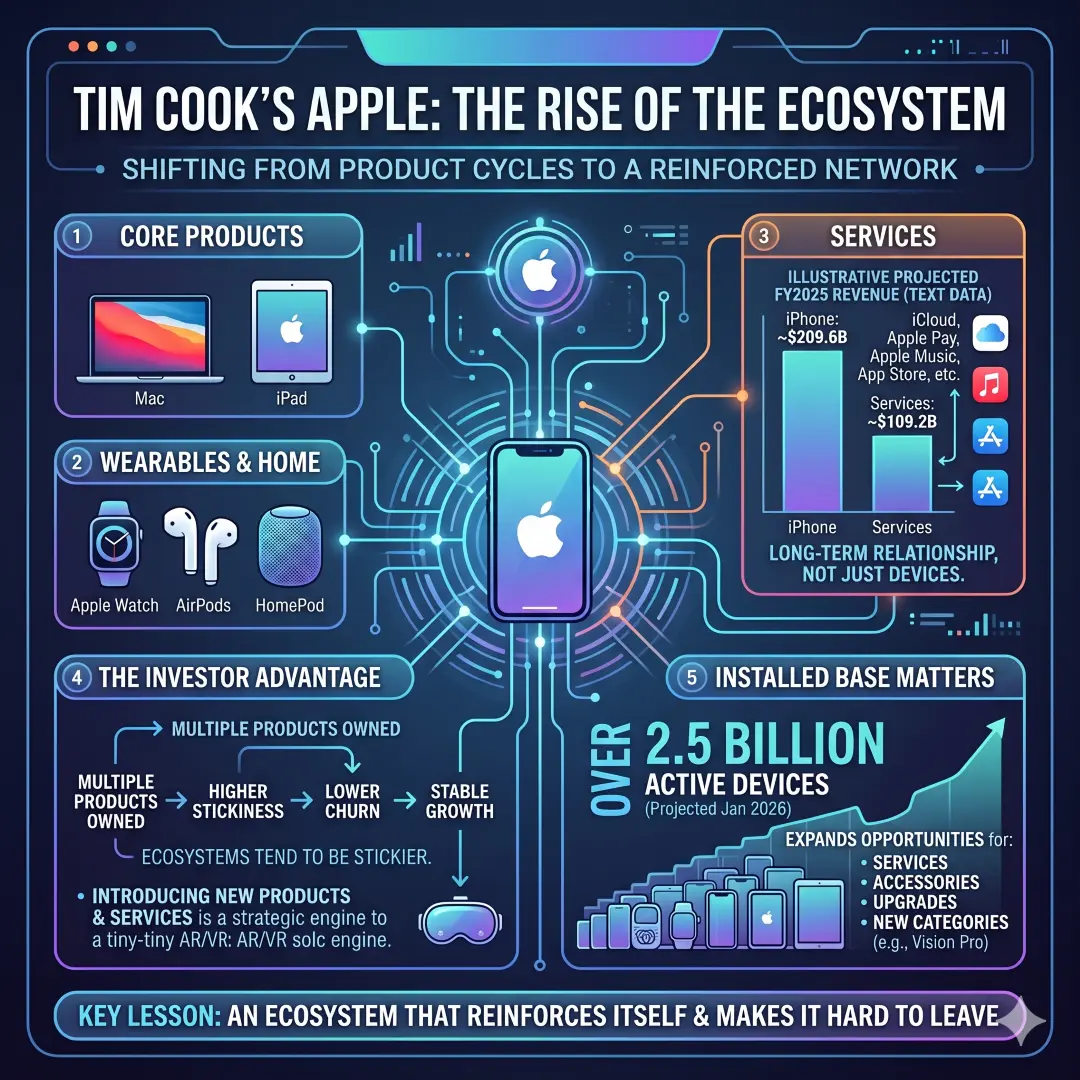
A simple way to think about Apple is this. The first sale starts the relationship. The next sale deepens it. The service subscription makes it recurring. The ecosystem makes it hard to leave. That is why the installed base matters so much. When Apple said in January 2026 that it had more than 2.5 billion active devices, it was really saying that the ecosystem had become enormous. Every extra device expands the company’s future opportunity for services, accessories, upgrades, and new categories.
Services are the most important strategic shift under Tim Cook
If one number best captures Cook’s Apple, it is Services. In FY2025, Services revenue was $109.158 billion, up 14% from the prior year. Apple said the growth came mainly from higher revenue in advertising, the App Store, and cloud services. The company also reported that the Services gross margin was 75.4%, far higher than the product gross margin of 36.8%. That gap is one reason investors pay such close attention to Apple’s mix shift.
This is not a small side business. Services represented about 26.2% of FY2025 net sales, based on Apple’s reported numbers. That is a huge move for a company that was once seen mainly as a premium hardware maker. A business with that kind of recurring revenue is usually less exposed to the ups and downs of any one product launch. It can still face pressure, but the revenue base becomes broader and more predictable.
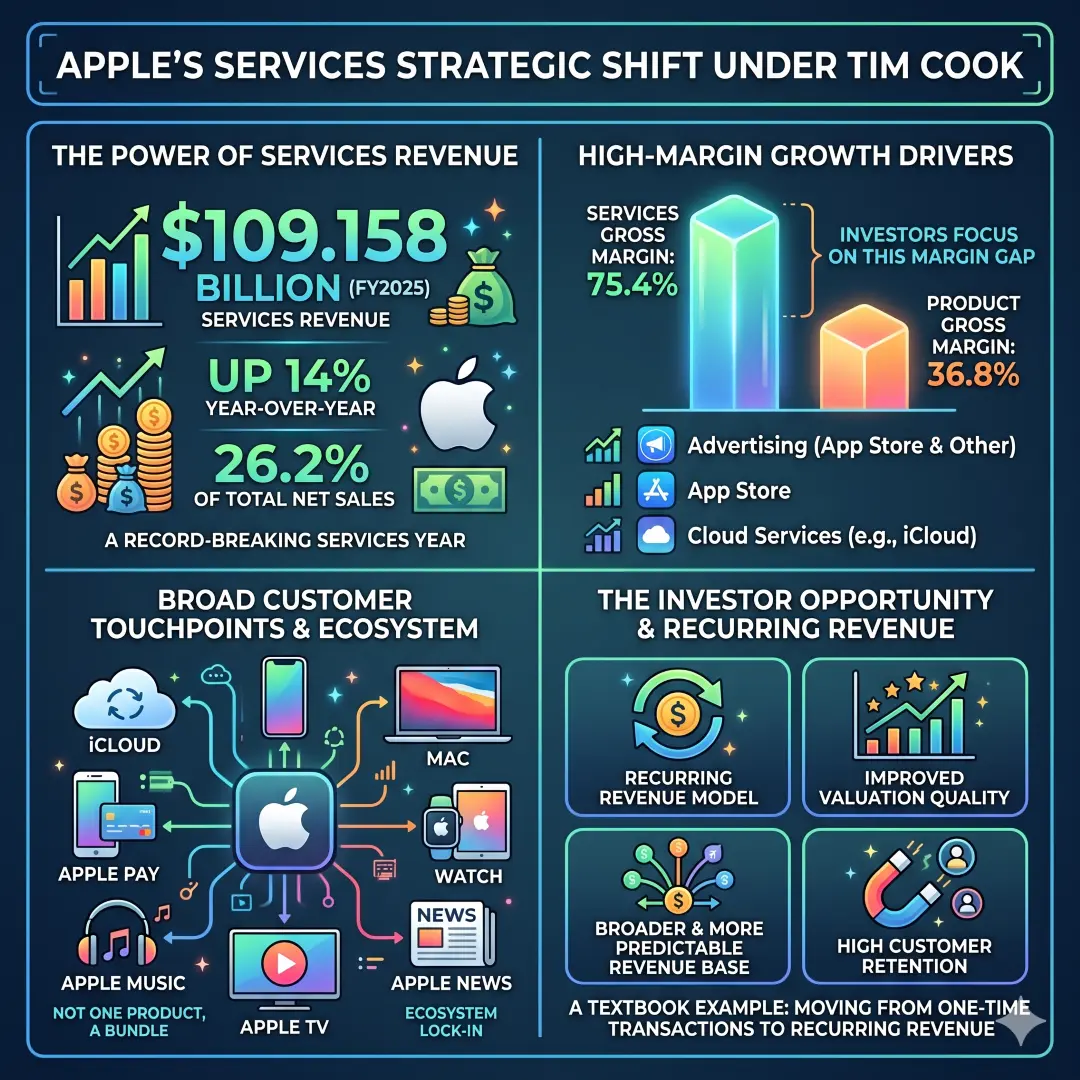
Apple’s own services materials show how broad this category has become. The company describes services such as Apple TV, Apple Music, Apple News, Apple Pay, and iCloud as part of a record-breaking services year in 2025. That is important because it shows that Services is not one product. It is a bundle of many customer touchpoints, each one making the Apple world more valuable and more useful.
For investors, the lesson is clear. A company can create a much stronger long-term story when it moves from one-time transactions to recurring revenue. Recurring revenue can improve valuation quality, especially when it is paired with strong margins and high customer retention. Apple’s Services business is a textbook example of that idea in practice.
Apple’s capital allocation strategy is part of its corporate strategy
Cook’s Apple is not just about growth. It is also about disciplined capital allocation. In FY2025, Apple announced a new $100 billion share repurchase program, raised its quarterly dividend from $0.25 to $0.26 per share, repurchased $89.3 billion of common stock, and paid $15.4 billion in dividends and dividend equivalents. Apple also reported repurchasing 402 million shares during 2025.
This tells investors something important. Apple does not treat cash as dead weight. It treats cash as a strategic resource. The company uses capital returns to reward shareholders while still keeping enough flexibility to invest in R&D, manufacturing, retail, and new technologies. That combination is hard to match. Many companies either keep too much cash without a clear plan or return too much and weaken the business. Apple has generally managed to do both growth and capital returns at the same time.
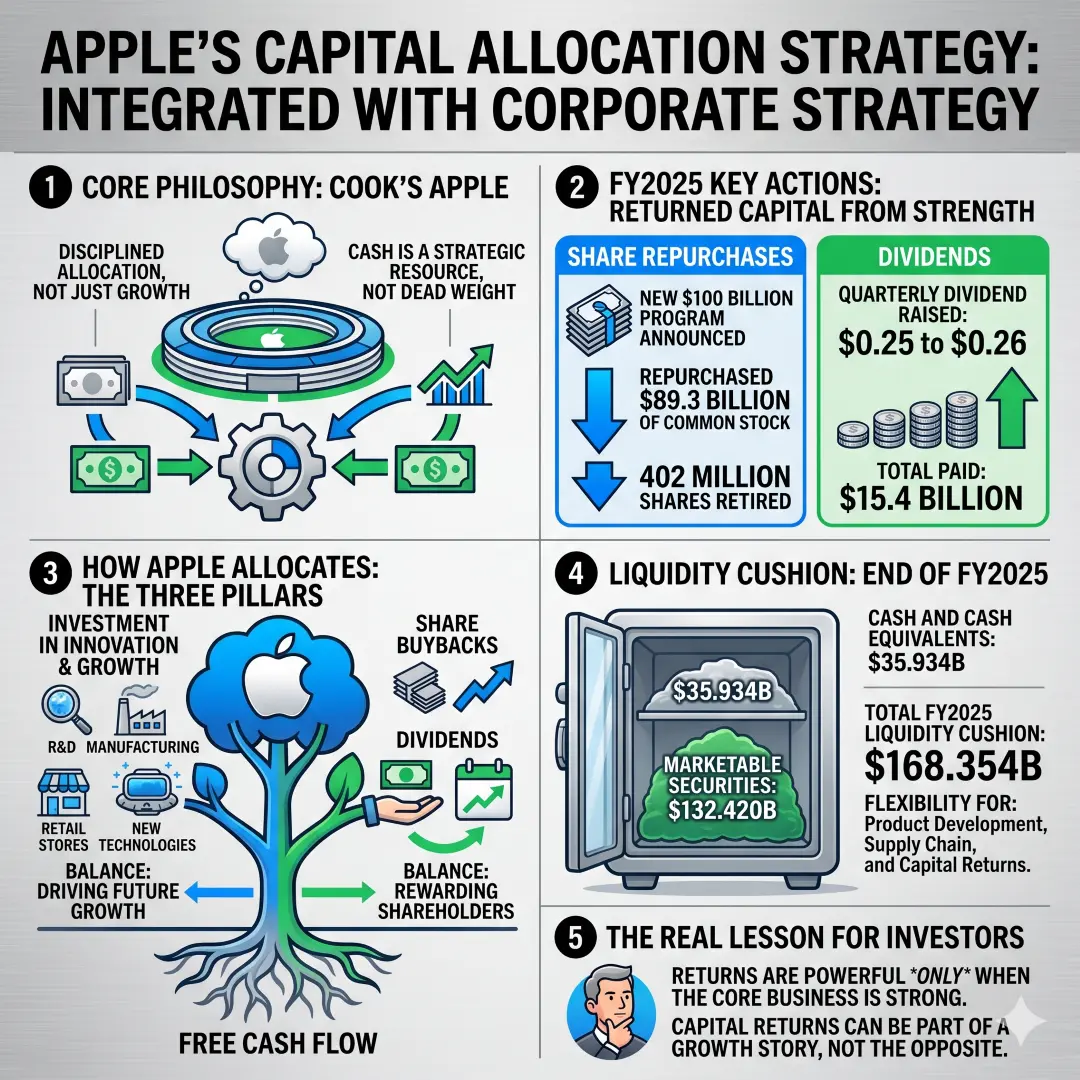
Apple’s liquidity also supports this strategy. At the end of FY2025, the company reported $35.934 billion in cash and cash equivalents and $132.420 billion in marketable securities, or about $168.354 billion combined. That gives Apple a huge cushion for product development, supply chain changes, and shareholder returns.
For investors, the real lesson is not simply that Apple returns cash. The lesson is that Apple returns cash from a position of strength. Buybacks and dividends can be powerful, but only when the core business remains strong enough to keep funding innovation. Apple has shown that capital returns can be part of a growth story, not the opposite of it.
Tim Cook made operational excellence a strategic advantage
Apple’s reputation for product design often gets more attention, but its real advantage also comes from operational excellence. Apple’s annual report says that substantially all of its hardware products are manufactured by outsourcing partners located primarily in China, India, Japan, South Korea, Taiwan, and Vietnam. That supply chain footprint is a strategic choice. It helps Apple balance scale, cost, and flexibility across different regions.
This matters to investors because operational execution is often what separates a great brand from a great business. A beautiful product is not enough if it cannot be made at scale, shipped reliably, and supported globally. Apple’s strategy depends on being able to launch new products, manage inventory, and coordinate suppliers efficiently. Its filings explicitly warn that the company depends on outsourcing partners and that supply agreements may not be renewed on similar terms or at all. That is the kind of discipline investors should pay attention to.
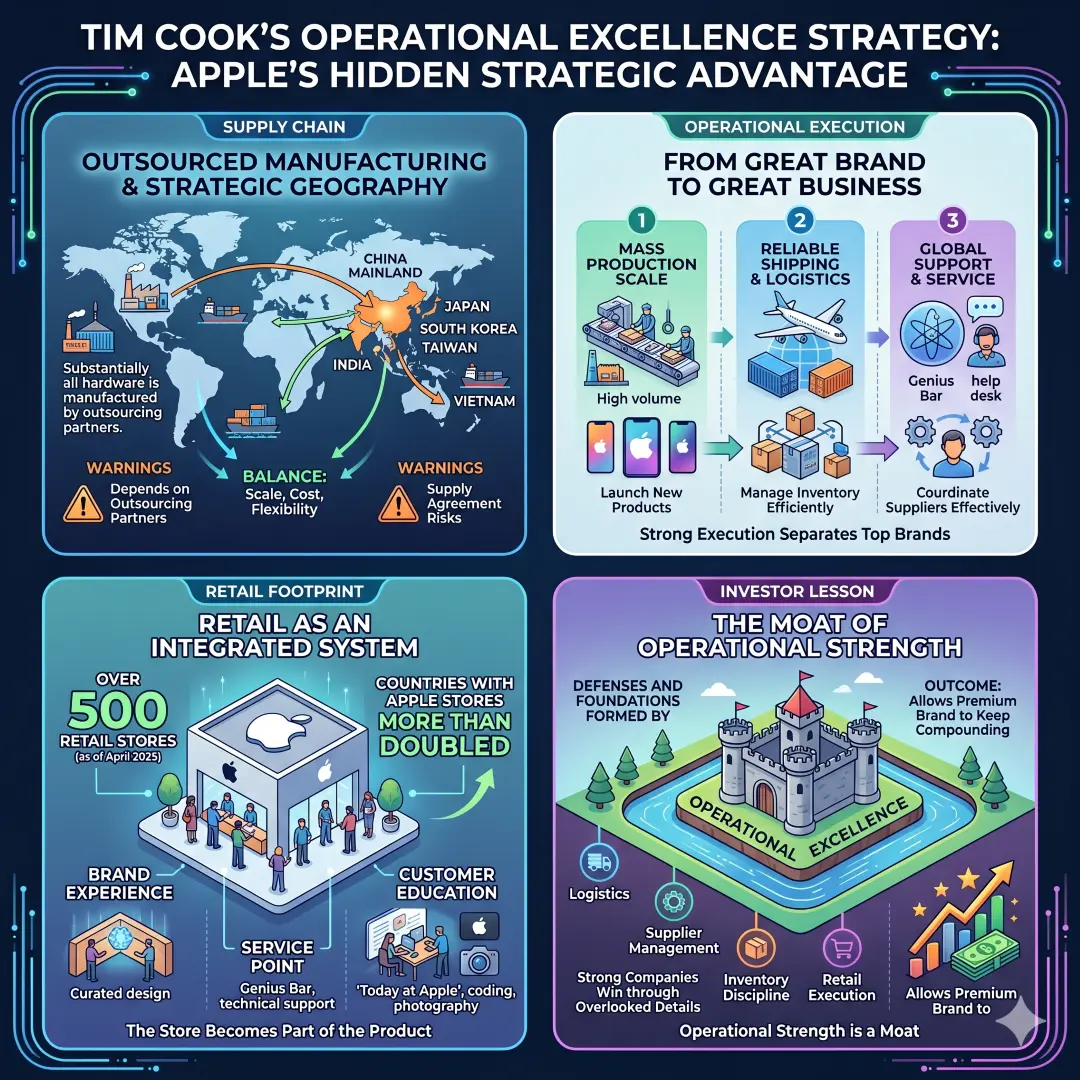
Apple also uses its retail footprint as part of the same system. The company said in April 2026 that it operates over 500 retail stores and has more than doubled the number of countries where customers can visit an Apple Store. This is not just a sales channel. It is a brand experience, a service point, and a customer education engine. For a premium company, the store itself becomes part of the product.
The broader investor lesson is that strong companies often win through details that are easy to overlook. Logistics, supplier management, inventory discipline, and retail execution may sound less exciting than product launches, but they are often what allow a premium brand to keep compounding. Apple’s model shows how operational strength can become a moat.
Research and development is not a cost center in Apple’s model; it is a future moat
Apple spent $31.370 billion on R&D in FY2025, which was about 8% of total net sales. That figure rose from $29.915 billion in FY2024 and $26.251 billion in FY2023. Apple says it continues to develop new technologies to enhance existing products and services, expand its offerings, and support growth through research, intellectual property licensing, and acquisitions of third-party businesses and technology.
This tells investors that Apple’s premium pricing strategy is not passive. It has to be funded continuously. Apple cannot remain a premium company by relying on old ideas. It has to keep investing in new hardware, new software, and new features that justify its prices and keep customers engaged. The company’s own annual report says it must continually improve products and services to maintain functional and design advantages.
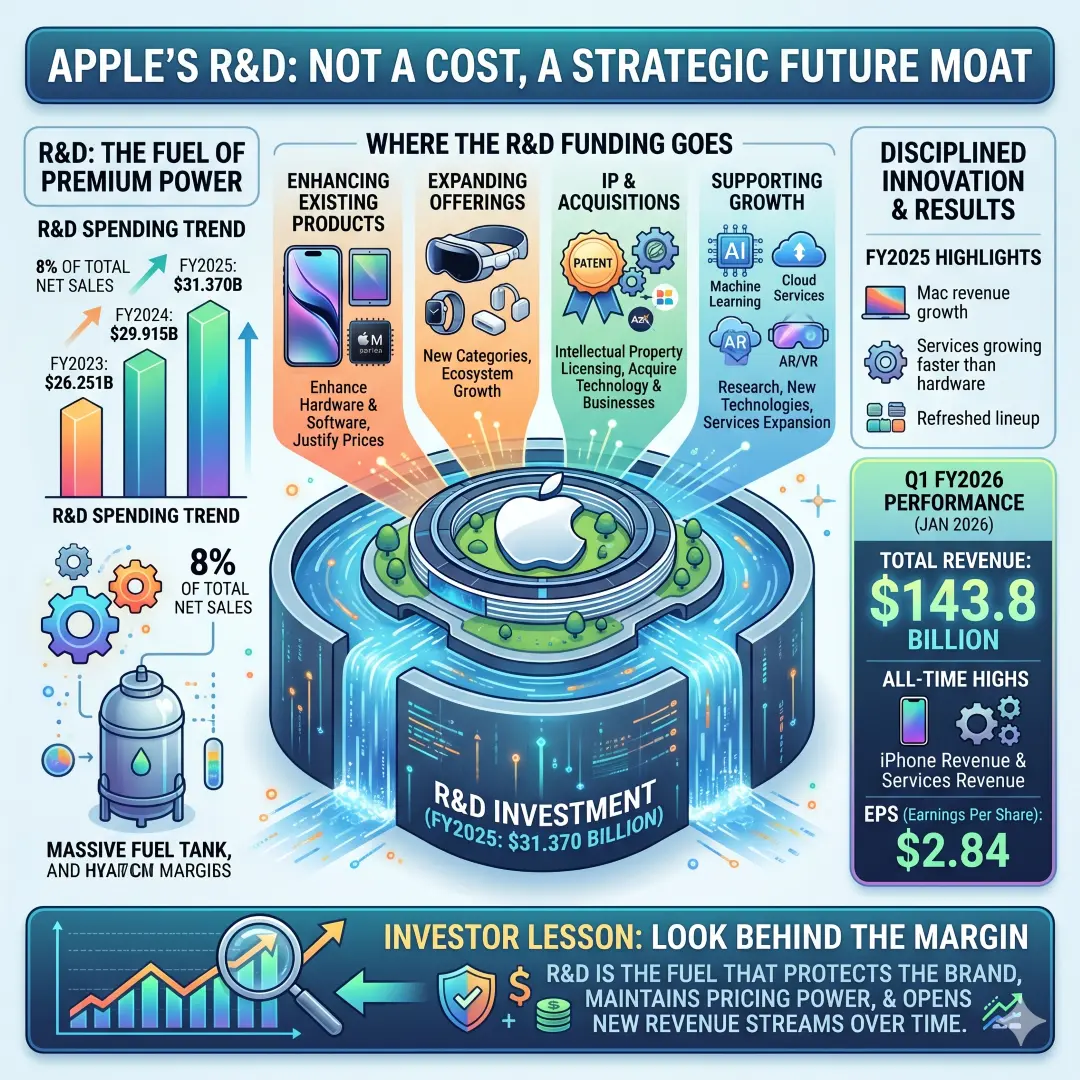
A useful example is Apple’s continued expansion of product categories and platform features. In FY2025, Apple continued to grow Mac revenue, kept Services growing at a faster pace than hardware, and refreshed its hardware lineup. In January 2026, the company reported that iPhone and Services revenue both reached new all-time highs in the first quarter, with total revenue of $143.8 billion and EPS of $2.84. That is what disciplined innovation looks like in a mature company.
For investors, the lesson is simple. When you study a premium company, do not look only at the latest margin. Look at the investment behind the margin. In Apple’s case, R&D is the fuel that helps protect the brand, maintain pricing power, and open new revenue streams over time.
Geographic diversification is part of Apple’s resilience
Apple manages its business primarily by geography. Its reportable segments are the Americas, Europe, Greater China, Japan, and the Rest of Asia Pacific. That matters because the company sells globally, supports customers globally, and must understand different market dynamics in each region. Apple also notes that net sales for geographic segments are based on the location of customers and retail stores.
This geographic structure is important for investors because global businesses can grow faster, but they also face more complexity. Apple benefits from a huge international footprint, but it also faces foreign exchange pressure, regulatory differences, and regional demand shifts. The company’s own filings say that its products and services compete in highly competitive global markets with price pressure, short product life cycles, and changing industry standards.
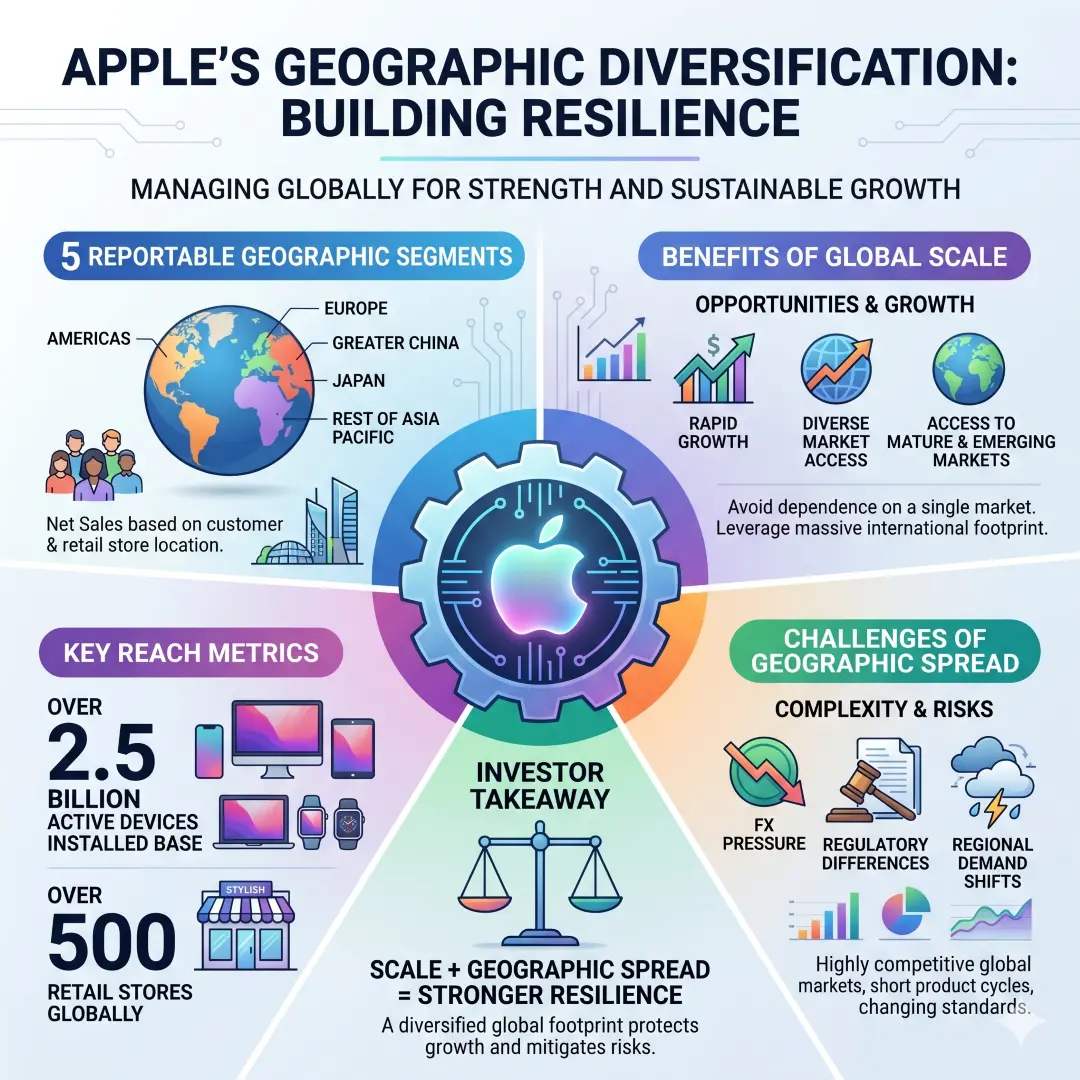
At the same time, global reach helps Apple avoid depending on one market alone. Its active installed base now exceeds 2.5 billion devices, and its retail network stretches across more than 500 stores. That combination gives Apple enormous reach into both mature and emerging markets. For investors, the lesson is that scale is strongest when it is paired with geographic spread.
Apple’s growth is impressive, but the risks are real
A strong strategy does not mean a risk-free business. Apple’s own filings highlight several important risks that investors should not ignore. The company says it has a minority market share in the global smartphone, personal computer, and tablet markets. It also faces intense competition from companies with broader product lines, lower-priced products, and larger installed bases of active devices. That means Apple’s premium positioning must be earned again and again.
Apple also warns that it must manage frequent introductions and transitions of products and services, and that new products may produce lower revenues or lower profit margins. That matters because a company with a rapid product cycle is always one launch away from disappointment if demand is weaker than expected or a transition goes badly.
There is also regulatory risk. Apple’s filings say changes to products and services, including changes in response to litigation, competition, market conditions, and legal or regulatory requirements, could materially affect the business. The company specifically notes that changes could reduce App Store sales or narrow the commission it retains. For investors, that means Services is powerful, but it is not immune to policy pressure.
Quality and technology risk also matter. Apple says that sophisticated operating system software and applications can have defects, and that new technologies such as artificial intelligence can increase safety risks, including harmful or inaccurate content. That is a very important reminder. A company can be world-class and still face new technology risks as it scales into the next wave of computing.
What investors can learn from Tim Cook’s corporate strategy
Here are the clearest investment lessons from Apple’s playbook.
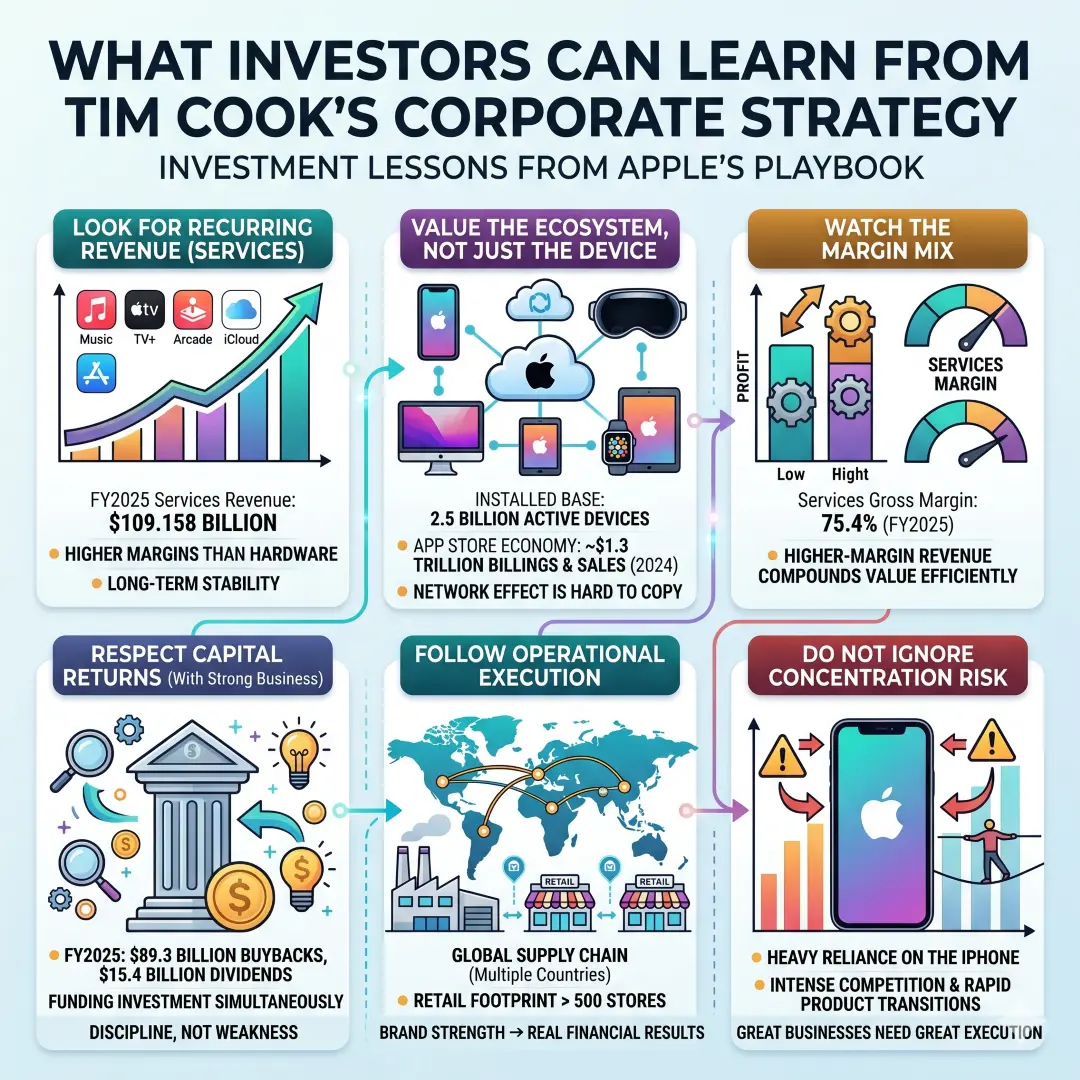
- Look for recurring revenue. Apple’s Services business reached $109.158 billion in FY2025 and carried much higher margins than hardware. That is a better foundation for long-term stability than pure product sales.
- Value the ecosystem, not just the device. Apple’s ecosystem is backed by a huge installed base of 2.5 billion active devices and an App Store economy that facilitated nearly $1.3 trillion in billings and sales in 2024. That kind of network effect is hard to copy.
- Watch the margin mix. Apple’s Services gross margin was 75.4% in FY2025, far above product gross margin. A company that keeps shifting toward higher-margin revenue can compound value more efficiently.
- Respect capital returns, but only when the business is strong. Apple returned $89.3 billion through buybacks and $15.4 billion in dividends in FY2025 while still funding major investments. That is a sign of discipline, not weakness.
- Follow operational execution. Apple’s supply chain spans multiple countries, and its retail footprint exceeds 500 stores. That operational depth helps turn brand strength into real financial results.
- Do not ignore concentration risk. Apple still relies heavily on the iPhone, and its own filings stress intense competition and rapid product transitions. Great businesses still need great execution.
A second table for investors: strategy, evidence, and the practical takeaway
| Apple’s strategy choice | What Apple does in practice | Investor takeaway | Evidence |
|---|---|---|---|
| Build an ecosystem | Connects iPhone, Mac, iPad, Watch, and Services into one customer journey | Ecosystems create higher retention and better lifetime value | SEC |
| Scale recurring revenue | Grew Services to $109.158 billion in FY2025 | Recurring revenue can smooth volatility and improve valuation quality | SEC |
| Protect premium pricing | Spends heavily on R&D, which reached $31.370 billion in FY2025 | Innovation spending helps defend pricing power | SEC |
| Return capital aggressively | Completed a large buyback program and started a new $100 billion authorization in 2025 | Strong balance sheets can support both growth and shareholder returns | SEC |
| Diversify operations | Manufactures across multiple countries, not just one region | Operational spread can reduce single-country risk | SEC |
| Keep the customer inside the platform | App Store and related services sit at the center of daily usage | Platform control can create long-term strategic value | Apple |
| Balance growth with discipline | Reported FY2025 total gross margin of 46.9% and cash plus securities of about $168.354 billion | Great companies do not have to choose between growth and prudence | SEC |
The most practical investor framework for reading Apple
If you are studying Apple as an investor, the best way to think about the company is to ask four simple questions.
First, does the company have a product or platform that customers come back to again and again? Apple’s answer is yes, and its 2.5 billion active devices and huge App Store ecosystem are strong proof of that.
Second, does the business have a way to make money after the first sale? Apple’s answer is yes again, through Services, which generated more than $109 billion in FY2025 and reached another all-time high in January 2026.
Third, can management turn cash into shareholder value without starving the business? Apple’s answer is yes, through enormous share repurchases, steady dividends, and continued investment in R&D.
Fourth, can the company keep adapting to new risks? Apple’s filings show it must manage product transitions, supplier dependence, regulatory scrutiny, and new technology risks, including AI safety and quality concerns. That is a reminder that even the best strategy must keep evolving.
Why Tim Cook’s Apple still matters so much to investors
Tim Cook’s most important contribution may be that he made Apple more like a long-duration business and less like a single-product story. The company still depends on world-class hardware, but it now earns a large and growing share of value from Services, from ecosystem loyalty, and from capital discipline. That is why Apple continues to stand out in the market. In FY2025, total net sales reached $416.161 billion.
In FY2026’s first quarter, Apple reported $143.8 billion in revenue, with iPhone and Services both at new all-time highs. That is the kind of scale that gives investors confidence, but it is the underlying strategy that makes the confidence believable.
A final point is worth emphasizing. Apple’s own 10-K shows a five-year total shareholder return index of $234 for a $100 investment, compared with $217 for the S&P 500 over the same period. Past performance is never a guarantee, but it does suggest that the market has rewarded Apple’s strategy, execution, and capital discipline.
Conclusion
The real story of Tim Cook and Apple’s corporate strategy is not just that Apple sells popular devices. It is that Apple has built a business where the first product sale opens the door to a much larger relationship. Services support that relationship, strengthened by the App Store, defended by heavy R&D, and backed by disciplined capital returns. Apple’s FY2025 results, its 2026 quarterly record, and its huge active installed base all point in the same direction. The company is built to keep customers close and keep value compounding. For investors, that is the core lesson. The best businesses do not merely sell. They stay useful, stay profitable, and keep getting harder to leave.
Also, Read these Articles in Detail
Article’s References and Sources
- Apple Inc. (2025). Form 10-K Annual Report for the Fiscal Year Ended September 27, 2025.
- Apple Inc. (2024). Form 10-K Annual Report for the Fiscal Year Ended September 28, 2024.
- Apple Inc. (2026). Apple Reports First Quarter Results.
- Apple Inc. (2026). 2025 Marked a Record-Breaking Year for Apple Services.
- Apple Inc. (2025). Apple Global Ecosystem Report.
- Apple Inc. (2026). Tim Cook to Become Executive Chairman, John Ternus to Become CEO.
Frequently Asked Questions
FAQ 1: What is Tim Cook’s corporate strategy at Apple, and why does it matter to investors?
Tim Cook’s corporate strategy at Apple is built around a few clear ideas. The first is to make Apple more than a company that sells devices. Under Cook, Apple has become a business centered on a powerful ecosystem, where hardware, software, services, and customer loyalty all work together. This matters because an ecosystem is stronger than a single product. When people buy an iPhone, they often stay inside the Apple world for many years by using iCloud, Apple Music, Apple Pay, the App Store, Apple Watch, Mac, and other connected products and services.
For investors, this is important because it creates long-term value in a way that is more stable than depending only on one product launch. A company with a strong ecosystem usually has better customer retention, repeat sales, and stronger pricing power. Apple’s strategy also shows that the company is focused on recurring revenue, especially through Services, which includes digital subscriptions, payments, cloud features, and app-related income. This helps reduce the pressure that can come from hardware cycles, where sales rise and fall depending on new device launches.
Another important part of Tim Cook’s strategy is capital discipline. Apple does not just sit on its money. It uses cash carefully through share buybacks, dividends, and continued investment in research and development. Investors often like this because it shows that management is not wasting capital. Instead, it is trying to support both growth and shareholder returns at the same time.
In simple terms, Tim Cook’s strategy matters because it turns Apple into a company that can keep growing, keep earning, and keep rewarding shareholders even in a competitive market. That is why investors study Apple so closely. It is not just a tech company. It is a model of long-term business strategy.
FAQ 2: Why is Apple’s Services business so important to the company’s future?
Apple’s Services business is one of the most important parts of the company’s future because it brings in revenue more predictably and profitably than hardware alone. Services include things like iCloud, Apple Music, Apple TV, Apple Pay, App Store revenue, advertising, and other digital offerings. These services are valuable because once a customer is inside the Apple ecosystem, they often continue using these services for years.
One of the biggest advantages of Services is that it has a much higher gross margin than hardware products. That means Apple keeps more profit from each dollar of Services revenue than from device sales. This is extremely attractive to investors because it can improve the company’s overall profitability over time. A growing Services business can also help smooth out the ups and downs of hardware demand. Even if iPhone sales slow in one year, recurring services can continue generating income.
Another reason Services matters is that it deepens customer loyalty. People who use Apple services are more likely to stay with Apple devices, because everything works together more smoothly. This creates a kind of lock-in, not in a negative sense, but in a practical one. Customers enjoy convenience, and Apple benefits from stronger retention.
For investors, Services is a sign that Apple has evolved from being mainly a device company into a platform company. That shift is extremely important because platform companies often enjoy longer-term stability and stronger earnings power. In the future, Services could become even more important as more people use cloud tools, subscriptions, digital payments, and connected devices in daily life.
FAQ 3: How does Apple’s ecosystem create long-term value for investors?
Apple’s ecosystem creates long-term value because it connects many products and services into one seamless experience. The ecosystem starts with the iPhone, but it extends far beyond that. A customer may use an iPhone to access iCloud, listen to Apple Music, make payments through Apple Pay, download apps through the App Store, wear an Apple Watch, and later buy a Mac or iPad. Every product and service makes the others more useful.
This matters because once people are inside the ecosystem, they are less likely to switch to another brand. That gives Apple a strong level of customer loyalty. It also means that each customer may generate value over many years, not just once. Investors often call this lifetime value, and it is a very powerful concept in business. A company with a high lifetime customer value can often grow more steadily than a company that depends on one-off purchases.
Apple’s ecosystem also supports pricing power. Customers are often willing to pay more for Apple products because they know the products work well together and because the overall experience feels premium. This is a major reason Apple has been able to stay highly profitable over time.
Another benefit of the ecosystem is that it supports future product launches. When Apple introduces a new device or service, it does not start from zero. It can sell to an enormous base of existing users who already trust the brand. That makes innovation more effective and more profitable.
For investors, the ecosystem is one of Apple’s strongest long-term advantages. It creates stronger engagement, more repeat business, and a deeper connection between the company and its users. That is why Apple is often valued as more than a technology maker. It is seen as a long-term platform with durable earnings potential.
FAQ 4: What can investors learn from Apple’s capital allocation strategy?
Apple’s capital allocation strategy teaches investors that cash should be used with discipline and purpose. Apple has become famous for its large share repurchase programs and regular dividends, but the key point is that the company does this while still investing in growth. This balance is very important.
A lot of companies either hold too much cash without using it well or return too much money to shareholders, weakening future growth. Apple tries to avoid both mistakes. It keeps a strong cash position, invests heavily in R&D, and still returns significant capital to investors. This shows that management is thinking carefully about how to create long-term value.
The lesson for investors is that capital allocation is not just a financial issue. It is a strategic issue. A company that knows how to use cash well can support earnings per share growth, protect the balance sheet, and maintain flexibility during uncertain times. Apple has shown that it can do all three.
Another lesson is that buybacks can be useful when the business is strong. If a company has strong profits, a strong ecosystem, and a large cash reserve, then buybacks may help improve per-share value over time. Apple’s buybacks are part of a broader plan, not a short-term fix.
For everyday investors, the key takeaway is to study how a company uses its cash. A strong balance sheet, disciplined buybacks, and steady reinvestment often signal that management is focused on long-term creation of value rather than short-term showmanship. Apple is one of the best examples of that approach.
FAQ 5: Why does Apple invest so heavily in research and development?
Apple invests heavily in research and development because innovation is essential to keeping the company competitive. Even though Apple is already one of the world’s most valuable companies, it cannot rely on past success. It has to keep improving existing products and developing new technologies that keep customers interested and willing to pay premium prices.
R&D helps Apple strengthen its product design, software features, chip technology, privacy tools, health features, and future devices. It also helps the company enter new areas of opportunity. Without strong R&D, Apple could slowly lose its edge. That is why this spending is not just a cost. It is a long-term investment in the future of the business.
Investors should pay close attention to R&D because it reveals how serious a company is about staying relevant. A company that spends too little on innovation may look efficient in the short term, but become weaker over time. Apple’s consistent R&D spending shows that management understands this risk.
There is also a financial side to this. Apple’s premium pricing depends on product quality and user experience. If those weaken, customers may look elsewhere. R&D helps Apple protect its brand value and justify its pricing. That is one reason the company can maintain strong margins and customer loyalty.
So, for investors, the lesson is simple. R&D is not just about invention. It is about long-term survival, market leadership, and the ability to keep a premium business model strong.
FAQ 6: How does Apple maintain strong profit margins compared to many other companies?
Apple maintains strong profit margins because it combines premium products, an ecosystem model, and a fast-growing Services business. The company sells hardware at high prices, but it also earns a lot of money from services that are even more profitable. This combination helps support overall margins.
The Services segment is especially important here because its margins are much higher than hardware margins. Hardware products involve manufacturing, shipping, supply chain management, and physical materials. Services, on the other hand, can often scale more efficiently. Once the service platform exists, each additional user can contribute a lot of profit without a large increase in cost.
Apple also benefits from brand strength. Many customers are willing to pay more because they trust the quality, design, and performance of Apple products. This trust gives the company pricing power, which helps protect margins even in competitive markets.
Another factor is that Apple has a very efficient supply chain and strong control over product design. It works closely with manufacturing partners and manages operations with a great deal of precision. That operational discipline reduces waste and helps keep the business profitable.
For investors, the lesson is that margins are not just a number on a financial statement. They tell a story about the quality of the business model. Apple’s strong margins suggest that the company has built a system that can produce profit efficiently and consistently. That is one reason why the market continues to view Apple as a high-quality investment.
FAQ 7: What risks should investors keep in mind when studying Apple’s strategy?
Even though Apple is a strong company, investors should still understand the risks. One of the biggest risks is competition. Apple operates in highly competitive markets for smartphones, computers, tablets, wearables, and digital services. Other companies offer cheaper products, different features, or broader product lines. That means Apple has to keep earning customer loyalty through quality and innovation.
Another risk is dependence on the iPhone. Although Apple has expanded into Services and other product categories, the iPhone remains a major part of the business. If iPhone demand weakens for a long time, the impact on revenue could be significant. This is why the company keeps trying to broaden its ecosystem and grow its services.
There is also regulatory risk. Apple’s business model depends heavily on its platform control, especially around the App Store. Regulators in different countries may challenge parts of that model, which could affect revenue or margins in the future. Investors should always think about how laws and regulations can change the economics of a platform business.
Supply chain risk is another issue. Apple relies on partners across multiple countries to manufacture and support its products. That gives the company scale, but it also creates exposure to geopolitical tensions, trade issues, and disruptions. A strong company can still face problems if its supply chain is strained.
Finally, Apple must manage the risks that come with new technologies such as artificial intelligence and software quality concerns. Innovation creates opportunity, but it also introduces uncertainty. Good investors do not ignore these risks. They study them carefully and balance them against the company’s strengths.
FAQ 8: How important is Apple’s installed base of devices to its business strategy?
Apple’s installed base is one of the most valuable parts of its strategy. The installed base refers to the total number of active Apple devices being used by customers. When Apple says it has billions of active devices, that means it has an enormous audience already connected to its ecosystem.
This matters because the installed base creates future business opportunities. Existing users are more likely to upgrade to a new iPhone, buy an Apple Watch, subscribe to Services, or switch to another Apple product. That makes sales more efficient because Apple does not need to introduce itself to these customers from scratch.
A large installed base also helps with loyalty and recurring revenue. The more devices customers own, the harder it becomes to leave the Apple environment. Everything from photos and messages to payments and subscriptions is tied together. That creates convenience for users and strong retention for Apple.
For investors, the installed base is important because it helps predict future earnings potential. A company with a huge base of active users has a built-in audience for future products and services. That can make revenue more durable over time.
In practical terms, Apple’s installed base is not just a number. It is a powerful strategic asset that supports growth, retention, and long-term value creation.
FAQ 9: Why is Apple’s leadership transition important for investors?
Apple’s leadership transition is important because it shows that the company is planning for continuity. When a major company changes its leadership, investors want to know whether the strategy will stay strong or become unstable. In Apple’s case, the company has been careful to show that its leadership change is part of a broader plan rather than a sudden shift.
This matters because a successful company must be bigger than one person. Tim Cook helped shape Apple into a highly efficient, highly profitable, and highly disciplined business. If the company can keep that culture and strategy under new leadership, then investors may feel more confident about its future.
A leadership transition also matters because it raises questions about execution, innovation, and future priorities. Investors will look to see whether Apple continues to invest in R&D, grow Services, support the ecosystem, and manage capital carefully. These are the pillars that have helped the company perform so well.
The best-case scenario for investors is continuity with smart evolution. That means keeping the strengths of the current strategy while adapting to new technologies and market conditions. Apple’s leadership change will be closely watched for that reason.
So, the main investor lesson is this. Leadership matters, but the quality of the strategy matters even more. If the strategy is strong and the organization is built well, then a company can remain powerful even during a leadership change.
FAQ 10: What is the biggest long-term lesson investors can learn from Tim Cook’s Apple?
The biggest long-term lesson from Tim Cook’s Apple is that a great company is built on more than popularity. It is built on a strong business model, a loyal ecosystem, disciplined capital allocation, ongoing innovation, and the ability to keep customers engaged for years.
Apple shows that a company can evolve from a product seller into a platform builder. That is a very important shift because platforms often create more durable value than one-time transactions. Apple’s growing Services business proves that recurring revenue can become a major profit engine when it is tied to a large, loyal customer base.
Another major lesson is that strategy and execution must work together. Apple does not rely only on brand image. It supports the brand with supply chain efficiency, product design, retail strength, and steady investment in future technologies. That combination is what makes the company so powerful.
For investors, Apple is a reminder that the best businesses often share a few traits. They solve real customer problems, make it hard for users to leave, generate recurring value, and use capital wisely. Apple is one of the clearest modern examples of this model.
In the long run, the lesson is simple and important. The strongest investments are often not just the companies that grow fast, but the companies that build systems capable of staying strong for a very long time. Apple under Tim Cook is a masterclass in that kind of thinking.
If you want, I can also turn these FAQs into a clean blog FAQ section with schema-friendly formatting for your article.
Article Disclaimer
The information presented in this article, “Tim Cook and Apple’s Corporate Strategy,” is intended for general informational and educational purposes only. It is based on publicly available data, commonly known business principles, and general interpretations of corporate strategies. While every effort has been made to ensure accuracy and clarity, the content should not be considered financial, investment, legal, or professional advice of any kind.
This article does not make any recommendations to buy, sell, or hold securities, including shares of Apple or any other company. Investment decisions should always be made based on your own research, financial situation, and consultation with a qualified financial advisor or investment professional. Markets can be unpredictable, and the past performance of any company does not guarantee future results.
All references to financial figures, business strategies, revenue models, and growth trends are subject to change over time. Companies continuously evolve their strategies, and external factors such as market conditions, economic changes, regulatory developments, and technological advancements may significantly impact outcomes. Therefore, readers are encouraged to verify information from official and up-to-date sources before making any decisions.
The analysis and opinions expressed in this article are interpretations for educational discussion purposes and may not reflect the views of Apple or its management. Any mention of products, services, or corporate strategies is purely for explanatory purposes and does not imply endorsement or affiliation.
Additionally, this content is not intended to address the specific financial goals, risk tolerance, or investment needs of any individual reader. Each investor’s situation is unique, and strategies that may work for one person may not be suitable for another. Readers should exercise independent judgment and critical thinking when evaluating the concepts discussed.
By reading this article, you acknowledge that you are responsible for your own decisions and that the author or publisher will not be held liable for any losses, damages, or outcomes resulting from the use of the information provided.
