

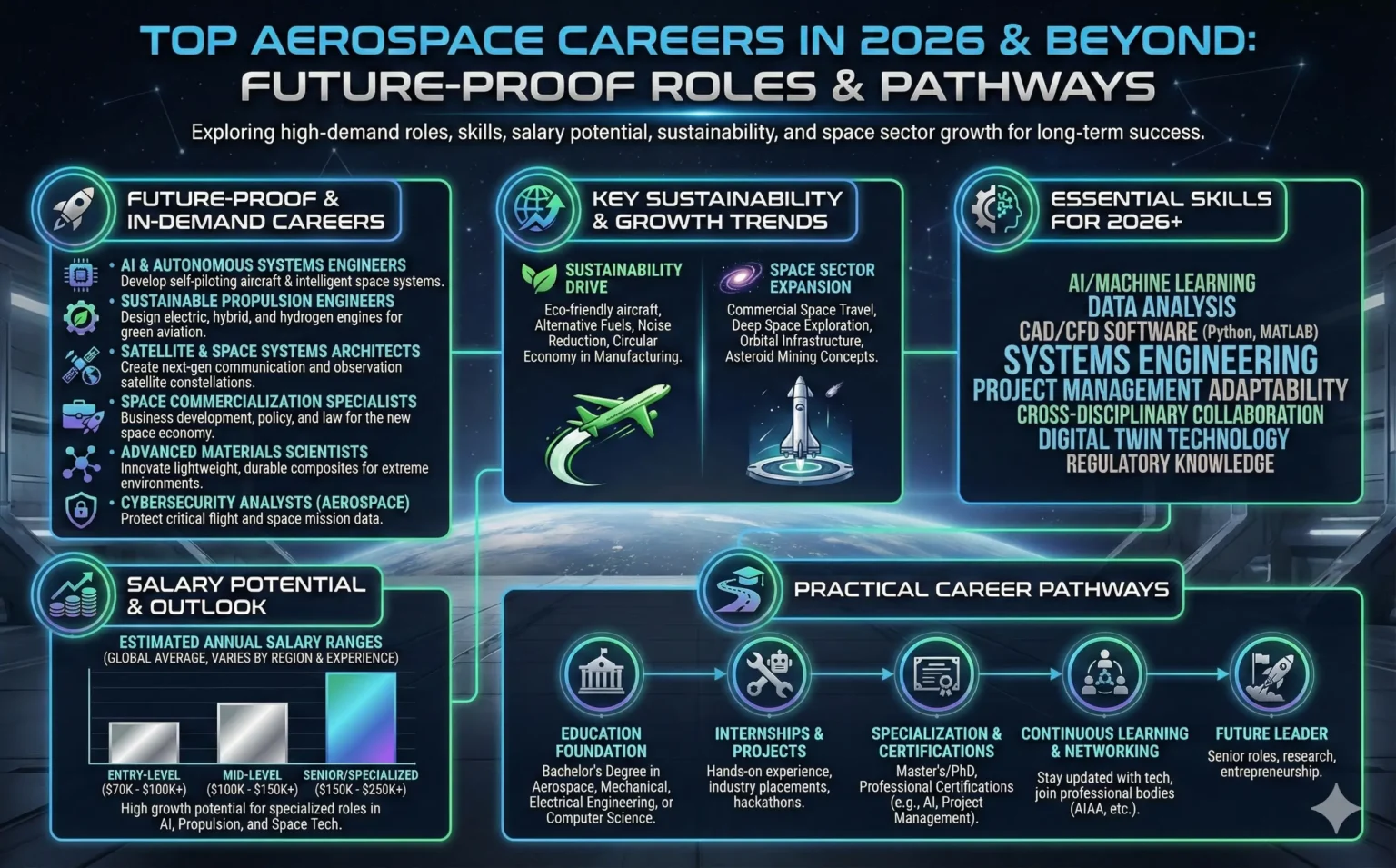
Aerospace is entering one of its most interesting hiring cycles in decades. The industry is growing in multiple directions at the same time: commercial fleets are expanding, airlines and manufacturers are modernizing faster than before, defense programs are scaling, and the space economy is accelerating into new commercial use cases. Over the next 20 years, forecasts continue to show sustained demand for new aircraft and the people who design, build, fly, maintain, certify, and secure them.
But here is the key shift for 2026 and beyond: the “best aerospace careers” are no longer limited to classic roles like aerodynamics engineer or pilot. The most resilient opportunities now sit at the intersection of aerospace with software, data, cybersecurity, sustainability, advanced manufacturing, and systems engineering. Industry outlooks highlight increased emphasis on AI, digital engineering, and digital sustainment, which directly changes what companies hire for and how teams deliver programs.
This article gives you a detailed, practical, and human-friendly map of top aerospace careers in 2026 and beyond, including what the job really involves, the skills that actually matter, and examples of how these roles show up in real projects.
Table of Contents
What’s Driving Aerospace Hiring Through 2026 and the 2030s
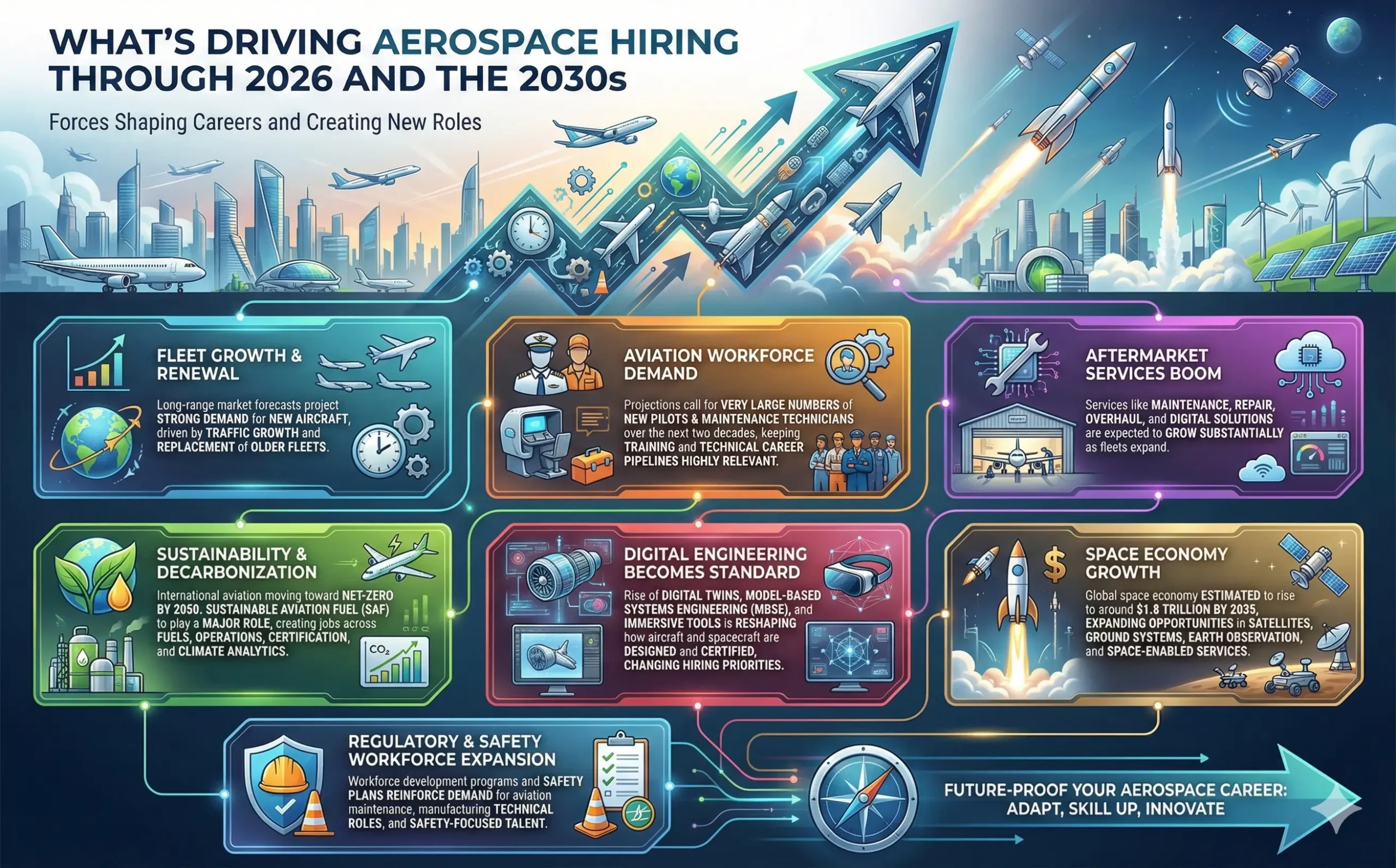
Several big forces are shaping careers and creating new roles:
- Fleet growth and renewal: Long-range market forecasts continue to project strong demand for new aircraft, driven by traffic growth and replacement of older fleets.
- Aviation workforce demand: Projections still call for very large numbers of new pilots and maintenance technicians over the next two decades, which keeps training and technical career pipelines highly relevant.
- Aftermarket services boom: Services such as maintenance, repair, overhaul, and digital solutions are expected to grow substantially as fleets expand.
- Sustainability and decarbonization: International aviation has a widely recognized long-term direction toward net-zero by 2050, and the industry expects Sustainable Aviation Fuel (SAF) to play a major role, creating jobs across fuels, operations, certification, and climate analytics.
- Digital engineering becomes standard: The rise of digital twins, Model-Based Systems Engineering (MBSE), and immersive tools is reshaping how aircraft and spacecraft are designed and certified, which changes hiring priorities.
- Space economy growth: Research estimates the global space economy could rise to around $1.8 trillion by 2035, expanding opportunities in satellites, ground systems, Earth observation, and space-enabled services.
- Regulatory and safety workforce expansion: Workforce development programs and safety plans reinforce demand for aviation maintenance, manufacturing technical roles, and safety-focused talent.
How to Use This Career Guide
You can treat the roles below like a menu. Pick 2–3 tracks that match your strengths, then build a portfolio around real evidence of skill: a project, a simulation, a design report, a code repository, a test plan, a maintenance logbook, or a certification.
To make this actionable, each career section includes:
- What you actually do
- Tools and skills to learn
- Typical entry paths
- A concrete example project
Career Mega-Table: The Top Aerospace Careers (2026 and Beyond)
| Career Path (2026+) | Best Fit For | Core Work You’ll Do | High-Value Skills to Build | Tools You’ll Commonly See | Where You’ll Work |
|---|---|---|---|---|---|
| Digital Twin Engineer | People who like systems, data, and modeling | Build “living” models of aircraft or engines for performance, maintenance, and upgrades | Systems thinking, data engineering, physics-based modeling, analytics | MBSE, simulation stacks, telemetry pipelines | OEMs, airlines, MRO, defense sustainment |
| MBSE Systems Engineer | Big-picture problem solvers | Define requirements, interfaces, verification, and lifecycle logic for complex systems | Requirements engineering, architecture, verification planning | SysML, MBSE platforms | Aircraft/spacecraft programs, avionics, propulsion |
| Aerospace Software Engineer | Strong coders | Build embedded and ground software for flight-critical and mission systems | C/C++, Python, real-time systems, DO-178-style discipline | RTOS, CI pipelines, test frameworks | Avionics, satellites, flight controls |
| Avionics Cybersecurity Engineer | Security-minded engineers | Secure aircraft networks, mission systems, and safety-critical digital interfaces | Threat modeling, secure architecture, incident response | Security tooling, network analysis | Defense, avionics suppliers, certification-heavy teams |
| Autonomy and AI Engineer | AI builders | Perception, planning, and safety logic for drones, robotics, or space systems | ML, sensor fusion, safety constraints | Simulation, ML frameworks | Drones, defense autonomy, space robotics |
| SATCOM and Space Systems Engineer | RF lovers and mission builders | Design satellite payloads, communications links, and mission performance | RF, link budgets, systems engineering | RF simulation, mission tools | Satellite firms, space startups, agencies |
| Launch and Range Operations Specialist | Operations-focused | Mission readiness, procedures, safety, and coordination for launch campaigns | Ops discipline, risk management, checklists | Ops consoles, telemetry tools | Launch sites, spaceports |
| Sustainable Aviation Specialist (SAF and operations) | Climate-forward aviation | SAF supply strategy, emissions accounting, operational efficiency | Life-cycle analysis, policy, fuel standards | LCA tools, compliance frameworks | Airlines, fuel ecosystem, policy teams |
| Hydrogen and Electrified Propulsion Engineer | Propulsion + sustainability | Components, thermal management, storage, integration, safety | Thermodynamics, systems integration | CFD/FEA, test labs | R&D groups, advanced programs |
| Additive Manufacturing Engineer | Makers | Qualify and produce flight parts with advanced materials and processes | DFAM, materials, quality | AM machines, metrology | Manufacturing, engines, space hardware |
| Supply Chain and Industrialization Analyst | Ops + analytics | Supplier risk, capacity planning, production ramp, resilience | Forecasting, risk, process improvement | ERP analytics, planning tools | OEM supply chains, tier-1 suppliers |
| MRO Reliability Engineer | Practical engineering | Improve dispatch reliability, reduce delays, optimize maintenance | Reliability, root cause analysis, data | Reliability analytics | Airlines, MRO, lessors |
| Aviation Safety and Compliance Specialist | Detail-oriented | Safety management systems, audits, compliance, investigations support | SMS, regulatory literacy, documentation | Audit tools, reporting | Regulators, airlines, OEMs |
| Manufacturing Technician (Aerospace) | Hands-on builders | Precision assembly, inspection, composites, avionics integration | Quality, process control, safety | Metrology, tooling | Factories, integration hangars |
| Aircraft Maintenance Technician | Mechanics + troubleshooting | Inspect, repair, certify airworthiness, line maintenance | Troubleshooting, documentation, safety | Maintenance manuals, diagnostics | Airlines, MRO, defense |
| Pilot and Flight Operations Track | Flight-focused | Training, flight ops, performance, safety, operational decision-making | Airmanship, CRM, procedures | Simulators, flight planning | Airlines, cargo, business aviation |
| Air Traffic Management Track | Calm under pressure | Separation, flow management, safety-critical comms | Situational awareness, procedures | ATC systems | ANSPs, airports |
Now let’s go deeper, role by role, in a way you can actually use.
1. Digital Twin Engineer
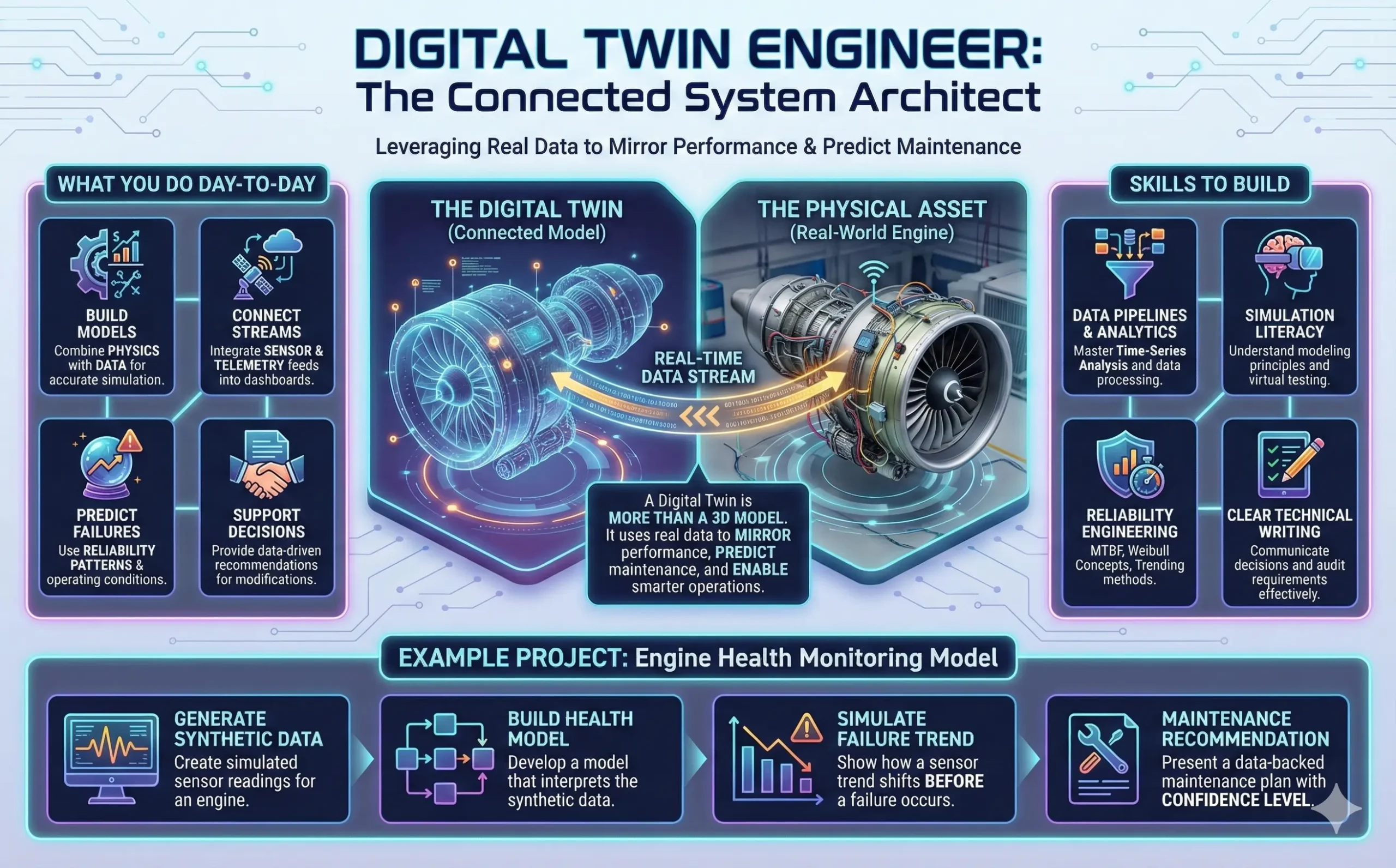
A Digital Twin is more than a 3D model. It is a connected system that uses real data to mirror performance and predict maintenance, enabling smarter operations and faster upgrades. As services and fleet sustainment grow, digital twin skills become extremely valuable across airlines, maintenance networks, and defense sustainment programs.
What you do day-to-day:
- Build models that combine physics with data
- Connect sensor or telemetry streams to performance dashboards
- Predict failures using reliability patterns and operating conditions
- Support engineering decisions for modifications and service bulletins
Skills to build:
- Data pipelines, time-series analytics, simulation literacy
- Reliability engineering methods (MTBF, Weibull concepts, trending)
- Clear technical writing for decisions and audits
Example project:
- Create a simplified engine health monitoring model using synthetic sensor data, then simulate how a trend shifts before a failure. Present a maintenance recommendation and explain the confidence level.
2. MBSE Systems Engineer (Model-Based Systems Engineering)
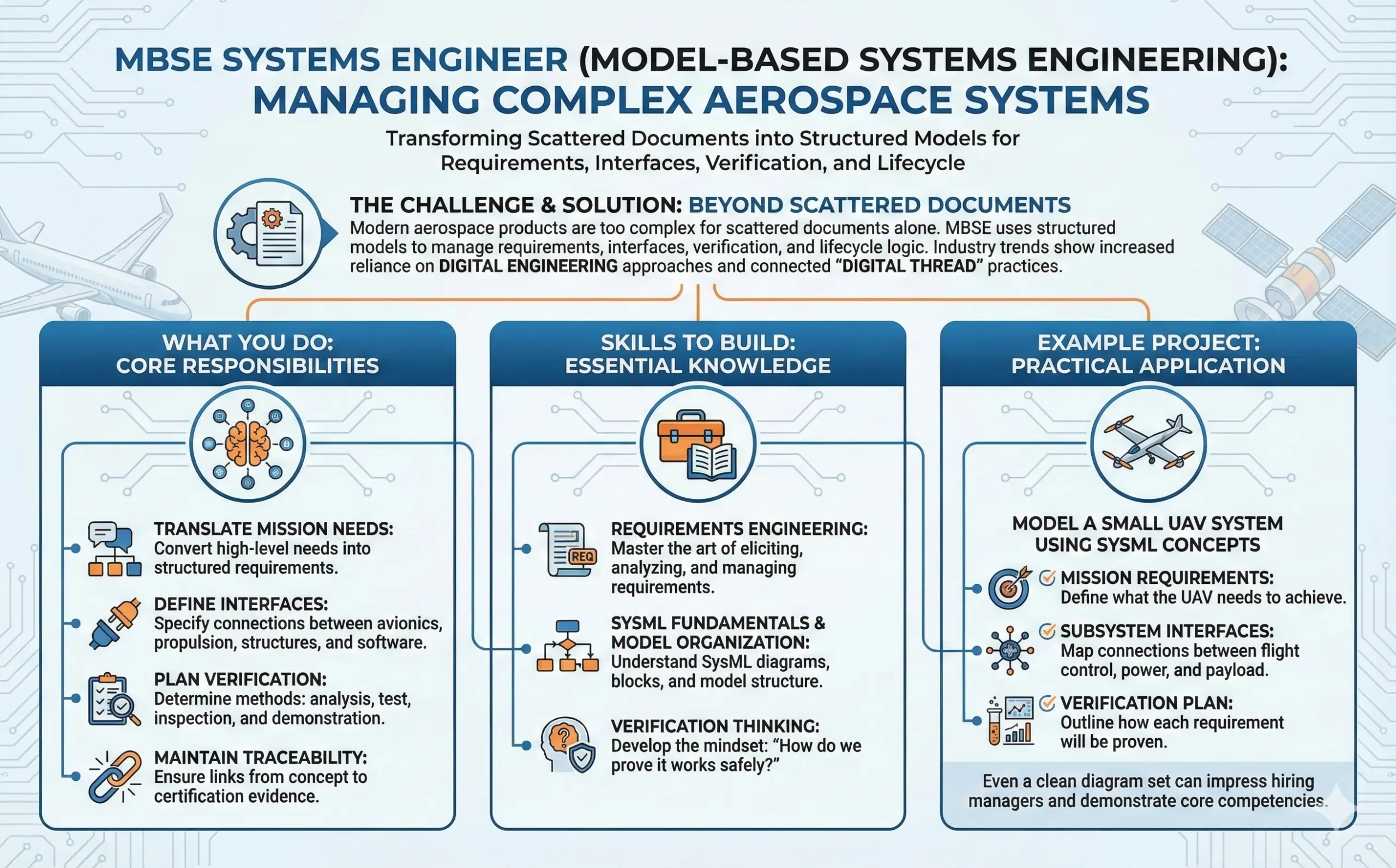
Modern aerospace products are too complex to manage with scattered documents alone. MBSE uses structured models to manage requirements, interfaces, verification, and lifecycle logic. Industry reports highlight increased reliance on digital engineering approaches like MBSE and connected “digital thread” practices.
What you do:
- Translate mission needs into structured requirements
- Define interfaces between avionics, propulsion, structures, and software
- Plan verification: analysis, test, inspection, and demonstration
- Maintain traceability from concept to certification evidence
Skills to build:
- Requirements engineering
- SysML fundamentals and model organization
- Verification thinking: “How do we prove it works safely?”
Example project:
- Model a small UAV system using SysML concepts: mission requirements, subsystem interfaces, and verification plan. Even a clean diagram set can impress hiring managers.
3. Aerospace Software Engineer (Embedded and Mission Software)
Software defines capability in modern aircraft and spacecraft. This includes flight control logic, navigation, health monitoring, display systems, satellite ground systems, and more.
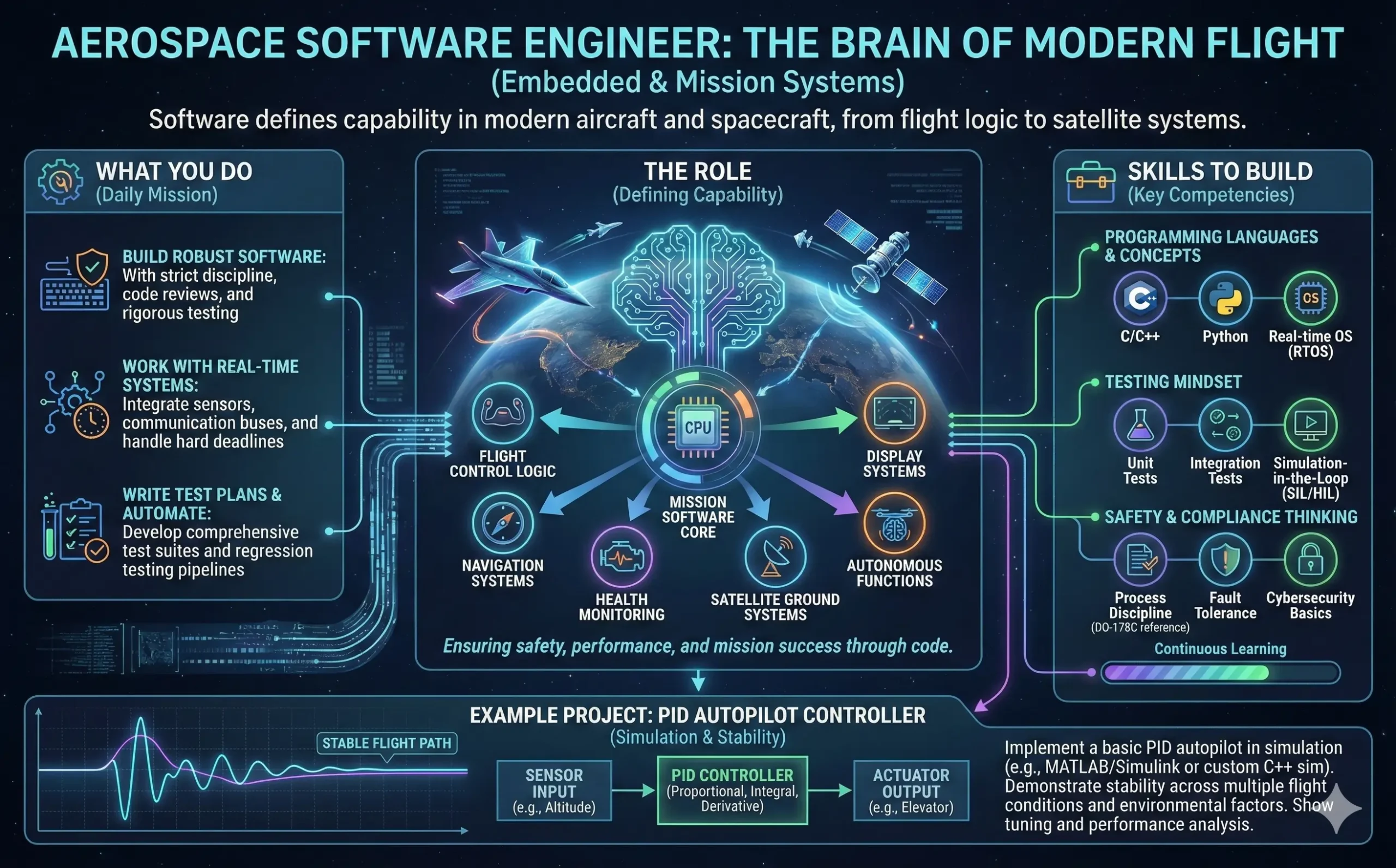
What you do:
- Build robust software with strict discipline and testing
- Work with sensors, communication buses, and real-time constraints
- Write test plans and automate regression testing
Skills to build:
- C/C++, Python, real-time concepts
- Testing mindset: unit tests, integration tests, simulation-in-the-loop
- Safety and compliance thinking (process discipline matters)
Example project:
- Implement a basic autopilot PID controller in simulation and show stability results across multiple conditions.
4. Avionics Cybersecurity Engineer
As aircraft become more connected, cybersecurity matters for safety, integrity, and trust. This role often blends systems engineering with security engineering.
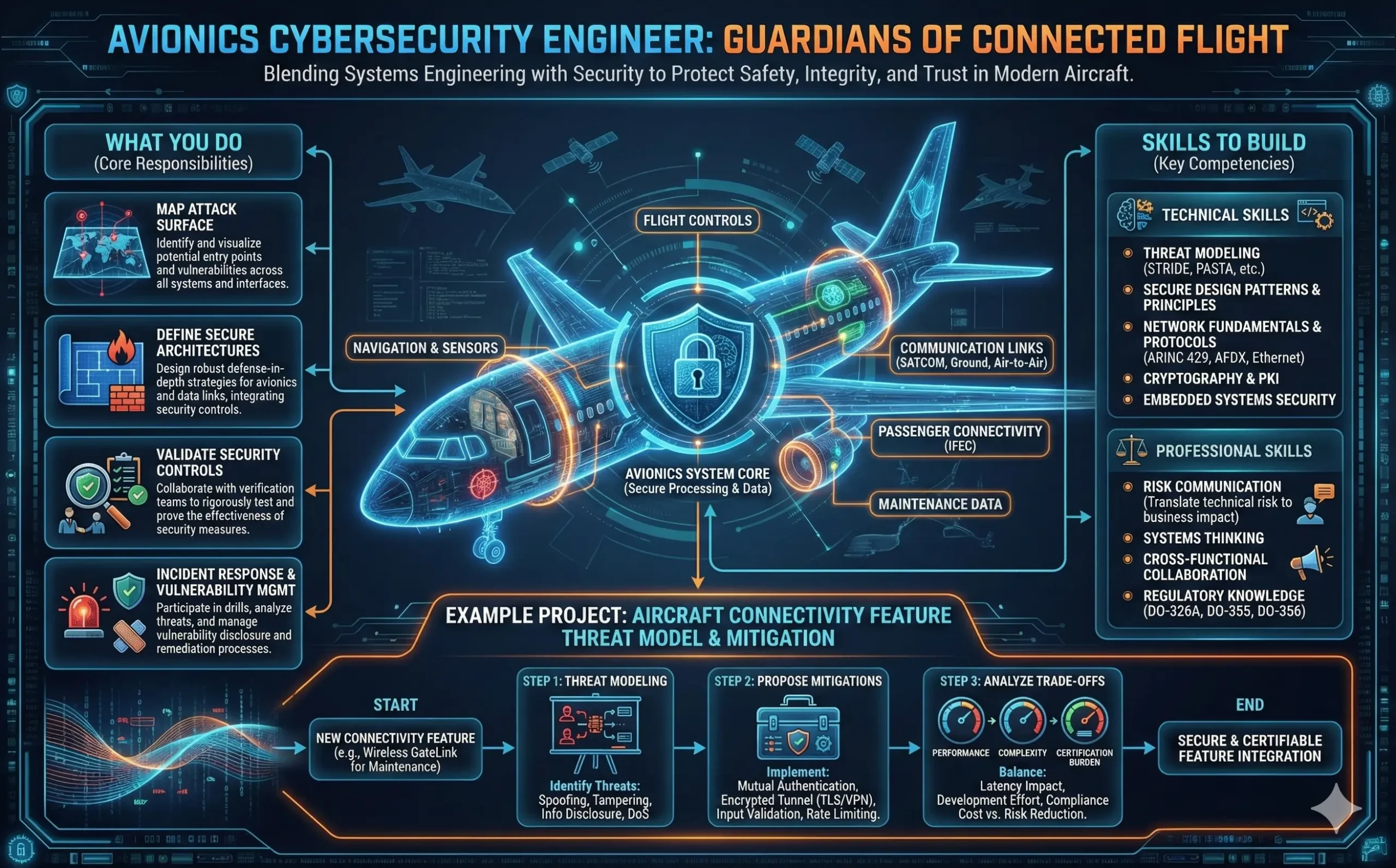
What you do:
- Map the system attack surface
- Define secure architectures for avionics and data links
- Work with verification teams to validate security controls
- Participate in incident response drills and vulnerability management
Skills to build:
- Threat modeling, secure design patterns, network fundamentals
- Risk communication, because security decisions affect schedules and budgets
Example project:
- Create a threat model for an aircraft connectivity feature and propose mitigations with trade-offs (performance, complexity, certification burden).
5. Autonomy and AI Engineer (Aerospace and Defense, Drones, Space Robotics)
Autonomy is a fast-growing capability area. The modern trend is not “AI everywhere,” but AI with constraints, heavy testing, and a strong safety case.
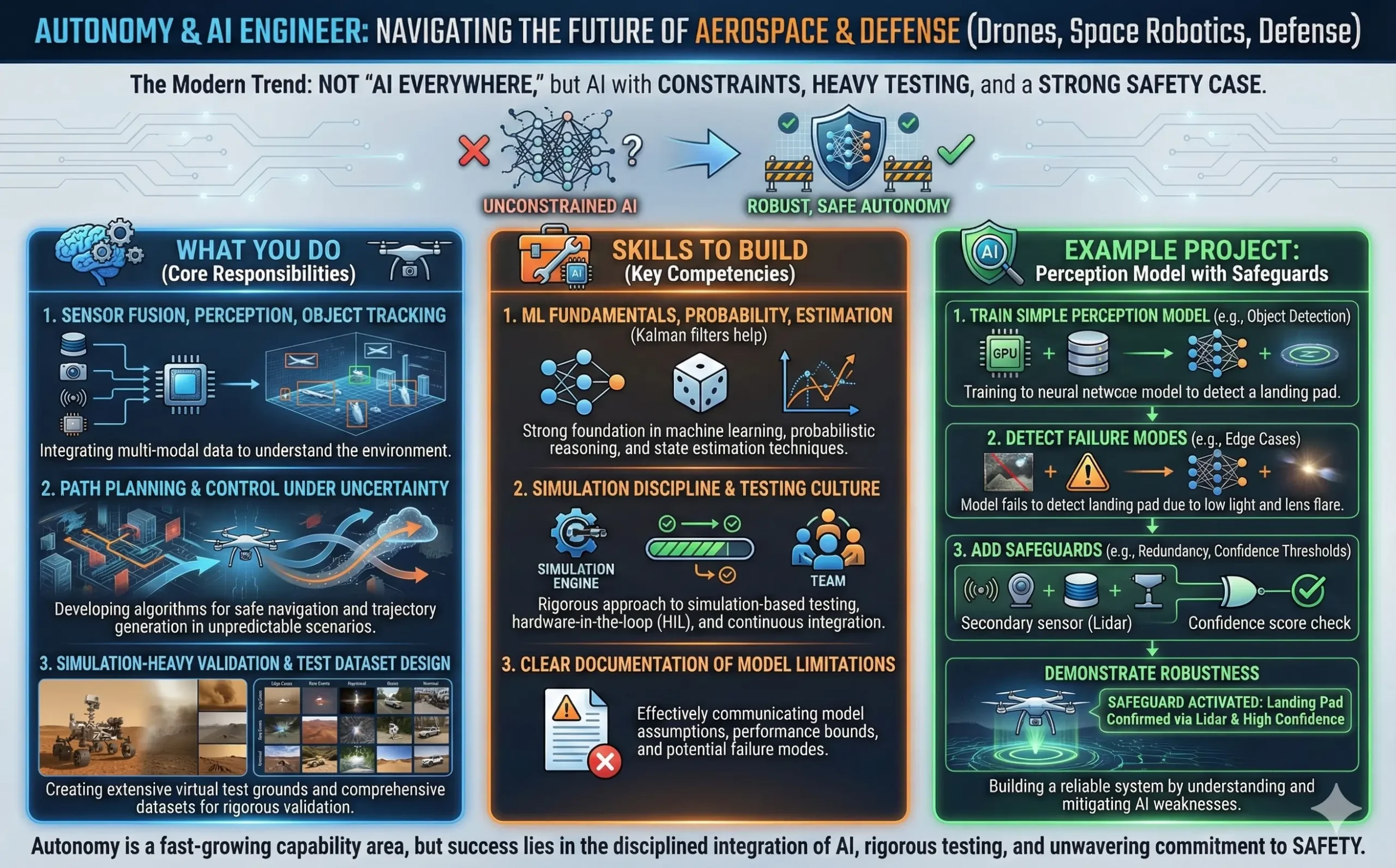
What you do:
- Sensor fusion, perception, object tracking
- Path planning and control under uncertainty
- Simulation-heavy validation and test dataset design
Skills to build:
- ML fundamentals, probability, estimation (Kalman filters help)
- Simulation discipline and testing culture
- Clear documentation of model limitations
Example project:
- Train a simple perception model, then demonstrate how you detect failure modes and add safeguards.
6. Sustainable Aviation Specialist (SAF, emissions, operations, compliance)
Aviation’s long-term direction includes net-zero by 2050 at the international level, and many decarbonization roadmaps rely heavily on SAF plus operational improvements, new aircraft technology, and policy measures.
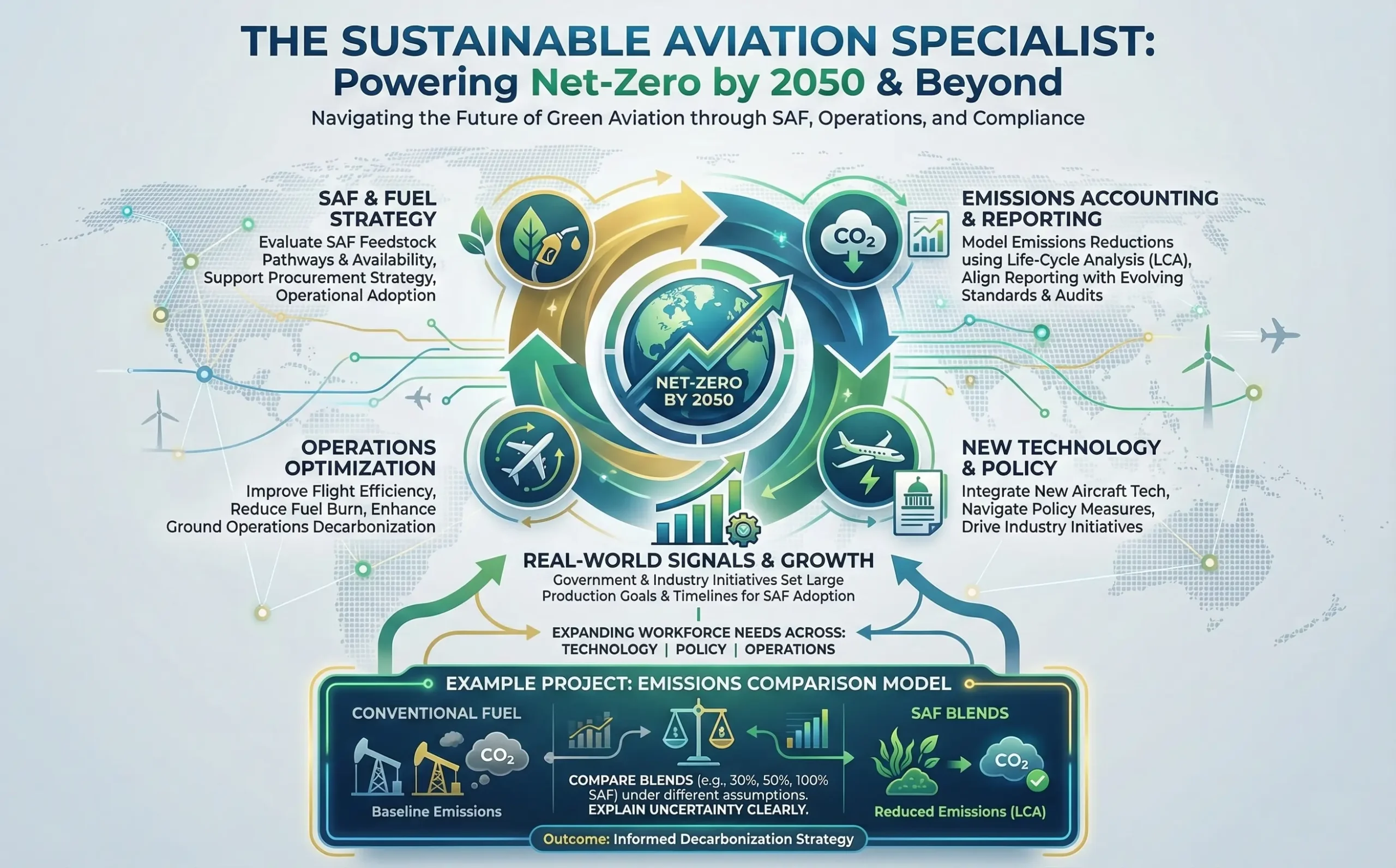
This creates new career lanes across:
- Fuel ecosystem strategy
- Emissions accounting and reporting
- Operations optimization
- Airport and ground operations decarbonization
What you do:
- Evaluate SAF feedstock pathways and availability
- Model emissions reductions using life-cycle analysis
- Support procurement strategy and operational adoption
- Align reporting with evolving standards and audits
Real-world signals:
- Government and industry initiatives set large production goals and timelines for SAF adoption, which expand workforce needs across technology, policy, and operations.
Example project:
- Build a simple emissions model comparing conventional fuel vs SAF blends under different assumptions. Explain uncertainty clearly.
7. Hydrogen and Electrified Propulsion Engineer
Hydrogen and electrification research continues because decarbonizing aviation likely requires multiple technology pathways. NASA research roadmaps emphasize hydrogen-focused technology development challenges and opportunities.
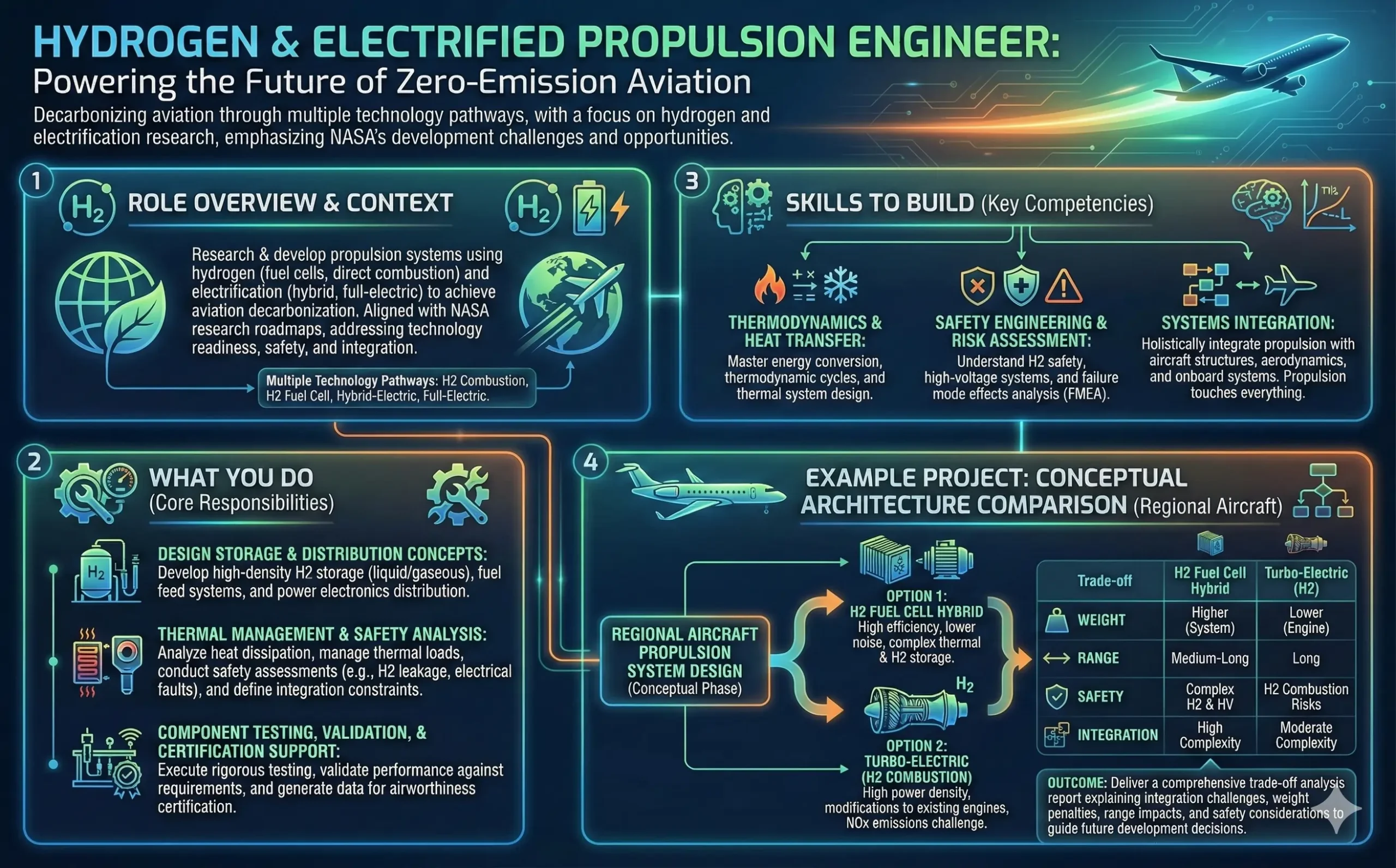
What you do:
- Design storage and distribution concepts
- Thermal management, safety analysis, integration constraints
- Component testing, validation, and certification support
Skills to build:
- Thermodynamics, heat transfer, safety engineering
- Systems integration, because propulsion touches everything
Example project:
- Compare conceptual architectures for a regional aircraft propulsion system and explain integration trade-offs like weight, range, and safety.
8. Additive Manufacturing Engineer (Aerospace Production and Qualification)
Additive manufacturing is no longer only prototyping. It is also production, repair, and supply chain flexibility when properly qualified.
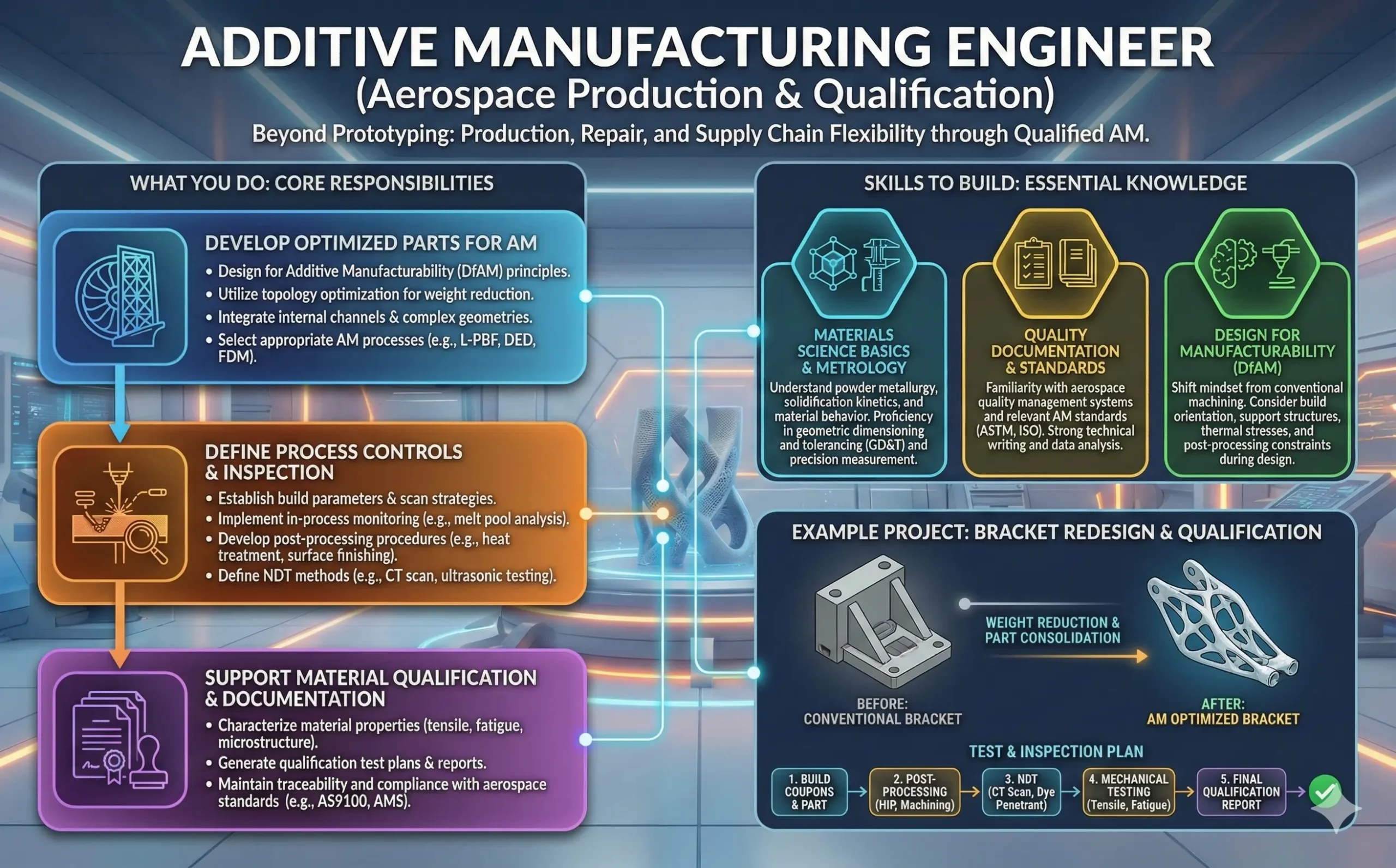
What you do:
- Develop parts optimized for AM
- Define process controls and inspection methods
- Support material qualification and documentation
Skills to build:
- Materials science basics, metrology, quality documentation
- Design for manufacturability, not only performance
Example project:
- Redesign a bracket for weight reduction using AM rules, then write a test and inspection plan to prove it is reliable.
9. Supply Chain and Industrialization Analyst
Aerospace demand can outpace supply, which increases the need for industrialization experts who can help ramp production while maintaining quality. Industry outlooks note persistent capacity constraints and workforce pressures.
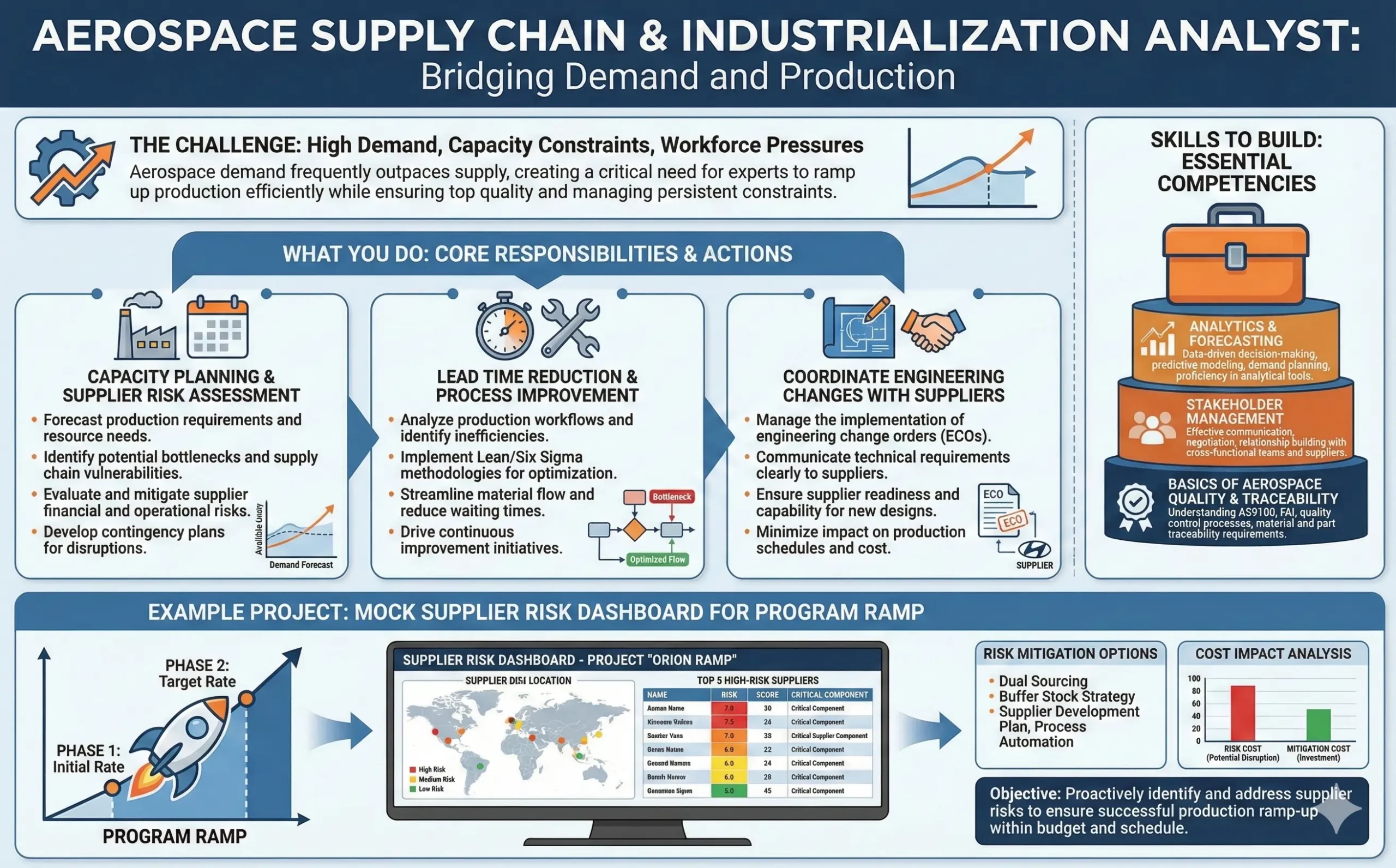
What you do:
- Capacity planning and supplier risk assessment
- Lead time reduction and process improvement
- Coordinate engineering changes with suppliers
Skills to build:
- Analytics, forecasting, stakeholder management
- Basics of aerospace quality and traceability
Example project:
- Create a mock supplier risk dashboard for a program ramp, with mitigation options and cost impact.
10. MRO Reliability Engineer (Maintenance Analytics and Operational Performance)
As service markets expand, reliability roles become more valuable. Services growth projections support a long runway for MRO-focused careers.
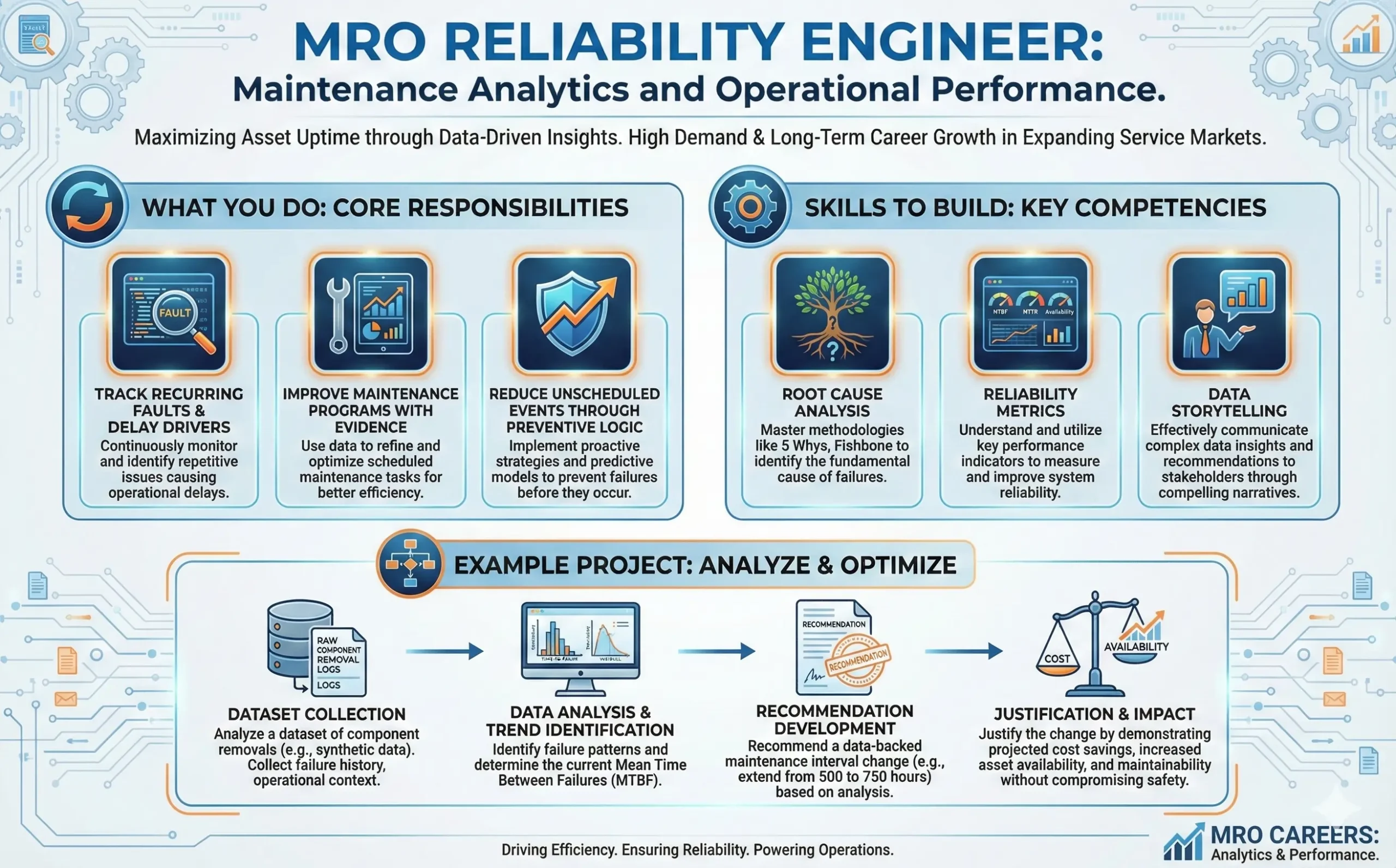
What you do:
- Track recurring faults and delay drivers
- Improve maintenance programs with evidence
- Reduce unscheduled events through preventive logic
Skills to build:
- Root cause analysis, reliability metrics, data storytelling
Example project:
- Analyze a dataset of component removals (synthetic is fine), then recommend a maintenance interval change and justify it.
11. Aviation Safety and Compliance Specialist
Safety roles stay essential, and regulator workforce planning and safety governance remain a major focus area.
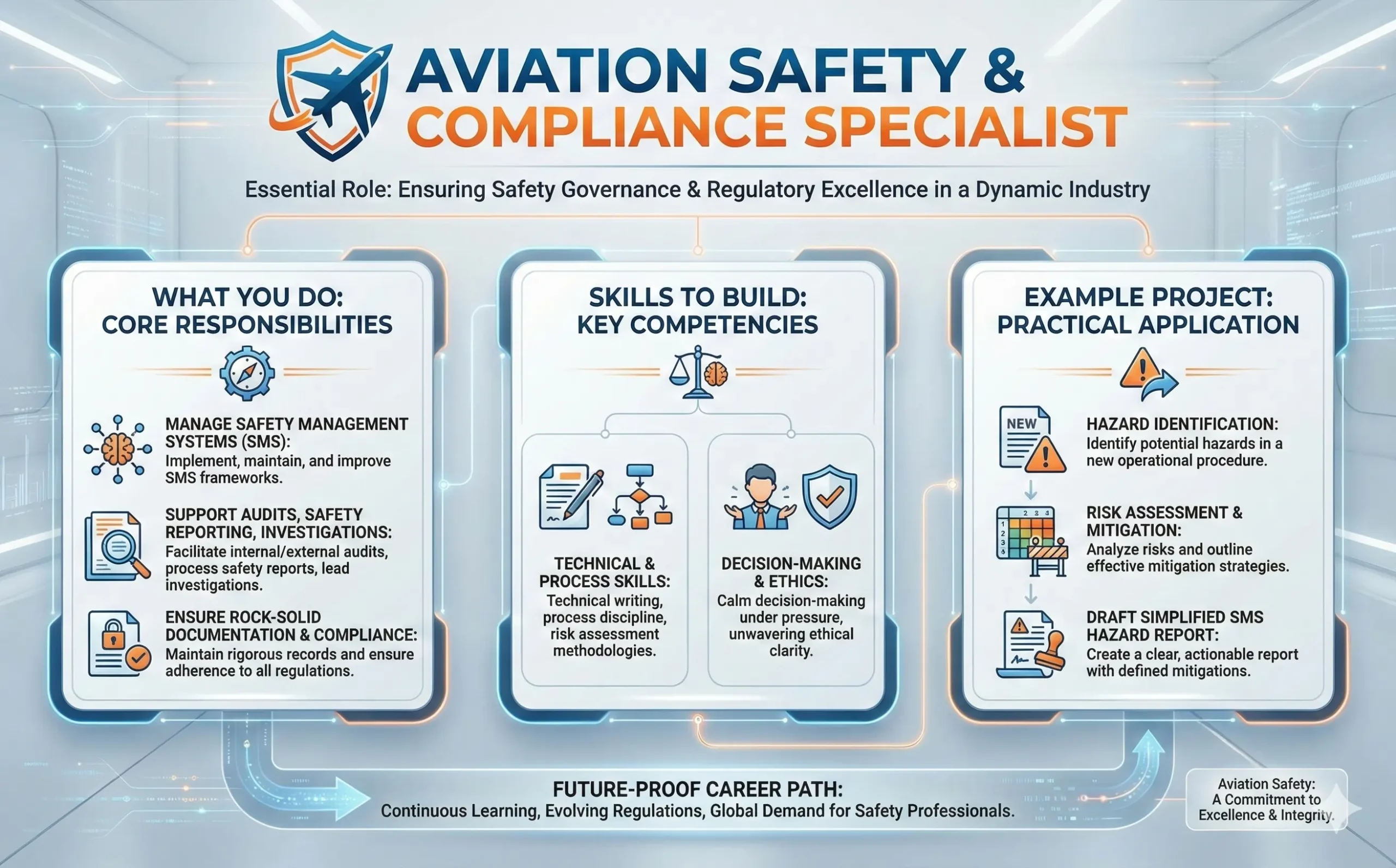
What you do:
- Manage Safety Management Systems (SMS)
- Support audits, safety reporting, investigations
- Ensure documentation and compliance are rock-solid
Skills to build:
- Technical writing, process discipline, risk assessment
- Calm decision-making and ethical clarity
Example project:
- Draft a simplified SMS hazard report for a new operational procedure and outline mitigations.
12. Manufacturing Technician and Aerospace Quality Specialist
Aerospace manufacturing workforce development is receiving focused attention, and technical pathways remain highly relevant.
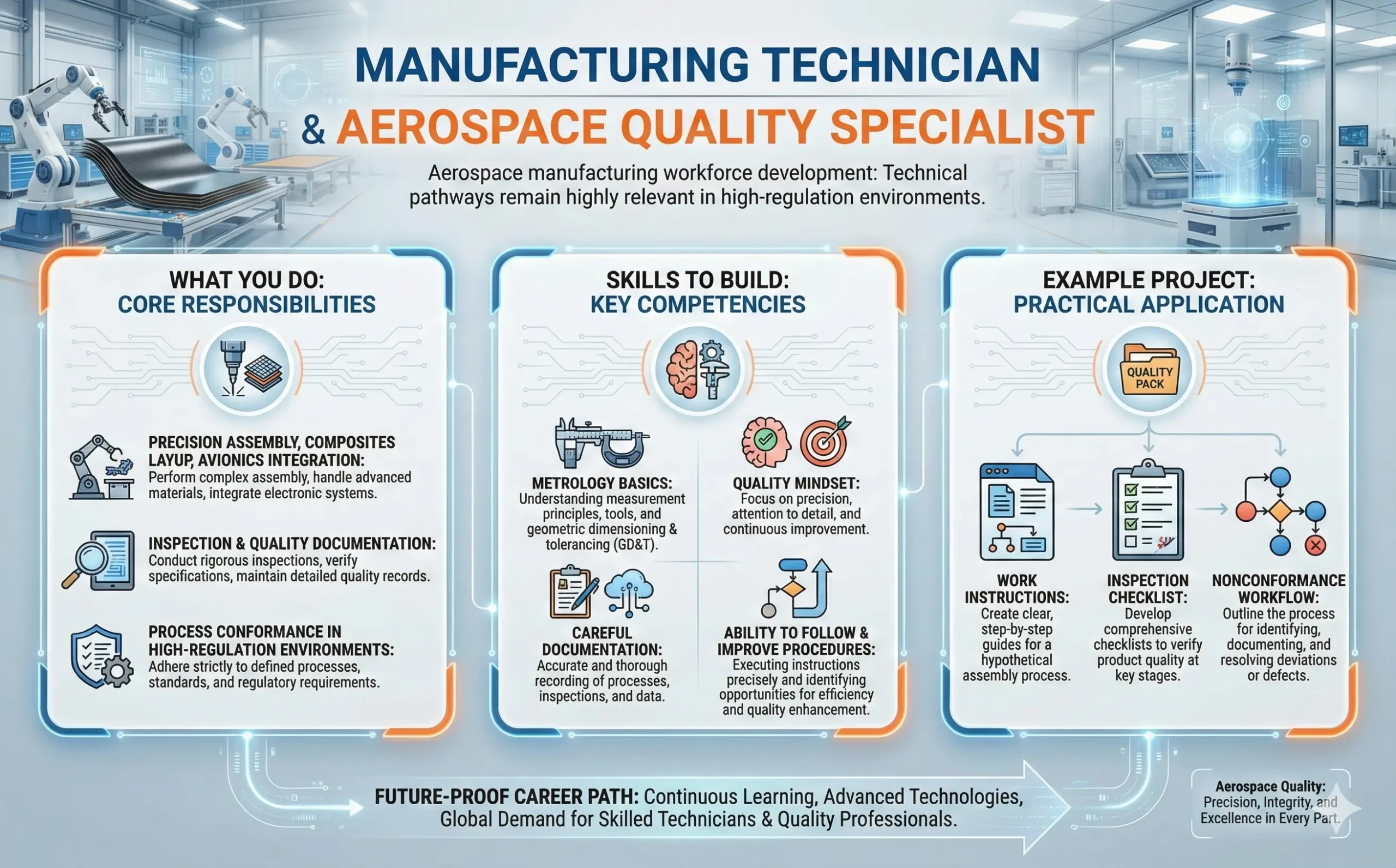
What you do:
- Precision assembly, composites layup, avionics integration
- Inspection and quality documentation
- Process conformance in high-regulation environments
Skills to build:
- Metrology basics, quality mindset, careful documentation
- Ability to follow and improve procedures
Example project:
- Build a small “quality pack” for a hypothetical assembly process: work instructions, inspection checklist, and nonconformance workflow.
13. Aircraft Maintenance Technician (AMT) and Powerplant Path
Global forecasts continue to show significant long-term demand for maintenance technicians.
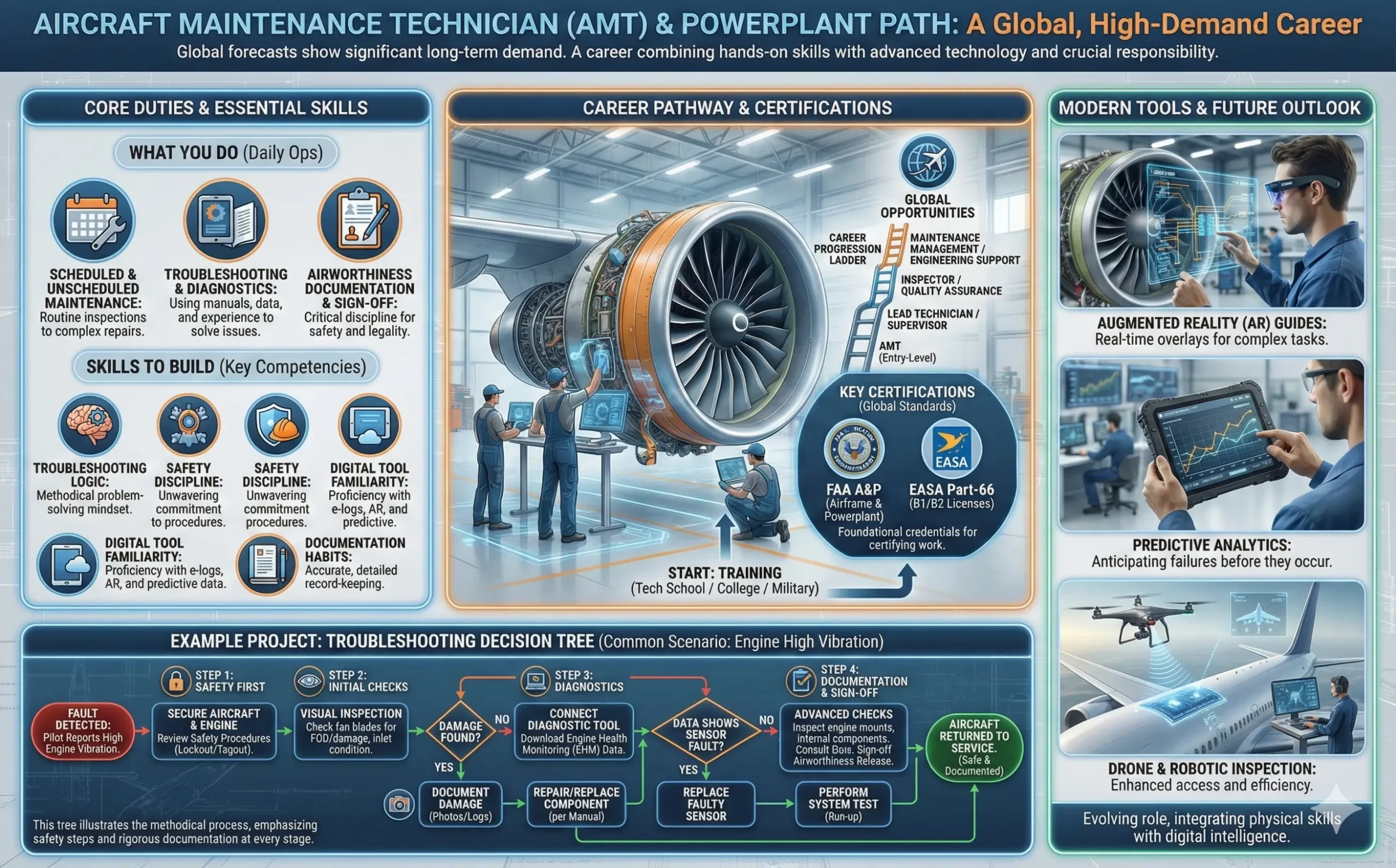
What you do:
- Scheduled and unscheduled maintenance
- Troubleshooting using manuals, diagnostics, and experience
- Airworthiness documentation and sign-off discipline
Skills to build:
- Troubleshooting logic, safety discipline, and documentation habits
- Familiarity with digital maintenance tools
Example project:
- Create a troubleshooting decision tree for a common fault scenario, including safety steps and documentation requirements.
14. Pilot and Flight Operations Track
Pilot demand forecasts remain strong long-term, and the pathway continues to be structured and training-intensive.
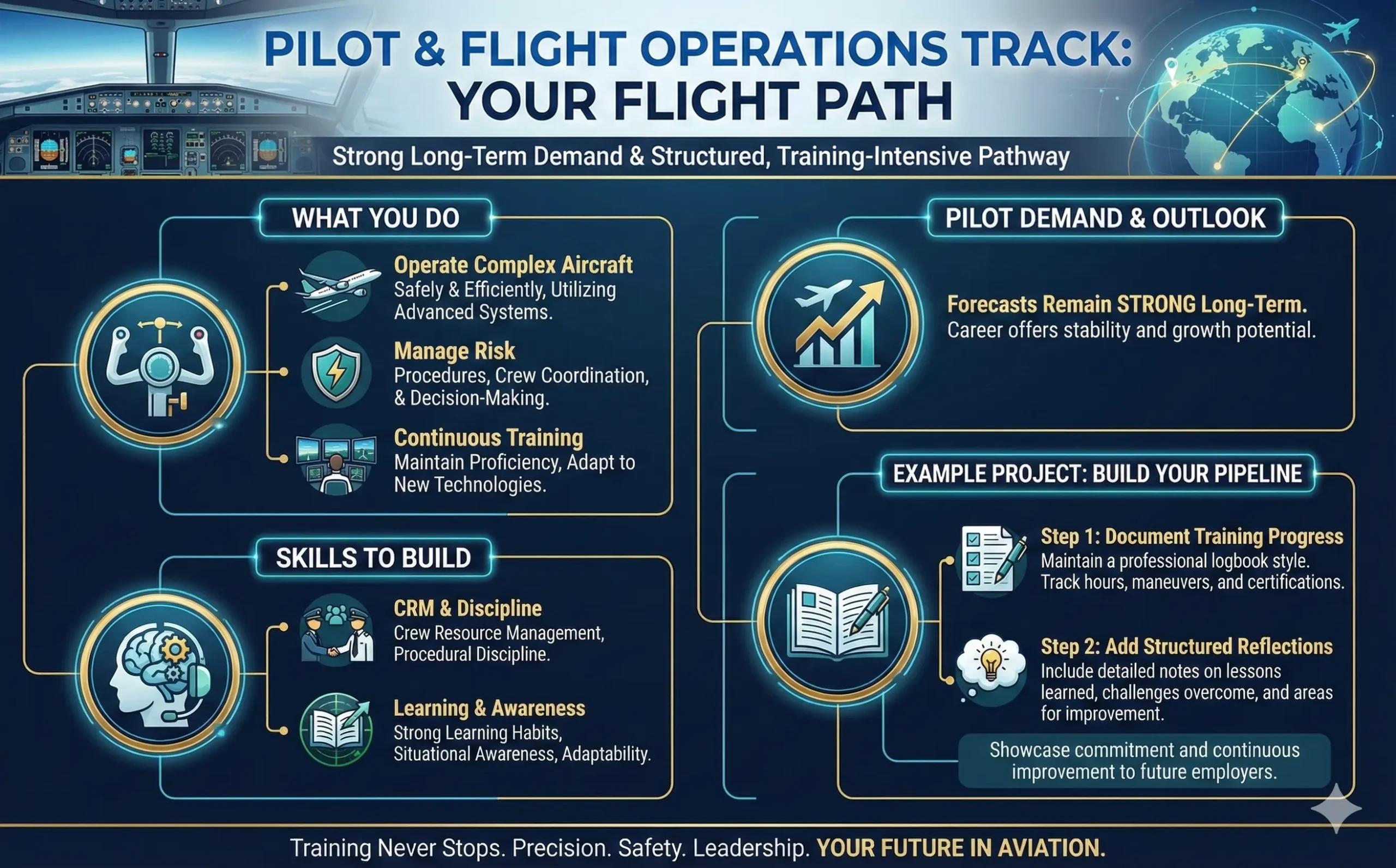
What you do:
- Operate complex aircraft safely and efficiently
- Manage risk with procedures, crew coordination, and decision-making
- Continuously train and maintain proficiency
Skills to build:
- CRM (Crew Resource Management), procedural discipline, situational awareness
- Strong learning habits, because training never stops
Example project:
- If you are earlier in the pipeline, document your training progress in a professional logbook style and add structured reflections on lessons learned.
15. Air Traffic Management and ATC Support Careers
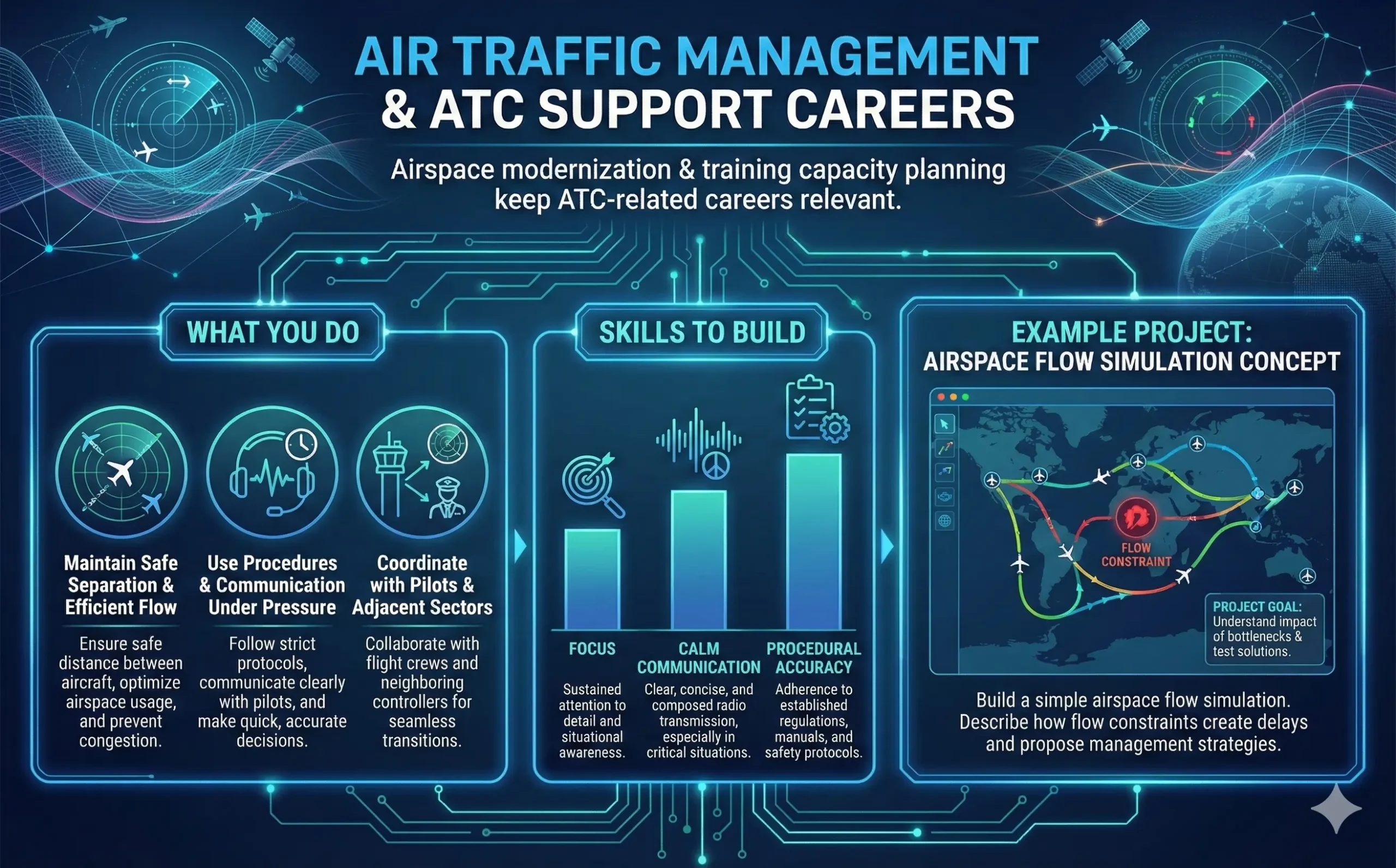
Airspace modernization and training capacity planning continue to be an important issue, which keeps ATC-related careers relevant.
What you do:
- Maintain safe separation and efficient flow
- Use procedures and communication under pressure
- Coordinate with pilots and adjacent sectors
Skills to build:
- Focus, calm communication, procedural accuracy
Example project:
- Build a simple airspace flow simulation concept and describe how flow constraints create delays.
16. Space Systems, Satellites, and Space-Enabled Services
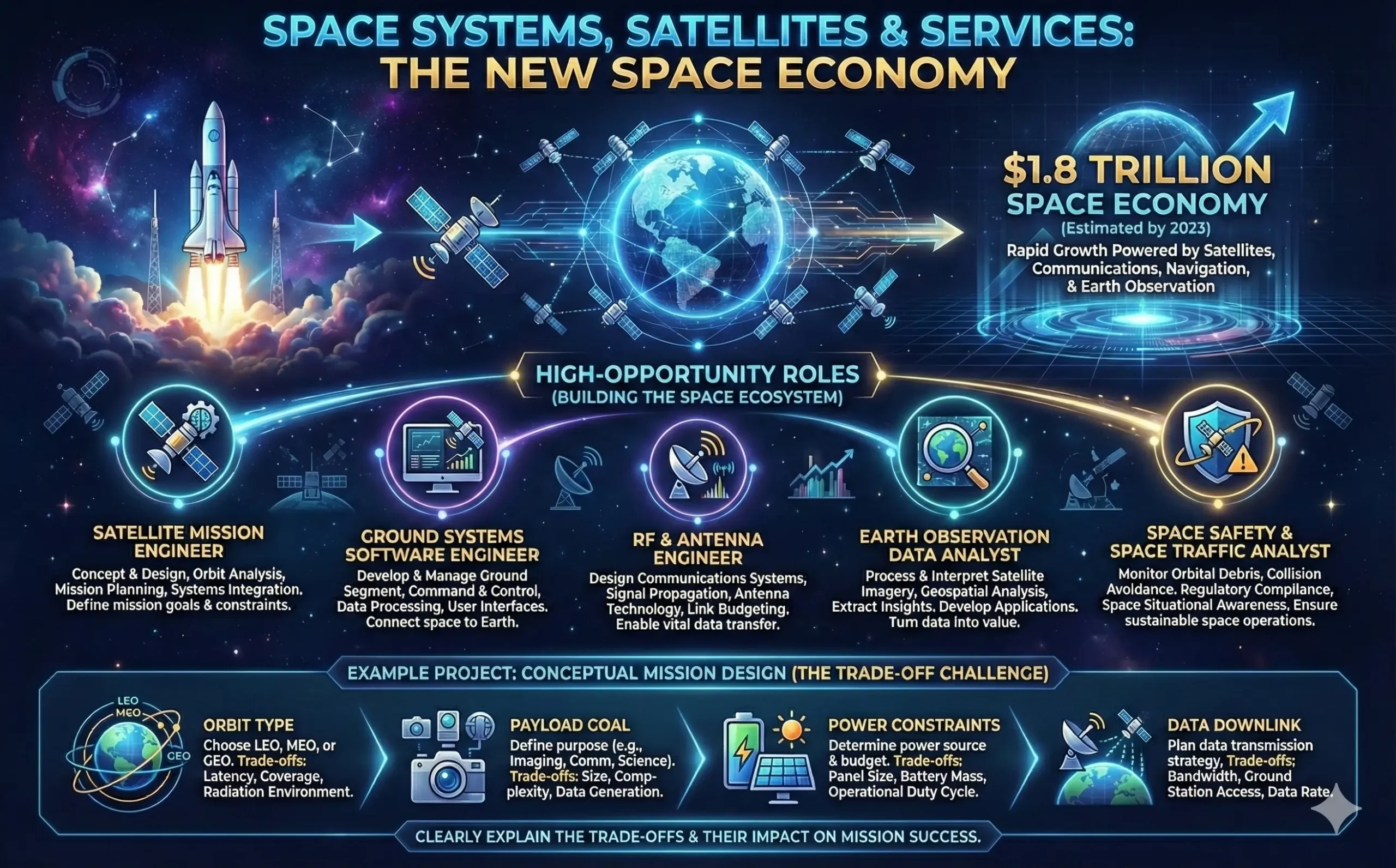
Space is no longer only rockets and astronauts. A huge share of growth comes from satellites and the services built on top: communications, navigation, and Earth observation. Research estimates rapid growth toward a much larger space economy by 2035.
High-opportunity roles include:
- Satellite mission engineer
- Ground systems software engineer
- RF and antenna engineer
- Earth observation data analyst
- Space safety and space traffic analyst (growing importance as orbits get crowded)
Example project:
- Design a simple conceptual mission: choose orbit type, payload goal, power constraints, and data downlink assumptions. Explain the trade-offs clearly.
Table: Skills That Will Matter Most in Aerospace Hiring (2026+)
| Skill Category | Why It’s Rising | What Hiring Teams Look For | Proof You Can Show |
|---|---|---|---|
| Digital Engineering and MBSE | Programs need traceability and faster iteration | Clean models, interface clarity, verification thinking | A small modeled system and verification plan |
| AI and Data Analytics | Predictive maintenance, autonomy, faster decisions | Practical use cases, safety awareness, validation | A data project with error analysis |
| Cybersecurity | Connectivity increases risk exposure | Threat modeling, secure architectures, disciplined testing | A written security assessment or lab demo |
| Sustainability and SAF | Net-zero direction and SAF scaling | LCA thinking, policy literacy, implementation realism | Emissions model, SAF scenario analysis |
| Advanced Manufacturing | Quality and throughput need modern processes | Process control, documentation, metrology | A process plan plus an inspection checklist |
| Reliability and MRO Analytics | Services growth, fleet expansion | Root cause skills, operational reasoning | Reliability report and recommendations |
| Systems Integration | Complexity is the norm | Interface management, trade studies, clear decisions | Trade study write-up with assumptions |
Table: Recommended Learning Routes (By Background)
| Your Background | Best Career Picks | What to Learn First | 90-Day Portfolio Goal |
|---|---|---|---|
| Mechanical or Aerospace student | MBSE Systems, Thermal, Manufacturing, Reliability | Requirements, modeling basics, test thinking | One end-to-end system concept plus verification plan |
| Electrical or Electronics student | Avionics, SATCOM, Embedded Software, Cybersecurity | Signals, real-time basics, network fundamentals | Build a simulated avionics feature and test plan |
| Computer Science student | Aerospace Software, Digital Twins, Autonomy, Ground Systems | Testing discipline, simulation, data pipelines | A flight or mission simulation with analytics dashboard |
| Diploma or hands-on technical learner | Manufacturing Tech, AMT, Quality | Documentation, metrology basics, troubleshooting | A professional process pack (work steps + inspection) |
| Working professional switching careers | Safety, Compliance, Supply Chain, Program Support | Aviation domain literacy, reporting clarity | A “case study” portfolio showing structured problem-solving |
The “Hidden” Aerospace Careers That Quietly Pay Off Long-Term
Many people chase only the glamorous roles, but these tracks can be extremely stable and influential:
- Certification and compliance engineering
- Test engineering (ground test, flight test support, verification)
- Configuration management and requirements management
- Safety engineering and system assurance
- Supplier quality engineering
- Technical publications and maintenance documentation (high impact, underestimated)
These roles are often close to decision-making, because certification evidence and safety cases decide whether a product ships.
What to Expect in Hiring From 2026 Onward
Expect more emphasis on “proof of skill” than “perfect resume.”
In practical terms, that means:
- A small portfolio beats a long list of courses
- Clear writing is a career accelerator in aerospace
- Employers value candidates who understand trade-offs (weight vs cost vs safety vs schedule)
- Teams want people who can work across disciplines, especially in systems and digital work
Industry research has also emphasized talent gaps and the importance of reskilling and productivity, which is another reason portfolios and practical skill signals matter.
Examples of “Portfolio Proof” That Works for Aerospace
You can build these without expensive equipment:
- A trade study comparing two aircraft configurations with assumptions and sensitivity analysis
- A digital twin mini-project: synthetic telemetry, anomaly detection, maintenance recommendation
- An MBSE mini-model: requirements, interfaces, verification plan for a UAV or satellite subsystem
- A reliability report: recurring fault patterns and a mitigation plan
- A SAF scenario analysis: emissions impact, cost assumptions, uncertainty explanation
- A cyber threat model: attack surface, mitigations, verification steps
- A manufacturing process and inspection pack with clean documentation
Aerospace Career Planning Table: Choose Your Track Like a Strategy
| Career Goal | Choose This Track | Build These Skills | Best Early Projects |
|---|---|---|---|
| Work on next-gen aircraft programs | MBSE, digital engineering, manufacturing quality | Requirements, interfaces, verification | Modeled system + test plan |
| Get into airline operations growth | MRO, reliability, flight ops analytics | Reliability metrics, decision-making | Delay-driver analysis |
| Build climate-focused aviation impact | SAF, emissions, operations efficiency | LCA thinking, policy literacy | SAF adoption model |
| Enter the space ecosystem | satellite systems, ground software, data services | Systems, software, RF basics | Mission concept + downlink plan |
| Join defense and high-assurance programs | cybersecurity, systems assurance, test engineering | Security + verification discipline | Threat model + verification outline |
| Prefer hands-on, stable growth | AMT, manufacturing tech, quality | Documentation, troubleshooting | Process pack + inspection checklist |
Mistakes to Avoid When Choosing an Aerospace Career
- Chasing only the job title instead of the skill stack
A “cool title” without in-demand skills is fragile. - Ignoring documentation and process
Aerospace is a proof-driven industry. If you cannot document, you cannot scale. - Skipping systems thinking
Even specialists get promoted faster when they understand interfaces and trade-offs. - Treating sustainability as a buzzword
Hiring managers prefer candidates who understand the operational reality: fuel availability, costs, certification, and uncertainty.
A Simple, Action-Oriented Roadmap to Start in 2026
Week 1–2: Pick one track and one adjacent track
Example: MBSE Systems Engineer plus Cybersecurity, or MRO Reliability plus Data Analytics.
Week 3–6: Build one strong project
Keep it small, clean, and complete. One polished project beats five unfinished ones.
Week 7–10: Write like a professional
Create a short technical report: assumptions, method, results, limitations, next steps.
Week 11–12: Package your proof
One-page resume + portfolio links + a short “what I built” summary.
Final Thoughts
Aerospace is still about aircraft and spacecraft, but the winning careers in 2026 and beyond are increasingly hybrid: engineering plus software, operations plus data, sustainability plus systems, manufacturing plus quality plus automation.
If you want a future-proof move, build skills that sit on long-term horizons: digital engineering, safety, reliability, cybersecurity, and sustainability. Forecasts of continued fleet growth, expanding services markets, and rising demand for aviation personnel all suggest that aerospace remains a strong long-term field, especially for people who keep learning and can prove what they can do.
Key Citations With Source Links
- Commercial Aircraft Demand Forecast (Long-Term Outlook)
https://www.boeing.com/commercial/market/commercial-market-outlook - Global Pilot and Aviation Workforce Demand Forecast
https://www.boeing.com/commercial/market/pilot-technician-outlook - Aerospace Services and MRO Market Growth Analysis
https://www.boeing.com/services/market-outlook - Model-Based Systems Engineering and Digital Engineering Overview
https://www.nasa.gov/digitaltransformation/digital-engineering - Digital Twin Technology in Aerospace Applications
https://www.ibm.com/topics/digital-twin - Global Space Economy Growth Projections
https://www.weforum.org/reports/space-the-1-8-trillion-opportunity-for-global-economic-growth - Satellite Communications and Space Systems Market Trends
https://www.esa.int/Applications/Telecommunications_Integrated_Applications - Autonomous Systems and AI Safety in Aerospace
https://www.nasa.gov/artificial-intelligence - Aircraft and Avionics Cybersecurity Risk Frameworks
https://www.easa.europa.eu/en/domains/cybersecurity - Global Aviation Net-Zero Emissions Commitment
https://www.icao.int/environmental-protection/Pages/ClimateChange.aspx - Sustainable Aviation Fuel Industry Roadmap
https://www.iata.org/en/programs/environment/sustainable-aviation-fuels - Life-Cycle Emissions Analysis of Sustainable Aviation Fuel
https://www.energy.gov/eere/bioenergy/sustainable-aviation-fuel - Hydrogen Aviation Technology Roadmap
https://www.nasa.gov/aeronautics/hydrogen-aircraft - Electrified Aircraft Propulsion Research
https://www.nasa.gov/aeronautics/electric-aircraft - Additive Manufacturing Qualification in Aerospace
https://www.nasa.gov/3d-printing-in-space - Aerospace Supply Chain Resilience and Industrialization
https://www.weforum.org/reports/global-aerospace-supply-chain-resilience - Reliability Engineering and Predictive Maintenance in Aviation
https://www.iata.org/en/programs/ops-infra/maintenance - Safety Management Systems (SMS) Regulatory Guidance
https://www.faa.gov/about/initiatives/sms - Aviation Regulatory Workforce Planning and Safety Oversight
https://www.icao.int/safety/Pages/default.aspx - Aerospace Manufacturing Workforce Development
https://www.manufacturing.gov/aerospace - Aircraft Maintenance Technician Career Outlook
https://www.bls.gov/ooh/installation-maintenance-and-repair/aircraft-and-avionics-equipment-mechanics-and-technicians.htm - Professional Pilot Career Outlook and Training Pathways
https://www.faa.gov/pilots/become - Air Traffic Management and ATC Modernization
https://www.faa.gov/air_traffic - Defense and High-Assurance Systems Engineering Standards
https://www.incose.org/systems-engineering - Aerospace Talent Gap and Reskilling Trends
https://www.weforum.org/reports/the-future-of-jobs-report-2023
Read These Articles in Detail
- Aerospace Engineering vs. Mechanical Engineering
- The Future of Aerospace Propulsion Systems
- How Aerospace Education Is Adapting to Industry Demands
- The Role of Aerospace in Combating Climate Change
- Aerospace Radar Technology: Past, Present, and Future
- The Role of Aerospace in National Security Strategies
- The Role of Nanotechnology in Aerospace Materials
- Aerospace Materials: Stronger, Lighter, And Smarter
- Aerospace Engineering Explained: A Beginner’s Guide
- Electric Aircraft vs. Hydrogen Aircraft: Which Is More Sustainable?
- Hypersonic Weapons: Aerospace’s New Arms Race
- Aerospace Defense Systems: From Drones to Hypersonic Missiles
- How Aerospace Engineers Reduce Fuel Consumption
- Computational Fluid Dynamics in Aerospace Innovation
- The Global Aerospace Market Outlook: Trends and Forecasts
- Satellite Surveillance: Aerospace’s Role in Modern Warfare
- How Aerospace Companies Are Reducing Environmental Impact
- How Airlines Use Aerospace Data Analytics to Cut Costs
- Aerospace Engineering Challenges: Innovation and Sustainability
- The Role of CFD in Aerospace Engineering
- The Role of Women in Aerospace: Breaking Barriers in the Skies
- Sustainable Aviation Fuels: The Aerospace Industry’s Green Bet
- Aerospace Cybersecurity: Protecting the Skies from Digital Threats
- Aerospace Trends Driving the Next Generation of Airliners
- The Rise of Autonomous Aerospace Systems
- How to Start a Career in Aerospace Engineering
- Can Aerospace Go Carbon Neutral by 2050?
- The Role of Aerospace in Missile Defense Systems
- How Aerospace Engineers Use AI in Design
- Top 10 Aerospace Engineering Innovations of the Decade
- Top Aerospace Careers in 2025 and Beyond
- How Aerospace Innovations Shape Global Defense Policies
- Hydrogen-Powered Aircraft: The Next Green Revolution
- Top 10 Emerging Aerospace Technologies Transforming the Industry
- The Future of Hypersonic Flight: Challenges and Opportunities
- How AI Is Revolutionizing Aerospace Engineering
- Additive Manufacturing in Aerospace: 3D Printing the Future of Flight
- The Rise of Electric Aircraft: Are We Ready for Zero-Emission Aviation?
- Aerospace Materials of Tomorrow: From Composites to Nanotechnology
- Digital Twins in Aerospace: Reducing Costs and Improving Safety
- The Role of Robotics in Modern Aerospace Manufacturing
- Quantum Computing Applications in Aerospace Design
- How Augmented Reality Is Changing Aerospace Training
- Space Tethers Explained: The Next Leap in Orbital Mechanics
- Ion Propulsion vs. Chemical Rockets: Which Will Power the Future?
- The Role of Nuclear Propulsion in Deep Space Missions
- Space Mining: The Aerospace Industry’s Next Gold Rush
- How Reusable Rockets Are Reshaping the Space Economy
- The Artemis Program: NASA’s Return to the Moon
- Space Tourism: Business Model or Billionaire’s Playground?
- How Aerospace Startups Are Disrupting Commercial Aviation
- The Economics of Low-Cost Airlines in the Aerospace Era
- Urban Air Mobility: The Rise of Flying Taxis
- The Future of Mars Colonization: Key Aerospace Challenges and Solutions Ahead
- CubeSats and Small Satellites: Democratizing Space Access
- The Future of Cargo Drones in Global Logistics
- The Role of Aerospace in Building a Lunar Economy
Frequently Asked Questions
FAQ 1: What makes aerospace careers a strong long-term choice beyond 2026?
Aerospace careers remain strong beyond 2026 because they are driven by long-term global needs, not short-term trends. Commercial aviation continues to expand due to rising passenger demand, fleet replacement cycles, and stricter efficiency standards. At the same time, space systems, satellite services, and defense modernization are creating parallel growth streams that reinforce job stability.
Another important factor is regulation. Aerospace is a highly regulated industry, which means skills related to safety, certification, quality, and compliance cannot be automated away easily. Once professionals build experience in these areas, they become extremely valuable across multiple programs and even across countries.
Finally, the push toward sustainable aviation, including Sustainable Aviation Fuel (SAF), electrification, and hydrogen research, is creating entirely new roles that did not exist a decade ago. These roles are expected to grow steadily as environmental targets move from planning to execution.
FAQ 2: Which aerospace roles are expected to grow the fastest after 2026?
Several roles stand out due to technology shifts, sustainability goals, and operational complexity. These roles are not only growing but also evolving in responsibility and influence.
- Model-Based Systems Engineering (MBSE) Engineer, because complex aircraft and spacecraft require integrated digital system models
- Aircraft Maintenance Technician (AMT), driven by fleet growth and aircraft longevity
- Avionics and Embedded Systems Engineer, due to increasing software-defined aircraft architectures
- Spacecraft Operations and Mission Engineer, as satellite constellations expand
- Sustainability and SAF Program Specialist, supporting decarbonization commitments
What makes these roles especially attractive is that they sit at the intersection of engineering, operations, and decision-making, which makes them resilient to economic cycles.
FAQ 3: How important is sustainability for future aerospace careers?
Sustainability is no longer a side topic in aerospace. It is becoming a core hiring driver. Airlines, manufacturers, and regulators are aligning around net-zero emissions goals, which means companies need professionals who can translate climate targets into real engineering and operational changes.
This has created demand for roles that combine technical knowledge with system-level thinking. Engineers and analysts working with SAF, emissions modeling, life-cycle assessment, and energy efficiency are now central to long-term aerospace strategies. These professionals often collaborate with fuel suppliers, policymakers, and operations teams, making their work both technical and strategic.
For students and early-career professionals, sustainability-focused aerospace roles offer a rare opportunity to build careers that are both future-proof and impact-driven, without leaving the core aerospace ecosystem.
FAQ 4: What qualifications are required to enter the aerospace industry in 2026 and beyond?
The required qualifications vary by role, but aerospace generally values depth, discipline, and evidence of competence more than titles alone.
| Career path | Typical qualification | Additional expectations |
|---|---|---|
| Design and analysis engineering | Bachelor’s or Master’s in aerospace or mechanical engineering | Strong project portfolio and documentation skills |
| Avionics and software roles | Electrical engineering or computer science degree | Safety-oriented coding and testing mindset |
| Maintenance and MRO | Approved technical diploma or certification | Strict adherence to procedures and regulations |
| Space operations | Engineering or physics background | Systems thinking and simulation exposure |
| Quality and certification | Engineering or applied science degree | Process control and technical writing ability |
Across all roles, employers increasingly look for candidates who understand requirements, verification, and traceability, even at the entry level.
FAQ 5: Can professionals from non-aerospace backgrounds transition into aerospace careers?
Yes, transitions into aerospace are common and increasingly encouraged, especially in areas such as quality engineering, systems engineering, data analytics, and cybersecurity. Aerospace values transferable skills like structured problem-solving, documentation discipline, and risk awareness.
Professionals from automotive, energy, manufacturing, IT, and defense-adjacent sectors often transition successfully by learning aerospace-specific standards and terminology. The key is not to relearn everything from scratch, but to reframe existing experience within a regulated, safety-critical context.
Those who invest time in understanding aerospace workflows, such as configuration control and verification planning, tend to integrate quickly and advance steadily.
FAQ 6: What technical skills will matter most for aerospace jobs after 2026?
Future aerospace professionals will need a balanced mix of fundamentals and modern tools. The most valuable skills are those that support safe, scalable, and efficient systems.
- Strong foundations in engineering fundamentals, such as mechanics, thermodynamics, and electronics
- Ability to work with simulation and modeling, while understanding their limitations
- Familiarity with digital engineering workflows, including model-based approaches
- Comfort with data analysis for reliability, maintenance, and performance monitoring
- Clear technical writing for reports, procedures, and certification evidence
Employers value engineers who can explain why a result is valid, not just how it was obtained.
FAQ 7: How does the space sector influence aerospace career opportunities?
The space sector has transformed aerospace career opportunities by expanding beyond government-led missions into commercial and operational systems. This shift has increased demand for engineers who can support production-scale spacecraft, frequent launches, and continuous mission operations.
Unlike earlier eras focused mainly on research, today’s space roles emphasize reliability, automation, operations, and cost control. Careers in satellite operations, flight dynamics, spacecraft integration, and ground systems are especially strong because constellations require long-term operational support.
For professionals who enjoy systems-level challenges and real-time decision-making, the space sector offers dynamic and globally relevant career paths.
FAQ 8: What role do digital twins and data play in future aerospace jobs?
Digital Twin technology is becoming a foundational tool in aerospace engineering and maintenance. It allows engineers to connect design data with real-world operational data, creating continuous feedback loops.
| Application area | How digital twins are used | Career impact |
|---|---|---|
| Aircraft maintenance | Predict component wear and failures | Increased demand for reliability engineers |
| Structural health monitoring | Track fatigue and load usage | Growth in data-informed stress analysis |
| Spacecraft operations | Monitor system behavior in orbit | Expansion of mission analytics roles |
| Manufacturing | Improve quality and reduce defects | Stronger link between production and engineering |
Professionals who understand both physics-based models and data interpretation are especially well positioned for leadership roles.
FAQ 9: Are aerospace careers still relevant in an era of automation and AI?
Aerospace careers remain highly relevant because automation and AI augment, rather than replace, human expertise in safety-critical systems. Automated tools assist with simulation, optimization, and data processing, but final decisions still require human judgment, certification accountability, and ethical responsibility.
In fact, aerospace engineers are often the ones who design, validate, and govern these automated systems. This increases demand for professionals who understand how AI models behave under edge cases and failure scenarios.
The safest career strategy is not avoiding automation, but learning how to work alongside it responsibly within regulated environments.
FAQ 10: How can students and early professionals prepare effectively for aerospace careers in 2026 and beyond?
Preparation should focus on practical proof, not just academic achievement. Aerospace employers consistently favor candidates who demonstrate structured thinking and real-world readiness.
- Choose one aerospace subfield early and build depth
- Create portfolio projects with clear requirements and validation steps
- Practice writing concise technical reports and procedures
- Learn how safety, quality, and certification influence design decisions
- Develop the habit of explaining assumptions and limitations
By treating learning as preparation for real aerospace programs, students and early professionals can enter the industry with confidence and long-term growth potential.
FAQ 11: How do aerospace careers differ from other engineering careers in terms of responsibility?
Aerospace careers differ significantly from many other engineering fields because of the level of responsibility tied to safety, reliability, and compliance. Engineers and technicians in aerospace often work on systems where failures can affect human lives, national infrastructure, or multi-billion-dollar missions. This reality shapes how work is planned, reviewed, and approved.
Unlike fast-moving consumer technology sectors, aerospace emphasizes verification, validation, and documentation at every stage. Decisions are rarely based on speed alone. Instead, they are guided by evidence, testing, and regulatory approval. This makes aerospace careers especially suitable for professionals who value precision, accountability, and long-term impact over rapid experimentation.
Over time, this responsibility also leads to strong professional credibility. Aerospace experience is widely respected across industries because it demonstrates discipline, structured thinking, and the ability to operate under strict constraints.
FAQ 12: Is aerospace a good career choice for long-term job stability?
Aerospace is widely considered a strong option for long-term job stability because it is supported by multiple enduring sectors. Commercial aviation, defense, space systems, and maintenance services operate on long planning cycles that extend well beyond economic fluctuations.
Aircraft programs often run for decades, and once professionals gain experience on specific platforms or systems, their skills remain relevant for many years. Roles related to maintenance, quality, safety, and certification are particularly stable because they are required throughout the entire life cycle of an aircraft or spacecraft.
While no industry is completely immune to change, aerospace professionals with adaptable skills and regulatory knowledge tend to experience steady career progression rather than sudden disruption.
FAQ 13: What are the most common entry-level aerospace job roles in 2026?
Entry-level aerospace roles are designed to build strong foundations while exposing new professionals to real-world systems and processes.
- Graduate Design Engineer, supporting component design and documentation
- Junior Stress or Analysis Engineer, assisting with simulations and calculations
- Test and Validation Engineer, helping execute and document test programs
- Maintenance Technician Trainee, learning inspection and repair procedures
- Systems Engineering Associate, supporting requirements and interface tracking
These roles focus heavily on learning how the aerospace work is structured. Employers expect early-career professionals to ask questions, follow procedures carefully, and gradually take on more responsibility as their understanding grows.
FAQ 14: How important are certifications and licenses in aerospace careers?
Certifications and licenses play a crucial role in many aerospace career paths, especially in regulated and operational roles. For example, aircraft maintenance technicians, pilots, and certain quality professionals often require formal licenses to perform and approve work.
For engineers, certifications are usually not mandatory, but they can add credibility in specialized areas such as quality management, systems engineering, or project leadership. More important than the certificate itself is an understanding of the standards and processes that govern aerospace work.
Professionals who combine hands-on experience with relevant certifications often gain access to broader responsibilities and leadership roles over time.
FAQ 15: What does career growth look like in aerospace over 10 to 20 years?
Career growth in aerospace tends to be steady and layered, rather than rapid and volatile. Early years focus on technical depth and learning how complex systems operate. Mid-career professionals often move into roles with a broader scope, such as lead engineer, systems integrator, or technical specialist.
Over longer periods, many aerospace professionals transition into technical leadership, program management, safety oversight, or strategic planning roles. Others remain deep specialists, especially in areas like stress analysis, propulsion, or avionics, where expertise accumulates over decades.
This gradual progression suits individuals who value mastery, mentorship, and long-term contribution over frequent job changes.
FAQ 16: How do aerospace employers evaluate candidates during hiring?
Aerospace employers typically evaluate candidates using a combination of technical competence, process awareness, and communication ability. Interviews often focus on how candidates approach problems rather than just the final answer.
| Evaluation area | What employers look for |
|---|---|
| Technical knowledge | Sound fundamentals and logical reasoning |
| Problem-solving | Structured approach and risk awareness |
| Documentation skills | Clear explanations and traceable decisions |
| Team collaboration | Ability to work across disciplines |
| Safety mindset | Awareness of consequences and constraints |
Candidates who can explain assumptions, limitations, and verification steps usually stand out more than those who focus only on results.
FAQ 17: Are aerospace careers suitable for people who prefer hands-on work?
Yes, aerospace offers many hands-on career paths that are essential to the industry. Roles in assembly, integration, testing, manufacturing, and maintenance rely heavily on practical skills and disciplined execution.
These professionals work directly with aircraft and spacecraft hardware, often following detailed procedures and quality checks. Their work ensures that designs function correctly in real-world conditions. Hands-on roles also provide strong career mobility, allowing individuals to move into supervisory, inspection, or technical specialist positions.
For those who enjoy building, troubleshooting, and seeing tangible results, these aerospace careers can be deeply rewarding.
FAQ 18: How does global demand affect aerospace job opportunities?
Aerospace is inherently global, and this creates diverse job opportunities across regions. Aircraft manufacturing, airline operations, space missions, and maintenance services often involve international collaboration, supply chains, and regulatory coordination.
Global demand for air travel and satellite services means that aerospace skills are transferable across borders, especially for roles tied to engineering standards, maintenance procedures, and safety compliance. Professionals with experience in international programs often develop strong adaptability and cultural awareness.
This global nature also allows aerospace professionals to explore career opportunities in different countries over the course of their careers.
FAQ 19: What soft skills are most valuable in aerospace careers?
While technical expertise is essential, soft skills play a critical role in aerospace success.
- Clear and concise communication, especially in technical writing
- Patience and attention to detail when following procedures
- Ability to collaborate across engineering, operations, and management teams
- Willingness to learn continuously as systems and regulations evolve
Aerospace rewards professionals who can explain complex ideas simply and who remain calm and methodical under pressure.
FAQ 20: How can aerospace professionals keep their skills relevant beyond 2030?
Keeping skills relevant in aerospace requires continuous learning aligned with industry direction. Technologies, materials, and regulations evolve steadily, and professionals who adapt remain in demand.
This often means updating knowledge in areas such as digital engineering, data analysis, automation, and sustainability, while maintaining strong fundamentals. Participating in new programs, cross-functional projects, or certification efforts also helps professionals stay current.
Those who view learning as a long-term habit rather than a one-time phase tend to build the most resilient and fulfilling aerospace careers.
