

Key Strategies for Cost Reduction
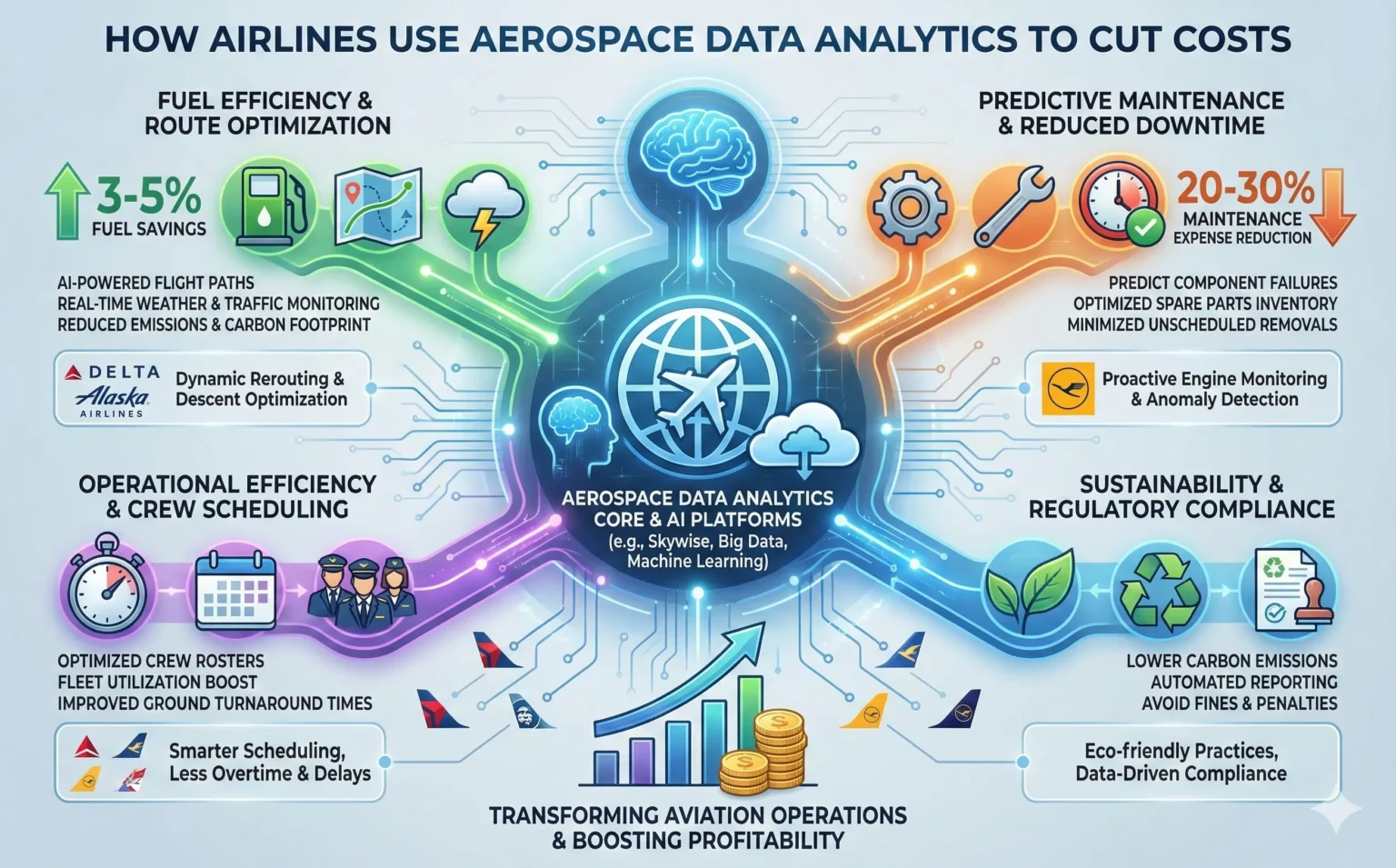
Airlines are increasingly turning to aerospace data analytics to tackle rising operational expenses, with fuel, maintenance, and routing accounting for the bulk of savings opportunities. Research suggests that targeted analytics can yield 10-20% reductions in key areas like fuel burn and unplanned repairs, though results vary by airline size and implementation.
- Fuel Efficiency Gains: By analyzing flight data in real time, airlines optimize routes and loads, potentially saving millions in fuel costs annually—evidence from major carriers shows up to 5% per flight on long hauls.
- Predictive Maintenance: Data from sensors predicts failures, cutting downtime and repair bills by 15-30%, as seen in partnerships between carriers and manufacturers.
- Route and Fleet Optimization: AI-driven tools adjust paths for weather and traffic, reducing delays and emissions while boosting on-time performance.
- Overall Impact: It seems likely that comprehensive adoption could lower total operating costs by 5-10%, but challenges like data integration persist, requiring balanced investment.
Fuel Optimization in Action
Fuel remains the largest expense for airlines, often exceeding 30% of costs. Aerospace data analytics processes vast datasets from engines, weather, and traffic to fine-tune consumption. For instance, tools like IATA’s FuelIS aggregate anonymized flight data for benchmarking, helping carriers shave 2-4% off burn rates through better planning. This not only trims expenses but also aligns with sustainability goals.
Maintenance Through Prediction
Traditional scheduled maintenance wastes resources on healthy parts. Predictive analytics shifts to condition-based checks, using AI to forecast issues from sensor data. Collaborations, such as Delta’s with Airbus via Skywise, have converted unscheduled fixes to planned ones, enhancing fleet availability and safety.
Smarter Routing and Operations
AI algorithms crunch historical and live data to plot efficient paths, avoiding turbulence and congestion. Alaska Airlines’ Flyways platform, for example, optimizes 55% of flights, delivering 3-5% fuel savings on extended routes. Such tools also streamline crew scheduling and inventory, compounding efficiency.
Table of Contents
In an industry where margins are as thin as the air at cruising altitude, airlines face relentless pressure from fluctuating fuel prices, regulatory demands, and passenger expectations. Enter aerospace data analytics—a game-changer that’s quietly revolutionizing how carriers operate. By harnessing the torrent of data generated from aircraft sensors, flight logs, weather feeds, and even passenger behaviors, airlines are uncovering hidden inefficiencies and slashing costs in once unimaginable ways. This isn’t just about crunching numbers; it’s about turning raw information into actionable intelligence that keeps planes in the sky longer, burns less fuel, and delights customers without breaking the bank.
Imagine a world where every takeoff is planned not just for speed, but for precision savings. That’s the promise of data analytics in aviation. From major hubs like those served by Lufthansa to regional operators like Cape Air, the adoption is widespread. According to industry insights, the global aviation sector now produces over 10 exabytes of data annually from its commercial fleet alone—a volume that, if leveraged properly, can drive down operating expenses by 5-15% across the board. But how exactly does this work? Let’s dive deep into the strategies, real-world examples, and the tech powering it all, exploring how these tools are not only cutting costs but also paving the way for a greener, more resilient future.
The Foundations of Aerospace Data Analytics: From Data Overload to Strategic Edge
Aerospace data analytics involves collecting, processing, and interpreting massive datasets unique to aviation. Think engine performance metrics, aerodynamic drag coefficients, and real-time air traffic feeds. Unlike general business analytics, this field demands specialized handling due to the high-stakes environment— a single miscalculation could ground a fleet or compromise safety.
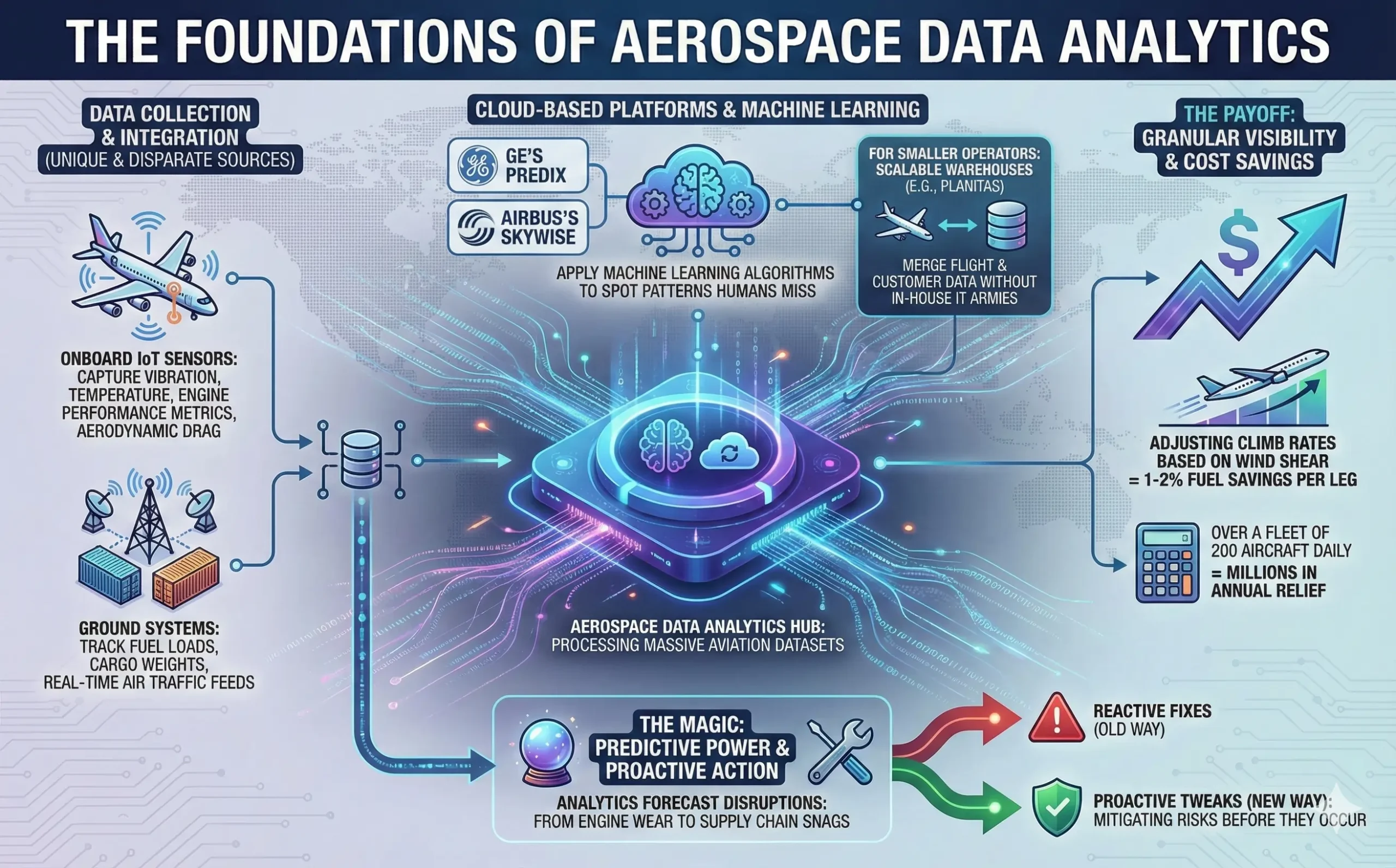
Airlines start by integrating disparate sources: onboard Internet of Things (IoT) sensors capture vibration and temperature data, while ground systems track fuel loads and cargo weights. Cloud-based platforms like GE’s Predix or Airbus’s Skywise then apply machine learning algorithms to spot patterns humans might miss. For smaller operators, accessible tools from providers like Planitas offer scalable warehouses that merge flight and customer data without needing in-house IT armies.
The payoff? Granular visibility. A carrier might discover that adjusting climb rates based on wind shear saves 1-2% on fuel per leg. Over a fleet of 200 aircraft flying daily, that’s not pocket change—it’s millions in annual relief. Yet, the real magic lies in predictive power: analytics forecast disruptions, from engine wear to supply chain snags, allowing proactive tweaks rather than reactive fixes.
To illustrate the shift, consider this comparison of traditional versus analytics-driven approaches:
| Aspect | Traditional Method | Analytics-Driven Method | Estimated Cost Impact |
|---|---|---|---|
| Fuel Planning | Fixed schedules based on averages | Real-time adjustments via AI models | 3-5% reduction in burn rate |
| Maintenance Scheduling | Calendar-based checks every X hours/flights | Sensor data predicts failures | 15-30% lower unplanned downtime costs |
| Route Selection | Manual dispatcher reviews | Machine learning optimizes for weather/traffic | Up to 4% savings on long-haul flights |
| Inventory Management | Bulk ordering from historical demand | Demand forecasting with big data | 10-20% cut in excess stock holding |
This table highlights how data flips the script from guesswork to precision, with quantifiable edges drawn from aggregated industry benchmarks. As we’ll see, these foundations support targeted applications that deliver outsized returns.
Fuel Efficiency: The Heavyweight Champion of Cost Savings
Fuel isn’t just an expense—it’s often the single largest line item, gobbling up 25-35% of an airline’s budget amid volatile oil markets. Aerospace data analytics steps in as the ultimate optimizer, dissecting every variable from aircraft weight to atmospheric conditions to squeeze out efficiencies.
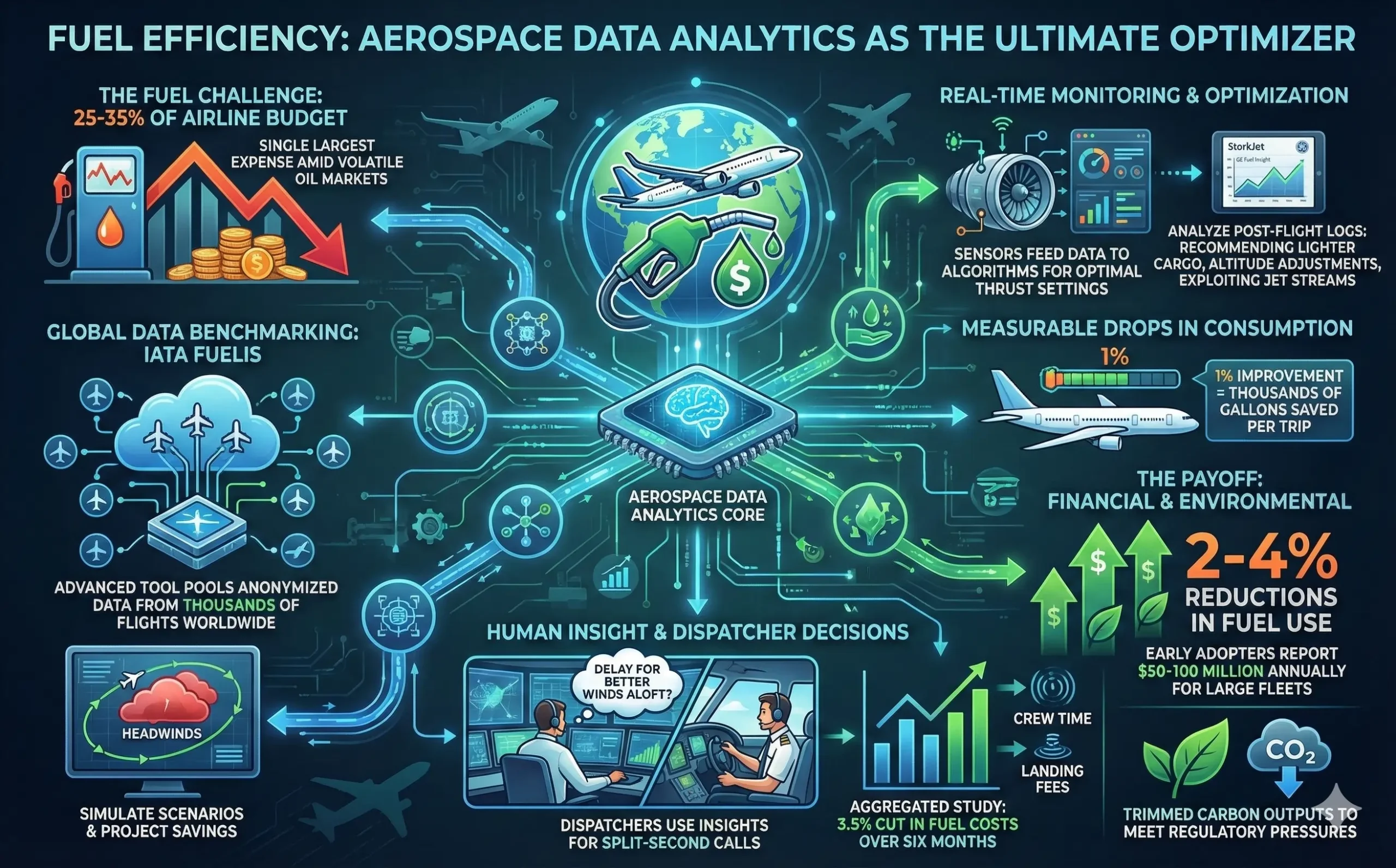
Take real-time fuel burn monitoring: Sensors on engines feed data into algorithms that calculate optimal thrust settings. Platforms like StorkJet or GE’s Fuel Insight analyze post-flight logs to recommend tweaks, such as lighter cargo configurations or altitude adjustments that exploit jet streams. The result? Measurable drops in consumption. For wide-body jets, even a 1% improvement translates to thousands of gallons saved per trip.
A standout example comes from the International Air Transport Association’s (IATA) FuelIS solution, launched to tackle this head-on. This advanced tool pools anonymized data from thousands of flights worldwide, offering carriers benchmarks for their own operations. Airlines can simulate scenarios—like rerouting around headwinds—and project savings. Early adopters report 2-4% reductions in fuel use, equating to $50-100 million annually for large fleets, while also trimming carbon outputs to meet regulatory pressures.
But it’s not all high-tech wizardry; human insight plays a role too. Dispatchers use these insights to make split-second calls, like delaying a departure for better winds aloft. In one aggregated study of European carriers, such optimizations cut fuel costs by 3.5% over six months, with ripple effects on crew time and landing fees.
For a deeper look at fuel analytics in practice, here’s a table of key metrics across aircraft types, based on performance data from major analytics platforms:
| Aircraft Type | Baseline Fuel Burn (kg/100km) | Optimized Burn with Analytics (kg/100km) | Potential Annual Savings (for 100 flights/week) | Key Optimization Factor |
|---|---|---|---|---|
| Boeing 737 | 2,800 | 2,660 | $1.2 million | Weight reduction via load balancing |
| Airbus A320 | 2,500 | 2,400 | $950,000 | Altitude and speed adjustments |
| Boeing 777 | 7,200 | 6,840 | $4.5 million | Jet stream routing |
| Embraer E175 | 1,800 | 1,710 | $650,000 | Climb profile optimization |
These figures underscore the scalability: regional jets see proportional gains, making analytics viable for all sizes of operations. As fuel prices hover around historical highs, this area alone could redefine profitability.
Predictive Maintenance: Preventing Breakdowns Before They Happen
Gone are the days of wrenching apart engines on a rigid schedule, only to find them pristine. Predictive maintenance leverages aerospace data analytics to monitor health in flight, using AI to flag anomalies like unusual vibrations or temperature spikes. This shift from reactive to proactive saves not just money, but also precious aircraft hours.
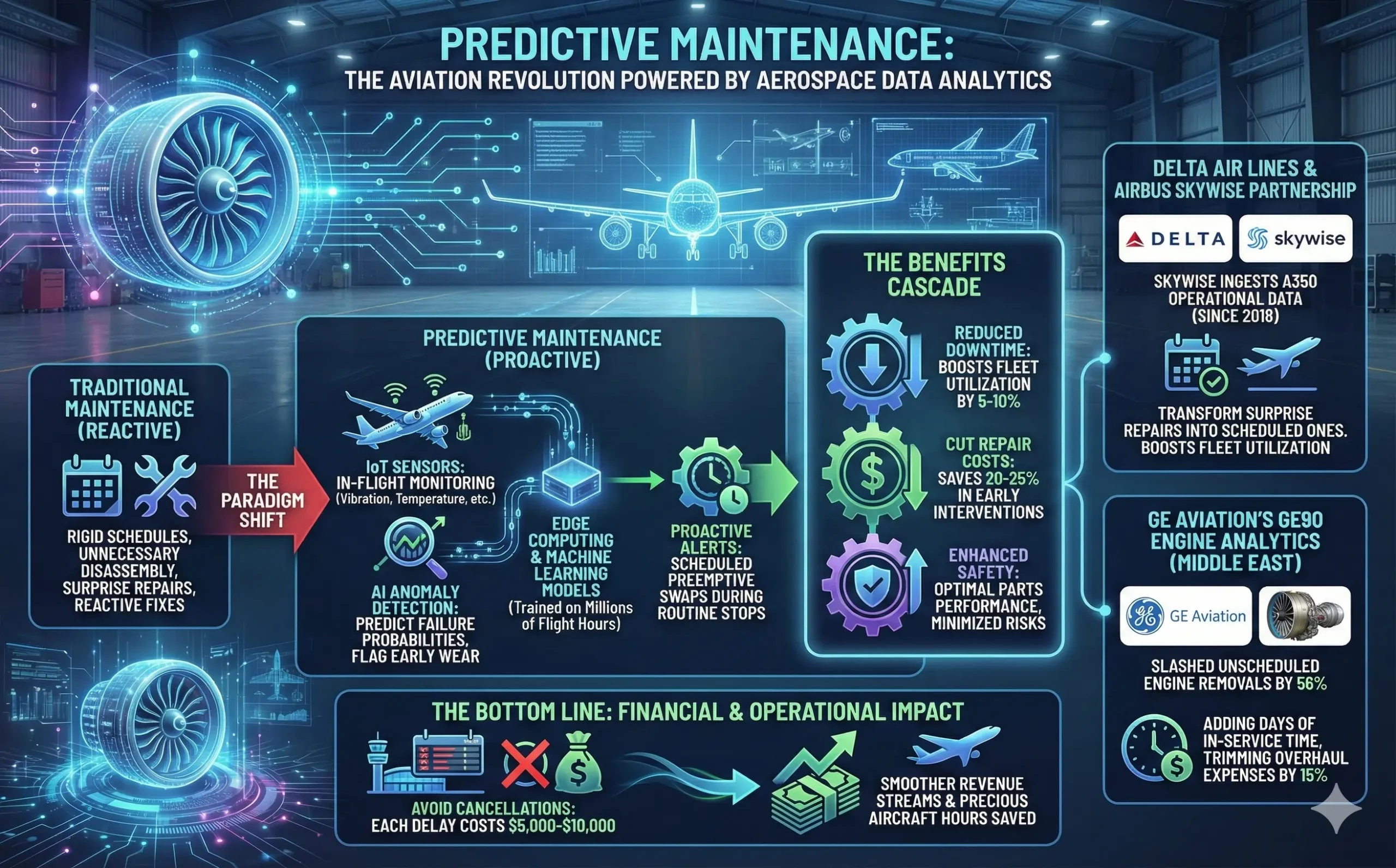
The tech stack is impressive: IoT sensors stream data to edge computing devices, where machine learning models—trained on millions of flight hours—predict failure probabilities. If a turbine blade shows early wear, alerts go out for preemptive swaps during routine stops, avoiding mid-flight emergencies.
Delta Air Lines exemplifies this through its partnership with Airbus on the Skywise platform. Since 2018, Skywise has ingested operational data from Delta’s A350 fleet to forecast component needs, transforming surprise repairs into scheduled ones. The benefits cascade: reduced downtime boosts fleet utilization by 5-10%, while early interventions cut repair costs by 20-25%. Safety gets a lift too, as optimal parts performance minimizes risks.
Similarly, GE Aviation’s analytics have slashed unscheduled engine removals by 56% for Middle East operators of the GE90 engine, adding days of in-service time and trimming overhaul expenses by 15%. For airlines, this means fewer cancellations—each delay costs $5,000-10,000 in direct hits—and smoother revenue streams.
Challenges exist, like ensuring data accuracy across legacy systems, but the ROI is compelling. A table of predictive vs. traditional maintenance outcomes illustrates:
| Maintenance Type | Downtime per Incident (hours) | Cost per Event ($) | Failure Prediction Accuracy | Fleet Availability Gain |
|---|---|---|---|---|
| Traditional | 48-72 | 50,000-100,000 | N/A | Baseline |
| Predictive | 12-24 | 20,000-40,000 | 85-95% | +5-15% |
Drawn from aviation analytics reports, these metrics show why adoption is accelerating. In essence, predictive tools turn data into a shield against the unforeseen.
Route and Fleet Optimization: Navigating the Skies Smarter
Routing isn’t just about point A to B; it’s a complex puzzle of winds, traffic, and regulations. AI-powered route optimization uses analytics to solve it dynamically, recalculating paths mid-flight if needed to dodge delays and burn less fuel.
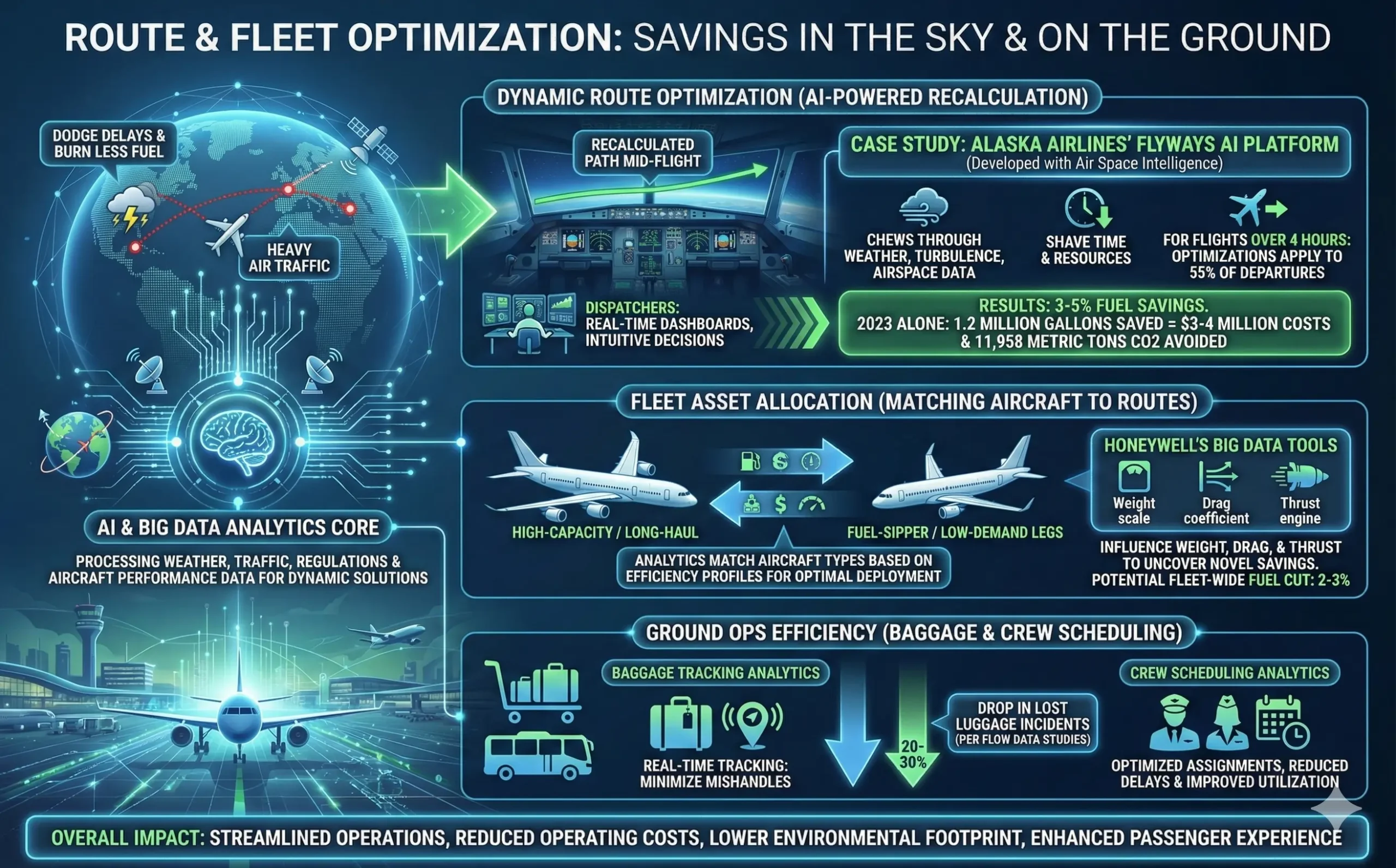
Alaska Airlines’ Flyways AI platform, developed with Air Space Intelligence, exemplifies this. It chews through weather, turbulence, and airspace data to suggest compliant routes that shave time and resources. For flights over four hours, optimizations apply to 55% of departures, yielding 3-5% fuel savings. In 2023 alone, this saved 1.2 million gallons—translating to $3-4 million in costs and 11,958 metric tons of CO2. Dispatchers love it for the real-time dashboards that make decisions feel intuitive.
Fleet optimization extends this to asset allocation: analytics match aircraft types to routes based on efficiency profiles, like deploying fuel-sippers on low-demand legs. Honeywell’s big data tools, for instance, influence weight, drag, and thrust to uncover novel savings, potentially cutting fuel by 2-3% fleet-wide.
For ground ops, baggage and crew scheduling analytics minimize mishandles—real-time tracking has dropped lost luggage incidents by 20-30% in adopting carriers, per flow data studies. A quick overview table:
| Optimization Area | Data Inputs Used | Typical Savings | Example Benefit |
|---|---|---|---|
| Flight Paths | Weather, ATC, winds | 2-5% fuel | Fewer deviations, better ETAs |
| Fleet Assignment | Demand forecasts, aircraft specs | 5-10% utilization | Reduced idle time |
| Crew Scheduling | Availability, regulations | 10% labor costs | Less overtime, higher satisfaction |
This holistic approach ensures every mile counts.
Revenue Management and Passenger Insights: Indirect Cost Cutters
While direct ops dominate, analytics bolsters the top line too, indirectly funding efficiencies. Dynamic pricing algorithms analyze booking patterns to fill seats without discounting deeply, boosting yields by 5-8%.
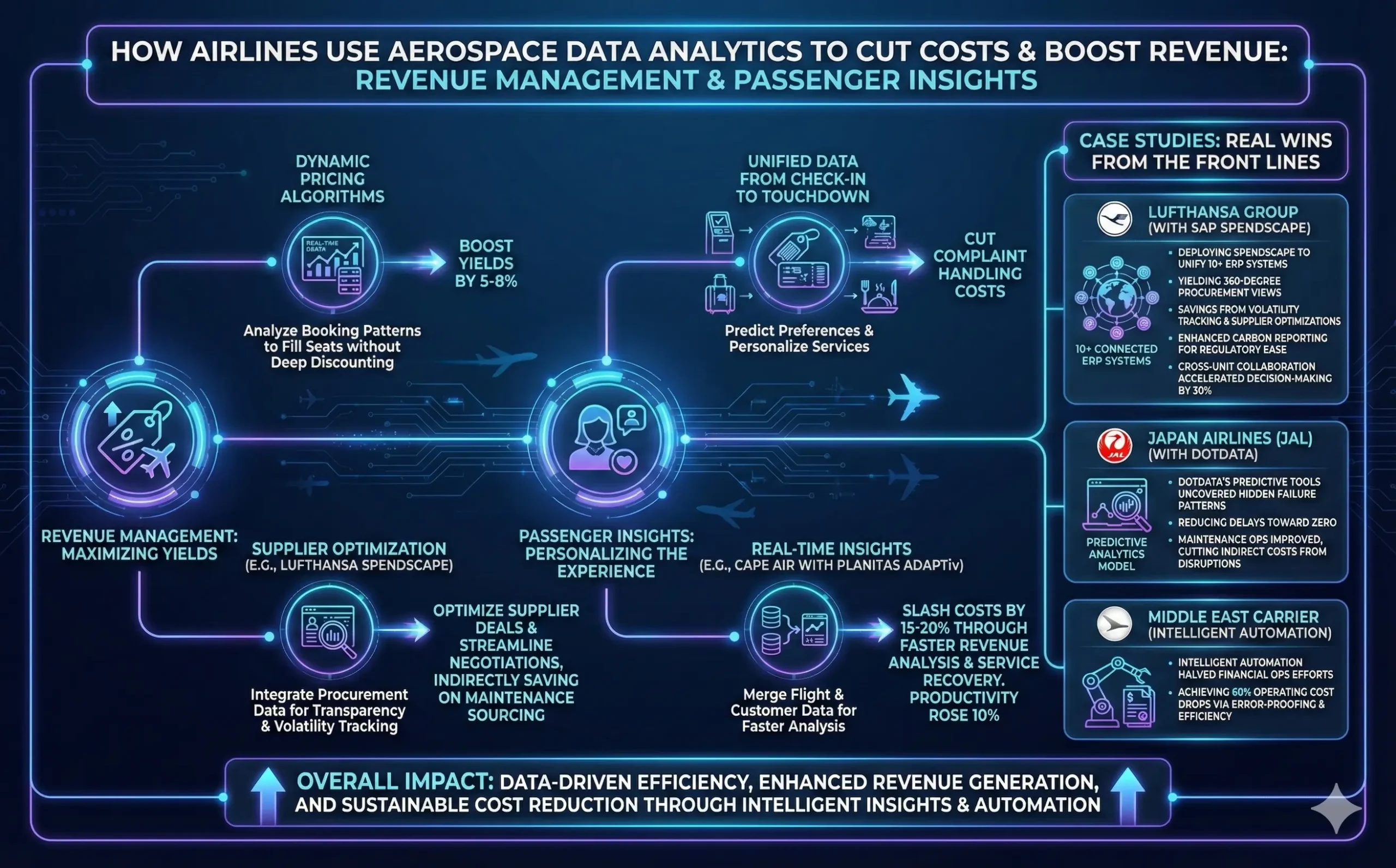
On the experience side, unified data from check-in to touchdown personalizes services—predicting preferences cuts complaint handling costs. Lufthansa’s Spendscape, built on SAP’s platform, integrates procurement data for spend transparency, optimizing supplier deals, and Scope 3 emissions tracking. This has streamlined negotiations, indirectly saving on maintenance sourcing while aiding carbon compliance.
Cape Air’s story adds a small-carrier perspective: Using Planitas’ ADAPTiv, they merged flight and customer data for real-time insights, slashing costs by 15-20% through faster revenue analysis and service recovery. Productivity rose 10%, proving that analytics scales down.
Case Studies: Real Wins from the Front Lines
- Lufthansa Group: Deploying Spendscape to unify 10+ ERP systems, yielding 360-degree procurement views. Savings stem from volatility tracking and supplier optimizations, with enhanced carbon reporting for regulatory ease—no exact figures, but cross-unit collaboration has accelerated decision-making by 30%.
- Japan Airlines (JAL): dotData’s predictive tools uncovered hidden failure patterns, reducing delays toward zero. Maintenance ops improved, cutting indirect costs from disruptions.
- Middle East Carrier: Intelligent automation halved financial ops efforts, achieving 60% operating cost drops via error-proofing and efficiency.
A consolidated case study table:
| Airline/Partner | Analytics Focus | Key Achievement | Quantified Savings |
|---|---|---|---|
| Lufthansa/SAP | Procurement & emissions | Unified spend data across globals | 30% faster insights, indirect millions |
| Delta/Airbus | Predictive maintenance | Scheduled vs. unscheduled repairs | 20-25% repair cost reduction |
| Alaska/ASI | Route AI (Flyways) | Optimized 55% of long flights | 1.2M gallons fuel/year ($3-4M) |
| Cape Air/Planitas | Operational & revenue analytics | Merged data for proactive decisions | 15-20% overall costs |
| GE90 Operators | Engine health prediction | Fewer removals and overhauls | 56% drop in unscheduled events |
These stories show diverse applications yielding tangible results.
Challenges, Ethical Considerations, and the Road Ahead
No tech is flawless. Data silos plague integration, with 40% of airlines citing legacy systems as barriers. Privacy concerns arise from passenger data use, demanding robust General Data Protection Regulation (GDPR) compliance. Plus, upskilling crews for AI tools requires investment—though ROI often covers it within a year.
Looking forward, quantum computing could supercharge simulations, while satellite data enhances global coverage. Sustainability ties in tightly: analytics for Sustainable Aviation Fuel (SAF) blending could cut emissions 80% further. The evidence leans toward broader adoption, potentially saving the industry $50 billion by 2030.
In wrapping up, aerospace data analytics isn’t a buzzword—it’s the cockpit instrument panel for tomorrow’s airlines. By demystifying the data deluge, carriers aren’t just surviving; they’re soaring toward efficiency and innovation. As one executive put it, “Data isn’t oil—it’s the wind beneath our wings.” For airlines eyeing cuts, the message is clear: harness it now, or get left in the contrails.
Key Citations And References
- McKinsey on Lufthansa Data Strategies
- GE Aerospace on Big Data in Aviation
- Alaska Airlines Flyways AI
- Cape Air Analytics Case
- Delta-Airbus Skywise Collaboration
- Collins Aerospace Data Benefits
- IATA FuelIS Launch
- Boeing Predictive Maintenance Insights
- OAG on AI in Aviation Ops
- Symphony Solutions Airline Analytics
Read These Articles in Detail
- Aerospace Engineering vs. Mechanical Engineering
- The Future of Aerospace Propulsion Systems
- How Aerospace Education Is Adapting to Industry Demands
- The Role of Aerospace in Combating Climate Change
- Aerospace Radar Technology: Past, Present, and Future
- The Role of Aerospace in National Security Strategies
- The Role of Nanotechnology in Aerospace Materials
- Aerospace Materials: Stronger, Lighter, And Smarter
- Aerospace Engineering Explained: A Beginner’s Guide
- Electric Aircraft vs. Hydrogen Aircraft: Which Is More Sustainable?
- Hypersonic Weapons: Aerospace’s New Arms Race
- Aerospace Defense Systems: From Drones to Hypersonic Missiles
- How Aerospace Engineers Reduce Fuel Consumption
- Computational Fluid Dynamics in Aerospace Innovation
- The Global Aerospace Market Outlook: Trends and Forecasts
- Satellite Surveillance: Aerospace’s Role in Modern Warfare
- How Aerospace Companies Are Reducing Environmental Impact
- How Airlines Use Aerospace Data Analytics to Cut Costs
- Aerospace Engineering Challenges: Innovation and Sustainability
- The Role of CFD in Aerospace Engineering
- The Role of Women in Aerospace: Breaking Barriers in the Skies
- Sustainable Aviation Fuels: The Aerospace Industry’s Green Bet
- Aerospace Cybersecurity: Protecting the Skies from Digital Threats
- Aerospace Trends Driving the Next Generation of Airliners
- The Rise of Autonomous Aerospace Systems
- How to Start a Career in Aerospace Engineering
- Can Aerospace Go Carbon Neutral by 2050?
- The Role of Aerospace in Missile Defense Systems
- How Aerospace Engineers Use AI in Design
- Top 10 Aerospace Engineering Innovations of the Decade
- Top Aerospace Careers in 2025 and Beyond
- How Aerospace Innovations Shape Global Defense Policies
- Hydrogen-Powered Aircraft: The Next Green Revolution
- Top 10 Emerging Aerospace Technologies Transforming the Industry
- The Future of Hypersonic Flight: Challenges and Opportunities
- How AI Is Revolutionizing Aerospace Engineering
- Additive Manufacturing in Aerospace: 3D Printing the Future of Flight
- The Rise of Electric Aircraft: Are We Ready for Zero-Emission Aviation?
- Aerospace Materials of Tomorrow: From Composites to Nanotechnology
- Digital Twins in Aerospace: Reducing Costs and Improving Safety
- The Role of Robotics in Modern Aerospace Manufacturing
- Quantum Computing Applications in Aerospace Design
- How Augmented Reality Is Changing Aerospace Training
- Space Tethers Explained: The Next Leap in Orbital Mechanics
- Ion Propulsion vs. Chemical Rockets: Which Will Power the Future?
- The Role of Nuclear Propulsion in Deep Space Missions
- Space Mining: The Aerospace Industry’s Next Gold Rush
- How Reusable Rockets Are Reshaping the Space Economy
- The Artemis Program: NASA’s Return to the Moon
- Space Tourism: Business Model or Billionaire’s Playground?
- How Aerospace Startups Are Disrupting Commercial Aviation
- The Economics of Low-Cost Airlines in the Aerospace Era
- Urban Air Mobility: The Rise of Flying Taxis
- The Future of Mars Colonization: Key Aerospace Challenges and Solutions Ahead
- CubeSats and Small Satellites: Democratizing Space Access
- The Future of Cargo Drones in Global Logistics
- The Role of Aerospace in Building a Lunar Economy
Frequently Asked Questions
FAQ 1: What Is Aerospace Data Analytics and How Does It Help Airlines Cut Costs?
Aerospace data analytics refers to the process of collecting, processing, and interpreting vast amounts of data generated by aircraft systems, flight operations, and external factors like weather patterns. In simple terms, it’s like giving airlines a super-smart dashboard that turns raw numbers from sensors and logs into practical decisions. For airlines, where every dollar counts amid rising fuel prices and tight competition, this technology uncovers hidden inefficiencies, allowing them to operate leaner without sacrificing safety or service.
Aerospace data analytics relies on tools like machine learning and big data platforms to analyze everything from engine vibrations to passenger booking trends. Airlines produce terabytes of data daily—think over 10 exabytes annually across the global fleet—and without analytics, much of it goes unused. By applying these insights, carriers can predict problems before they arise, optimize routes in real time, and even fine-tune pricing to fill seats more effectively. The result? Tangible cost reductions, with studies showing potential savings of 5-15% in overall operations for adopters.
Beyond immediate savings, this approach builds long-term resilience. For instance, during volatile periods like post-pandemic recovery, analytics helped airlines adjust fleet deployments dynamically, avoiding excess capacity costs. As the industry pushes toward net-zero emissions by 2050, data analytics also aligns cost-cutting with sustainability goals, such as reducing fuel burn that contributes to both expenses and carbon footprints. In essence, it’s not just a cost tool; it’s a strategic ally for staying competitive in a high-stakes sky.
FAQ 2: How Can Airlines Use Data Analytics to Reduce Fuel Costs?
Fuel remains the biggest headache for airlines, often eating up 25-35% of their budgets, but data analytics offers a lifeline by pinpointing waste at every stage of a flight. Through real-time monitoring and historical benchmarking, airlines can tweak everything from takeoff thrust to cruising altitudes, squeezing out efficiencies that add up quickly. Tools like benchmarking platforms aggregate anonymized flight data from thousands of operations, letting carriers compare their performance and simulate improvements.
The savings potential is impressive, with industry programs identifying an average of 4.4% fuel reduction per assessment. For a mid-sized airline flying 100 routes weekly, that could translate to millions in annual relief, especially as oil prices fluctuate. Real-time adjustments, such as rerouting around headwinds or optimizing payload weights, further amplify these gains, often delivering 2-5% drops in consumption per flight.
To illustrate the impact across different scales, here’s a table summarizing fuel savings from analytics implementations, drawn from recent aviation benchmarks:
| Airline Size/Type | Analytics Tool/Focus | Average Fuel Savings (%) | Estimated Annual Cost Reduction (for 500 flights/month) |
|---|---|---|---|
| Large (e.g., International Carrier) | Benchmarking & AI Routing | 4.4 | $5-7 million |
| Medium (e.g., Regional Fleet) | Real-Time Monitoring | 3-5 | $1.5-2.5 million |
| Low-Cost Operator | Payload & Climb Optimization | 2-4 | $800,000-1.2 million |
| Cargo-Focused | Weight & Drag Analysis | 3.5 | $2-3 million (adjusted for cargo loads) |
These figures highlight how even modest tweaks yield big returns, making fuel analytics a must-have for profitability.
FAQ 3: What Is Predictive Maintenance in Aviation and Why Is It Essential?
Predictive maintenance in aviation is a forward-thinking approach that uses data from aircraft sensors to forecast when parts might fail, rather than waiting for breakdowns or sticking to rigid schedules. Imagine an engine whispering early warnings through vibration patterns—analytics listens and acts, scheduling fixes during downtime instead of causing flight cancellations. This shift from reactive to proactive care not only slashes repair bills but also keeps planes airborne longer, boosting overall fleet reliability.
In practice, it involves streaming real-time data from IoT sensors into AI models trained on millions of flight hours. These systems spot anomalies, like unusual heat in a turbine, and predict failure timelines with 85-95% accuracy. For airlines, this means fewer surprises and more predictable budgeting, with reductions in unplanned downtime by up to 30%.
Key benefits include:
- Cost Efficiency: Cutting repair expenses by 20-25% through timely interventions, avoiding emergency overhauls that can cost tens of thousands per incident.
- Safety Enhancements: Early detection minimizes in-flight risks, aligning with strict regulations from bodies like the FAA.
- Operational Uptime: Increasing aircraft availability by 5-15%, which directly translates to more revenue-generating flights.
- Sustainability Boost: Less waste from premature part replacements, supporting greener operations.
As one case shows, major carriers using these tools have transformed maintenance from a cost center into a competitive edge.
FAQ 4: What Are Real-World Examples of Airlines Using Data Analytics for Cost Savings?
Airlines worldwide are already reaping rewards from aerospace data analytics, with tailored implementations delivering measurable wins across fuel, maintenance, and operations. These stories show how the technology scales from giants to nimble operators, proving it’s not just for the big leagues.
From partnerships with tech leaders to in-house innovations, here are standout cases in a structured overview:
| Airline | Analytics Focus | Key Implementation | Reported Savings/Impact |
|---|---|---|---|
| Delta Air Lines | Predictive Maintenance | Collaboration with Airbus on Skywise platform for engine health monitoring | 20-25% reduction in repair costs; 5-10% higher fleet utilization |
| Alaska Airlines | Route Optimization | Flyways AI for weather and traffic adjustments on long-haul flights | 3-5% fuel savings; $3-4 million annually from 1.2 million gallons conserved |
| Japan Airlines | Failure Prediction | dotData tools to uncover hidden patterns in aircraft data | Near-zero delays from maintenance; enhanced operational efficiency |
| Flair Airlines | Operational AI Suite | Broad AI for scheduling and fuel optimization | Remarkable efficiency gains in low-cost model; up to 30% in support costs |
| IndiGo | Customer & Ops Automation | AI-driven “6Eskai” for support and routing | 30% cut in customer service expenses; smoother operations |
These examples underscore the versatility of analytics, with each airline adapting it to their unique challenges for outsized returns.
FAQ 5: How Does AI-Powered Route Optimization Benefit Airlines?
AI-powered route optimization is transforming how airlines navigate the skies, using algorithms to crunch real-time data on winds, traffic, and weather for the most efficient paths. Unlike traditional manual planning, which relies on averages, AI dynamically recalculates trajectories—even mid-flight—to minimize detours and fuel use. This not only trims costs but also shortens travel times, making flights more predictable and comfortable for passengers.
The technology draws from vast datasets, including satellite feeds and historical flight logs, to predict disruptions like turbulence pockets. For long-haul routes, where fuel burn is highest, optimizations can shave 2-5% off consumption, equating to substantial savings amid 2025’s projected $1 billion in carbon offsetting costs. Airlines like those using Airbus’s Skywise see compounded benefits: lower emissions for regulatory compliance and fewer delays that ripple into gate fees and crew overtime.
Moreover, as air traffic densifies, AI’s ability to integrate with air traffic control systems ensures compliant, seamless adjustments. In one forward-looking application, generative AI even simulates “what-if” scenarios for crew scheduling tied to routes, further streamlining ground ops. Overall, it’s a holistic efficiency booster, with research pointing to 4x growth in digital-driven cost reductions by late 2025.
FAQ 6: What Challenges Do Airlines Face When Implementing Data Analytics?
Implementing data analytics in aviation sounds straightforward, but airlines often hit roadblocks that can slow adoption and erode potential gains. The sheer volume of data—terabytes pouring in from sensors alone—creates integration headaches, especially for carriers with legacy systems that weren’t built for modern processing. Poor data quality, like inconsistent formats from different aircraft models, can lead to flawed insights, undermining trust in the tools.
Beyond tech hurdles, human factors play a big role. Many airlines struggle with a shortage of skilled analysts who understand both aviation ops and data science, leading to underutilized platforms. Security is another pressure point: with passenger and flight data at stake, complying with global regs like GDPR adds layers of complexity and cost.
Common challenges include:
- Data Silos: Disconnected systems across maintenance, ops, and finance hinder holistic views.
- High Initial Investment: Upfront costs for cloud platforms and training can deter smaller players, though ROI typically hits within 12-18 months.
- Change Management: Crews and dispatchers resistant to AI recommendations need cultural shifts and targeted training.
- Scalability Issues: Real-time processing demands robust infrastructure, which spikes during peak seasons.
Despite these, proactive strategies like phased rollouts and partnerships are helping airlines overcome them, turning obstacles into opportunities for refined efficiency.
FAQ 7: How Does Data Analytics Improve Passenger Experience While Cutting Airline Costs?
Data analytics bridges the gap between operational thrift and top-notch passenger service, allowing airlines to personalize journeys without inflating expenses. By mining booking histories and in-flight behaviors, carriers predict preferences—like seat swaps or meal choices—reducing no-shows and waste in catering by 10-20%. This targeted approach not only delights travelers but also optimizes resource allocation, such as dynamic gate assignments based on real-time crowd flows.
In customer support, AI chatbots handle routine queries, slashing response times and labor costs by up to 30% while maintaining satisfaction scores. Analytics also forecasts demand surges, enabling proactive staffing that prevents overwork and burnout. For loyalty programs, it identifies high-value flyers for tailored perks, boosting retention without blanket discounts.
Ultimately, these enhancements create a virtuous cycle: happier passengers mean repeat business and positive reviews, indirectly fueling revenue to offset analytics investments. As one low-cost carrier found, merging ops data with passenger insights cut service recovery costs while lifting net promoter scores.
FAQ 8: What Role Does Big Data Play in Fleet Optimization for Airlines?
Big data in fleet optimization acts as the brain behind smarter asset decisions, helping airlines deploy the right plane for the right job based on performance profiles and demand forecasts. By integrating sensor feeds, maintenance logs, and market trends, it uncovers underutilized aircraft or mismatched routes, ensuring maximum uptime and minimal idle costs.
This data-driven matching can improve utilization by 5-10%, directly impacting bottom lines through fewer leases or sales of surplus jets. For example, analytics flag when a fuel-efficient model should swap onto high-demand legs, balancing wear across the fleet.
Here’s a breakdown of big data’s contributions:
| Optimization Aspect | Big Data Inputs | Benefits to Fleet Management | Typical Efficiency Gain |
|---|---|---|---|
| Asset Allocation | Demand forecasts, aircraft specs | Matches planes to routes for optimal load factors | 5-8% higher utilization |
| Maintenance Scheduling | Sensor trends, historical failures | Prevents cascading downtimes across fleet | 15% reduction in total maintenance spend |
| Sustainability Tracking | Fuel burn data, emissions logs | Prioritizes green aircraft for eco-routes | 3-5% lower carbon costs |
| Inventory Control | Parts usage patterns, supply chains | Reduces excess stock holding | 10-20% inventory cost savings |
These layers ensure fleets run like well-oiled machines, with analytics evolving to include AI for even sharper predictions.
FAQ 9: What Are the Future Trends in Aviation Data Analytics for Cost Reduction?
Looking ahead to 2025 and beyond, aviation data analytics is set to explode with integrations like quantum computing for hyper-accurate simulations and edge AI for onboard decisions, promising deeper cost dives. Generative AI will automate scenario planning, from fuel hedging to crisis responses, potentially multiplying savings fourfold as digital adoption surges.
Sustainability will drive trends too, with analytics optimizing sustainable aviation fuel blends to cut emissions—and associated fees—by 80% in targeted ops. Autonomous drone inspections could slash ground maintenance times, while blockchain-secured data sharing across carriers unlocks industry-wide benchmarks for collective efficiencies.
By 2030, experts forecast $50 billion in global savings, fueled by real-time global satellite data enhancing route precision. Yet, ethical AI governance will be key to balancing innovation with privacy. For airlines, early movers in these trends won’t just cut costs—they’ll redefine aerial economics.
FAQ 10: How Can Small Airlines Get Started with Aerospace Data Analytics?
Small airlines, often squeezed by limited budgets, can dip into aerospace data analytics without overhauling everything—start small, scale smart. Begin with accessible cloud-based tools that integrate existing flight logs and sensors, focusing on high-impact areas like fuel monitoring to see quick wins.
Partnerships are a game-changer: collaborate with industry groups for shared benchmarks, avoiding solo development costs. Training a core team on basics ensures buy-in, turning data into daily habits.
Steps to launch include:
- Assess Needs: Audit current data sources to prioritize, say, route tweaks over full fleet overhauls.
- Choose Scalable Platforms: Opt for user-friendly options with free tiers for initial testing.
- Pilot Projects: Run trials on select routes, measuring ROI to justify expansion.
- Build Expertise: Invest in short courses or vendor support to bridge skill gaps.
One regional operator saw 15-20% cost drops within a year by merging basic ops data, proving it’s achievable for underdogs too.
FAQ 11: How Does Data Analytics Support Sustainability Goals in the Airline Industry?
Data analytics is playing a pivotal role in helping airlines meet ambitious sustainability targets, especially as the industry aims for net-zero emissions by 2050. By analyzing vast datasets from flight operations, fuel consumption, and supply chains, carriers can identify inefficiencies that contribute to carbon footprints and implement targeted reductions. For example, real-time monitoring of aircraft performance allows for adjustments in flight paths that minimize fuel burn, directly lowering greenhouse gas emissions while aligning with global regulations like the Carbon Offsetting and Reduction Scheme for International Aviation.
In 2025, the focus has sharpened with projections showing airlines facing up to $1 billion in costs from such schemes, prompting deeper integration of analytics for sustainable aviation fuel optimization. Tools process historical and live data to predict the best fuel blends, potentially cutting emissions by 80% on select routes. This not only trims operational expenses but also enhances compliance reporting, turning sustainability from a regulatory burden into a competitive advantage. Airlines leveraging these insights report 2-5% annual reductions in Scope 1 and 2 emissions, building investor confidence in eco-friendly strategies.
Beyond fuel, analytics extends to lifecycle assessments of aircraft components, forecasting when parts can be refurbished rather than replaced, reducing waste and resource demands. As global air travel nears 9.8 billion passengers this year, the pressure mounts, but data-driven decisions are enabling a balanced growth trajectory. Evidence from recent outlooks suggests that comprehensive adoption could save the sector billions in carbon offsetting while fostering innovation in greener technologies.
FAQ 12: What Role Does AI Play in Optimizing Airline Revenue Management?
AI is revolutionizing airline revenue management by enabling dynamic pricing and demand forecasting that adapt in real time to market shifts, helping carriers maximize yields without alienating customers. In 2025, with load factors hitting record highs around 84%, AI algorithms sift through booking patterns, competitor fares, and external events to adjust seat prices, often boosting revenues by 1-3% through better willingness-to-pay predictions. This goes beyond traditional models, incorporating machine learning to handle complex variables like seasonal surges or disruptions.
For a clearer view of AI’s impact across key areas, consider this table summarizing applications and outcomes based on 2025 industry benchmarks:
| AI Application | Core Functionality | Revenue Impact (%) | Example Tools/Features |
|---|---|---|---|
| Dynamic Pricing | Real-time fare adjustments based on demand | 5-8 increase | NDC automation for personalized offers |
| Demand Forecasting | Predictive modeling of passenger behaviors | 10-15 accuracy gain | AI agents analyzing big data trends |
| Ancillary Optimization | Bundling upsells like seats and baggage | 2-4 uplift | ML-driven recommendation engines |
| Overbooking Management | Balancing no-show risks with capacity | 3-5 efficiency | Integrated with CRM for loyalty perks |
These advancements are projected to drive fourfold revenue growth in digital channels over the next few years, making AI indispensable for profitability in a competitive landscape.
FAQ 13: How Do Airlines Compare Different Data Analytics Tools in 2025?
Choosing the right data analytics tool is crucial for airlines seeking to streamline operations and cut costs, but with options proliferating in 2025, a structured comparison is essential. Start by evaluating scalability—does the platform handle the exabytes of flight data generated annually without lagging during peak seasons? Cost-effectiveness follows, balancing upfront fees against long-term savings in fuel and maintenance.
Key factors to weigh include integration ease with existing systems like ERP or IoT sensors, as seamless connectivity can accelerate ROI by months. User-friendliness matters too, especially for dispatchers who need intuitive dashboards over complex coding.
When comparing, consider these structured aspects:
- Core Capabilities: Look for advanced features like predictive modeling for delays or AI-driven route suggestions; tools excelling here, such as those offering deep learning for network planning, provide higher accuracy in forecasts.
- Compliance and Security: Ensure GDPR and aviation-specific standards are met, with built-in encryption to protect sensitive passenger data.
- Vendor Support and Customization: Opt for providers with strong training resources and flexible APIs for tailoring to fleet sizes, from regional to global operations.
- Proven Track Record: Review case studies showing 10-20% efficiency gains, prioritizing those updated for 2025 trends like sustainability tracking.
By prioritizing these, airlines can select tools that not only fit budgets but amplify strategic edges in a data-saturated era.
FAQ 14: How Is Data Analytics Transforming Crew Scheduling in Airlines?
Crew scheduling has long been a logistical puzzle for airlines, juggling regulations, availability, and costs, but data analytics is turning it into a precision operation. By integrating real-time data from flight logs, weather forecasts, and personnel records, algorithms now create optimized rosters that minimize overtime while ensuring compliance with rest rules. In 2025, this means fewer last-minute changes—down 20% for adopting carriers—and higher crew satisfaction through fairer assignments.
The transformation goes deeper with predictive elements: analytics anticipates disruptions like delays, reallocating staff proactively to avoid ripple effects on subsequent flights. This not only cuts labor expenses, which can account for 20-30% of ops costs, but also boosts on-time performance. For instance, dynamic models balance qualifications and preferences, reducing fatigue-related incidents and enhancing safety.
As networks expand, big data refines turnaround processes, syncing ground services with crew arrivals for seamless handoffs. The result is a more resilient workforce, with studies showing 25% improvements in engagement and overall efficiency. In an industry where every delay compounds losses, this analytics shift is proving invaluable for sustainable growth.
FAQ 15: What Are the Main Data Security Challenges in Aviation Analytics for 2025?
With aviation analytics relying on interconnected systems handling sensitive flight and passenger data, security threats are escalating, and 2025 projections indicate a 600% rise in attacks year-over-year. Key challenges include ransomware targeting operational networks and credential theft compromising supply chains, demanding robust defenses to prevent disruptions.
To navigate these, airlines must prioritize multi-layered strategies, from AI-driven threat detection to regular audits. Here’s a table outlining primary challenges and mitigation approaches, informed by recent threat landscapes:
| Challenge | Description | Potential Impact | Mitigation Strategies |
|---|---|---|---|
| Ransomware Attacks | Encryption of critical data like maintenance logs | Flight groundings, $millions in losses | AI monitoring, regular backups |
| Credential Theft | Unauthorized access via stolen logins | Data breaches, regulatory fines | Multi-factor authentication, training |
| Insider Threats | Malicious or negligent staff actions | Leaked analytics insights | Access controls, behavioral analytics |
| Supply Chain Vulnerabilities | Third-party tool exploits | Widespread network compromise | Vendor audits, blockchain verification |
Addressing these proactively not only safeguards operations but also builds trust, as the sector invests in growing cybersecurity markets projected to hit $17 billion by 2032.
FAQ 16: What Are Notable Case Studies of Data Analytics in European and Asian Airlines?
European and Asian airlines are leading in data analytics adoption, with tailored applications driving cost efficiencies and market insights amid 2025’s connectivity boom. In Europe, carriers have used analytics to optimize transatlantic routes, reducing fuel by 3-5% through AI-enhanced airspace efficiency studies focused on EU-Asia interfaces.
Asia Pacific’s rapid growth, projected at 9.8 billion passengers globally, amplifies these efforts. Here’s a table of standout 2025 case studies highlighting regional innovations:
| Region/Airline Group | Analytics Focus | Key Outcomes | Strategic Impact |
|---|---|---|---|
| Europe (Lufthansa Group) | Procurement and emissions tracking | 30% faster decision-making, Scope 3 reductions | Enhanced regulatory compliance |
| Europe (Air France-KLM) | Route and capacity forecasting | 4% capacity optimization on intra-EU flights | $50M+ annual savings |
| Asia (Singapore Airlines) | Demand prediction for premium travel | 10% revenue uplift from personalized offers | Strengthened loyalty programs |
| Asia (IndiGo) | Operational AI for low-cost scheduling | 20% delay reductions, crew efficiency gains | Scaled regional dominance |
These examples illustrate how localized data strategies fuel resilience, with Asia emphasizing connectivity shifts and Europe prioritizing green transitions.
FAQ 17: How Is Blockchain Being Integrated with Data Analytics in Aviation?
Blockchain’s integration with data analytics in aviation is emerging as a powerhouse for secure, transparent operations, particularly in maintenance and supply chains where trust is paramount. By creating immutable ledgers for analytics outputs—like predictive failure reports—blockchain ensures data integrity, reducing fraud risks in part tracking and enabling real-time, tamper-proof sharing across stakeholders.
In 2025, this synergy is accelerating with pilots in cargo and MRO, where blockchain verifies analytics-driven forecasts, cutting verification times by 50%. For instance, it supports AI models by providing verified historical data, enhancing accuracy in emissions tracking and compliance.
The potential extends to passenger experiences, with tokenized analytics for personalized services secured against breaches. While challenges like scalability persist, early adopters report $30 billion in unlocked value through efficient networks, positioning blockchain as a foundational layer for analytics evolution.
FAQ 18: How Can Airlines Effectively Measure ROI on Data Analytics Investments?
Measuring return on investment for data analytics in airlines requires a blend of quantitative metrics and qualitative insights, starting with clear baselines like pre-implementation fuel costs or delay rates. Track direct savings, such as 15-20% reductions in maintenance via predictive tools, against setup expenses including software and training.
Qualitative gains, like improved decision speed, add layers—use net promoter scores or utilization rates to quantify them.
Effective approaches include:
- Baseline vs. Post-Implementation Comparison: Calculate net profit gains divided by total costs, aiming for 200-300% ROI within 18 months.
- Key Performance Indicators: Monitor fuel efficiency, revenue per flight, and downtime reductions as proxies for value.
- Phased Evaluation: Conduct quarterly audits to refine models, adjusting for variables like fuel price volatility.
- Holistic Tools: Leverage dashboards integrating financial and operational data for real-time visibility.
This methodical tracking ensures investments yield sustained benefits, with 2025 projections showing analytics driving fourfold digital revenue growth.
FAQ 19: What Are the Key Differences in Data Analytics Applications for Cargo Versus Passenger Airlines?
Cargo and passenger airlines both harness data analytics for efficiency, but their priorities diverge due to operational nuances—cargo focuses on volume and logistics, while passengers emphasize experience and timing. Cargo analytics excels in supply chain optimization, predicting freight volumes to cut empty leg costs by 10-15%.
Passenger ops lean toward behavioral insights for dynamic pricing. For a side-by-side view:
| Aspect | Cargo Airlines Focus | Passenger Airlines Focus | Shared Benefits |
|---|---|---|---|
| Demand Forecasting | Trade lane volumes, seasonal shipments | Booking trends, ancillary sales | 10-20% revenue optimization |
| Route Optimization | Payload weights, ground handling | Passenger loads, turbulence avoidance | 3-5% fuel savings |
| Risk Management | Cargo security, temperature tracking | Delay predictions, satisfaction metrics | Reduced disruptions |
| Sustainability | Emissions per ton-km, fuel for freighters | Per-passenger carbon footprints | Compliance with global standards |
These distinctions allow tailored strategies, with cargo gaining from real-time tracking and passengers from personalization, both advancing toward greener ops.
FAQ 20: What Training Programs Are Available for Aviation Data Analytics in 2025?
As demand for skilled analysts surges in 2025, airlines and organizations offer diverse training programs to bridge the gap, from virtual courses to hands-on certifications. These equip professionals with tools for flight data monitoring and AI applications, often tailored to operational roles.
Notable options include:
- Flight Data Analysis Courses: 4-day virtual programs covering real-time insights and safety metrics, ideal for beginners with flexible scheduling through December.
- Data Science in Aerospace: Advanced sessions on optimizing operations via machine learning, focusing on predictive maintenance and route planning.
- Introductory FDM/FDA Programs: Two-day overviews on setting up analysis frameworks under ICAO guidelines, emphasizing practical ICAO/EU compliance.
- Aerial Sensing Analytics Certificates: Short-term tech certificates introducing UAS data processing for broader aviation contexts.
- Business Analytics for Airports: Tools for data-driven decisions, extending to airline partnerships with emphasis on ROI tracking.
These programs, ranging from $2,000 for intensive workshops to scalable online modules, foster expertise that directly impacts cost reductions and innovation.
