

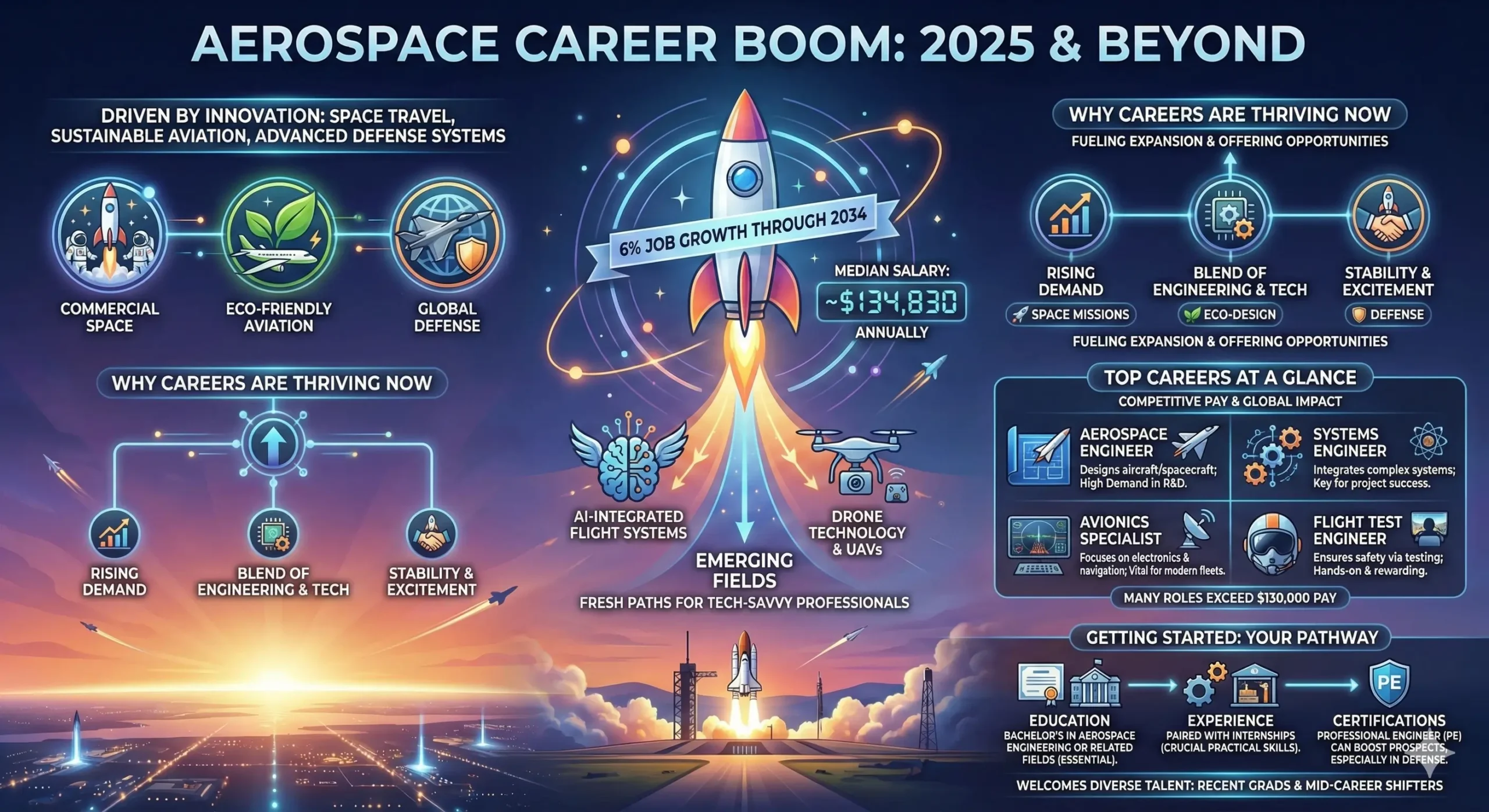
The aerospace industry in 2025 is booming, driven by innovations in space travel, sustainable aviation, and advanced defense systems. Aerospace engineers lead the pack as one of the most sought-after roles, with a projected 6% job growth through 2034 and a median salary of around $134,830 annually. Emerging fields like AI-integrated flight systems and drone technology are creating fresh paths for tech-savvy professionals.
Why Aerospace Careers Are Thriving Now
Rising demand for commercial space missions, eco-friendly aircraft designs, and global defense needs are fueling expansion. Companies are hiring aggressively for roles that blend engineering with cutting-edge tech, offering stability and excitement.
Top Careers at a Glance
- Aerospace Engineer: Designs aircraft and spacecraft; high demand in R&D.
- Systems Engineer: Integrates complex aerospace systems; key for project success.
- Avionics Specialist: Focuses on electronics and navigation; vital for modern fleets.
- Flight Test Engineer: Ensures safety through rigorous testing; hands-on and rewarding.
These roles promise competitive pay, with many exceeding $130,000, and opportunities for global impact. Whether you’re a recent grad or mid-career shifter, the sector welcomes diverse talent.
Getting Started
A bachelor’s in aerospace engineering or related fields is essential, often paired with internships. Certifications like Professional Engineer (PE) can boost prospects, especially in defense.
Table of Contents
Imagine waking up every day to a job where you’re not just pushing papers but actually shaping the future of how humanity explores the stars, connects the globe, and defends its skies. That’s the allure of aerospace careers in 2025—a field that’s evolving faster than ever, thanks to breakthroughs in reusable rockets, electric propulsion, and smart satellites. As air travel rebounds post-pandemic and private companies like those pioneering Mars missions ramp up, the industry isn’t just recovering; it’s exploding with opportunity.
This isn’t hype; it’s backed by steady projections showing about 4,500 new openings for aerospace professionals each year through 2034, outpacing many other sectors. Whether you’re drawn to the roar of jet engines or the quiet precision of orbital mechanics, there’s a role here that could launch your passion into orbit.
In this deep dive, we’ll unpack the top careers dominating the aerospace landscape right now and what’s coming next. We’ll cover everything from classic engineering powerhouses to emerging niches fueled by artificial intelligence (AI) and sustainable aviation fuels (SAF). Expect real-world examples, skill breakdowns, salary insights, and even tables to compare options side-by-side. By the end, you’ll have a roadmap to navigate this high-flying job market, complete with tips on breaking in and staying ahead.
Why 2025 Is a Golden Era for Aerospace Pros
The aerospace sector has always been a blend of grit and genius, but 2025 marks a pivotal shift. Global air passenger traffic is expected to hit pre-pandemic levels and beyond, with airlines ordering thousands of new planes to meet demand. Meanwhile, space isn’t just for governments anymore—commercial ventures are democratizing access, from satellite constellations beaming internet to remote villages to tourist jaunts beyond the atmosphere. Add in defense spending surges amid geopolitical tensions, and you’ve got a recipe for explosive growth.
But it’s not all smooth skies. Challenges like supply chain snarls and a talent crunch mean companies are scrambling for skilled workers. The good news? This creates leverage for job seekers. Roles requiring cybersecurity for space systems or autonomous drone operations are popping up, blending aerospace with hot fields like software and data science. Entry-level spots are abundant too, especially for those with hands-on experience from co-ops or certifications.
To give you a snapshot, here’s a table outlining the industry’s top growth drivers and their career ripple effects:
| Trend | Description | Impact on Careers | Projected Market Growth (2024-2030) |
|---|---|---|---|
| Sustainable Aviation | Shift to electric/hybrid aircraft and biofuels to cut emissions. | Boosts demand for propulsion engineers and materials specialists. | $15 billion annual investment by 2030 |
| Commercial Space Exploration | Private rockets and space tourism. | Creates jobs in launch operations and orbital mechanics. | 8.5% CAGR, reaching $1 trillion by 2040 |
| AI and Robotics Integration | Automated assembly lines and predictive maintenance. | Opens doors for AI engineers in aerospace applications. | From $32.5B in 2024 to $67.9B by 2034 |
| Urban Air Mobility (UAM) | eVTOL vehicles for city commutes. | Spawns roles in drone certification and air traffic control. | 55% CAGR, market to $1T by 2040 |
| Defense Modernization | Upgraded fighters and hypersonic tech. | Heightens need for systems integrators with security clearances. | 4-5% annual global spend increase |
These trends aren’t abstract—they’re translating into real hires. For instance, major manufacturers are expanding teams to handle backlogs, with one European giant alone planning to add 400 engineers for wing production. If you’re eyeing a switch, now’s the time: the sector’s unemployment rate hovers below average, and relocation perks are common for qualified candidates.
Core Careers: Building the Backbone of Aerospace
Let’s start with the heavy hitters—the roles that form the industry’s foundation. These positions demand a mix of technical prowess and creative problem-solving, often starting with a bachelor’s degree in aerospace engineering, mechanical engineering, or a related discipline. Many pros advance through internships or co-op programs, gaining that edge in a competitive field.
Aerospace Engineer
The aerospace engineer is a jack-of-all-trades who dreams up everything from fighter jets to Mars rovers. These folks specialize in either aeronautics (Earth-bound flight) or astronautics (space ventures), tackling challenges like aerodynamic drag or zero-gravity fuel systems. Picture this: You’re iterating on a prototype for a quieter commercial airliner, using wind tunnel tests to shave noise levels by 20%. That’s daily life here.
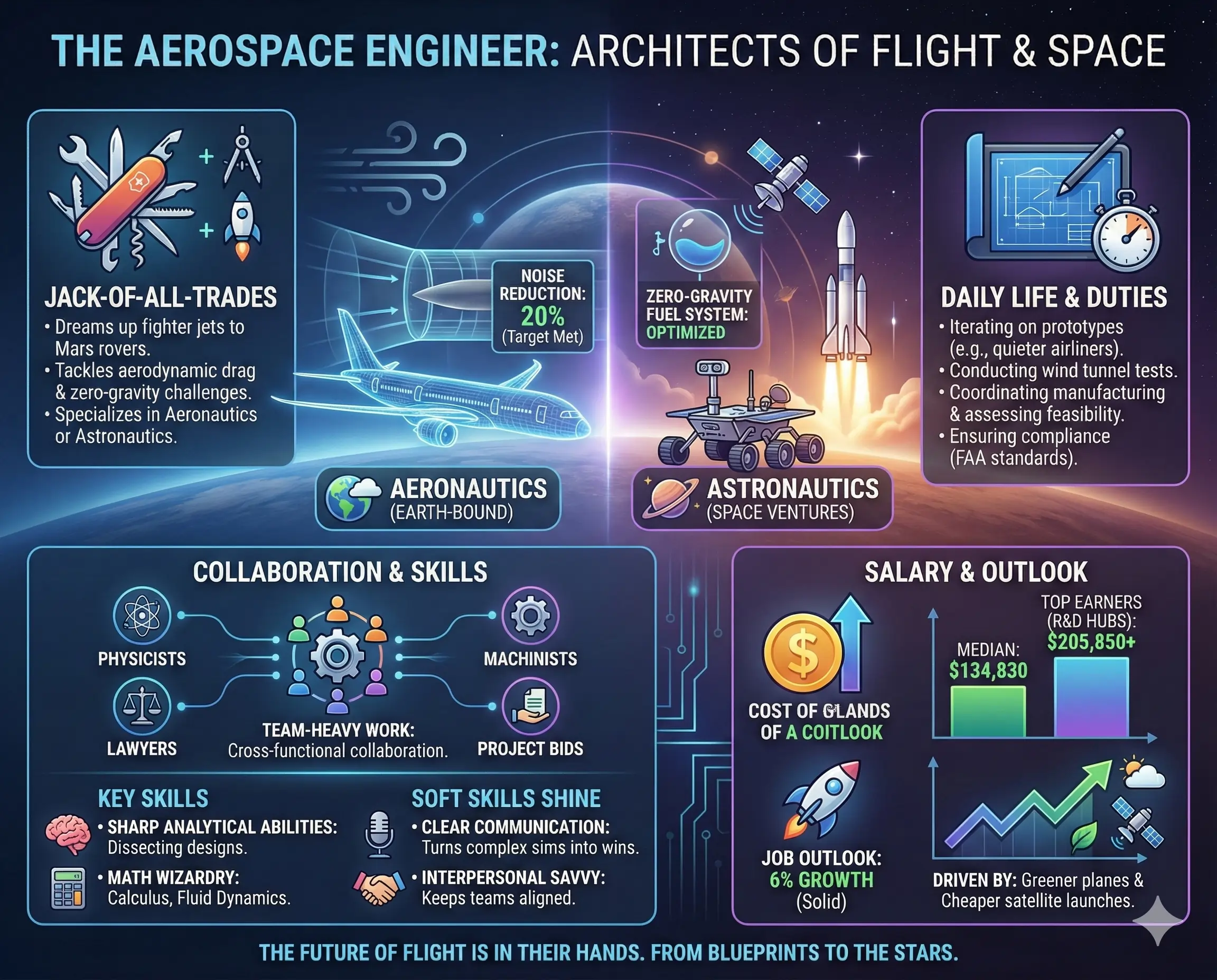
Duties go beyond blueprints—they include coordinating manufacturing, assessing feasibility, and ensuring compliance with regs like FAA standards. It’s team-heavy work, collaborating with physicists, machinists, and even lawyers on project bids.
Key skills? Sharp analytical abilities for dissecting designs, plus math wizardry in calculus and fluid dynamics. Soft skills shine too: Clear communication turns complex sims into boardroom wins, while interpersonal savvy keeps cross-functional teams aligned.
Salaries reflect the expertise: Median hits $134,830, with top earners clearing $205,850 in R&D hubs. Outlook is solid at 6% growth, driven by greener planes and cheaper satellite launches.
For a quick comparison of aerospace engineer subspecialties, check this table:
| Subspecialty | Focus Area | Average Salary (2025) | Example Project |
|---|---|---|---|
| Aeronautical Engineer | Aircraft within the atmosphere | $130,000 – $160,000 | Designing fuel-efficient wings for long-haul jets |
| Astronautical Engineer | Spacecraft and satellites | $135,000 – $170,000 | Developing cubesats for Earth observation |
| Propulsion Engineer | Engines and thrust systems | $140,000 – $180,000 | Hybrid rocket motors for reusable launchers |
Real example: At a leading U.S. defense contractor, aeronautical engineers recently redesigned a drone fleet for wildfire monitoring, integrating computational fluid dynamics (CFD) software to optimize flight paths—saving millions in fuel and boosting response times.
Systems Engineer
If aerospace engineers are architects, systems engineers are the conductors ensuring every instrument plays in harmony. They integrate hardware, software, and humans into seamless wholes—such as ensuring a satellite’s communications link up with ground control without a hitch. In 2025, with megaprojects such as next-generation fighters, this role is indispensable.
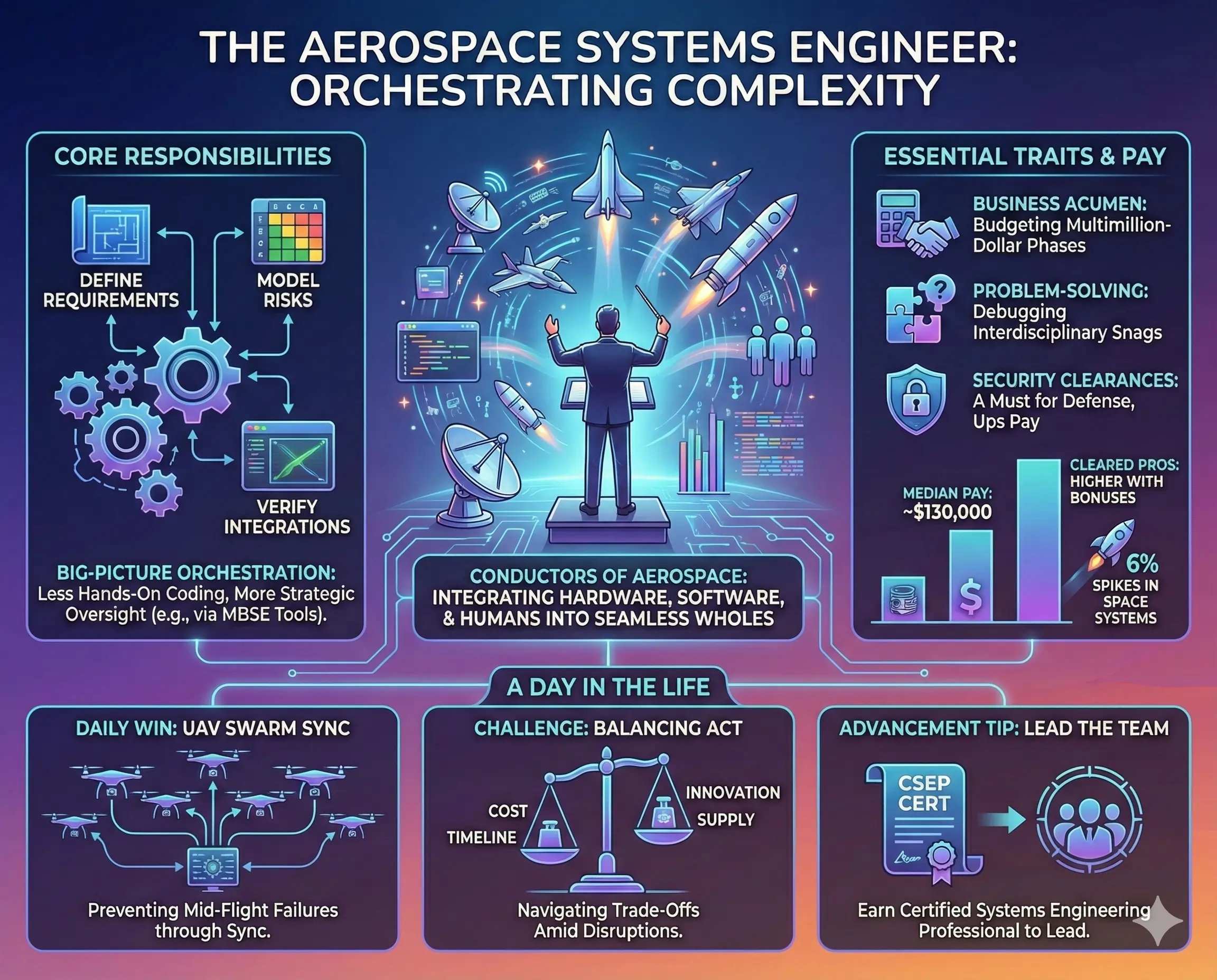
Expect to define requirements, model risks, and verify integrations. It’s less hands-on coding, more big-picture orchestration, often using tools like Model-Based Systems Engineering (MBSE).
Essential traits include business acumen for budgeting multimillion-dollar phases and problem-solving to debug interdisciplinary snags. Security clearances are a must for defense gigs, limiting pools but upping pay.
Median pay? Around $130,000, with bonuses for cleared pros pushing it higher. Growth mirrors the field’s 6%, with spikes in space systems.
- Daily Wins: Overseeing a UAV swarm’s software-hardware sync, preventing mid-flight failures.
- Challenges: Balancing cost, timeline, and innovation amid supply disruptions.
- Advancement Tip: Earn a Certified Systems Engineering Professional (CSEP) cert to lead teams.
Case in point: During a recent hypersonic missile program, systems engineers at a global firm used digital twins to simulate 1,000 flight scenarios, cutting test costs by 30% and accelerating deployment.
Tech-Infused Roles: Where Aerospace Meets the Digital Frontier
The fusion of aerospace with digital twins, machine learning, and additive manufacturing is birthing hybrid careers that appeal to coders and tinkerers alike. These aren’t fringe; they’re core to 2025’s efficiency push.
Software Engineer (Aerospace)
Gone are the days when aerospace was all metal and math—now, software engineers script the brains behind autonomous flights and predictive analytics. Think about developing algorithms for collision avoidance in urban air taxis or optimizing satellite orbits via AI.
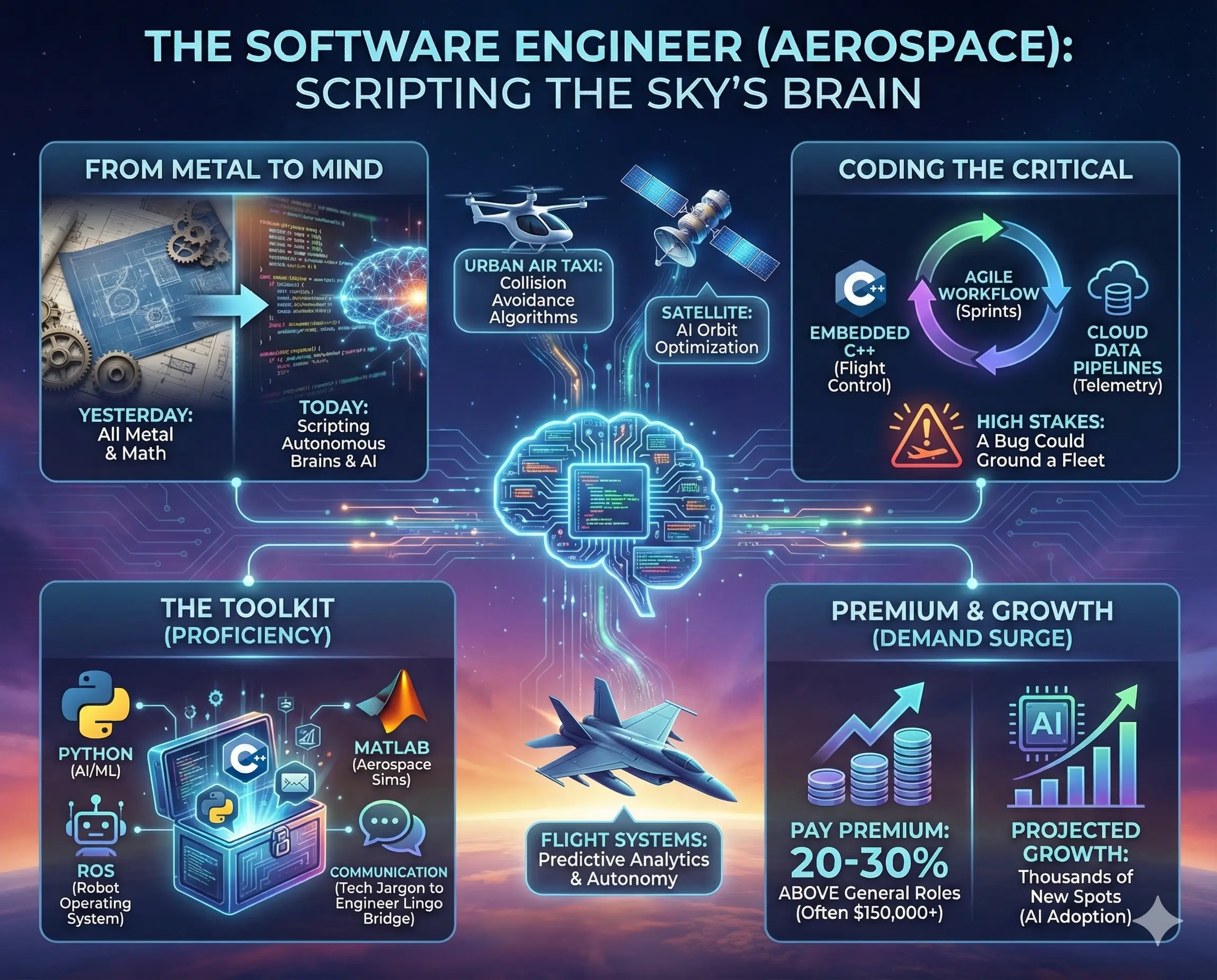
Responsibilities span from embedded systems coding in C++ to cloud-based data pipelines for telemetry. It’s agile work, with sprints mirroring software norms but stakes sky-high: A bug could ground a fleet.
You’ll need proficiency in Python, ROS (Robot Operating System), and aerospace-specific sims like MATLAB. Communication bridges tech jargon to engineer lingo.
Pay premium: 20-30% above general software roles, often $150,000+. Demand surges with AI adoption, projected to add thousands of spots.
Here’s a table of hot software sub-roles:
| Role | Key Tech Stack | Salary Range (2025) | Growth Driver |
|---|---|---|---|
| Avionics Software Developer | Ada, DO-178C standards | $140,000 – $175,000 | Safety-critical flight systems |
| AI Flight Optimization Specialist | TensorFlow, reinforcement learning | $155,000 – $200,000 | Fuel efficiency algorithms |
| Cybersecurity Coder for Space | Encryption protocols, blockchain | $145,000 – $180,000 | Protecting satellite networks |
Example: Engineers at an innovative startup coded ML models to predict engine wear in real-time, extending maintenance intervals by 25% on a commercial fleet—saving airlines billions.
Avionics and Flight Test Engineers
Avionics engineers wire the nerves of modern aircraft—think GPS, radar, and fly-by-wire controls. With electrification booming, they’re retrofitting legacy planes for hybrid power, ensuring seamless transitions.
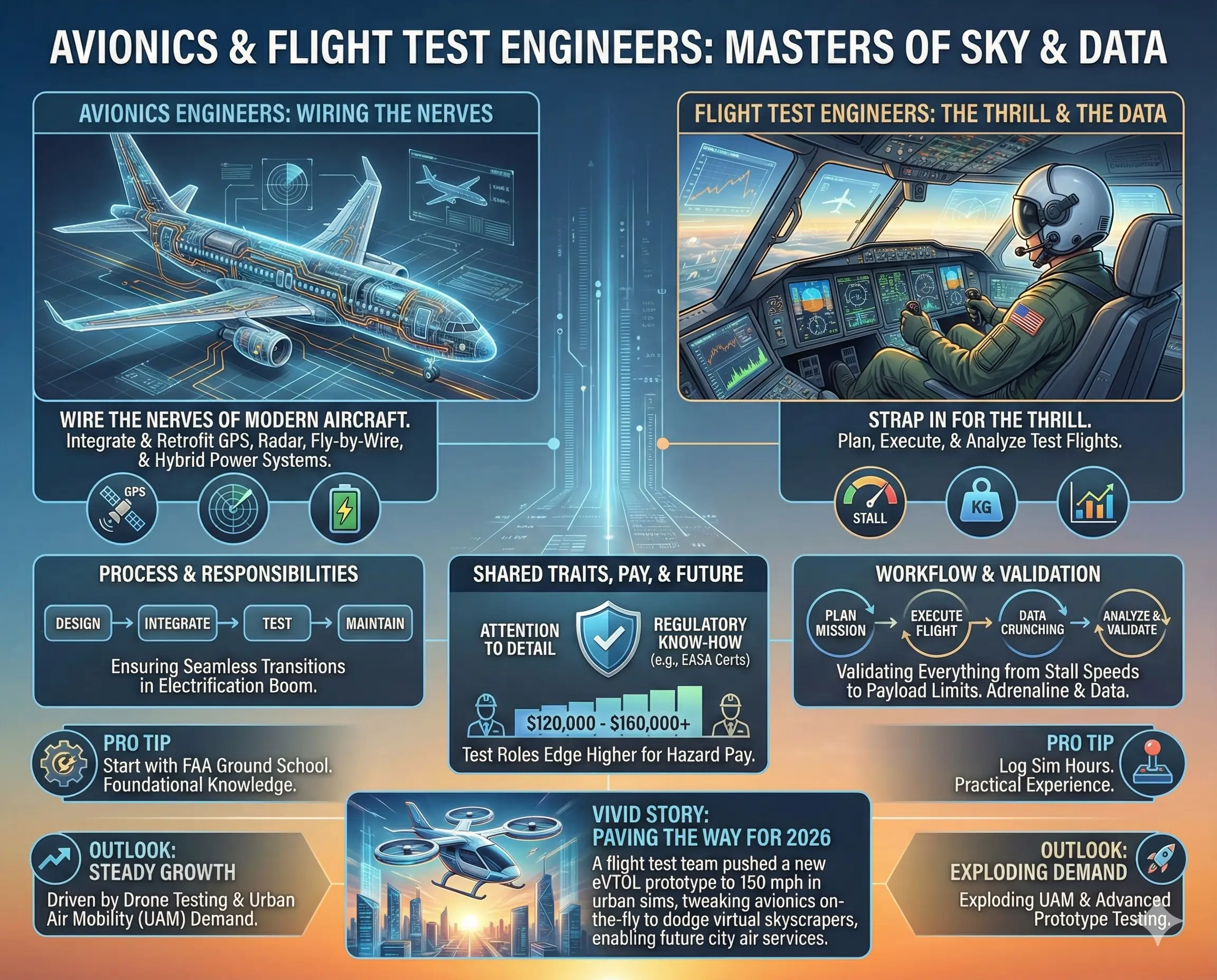
Flight test engineers, meanwhile, strap in for the thrill: They plan, execute, and analyze test flights, validating everything from stall speeds to payload limits. It’s equal parts adrenaline and data crunching.
Both roles crave attention to detail and regulatory know-how (e.g., EASA certs). Salaries hover at $120,000-$160,000, with test roles edging higher for hazard pay.
- Pro Tip: Start with FAA ground school for avionics; log sim hours for testing.
- Outlook: Steady, with drone testing exploding UAM demand.
Vivid story: A flight test team recently pushed a new eVTOL prototype to 150 mph in urban sims, tweaking avionics on-the-fly to dodge virtual skyscrapers—paving the way for 2026 city air services.
Emerging Frontiers: Tomorrow’s Aerospace Jobs Today
As we gaze beyond 2025, niches like space tourism logistics and hypersonic travel are crystallizing into viable paths. These blend aerospace roots with futurism, often requiring interdisciplinary chops.
Launch Vehicle and Spacecraft Systems Specialists
Launch vehicle specialists oversee reusable rocket ops, from payload integration to recovery splashes. Spacecraft systems engineers design habitats and life support for deep-space jaunts.
Duties: Risk modeling, vibration testing, thermal analysis. Skills: Orbital mechanics, finite element analysis (FEA).
Pay: $140,000-$190,000, with equity in startups. Growth: Explosive, tied to 1,000+ annual launches by 2030.
Table of space career variants:
| Career | Core Duty | Median Salary | Key Trend Fueling It |
|---|---|---|---|
| Satellite Data Analyst | Process orbital telemetry | $125,000 | Constellation builds (e.g., 10,000+ birds) |
| Thermodynamics Engineer | Heat management in re-entry | $150,000 | Hypersonic vehicles |
| UAV Autonomy Expert | AI for drone swarms | $135,000 | Delivery and surveillance ops |
Take Relativity Space: Their specialists iterated on 3D-printed rockets, slashing build times from months to weeks—revolutionizing access for small payloads like climate sensors.
Sustainability and Drone Specialists
Sustainable aerospace engineers pioneer hydrogen propulsion and recycled composites, aligning with net-zero goals. Drone specialists certify UAVs for everything from parcel drops to border patrols.
These roles demand life cycle assessment skills and eco-cert knowledge. Salaries: $128,000 average, rising with green incentives.
- Insight: Drones could replace 30% of short-haul flights by 2035, spawning 100,000+ jobs.
- Example: A team optimized biofuel blends for regional jets, cutting CO2 by 80% on test routes.
Education, Entry, and Advancement: Your Launchpad
Breaking in? A bachelor’s degree is table stakes—focus on accredited programs with labs in stability and control or propulsion. High school preps with AP physics and calculus. Internships at majors like Boeing seal deals, often converting to full-time.
For vets or career changers: Bootcamps in aerospace coding or PE licensure bridge gaps. Networking via AIAA events uncovers hidden gems.
Advancement? Master’s or PhDs unlock R&D leads; leadership tracks hit $167,000+ as managers. Continuous learning in AI or sustainability keeps you airborne.
| Education Path | Duration | Cost Estimate | Career Boost |
|---|---|---|---|
| Bachelor’s in Aerospace Eng | 4 years | $40,000-$200,000 | Entry-level design roles |
| Master’s with Co-op | 1-2 years | $20,000-$60,000 | Systems integration specialist |
| PE Certification | 4+ years exp | $1,000-$2,000 | Supervisory positions |
| AI Specialization Cert | 6-12 months | $5,000-$15,000 | Emerging tech hybrids |
Challenges and Rewards: The Human Side
It’s not all glamour—long hours during test phases or clearance waits can test resolve. Yet, the payoff? Seeing your work in the skies, from news clips of successful launches to greener commutes. Pros rave about the camaraderie, innovation pace, and global reach.
In diverse teams, empathy and adaptability shine, fostering inclusive cultures amid talent wars. For underrepresented groups, scholarships and mentorships are expanding access.
Wrapping Up: Soar into Your Future
Aerospace in 2025 and beyond isn’t just jobs—it’s a calling to engineer wonder. From tweaking turbofans for silence to coding constellations for connectivity, these careers offer purpose, pay, and progress. Dive in with curiosity, skill up relentlessly, and who knows? You might just be the one getting us to Mars.
Ready to apply? Polish that resume with quantifiable wins, like “Optimized CFD model reducing drag by 15%,” and target growing firms. The sky’s not the limit—it’s your starting line.
Key Citations And References
- BLS Occupational Outlook Handbook: Aerospace Engineers
- Refonte Learning: Top Aerospace Companies Hiring in 2025
- Fonzi.ai: Aerospace Jobs & Careers in 2025
- ZipRecruiter: Highest Paying Aerospace Engineer Jobs
- Blue Signal Search: 2025 Hiring Trends in Aerospace & Defense
- Deloitte Insights: 2026 Aerospace and Defense Industry Outlook
- KPMG: Emerging Trends in Aerospace and Defense 2025
- CareerExplorer: Aerospace Engineer Job Market
- Wellfound: Best Aerospace Companies and Startups
- LinkedIn: Breaking into Aerospace Entry-Level Opportunities
Read These Articles in Detail
- Aerospace Engineering vs. Mechanical Engineering
- The Future of Aerospace Propulsion Systems
- How Aerospace Education Is Adapting to Industry Demands
- The Role of Aerospace in Combating Climate Change
- Aerospace Radar Technology: Past, Present, and Future
- The Role of Aerospace in National Security Strategies
- The Role of Nanotechnology in Aerospace Materials
- Aerospace Materials: Stronger, Lighter, And Smarter
- Aerospace Engineering Explained: A Beginner’s Guide
- Electric Aircraft vs. Hydrogen Aircraft: Which Is More Sustainable?
- Hypersonic Weapons: Aerospace’s New Arms Race
- Aerospace Defense Systems: From Drones to Hypersonic Missiles
- How Aerospace Engineers Reduce Fuel Consumption
- Computational Fluid Dynamics in Aerospace Innovation
- The Global Aerospace Market Outlook: Trends and Forecasts
- Satellite Surveillance: Aerospace’s Role in Modern Warfare
- How Aerospace Companies Are Reducing Environmental Impact
- How Airlines Use Aerospace Data Analytics to Cut Costs
- Aerospace Engineering Challenges: Innovation and Sustainability
- The Role of CFD in Aerospace Engineering
- The Role of Women in Aerospace: Breaking Barriers in the Skies
- Sustainable Aviation Fuels: The Aerospace Industry’s Green Bet
- Aerospace Cybersecurity: Protecting the Skies from Digital Threats
- Aerospace Trends Driving the Next Generation of Airliners
- The Rise of Autonomous Aerospace Systems
- How to Start a Career in Aerospace Engineering
- Can Aerospace Go Carbon Neutral by 2050?
- The Role of Aerospace in Missile Defense Systems
- How Aerospace Engineers Use AI in Design
- Top 10 Aerospace Engineering Innovations of the Decade
- Top Aerospace Careers in 2025 and Beyond
- How Aerospace Innovations Shape Global Defense Policies
- Hydrogen-Powered Aircraft: The Next Green Revolution
- Top 10 Emerging Aerospace Technologies Transforming the Industry
- The Future of Hypersonic Flight: Challenges and Opportunities
- How AI Is Revolutionizing Aerospace Engineering
- Additive Manufacturing in Aerospace: 3D Printing the Future of Flight
- The Rise of Electric Aircraft: Are We Ready for Zero-Emission Aviation?
- Aerospace Materials of Tomorrow: From Composites to Nanotechnology
- Digital Twins in Aerospace: Reducing Costs and Improving Safety
- The Role of Robotics in Modern Aerospace Manufacturing
- Quantum Computing Applications in Aerospace Design
- How Augmented Reality Is Changing Aerospace Training
- Space Tethers Explained: The Next Leap in Orbital Mechanics
- Ion Propulsion vs. Chemical Rockets: Which Will Power the Future?
- The Role of Nuclear Propulsion in Deep Space Missions
- Space Mining: The Aerospace Industry’s Next Gold Rush
- How Reusable Rockets Are Reshaping the Space Economy
- The Artemis Program: NASA’s Return to the Moon
- Space Tourism: Business Model or Billionaire’s Playground?
- How Aerospace Startups Are Disrupting Commercial Aviation
- The Economics of Low-Cost Airlines in the Aerospace Era
- Urban Air Mobility: The Rise of Flying Taxis
- The Future of Mars Colonization: Key Aerospace Challenges and Solutions Ahead
- CubeSats and Small Satellites: Democratizing Space Access
- The Future of Cargo Drones in Global Logistics
- The Role of Aerospace in Building a Lunar Economy
Frequently Asked Questions
FAQ 1: What Are the Most In-Demand Aerospace Careers in 2025?
The aerospace industry is buzzing with opportunities as demand surges for innovative roles driven by sustainable tech, space exploration, and defense advancements. In 2025, professionals skilled in blending traditional engineering with digital tools are especially sought after, reflecting a market projected to grow by 6% through the decade. Key positions span from core design experts to those pioneering AI-driven systems, offering paths for both fresh graduates and seasoned specialists.
To help you navigate this landscape, here’s a detailed table highlighting the top in-demand careers, including responsibilities, growth outlook, and median salaries based on current industry data:
| Career Role | Key Responsibilities | Projected Growth (2024-2034) | Median Salary (2025) |
|---|---|---|---|
| Aerospace Engineer | Designing aircraft and spacecraft, conducting simulations, ensuring regulatory compliance | 6% | $134,830 |
| Systems Engineer | Integrating hardware, software, and human elements for complex projects like satellites | Strong demand in space tech | $130,000 |
| Avionics Engineer | Developing navigation and electronic systems for modern fleets, including electric propulsion | 4-6% | $120,000-$160,000 |
| Software Engineer (Aerospace) | Coding for autonomous flights, predictive maintenance, and AI optimization | 20-30% above average | $150,000+ |
| Flight Test Engineer | Planning and analyzing test flights for safety and performance in drones and jets | Tied to UAM expansion | $125,000-$155,000 |
These roles are thriving due to global pushes for greener aviation and commercial space ventures, with thousands of openings expected annually. For instance, aircraft design engineers are crucial for retrofitting planes with hybrid engines, while spacecraft systems specialists support reusable rocket programs. If you’re eyeing a switch, focusing on certifications in areas like Model-Based Systems Engineering can give you an edge in this competitive field.
FAQ 2: How Much Can I Expect to Earn as an Aerospace Engineer in 2025?
Salaries in aerospace engineering remain one of the field’s biggest draws, offering competitive pay that reflects the high-stakes nature of the work. In 2025, the median annual wage for aerospace engineers stands at around $134,830, with variations based on experience, location, and specialization. Entry-level positions often start at $70,000 to $90,000, while mid-career pros can climb to $100,000-$130,000, and seniors exceeding $150,000, especially in high-cost areas like California or defense hubs.
Factors influencing earnings include the shift toward tech-infused roles, where software-savvy engineers command premiums of 20-30% over traditional ones. Global trends also play a part: In the U.S., salaries rose 6-9% last year due to talent shortages, outpacing many sectors. Overseas, figures adjust for local economies, like €70,000-€90,000 in Europe for mid-level roles.
- Entry-Level Boosts: Internships at firms like Boeing can lead to starting offers with bonuses up to $10,000.
- Specialization Perks: Propulsion or AI experts often see $140,000+ due to demand in sustainable fuels and autonomous systems.
- Total Compensation: Beyond base pay, expect benefits like relocation aid, stock options in startups, and 401(k) matches adding 15-20% value.
Overall, the field’s stability and growth make it a smart bet for long-term financial security, with top earners in R&D pushing toward $200,000 amid 2025’s hiring boom.
FAQ 3: What Education Do I Need to Start a Career in Aerospace Engineering?
Breaking into aerospace engineering starts with a solid educational foundation, typically a bachelor’s degree that equips you with the technical know-how to tackle flight dynamics and space challenges. Most entry-level roles require at least a four-year degree in aerospace engineering, mechanical engineering, or a closely related field from an ABET-accredited program, ensuring you grasp core concepts like aerodynamics and materials science.
High school prep is key too—focus on advanced math, physics, and even introductory programming to build momentum. Once in college, expect a rigorous curriculum covering calculus, fluid mechanics, and hands-on labs, often culminating in a capstone project like designing a drone prototype. For those aiming higher, a master’s can open doors to R&D, adding 1-2 years and specializing in areas like propulsion or orbital mechanics.
Many programs integrate co-ops or internships, which are gold for landing jobs—companies like Lockheed Martin often hire directly from these. If you’re a career changer, online certificates in CAD or computational fluid dynamics can bridge gaps, but a full degree remains the gold standard. In 2025, with industry growth at 6%, investing in this education pays off quickly through abundant opportunities and salaries starting above $70,000.
FAQ 4: What Skills Are Essential for Success in Aerospace Careers in 2025?
Success in aerospace hinges on a mix of technical prowess and adaptable mindsets, especially as the field evolves with AI and sustainable tech. At the core, strong foundations in mathematics and physics are non-negotiable, enabling you to model everything from wind resistance to rocket trajectories. Proficiency in tools like CAD software and simulation platforms, such as MATLAB or ANSYS, lets you turn ideas into testable designs efficiently.
Beyond the numbers, soft skills shine in collaborative environments. Effective communication—whether explaining complex sims to non-tech teams or writing grant proposals—builds bridges across disciplines. Problem-solving under pressure is vital too, as deadlines for flight tests or satellite launches demand quick, creative fixes.
Here’s a breakdown of must-have skills tailored to 2025’s trends:
- Technical Essentials: Aerodynamics knowledge for efficient aircraft; coding in Python or C++ for embedded systems.
- Emerging Tech: AI and machine learning for predictive maintenance; cybersecurity basics to protect space networks.
- Professional Edges: Teamwork for cross-functional projects; adaptability to learn additive manufacturing for rapid prototyping.
Employers value continuous learners, so pursuing certifications in systems engineering or green propulsion keeps you ahead. Real-world application? A propulsion engineer might use data analysis to optimize hybrid engines, cutting emissions by 20%—proving these skills drive tangible impact.
FAQ 5: What Are the Best Entry-Level Aerospace Jobs for 2025?
For newcomers, 2025 offers a wealth of entry-level aerospace jobs that blend learning with real contributions, often converting to full-time roles post-internship. With over 4,500 annual openings projected, fresh grads can dive into design, testing, or operations at giants like Boeing or startups pushing space boundaries. These positions emphasize hands-on experience, making them ideal for building portfolios quickly.
Check out this table of standout entry-level opportunities, including typical duties, required quals, and starting pay:
| Job Title | Typical Duties | Required Qualifications | Starting Salary (2025) |
|---|---|---|---|
| Junior Aerospace Engineer | Assist in simulations and prototyping for aircraft components | Bachelor’s in engineering; basic CAD | $70,000-$90,000 |
| Avionics Technician Trainee | Support installation and testing of flight electronics under supervision | Associate’s or bachelor’s; FAA basics | $60,000-$80,000 |
| Flight Test Support Specialist | Log data during ground and flight tests for drones or jets | Degree in aero; safety certs | $65,000-$85,000 |
| Systems Integration Assistant | Help assemble and verify subsystems for satellites | Engineering degree; teamwork focus | $75,000-$95,000 |
| UAV Operations Coordinator | Monitor drone missions for urban air mobility trials | Bachelor’s; programming intro | $68,000-$88,000 |
Programs at Northrop Grumman or GE Aerospace often include mentorship, accelerating growth. Tip: Tailor resumes with project experience, like university rocketry clubs, to stand out in this talent-hungry market.
FAQ 6: How Is the Aerospace Job Market Trending for 2025?
The aerospace job market in 2025 is on an upward trajectory, fueled by post-pandemic travel recovery, defense investments, and the commercial space boom. Employment for aerospace engineers is set to grow 6% faster than average, with about 4,500 new spots yearly, driven by needs in electric aircraft and satellite networks. Salaries are climbing too, up 5-9% industry-wide, as companies compete for cleared talent amid supply chain recoveries.
Challenges persist, like clearance delays slowing defense hires, but opportunities abound in regions like the U.S. Southwest and Scotland, where postings rose 4-9%. Urban air mobility and AI integration are hotspots, spawning roles in eVTOL certification and data analytics. Globally, the sector’s $1 trillion space economy projection by 2040 underscores long-term stability.
For job seekers, this means leveraging networks via AIAA events and upskilling in sustainable aviation fuels. Veterans and diverse hires benefit from targeted programs, ensuring the market’s inclusivity matches its innovation pace.
FAQ 7: What Emerging Jobs Are Arising from Space Tourism in 2025?
Space tourism is transforming aerospace, birthing roles that merge adventure with engineering as companies like SpaceX and Blue Origin scale suborbital flights. By 2025, the sector’s 12% CAGR is creating demand for specialists in passenger safety and orbital logistics, with the workforce expanding 7.5% yearly.
These jobs go beyond rockets, encompassing hospitality and sustainability for civilian spacefarers. For example, mission controllers now handle tourist trajectories, while designers craft zero-gravity cabins.
Key emerging positions include:
- Space Tourism Coordinator: Manages bookings, training, and itineraries for high-altitude joyrides, blending aviation ops with customer service.
- Microgravity Safety Engineer: Develops protocols for passenger health during flights, focusing on radiation shielding and emergency sims.
- Orbital Hospitality Specialist: Designs amenities like space-adapted meals or VR entertainment for extended stays.
- Debris Retrieval Analyst: Monitors and plans removal of orbital junk to safeguard tourist paths, using AI for predictions.
With Axiom Space’s stations launching modules soon, these roles offer salaries from $100,000+, appealing to those passionate about democratizing space.
FAQ 8: Which Aerospace Companies Are Hiring the Most in 2025?
Major players are ramping up recruitment in 2025 to meet backlogs in aircraft orders and space missions, with thousands of engineering and tech spots open. Boeing and Airbus lead commercial hiring, while defense firms like Lockheed focus on cleared roles. Startups add agility, offering equity for innovative minds.
This table spotlights top hirers, their focus areas, and active openings:
| Company Name | Hiring Focus Areas | Estimated Open Roles (2025) | Notable Perks |
|---|---|---|---|
| Boeing | Aircraft design, global engineering diversification | 5,000+ | Rotational programs, relocation |
| Airbus | Wing production, sustainable propulsion | 400+ in UK alone | International mobility |
| Lockheed Martin | Defense systems, satellite integration | 2,000+ | Security clearances, mentorship |
| SpaceX | Reusable rockets, space tourism ops | 1,500+ | Equity shares, fast-paced culture |
| GE Aerospace | Engine manufacturing, early talent programs | 1,000+ | Handshake awards for new grads |
These firms prioritize diverse talent, with remote options at places like RTX’s Collins Aerospace. Networking on platforms like LinkedIn can uncover unposted gems.
FAQ 9: How Can Women Break Into and Advance in Aerospace Careers?
Women are making strides in aerospace, though representation hovers around 14% in technical roles, thanks to initiatives like scholarships and mentorships. In 2025, breaking in starts with targeted education—pursue ABET-accredited degrees and join groups like Women in Aerospace for networking events that connect you to leaders at Boeing or NASA.
Advancement requires proactive steps: Seek sponsors for high-visibility projects, such as AI flight systems, and leverage programs like SWANRise for guidance on navigating biases. Events like AeroWomen conferences foster belonging, sharing stories of trailblazers in propulsion design.
Building resilience through allyship is crucial—male colleagues’ support in inclusive teams boosts retention. With the industry’s growth, women-led innovations in sustainable tech are rising, offering paths to leadership. Start small: Volunteer for AIAA outreach to inspire the next wave while honing your voice.
FAQ 10: What’s the Difference Between Aeronautical and Astronautical Engineering Careers?
Aeronautical and astronautical engineering both fuel aerospace dreams but diverge in focus: aeronautical tackles atmospheric flight, like jets and drones, while astronautical ventures into space with satellites and rockets. In 2025, aeronautical roles emphasize eco-friendly aviation amid rising passenger traffic, whereas astronautical thrives on commercial launches, projected to hit 1,000+ annually.
Aeronautical engineers optimize within Earth’s bounds, dealing with air resistance and weather, often for airlines or UAM. Astronautical pros grapple with vacuum challenges, like thermal shielding for re-entry, supporting tourism and deep-space probes.
For clarity, compare via this table:
| Aspect | Aeronautical Engineering | Astronautical Engineering |
|---|---|---|
| Primary Environment | Within Earth’s atmosphere (up to 100 km) | Beyond atmosphere (space, orbits, deep space) |
| Common Projects | Commercial planes, helicopters, urban drones | Satellites, reusable rockets, space habitats |
| Key Challenges | Fuel efficiency, noise reduction | Zero-gravity propulsion, radiation protection |
| Salary Range (2025) | $130,000-$160,000 | $135,000-$170,000 |
Many pros cross over, but specializing early via electives sharpens expertise. Both promise impact, from greener skies to stellar explorations.
FAQ 11: What Are the Key Future Trends Shaping Aerospace Careers in 2025 and Beyond?
The aerospace industry is on the cusp of transformative changes, with trends like sustainable technologies and AI integration set to redefine career paths through the next decade. As global air travel surges and space exploration expands, professionals can expect a blend of traditional engineering roles evolving alongside new opportunities in green propulsion and digital systems. These shifts are creating a dynamic job market where adaptability and upskilling are key to long-term success.
To illustrate the most influential trends, here’s a detailed table summarizing their impact on careers, based on recent projections:
| Trend | Description | Career Impact | Projected Growth Impact (2025-2034) |
|---|---|---|---|
| Sustainable Aviation Technologies | Focus on electric/hybrid aircraft, biofuels, and lightweight materials to reduce emissions. | Increases demand for propulsion and materials engineers specializing in eco-designs. | 7-10% rise in green engineering roles |
| AI and Automation in Design | Use of machine learning for predictive maintenance and autonomous systems. | Boosts roles in AI-integrated avionics and data analytics for flight optimization. | 26% growth in AI engineering positions |
| Commercial Space Expansion | Growth in satellite networks and tourism, with over 1,000 annual launches. | Creates jobs in orbital mechanics and launch operations for startups and agencies. | 6% overall aerospace employment increase |
| Urban Air Mobility (UAM) | Development of eVTOL vehicles for short urban flights. | Spawns certification and air traffic roles in drone and vertiport management. | 55% CAGR in UAM market |
| Defense Modernization | Upgrades in hypersonics and cybersecurity for national security. | Heightens need for cleared systems engineers in secure tech development. | 4-5% annual defense spend growth |
These trends signal a robust outlook, with about 4,500 new aerospace jobs annually, emphasizing interdisciplinary skills. For aspiring professionals, staying ahead means pursuing education in emerging areas like renewable energy engineering, which could see even faster expansion.
FAQ 12: What Are the Best Certifications for Advancing an Aerospace Engineering Career in 2025?
Certifications play a crucial role in standing out in the competitive aerospace field, validating expertise and opening doors to higher-paying roles. In 2025, with the industry prioritizing innovation in AI and sustainability, targeted credentials can accelerate progression from entry-level to senior positions. They not only demonstrate technical proficiency but also align with employer needs for compliance and efficiency.
Among the top recommendations, the Professional Engineer (PE) License stands out as a foundational achievement, requiring a bachelor’s degree, work experience, and passing the Fundamentals of Engineering exam. It’s essential for supervisory roles, allowing engineers to sign off on projects and boosting salaries by up to 10-15%. Similarly, the Certified Systems Engineering Professional (CSEP) from the International Council on Systems Engineering focuses on integrating complex systems, ideal for satellite or aircraft projects, and is highly valued in defense sectors.
For specialized paths, consider the SpaceTEC Aerospace Manufacturing Certification, which covers composites and fabrication—critical for modern lightweight designs—and can be completed in months with hands-on training. Those eyeing AI applications might pursue ANSYS CFD Simulation certifications, enhancing skills in fluid dynamics modeling for aerodynamic testing.
- Project Management Professional (PMP): Builds leadership for overseeing multimillion-dollar programs; average completion time is 3-6 months.
- Certified Reliability Engineer (CRE): Emphasizes quality assurance in high-stakes environments, with strong demand in avionics.
- Geometric Dimensioning & Tolerancing (GD&T) Professional: Vital for precise manufacturing; offered by ASME, it sharpens design accuracy.
Earning these can lead to 20% faster promotions, especially as companies like Boeing seek certified talent for global initiatives. Start with self-assessments to match your goals, and pair them with ongoing education for maximum impact.
FAQ 13: Are There Growing Remote Work Opportunities in Aerospace Careers for 2025?
Remote work has steadily gained traction in aerospace, transforming how teams collaborate on everything from design simulations to data analysis. By 2025, with tools like cloud-based CAD and virtual reality testing maturing, more roles are shifting away from traditional on-site requirements, especially in software-heavy areas. This flexibility appeals to a global talent pool, helping companies address shortages while allowing engineers to balance personal lives with high-impact projects.
The appeal lies in the nature of modern aerospace work: Much of it involves computational modeling, code development, and remote oversight of manufacturing via digital twins. For instance, systems engineers can now review satellite integrations from home, using secure platforms that comply with industry regulations. This trend accelerated post-pandemic, with firms reporting 20-30% of engineering tasks fully remote, and it’s expected to grow as AI handles routine verifications.
However, not all positions lend themselves to full remoteness—flight testing or hardware assembly still demands physical presence for safety and precision. Hybrid models dominate, offering 2-3 office days weekly, which supports collaboration without burnout. Emerging hotspots include AI flight optimization and cybersecurity for space systems, where remote experts contribute to international teams.
Overall, remote opportunities are expanding, with over 300 space-related remote jobs listed globally, including software developers earning $150,000+ annually. If you’re skilled in Python or MATLAB, targeting startups or consultancies could yield the most flexible paths, fostering innovation without geographical limits.
FAQ 14: How Does Work-Life Balance Look in Aerospace Engineering Careers?
Achieving work-life balance in aerospace engineering can vary widely depending on the employer, project phase, and role, but many professionals find it rewarding amid the challenges. The field’s high-stakes projects often mean intense periods, yet forward-thinking companies are prioritizing wellness to retain talent in this growing sector.
Here’s a table breaking down common experiences across career stages, drawn from industry insights:
| Career Stage | Typical Work Hours | Balance Factors | Strategies for Improvement |
|---|---|---|---|
| Entry-Level | 40-50 hours/week, occasional overtime | High learning curve; team support helps, but deadlines loom. | Set boundaries early; join mentorship programs. |
| Mid-Career | 45-55 hours/week during peaks | Project leadership adds stress, but remote options ease commutes. | Prioritize hybrid schedules; use wellness perks. |
| Senior/Leadership | 50+ hours/week, flexible | Autonomy in managing teams, but travel for tests disrupts. | Delegate tasks; advocate for family leave policies. |
| Defense vs. Commercial | Defense: 50-60 hours; Commercial: 40-50 | Clearances add on-call duties; commercial offers more predictability. | Seek roles with defined OT caps; focus on startups for agility. |
While some report 27% working just 1-4 extra hours weekly, others face 11-20 during crunches, highlighting the need for proactive management. Positive aspects include generous PTO and camaraderie from shared missions, with many achieving fulfillment through impactful work like sustainable designs.
FAQ 15: What Global Opportunities Exist for Aerospace Professionals in 2025?
The aerospace sector’s international scope offers exciting prospects for those willing to explore beyond borders, with hubs in Europe, Asia, and the Middle East driving expansion. In 2025, rising demand for sustainable aircraft and space tech is creating cross-continental roles, from design in the U.S. to manufacturing in India.
Key regions include the U.S. Southwest for innovation, the UK for wing production, and China’s booming satellite market. Opportunities span engineering transfers and joint ventures, with salaries adjusted for locales—€70,000-€90,000 in Europe versus $130,000+ in the U.S.
- Europe (Airbus Hubs): Focus on green propulsion; roles in Toulouse emphasize hybrid systems, with EU grants supporting mobility.
- Asia-Pacific (Boeing/GE Sites): High growth in assembly; Singapore offers avionics jobs with 5-7% annual raises.
- Middle East (Emirates Ties): Urban air mobility pilots; Dubai’s vertiports need certification experts amid tourism surges.
- Emerging Markets (India/Brazil): Cost-effective R&D; ISRO collaborations seek orbital specialists for low-Earth orbit projects.
Networking via AIAA international chapters can unlock these, with relocation packages common. Global experience not only diversifies resumes but also exposes pros to varied regulations, enhancing versatility in a $1 trillion industry.
FAQ 16: How Is AI Impacting Aerospace Engineering Jobs in 2025?
Artificial intelligence is revolutionizing aerospace by streamlining design, maintenance, and operations, but it’s also reshaping job landscapes in nuanced ways. In 2025, AI tools are automating routine tasks like initial simulations, allowing engineers to focus on creative problem-solving and strategic oversight. This shift promises efficiency gains—such as 30% reductions in downtime via predictive analytics—but raises questions about role evolution rather than outright replacement.
On the positive side, AI is spawning hybrid positions, like AI avionics specialists who integrate machine learning into flight controls for safer, fuel-efficient aircraft. The U.S. Department of Defense’s $849.8 billion budget underscores this, funneling funds into unmanned systems where AI enhances decision-making. Yet, challenges persist: Only 6% of firms fully trust AI for supply chain automation, emphasizing human-AI collaboration in regulated environments.
For workers, upskilling in AI proficiency is crucial, with demand for data-savvy engineers projected to surge 15% annually. While entry-level tasks may consolidate, mid-to-senior roles in ethical AI governance and customization will expand, ensuring the field’s 6% growth translates to meaningful careers. Ultimately, AI augments human ingenuity, making aerospace more innovative and accessible.
FAQ 17: What Sustainability Roles Are Emerging in the Aerospace Industry for 2025?
Sustainability is at the forefront of aerospace evolution, with net-zero goals by 2050 spurring dedicated roles that blend engineering with environmental strategy. These positions are vital as the sector invests $15 billion annually in green tech, from biofuels to electric propulsion, creating pathways for eco-focused professionals.
For a clear overview, this table highlights prominent roles, their duties, and entry requirements:
| Role | Key Duties | Required Skills/Quals | Average Salary (2025) |
|---|---|---|---|
| Sustainability Manager | Track emissions, implement SAF programs, report on ESG compliance. | Bachelor’s in env. science; PMP cert preferred | $120,000-$150,000 |
| Alternative Fuels Researcher | Develop/test biofuels and hydrogen systems for aircraft integration. | ChemEng degree; lab experience | $110,000-$140,000 |
| Carbon Composite Engineer | Design lightweight, recyclable materials to cut fuel use. | Materials science background; GD&T cert | $125,000-$160,000 |
| Aircraft Recycling Specialist | Manage end-of-life disassembly for reusable parts. | MechEng; sustainability coursework | $95,000-$120,000 |
| ESG Compliance Analyst | Audit operations for regulatory alignment, like ICAO standards. | Env. policy knowledge; data analytics skills | $100,000-$130,000 |
These roles are proliferating at firms like Airbus and GE, with 63% of leaders eyeing AI for supply chain sustainability. Entry often starts with certifications in life cycle assessment, leading to impactful work that aligns passion for flight with planetary care.
FAQ 18: What’s the Difference Between Defense and Commercial Aerospace Careers?
Navigating defense versus commercial aerospace involves weighing stability against innovation, with each sector offering unique rewards and demands. Defense roles emphasize security and precision, while commercial focuses on efficiency and passenger experience, both fueling the industry’s 6% growth.
This comparison table outlines core distinctions to guide your choice:
| Aspect | Defense Aerospace | Commercial Aerospace |
|---|---|---|
| Focus Areas | Hypersonics, cybersecurity, missile systems. | Passenger jets, sustainable fuels, urban mobility. |
| Job Stability | High, with government contracts; clearances required. | Cyclical with travel demand; faster innovation cycles. |
| Work Environment | Secure facilities, potential travel to test sites. | Global teams, emphasis on supply chain agility. |
| Salary Range (2025) | $130,000-$180,000, plus clearances bonuses. | $120,000-$160,000, with performance incentives |
| Career Growth | Structured promotions in primes like Lockheed. | Rapid advancement in startups like SpaceX. |
Defense suits those thriving in regulated settings, comprising 54% of jobs, while commercial offers broader global exposure. Many switch sectors mid-career, leveraging transferable skills for versatility.
FAQ 19: What Are Essential Resume Tips for Landing Aerospace Engineering Jobs in 2025?
Crafting a resume for aerospace engineering requires precision, much like the field itself—highlight quantifiable achievements and tailor to job specs for maximum impact. In 2025’s competitive market, focus on ATS-friendly formats and keywords from postings, like “CFD modeling” or “systems integration.”
Start with a strong professional summary: Two to three sentences showcasing years of experience, key tools (e.g., MATLAB, ANSYS), and a standout project, such as “Optimized wing design reducing drag by 15%.” Keep it under 150 words to hook recruiters quickly.
- Quantify Impacts: Use metrics, e.g., “Led team to deliver satellite subsystem 20% under budget,” over vague duties.
- Skills Section: List 8-10 relevant ones, prioritizing technical (CAD, propulsion) and soft (teamwork, problem-solving).
- Tailor Experiences: Reverse-chronological order; emphasize aerospace-specific roles, internships, or co-ops with action verbs like “engineered” or “validated.”
- Education and Certs: Highlight ABET-accredited degrees and PE status; include GPA if above 3.5 for entry-level.
- Length and Design: One page for juniors, two for seniors; clean fonts (Arial 10-12pt), ample white space.
Proofread rigorously and incorporate industry buzzwords naturally. Pair with a portfolio of simulations for interviews— this approach has helped candidates secure roles at top firms by demonstrating real value.
FAQ 20: What Does Career Progression Look Like for Aerospace Engineers?
Career progression in aerospace engineering unfolds as a structured yet flexible journey, starting with foundational roles and ascending to leadership through experience and specialization. Entry-level engineers often begin in design or testing, gaining hands-on exposure to aerodynamics or propulsion, with bachelor’s holders entering at $70,000-$90,000 amid the field’s 6% growth.
Mid-career, after 3-5 years, pros advance to systems integration or project coordination, overseeing teams on aircraft prototypes. Salaries climb to $100,000-$130,000, with opportunities for master’s degrees unlocking R&D paths. Senior levels involve leading innovations like hybrid engines, requiring PE licensure for autonomy.
At executive tiers, engineers transition to program management or CTO roles, influencing strategy at firms like Boeing. Continuous learning—via certifications or AI upskilling—is key, as is networking through AIAA. Many diversify into consulting or academia, ensuring a fulfilling arc from builder to visionary.
