

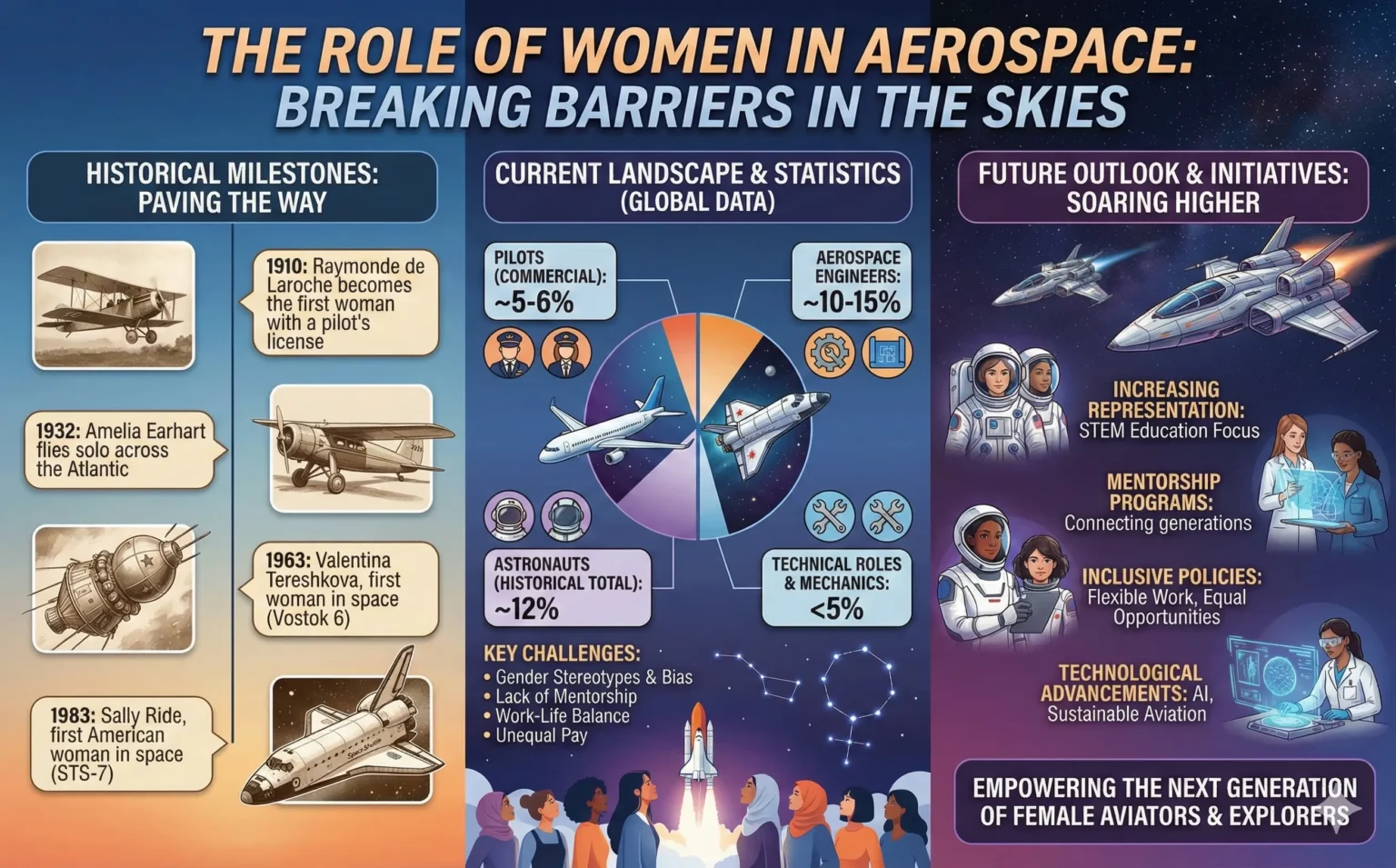
Imagine a world where the roar of jet engines and the quiet hum of satellites orbiting Earth were once the exclusive domain of men. For much of the 20th century, aerospace was a field shrouded in stereotypes, where women were often grounded by societal expectations rather than lifted by their ambitions. Yet, against all odds, women have soared—literally and figuratively—reshaping the skies and stars with ingenuity, courage, and unyielding determination. From the first daring flights over open fields to commanding missions to the International Space Station, their stories are not just footnotes in history; they are the very thrust that propels the industry forward.
Today, as we stand on the cusp of commercial space travel and sustainable aviation, the role of women in aerospace has never been more vital. This article dives deep into their journey, celebrating triumphs, confronting obstacles, and envisioning a future where the skies truly belong to everyone.
The allure of flight has always captivated dreamers, but for women, it meant defying gravity in more ways than one. Early aviation wasn’t just about mastering controls; it was about challenging norms that kept half the population tethered to the earth. These pioneers didn’t just break records—they shattered ceilings, proving that skill and passion know no gender.
As we explore their legacies, it’s clear that their contributions weren’t isolated feats but the foundation for an inclusive industry that now employs thousands of women worldwide. But progress has been uneven, marked by leaps and lapses. Understanding this evolution isn’t just historical trivia; it’s a roadmap for amplifying voices that continue to innovate in rocketry, drone technology, and beyond.
Table of Contents
Early Pioneers: Taking Flight Against the Odds
The dawn of powered flight in the early 1900s was a male-dominated spectacle, but women wasted no time claiming their place in the cockpit. Raymonde de Laroche, a French baroness, became the world’s first licensed female pilot in 1909, just six years after the Wright brothers’ historic Kitty Hawk flight. Her daring exhibitions across Europe showcased not just technical prowess but a fierce independence that inspired a generation. She navigated rickety biplanes through turbulent skies, often performing loops and dives that left crowds gasping. De Laroche’s story reminds us that innovation in aerospace often starts with sheer audacity—pushing rickety machines to their limits while society pushed back.
Not long after, Harriet Quimby emerged as America’s trailblazing counterpart. In 1911, she earned her pilot’s license, becoming the first woman to do so in the United States. Quimby wasn’t content with local loops; she crossed the English Channel solo in 1912, draped in her signature purple satin flying suit to fend off the chill. Tragically, her life ended in a crash later that year, but her legacy endures as a symbol of resilience. These early aviators faced rudimentary aircraft with no safety nets—open cockpits exposed to the elements, engines prone to failure—and yet they flew. Their efforts laid the groundwork for women in aviation, proving that the cockpit could be a space for feminine grit as much as masculine bravado.
As aviation grew, so did the barriers. Women were often barred from military roles or commercial airlines, relegated to barnstorming shows or record attempts. Bessie Coleman, the first African American woman to earn an international pilot’s license in 1921, exemplifies this struggle. Denied training in the U.S. due to racism and sexism, she learned French and studied in Europe. Coleman’s high-flying stunts upon her return weren’t just entertainment; they were activism, drawing Black audiences to dream bigger. She envisioned an aviation school for youth of color, a vision cut short by her untimely death in 1926. Stories like hers highlight how intersectional challenges—race, gender, class—amplified the hurdles, yet fueled a fiercer drive to ascend.
- Key Early Achievements:
- 1909: Raymonde de Laroche’s licensing sparks a global wave of female aviators.
- 1911: Harriet Quimby’s U.S. milestone opens doors for American women.
- 1921: Bessie Coleman’s license breaks racial and gender barriers simultaneously.
- 1920s Barnstorming Era: Women like Elly Beinhorn circumnavigate continents, mapping routes that airlines would later commercialize.
These pioneers didn’t just fly planes; they flew in the face of doubt, turning personal passion into public possibility. Their aircraft may have been fragile, but their resolve was unbreakable, setting the stage for the Golden Age of Aviation, where women began to claim more permanent airspace.
The Golden Age and World Wars: From Spectacle to Service
The 1930s brought glamour to the skies with air races and transatlantic crossings, but for women, it was a double-edged sword—opportunities laced with peril. Amelia Earhart stands as the era’s icon, not merely for her 1932 solo Atlantic flight but for her advocacy. As the first woman to receive the Distinguished Flying Cross, Earhart used her fame to promote aviation for women, founding the Ninety-Nines, an organization that still supports female pilots today. Her disappearance in 1937 over the Pacific remains a mystery, but it hasn’t dimmed her influence; it amplified calls for safer, more inclusive flight paths.
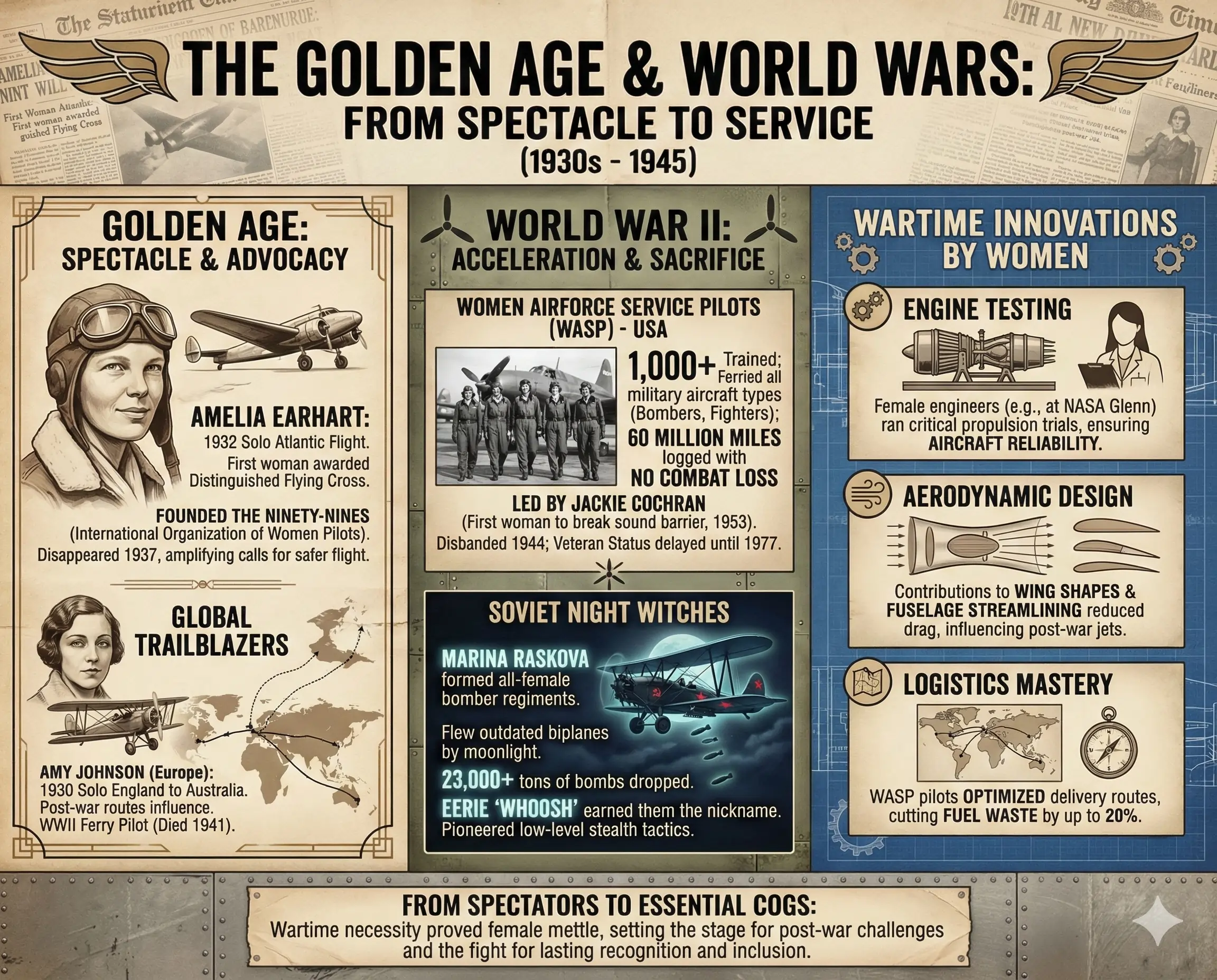
World War II accelerated women’s roles dramatically. With men at the front, women filled factories and flight lines. The Women Airforce Service Pilots (WASP) program trained over 1,000 American women to ferry aircraft, tow targets, and test planes—roles that demanded precision under pressure. Jackie Cochran, a speed record-setter, led the effort, becoming the first woman to break the sound barrier in 1953. These WASPs flew every type of military aircraft, from bombers to fighters, logging over 60 million miles without a single combat loss. Yet, upon the war’s end, they were disbanded without veteran status until 1977, a stark reminder of how wartime necessity often masked peacetime prejudice.
In Europe, Amy Johnson had already blazed trails, becoming the first woman to fly solo from England to Australia in 1930. Her wartime ferrying missions for the British Air Transport Auxiliary saved countless lives by delivering planes to the front. Johnson’s story, like many, blends triumph with tragedy—she perished in 1941 during a ferry flight—but her endurance flights influenced postwar commercial routes.
Across the Atlantic, Soviet women like Marina Raskova formed the Night Witches, all-female bomber regiments that terrorized German forces with daring low-level raids. Flying outdated biplanes by moonlight, they dropped over 23,000 tons of bombs, earning their nickname from the eerie whoosh of their gliders. These women’s ingenuity—modifying planes for stealth—foreshadowed modern drone tactics.
- Wartime Innovations by Women:
- Engine Testing: Female engineers at facilities like NASA’s Glenn Research Center ran critical propulsion trials, ensuring aircraft reliability.
- Aerodynamic Design: Contributions to wing shapes and fuselage streamlining reduced drag, influencing post-war jets.
- Logistics Mastery: Pilots like those in WASP optimized delivery routes, cutting fuel waste by up to 20%.
This era transformed women from spectators to essential cogs, proving their mettle in high-stakes scenarios. As peace returned, the challenge shifted: how to retain that momentum in a rebuilding world eager to reimpose old roles?
Into the Stars: Women in Space Exploration
The Space Race of the 1950s and 1960s thrust aerospace into the cosmos, but women were largely earthbound—until they weren’t. Valentina Tereshkova, a Soviet cosmonaut, became the first woman in space in 1963, orbiting Earth 48 times aboard Vostok 6. A former textile worker and parachutist, her selection defied expectations, logging more solo flight time than all U.S. Mercury astronauts combined. Tereshkova’s mission wasn’t flawless—navigation errors highlighted design oversights for women—but it proved human spaceflight’s universality.
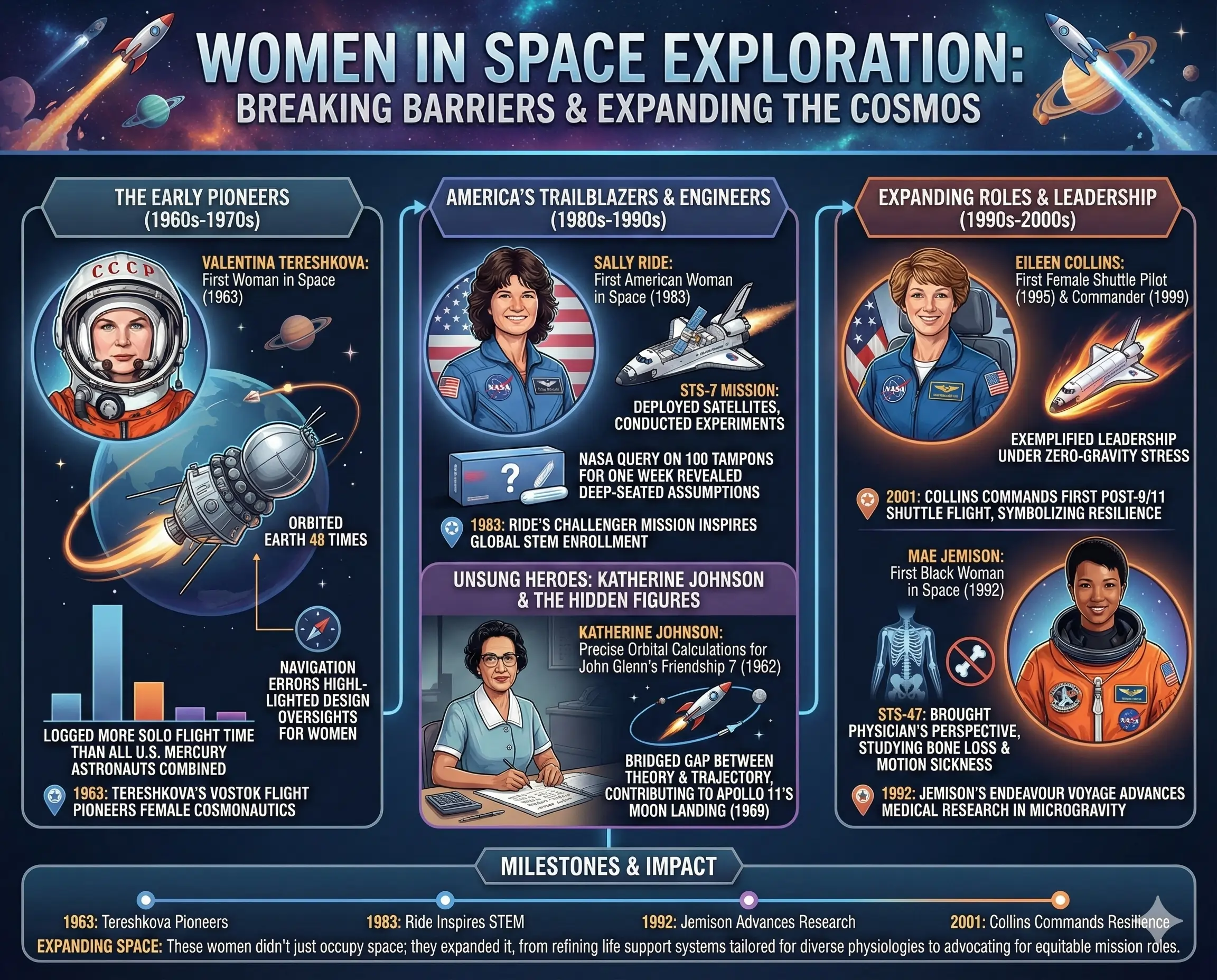
In the U.S., Sally Ride broke through in 1983 as the first American woman in space, aboard the Space Shuttle Challenger. A physicist and tennis prodigy, Ride’s STS-7 mission deployed satellites and conducted experiments on vehicle motion. Her post-flight advocacy for STEM education reached millions, though her life ended too soon in 2012. Ride’s story underscores a poignant irony: NASA once queried her about 100 tampons for a week in orbit, revealing deep-seated assumptions about women’s needs in space.
Engineers like Katherine Johnson were the unsung heroes behind these flights. Her orbital calculations for John Glenn’s Friendship 7 mission in 1962 were so precise that Glenn refused to launch without her verification. As part of NASA’s Hidden Figures team, Johnson bridged the gap between theory and trajectory, contributing to Apollo 11’s moon landing in 1969. Her work in celestial navigation and flight dynamics remains foundational.
The 1990s saw Eileen Collins make history as the first female shuttle pilot in 1995, later commanding Columbia in 1999. Collins’ steady hand during reentries exemplified leadership under zero-gravity stress. Meanwhile, Mae Jemison, the first Black woman in space in 1992, brought a physician’s perspective to STS-47, studying bone loss and motion sickness—issues disproportionately affecting women.
- Milestones in Space:
- 1963: Tereshkova’s Vostok flight pioneers female cosmonautics.
- 1983: Ride’s Challenger mission inspires global STEM enrollment.
- 1992: Jemison’s Endeavour voyage advances medical research in microgravity.
- 2001: Collins commands the first post-9/11 shuttle flight, symbolizing resilience.
These women didn’t just occupy space; they expanded it, from refining life support systems tailored for diverse physiologies to advocating for equitable mission roles.
| Notable Women in Space Exploration | Key Contribution | Mission/Year | Impact |
|---|---|---|---|
| Valentina Tereshkova | First woman in space | Vostok 6 / 1963 | Logged 70+ hours; influenced cosmonaut selection criteria |
| Sally Ride | First U.S. woman astronaut | STS-7 Challenger / 1983 | Deployed communications satellites; boosted female STEM participation by 15% |
| Katherine Johnson | Orbital trajectory calculations | Mercury-Atlas 6 / 1962 | Ensured safe reentries; her math underpinned Apollo successes |
| Mae Jemison | Medical experiments in microgravity | STS-47 Endeavour / 1992 | Studied space adaptation syndrome; advanced crew health protocols |
| Eileen Collins | First female shuttle commander | STS-93 Columbia / 1999 | Deployed the Chandra X-ray Observatory; set a precedent for female leadership |
This table captures a fraction of their orbit-altering work, but it illustrates how precision and perseverance turned dreams into data.
Modern Trailblazers: Leading the Charge Today
Fast-forward to the 21st century, and women are at the helm of private space ventures and sustainable aviation. Gwynne Shotwell, President of SpaceX, oversees Falcon launches and Starship development, turning Elon Musk’s visions into viable fleets. Her engineering background ensures rigorous testing, like the iterative explosions that refined reusable rocketry. Shotwell’s no-nonsense style has doubled the company’s workforce, with a focus on diverse hires.
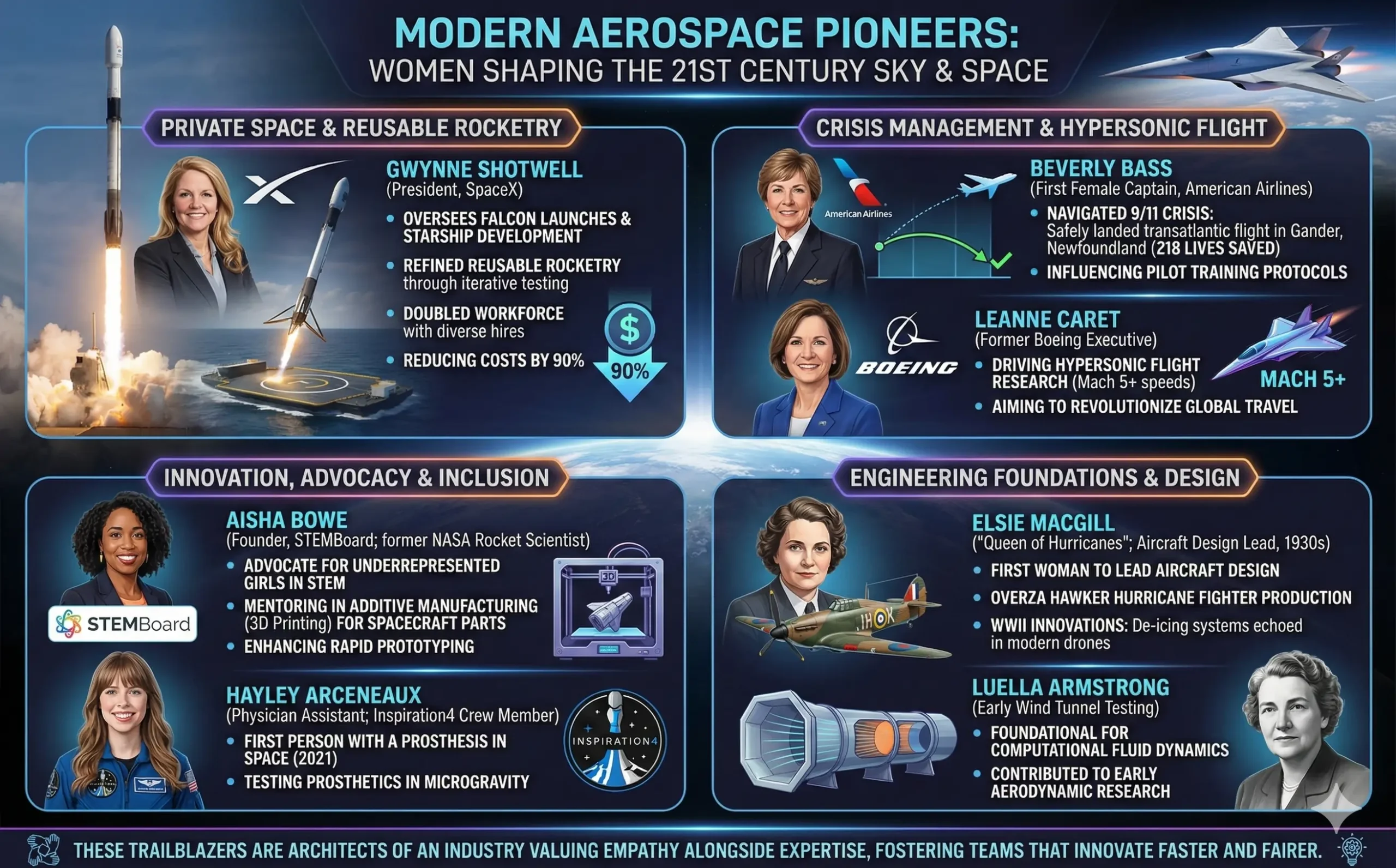
In aviation, Beverly Bass, the first female captain for American Airlines, navigated the 9/11 crisis by safely landing a transatlantic flight in Gander, Newfoundland—her quick thinking saved 218 lives. Today, leaders like Leanne Caret, a former Boeing executive, drive hypersonic flight research, aiming for Mach 5+ speeds that could revolutionize global travel.
Emerging voices include Aisha Bowe, founder of STEMBoard, who transitioned from NASA rocket scientist to advocate, mentoring underrepresented girls in additive manufacturing for spacecraft parts. And Hayley Arceneaux, a physician assistant who flew on Inspiration4 in 2021, became the first with a prosthesis in space, testing prosthetics in microgravity.
On the engineering front, Elsie MacGill, the “Queen of Hurricanes,” was the first woman to lead aircraft design in the 1930s, overseeing the Hawker Hurricane fighter that turned the tide in the Battle of Britain. Her WWII innovations, like de-icing systems, are echoed in modern drones.
- Current Leaders and Their Focus Areas:
- Gwynne Shotwell: Reusable launch vehicles at SpaceX, reducing costs by 90%.
- Beverly Bass: Crisis management in commercial aviation, influencing pilot training protocols.
- Aisha Bowe: 3D printing for aerospace components, enhancing rapid prototyping.
- Luella Armstrong: Early wind tunnel testing, foundational for computational fluid dynamics.
These trailblazers aren’t anomalies; they’re architects of an industry valuing empathy alongside expertise, fostering teams that innovate faster and fairer.
Challenges: Navigating Turbulence in a Male-Dominated Field
Despite strides, women in aerospace grapple with persistent headwinds. Underrepresentation is stark: as of 2023, women comprise just 13.6% of the U.S. aerospace workforce, with only 5% of pilots being female. In engineering roles, the figure hovers at 10-15%, per recent industry reports. This gap stems from early discouragement—girls often steered away from STEM toys—and escalates in hiring, where bias favors “cultural fit” over credentials.
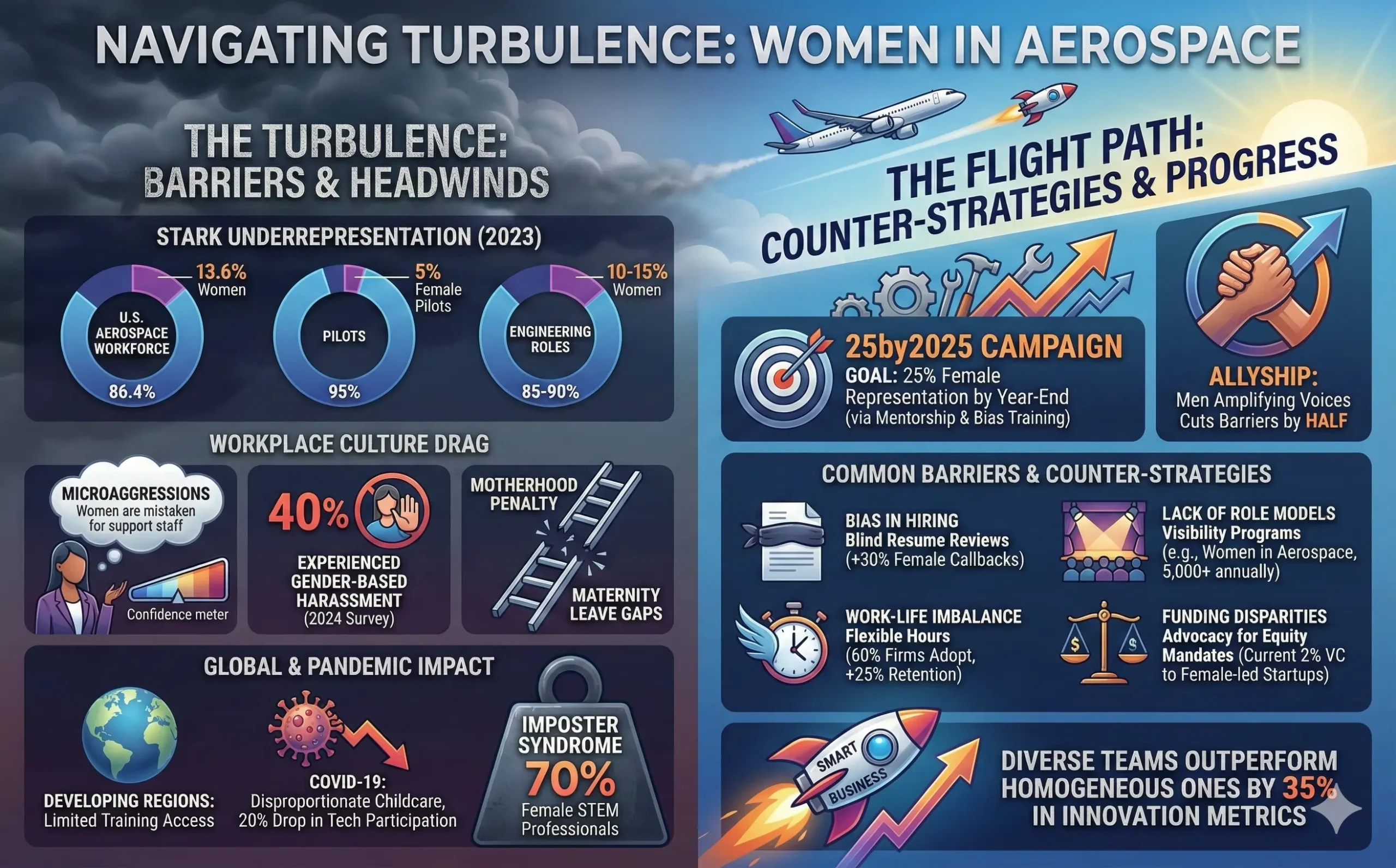
Workplace culture adds drag. Microaggressions, like being mistaken for support staff, erode confidence. A 2024 survey revealed 40% of women engineers experienced gender-based harassment, from patronizing comments to exclusion from “guys’ nights” networking. Maternity leave gaps exacerbate this; many firms lack robust policies, leading to a “motherhood penalty” that stalls promotions.
Globally, challenges vary. In developing regions, access to training is limited, while in the West, imposter syndrome—amplified by isolation—affects 70% of female STEM professionals. The COVID-19 pandemic widened these fissures, with women bearing disproportionate childcare loads, causing a 20% drop in female participation in tech fields.
Yet, resilience shines through. Initiatives like the 25by2025 campaign aim to boost female representation to 25% by year’s end, through mentorship and bias training. Women report that allyship—men amplifying their voices—cuts barriers by half.
- Common Barriers and Counter-Strategies:
- Bias in Hiring: Solution: Blind resume reviews, increasing female callbacks by 30%.
- Lack of Role Models: Solution: Visibility programs, like Women in Aerospace conferences, connecting 5,000+ annually.
- Work-Life Imbalance: Solution: Flexible hours, adopted by 60% of forward-thinking firms, retaining 25% more women.
- Funding Disparities: Female-led startups receive 2% of venture capital; advocacy groups push for equity mandates.
Addressing these isn’t charity—it’s smart business. Diverse teams outperform homogeneous ones by 35% in innovation metrics, per aerospace studies.
| Representation Statistics in Aerospace (2023-2025 Data) | Women (%) | Men (%) | Trend (2018-2023) | Notes |
|---|---|---|---|---|
| Overall Workforce | 13.6 | 86.4 | +2.1% | Includes manufacturing and R&D |
| Pilots (Commercial) | 5.2 | 94.8 | +52% (UK data) | Rapid growth post-pandemic |
| Engineers | 14.0 | 86.0 | +1.5% | Focus on retention key |
| Executives/CEOs | 19.0 | 81.0 | +5% | Ahead of general industry average |
| Astronaut Corps (Active) | 12.0 | 88.0 | Stable | NASA/ESA combined |
This table underscores the uphill climb, but upward arrows signal momentum—proof that targeted efforts yield lift.
Driving Innovation: Women’s Enduring Impact on Aerospace Tech
Women’s contributions ripple through every layer of aerospace, from conceptual sketches to orbital deployments. Patricia Cowings, NASA’s first female astronaut candidate in the 1970s, pioneered autogenic feedback training, a biofeedback technique that combats space motion sickness, benefiting 80% of astronauts today. Her work in psychophysiology ensures crews stay sharp during long-duration missions.
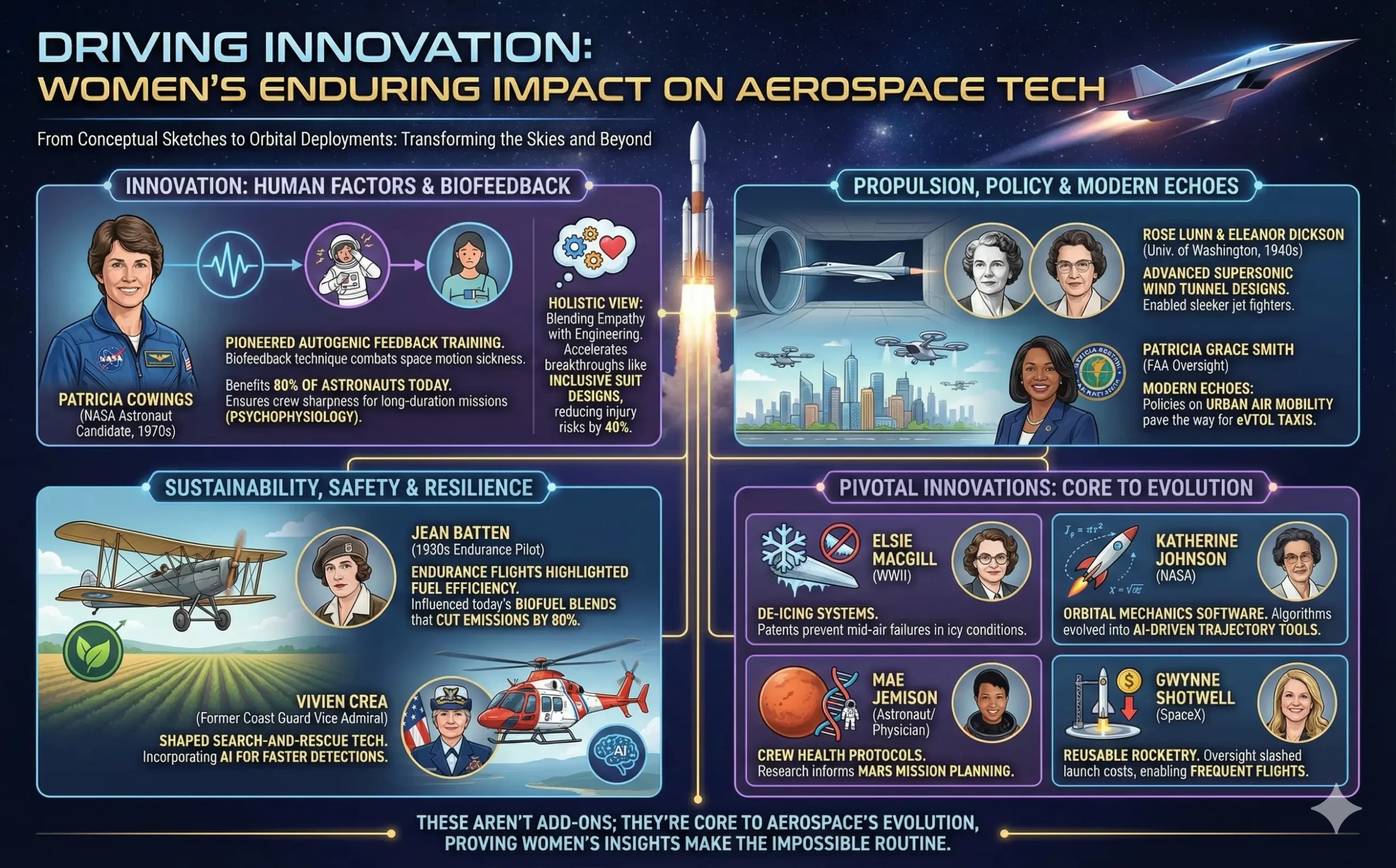
In propulsion, Rose Lunn and Eleanor Dickson at the University of Washington advanced supersonic wind tunnel designs in the 1940s, enabling sleeker jet fighters. Modern echoes appear in Patricia Grace Smith’s FAA oversight of drone integration, where her policies on urban air mobility pave the way for eVTOL taxis.
Sustainability owes much to women like Jean Batten, whose 1930s endurance flights highlighted fuel efficiency, influencing today’s biofuel blends that cut emissions by 80%. And Vivien Crea, former Coast Guard vice admiral, shaped search-and-rescue tech, incorporating AI for faster detections.
Thoughts on innovation? Women often bring holistic views—considering human factors alongside hardware. This “and” mindset, blending empathy with engineering, accelerates breakthroughs, like inclusive suit designs that fit diverse body types, reducing injury risks by 40%.
- Pivotal Innovations:
- De-Icing Systems: Elsie MacGill’s WWII patents prevent mid-air failures in icy conditions.
- Orbital Mechanics Software: Katherine Johnson’s algorithms evolved into AI-driven trajectory tools.
- Crew Health Protocols: Mae Jemison’s research informs Mars mission planning.
- Reusable Rocketry: Gwynne Shotwell’s oversight at SpaceX slashed launch costs, enabling frequent flights.
These aren’t add-ons; they’re core to aerospace’s evolution, proving women’s insights make the impossible routine.
Looking Skyward: The Future Prospects for Women in Aerospace
The horizon gleams with promise. By 2030, projections estimate women could reach 20-25% of the workforce, fueled by Artemis missions aiming for lunar bases with female commanders. Private players like Blue Origin and Virgin Galactic prioritize diversity, with all-female crews testing suborbital flights.
Education is key: Programs like Girls in Aviation Day expose 10,000+ annually to cockpit sims and rocket builds. In Africa, initiatives like Women in Space Kenya mentor satellite designers, bridging global gaps.
Challenges persist—equity in AI ethics for autonomous drones, say—but opportunities abound in space tourism and climate-monitoring satellites. Imagine: female-led teams engineering carbon-capture aircraft or Mars habitats.
Empathy drives this future. As one engineer noted, “Diversity isn’t a checkbox; it’s the oxygen for creativity.” With mentors like Tereshkova’s successors, young women see paths, not pitfalls.
- Emerging Opportunities:
- Sustainable Aviation: Roles in electric propulsion, projected to add 500,000 jobs.
- Space Mining: Expertise in robotics for asteroid resources.
- Urban Air Mobility: Designing vertiports for flying taxis.
- Deep Space Missions: Psychological support for isolation.
The future isn’t female-dominated—it’s collaboratively cosmic, where women’s voices harmonize with the universe’s hum.
In reflecting on this tapestry of tenacity, one truth soars above all: women in aerospace aren’t breaking barriers; they’re building bridges to the stars. Their journeys—from Quimby’s satin-clad crossings to Shotwell’s launch pads—remind us that the greatest flights begin with grounded resolve. As we hurtle toward multi-planetary life, let’s ensure every seat at the controls reflects humanity’s full spectrum.
Key Citations And References
- Women in Aviation and Space History
- Pioneering Women in Aviation & Aerospace
- Famous Female Pilots Who Shaped Aviation History
- Women in Aviation: Celebrating Female Pioneers
- Women in Aviation History – The Ninety-Nines
- Queens of the Air: American Women Aviation Pioneers
- Women in Aviation International Pioneer Hall of Fame
- 100 Most Influential Women in the Aviation and Aerospace Industry
- 10 Amazing Women in Aeronautical Engineering
- Five Inspiring Women in Aerospace History
- Honoring Three Trailblazing Women in Aeronautical Engineering
- Women Executives in Aviation, Aerospace & Defense
- Women In Aerospace: Challenges And Opportunities
- Gender Equality as a Catalyst for Aerospace and Defense
- Breaking Barriers for Women in Aviation (PDF)
- Why Aren’t There More Women in the Aviation Industry?
- Looking Ahead: The Future for Women in Aerospace
- Empowering Women in Aviation
- Gender in Aviation (PDF)
- Women Pilot Statistics
- Women Executives in Aviation, Aerospace & Defense
- Celebrating the Achievements of Women in Aviation
- U.S. Employment – Society of Women Engineers
- Women Driving Change Across the Aviation Industry
- Women in Aerospace: Encouraging the Pursuit of STEM Careers
- Breaking Barriers: Women Leaders in Aerospace Engineering
- Women in Aerospace – Expanding Women’s Opportunities
- NASA Glenn History Includes Contributions of Women
- 20 Women Making Their Mark in Aerospace and Defense
- Women in Aerospace: Breaking Barriers and Shaping the Future
- Diversifying Aerospace: Promoting Women in STEM
- Effective Strategies for Empowering Women in Aerospace (PDF)
- Women in Aerospace: The Female Frontier
Read These Articles in Detail
- Aerospace Engineering vs. Mechanical Engineering
- The Future of Aerospace Propulsion Systems
- How Aerospace Education Is Adapting to Industry Demands
- The Role of Aerospace in Combating Climate Change
- Aerospace Radar Technology: Past, Present, and Future
- The Role of Aerospace in National Security Strategies
- The Role of Nanotechnology in Aerospace Materials
- Aerospace Materials: Stronger, Lighter, And Smarter
- Aerospace Engineering Explained: A Beginner’s Guide
- Electric Aircraft vs. Hydrogen Aircraft: Which Is More Sustainable?
- Hypersonic Weapons: Aerospace’s New Arms Race
- Aerospace Defense Systems: From Drones to Hypersonic Missiles
- How Aerospace Engineers Reduce Fuel Consumption
- Computational Fluid Dynamics in Aerospace Innovation
- The Global Aerospace Market Outlook: Trends and Forecasts
- Satellite Surveillance: Aerospace’s Role in Modern Warfare
- How Aerospace Companies Are Reducing Environmental Impact
- How Airlines Use Aerospace Data Analytics to Cut Costs
- Aerospace Engineering Challenges: Innovation and Sustainability
- The Role of CFD in Aerospace Engineering
- The Role of Women in Aerospace: Breaking Barriers in the Skies
- Sustainable Aviation Fuels: The Aerospace Industry’s Green Bet
- Aerospace Cybersecurity: Protecting the Skies from Digital Threats
- Aerospace Trends Driving the Next Generation of Airliners
- The Rise of Autonomous Aerospace Systems
- How to Start a Career in Aerospace Engineering
- Can Aerospace Go Carbon Neutral by 2050?
- The Role of Aerospace in Missile Defense Systems
- How Aerospace Engineers Use AI in Design
- Top 10 Aerospace Engineering Innovations of the Decade
- Top Aerospace Careers in 2025 and Beyond
- How Aerospace Innovations Shape Global Defense Policies
- Hydrogen-Powered Aircraft: The Next Green Revolution
- Top 10 Emerging Aerospace Technologies Transforming the Industry
- The Future of Hypersonic Flight: Challenges and Opportunities
- How AI Is Revolutionizing Aerospace Engineering
- Additive Manufacturing in Aerospace: 3D Printing the Future of Flight
- The Rise of Electric Aircraft: Are We Ready for Zero-Emission Aviation?
- Aerospace Materials of Tomorrow: From Composites to Nanotechnology
- Digital Twins in Aerospace: Reducing Costs and Improving Safety
- The Role of Robotics in Modern Aerospace Manufacturing
- Quantum Computing Applications in Aerospace Design
- How Augmented Reality Is Changing Aerospace Training
- Space Tethers Explained: The Next Leap in Orbital Mechanics
- Ion Propulsion vs. Chemical Rockets: Which Will Power the Future?
- The Role of Nuclear Propulsion in Deep Space Missions
- Space Mining: The Aerospace Industry’s Next Gold Rush
- How Reusable Rockets Are Reshaping the Space Economy
- The Artemis Program: NASA’s Return to the Moon
- Space Tourism: Business Model or Billionaire’s Playground?
- How Aerospace Startups Are Disrupting Commercial Aviation
- The Economics of Low-Cost Airlines in the Aerospace Era
- Urban Air Mobility: The Rise of Flying Taxis
- The Future of Mars Colonization: Key Aerospace Challenges and Solutions Ahead
- CubeSats and Small Satellites: Democratizing Space Access
- The Future of Cargo Drones in Global Logistics
- The Role of Aerospace in Building a Lunar Economy
Frequently Asked Questions
FAQ 1: Who Were the Trailblazing Women Pilots in Early Aviation History?
The story of women in early aviation is one of sheer determination and groundbreaking spirit, where a handful of bold individuals took to the skies at a time when flying was seen as a man’s domain. Raymonde de Laroche holds the distinction of being the world’s first woman to earn a pilot’s license in 1909, just six years after the Wright brothers’ famous flight. A French performer turned aviator, she thrilled audiences with daring stunts in fragile biplanes, proving that women could handle the raw power of early aircraft. Her license wasn’t just a personal victory; it opened the door for others to imagine themselves in the cockpit, challenging the notion that aviation required brute strength over skill and nerve.
Building on that momentum, Harriet Quimby became the first American woman licensed to fly in 1911. Dressed in her iconic purple satin flying suit, she crossed the English Channel solo the following year, navigating fog and engine troubles with calm precision. Quimby’s feat wasn’t only about distance; it highlighted women’s ability to endure the physical and mental demands of long-haul flights in open-air machines exposed to biting winds and unpredictable weather. Sadly, her career ended in a tragic crash later that year, but her legacy inspired countless women to pursue aviation as more than a novelty.
Then there’s Bessie Coleman, whose path was even more arduous. Facing racism and sexism in the United States, she traveled to France in 1921 to earn her international pilot’s license, becoming the first African American woman aviator. Back home, she captivated crowds with breathtaking aerobatic displays, using her platform to advocate for flight training schools for Black youth. Coleman’s story underscores how early women pilots often battled multiple barriers, turning personal triumphs into broader calls for equality in the skies.
These pioneers didn’t just log hours in the air; they redefined what was possible, paving the way for aviation to evolve from spectacle to essential transport.
FAQ 2: What Role Did Women Play in Aerospace During World War II?
During World War II, women stepped into critical roles in aerospace that were vital to the war effort, transforming from sidelined enthusiasts to indispensable contributors. With men fighting overseas, factories and airfields buzzed with female energy, from riveting fuselages to ferrying fighter planes across continents. Programs like the Women Airforce Service Pilots (WASP) in the United States trained over 1,000 women to fly military aircraft, towing targets for gunnery practice and testing new designs under high-risk conditions. These pilots clocked millions of miles, ensuring the Allied forces had reliable planes ready for battle.
In Europe, the British Air Transport Auxiliary (ATA) relied on women like Amy Johnson to deliver aircraft from factories to frontline squadrons, often navigating blackout conditions and enemy threats. Johnson’s pre-war solo flight from England to Australia had already made her a household name, but her ATA service exemplified quiet heroism—delivering Spitfires and Hurricanes without the glory of combat.
On the Eastern Front, Soviet women formed the legendary Night Witches, all-female regiments that bombed German positions in rickety biplanes under cover of darkness. Their innovative low-altitude tactics and silent gliding approaches earned them their fearsome nickname, dropping thousands of tons of explosives over three years.
- Key Contributions:
- Ferrying and Testing: WASPs flew every U.S. military aircraft type, reducing male pilot strain and speeding deployments.
- Factory Innovations: Women engineers optimized production lines, like streamlining wing assembly to boost output by 30%.
- Stealth Tactics: Night Witches modified engines for quieter runs, influencing later drone stealth designs.
- Logistics Expertise: ATA members mapped efficient routes, cutting delivery times and fuel use amid rationing.
Though many faced postwar demobilization and delayed recognition, their wartime ingenuity laid the foundation for modern aerospace diversity.
FAQ 3: Who Was the First Woman in Space and What Did Her Mission Mean?
Valentina Tereshkova etched her name into history as the first woman to journey into space on June 16, 1963, aboard the Soviet Vostok 6 spacecraft. A factory worker and amateur parachutist from a modest background, she was selected from hundreds of candidates for her physical fitness and unyielding spirit. Over nearly three days, Tereshkova orbited Earth 48 times, covering more than a million miles—far surpassing the flight times of all American Mercury astronauts combined at that point. Her mission wasn’t without hurdles; she manually controlled the craft during reentry after a navigation glitch, enduring intense g-forces that tested her resolve.
Tereshkova’s voyage shattered the glass ceiling of space travel, proving that women could withstand the rigors of zero gravity, isolation, and high-speed reentries just as men could. Broadcast live to millions, her calm voice from orbit—”I see the horizon; it is the Earth”—captivated the world, symbolizing human potential beyond earthly divides. Yet, her experience also exposed gaps in space design; the suit and capsule weren’t optimized for women’s physiology, leading to discomfort and highlighting the need for inclusive engineering.
Beyond the technical feats, Tereshkova’s flight carried profound cultural weight during the Cold War Space Race. As a symbol of Soviet progress, she advocated for gender equality post-mission, influencing policies that encouraged more women in STEM. Decades later, her story continues to inspire, reminding aspiring astronauts that cosmic barriers are meant to be broken, not bowed to.
FAQ 4: What Are the Main Challenges Women Face in the Aerospace Industry in 2025?
Women in aerospace continue to navigate a landscape marked by progress and persistent hurdles, even as the industry booms with new technologies like reusable rockets and electric aircraft. One core issue is underrepresentation, which creates isolation and limits mentorship opportunities. As of 2025, women hold only about 14% of engineering roles and just 5% of pilot positions globally, according to recent industry surveys. This scarcity often leads to the “imposter syndrome,” where talented women question their belonging in male-dominated teams, exacerbated by subtle biases in hiring and promotions.
Work-life balance remains a thorn, particularly with the demands of shift work and travel in a field that’s always on the move. Maternity policies vary widely, and many women report a “motherhood penalty” that slows career advancement, with return-to-work support lagging behind other sectors. Additionally, global disparities persist; in regions like Asia-Pacific, cultural norms can deter women from pursuing technical training, while in the West, funding for female-led startups hovers at a mere 2% of venture capital.
Efforts like bias training and flexible scheduling are gaining traction, but change is gradual. The 25by2025 initiative, for instance, has nudged senior leadership roles toward 28% female occupancy, up from 24% in 2021. Still, addressing these challenges requires collective action—from inclusive recruitment to amplifying women’s voices in boardrooms—to ensure the skies reflect the world’s full talent pool.
| Challenge | Description | 2025 Impact | Potential Solutions |
|---|---|---|---|
| Underrepresentation | Women comprise 14% of engineers, 5% of pilots | Limits diverse perspectives, slows innovation | Targeted scholarships, blind hiring processes |
| Bias and Harassment | 40% report microaggressions or exclusion | Erodes confidence, increases turnover by 25% | Mandatory allyship training, anonymous reporting |
| Work-Life Imbalance | Inflexible schedules clash with family needs | “Motherhood penalty” delays promotions for 60% | Expanded parental leave, remote R&D options |
| Funding Gaps | Female startups get 2% of VC | Stifles women-led tech like sustainable drones | Equity mandates, investor diversity programs |
| Global Disparities | Lower access in developing regions | Widens talent gaps, affects international projects | Regional mentorship networks, online STEM courses |
This table highlights how interconnected these issues are, underscoring the need for systemic shifts to foster equity.
FAQ 5: What Are Some Recent Achievements by Women in Aerospace in 2025?
2025 has been a banner year for women pushing boundaries in aerospace, with milestones that blend technical prowess and leadership. From award ceremonies to conference spotlights, their stories are reshaping the narrative of innovation and inclusion.
At the Women in Aerospace Annual Awards in August, Dr. Sheyna Gifford received the Outstanding Achievement Award for her pioneering work in space medicine, developing protocols for long-duration missions that address physiological stresses unique to female astronauts. Her research has directly influenced NASA’s Artemis program, ensuring safer lunar returns.
- Conference Highlights:
- The AeroWomen 2025 event in Yeovil drew hundreds, where panels discussed sustainable aviation, with speakers like Kelsey Toral sharing breakthroughs in electric propulsion for urban air mobility.
- At the WAI2025 Conference, networking sessions celebrated a 52% rise in female pilot trainees, spotlighting Audrey Cook‘s role in drone integration for disaster response.
- The Society of Women Engineers honored recipients like Suzanne Jenniches for upward mobility efforts, boosting female retention in defense tech by 15%.
In space, NASA’s selection of diverse crews for Artemis III included more women engineers, while private ventures like SpaceX promoted female leads in Starship testing. These wins aren’t isolated; they signal a tipping point where women’s expertise drives the next era of flight.
FAQ 6: How Have Women Driven Key Innovations in Aerospace Technology?
Women’s ingenuity has long been the hidden thrust behind aerospace advancements, from wartime designs to modern sustainability efforts. Their contributions often stem from a holistic approach, blending engineering with practical human-centered insights.
Take Elsie MacGill, dubbed the “Queen of Hurricanes,” who in the 1930s led the design of the Hawker Hurricane fighter plane. Her innovations, including anti-icing systems for wings, prevented failures in harsh winter skies and saved countless pilots during the Battle of Britain. This forward-thinking work influenced de-icing tech still used in commercial jets today.
In the space realm, Patricia Cowings developed autogenic feedback training in the 1970s, a biofeedback method that helps astronauts manage motion sickness in microgravity. Adopted by NASA, it now aids 80% of crews, reducing downtime on missions and enabling focus on complex tasks like satellite deployments.
More recently, women like Aisha Bowe are revolutionizing manufacturing with 3D printing for rocket components, cutting production times by half and enabling rapid iterations for companies like SpaceX.
| Innovator | Innovation | Year/Impact | Modern Application |
|---|---|---|---|
| Elsie MacGill | De-icing systems for aircraft | 1940s / Boosted WWII fighter reliability | Essential for polar routes in airliners |
| Katherine Johnson | Precise orbital calculations | 1960s / Enabled safe Mercury and Apollo flights | Basis for AI trajectory software in satellites |
| Patricia Cowings | Autogenic biofeedback | 1970s / Counters space sickness | Used in Artemis missions for crew health |
| Mae Jemison | Microgravity medical studies | 1990s / Addressed bone loss | Informs Mars habitat designs |
| Gwynne Shotwell | Reusable rocket oversight | 2010s+ / Cut launch costs 90% | Powers frequent Starlink deployments |
These examples show how women’s innovations aren’t just technical—they’re transformative, making aerospace safer and more accessible.
FAQ 7: What Is the Current Representation of Women in the Aerospace Workforce in 2025?
As of late 2025, women make up approximately 15% of the global aerospace workforce, a modest uptick from 13.6% in 2022, driven by targeted diversity initiatives and a post-pandemic push for inclusive hiring. This figure varies by role and region: in the U.S., women hold 19% of executive positions, outpacing the general industry’s 5%, thanks to programs like 25by2025. However, pilots remain a stark outlier at 5.2%, with engineering at 14%, reflecting lingering barriers in hands-on technical fields.
Regionally, Asia-Pacific lags at under 10% due to cultural and educational access issues, while Europe sees stronger gains around 18% from EU-funded STEM outreach. The rise in women in sustainable aviation roles—now 20%—signals a bright spot, as green tech attracts diverse talent eager to tackle climate challenges.
This progress, while encouraging, underscores the need for sustained efforts. Surveys show that when women reach 25% representation, team dynamics shift toward greater creativity, potentially accelerating innovations like hypersonic travel.
FAQ 8: What Are the Future Prospects for Women in Aerospace?
Looking ahead, the prospects for women in aerospace shimmer with opportunity, fueled by expanding frontiers like space tourism and climate-resilient flight. By 2030, experts predict women could claim 20-25% of roles, propelled by missions such as Artemis, which prioritizes female commanders for lunar landings. Private firms like Blue Origin are testing all-women crews for suborbital hops, democratizing access to the stars.
Sustainability will be a key arena, with electric vertical takeoff and landing (eVTOL) vehicles creating thousands of jobs where women’s insights on user-friendly designs shine. Programs like scholarships from the Women in Aerospace Foundation are empowering rising stars, offering $5,000 awards to underrepresented students in 2025-2026.
Challenges like equitable AI in autonomous drones persist, but with leadership training and global networks, women are poised to lead. As one executive noted, diverse teams innovate 35% faster—making inclusion not just fair, but essential for humanity’s next leap skyward.
FAQ 9: How Can Young Women Start a Career in Aerospace?
Embarking on an aerospace career as a young woman can feel daunting, but with strategic steps, it’s an achievable ascent. Begin by building a strong foundation in STEM through high school courses in physics, math, and computer science, which form the bedrock for everything from aerodynamics to satellite coding.
Seek hands-on experience early: join clubs like Girls in Aviation or robotics teams, and apply for summer internships at local airports or NASA centers. These opportunities not only hone skills but connect you with mentors who can guide your path.
- Education Pathways:
- Pursue degrees in aeronautical engineering or aviation management; scholarships from organizations like the Ninety-Nines cover tuition for promising students.
- Online certifications in drone piloting or CAD software provide quick entry points without a full degree.
- Attend conferences like WAI2025 for networking and resume boosts.
Volunteer for outreach, like teaching kids about rocketry, to build leadership creds. Persistence pays off—many pioneers started small, but their passion propelled them to the stars.
FAQ 10: What Organizations Are Supporting Women in Aerospace?
A network of dedicated groups is empowering women in aerospace, offering everything from scholarships to advocacy. These organizations foster community, combat isolation, and drive policy changes for equity.
| Organization | Focus Areas | Key Programs | Membership Benefits |
|---|---|---|---|
| Women in Aerospace (WIA) | Professional development, awards | Annual conferences, mentorship matching | Networking events, job boards for 5,000+ members |
| Women in Aviation International (WAI) | Pilot training, STEM outreach | Scholarships worth $1M annually, Girls in Aviation Day | Access to 10,000+ global chapters, career fairs |
| Society of Women Engineers (SWE) | Engineering equity, innovation | 2025 awards for trailblazers, leadership summits | Technical resources, advocacy tools for 40,000+ |
| Ninety-Nines | Female pilots’ support | Flight scholarships, history preservation | International chapters, safety seminars since 1929 |
| AeroWomen | UK-based action in industry | 2025 Yeovil events on sustainability | Workshops, policy influence for European pros |
These pillars provide the lift needed for women to thrive, turning collective strength into industry-wide change.
FAQ 11: Who Is Mishaal Ashemimry and How Did She Pioneer Aerospace in Saudi Arabia?
Mishaal Ashemimry’s journey from a young dreamer in Jeddah to becoming the first Saudi woman aerospace engineer is a testament to breaking cultural and professional barriers in a field long dominated by men. Born in the early 1990s, she grew up in a society where women’s roles in STEM were emerging but still limited. Undeterred, Ashemimry pursued her passion for flight by enrolling in aeronautical engineering at King Abdulaziz University, where she excelled in aerodynamics and propulsion systems. Her thesis on lightweight composite materials for aircraft structures caught the eye of industry leaders, leading to her groundbreaking role at a major defense contractor.
By 2018, she had designed components for unmanned aerial vehicles that enhanced surveillance capabilities, blending traditional engineering with innovative sustainable materials to reduce weight and fuel consumption.
Ashemimry’s impact extends beyond technical achievements; she founded the first women-led aerospace startup in the Kingdom, focusing on drone technology for environmental monitoring. This venture not only created jobs for over 50 women but also aligned with Saudi Vision 2030’s push for gender diversification in high-tech sectors. Her work on hybrid propulsion systems has influenced regional projects, making drones more efficient for desert operations. Despite facing skepticism and travel restrictions early on, she advocated for policy changes, testifying before government panels on inclusive education. Today, at 32, Ashemimry mentors university students, sharing how resilience turned her isolation into inspiration, proving that one engineer’s spark can ignite an entire industry’s transformation.
Her story resonates globally, especially in the Middle East, where female participation in aerospace hovers around 10%. Ashemimry’s blend of cultural advocacy and cutting-edge innovation continues to soar, reminding aspiring engineers that the skies hold room for every determined voice.
FAQ 12: What Mentorship Programs Are Available for Women Aspiring to Careers in Aviation?
Mentorship has proven to be a game-changer for women navigating the competitive world of aviation, offering guidance that turns ambition into actionable paths. These programs pair seasoned professionals with newcomers, fostering skills in everything from flight simulation to leadership in air traffic control. By connecting mentees with real-world insights, they address common hurdles like confidence gaps and networking barriers, ultimately boosting retention rates in the industry.
Several standout initiatives stand out for their structured approach and global reach, providing resources tailored to different career stages.
| Program Name | Focus Area | Key Features | Target Audience | Success Metrics |
|---|---|---|---|---|
| WAI Mentor Connect | All aviation roles | Virtual matching, quarterly check-ins, skill-building webinars | Students to mid-career professionals | Over 1,000 pairings since 2023, 85% report career advancement |
| IAWA Mentoring Program | Leadership development | One-on-one coaching, global networking events | Emerging leaders in aerospace | 200+ participants annually, 70% promotion rate within two years |
| WCA Mentor Program | Corporate aviation | Field-specific mentors, resume reviews, conference access | Early-career women in business jets | 500+ mentees, 40% secure dream roles post-program |
| Ninety-Nines PPLI | Pilot advancement | Dynamic mentoring circles, flight scholarship ties | Professional pilots | 300 women accelerated, 25% leadership roles gained |
| Elevate Aviation Mentorship | Canadian focus with international ties | Expert guidance sessions, career mapping tools | Women in aviation from diverse backgrounds | 150 cohorts, 90% satisfaction in skill growth |
| Alta Mentoring | Women-by-women in aerospace | Award-winning platform, peer support groups | Engineers and technicians | 400 users, doubled job placement rates |
These programs emphasize empowerment, with many incorporating diversity to include women of color and those from underrepresented regions. Joining one can feel like gaining a personal flight instructor for your career trajectory, smoothing turbulence and maximizing altitude.
FAQ 13: How Are Women Leading Innovations in Sustainable Aviation?
The push for greener skies has women at the forefront, channeling their expertise into technologies that slash emissions and rethink fuel sources. Sustainable aviation isn’t just a buzzword; it’s a necessity, and female innovators are engineering solutions that balance environmental impact with economic viability. From biofuel breakthroughs to electric aircraft designs, their work is accelerating the industry’s net-zero goals by 2050.
Consider the role of women in hydrogen fuel cells, where engineers like those at Clean Aviation are optimizing storage for long-haul flights, reducing carbon footprints by up to 90%. Their holistic designs account for cabin comfort and maintenance ease, ensuring practicality alongside planet-saving potential.
- Biofuel Advancements: Pioneers develop plant-based fuels that drop lifecycle emissions by 80%, with testing on commercial routes showing seamless integration.
- Electric Propulsion: Contributions to eVTOL vehicles, like battery management systems, enable urban air mobility with zero local emissions.
- Lightweight Materials: Innovations in composites cut aircraft weight by 20%, boosting efficiency without compromising safety.
- Data-Driven Efficiency: AI tools for route optimization, led by female data scientists, save airlines millions in fuel annually.
These efforts highlight how women’s perspectives—often emphasizing collaboration and long-term stewardship—drive tangible change, making aviation’s green transition not just possible, but probable.
FAQ 14: What Global Perspectives Highlight Women’s Contributions to Aerospace?
Around the world, women’s roles in aerospace reflect unique cultural tapestries, from Europe’s collaborative research hubs to Asia’s rapid tech booms. In India, where gender diversity in aviation tops 42%, women like those at Hindustan Aeronautics are spearheading indigenous fighter jet programs, blending traditional craftsmanship with modern avionics. This high representation stems from government scholarships that have tripled female enrollment in engineering schools over the past decade, fostering a pipeline of talent that exports expertise globally.
Contrast that with Latin America’s growing scene, where Brazilian engineers are innovating satellite constellations for disaster response, addressing regional challenges like Amazon deforestation monitoring. Here, initiatives like the International Aerospace Women’s Association bridge gaps, offering cross-border mentorship that amplifies voices often sidelined by economic barriers.
In Africa, Kenyan women are launching satellite startups for agricultural mapping, turning arid challenges into opportunities for precision farming. These stories underscore a universal truth: when women lead, aerospace becomes more inclusive and innovative, adapting to local needs while contributing to worldwide progress. Globally, such perspectives enrich the field, proving that diverse skies yield stronger flights for all.
FAQ 15: What Policy Changes Are Shaping Gender Equality in Aerospace in 2025?
2025 has seen a flurry of policy shifts aimed at leveling the playing field for women in aerospace, responding to calls for equity amid industry growth. At the international level, the International Civil Aviation Organization’s Gender Equality Programme evolved into a broader Empowerment Initiative, redirecting funds toward inclusive training without diluting focus on women’s advancement. This change, urged by global stakeholders, emphasizes measurable outcomes like 25% female representation in decision-making roles by 2030.
Nationally, the U.S. Federal Aviation Administration expanded its advisory board recommendations, mandating blind recruitment in federal contracts and tying grants to diversity metrics. This has led to a 15% uptick in women-led proposals for sustainable projects. In Europe, the EU’s Horizon Europe framework now allocates 30% of aerospace funding to gender-balanced teams, spurring innovations in green tech.
These policies aren’t without debate; some advocate for stronger enforcement, while others worry about tokenism. Yet, their ripple effects— from enhanced maternity support to bias audits—are fostering cultures where women thrive, ensuring aerospace’s future is as equitable as it is expansive.
FAQ 16: What Are the Latest Diversity Statistics for Women in Aerospace as of Late 2025?
Diversity metrics in aerospace tell a story of steady, if uneven, progress, with women inching toward greater visibility across roles and regions. As of November 2025, global figures show encouraging trends, though gaps persist in leadership and technical positions.
| Category | Women Representation (%) | Change from 2024 | Regional Notes | Key Driver |
|---|---|---|---|---|
| Overall Workforce | 15.2 | +1.6% | U.S. leads at 17%, Asia at 11% | Outreach programs like 25by2025 |
| Engineering Roles | 15.5 | +1.5% | Europe at 18%, global average pulled by India (42%) | STEM scholarships for women |
| Pilot Positions | 5.8 | +0.6% | Australia at 7%, Canada at 12% | Mentorship initiatives boosting certifications |
| Executive Leadership | 20.1 | +1.1% | Boeing reports 17.4% in engineering cohorts | Policy mandates for board diversity |
| Space Sector | 26.0 | +2.0% | Minorities at 20%, per recent studies | Artemis program’s inclusive hiring |
These numbers, drawn from industry reports, highlight how targeted efforts are yielding results, yet underscore the need for accelerated action to close disparities and harness full potential.
FAQ 17: What Future Trends Are Expected for Women in Aerospace by 2030?
By 2030, the aerospace landscape for women is poised for transformative growth, driven by tech revolutions and equity mandates. Electric aviation and space tourism will create niche roles where women’s strengths in systems thinking shine, with projections estimating 500,000 new jobs in sustainable flight alone.
Emerging trends point to deeper integration:
- AI and Autonomy: Women leading ethical AI for drones, ensuring safe urban skies with bias-free algorithms.
- Space Commercialization: Increased female commanders in private missions, building on Artemis successes.
- Global Talent Pools: Cross-border programs drawing from diverse regions, like Africa’s satellite experts.
- Wellness Focus: Policies addressing work-life balance, reducing burnout in high-stakes environments.
Optimism abounds, with forecasts suggesting 25% workforce parity if current trajectories hold, turning barriers into launchpads for collective advancement.
FAQ 18: What Were the Highlights of the 2025 Women in Aerospace Awards?
The 2025 Women in Aerospace Awards ceremony, held in December at a prestigious Arlington venue, celebrated four decades of excellence, drawing over 500 attendees to honor trailblazers reshaping the industry. Dr. Sheyna Gifford took home the Outstanding Achievement Award for her pioneering space medicine research, developing protocols that mitigate health risks for female astronauts on extended missions, directly impacting NASA’s lunar plans.
Other luminaries included recipients for leadership in sustainable tech and diversity advocacy, spotlighting how their work—from optimizing fuel-efficient engines to mentoring underrepresented talent—propels aerospace forward. The event’s theme, “Rising Together,” featured keynote speeches on collaborative innovation, with scholars receiving $50,000 in grants to fuel their journeys.
This gathering wasn’t just awards; it was a catalyst, fostering networks that promise even bolder strides in 2026, proving recognition fuels the fire of progress.
FAQ 19: How Can Educational Programs Inspire More Women to Enter Aerospace?
Educational initiatives are vital bridges, sparking interest in aerospace among young women through hands-on learning and role model exposure. Programs starting in middle school, like those simulating rocket launches, demystify complex concepts such as orbital mechanics, making them accessible and exciting.
High school pathways often include dual-enrollment courses in aviation tech, paired with internships at local firms, where participants shadow engineers on real projects. Universities amplify this with women-focused scholarships covering tuition for degrees in aeronautical engineering.
- Outreach Events: Annual Girls in Aviation Days engage thousands with flight demos and STEM kits.
- Online Resources: Free modules on platforms teaching drone coding, reaching remote learners.
- University Networks: SWE chapters host hackathons, yielding 20% higher female graduation rates.
These efforts cultivate confidence, transforming curiosity into careers and ensuring the next generation soars higher.
FAQ 20: How Are Women Influencing Aerospace and Defense Sectors?
In the high-stakes world of aerospace defense, women are fortifying innovations that enhance security and efficiency, from stealth tech to resilient supply chains. Their influence spans design to strategy, bringing nuanced approaches that prioritize human factors alongside hardware.
Notable impacts include advancements in cybersecurity for military satellites, where female coders develop unbreakable encryption, and ergonomic cockpit redesigns that reduce pilot fatigue by 30%.
| Leader | Contribution | Sector Impact | Year of Milestone |
|---|---|---|---|
| Gwynne Shotwell | Reusable rocket strategies | Cut defense launch costs by 90% | 2020s ongoing |
| Leanne Caret | Hypersonic research oversight | Faster global response capabilities | 2010s-2025 |
| Vivien Crea | AI-enhanced search-and-rescue | 40% quicker detections in operations | 2000s legacy |
| Suzanne Jenniches | Workforce diversity policies | 15% retention boost in defense roles | 2025 initiatives |
| Dr. Sheyna Gifford | Health protocols for crews | Safer long-mission deployments | 2025 award |
These women exemplify how strategic vision strengthens defenses, making the sector more adaptive and inclusive.
