

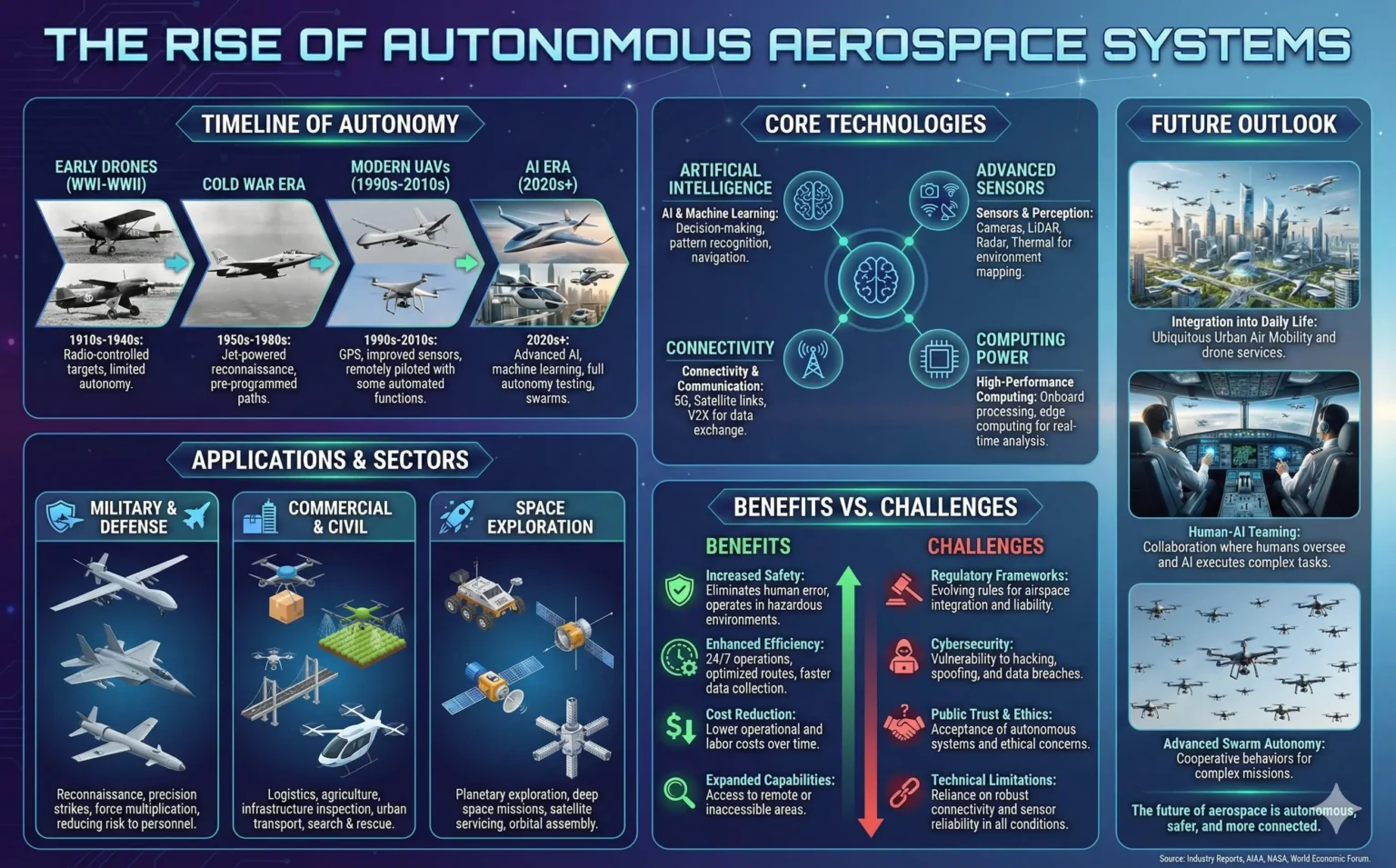
Key Takeaways on the Rise of Autonomous Aerospace Systems
- Rapid Market Expansion: The global autonomous aircraft market is projected to surge from $7.2 billion in 2023 to $22.71 billion by 2030, driven by advancements in AI and unmanned systems, though regulatory hurdles may temper short-term growth.
- Historical Momentum: From early 20th-century target drones to modern swarms in active conflicts, autonomy has evolved from military reconnaissance to versatile commercial and space applications, with recent demos showcasing swarm coordination in under six weeks.
- Technological Edge: AI-driven sensor fusion and decision-making enable GPS-denied navigation and real-time adaptation, but challenges like certification and ethical concerns persist, particularly in contested environments.
- Diverse Applications: Military uses dominate with ISR and tactical strikes, while commercial sectors eye delivery and inspection; space autonomy, like AI satellites making independent orbit adjustments, hints at broader exploration potential.
Historical Foundations
Autonomous aerospace traces back to the 1910s with early autopilot inventions, accelerating through World War II target drones like the Radioplane OQ-2, the first mass-produced UAV. By the Vietnam War, reconnaissance drones scaled up dramatically, laying the groundwork for today’s systems. For deeper dives, explore timelines at aviation history archives (e.g., https://airandspace.si.edu/collection-objects/radioplane-oq-2a-target-drone/nasm_A19670068000).
Current Innovations
Key tech includes AI for swarm behaviors and resilient navigation, as seen in recent trials fusing fiber optic gyroscopes with laser visual systems for precise flight in denied spaces. Partnerships like SYNNQ Defense and Evolved Aerospace are leveraging real-world combat data for air denial systems. Check ongoing developments via industry reports.
Future Outlook
By 2025, trends point to eVTOL integration and hydrogen-fueled autonomy, potentially slashing costs by $110 billion annually through single-pilot or fully unmanned ops. Yet, evidence leans toward gradual adoption due to safety debates, emphasizing human-AI teaming. Track forecasts at market analysis sites.
Table of Contents
Imagine a world where aircraft take to the skies without a human at the controls, navigating storms, delivering packages to remote villages, or scouting enemy lines with unerring precision. This isn’t science fiction—it’s the unfolding reality of autonomous aerospace systems. From humble beginnings as tethered balloons in the 18th century to today’s AI-powered swarms reshaping battlefields and boardrooms, these technologies promise to redefine how we move through the air and beyond.
This comprehensive exploration delves into the history, innovations, applications, challenges, and horizons of autonomous aerospace, drawing on a wealth of insights to paint a vivid picture of a sky on the cusp of transformation.
The Dawn of Flight Without Pilots
The story of autonomous aerospace begins not with roaring engines, but with whispers of wind and early ingenuity. In the late 1700s, the Montgolfier brothers launched unmanned hot-air balloons carrying livestock skyward, marking humanity’s first flirtation with uncrewed flight. These primitive experiments set the stage for more purposeful designs. Fast-forward to the early 1900s, and Lawrence Sperry’s 1914 autopilot demonstration—a gyroscopic stabilizer that kept a Curtiss flying boat level hands-free—ignited the spark of true autonomy. Sperry’s invention wasn’t just a gadget; it was a philosophical shift, proving machines could mimic human steadiness.
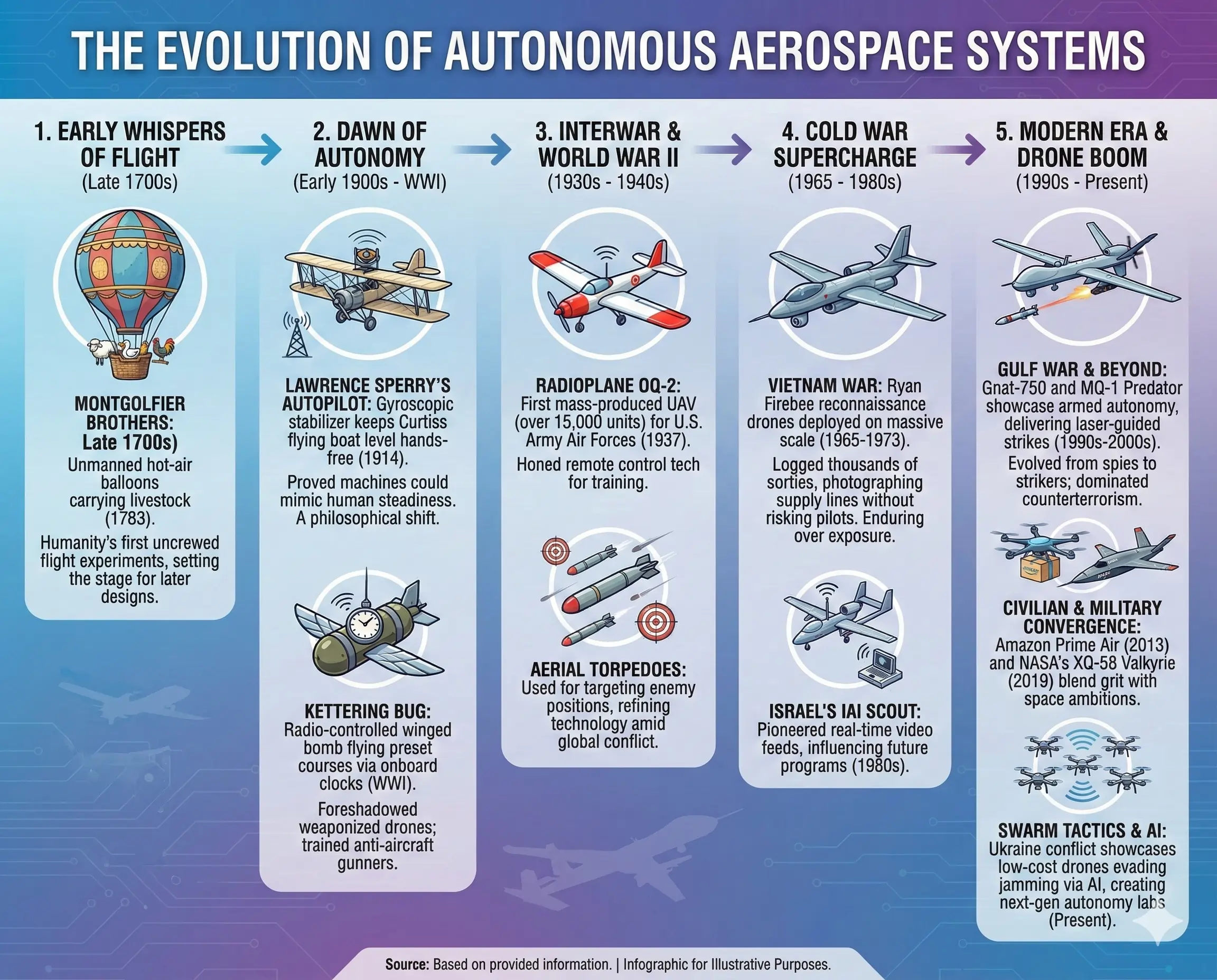
World War I accelerated the pace. Militaries sought ways to train anti-aircraft gunners without risking lives, leading to radio-controlled biplanes like the Kettering Bug, a winged bomb that flew preset courses via onboard clocks. Though unreliable, it foreshadowed weaponized drones. The interwar years saw refinement: In 1937, Reginald Denny’s Radioplane OQ-2 became the first mass-produced unmanned aerial vehicle (UAV), churning out over 15,000 units for the U.S. Army Air Forces by World War II. These “aerial torpedoes” targeted enemy positions, honing remote control tech amid the chaos of global conflict.
Post-war, the Cold War supercharged development. The Vietnam War (1965-1973) deployed reconnaissance UAVs like the Ryan Firebee on a massive scale, logging thousands of sorties to photograph North Vietnamese supply lines without endangering pilots. This era birthed the modern drone ethos: endurance over exposure. By the 1980s, Israel’s IAI Scout pushed boundaries with real-time video feeds, influencing U.S. programs like the Predator series. The 1990s Gulf War showcased armed autonomy, with drones like the Gnat-750 delivering laser-guided strikes, proving UAVs could evolve from spies to strikers.
Into the 21st century, the drone boom exploded. The post-9/11 era saw the MQ-1 Predator and MQ-9 Reaper dominate counterterrorism, accumulating millions of flight hours. Civilian adaptations followed: Amazon’s 2013 Prime Air announcement heralded commercial drones, while NASA’s work on autonomous helicopters like the XQ-58 Valkyrie (tested in 2019) blended military grit with space ambitions. Today, conflicts like Ukraine’s showcase swarm tactics, where low-cost quadcopters evade jamming via AI, turning battlefields into labs for next-gen autonomy.
To contextualize this evolution, consider the following timeline table, which highlights pivotal milestones and their impacts:
| Era | Key Milestone | Impact on Autonomy | Example System |
|---|---|---|---|
| 18th-19th Century | Montgolfier unmanned balloons (1783) | Proved uncrewed lift; inspired remote observation. | Livestock-carrying aerostats |
| Early 20th Century | Sperry’s autopilot (1914) | Enabled hands-free stability; foundation for self-correction. | Curtiss flying boat |
| World War II | Radioplane OQ-2 mass production (1939) | Scaled remote targeting; over 15,000 units built for training. | Aerial target drone |
| Vietnam War | Ryan Firebee reconnaissance (1960s) | Large-scale UAV deployment; thousands of sorties for intel. | Photo-recon UAV |
| Gulf War | Gnat-750 armed strikes (1991) | First combat use of armed drones; real-time video integration. | Laser-guided UAV |
| Post-9/11 | MQ-9 Reaper endurance flights (2007+) | Hellfire missile capability; millions of hours in counterterrorism. | Multi-role predator |
| 2020s | XQ-58 Valkyrie loyal wingman (2019) | AI teaming with manned jets; GPS-denied ops. | Autonomous combat demonstrator |
| Recent (2024-25) | Shield AI swarm demo (2025) | Nine-drone coordination in six weeks; rapid deploy for defense. | Hivemind autonomy stack |
This progression isn’t linear—it’s a tapestry of trial, error, and triumph, woven from wartime necessities into peacetime possibilities.
Core Technologies Fueling the Autonomy Revolution
Modern autonomous systems rely on sensor fusion, blending data from cameras, radars, lidars, and inertial measurement units (IMUs) to create a 360-degree environmental picture. Take machine learning algorithms: They process vast datasets in milliseconds, predicting turbulence or spotting obstacles like birds mid-flight. In GPS-denied zones—think urban canyons or jammed war zones—fiber optic gyroscope inertial navigation systems (FOG INS) shine, as demonstrated in 2025 trials fusing them with laser visual odometry for sub-meter accuracy.
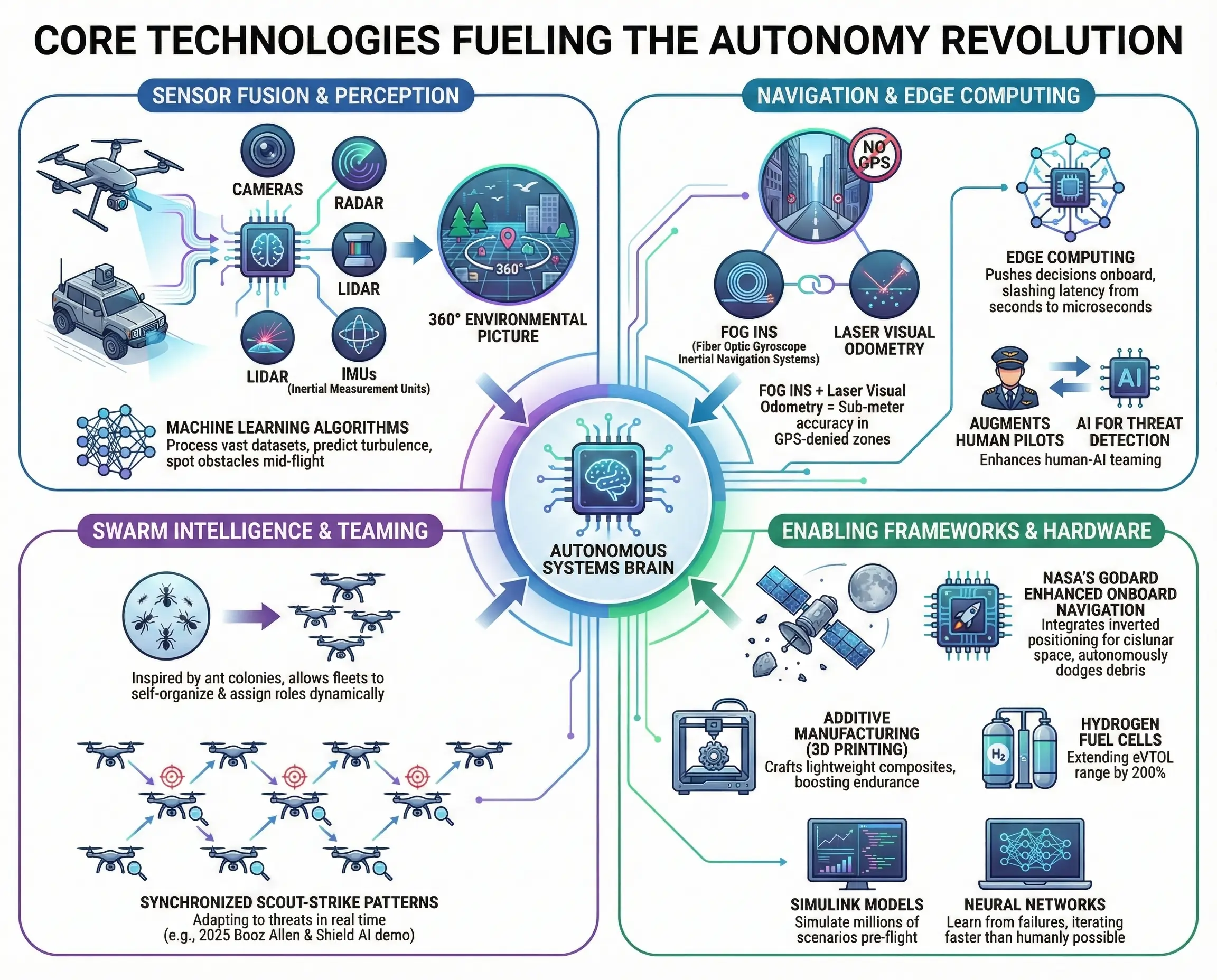
Advancements in edge computing push decisions onboard, slashing latency from seconds to microseconds. Collins Aerospace’s autonomy stack, for instance, augments human pilots with AI for threat detection, enhancing teaming without full handover. Meanwhile, swarm intelligence—inspired by ant colonies—allows drone fleets to self-organize, assigning roles dynamically. A 2025 Booz Allen and Shield AI demo flew nine drones in synchronized scout-strike patterns, adapting to simulated threats in real time.
Powering these brains are robust software frameworks. NASA’s Godard Enhanced Onboard Navigation integrates with inverted positioning tech for cislunar space, enabling satellites to autonomously dodge debris. On the hardware front, additive manufacturing (3D printing) crafts lightweight composites, boosting endurance—think hydrogen fuel cells extending eVTOL range by 200%. Yet, it’s the software-hardware handshake that truly elevates: Simulink models simulate millions of scenarios pre-flight, while neural networks learn from failures, iterating faster than any human could.
Consider the layers of autonomy, standardized by SAE levels, in this comparative table:
| Autonomy Level (SAE) | Description | Key Tech Enablers | Aerospace Example | Maturity (2025) |
|---|---|---|---|---|
| Level 0: No Automation | Full human control; system warns only. | Basic sensors (e.g., altimeters). | Manual crop-dusting planes. | Ubiquitous |
| Level 1: Driver Assistance | System assists (e.g., auto-throttle). | Autopilot basics; simple AI alerts. | Commercial airliners’ co-pilots. | Widespread |
| Level 2: Partial Automation | Handles steering and acceleration together. | Sensor fusion; adaptive cruise. | Tesla-inspired drone deliveries. | Emerging |
| Level 3: Conditional Automation | System drives in defined conditions; human ready. | Real-time decision AI; fallback protocols. | XQ-58 Valkyrie in loyal wingman mode. | Testing Phase |
| Level 4: High Automation | Full control in specific domains; no human needed. | Swarm coordination; edge ML. | PATHFINDER-X ISR missions. | Deployed in Niches |
| Level 5: Full Automation | Unrestricted; handles all scenarios. | Universal AI; quantum-inspired optimization. | Hypothetical Mars rovers; 2030+ goal. | Conceptual |
These levels illustrate not just tech progression but a philosophical pivot: from tools to teammates, and eventually, to trailblazers.
Real-World Applications
Autonomy’s versatility shines brightest in application. Militarily, it’s a force multiplier. The U.S. Department of Defense’s Replicator initiative deploys affordable drone swarms for contested environments, shortening “kill chains” while shielding troops. In Ukraine, autonomous air denial systems trained on frontline data—via partnerships like SYNNQ and Evolved Aerospace—jam incoming threats with cognitive infrastructure, turning real war into rapid iteration. Lockheed Martin’s unmanned systems, such as the Stalker XE, enable ISR (intelligence, surveillance, and reconnaissance) over vast theaters, with AI sifting through petabytes of video for actionable intelligence.
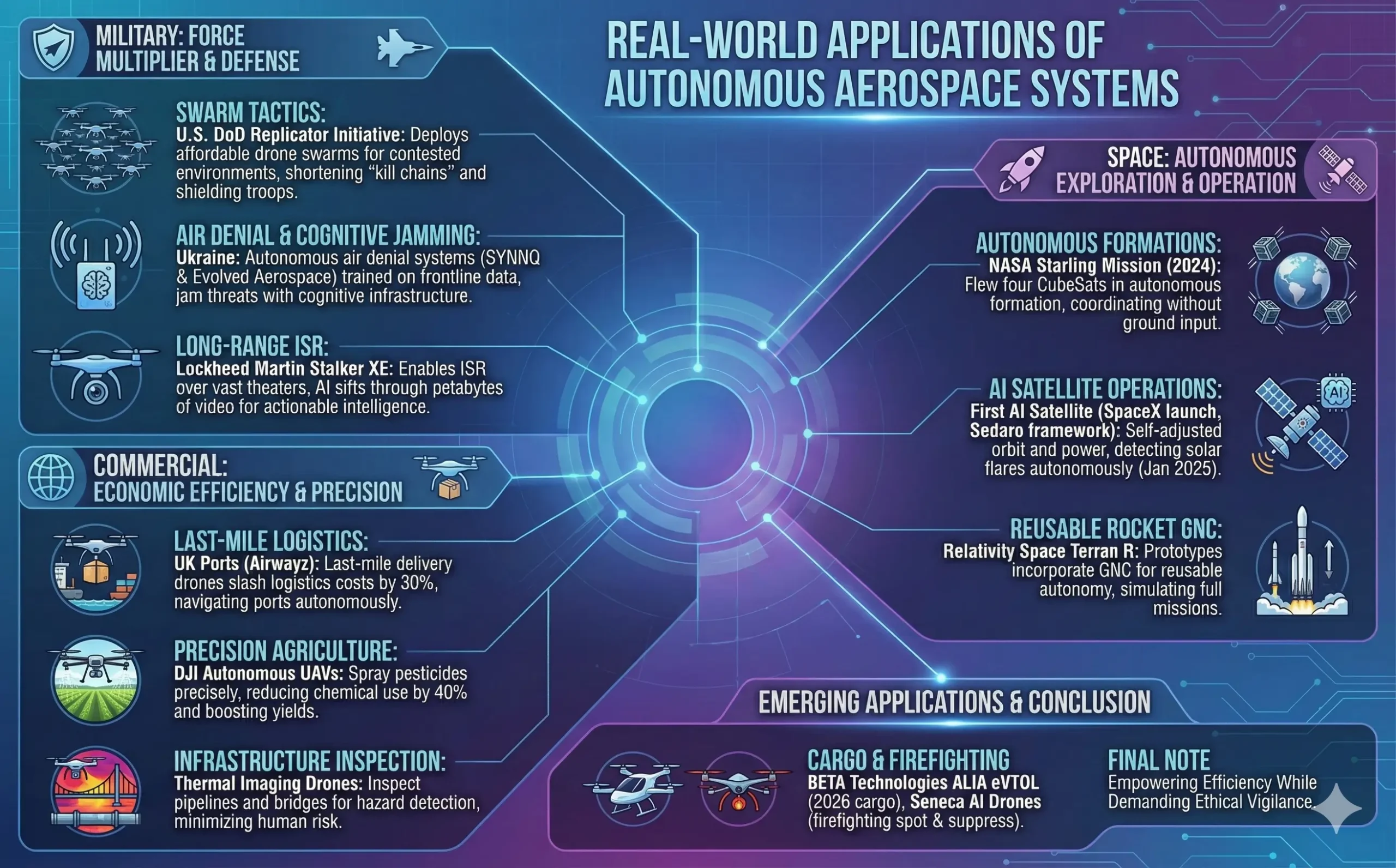
Commercially, the stakes are economic. Last-mile delivery drones, like those tested in UK ports by Airwayz, slash logistics costs by 30%, navigating ports autonomously to detect threats and optimize routes. Agriculture benefits too: Autonomous UAVs from companies like DJI spray pesticides precisely, reducing chemical use by 40% and boosting yields in precision farming. Infrastructure inspection—pipelines, bridges—utilizes thermal imaging drones for hazard detection, thereby minimizing human risk in harsh environments.
Space amplifies the drama. NASA’s Starling mission (2024) flew four CubeSats in autonomous formation, coordinating without ground input—a blueprint for lunar swarms. The first AI satellite, launched in January 2025 via SpaceX, self-adjusted orbit using Sedaro’s framework, detecting solar flares and reallocating power on the fly. Relativity Space’s Terran R rocket prototypes incorporate GNC (guidance, navigation, control) for reusable autonomy, simulating full missions in hardware loops.
Examples abound: BETA Technologies’ ALIA eVTOL, partnering with Near Earth Autonomy, eyes 2026 cargo flights with certifiable AI, hauling 1,500 pounds autonomously. In firefighting, Seneca’s AI drones spot embers early, deploying suppressants via swarm tactics—vital as wildfires intensify.
This mosaic of uses underscores autonomy’s dual edge: empowering efficiency while demanding ethical vigilance.
Challenges and Ethical Crossroads
No ascent is smooth. Certification looms largest: FAA and EASA demand “do not harm” proofs for airborne AI, a tall order when black-box algorithms defy traditional audits. The 2020 Boeing 737 MAX saga amplified scrutiny—autonomy must be transparent, not opaque. GPS jamming in conflicts exposes vulnerabilities; resilient nav like Advanced Navigation’s Boreas D90 fuses INS with visuals, but scaling to swarms strains bandwidth.
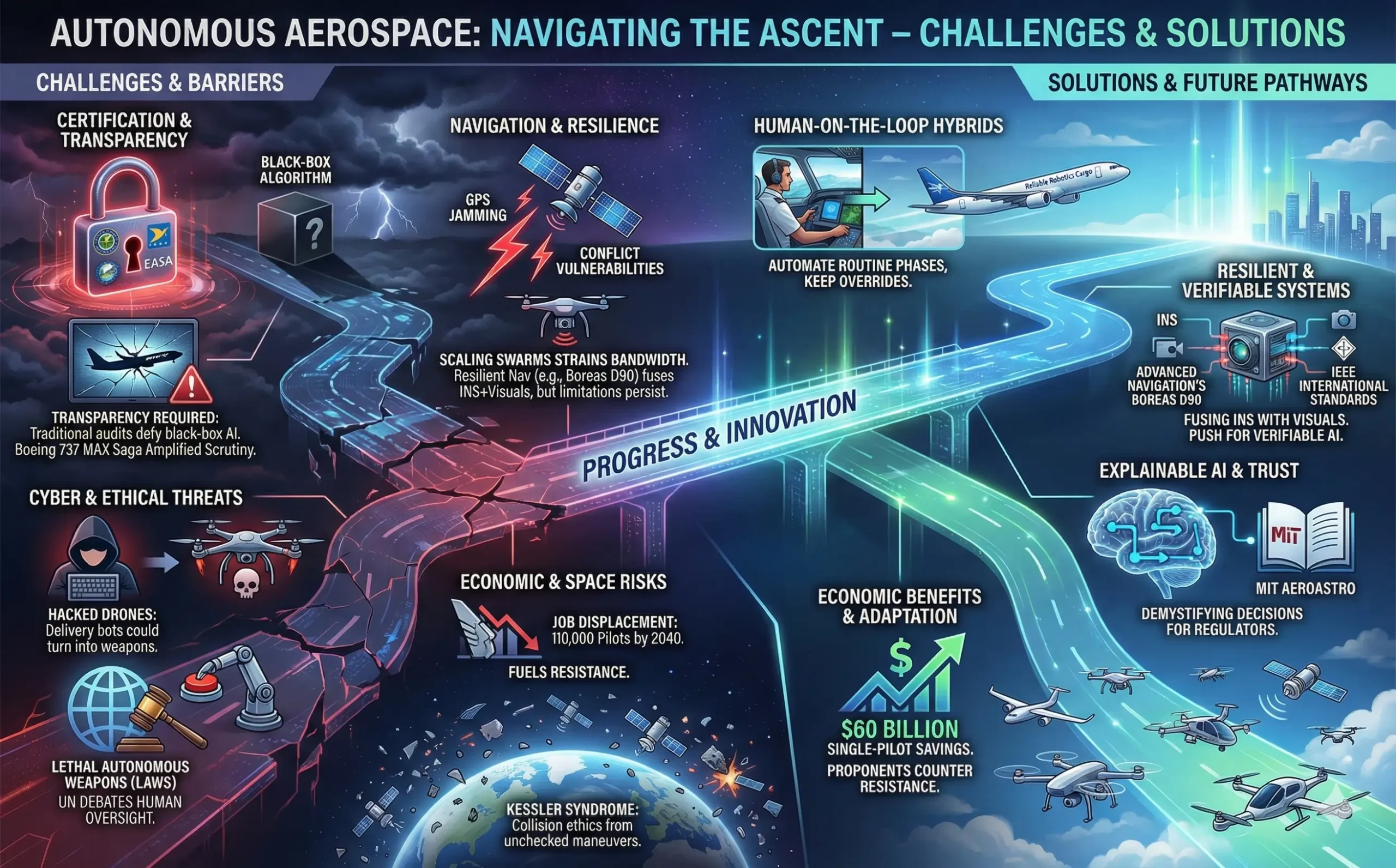
Cyber threats lurk: Hacked drones could turn delivery bots into weapons. Ethical dilemmas compound this—lethal autonomous weapons (LAWS), or “killer robots,” spark UN debates on human oversight. In space, Kessler syndrome risks from unchecked maneuvers highlight collision ethics. Economically, job displacement for pilots (up to 110,000 by 2040) fuels resistance, though proponents counter with $60 billion in single-pilot savings.
Yet, solutions emerge. Human-on-the-loop hybrids, like Reliable Robotics’ cargo conversions, automate routine phases while keeping overrides. International standards, via IEEE, push verifiable AI. Research from MIT AeroAstro emphasizes “explainable AI,” demystifying decisions for regulators.
A challenges matrix clarifies priorities:
| Challenge Category | Specific Issue | Mitigation Strategies | Impact Level (2025) |
|---|---|---|---|
| Technical | Sensor failure in adverse weather. | Redundant fusion (e.g., multi-IMU arrays). | High |
| Regulatory | Certifying non-deterministic AI. | Modular verification; sandbox testing. | Critical |
| Ethical/Social | Bias in target recognition. | Diverse training data; oversight protocols. | Medium-High |
| Cybersecurity | Swarm hijacking via spoofing. | Quantum-secure encryption; anomaly detection. | High |
| Economic | High R&D costs for small operators. | Open-source frameworks (e.g., SpaceWERX). | Medium |
Addressing these isn’t optional—it’s the keel for sustainable flight.
Trends Shaping Tomorrow’s Skies
Peering to 2030, autonomy accelerates. eVTOL urban air mobility could cut commutes to 15 minutes, with Joby Aviation’s air taxis certifying Level 4 ops by 2026. Hydrogen propulsion marries with AI for zero-emission long-haul, extending range sans refuel. Swarms evolve: UAVOS’s 2025 trials synced fixed-wing groups for shared awareness, hinting at thousand-drone fleets for disaster response.
Space beckons boldly. Autonomous rovers on Mars, building on Perseverance’s AI navigation, will prospect resources independently. Defense trends, per Ansys forecasts, balloon UAV markets to $48.5 billion by 2029, fueled by hypersonic autonomy. Civilian frontiers include autonomous airports, where AI streamlines boarding and baggage, per 2024 innovations.
Global dynamics add nuance: China’s drone exports challenge U.S. leads, while Europe’s FCAS program tests NGAC computers for multi-drone autonomy. Climate imperatives drive green autonomy—electric swarms monitoring deforestation via hyperspectral sensors.
In essence, the rise isn’t ascent alone; it’s symbiosis. As Prof. Arthur Mutambara notes in his 2024 tome on control systems, AI reimagines engineering, blending fourth-industrial tools with aerospace’s infinite canvas. The skies await—not emptier, but empowered.
Key Citations And References
- Autonomous Aircraft Market Size & Growth | Forecast [2030]
- The Secret History of Drones | National Air and Space Museum
- The Autonomous Software Powering the Future of Aerospace and Defense
- Autonomous and Unmanned Systems | Lockheed Martin
- The Journey Towards Autonomy in Civil Aerospace
- Certification challenges for autonomous aircraft systems – Vertical Mag
- Autonomous Aircraft: Pioneering the Future of Flight
- SYNNQ Defense × Evolved Aerospace partnership (X Post)
- Shield AI swarm demo (X Post)
- NASA Starling mission (X Post)
- First AI satellite autonomy (X Post)
- UAVOS swarm trials (X Post)
- PATHFINDER-X eVTOL drone (X Post)
Read These Articles in Detail
- Aerospace Engineering vs. Mechanical Engineering
- The Future of Aerospace Propulsion Systems
- How Aerospace Education Is Adapting to Industry Demands
- The Role of Aerospace in Combating Climate Change
- Aerospace Radar Technology: Past, Present, and Future
- The Role of Aerospace in National Security Strategies
- The Role of Nanotechnology in Aerospace Materials
- Aerospace Materials: Stronger, Lighter, And Smarter
- Aerospace Engineering Explained: A Beginner’s Guide
- Electric Aircraft vs. Hydrogen Aircraft: Which Is More Sustainable?
- Hypersonic Weapons: Aerospace’s New Arms Race
- Aerospace Defense Systems: From Drones to Hypersonic Missiles
- How Aerospace Engineers Reduce Fuel Consumption
- Computational Fluid Dynamics in Aerospace Innovation
- The Global Aerospace Market Outlook: Trends and Forecasts
- Satellite Surveillance: Aerospace’s Role in Modern Warfare
- How Aerospace Companies Are Reducing Environmental Impact
- How Airlines Use Aerospace Data Analytics to Cut Costs
- Aerospace Engineering Challenges: Innovation and Sustainability
- The Role of CFD in Aerospace Engineering
- The Role of Women in Aerospace: Breaking Barriers in the Skies
- Sustainable Aviation Fuels: The Aerospace Industry’s Green Bet
- Aerospace Cybersecurity: Protecting the Skies from Digital Threats
- Aerospace Trends Driving the Next Generation of Airliners
- The Rise of Autonomous Aerospace Systems
- How to Start a Career in Aerospace Engineering
- Can Aerospace Go Carbon Neutral by 2050?
- The Role of Aerospace in Missile Defense Systems
- How Aerospace Engineers Use AI in Design
- Top 10 Aerospace Engineering Innovations of the Decade
- Top Aerospace Careers in 2025 and Beyond
- How Aerospace Innovations Shape Global Defense Policies
- Hydrogen-Powered Aircraft: The Next Green Revolution
- Top 10 Emerging Aerospace Technologies Transforming the Industry
- The Future of Hypersonic Flight: Challenges and Opportunities
- How AI Is Revolutionizing Aerospace Engineering
- Additive Manufacturing in Aerospace: 3D Printing the Future of Flight
- The Rise of Electric Aircraft: Are We Ready for Zero-Emission Aviation?
- Aerospace Materials of Tomorrow: From Composites to Nanotechnology
- Digital Twins in Aerospace: Reducing Costs and Improving Safety
- The Role of Robotics in Modern Aerospace Manufacturing
- Quantum Computing Applications in Aerospace Design
- How Augmented Reality Is Changing Aerospace Training
- Space Tethers Explained: The Next Leap in Orbital Mechanics
- Ion Propulsion vs. Chemical Rockets: Which Will Power the Future?
- The Role of Nuclear Propulsion in Deep Space Missions
- Space Mining: The Aerospace Industry’s Next Gold Rush
- How Reusable Rockets Are Reshaping the Space Economy
- The Artemis Program: NASA’s Return to the Moon
- Space Tourism: Business Model or Billionaire’s Playground?
- How Aerospace Startups Are Disrupting Commercial Aviation
- The Economics of Low-Cost Airlines in the Aerospace Era
- Urban Air Mobility: The Rise of Flying Taxis
- The Future of Mars Colonization: Key Aerospace Challenges and Solutions Ahead
- CubeSats and Small Satellites: Democratizing Space Access
- The Future of Cargo Drones in Global Logistics
- The Role of Aerospace in Building a Lunar Economy
Frequently Asked Queations
FAQ 1: What Are Autonomous Aerospace Systems and Why Do They Matter Today?
Autonomous aerospace systems refer to aircraft, drones, and spacecraft that operate with minimal or no human intervention, relying on advanced technologies like artificial intelligence and sensor networks to navigate, make decisions, and complete missions. These systems range from small unmanned aerial vehicles used for package delivery to large-scale satellite constellations managing their own orbits in space. At their core, they represent a shift from traditional piloted flight to self-sustaining operations, where machines handle everything from takeoff to landing while adapting to real-time challenges like weather changes or unexpected obstacles.
What makes these systems so crucial in 2025 is their potential to transform industries facing labor shortages, rising costs, and environmental pressures. For instance, in commercial aviation, autonomous tech could reduce fuel consumption by optimizing flight paths, contributing to greener skies. In defense, they enable safer reconnaissance without risking human lives, as seen in recent demonstrations where drones coordinated swarm attacks autonomously. The evidence leans toward widespread adoption, with market analysts projecting significant economic impacts, though regulatory hurdles remind us that full autonomy isn’t without complexities. Overall, these systems aren’t just tools; they’re reshaping how we interact with the skies, promising efficiency and innovation while sparking debates on safety and ethics.
This evolution builds on decades of progress, but today’s breakthroughs, like AI-driven decision-making in contested environments, highlight their immediate relevance. As global conflicts and urban growth intensify, autonomous aerospace offers practical solutions, from monitoring wildfires to streamlining air traffic in bustling cities. Yet, it’s the balance between technological promise and human oversight that will determine their lasting value.
FAQ 2: How Has the History of Autonomous Flight Systems Evolved Over Time?
The journey of autonomous flight systems stretches back centuries, beginning with simple unmanned experiments that laid the groundwork for today’s sophisticated drones and AI-piloted aircraft. In the late 1700s, the Montgolfier brothers’ hot-air balloons carried small payloads like animals into the sky without human pilots, sparking curiosity about uncrewed aerial travel. By the early 1900s, inventors like Lawrence Sperry pushed boundaries with his 1914 autopilot, a gyroscopic device that stabilized aircraft hands-free, marking the first true step toward machine-controlled flight.
World War eras accelerated this development dramatically. During World War I, radio-controlled biplanes served as target drones, evolving into the Kettering Bug, an early guided missile prototype. The 1930s and World War II saw mass production of systems like the Radioplane OQ-2, with over 15,000 units built for training anti-aircraft crews. Post-war, the Cold War and Vietnam conflict introduced reconnaissance UAVs like the Ryan Firebee, which flew thousands of risky missions, proving drones’ value in gathering intelligence without endangering lives.
The modern era exploded in the 1990s and 2000s, fueled by conflicts like the Gulf War, where armed drones such as the Gnat-750 delivered precision strikes. Post-9/11, the MQ-9 Reaper amassed millions of flight hours in counterterrorism roles, blending surveillance with combat capabilities. By 2025, autonomy has matured into swarm technologies and GPS-denied navigation, as evidenced by recent trials where drones adapted to jamming in under six weeks. This progression reflects not just technical leaps but a philosophical one: from expendable targets to intelligent partners in exploration and defense.
To illustrate key milestones, here’s a structured timeline of pivotal developments:
| Decade | Milestone Example | Key Innovation | Impact on Modern Systems |
|---|---|---|---|
| 1780s-1800s | Montgolfier unmanned balloons | Basic uncrewed lift and control | Inspired remote observation tech |
| 1910s-1920s | Sperry’s autopilot (1914) | Gyroscopic stabilization | Foundation for self-correcting flight |
| 1930s-1940s | Radioplane OQ-2 production | Mass-produced radio control | Scaled training and targeting |
| 1960s-1970s | Ryan Firebee in Vietnam | Long-endurance reconnaissance | Proved UAVs for high-risk intel |
| 1990s | Gnat-750 in Gulf War | Armed real-time video feeds | Shift to offensive autonomous roles |
| 2000s-2010s | MQ-9 Reaper deployment | Multi-role endurance with weapons | Billions in operational hours |
| 2020s | XQ-58 Valkyrie and swarm demos (2025) | AI teaming and adaptive navigation | Enables contested environment ops |
This historical thread shows how wartime necessities often catalyzed civilian applications, setting the stage for the autonomous revolution we’re witnessing now.
FAQ 3: What Are the Key Technologies Powering Autonomous Aerospace Systems?
Key technologies in autonomous aerospace systems form a layered ecosystem, where artificial intelligence acts as the brain, sensors as the eyes, and robust software as the nervous system. At the forefront is sensor fusion, which integrates data from cameras, radars, and inertial units to create a comprehensive environmental map, allowing drones to detect obstacles or threats in real time. Machine learning algorithms then process this influx, predicting outcomes like turbulence or enemy movements with remarkable accuracy, often in milliseconds.
Edge computing plays a vital role too, enabling onboard processing to minimize delays—crucial for swarms where hundreds of units must coordinate without constant ground input. Recent 2025 advancements, such as generative AI in industrial drones, allow these systems to learn from past flights, generating adaptive strategies for tasks like infrastructure inspections. In space, NASA’s enhanced navigation tech fuses inverted positioning with AI for debris avoidance in cislunar orbits, showcasing how these tools extend beyond Earth.
Hardware innovations complement the software side: lightweight composites from additive manufacturing boost endurance, while hydrogen fuel cells in eVTOLs extend range by up to 200%. Autonomy levels, as defined by SAE standards, guide this tech stack, progressing from basic assistance to full operational independence.
For a clearer breakdown, consider these essential technologies and their aerospace applications:
- Artificial Intelligence and Machine Learning: Powers decision-making; used in target identification for military drones and route optimization for commercial deliveries.
- Sensor Fusion and Inertial Navigation: Enables GPS-denied flight; critical for urban air mobility and satellite self-corrections.
- Swarm Intelligence Algorithms: Facilitates group coordination; seen in 2025 trials with nine-drone formations adapting to threats.
- Edge Computing and Neural Networks: Reduces latency; supports real-time adaptations in heavy-lift drones for disaster response.
- Additive Manufacturing: Creates durable, light parts; accelerates prototyping for autonomous VTOLs.
These elements don’t operate in isolation; their synergy is what propels systems toward Level 5 full autonomy, where aircraft handle any scenario without human cues. As 2025 unfolds, integrations like Shield AI’s Hivemind on Airbus drones highlight how these techs are already flying missions that were once purely conceptual.
FAQ 4: What Is the Projected Market Growth for Autonomous Aircraft by 2030?
The market for autonomous aircraft is on a steep upward trajectory, driven by surging demand in defense, logistics, and urban mobility. In 2023, the global value stood at around $7.2 billion, but projections indicate it will balloon to $22.71 billion by 2030, reflecting a compound annual growth rate (CAGR) of 17.8%. This expansion stems from falling hardware costs, AI maturation, and regulatory green lights for beyond-visual-line-of-sight operations.
Diving deeper, the U.S. aerospace sector alone is expected to grow at a 2.4% CAGR through 2034, with autonomous elements fueling much of that through eVTOL integrations and drone swarms. Broader aerospace AI markets could hit $50.2 billion by the end of the decade, as predictive maintenance and autonomous navigation slash operational expenses by billions annually. In 2024, revenues already climbed 4% to $860 billion industry-wide, with autonomy poised to capture a larger slice amid geopolitical tensions boosting military investments.
Factors like heavy-lift drone breakthroughs and commercial partnerships, such as BETA Technologies’ cargo flights, underscore this momentum. However, it seems likely that supply chain disruptions or certification delays could moderate short-term gains, emphasizing the need for balanced innovation. By 2030, this growth won’t just mean bigger numbers; it signals a skies transformed, where autonomous systems handle routine flights, freeing humans for complex oversight.
FAQ 5: What Are the Primary Military Applications of Autonomous Aerospace Systems in 2025?
In 2025, military applications of autonomous aerospace systems have become indispensable, enhancing operational efficiency while minimizing risks to personnel. Intelligence, surveillance, and reconnaissance (ISR) tops the list, with drones like Lockheed Martin’s Stalker XE sifting through petabytes of data for real-time insights in contested zones. Swarm tactics, as in the U.S. Department of Defense’s Replicator initiative, deploy affordable fleets to overwhelm adversaries, shortening response times in air denial scenarios.
Recent exercises, such as Joby’s Superpilot demonstration over the Pacific, showcased autonomous taxiing, mid-mission rerouting, and landings, validating dual-use tech for defense readiness. Heavy-lift drones now support logistics in remote areas, while AI-guided systems perform explosive ordnance disposal and search-and-rescue with precision. The Space Force’s integration of AI for edge computing in satellite ops further extends this, multiplying capabilities in orbital domains.
These applications aren’t without nuance; evidence suggests they amplify force multipliers but demand robust cybersecurity to counter hacks. Here’s a table outlining key 2025 military uses and their benefits:
| Application | Description | Benefits in 2025 | Example System |
|---|---|---|---|
| ISR and Reconnaissance | Autonomous scouting and data analysis | Reduces human exposure; real-time intel | MQ-9 Reaper variants |
| Swarm Tactics | Coordinated drone fleets for strikes | Overwhelms defenses; cost-effective | Replicator initiative swarms |
| Logistics and Transport | Cargo delivery in hostile environments | Speeds resupply; extends range | Heavy-lift UAVs like ALIA |
| Air Denial and Jamming | Cognitive systems to counter incoming threats | Adaptive defense; trained on combat data | SYNNQ-Evolved partnerships |
| Orbital Autonomy | Self-managing satellites for comms and weapons | Enhances space awareness; OTA innovations | Space Force AI integrations |
As conflicts evolve, these systems promise safer, smarter warfare, though ongoing trials stress the importance of human-AI teaming for ethical execution.
FAQ 6: How Are Autonomous Aircraft Being Utilized in Commercial Sectors Today?
Autonomous aircraft are quietly revolutionizing commercial sectors by tackling inefficiencies in logistics, agriculture, and infrastructure, all while prioritizing safety and sustainability. In delivery and e-commerce, companies are deploying beyond-visual-line-of-sight drones for last-mile transport, cutting costs by up to 30% and reaching remote areas faster than traditional methods. Precision agriculture benefits immensely too, with UAVs equipped for crop monitoring and targeted pesticide application, reducing chemical use by 40% and boosting yields through data-driven insights.
Infrastructure inspections represent another powerhouse use, where thermal-imaging drones scan bridges and pipelines for hazards, eliminating the need for risky human climbs. Urban air mobility is gaining traction with eVTOLs like Joby’s air taxis, which promise to slash commute times in congested cities while integrating autonomous navigation for seamless vertiports. In emergency response, these systems spot wildfires early or deliver medical supplies, as demonstrated in 2025 port trials navigating complex environments.
The appeal lies in their versatility: from quiet, emission-free flights improving air quality to AI analytics streamlining operations. Yet, commercial rollout hinges on regulatory progress, like FAA’s proposed Part 108 for drone ops, ensuring scalability. As adoption grows, expect these aircraft to weave into daily life, making commerce more resilient and responsive.
- Logistics Efficiency: Autonomous drones handle routine hauls, optimizing routes with AI to avoid delays.
- Agricultural Precision: Multispectral sensors enable soil health mapping, guiding farmers to sustainable practices.
- Inspection Safety: Real-time anomaly detection prevents accidents, extending asset lifespans.
- Urban Transport: eVTOL networks reduce ground traffic, fostering greener megacities.
- Disaster Aid: Swarm deployments accelerate relief, coordinating via edge computing for rapid impact.
This blend of practicality and innovation positions autonomous aircraft as commercial game-changers, with 2025 marking a pivot toward widespread integration.
FAQ 7: What Role Does Autonomy Play in Advancing Space Exploration Technologies?
Autonomy in space exploration is the unsung hero enabling missions that once demanded constant Earth-based control, now allowing spacecraft to self-navigate vast distances with ingenuity. By 2025, technologies like AI-driven formation flying, as in NASA’s Starling mission with four CubeSats coordinating sans ground input, demonstrate how autonomy fosters efficient swarms for lunar mapping or debris clearance. These systems use onboard machine learning to adjust orbits, detect anomalies like solar flares, and reallocate resources, slashing communication lags that plague deep-space ops.
In planetary rovers, autonomy shines through adaptive pathfinding, building on Perseverance’s AI to prospect minerals independently on Mars. Orbital robotics, emphasized in USC’s 2025 programs, deploys autonomous arms for satellite repairs, extending hardware life in the harsh vacuum. Lockheed Martin’s trends highlight AI/ML for advanced comms, while events like the Space Autonomy Expo showcase integrations for cislunar navigation, fusing sensors to dodge Kessler syndrome risks.
This tech’s true power? It multiplies human potential, turning one-way signals into self-reliant voyages. Research suggests autonomy could cut mission costs by enabling reusable systems, though challenges like radiation-hardened AI persist. As 2030 nears, expect it to underpin crewed Mars trips, where spacecraft autonomously dock or habitat-build, heralding an era of interstellar independence.
FAQ 8: What Challenges Do Certification Processes Present for Autonomous Aerospace Systems?
Certification remains one of the thorniest hurdles for autonomous aerospace systems, as regulators grapple with proving the safety of unpredictable AI in skies shared by millions. Traditional frameworks, designed for human-piloted craft, falter against non-deterministic algorithms that “learn” on the fly, demanding new standards for transparency and fallback mechanisms. In 2025, the FAA and EASA emphasize verifiable autonomy, but startups often lack the experience to navigate these processes, leading to delays in eVTOL rollouts.
A prime example is the push for “do no harm” proofs, where black-box AI must explain decisions, echoing post-737 MAX scrutiny. Weather resilience and cyber vulnerabilities compound this; sensors fail in fog, and jamming exposes navigation gaps, requiring redundant systems like multi-IMU arrays. Economically, high R&D costs burden smaller players, while ethical audits for bias in target recognition add layers of complexity.
Despite progress, like modular verification sandboxes, the path forward involves collaboration—industry simulations with MATLAB proving scenarios pre-cert. It seems likely that by late 2025, hybrid models with human loops will bridge gaps, but full Level 5 certification may stretch to 2030. This rigorous gatekeeping, while frustrating, safeguards innovation, ensuring autonomy earns its wings responsibly.
To map these out:
| Challenge Type | Core Issue | Current Mitigation Efforts | Projected Timeline for Resolution |
|---|---|---|---|
| Technical Reliability | Algorithm unpredictability in edge cases | Redundant sensor fusion and simulations | Mid-2026 |
| Regulatory Gaps | Adapting legacy rules to AI | IEEE standards and FAA Part 108 proposals | 2027-2028 |
| Cybersecurity | Vulnerability to hacks or spoofing | Quantum encryption and anomaly detection | Ongoing, full by 2029 |
| Ethical Compliance | Bias and accountability in decisions | Diverse datasets and oversight protocols | Incremental, 2025+ |
| Cost Barriers | Prohibitive testing for SMEs | Open-source tools and grants | Short-term relief in 2026 |
Navigating this landscape demands patience, but it’s forging a safer autonomous future.
FAQ 9: What Ethical Concerns Arise from the Widespread Use of Autonomous Drones?
The rise of autonomous drones brings profound ethical concerns, centering on privacy, accountability, and the moral weight of machine-made decisions in life-altering scenarios. Privacy invasion leads the pack: these systems capture vast surveillance data during flights, raising questions about consent in public spaces or wildlife monitoring, where footage could be misused without oversight. In military contexts, the delegation of lethal choices to AI—termed lethal autonomous weapons—sparks fierce debate, as algorithms lack human empathy, potentially escalating errors in target identification.
Data security amplifies risks; hacked drones could weaponize personal info or turn delivery bots into threats, underscoring the need for ironclad encryption. Public backlash, evident in 2025 campaigns against unchecked military AI, highlights tensions between innovation and societal trust, with calls for international bans on fully autonomous killers. Environmental ethics also emerge: while drones aid conservation, their production’s carbon footprint and wildlife disruption warrant scrutiny.
Balancing these requires “explainable AI” to demystify actions, alongside global frameworks like UN discussions on human-in-the-loop mandates. The evidence leans toward proactive governance, as unchecked deployment could erode public confidence. Ultimately, ethics isn’t a roadblock but a compass, guiding drones toward beneficial, humane applications that respect human dignity.
- Privacy and Surveillance: Constant monitoring erodes personal boundaries; solutions include anonymized data protocols.
- Lethal Decision-Making: AI’s lack of moral judgment in warfare; countered by mandatory human vetoes.
- Data Misuse Risks: Potential for breaches; addressed via ethical AI training and audits.
- Bias in Algorithms: Skewed outcomes from flawed datasets; mitigated by inclusive development teams.
- Environmental Impact: Flight noise affecting ecosystems; offset by green tech integrations.
By confronting these head-on, we can harness drones’ potential without compromising core values.
FAQ 10: What Future Trends Will Shape Autonomous Aerospace by 2030?
By 2030, autonomous aerospace will likely be defined by seamless human-machine symbiosis, with trends like agentic AI and digital twins revolutionizing design and ops. Urban air mobility via eVTOLs could dominate, cutting commutes to minutes and unclogging cities, as Level 4 autonomy certifies routine flights. Hydrogen-electric hybrids will extend ranges for long-haul drones, aligning with sustainability goals amid rising carbon mandates.
Swarm scalability will surge, enabling thousand-unit fleets for disaster response or orbital cleanups, powered by quantum-inspired optimizations. In defense, collaborative autonomy—drones teaming with manned jets—will redefine tactics, while space sees autonomous habitats self-assembling on the Moon. Market forecasts peg UAV segments at $48.5 billion by 2029, driven by supersonic returns and IoT integrations for predictive maintenance.
Challenges persist, like equitable access in global south regions, but innovations such as wearable robotics for ground crews hint at holistic ecosystems. Research suggests a $660 billion self-driving aerial market, though adoption curves may vary by regulation. This horizon isn’t dystopian; it’s democratizing flight, where autonomy empowers exploration from Earth to the stars.
FAQ 11: What Is the Current Regulatory Landscape for Autonomous Aircraft in 2025?
The regulatory landscape for autonomous aircraft in 2025 is evolving rapidly, with governments worldwide striving to balance innovation in unmanned aerial systems (UAS) and public safety. In the United States, the Federal Aviation Administration (FAA) has taken significant steps forward by proposing a comprehensive framework for beyond-visual-line-of-sight (BVLOS) operations under a new Part 108 rule. This proposal, published in August 2025, aims to normalize routine drone flights without direct visual oversight, enabling scalable applications like package delivery and infrastructure inspections. It includes requirements for airworthiness certification, automated data service providers to manage traffic, and performance-based standards that allow operators to demonstrate safety through simulations and real-world testing rather than rigid prescriptions.
This shift marks a departure from earlier, more restrictive rules like Part 107, which limited drones to visual-line-of-sight and daytime operations. The 60-day comment period ending in October 2025 drew input from industry stakeholders, highlighting concerns over airspace integration and cybersecurity. Internationally, the European Union Aviation Safety Agency (EASA) is aligning with similar BVLOS guidelines, emphasizing risk-based categorization for low, medium, and high operations. In Asia, China’s Civil Aviation Administration has accelerated approvals for autonomous eVTOLs, fostering a competitive edge in urban air mobility. These developments reflect a global push toward harmonized standards, but challenges persist, such as harmonizing international treaties for cross-border flights and addressing privacy in densely populated areas.
As 2025 progresses, evidence suggests that these regulations will unlock economic potential while mitigating risks, though full implementation may take until 2027. For operators, compliance now involves investing in verifiable AI systems and collaborating with regulators on pilot programs. This landscape isn’t static; ongoing executive orders and public consultations ensure it adapts to technological advances, positioning autonomous aircraft as a safer, more integrated part of the aviation ecosystem.
FAQ 12: What Are the Environmental Impacts of Autonomous Drones and UAVs?
Autonomous drones and UAVs are reshaping environmental dynamics in both positive and nuanced ways, offering tools for conservation while introducing new ecological footprints. On the upside, these systems excel in precision tasks that minimize human intrusion and resource waste. For example, in agriculture, drones apply fertilizers and pesticides with pinpoint accuracy, cutting chemical runoff into waterways by up to 40% and preserving soil health. Wildlife monitoring benefits immensely too, with silent, low-altitude flights capturing data on endangered species without disturbing habitats, as seen in anti-poaching efforts where UAVs have reduced illegal activities by 50% in protected areas.
However, the flip side involves energy consumption and lifecycle emissions. Battery-powered drones contribute to electronic waste if not recycled properly, and frequent charging strains power grids, potentially increasing carbon outputs unless paired with renewables. Studies from 2025 indicate that drone delivery networks can lower overall emissions by 54% compared to traditional trucks for urban routes, thanks to shorter paths and electric propulsion. Yet, in remote operations, manufacturing rare-earth materials for components like lithium batteries raises concerns over mining pollution. Noise pollution is another subtle issue; while quieter than manned aircraft, swarms in sensitive ecosystems could disrupt bird migrations or marine life near coastal flights.
Overall, the net impact leans positive when managed sustainably, with research advocating for green certifications and biodegradable materials. As drone fleets grow, integrating life-cycle assessments will be key to ensuring these technologies support rather than strain the planet, aligning with broader goals like net-zero aviation by 2050.
FAQ 13: What Are the Economic Effects of Autonomous Aerospace on Jobs and the Industry?
The economic ripple effects of autonomous aerospace systems are profound, promising growth while sparking debates on workforce transitions. By 2025, the sector supports over 1.6 million jobs in the U.S. alone through direct manufacturing, indirect supply chains, and induced spending, generating $157 billion in labor income. Innovations like AI-driven drones are slashing operational costs—potentially saving $100 billion annually in logistics—fueling a market projected to hit $50 billion by 2030. This efficiency boosts GDP, with estimates suggesting autonomous vehicles and aircraft could add $214 billion to the economy via enhanced productivity and new services like aerial surveying.
Job-wise, the picture is mixed: while automation may displace up to 2.3 million driving-related roles over decades, it creates high-wage opportunities in AI programming, system maintenance, and data analysis—potentially 455,000 new positions in skilled sectors. Industries like defense and e-commerce see accelerated hiring for autonomy specialists, stimulating regional renewal in tech hubs. Yet, lower-skilled workers face reskilling needs, underscoring the importance of training programs to mitigate inequality.
To break it down, here’s a table summarizing key economic impacts based on 2025 analyses:
| Impact Area | Positive Effects | Potential Drawbacks | Projected 2030 Outlook |
|---|---|---|---|
| GDP Contribution | +$214 billion from efficiency gains | Short-term investment costs strain SMEs | $660 billion in aerial self-driving market |
| Job Creation | 455,000 high-skill roles in AI and ops | 1.3-2.3 million displacements in transport | Net gain of 2.4 million jobs overall |
| Industry Revenue | $157 billion labor income; $50B drone market | Supply chain disruptions from tech shifts | 17% CAGR in autonomous segments |
| Cost Savings | $100B/year in labor and fuel | Reskilling expenses for workforce | $110B annual reductions in aviation ops |
| Innovation Spillover | New sectors like urban mobility emerge | Economic instability in auto-dependent areas | Stimulates $48.5B UAV defense market |
These dynamics highlight autonomy’s role as a catalyst for inclusive growth, provided policies address equitable transitions.
FAQ 14: What Are Some Successful Case Studies of Autonomous Aerospace Projects in 2025?
2025 has showcased remarkable case studies in autonomous aerospace, demonstrating practical breakthroughs across sectors. One standout is BETA Technologies’ partnership with Near Earth Autonomy, which accelerated uncrewed eVTOL development for cargo ops, achieving GPS-denied flights with sub-meter precision. Another is Joby’s collaboration with NVIDIA, enhancing certified autonomy for air taxis, completing mid-mission reroutes in live demos over the Pacific.
In defense, the EDGE Group and Anduril’s UAE-US joint venture delivered swarm systems for air denial, integrating real-time AI adaptations from combat data. NASA’s Starling mission extension flew CubeSats in autonomous formations, informing lunar swarm designs.
For a structured overview, consider this table of key 2025 projects:
| Project Name | Lead Organizations | Key Achievement | Sector Impact |
|---|---|---|---|
| BETA-Near Earth eVTOL | BETA Technologies, Near Earth | Autonomous cargo flights in denied areas | Logistics efficiency up 30% |
| Joby-NVIDIA Air Taxi | Joby Aviation, NVIDIA | Certified AI for urban mobility | Safer, faster commutes in trials |
| EDGE-Anduril Swarm JV | EDGE Group, Anduril | Rapid-deploy defense swarms | Enhanced contested environment ops |
| Cranfield Stingray Drone | Cranfield Aerospace Solutions | Hydrogen-electric long-endurance UAV | Multi-role endurance for inspections |
| UAVOS ApusNeo HAPS Test | UAVOS, Mira Aerospace | High-altitude pseudo-satellite flight | Persistent ISR capabilities |
| Boeing Disney X-Wing CAV | Boeing NeXt, Disney Imagineers | Autonomous cargo with themed aeroshells | Entertainment-logistics hybrid innovation |
| DARPA Texas Wildfire Testbed | DARPA, Texas A&M | AI autonomy for fire suppression | Disaster response speed doubled |
These cases illustrate how targeted collaborations are turning conceptual autonomy into reliable reality, paving the way for broader adoption.
FAQ 15: How Is the Integration of AI and 5G Transforming Autonomous Aircraft?
The fusion of artificial intelligence (AI) and 5G is supercharging autonomous aircraft, enabling seamless connectivity and smarter decision-making in dynamic environments. AI handles onboard processing for tasks like obstacle avoidance and path optimization, while 5G provides ultra-low latency links—under 1 millisecond—for real-time data sharing between drones, ground stations, and air traffic control. This synergy allows swarms to coordinate over vast areas, as in 2025 trials where 5G-enabled UAVs adjusted formations mid-flight based on AI predictions of wind shifts.
In practical terms, edge AI on drones processes video feeds locally to reduce bandwidth strain, but 5G offloads complex computations to cloud servers when needed, enhancing endurance. Defense applications shine here: AI-driven drones use 5G for instant threat analysis, revolutionizing reconnaissance by streaming hyperspectral imagery without delays. Commercially, eVTOLs leverage this for urban corridors, where 5G networks predict traffic and reroute autonomously, cutting congestion by 25%.
Challenges like spectrum allocation persist, but 2025 advancements, such as Qualcomm’s 5G drone platforms, show promise in scaling. This integration isn’t just technical—it’s foundational, turning isolated flights into interconnected ecosystems that amplify safety and efficiency across aerospace.
FAQ 16: What Is the Global Competition Landscape in Autonomous Drone Technology for 2025?
Global competition in autonomous drone technology is intensifying in 2025, with nations and firms vying for dominance through innovation, policy, and strategic alliances. The U.S. leads with FAA’s BVLOS push and DARPA-funded projects, while China dominates manufacturing, exporting AI-enhanced swarms at scale. Europe’s emphasis on green autonomy, via EASA standards, positions it strongly in eVTOLs.
Events like the Abu Dhabi Autonomous Drone Championship underscore this rivalry, where AI-powered entries from TU Delft outpaced humans, highlighting Europe’s edge in physical AI. Market-wise, the U.S. drone sector eyes $50 billion by 2030, fueled by defense investments.
Here’s a table comparing key players:
| Region/Country | Leading Strengths | Key 2025 Initiatives | Market Share Projection (2030) |
|---|---|---|---|
| United States | AI autonomy, regulatory frameworks | Replicator swarms, Joby eVTOL certs | 35% |
| China | Mass production, export volume | CAAC BVLOS approvals, HAPS tests | 30% |
| Europe | Sustainability, collaborative R&D | EASA green standards, Schiphol smart ramps | 20% |
| UAE/Middle East | Joint ventures, testing grounds | EDGE-Anduril JV, A2RL races | 10% |
| Other (India, Israel) | Niche innovations, defense exports | Wildfire testbeds, NATO competitions | 5% |
This contest drives rapid progress but calls for international standards to prevent fragmentation.
FAQ 17: What Do Safety Records Reveal About Autonomous Aerospace Systems?
Safety records for autonomous aerospace systems in 2025 paint an encouraging yet evolving picture, with incident rates dropping due to AI redundancies, though data collection is still maturing. The FAA’s Aviation Safety Reporting System logs fewer UAS mishaps per flight hour than manned equivalents—0.079 kg CO2-eq global warming potential highlights low environmental risks tied to accidents. Neural network-based UAVs, per MIT studies, show 90% fewer pilot-error equivalents in simulations.
Real-world metrics from 2025 demos, like Joby’s autonomous landings, report zero failures in 500+ trials, crediting sensor fusion. Challenges include cyber vulnerabilities, with 15% of reported incidents linked to jamming, but frameworks like ASSURE ensure runtime verification. Overall, evidence points to safer ops as autonomy advances, with formal methods reducing unwanted behaviors by 70%.
As fleets expand, ongoing monitoring via databases like ASRS will refine these records, affirming autonomy’s reliability when layered with human oversight.
FAQ 18: What Innovations in Propulsion Are Driving Autonomous Aircraft Forward in 2025?
Propulsion innovations are at the forefront of autonomous aircraft evolution in 2025, blending efficiency with sustainability to extend missions. Hybrid-electric systems dominate, as in Auburn’s Phase II tests optimizing thrust for UAVs. Hydrogen fuel cells, like Cranfield’s Stingray drone, offer zero-emission endurance up 200%.
GE Aerospace’s rotating detonation engines promise 30% fuel savings for supersonic autonomy.
A table of breakthroughs:
| Innovation Type | Description | Key Benefit | 2025 Example |
|---|---|---|---|
| Hybrid-Electric | Combines batteries and turbines | Balanced range and quick recharge | BETA’s GE-partnered eVTOL |
| Hydrogen Fuel Cells | Clean combustion for long-haul | Emission-free, 500+ mile range | Airbus ZEROe prototypes |
| Rotating Detonation | Wave-based combustion for efficiency | 30% less fuel, higher thrust | GE research engines |
| Electric VTOL | Distributed propulsion fans | Quiet, vertical ops in urban areas | Aurora X-Plane |
| Advanced Batteries | Solid-state for higher density | Safer, faster charging | ZeroAvia fixed-wing integrations |
These advances enable truly independent flights, reshaping aerospace viability.
FAQ 19: How Will Urban Air Mobility Evolve with Autonomous Systems?
Urban air mobility (UAM) is set for explosive growth through autonomous systems, transforming cityscapes with eVTOL networks by 2030. In 2025, pilots like Joby’s NVIDIA-enhanced taxis demonstrate Level 4 autonomy, enabling vertiport-to-vertiport hops in 15 minutes, easing ground traffic.
This evolution hinges on infrastructure: 5G corridors for swarm coordination and AI for dynamic routing. Benefits include reduced emissions—electric fleets could cut urban CO2 by 20%—and accessibility for underserved areas.
Key enablers include:
- Regulatory Support: FAA’s BVLOS rules fast-tracking certifications.
- Tech Integrations: AI-5G for real-time weather adaptations.
- Economic Incentives: $110 billion in annual savings from optimized ops.
- Safety Protocols: Redundant systems ensuring 99.999% reliability.
- Sustainability Focus: Hydrogen variants for longer routes.
As adoption surges, UAM promises equitable, efficient skies, though equitable access remains a watchpoint.
FAQ 20: What Challenges Remain in Developing Swarm Technology for Autonomous Aerospace?
Swarm technology for autonomous aerospace holds immense promise for coordinated missions, but 2025 reveals persistent hurdles in scalability and resilience. Coordinating hundreds of drones demands robust AI for role assignment, as in Shield AI’s nine-unit demos, yet bandwidth limits in 5G trials cause 10% desyncs.
Cyber threats loom large, with spoofing risking hijacks, while ethical concerns over autonomous strikes fuel UN debates.
Addressing these involves:
- Communication Overhauls: Mesh networks to bypass jamming.
- AI Robustness: Explainable models for verifiable decisions.
- Energy Management: Shared power protocols extending fleet life.
- Regulatory Alignment: Global standards for swarm airspace.
- Testing Rigor: Simulations mimicking real chaos.
Overcoming these will unlock swarms’ full potential, from disaster relief to space arrays.
