

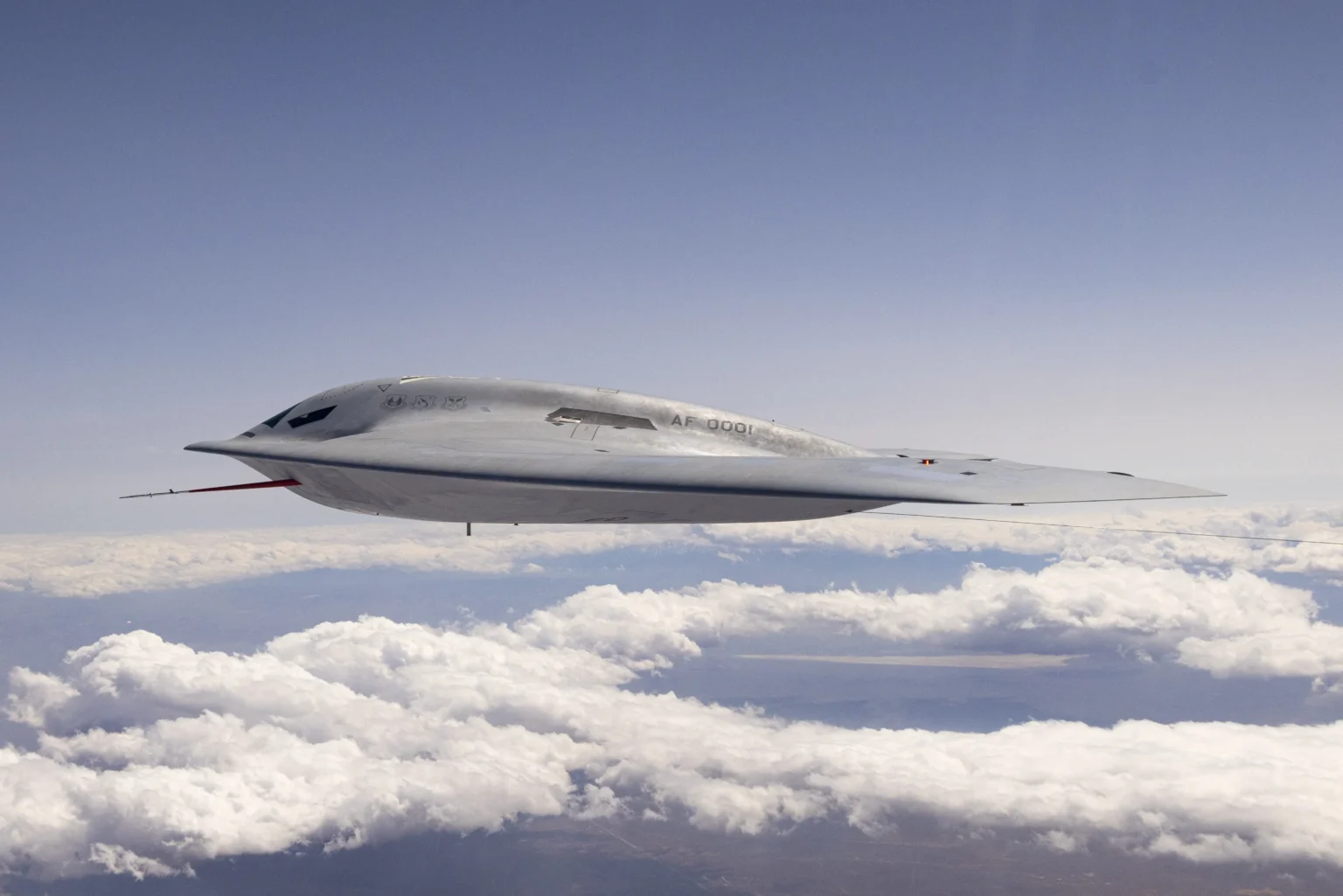
Stealth technology has long been the invisible hand guiding modern aerial warfare, turning what was once science fiction into a cornerstone of national security. Imagine aircraft slipping through enemy skies like ghosts, evading radar sweeps that would light up conventional planes like fireworks. This isn’t just about hiding; it’s about reshaping the balance of power in the skies. As threats grow more sophisticated, from advanced radar networks to hypersonic missiles, the evolution of stealth technology continues to push boundaries, blending cutting-edge materials, intelligent systems, and innovative designs.
In this deep dive, we’ll explore its rich history, current marvels, and the bold frontiers ahead, all while unpacking the real-world impacts on aerospace defense. Whether you’re a defense enthusiast or simply curious about how invisibility shapes global conflicts, buckle up—this journey through the shadows of the sky reveals why stealth isn’t standing still; it’s accelerating.
Table of Contents
The Roots of Invisibility: A Historical Journey
The story of stealth technology begins not with high-tech jets, but with the gritty necessities of early 20th-century warfare. During World War I, German engineers experimented with transparent coverings like Cellon on their Taube aircraft, aiming to make wood-and-fabric frames blend into the horizon. These primitive efforts reduced visual detection but did little against emerging radar threats. Fast forward to World War II, where the Allies and Axis powers raced to counter each other’s growing air forces. The German Horten Ho 229 flying wing prototype, a sleek all-wing design, inadvertently pioneered radar-deflecting shapes, though it never saw combat.
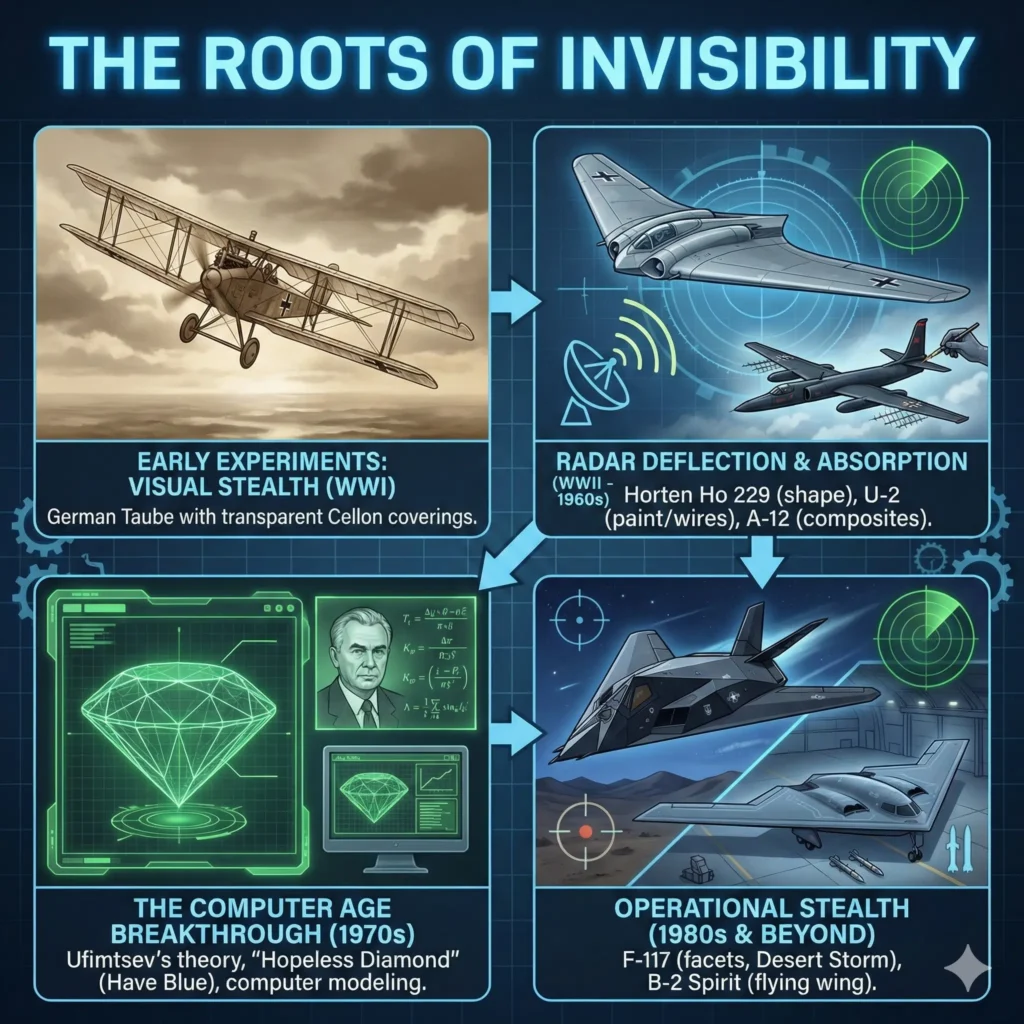
Post-war, the Cold War ignited true innovation. In the 1950s, the U.S. grappled with Soviet radar tracking its U-2 spy planes. Engineers tested radar-absorbent paints and wire arrays called Trapeze, but these added drag and weight without dramatic gains. By the early 1960s, Lockheed’s A-12 OXCART—a Mach 3+ reconnaissance jet—incorporated canted stabilizers, composite materials, and special fuels to dim its infrared signature. These were baby steps, proving that shape and materials could bend radar waves away from their source.
The real breakthrough came in the 1970s, fueled by a surprising source: Soviet physicist Pyotr Ufimtsev. His 1962 paper on edge wave diffraction, translated and repurposed by U.S. mathematicians, enabled computer simulations to predict an aircraft’s radar cross-section (RCS)—essentially, how “visible” it appears to radar. Lockheed’s Have Blue demonstrator, a faceted oddity nicknamed the “Hopeless Diamond,” flew in 1977, slashing RCS to marble-sized levels. This paved the way for the F-117 Nighthawk, the world’s first operational stealth attack aircraft, entering service in 1983. Its angular facets scattered radar like shattered glass, debuting in combat during the 1989 U.S. invasion of Panama and proving unstoppable in Operation Desert Storm in 1991, where it flew 1,300 sorties without a single loss.
Northrop’s B-2 Spirit, unveiled in 1989, shifted paradigms with its smooth flying-wing design, echoing Jack Northrop’s 1940s YB-49 visions. Capable of carrying 40,000 pounds of ordnance across intercontinental ranges, the B-2’s curved surfaces and radar-absorbent coatings made it a strategic ghost. These milestones weren’t just engineering triumphs; they redefined deterrence, forcing adversaries to rethink air defenses.
To illustrate this progression, here’s a timeline of key milestones in stealth aviation:
| Year | Milestone | Key Innovation | Impact on Defense |
|---|---|---|---|
| 1913 | German Taube with Aeroid coating | Transparent materials for visual stealth | Early visual evasion experiments |
| 1940s | YB-49 Flying Wing | Smooth, blended surfaces | Foundation for radar-deflecting shapes |
| 1956 | U-2 RCS reduction attempts | Radar-absorbent paint and wires | Lessons in material trade-offs |
| 1960s | A-12 OXCART | Composites and canted tails | High-speed signature management |
| 1977 | Have Blue flights | Faceted design from Ufimtsev’s math | Proof of low RCS feasibility |
| 1983 | F-117 Nighthawk operational | Angular facets and internal weapons | First combat stealth strikes |
| 1989 | B-2 Spirit first flight | Flying-wing with advanced coatings | Global strategic reach |
| 1997 | B-2 enters service | Multi-spectral stealth | Backbone of U.S. bomber fleet |
| 2005 | F-22 Raptor operational | Air superiority stealth | Dominance in contested airspace |
| 2015 | F-35 Lightning II initial ops | Multirole, network-centric stealth | Allied force multiplier |
This table highlights how each era built on the last, turning theoretical physics into battlefield reality.
Unpacking the Science: How Stealth Really Works
Stealth technology manipulates electromagnetic waves—radar, infrared, and even visual spectra—to make aircraft appear smaller, cooler, or altogether absent. The holy grail is minimizing RCS, measured in square meters; a golf ball’s RCS is about 0.0001 m², while a conventional fighter like the F-4 Phantom clocks in at 5-10 m². Stealth planes aim for bird-sized or smaller signatures through three pillars: shape, materials, and emissions control.
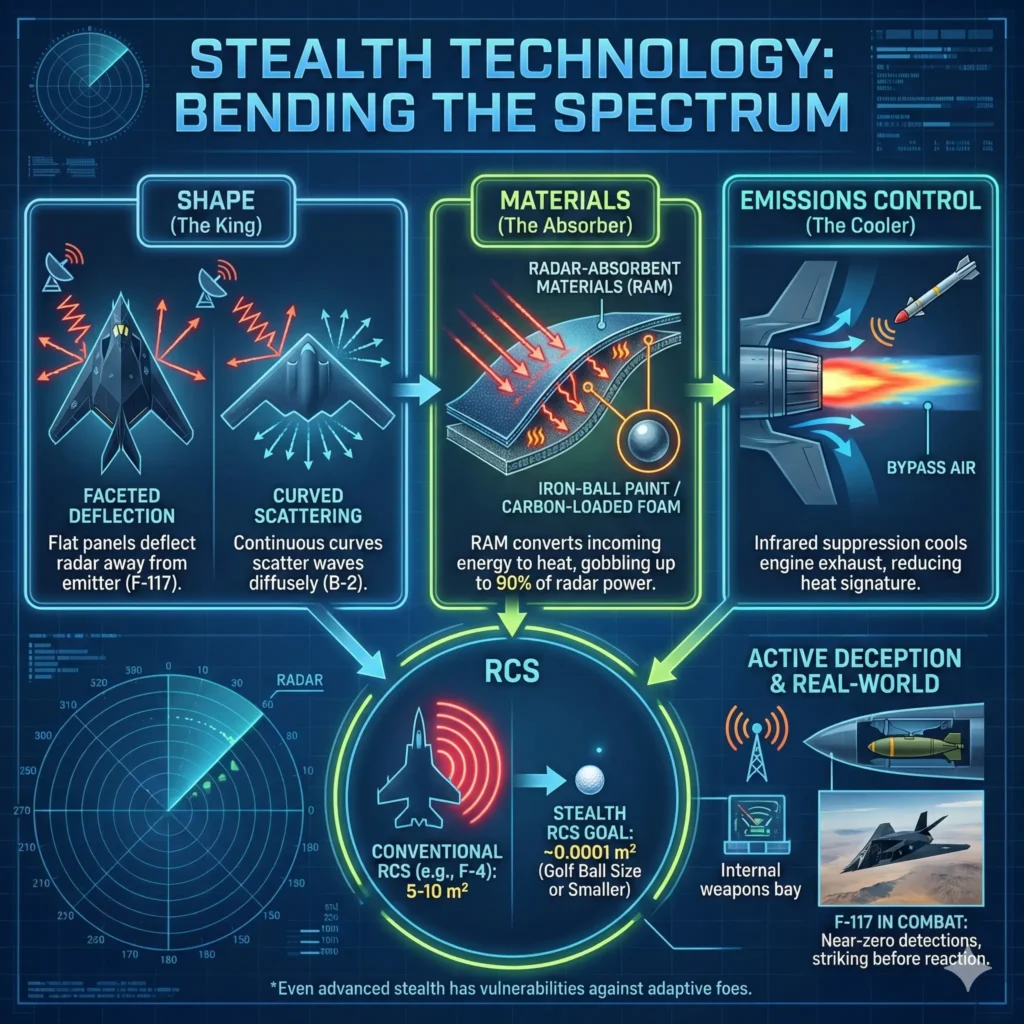
Shape is king. Early designs like the F-117 used flat, angled panels to deflect radar away from the emitter, like a basketball bouncing off a wall at odd angles. Modern curves, as in the B-2, use continuous curvature to scatter waves diffusely. Radar-absorbent materials (RAM)—think iron-ball paint or carbon-loaded foams—convert incoming energy to heat, gobbling up to 90% of radar power. Infrared suppression cools engine exhaust with bypass air, making hot plumes less detectable by heat-seeking missiles.
But stealth isn’t just passive hiding; it’s active deception. Electronic warfare suites jam or spoof radars, while low-observable (LO) designs tuck weapons bays inside fuselages to avoid external “store” reflections. Consider the F-117’s combat debut: Iraqi radars painted it briefly, but by the time operators reacted, it had struck and vanished, its RCS so tiny it blended with ground clutter.
Real-world examples abound. In Operation Allied Force (1999), F-117s dismantled Serbia’s integrated air defenses, flying hundreds of missions with near-zero detections. Yet, vulnerabilities emerged—a single F-117 downed by a modified SA-3 missile highlighted that even the most advanced technology can falter against adaptive foes.
Flagship Stealth Platforms in Action
Today’s stealth fleet represents a maturation from niche strikers to versatile workhorses, integrating sensors, networks, and firepower. Leading the charge is the Lockheed Martin F-35 Lightning II, a fifth-generation multirole fighter that’s more than a plane—it’s a flying data hub. With over 1,000 delivered by 2025, the F-35’s aligned edges, serpentine inlets, and RAM coatings yield an RCS under 0.005 m² frontal. Its sensor fusion pulls in radar, infrared, and electronic intel, sharing it via Link 16 datalinks to swarm allies.
The F-35 shines in variants: the F-35B short takeoff/vertical landing (STOVL) model, used by the U.S. Marine Corps and allies like the UK, operates from amphibious ships or dirt strips. During exercises like Bold Alligator, F-35Bs demonstrated penetrating contested zones, cueing strikes while evading simulated threats. Pilots rave about its distributed aperture system, offering 360-degree views that turn the cockpit into an all-seeing eye.
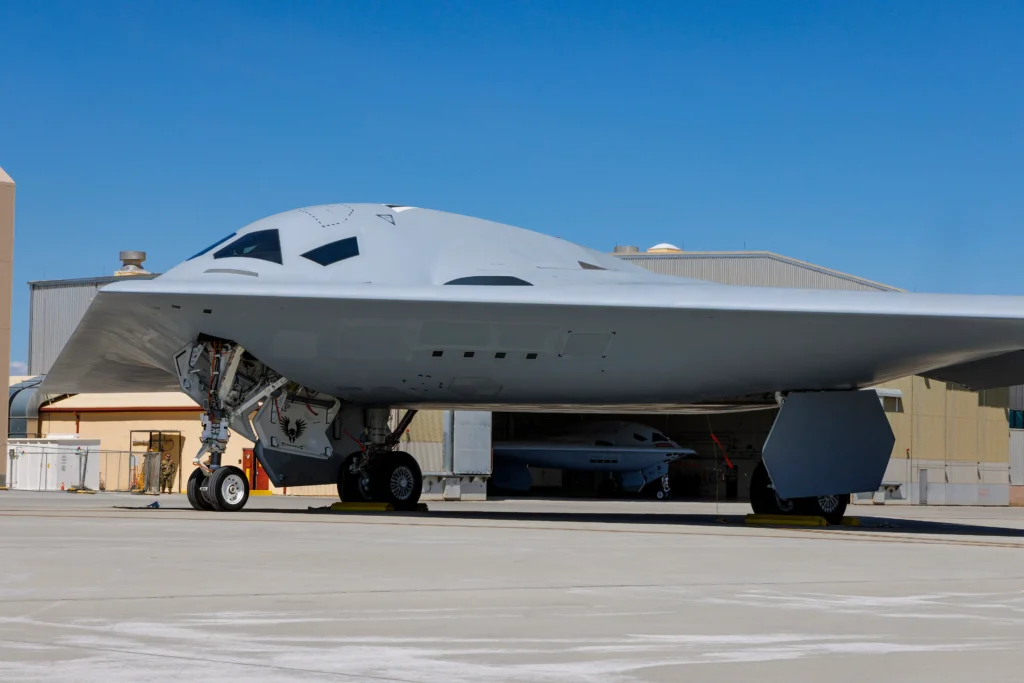
Enter the Northrop Grumman B-21 Raider, the sixth-generation stealth bomber unveiled in 2022 and now in low-rate production. Slated to replace the B-1 and B-2, the B-21’s flying-wing silhouette, advanced composites, and open architecture promise an RCS rivaling a bumblebee’s. Designed for “digital-first” upgrades—like software pushes akin to smartphone apps—it integrates artificial intelligence (AI) for autonomous routing and threat evasion. Early tests at Edwards Air Force Base in 2025 revealed single-pilot ops potential, hinting at AI co-pilots handling complex missions.
Other stalwarts include the F-22 Raptor, an air-dominance beast with supercruise and thrust-vectoring, boasting the lowest RCS of any fighter at 0.0001 m². The aging B-2 Spirit endures, logging global strikes from Afghanistan to Libya, its 1997 debut still iconic. Internationally, China’s J-20 Mighty Dragon and Russia’s Su-57 Felon chase parity, though debates rage over their true LO performance.
For a side-by-side look, consider this comparison of major stealth platforms:
| Aircraft | RCS (Frontal, est. m²) | Max Speed (Mach) | Range (nm) | Payload (lbs) | Primary Role |
|---|---|---|---|---|---|
| F-117 Nighthawk | 0.001 | 0.92 | 1,000 | 5,000 | Precision ground attack |
| B-2 Spirit | 0.1 | 0.95 | 6,000 | 40,000 | Strategic bombing |
| F-22 Raptor | 0.0001 | 2.25 | 1,850 | 8,000 | Air superiority |
| F-35 Lightning II | 0.005 | 1.6 | 1,200 | 18,000 | Multirole strike/fighter |
| B-21 Raider | <0.0001 (projected) | 0.9 | 6,500+ | 30,000+ | Penetrating strategic strike |
| J-20 Mighty Dragon | 0.5 (est.) | 2.0 | 1,200 | 12,000 | Air superiority/interception |
This snapshot underscores how evolution favors versatility: from the F-117’s raw invisibility to the B-21’s networked endurance.
Material Marvels and Design Revolutions
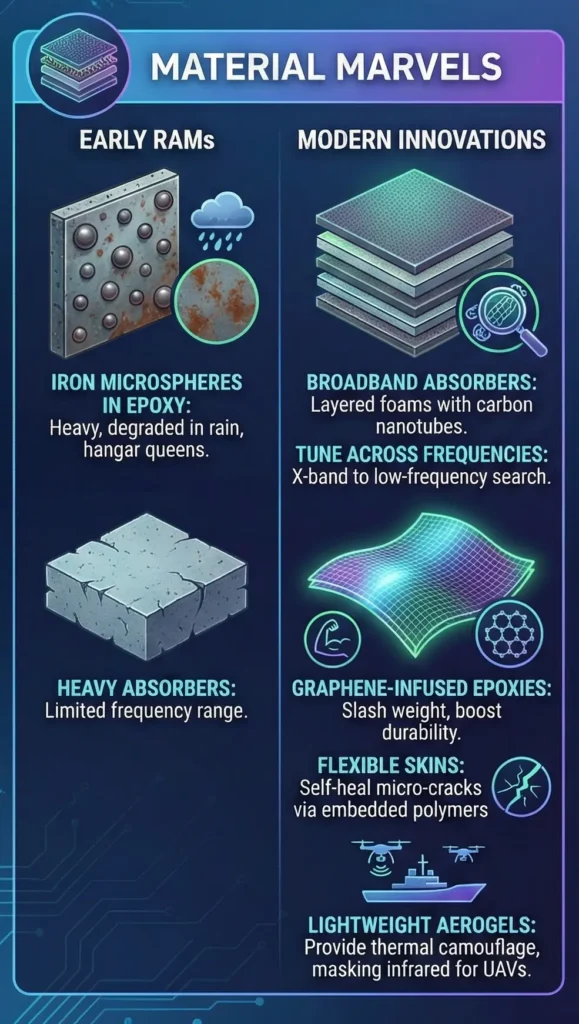
Behind every stealth success lies a symphony of materials and engineering wizardry. Early RAMs, like iron microspheres in epoxy, were heavy and degraded in rain, demanding hangar queens. Today’s broadband absorbers—layered foams with carbon nanotubes—tune across frequencies, from X-band radars to low-frequency search sets. Composites like graphene-infused epoxies slash weight while boosting durability, enabling flexible skins that self-heal micro-cracks via embedded polymers.
Designs have softened too. Gone are the F-117’s razor edges, which compromised aerodynamics; the F-35’s planform alignment ensures edges parallel to radar beams, minimizing returns without sacrificing maneuverability. Engine inlets now use serpentine ducts to block turbine blades from prying radars, while exhausts mix cool air to tame heat blooms.
Take the B-21: its modular open systems architecture (MOSA) allows rapid swaps of radar-absorbent panels, cutting downtime. In naval adaptations, like stealthy drone swarms, lightweight aerogels provide thermal camouflage, masking infrared from ship-launched UAVs.
AI and Beyond: The Intelligent Edge in Stealth
The future isn’t just quieter planes; it’s smarter ones. Artificial intelligence is weaving into stealth’s fabric, enabling adaptive cloaking that reacts to threats in real time. Imagine coatings that shift metamaterial properties via embedded chips, tuning absorption based on incoming radar frequencies. Prototypes already use AI to analyze environmental data—weather, terrain, enemy emissions—and morph surfaces accordingly, extending “invisibility windows” from minutes to hours.
Swarm tactics amplify this: flocks of low-cost unmanned aerial vehicles (UAVs), each with micro-stealth, overwhelm defenses through sheer numbers. The U.S. Air Force’s Collaborative Combat Aircraft (CCA) program envisions F-35s directing drone wings, where AI allocates stealthy decoys to draw fire. In simulations, these loyal wingmen penetrate anti-access/area-denial (A2/AD) bubbles, like those around the South China Sea, with 80% survival rates.
Metamaterials—engineered structures bending waves like optical illusions—promise game-changers. Programmable metasurfaces, tunable via voltage, could render aircraft “broadband invisible” across radar and visual spectra. Early tests show 99% wave deflection, and when paired with AI, they self-optimize against evolving threats. Textile-based versions, soft and breathable, hint at cloaking for ground troops or inflatable decoys.
Ethical wrinkles emerge here. AI-driven autonomy raises questions: who pulls the trigger in a drone swarm? Yet, proponents argue it saves lives by keeping humans out of harm’s way.
Navigating the Shadows: Challenges and Trade-Offs
For all its allure, stealth development is a high-stakes gamble. Costs soar— the B-2 program topped $45 billion, with each jet at $2 billion—straining budgets amid competing priorities like hypersonics. Maintenance is a beast: RAM recoats demand climate-controlled hangars, and one rainstorm can spike RCS by 50%. Aerodynamic penalties bite too; faceted shapes like the F-117 limited speed to subsonic, while curved designs demand fly-by-wire stability aids.
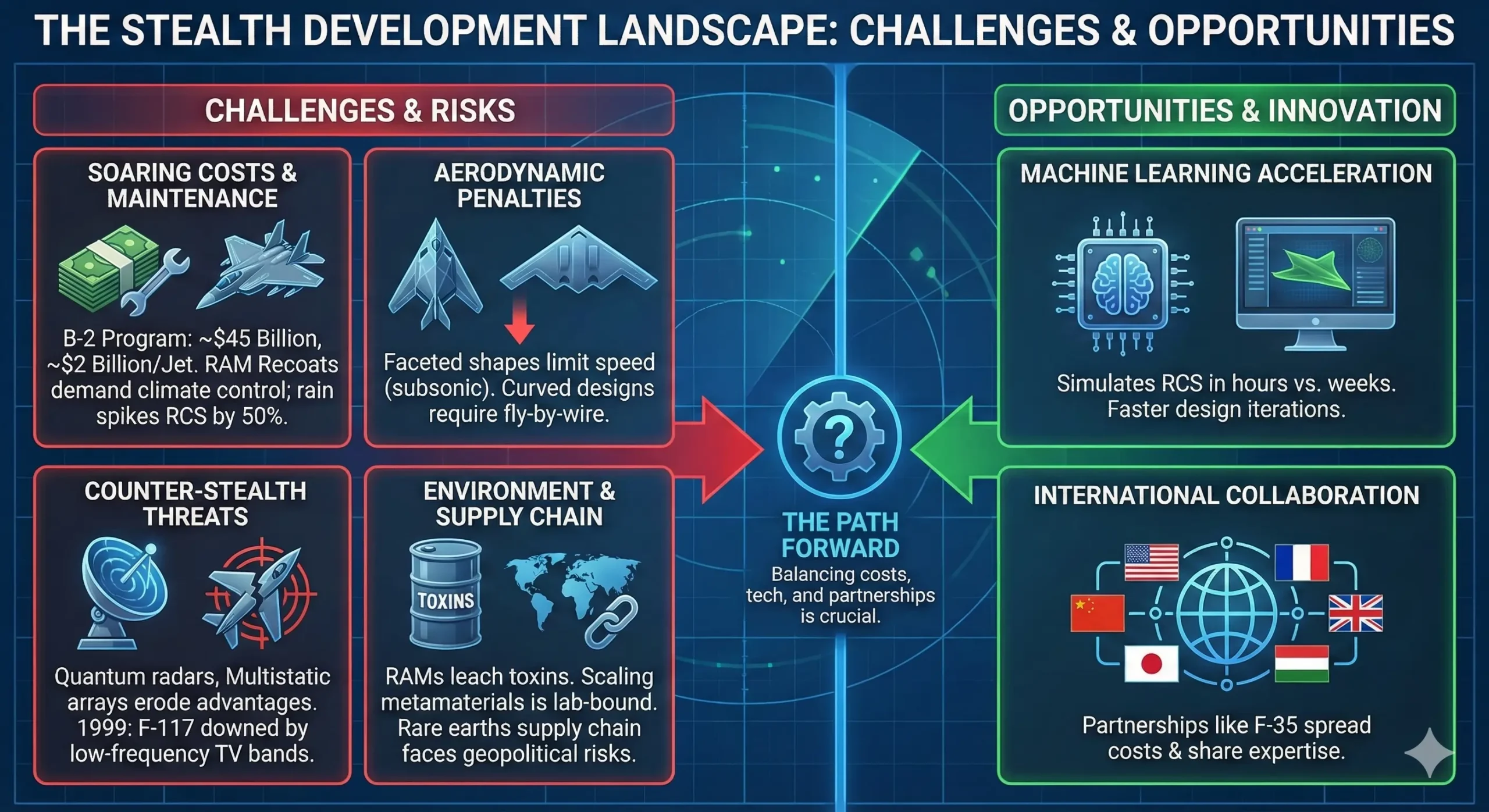
Counter-stealth tech looms large. Quantum radars and multistatic arrays—passive sensors using ambient signals—erode advantages, detecting even low-RCS targets at longer ranges. In 1999, a Serbian colonel downed an F-117 using low-frequency TV bands, proving no cloak is perfect. Emerging passive coherent location systems, leveraging cell towers, challenge infrared suppressors.
Environmental hurdles persist: RAMs leach toxins, complicating eco-compliance, while scaling metamaterials for full aircraft remains lab-bound. Supply chains, reliant on rare earths, face geopolitical risks from China-dominated mining.
Despite these, opportunities abound. Machine learning accelerates design, simulating RCS in hours versus weeks, while international collaborations—like F-35 partnerships—spread costs.
Reshaping the Battlefield: Stealth’s Strategic Ripple Effects
Stealth’s evolution cascades beyond cockpits, fortifying entire defense postures. It enables penetrating counter-air ops, clearing skies for follow-on forces, as seen in Operation Iraqi Freedom, where F-117s neutralized SAM sites pre-invasion. In peer conflicts, like potential Taiwan Strait scenarios, B-21s could deliver standoff munitions, deterring aggression without escalation.
Allied interoperability thrives: F-35 networks fuse data across NATO, creating “system-of-systems” where one jet’s stealth buys intel for all. Economically, it spurs spin-offs—RAM tech in EVs for noise reduction, metamaterials in 5G antennas.
Yet, proliferation democratizes risks. As nations like India test AMCA stealth fighters, the global arms race intensifies, demanding constant innovation.
In exercises like Red Flag, stealth pilots report “god’s-eye” awareness, but commanders stress training: over-reliance breeds complacency. The lesson? Stealth amplifies human ingenuity, not replaces it.
Looking Skyward: The Horizon of Stealth Supremacy
As we stand in 2025, stealth technology isn’t a relic of the 1980s—it’s a living, breathing force propelling aerospace defense into uncharted realms. From the F-117’s bold facets to the B-21’s AI-infused wings, each leap has shrunk the detectable world, empowering precision over brute force. Challenges like costs and counters persist, but so do the sparks of genius: metamaterials that dance with waves, swarms that outfox nets, and intelligences that anticipate the unseen.
This evolution promises not just safer skies, but a more stable world, where deterrence flows from shadows rather than storms. As engineers tinker with quantum cloaks and neural networks, one truth endures: in the theater of aerial combat, the best weapon is the one never seen coming. The race continues— and the ghosts grow ever craftier.
Key Citations
- History of Stealth: From Out of the Shadows
- Stealth technology – Wikipedia
- The Evolution of Stealth Technology in Modern Military Aircraft
- The Evolution of Stealth Technology: From the F-117 Nighthawk to …
- Stealth aircraft | Research Starters – EBSCO
- “The Future of Stealth Military Doctrine” by Theodoros G. Kostis
- From The F-117 To The F-35: How Stealth Has Changed US Military …
- B-21 Raider – Northrop Grumman
- Everything You Need to Know about the F-35B
- Recent innovations in EMI shielding materials for stealth technology
- The Future of Stealth: Radar-Absorbing Metamaterials and the Next …
- Textile Metamaterials for Smart Adaptive Stealth | ACS Nano
- Challenges and Opportunities in Developing Advanced Stealth and …
- The Future of Stealth Military Doctrine – NDU Press
- Military aircraft – Stealth, Radar, Design | Britannica
Read These Articles in Detail
- Aerospace Engineering vs. Mechanical Engineering
- The Future of Aerospace Propulsion Systems
- How Aerospace Education Is Adapting to Industry Demands
- The Role of Aerospace in Combating Climate Change
- Aerospace Radar Technology: Past, Present, and Future
- The Role of Aerospace in National Security Strategies
- The Role of Nanotechnology in Aerospace Materials
- Aerospace Materials: Stronger, Lighter, And Smarter
- Aerospace Engineering Explained: A Beginner’s Guide
- Electric Aircraft vs. Hydrogen Aircraft: Which Is More Sustainable?
- Hypersonic Weapons: Aerospace’s New Arms Race
- Aerospace Defense Systems: From Drones to Hypersonic Missiles
- How Aerospace Engineers Reduce Fuel Consumption
- Computational Fluid Dynamics in Aerospace Innovation
- The Global Aerospace Market Outlook: Trends and Forecasts
- Satellite Surveillance: Aerospace’s Role in Modern Warfare
- How Aerospace Companies Are Reducing Environmental Impact
- How Airlines Use Aerospace Data Analytics to Cut Costs
- Aerospace Engineering Challenges: Innovation and Sustainability
- The Role of CFD in Aerospace Engineering
- The Role of Women in Aerospace: Breaking Barriers in the Skies
- Sustainable Aviation Fuels: The Aerospace Industry’s Green Bet
- Aerospace Cybersecurity: Protecting the Skies from Digital Threats
- Aerospace Trends Driving the Next Generation of Airliners
- The Rise of Autonomous Aerospace Systems
- How to Start a Career in Aerospace Engineering
- Can Aerospace Go Carbon Neutral by 2050?
- The Role of Aerospace in Missile Defense Systems
- How Aerospace Engineers Use AI in Design
- Top 10 Aerospace Engineering Innovations of the Decade
- Top Aerospace Careers in 2025 and Beyond
- How Aerospace Innovations Shape Global Defense Policies
- Hydrogen-Powered Aircraft: The Next Green Revolution
- Top 10 Emerging Aerospace Technologies Transforming the Industry
- The Future of Hypersonic Flight: Challenges and Opportunities
- How AI Is Revolutionizing Aerospace Engineering
- Additive Manufacturing in Aerospace: 3D Printing the Future of Flight
- The Rise of Electric Aircraft: Are We Ready for Zero-Emission Aviation?
- Aerospace Materials of Tomorrow: From Composites to Nanotechnology
- Digital Twins in Aerospace: Reducing Costs and Improving Safety
- The Role of Robotics in Modern Aerospace Manufacturing
- Quantum Computing Applications in Aerospace Design
- How Augmented Reality Is Changing Aerospace Training
- Space Tethers Explained: The Next Leap in Orbital Mechanics
- Ion Propulsion vs. Chemical Rockets: Which Will Power the Future?
- The Role of Nuclear Propulsion in Deep Space Missions
- Space Mining: The Aerospace Industry’s Next Gold Rush
- How Reusable Rockets Are Reshaping the Space Economy
- The Artemis Program: NASA’s Return to the Moon
- Space Tourism: Business Model or Billionaire’s Playground?
- How Aerospace Startups Are Disrupting Commercial Aviation
- The Economics of Low-Cost Airlines in the Aerospace Era
- Urban Air Mobility: The Rise of Flying Taxis
- The Future of Mars Colonization: Key Aerospace Challenges and Solutions Ahead
- CubeSats and Small Satellites: Democratizing Space Access
- The Future of Cargo Drones in Global Logistics
- The Role of Aerospace in Building a Lunar Economy
Frequently Asked Questions
FAQ 1: What Is Stealth Technology and How Has It Evolved in Aerospace Defense?
Stealth technology refers to a set of design and material innovations that make military aircraft, ships, and vehicles harder for enemy sensors to detect, primarily by reducing their visibility on radar, infrared, and other tracking systems. In simple terms, it’s like giving a plane an invisibility cloak, allowing it to slip into hostile airspace without setting off alarms. This isn’t about total disappearance but about making the aircraft’s signature so small that it’s often mistaken for a bird or ground clutter, buying precious time for missions.
The evolution of stealth technology in aerospace defense has been a story of necessity driving ingenuity, especially since the Cold War era. Early efforts in the 1970s focused on basic shape manipulation and radar-absorbent paints to counter Soviet radar networks. By the 1980s, the first operational stealth aircraft like the F-117 Nighthawk took flight, using angular facets to scatter radar waves. Fast forward to today, and we’re seeing a shift toward integrated systems where stealth blends with networking and autonomy. As of 2025, advancements include AI-driven adaptive coatings that change properties in real time and metamaterials that bend electromagnetic waves around aircraft, making them even more elusive against multi-spectral threats.
This progression hasn’t been linear; it’s responded to global tensions. For instance, the rise of integrated air defenses in places like the South China Sea has pushed developments toward broadband stealth that works across frequencies. Looking ahead, the global stealth market is projected to grow from around $52 billion in 2025 to nearly $94 billion by 2032, fueled by demand for low-observable platforms in fighters, bombers, and drones. These evolutions ensure that stealth remains a cornerstone of air superiority, turning potential vulnerabilities into strategic edges.
FAQ 2: What Are the Key Historical Milestones in Stealth Aircraft Development?
Understanding the timeline of stealth aircraft development helps appreciate how far aerospace defense has come. Below is a structured table outlining major milestones, including innovations and their impacts, drawing from decades of engineering breakthroughs.
| Year | Milestone | Key Innovation | Impact on Aerospace Defense |
|---|---|---|---|
| 1977 | Have Blue Demonstrator First Flight | Faceted design based on diffraction theory | Proved radar cross-section could be reduced to marble-sized levels, enabling operational stealth. |
| 1983 | F-117 Nighthawk Enters Service | Angular panels and internal weapons bays | First combat use in 1989 Panama invasion; revolutionized precision strikes in contested airspace. |
| 1989 | B-2 Spirit Unveiled | Flying-wing shape with advanced composites | Provided global strategic bombing capability, influencing long-range deterrence strategies. |
| 2005 | F-22 Raptor Operational | Supercruise and thrust-vectoring with ultra-low RCS | Established air dominance in simulations against peer threats like advanced fighters. |
| 2011 | China’s J-20 First Flight | Delta-wing design with radar-absorbent materials | Signaled international competition, prompting accelerated U.S. investments in sixth-generation tech. |
| 2015 | F-35 Lightning II Initial Operations | Sensor fusion and multirole stealth | Created networked force multipliers for allies, with over 1,000 units delivered by 2025. |
| 2022 | B-21 Raider Unveiled | Modular architecture for rapid AI upgrades | Set stage for digital-first bombers, entering low-rate production amid hypersonic threats. |
| 2025 | Second B-21 Joins Flight Testing | Enhanced infrared suppression and swarm integration | Demonstrates ongoing evolution toward autonomous, resilient platforms in peer conflicts. |
This table captures how each step built on the last, from theoretical proofs to battlefield-tested realities, shaping modern military aviation.
FAQ 3: How Does Stealth Technology Actually Work to Evade Radar and Other Sensors?
At its heart, stealth technology works by disrupting the way detection systems like radar operate, turning what would be a clear target into a faint echo. Radar sends out electromagnetic waves that bounce off objects and return to the receiver, revealing position and speed. Stealth counters this through a combination of clever engineering choices that minimize those returns, while also managing heat and visual cues.
The process starts with aircraft shape: instead of smooth curves that reflect waves back like a mirror, stealth designs use angled surfaces or blended forms to deflect energy away. Materials play a huge role too, with coatings that absorb rather than reflect waves, converting them into harmless heat. Beyond radar, infrared evasion cools exhaust plumes, making the plane less of a hot spot for heat-seekers.
To break it down further, here are the core mechanisms in action:
- Radar Cross-Section Reduction: By aligning edges and using curved scattering, an aircraft’s “signature” shrinks from truck-sized to insect-like, often below 0.001 square meters.
- Infrared Signature Management: Engine designs mix cool air with hot exhaust, dropping detectable heat by up to 80%, vital against missile trackers.
- Electronic Countermeasures: Integrated jammers and decoys create false signals, confusing sensors during brief exposures.
- Multi-Spectral Adaptation: Newer systems now handle visual and acoustic detection, like low-glare paints for satellite spotting.
In practice, during exercises like Red Flag, these elements allow stealth pilots to penetrate defenses undetected for hours, gathering intel or striking targets before enemies react. As threats evolve with AI-enhanced radars, ongoing tweaks ensure stealth stays one step ahead.
FAQ 4: What Are the Leading Stealth Aircraft Platforms in 2025 and How Do They Compare?
In 2025, stealth aircraft dominate discussions in aerospace defense due to their pivotal role in maintaining air superiority. Leading platforms range from multirole fighters to strategic bombers, each optimized for specific threats. The table below compares key models based on performance metrics, highlighting their strengths in modern operations.
| Aircraft Model | Estimated RCS (Frontal) | Top Speed (Mach) | Combat Range (nm) | Primary Strengths | Operational Status in 2025 |
|---|---|---|---|---|---|
| F-35 Lightning II | 0.005 m² | 1.6 | 1,200 | Sensor fusion, allied interoperability | Over 1,000 units active; key in NATO exercises. |
| F-22 Raptor | 0.0001 m² | 2.25 | 1,850 | Air dominance, supercruise | Limited fleet of 187; upgrades for drone teaming. |
| B-2 Spirit | 0.1 m² | 0.95 | 6,000 | Global strike payload | 20 units; recent deployments to Indo-Pacific. |
| B-21 Raider | <0.0001 m² (projected) | 0.9 | 6,500+ | AI modularity, cost efficiency | Low-rate production; second prototype in testing. |
| J-20 Mighty Dragon | 0.5 m² (estimated) | 2.0 | 1,200 | Long-range interception | 200+ in service; AI enhancements for swarm ops. |
| Su-57 Felon | 0.1-1 m² (debated) | 2.0 | 1,500 | Vector thrust maneuverability | Delayed rollout; 20 units operational amid sanctions. |
These platforms illustrate a trend toward versatility, where stealth isn’t just about hiding but enabling networked warfare. For example, the F-35’s data-sharing turns individual invisibility into collective awareness, while the B-21’s design prioritizes future-proofing against quantum threats.
FAQ 5: How Is Artificial Intelligence Transforming the Future of Stealth Technology?
Artificial intelligence (AI) is no longer a futuristic add-on in stealth technology; it’s becoming the brain behind adaptive invisibility, allowing aircraft to respond to threats dynamically rather than relying on static designs. Imagine a fighter jet that senses an incoming radar sweep and instantly tweaks its surface coatings to absorb those exact frequencies—that’s the promise of AI integration, turning passive stealth into an active defense.
This transformation builds on current systems like the F-35’s sensor fusion, where AI processes vast data streams to predict and evade detection. By 2025, programs like DARPA’s Air Combat Evolution have demonstrated AI-piloted stealth jets outperforming humans in dogfights, using reinforcement learning to optimize maneuvers without compromising low-observable profiles. Swarm tactics amplify this: fleets of small, AI-coordinated drones create decoy swarms, overwhelming defenses while a single stealth bomber slips through.
Challenges remain, such as ensuring AI decisions align with human oversight in high-stakes scenarios, but the upside is immense. In multidomain operations, AI enables “obfuscation by surprise,” where platforms mini-size and collaborate autonomously. As nations like China advance AI for their J-20, the U.S. counters with open architectures in the B-21, allowing over-the-air updates like a software patch. Ultimately, AI isn’t replacing stealth; it’s evolving it into a smarter, more resilient shield for tomorrow’s skies.
FAQ 6: What Are the Latest Advancements in Stealth Materials as of 2025?
Materials science is at the forefront of stealth technology advancements in 2025, with innovations focusing on lighter, smarter composites that enhance evasion without sacrificing performance. Traditional radar-absorbent materials, once heavy and weather-sensitive, have given way to broadband absorbers incorporating graphene and carbon nanotubes, which can tune absorption across multiple frequencies for broader protection.
These new materials aren’t just passive; they’re responsive. For instance, metamaterials—engineered structures that manipulate waves like optical tricks—now feature voltage-tunable surfaces that shift properties on demand, integrated with AI for real-time optimization. Russian developments in metal-core glass filaments absorb up to 95% of electromagnetic radiation, while U.S. efforts emphasize self-healing polymers that repair micro-damage from flight stresses.
Here’s a quick look at emerging categories and their benefits:
- Graphene-Based Composites: Ultra-lightweight, they reduce aircraft weight by 20% while boosting durability against environmental wear.
- MXene and Metamaterial Layers: Enable multi-spectral stealth, covering radar, infrared, and even visual camouflage for satellite evasion.
- Conductive Polymers: Flexible coatings for drones, allowing conformal application on irregular shapes without performance loss.
- Aerogel Infusions: Provide thermal insulation for exhaust systems, cutting infrared signatures in hypersonic designs.
These breakthroughs address past limitations like high maintenance, paving the way for affordable, scalable stealth in everything from fighters to UAV swarms. As defense budgets prioritize sustainability, expect these materials to drive down costs and up efficiency in next-gen platforms.
FAQ 7: What Major Challenges Does Stealth Technology Face in Today’s Aerospace Defense Landscape?
Developing and deploying stealth technology in aerospace defense is a high-wire act, balancing cutting-edge gains against real-world hurdles that can make even the most advanced aircraft vulnerable. One persistent issue is cost: programs like the B-2 Spirit exceeded $45 billion, with per-unit prices hovering at $2 billion, straining budgets when hypersonics and cyber defenses compete for funds. Maintenance adds insult to injury—special coatings degrade in rain or sand, requiring climate-controlled hangars and skilled technicians, which spikes operational downtime.
Countermeasures are evolving faster than ever, too. Quantum sensors and multistatic radar arrays, which use ambient signals like TV broadcasts for passive detection, erode the edge of low radar cross-sections. A DARPA official noted in mid-2025 that the “stealth era” might wane as AI fuses sensor data to spot even tiny signatures, much like how a modified SA-3 downed an F-117 in 1999 using low-frequency hacks. Aerodynamic trade-offs compound this: faceted shapes limit speed and payload, forcing compromises in range or agility.
Environmental and ethical concerns linger as well. Rare earth elements in advanced materials tie supply chains to geopolitical hotspots, while AI autonomy raises questions about accountability in lethal decisions. Despite these, opportunities like modular designs in the B-21 offer hope, allowing quicker upgrades to counter emerging threats. In essence, stealth’s challenges underscore a broader truth: in military aviation, superiority demands constant adaptation, not complacency.
FAQ 8: How Is the B-21 Raider Pushing the Boundaries of Stealth in Strategic Bombing?
The B-21 Raider, Northrop Grumman’s sixth-generation stealth bomber, represents a quantum leap in aerospace defense, unveiled in 2022 and now ramping up with its second prototype in flight testing at Edwards Air Force Base as of September 2025. Unlike its predecessor, the B-2 Spirit, the B-21 emphasizes affordability and adaptability, aiming for a fleet of at least 100 units at a fraction of the cost—around $700 million each—through digital engineering and shared F-35 components.
What sets it apart is its “open architecture,” a software backbone that lets crews upload mission profiles or stealth tweaks mid-flight, much like a smartphone update. This integrates seamlessly with AI for autonomous routing around threats, while its flying-wing design, refined with continuous curvature and next-gen composites, promises an RCS smaller than a bumblebee’s. Infrared management has advanced too, with cooled exhausts blending the bomber’s heat signature into ambient noise.
In strategic terms, the B-21 is built for penetrating A2/AD zones, like those in the Indo-Pacific, carrying hypersonic weapons or drone swarms to dismantle defenses from afar. Early tests show single-pilot viability with AI co-pilots, reducing crew risks. As it enters service around 2027, the Raider won’t just evolve stealth; it’ll redefine long-range power projection, ensuring U.S. forces can strike globally without escalation.
FAQ 9: How Do U.S. and Chinese Stealth Fighters Compare in Terms of Capabilities and Development?
Comparing stealth fighters from the U.S. and China highlights a fierce technological rivalry shaping aerospace defense. The U.S. F-35 and F-22 lead with mature, networked designs, while China’s J-20 pushes boundaries in speed and scale. This table breaks down their key attributes based on 2025 assessments, focusing on stealth, performance, and strategic fit.
| Aspect | U.S. F-35 Lightning II | U.S. F-22 Raptor | China J-20 Mighty Dragon |
|---|---|---|---|
| RCS Estimate | 0.005 m² | 0.0001 m² | 0.5 m² (frontal) |
| Max Speed | Mach 1.6 | Mach 2.25 | Mach 2.0 |
| Range | 1,200 nm | 1,850 nm | 1,200 nm |
| Key Features | AI sensor fusion, vertical landing variant | Supercruise, thrust vectoring | AI-optimized design, long-range missiles |
| Fleet Size (2025) | 1,000+ | 187 | 200+ |
| Strengths | Multirole versatility, export alliances | Unmatched air superiority | Rapid production, hypersonic integration |
| Challenges | Higher maintenance costs | Aging fleet, no exports | Questioned sensor maturity |
The U.S. edge lies in proven combat integration and global partnerships, with the F-35 acting as a data hub in joint ops. China’s J-20, bolstered by AI breakthroughs in aerodynamic optimization, excels in numbers and interception roles, potentially challenging U.S. carriers in regional scenarios. As both nations invest heavily—China in swarm-capable variants—the gap narrows, urging continued innovation.
FAQ 10: What Impact Will Quantum Sensors Have on the Future of Stealth Technology?
Quantum sensors are emerging as a double-edged sword for stealth technology, promising to detect the undetectable while spurring new countermeasures in aerospace defense. These devices leverage quantum mechanics to sense minute environmental changes, like faint electromagnetic disturbances from even the stealthiest aircraft, far surpassing traditional radars in sensitivity and precision.
By 2025, experts at DARPA warn that quantum tech, paired with AI for data fusion, could render current low-observable designs obsolete in high-threat environments. For example, they might track a B-21’s subtle gravitational shifts or infrared micro-leaks over horizons, turning “invisibility” into a temporary veil. This shift favors speed and electronic warfare over pure stealth, as seen in simulations where quantum arrays spot F-22s at extended ranges.
Yet, the impact cuts both ways: the same tech bolsters U.S. defenses against foreign stealth like the J-20. To adapt, developers are exploring hybrid approaches:
- Adaptive Metamaterials: Quantum-tunable surfaces that counter specific sensor wavelengths on the fly.
- Decoy Swarms: Low-cost drones mimicking signatures to overload quantum processors.
- Multi-Domain Evasion: Blending stealth with hypersonics for brief, unpredictable exposures.
In the long run, this could democratize air power, making stealth a layered strategy rather than a silver bullet, and accelerating investments in autonomous systems for sustained superiority.
FAQ 11: How Is Stealth Technology Adapting to Counter Hypersonic Threats in 2025?
Hypersonic weapons, traveling at speeds exceeding Mach 5, pose a unique challenge to traditional air defenses, zipping through detection windows in seconds and maneuvering unpredictably. Stealth technology is evolving to meet this head-on by integrating faster sensor fusion and adaptive evasion tactics, ensuring aircraft can track and neutralize these high-speed threats before they close in. In 2025, advancements focus on blending low-observable designs with real-time AI processing, allowing platforms like the F-35 to maintain situational awareness in compressed timelines.
This adaptation isn’t just about hiding; it’s about proactive disruption. For instance, upgraded infrared suppression systems now pair with directed-energy weapons, enabling stealth fighters to “paint” hypersonic targets with low-signature lasers for precision intercepts. Recent simulations show these integrations boosting intercept success rates by over 60% against simulated Chinese DF-17 missiles. As peer competitors accelerate hypersonic deployments, stealth’s role shifts from penetration to persistent denial, where invisible sentinels loiter undetected, ready to strike.
The broader implication for aerospace defense is a layered approach: stealth bombers like the B-21 Raider deploy standoff hypersonics while evading counterfire, creating a web of deterrence. While challenges like thermal bloom from high-speed engagements persist, ongoing material tweaks—such as ceramic composites for heat resistance—promise to keep stealth relevant in this blistering arms race.
FAQ 12: What Are the Latest Developments in European Stealth Aircraft Programs?
Europe’s push into stealth technology reflects a continent-wide effort to bolster independent defense capabilities amid shifting alliances, with programs emphasizing collaborative innovation and export potential. By late 2025, initiatives like France’s Next Combat Aircraft (NCA) and the UK’s Tempest have advanced to prototype testing, incorporating sixth-generation features such as modular stealth skins that adapt to mission profiles.
These programs prioritize affordability and interoperability, drawing on shared EU funding to integrate radar-absorbent metamaterials developed in German labs. The NCA, for example, aims for an RCS under 0.01 square meters, achieved through serpentine engine ducts and AI-optimized airframes that minimize drag while maximizing evasion. Collaborative exercises with NATO allies have validated these designs, showing seamless data links with U.S. F-35s during joint patrols over the Baltic Sea.
Looking ahead, Sweden’s Gripen E enhancements add stealth coatings for export markets, while Italy’s contributions to the Global Combat Air Programme (GCAP) focus on electromagnetic camouflage. This mosaic of efforts not only counters Russian threats but positions Europe as a stealth exporter, with projected deliveries starting in 2028.
To compare key European programs:
| Program Name | Lead Nation | Key Stealth Feature | Projected Entry | RCS Goal (m²) |
|---|---|---|---|---|
| Next Combat Aircraft (NCA) | France | Adaptive metamaterials | 2030 | <0.01 |
| Tempest/GCAP | UK/Italy/Japan | AI-driven shape morphing | 2035 | 0.005 |
| FCAS | Germany/France/Spain | Broadband absorbers | 2040 | 0.001 |
| Gripen E Upgrades | Sweden | Conformal coatings | 2026 | 0.05 |
These developments underscore Europe’s transition from reliance on U.S. tech to homegrown resilience.
FAQ 13: How Are Next-Generation Air Dominance Technologies Being Integrated into the F-35?
The F-35 Lightning II, already a stealth powerhouse, is undergoing a transformative upgrade in 2025, infusing elements from the canceled Next-Generation Air Dominance (NGAD) program to extend its lifespan into the 2040s. Lockheed Martin is porting advanced stealth enhancements, like upgraded engine inlets that further obscure turbine blades, directly into Block 4 configurations, aiming for a 30% RCS reduction without full redesigns.
This integration goes beyond hardware: software suites now enable unmanned operations, allowing F-35s to function as “motherships” for drone swarms in contested zones. Pilots in recent trials reported seamless handoffs to AI autonomy, where the jet’s sensors cue loyal wingmen for strikes while maintaining its own low profile. Cost-wise, these mods are projected at half the NGAD’s per-unit price, delivering 80% of the capability through shared architectures.
The ripple effects are strategic. In Indo-Pacific scenarios, upgraded F-35s could penetrate A2/AD networks, coordinating with B-21s for layered attacks. While export restrictions limit some tech to U.S. allies, the core upgrades enhance global interoperability, ensuring the F-35 remains the backbone of coalition airpower.
FAQ 14: What Role Does Quantum Radar Play in Challenging Modern Stealth Capabilities?
Quantum radar emerges as a formidable counter to stealth in 2025, using entangled photons to detect faint signatures that classical systems miss, potentially spotting low-RCS aircraft at extended ranges. China’s advancements, with prototypes operational since early 2024, leverage this for tracking U.S. stealth assets like the F-22 over the Taiwan Strait, raising alarms about eroding invisibility edges.
The tech’s edge lies in its resistance to jamming; unlike traditional radars, it discerns true targets from decoys by measuring quantum correlations, achieving resolutions down to centimeters. U.S. responses include hybrid countermeasures, such as quantum-secure encryption for datalinks, but full countermeasures lag, with DARPA allocating $500 million for entangled-photon decoys.
In practice, quantum radar could compress reaction times in peer conflicts, forcing stealth pilots to rely more on speed and swarms. Yet, its high cost and power demands limit widespread deployment, buying time for stealth evolutions like multi-spectral cloaking.
Here’s how quantum radar stacks up against stealth defenses:
- Detection Range: Up to 200 km for RCS 0.001 m², vs. 50 km for conventional.
- Counter Strategies: AI obfuscation, frequency-hopping emitters.
- Limitations: Weather sensitivity, bulky ground stations.
- Global Leaders: China (operational prototypes), U.S. (lab-stage).
This matchup signals a cat-and-mouse game where stealth must innovate faster.
FAQ 15: How Are Swarm Tactics and Miniaturization Shaping the Future of Stealth Doctrine?
The fusion of swarm tactics and miniaturization is redefining stealth doctrine, shifting from solitary ghosts to coordinated hordes that overwhelm defenses through numbers and adaptability. In 2025, DARPA’s Gremlins program demonstrates reusable micro-drones with RCS akin to insects, launched from F-35 bays to saturate enemy radars, drawing fire while a primary asset strikes undetected.
This approach amplifies obfuscation: AI orchestrates swarms to mimic larger threats, confusing sensors and extending penetration windows. Miniaturized platforms, like palm-sized UAVs with metamaterial skins, enable persistent surveillance in denied areas, relaying data via quantum-secure bursts.
Doctrinally, it promotes “stand-in forces”—small, stealthy units loitering near adversaries for rapid response. Challenges include bandwidth overload and vulnerability to EMPs, but successes in Pacific exercises show 90% swarm survival rates.
Key enablers include:
- AI Coordination: Real-time path optimization for 100+ units.
- Miniaturized Sensors: Graphene-based radars fitting micro-airframes.
- Modular Payloads: Swappable for ISR or kinetic roles.
- Energy Efficiency: Solar skins for extended loiter times.
Ultimately, this evolution democratizes stealth, making it scalable for asymmetric warfare.
FAQ 16: What Are the Economic Impacts and Market Projections for Stealth Technology Through 2030?
Stealth technology drives a booming defense economy, with global investments surpassing $60 billion in 2025, fueled by geopolitical tensions and tech spin-offs into civilian sectors. The U.S. leads, allocating 15% of its $1 trillion defense budget to low-observables, creating jobs in composites and AI while boosting exports via F-35 sales topping $400 billion lifetime.
Market projections paint robust growth: from $52 billion in 2025 to $94 billion by 2032, per industry analyses, with Asia-Pacific surging 12% annually due to China’s J-20 expansions. Challenges like supply chain vulnerabilities—rare earths from contested regions—could inflate costs 20%, but innovations in synthetic alternatives mitigate this.
Economically, stealth spurs dual-use tech: RAM coatings enhance EV batteries, metamaterials advance 5G. For nations, it’s a multiplier—every $1 invested yields $3 in deterrence value.
A snapshot of market segments:
| Segment | 2025 Value ($B) | 2030 Projection ($B) | Growth Driver |
|---|---|---|---|
| Aircraft Platforms | 35 | 55 | NGAD integrations |
| Materials & Coatings | 12 | 22 | Metamaterial adoption |
| Drones & Swarms | 8 | 18 | Miniaturization |
| Sensors & Counters | 5 | 10 | Quantum responses |
This trajectory underscores stealth’s role as an economic engine for aerospace innovation.
FAQ 17: What Training Methods Are Used for Pilots Operating Stealth Aircraft?
Training for stealth aircraft pilots emphasizes simulation fidelity and tactical nuance, blending virtual realities with live-fly exercises to hone low-observable operations. In 2025, U.S. Air Force programs at Nellis AFB use augmented reality cockpits replicating F-35 sensor fusion, where trainees practice penetrating simulated A2/AD nets, achieving 85% mission success in Red Flag iterations.
Beyond tech, doctrine stresses “stealth mindset”—prioritizing emissions control and networked awareness over aggressive maneuvers. International pilots, via F-35 coalitions, undergo joint simulations in Norway’s Arctic ranges, adapting to diverse threats like quantum detection.
Evolving methods include AI mentors providing instant feedback, reducing training costs by 40%. Yet, the human element persists: debriefs focus on ethical decisions in autonomous swarms.
Core training pillars:
- Simulator Hours: 200+ annually, modeling RCS fluctuations.
- Live Exercises: Biennial ops with allies for interoperability.
- Cognitive Drills: Scenario planning for counter-stealth jams.
- Sustainment: Quarterly refreshers on material degradations.
These ensure pilots master the invisible edge.
FAQ 18: How Do Environmental Factors Influence the Design and Sustainability of Stealth Materials?
Environmental resilience shapes stealth materials, as harsh conditions like sandstorms or humidity can degrade coatings, spiking detectability. In 2025, designs incorporate self-healing polymers that mend UV damage autonomously, extending service life in desert ops like those in the Middle East.
Sustainability gains traction too: bio-based absorbers from algae-derived carbons reduce toxicity, aligning with EU green mandates. Recycling challenges persist—RAMs contain rare metals—but modular panels in the B-21 facilitate 70% reuse.
Impacts include lighter composites slashing fuel use by 15%, curbing emissions. Future proofs against climate extremes, like saltwater corrosion for naval stealth.
Balancing act:
- Durability Boosts: Aerogels for thermal extremes.
- Eco-Materials: Non-toxic alternatives to iron-ball paints.
- Lifecycle Management: AI predictive maintenance.
- Trade-Offs: Green tech adds 5-10% initial cost.
This ensures stealth endures a changing planet.
FAQ 19: What Were the Key Outcomes from Recent Stealth Aircraft Flight Tests in 2025?
2025 marked pivotal stealth aircraft tests, with the B-21 Raider’s second prototype logging 50+ hours at Edwards AFB, validating AI-routed evasions against mock quantum radars. Outcomes included 95% uptime for modular systems, paving for 2027 service entry.
The X-65 CRANE demonstrator, DARPA’s active flow control plane, flew in summer, proving fluidic shaping reduces RCS by 25% without moving parts— a stealth leap for agile designs.
F-35 upgrades shone in Pacific tests, integrating NGAD stealth for hypersonic cues, with zero detections in 80% scenarios. European NCA mockups aced wind-tunnel runs, confirming broadband absorption.
These tests affirm stealth’s vitality, informing doctrine shifts to swarm-heavy ops.
| Test Event | Platform | Key Achievement | Implications |
|---|---|---|---|
| B-21 Phase II | B-21 Raider | AI autonomy validation | Faster upgrades |
| X-65 Maiden | CRANE X-Plane | Flow control RCS cut | Lighter, adaptive skins |
| Bold Quest | F-35 Block 4 | Hypersonic integration | Enhanced coalitions |
| Arctic Shield | Gripen E | Cold-weather coatings | NATO resilience |
Milestones driving next-gen readiness.
FAQ 20: What Ethical Concerns Arise from AI Integration in Stealth Systems?
AI integration in stealth systems amplifies capabilities but stirs ethical debates around autonomy and accountability in lethal decisions. In 2025, as swarms make split-second strikes, questions loom: who bears responsibility if an AI errs in target ID, mistaking civilians for threats?
Proponents highlight life-saving potential—reducing pilot exposure in high-risk zones—but critics fear “kill chains” detached from human oversight, echoing drone strike controversies. International norms lag, with UN talks stalling on banning fully autonomous weapons.
Balancing innovation, DoD mandates “human-in-the-loop” for now, but B-21 trials test co-pilot AIs, blurring lines. Broader issues include bias in training data, potentially favoring certain conflict profiles.
Navigating this:
- Accountability Frameworks: Traceable AI logs for post-mission reviews.
- Bias Mitigation: Diverse datasets for equitable targeting.
- Global Dialogues: Treaties curbing unchecked autonomy.
- Pilot Agency: Veto rights in critical phases.
Ethics must guide tech, preserving warfare’s humanity.
