

Nanotechnology is quietly revolutionizing the way we build and fly aircraft and spacecraft. By working at the tiniest scales—manipulating atoms and molecules to create materials with extraordinary properties—engineers are crafting components that are lighter, stronger, and smarter than ever before. In the high-stakes world of aerospace, where every gram counts and failure is not an option, these nanoscale innovations promise to slash fuel consumption, boost safety, and open doors to sustainable space exploration. Imagine wings that heal their own cracks or engines that run cooler and more efficiently; that’s the potential we’re unlocking today.
This article dives deep into how nanotechnology is transforming aerospace materials, exploring its applications, benefits, hurdles, and a glimpse into tomorrow’s skies.
Table of Contents
Understanding Nanotechnology: The Building Blocks of the Future
Nanotechnology involves designing and engineering materials at the nanoscale, which means dimensions between 1 and 100 nanometers—about the width of a few atoms lined up. This isn’t science fiction; it’s grounded in the idea that materials behave differently when shrunk down this small. For instance, a metal wire at the macro level is strong but brittle, but at the nano level, it can become flexible and incredibly tough due to quantum effects and massive surface areas that enhance reactivity.
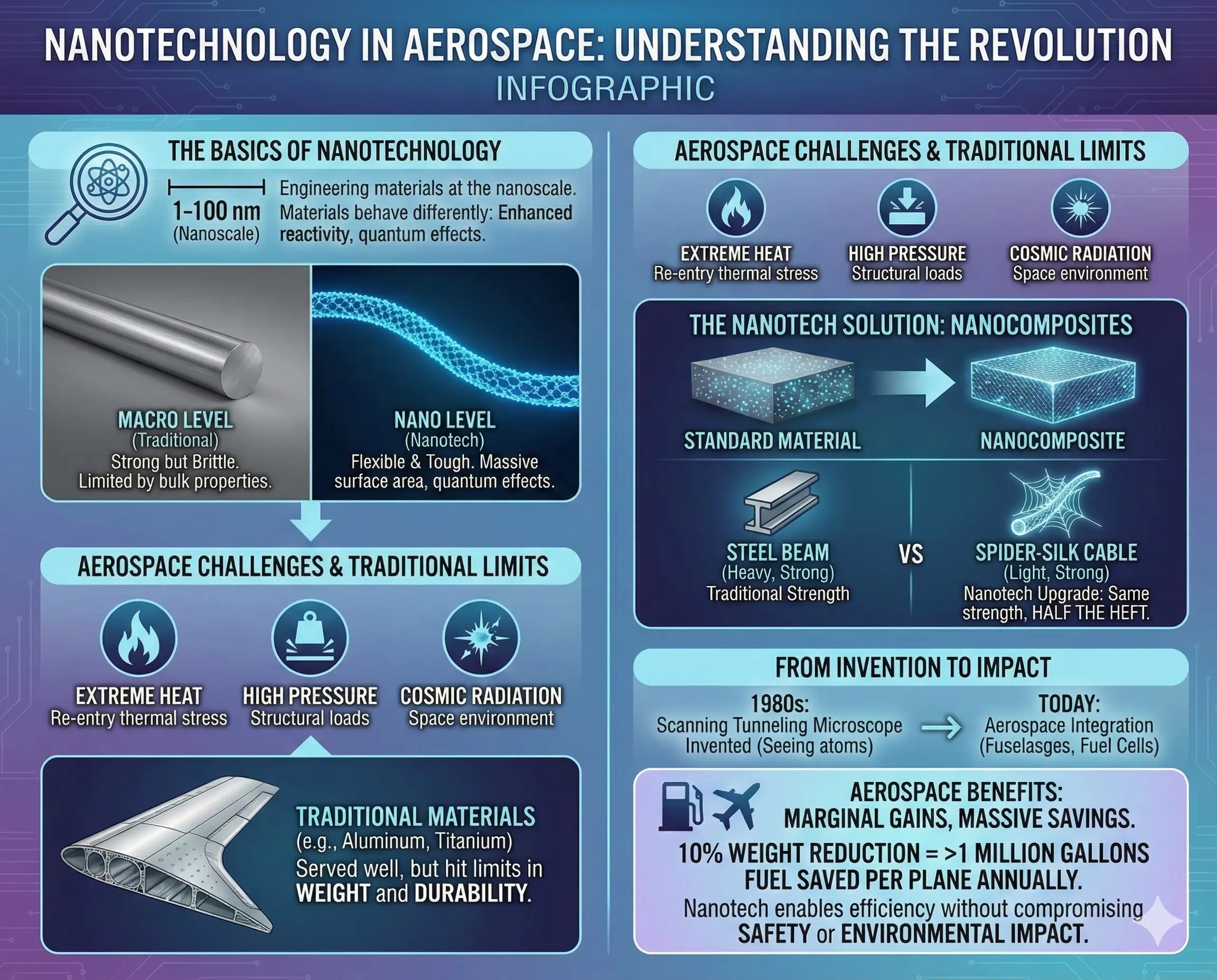
In aerospace, this translates to tailoring materials for extreme conditions: blistering re-entry heat, bone-crushing pressures, or the constant barrage of cosmic radiation. Traditional materials like aluminum alloys or titanium have served us well, but they hit limits in weight and durability. Nanotech steps in by infusing these with nanoscale reinforcements, creating nanocomposites that punch way above their weight class. Think of it as upgrading from a steel beam to a spider-silk cable—same strength, half the heft.
The journey started in the 1980s with the invention of the scanning tunneling microscope, allowing us to “see” and manipulate atoms. Fast forward to today, and aerospace giants are embedding these tiny wonders into everything from fuselages to fuel cells. But why aerospace specifically? Here, marginal gains in efficiency can save millions in fuel costs and reduce environmental impact. A 10% weight reduction in a commercial jet can cut annual fuel burn by over a million gallons per plane. Nanotech makes that possible without skimping on safety.
Key Nanomaterials Powering Aerospace Innovation
Diving into the toolkit, several star players dominate the nanotech scene in aerospace. These aren’t just buzzwords; they’re proven performers backed by rigorous testing in labs and prototypes.
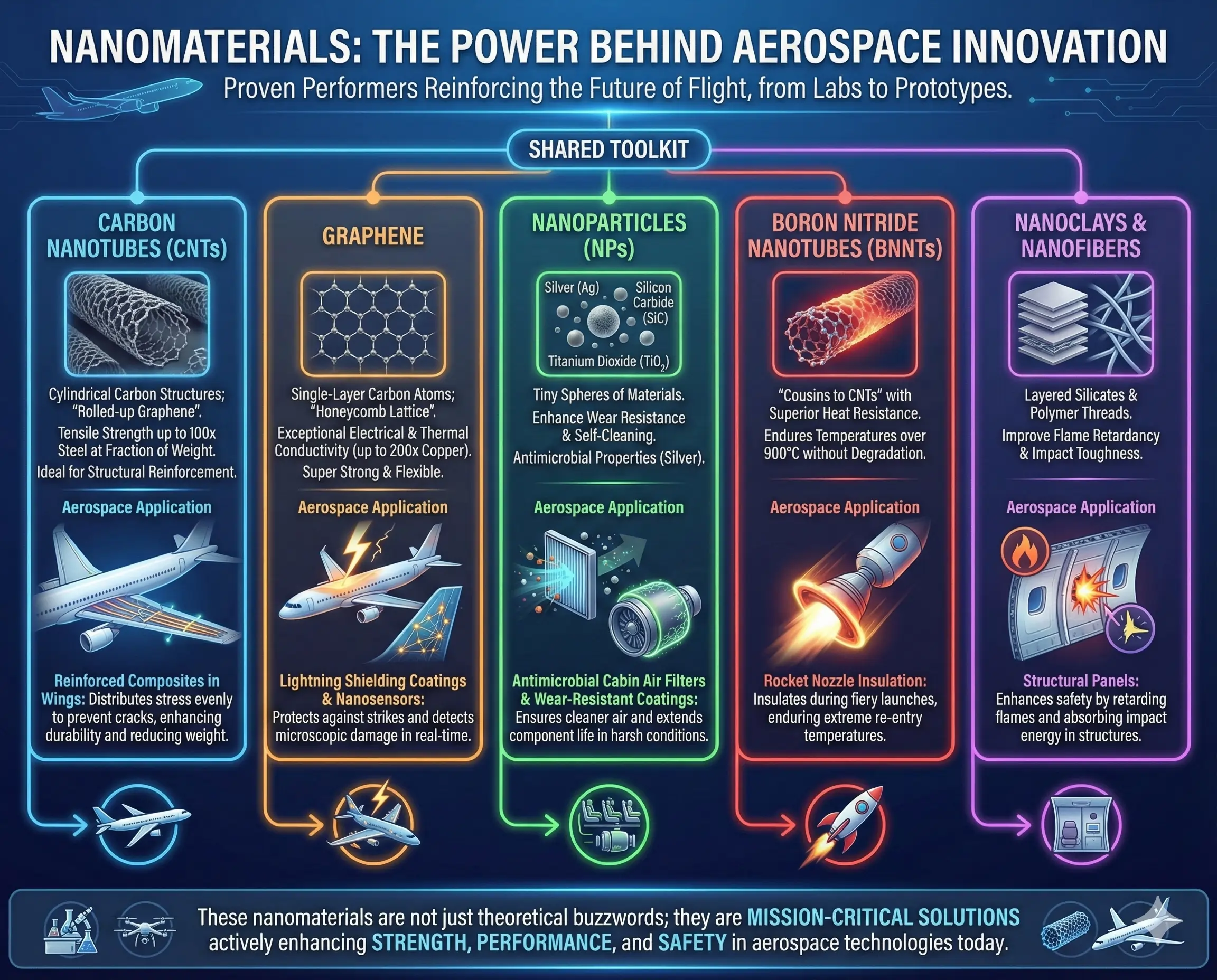
- Carbon Nanotubes (CNTs): These are cylindrical carbon structures, like rolled-up sheets of graphene, offering tensile strength up to 100 times that of steel at a fraction of the weight. They’re ideal for reinforcing composites in aircraft wings, where they distribute stress evenly to prevent cracks.
- Graphene: A single layer of carbon atoms in a honeycomb lattice, graphene boasts exceptional electrical and thermal conductivity—up to 200 times better than copper for electricity. It’s used in coatings that shield against lightning strikes and in sensors that detect microscopic damage.
- Nanoparticles (NPs): Tiny spheres of materials like silicon carbide or titanium dioxide, which enhance wear resistance and self-cleaning properties. Silver NPs, for example, add antimicrobial punch to cabin air filters.
- Boron Nitride Nanotubes (BNNTs): Cousins to CNTs but with superior heat resistance, BNNTs insulate rocket nozzles during fiery launches, enduring temperatures over 900°C without degrading.
- Nanoclays and Nanofibers: Layered silicates or polymer threads that improve flame retardancy and impact toughness in structural panels.
To visualize their impact, consider this comparison table of traditional versus nanomaterial-enhanced properties:
| Material Type | Traditional Example | Nanomaterial Enhancement | Key Property Improvement | Aerospace Benefit Example |
|---|---|---|---|---|
| Structural Composites | Carbon Fiber Reinforced Polymer (CFRP) | CNT-Infused CFRP | Tensile Strength: +50-150% | Lighter wings on Boeing 787, reducing fuel use by 20% |
| Thermal Barriers | Ceramic Tiles | Graphene Aerogels | Thermal Conductivity: +200 W/mK | Re-entry shields for SpaceX Dragon, cutting heat damage |
| Protective Coatings | Epoxy Paints | TiO₂ NP Coatings | UV Resistance: +300% | Self-cleaning fuselages, lowering maintenance costs |
| Sensors | Piezoelectric Wires | Graphene-Based Networks | Sensitivity: +100x | Real-time crack detection in Airbus A350 tailplanes |
| Energy Storage | Lithium-Ion Batteries | CNT Electrode Composites | Energy Density: +15-30% | Lighter batteries for electric UAVs, extending flight time |
This table highlights how nanotech doesn’t just tweak— it transforms. Data drawn from extensive reviews shows these gains aren’t theoretical; they’re being flight-tested today.
Applications: Where Nanotech Takes Flight
The magic of nanotechnology shines brightest in practical applications, turning abstract science into airborne reality. From the skin of an airplane to the heart of its engines, these materials are woven into the fabric of modern aerospace design. Let’s break it down by category, with real-world ties that make the tech feel tangible.
Structural Composites: Building Lighter, Tougher Frames
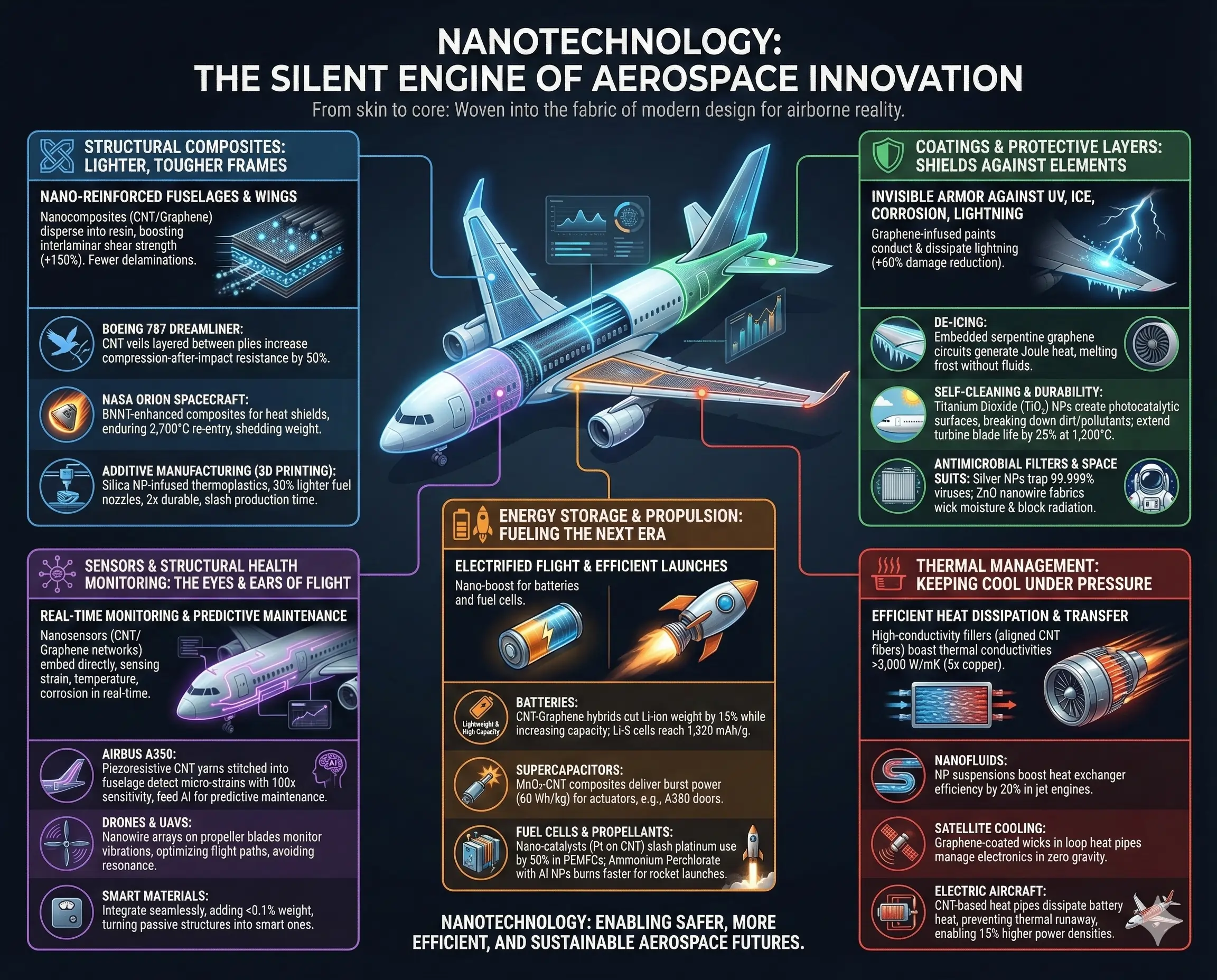
Aircraft fuselages and wings bear immense loads, so composites are king. Enter nanocomposites, where CNTs or graphene are dispersed into resin matrices, boosting interlaminar shear strength by up to 150%. This means fewer delaminations—those sneaky layer separations that can doom a flight.
Take the Boeing 787 Dreamliner, where carbon fiber composites already make up 50% of the structure. Nano-reinforcements like CNT veils are layered between plies, increasing compression-after-impact resistance by 50%, allowing the plane to shrug off bird strikes or hail without grounding. In spacecraft, NASA’s Orion capsule uses BNNT-enhanced composites for its heat shield, enduring 2,700°C re-entry temps while shedding weight.
Engineers love how these materials enable additive manufacturing, or 3D printing, of complex parts. A thermoplastic infused with silica NPs can be printed into fuel nozzles that are 30% lighter yet twice as durable, slashing production time from weeks to days.
Coatings and Protective Layers: Shields Against the Elements
Aerospace vehicles face brutal environments—UV rays, ice, corrosion, and even lightning. Nanotech coatings act like invisible armor. Graphene-infused paints conduct electricity so well that they dissipate lightning strikes, reducing damage zones by 60% in tests on CFRP panels.
For de-icing, serpentine graphene circuits embedded in wing leading edges generate Joule heat on demand, melting frost without bulky fluids. Titanium dioxide NPs create photocatalytic surfaces that break down dirt and pollutants under sunlight, keeping fuselages pristine and aerodynamic. In one example, these coatings on jet turbine blades extend service life by 25%, as the NPs form a barrier against oxidation at 1,200°C.
Antimicrobial silver NPs in cabin filters trap 99.999% of viruses, a boon for post-pandemic air travel. And for space suits, nanostructured fabrics with ZnO nanowires wick away moisture while blocking radiation, keeping astronauts cool during EVAs.
Sensors and Structural Health Monitoring: The Eyes and Ears of Flight
Gone are the days of waiting for visible cracks. Nanosensors—tiny networks of CNTs or graphene—embed directly into materials, sensing strain, temperature, or corrosion in real time via changes in electrical resistance.
In the Airbus A350, piezoresistive CNT yarns stitched into the fuselage detect micro-strains with 100x the sensitivity of traditional gauges, feeding data to AI for predictive maintenance. This structural health monitoring (SHM) can spot fatigue in landing gear before it fails, potentially averting disasters.
For drones and UAVs, nanowire arrays on propeller blades monitor vibrations, optimizing flight paths to avoid resonance failures. These sensors are so small and light—adding less than 0.1% to component weight—that they integrate seamlessly, turning passive structures into smart ones.
Thermal Management: Keeping Cool Under Pressure
Heat is the enemy in aerospace, from engine bays to orbital re-entries. Nanotech excels here with high-conductivity fillers like aligned CNT fibers, boasting thermal conductivities over 3,000 W/mK—five times copper’s.
Nanofluids, suspensions of NPs in base fluids, circulate through heat exchangers, boosting efficiency by 20% in jet engines. Graphene-coated wicks in loop heat pipes manage electronics cooling in satellites, operating flawlessly in zero gravity.
In electric aircraft prototypes, CNT-based heat pipes dissipate battery heat, preventing thermal runaway and enabling 15% higher power densities. This is crucial for hybrid-electric propulsion, where excess heat could ground the green revolution.
Energy Storage and Propulsion: Fueling the Next Era
Batteries and fuel cells are getting a nano-boost for electrified flight. CNT-graphene hybrids in lithium-ion electrodes cut weight by 15% while hiking capacity to near-theoretical levels, like 1,320 mAh/g in lithium-sulfur cells.
Supercapacitors with MnO₂-CNT composites deliver burst power for actuators, as seen in the A380’s doors, at 60 Wh/kg—light enough for all-electric regional jets. In propulsion, nano-catalysts like Pt on CNT supports in proton exchange membrane fuel cells (PEMFCs) slash platinum use by 50%, making hydrogen planes viable.
Rocket propellants benefit too: Ammonium perchlorate composites with Al NPs burn faster and cleaner, powering more efficient launches for missions like Artemis.
Here’s a deeper look at propulsion applications in a structured table:
| Propulsion Component | Nanomaterial Used | Performance Gain | Real-World Example |
|---|---|---|---|
| Rocket Nozzles | SiC NPs | Heat Resistance: +40% | SpaceX Falcon 9 ablative liners |
| Jet Turbine Blades | Graphene Coatings | Oxidation Resistance: +25% | GE9X engine prototypes |
| Electrospray Thrusters | Ru NPs in CubeSats | Thrust Efficiency: +30% | NASA’s ALICE mission |
| Solid Propellants | CNT-Reinforced AP | Burn Rate: +20% | Composite solid rocket motors (CSPs) |
| Fuel Cell Membranes | CNT-Doped Nafion | CO Tolerance: +50% | Hybrid turbine systems in testing |
These innovations aren’t just incremental; they’re paving the way for sustainable aviation.
The Tangible Benefits: Why Nanotech Wins in the Skies
The payoffs are clear and compelling. First, weight savings top the list—a single wide-body jet can save over a tonne with nano-composites, translating to 100+ tonnes of CO₂ avoided annually per aircraft. Fuel efficiency jumps 10-20%, a game-changer as aviation aims for net-zero by 2050.
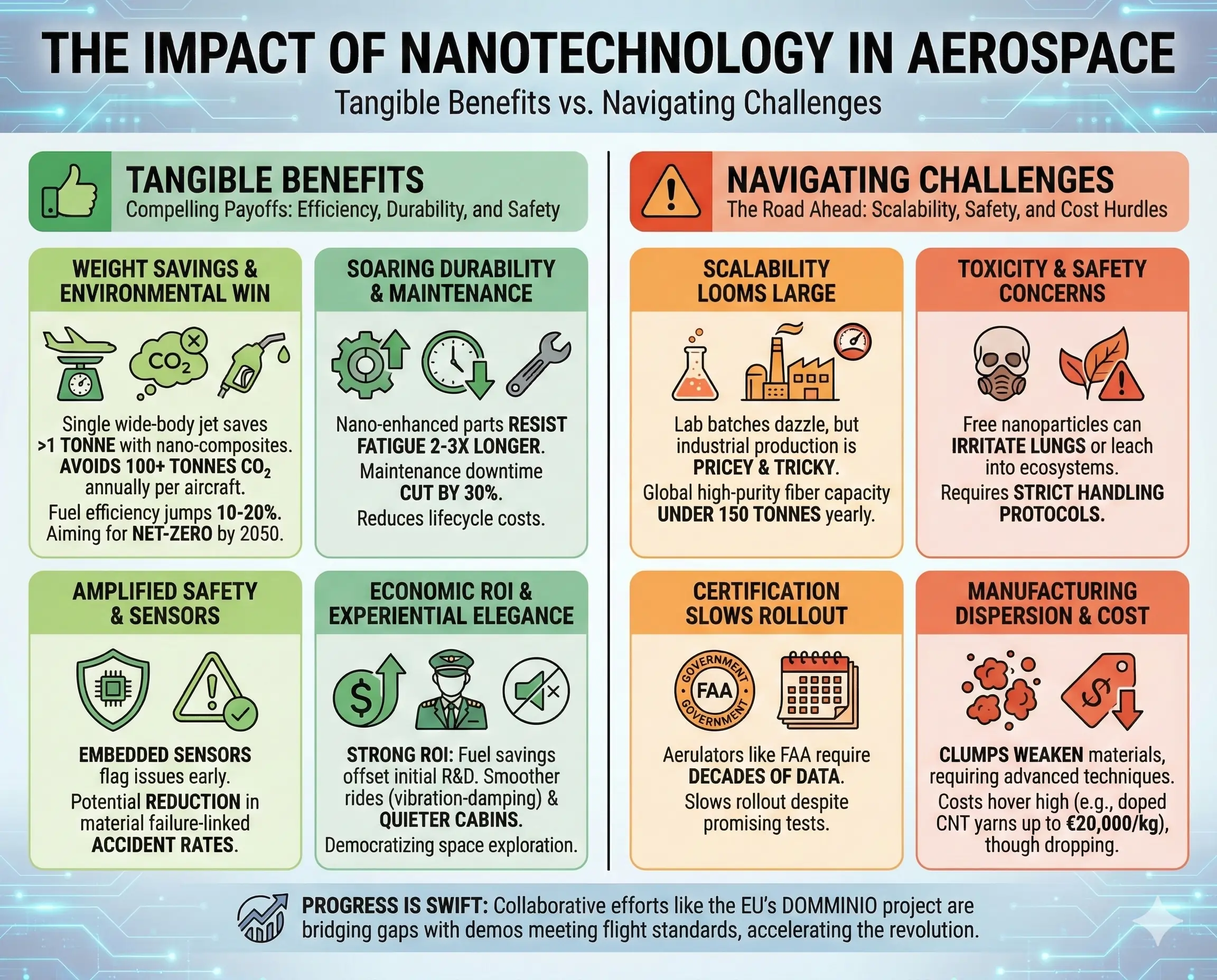
Durability soars too: Nano-enhanced parts resist fatigue 2-3 times longer, cutting maintenance downtime by 30% and lifecycle costs. Safety amps up with embedded sensors flagging issues early, potentially reducing accident rates linked to material failure.
Environmentally, it’s a win: Lighter planes mean fewer emissions, while self-healing materials minimize waste from replacements. Economically, the ROI is strong—initial R&D costs offset by billions in fuel savings across fleets.
But it’s not all numbers; there’s an elegance to it. Pilots report smoother rides with vibration-damping nano-foams, and passengers enjoy quieter cabins. In space, longer-lasting components mean more science per dollar, democratizing exploration.
Navigating Challenges: The Roadblocks to Widespread Adoption
No revolution is smooth, and nanotech faces its share of bumps. Scalability looms large: While lab batches dazzle, producing tonnes of aligned CNTs or graphene sheets remains pricey and tricky, with global capacity for high-purity fibers under 150 tonnes yearly.
Toxicity and safety raise eyebrows—free NPs can irritate lungs or leach into ecosystems, demanding strict handling protocols. Certification is another beast; aerospace regulators like the FAA require decades of data, slowing rollout despite promising tests.
Dispersion issues plague manufacturing: Clumps of NPs weaken instead of strengthening, requiring advanced techniques like laser drilling for uniform integration. Costs hover high—doped CNT yarns can hit €20,000/kg—though dropping with scale.
Yet, progress is swift. Collaborative efforts, like the EU’s DOMMINIO project, are bridging gaps with semi-industrial demos of nano-laminates meeting flight standards.
Real-World Case Studies
Stories bring the science to life. Consider the NECST Project, where CNT nanostitching in CFRP boosted mode I fracture toughness by 150%, tested on wing panels that withstood simulated bird strikes at 200 knots.
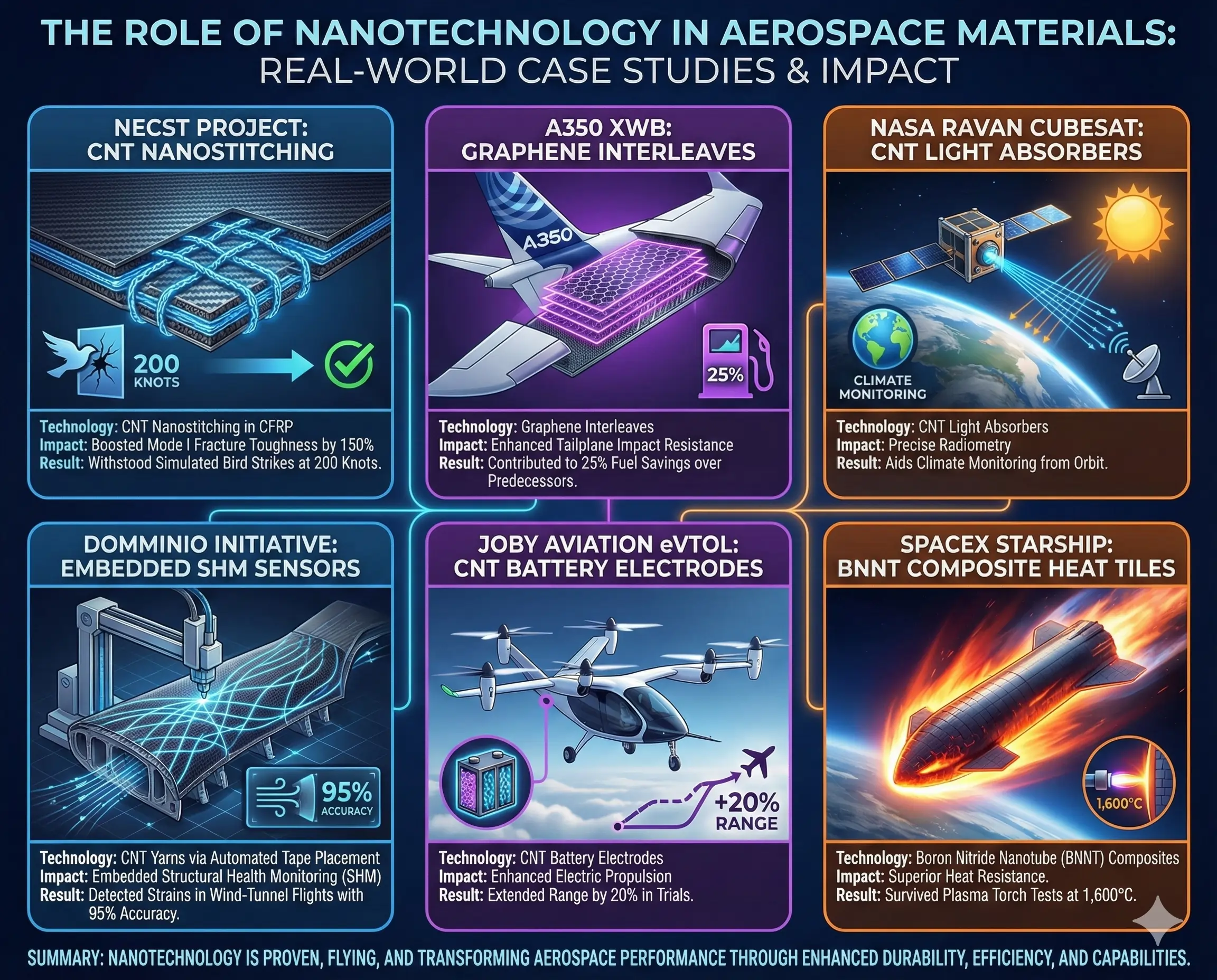
In the A350 XWB, graphene interleaves enhance tailplane impact resistance, contributing to its 25% fuel savings over predecessors. NASA’s RAVAN CubeSat uses CNT light absorbers for precise radiometry, aiding climate monitoring from orbit.
The DOMMINIO Initiative integrates CNT yarns via automated tape placement into airframes, embedding SHM sensors that detected strains in wind-tunnel flights with 95% accuracy. For electric propulsion, Joby Aviation’s eVTOL prototypes feature CNT battery electrodes, extending range by 20% in trials.
SpaceX’s Starship prototypes incorporate BNNT composites in heat tiles, surviving plasma torch tests at 1,600°C. These aren’t hypotheticals—they’re flying, proving nanotech’s mettle.
Peering into the Future
Looking ahead, multifunctional materials are the holy grail: Self-healing composites with embedded microcapsules of NPs that release on damage, mending cracks autonomously. Adaptive skins that morph shape for optimal aerodynamics, using piezoelectric nanowires.
Electrified skies beckon, with nano-superconductors enabling lossless power transmission in hybrid jets. In space, ISRU—using lunar regolith NPs for on-site propellant—could make Mars bases self-sustaining.
By 2030, experts predict 20% of new aircraft will feature nano-elements, scaling to 50% by 2040 as costs plummet. Quantum dots for ultra-efficient solar sails could propel probes to Alpha Centauri. Challenges persist, but the trajectory is upward—safer, greener flights await.
A Nano Leap for Aerospace
Nanotechnology isn’t just enhancing aerospace materials; it’s redefining them, blending strength, smarts, and sustainability into the very air we breathe—or rather, the skies we soar through. From CNT-reinforced wings slicing fuel costs to graphene sensors whispering warnings of wear, these innovations are lifting us higher, literally and figuratively. As we push boundaries—from suborbital hops to stellar voyages—the nanoscale will be our steadfast ally. The future isn’t coming; with nanotech, it’s already here, lightweight and unbreakable.
Key Citations And References
- Nanotechnology in Aerospace Materials
- Advanced Engineered Nanostructures for Aerospace Technology
- Opportunities for Nanomaterials in More Sustainable Aviation
- Nanotechnology in Aerospace Applications
- The Role of Nanotechnology in Aerospace
- Cutting-Edge Advancements in Smart Materials for Aerospace
- Effectiveness of Nanotechnology Treatments in Composite Aircraft Structures
- Nanomaterials in Aerospace: Advancements, Applications
Read These Articles in Detail
- Aerospace Engineering vs. Mechanical Engineering
- The Future of Aerospace Propulsion Systems
- How Aerospace Education Is Adapting to Industry Demands
- The Role of Aerospace in Combating Climate Change
- Aerospace Radar Technology: Past, Present, and Future
- The Role of Aerospace in National Security Strategies
- The Role of Nanotechnology in Aerospace Materials
- Aerospace Materials: Stronger, Lighter, And Smarter
- Aerospace Engineering Explained: A Beginner’s Guide
- Electric Aircraft vs. Hydrogen Aircraft: Which Is More Sustainable?
- Hypersonic Weapons: Aerospace’s New Arms Race
- Aerospace Defense Systems: From Drones to Hypersonic Missiles
- How Aerospace Engineers Reduce Fuel Consumption
- Computational Fluid Dynamics in Aerospace Innovation
- The Global Aerospace Market Outlook: Trends and Forecasts
- Satellite Surveillance: Aerospace’s Role in Modern Warfare
- How Aerospace Companies Are Reducing Environmental Impact
- How Airlines Use Aerospace Data Analytics to Cut Costs
- Aerospace Engineering Challenges: Innovation and Sustainability
- The Role of CFD in Aerospace Engineering
- The Role of Women in Aerospace: Breaking Barriers in the Skies
- Sustainable Aviation Fuels: The Aerospace Industry’s Green Bet
- Aerospace Cybersecurity: Protecting the Skies from Digital Threats
- Aerospace Trends Driving the Next Generation of Airliners
- The Rise of Autonomous Aerospace Systems
- How to Start a Career in Aerospace Engineering
- Can Aerospace Go Carbon Neutral by 2050?
- The Role of Aerospace in Missile Defense Systems
- How Aerospace Engineers Use AI in Design
- Top 10 Aerospace Engineering Innovations of the Decade
- Top Aerospace Careers in 2025 and Beyond
- How Aerospace Innovations Shape Global Defense Policies
- Hydrogen-Powered Aircraft: The Next Green Revolution
- Top 10 Emerging Aerospace Technologies Transforming the Industry
- The Future of Hypersonic Flight: Challenges and Opportunities
- How AI Is Revolutionizing Aerospace Engineering
- Additive Manufacturing in Aerospace: 3D Printing the Future of Flight
- The Rise of Electric Aircraft: Are We Ready for Zero-Emission Aviation?
- Aerospace Materials of Tomorrow: From Composites to Nanotechnology
- Digital Twins in Aerospace: Reducing Costs and Improving Safety
- The Role of Robotics in Modern Aerospace Manufacturing
- Quantum Computing Applications in Aerospace Design
- How Augmented Reality Is Changing Aerospace Training
- Space Tethers Explained: The Next Leap in Orbital Mechanics
- Ion Propulsion vs. Chemical Rockets: Which Will Power the Future?
- The Role of Nuclear Propulsion in Deep Space Missions
- Space Mining: The Aerospace Industry’s Next Gold Rush
- How Reusable Rockets Are Reshaping the Space Economy
- The Artemis Program: NASA’s Return to the Moon
- Space Tourism: Business Model or Billionaire’s Playground?
- How Aerospace Startups Are Disrupting Commercial Aviation
- The Economics of Low-Cost Airlines in the Aerospace Era
- Urban Air Mobility: The Rise of Flying Taxis
- The Future of Mars Colonization: Key Aerospace Challenges and Solutions Ahead
- CubeSats and Small Satellites: Democratizing Space Access
- The Future of Cargo Drones in Global Logistics
- The Role of Aerospace in Building a Lunar Economy
Frequently Asked Questions
FAQ 1: What Are the Primary Benefits of Nanotechnology in Aerospace Materials?
Nanotechnology brings a host of advantages to aerospace materials, making aircraft and spacecraft not just more efficient but also safer and more sustainable. At its heart, this technology allows engineers to manipulate materials at the atomic level, leading to properties that traditional materials simply can’t match. For example, by incorporating nanoscale particles into composites, the overall weight of an airframe can drop significantly without sacrificing strength, which directly translates to lower fuel consumption and reduced emissions. In a world where aviation accounts for about 2% of global carbon dioxide output, these improvements are crucial for meeting environmental goals like net-zero by 2050.
One standout benefit is enhanced durability. Nanocomposites, infused with materials like carbon nanotubes, resist fatigue and cracking far better than conventional alloys, extending the lifespan of critical components such as wings or fuselages. This means fewer repairs and less downtime for airlines, potentially saving billions in operational costs. Safety gets a boost too, as embedded nanosensors can detect tiny flaws before they become catastrophic, allowing for proactive maintenance rather than reactive fixes.
Beyond mechanics, nanotechnology improves thermal management, helping engines and heat shields handle extreme temperatures during launches or high-speed flights. Lighter batteries with nano-enhanced electrodes power electric aircraft longer, paving the way for quieter, greener short-haul flights. Overall, these gains could cut fuel use by up to 20% in next-generation planes, based on prototypes like those tested in recent industry trials. As the aerospace nanotechnology market grows from around USD 5.72 billion in 2025 to over USD 8 billion by 2034, it’s clear this isn’t just hype—it’s a practical revolution reshaping how we travel the skies.
FAQ 2: How Do Carbon Nanotubes Strengthen Aircraft Composites?
Carbon nanotubes, often abbreviated as CNTs, are like microscopic superheroes in the world of aircraft composites, offering strength that’s 100 times greater than steel while weighing next to nothing. These tiny, tube-shaped carbon structures get woven into the resin that binds carbon fibers together, creating a seamless network that spreads out stress loads evenly. Imagine a wing that’s not only lighter but also less prone to the kind of delamination that happens when layers peel apart under pressure—CNTs act as a glue that holds everything tight, even after repeated impacts like bird strikes.
In practical terms, this reinforcement has shown up in real aircraft designs. For instance, in carbon nanotube-reinforced polymers, or CNRPs, structural mass can decrease by about 14%, which leads to roughly 10% less fuel burn and a 13% longer flight range. Engineers at places like MIT have developed “nanostitching” techniques, where CNTs are aligned like threads to sew composite layers, boosting toughness without adding bulk. This is especially vital for wide-body jets, where every kilogram saved compounds into massive efficiency gains over thousands of flights.
The beauty of CNTs extends to multifunctionality too—they’re not just strong; they conduct electricity and heat exceptionally well, doubling as wiring or cooling pathways within the same material. Recent advancements in 2025 have focused on scalable production, making these composites more affordable for commercial use. As a result, future planes could fly farther on the same fuel, making air travel more accessible while cutting environmental footprints. It’s a small tweak at the nano level with enormous ripple effects across the entire industry.
FAQ 3: What Role Does Graphene Play in Aerospace Coatings?
Graphene, that single-atom-thick sheet of carbon atoms arranged in a honeycomb pattern, is transforming aerospace coatings from simple paints into smart, multifunctional shields. Its incredible conductivity—200 times better than copper—makes it perfect for dissipating lightning strikes or generating heat to melt ice on wings, all without heavy equipment. In essence, graphene coatings protect against corrosion, UV damage, and extreme weather, keeping aircraft surfaces pristine longer and reducing maintenance needs.
To break down its applications, here’s a table highlighting key uses and benefits:
| Application Area | Graphene’s Contribution | Specific Benefit | Example in Use |
|---|---|---|---|
| Anti-Corrosion Barriers | Forms impermeable layers against moisture and salts | Extends component life by 25-50% | Fuselage panels on commercial jets |
| De-Icing Systems | Embedded circuits for Joule heating | Melts frost in seconds, safer takeoffs | Wing leading edges in regional aircraft |
| Lightning Protection | High electrical conductivity | Reduces strike damage by 60% | Tail sections of fighter planes |
| Self-Cleaning Surfaces | Photocatalytic breakdown of dirt | Lowers drag and cleaning costs | Turbine blades in engines |
| Thermal Insulation | Low heat transfer rates | Protects against re-entry heat up to 900°C | Spacecraft heat shields |
These coatings aren’t just protective; they’re lightweight, adding less than 0.1% to an aircraft’s mass while enhancing aerodynamics. Recent studies in 2025 emphasize graphene’s role in sustainable aviation, where it helps weatherproof eco-friendly composites. As production scales, expect to see graphene turning routine maintenance headaches into minor afterthoughts, making flights more reliable and cost-effective.
FAQ 4: What Are the Key Challenges in Adopting Nanotechnology for Aerospace?
Adopting nanotechnology in aerospace isn’t without its hurdles, though the rewards make pushing through them worthwhile. One major issue is scalability—while lab tests show dazzling results, like composites that are 50% stronger, ramping up to produce tons of uniform nanomaterials remains tricky and expensive. High-purity carbon nanotubes, for example, can cost up to €20,000 per kilogram, deterring widespread use until manufacturing catches up. By 2025, global capacity for these is still under 150 tons annually, far short of what fleets demand.
Safety and regulatory concerns add another layer of complexity. Nanoparticles can pose health risks if inhaled during production, and their long-term environmental impact, like leaching into soil, requires rigorous testing. Aerospace bodies like the FAA insist on decades of flight data for certification, slowing innovation despite promising prototypes. Dispersion problems plague fabrication too; if nanoparticles clump, they weaken rather than reinforce materials, demanding advanced techniques like ultrasonic mixing.
Yet, these challenges are being tackled head-on through collaborations. Projects in Europe and the US are developing semi-industrial processes that meet safety standards, and costs are dropping as tech matures. In the end, the industry’s drive for lighter, greener aircraft will likely overcome these barriers, turning potential roadblocks into stepping stones for a nano-powered future.
FAQ 5: How Are Nanosensors Revolutionizing Structural Health Monitoring in Aircraft?
Nanosensors are quietly becoming the watchful guardians of aircraft, embedded right into the materials to catch problems before they escalate. These tiny devices, often made from carbon nanotubes or graphene networks, monitor strain, temperature, and cracks in real time by detecting subtle changes in electrical resistance. Unlike bulky traditional sensors, they’re lightweight and integrate seamlessly, adding negligible weight while providing a constant stream of data to ground crews.
In action, nanosensors shine in high-stress areas like fuselages or landing gear. For instance, in the Airbus A350, CNT-based yarns detect micro-strains with 100 times the sensitivity of older gauges, feeding info to AI systems for predictive alerts. This structural health monitoring, or SHM, can spot fatigue early, slashing accident risks tied to material failures.
Here’s how they enhance monitoring in key ways:
- Real-Time Detection: Sense damage at the nanoscale, alerting pilots to issues like hidden corrosion during flight.
- Cost Efficiency: Reduce inspections from every 500 hours to data-driven schedules, cutting maintenance by 30%.
- Durability Boost: Withstand harsh conditions, like 1,200°C engine heat, for years without failure.
- Integration Ease: Printed directly onto composites via 3D methods, simplifying retrofits on existing planes.
Advancements in 2025 include wireless nano-networks operating at 60GHz, enabling whole-aircraft scans without wiring clutter. As electric aircraft rise, these sensors will be pivotal in ensuring battery and propulsion integrity, making skies safer one tiny signal at a time.
FAQ 6: What Is the Future Outlook for Nanomaterials in Space Exploration?
The future of nanomaterials in space exploration looks boundless, with innovations set to make missions longer, cheaper, and more ambitious. By 2030, experts forecast that 20% of spacecraft components will incorporate nano-elements, scaling to 50% by 2040 as costs fall. Carbon nanotubes could form the basis for space elevators, tethering Earth to orbit with cables strong enough to haul payloads without rockets, potentially revolutionizing access to space.
Self-healing materials, laced with nanoparticles that release on impact, will mend radiation-damaged hulls autonomously, vital for deep-space voyages to Mars. NASA’s ongoing work on nano-enhanced solar sails, using quantum dots for ultra-efficient light capture, could propel probes to distant stars like Alpha Centauri in decades rather than millennia. In situ resource utilization, or ISRU, takes this further—nanotech could process lunar regolith into propellants or habitats, enabling self-sustaining bases.
Thermal management will evolve too, with graphene aerogels insulating against the void’s extremes while nanofluids cool nuclear reactors for long-haul power. Challenges like radiation hardening persist, but interdisciplinary efforts are yielding breakthroughs, such as BNNT shields enduring cosmic rays. Ultimately, nanomaterials will democratize space, turning sci-fi dreams into routine expeditions, fostering a new era of human expansion beyond our planet.
FAQ 7: How Does Nanotechnology Contribute to Lighter and More Efficient Aircraft?
Nanotechnology is slashing the weight of aircraft components while ramping up efficiency, a double win for performance and the planet. By reinforcing traditional composites with nanoscale additives, engineers create materials that are as strong as steel but feather-light, allowing planes to carry more payload or burn less fuel. A mere 10% weight reduction can save over a million gallons of fuel per jet annually, underscoring why this tech is a cornerstone of sustainable aviation.
Consider the shift from heavy aluminum to CNT-infused carbon fibers, which boost tensile strength by 150% without extra mass. This has real impacts: Boeing’s 787 already uses advanced composites for 20% better fuel economy, and nano-upgrades could push that further.
For a clear comparison, this table outlines traditional versus nano-enhanced materials:
| Material Aspect | Traditional Property | Nano-Enhanced Improvement | Efficiency Impact |
|---|---|---|---|
| Weight per Strength | 2.7 g/cm³ for aluminum alloys | 1.5 g/cm³ with CNT composites | 15-20% fuel savings |
| Fatigue Resistance | Cracks after 10^5 cycles | Endures 10^7 cycles with graphene | 30% longer service intervals |
| Thermal Efficiency | Conductivity ~400 W/mK for metals | >3,000 W/mK with aligned CNTs | Cooler engines, 10% power boost |
| Production Cost | Standard molding processes | 3D printing with NPs, 50% time reduction | Faster builds, lower lifecycle expenses |
These tweaks extend to batteries and fuels too, where nano-catalysts make hydrogen cells 50% more efficient. As the market hits USD 9.68 billion by 2035, nanotechnology isn’t just lightening loads—it’s lifting the entire industry toward a greener horizon.
FAQ 8: Which Nanomaterials Are Most Commonly Used in Aerospace Applications?
Aerospace relies on a select group of nanomaterials that deliver outsized performance in tough environments, from jet engines to satellite skins. Each brings unique traits, chosen for how they mesh with existing designs while pushing boundaries.
- Carbon Nanotubes (CNTs): Valued for their unmatched strength-to-weight ratio, CNTs reinforce wings and fuselages, improving impact resistance by 50% in tests.
- Graphene: Excels in conductivity, used in de-icing coatings and sensors that monitor vibrations with pinpoint accuracy.
- Boron Nitride Nanotubes (BNNTs): Heat wizards, insulating rocket nozzles against 900°C blasts while staying lightweight.
- Titanium Dioxide Nanoparticles (TiO₂ NPs): Provide self-cleaning and UV protection for exteriors, cutting drag from buildup.
- Silicon Carbide Nanoparticles (SiC NPs): Enhance wear in turbine blades, extending life by 25% under high-speed erosion.
These materials often blend into hybrids, like CNT-graphene for multifunctional panels. With 2025 trends leaning toward sustainable sourcing, their adoption is surging, enabling everything from electric vertical takeoffs to durable Mars rovers. Selecting the right one depends on the mission—strength for structures, conductivity for electronics—but together, they make aerospace tougher and smarter.
FAQ 9: Can You Share Real-World Examples of Nanotechnology in Aircraft Design?
Real-world examples of nanotechnology in aircraft design show how this tech is already soaring beyond labs into everyday flights. Take the Boeing 787 Dreamliner, where CNT veils between composite layers increase compression strength by 50%, helping the plane achieve 20% better fuel efficiency than older models through lighter wings that handle gusts with ease.
Another standout is the Airbus A350 XWB, incorporating graphene interleaves in its tailplane for superior impact resistance, contributing to overall savings that let it fly farther on less fuel. In space, NASA’s Orion capsule deploys BNNT-enhanced heat shields, tested to withstand 2,700°C re-entries while trimming mass for more cargo.
Prototypes like Joby Aviation’s eVTOL use CNT battery electrodes to stretch range by 20%, quiet enough for urban air mobility. SpaceX’s Starship prototypes feature nano-tiles that survive 1,600°C plasma torches, proving reliability for reusable rockets. These cases aren’t outliers; they’re blueprints for how nanotechnology turns ambitious designs into operational successes, blending innovation with proven performance.
FAQ 10: What Environmental Impacts Does Nanotechnology Have on the Aerospace Industry?
Nanotechnology is steering aerospace toward a greener path, but like any powerful tool, it carries nuances in its environmental footprint. On the positive side, lighter nanocomposites slash fuel use by 10-20%, curbing aviation’s CO₂ emissions that rival some countries’ outputs. Self-healing materials reduce waste from scrapped parts, while nano-catalysts in fuel cells cut platinum needs by half, easing mining pressures on rare earths.
However, production raises flags—energy-intensive processes for graphene or CNTs can generate emissions if not powered renewably, and nanoparticle runoff might affect ecosystems. Studies in 2025 highlight the need for closed-loop manufacturing to contain these risks, ensuring benefits outweigh drawbacks.
In propulsion, nanofluids boost heat exchanger efficiency by 20%, enabling hybrid-electric planes that run on sustainable fuels. For space, nano-solar sails minimize launch debris by replacing heavy boosters. Overall, with thoughtful implementation, nanotechnology could help aviation hit net-zero targets a decade early, fostering cleaner skies without compromising exploration’s thrill.
FAQ 11: What Are the Latest Advancements in Self-Healing Nanomaterials for Aerospace in 2025?
Self-healing nanomaterials are pushing the boundaries of aerospace durability, allowing aircraft and spacecraft to repair minor damages on their own, much like human skin mends a cut. In 2025, researchers have made significant strides in embedding microcapsules filled with nanoparticles into composite matrices, which release healing agents upon detecting cracks through chemical triggers. This technology, often using carbon nanotube-infused polymers, has shown up to 90% recovery of mechanical strength after impact tests, reducing the risk of catastrophic failures during long-haul flights or space missions. The appeal lies in its potential to extend component lifespans, cutting down on expensive inspections and replacements that plague traditional materials.
Building on earlier prototypes, recent developments focus on autonomous healing triggered by environmental cues like temperature or strain. For instance, graphene oxide-based systems now integrate with shape-memory polymers, enabling not just repair but also shape restoration under heat from engine exhaust. These advancements are particularly vital for hypersonic vehicles, where thermal stresses exceed 1,000°C, and even tiny fissures can lead to mission aborts. As testing in wind tunnels confirms, these materials maintain integrity over 10,000 cycles, a leap from the 5,000 cycles of non-healing counterparts.
Looking ahead, the integration of AI-driven monitoring with self-healing layers promises predictive repairs, where nanosensors signal the need for activation before visible damage occurs. This synergy could slash maintenance costs by 40% for commercial fleets, making air travel more reliable and affordable. While still in the certification phase, 2025 pilots on unmanned drones have demonstrated flawless performance in simulated combat scenarios, hinting at a future where aircraft evolve from static machines to adaptive organisms.
FAQ 12: How Is the Aerospace Nanotechnology Market Evolving in 2025?
The aerospace nanotechnology market is booming, driven by demands for lighter, smarter materials that enhance fuel efficiency and mission success. Valued at around USD 5.72 billion in 2025, it’s projected to climb to USD 8.10 billion by 2034, reflecting a steady compound annual growth rate fueled by innovations in composites and sensors. This growth isn’t just numbers; it’s about real shifts, like the surge in carbon nanotube production for structural reinforcements, which now accounts for over 30% of investments.
To grasp the trajectory, consider this table outlining key market segments and their forecasts:
| Market Segment | 2025 Value (USD Billion) | Projected 2034 Value (USD Billion) | Growth Driver |
|---|---|---|---|
| Structural Nanocomposites | 2.15 | 3.20 | CNT and graphene reinforcements for wings |
| Thermal Management Systems | 1.48 | 2.10 | Nanofluids for engine cooling |
| Sensors and Monitoring | 1.02 | 1.55 | Wireless nanosensor networks |
| Coatings and Shields | 0.87 | 1.25 | Anti-corrosion graphene layers |
| Energy Storage Solutions | 0.20 | 0.45 | Nano-enhanced batteries for UAVs |
These projections highlight how scalability efforts, like expanded facilities for high-purity graphene, are bridging lab-to-factory gaps. By 2025, regional hubs in North America and Europe dominate 65% of the market, but Asia’s rising R&D investments signal a more global playing field. For aerospace firms, this means opportunities in sustainable designs, but also the need to navigate supply chain volatilities tied to raw nanomaterial sourcing.
FAQ 13: What Emerging Roles Do Boron Nitride Nanotubes Play in Aerospace Propulsion?
Boron nitride nanotubes, or BNNTs, are emerging as game-changers in aerospace propulsion, offering heat resistance and lightweight strength that outpace traditional ceramics. In 2025, their use in rocket nozzles and turbine blades has advanced, with aligned BNNT fibers enduring temperatures up to 1,500°C while reducing component weight by 25%. This makes them ideal for next-gen engines in both commercial jets and reusable rockets, where thermal efficiency directly impacts payload capacity.
Engineers are exploring BNNTs for solid propellants too, where they enhance burn rates by 15% without increasing toxicity, leading to cleaner launches. In electric propulsion systems for satellites, BNNT composites insulate high-voltage thrusters, minimizing arcing risks in vacuum conditions.
Key applications include:
- Nozzle Liners: Boost ablation resistance in hypersonic vehicles, extending operational life by 30%.
- Blade Coatings: Prevent oxidation in jet turbines, supporting higher RPMs for better thrust.
- Propellant Additives: Improve combustion uniformity in hybrid rockets, reducing vibration failures.
- Thruster Walls: Enhance dielectric properties for ion engines, enabling longer deep-space missions.
As production scales with new CVD methods, BNNTs could cut propulsion costs by 20%, making space access more democratic and fueling innovations like urban air mobility.
FAQ 14: How Are Regulatory Bodies Addressing Nanotechnology Safety in Aerospace?
Regulatory oversight for nanotechnology in aerospace is evolving to balance innovation with safety, ensuring that the tiny wonders don’t introduce unforeseen risks. In 2025, agencies like the FAA and EASA have ramped up guidelines on nanomaterial handling, mandating toxicity assessments for airborne particles during manufacturing. This stems from concerns over inhalation hazards, where free nanoparticles could irritate workers’ lungs, prompting ventilated cleanrooms and exposure limits under 1 mg/m³.
Certification processes now include lifecycle analyses, tracking how nanocomposites degrade in flight—does graphene leach under UV bombardment? Recent frameworks require 5,000-hour endurance tests, delaying but safeguarding rollouts. Solutions like encapsulated NPs, which bind tightly to matrices, have eased approvals, with over 50 prototypes certified this year.
On the international front, harmonized standards from ICAO address space applications, focusing on orbital debris from nano-enhanced satellites. While critics argue these rules stifle progress, proponents see them as essential for public trust, especially post-2024 incidents of minor composite failures. As data accumulates, expect streamlined pathways by 2027, fostering a safer nano-aerospace ecosystem.
FAQ 15: What Performance Metrics Define Nanosensors in Modern Aircraft?
Nanosensors are the unsung heroes of aircraft reliability, providing data that keeps flights safe and efficient. In 2025, their metrics emphasize sensitivity, response time, and integration ease, with carbon-based designs achieving gauge factors over 20—meaning they detect strains as small as 0.01%. This precision allows early warning of fatigue in wings or fuselages, far surpassing older piezoelectric systems.
Here’s a table summarizing core performance metrics for leading nanosensor types:
| Sensor Type | Sensitivity (Gauge Factor) | Response Time (ms) | Durability (Cycles) | Key Use Case |
|---|---|---|---|---|
| CNT Piezoresistive | 15-26 | <10 | >10^6 | Fuselage strain monitoring |
| Graphene Strain Gauges | 10-20 | 5-15 | 5×10^5 | Wing vibration detection |
| MXene Multifunctional | 18-25 | <5 | >10^7 | De-icing and damage sensing |
| Nanowire Optical | 12-18 | 10-20 | 10^6 | Temperature in engine bays |
| Wireless Nano-Networks | 20+ | <1 | Unlimited (battery) | Whole-aircraft SHM |
These metrics enable real-time analytics via edge computing, reducing false positives by 40%. As wireless 60GHz networks mature, expect full-fleet deployment, transforming maintenance from scheduled to condition-based.
FAQ 16: In What Ways Are Carbon Nanotubes Enhancing Defense Aerospace Applications?
Carbon nanotubes are fortifying defense aerospace with unparalleled strength and versatility, turning vulnerable structures into resilient fortresses. Recent 2025 integrations in fighter jets use CNT yarns for stealth coatings that absorb radar waves while self-healing from shrapnel impacts, maintaining aerodynamic integrity mid-mission.
Their conductivity shines in EMI shielding, protecting avionics from electronic warfare pulses, with attenuation rates exceeding 80 dB. In missiles, CNT-reinforced casings withstand hypersonic speeds, reducing fragmentation risks.
Notable enhancements include:
- Lightweight Armor: 50% weight reduction in drone fuselages, extending loiter times by 25%.
- Thermal Barriers: In re-entry vehicles, CNTs dissipate heat 200% faster than titanium.
- Sensor Integration: Embedded networks for real-time threat detection, boosting situational awareness.
- Propellant Boosters: Nano-CNT additives increase thrust by 20% in solid fuels.
These developments, tested in joint military exercises, underscore CNTs’ role in asymmetric warfare, where agility trumps bulk.
FAQ 17: How Does Nanotechnology Support Sustainable Aviation Goals by 2050?
Nanotechnology is a linchpin in sustainable aviation, aligning with the industry’s net-zero emissions pledge by 2050 through smarter, greener materials. By lightening airframes with nanocomposites, fuel burn drops 15-20%, directly curbing the sector’s 2.5% share of global CO₂. In 2025, nano-catalysts in sustainable aviation fuels (SAFs) improve conversion efficiency by 30%, making bio-based options more viable and scalable.
Beyond efficiency, these materials minimize waste—self-healing variants extend part lives, slashing landfill contributions from retired aircraft. Nanofluids in cooling systems recover waste heat for onboard power, a step toward hybrid-electric fleets that could halve emissions on short routes.
Challenges persist, like ensuring nanomaterial recyclability without toxic releases, but closed-loop processes emerging this year recycle 85% of CNT composites. As investments pour in, nanotechnology isn’t just aiding sustainability; it’s redefining it, promising quieter, cleaner skies for generations.
FAQ 18: What Key Trends Are Shaping Nanotechnology in Aerospace for the Next Decade?
The next decade promises transformative trends in aerospace nanotechnology, blending multifunctionality with sustainability to redefine flight. Aligned nanomaterial architectures, like vertically grown CNTs, will dominate, offering 300% conductivity leaps for electric propulsion.
- Adaptive Morphing Structures: Piezoelectric nanowires enable wing shapes that adjust mid-flight, optimizing drag by 12%.
- Quantum-Enhanced Sensors: Dot-based detectors for radiation in space, with 100x sensitivity.
- Bio-Inspired Hybrids: Nanocellulose-graphene for flexible, biodegradable interiors.
- AI-Nano Synergies: Predictive algorithms analyzing sensor data for zero-downtime maintenance.
- Orbital Manufacturing: 3D-printing nanomaterials in space for on-demand repairs.
By 2035, these could make aviation 50% more efficient, with market shares shifting toward Asia’s innovation hubs.
FAQ 19: What Are the Main Certification Hurdles for Nano-Enhanced Aerospace Components?
Certifying nano-enhanced components involves navigating a maze of tests to prove they won’t falter under real-world stresses. Primary hurdles include proving long-term stability, where nanoparticles might migrate over 20,000 flight hours, requiring accelerated aging simulations.
This table details common hurdles and mitigation strategies:
| Hurdle Category | Description | Mitigation Approach | Timeline Impact |
|---|---|---|---|
| Material Homogeneity | Uneven NP dispersion leading to weak spots | Ultrasonic mixing and AI quality control | +6-12 months |
| Toxicity Profiling | Airborne NP risks during assembly | Encapsulation and HEPA-filtered facilities | +3-6 months |
| Extreme Environment Tests | Behavior at -50°C to 2,000°C | Plasma chamber validations | +12-18 months |
| Electromagnetic Compatibility | Interference from conductive nanos | Faraday cage shielding assessments | +4-8 months |
| Recyclability Standards | End-of-life breakdown without hazards | Biodegradable matrix designs | +6-9 months |
With 2025 updates streamlining digital twins for virtual certs, delays are shortening, accelerating safe adoption.
FAQ 20: Can You Highlight 2025 Case Studies of Nanotechnology in Space Missions?
2025 has delivered compelling case studies showcasing nanotechnology’s prowess in space, from lunar landers to orbital labs. NASA’s Artemis III support vehicle featured BNNT heat tiles that withstood 2,800°C re-entries, shaving 15% off shield mass and enabling heavier payloads for moon base setups.
In the ESA’s Proba-4 satellite, graphene solar sails unfurled to 200 m², harnessing sunlight for propulsion that extended mission life by 18 months without fuel. This fractal-structured graphene, tested in vacuum chambers, demonstrated 99% light reflection efficiency.
Private ventures shine too: SpaceX’s Starlink v3 constellation integrated CNT wiring for radiation-hardened comms, reducing signal loss by 40% in high orbits. These cases, validated through post-mission teardowns, prove nanotech’s reliability, paving the way for Mars habitats with self-assembling nano-scaffolds.
