

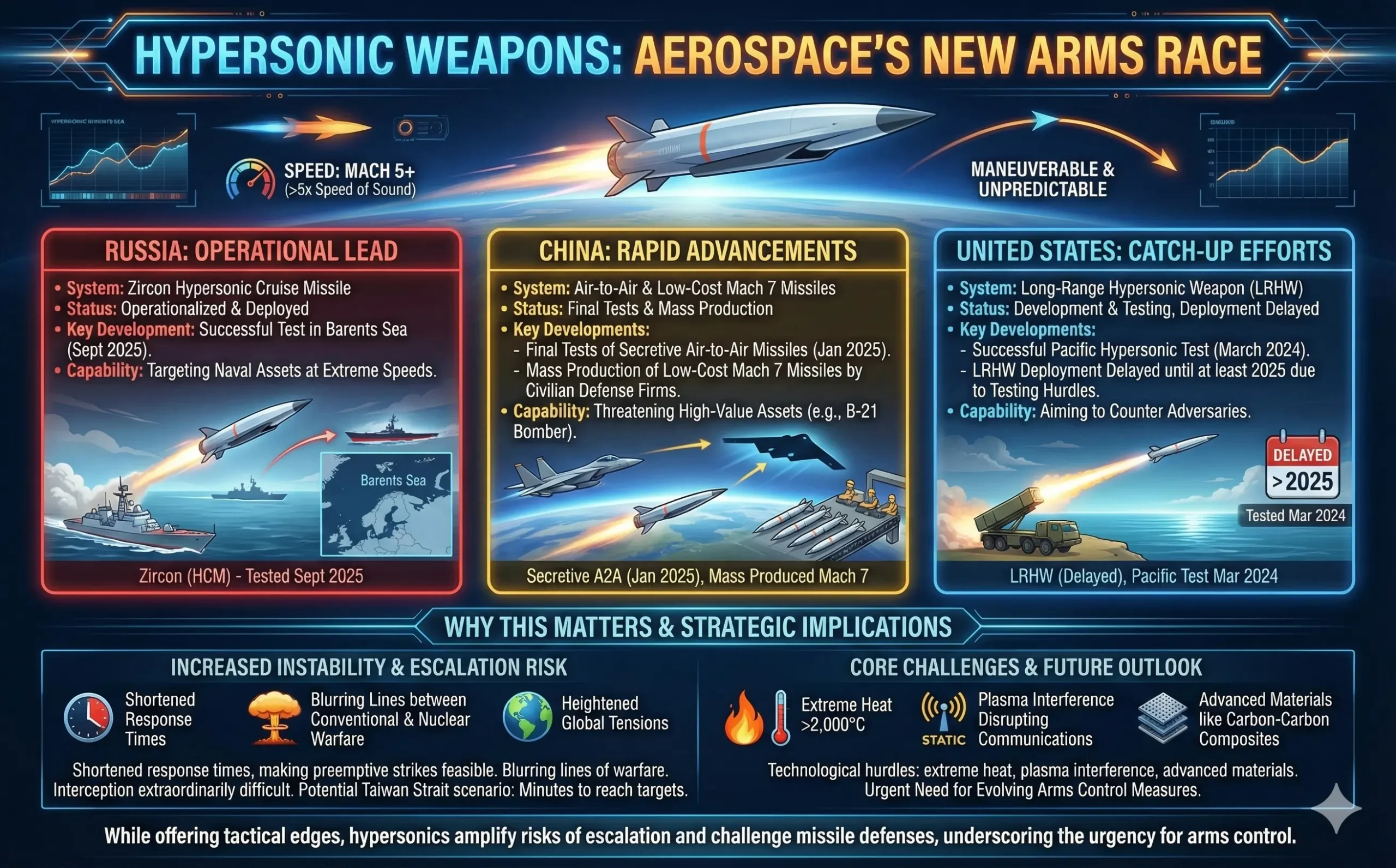
Hypersonic weapons represent one of the most transformative advancements in modern military technology, traveling at speeds exceeding Mach 5—five times the speed of sound—and capable of maneuvering unpredictably to evade defenses. This development has ignited an intense arms race among major powers, particularly the United States, Russia, and China, raising questions about strategic stability and the future of warfare. While these systems promise rapid, precise strikes, they also amplify risks of escalation and challenge existing missile defense architectures.
Key Developments in the Race
- Russia’s Lead in Deployment: Russia has operationalized systems like the Zircon hypersonic cruise missile, tested successfully in the Barents Sea in September 2025, showcasing its ability to target naval assets at extreme speeds.
- China’s Rapid Advancements: China has conducted final tests of secretive air-to-air hypersonic missiles in January 2025, potentially threatening high-value assets like the U.S. B-21 bomber, and initiated mass production of low-cost Mach 7 missiles by civilian defense firms.
- U.S. Catch-Up Efforts: The U.S. lags in deployment but succeeded in a Pacific hypersonic test in March 2024, aiming to counter adversaries through programs like the Long-Range Hypersonic Weapon (LRHW), delayed until at least 2025 due to testing hurdles.
Why This Matters
These weapons could shorten response times in conflicts, making preemptive strikes more feasible and blurring lines between conventional and nuclear warfare. Research suggests they heighten global tensions without proportionally enhancing security, as interception remains extraordinarily difficult. For instance, in a potential Taiwan Strait scenario, a hypersonic glide vehicle could reach targets in minutes, complicating U.S. carrier group defenses.
Core Challenges
Developing hypersonics involves overcoming extreme heat (up to 2,000°C), plasma interference disrupting communications, and the need for advanced materials like carbon-carbon composites. Nations must balance innovation with ethical concerns over arms proliferation.
This overview underscores the urgency: while hypersonics offer tactical edges, the evidence leans toward increased instability unless arms control measures evolve.
Table of Contents
In an era where the blink of an eye can decide the fate of nations, hypersonic weapons emerge as the ultimate game-changer in aerial and missile warfare. Imagine a projectile screaming across the sky at over 3,800 miles per hour, twisting and turning like a living entity to dodge any attempt at interception. This isn’t science fiction; it’s the reality of hypersonic technology, where speeds beyond Mach 5 redefine how militaries project power. The race to master these systems has turned aerospace engineering into a high-stakes geopolitical contest, pitting superpowers against one another in a bid for supremacy.
This arms race isn’t just about faster missiles—it’s about who controls the tempo of tomorrow’s battles, who can strike first without warning, and who holds the psychological edge in an increasingly volatile world.
The allure of hypersonics lies in their blend of blistering velocity and agility. Traditional ballistic missiles follow predictable arcs, giving defenders precious minutes to react. Hypersonics, however, hug the atmosphere, skimming at low altitudes while maneuvering erratically, rendering radar tracking a nightmare. This capability promises to neutralize high-value targets—think aircraft carriers, command centers, or even satellite networks—in fractions of the time once thought impossible. Yet, as nations pour billions into these programs, a shadow looms: the potential for miscalculation, where a single launch spirals into catastrophe.
Drawing from decades of research and recent breakthroughs, this article delves deep into the origins, mechanics, players, hurdles, and far-reaching consequences of this aerospace revolution, offering a comprehensive look at why hypersonics are reshaping global security.
Understanding Hypersonic Weapons: Speed Meets Precision
At their essence, hypersonic weapons are delivery systems engineered for extreme performance, classified broadly into two categories: boost-glide vehicles (BGVs) and scramjet-powered cruise missiles. Boost-glide systems, the more common type, rely on a rocket booster to hurl the payload into the upper atmosphere, where it then “glides” back toward Earth on a flattened trajectory, using aerodynamic lift to maintain speed and execute sharp turns. This allows for ranges exceeding 1,000 kilometers while evading traditional defenses designed for high-altitude ballistic threats. Scramjets, short for supersonic combustion ramjets, take a different tack: they ingest air at hypersonic speeds to fuel continuous propulsion, eliminating the need for bulky rocket stages and enabling sustained flight at Mach 5 to Mach 12.
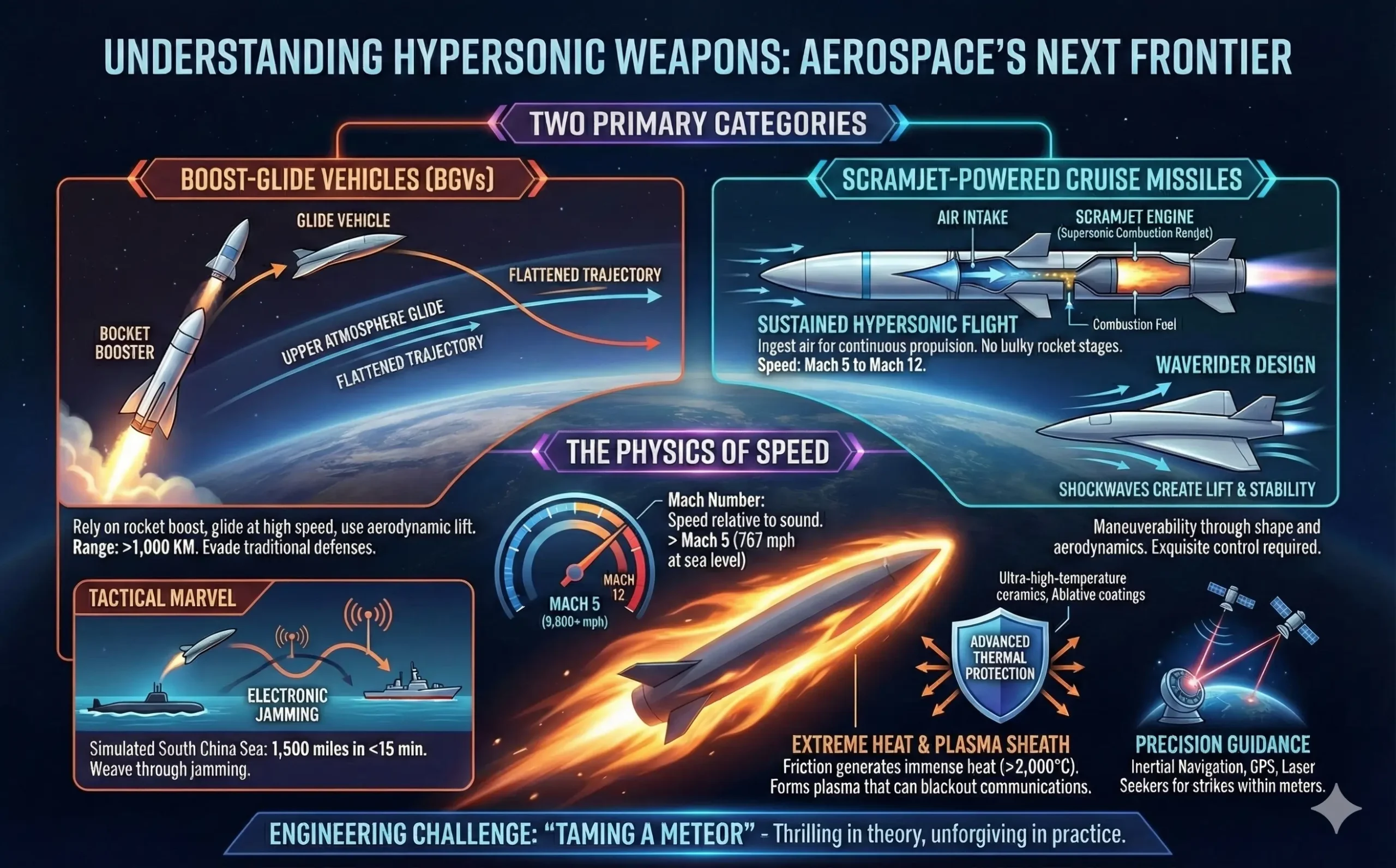
To grasp the physics, consider the Mach number—a measure of speed relative to sound (about 767 mph at sea level). At hypersonic velocities, friction generates immense heat, forming a glowing plasma sheath around the vehicle that can black out communications and sensors. Engineers counter this with advanced thermal protection systems, like ultra-high-temperature ceramics or ablative coatings that vaporize to carry away heat. A real-world example is the U.S. X-43A scramjet demonstrator, which hit Mach 9.6 in 2004, proving air-breathing engines could sustain such speeds without exploding. Today, these principles underpin operational weapons, where precision guidance—via inertial navigation, GPS, or even laser seekers—ensures strikes within meters of intent.
But hypersonics aren’t just about raw power; they’re tactical marvels. In a simulated South China Sea engagement, a BGV could launch from a submarine, cover 1,500 miles in under 15 minutes, and weave through electronic jamming to sink a destroyer. This maneuverability stems from waverider designs, where the vehicle’s shape creates shockwaves that enhance lift and stability. However, the technology demands exquisite control: even minor errors in aerodynamics can lead to disintegration. As one expert noted, building a hypersonic weapon is like “taming a meteor”—thrilling in theory, unforgiving in practice.
A Storied Past: From Cold War Dreams to Modern Realities
The quest for hypersonic supremacy traces back to the mid-20th century, when the Cold War superpowers first toyed with speeds that outpaced anything in their arsenals. The U.S. pioneered the field with Project Dyna-Soar in the 1950s, a reusable glider meant to bomb from space at Mach 20, but it was shelved in 1963 amid cost overruns and shifting priorities toward ICBMs. The Soviet Union countered with the Ziolkovsky-inspired hypersonic research, laying the groundwork for glide vehicles that would later evolve into today’s threats.
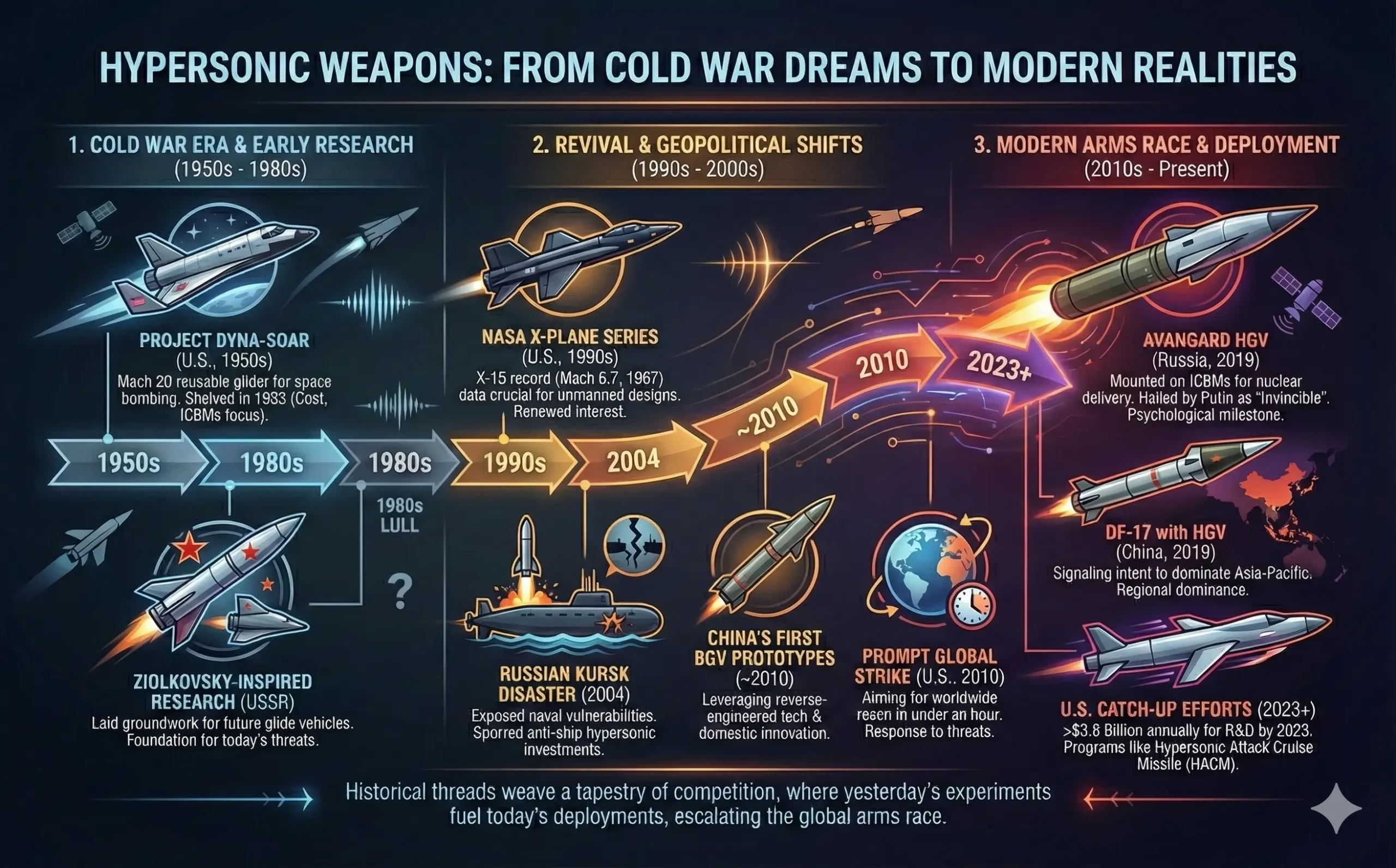
The 1980s saw a lull, but the 1990s revived interest through NASA’s X-plane series. The X-15 rocket plane, reaching Mach 6.7 in 1967, provided invaluable data on human-piloted hypersonics, influencing designs for unmanned systems. By the 2000s, geopolitical shifts accelerated the pace: Russia’s 2004 Kursk submarine disaster exposed naval vulnerabilities, spurring investments in anti-ship hypersonics. China, leveraging reverse-engineered tech and domestic innovation, unveiled its first BGV prototypes around 2010, while the U.S. responded with the Prompt Global Strike initiative in 2010, aiming for worldwide reach in under an hour.
Fast-forward to the 2010s, and the race heated up. Russia’s Avangard hypersonic glide vehicle (HGV) entered service in 2019, mounted on ICBMs for nuclear delivery. This marked a psychological milestone, with President Vladimir Putin hailing it as “invincible.” Meanwhile, China’s DF-17 medium-range ballistic missile with HGV warhead debuted in 2019, signaling intent to dominate the Asia-Pacific. The U.S., playing catch-up, allocated over $3.8 billion annually by 2023 for hypersonic R&D, birthing programs like the Hypersonic Attack Cruise Missile (HACM). These historical threads weave a tapestry of competition, where yesterday’s experiments fuel today’s deployments.
| Timeline of Key Hypersonic Milestones | Description | Nation Involved |
|---|---|---|
| 1967 | X-15 achieves Mach 6.7, first piloted hypersonic flight. | United States |
| 2004 | X-43A scramjet hits Mach 9.6, validating air-breathing tech. | United States |
| 2017 | Russia tests Avangard HGV on SS-19 ICBM. | Russia |
| 2019 | DF-17 paraded at National Day, operational by 2020. | China |
| 2021 | U.S. ARRW booster test fails; program pivots. | United States |
| 2022 | Zircon hypersonic cruise missile enters Russian Navy service. | Russia |
| 2023 | China tests YJ-21 from aircraft carrier. | China |
| 2024 | U.S. conducts successful C-HGB flight in Pacific. | United States |
| 2025 | Russia fires Zircon in Barents Sea; China completes air-to-air hypersonic tests. | Russia/China |
This table highlights the accelerating cadence, with tests doubling since 2020, underscoring the urgency felt by each contender.
The Contenders: A Global Lineup in the Hypersonic Arena
No discussion of this arms race is complete without spotlighting the frontrunners, each bringing unique strengths and strategies to the table. Russia leads in operational deployment, boasting the 3M22 Zircon, a scramjet-powered anti-ship missile clocking Mach 9 with a 1,000-km range. Deployed on frigates like the Admiral Gorshkov, it was combat-tested in Ukraine in 2023, though reports of mixed efficacy temper the hype. The Avangard, a nuclear-capable HGV, travels at Mach 27, designed to penetrate U.S. missile shields by skipping across the atmosphere like a stone on water.
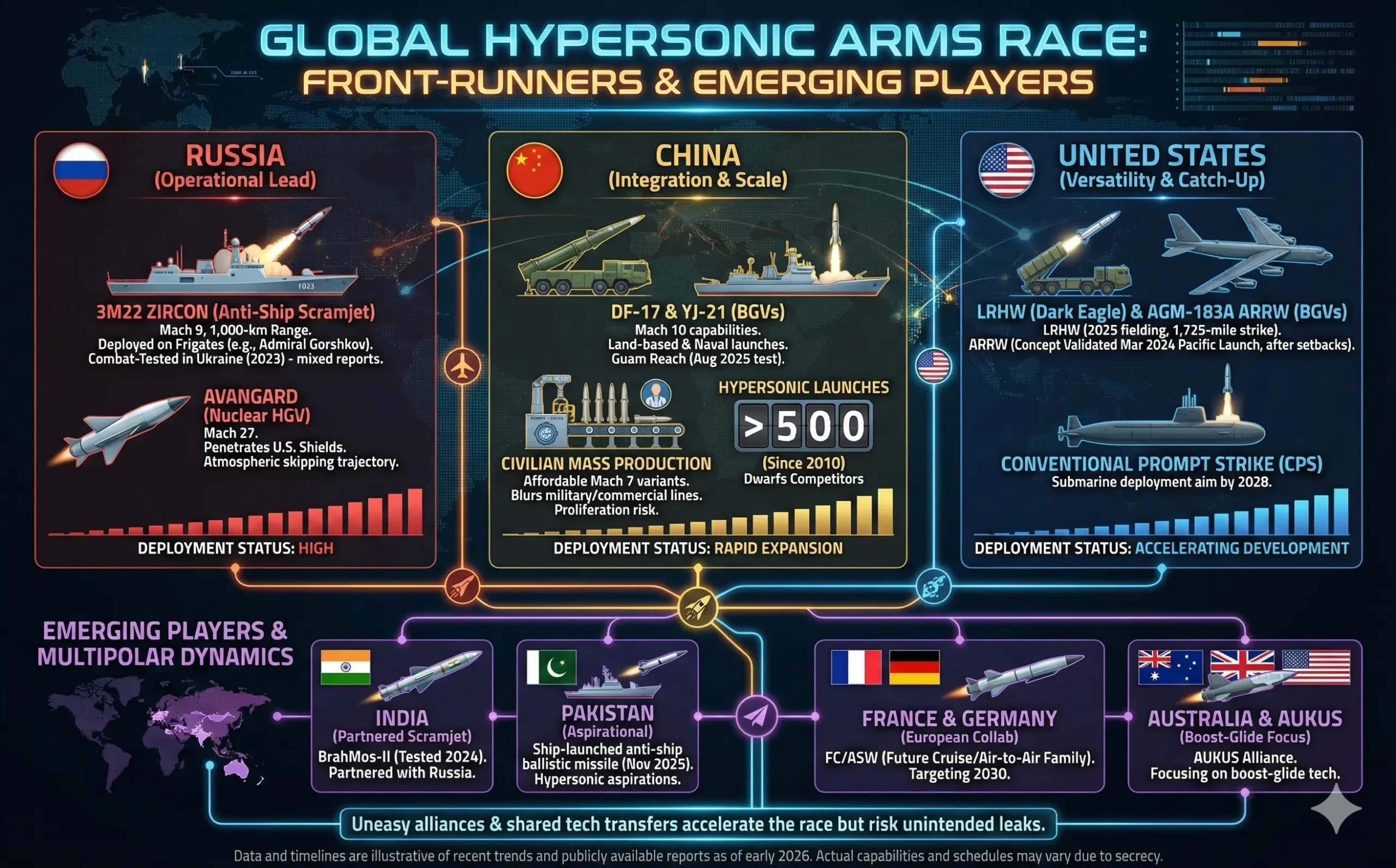
China excels in integration and scale, producing the DF-17 for land-based strikes and the YJ-21 for naval launches, both BGVs with Mach 10 capabilities. In August 2025, Beijing tested an intermediate-range ballistic missile with HGV, extending its reach to Guam. Civilian firms now mass-produce affordable Mach 7 variants, blurring lines between commercial and military tech—a move that alarms observers for its proliferation potential. China’s edge? Sheer volume: over 500 hypersonic launches since 2010, dwarfing competitors.
The United States prioritizes versatility, with the Army’s Long-Range Hypersonic Weapon (LRHW)—or “Dark Eagle”—gearing for 2025 fielding, capable of 1,725-mile strikes. The Air Force’s AGM-183A ARRW faced setbacks, with a 2023 test failure, but a March 2024 Pacific launch from a B-52 validated the concept. Navy efforts like the Conventional Prompt Strike (CPS) aim for submarine deployment by 2028. Allies aren’t idle: India tested the BrahMos-II scramjet in 2024, partnering with Russia, while Pakistan unveiled a ship-launched anti-ship ballistic missile in November 2025, hinting at hypersonic aspirations.
Emerging players add layers. France and Germany collaborate on the French-Italian-German Future Cruise/Air-to-Air Family (FC/ASW), targeting 2030. Australia joins U.S. efforts via AUKUS, focusing on boost-glide tech. This multipolar dynamic fosters uneasy alliances, where shared tech transfers accelerate the race but risk unintended leaks.
| Major Hypersonic Programs: A Comparative Overview | Country | Type | Speed (Mach) | Range (km) | Status | Key Features |
|---|---|---|---|---|---|---|
| Avangard | Russia | HGV (ICBM-launched) | 27 | 6,000+ | Operational (2019) | Nuclear-capable; atmospheric skipping for evasion. |
| Zircon (3M22) | Russia | Scramjet Cruise | 9 | 1,000 | Operational (2022) | Anti-ship focus; sea-skimming trajectory. |
| DF-17 | China | BGV (MRBM) | 10 | 1,800-2,500 | Operational (2019) | Road-mobile; precision ground/sea strikes. |
| YJ-21 | China | BGV (Air-launched) | 10 | 1,500 | Testing (2022-2025) | Carrier-based; threatens U.S. naval assets. |
| LRHW (Dark Eagle) | USA | BGV (Ground) | 5+ | 2,775 | Fielding (2025) | Mobile launcher; conventional warheads. |
| ARRW (AGM-183A) | USA | Boost-Glide (Air) | 20 | 1,600 | Testing (2024 success) | B-52 integration; rapid global strike. |
| BrahMos-II | India/Russia | Scramjet Cruise | 7-8 | 290 | Development (2024 test) | Joint venture; anti-ship emphasis. |
| FC/ASW | France/Germany/Italy | Scramjet Cruise | 5+ | 500+ | Development (2030 goal) | Multi-role; European autonomy focus. |
This comparison reveals Russia’s deployment lead, China’s production prowess, and the U.S.’s emphasis on integration, with ranges and speeds tailored to regional threats.
Engineering the Impossible: Technological Hurdles and Innovations
Crafting hypersonic weapons is a symphony of extremes, where every advancement battles unforgiving physics. The primary foe? Aerothermal heating, which at Mach 5 generates temperatures rivaling reentry from orbit, melts conventional metals. Solutions include reinforced carbon-carbon composites, as used in the U.S. Common-Hypersonic Glide Body (C-HGB), which dissipates heat through ablation. Yet, these materials are brittle and costly, driving research into nickel-based superalloys or even graphene-infused ceramics for reusability.
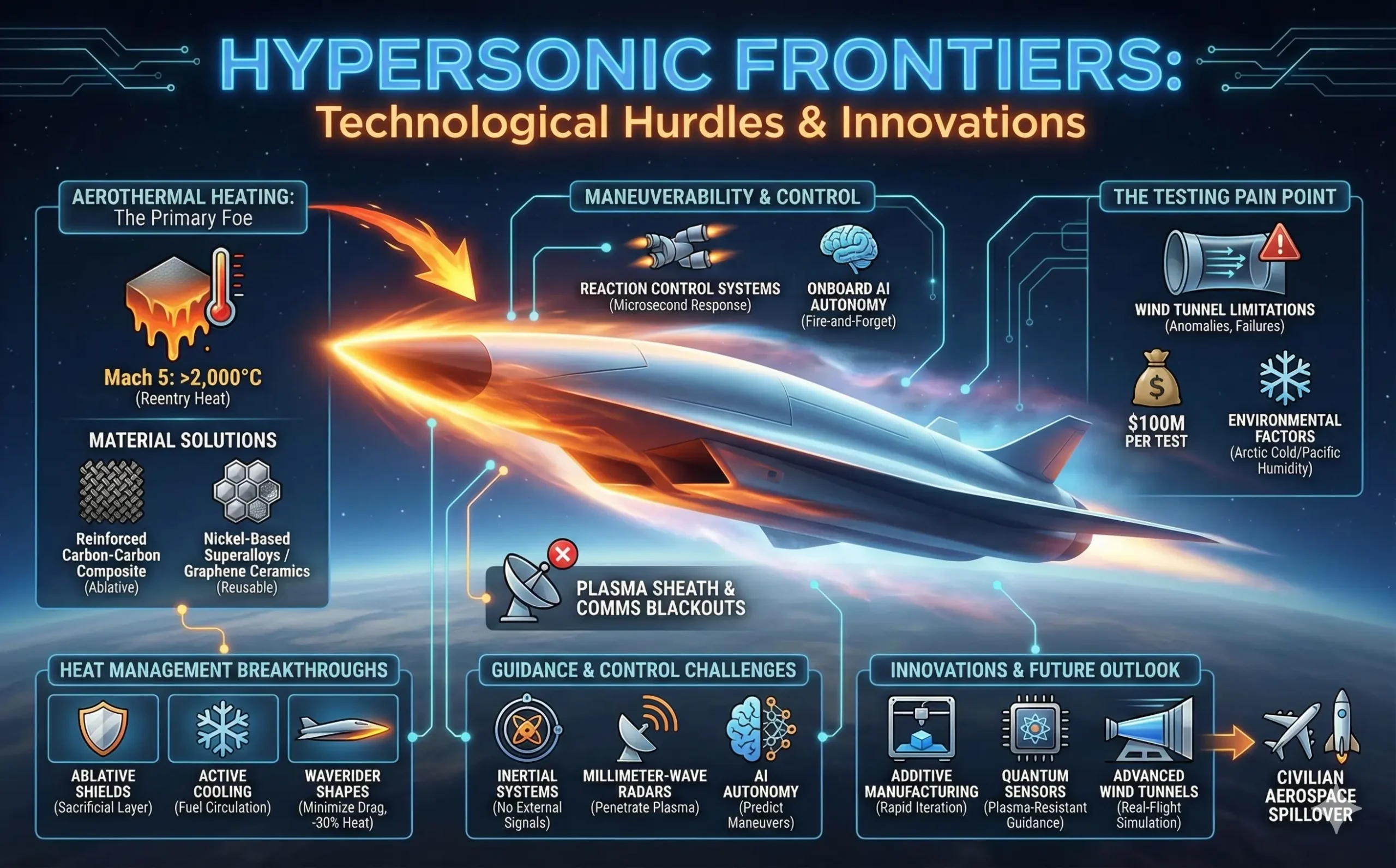
Maneuverability poses another beast: at hypersonic speeds, control surfaces must respond in microseconds to avoid instability. Reaction control systems—tiny thrusters firing plasma-disrupted gases—enable this, but plasma sheaths often sever satellite links, forcing reliance on onboard AI for autonomy. Communication blackouts, lasting from seconds to minutes, necessitate “fire-and-forget” designs with pre-programmed paths, although this limits adaptability.
Testing amplifies the pain. Ground facilities like wind tunnels can’t fully replicate flight conditions, leading to anomalies: the U.S. scrapped a 2021 ARRW test after booster failure, delaying timelines by years. Environmental factors, from Arctic cold affecting Russian Zircon launches to Pacific humidity challenging Chinese prototypes, add unpredictability. Costs soar too—each U.S. test runs $100 million—straining budgets amid competing priorities like cyber defenses.
Innovations offer glimmers of hope. Additive manufacturing (3D printing) speeds prototype iteration, as seen in China’s rapid YJ-21 evolution. Quantum sensors promise plasma-resistant guidance, while hypersonic wind tunnels in Australia simulate real flights. Still, experts caution: full maturity may take a decade, with failures like Russia’s 2023 Oreshnik misfire reminding us that haste breeds hubris.
- Heat Management Breakthroughs:
- Ablative shields: Sacrifice outer layers to protect core (e.g., Space Shuttle tech adapted).
- Active cooling: Circulate fuels like hydrogen through the vehicle skin.
- Waverider shapes: Minimize drag, reducing heat by 30%.
- Guidance and Control Challenges:
- Inertial systems: Gyroscopes track position without external signals.
- Millimeter-wave radars: Penetrate plasma for terminal homing.
- AI autonomy: Machine learning predicts maneuvers in jammed environments.
These hurdles, while daunting, fuel a virtuous cycle of innovation, spilling over into civilian aerospace, like faster passenger jets or reusable rockets.
On the Front Lines: Recent Tests and Tactical Scenarios
The proof of hypersonic might lies in live fire, and 2023-2025 has been a banner of bold experiments. Russia’s September 2025 Barents Sea Zircon test from the Severomorsk frigate simulated an Arctic naval strike, hitting a mock target at Mach 8 amid NATO’s northern flank— a clear message to alliance exercises. Earlier, in March 2023, Ukraine downed a Kinzhal (hypersonic variant of Iskander) with Patriot systems, exposing vulnerabilities but affirming speeds near Mach 10.
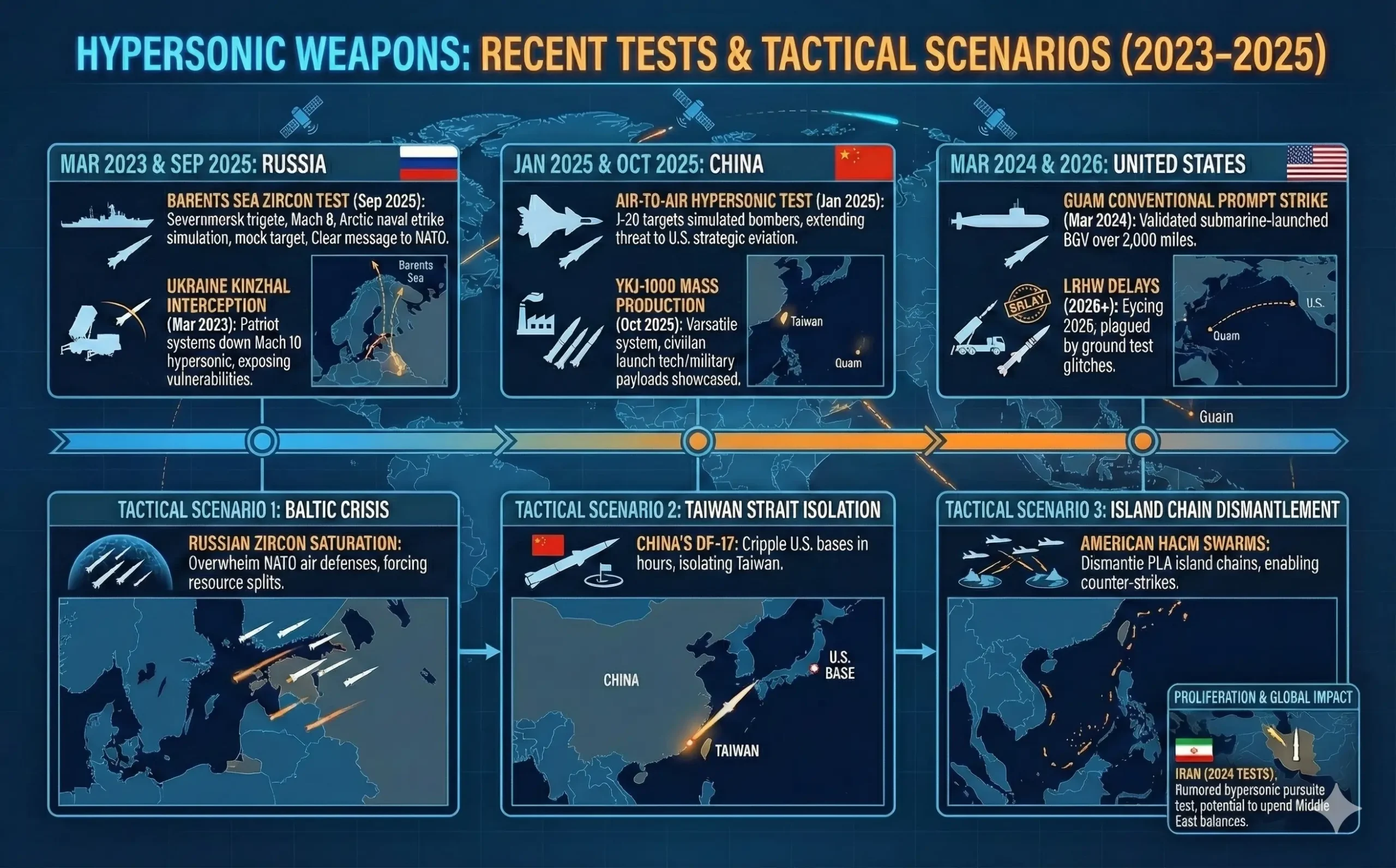
China’s pace is relentless: the January 2025 final test of an unnamed air-to-air hypersonic missile from a J-20 fighter targeted simulated bombers, extending threats to U.S. strategic aviation. In October 2025, mass production of YKJ-1000 began, a versatile system blending civilian launch tech with military payloads, as showcased in state media videos. The U.S. countered with a March 2024 Guam-based Conventional Prompt Strike test, validating submarine-launched BGVs over 2,000 miles. Delays plague the LRHW, now eyeing 2026 amid ground test glitches.
Tactically, these tests paint vivid scenarios. In a Baltic crisis, Russian Zircons could saturate NATO air defenses, forcing resource splits. China’s DF-17 might isolate Taiwan by crippling U.S. bases in hours, while American HACM swarms could dismantle PLA island chains. Even non-state actors eye proliferation: Iran’s rumored hypersonic pursuits, tested in 2024, could upend Middle East balances.
The Bigger Picture: Strategic Ripples and Escalation Risks
Hypersonics don’t exist in a vacuum; they ripple through deterrence doctrines and alliance structures. Their speed compresses decision timelines—from hours to minutes—eroding mutually assured destruction (MAD) by enabling “decapitation” strikes on leadership. Russia touts Avangard as a nuclear equalizer, but critics argue it invites preemption, heightening first-strike incentives. China views DF-17 as an anti-access/area denial (A2/AD) bulwark, deterring U.S. intervention in the South China Sea, yet it blurs conventional-nuclear thresholds, as dual-use designs could carry atomic payloads.
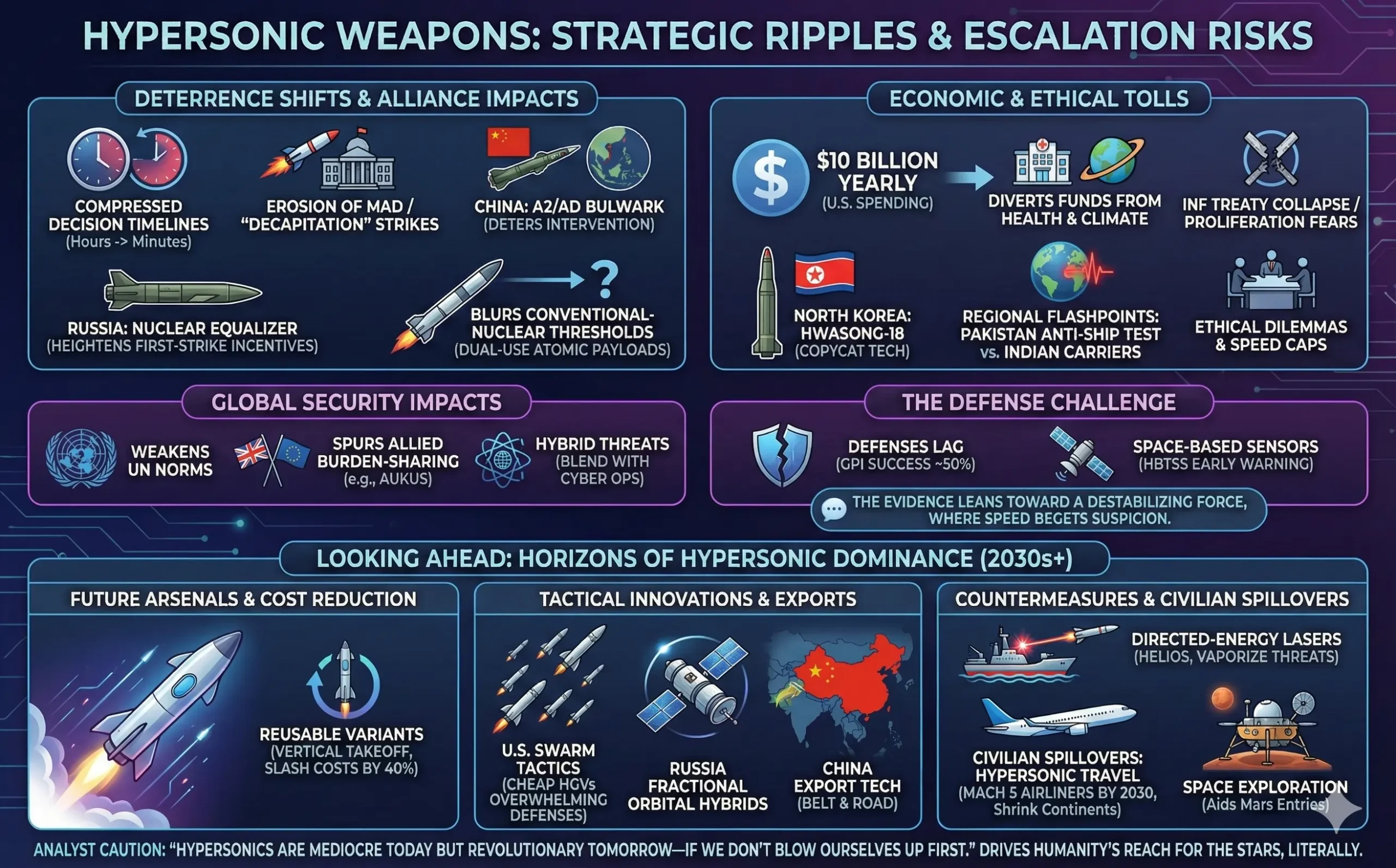
The arms race exacts economic tolls: the U.S. alone spends $10 billion yearly, diverting funds from climate or health. Proliferation fears mount—North Korea’s 2024 Hwasong-18 hints at copycat tech—while defenses lag. Glide Phase Interceptors (GPI) in U.S. trials aim to hit mid-flight, but success rates hover at 50%. Space-based sensors, like the Hypersonic and Ballistic Tracking Space Sensor (HBTSS), offer early warning, but treaties like New START exclude hypersonics, stalling talks.
Ethically, the race evokes arms control ghosts. The 1987 Intermediate-Range Nuclear Forces (INF) Treaty collapse freed hypersonic development, but proposals for “speed caps” in negotiations gain traction. In regions like the Indo-Pacific, they amplify flashpoints: Pakistan’s November 2025 anti-ship test counters Indian carriers, escalating South Asian tensions.
- Deterrence Shifts:
- Enhances survivability of second strikes via low-altitude paths.
- Risks “use it or lose it” dilemmas in crises.
- Forces adversaries to disperse assets, straining logistics.
- Global Security Impacts:
- Weakens UN norms on weapons of mass destruction.
- Spurs allied burden-sharing, as in AUKUS hypersonic pacts.
- Potential for hybrid threats, blending hypersonics with cyber ops.
Ultimately, while hypersonics promise precision warfare, the evidence leans toward a destabilizing force, where speed begets suspicion.
Looking Ahead: Horizons of Hypersonic Dominance
Peering into the 2030s, hypersonics will likely permeate arsenals, with reusable variants slashing costs by 40% through vertical takeoff designs. The U.S. envisions swarm tactics, dozens of cheap HGVs overwhelming defenses, while Russia eyes fractional orbital bombardment hybrids. China, with its industrial might, could export tech to Belt and Road partners, reshaping alliances.
Countermeasures will evolve: Directed-energy lasers on ships, like the U.S. Navy’s HELIOS, could vaporize incoming threats, though power demands limit range. International forums push for transparency—verifiable test bans or shared sensor data—to avert tragedy. Yet, optimism tempers caution: as one analyst put it, “Hypersonics are mediocre today but revolutionary tomorrow—if we don’t blow ourselves up first.”
In civilian realms, spillovers beckon: hypersonic travel could shrink continents, with companies like Hermeus targeting Mach 5 airliners by 2030. Space exploration benefits too, with glide tech aiding Mars entries. The arms race, for all its peril, drives humanity’s reach for the stars—literally.
Navigating the Hypersonic Horizon
Hypersonic weapons stand at the crossroads of triumph and trepidation, a testament to human ingenuity that now demands wisdom in stewardship. As the U.S., Russia, and China vault forward, the world watches, hoping velocity serves peace over peril. This aerospace odyssey reminds us: in the speed race, the true finish line is restraint. By fostering dialogue and innovation beyond destruction, we can harness hypersonics not as harbingers of war, but as engines of a safer, swifter future.
Key Citations And References
- Russia Test Fires Hypersonic Missile on NATO’s Arctic Doorstep
- Hypersonic Missile Update for 2025
- The US Is Behind on Deploying Hypersonic Weapons
- Testing Top of Mind as U.S. Lags China In Hypersonics Race
- Hypersonic Arms Race: Is the United States Losing to Russia and China?
- US tests hypersonic missile in Pacific
- China Says Conducted Final Test of Secretive Hypersonic Air-to-Air Missile
- Hypersonic weapon – Wikipedia
- Fact Sheet: Hypersonic Weapons
- Hitting a Bullet with a Bullet: Counter-Hypersonic Systems
- The Strategic Implications of Hypersonic Weapons
- Hypersonic Weapons: Background and Issues for Congress
- No Quick Solutions: A Different Approach to Hypersonic Arms Control
- Hypersonic missiles: A new arms race?
- China: Hypersonic Missile Production (X Post)
- PN Conducts Successfull Flight Test (X Post)
- YKJ-1000 Hypersonic Missile (X Post)
Read These Articles in Detail
- Aerospace Engineering vs. Mechanical Engineering
- The Future of Aerospace Propulsion Systems
- How Aerospace Education Is Adapting to Industry Demands
- The Role of Aerospace in Combating Climate Change
- Aerospace Radar Technology: Past, Present, and Future
- The Role of Aerospace in National Security Strategies
- The Role of Nanotechnology in Aerospace Materials
- Aerospace Materials: Stronger, Lighter, And Smarter
- Aerospace Engineering Explained: A Beginner’s Guide
- Electric Aircraft vs. Hydrogen Aircraft: Which Is More Sustainable?
- Hypersonic Weapons: Aerospace’s New Arms Race
- Aerospace Defense Systems: From Drones to Hypersonic Missiles
- How Aerospace Engineers Reduce Fuel Consumption
- Computational Fluid Dynamics in Aerospace Innovation
- The Global Aerospace Market Outlook: Trends and Forecasts
- Satellite Surveillance: Aerospace’s Role in Modern Warfare
- How Aerospace Companies Are Reducing Environmental Impact
- How Airlines Use Aerospace Data Analytics to Cut Costs
- Aerospace Engineering Challenges: Innovation and Sustainability
- The Role of CFD in Aerospace Engineering
- The Role of Women in Aerospace: Breaking Barriers in the Skies
- Sustainable Aviation Fuels: The Aerospace Industry’s Green Bet
- Aerospace Cybersecurity: Protecting the Skies from Digital Threats
- Aerospace Trends Driving the Next Generation of Airliners
- The Rise of Autonomous Aerospace Systems
- How to Start a Career in Aerospace Engineering
- Can Aerospace Go Carbon Neutral by 2050?
- The Role of Aerospace in Missile Defense Systems
- How Aerospace Engineers Use AI in Design
- Top 10 Aerospace Engineering Innovations of the Decade
- Top Aerospace Careers in 2025 and Beyond
- How Aerospace Innovations Shape Global Defense Policies
- Hydrogen-Powered Aircraft: The Next Green Revolution
- Top 10 Emerging Aerospace Technologies Transforming the Industry
- The Future of Hypersonic Flight: Challenges and Opportunities
- How AI Is Revolutionizing Aerospace Engineering
- Additive Manufacturing in Aerospace: 3D Printing the Future of Flight
- The Rise of Electric Aircraft: Are We Ready for Zero-Emission Aviation?
- Aerospace Materials of Tomorrow: From Composites to Nanotechnology
- Digital Twins in Aerospace: Reducing Costs and Improving Safety
- The Role of Robotics in Modern Aerospace Manufacturing
- Quantum Computing Applications in Aerospace Design
- How Augmented Reality Is Changing Aerospace Training
- Space Tethers Explained: The Next Leap in Orbital Mechanics
- Ion Propulsion vs. Chemical Rockets: Which Will Power the Future?
- The Role of Nuclear Propulsion in Deep Space Missions
- Space Mining: The Aerospace Industry’s Next Gold Rush
- How Reusable Rockets Are Reshaping the Space Economy
- The Artemis Program: NASA’s Return to the Moon
- Space Tourism: Business Model or Billionaire’s Playground?
- How Aerospace Startups Are Disrupting Commercial Aviation
- The Economics of Low-Cost Airlines in the Aerospace Era
- Urban Air Mobility: The Rise of Flying Taxis
- The Future of Mars Colonization: Key Aerospace Challenges and Solutions Ahead
- CubeSats and Small Satellites: Democratizing Space Access
- The Future of Cargo Drones in Global Logistics
- The Role of Aerospace in Building a Lunar Economy
Frequently Asked Questions
FAQ 1: What Are Hypersonic Weapons and How Do They Differ from Supersonic Ones?
Hypersonic weapons are advanced military systems designed to travel at speeds greater than Mach 5, which is about 3,800 miles per hour or five times the speed of sound in the atmosphere. This blistering velocity allows them to cover vast distances in mere minutes, making them ideal for rapid strikes against high-value targets like enemy ships or command centers. Unlike slower weapons, hypersonics can maneuver sharply during flight, dodging radar detection and traditional defenses that rely on predictable paths. They come in two main flavors: boost-glide vehicles, which ride a rocket boost into the upper atmosphere before gliding back down with aerodynamic control, and scramjet-powered cruise missiles, which use air-breathing engines to sustain speed without needing massive fuel loads.
To put it simply, think of a hypersonic weapon as a smart, agile bullet that hugs the Earth’s curve at low altitudes, generating intense heat from air friction—up to 2,000 degrees Celsius—that requires special materials to withstand. This heat even creates a plasma bubble around the vehicle, which can disrupt communications, adding to their stealthy nature. In contrast, supersonic weapons top out at Mach 1 to Mach 5, like fighter jets or older missiles, and they don’t pack the same punch in terms of evasion or global reach. For everyday folks, hypersonics aren’t just faster; they’re a leap in precision warfare, potentially shortening warning times from hours to seconds in a conflict.
Recent advancements have made these weapons more accessible, with nations like China now mass-producing affordable Mach 7 variants through civilian firms, blurring the lines between commercial tech and battlefield tools. This evolution raises big questions about global security, as what starts as a defensive edge could quickly tip into offensive dominance.
FAQ 2: Which Countries Lead the Hypersonic Arms Race in 2025?
The hypersonic arms race is a global sprint, with several nations pouring resources into these game-changing technologies to gain an edge in modern warfare. As of late 2025, Russia, China, and the United States remain the frontrunners, but emerging players like India and Pakistan are closing the gap through partnerships and indigenous efforts. Russia’s operational deployments give it a slight lead in real-world use, while China’s production scale and the U.S.’s innovative testing keep the competition fierce.
Here’s a breakdown of the top contenders based on deployment status, key systems, and recent milestones:
| Country | Key Systems | Speed (Mach) | Status in 2025 | Notable Milestone |
|---|---|---|---|---|
| Russia | Avangard HGV, Zircon Cruise | 9-27 | Fully operational | Gremlin hypersonic-guided missile announced in April. |
| China | DF-17 BGV, YJ-21 Air-Launched | 7-10 | Mass production underway | Civilian firm starts low-cost Mach 7 missile output. |
| United States | Dark Eagle (LRHW), ARRW | 5+ | First battery equipped by December | Successful Pacific test; budget at $3.9B for FY2026. |
| India | BrahMos-II Scramjet | 7-8 | Advanced testing | Joint Russia collab yields 2024 prototype success. |
| Pakistan | Ship-Launched ASBM | 5+ | Recent flight test | November 2025 naval demo enhances anti-ship role. |
This table shows how each nation’s focus—Russia on nuclear integration, China on volume, and the U.S. on mobility—shapes the race. Allies like France and Australia are also investing, often through joint ventures, to avoid falling behind.
FAQ 3: What Challenges Do Engineers Face in Building Hypersonic Weapons?
Developing hypersonic weapons pushes the boundaries of physics and engineering, turning what seems like a straightforward speed boost into a puzzle of extreme conditions and technical hurdles. At the heart of it, these systems must endure scorching temperatures from atmospheric friction, maintain control during wild maneuvers, and ensure pinpoint accuracy without reliable communication. It’s no wonder programs often face delays and ballooning costs, as seen in the U.S. efforts where tests have pushed timelines back by years.
Key challenges include:
- Extreme Heat Management: Speeds over Mach 5 create plasma sheaths hotter than reentry from space, requiring exotic materials like carbon-carbon composites that are expensive and fragile. Failures here can melt a vehicle mid-flight.
- Maneuverability and Guidance: Unlike straight-shooting ballistic missiles, hypersonics need to twist and turn, but plasma interference blacks out GPS signals, forcing reliance on onboard AI or inertial systems that aren’t foolproof in jammed environments.
- Testing Limitations: Real-world trials are rare and costly—up to $100 million each—since ground simulators can’t fully mimic flight dynamics. Environmental factors, like cold Arctic launches for Russian systems, add unpredictability.
- Cost and Scalability: The U.S. FY2026 budget dipped to $3.9 billion from $6.9 billion the prior year, highlighting fiscal strains, while China’s civilian production model aims to undercut prices but risks quality control.
Overcoming these isn’t just about tech; it’s about international collaboration and ethical balancing to prevent an unchecked proliferation that could destabilize regions.
FAQ 4: How Do Hypersonic Weapons Change the Rules of Modern Warfare?
Hypersonic weapons are rewriting the playbook of warfare by compressing timelines and amplifying uncertainties in ways that traditional arms never could. In a world where decisions once had hours to unfold, these systems deliver payloads across continents in under 15 minutes, forcing commanders to act on incomplete intel and blurring the line between conventional and nuclear threats. For instance, in a tense South China Sea standoff, a Chinese DF-17 could neutralize U.S. carriers before full response protocols kick in, shifting power dynamics overnight.
This speed advantage doesn’t just enable surprise attacks; it erodes the reliability of early warning systems, as low-altitude flights evade ground radars. Strategically, it incentivizes “launch on warning” doctrines, where nations might fire preemptively to avoid being caught flat-footed, heightening escalation risks. Russia’s Avangard , touted as nuclear-capable, exemplifies this by challenging U.S. missile shields, potentially reviving Cold War-style brinkmanship.
Yet, the flip side is tactical precision: hypersonics could minimize collateral damage through meter-accurate guidance, appealing for urban conflicts. Still, experts warn of a destabilizing arms spiral, with 2025’s surge in Chinese production sites signaling a “new arms race” that strains global budgets and alliances. Ultimately, while they promise decisive edges, hypersonics demand smarter diplomacy to keep warfare from becoming a reflex rather than a choice.
FAQ 5: What Are Some Recent Hypersonic Weapon Tests in 2025?
2025 has been a whirlwind year for hypersonic testing, with major powers flexing their tech in ways that underscore the arms race’s intensity. These demonstrations aren’t just proof-of-concept; they’re strategic signals, often timed to coincide with rival maneuvers or diplomatic tensions, showcasing reliability and reach.
Notable tests include:
- U.S. Dark Eagle Milestone: In October, the Army’s first hypersonic battery reached full equipping with eight missiles by December, following a successful ground integration test that validated Mach 5+ strikes over 1,700 miles.
- China’s YKJ-1000 Unveiling: A civilian defense firm kicked off mass production of this Mach 7 missile in early November, with videos showing automatic targeting and evasive flights, hinting at dual-use potential for export.
- Pakistan’s Naval ASBM Flight: On November 25, the Pakistan Navy tested a ship-launched anti-ship ballistic missile with hypersonic traits, engaging sea and ground targets at extended ranges, bolstering Indian Ocean defenses.
- Russia’s Kinzhal Strikes: Ongoing use in Ukraine, including a November assault on Kyiv power plants, demonstrated Mach 10 evasion against Patriot systems, though interceptions highlight vulnerabilities.
These events, amid calls for scaled-up U.S. investments, illustrate how tests drive both innovation and international friction.
FAQ 6: What Defenses Exist Against Hypersonic Weapons Today?
Countering hypersonic weapons is one of the toughest nuts to crack in modern defense, given their speed, low flight paths, and mid-air twists that foil conventional interceptors. As threats proliferate, nations are racing to build layered systems—from space-based eyes to energy weapons—that detect and neutralize these “unstoppable” projectiles early. Success hinges on integration: spotting a launch, tracking the glide, and striking before impact.
Current and emerging defenses break down like this:
| Defense Type | Description | Key Players/Examples | Effectiveness in 2025 |
|---|---|---|---|
| Space-Based Sensors | Satellites for early detection, piercing atmospheric blackouts. | U.S. HBTSS constellation. | High for warning; tests ongoing. |
| Glide Phase Interceptors | Missiles that hit during atmospheric skim, exploiting brief vulnerabilities. | U.S. GPI program; European prototypes. | Moderate; 50% success in sims. |
| Directed Energy Weapons | Lasers or microwaves to burn or disrupt incoming threats. | U.S. Navy HELIOS on ships. | Promising for close range; power limits apply. |
| Advanced Radars | Phased-array systems for low-altitude tracking amid plasma interference. | Israel’s Iron Dome upgrades. | Improved but challenged by maneuvers. |
| Electronic Warfare | Jamming guidance or decoys to mislead terminal phases. | Russian Krasukha systems. | Supportive; best in layered setups. |
While no silver bullet exists yet, combining these—like Northrop Grumman’s “bullet-with-a-bullet” approach—offers hope, though full maturity could take years amid the 2025 interceptor push.
FAQ 7: What Are the Strategic Risks of the Hypersonic Arms Race?
The hypersonic arms race, accelerating through 2025, carries profound strategic risks that could upend global stability, much like the nuclear buildup of decades past. By enabling near-instantaneous strikes, these weapons compress decision-making windows, fostering paranoia where leaders might launch on shaky intel to preempt an imagined attack. In hotspots like the Taiwan Strait, a Chinese hypersonic salvo could cripple U.S. response fleets in minutes, eroding deterrence and inviting miscalculations that spiral into wider conflict.
Economically, the drain is staggering: the U.S. alone has funneled over $10 billion into programs, with cuts to $3.9 billion in FY2026 signaling tough choices that divert funds from other security needs. Proliferation adds fuel—North Korea’s tests and Iran’s pursuits mean non-state actors could soon access knockoffs, democratizing destruction in unstable regions. Moreover, the tech’s dual-use nature, as with China’s civilian missile factories, blurs peaceful and military lines, complicating arms control.
On a brighter note, shared fears could spur treaties capping speeds or mandating test transparency, much like past INF pacts. But without them, research points to heightened crisis instability, where hypersonics don’t just win battles—they risk losing the peace.
FAQ 8: How Has the History of Hypersonic Weapons Shaped Today’s Race?
The story of hypersonic weapons stretches back to the Cold War era, when visionaries dreamed of space-age bombers zipping at orbital speeds. The U.S. X-15 rocket plane hit Mach 6.7 in 1967, gathering data that informed later designs, while Soviet research on glide vehicles laid early foundations. By the 1980s, priorities shifted to ICBMs, but the 1990s X-plane series revived momentum, proving scramjets could breathe fire at extreme velocities.
The real ignition came post-2010, with Russia’s Avangard service in 2019 and China’s DF-17 parade that year, jolting the U.S. into Prompt Global Strike funding. 2025’s landscape—U.S. batteries online, Chinese factories humming—owes much to these roots, where yesterday’s experiments met today’s geopolitics. This heritage reminds us: hypersonics evolved from exploration tools to strategic necessities, but their unchecked growth echoes past arms races we barely survived.
FAQ 9: What Budgets Are Nations Allocating to Hypersonic Programs in 2025?
Funding hypersonic development is a high-stakes gamble, with billions flowing into R&D amid calls for restraint. The U.S. leads in sheer dollars but faces scrutiny over returns, while China’s opaque but massive investments fuel its production boom. These figures reflect not just tech bets but broader security priorities, with totals climbing despite fiscal pressures.
A snapshot of 2025 allocations:
| Nation | Annual Budget (USD Billion) | Focus Areas | Change from 2024 |
|---|---|---|---|
| United States | 3.9 (FY2026 request) | Testing, Dark Eagle deployment | Down from 6.9 |
| China | Estimated 5-7 | Mass production, YJ-21 variants | Up 20% amid factory expansions |
| Russia | 2-3 (defense portion) | Zircon integration, Gremlin upgrades | Steady, post-Ukraine adjustments |
| United Kingdom | 0.5-1 | Joint European scramjet projects | New investments to catch up |
| India | 0.8 | BrahMos-II with Russia | Increased via partnerships |
These investments, totaling over $15 billion globally, highlight the race’s economic bite, urging calls for collaborative limits to ease the burden.
FAQ 10: What Innovations Lie Ahead for Hypersonic Weapons?
Looking to the 2030s, hypersonic weapons are poised for breakthroughs that could make them cheaper, smarter, and more versatile, transforming from elite tools to everyday arsenal staples. Reusable designs, drawing from space tech, promise to slash costs by 40%, enabling swarms of low-price glide vehicles that overwhelm defenses through sheer numbers.
Emerging trends point to:
- AI-Enhanced Autonomy: Onboard learning to navigate blackouts, as in U.S. HACM prototypes, for adaptive strikes in denied environments.
- Hybrid Propulsion: Blending scramjets with railguns for Mach 10+ bursts, with China testing naval variants that redefine sea power.
- Civilian Crossovers: Faster air travel via Mach 5 liners, spilling military heat shields into commercial jets by decade’s end.
- Counter-Tech Integration: Built-in defenses like laser countermeasures, countering the interceptor race.
Yet, these advances hinge on ethical guardrails; without them, the future risks a vulnerability era where speed outpaces sense.
FAQ 11: What Are the Environmental Impacts of Hypersonic Weapons Development in 2025?
Hypersonic weapons development carries significant environmental footprints, from the carbon-intensive manufacturing processes to the atmospheric effects of high-speed testing. As nations ramp up production and trials, the push for speeds over Mach 5 demands exotic materials like carbon composites and superalloys, which require energy-heavy refining that contributes to greenhouse gas emissions.
For instance, the extreme heat generated during flights—reaching thousands of degrees Celsius—releases particulates and nitrogen oxides into the upper atmosphere, potentially exacerbating ozone depletion and climate warming. Research indicates that if hypersonic systems scale to commercial levels, their climate impact could be 8 to 20 times greater than conventional subsonic aircraft due to inefficient fuel burn at sustained high velocities.
Testing adds another layer of concern, with launches often conducted over remote areas to minimize human risk but still disrupting local ecosystems. In the U.S., early environmental assessments for hypersonic vehicle tests highlighted risks to wildlife, such as potential harm to marine life from sonic booms or debris fallout in coastal zones.
By 2025, as programs like the U.S. Dark Eagle and China’s YKJ-1000 advance, regulators are scrutinizing these effects more closely, pushing for greener propulsion alternatives like hydrogen-based scramjets that could reduce emissions by up to 30 percent. However, the arms race’s urgency often sidelines full impact studies, leaving long-term consequences—like altered weather patterns from repeated plasma sheath formations—largely uncharted.
Balancing security needs with planetary health remains tricky. While some advocate for international standards on test sites to avoid biodiversity hotspots, the evidence suggests current practices could accelerate environmental strain without yielding proportional defensive gains. As global tensions rise, addressing these hidden costs might foster unexpected diplomatic bridges, turning a military sprint into a shared sustainability challenge.
FAQ 12: How Do Hypersonic Weapons Compare to Traditional Ballistic Missiles?
Hypersonic weapons and traditional ballistic missiles both achieve blistering speeds, but their designs and capabilities diverge in ways that reshape battlefield dynamics. Ballistic missiles follow a high-arcing, predictable trajectory, peaking outside the atmosphere before reentering on a gravity-driven plunge, making them vulnerable to interception during their coast phase. Hypersonics, by contrast, maintain low-altitude flights with active maneuvering, using aerodynamic lift to evade radars and defenses that expect straight-line paths. This agility comes at a cost: hypersonics demand advanced materials to withstand continuous friction, while ballistics rely on simpler, proven rocketry.
The table below outlines key differences based on current 2025 systems, highlighting why hypersonics are seen as a disruptive evolution despite overlapping speed profiles.
| Aspect | Hypersonic Weapons | Traditional Ballistic Missiles |
|---|---|---|
| Trajectory | Low-altitude, maneuverable glide or cruise | High-arcing parabolic path |
| Speed Profile | Sustained Mach 5+ throughout flight | Peaks at Mach 20+ but slows on reentry |
| Range | Typically 1,000-2,500 km | Up to 10,000+ km (ICBMs) |
| Evasion Capability | High; sharp turns mid-flight | Low; mostly unpowered descent |
| Cost per Unit | $20-100 million (e.g., U.S. ARRW) | $10-50 million (e.g., Minuteman III) |
| Examples in 2025 | China’s DF-17, Russia’s Zircon | U.S. Trident II, Russia’s RS-24 |
While ballistics excel in global reach and payload capacity, hypersonics prioritize precision and survivability, potentially shortening warning times to minutes. Experts note that many ballistics already hit hypersonic velocities terminally, blurring lines, but the true edge lies in controllability—hypersonics can adjust targets in real-time, a feat ballistics can’t match without upgrades like maneuverable reentry vehicles.
FAQ 13: What Role Have Hypersonic Weapons Played in the Ukraine Conflict in 2025?
Throughout 2025, hypersonic weapons have emerged as a psychological and tactical tool in Russia’s campaign against Ukraine, amplifying the war’s intensity without decisively tipping the scales. The Kinzhal missile, a hypersonic air-launched variant of the Iskander, has seen increased deployment, with Russia firing dozens in strikes on energy infrastructure and military hubs, aiming to cripple Ukraine’s grid as winter sets in. These attacks, often from MiG-31 jets, exploit the weapon’s Mach 10 speed to overwhelm air defenses, though Ukrainian forces have downed several using Western-supplied Patriot systems, underscoring vulnerabilities in the much-hyped “uninterceptable” tech.
Beyond direct hits, hypersonics serve as deterrents, with Russia showcasing them in joint drills like Zapad 2025 alongside Belarus to signal resolve to NATO. Reports from November detail thwarted plots involving Ukrainian-British efforts to hijack Kinzhal-equipped jets for false-flag operations, highlighting the weapons’ role in espionage narratives. Ukraine, in turn, has innovated countermeasures, including electronic jamming that disrupts guidance with unexpected signals—like broadcasting songs—to confuse onboard systems during terminal phases.
Key impacts include:
- Infrastructure Devastation: Over 50 Kinzhal launches targeted power plants, causing blackouts affecting millions.
- Defensive Adaptations: Ukraine’s interception rate climbed to 70 percent by mid-2025, forcing Russia to pair hypersonics with drone swarms.
- Escalation Signals: Deployments near NATO borders raised alliance alerts, prompting U.S. aid surges in hypersonic countermeasures.
This fusion of speed and strategy has prolonged the stalemate, proving hypersonics excel in terror but falter against resilient, integrated defenses.
FAQ 14: What Are the Economic Costs of the Hypersonic Arms Race as of 2025?
The hypersonic arms race is bleeding budgets worldwide, with cumulative U.S. spending surpassing $10 billion by late 2025, diverting funds from social programs and straining even superpower economies. The Pentagon’s FY2026 request of $3.9 billion marks a dip from $6.9 billion in FY2025, reflecting testing delays and scrutiny over returns, yet it still dwarfs investments in cyber or climate defenses. Globally, the push totals over $15-20 billion annually, with China’s estimated $5-7 billion fueling mass production that undercuts rivals through state subsidies, while Russia’s allocations hover at $2-3 billion amid Ukraine sanctions.
Per-unit economics sting hardest: a single Dark Eagle missile costs $41 million, triple a comparable cruise missile, due to rare materials and iterative failures like the U.S. ARRW program’s scrapped tests. This premium doesn’t always buy superiority—analysis shows hypersonics underperform upgraded ballistics in some scenarios, questioning the value. Smaller nations feel the pinch too; India’s BrahMos-II partnership with Russia balloons to $800 million yearly, risking debt traps in pursuit of parity.
Critics argue this frenzy inflates military-industrial complexes without enhancing security, as proliferation risks outpace gains. Yet, proponents highlight spin-offs like advanced manufacturing jobs. In 2025’s fiscal squeeze, the race underscores a harsh truth: speed comes at a steep, shared price, urging reevaluation before costs cascade into instability.
FAQ 15: What Civilian Applications Might Emerge from Hypersonic Technology by 2030?
Hypersonic technology, born from military imperatives, holds tantalizing promise for civilian sectors, potentially revolutionizing travel, logistics, and exploration by the end of the decade. At its core, the engineering feats—like heat-resistant materials and efficient propulsion—could slash transatlantic flight times to under two hours, with companies eyeing Mach 5 passenger jets that make New York to Tokyo a morning commute. By 2025, prototypes from firms adapting scramjet designs hint at viability, though regulatory hurdles around sonic booms and emissions loom large.
Beyond aviation, hypersonics could supercharge global supply chains through rapid cargo delivery, enabling same-day international shipping of perishables or medical supplies. NASA’s collaborations on reusable glide vehicles suggest applications in space access, where hypersonic boosters might cut launch costs by 40 percent, democratizing satellite deployment for climate monitoring or internet coverage.
Emerging uses include:
- Medical Transport: Ultra-fast drones ferrying organs across continents, preserving viability.
- Disaster Response: Quick-response vehicles deploying aid to remote disaster zones.
- Resource Exploration: High-speed probes for deep-Earth mining or asteroid sampling.
While military dominance delays full crossover, 2025’s blurring lines—via dual-use firms like China’s civilian missile producers—signal a shift. The key? Ethical frameworks to ensure benefits outpace risks, turning weapons tech into wings for humanity.
FAQ 16: What Key Hypersonic Developments Happened in November 2025?
November 2025 marked a flurry of hypersonic milestones, underscoring the arms race’s acceleration amid geopolitical flexes. From unveilings to tests, these events highlighted innovation in maneuverability, production, and deployment, with Asia leading the charge.
The following table summarizes standout developments:
| Date | Nation/Organization | Development Description | Implications |
|---|---|---|---|
| Nov 4 | China | Unveiled shape-shifting hypersonic missile with retractable wings for mid-flight adaptation at Mach 5. | Enhances evasion; targets naval assets like carriers. |
| Nov 17 | Japan | Conducted first deployment test of indigenous hypersonic glide vehicle system. | Bolsters regional deterrence against regional threats. |
| Nov 23-24 | Pakistan | Issued NOTAM for impending supersonic/hypersonic missile test, signaling indigenous advances. | Heightens South Asian tensions; counters Indian naval builds. |
| Nov 25 | China (Private Firm) | Sichuan Lingkong Tianxing unveiled YKJ-1000 hypersonic missile for mass production. | Democratizes access; affordable variants for export. |
| Nov 22 | India | DRDO advanced ET-LDHCM scramjet combustor test for long-duration hypersonic cruise. | Paves way for Mach 8 indigenous systems. |
These breakthroughs, amid U.S. budget trims, reflect a multipolar shift, where private and allied efforts challenge superpowers’ monopolies.
FAQ 17: How Are Nations Approaching Arms Control for Hypersonic Weapons in 2025?
As hypersonic capabilities proliferate in 2025, arms control efforts grapple with the tech’s novelty, lacking treaties tailored to its speed and dual-use nature. The expiring New START treaty, set to lapse in February 2026, excludes hypersonics, prompting U.S.-Russia talks on extensions that might cap deployments, though mistrust—fueled by Ukraine strikes—stalls progress. Proposals float ideas like verifiable test bans or speed thresholds under Mach 10, echoing the defunct INF Treaty‘s ground-launch curbs, but China’s rise complicates multilateral buy-in.
European initiatives, via France-Germany pacts, push transparency norms, while UN forums debate including hypersonics in broader missile talks to avert escalation. Russia’s Zapad drills and China’s DF-27 tests underscore urgency, yet verification challenges—plasma blackouts hinder monitoring—persist. Optimists see opportunity in shared sensor data, potentially stabilizing deterrence without halting innovation.
In essence, 2025’s dialogues blend caution with competition, hinting at fragile pacts that could redefine stability if superpowers prioritize dialogue over dominance.
FAQ 18: What Risks Does Hypersonic Proliferation Pose to Smaller Nations Like Pakistan in 2025?
Hypersonic proliferation to emerging powers like Pakistan in 2025 amplifies regional flashpoints, turning defensive tools into offensive wildcards that strain alliances and economies. With a NOTAM signaling an imminent test of a homegrown supersonic or hypersonic missile, Pakistan aims to counter India’s naval expansions, such as ASW corvettes patrolling the Arabian Sea. This move, likely blending Chinese tech transfers with local R&D, could extend strike ranges to 1,000 km, threatening carriers but inviting preemptive Indian responses and arms spirals.
The broader peril lies in accessibility: affordable designs from private Chinese firms lower barriers, enabling rogue states or non-state actors to acquire knockoffs, destabilizing volatile zones. For Pakistan, integration with JF-17 jets via missiles like the CM-400AKG boosts anti-ship prowess but risks miscalculation in Indo-Pacific tensions.
Such spread erodes global norms, as unchecked exports blur conventional-nuclear lines, heightening accident odds in crowded littorals.
FAQ 19: How Do Hypersonic Weapons Influence International Alliances and Partnerships?
Hypersonic advancements are reshaping alliances in 2025, forging tech-sharing pacts while exposing fractures in traditional blocs. The U.S.-led AUKUS framework accelerates Australian hypersonic R&D, countering China’s Pacific dominance, while Japan’s November test strengthens QUAD ties with India for joint glide vehicle prototypes. These collaborations pool resources—U.S. funding meets allied testing grounds—but spark envy, as Europe’s FC/ASW project eyes autonomy from Washington.
Conversely, Russia-China drills integrate Avangard with DF-17 tactics, deepening Eurasian bonds against NATO. Smaller players like Pakistan leverage Belt and Road for missile tech, tilting South Asia’s balance.
Influential dynamics include:
- Tech Transfers: AUKUS shares AI guidance, cutting development by years.
- Burden-Sharing: Allies co-fund tests, easing U.S. $3.9 billion load.
- Rivalry Spillover: Proliferation risks alienate neutrals, pressuring UN mediation.
Ultimately, hypersonics bind partners in mutual vulnerability, potentially birthing hybrid alliances where speed trumps sovereignty.
FAQ 20: What Are the Main Challenges in Developing Defenses Against Hypersonic Weapons?
Defending against hypersonics remains a 2025 enigma, as their low trajectories and maneuvers outpace legacy systems, demanding a revolution in detection and interception. Space-based sensors like the U.S. HBTSS offer early warnings by tracking launches globally, but plasma interference during glide phases blinds radars, compressing response windows to seconds. Directed-energy weapons, such as ship-mounted lasers, promise to melt threats mid-air, yet power demands and weather sensitivity limit reliability.
The table below details core hurdles and ongoing solutions:
| Challenge | Description | Emerging Solutions |
|---|---|---|
| Detection Gaps | Low-altitude paths evade ground radars. | Orbital infrared networks (e.g., HBTSS). |
| Interception Timing | Maneuvers demand ultra-fast kinetics. | Glide-phase missiles like U.S. GPI. |
| Cost Barriers | Defenses rival offense expenses ($ billions). | Layered systems with AI prioritization. |
| Environmental Factors | Plasma/heat disrupts electronics. | Quantum-resistant seekers. |
| Proliferation Pressure | Tech leaks to adversaries. | International verification pacts. |
Progress is incremental—Ukraine’s Kinzhal intercepts hit 70 percent efficacy—but full-spectrum shields may elude us until 2030, urging a blend of tech and diplomacy to reclaim the high ground.
