

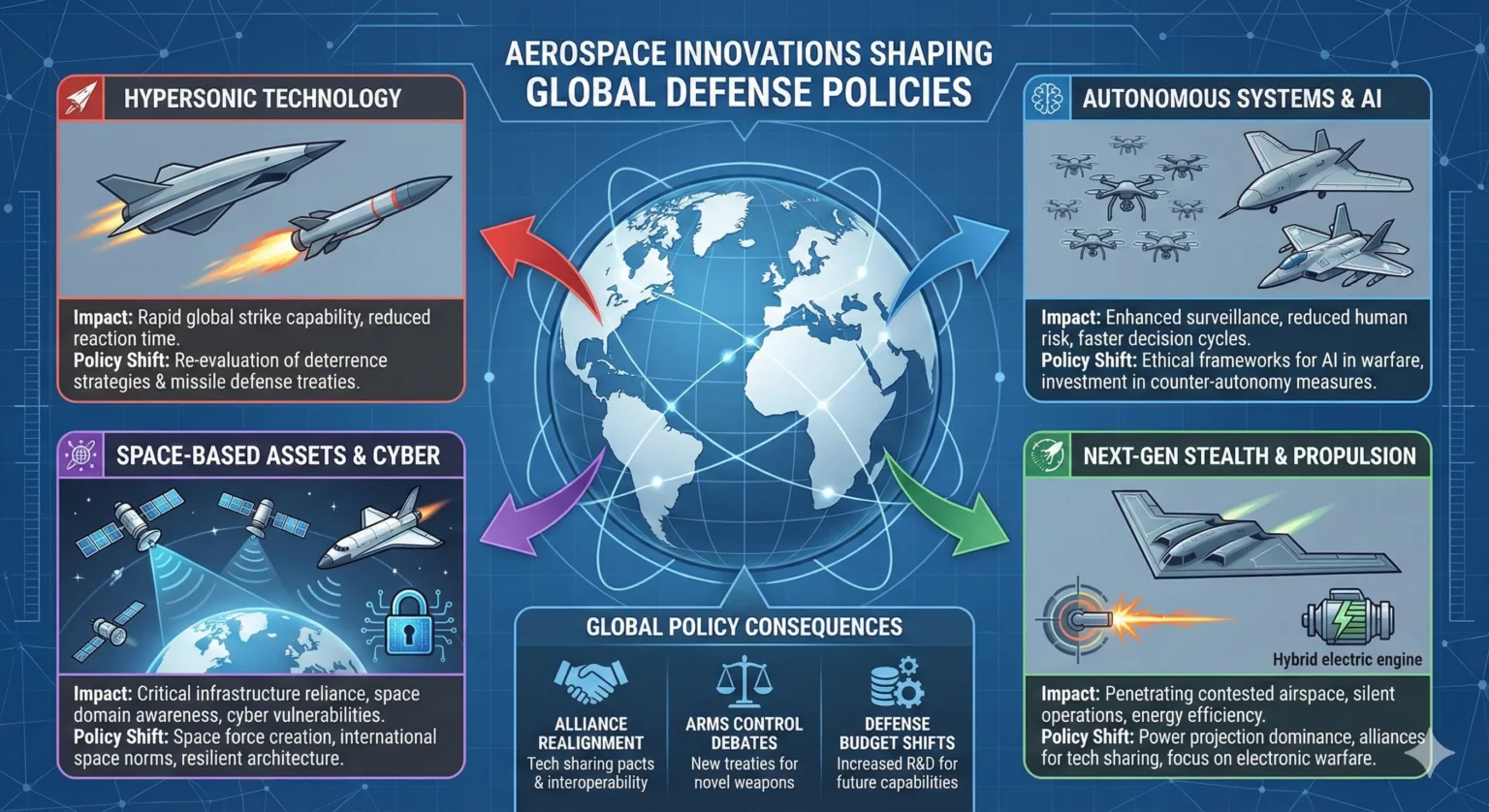
In an era where the skies and stars hold the keys to power, aerospace innovations are not just engineering marvels—they’re the invisible architects of global defense strategies. From the roar of jet engines during World War II to the silent glide of hypersonic missiles streaking across continents today, these breakthroughs have repeatedly forced nations to rewrite their military doctrines, reallocate budgets, and forge uneasy alliances.
Imagine a world where a single unmanned aerial vehicle (UAV) swarm can neutralize a carrier strike group, or where artificial intelligence (AI)-driven satellites predict conflicts before the first shot is fired. This isn’t science fiction; it’s the reality reshaping how superpowers like the United States, China, and emerging players like India approach security. As geopolitical tensions simmer—from the South China Sea to Eastern Europe—these technologies don’t just enhance capabilities; they dictate the very rules of engagement, compelling governments to balance innovation with ethics, economics, and international norms.
The interplay between aerospace advancements and defense policies is profound. Historically, breakthroughs in flight and propulsion spurred massive investments in air superiority, leading to doctrines like strategic bombing that defined the 20th century. Today, the rise of autonomous systems and space-based weapons is pushing policies toward multi-domain operations, where air, sea, land, cyber, and space converge in a single battlespace. Nations are pouring trillions into R&D, with global defense spending projected to hit $2.5 trillion by 2027, much of it funneled into aerospace. Yet, this arms race isn’t without controversy: ethical debates rage over lethal autonomous weapons, while supply chain vulnerabilities expose how reliant modern militaries are on fragile global networks.
Table of Contents
As we delve deeper, we’ll explore how these innovations have evolved, their tangible impacts on policy, real-world examples, and the horizon ahead—revealing a future where control of the atmosphere isn’t just a tactical edge, but a cornerstone of sovereignty.
The Historical Foundations: From Wings to Missiles
Aerospace’s story begins with humble propellers but quickly escalates to world-altering forces. The Wright brothers’ first powered flight in 1903 wasn’t merely a milestone in human ingenuity; it ignited a frenzy of military interest that would culminate in the aerial dogfights of World War I. By 1918, rudimentary reconnaissance planes had evolved into bombers capable of strategic strikes, prompting early defense policies focused on air defense perimeters. European powers, reeling from the war’s devastation, invested heavily in aviation treaties, like the Washington Naval Treaty of 1922, which indirectly capped aerial naval support to maintain fragile peace.
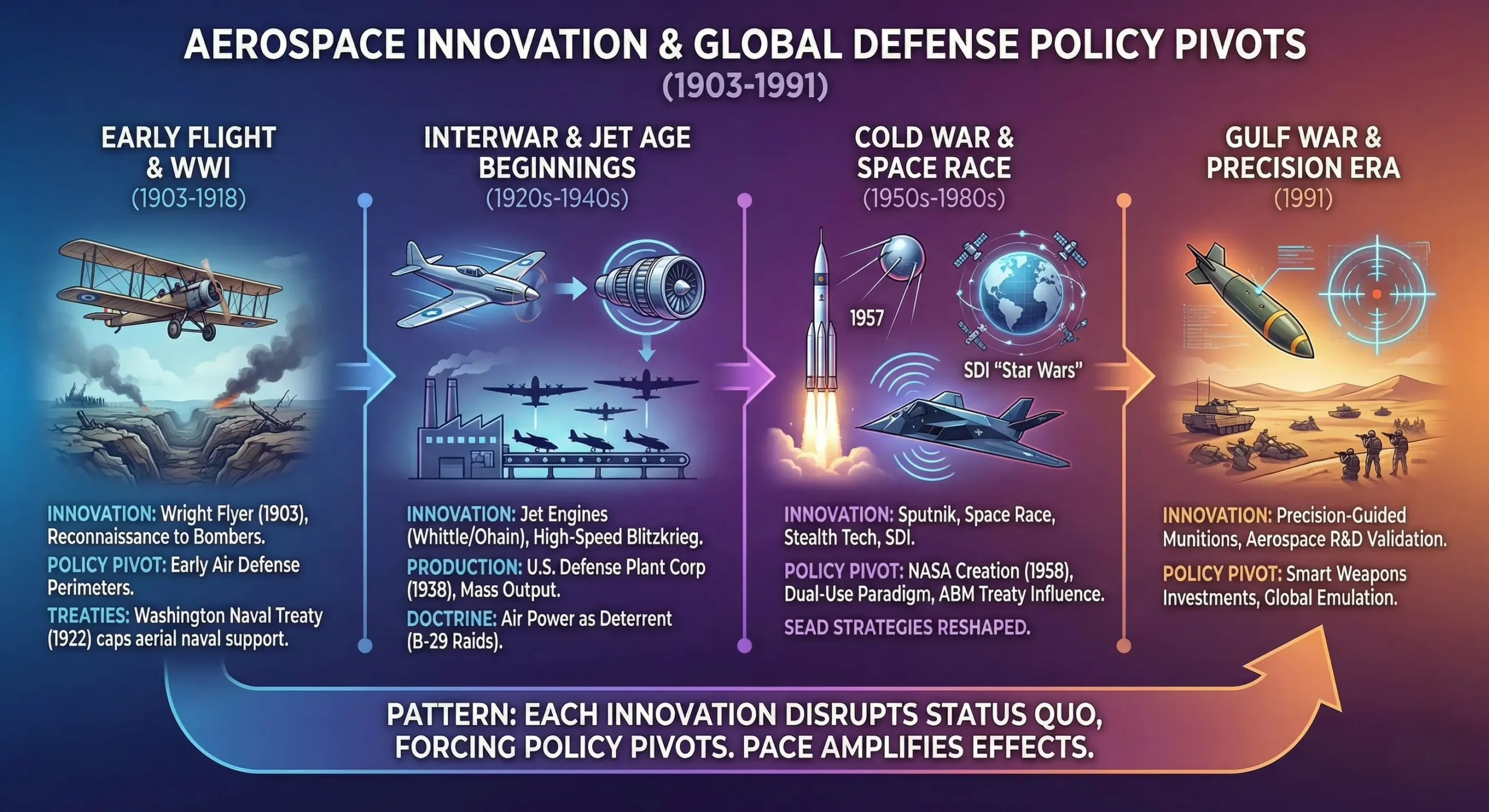
The interwar period saw acceleration. The development of jet engines in the late 1930s by engineers like Frank Whittle in Britain and Hans von Ohain in Germany transformed warfare from biplane skirmishes to high-speed blitzkriegs. World War II exemplified this shift: the Allies’ supremacy in production—churning out over 300,000 aircraft—stemmed from policies like the U.S. Defense Plant Corporation of 1938, which funneled civilian factories into military output. Companies such as Boeing and Lockheed pivoted assembly lines to produce icons like the B-29 Superfortress, whose firebombing raids over Japan influenced post-war doctrines emphasizing air power as a deterrent.
Post-1945, the Cold War supercharged aerospace’s policy role. The Soviet Union’s Sputnik launch in 1957 not only sparked the space race but also birthed U.S. policies like the National Aeronautics and Space Act of 1958, creating NASA while embedding military oversight through the Air Force. This dual-use paradigm—civilian tech feeding defense—led to breakthroughs like stealth technology in the 1970s, tested on the F-117 Nighthawk, which evaded radar and reshaped suppression of enemy air defenses (SEAD) strategies. By the 1980s, President Ronald Reagan’s Strategic Defense Initiative (SDI), dubbed Star Wars, poured billions into space-based interceptors, influencing arms control talks and the Anti-Ballistic Missile (ABM) Treaty amendments.
These historical threads weave a pattern: each innovation disrupts the status quo, forcing policy pivots. The Gulf War of 1991 showcased precision-guided munitions from aerospace R&D, validating U.S. investments in smart weapons and inspiring global emulation. Yet, as we’ll see, today’s pace—driven by digital integration—amplifies these effects exponentially.
| Historical Aerospace Innovation | Key Development Year | Policy Impact | Example Outcome |
|---|---|---|---|
| Powered Flight | 1903 | Shift to aerial reconnaissance in treaties | Hague Conventions limited the bombing of civilians |
| Jet Engine | 1939 | Emphasis on air superiority doctrines | Blitzkrieg tactics in WWII; post-war NATO air commands |
| Sputnik Satellite | 1957 | Creation of space agencies with military ties | NASA Act; escalation in ICBM deployments |
| Stealth Technology | 1977 (F-117 debut) | Focus on SEAD and asymmetric warfare | ABM Treaty revisions; reduced reliance on massed forces |
| Precision-Guided Munitions | 1991 (Gulf War use) | Budgets for “smart” vs. “dumb” weapons | Global surge in UAV procurement; end of carpet bombing norms |
This table highlights how innovations didn’t just enhance tools—they redefined what “defense” means, from territorial buffers to orbital denial.
Core Innovations Driving Modern Defense Shifts
Contemporary aerospace lies technologies that blur lines between offense, defense, and deterrence. Unmanned Aerial Vehicles (UAVs), or drones, have democratized air power, allowing even mid-tier nations to project force without risking pilots. Evolving from reconnaissance tools in the 1990s to armed predators like the MQ-9 Reaper, UAVs now incorporate swarm tactics, where hundreds coordinate via AI for saturation attacks. This has prompted policies like the U.S. Replicator Initiative of 2023, aiming to field thousands of low-cost, attritable drones to counter anti-access/area denial (A2/AD) systems in the Indo-Pacific.
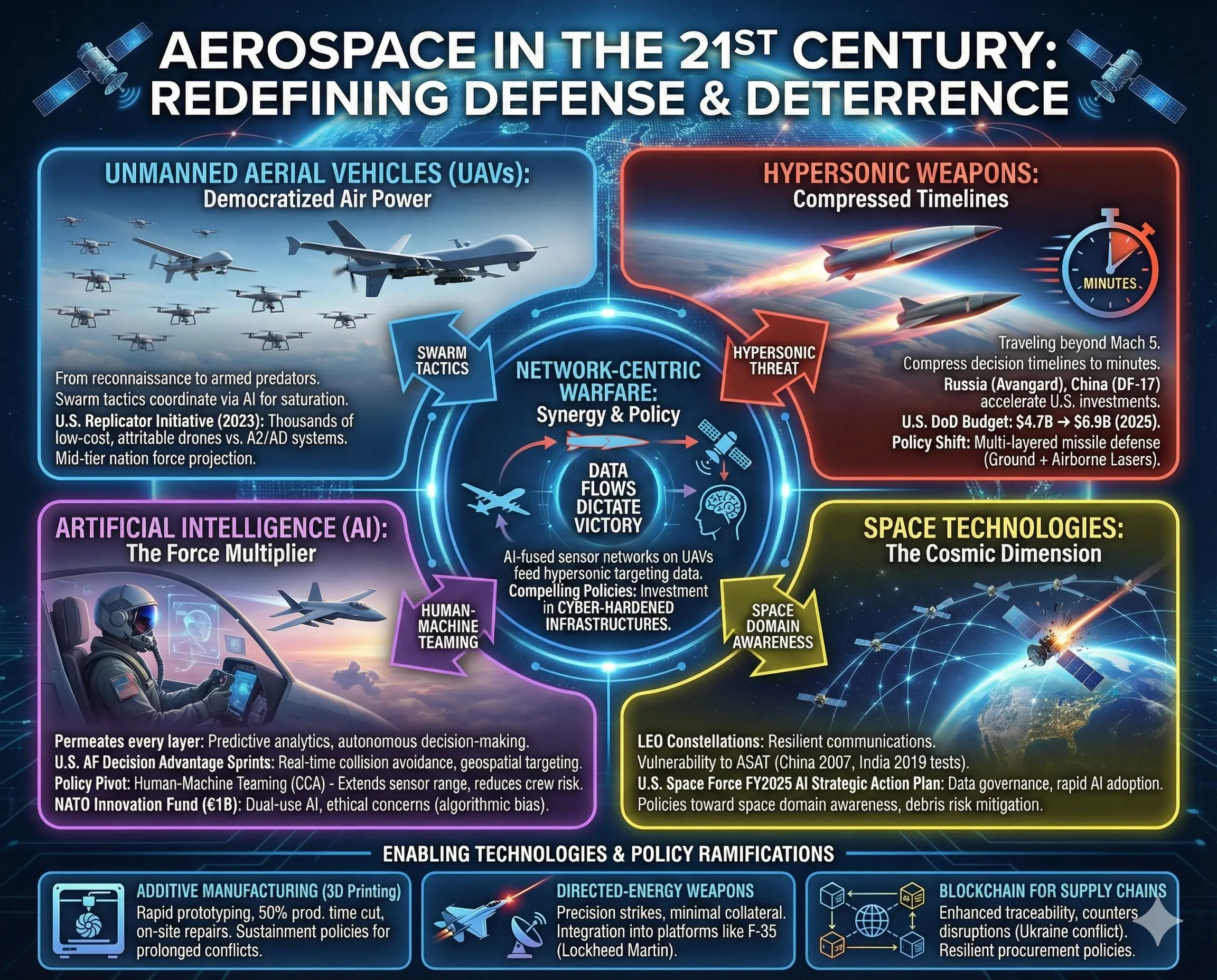
Hypersonic weapons, traveling beyond Mach 5, compress decision timelines to minutes, rendering traditional defenses obsolete. Russia’s Avangard glide vehicle and China’s DF-17 missile have accelerated U.S. investments, with the Department of Defense (DoD) boosting hypersonic budgets from $4.7 billion to $6.9 billion in 2025 alone. Policies now emphasize multi-layered missile defense, integrating ground-based interceptors with airborne lasers, as seen in NATO’s enhanced forward presence.
Artificial Intelligence (AI) permeates every layer, from predictive analytics to autonomous decision-making. In mission systems, AI enables real-time collision avoidance and geospatial targeting, as demonstrated in U.S. Air Force Decision Advantage Sprints. For defense policies, this means a pivot to human-machine teaming, where AI augments pilots in collaborative combat aircraft (CCA)—loyal wingmen that extend sensor ranges without escalating crew risks. Europe’s NATO Innovation Fund, a €1 billion pool for dual-use AI, underscores how these tools foster alliances while addressing ethical concerns like algorithmic bias in targeting.
Space technologies add a cosmic dimension. Low-Earth Orbit (LEO) constellations like Starlink enable resilient communications, but also vulnerability to anti-satellite (ASAT) weapons, as tested by China in 2007 and India in 2019. The U.S. Space Force’s FY2025 AI Strategic Action Plan prioritizes data governance and rapid AI adoption, influencing policies toward space domain awareness treaties to mitigate debris risks.
- Additive Manufacturing (3D Printing): Revolutionizes rapid prototyping of turbine blades, cutting production times by 50% and enabling on-site repairs in contested zones—key for sustainment policies in prolonged conflicts.
- Directed-Energy Weapons: Lasers and microwaves offer precision strikes with minimal collateral, driving budgets for integration into fighters like the F-35, as pursued by Lockheed Martin.
- Blockchain for Supply Chains: Enhances traceability in global parts sourcing, countering disruptions seen in the Ukraine conflict, and informing resilient procurement policies.
These innovations aren’t isolated; they synergize, creating network-centric warfare where data flows dictate victory. For instance, AI-fused sensor networks on UAVs feed hypersonic targeting data, compelling policies that invest in cyber-hardened infrastructures.
Policy Ramifications: Budgets, Alliances, and Doctrinal Overhauls
Aerospace innovations don’t whisper suggestions—they demand action. Global defense budgets, already at historic highs with U.S. spending topping $1 trillion, are skewing toward aerospace: over 50% of post-WWII expenditures have funded air power, a trend accelerating with drones claiming 20% of new allocations. The DoD’s positioning of AI as a foundational capability across missions—from simulation to command—exemplifies this, with initiatives like agentic AI for autonomous planning reshaping acquisition laws to favor agile contractors over legacy giants.
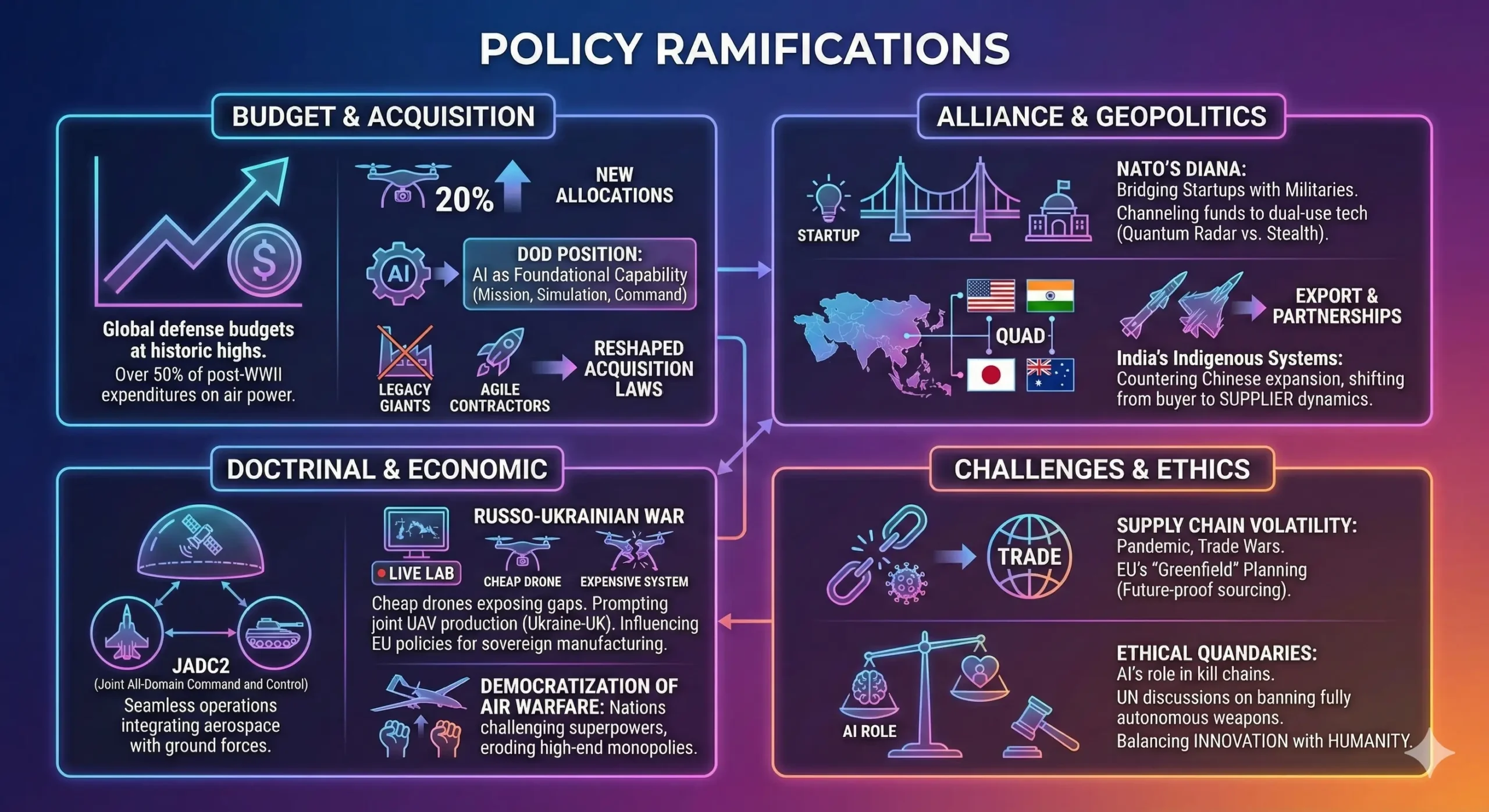
Alliances evolve too. NATO’s Defence Innovation Accelerator for the North Atlantic (DIANA) bridges startups with militaries, channeling funds into dual-use tech like quantum radar to counter stealth threats. In Asia, India’s indigenous Akash missile system and Tejas fighters bolster QUAD partnerships, exporting affordable air defenses to counter Chinese expansion—shifting from buyer to supplier dynamics.
Doctrinally, the move is toward joint all-domain command and control (JADC2), integrating aerospace with ground forces for seamless operations. The Russo-Ukrainian War has been a live lab: cheap drones exposing gaps in expensive systems, prompting Ukraine’s joint UAV production with the UK, and influencing EU policies for sovereign manufacturing. Economically, this fosters “democratization of air warfare,” where nations like Turkey with Bayraktar TB2 drones challenge superpowers, eroding monopolies on high-end platforms.
Yet, challenges abound. Supply chain volatility—exacerbated by pandemics and trade wars—demands policies like the EU’s “greenfield” planning, prioritizing future-proof sourcing. Ethical quandaries, such as AI’s role in kill chains, spur UN discussions on banning fully autonomous weapons, balancing innovation with humanity.
| Policy Area | Pre-Innovation Focus | Post-Innovation Shift | Global Example |
|---|---|---|---|
| Budget Allocation | Manned platforms (e.g., fighters 50% of air budgets) | Attritable autonomy (drones 20%+ surge) | U.S. Replicator: $1B for 1,000+ UAVs by 2025 |
| Alliance Structures | Bilateral arms sales | Multilateral R&D hubs | NATO DIANA: €1B for AI/space tech |
| Doctrinal Emphasis | Air superiority via mass | Airspace denial via networks | India’s multi-node aerostat radars for layered defense |
| Ethical Frameworks | Human-in-loop targeting | Debates on lethal autonomy | UN talks on banning AI weapons post-Ukraine drone use |
This framework illustrates the ripple effects, turning tech labs into policy engines.
Case Studies: Innovations in Action Across Continents
Real-world applications illuminate these dynamics. In the U.S., the F-35 Lightning II program—a $1.7 trillion behemoth—integrates stealth, AI, and sensor fusion, but its teething issues highlight policy trade-offs: prioritizing interoperability over speed, as allies like the UK adapt for CCA wingmen. The Replicator Initiative counters this by flooding the Pacific with cheap drones, directly responding to China’s A2/AD bubbles and influencing AUKUS pacts for shared hypersonic R&D.
China’s ascent is stark. Investments in high-altitude pseudo-satellites (HAPS) and particle beam weapons—a 2.6-megawatt satellite system with microsecond precision—threaten U.S. orbital dominance, prompting DoD shifts toward resilient LEO swarms. Beijing’s 3D network-centric doctrine, layering sensors at 40,000 meters with hypersonic strikes, checkmates traditional incursions, fueling U.S. policies for low-orbit substitutes, and accelerating NGAD (Next Generation Air Dominance) prototypes.
Europe’s response to Ukraine has been transformative. The war’s drone barrages rendered missile defenses uneconomical, birthing policies for economically viable countermeasures like electronic warfare jammers and cheap interceptors. Joint UK-Ukraine Raybird UAV production exemplifies rearming through innovation, with the EU’s net-zero goals weaving sustainability into defense—hydrogen-powered aircraft reducing emissions while enhancing endurance.
India emerges as a wildcard. Controlling 50% of global air power budgets historically, its focus on indigenous systems like BrahMos hypersonics and aerostat-borne radars builds a “formidable package” for export, challenging U.S./Chinese dominance and reshaping Indo-Pacific deterrence. Policies emphasize multi-domain integration, with QUAD collaborations countering border threats.
- U.S.-China Hypersonic Race: U.S. lags prompt $6.9B boost; China fields DF-17, altering Taiwan Strait strategies.
- Ukraine’s Drone Swarms: 80% of strikes are unmanned; influences NATO’s €1B fund for attritable tech.
- India’s Akash Exports: Low-cost SAMs to Vietnam/Armenia; bolsters non-aligned deterrence.
These cases show innovations as policy catalysts, turning battlefields into blueprints.
Emerging Frontiers: Sustainability, Autonomy, and Ethical Horizons
Looking ahead, aerospace’s trajectory points to convergence. Generative AI will automate kill chains, as in U.S. Intelligent Decision Support Systems (IDSS), but raises fears of escalation—prompting policies for “human oversight” mandates. By 2035, the space economy will hit $1.8 trillion, with reusable rockets and HAPS enabling persistent surveillance, influencing treaties like the updated Outer Space Treaty for debris norms.
Sustainability integrates deeply: zero-emission hydrogen aircraft from Airbus targets net-zero by 2050, aligning defense with global climate pacts and reducing logistical footprints. Autonomy surges, with unmanned ships and robot wingmen under CCA programs, but vulnerabilities—like GNSS dependencies—demand policies for redundant, jam-proof networks.
Ethical tensions loom large. Lethal autonomous weapons risk “democratizing” atrocities, as cheap drones proliferate, urging international bans akin to chemical weapons conventions. Workforce shifts—AI displacing pilots—necessitate upskilling policies, with DoD emphasizing diverse talent for innovation.
| Future Trend | Projected Impact by 2030 | Policy Driver | Potential Risk |
|---|---|---|---|
| Generative AI in Targeting | 30% faster decision cycles | JADC2 mandates | Escalation from false positives |
| Hypersonic Proliferation | Market to $19.5B | Export controls | Arms race in Asia-Pacific |
| Sustainable Propulsion | 40% emission cuts | Net-zero aviation goals | Higher upfront R&D costs |
| LEO Swarms | USD 54.7B autonomous market | Space resilience treaties | Orbital congestion/debris |
Anticipating these ensures policies evolve proactively.
Navigating Challenges: Equity, Risks, and Global Cooperation
No innovation thrives unchecked. Talent constraints plague the sector, with aging workforces and skill gaps demanding policies like the U.S. CHIPS and Science Act for STEM pipelines. Geopolitical flux—rising powers like India challenging duopolies—fosters multipolar policies, where tech transfers build coalitions against common threats.
Equity matters: developing nations, squeezed by costs, turn to affordable Indian/Chinese systems, altering alliances and underscoring the need for inclusive R&D forums. Risks like cyber vulnerabilities in networked UAVs require robust policies, blending offense with defense in multi-domain operations.
Cooperation offers salvation. Initiatives like AIA’s Vision for 2050 advocate unified advocacy for policies enhancing competitiveness while safeguarding ethics. By 2050, aerospace could propel economies and security, but only if policies harness innovation for peace, not peril.
In conclusion, aerospace innovations are the pulse of global defense, pulsing through history to forge tomorrow’s safeguards. From historical propellers to futuristic beams, they compel bold policies that secure skies without scorching earth. As nations navigate this aerial odyssey, the lesson is clear: innovate wisely, or risk being outflown. The stars await those who lead with vision.
Key Citations And References
- 2026 Aerospace and Defense Industry Outlook | Deloitte Insights
- Top 10 Aerospace and Defense Industry Trends – PTC
- A rising wave of tech disruptors: The future of defense innovation?
- What’s Next for Aerospace and Defense: A Vision for 2050
- New Technology Trends in Aerospace and Defense Industry [2025]
- The History of Aerospace
- Aerospace History Timeline by AIAA
- The History of The U.S. Defense Industrial Base – Cevians
- Emerging trends in aerospace and defense 2025 – KPMG International
- Aerospace and defense industry trends – PwC
- Top 10 Aerospace Trends & Innovations in 2026 | StartUs Insights
- X Post by @Microinteracti1 on European defense innovation
- X Post by @zhao_dashuai on democratization of air warfare
- X Post by @boris_beissner on air defense transformation
- X Post by @MarioNawfal on warfare revolution
- X Post by @suryakane on India’s air defense
- X Post by @pati_marins64 on network-centric warfare
Read These Articles in Detail
- Aerospace Engineering vs. Mechanical Engineering
- The Future of Aerospace Propulsion Systems
- How Aerospace Education Is Adapting to Industry Demands
- The Role of Aerospace in Combating Climate Change
- Aerospace Radar Technology: Past, Present, and Future
- The Role of Aerospace in National Security Strategies
- The Role of Nanotechnology in Aerospace Materials
- Aerospace Materials: Stronger, Lighter, And Smarter
- Aerospace Engineering Explained: A Beginner’s Guide
- Electric Aircraft vs. Hydrogen Aircraft: Which Is More Sustainable?
- Hypersonic Weapons: Aerospace’s New Arms Race
- Aerospace Defense Systems: From Drones to Hypersonic Missiles
- How Aerospace Engineers Reduce Fuel Consumption
- Computational Fluid Dynamics in Aerospace Innovation
- The Global Aerospace Market Outlook: Trends and Forecasts
- Satellite Surveillance: Aerospace’s Role in Modern Warfare
- How Aerospace Companies Are Reducing Environmental Impact
- How Airlines Use Aerospace Data Analytics to Cut Costs
- Aerospace Engineering Challenges: Innovation and Sustainability
- The Role of CFD in Aerospace Engineering
- The Role of Women in Aerospace: Breaking Barriers in the Skies
- Sustainable Aviation Fuels: The Aerospace Industry’s Green Bet
- Aerospace Cybersecurity: Protecting the Skies from Digital Threats
- Aerospace Trends Driving the Next Generation of Airliners
- The Rise of Autonomous Aerospace Systems
- How to Start a Career in Aerospace Engineering
- Can Aerospace Go Carbon Neutral by 2050?
- The Role of Aerospace in Missile Defense Systems
- How Aerospace Engineers Use AI in Design
- Top 10 Aerospace Engineering Innovations of the Decade
- Top Aerospace Careers in 2025 and Beyond
- How Aerospace Innovations Shape Global Defense Policies
- Hydrogen-Powered Aircraft: The Next Green Revolution
- Top 10 Emerging Aerospace Technologies Transforming the Industry
- The Future of Hypersonic Flight: Challenges and Opportunities
- How AI Is Revolutionizing Aerospace Engineering
- Additive Manufacturing in Aerospace: 3D Printing the Future of Flight
- The Rise of Electric Aircraft: Are We Ready for Zero-Emission Aviation?
- Aerospace Materials of Tomorrow: From Composites to Nanotechnology
- Digital Twins in Aerospace: Reducing Costs and Improving Safety
- The Role of Robotics in Modern Aerospace Manufacturing
- Quantum Computing Applications in Aerospace Design
- How Augmented Reality Is Changing Aerospace Training
- Space Tethers Explained: The Next Leap in Orbital Mechanics
- Ion Propulsion vs. Chemical Rockets: Which Will Power the Future?
- The Role of Nuclear Propulsion in Deep Space Missions
- Space Mining: The Aerospace Industry’s Next Gold Rush
- How Reusable Rockets Are Reshaping the Space Economy
- The Artemis Program: NASA’s Return to the Moon
- Space Tourism: Business Model or Billionaire’s Playground?
- How Aerospace Startups Are Disrupting Commercial Aviation
- The Economics of Low-Cost Airlines in the Aerospace Era
- Urban Air Mobility: The Rise of Flying Taxis
- The Future of Mars Colonization: Key Aerospace Challenges and Solutions Ahead
- CubeSats and Small Satellites: Democratizing Space Access
- The Future of Cargo Drones in Global Logistics
- The Role of Aerospace in Building a Lunar Economy
Frequently Asked Questions
FAQ 1: What Historical Aerospace Innovations Have Most Shaped Global Defense Policies?
The evolution of aerospace technologies has long been intertwined with the shifting sands of global security, turning what started as experimental flights into cornerstones of military strategy. From the dawn of powered flight to the dawn of the space age, these innovations haven’t just improved capabilities—they’ve forced governments to rethink alliances, budgets, and even the ethics of warfare. Understanding this history helps explain why today’s policies prioritize things like air superiority and orbital dominance, as nations learn from past conflicts where aerial power tipped the scales.
Take the Wright brothers’ powered flight in 1903, which sparked immediate military interest and led to early reconnaissance roles in World War I. This shift prompted the Hague Conventions to limit aerial bombing of civilians, setting a precedent for international norms that still echo in modern treaties. Fast forward to the jet engine’s debut in 1939, pioneered by figures like Frank Whittle and Hans von Ohain, and you see how it fueled World War II blitzkriegs, influencing post-war structures like NATO’s air commands. These weren’t isolated breakthroughs; they demanded policy responses, such as the U.S. Defense Plant Corporation ramping up production to over 300,000 aircraft, proving that industrial mobilization could win wars.
The Cold War amplified this pattern dramatically. The Soviet Sputnik launch in 1957 didn’t just kick off the space race—it birthed the National Aeronautics and Space Act, blending civilian exploration with military oversight through the Air Force. Stealth tech, tested on the F-117 Nighthawk in the 1970s, revolutionized suppression of enemy air defenses, while Reagan’s Star Wars initiative in the 1980s poured billions into space interceptors, reshaping arms talks like the Anti-Ballistic Missile Treaty. By the Gulf War in 1991, precision-guided munitions validated “smart” weapon investments, ending reliance on indiscriminate bombing and inspiring worldwide UAV adoption.
Looking at it through a structured lens reveals clear patterns: each era’s tech disrupted the balance of power, compelling reactive policies that evolved into proactive doctrines.
| Innovation | Year | Key Policy Shift | Lasting Impact |
|---|---|---|---|
| Powered Flight | 1903 | Aerial reconnaissance treaties | Hague limits on civilian bombing |
| Jet Engine | 1939 | Air superiority focus | NATO integrated air forces |
| Sputnik Launch | 1957 | Space agency creation | ICBM proliferation and NASA dual-use model |
| Stealth Tech | 1977 | Asymmetric warfare emphasis | ABM Treaty adaptations |
| Precision Munitions | 1991 | Smart weapon budgets | Decline in mass bombing doctrines |
This timeline underscores how aerospace has been a policy forge, hammering out strategies that prioritize speed, stealth, and precision over sheer numbers.
FAQ 2: How Are UAVs Revolutionizing Defense Strategies in 2025?
Unmanned aerial vehicles, or UAVs, have moved from niche tools to game-changers in global defense, especially as conflicts like those in Ukraine highlight their role in everything from surveillance to precision strikes. In 2025, with production ramping up worldwide, UAVs are forcing a rethink of traditional manned operations, emphasizing swarms and attritable designs that reduce human risk while overwhelming adversaries. This isn’t just about tech—it’s reshaping budgets and doctrines, as nations race to field thousands of these affordable assets.
The U.S. Army’s SkyFoundry program, launched this year, aims to produce a million drones in the next two to three years through public-private partnerships, addressing gaps exposed in recent exercises. This initiative counters anti-access/area denial threats in regions like the Indo-Pacific, where cheap swarms can saturate defenses. Meanwhile, counter-UAV efforts are booming: the Army’s request for interceptor components signals a future program to tackle small drone swarms, blending AI detection with low-cost rams. Europe’s experiments, like the Merops system tested with Poland and Romania, show NATO allies integrating AI-enabled truck-mounted counters, extending these tactics to the Indo-Pacific.
Beyond hardware, UAVs are driving policy toward “democratized” warfare. Nations like Turkey with the Bayraktar TB2 are exporting capabilities, eroding superpowers’ monopolies and prompting alliances like AUKUS to share tech. The Pentagon’s push for low-cost production, spurred by a 2025 executive order, underscores this: drones aren’t luxuries anymore—they’re the backbone of resilient, scalable forces. As swarms evolve, expect doctrines to stress human-machine teaming, ensuring operators retain oversight amid ethical debates on autonomy.
FAQ 3: What Impact Are Hypersonic Weapons Having on Global Defense Policies in 2025?
Hypersonic weapons, zipping past Mach 5 with maneuverability that dodges traditional defenses, are compressing reaction times and igniting an arms race that’s rewriting international security rules. In 2025, as Russia deploys more Avangard gliders and China rolls out DF-17 missiles, policies are pivoting from deterrence to multi-layered shields, with budgets ballooning to counter these “prompt global strike” threats.
- Budget Surges and Program Shifts: The U.S. DoD’s FY2026 request dips to $3.9 billion for hypersonics from $6.9 billion in 2025, but the Missile Defense Agency ups its ask to $200.6 million for interceptors, signaling a focus on affordability amid test failures like the shelved ARRW. This reflects broader policy debates: critics argue these weapons lack clear missions and fuel escalation, while proponents see them as vital for hitting time-sensitive targets like mobile missiles.
- Arms Control Tensions: Fielding hypersonics risks unraveling treaties like New START, expiring in 2026, as they enable responsive strikes that blur nuclear thresholds. Nations are eyeing expansions or new pacts, but U.S. resistance to space-based limits draws fire from China and Russia, who decry “militarization” while advancing their own ASAT counters.
- Regional Ripples: In the Gulf, Iran’s basic hypersonics prompt GCC states to boost IAMD, selectively co-developing with the U.S. to avoid export snags. Globally, the market hits $19.5 billion by 2030, driving export controls and alliances like AUKUS for shared R&D.
These dynamics highlight hypersonics as policy accelerators, demanding balanced innovation to avoid a destabilizing spiral.
FAQ 4: How Is Artificial Intelligence Reshaping Aerospace Defense Policies in 2025?
Artificial intelligence (AI) is no longer a buzzword in aerospace defense—it’s the engine powering everything from predictive maintenance to autonomous swarms, with policies adapting to embed it as a “foundational capability.” This year’s focus is on rapid adoption, ethical governance, and partnerships, as spending surges to $5.8 billion by 2029 in the U.S. alone.
The DoD’s push for AI in missions like simulation and command control is evident in contracts to four leading firms, accelerating tools for operator assistants. Space Force’s FY2025 plan emphasizes data literacy and AI-driven cultures, fostering ties with industry for analytics.
| AI Application | Policy Driver | 2025 Impact | Example |
|---|---|---|---|
| Predictive Maintenance | DoD AI foundational initiatives | 30% downtime reduction | GE Aviation’s tailored systems |
| Autonomous Systems | JADC2 mandates | Faster decision cycles | Project Maven drone analysis |
| Data Governance | Space Force Action Plan | Enterprise-wide AI literacy | Guardian workforce upskilling |
| Human-Machine Teaming | NATO Innovation Fund | Bias mitigation in targeting | €1B for dual-use AI |
By 2030, 49% of production could be AI-powered, but policies must tackle biases and cyber risks to keep advancements ethical and secure.
FAQ 5: Why Are Space Technologies Central to Global Defense Strategies in 2025?
Space isn’t just the final frontier anymore—it’s the high ground of modern warfare, where satellites enable everything from GPS to missile warnings, making it a $1.8 trillion economy by 2035. In 2025, escalating threats like jamming in conflict zones are pushing policies toward resilient constellations and domain awareness, as nations like the U.S. boost Space Force funding to $40 billion while slashing NASA’s budget.
The CSIS Space Threat Assessment 2025 details counterspace weapons from China, Russia, Iran, and North Korea, including GPS spoofing in the Middle East, underscoring the need for treaties on debris and ASATs. U.S. efforts like the SDA’s transport layer provide low-latency military data, integrating air-space ops for joint missions. Meanwhile, commercial mega-constellations like Starlink capture 66% of launches but only 11% of value, with defense anchoring 48% economically.
As threats evolve, policies emphasize “defense for space,” blending innovation with international cooperation to safeguard assets critical to daily life and security.
FAQ 6: What Defines the US-China Aerospace Arms Race in 2025?
The US-China aerospace rivalry is heating up, with satellite imagery revealing China’s missile sites expanding by 21 million square feet since 2020, fueling a “new arms race” in hypersonics and space. This isn’t just about hardware—it’s a contest for strategic parity, as Beijing’s nuclear stockpile grows by 100 warheads yearly, nearing U.S. levels by 2035.
- Missile and Nuclear Buildup: China’s surge in production sites for advanced missiles prompts U.S. responses like the Golden Dome shield, decried by Beijing as OST-violating and arms-race igniting. Russia joins, viewing it as space militarization.
- Space Domain Competition: The LAUNCH Act counters China’s accelerating program, which meets Apollo-era goals while U.S. delays mount; Beijing eyes AI dominance by 2030.
- Rare Earths Leverage: China’s export curbs on elements vital for magnets hit U.S. defense, spurring domestic “mine-to-magnet” chains by 2027.
This three-way nuclear dynamic with Russia risks New START’s lapse, demanding diplomacy amid tech races.
FAQ 7: How Are Sustainable Innovations Transforming Defense Aerospace?
Sustainability in defense aerospace is bridging green goals with security needs, as firms target net-zero by 2050 through fuels and propulsion that cut emissions without compromising readiness. This shift isn’t optional—it’s driven by policies tying defense to climate pacts, unlocking resilient supply chains.
| Innovation | Emission Reduction Potential | Defense Application | 2025 Milestone |
|---|---|---|---|
| Sustainable Aviation Fuels (SAF) | Up to 80% lifecycle cut | Boeing’s 100% SAF flights | EU mandates for military use |
| Hydrogen Propulsion | Zero CO2, water byproduct | Airbus ZEROe concepts | First commercial tests by 2035 |
| Electric/Hybrid Systems | 21% flight emissions drop | Short-haul UAVs | NASA prototypes for endurance |
| Advanced Materials | Lighter composites for efficiency | F-35 integrations | 40% GHG cut by 2034 targets |
Companies like Northrop Grumman lead with 40% reductions by 2034, while General Dynamics pioneers SAF flights, proving eco-innovations enhance operational sustainability. By 2030, these could slash sector emissions by 55%, fostering policies for green procurement.
FAQ 8: What Ethical Dilemmas Surround Lethal Autonomous Weapons in 2025?
Lethal autonomous weapons systems, or LAWS, promise precision but raise profound ethical red flags, from eroding human judgment to risking unchecked escalation. As 156 UN states back resolutions against them, the debate centers on whether machines can ever morally wield lethal force without oversight.
The core issue is accountability: without human control, who bears responsibility for errors, like misidentifying civilians? UN experts warn LAWS violate the right to life by failing distinction and proportionality tests, as algorithms can’t grasp nuanced cues or defuse tensions. Secretary-General Guterres calls them “morally repugnant,” pushing for a 2026 ban on systems lacking oversight, amid fears of proliferation to non-state actors.
Deeper still, LAWS could “de-skill” operators, dulling moral instincts and lowering war’s threshold. While proponents argue they reduce human error, critics like Human Rights Watch highlight humanitarian risks, urging treaties akin to chemical bans. In 2025, as AWS proliferate in conflicts, balancing innovation with humanity demands urgent global norms.
FAQ 9: What Key Future Trends Will Define Aerospace Defense by 2030?
By 2030, aerospace defense will be a tapestry of AI, autonomy, and sustainability, with the sector hitting $1.5 trillion amid talent gaps and green mandates. Policies will prioritize resilient chains and ethical AI, as megatrends converge.
- AI and Autonomy Boom: Agentic AI expands to battlefields, with 15% CAGR in user-facing tools; expect swarms and predictive ops, but with oversight mandates.
- Hypersonic and Space Proliferation: $19.5B market drives layered defenses; LEO swarms hit $54.7B, but debris treaties loom.
- Sustainability Imperatives: 40% emission cuts via hydrogen; net-zero goals reshape procurement.
- Talent and Supply Shifts: Million-person shortages spur upskilling; 45% nearshoring by 2030.
These trends signal a bolder, greener era, where tech outpaces infrastructure, demanding adaptive leadership.
FAQ 10: What Supply Chain Challenges Are Plaguing Aerospace Defense in 2025?
Supply chains in aerospace defense remain fragile in 2025, with disruptions costing airlines $11 billion and delaying military ramps, despite post-pandemic gains. Geopolitics, labor shortages, and competition with civil sectors exacerbate vulnerabilities.
| Challenge | Impact | Mitigation Strategy | 2025 Outlook |
|---|---|---|---|
| Personnel Shortages | 65% cite as top issue | Workforce upskilling via CHIPS Act | Persistent, with 2.2M jobs strained |
| Material/Lead Time Delays | 64% face disruptions | Nearshoring 45% of production | Stabilizing but volatile through 2027 |
| Geopolitical Tensions | Tariffs, rare earth curbs | Redundant failover systems | Tug-of-war with defense budgets |
| Counterfeit/Compliance Risks | Product diversion to sanctioned states | AI-powered de-risking | NDAA amendments heighten scrutiny |
Resilience is improving—disruptions dipped slightly—but scaling defense output stresses tiers, urging sovereign bases and digital twins for visibility.
FAQ 11: How Is India Leading Aerospace Innovations in Global Defense by 2025?
India’s aerospace sector is surging forward in 2025, transforming from a major importer to a key innovator and exporter in defense technologies, driven by government initiatives that prioritize self-reliance and technological sovereignty. This shift is reshaping global defense dynamics, as India’s affordable, high-performance systems gain traction in emerging markets, challenging traditional powerhouses and fostering new alliances in the Indo-Pacific region. With events like Aero India 2025 showcasing indigenous breakthroughs, the country is not just meeting its own security needs but influencing international policies through collaborative R&D and exports.
At the heart of this evolution is the Innovation for Defence Excellence (iDEX) program, which has empowered over 2,000 startups and MSMEs to develop cutting-edge solutions in AI, drones, and quantum tech. For instance, the 2025 edition of Swavlamban highlighted Navy-backed innovations in underwater drones and hypersonic materials, emphasizing a “profit-plus” model where private sector gains align with national security. Defence Minister Rajnath Singh’s vision of a “golden era” underscores this, with investments exceeding $100 billion in programs like the Tejas Mk2 fighter and BrahMos-II hypersonic missile, boosting GDP contributions to over 2% and creating 1.5 million jobs.
This momentum extends to international partnerships, as seen at Dubai Airshow 2025, where 15 iDEX winners displayed versatile systems like the Akash-NG air defense missile, attracting deals with Vietnam and Armenia. Policies under the Atmanirbhar Bharat initiative have delicensed 300+ items, spurring a 25% rise in private sector participation and reducing import dependency by 40%. Yet, challenges like supply chain resilience persist, prompting greenfield investments in sustainable propulsion to align with global net-zero goals.
India’s progress signals a multipolar defense landscape, where cost-effective innovations democratize advanced capabilities, compelling superpowers to adapt procurement strategies and deepen QUAD collaborations for shared tech ecosystems.
FAQ 12: What Lasting Effects Has the Ukraine War Had on Global Aerospace Defense Policies in 2025?
The Ukraine war, now in its fourth year by 2025, continues to serve as a real-time laboratory for aerospace tactics, profoundly influencing defense policies worldwide by validating low-cost unmanned systems over expensive manned platforms and accelerating investments in resilient air defenses. This conflict has exposed vulnerabilities in legacy aircraft, prompting a global pivot toward hybrid manned-unmanned operations and rapid prototyping, with lessons rippling through NATO doctrines and beyond.
From the outset, Ukraine’s innovative use of commercial drones for 80% of strikes has dismantled traditional air superiority models, leading to policies like the U.S. Replicator Initiative’s expansion to produce 1 million attritable UAVs by 2027. European nations, facing Shahed drone swarms, have surged artillery and air defense production by 91% since 2019, with the EU’s €1.5 billion EDIP program channeling funds into joint manufacturing hubs. Russia’s adaptations, including Iskander-M maneuvers to evade Patriots, have heightened focus on electronic warfare, as seen in NATO’s updated forward presence strategies emphasizing layered, AI-augmented shields.
- Budget Reallocations: Global defense spending hit $2.5 trillion, with 20% redirected to drones and EW, as Ukraine’s domestic missile program—now fielding Neptune variants—demonstrates self-sufficiency’s edge over aid dependency.
- Doctrinal Shifts: The war’s emphasis on multi-domain integration has birthed concepts like JADC2 enhancements, where Ukraine’s F-16 integrations with Western systems inform U.S. CCA programs for loyal wingmen.
- Innovation Accelerators: Startups in Kyiv and beyond are prototyping AI-guided swarms, influencing policies for sovereign tech bases, with the UK-Ukraine Raybird production scaling to counter hypersonic threats.
As 2025 unfolds, these effects underscore a future where affordability and adaptability trump sheer firepower, urging policymakers to balance ethical AI use with urgent procurement reforms.
| Policy Shift | Pre-War Focus | 2025 Impact from Ukraine | Example |
|---|---|---|---|
| Air Defense Prioritization | Manned interceptors | Drone swarm countermeasures | EU’s €1B fund for attritable tech |
| Unmanned Systems Investment | Reconnaissance UAVs | Offensive swarms and EW | U.S. SkyFoundry: 1M drones by 2027 |
| Supply Chain Resilience | Global sourcing | Sovereign manufacturing | Ukraine’s Neptune missile scaling |
| Alliance Procurement | Bilateral sales | Multilateral R&D | NATO DIANA’s joint EW hubs |
This table captures how the war’s lessons are forging more agile, collaborative defense frameworks.
FAQ 13: What Are the Latest Advances in Stealth Technology for Defense Applications in 2025?
Stealth technology in 2025 is evolving beyond radar evasion into a multi-spectral shield that counters quantum sensors and infrared detection, driven by the need to penetrate advanced A2/AD environments in contested regions like the South China Sea. These innovations are not just enhancing aircraft survivability but are prompting doctrinal overhauls, as nations integrate AI-driven adaptive coatings and swarm tactics to maintain air dominance amid rising threats from hypersonic and drone proliferation.
Lockheed Martin’s upgrades to the F-35 exemplify this, incorporating infrared-suppressing engine inlets and AI-optimized body shapes for a “meaningful increase” in low-observability, with prototypes eyeing deployment by 2027 at half the cost of full NGAD platforms. DARPA’s warnings about quantum radars nullifying traditional stealth have accelerated R&D into electromagnetic camouflage, where materials dynamically alter signatures based on real-time threats, as tested in the X-45 unmanned series.
Meanwhile, China’s quantum radar prototypes, capable of spotting stealth jets at extended ranges, are fueling U.S. countermeasures like the Vectis drone—a Category 5 reusable platform with modular stealth payloads for CCA integration. Europe’s focus on miniaturization allows swarms of palm-sized drones to obfuscate larger assets, blending AI pathfinding with metamaterials for near-invisibility.
These advances signal a stealth paradigm where obfuscation via autonomy trumps physical invisibility, influencing policies toward hybrid fleets that prioritize scalability and ethical AI oversight in targeting.
FAQ 14: How Are Directed Energy Weapons Transforming Aerospace Defense in 2025?
Directed energy weapons, harnessing lasers and microwaves for precision strikes, are maturing rapidly in 2025, offering unlimited “magazine depth” against drone swarms and missiles while slashing logistics costs in high-threat theaters. This shift from kinetic to energy-based defenses is redefining aerospace operations, as systems like Israel’s Iron Beam enter service, compelling global policies to integrate DEWs into multi-layered architectures for cost-effective deterrence.
The U.S. Army’s DE M-SHORAD program leads with 50kW lasers on Strykers, proven in Fort Sill exercises to neutralize UAS threats alongside traditional interceptors, paving the way for the FY26 Enduring High Energy Laser acquisition. Raytheon’s 20kW LOCUST systems on JLTVs mark a milestone, with prototypes delivered for mobile C-UAS roles, reducing per-shot costs to under $1 from millions in missiles.
- Power Scaling: From 10kW palletized units to 300kW airborne variants, DEWs address hypersonic intercepts, with the DoD’s roadmap targeting 500kW by FY2025 for carrier-based deployments.
- Platform Integration: Naval applications like DragonFire’s aerial engagements highlight versatility, influencing NATO’s push for DEW retrofits on F-35s.
- Sustainability Gains: Zero-emission operations align with net-zero mandates, though challenges like atmospheric interference spur R&D in adaptive optics.
By 2030, DEWs could capture 15% of defense budgets, fostering treaties on non-lethal uses while enhancing ethical frameworks for autonomous engagements.
| DEW Type | Power Level | 2025 Application | Cost Savings |
|---|---|---|---|
| High-Energy Laser (HEL) | 20-50kW | Ground/vehicle C-UAS | $1 per shot vs. $2M missile |
| High-Power Microwave (HPM) | 100kW+ | Swarm disruption | Unlimited pulses, no ammo |
| Airborne Variants | 300kW | Fighter integrations | Reduces logistics by 40% |
| Naval Systems | 150kW | Ship defense | Fielded on USS Ponce successors |
Such integrations promise a resilient battlespace, where energy trumps expendables.
FAQ 15: What Role Is Quantum Computing Playing in Aerospace and Defense Innovations in 2025?
Quantum computing is unlocking unprecedented computational power for aerospace and defense in 2025, tackling optimization nightmares from trajectory modeling to cryptanalysis, as partnerships like Lockheed Martin and PsiQuantum accelerate fault-tolerant hardware for mission-critical simulations. This technology isn’t replacing classical systems but augmenting them, enabling breakthroughs in materials design and secure communications that outpace adversaries in an era of AI-driven warfare.
The global quantum market in A&D is projected to hit $4.25 billion by 2029, with IonQ’s 99.99% gate fidelity record powering drone navigation in GPS-denied zones via Heven AeroTech collaborations. DARPA’s RoQS program funds Q-CTRL’s resilient sensors for platforms like submarines, enhancing stealth by detecting minute gravitational anomalies for submarine hunts.
D-Wave’s Huntsville facility optimizes logistics and radar detection, while NASA’s JPL experiments on the ISS pave the way for quantum networks in space-based ISR. Policies emphasize ethical quantum use, with the DoD’s roadmap prioritizing hybrid quantum-classical workflows to counter China’s leads in sensing.
As utility-scale systems emerge, quantum’s edge in simulating hypersonic flows could slash R&D timelines by 50%, but vulnerabilities like decoherence demand robust error-correction investments.
- Optimization Applications: Real-time mission planning for UAV swarms, reducing fuel by 20%.
- Security Enhancements: Quantum key distribution for unbreakable satellite links.
- Sensing Revolutions: Atomic-scale detection nullifying stealth, as in CAPRI’s SkyLink-E trials.
These strides position quantum as a force multiplier, urging international norms to prevent an unbalanced arms race.
FAQ 16: How Are Women Shaping the Future of the Aerospace and Defense Industry in 2025?
Women are increasingly at the helm of aerospace and defense innovations in 2025, breaking barriers through leadership roles, mentorship programs, and targeted initiatives that boost diversity and drive creative problem-solving in a male-dominated field. From executive suites to engineering labs, their contributions are enhancing industry resilience, with representation climbing to 28% in senior roles among key U.S. firms, up from 24% in 2021, fostering inclusive cultures that accelerate tech adoption.
Events like the AeroWomen 2025 summit in Yeovil united hundreds to spotlight action-oriented strategies, from AI ethics to sustainable propulsion, while the Women in Aerospace Awards honored trailblazers like Leanne Caret of Boeing Defense. Boeing’s engineering cohort now includes 17.4% women, reflecting targeted scholarships and rotations that pipeline talent into hypersonic and space programs.
The 25by2025 initiative pushes airlines toward 25% female leadership, though gaps persist at 3% for airline CEOs, prompting global forums like Paris Air Show’s Women in Aerospace week for cross-border networking. BAE Systems aims for 30% workforce diversity by 2030, with 30% female apprentices fueling MRO and autonomy R&D.
This progress not only enriches innovation—diverse teams patent 20% more solutions—but also aligns with policies mandating equity in federal contracts, ensuring women’s voices shape equitable defense futures.
| Initiative | Focus Area | 2025 Milestone | Impact on Diversity |
|---|---|---|---|
| Women in Aerospace Awards | Recognition & Networking | 40th annual event | 7 honorees in leadership |
| 25by2025 | Senior Roles in Aviation | 28% achievement | Pipeline for 30% by 2030 |
| AeroWomen Summit | Action in Tech | 1000+ connections | Boost in AI/sustainability patents |
| SWE Scholarships | Engineering Talent | 1.5M jobs created | 17.4% female engineers at Boeing |
Empowering women yields stronger, more adaptive industries ready for tomorrow’s challenges.
FAQ 17: What Economic Impacts Are Aerospace Innovations Having on Global Defense in 2025?
Aerospace innovations are fueling a $995 billion economic engine in the U.S. alone for 2025, sustaining 2.2 million high-skill jobs and contributing $556 billion in direct output amid surging defense budgets that top $1 trillion globally. This boom, propelled by AI, hypersonics, and space commercialization, is not only bolstering national security but also rippling through supply chains, with MRO demand growing at 3.2% CAGR to favor engines at 53% of spends.
The sector’s net-positive trade balance—unique among manufacturing—hits $124 billion, driven by exports of advanced fighters and drones, while VC flows into European air defenses accelerate regional growth. India’s self-reliance push adds $91 billion to GDP, tripling passenger traffic via $100 billion investments, intertwining civil-military synergies.
Challenges like talent shortages, projected at 1 million gaps, spur upskilling via CHIPS Act, yet innovations yield 4.8% CAGR to $620 billion by 2035, with AI spending quadrupling to $5.8 billion.
- Job Creation: 136% rise in Middle East aviation roles to 1.4 million, led by Saudi’s 330 million passenger goal.
- Investment Shifts: $175 billion from Golden Dome initiative spurs arms deals and alliances.
- Sustainability Gains: eVTOL and SAF cut emissions 40%, unlocking green procurement worth $730 billion regionally by 2043.
These dynamics affirm aerospace as a GDP powerhouse, demanding policies that harness innovation for inclusive growth.
| Economic Metric | 2024 Value | 2025 Projection | Key Driver |
|---|---|---|---|
| Total Business Activity | $995B | $1T+ | AI & hypersonics |
| Direct Output | $556B | $600B | Defense exports |
| Job Sustainment | 2.2M | 2.5M | Supply chain expansion |
| Trade Balance | $124B | $150B | Drone & space tech |
Robust ecosystems ensure enduring prosperity.
FAQ 18: How Are International Treaties Influencing Aerospace Defense Policies in 2025?
International treaties in 2025 are navigating a tense balance between cooperation and competition in aerospace defense, with frameworks like the EU’s €1.5 billion EDIP promoting joint procurement while U.S. tariffs under Trump 2.0 strain alliances, reshaping export controls and tech transfers amid rising geopolitical frictions. These pacts are essential for mitigating arms races in hypersonics and space, yet enforcement gaps highlight the need for updated norms on dual-use innovations.
The EDIP, approved by the European Parliament, targets Ukraine’s industrial base integration, mandating 65% European content to bolster EDTIB resilience against supply disruptions. NATO’s DIANA hubs facilitate €1 billion in AI/space R&D, aligning with CSpO for secure data sharing, while the Outer Space Treaty faces revisions for debris mitigation as LEO constellations proliferate.
- Arms Control Evolution: New START’s 2026 expiry risks hypersonic escalations, prompting U.S.-China dialogues on quantum limits.
- Trade Policy Tensions: CFIUS filings surge 12% for foreign investments, freezing DFARS rules on DEI and emissions.
- Sustainability Mandates: Paris Agreement ties influence green aviation pacts, with eVTOL pilots under FAA’s eIPP.
Events like Paris Air Show underscore collaborative potential, but treaties must evolve to encompass AI autonomy and cyber vulnerabilities for equitable global security.
FAQ 19: How Is Climate Change Reshaping Aerospace and Defense Policies in 2025?
Climate change is forcing a reckoning in aerospace and defense policies by 2025, with extreme weather disrupting bases and supply chains, prompting $1.6 billion cuts in U.S. “wasteful” adaptation spending under Trump while underscoring vulnerabilities like heat-compromised readiness and flood-prone installations. This tension highlights a strategic imperative: integrating resilience without politicization, as global warming amplifies conflict multipliers from resource scarcity to migration.
The DoD’s 2024-2027 Climate Adaptation Plan, now under review, mandates hazard assessments for wildfires and sea-level rise, yet Hegseth’s “no climate worship” directive suspends 40+ NASA programs, including Earth observation satellites critical for ISR. European policies weave net-zero into EDIP, targeting 40% emission cuts via SAF and hydrogen propulsion, aligning defense with COP30 goals despite U.S. Paris withdrawal.
In the Middle East, aviation’s GDP surge to $730 billion by 2043 incorporates AI for fuel optimization, mitigating 150% job growth amid heat waves. Challenges include “black flag days” halving training, costing billions in lost readiness.
Policies must prioritize predictive tools and diversified basing, ensuring forces withstand a 2.8°C warming trajectory while advancing green tech for operational edge.
| Climate Hazard | Policy Response | 2025 Economic Cost | Mitigation Innovation |
|---|---|---|---|
| Extreme Heat | Training adaptations | $6B in readiness losses | AI predictive maintenance |
| Flooding/Storms | Base hardening | $1.6B adaptation cuts | eVTOL resilient logistics |
| Sea-Level Rise | Relocation planning | 0.1°C extra warming risk | Quantum sensing for ISR |
| Wildfires | Hazard modeling | $91B regional GDP tie | SAF for 80% emission cuts |
Forward-thinking integration safeguards missions in a volatile world.
FAQ 20: What Does the Future Hold for Manned Versus Unmanned Aircraft in Defense Strategies by 2025?
The debate over manned versus unmanned aircraft in 2025 tilts decisively toward hybrid teaming, where crewed fighters like the F-35 orchestrate swarms of CCAs for enhanced survivability and scalability, as the U.S. Army slashes 6,500 aviation billets to pivot 20% of its force to drones amid Ukraine’s drone-heavy lessons. This evolution prioritizes human oversight for complex decisions while leveraging unmanned affordability against proliferating air defenses.
The Navy’s contracts with five firms for armed CCAs signal carrier-based autonomy, with XQ-58 Valkyries flying alongside F-16s in Eglin tests, demonstrating 80% NGAD capability at half cost. DARPA’s SiVSMD concept fuses AI swarms with manned assets for obfuscation-based stealth, reducing pilot risks in contested zones.
- Survivability Gains: Unmanned attrition in Ukraine downed $ billions in Russian assets cheaply, informing Army’s drone-enabled brigades.
- Teaming Paradigms: 6th-gen fighters command UAVs via secure links, as in Aurora’s extended-range concepts.
- Ethical Balances: Policies mandate human-in-loop for lethal actions, with eVTOL pilots accelerating UAS integration.
By 2030, unmanned systems could comprise 60% of fleets, but manned platforms endure for strategic strikes, blending intuition with machine precision.
| Aspect | Manned Aircraft | Unmanned Systems | Hybrid Future |
|---|---|---|---|
| Cost Efficiency | High ($100M+ per unit) | Low ($2M attritable) | 50% savings via teaming |
| Risk to Personnel | High exposure | Minimal | Reduced by 70% |
| Mission Flexibility | Complex ops | Swarm saturation | Unified multi-domain |
| 2025 Deployment | F-35 upgrades | 1M Army drones | CCA prototypes flying |
This synergy ensures adaptive dominance.
