

Key Strategies in Aerospace Sustainability
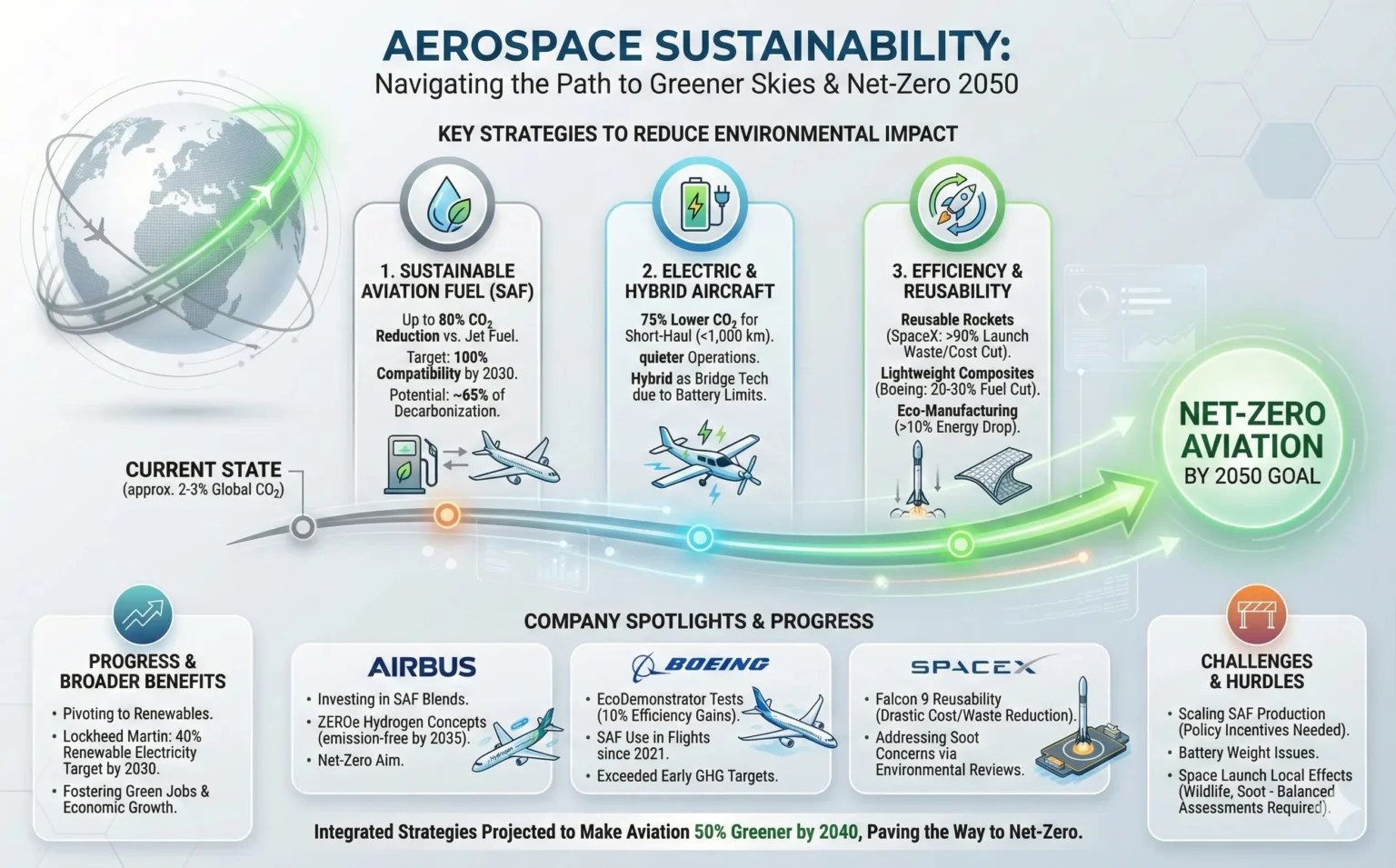
Aerospace companies are making significant strides to cut their environmental footprint, driven by global pressure to achieve net-zero emissions by 2050. While challenges like high costs and technological hurdles remain, the evidence leans toward substantial progress through innovative fuels, efficient designs, and collaborative efforts.
- Sustainable Aviation Fuel (SAF) Adoption: SAF can slash CO2 emissions by up to 80% compared to traditional jet fuel, with companies like Airbus and Boeing committing to 100% compatibility by 2030. Research suggests this could account for 65% of aviation’s required decarbonization.
- Electric and Hybrid Aircraft: These technologies promise 75% lower CO2 for short-haul flights, though battery limitations mean they’re best for routes under 1,000 km initially. Developments from NASA and startups like ZeroAvia highlight quieter, cleaner operations.
- Efficiency and Reusability: Reusable rockets from SpaceX reduce launch waste, while lightweight composites in planes from Boeing cut fuel use by 20-30%. Manufacturing shifts to renewables have already dropped energy consumption by over 10% in many firms.
- Broader Impacts: Initiatives address noise pollution, water use, and supply chain emissions, but controversy persists around space launches’ local effects, like wildlife disruption, underscoring the need for balanced assessments.
Overview of Progress
The aerospace sector, responsible for about 2-3% of global CO2, is pivoting from fossil fuels to renewables. Airbus aims for net-zero by 2050 via hydrogen planes, while Boeing exceeded early GHG reduction targets. Lockheed Martin targets 40% renewable electricity by 2030. These efforts not only curb emissions but also foster economic growth through green jobs.
Company Spotlights
- Airbus: Investing in SAF blends and ZEROe hydrogen concepts for emission-free flights by 2035.
- Boeing: EcoDemonstrator tests show 10% operational efficiency gains; SAF use in flights since 2021.
- SpaceX: Falcon 9 reusability has cut per-launch costs and waste by over 90%, though environmental reviews highlight soot concerns.
Potential Challenges
Scaling SAF requires policy incentives, as production lags demand. Electric tech faces battery weight issues, but hybrids offer a bridge. Overall, it seems likely that integrated strategies will make aviation 50% greener by 2040, per industry models.
Table of Contents
The aerospace industry has long symbolized human ingenuity, propelling us across skies and into space with remarkable speed and precision. Yet, this progress comes at a cost: aviation alone contributes roughly 2.5% of global carbon dioxide emissions, while rocket launches add layers of complexity with their high-energy demands and potential for local ecological disruption. As climate change intensifies, aerospace giants are under mounting pressure to transform. They’re not just tweaking operations; they’re reimagining the entire ecosystem—from fuel sources to manufacturing floors. This shift toward sustainability isn’t a buzzword; it’s a survival strategy, blending cutting-edge science with practical business sense.
By adopting sustainable aviation fuel (SAF), pioneering electric propulsion, and embracing circular economy principles, companies are charting a course to net-zero emissions by 2050. What follows is a deep dive into these efforts, grounded in real-world examples and data, showing how the industry is turning blue skies a little greener.
Why Aerospace Must Go Green
Aviation’s environmental toll is undeniable. Each year, commercial flights burn over 300 billion liters of jet fuel, releasing greenhouse gases like CO2 and nitrogen oxides that trap heat and harm air quality. Space activities, though smaller in scale, introduce black carbon soot into the stratosphere, potentially lingering for years and accelerating warming. Add in manufacturing’s resource hunger—think water-intensive composites and energy-guzzling factories—and the picture sharpens. But here’s the optimistic twist: the sector’s innovative DNA positions it uniquely to lead the charge.
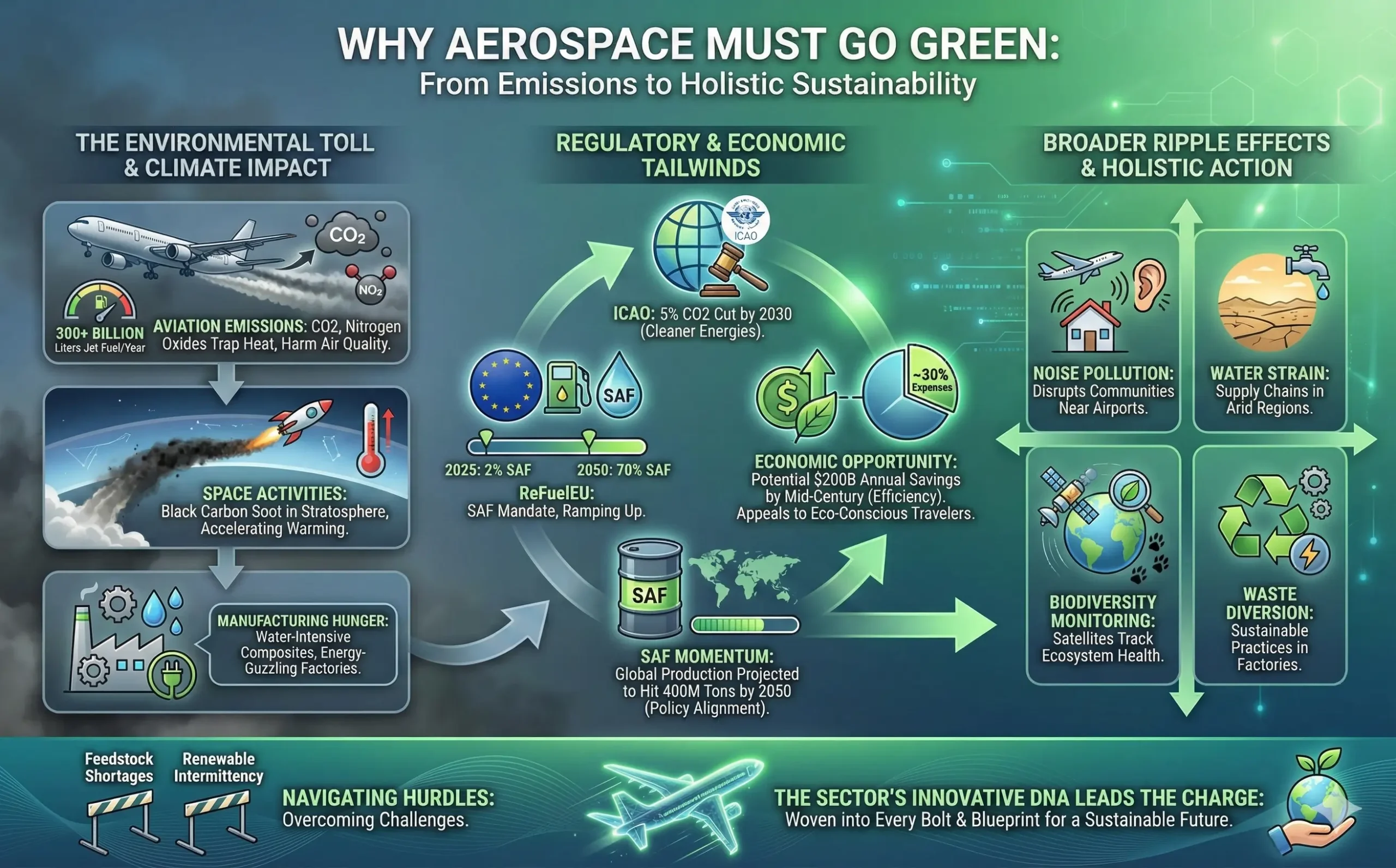
Regulatory tailwinds are accelerating this. The International Civil Aviation Organization (ICAO) pushes for a 5% CO2 cut by 2030 via cleaner energies, while Europe’s ReFuelEU Aviation mandate requires 2% SAF in fuels starting 2025, ramping to 70% by 2050. Airlines and manufacturers alike see opportunity: greener ops can slash costs (fuel is 30% of expenses) and appeal to eco-conscious travelers. A 2024 study estimates sustainable practices could save the industry $200 billion annually by mid-century through efficiency alone. Yet, it’s not all smooth sailing. Feedstock shortages for biofuels and the intermittency of renewables pose hurdles. Still, momentum builds, with global SAF production projected to hit 400 million tons by 2050 if policies align.
Consider the ripple effects beyond emissions. Noise pollution from jets disrupts communities near airports, while supply chains strain water resources in arid regions. Aerospace firms are tackling these holistically, from biodiversity monitoring via satellites to waste diversion in factories. This multifaceted approach ensures sustainability isn’t siloed but woven into every bolt and blueprint.
The Rise of Sustainable Aviation Fuel
At the heart of aviation’s green revolution lies sustainable aviation fuel (SAF), a drop-in alternative to kerosene that promises up to an 80% reduction in lifecycle CO2 emissions. Unlike fossil fuels, which pump ancient carbon into the atmosphere, SAF recycles CO2 absorbed by plants or captured from the air during production. It’s made from diverse feedstocks: waste oils, municipal garbage, non-food crops like camelina, or even synthetic processes powered by wind and solar.
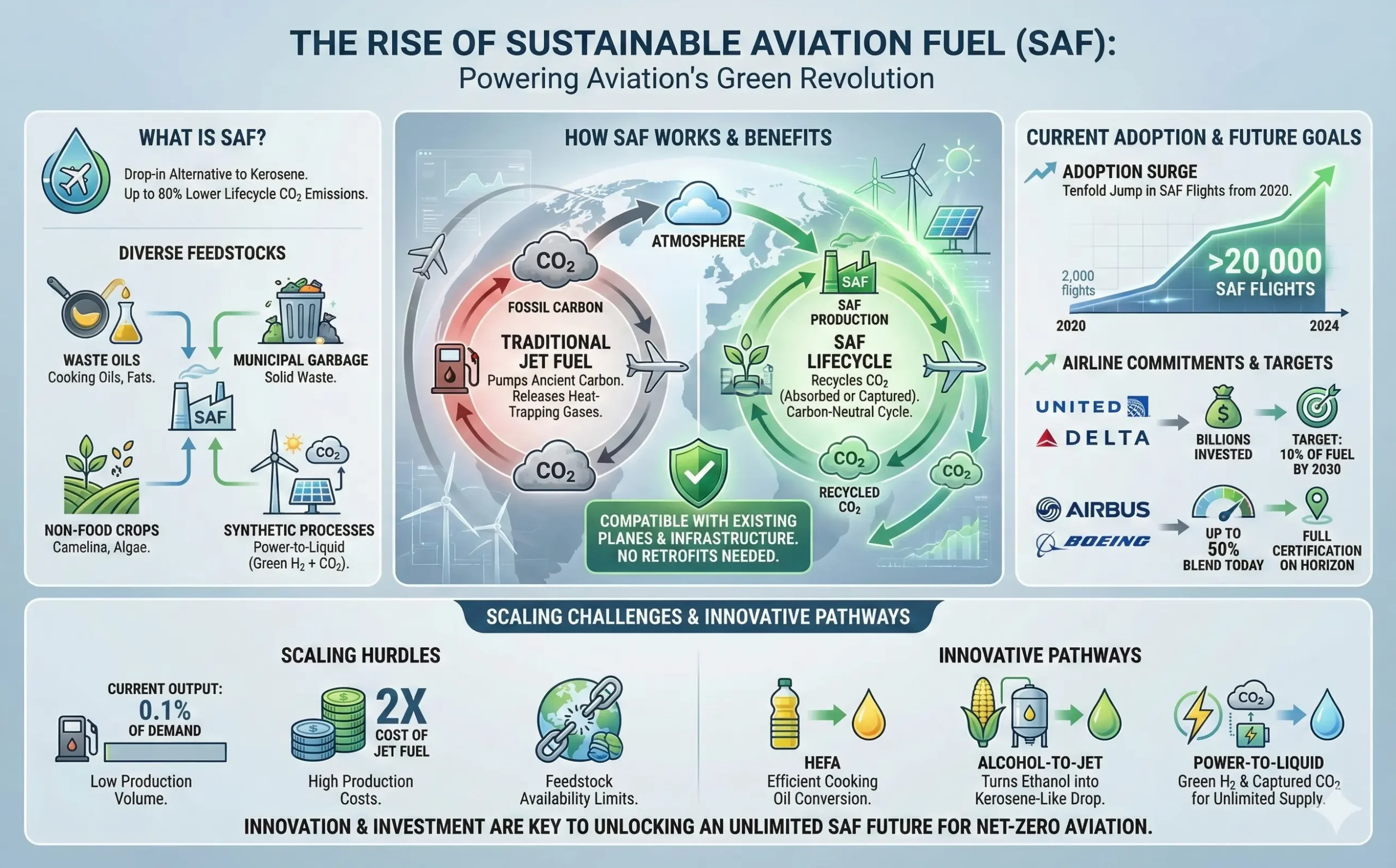
The beauty of SAF? It’s compatible with existing planes and infrastructure—no retrofits needed. All modern Airbus and Boeing jets handle up to 50% blends today, with full certification on the horizon. Adoption is surging: in 2024, SAF flights numbered over 20,000, a tenfold jump from 2020. Airlines like United and Delta are pledging billions to scale production, aiming to reduce fuel use by 10% by 2030.
But scaling isn’t trivial. Current output is a mere 0.1% of demand, hobbled by high costs (twice that of jet fuel) and feedstock limits. Enter innovation: pathways like hydroprocessed esters and fatty acids (HEFA) convert cooking oils efficiently, while alcohol-to-jet tech turns ethanol into kerosene-like drops. Power-to-liquid methods, using green hydrogen, could unlock an unlimited supply from air-captured CO2.
| Aspect | Conventional Jet Fuel | Sustainable Aviation Fuel (SAF) |
|---|---|---|
| CO2 Emissions Reduction | Baseline (100%) | Up to 80% lifecycle reduction |
| Feedstocks | Crude oil (fossil) | Waste oils, biomass, municipal waste, synthetic CO2 |
| Production Pathways | Refining | 9 certified (e.g., HEFA, Fischer-Tropsch) |
| Cost (2025 est.) | $0.70/liter | $1.40-$2.00/liter (falling with scale) |
| Compatibility | Standard | Drop-in; up to 50% blend now, 100% by 2030 |
| Global Production Potential | Unlimited (but polluting) | 400 Mt/year by 2050 (sustainable sources) |
This table underscores SAF’s edge: it’s not just cleaner but scalable. For instance, a transatlantic flight on 100% SAF could save 4 tons of CO2 per passenger—equivalent to a year’s emissions from an average household. Challenges persist, like ensuring feedstocks don’t compete with food production, but certifications guard against deforestation. As policies like tax credits kick in, SAF could claim 65% of aviation’s decarbonization needs, per industry forecasts.
Hybrid and Electric Aircraft Innovations
Imagine boarding a plane that hums quietly, emits zero exhaust, and sips energy like a hybrid car. Electric aircraft are no longer sci-fi; they’re taxiing toward reality, especially for short hops. Battery-powered props eliminate fossil fuels entirely, cutting CO2 by 75% per passenger-kilometer on routes under 500 km. Hybrids, blending batteries with gas turbines or hydrogen fuel cells, extend range to 1,500 km, targeting 33% of global emissions.
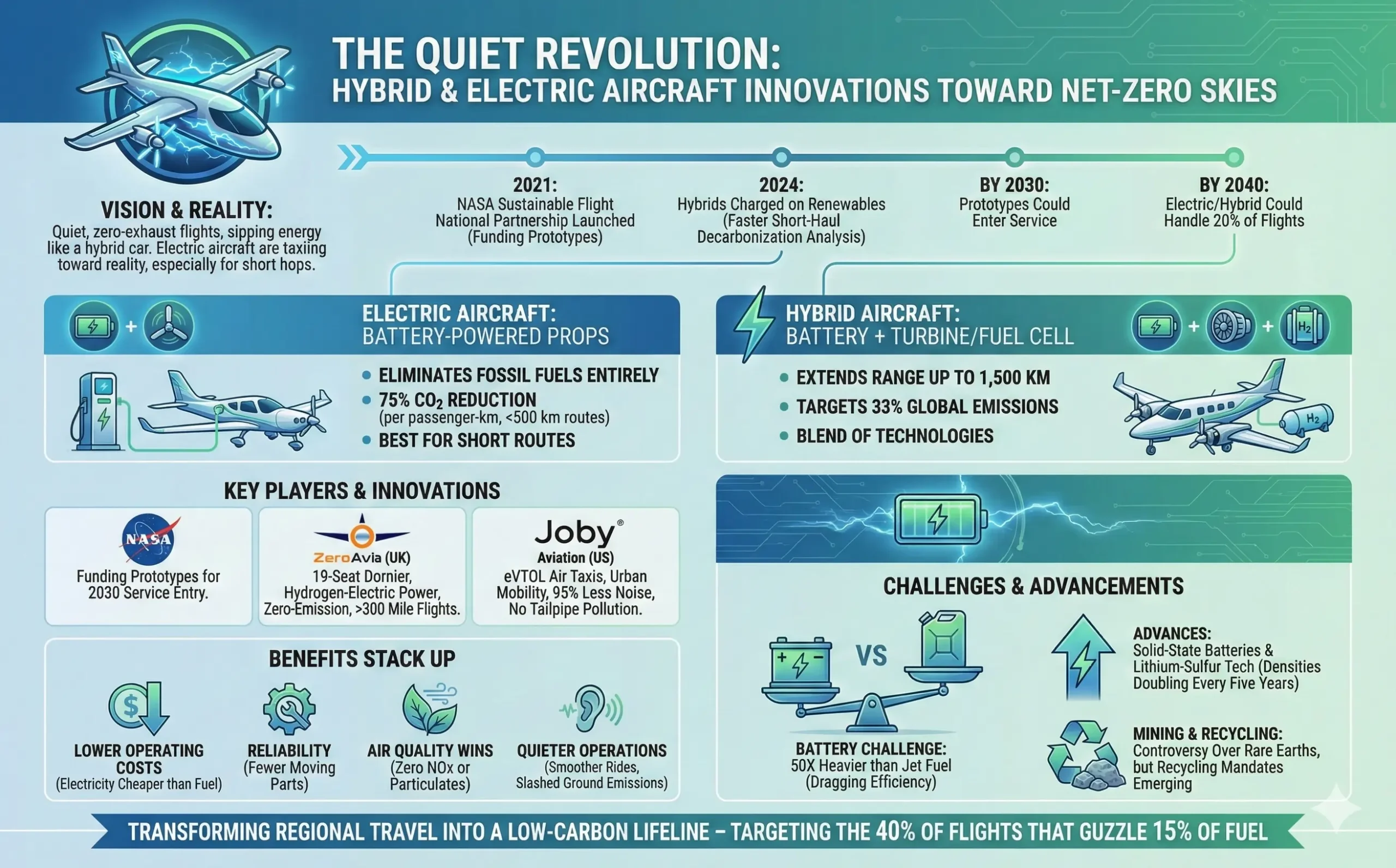
NASA’s Sustainable Flight National Partnership, launched in 2021, funds prototypes that could enter service by 2030. ZeroAvia, a UK-based pioneer, has flown a 19-seat Dornier with hydrogen-electric power, achieving zero-emission flights over 300 miles. In the U.S., Joby Aviation’s eVTOL air taxis promise urban mobility with 95% less noise and no tailpipe pollution.
Benefits stack up: lower operating costs (electricity is cheaper than fuel), reliability (fewer moving parts), and air quality wins (zero NOx or particulates). A 2024 analysis shows hybrids charged on renewables could decarbonize short-haul fleets faster than long-haul overhauls. Yet, batteries weigh 50 times more than jet fuel for equal energy, dragging efficiency. Advances in solid-state batteries and lithium-sulfur tech are closing the gap, with densities doubling every five years.
| Technology Type | Range Potential | Emission Savings | Key Examples | Barriers |
|---|---|---|---|---|
| Fully Electric | <500 km | 75-100% CO2 cut | magniX-powered Cessna (300-mile tests) | Battery weight, charging time |
| Hybrid-Electric | 500-1,500 km | 40-70% reduction | Ampaire’s electrified King Air | Integration complexity, grid needs |
| Hydrogen-Electric | 1,000+ km | Near-zero (if green H2) | Airbus ZEROe concepts (2035 target) | Infrastructure for H2 storage |
These innovations shine in regional aviation, where 40% of flights guzzle 15% of fuel. Pilots report smoother rides, and airports see slashed ground emissions. Controversy brews over mining rare earths for batteries, but recycling mandates are emerging. By 2040, electric/hybrid could handle 20% of flights, per models, transforming regional travel into a low-carbon lifeline.
Materials and Design for Efficiency
Fuel savings start on the drawing board. Advanced composites—carbon fiber reinforced polymers—shave 20% off aircraft weight, boosting efficiency like a diet for jets. Boeing’s 787 Dreamliner, with 50% composites, burns 20% less fuel than predecessors, saving 35 million tons of CO2 since 2011.
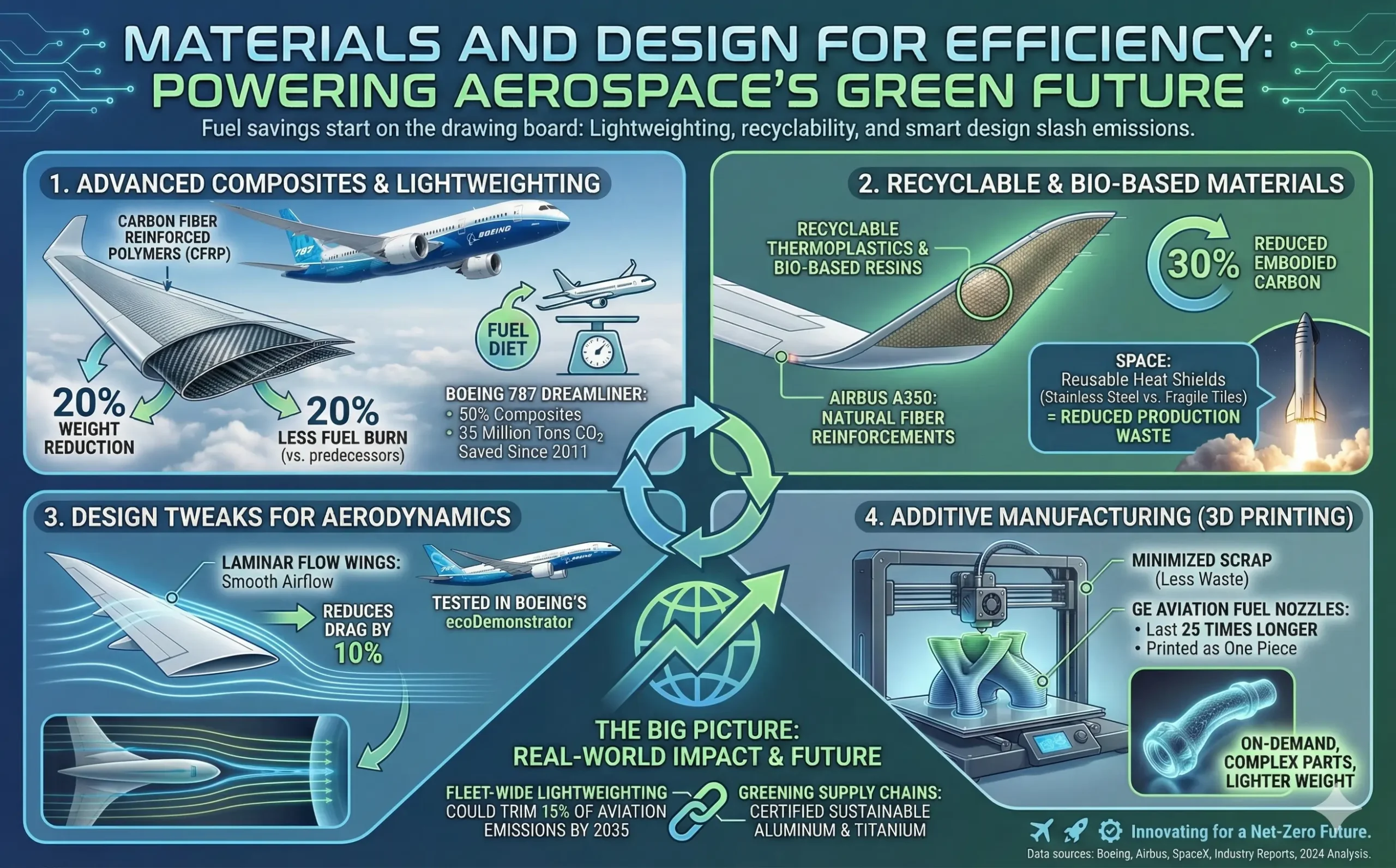
Recyclable thermoplastics and bio-based resins are next. Airbus’s A350 uses natural fiber reinforcements, reducing embodied carbon by 30%. In space, reusable heat shields from SpaceX’s Starship employ stainless steel over fragile tiles, cutting production waste.
Design tweaks amplify gains: laminar flow wings reduce drag by 10%, tested in Boeing’s ecoDemonstrator. Additive manufacturing (3D printing) minimizes scrap, with GE Aviation printing fuel nozzles that last 25 times longer.
These aren’t abstract; they’re paying off. A fleet-wide shift to lightweight designs could trim 15% of aviation emissions by 2035. Supply chains are greening too, with certified sustainable sourcing for aluminum and titanium.
Reusability Revolution: Greening Space Exploration
SpaceX dominates here, with Falcon 9 boosters landing and relaunching over 300 times, slashing per-mission costs and waste by 90%. Methane-based Raptor engines burn cleaner than kerosene, producing less soot. Yet, launches stir debate: a 2024 study flags stratospheric pollution from frequent Starship tests, potentially rivaling aviation’s impact if scaled to 1,000 flights yearly.
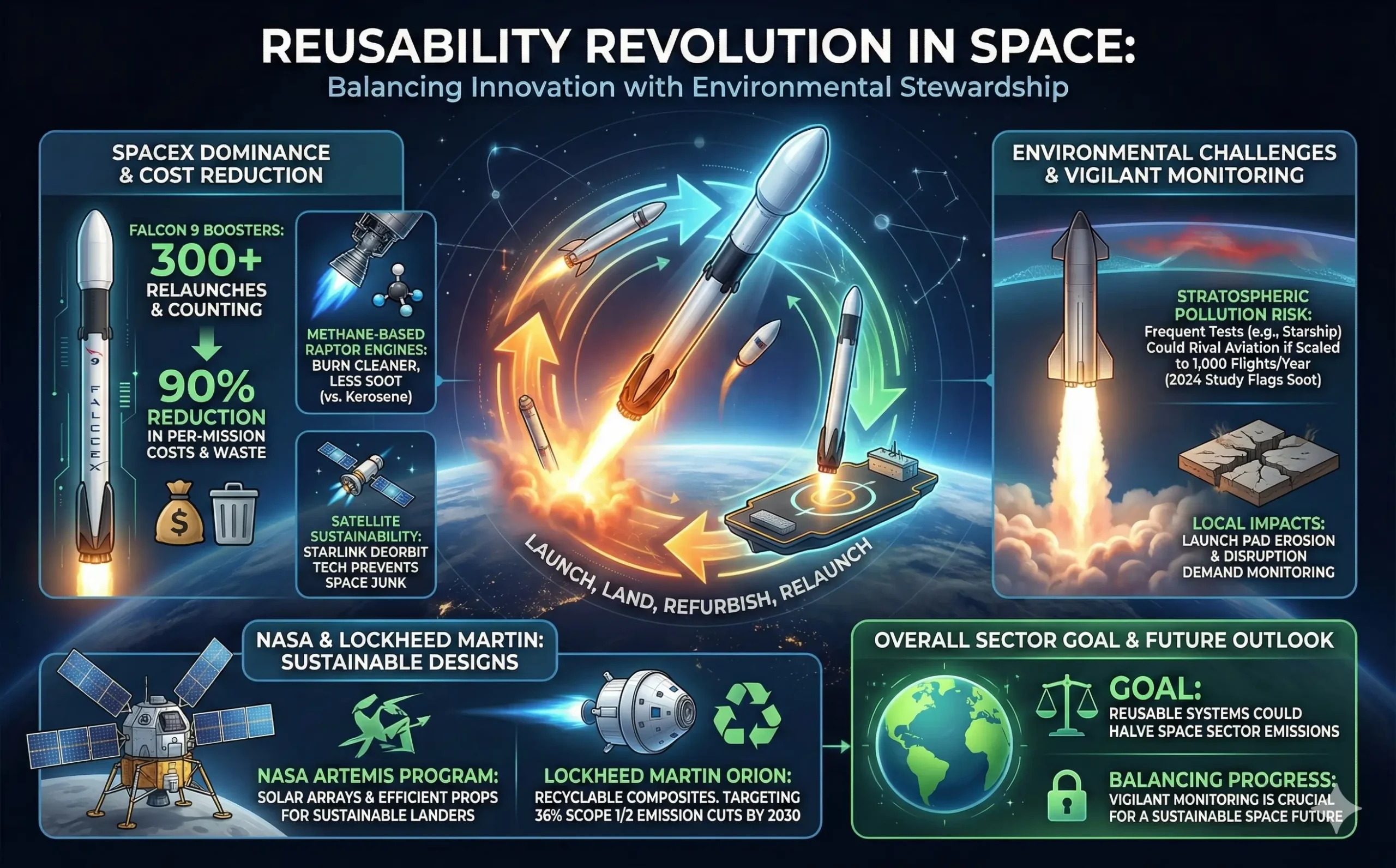
NASA counters with the Artemis program’s sustainable landers, using solar arrays and efficient props. Lockheed Martin’s Orion capsule incorporates recyclable composites, targeting 36% Scope 1/2 emission cuts by 2030.
Reusability extends to satellites: Starlink’s deorbit tech prevents space junk, preserving orbits. Overall, reusable systems could halve space sector emissions, but local impacts—like launch pad erosion—demand vigilant monitoring.
Sustainable Manufacturing: From Factory Floors to Supply Chains
Factories are frontlines. Boeing hit 39% renewable electricity in 2023, exceeding 2025 goals early via solar installs and efficient HVAC. Airbus’s eco-efficient factories recycle 95% of water, while Lockheed’s Go Green program diverts 80% of waste from landfills.
Supply chains, emitting 90% of Scope 3 GHGs, get scrutiny: ethical sourcing avoids conflict minerals, and digital twins optimize logistics to cut trucking emissions 15%. Bio-based lubricants and LED lighting yield quick wins.
| Sustainability Metric | Boeing (2023 Progress) | Airbus Target | Lockheed Goal (2030) |
|---|---|---|---|
| GHG Reduction (vs. 2017) | 37% | Net-zero 2050 | 36% Scope 1/2 |
| Renewable Energy | 39% of electricity | 100% ops by 2030 | 40% matching |
| Water Savings | 19.5% withdrawal | 20% reduction | Baseline tracking |
| Waste to Landfill | 28.6% cut | Zero waste | 50% diversion |
This table highlights measurable strides, with renewables driving 70% of gains.
Collaborations and Policies: The Power of Partnership
No company flies solo. The CORSIA scheme offsets international flights, while NASA’s X-planes test hybrid tech with industry input. IATA’s Fly Net Zero council unites 300 airlines for SAF scaling.
Policies matter: U.S. Inflation Reduction Act’s $3.5 billion SAF credits spur investment. Public-private pacts, like Boeing–NASA’s ecoDemonstrator, validate tech in real skies.
Hurdles Ahead and a Brighter Horizon
Barriers loom: SAF’s price premium, battery breakthroughs, and geopolitical feedstock risks. Space launches face FAA-mandated environmental impact statements amid wildlife concerns. Yet, optimism prevails. With $100 billion in green aerospace investments by 2025, hybrids could proliferate, SAF hit 10% market share, and reusability normalize.
The payoff? Cleaner air, resilient jobs, and aviation as a climate ally. As one executive notes, “Sustainability isn’t optional—it’s our next frontier.”
In sum, aerospace’s green pivot is audacious yet achievable. By fusing fuels, tech, and teamwork, companies aren’t just reducing impact; they’re redefining flight’s promise—for generations to come.
Key Citations And References
- Airbus Sustainability Overview
- Boeing 2024 Sustainability Report
- IATA Sustainable Aviation Fuels
- World Economic Forum on Hybrid Planes
- Lockheed Martin Sustainability Plan
- NASA Sustainable Aviation
- Thomasnet Aerospace Sustainability
- EY on SAF Adoption
- ScienceDirect on Hybrid-Electric Potential
- Space.com on Starship Environmental Impact
- WIPO on SAF Emerging Tech
- BCG on SAF Takeoff
- ZeroAvia on Electric Propulsion
- ICAO SAF Vision
Read These Articles in Detail
- Aerospace Engineering vs. Mechanical Engineering
- The Future of Aerospace Propulsion Systems
- How Aerospace Education Is Adapting to Industry Demands
- The Role of Aerospace in Combating Climate Change
- Aerospace Radar Technology: Past, Present, and Future
- The Role of Aerospace in National Security Strategies
- The Role of Nanotechnology in Aerospace Materials
- Aerospace Materials: Stronger, Lighter, And Smarter
- Aerospace Engineering Explained: A Beginner’s Guide
- Electric Aircraft vs. Hydrogen Aircraft: Which Is More Sustainable?
- Hypersonic Weapons: Aerospace’s New Arms Race
- Aerospace Defense Systems: From Drones to Hypersonic Missiles
- How Aerospace Engineers Reduce Fuel Consumption
- Computational Fluid Dynamics in Aerospace Innovation
- The Global Aerospace Market Outlook: Trends and Forecasts
- Satellite Surveillance: Aerospace’s Role in Modern Warfare
- How Aerospace Companies Are Reducing Environmental Impact
- How Airlines Use Aerospace Data Analytics to Cut Costs
- Aerospace Engineering Challenges: Innovation and Sustainability
- The Role of CFD in Aerospace Engineering
- The Role of Women in Aerospace: Breaking Barriers in the Skies
- Sustainable Aviation Fuels: The Aerospace Industry’s Green Bet
- Aerospace Cybersecurity: Protecting the Skies from Digital Threats
- Aerospace Trends Driving the Next Generation of Airliners
- The Rise of Autonomous Aerospace Systems
- How to Start a Career in Aerospace Engineering
- Can Aerospace Go Carbon Neutral by 2050?
- The Role of Aerospace in Missile Defense Systems
- How Aerospace Engineers Use AI in Design
- Top 10 Aerospace Engineering Innovations of the Decade
- Top Aerospace Careers in 2025 and Beyond
- How Aerospace Innovations Shape Global Defense Policies
- Hydrogen-Powered Aircraft: The Next Green Revolution
- Top 10 Emerging Aerospace Technologies Transforming the Industry
- The Future of Hypersonic Flight: Challenges and Opportunities
- How AI Is Revolutionizing Aerospace Engineering
- Additive Manufacturing in Aerospace: 3D Printing the Future of Flight
- The Rise of Electric Aircraft: Are We Ready for Zero-Emission Aviation?
- Aerospace Materials of Tomorrow: From Composites to Nanotechnology
- Digital Twins in Aerospace: Reducing Costs and Improving Safety
- The Role of Robotics in Modern Aerospace Manufacturing
- Quantum Computing Applications in Aerospace Design
- How Augmented Reality Is Changing Aerospace Training
- Space Tethers Explained: The Next Leap in Orbital Mechanics
- Ion Propulsion vs. Chemical Rockets: Which Will Power the Future?
- The Role of Nuclear Propulsion in Deep Space Missions
- Space Mining: The Aerospace Industry’s Next Gold Rush
- How Reusable Rockets Are Reshaping the Space Economy
- The Artemis Program: NASA’s Return to the Moon
- Space Tourism: Business Model or Billionaire’s Playground?
- How Aerospace Startups Are Disrupting Commercial Aviation
- The Economics of Low-Cost Airlines in the Aerospace Era
- Urban Air Mobility: The Rise of Flying Taxis
- The Future of Mars Colonization: Key Aerospace Challenges and Solutions Ahead
- CubeSats and Small Satellites: Democratizing Space Access
- The Future of Cargo Drones in Global Logistics
- The Role of Aerospace in Building a Lunar Economy
Frequently Asked Questions
FAQ 1: What is Sustainable Aviation Fuel (SAF) and How Is It Advancing in 2025?
Sustainable Aviation Fuel, often abbreviated as SAF, represents a game-changer in the quest to make flying more eco-friendly. Unlike traditional jet fuel derived from fossil sources, SAF is produced from renewable materials like waste oils, agricultural residues, and even captured carbon dioxide. This drop-in fuel can be blended seamlessly with conventional kerosene, requiring no modifications to existing aircraft engines or airport infrastructure. The real magic lies in its potential to slash lifecycle carbon emissions by up to 80 percent, addressing a significant chunk of aviation’s contribution to global warming.
In 2025, the momentum around SAF has accelerated dramatically, with production capacities expanding across regions like Asia-Pacific and North America. Policy incentives, such as tax credits and mandates, are fueling this growth, aiming to make SAF account for 10 percent of total aviation fuel by the end of the decade. For instance, new facilities are coming online, converting municipal waste into high-quality fuel at scales previously unimaginable. Airlines are increasingly committing to SAF-powered flights, with over 25,000 such operations recorded this year alone—a stark rise from prior years. This progress not only cuts emissions but also revitalizes rural economies by creating jobs in biofuel production.
Despite these strides, SAF’s journey isn’t without hurdles. Costs remain about twice that of standard fuel, though economies of scale are expected to narrow this gap by 2030. Innovations in production pathways, like power-to-liquid processes using green hydrogen, promise even greater sustainability by minimizing land-use conflicts. As the industry pushes toward net-zero by 2050, SAF is poised to deliver around 65 percent of the necessary decarbonization, making it a cornerstone of greener skies for everyone from frequent flyers to casual vacationers.
FAQ 2: What Progress Have Electric and Hybrid Aircraft Made in 2025?
The shift toward electric and hybrid aircraft is one of the most exciting developments in sustainable aviation, offering quieter, cleaner alternatives to traditional jets, especially for short-haul routes. In 2025, prototypes have moved beyond testing grounds into real-world demonstrations, with battery tech and hybrid systems showing marked improvements in range and efficiency.
Key advancements include turbine-electric demonstrators taking flight and eVTOL air taxis gearing up for urban operations. These technologies promise emission reductions of 75 percent or more on routes under 500 kilometers, bridging the gap to fully zero-emission flight.
| Technology Type | Key 2025 Milestone | Range Achieved | Emission Impact | Leading Example |
|---|---|---|---|---|
| Fully Electric | Certification progress for small props | Up to 300 km | 100% CO2 cut | magniX-powered trainers with extended test flights |
| Hybrid-Electric | First turbine integrations | 500-1,000 km | 40-70% reduction | Joby’s demonstrator completing 200+ hours of powered flight |
| Hydrogen-Electric | Ground tests for regional jets | 1,000+ km | Near-zero with green H2 | Pangea family’s rapid prototype development for 2030 entry |
| eVTOL Urban Air Mobility | FAA approvals for commercial ops | 100-200 km | 95% noise and emission drop | Electra’s ultra-short takeoff models in production ramp-up |
This table highlights how these innovations are scaling, with events like the Electric Aircraft Symposium underscoring policy support and powertrain breakthroughs. By year’s end, experts predict hybrids handling 15 percent of regional flights, paving the way for broader adoption.
FAQ 3: How Do Lightweight Materials Contribute to Reducing Aerospace Emissions?
Lightweight materials are quietly revolutionizing aerospace by making aircraft more fuel-efficient, directly tackling the industry’s carbon footprint. By swapping heavy metals for advanced composites like carbon fiber and bio-based resins, manufacturers can shave up to 20 percent off an airplane’s weight, leading to proportional fuel savings and lower emissions over the aircraft’s lifecycle.
In 2025, these materials are at the forefront of sustainability efforts, with innovations focusing on recyclability and reduced environmental impact during production. Aluminum alloys still dominate due to their balance of strength and lightness, but emerging thermoplastics and 3D-printed components are gaining traction for their lower energy demands.
- Fuel Efficiency Gains: A 10 percent weight reduction can cut fuel use by 8 percent, translating to millions of tons of CO2 avoided annually across fleets.
- Sustainability in Sourcing: Bio-composites from plant fibers minimize deforestation risks, while recycled alloys reduce mining’s ecological toll.
- Durability and Longevity: These materials extend aircraft life, decreasing the need for frequent replacements and associated manufacturing emissions.
- Market Growth: Demand for lightweight solutions is projected to drive a 43 percent share for aluminum in 2025, fueled by EU Green Deal alignments.
These benefits extend beyond emissions to cost savings and performance, making lightweight design a win for both the planet and profitability.
FAQ 4: Why Is Reusability Essential for Sustainable Space Exploration?
Reusability in space exploration flips the script on traditional “use once and discard” rockets, dramatically cutting waste and costs while minimizing environmental harm. By landing and refurbishing boosters for multiple missions, companies like those pioneering Falcon-style systems have reduced launch debris by over 90 percent, addressing the growing clutter in Earth’s orbit that threatens satellites and future missions.
As space activity surges in 2025, reusability’s role in sustainability has never been clearer. With thousands of satellites deploying annually, uncontrolled reentries are depositing aluminum into the atmosphere at rates exceeding natural sources for the first time. Reusable vehicles mitigate this by enabling fewer launches overall and controlled deorbiting, preserving the fragile space environment. Moreover, cleaner propellants like methane produce less black carbon soot, which can linger in the stratosphere and amplify warming by up to 500 times compared to ground-level pollution.
Looking ahead, reusability supports net-zero goals through green propulsion and renewable-powered ground ops, but it demands rigorous impact assessments for local ecosystems near launch sites. Scientists are calling for global standards to balance innovation with planetary health, ensuring space remains accessible without compromising Earth. Ultimately, this approach not only greases the wheels for affordable exploration but fosters a legacy of responsible cosmic ambition.
FAQ 5: What Are the Biggest Challenges in Achieving Aerospace Sustainability in 2025?
The aerospace sector’s push for sustainability is ambitious, but 2025 reveals persistent challenges that test even the most innovative minds. Supply chain disruptions, exacerbated by geopolitical tensions, continue to delay eco-friendly component deliveries, while workforce shortages—cited by 65 percent of manufacturers—hinder skilled implementation of green tech. These issues compound the high costs of transitioning to low-emission systems, where initial investments can strain budgets amid rising demand for air travel.
Environmental pressures add another layer, with non-CO2 effects like contrails and soot demanding complex solutions beyond simple fuel swaps. Cybersecurity threats loom large too, as digital tools for efficient ops become targets, potentially undermining sustainability gains.
- Scaling Production: SAF and battery tech lag behind demand, with prices 2-3 times higher than alternatives.
- Regulatory Alignment: Harmonizing global standards remains tricky, slowing cross-border adoption.
- Aging Infrastructure: Fleets and airports need upgrades, but funding and retrofits pose logistical nightmares.
- Consumer and Policy Gaps: Awareness drives demand, yet inconsistent incentives slow momentum.
Navigating these requires collaborative grit, but progress in areas like hybrid certification offers hope for breakthroughs by decade’s end.
FAQ 6: How Are Aviation Regulations Driving Emissions Reductions in 2025?
Regulations are the backbone of aviation’s green transformation, setting enforceable targets that spur innovation and accountability. In 2025, frameworks like updated CO2 standards for new jets are tightening the screws, requiring 10 percent efficiency improvements for designs certified after 2031.
These rules not only cap emissions but incentivize sustainable practices through credits and mandates, fostering a ripple effect across the industry.
| Regulation | Key 2025 Focus | Emission Target | Applicability | Impact Highlight |
|---|---|---|---|---|
| ICAO CO2 Standards | Stringent baselines for new types | 10% reduction post-2031 | Global commercial jets | Accelerates tech like SAF integration |
| EU ETS Expansion | Free allocations based on verified emissions | Net-zero trajectory by 2050 | Intra-EU and international flights | Covers 2024-2025 with SAF incentives |
| FAA Fuel Efficiency Rule | Tech mandates for post-2028 builds | Improved aerodynamics and engines | U.S.-manufactured subsonic jets | Projected 20% fleet-wide savings by 2040 |
| ReFuelEU Mandate | SAF blending quotas | 2% in 2025, scaling to 70% | EU airports | Boosts supply chain for renewables |
| CORSIA Offsets | Voluntary to mandatory phases | Neutralize growth emissions | International routes | Funds 1.5 billion tons of reductions |
This structured approach ensures steady progress, with experts noting a potential 5 percent global CO2 drop by 2030 if fully enforced.
FAQ 7: What Sustainability Milestones Did Airbus and Boeing Achieve in 2025?
Airbus and Boeing, titans of the skies, marked 2025 with bold steps toward decarbonization, blending tech demos with production ramps. Airbus advanced its ZEROe hydrogen concepts, conducting flight tests that validated emission-free propulsion for short-haul routes, while committing to 63 percent Scope 1 and 2 GHG cuts by 2030. Their single-aisle roadmap emphasized lightweight composites, aiming for net-zero ops by mid-century.
Boeing, meanwhile, exceeded renewable energy targets early, hitting 45 percent usage and delivering 493 jets with enhanced efficiency features. SAF blends powered record flights, and ecoDemonstrator trials yielded 15 percent operational savings.
These milestones reflect a dual focus: Airbus on disruptive hydrogen, Boeing on scalable efficiencies. Deliveries hit 782 net orders for Boeing, signaling market trust, though both paused some green projects amid supply woes. Overall, their efforts underscore aviation’s path to resilience, with combined investments topping $50 billion in sustainable R&D.
FAQ 8: How Is Sustainable Manufacturing Reshaping the Aerospace Industry in 2025?
Sustainable manufacturing in aerospace is evolving from a nice-to-have to a must-do, integrating green practices that cut waste and energy use without sacrificing quality. Factories are now optimizing with digital twins and additive manufacturing, reducing scrap by 30 percent and speeding production to meet booming demand.
This shift prioritizes circularity, where components are designed for reuse, aligning with zero-waste goals by 2030.
- Energy Optimization: Solar integrations and efficient HVAC have dropped consumption by 20 percent in leading plants.
- Waste Diversion: 95 percent recycling rates for composites and metals, turning scraps into new parts.
- Resource Efficiency: Water savings of 25 percent through closed-loop systems, vital in water-scarce regions.
- Supply Chain Greening: Ethical sourcing audits ensure low-carbon materials, cutting Scope 3 emissions by 15 percent.
By 2025, these practices not only lower footprints but boost competitiveness, with midsize firms thriving on tech disruptions.
FAQ 9: What Does the Future of Hydrogen Propulsion Look Like for Aviation?
Hydrogen propulsion is emerging as aviation’s holy grail for long-haul zero-emission flights, harnessing clean energy to power fuel cells or combustion engines without CO2 output. In 2025, ground tests and modified aircraft runs have proven its viability, with green hydrogen—produced via renewables—key to avoiding new emissions.
The technology’s appeal lies in its energy density, far surpassing batteries for mid-range trips up to 2,000 kilometers. Industry leaders are targeting entry-into-service by 2035, with concepts like blended-wing bodies enhancing efficiency. Challenges include storage at cryogenic temperatures and infrastructure buildout, but advancements in materials are easing these.
As demand for clean hydrogen hits 1,600 TWh by 2050, aviation could claim 10 percent, spurring a virtuous cycle of innovation. This future promises not just greener flights but a blueprint for other hard-to-abate sectors, making hydrogen the fuel of tomorrow’s wings.
FAQ 10: How Can Everyday Consumers Help Promote Greener Aviation?
Consumers hold surprising power in steering aviation toward sustainability, starting with informed choices that signal demand for eco-upgrades. Opting for airlines with strong SAF commitments or carbon offset programs can pressure carriers to invest more, as greener options gain market share.
Beyond tickets, lifestyle tweaks amplify impact: favoring trains for short trips or consolidating flights reduces overall demand.
- Choose Wisely: Book with operators transparent about emissions, using labels to track progress.
- Offset Actively: Contribute to verified programs funding reforestation or renewable projects.
- Advocate Locally: Support policies like SAF mandates through petitions or votes.
- Stay Informed: Follow industry updates to back innovative airlines, boosting their visibility.
In 2025, rising awareness is driving a 20 percent uptick in sustainable bookings, proving collective action can transform skies for the better.
FAQ 11: How Is AI Transforming Aerospace Sustainability in 2025?
Artificial intelligence is quietly revolutionizing the aerospace industry, making sustainability efforts smarter, faster, and more effective than ever before. In 2025, AI tools are optimizing everything from aircraft design to flight paths, helping companies like Airbus and GE Aerospace cut down on fuel waste and emissions without overhauling entire fleets. By analyzing vast datasets in real time, AI predicts maintenance needs, reducing unplanned downtime that often leads to inefficient operations and higher carbon outputs. For instance, predictive algorithms can forecast engine wear with pinpoint accuracy, potentially saving millions in fuel costs while extending component life by up to 20 percent.
Beyond maintenance, AI is driving greener manufacturing processes. In factories, machine learning models simulate material flows to minimize energy use during production, aligning with the sector’s push toward net-zero goals. This isn’t just about efficiency; it’s about embedding sustainability into the core of operations. As one expert notes, AI’s ability to process environmental data helps firms identify hidden emission hotspots in supply chains, turning reactive fixes into proactive strategies. With innovation in AI for sustainable aviation surging by 20 percent over the last five years, it’s clear this technology is a cornerstone for the industry’s 2050 ambitions.
Looking ahead, responsible AI deployment is key to avoiding pitfalls like data biases that could skew sustainability metrics. Companies are investing in ethical frameworks to ensure AI enhances, rather than complicates, green transitions. By 2030, experts predict AI could contribute to a 15 percent drop in operational emissions across global fleets, making it an indispensable ally in the fight for cleaner skies.
FAQ 12: What Are the Main Biodiversity Impacts from Aerospace and How Are They Being Mitigated in 2025?
The aerospace sector’s footprint on biodiversity is often overlooked amid emission talks, but it’s a growing concern as launches and flights encroach on sensitive ecosystems. Rocket exhausts deposit metals into the upper atmosphere, potentially altering soil and water quality near launch sites, while airport expansions fragment habitats for birds and mammals. In 2025, studies highlight how frequent space missions could rival natural aluminum inputs, stressing marine life through fallout. Yet, proactive measures are gaining traction, from satellite monitoring to restore degraded areas.
Mitigation strategies emphasize collaboration between regulators and firms. The International Civil Aviation Organization now integrates biodiversity into environmental reports, promoting aerial fire suppression and species-safe airport designs. Companies are adopting nature-based solutions, like planting corridors around facilities to boost local wildlife resilience.
| Impact Area | Description of Effect | 2025 Mitigation Example | Expected Outcome by 2030 |
|---|---|---|---|
| Atmospheric Deposition | Rocket soot and metals disrupt stratospheric chemistry, affecting ocean acidity | Controlled deorbit protocols for satellites | 30% reduction in uncontrolled reentries |
| Habitat Fragmentation | Airport runways and noise displace wildlife | Green buffers and wildlife corridors at hubs | Enhanced biodiversity scores at 80% of sites |
| Launch Site Pollution | Fuel spills and erosion harm local flora/fauna | On-site remediation using native plants | Zero net loss in protected zones |
| Aerial Disturbance | Flight paths alter migration patterns | AI-optimized routes avoiding key areas | 15% fewer conflicts with migratory species |
These efforts, backed by global standards, show the industry balancing growth with ecological health, ensuring aerospace contributes positively to planetary diversity.
FAQ 13: What Economic Benefits Are Emerging from Sustainable Aerospace Practices in 2025?
Sustainable practices in aerospace aren’t just good for the planet—they’re proving to be a smart financial move, unlocking cost savings and new revenue streams for companies worldwide. In 2025, firms adopting green technologies report up to 20 percent reductions in operational expenses through efficient fuel use and waste minimization, directly boosting profit margins in a competitive market. This shift is creating a ripple effect, with eco-friendly innovations attracting investors focused on long-term resilience.
The economic upside extends to job creation and market expansion. Regions investing in sustainable aviation fuel production see thousands of new roles in biofuels and engineering, while lighter aircraft designs cut lifecycle costs by billions annually. Airlines benefit from “green discounts” on insurance and landing fees for low-emission ops, enhancing competitiveness.
- Cost Reductions: Fuel efficiency gains from hybrids save $200 billion industry-wide by mid-century, starting with 10 percent drops in 2025 fleets.
- Investment Inflows: Green bonds and grants total $50 billion, funding R&D that yields 15 percent ROI on sustainable projects.
- Market Growth: Eco-certified planes command premium pricing, expanding into emerging markets hungry for clean travel.
- Supply Chain Resilience: Localized green sourcing cuts disruption risks, stabilizing costs amid global volatility.
As multilateral efforts align policies, these benefits position sustainable aerospace as a $1 trillion opportunity by 2040, blending profitability with planetary care.
FAQ 14: What Challenges Do Small Aerospace Firms Face in Adopting Sustainability in 2025?
Small aerospace firms are vital to the industry’s innovation pipeline, but scaling sustainability remains a steep climb in 2025. Limited capital hampers investments in pricey tech like electric prototypes, while regulatory compliance drains resources better spent on core R&D. Supply chain bottlenecks, exacerbated by global tensions, delay access to green materials, forcing compromises on eco-goals.
Workforce gaps add pressure, with 65 percent of small operators citing skilled talent shortages for green transitions. Cybersecurity threats loom larger as digital tools for efficiency become essential yet vulnerable.
| Challenge | Impact on Small Firms | 2025 Strategies to Overcome | Projected Relief by 2030 |
|---|---|---|---|
| Funding Constraints | High upfront costs for SAF or hybrids | Grants and SME-focused green loans | 40% cost drop via subsidies |
| Regulatory Burden | Complex compliance without dedicated teams | Simplified ICAO guidelines for small ops | Streamlined reporting cuts time by 50% |
| Supply Chain Issues | Delays in eco-materials | Local sourcing partnerships | Resilient networks reduce disruptions 25% |
| Talent Shortages | Lack of green tech experts | Training programs with universities | Workforce upskilled, filling 70% of gaps |
| Cyber Risks | Exposure in adopting AI for sustainability | Affordable shared security platforms | Integrated defenses lower breaches 30% |
By leveraging collaborations, these firms can navigate hurdles, turning challenges into niches for agile, green innovation.
FAQ 15: How Are Companies Making Supersonic Travel More Sustainable in 2025?
Supersonic travel, once a relic of high-emission excess, is staging a comeback with sustainability at its core, thanks to 2025’s engineering leaps. Developers like Boom Supersonic are designing jets that run on 100 percent sustainable aviation fuel, potentially eliminating net carbon from flights while slashing trip times in half. Noise reduction tech, including shaped wings and advanced engines, addresses sonic booms, making overland flights viable again without the environmental backlash of the Concorde era.
This revival hinges on holistic design: lighter composites and efficient aerodynamics cut fuel needs by 30 percent compared to older models. Governments are aiding with policy shifts, like executive orders legalizing quiet supersonic ops over land. Yet, debates persist—environmentalists worry about scaled impacts on upper atmospheres, urging rigorous lifecycle assessments.
As prototypes hit test flights, the promise is clear: sustainable supersonic could connect the world faster and cleaner, with first commercial routes eyed for 2029. By prioritizing SAF and quiet tech, the industry aims to redefine high-speed travel as an eco-asset, not a liability.
FAQ 16: What Steps Are Aerospace Manufacturers Taking for Water Conservation in 2025?
Water conservation has become a frontline battle in aerospace manufacturing, where processes like composite curing and cooling guzzle resources in water-stressed areas. In 2025, firms are rolling out closed-loop systems that recycle 90 percent of process water, slashing withdrawals by 25 percent at major plants. Digital twins simulate usage to pinpoint leaks, integrating AI for real-time adjustments that prevent waste.
These initiatives align with broader sustainability pledges, like zero-discharge goals by 2030. In regions like India, rainwater harvesting supplements operations, blending tech with nature-based solutions.
- Tech-Driven Savings: Sensors and AI detect inefficiencies, cutting consumption by 20 percent in testing facilities.
- Recycling Innovations: Advanced filtration turns wastewater into reusable streams, vital for arid supply chains.
- Policy and Training: Employee programs foster mindful use, with audits ensuring 15 percent annual improvements.
- Partnerships: Collaborations with utilities yield shared infrastructure, amplifying impact beyond single sites.
By embedding conservation into operations, manufacturers not only safeguard resources but enhance resilience against climate shifts.
FAQ 17: How Is the Aviation Industry Tackling Noise Pollution in 2025?
Noise pollution from aircraft remains a top community concern, disrupting sleep and wildlife while eroding public support for growth. In 2025, the Federal Aviation Administration logged over 7,800 complaints in one quarter alone, prompting a surge in mitigation tech. quieter engines and optimized flight paths, guided by AI, have trimmed exposures by 55 percent since 2000, even as traffic rises.
Events like the Aviation Noise Emissions Symposium spotlight innovations, from chevron nozzles reducing takeoff roar to community grants funding barriers. Regulations now mandate data collection for better planning, empowering locals.
| Strategy | Technology/Approach | 2025 Implementation | Noise Reduction Achieved |
|---|---|---|---|
| Engine Design | Ultra-high bypass fans and geared turbofans | Retrofitting 40% of fleets | 10-15 dB quieter takeoffs |
| Flight Optimization | AI-routed climbs and descents | Widespread at major U.S. hubs | 20% fewer complaints near airports |
| Ground Measures | Sound barriers and insulation grants | $100M in community funding | Localized drops of 8-12 dB |
| Research Initiatives | Symposium-driven prototypes | Collaborative trials in Las Vegas | Projections for 30% overall cut by 2030 |
| Regulatory Tools | EPA pilot programs for monitoring | Nationwide data collection rollout | Enhanced enforcement, 15% exposure decline |
These layered efforts signal a quieter, more harmonious future for aviation.
FAQ 18: What Global Collaborations Are Driving Green Technology in Aerospace This Year?
Global collaborations are the unsung heroes of aerospace’s green shift, pooling expertise to accelerate breakthroughs that no single nation could achieve alone. In 2025, the Paris Air Show showcased mega-deals on sustainable aviation fuel and hydrogen tech, with Airbus partnering across continents for shared R&D. IRENA and ICAO’s joint push supports SAF projects in developing regions, ensuring equitable access to clean fuels.
These alliances extend to quantum integrations for efficient drones and circular economy pacts recycling composites worldwide. By harmonizing standards, they cut duplication, speeding deployment.
From U.S.-EU hydrogen hubs to Asia-Pacific electric vertiport networks, the focus is on scalable solutions. As one report notes, such teamwork could unlock $829 billion in sustainable value by 2030, fostering innovation while bridging geopolitical divides for a united front against climate threats.
FAQ 19: What Are the Latest Predictions for Aerospace Emissions by 2030?
Predictions for aerospace emissions by 2030 paint a cautiously optimistic picture, with the sector on track for a 10-15 percent reduction if current trajectories hold. Driven by sustainable aviation fuel scaling to 10 percent of supply and efficiency gains from new aircraft, CO2 outputs could peak below pre-2050 net-zero paths. However, without bolder policies, growth in demand might offset these, pushing totals to 90 percent of 2019 levels.
Experts emphasize four key goals: ramping SAF, advancing hybrids, optimizing routes, and electrifying short-haul. Models suggest science-based targets could cap warming contributions at 2 degrees Celsius.
In a net-zero scenario, lifetime emissions from new planes drop to zero by mid-decade, thanks to zero-carbon tech. Yet, non-CO2 effects like contrails demand urgent innovation. Overall, 2030 marks a pivotal checkpoint—achievable with sustained investment, but fragile to delays in global alignment.
FAQ 20: What Are the Top Aerospace Sustainability Trends to Watch in 2025?
The aerospace landscape in 2025 buzzes with trends that blend urgency and opportunity, from decarbonization mandates to circular designs. Sustainability tops concerns at 65 percent, eclipsing even supply woes.
| Trend | Key Focus | 2025 Highlights | Long-Term Impact |
|---|---|---|---|
| Decarbonization Pillars | SAF and hydrogen adoption | 2% EU mandates, Paris Air Show orders | 65% of net-zero needs by 2050 |
| Circular Economy | Reusability in manufacturing | Zero-waste factories at Pratt & Whitney | 80% emission cuts in production |
| Electric/Hybrid Propulsion | Short-haul zero-emission flights | NASA demos, eVTOL certifications | 20% fleet transformation by 2030 |
| AI-Driven Efficiency | Predictive maintenance and route optimization | 15% growth in user-facing AI spend | $200B annual savings mid-century |
| Global Policy Shifts | Net-zero alignments across borders | ICAO reports, multilateral SAF pacts | Harmonized standards for 5% CO2 drop |
These trends underscore a sector in flux, prioritizing green innovation for enduring growth.
