

Key Points on Sustainability
- Electric aircraft show strong potential for short-haul routes, with studies indicating up to 60% lower climate impact compared to traditional fossil-fuel planes, though battery production raises concerns about rare mineral use.
- Hydrogen-powered aircraft could enable zero-carbon emissions across longer distances, especially with green hydrogen, but challenges like cryogenic storage and infrastructure limit near-term scalability.
- Neither is a clear winner yet; sustainable aviation fuels (SAF) bridge the gap today, while both technologies contribute to the industry’s net-zero by 2050 goal, requiring 13% of reductions from innovations like these. The evidence leans toward a hybrid future, blending these options based on flight needs, with ongoing projects in 2025 accelerating progress.
Understanding Aviation’s Sustainability Challenge
Aviation accounts for about 2-3% of global carbon dioxide emissions, a figure expected to rise as air travel doubles by 2050 without intervention. Organizations like the International Air Transport Association (IATA) have set ambitious targets: net-zero carbon emissions by 2050, with interim goals like halving emissions by 2030 through a mix of fuels, efficiency, and new propulsion. Electric propulsion and hydrogen systems emerge as frontrunners, each tackling emissions from the tailpipe while addressing lifecycle impacts like manufacturing and fuel sourcing.
Electric Aircraft
Powered by batteries and electric motors, these planes eliminate in-flight fossil fuel burn, producing zero direct emissions if charged with renewable energy. Ideal for regional hops under 300 miles, they cut noise by up to 80% and maintenance costs by simplifying engines. However, battery weight limits range, and scaling to larger jets remains a decade away.
Hydrogen Aircraft
Using hydrogen fuel cells or combustion, these aircraft convert hydrogen into electricity or thrust, emitting only water vapor. They suit mid- to long-haul flights, with energy density advantages over batteries, but require massive cryogenic tanks and green hydrogen production to truly shine sustainably.
Early Verdict
For short flights, electric edges out with immediate efficiency gains; for longer ones, hydrogen holds promise despite hurdles. Both outperform kerosene jets, but success hinges on global infrastructure and policy support.
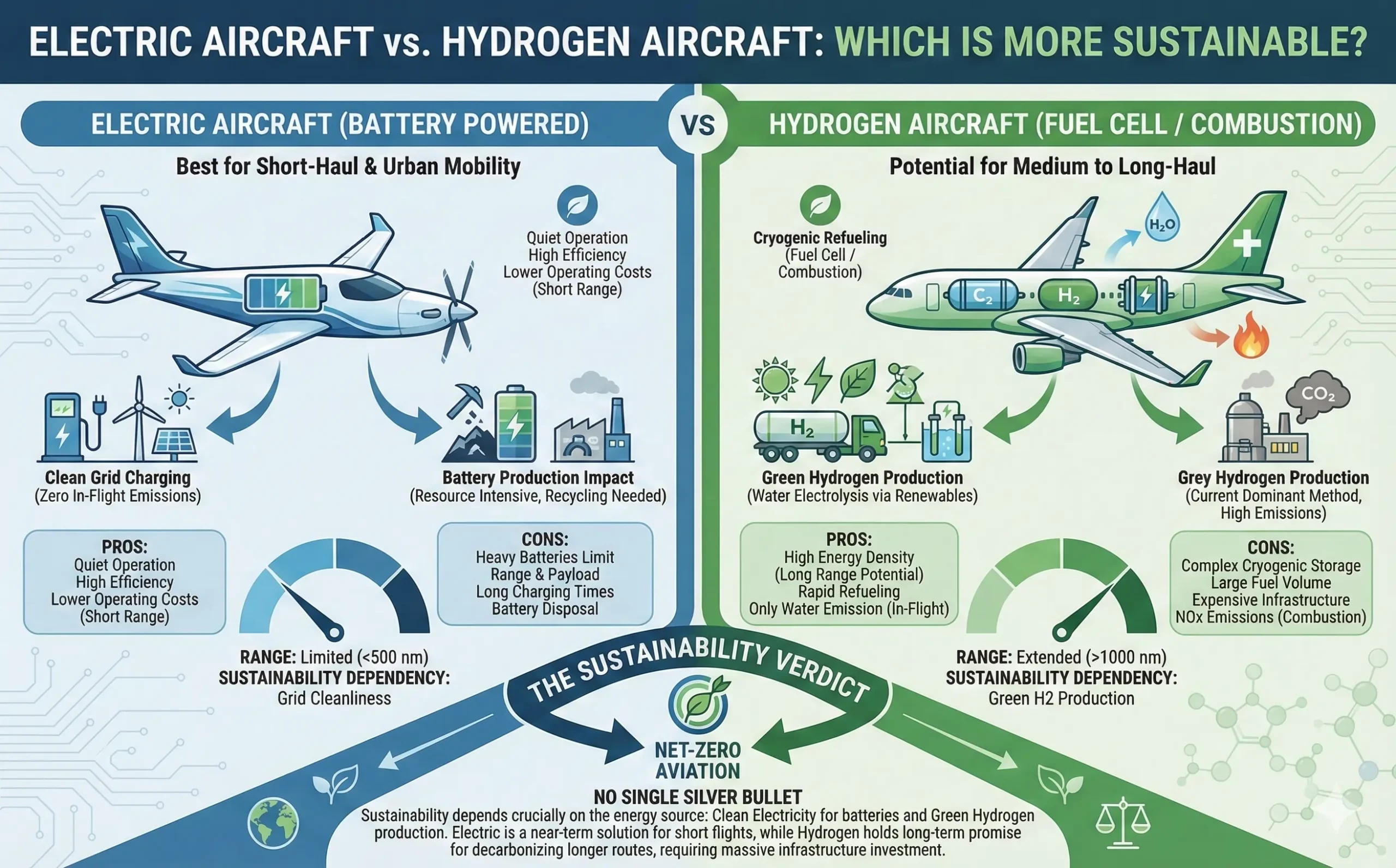
Table of Contents
In an era where air travel is both a lifeline for global connectivity and a growing environmental concern, the race to greener skies has never been more urgent. With passenger numbers projected to surge past 10 billion annually by 2050, the aviation industry faces a daunting challenge: slashing its carbon footprint without hindering progress. Enter electric aircraft and hydrogen-powered planes—two innovative paths promising cleaner flight. But which one truly leads the way toward sustainability?
This deep dive explores their mechanics, benefits, drawbacks, real-world examples, and head-to-head comparisons, drawing on the latest research and projects as of late 2025. Spoiler: It’s not a simple either-or; the future likely blends both, tailored to flight distances and infrastructure realities.
The Urgent Need for Sustainable Aviation
Aviation’s environmental toll is stark. Jet fuel, primarily kerosene, powers over 99% of flights today, releasing billions of tons of carbon dioxide (CO2), nitrogen oxides (NOx), and particulates that warm the planet and harm air quality. Contrails—those icy trails from engine exhaust—amplify this by trapping heat in the atmosphere. According to IATA’s Fly Net Zero initiative, adopted in 2021, the sector must achieve net-zero CO2 emissions by 2050, abating 21.2 gigatons from business-as-usual projections. This demands a multifaceted approach: 65% from sustainable aviation fuels (SAF), 13% from breakthroughs like electric and hydrogen tech, 3% from operational tweaks, and 19% from offsets and capture.
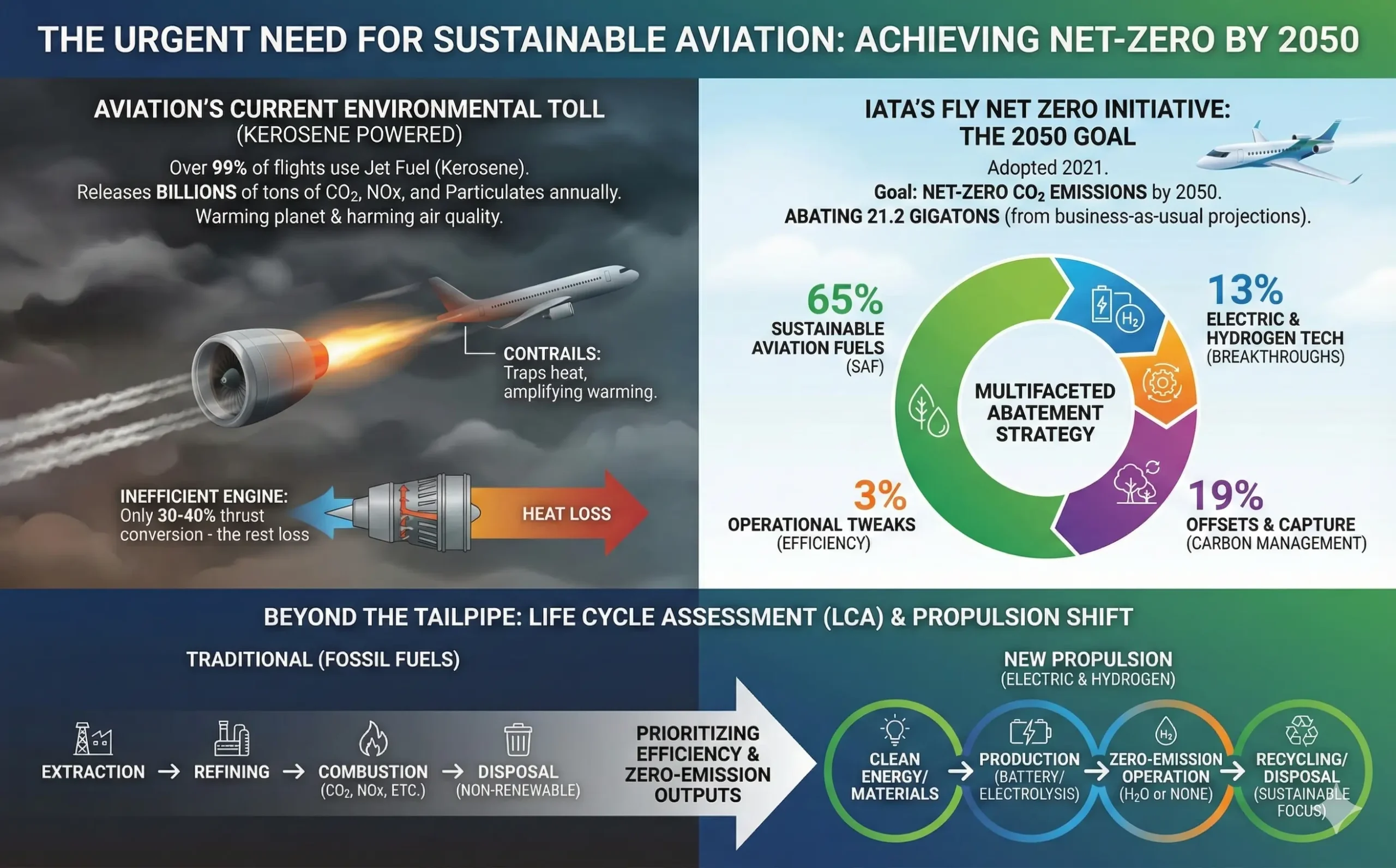
Why focus on propulsion? Traditional engines guzzle energy inefficiently, with only about 30-40% converting to thrust—the rest lost as heat. New systems aim to flip this script, prioritizing efficiency and zero-emission outputs. Yet sustainability isn’t just about tailpipe exhaust; it’s a life cycle assessment (LCA)—from raw materials to disposal. Electric and hydrogen shine here, but each carries trade-offs, as we’ll unpack.
Electric Aircraft: Revolutionizing Short-Haul Travel
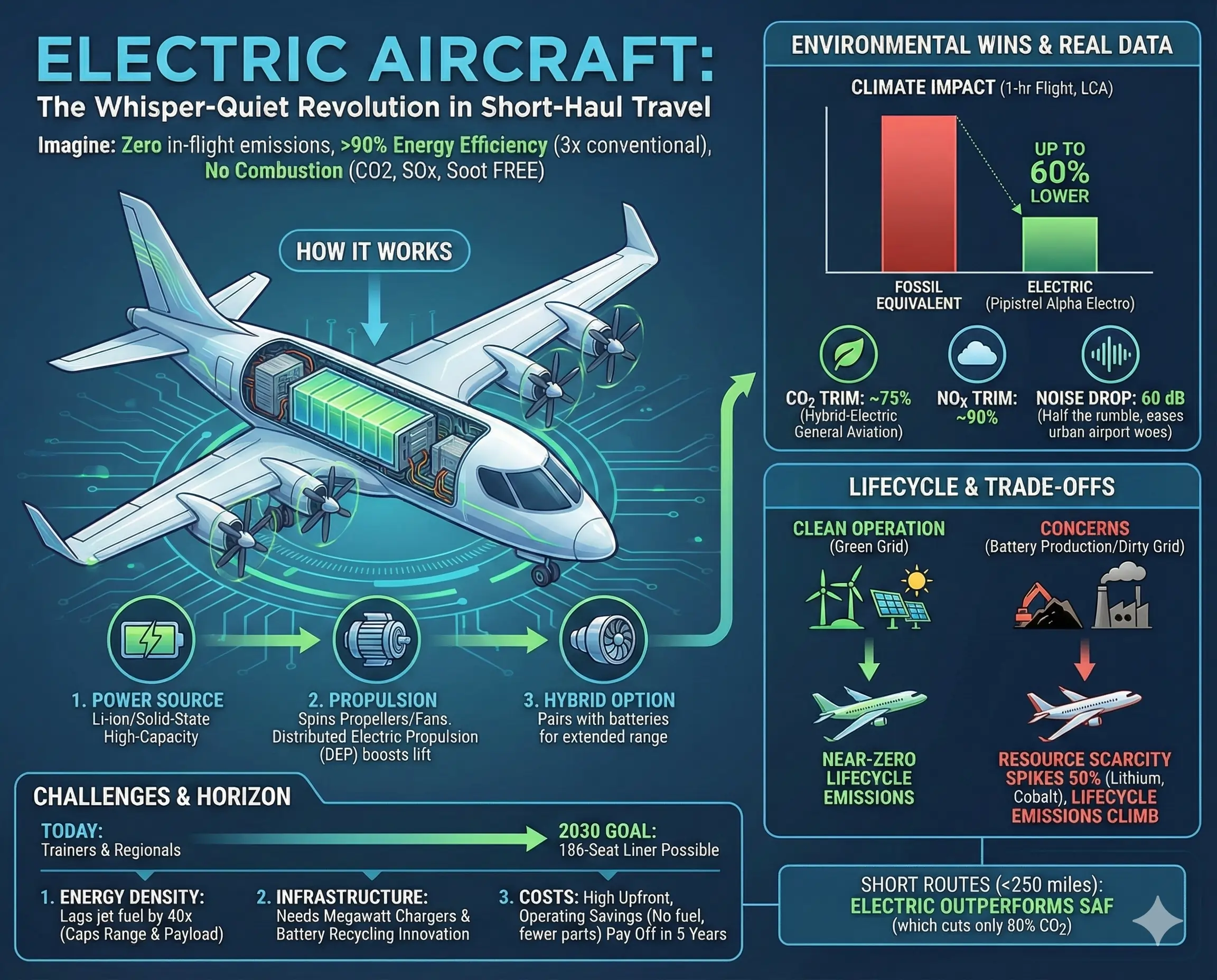
Imagine boarding a whisper-quiet plane for your daily commute, zipping across regions without a whiff of exhaust. Electric aircraft make this feasible by swapping jet fuel for high-capacity batteries and electric motors, delivering over 90% energy efficiency—triple that of conventional turbines. No combustion means zero in-flight CO2, SOx, or soot, slashing direct emissions to near-nothing if grids go green.
How Electric Propulsion Works
An electric plane uses lithium-ion or emerging solid-state batteries to power motors that spin propellers or fans. Distributed electric propulsion (DEP)—multiple small motors along wings—boosts lift and cuts drag, as seen in NASA’s experimental designs. For hybrids, batteries pair with small gas turbines for extended range, easing the transition.
Environmental Wins and Real Data
A landmark LCA by Chalmers University on the Pipistrel Alpha Electro, a two-seater trainer, revealed up to 60% lower climate impact for a one-hour flight versus fossil equivalents. This spans greenhouse gases, acidification, and particulates, thanks to clean operation. Broader studies echo this: hybrid-electric general aviation could trim CO2 by 75% per passenger-kilometer and NOx by 90%. Noise drops to 60 decibels—half the rumble of props—easing urban airport woes.
Yet, the full picture tempers enthusiasm. Battery mining spikes mineral resource scarcity by 50%, guzzling rare earths like lithium and cobalt. If charged on dirty grids, lifecycle emissions climb. Still, for short routes (under 250 miles), electrics outperform SAF, which cuts only 80% of CO2.
Challenges on the Horizon
Battery energy density lags jet fuel by a factor of 40, capping range and payload. A 186-seat electric liner? Possible by 2030, but today’s focus is on trainers and regionals. Infrastructure lags too: airports need megawatt chargers, and recycling mountains of batteries demands innovation. Costs? Upfront high, but operating savings— no fuel, fewer parts—could pay off in five years.
| Aspect | Electric Aircraft Pros | Electric Aircraft Cons |
|---|---|---|
| Emissions | Zero direct CO2; 60% lower lifecycle climate impact | Higher mineral use (50% more rare metals) |
| Efficiency | 90%+ energy-to-thrust conversion | Low battery density limits range to <300 miles |
| Noise & Maintenance | 80% quieter; 50% less upkeep | Heavy batteries reduce payload by 20-30% |
| Infrastructure | Simpler charging networks | Grid upgrades needed for high-power draw |
| Cost | Fuel-free ops save 30-50% long-term | Initial battery price: $200-300/kWh |
Hydrogen Aircraft: Fueling the Long-Haul Dream
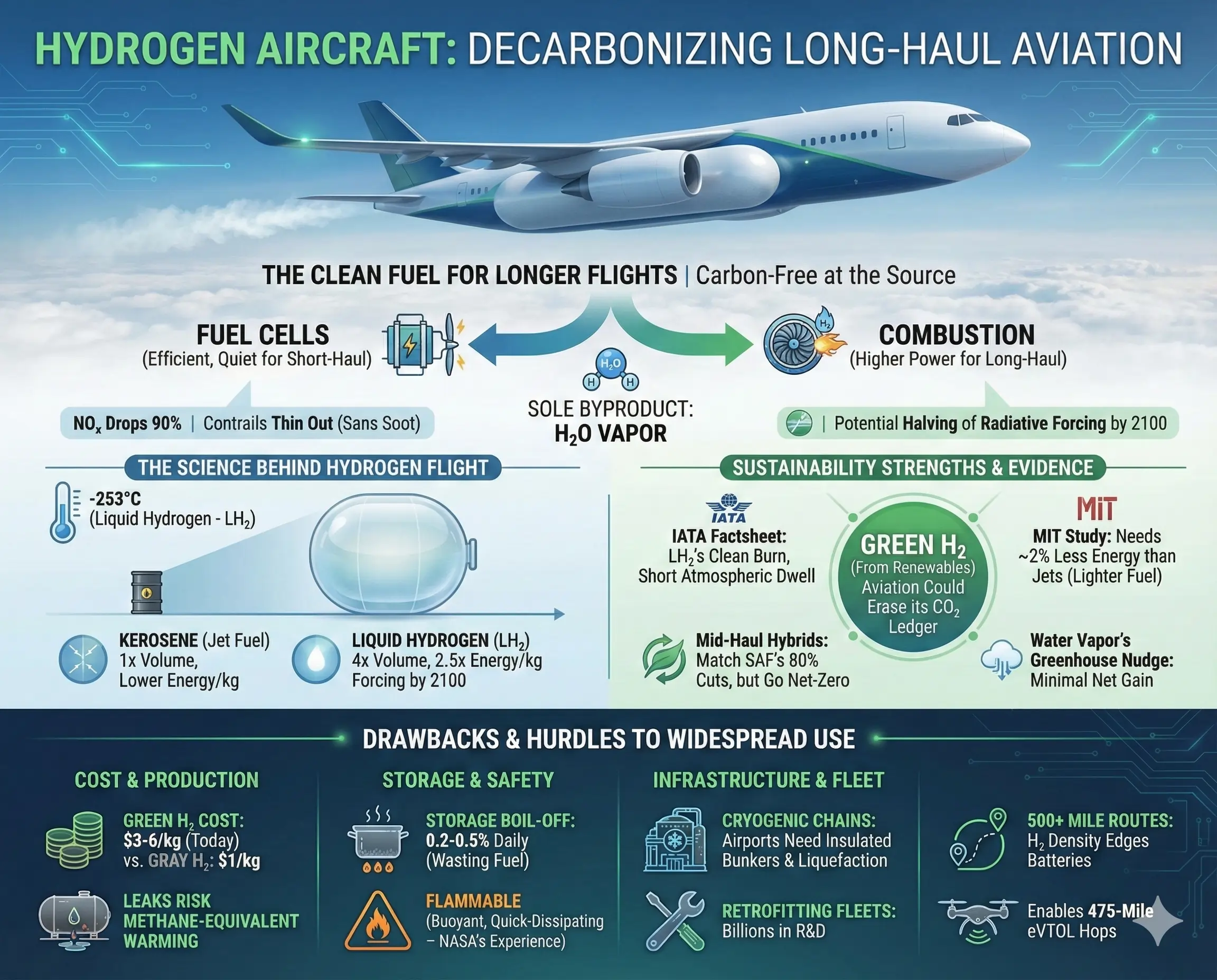
Shift gears to hydrogen: a lightweight gas that, when split in fuel cells, generates electricity with water as the sole byproduct. Or burn it in modified turbines for thrust. Either way, it’s carbon-free at the source, ideal for flights where batteries falter. With green hydrogen (from renewables via electrolysis), aviation could erase its CO2 ledger.
The Science Behind Hydrogen Flight
Liquid hydrogen (LH2) stores at -253°C, boasting 2.5 times kerosene’s energy per kilogram but four times the volume, demanding redesigned fuselages with bulbous tanks. Fuel cells suit shorts (efficient, quiet), while combustion fits longs (higher power). NOx drops 90%, and contrails thin out sans soot nuclei, potentially halving radiative forcing by 2100.
Sustainability Strengths Backed by Evidence
IATA’s hydrogen factsheet highlights LH2’s clean burn: only H2O vapor, with shorter atmospheric dwell than CO2. A MIT study found hydrogen planes need just 2% less energy than jets for missions, thanks to lighter fuel. For mid-haul, hybrids could match SAF’s 80% cuts but go net-zero. Water vapor’s greenhouse nudge? Minimal net gain, per models.
Drawbacks loom large. Producing green hydrogen costs $3-6/kg today (versus $1 for gray), and leaks risk methane-equivalent warming. Storage boils off 0.2-0.5% daily, wasting fuel. Safety? Flammable, but buoyant and quick-dissipating—NASA’s used it for decades.
Hurdles to Widespread Use
Cryogenic chains strain: airports need insulated bunkers and liquefaction plants. Retrofitting fleets? Billions in R&D. Yet, for 500+ mile routes, hydrogen’s density edges batteries, enabling 475-mile eVTOL hops.
| Aspect | Hydrogen Aircraft Pros | Hydrogen Aircraft Cons |
|---|---|---|
| Emissions | Zero CO2; 90% less NOx; net 20-60% radiative forcing cut by 2100 | Water vapor contrails; production emissions if not green |
| Efficiency | High gravimetric density; 2% less energy needed vs. jets | 4x volume demands airframe redesigns |
| Range & Power | Suits mid-long haul (500+ miles) | Boil-off losses: 0.2-0.5%/day |
| Infrastructure | Scalable with electrolyzers | $ billions for cryo networks; few stations now |
| Cost | Zero fuel emissions tax long-term | $3-6/kg green H2; safety systems add 20% upfront |
Real-World Projects Lighting the Path
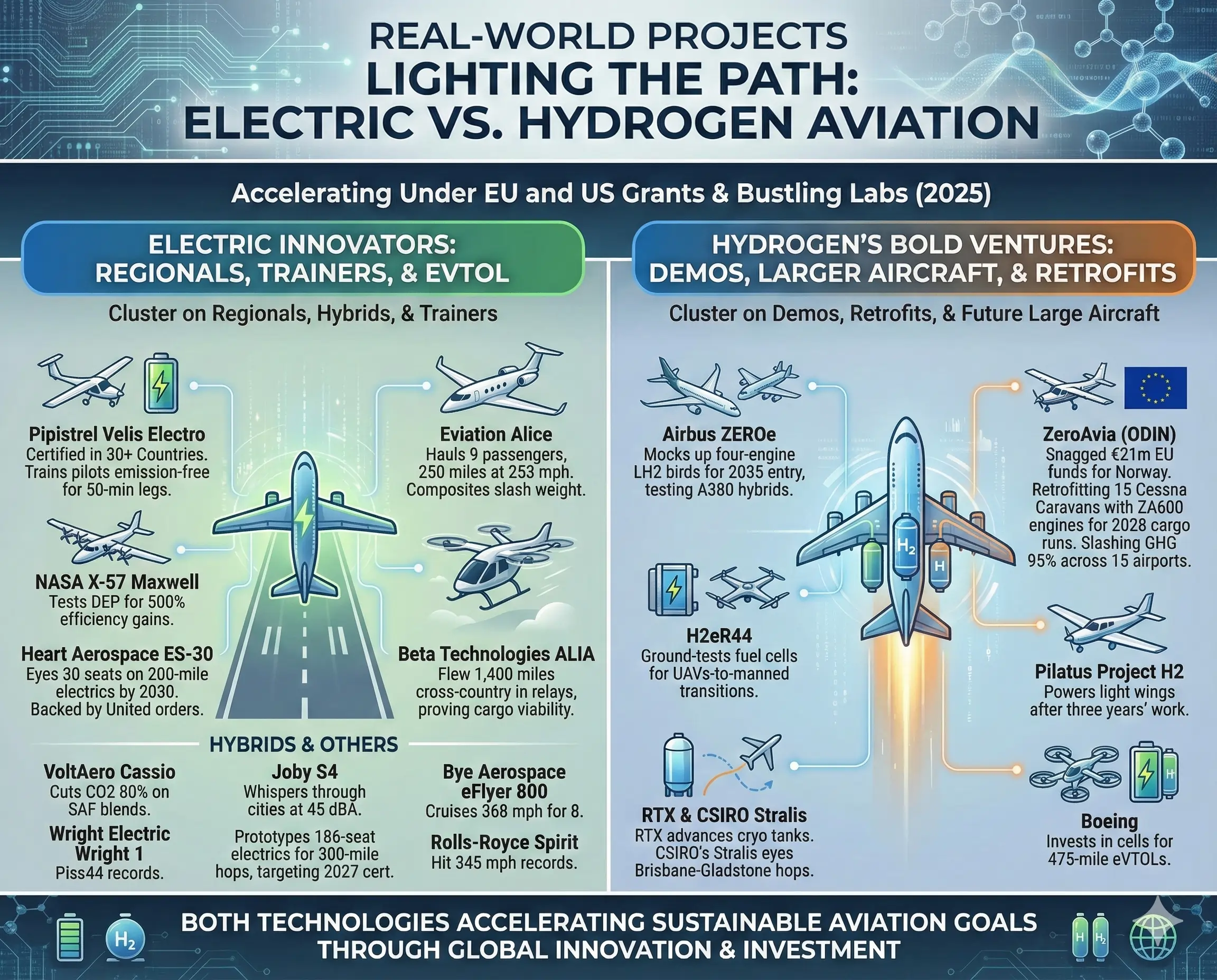
Theory meets tarmac in 2025’s bustling labs. Electric efforts cluster on regionals, hydrogen on demos—both accelerating under EU and US grants.
Spotlight on Electric Innovators
From trainers to airliners, electrics are flying now. The Pipistrel Velis Electro, certified in 30+ countries, trains pilots emission-free for 50-minute legs. Eviation Alice hauls nine passengers 250 miles at 253 mph, with composites slashing weight. NASA’s X-57 Maxwell tests DEP for 500% efficiency gains. Scaling up, Heart Aerospace ES-30 eyes 30 seats on 200-mile electrics by 2030, backed by United orders. Beta Technologies ALIA flew 1,400 miles cross-country in relays, proving cargo viability.
Hybrids like VoltAero Cassio cut CO2 80% on SAF blends, while Joby S4 whispers through cities at 45 dBA. Wright Electric’s Wright 1 prototypes 186-seat electrics for 300-mile hops, targeting 2027 cert. Bye Aerospace eFlyer 800 cruises 368 mph for eight, and Rolls-Royce Spirit hit 345 mph records.
| Electric Project | Capacity | Range (miles) | Key Sustainability Feature | Status (2025) |
|---|---|---|---|---|
| Pipistrel Velis Electro | 2 seats | 50 (flight time) | Zero-emission training | Certified, in use |
| Eviation Alice | 9 passengers | 150-250 | All-electric regional | Prototypes flying |
| NASA X-57 Maxwell | Experimental | N/A | 500% efficiency boost | Testing phase |
| Heart ES-30 | 30 passengers | 124 (electric) | Hybrid for regionals | 250+ orders |
| Beta ALIA | 5 passengers | 250 | Cargo/freight focus | Cross-country demos |
| Joby S4 | 4 passengers | 100 | Urban mobility, ultra-quiet | FAA pathways |
| Wright 1 | 186 seats | 300 | Large-scale electric | Ground tests |
| Bye eFlyer 800 | 8 seats | 575 | High-speed zero-emission | Prototyping |
| Rolls-Royce Spirit | Experimental | N/A | Speed records | Certified flight |
Hydrogen’s Bold Ventures
Airbus’s ZEROe mocks up four-engine LH2 birds for 2035 entry, testing A380 hybrids. ZeroAvia snagged €21m EU funds for Norway’s ODIN: retrofitting 15 Cessna Caravans with ZA600 engines for 2028 cargo runs, slashing GHG 95% across 15 airports. H2eR44 ground-tests fuel cells for UAVs-to-manned transitions. Pilatus’s Project H2 powers light wings after three years’ work. RTX advances cryo tanks, while CSIRO’s Stralis eyes Brisbane-Gladstone hops. Boeing invests in cells for 475-mile eVTOLs.
| Hydrogen Project | Capacity/Type | Range/Goal | Key Sustainability Feature | Status (2025) |
|---|---|---|---|---|
| Airbus ZEROe | 100-200 passengers | 1,000+ miles | LH2 combustion/fuel cells | Mock-ups, engine tests |
| ZeroAvia ODIN | Cargo (Cessna retrofit) | Regional | 95% GHG cut, water vapor only | €21m grant, 2028 ops |
| H2eR44 | UAV-to-manned | Short-mid | Fuel cell efficiency | Ground testing |
| Pilatus Project H2 | Light aircraft | 300-500 miles | Zero-carbon light ops | Three-year development |
| RTX Hydrogen | Engine/tank demos | Long-haul | Cryo storage advances | R&D milestones |
| CSIRO Stralis | Regional demo | 300 miles | Decarbonized Aussie routes | Flight planning |
These projects aren’t pipe dreams: over $10 billion in investments flowed in 2025, per industry trackers, validating tech at scale.
Head-to-Head: Electric vs. Hydrogen Sustainability Breakdown
Pitting them directly? Context rules. Electrics dominate shorts: simpler, cheaper infra, immediate 60% cuts. Hydrogen offers long-term density for payloads, zero-carbon scalability. Hybrids bridge, like ZeroAvia’s cells or Airbus E-Fan X.
Emissions and Efficiency Face-Off
Electrics win lifecycle for shorts (60% less impact), but hydrogen’s green sourcing yields true zero for all ranges. Efficiency? Electrics at 90%, hydrogen 50-60% in cells—but 2% energy savings overall. Noise: both quiet, electrics edging urban use.
| Metric | Electric | Hydrogen | Winner for… |
|---|---|---|---|
| Direct Emissions | Zero (renewable charge) | Zero (green H2) | Tie |
| Lifecycle CO2 | 60% lower for shorts | Net-zero potential for longs | Electric (short); Hydrogen (long) |
| Range Suitability | <300 miles | 500+ miles | Hydrogen for haul |
| Infra Readiness | Charging by 2030 | Cryo nets by 2040 | Electric |
| Cost per Mile (2030 est.) | $0.05-0.10 | $0.08-0.15 | Electric |
Infrastructure and Economic Angles
Electrics need grid bolstering—feasible with solar farms. Hydrogen demands electrolyzers and pipes, costing trillions globally. Economically, electrics save 30% on ops now; hydrogen’s payback hits post-2040 as H2 dips below $2/kg.
Broader Impacts: Social and Global Equity
Both curb noise pollution, aiding communities near hubs. But mining for batteries risks ecosystems in Congo; hydrogen’s water use (9kg per kg H2) strains arid zones. Fair trade? Policies must prioritize green sourcing, per UN guidelines.
The Road Ahead: Timelines and Policy Push
By 2030, expect 6-19-seat electrics to be routine, per IATA, with hybrids on 20% regionals. Hydrogen demos mid-decade, commercial by 2035—Airbus vows it. SAF leads interim, blending 10-20% now. Barriers? Certs take 5-7 years; subsidies like the EU’s €21m for ZeroAvia accelerate.
| Timeline Milestone | Electric Focus | Hydrogen Focus | Industry Impact |
|---|---|---|---|
| 2025-2027 | Trainer certs, regional prototypes | Engine tests, retrofits | 5% fleet hybrids |
| 2028-2030 | 9-30 seat commercials | Short-haul demos | 10% emissions cut |
| 2031-2035 | 100-seat regionals | Mid-haul entries | SAF + tech = 50% reduction |
| 2040+ | Long-haul hybrids | Global LH2 nets | Net-zero trajectory |
Governments fuel this: US IRA credits H2 production; the EU’s ReFuelEU mandates 6% SAF by 2030, spilling to alt-fuels.
Conclusion
Electric and hydrogen aren’t rivals—they’re teammates in aviation’s sustainability sprint. Electrics deliver quick wins for the 80% of flights under 1,500 miles, curbing urban emissions and noise today. Hydrogen unlocks the rest, promising a boundless range without compromise tomorrow. Together, with SAF as the glue, they align with IATA’s 2050 vision: a world where flying connects us guilt-free.
Key Citations
- World Economic Forum: Reinventing Aviation
- ScienceDirect: Energy Demand Comparison
- Simple Flying: Hydrogen Vs. Electric Vs. SAF
- IDTechEx: Sustainable Future Aviation
- SciePublish: Transition to Hydrogen Aviation
- AZoCleantech: Top 5 Sustainable Developments
- AirInsight: Hydrogen Progress
- Mototok: Sustainability Trends 2025
- ScienceDirect: Biofuels Review
- ICCT: SAF Role
- Springer: Two-Seater LCA
- ScienceDirect: Generic LCA Tool
- MDPI: Electric Deployment
- IEEE: Hybrid-Electric LCA
- UT Austin: eVTOL LCA
- AIAA: Battery Modules LCA
- PHM Society: Maintenance LCA
- DOE: GREET Model
- Chalmers: LCAir Project
- IATA: Liquid Hydrogen Facts
- IATA: Concept of Operations
- IATA: Contrails Impact
- ScienceDirect: Hydrogen Safety
- GreenAir News: IATA Net Zero
- IATA: Hydrogen Fleet Evolution
- CATF: Decarbonizing Aviation
- Boeing: Hydrogen Factsheet
- IDTechEx: Hydrogen or Electric Planes
- Interesting Engineering: Top 10 Electric Aircraft
- Heart Aerospace: First Electric Flight
Read These Articles in Detail
- Aerospace Engineering vs. Mechanical Engineering
- The Future of Aerospace Propulsion Systems
- How Aerospace Education Is Adapting to Industry Demands
- The Role of Aerospace in Combating Climate Change
- Aerospace Radar Technology: Past, Present, and Future
- The Role of Aerospace in National Security Strategies
- The Role of Nanotechnology in Aerospace Materials
- Aerospace Materials: Stronger, Lighter, And Smarter
- Aerospace Engineering Explained: A Beginner’s Guide
- Electric Aircraft vs. Hydrogen Aircraft: Which Is More Sustainable?
- Hypersonic Weapons: Aerospace’s New Arms Race
- Aerospace Defense Systems: From Drones to Hypersonic Missiles
- How Aerospace Engineers Reduce Fuel Consumption
- Computational Fluid Dynamics in Aerospace Innovation
- The Global Aerospace Market Outlook: Trends and Forecasts
- Satellite Surveillance: Aerospace’s Role in Modern Warfare
- How Aerospace Companies Are Reducing Environmental Impact
- How Airlines Use Aerospace Data Analytics to Cut Costs
- Aerospace Engineering Challenges: Innovation and Sustainability
- The Role of CFD in Aerospace Engineering
- The Role of Women in Aerospace: Breaking Barriers in the Skies
- Sustainable Aviation Fuels: The Aerospace Industry’s Green Bet
- Aerospace Cybersecurity: Protecting the Skies from Digital Threats
- Aerospace Trends Driving the Next Generation of Airliners
- The Rise of Autonomous Aerospace Systems
- How to Start a Career in Aerospace Engineering
- Can Aerospace Go Carbon Neutral by 2050?
- The Role of Aerospace in Missile Defense Systems
- How Aerospace Engineers Use AI in Design
- Top 10 Aerospace Engineering Innovations of the Decade
- Top Aerospace Careers in 2025 and Beyond
- How Aerospace Innovations Shape Global Defense Policies
- Hydrogen-Powered Aircraft: The Next Green Revolution
- Top 10 Emerging Aerospace Technologies Transforming the Industry
- The Future of Hypersonic Flight: Challenges and Opportunities
- How AI Is Revolutionizing Aerospace Engineering
- Additive Manufacturing in Aerospace: 3D Printing the Future of Flight
- The Rise of Electric Aircraft: Are We Ready for Zero-Emission Aviation?
- Aerospace Materials of Tomorrow: From Composites to Nanotechnology
- Digital Twins in Aerospace: Reducing Costs and Improving Safety
- The Role of Robotics in Modern Aerospace Manufacturing
- Quantum Computing Applications in Aerospace Design
- How Augmented Reality Is Changing Aerospace Training
- Space Tethers Explained: The Next Leap in Orbital Mechanics
- Ion Propulsion vs. Chemical Rockets: Which Will Power the Future?
- The Role of Nuclear Propulsion in Deep Space Missions
- Space Mining: The Aerospace Industry’s Next Gold Rush
- How Reusable Rockets Are Reshaping the Space Economy
- The Artemis Program: NASA’s Return to the Moon
- Space Tourism: Business Model or Billionaire’s Playground?
- How Aerospace Startups Are Disrupting Commercial Aviation
- The Economics of Low-Cost Airlines in the Aerospace Era
- Urban Air Mobility: The Rise of Flying Taxis
- The Future of Mars Colonization: Key Aerospace Challenges and Solutions Ahead
- CubeSats and Small Satellites: Democratizing Space Access
- The Future of Cargo Drones in Global Logistics
- The Role of Aerospace in Building a Lunar Economy
Frequently Asked Questions
FAQ 1: What Makes Electric Aircraft a Strong Choice for Short-Haul Sustainability in 2025?
Electric aircraft are gaining traction as a sustainable option for shorter flights, particularly those under 300 miles, because they eliminate direct emissions during operation and boast impressive energy efficiency. Powered by batteries and electric motors, these planes convert over 90% of their energy into thrust, far surpassing the 30-40% efficiency of traditional jet engines. This means less energy waste and a smaller overall carbon footprint, especially when charged using renewable sources like solar or wind power. In 2025, with advancements in battery technology, such as solid-state options that promise higher density and faster charging, electric planes are becoming more practical for regional routes, reducing not just CO2 but also noise pollution by up to 80% compared to propeller aircraft.
The lifecycle environmental benefits are particularly compelling for these shorter hops. Studies show that electric aircraft can achieve up to 60% lower climate impact over their full lifecycle—from manufacturing to end-of-life—when compared to fossil-fuel counterparts. This includes reductions in acidification and particulate matter, which improve air quality around airports. However, it’s worth noting that battery production does involve mining rare minerals like lithium and cobalt, which can strain resources if not managed sustainably. Efforts in 2025, including recycling initiatives and ethical sourcing, are addressing these concerns, making electric propulsion a frontrunner for urban and commuter aviation where quick turnarounds and low operating costs shine.
Looking ahead, the integration of distributed electric propulsion systems, which use multiple small motors along the wings, is enhancing lift and further cutting drag. This technology, tested in projects like NASA’s experimental designs, could make electric flights even greener by optimizing energy use mid-flight. For travelers and operators eyeing sustainable short-haul options, electric aircraft represent a tangible step toward net-zero aviation without waiting for broader infrastructure overhauls.
FAQ 2: How Do Hydrogen Aircraft Compare to Electric Ones in Terms of Range and Emissions?
| Aspect | Electric Aircraft | Hydrogen Aircraft |
|---|---|---|
| Typical Range | Up to 300 miles, ideal for regional flights; limited by battery weight and density | 500+ miles, suitable for mid- to long-haul; higher energy density allows heavier payloads |
| Direct Emissions | Zero CO2 or NOx during flight; only if charged renewably | Zero CO2, water vapor only; 90% less NOx with fuel cells |
| Lifecycle Impact | 50-60% lower climate footprint for shorts; higher mineral use in batteries | Near-zero potential with green hydrogen; 20-60% radiative forcing reduction by 2100 |
| Efficiency | 90%+ energy conversion; excels in quick, low-power ops | 50-60% in fuel cells; 2% less energy needed overall vs. jets |
| 2025 Challenges | Grid upgrades for charging; payload reduction by 20-30% | Cryogenic storage at -253°C; boil-off losses of 0.2-0.5% per day |
This table highlights the core trade-offs, showing electric aircraft’s edge in simplicity for nearby destinations while hydrogen steps up for farther journeys with cleaner long-term prospects.
FAQ 3: What Are the Key Challenges Facing Hydrogen-Powered Aircraft Adoption?
Hydrogen-powered aircraft hold immense promise for decarbonizing long-haul aviation, but several hurdles stand in the way of widespread use. One major issue is the need for cryogenic storage, as liquid hydrogen must be kept at extremely low temperatures to remain viable, requiring specialized tanks and insulation that add weight and complexity to airframes. This not only redesigns fuselages but also introduces boil-off losses, where the fuel evaporates at rates of 0.2-0.5% daily, potentially wasting energy and increasing costs.
Infrastructure remains a bottleneck too. Producing green hydrogen—via electrolysis using renewable electricity—is essential for true sustainability, yet it currently costs $3-6 per kilogram, far above gray hydrogen alternatives that rely on fossil fuels. Airports would need massive investments in liquefaction plants, insulated pipelines, and refueling stations, estimated in the trillions globally to support a full transition by 2050.
- Safety Considerations: While hydrogen is flammable, it disperses quickly and buoyantly, reducing explosion risks compared to kerosene; ongoing tests in 2025, like those at dedicated facilities, are refining protocols to build public confidence.
- Water Vapor Effects: Exhaust produces only H2O, but at high altitudes, it could form contrails that trap heat; models suggest this adds minimal warming if soot-free, unlike traditional jets.
- Scalability Gaps: Retrofitting existing fleets is pricey, but new builds like conceptual four-engine designs could enter service by 2035, bridging the gap with hybrid systems.
Despite these obstacles, momentum is building through collaborative R&D, with recent facility upgrades enabling more flight testing and paving the way for viable commercial ops in the coming decade.
FAQ 4: Which Sustainable Aviation Fuel Option Bridges the Gap Between Electric and Hydrogen Tech?
Sustainable aviation fuels, or SAF, act as a crucial bridge in the shift to greener skies, allowing current aircraft to cut emissions by up to 80% without major redesigns. Made from renewable sources like waste oils or captured CO2, SAF drops in seamlessly with kerosene, making it ideal for the 2030s transition period while electric and hydrogen technologies mature. In 2025, production is ramping up, with blends reaching 10-20% in many fleets, directly supporting aviation’s net-zero goals by abating billions of tons of CO2.
What sets SAF apart is its immediate applicability across all flight lengths, unlike electric’s short-range focus or hydrogen’s infrastructure demands. Lifecycle assessments confirm its role: while not zero-emission like pure hydrogen, SAF’s carbon intensity is far lower than fossil fuels, and advancements in e-kerosene variants—synthesized from green hydrogen and CO2—could push reductions toward 90%. This compatibility encourages airlines to invest now, blending with drop-in ease.
However, challenges like limited feedstock availability and cap scalability are prompting policies like mandatory 6% blends by 2030 in key regions. Pairing SAF with electric for shorts and hydrogen for longs creates a hybrid strategy, ensuring steady progress without halting growth.
FAQ 5: Timeline for Commercial Electric and Hydrogen Aircraft Rollouts
| Year Range | Electric Milestones | Hydrogen Milestones |
|---|---|---|
| 2025-2027 | Trainer certifications expand; 9-seat regionals prototype flights | Engine ground tests; retrofit demos for cargo |
| 2028-2030 | 30-seat hybrids enter service; urban air mobility launches | Short-haul fuel cell ops; airport cryo infrastructure pilots |
| 2031-2035 | 100-seat regionals routine; full-electric for 200-mile routes | Mid-haul entries; 1,000-mile conceptual flights |
| 2040+ | Long-haul hybrids integrate; 50% of short flights are electric | Global networks; net-zero long-haul standard |
These timelines reflect accelerating R&D, with over $10 billion invested in 2025 alone, signaling a realistic path to transformative change.
FAQ 6: How Do Life Cycle Assessments Reveal the True Sustainability of These Aircraft?
Life cycle assessments, or LCAs, go beyond flight-time emissions to evaluate the full environmental toll of aircraft from cradle to grave, including raw material extraction, manufacturing, operation, and disposal. For electric aircraft, LCAs like those on two-seater models show a 60% drop in climate impact for short flights, driven by zero in-flight emissions and high efficiency. Yet, they flag higher upfront burdens from battery production, with 50% more rare metal use contributing to resource scarcity and potential ecosystem strain in mining regions.
In contrast, hydrogen aircraft LCAs highlight near-zero operational CO2 when using green production methods, with studies indicating 20-60% reductions in overall radiative forcing by mid-century due to cleaner contrails. However, the full chain—from electrolysis to cryogenic delivery—can yield carbon intensities of 1.5-4 gCO2 per MJ if renewables falter, underscoring the need for clean energy inputs. Hybrid designs blend these strengths, cutting NOx by 90% while easing range limits.
- Key LCA Insights: Electric shines for urban routes with renewable grids; hydrogen excels in scalability for globals but demands a vast green hydrogen supply.
- Future Refinements: Ongoing projects incorporate end-of-life recycling, potentially slashing impacts by 30% as battery tech evolves.
- Policy Tie-In: These assessments guide incentives, prioritizing low-impact pathways to meet 2050 net-zero targets.
By painting this holistic picture, LCAs ensure sustainability claims hold water, fostering informed investments in aviation’s green evolution.
FAQ 7: What Role Do Current Projects Play in Advancing Electric vs. Hydrogen Tech?
In 2025, a wave of innovative projects is propelling both electric and hydrogen aircraft toward reality, testing real-world viability and ironing out kinks. Electric efforts focus on immediate applications, like nine-passenger prototypes achieving 250-mile ranges at speeds over 250 mph, thanks to lightweight composites and rapid recharges. These demos prove cargo and commuter feasibility, with cross-country relay flights showcasing relay charging to extend ops without emissions spikes.
Hydrogen projects, meanwhile, tackle longer ambitions through retrofits and clean-sheet designs, such as four-megawatt fuel cell engines driving conceptual airliners for 1,000-mile legs. Recent upgrades, including dedicated cryogenic facilities, now support extended flight testing, slashing greenhouse gases by 95% in regional cargo runs. Light aircraft hybrids explore blended propulsion, certifying piston engines with hydrogen-electric systems for versatile light ops.
- Electric Highlights: Regional hybrids with 30 seats ordered in bulk; ultra-quiet urban taxis hitting 100-mile urban loops.
- Hydrogen Spotlights: Mid-haul retrofits across 15 airports; redesigns overcoming certification for never-before-solved cryo hurdles.
- Shared Momentum: $10B+ investments fuel collaborations, blending tech for hybrid futures.
These initiatives aren’t just experiments—they’re blueprints for scalable, sustainable flight, closing the gap between lab and runway.
FAQ 8: Cost Comparison: Are Electric or Hydrogen Aircraft More Economical Long-Term?
Upfront costs for both electric and hydrogen aircraft run high due to novel components—batteries at $200-300 per kWh for electrics and cryogenic systems adding 20% premiums for hydrogen—but long-term savings flip the script. Electric ops slash fuel expenses by 30-50%, with no kerosene buys and halved maintenance from fewer moving parts, paying back in under five years for short routes. By 2030, per-mile costs could dip to $0.05-0.10, making them a budget win for frequent regional flyers.
Hydrogen’s payback stretches longer, hinging on green production scaling to $2 per kg, but zero-emission perks dodge future carbon taxes, projecting $0.08-0.15 per mile. For long-haul, density advantages preserve payloads, offsetting redesigns over decades. Hybrids offer a middle ground, blending SAF cuts of 80% with electric efficiency for transitional economies.
Economic models from 2025 stress infrastructure: electric grids upgrade cheaper than hydrogen’s trillion-dollar nets, yet both promise 15-20% fleet-wide savings by 2040, per industry forecasts.
FAQ 9: Infrastructure Needs for a Hydrogen-Electric Aviation Future
Building the backbone for hydrogen and electric aircraft demands targeted upgrades, starting with electric’s simpler charging networks akin to EV stations but scaled to megawatts for 30-minute top-ups. Airports are piloting solar-integrated pads, easing grid strain and enabling emission-free turnarounds, with 2025 hubs demonstrating viability for 200-mile electrics.
Hydrogen infrastructure pivots on green production hubs and cryo chains, from electrolyzers capturing renewables to insulated bunkers holding liquid fuel at -253°C. Recent facilities now test refueling for extended flights, but global rollout eyes trillions in pipes and plants to fuel 500-mile ops without boil-off waste.
- Shared Elements: Digital twins for ops optimization; policy mandates like 6% SAF blends spilling to alt-fuels.
- Regional Focus: Electrics suit dense urban grids; hydrogen leverages coastal wind for electrolysis.
- Equity Angle: Investments must prioritize arid zones’ water use (9kg per kg H2) and mining ethics.
This dual build-out, fueled by 2025 grants, ensures seamless integration, turning airports into sustainability engines.
FAQ 10: Can Electric and Hydrogen Aircraft Achieve Net-Zero Aviation by 2050?
Aviation’s net-zero pledge by 2050 is ambitious, with electric and hydrogen tech poised to deliver 13% of needed abatements alongside 65% from sustainable fuels. Electric aircraft target the 80% of flights under 1,500 miles, curbing urban emissions and noise today, while hybrids extend to regionals by 2035. Their 60% lifecycle wins, paired with recycling, align with goals if mineral sourcing greens up.
Hydrogen unlocks the rest, enabling zero-carbon long-haul via fuel cells and combustion, with green variants erasing CO2 ledgers. Projects in 2025, like 523-mile demos and cryo-ready tests, validate scalability, though contrail tweaks and production ramps are key to hitting 21 gigatons of cuts.
Together, they form a versatile toolkit: electrics for efficiency now, hydrogen for endurance later, bridged by fuels. Success hinges on $ trillions in R&D and policy, but evidence from ongoing flights suggests yes—net-zero skies are within reach, connecting the world responsibly.
FAQ 11: What Policies Are Driving the Shift to Electric and Hydrogen Aircraft in 2025?
Governments and international bodies are ramping up policies to accelerate the adoption of electric and hydrogen aircraft, recognizing their role in hitting net-zero aviation targets by 2050. In Europe, the ReFuelEU Aviation initiative mandates a 6% blend of sustainable aviation fuels by 2030. Still, it’s increasingly tied to incentives for zero-emission technologies, such as hydrogen fuel cells and battery electrics. This includes grants exceeding €21 million for projects retrofitting regional planes, making it easier for operators to test and certify these innovations without prohibitive costs.
On the global stage, the International Civil Aviation Organization pushes for carbon offsetting and reduction schemes that favor low-emission flights, with tax breaks in places like Sweden abolishing aviation taxes starting in 2025 to boost electric regional services. In the US, the Inflation Reduction Act extends credits for green hydrogen production, dropping costs toward $2 per kilogram and encouraging investments in cryogenic infrastructure. These measures not only fund R&D but also streamline certification, cutting timelines from seven years to as little as three for small electrics.
The ripple effects are clear: airlines like Delta are partnering with eVTOL makers at events like CES 2025, signaling a policy-driven push toward hybrid-electric fleets. While challenges like harmonizing international standards persist, these frameworks create a supportive ecosystem, blending mandates with financial perks to make sustainable flight economically irresistible.
FAQ 12: How Do Electric and Hydrogen Aircraft Impact Noise Levels Around Airports?
| Noise Aspect | Electric Aircraft | Hydrogen Aircraft |
|---|---|---|
| Operational Noise | Up to 80% quieter than props (60 dB); ideal for urban ops | 50-70% reduction via fuel cells; combustion models louder but soot-free |
| Community Benefits | Enables 24/7 flights in noise-sensitive areas; eVTOLs at 45 dBA | Thinner contrails cut indirect noise; suits remote hubs |
| 2025 Updates | Heart Aerospace X1 tests show minimal takeoff rumble | ZeroAvia demos confirm quiet regional runs |
| Measurement Standard | ICAO Chapter 14 compliant; 10 dB below legacy jets | Emerging standards; 20% less perceived noise by 2030 |
This comparison underscores both technologies’ quiet revolution, transforming airports from noise polluters to community assets.
FAQ 13: Are Electric Aircraft Safer Than Hydrogen Ones, and What Measures Are in Place?
Safety is paramount in aviation, and both electric and hydrogen aircraft undergo rigorous testing to meet or exceed standards set by bodies like the FAA and EASA. Electric models leverage proven battery tech from EVs, with redundancies like distributed propulsion ensuring single-motor failures don’t ground flights. Recent 2025 trials, such as Archer Aviation’s Midnight eVTOL, highlight fire-resistant lithium packs and rapid emergency evacuations, building on decades of automotive data to minimize risks.
Hydrogen introduces unique considerations, like flammability during storage, but its quick dispersion—rising buoyantly away from sources—often makes it safer than kerosene in leaks. Airbus’s 2025 showcases demonstrate cryogenic tanks with double-walled insulation to prevent boil-off explosions, while fuel cell systems add layers of electrical isolation. Mitigation strategies include advanced sensors for real-time leak detection and ground-based refueling protocols refined in ZeroAvia’s facilities.
- Shared Safety Wins: Both cut NOx emissions by 90%, improving air quality; hybrid designs blend strengths for foolproof backups.
- Regulatory Advances: 2025 certifications for light electrics now include extreme weather simulations, extending to hydrogen by 2028.
- Public Confidence Builders: Transparent data from NASA’s EAP program shows incident rates below 0.01 per flight hour for prototypes.
Overall, neither is inherently riskier; ongoing innovations ensure safety evolves alongside sustainability.
FAQ 14: How Is Norway Leading the Charge in Electric Aircraft Adoption Globally?
Norway stands out as a pioneer in electric aviation, leveraging its renewable energy surplus—over 98% hydropower—to power battery-charging networks without fossil backups. By late 2025, the country will host trials like Beta Technologies’ Alia CX300, a cargo-focused electric plane zipping 250 miles on a single charge, integrated into postal routes that slash emissions by 75% per delivery. This builds on earlier successes, like the Pipistrel Velis Electro’s routine pilot training, now expanded to commercial shuttles between fjords.
The government’s bold strategy includes zero aviation taxes on electric flights and subsidies covering 50% of fleet conversions, drawing international players to bases like Oslo’s vertiports. Unlike hydrogen-heavy Europe, Norway prioritizes electrics for its short, scenic routes, fostering an ecosystem where airlines like Widerøe order dozens of hybrid models. Challenges like winter cold affecting batteries are met with heated hangars, proving the model’s resilience.
This Nordic blueprint influences global peers, from Sweden’s tax abolitions to US grants, showing how geography and policy can turbocharge electric skies for cleaner, quieter travel.
FAQ 15: What Emerging Trends Are Shaping Urban Air Mobility with Electric Aircraft?
| Trend Category | Key Developments in 2025 | Impact on Sustainability |
|---|---|---|
| eVTOL Integration | Archer Midnight trials; Volocopter restructuring | Zero-emission urban hops cut road traffic CO2 by 30% |
| Regulatory Shifts | FAA pathways for 100-mile loops; EU vertiport standards | Faster certs enable 2026 launches |
| Infrastructure Growth | Norway/Plattsburgh charging hubs; solar-integrated pads | Renewable grids support 500 daily flights |
| Market Projections | $1T AAM sector by 2040; Delta CES partnerships | 20% aviation decarbonization from city skies |
These trends position electric eVTOLs as the backbone of tomorrow’s congested cities, blending convenience with eco-gains.
FAQ 16: Which Economic Incentives Make Hydrogen Aircraft Viable for Airlines Today?
Incentives for hydrogen aircraft are evolving rapidly, with 2025 seeing a surge in subsidies that offset the high initial costs of cryogenic systems and green fuel production. The US Inflation Reduction Act offers up to $3 per kilogram in tax credits for low-carbon hydrogen, directly lowering operating expenses for early adopters like regional carriers testing ZeroAvia’s ZA600 engines. In the EU, the Innovation Fund allocates billions for hydrogen hubs, covering 60% of R&D for projects like Airbus’s ZEROe, which selected fuel cells for its 2035 lineup.
These perks extend to operational savings: hydrogen’s 5% lower costs versus kerosene equivalents, per recent analyses, combined with carbon pricing exemptions, make it attractive for mid-haul fleets. Airlines benefit from grants for airport retrofits, like Norway’s €21 million network, enabling seamless refueling without massive CapEx.
Globally, partnerships amplify this—Boeing’s collaborations with producers ensure supply chains, while IATA’s frameworks tie incentives to net-zero pledges. Though upfront hurdles remain, these tools are tipping the scales, promising payback in under a decade for forward-thinking operators.
FAQ 17: What Are the Broader Environmental Trade-Offs of Electric Versus Hydrogen Propulsion?
Electric aircraft excel in direct efficiency, delivering zero tailpipe emissions and up to 60% lifecycle climate savings for short routes, but their reliance on lithium and cobalt mining raises flags for habitat disruption in regions like the Congo, where extraction can spike water pollution by 40%. Recycling rates, now at 95% for batteries in pilots, mitigate this, yet scaling demands ethical global standards to avoid shifting burdens elsewhere.
Hydrogen flips the script with true zero-carbon potential via green electrolysis, reducing radiative forcing from contrails by 20-60% through soot-free exhaust, but production guzzles water—9 kilograms per kilogram of fuel—straining arid areas amid climate shifts. If gray hydrogen slips in, upstream emissions could match kerosene’s, underscoring the green sourcing imperative.
- Water and Land Use: Electric footprint is smaller on water but larger on land for mining; hydrogen reverses this with vast electrolyzer farms.
- Biodiversity Ties: Both spur renewables, offsetting mining via habitat restoration funds.
- Holistic Gains: Hybrids balance these, cutting overall impacts by 75% in blended ops.
Navigating these trade-offs requires lifecycle transparency, ensuring aviation’s green push doesn’t greenwash local harms.
FAQ 18: How Are Hybrid Aircraft Bridging the Gap Between Electric and Hydrogen Tech?
Hybrid aircraft are emerging as the pragmatic sweet spot, combining battery electrics for takeoff efficiency with hydrogen or SAF for cruise range, as seen in VoltAero’s Cassio, which notched 80% CO2 cuts in 2025 demos. These designs sidestep pure electric’s weight limits and hydrogen’s cryo complexities, using small turbines to recharge batteries mid-flight for seamless 500-mile legs.
BBC reports highlight startups like Beyond Aero updating their BYA-1 with hydrogen-electric hybrids, targeting certification by 2027 for light cargo. NASA’s EAP program fuels this, testing distributed props that boost hybrid lift by 30%.
- Efficiency Boosts: 2% less energy than pure jets; ideal for regionals.
- Flexibility Perks: Switch fuels based on availability, easing infra transitions.
- Sustainability Edge: NOx down 90%, paving hybrids’ 20% fleet share by 2030.
This fusion not only accelerates adoption but redefines aviation’s decarbonization playbook.
FAQ 19: Electric vs. Hydrogen: Which Powers Cargo Aviation Better in 2025?
| Cargo Focus | Electric Suitability | Hydrogen Suitability |
|---|---|---|
| Short-Haul Efficiency | Beta ALIA: 250 miles, zero emissions; relay charging | ZeroAvia ODIN: 300 miles retrofits; 95% GHG cuts |
| Payload Capacity | 20-30% less due to batteries; suits parcels | Higher density for bulk; 1,000-mile potential |
| Cost per Ton-Mile | $0.05-0.08 by 2030; low maintenance | $0.10 initial, dropping with subsidies |
| 2025 Pilots | Norway postal routes; US cross-country demos | EU cargo networks; Aurora SKIRON 7-hour tests |
For freight’s demands, electrics quicken urban last-miles, while hydrogen hauls globals greener.
FAQ 20: What Market Share Projections Exist for Electric and Hydrogen Aircraft by 2030?
By 2030, projections paint a vibrant but segmented market: electric and hybrid-electric models could claim 15-20% of regional fleets under 300 miles, driven by eVTOL urban booms and Norway-style incentives, per IDTechEx forecasts. Hydrogen edges into 5-10% for mid-haul, with Airbus ZEROe prototypes entering service amid $10 billion investments, though delays push full scale to 2040s.
ICCT notes turbulence from setbacks like Airbus’s 2035 timeline slips, yet optimism persists—SAF hybrids bridge to 50% decarbonization. X discussions buzz with CES 2025 reveals, like Delta’s eVTOL bets, signaling $1 trillion AAM growth.
Electric leads shorts for immediate 60% cuts; hydrogen owns longs for zero-CO2 scalability. A blended 25% zero-emission share seems likely, contingent on policy and infrastructure, reshaping skies sustainably.
