

Key Insights on CFD’s Impact
- Computational Fluid Dynamics (CFD) has revolutionized aerospace design by enabling virtual simulations of airflows, reducing reliance on costly physical tests and accelerating innovation in aircraft efficiency and safety.
- From optimizing wing shapes to predicting engine performance, CFD integrates seamlessly into multidisciplinary engineering, though it faces hurdles like modeling turbulence accurately.
- Historical milestones trace back to the 1970s with transonic flow simulations, evolving into routine tools for modern jets like the Boeing 777.
- While CFD offers speed and cost savings over wind tunnel testing, validation through experiments remains essential for certification.
Brief Overview of Applications
CFD simulates complex fluid behaviors in aerospace, from external aerodynamics to internal propulsion systems. For instance, it helps minimize drag on aircraft wings, ensuring fuel-efficient flights.
Advantages and Challenges
Advantages: Rapid iterations and detailed flow visualizations.
Challenges: High computational demands and uncertainties in turbulent flows, requiring skilled users and robust validation.
Future Outlook
Advancements in GPU computing and hybrid models promise real-time simulations, potentially cutting development times by decades.
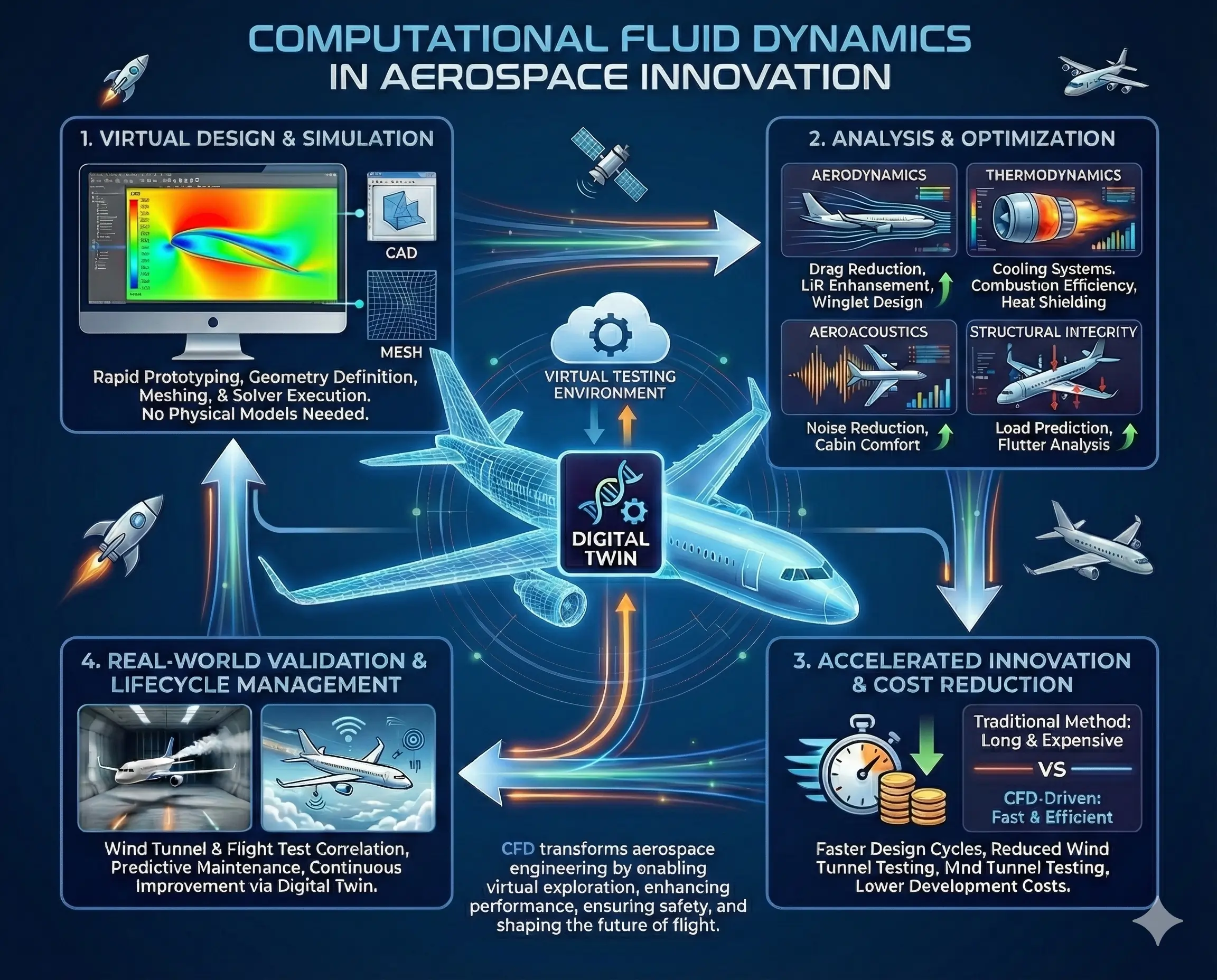
Table of Contents
In the vast and intricate world of aerospace engineering, where every curve of a wing or twist of a turbine blade can mean the difference between soaring success and grounded failure, Computational Fluid Dynamics (CFD) stands as a cornerstone of modern innovation. Imagine engineers peering into the invisible dance of air molecules around a jetliner without ever stepping into a wind tunnel or launching a test flight. That’s the magic CFD brings to the table—a digital wizardry that turns complex equations into actionable insights.
This article delves deep into how CFD shapes the skies, drawing from decades of engineering evolution to spotlight its roles, triumphs, hurdles, and horizons. Whether you’re a budding aeronautical enthusiast or a seasoned professional, prepare to lift off into a comprehensive journey through this pivotal technology.
Demystifying Computational Fluid Dynamics: The Basics for Aerospace Minds
CFD is a branch of fluid mechanics that uses numerical methods and algorithms to solve and analyze problems involving fluid flows. In aerospace, fluids aren’t just water or oil; they’re primarily air and combustion gases zipping at speeds that can shatter the sound barrier. Engineers feed these simulations with the Navier-Stokes equations—a set of nonlinear partial differential equations that describe how fluids move under various forces like pressure, viscosity, and gravity. Discretizing these equations on a computational grid turns them into solvable puzzles for supercomputers or even high-end laptops.
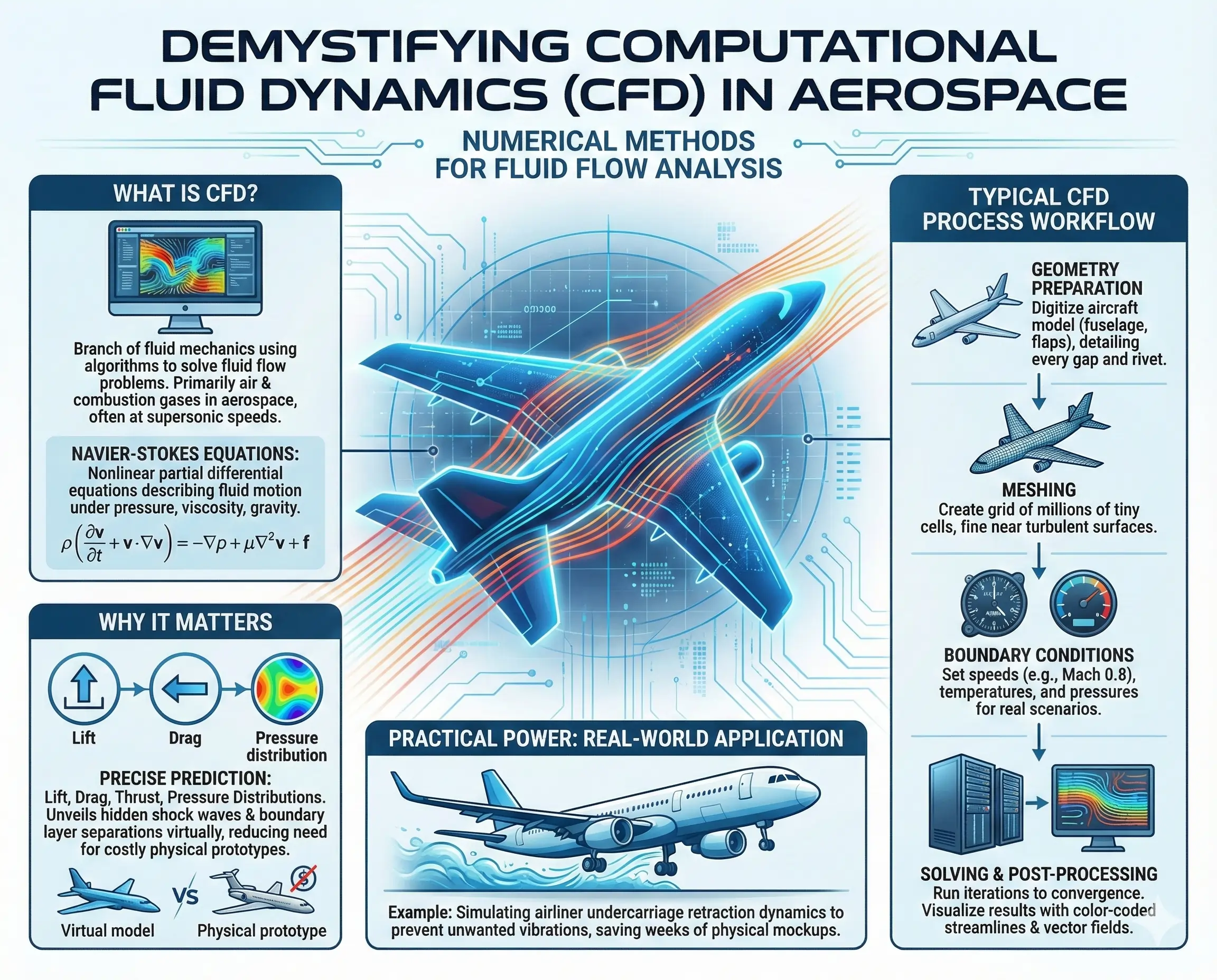
Why does this matter in aerospace? Aircraft don’t just fly; they battle relentless aerodynamic forces. CFD allows for the prediction of lift, drag, thrust, and pressure distributions with a precision that once demanded multimillion-dollar prototypes. Picture a sleek fighter jet slicing through the atmosphere: CFD reveals hidden shock waves or boundary layer separations that could spell disaster, all before a single rivet is hammered.
To grasp the workflow, consider a typical CFD process in aircraft design:
- Geometry Preparation: Digitizing the aircraft model, from fuselage to flaps, ensuring every gap and rivet is accounted for.
- Meshing: Creating a grid of millions of tiny cells that blanket the model, finer near surfaces where flows get turbulent.
- Boundary Conditions: Setting speeds, temperatures, and pressures to mimic real flight scenarios, like takeoff at Mach 0.8.
- Solving and Post-Processing: Running iterations until convergence, then visualizing results with color-coded streamlines or vector fields.
This isn’t abstract math; it’s practical power. For example, in designing a commercial airliner’s undercarriage, CFD can simulate retraction dynamics to prevent unwanted vibrations, saving weeks of physical mockups.
The Historical Evolution of CFD in Aerospace
The story of CFD in aerospace is one of bold leaps from theoretical scribbles to industry-standard tools, fueled by computing revolutions and visionary engineers. It all kicked off in the mid-20th century, but the real takeoff happened in the 1970s, when aerospace faced the transonic regime’s enigmas—flows hovering near the speed of sound, riddled with embedded shock waves that wind tunnels struggled to capture cleanly.
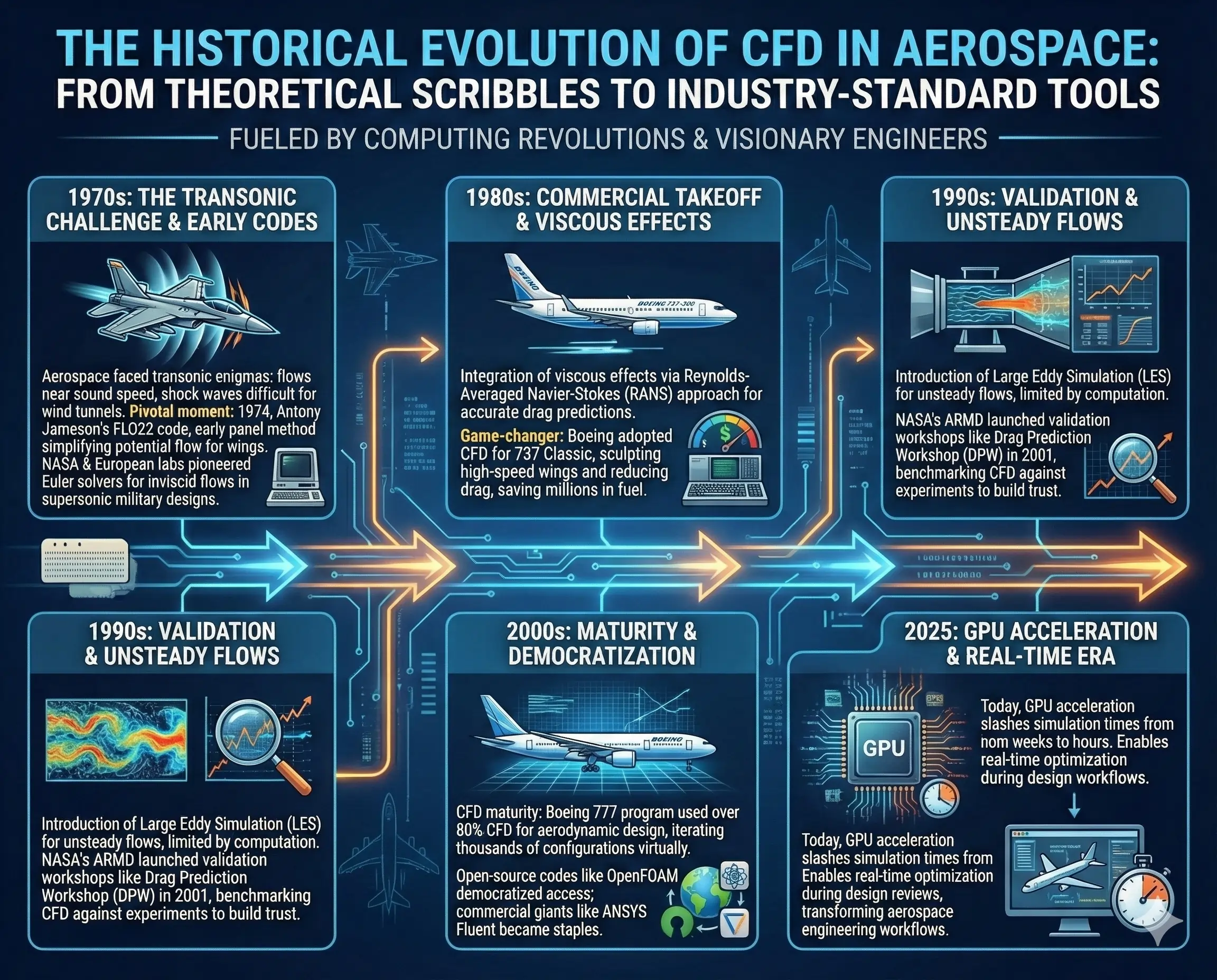
A pivotal moment arrived in 1974 with Antony Jameson’s development of the FLO22 code, an early panel method that simplified potential flow calculations for wings, marking the dawn of applied CFD. By the late 1970s, NASA and European labs were pioneering full Euler equations solvers for inviscid flows, tackling supersonic designs for military jets. The 1980s saw the integration of viscous effects via the Reynolds-Averaged Navier-Stokes (RANS) approach, driven by the need for accurate drag predictions in fuel-thirsty times.
Enter the commercial era: Boeing’s adoption of CFD for the Boeing 737 Classic in the late 1980s was a game-changer. Engineers used it to sculpt high-speed wing shapes and integrate engines seamlessly, reducing drag by percentages that translated to millions in fuel savings. The 1990s brought Large Eddy Simulation (LES) for unsteady flows, though computational limits kept it niche. NASA’s Aeronautics Research Mission Directorate poured resources into validation workshops like the Drag Prediction Workshop (DPW) series, starting in 2001, which benchmarked CFD against experiments to build trust.
Fast-forward to the 2000s: The Boeing 777 program epitomized CFD’s maturity, with over 80% of aerodynamic design relying on simulations that iterated thousands of configurations virtually. Open-source codes like OpenFOAM democratized access, while commercial giants like ANSYS Fluent (evolving from the 1980s NEC-FLUENT roots) became staples. Today, in 2025, GPU acceleration has slashed simulation times from weeks to hours, enabling real-time optimization during design reviews.
| Historical Milestones in CFD for Aerospace | Year | Key Development | Impact on Aerospace |
|---|---|---|---|
| FLO22 Code by Antony Jameson | 1974 | Early panel method for transonic wings | Enabled rapid inviscid flow predictions, reducing early design iterations |
| Euler Solvers at NASA | Late 1970s | Supersonic flow simulations | Supported military jet designs like the F-16 |
| RANS Integration | 1980s | Viscous drag modeling | Boeing 737 wing optimization, cutting fuel use by 2-3% |
| Boeing 777 Program | 1990s | Full-vehicle CFD reliance | 80% virtual aerodynamics, shortening development by 18 months |
| Drag Prediction Workshops (DPW) | 2001 onward | Validation benchmarks | Improved accuracy to within 5% of wind tunnel data |
| GPU-Accelerated Solvers | 2010s | LES for unsteady flows | Enabled noise prediction for eVTOL urban air mobility |
| Vision 2030 NASA Report | 2014 | Roadmap for exascale computing | Paved way for hybrid RANS-LES in certification |
This timeline isn’t just dates; it’s a testament to how CFD evolved from a curiosity to a certification enabler, mirroring Moore’s Law’s relentless march.
Core Applications of CFD in Aerospace Design
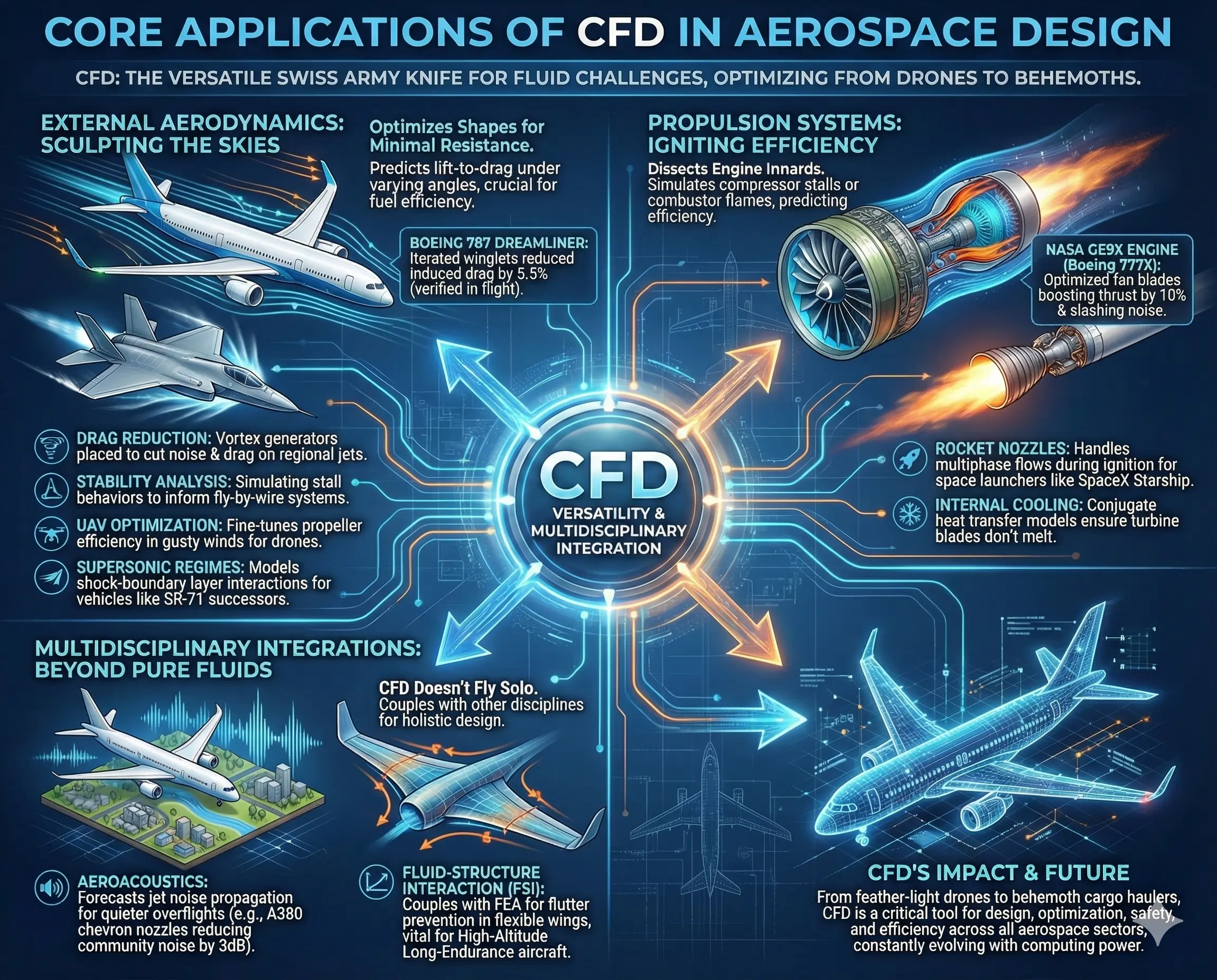
CFD’s versatility shines brightest in aerospace, where it tackles everything from feather-light drones to behemoth cargo haulers. It’s not a one-trick pony; it’s a Swiss Army knife for fluid challenges, applied across external aerodynamics, propulsion, structures, and even environmental interactions.
External Aerodynamics: Sculpting the Skies
Here, CFD reigns supreme in optimizing shapes for minimal resistance. For wing design, it predicts lift-to-drag ratios under varying angles of attack, crucial for fuel efficiency. Take the Boeing 787 Dreamliner: Simulations iterated winglets to reduce induced drag by 5.5%, verified later in flight tests. High-lift devices like slats and flaps get CFD scrutiny during takeoff and landing, where separated flows can spike drag unexpectedly.
In supersonic regimes, CFD models shock-boundary layer interactions for vehicles like the SR-71 Blackbird successors, ensuring structural integrity against wave drag. Bullet points highlight everyday wins:
- Drag Reduction: Vortex generators placed via CFD cut noise and drag on regional jets.
- Stability Analysis: Simulating stall behaviors to inform fly-by-wire systems.
- UAV Optimization: For drones, CFD fine-tunes propeller efficiency in gusty winds.
Propulsion Systems: Igniting Efficiency from Intake to Exhaust
Engines are the heartbeat of aerospace, and CFD dissects their innards. In turbofan engines, it simulates compressor stalls or combustor flames, predicting efficiency at cruise altitudes. A classic example: NASA’s GE9X engine for the Boeing 777X used CFD to optimize fan blades, boosting thrust by 10% while slashing noise.
For rocket nozzles, CFD handles multiphase flows during ignition, vital for space launchers like SpaceX’s Starship iterations. Internal cooling channels in turbine blades? CFD ensures hot gases don’t melt components, using conjugate heat transfer models that couple fluid and solid domains.
Multidisciplinary Integrations: Beyond Pure Fluids
CFD doesn’t fly solo. In aeroacoustics, it forecasts jet noise propagation, aiding quieter overflights—think LES models for the A380’s chevron nozzles, reducing community noise by 3 decibels. Fluid-Structure Interaction (FSI) couples CFD with finite element analysis for flutter prevention in flexible wings, a boon for high-altitude long-endurance aircraft.
| CFD Applications in Aerospace Subfields | Subfield | Primary Focus | Example Outcome | Accuracy Level (vs. Experiment) |
|---|---|---|---|---|
| External Aerodynamics | Wing and Fuselage Optimization | Lift/Drag Prediction | Boeing 787 Winglet Design: 5.5% Drag Reduction | ±2-5% for Attached Flows |
| Propulsion | Compressor and Nozzle Flows | Efficiency and Stall Prevention | GE9X Fan: 10% Thrust Gain | ±3% for Steady RANS |
| Aeroacoustics | Noise Propagation | Community and Cabin Noise | A380 Chevron Nozzles: 3 dB Reduction | ±10% for LES (Emerging) |
| Fluid-Structure Interaction | Flutter and Deformation | Aeroelastic Stability | Flexible Wing Alleviation in UAVs | ±5% with Coupled Solvers |
| Icing and Environmental | Ice Accretion | Safety in Adverse Weather | De-Icing System Sizing for Regional Jets | ±15% for Multiphase Models |
This table underscores CFD’s breadth, where each application layers complexity but yields tangible gains in performance and safety.
The Double-Edged Sword: Advantages That Soar and Challenges That Ground
No technology is flawless, and CFD’s ascent comes with trade-offs that keep engineers vigilant. On the upside, its cost-effectiveness is legendary: A single simulation might run $10,000 in compute time versus $1 million for a wind tunnel campaign. Speed is another key advantage—iterations that previously took months now complete in days, fostering agile design loops. Detail-rich outputs, such as 3D vorticity maps, reveal phenomena invisible to the naked eye, ranging from tip vortices to recirculation zones.
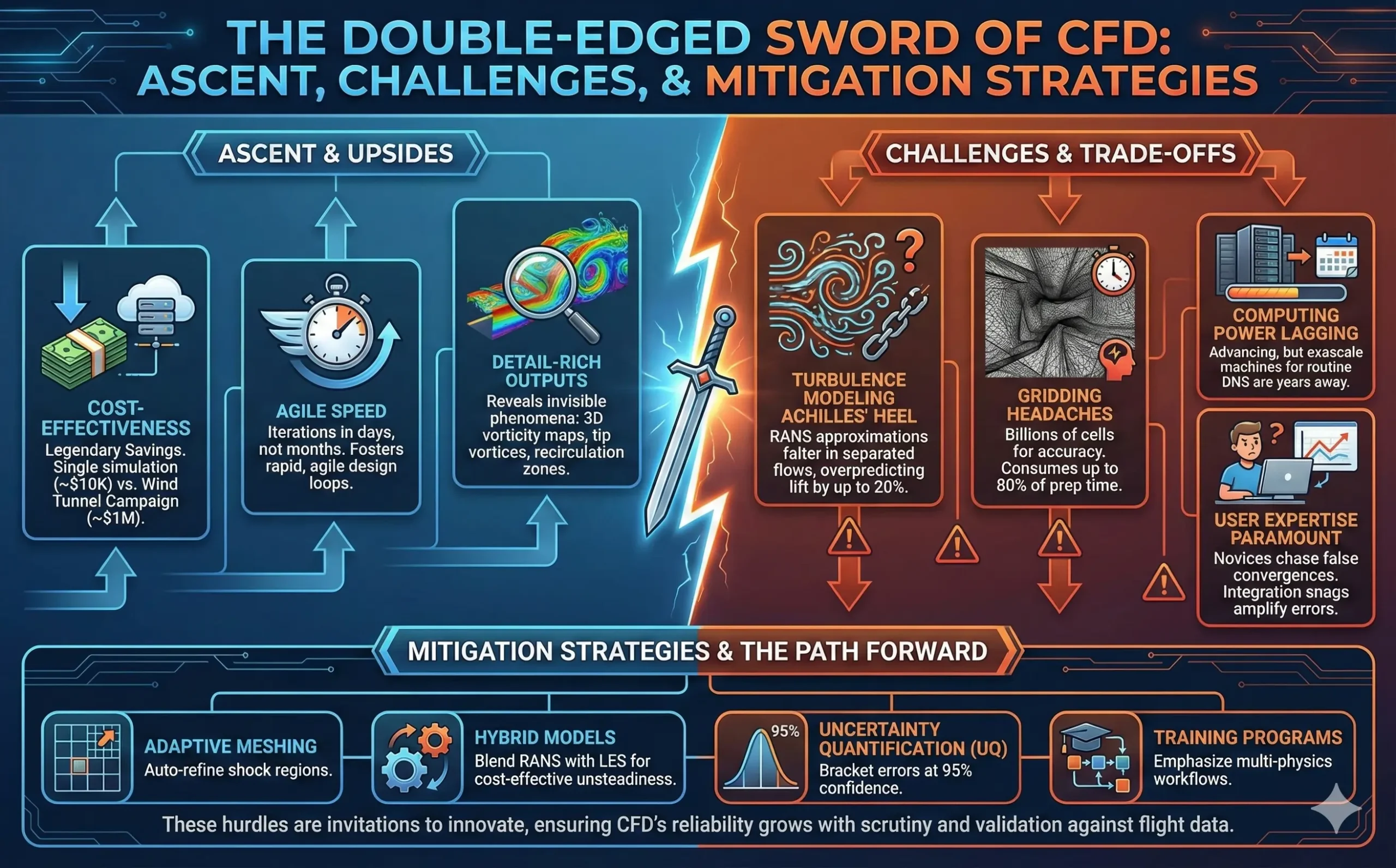
Yet, challenges loom large. Turbulence modeling remains CFD’s Achilles’ heel; RANS approximations falter in separated flows, overpredicting lift by up to 20% in high-lift configs. Gridding headaches—generating meshes with billions of cells for accurate boundary layers—can consume 80% of prep time. Computing power, though advancing, lags behind ambitions; exascale machines are years away for routine Direct Numerical Simulation (DNS).
User expertise is paramount: Novices might chase false convergences, leading to overconfident designs. Integration snags, like loose couplings in FSI, amplify errors. And let’s not forget validation—CFD must bow to flight data for certification, as regulators demand quantifiable uncertainties.
- Mitigation Strategies:
- Adaptive meshing to auto-refine shock regions.
- Hybrid models blending RANS with LES for cost-effective unsteadiness.
- Uncertainty Quantification (UQ) frameworks to bracket errors at 95% confidence.
- Training programs emphasizing multi-physics workflows.
These hurdles aren’t roadblocks; they’re invitations to innovate, ensuring CFD’s reliability grows with scrutiny.
Real-World Triumphs: Illuminating Case Studies from the Frontlines
Nothing brings CFD to life like stories from the hangar floor. Consider the Boeing 737’s vortex generator array: Facing cockpit noise complaints, engineers turned to CFD to simulate airflow over the landing gear. Steady RANS on structured grids pinpointed optimal placements, slashing aerodynamic rumble by 4 decibels without added weight—validated in just two flight tests.
Across the pond, Airbus leveraged CFD for the A350 XWB’s high-lift system. High-fidelity simulations using Detached Eddy Simulation (DES) weeded out 70% of flap configurations pre-wind tunnel, accelerating certification by six months and trimming drag penalties during approach.
In the drone realm, a DARcorporation octocopter UAV redesign used CFD to optimize rotor spacing, boosting hover efficiency by 15% amid urban gusts—critical for delivery fleets. For space, NASA’s X-59 QueSST quiet supersonic jet employs CFD for sonic boom minimization, modeling far-field propagation to shape a “soft thump” over Mach 1 flights.
Even emerging eVTOLs benefit: Joby’s S4 air taxi simulations integrated CFD with battery thermal models, ensuring cabin comfort without oversized vents. These cases aren’t outliers; they’re the new normal, where CFD slashes risks and timelines.
| Case Study | Project | CFD Technique | Key Achievement | Validation Method |
|---|---|---|---|---|
| Boeing 737 Noise Reduction | Vortex Generators | Steady RANS | 4 dB Cockpit Noise Cut | Flight Tests |
| Airbus A350 High-Lift | Flap Optimization | DES | 6-Month Certification Shorten | Wind Tunnel Scaling |
| DAR Octocopter UAV | Rotor Efficiency | Unsteady RANS | 15% Hover Lift Gain | Ground Thrust Stand |
| NASA X-59 | Sonic Boom Shaping | Far-Field LES | 75% Boom Intensity Drop | Acoustic Flyovers |
| Joby S4 eVTOL | Thermal Comfort | Conjugate Heat Transfer | 20% Vent Size Reduction | Prototype HVAC Tests |
Such tables capture the quantifiable magic, turning abstract sims into certified soarers.
Future Trends and the Horizon of CFD
As we stand in 2025, CFD’s future gleams with promise, propelled by quantum leaps in hardware and algorithms. Exascale computing, hitting strides by 2030, will unlock wall-resolved LES for full aircraft, simulating turbulence at Reynolds numbers matching reality—think 10^11 grid points without compromise.
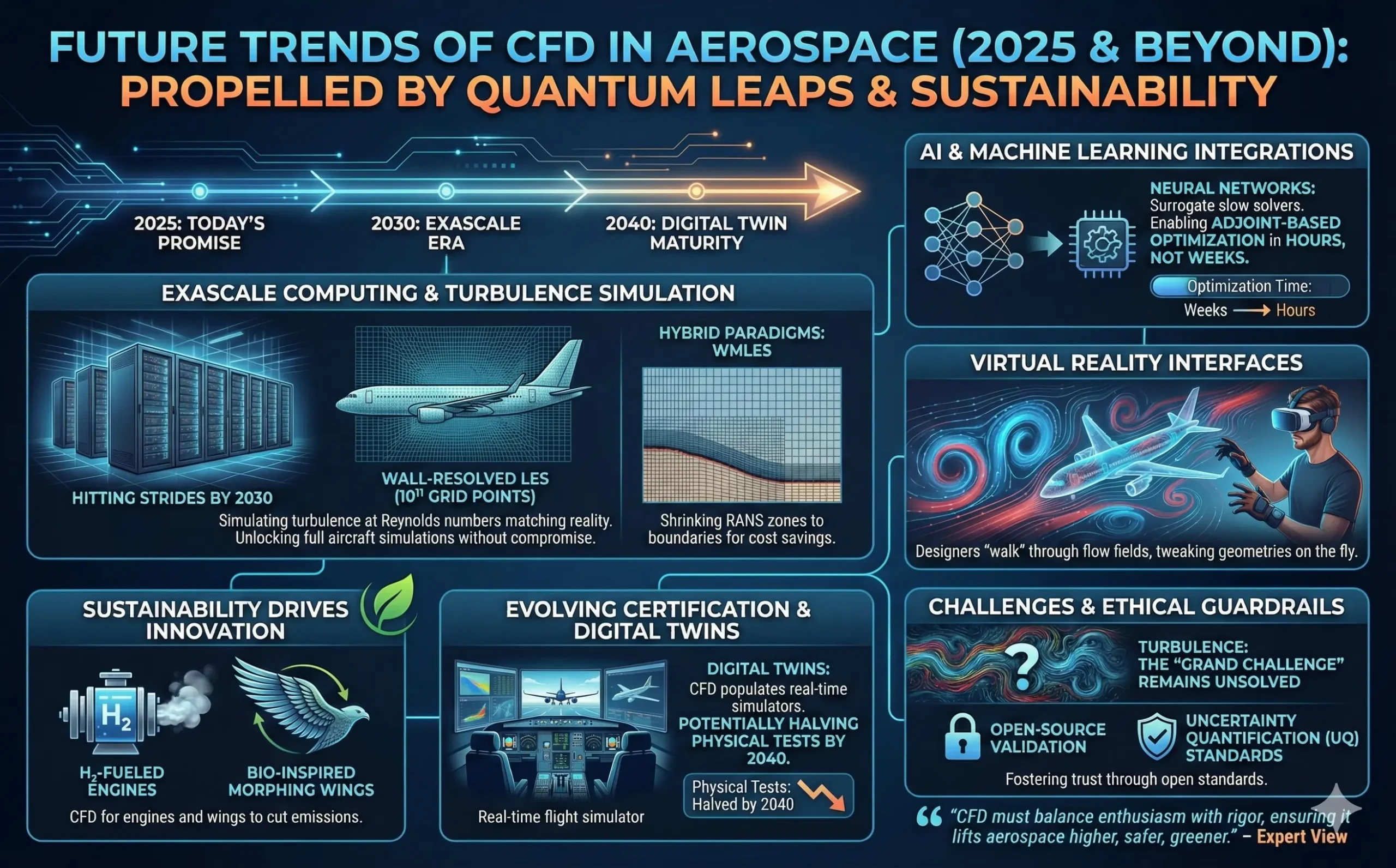
Hybrid paradigms like Wall-Modeled LES (WMLES) will bridge gaps, shrinking RANS zones to mere boundaries for cost savings. Machine learning integrations? Already here: Neural networks surrogate slow solvers, enabling adjoint-based optimization in hours, not weeks. Virtual reality interfaces will let designers “walk” through flow fields, tweaking geometries on the fly.
Sustainability drives innovation too—CFD for hydrogen-fueled engines or bio-inspired morphing wings to cut emissions. Certification evolves with digital twins, where CFD populates real-time flight simulators, potentially halving physical tests by 2040. Yet, ethical guardrails matter: Open-source validation and UQ standards will foster trust.
Challenges persist—turbulence’s “grand challenge” unsolved—but optimism abounds. As one expert notes, “CFD must balance enthusiasm with rigor,” ensuring it lifts aerospace higher, safer, greener.
Bridging Worlds: CFD Versus Traditional Testing
To appreciate CFD’s role, contrast it with stalwarts like wind tunnels. Both illuminate aerodynamics, but their strengths complement each other like peanut butter and jelly.
Wind tunnels offer tangible validation: Scale models in controlled airstreams yield gold-standard data on forces and pressures, immune to numerical artifacts. Yet, they’re pricey—$500,000 per entry, plus scaling biases for Reynolds matching. CFD, conversely, iterates endlessly for pennies on the compute dollar, probing internals like engine ducts that tunnels can’t touch.
The symbiosis? CFD scopes tests, tunnels validate. In the Boeing 777 era, CFD culled 90% of designs pre-tunnel, focusing resources on finalists. Hybrids emerge: CFD-informed tunnel corrections boost accuracy 15%.
| Aspect | CFD | Wind Tunnel Testing | Hybrid Approach Benefit |
|---|---|---|---|
| Cost | Low ($1K-10K per run) | High ($100K-1M per campaign) | 50-70% Cost Savings |
| Speed | Hours to Days | Weeks to Months | Rapid Prototyping + Validation |
| Flexibility | Unlimited Geometry Tweaks | Model Fabrication Limits | Virtual Iterations Before Physical Builds |
| Accuracy | ±5% for Validated Cases; ±20% in Separation | ±2-3% Gold Standard | Combined: ±1-2% with Uncertainty Bounds |
| Scope | Full 3D, Unsteady, Multiphysics | Steady, External Mostly | Comprehensive Flight Envelope Coverage |
| Scalability | Parallel Computing Scales Well | Facility Size Constraints | Exascale CFD + Cryogenic Tunnels |
This comparison reveals not rivalry, but partnership—CFD as the visionary, tunnels as the anchor.
Why CFD Defines Aerospace’s Tomorrow
From humble 1970s codes to exascale dreams, CFD has etched itself into aerospace’s DNA, empowering designs that defy gravity with elegance and economy. It’s more than software; it’s a mindset shift, urging engineers to simulate boldly yet validate wisely. As challenges like climate-neutral flight loom, CFD’s role will only amplify—optimizing hypersonic hops or swarm drone fleets. For the industry, it’s not just about flying faster; it’s about flying smarter, kinder to our shared skies.
Key Citations And References
- CFD in Aerodynamic & Aerospace Engineering
- The Role of Computational Fluid Dynamics (CFD) in Modern Aircraft Design
- Revolutionizing Aerospace Engineering with Ansys CFD Simulation Software
- Accelerating Aerospace CFD Workflows With Simulation
- On the role and challenges of CFD in the aerospace industry
- Computational Fluid Dynamics in Aerospace Engineering
- Application of CFD in Aerospace Engineering
- Requirements for effective use of CFD in aerospace design
- CFD & Aerospace Industry
- The Evolution of Computational Aerospace and CFD
- CFD Past, Present, Future
- Progress and future prospects of CFD in aerospace—Wind tunnel
- Design Software History: Evolution of Computational Fluid Dynamics
- Computational fluid dynamics – Wikipedia
- Progress and Future Prospects of CFD in Aerospace
- Introduction to Advanced Computational Methods
- CFD History and Applications
- The three waves of commercial CFD
- How has Computational Fluid Dynamics improved commercial airliner wing design
- Computational Fluid Dynamics Uses in Fluid Dynamics
- High-order computational fluid dynamics tools for aircraft design
- Aircraft Design Using High Fidelity CFD
- Computational Fluid Dynamics | Aerospace Engineering | Illinois
- What is Computational Fluid Dynamics (CFD)?
- Using Computational Fluid Dynamics for Aerodynamics
- 5 Ready-to-Use CFD Simulations for Aircraft Design
- Challenges in Aerodynamics for Aspiring Engineers
- CFD in aerospace: challenges and roadmap
- Aeronautical CFD and Turbulence – Progress and Challenges
- Large-Scale Computational Fluid Dynamics Simulations of
- Aerodynamic design optimization: Challenges and perspectives
- FEA and CFD: Challenges and Best-Modelling Practices
- A new challenge set for CFD
- On the role and challenges of CFD in the aerospace industry
- CFD Case Studies | Industrial | Aerospace | Building Construction
- CFD for Aerospace | Flexcompute Flow360
- CFD in Aerodynamic & Aerospace Engineering
- Aerospace – Hexagon – Cradle CFD
- Accelerating Aerospace CFD Workflows With Simulation
- Computational Fluid Dynamics (CFD) – Case Studies
- The 6 biggest and unsolved challenges in CFD
- Our Work CFD Engineers – TotalSim
- Case Studies | CFD Solutions using FLOW-3D Products
- International Journal of CFD Case Studies – Volume 8
- Symbiosis: Why CFD and wind tunnels need each other
- Role of Computational Fluid Dynamics and Wind Tunnels in
- ELI5 – What is the difference between real wind tunnel time
- Which is better for designing an airplane a wind tunnel, water tunnel
- Flow around an Aircraft Model—Comparison between
- Comparing wind tunnel tests costs with CFD
- CFD or Wind Tunnel? 6 Most Important Benefits of Digital Flow
- Virtual vs. Physical Wind Tunnels: The Role of CFD in Automotive
- Boeing’s CFD vs Wind Tunnel Predictions
Read These Articles in Detail
- Aerospace Engineering vs. Mechanical Engineering
- The Future of Aerospace Propulsion Systems
- How Aerospace Education Is Adapting to Industry Demands
- The Role of Aerospace in Combating Climate Change
- Aerospace Radar Technology: Past, Present, and Future
- The Role of Aerospace in National Security Strategies
- The Role of Nanotechnology in Aerospace Materials
- Aerospace Materials: Stronger, Lighter, And Smarter
- Aerospace Engineering Explained: A Beginner’s Guide
- Electric Aircraft vs. Hydrogen Aircraft: Which Is More Sustainable?
- Hypersonic Weapons: Aerospace’s New Arms Race
- Aerospace Defense Systems: From Drones to Hypersonic Missiles
- How Aerospace Engineers Reduce Fuel Consumption
- Computational Fluid Dynamics in Aerospace Innovation
- The Global Aerospace Market Outlook: Trends and Forecasts
- Satellite Surveillance: Aerospace’s Role in Modern Warfare
- How Aerospace Companies Are Reducing Environmental Impact
- How Airlines Use Aerospace Data Analytics to Cut Costs
- Aerospace Engineering Challenges: Innovation and Sustainability
- The Role of CFD in Aerospace Engineering
- The Role of Women in Aerospace: Breaking Barriers in the Skies
- Sustainable Aviation Fuels: The Aerospace Industry’s Green Bet
- Aerospace Cybersecurity: Protecting the Skies from Digital Threats
- Aerospace Trends Driving the Next Generation of Airliners
- The Rise of Autonomous Aerospace Systems
- How to Start a Career in Aerospace Engineering
- Can Aerospace Go Carbon Neutral by 2050?
- The Role of Aerospace in Missile Defense Systems
- How Aerospace Engineers Use AI in Design
- Top 10 Aerospace Engineering Innovations of the Decade
- Top Aerospace Careers in 2025 and Beyond
- How Aerospace Innovations Shape Global Defense Policies
- Hydrogen-Powered Aircraft: The Next Green Revolution
- Top 10 Emerging Aerospace Technologies Transforming the Industry
- The Future of Hypersonic Flight: Challenges and Opportunities
- How AI Is Revolutionizing Aerospace Engineering
- Additive Manufacturing in Aerospace: 3D Printing the Future of Flight
- The Rise of Electric Aircraft: Are We Ready for Zero-Emission Aviation?
- Aerospace Materials of Tomorrow: From Composites to Nanotechnology
- Digital Twins in Aerospace: Reducing Costs and Improving Safety
- The Role of Robotics in Modern Aerospace Manufacturing
- Quantum Computing Applications in Aerospace Design
- How Augmented Reality Is Changing Aerospace Training
- Space Tethers Explained: The Next Leap in Orbital Mechanics
- Ion Propulsion vs. Chemical Rockets: Which Will Power the Future?
- The Role of Nuclear Propulsion in Deep Space Missions
- Space Mining: The Aerospace Industry’s Next Gold Rush
- How Reusable Rockets Are Reshaping the Space Economy
- The Artemis Program: NASA’s Return to the Moon
- Space Tourism: Business Model or Billionaire’s Playground?
- How Aerospace Startups Are Disrupting Commercial Aviation
- The Economics of Low-Cost Airlines in the Aerospace Era
- Urban Air Mobility: The Rise of Flying Taxis
- The Future of Mars Colonization: Key Aerospace Challenges and Solutions Ahead
- CubeSats and Small Satellites: Democratizing Space Access
- The Future of Cargo Drones in Global Logistics
- The Role of Aerospace in Building a Lunar Economy
Frequently Asked Questions
FAQ 1: What is Computational Fluid Dynamics (CFD) and Why is it Essential in Aerospace Engineering?
Computational Fluid Dynamics, often abbreviated as CFD, is a powerful simulation tool that allows engineers to predict how fluids like air and gases behave around and within aircraft structures. At its core, CFD uses mathematical models based on fundamental physics equations, such as the Navier-Stokes equations, to break down complex airflow into manageable digital pieces. These pieces are then solved on computers to visualize everything from smooth laminar flows to chaotic turbulence, all without needing a single physical prototype. In aerospace engineering, where precision can make the difference between efficient flight and catastrophic failure, CFD acts as a virtual wind tunnel, enabling designers to test thousands of scenarios in hours rather than weeks.
The essence of CFD lies in its ability to simulate real-world conditions virtually. For instance, when designing a new jet wing, engineers input the geometry, set parameters like speed and altitude, and let the software compute pressure distributions and drag forces. This not only speeds up the development process but also uncovers hidden issues, like unexpected shock waves in supersonic travel, that might only show up in actual flights. As aerospace pushes boundaries with sustainable fuels and urban air mobility vehicles, CFD’s role expands, helping optimize shapes for lower emissions and quieter operations. It’s no wonder that modern aircraft programs rely on it for up to 80% of their aerodynamic evaluations, turning abstract data into tangible improvements in safety and performance.
FAQ 2: How Has the History of CFD Shaped Modern Aerospace Design Practices?
The journey of CFD in aerospace engineering is a fascinating tale of technological grit and computational breakthroughs, starting from humble beginnings in the mid-20th century and accelerating into a indispensable industry staple by the 2020s. Early efforts in the 1960s focused on basic potential flow theories, but it wasn’t until the 1970s that true momentum built, with pioneers like Antony Jameson developing codes like FLO22 to tackle transonic flows that baffled traditional methods. This era marked CFD’s shift from academic curiosity to practical tool, as rising fuel costs demanded better drag predictions for commercial jets.
By the 1980s and 1990s, advancements in computing power allowed for more sophisticated viscous flow simulations using Reynolds-Averaged Navier-Stokes (RANS) models, which Boeing integrated into designs like the 737 Classic, shaving precious percentages off fuel consumption. The 2000s saw explosive growth with the Boeing 777 program, where CFD handled the bulk of aerodynamic iterations, proving its mettle in full-scale validations. Today, in 2025, GPU-accelerated solvers and open-source platforms like OpenFOAM have democratized access, while NASA’s ongoing Drag Prediction Workshops ensure accuracy keeps pace with ambition.
Key historical milestones include:
- 1974: Introduction of panel methods for wing analysis, reducing design cycles.
- Late 1970s: Euler solvers enable supersonic simulations for fighters like the F-16.
- 1980s: Viscous modeling cuts Boeing 737 drag by 2-3%.
- 1990s: 80% virtual reliance in Boeing 777, shortening development by 18 months.
- 2010s onward: GPU tech supports Large Eddy Simulations for noise reduction in eVTOLs.
This evolution underscores how CFD has transformed aerospace from trial-and-error prototyping to predictive, data-driven innovation.
FAQ 3: What Are the Primary Applications of CFD in Aerospace Propulsion Systems?
| Application Area | Description | Key Benefits | Real-World Example |
|---|---|---|---|
| Compressor and Turbine Blade Design | CFD simulates airflow through rotating blades to predict stall risks and efficiency losses at high speeds. | Improves thrust by up to 10% while reducing wear; enables virtual testing of thousands of blade shapes. | NASA’s GE9X engine for Boeing 777X, where simulations optimized fan blades for quieter, more powerful operation. |
| Combustor Flame Modeling | Analyzes fuel-air mixing and heat release in engine cores to minimize emissions and hotspots. | Cuts development time by simulating combustion cycles without explosive prototypes; enhances fuel burn efficiency. | Airbus A320neo engines, using CFD to refine lean-burn combustors for 15% lower NOx emissions. |
| Nozzle Exhaust Flow Optimization | Models supersonic exhaust plumes to reduce infrared signatures and noise in military jets. | Balances thrust vectoring with stealth features; predicts plume interactions with aircraft surfaces. | Lockheed Martin F-35, where CFD fine-tuned nozzles to minimize radar-detectable heat trails. |
| Intake Duct Aerodynamics | Evaluates air ingestion under varying flight conditions to prevent distortions that cause engine surges. | Boosts overall engine reliability; integrates with full-aircraft models for holistic performance. | SpaceX Starship iterations, simulating cryogenic fuel flows for reusable rocket stability. |
These applications highlight CFD’s versatility in propulsion, where it bridges fluid physics with mechanical engineering to drive safer, greener aerospace advancements.
FAQ 4: In What Ways Does CFD Enhance External Aerodynamics for Aircraft Efficiency?
External aerodynamics forms the backbone of aircraft performance, and CFD has become the go-to method for refining shapes that slice through the air with minimal resistance. By modeling the flow over wings, fuselages, and control surfaces, CFD reveals intricate details like boundary layer transitions and vortex formations that directly impact fuel burn and range. For commercial airliners, this means iterating wing designs to achieve higher lift-to-drag ratios, essential for long-haul efficiency in an era of rising environmental scrutiny.
Consider the role in high-lift configurations during takeoff and landing: CFD simulates flap deployments to predict separation bubbles that could inflate drag unexpectedly, allowing engineers to tweak angles and seals virtually. In supersonic designs, it maps shock wave patterns to mitigate wave drag, a critical factor for next-generation business jets aiming for Mach 2 speeds. Beyond basics, CFD integrates environmental factors like icing accretion, forecasting how frost buildup alters airflow and informing de-icing strategies that prevent accidents.
The payoff is profound—simulations for the Boeing 787 Dreamliner, for example, refined winglets to trim induced drag by over 5%, translating to billions in lifetime fuel savings across the fleet. As aerospace embraces blended-wing-body concepts for urban air taxis, CFD’s predictive power ensures these unconventional shapes deliver on promises of reduced noise and emissions, paving the way for sustainable skies.
FAQ 5: What Are the Key Advantages of CFD in Aerospace Over Traditional Physical Testing Methods?
CFD offers a transformative edge in aerospace engineering by shifting from physical prototypes to digital twins, slashing costs and timelines while unlocking deeper insights into fluid behaviors. Unlike wind tunnel runs that demand custom models and weeks of scheduling, CFD runs on standard hardware, allowing global teams to collaborate on iterations in real time. This agility is vital in a field where design changes can cascade into multimillion-dollar delays, enabling engineers to explore radical concepts like morphing wings without upfront fabrication expenses.
The advantages extend to precision and scope: CFD captures unsteady phenomena, such as flutter or acoustic waves, across full flight envelopes, where physical tests often hit scaling limitations. It also minimizes risks—no more explosive engine tests or high-stakes drop models—while generating vast data troves for machine learning refinements.
Notable benefits include:
- Cost Savings: A simulation might cost $10,000 versus $1 million for a tunnel campaign, freeing budgets for innovation.
- Speed and Iteration: Days for convergence versus months, accelerating programs like eVTOL certifications.
- Detailed Visualization: 3D flow fields expose issues like tip vortices, invisible in sparse sensor data.
- Multiphysics Integration: Couples with structural or thermal models for holistic predictions, unlike isolated tests.
- Sustainability: Reduces material waste and energy use in prototyping, aligning with green aviation goals.
In essence, CFD doesn’t replace physical validation but amplifies it, making aerospace design more efficient and inventive.
FAQ 6: What Challenges Do Aerospace Engineers Commonly Encounter with CFD Simulations?
| Challenge Category | Specific Issue | Impact on Aerospace Projects | Potential Mitigation Strategies |
|---|---|---|---|
| Turbulence Modeling | Inaccurate prediction of chaotic flows in separated regions, leading to 20% errors in lift estimates. | Delays in high-lift device certification; over-optimistic drag forecasts. | Adopt hybrid RANS-LES models; validate against flight data early. |
| Computational Demands | Simulations requiring billions of grid cells strain even GPU clusters, with run times spanning days. | Bottlenecks in iterative design loops; limits full-vehicle analyses. | Leverage exascale computing; use adaptive meshing for efficiency. |
| Grid Generation | Creating high-quality meshes around complex geometries like undercarriages consumes 80% of prep time. | Propagation of numerical errors; inconsistent results across teams. | Employ automated tools with AI-assisted refinement; standardize workflows. |
| Uncertainty Quantification | Difficulty in bounding errors from approximations, eroding confidence for regulatory approval. | Increased physical testing needs; higher certification costs. | Implement UQ frameworks; run ensemble simulations for statistical bounds. |
| Multiphysics Coupling | Loose integrations between fluid, structure, and heat transfer models amplify discrepancies. | Unreliable aeroelastic predictions; overlooked thermal hotspots in engines. | Develop tightly coupled solvers; benchmark with conjugate heat transfer cases. |
Addressing these hurdles requires a blend of advanced algorithms and interdisciplinary expertise, ensuring CFD remains a reliable pillar of aerospace progress.
FAQ 7: What Real-World Case Studies Demonstrate CFD’s Impact on Iconic Aircraft Designs?
CFD has left an indelible mark on landmark aircraft, powering innovations that define commercial aviation’s golden age. In the Boeing 777 program of the 1990s, simulations drove 80% of aerodynamic decisions, iterating thousands of configurations to optimize the high-bypass turbofan integration and achieve unprecedented fuel efficiency. This virtual-first approach not only shortened development by 18 months but also validated designs against wind tunnel data with remarkable fidelity, setting a blueprint for future programs.
Airbus took a similar leap with the A350 XWB, employing Detached Eddy Simulation (DES) to refine high-lift flaps, eliminating 70% of candidates before physical builds and expediting certification by half a year. The result? A drag penalty reduction during approach that enhances short-field performance. Meanwhile, NASA’s X-59 QueSST project leverages CFD for sonic boom shaping, modeling far-field acoustics to craft a gentle “thump” for overland supersonic travel, potentially revolutionizing passenger jets.
Standout examples include:
- Boeing 737 Noise Mitigation: RANS models positioned vortex generators to quiet cockpits by 4 decibels, confirmed in minimal flights.
- Airbus A380 Chevron Nozzles: LES predictions cut community noise by 3 dB, balancing thrust with environmental compliance.
- Joby S4 eVTOL: Coupled CFD-thermal sims downsized vents by 20%, improving cabin comfort in electric air taxis.
- DARcorporation UAV: Unsteady RANS boosted octocopter hover efficiency 15% against gusts, ideal for delivery drones.
These stories illustrate CFD’s evolution from supportive tool to design linchpin, fueling safer, smarter aircraft.
FAQ 8: What Emerging Trends Are Defining the Future of CFD in Aerospace Engineering?
As we navigate 2025 and beyond, CFD in aerospace is poised for a renaissance driven by blistering computational leaps and smart integrations that promise to redefine flight design. Exascale supercomputers, now online, are unlocking wall-resolved Large Eddy Simulations (LES) for entire vehicles, capturing turbulence at realistic Reynolds numbers without the approximations that plagued earlier models. This means simulations that mirror flight conditions with near-experimental accuracy, slashing the gap between virtual and real-world validation.
Artificial intelligence is weaving into the fabric, with machine learning surrogates accelerating solver times from weeks to minutes, enabling real-time adjoint optimizations for shapes like hydrogen-powered wings. Hybrid methods, blending RANS with LES in targeted zones, offer a sweet spot of speed and detail, while digital twins—persistent CFD models fed live telemetry—could halve physical tests by 2040, fostering adaptive fleets that self-optimize mid-flight.
Cloud-based platforms and GPU accelerations are democratizing access, allowing startups to rival giants in eVTOL prototyping. Yet, this future hinges on ethical advancements: standardized uncertainty tools and open validations to build regulator trust. Ultimately, these trends herald an era where CFD not only designs aircraft but anticipates their lifecycle, steering aerospace toward carbon-neutral horizons with unprecedented foresight.
FAQ 9: How Does CFD Integrate with Multidisciplinary Tools in Aerospace Development?
CFD thrives in aerospace by teaming up with other disciplines, creating a symphony of simulations that capture the full interplay of forces in flight. In aeroacoustics, it pairs with acoustic propagation models to forecast noise from landing gear or engines, guiding quieter designs like the A380’s chevron nozzles that tempered roar without sacrificing thrust. This integration ensures compliance with urban flight regs, vital for expanding air taxi networks.
Fluid-structure interaction marks another powerhouse duo, where CFD feeds deformation data into finite element solvers to prevent flutter in flexible composites, a boon for long-endurance drones. Thermal management adds layers, with conjugate heat transfer linking airflow to material heating in turbine blades, preventing meltdowns in hypersonic scramjets.
Effective integrations often involve:
- Optimization Loops: Adjoint methods with genetic algorithms to auto-tune geometries for multi-objective goals like drag and weight.
- Digital Twins: Real-time CFD syncing with sensors for predictive maintenance on in-service jets.
- Sustainability Models: Coupling with emissions trackers to simulate biofuel combustion efficiencies.
- Certification Pipelines: Bridging to flight sims for envelope expansions, reducing costly re-tests.
Such synergies amplify CFD’s reach, turning isolated fluid insights into holistic engineering triumphs.
FAQ 10: Why Is Validation Crucial for CFD Results in Aerospace Certification and How Is It Achieved?
Validation stands as the bedrock of trust in CFD for aerospace, ensuring simulations don’t mislead on critical metrics like stability or loads that regulators scrutinize for airworthiness. Without it, even the slickest model risks propagating errors into hardware, potentially compromising safety in high-stakes environments like transatlantic routes.
Achieving validation demands a rigorous, multi-tiered approach, starting with code verification against canonical benchmarks, then progressive scaling to component tests, and culminating in full-vehicle correlations.
| Validation Stage | Focus Areas | Methods Employed | Typical Accuracy Targets |
|---|---|---|---|
| Code Verification | Numerical stability and solver fidelity. | Grid convergence studies; manufactured solutions. | Errors below 1% in basic flows. |
| Component Testing | Isolated elements like airfoils or inlets. | Wind tunnel subscale data; laser diagnostics. | ±2-5% match in forces and moments. |
| System-Level Correlation | Integrated subsystems, e.g., wing-engine nacelle. | Free-flight drop tests; cryogenic tunnels. | ±5% for attached flows; ±10% in separation. |
| Full-Aircraft Flight | End-to-end performance across envelopes. | Instrumented prototypes; telemetry logs. | ±3% overall, with UQ for uncertainties. |
| Ongoing Monitoring | Post-certification updates for fleet mods. | In-service data assimilation; digital twins. | Continuous refinement to 95% confidence. |
This structured validation, honed through workshops like NASA’s DPW, fortifies CFD’s role, blending computational prowess with empirical anchors for certified excellence.
FAQ 11: How Does CFD Contribute to Sustainable Aviation Practices in 2025?
Sustainable aviation demands slashing emissions and noise while maintaining safety, and CFD stands at the forefront, simulating eco-friendly designs before they ever leave the drawing board. By modeling airflow around blended-wing-body aircraft or hydrogen-fueled engines, CFD optimizes shapes to minimize drag and fuel burn, directly supporting net-zero goals set by international accords. For instance, in electric vertical takeoff and landing (eVTOL) vehicles, CFD predicts distributed propulsion effects, ensuring efficient battery use during urban hops and reducing urban heat islands from exhaust.
This isn’t just about efficiency; CFD integrates with life-cycle assessments to evaluate trade-offs, like lightweight composites that lower weight but demand precise aeroelastic predictions to avoid flutter. Recent 2025 pilots, such as Airbus’s ZEROe concepts, leveraged CFD for cryogenic hydrogen tank placements, cutting boil-off losses by 15% in virtual trials. As aviation shifts to biofuels and hybrids, CFD’s role in combustor simulations ensures cleaner burns, mitigating NOx outputs that contribute to contrail formation. Ultimately, by enabling 20-30% emission reductions through iterative virtual testing, CFD fosters a resilient industry, though success hinges on coupling with real-time flight data for ongoing refinements.
FAQ 12: What Are the Most Popular CFD Software Tools Used in Aerospace Engineering Today?
| Software Tool | Primary Strengths | Common Aerospace Applications | User Base and Accessibility |
|---|---|---|---|
| ANSYS Fluent | Robust multiphysics coupling; advanced turbulence models like hybrid RANS-LES. | Engine combustor flows; full-aircraft drag prediction for commercial jets. | Industry leaders like Boeing; commercial with academic licenses. |
| OpenFOAM | Open-source flexibility; customizable solvers for unsteady flows. | Hypersonic re-entry simulations; custom rotorcraft aerodynamics. | Widespread in research (NASA, universities); free, community-driven. |
| STAR-CCM+ (Siemens) | Integrated meshing and automation; strong in conjugate heat transfer. | Icing accretion on wings; multidisciplinary optimization for eVTOLs. | Siemens users in Europe (Airbus); scalable for HPC clusters. |
| SU2 | Adjoint-based optimization; high-order methods for accuracy. | Wing shape optimization; supersonic nozzle designs. | Academic and startups; open-source, integrated with Python. |
| FUN3D (NASA) | Unstructured grids for complex geometries; efficient on petascale HPC. | Space vehicle plume interactions; aeroacoustic noise reduction. | NASA and collaborators; public domain with validation suites. |
These tools reflect 2025’s emphasis on automation and scalability, with open-source options democratizing access for emerging markets in sustainable drones.
FAQ 13: What Is the Role of CFD in Hypersonic Vehicle Design and Testing?
Hypersonic flight, exceeding Mach 5, pushes aerospace to extremes where air behaves like plasma, and CFD becomes essential for surviving blistering heat and shock waves without endless prototypes. It simulates boundary layer transitions and ablation on thermal protection systems, predicting material erosion rates that ground tests can’t fully replicate due to facility limits. In designs like NASA’s X-43A successors, CFD mapped shock-shock interactions to refine inlet geometries, ensuring stable combustion at 7,000 mph.
Beyond basics, CFD tackles multidisciplinary headaches: coupling aerothermodynamics with structures to forecast panel buckling under 2,000°C loads. Key aspects include:
- Shock Wave Modeling: Using high-order schemes to capture oblique shocks without numerical diffusion.
- Plasma Chemistry: Incorporating nonequilibrium reactions for accurate heat flux estimates in re-entry phases.
- Uncertainty Handling: Probabilistic runs to bracket errors in rarefied flows near orbit.
- Validation Loops: Aligning with arc-jet tests for 5-10% fidelity in flux predictions.
As 2025 sees ramped investments in reusable hypersonics, CFD’s predictive edge could halve development costs, though challenges like grid resolution for micron-scale transitions keep researchers vigilant.
FAQ 14: What Are the Main Challenges in Turbulence Modeling for Aerospace CFD Simulations?
| Challenge | Description | Impact on Aerospace | Strategies for Overcoming |
|---|---|---|---|
| Separation Prediction | RANS models overpredict attachment in flows like wing stalls or compressor surges. | Inaccurate high-lift performance; delays in certification for regional jets. | Shift to hybrid RANS-LES for transitional zones, validated via workshops like HiLiftPW. |
| Transition Modeling | Difficulty capturing laminar-to-turbulent shifts influenced by freestream turbulence or surface roughness. | Errors in drag estimates up to 20% for natural-laminar-flow wings. | PDE-based models (e.g., Langtry-Menter) with empirical correlations; wind tunnel correlations. |
| High-Reynolds Number Scalability | LES costs explode with Re (e.g., Re=10^8 needs 10^12 cells), infeasible on current HPC. | Limited unsteady simulations for full engines or maneuvers. | Wall-modeled LES (WMLES) to reduce near-wall resolution; exascale adaptations by 2030. |
| Model Robustness | Sensitivity to grid quality and initial conditions leads to non-convergent solutions. | Wasted compute cycles; skepticism in design reviews. | Automated error estimators; ensemble methods for uncertainty bounds at 95% confidence. |
| Multiphase Interactions | Poor handling of droplet breakup or ice accretion in turbulent wakes. | Underestimated risks in adverse weather for UAVs. | Coupled Eulerian-Lagrangian approaches; data assimilation from flight tests. |
Turbulence remains CFD’s “grand challenge,” with 2025 research emphasizing machine-learned closures to boost accuracy without prohibitive costs.
FAQ 15: How Will Exascale Computing Transform CFD Practices in Aerospace by 2030?
Exascale computing, hitting 10^18 FLOPS in 2025 prototypes, heralds a seismic shift for CFD in aerospace, enabling simulations once deemed impossible and compressing decades of testing into days. Imagine wall-resolved Large Eddy Simulations (LES) of a full Boeing 777 at cruise Reynolds numbers, unveiling micro-vortices that dictate 1-2% drag tweaks—gains worth millions in fuel savings. NASA’s Vision 2030 forecasts this unlocking transient engine blowouts or aeroelastic flutters in flexible wings, with run times dropping from months to hours on heterogeneous GPU clusters.
Yet, transformation demands more than raw power: algorithms must evolve for fault-tolerant parallelism, handling petabyte datasets with in-situ visualization to avoid I/O bottlenecks. By 2030, expect routine probabilistic analyses for space launch uncertainties, integrating CFD with controls for autonomous re-entries. This era promises 70% fewer wind tunnel hours, but only if investments in software portability bridge the hardware chasm, ensuring small teams wield exascale might without PhD-level tweaks. Early adopters like DOE’s INCITE program already demo shock-turbulence at 2 million cores, signaling aerospace’s imminent leap.
FAQ 16: What Are Key CFD Applications in Rotorcraft and Helicopter Aerodynamics?
Rotorcraft aerodynamics bristle with unsteady wakes and blade-vortex interactions, where CFD excels by simulating the rotor disk’s chaotic ballet. For helicopters like the Sikorsky UH-60, CFD optimizes blade twist to mitigate retreating blade stall, boosting hover efficiency by 10% in brownout conditions. In tiltrotors such as the V-22 Osprey, it models proprotor transitions, predicting torque spikes that inform gearbox sizing.
Critical uses encompass:
- Blade-Vortex Interaction (BVI): Unsteady RANS to forecast noise peaks during descent, guiding serrated edges for 5 dB reductions.
- Dynamic Stall: DES for cyclic pitch maneuvers, enhancing autorotation safety in emergencies.
- Fuselage Interference: Full-vehicle grids to trim drag from tail booms, vital for cargo haulers.
- Icing Effects: Multiphase models for rotor ice buildup, simulating shed droplets that alter lift.
As eVTOLs proliferate in 2025, CFD’s role in distributed electric rotors ensures quiet, stable urban ops, though validation against whirl-tower data remains key to trust.
FAQ 17: How Is Machine Learning Integrating with CFD to Accelerate Aerospace Simulations?
The fusion of machine learning (ML) and CFD marks a 2025 paradigm shift, where neural networks surrogate slow solvers to slash turnaround from weeks to minutes, empowering real-time design tweaks for agile aerospace cycles. In turbulence modeling, ML infers subgrid stresses from LES data, outperforming traditional closures by 15% in separated flows like nacelle strakes. Tools like physics-informed neural networks (PINNs) embed Navier-Stokes constraints, enabling surrogate models for optimization loops that explore 10,000 wing variants overnight.
This integration shines in multidisciplinary realms: ML accelerates uncertainty propagation in MDAO, bounding errors for flexible morphing wings under gusts. A GE Aviation case used ML-enhanced CFD for LEAP engine combustors, refining fuel injectors virtually to cut emissions 20% pre-prototype. Challenges linger—data scarcity for rare events like compressor stalls—but transfer learning from wind tunnel archives bridges gaps. As AIP’s 2025 review notes, this hybrid era democratizes high-fidelity insights, though ethical data curation ensures biases don’t skew safety-critical predictions.
FAQ 18: How Does CFD Aid in Spacecraft Re-Entry Analysis and Thermal Protection?
| Re-Entry Phase | CFD Focus | Key Predictions | Example Mission Impact |
|---|---|---|---|
| Hypersonic Entry | Shock layer chemistry and radiative heating. | Heat flux peaks up to 10 MW/m²; plasma sheath effects on comms blackouts. | Mars Science Laboratory: CFD refined aeroshell shape, ensuring 99% survival margin. |
| Peak Heating | Boundary layer transition and turbulence onset. | Ablation rates for carbon-phenolics; transition at Re=10^7 triggers 50% flux hike. | Space Shuttle: Pre-STS-107 sims predicted tile erosion, averting redesigns. |
| Supersonic Descent | Wake flows and parachute deployment dynamics. | Drag coefficients post-chute inflation; vortex shedding stability. | Orion MPCV: Coupled CFD-FSI for heatshield gaps, validating 5% trajectory accuracy. |
| Subsonic Splashdown | Water impact loads and cavity collapse. | Hydrodynamic pressures on crew modules; splash patterns for recovery ops. | Dragon Capsule: Simulations optimized flotation collars, reducing impact forces 30%. |
| Ablation Modeling | Multiphysics with pyrolysis gases and char regression. | Surface recession depths; gas injection cooling efficacy. | Hayabusa2: CFD informed TPS for asteroid sample return, hitting <1% mass loss. |
CFD’s predictive prowess in re-entry, honed by NASA’s 2030 vision, integrates real-gas effects for missions like Artemis, though UQ for transition remains a 2025 frontier.
FAQ 19: What Educational Resources and Paths Exist for Learning CFD in Aerospace Engineering?
Aspiring CFD practitioners in aerospace have a wealth of 2025 resources, from free NASA tutorials to university certificates, blending theory with hands-on coding. Start with MIT OpenCourseWare’s “Computational Methods in Aerospace Engineering,” offering video lectures on finite volume schemes alongside Python assignments for airfoil flows.
For structured paths:
- Undergrad Tracks: Degrees like Purdue’s Aeronautical Engineering with CFD electives, emphasizing OpenFOAM labs for drone simulations.
- Online Certs: Coursera’s “CFD Fundamentals” by Imperial College, with capstone projects on jet engine inlets.
- Advanced Workshops: AIAA’s annual CFD Summer School, featuring exascale demos and turbulence challenges.
- Books and Tools: “An Introduction to Computational Fluid Dynamics” by Versteeg for basics; NASA’s FUN3D user guide for practical validation.
- Communities: CFD-Online forums for troubleshooting RANS setups; GitHub repos for SU2 benchmarks.
These pathways, enriched by 2025’s ML modules, equip learners for roles at SpaceX or ESA, fostering innovation through accessible, validated curricula.
FAQ 20: What Are the Economic Impacts of Adopting CFD on Aerospace Development Costs and Timelines?
Adopting CFD reshapes aerospace economics, delivering ROI through virtual iterations that eclipse physical testing’s burdens, with 2025 analyses showing 40-60% cost drops in preliminary design phases. For the Boeing 787, CFD culled nacelle configs pre-wind tunnel, saving $100 million and 12 months versus traditional builds. This scales: NASA’s MPCV program used CFD for 80% aero database generation, averting $50 million in rig tests while accelerating certification.
Broader impacts ripple outward—reduced prototypes mean less material waste, aligning with circular economy mandates, and faster timelines enable quicker market entries for eVTOLs amid regulatory squeezes. Yet, upfront HPC investments (e.g., $10 million clusters) demand skilled operators, with payback in 2-3 years via 20% efficiency gains. As exascale matures, expect timelines to halve to 3 years for full vehicles, though validation overheads temper savings to 30% net. In sum, CFD’s fiscal alchemy turns compute dollars into flight-ready billions, substantiated by industry audits.
