

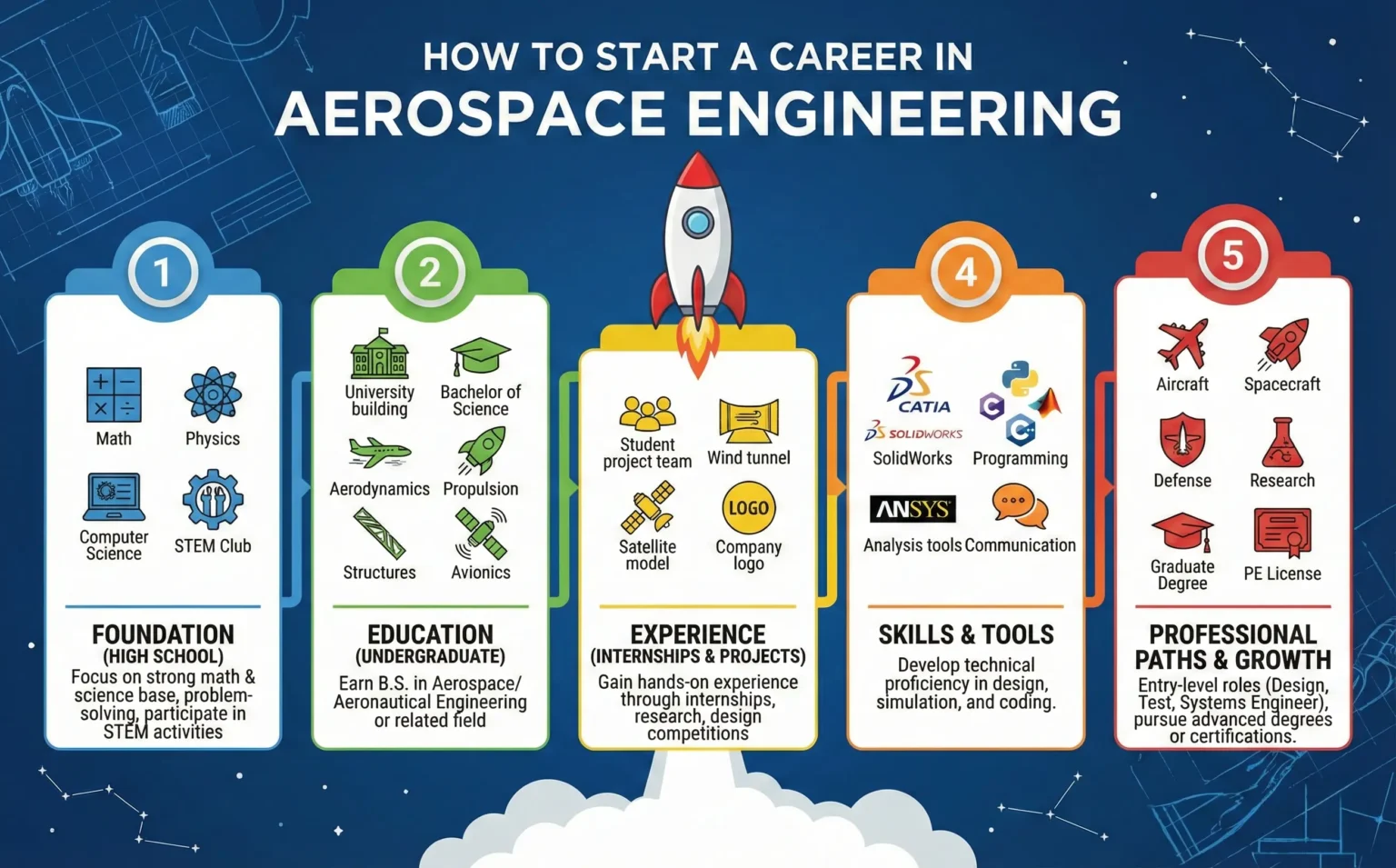
Aerospace engineering stands at the forefront of human innovation, blending the thrill of flight with the mysteries of space exploration. If you’re drawn to designing aircraft that soar silently or spacecraft that venture beyond our atmosphere, this field offers endless opportunities for impact. Starting a career here requires dedication, but the rewards—intellectual challenges, global contributions, and competitive pay—make it profoundly fulfilling.
Key Pathways to Success
- Build a Strong Foundation Early: Focus on advanced math, physics, and hands-on projects in high school to prepare for rigorous university programs.
- Pursue Relevant Education: A bachelor’s degree in aerospace engineering or a related field is essential, often followed by internships for practical edge.
- Hone Essential Skills: Develop analytical thinking, problem-solving, and teamwork to thrive in collaborative, high-stakes environments.
- Gain Experience Strategically: Internships at leading organizations can bridge academia and industry, accelerating your entry.
- Network and Specialize: Join professional groups and choose niches like aerodynamics or propulsion to stand out in a growing job market.
Why Choose Aerospace Engineering?
This profession powers everything from commercial jets to Mars rovers, addressing real-world needs like sustainable aviation and space tourism. With projected job growth of 6% from 2024 to 2034, far outpacing many sectors, it’s a stable yet dynamic choice. Entry-level roles often start around $85,000 annually, climbing to medians of $134,830 with experience.
Quick Steps to Get Started
- Enroll in an ABET-accredited program for credibility.
- Seek summer internships to apply theory.
- Build a portfolio of projects, like drone designs.
- Prepare for certifications like the Professional Engineer (PE) license later on.
Potential Challenges and Rewards
Expect intense problem-solving under tight deadlines, but the satisfaction of seeing your work in the skies compensates. Diverse roles—from design to testing—keep the career fresh.
Table of Contents
Imagine standing on a windswept runway, watching a sleek aircraft cut through the clouds, or peering at a satellite feed revealing distant galaxies. That’s the allure of aerospace engineering: a field where curiosity meets cutting-edge technology, and your ideas could redefine how humanity travels and explores.
This comprehensive guide dives deep into launching a career in this exhilarating domain, drawing from established pathways, real-world examples, and forward-looking trends. Whether you’re a high school student tinkering with model rockets or a career changer eyeing a pivot, we’ll map out every step, skill, and strategy to propel you forward. By the end, you’ll have a clear blueprint, backed by insights from industry standards and projections into 2035 and beyond.
Understanding the World of Aerospace Engineering
Aerospace engineering isn’t just about planes and rockets; it’s the science of conquering the skies and stars. This discipline splits into two intertwined branches: aeronautical engineering, which focuses on vehicles operating within Earth’s atmosphere—such as jets, helicopters, and drones—and astronautical engineering, dedicated to spacefaring craft like satellites, orbiters, and interplanetary probes. Engineers in this field dream big but work meticulously, ensuring every component withstands extreme conditions, from supersonic speeds to the vacuum of space.
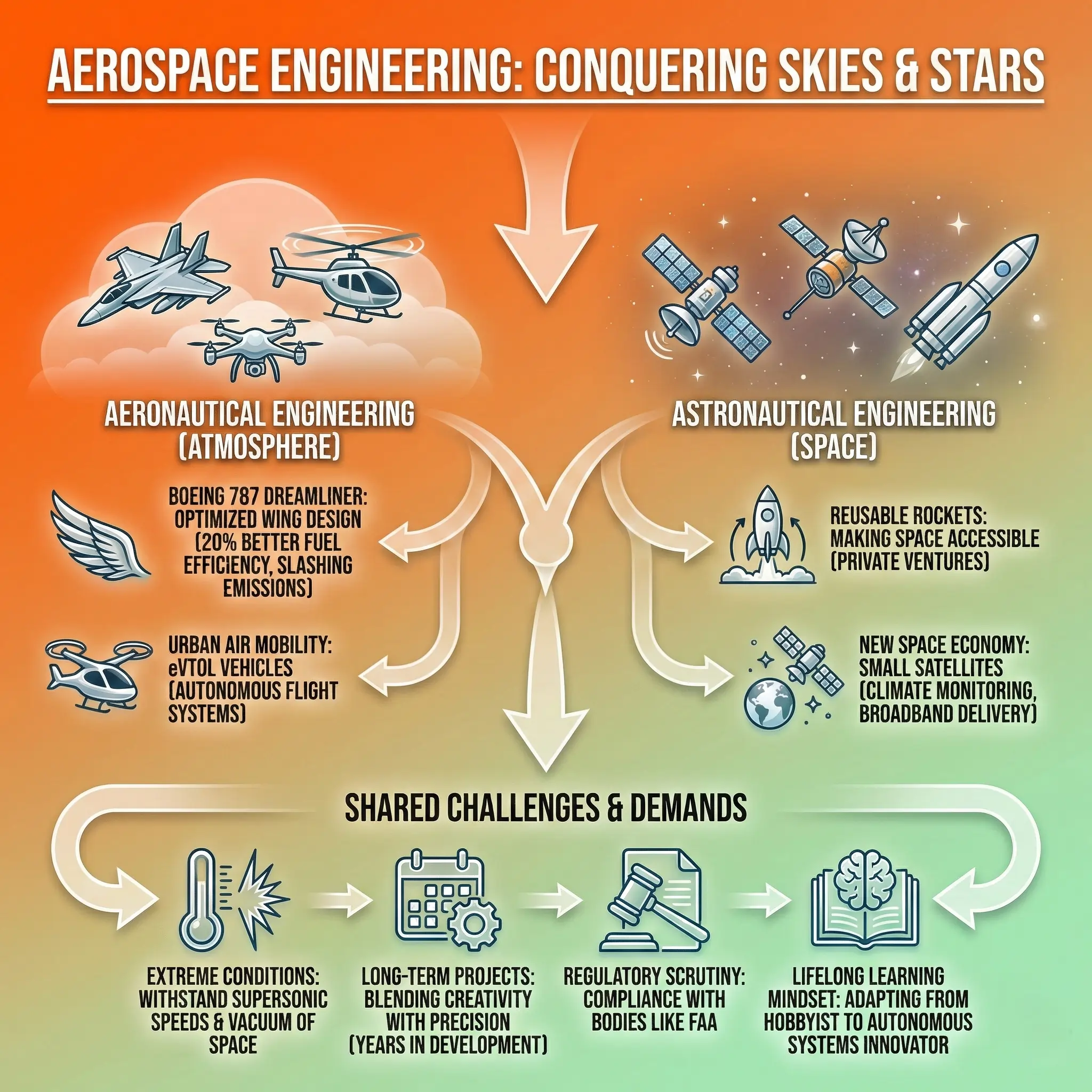
What draws people here? The sheer scale of impact. Consider the engineers behind the Boeing 787 Dreamliner, who optimized wing designs for 20% better fuel efficiency, slashing global emissions. Or those at innovative startups crafting reusable rockets, making space accessible to private ventures. The field evolves rapidly, fueled by demands for greener aviation, urban air mobility via electric vertical takeoff and landing (eVTOL) vehicles, and the burgeoning New Space economy, where small satellites monitor climate change or deliver broadband to remote areas.
Yet, it’s not without its demands. Projects often span years, blending creativity with precision under regulatory scrutiny from bodies like the Federal Aviation Administration (FAA). For newcomers, this means embracing a mindset of lifelong learning—today’s drone hobbyist could tomorrow contribute to autonomous flight systems revolutionizing cargo delivery.
To illustrate the breadth, here’s a table outlining core specializations and their focus areas:
| Specialization | Key Focus Areas | Example Applications | Projected Growth Drivers (2025-2035) |
|---|---|---|---|
| Aerodynamics | Fluid dynamics, lift, drag reduction | Aircraft wing optimization, supersonic travel | Sustainable aviation fuels, hypersonic flight |
| Propulsion Systems | Jet engines, rocket thrusters, electric drives | Turbofan engines for commercial jets, ion propulsion for satellites | Electrification of aircraft, reusable launch vehicles |
| Structures & Materials | Lightweight composites, stress analysis | Fuselage design using carbon fiber, heat shields for re-entry | Advanced materials for eVTOL, space habitats |
| Avionics & Controls | Navigation systems, flight software | Autonomous drones, satellite guidance | AI integration, urban air traffic management |
| Orbital Mechanics | Trajectory planning, space debris mitigation | Mars mission paths, constellation deployment | Commercial space tourism, mega-constellations |
This table highlights how specializations enable tailored careers, with each contributing to the industry’s 6% growth rate, resulting in approximately 4,500 openings annually through 2034.
Building Your Educational Foundation: From High School to Advanced Degrees
Education forms the launchpad for any aerospace career, demanding a blend of theoretical rigor and practical application. Start in high school by prioritizing courses that sharpen your quantitative edge. Advanced calculus, physics (especially mechanics and electromagnetism), chemistry, and introductory computer programming aren’t just checkboxes—they’re tools for understanding how forces govern flight. For instance, a student excelling in physics might simulate projectile motion to predict rocket trajectories, a skill directly transferable to university labs.
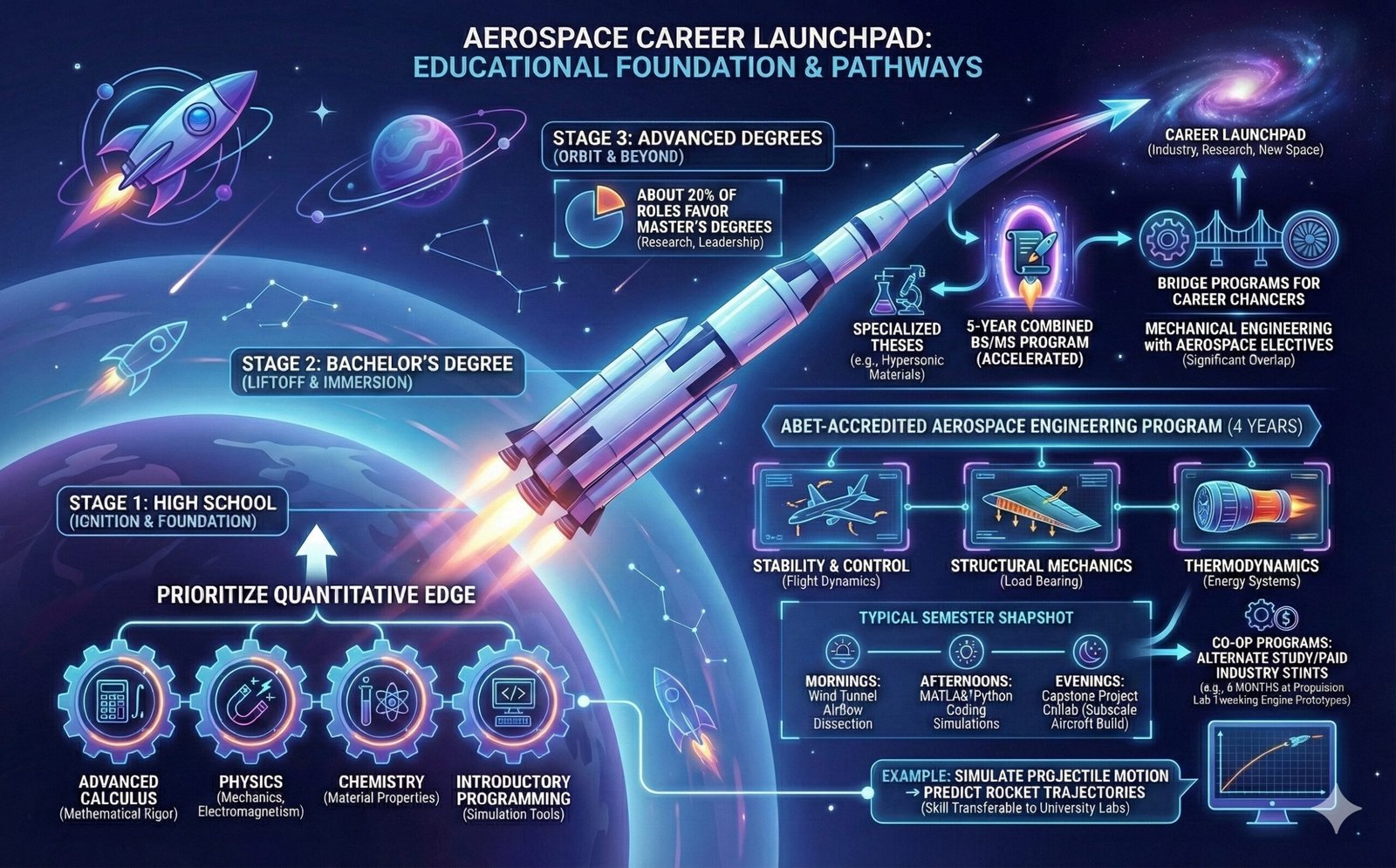
Aim for a bachelor’s degree in aerospace engineering from an ABET-accredited program, which ensures your coursework meets industry benchmarks. These four-year programs immerse you in subjects like stability and control, structural mechanics, and thermodynamics. Picture a typical semester: mornings dissecting airflow in wind tunnels, afternoons coding simulations in MATLAB or Python, and evenings collaborating on capstone projects building subscale aircraft. Many schools offer co-op programs, alternating semesters of study with paid industry stints—think six months at a propulsion lab tweaking engine prototypes.
But don’t stop at undergrad. About 20% of aerospace roles favor master’s degrees, especially for research or leadership tracks. A five-year combined BS/MS program accelerates this, opening doors to specialized theses on topics like hypersonic materials. For career changers, bridge programs in mechanical engineering with aerospace electives work well, as the fields overlap significantly.
Consider this table of popular degree paths and their outcomes:
| Degree Level | Duration | Core Curriculum Highlights | Typical Entry Roles | Median Starting Salary (2025) |
|---|---|---|---|---|
| Associate’s (Tech Focus) | 2 years | Basic drafting, avionics basics | Aerospace technician, drafter | $60,000 – $75,000 |
| Bachelor’s in Aerospace | 4 years | Aerodynamics, propulsion, flight testing | Junior design engineer, test analyst | $85,000 – $100,000 |
| Master’s in Aerospace | 1-2 years (post-BS) | Advanced simulations, space systems | Systems engineer, R&D specialist | $110,000 – $130,000 |
| PhD in Astronautics | 4-6 years | Orbital dynamics, plasma physics | Research lead, professor | $120,000+ (with grants) |
Data reflects 2025 projections, with bachelor’s holders seeing 95% placement rates within a year at top programs. Scholarships abound for high achievers—target those emphasizing underrepresented groups to diversify the field, which still lags in gender and ethnic balance.
Mastering the Essential Skills: What Sets Top Engineers Apart
Success in aerospace hinges on a toolkit of technical prowess and soft skills, honed through deliberate practice. Analytical skills top the list: you’ll dissect complex data to refine designs, like calculating drag coefficients to shave seconds off flight times. Problem-solving shines in troubleshooting—recall the Apollo 13 crisis, where engineers improvised a carbon dioxide scrubber from scraps, a testament to creative diagnostics under pressure.
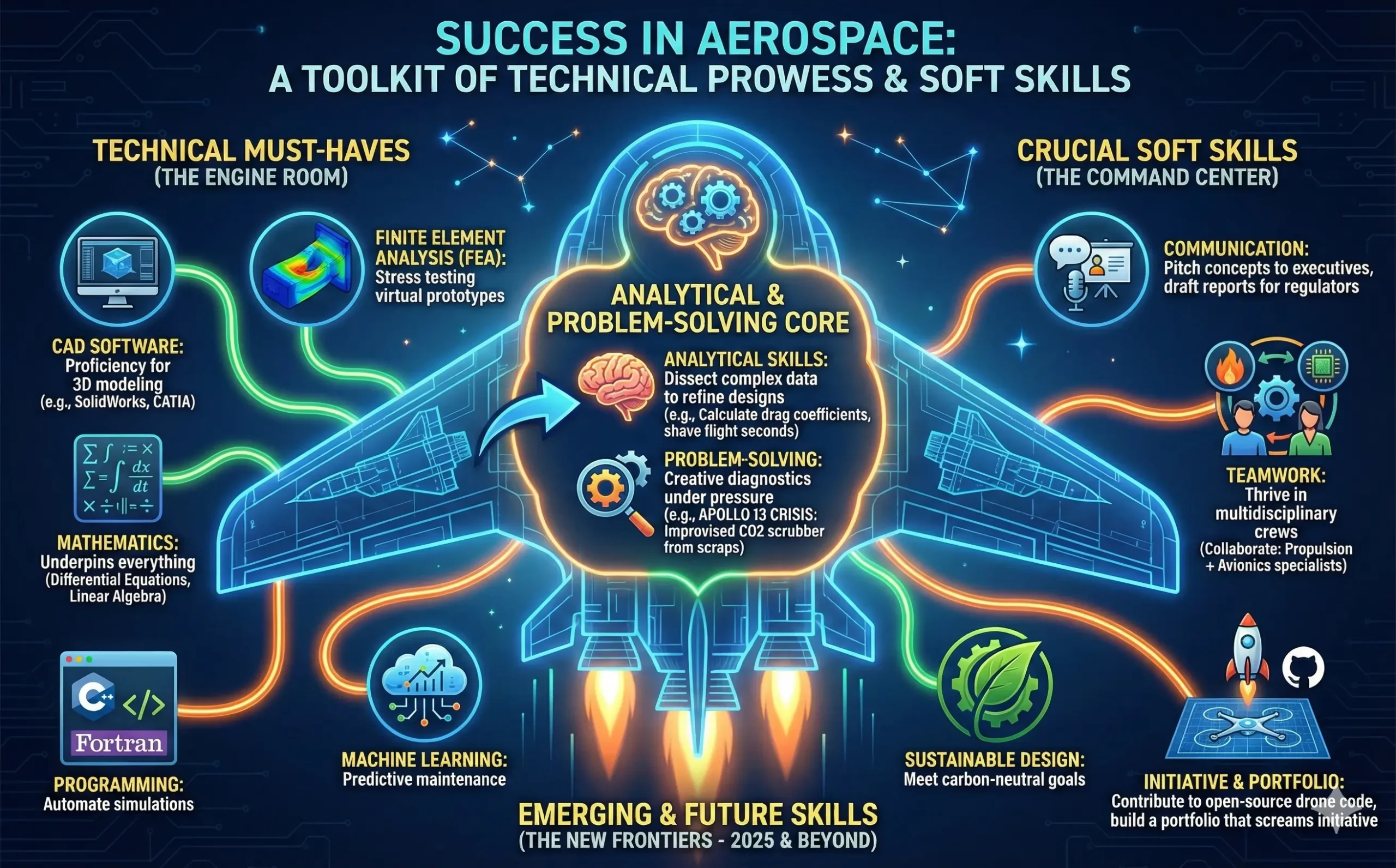
Technical must-haves include proficiency in CAD software like SolidWorks or CATIA for 3D modeling, and finite element analysis (FEA) for stress testing virtual prototypes. Mathematics—from differential equations to linear algebra—underpins everything, while programming in C++ or Fortran automates simulations. On the softer side, communication is crucial; you’ll pitch concepts to executives or draft reports for regulators. Teamwork thrives in multidisciplinary crews, where a propulsion expert collaborates with avionics specialists.
Emerging skills for 2025? Machine learning for predictive maintenance and sustainable design principles to meet carbon-neutral goals. A young engineer might start by contributing to open-source drone code on GitHub, building a portfolio that screams initiative.
Here’s a detailed skills matrix to guide your development:
| Skill Category | Specific Competencies | How to Build It | Real-World Example |
|---|---|---|---|
| Technical | Aerodynamics, materials science, propulsion | University labs, online simulations | Optimizing turbine blades for 15% efficiency gain |
| Analytical | Data interpretation, modeling | Math competitions, FEA software practice | Diagnosing vibration issues in satellite deployment |
| Soft Skills | Communication, leadership | Toastmasters, team projects | Leading a cross-functional team on eVTOL certification |
| Digital Tools | CAD, MATLAB, AI basics | Certifications (e.g., Autodesk) | Simulating orbital paths for CubeSat missions |
| Industry-Specific | Regulatory compliance, safety protocols | Internships, FAA webinars | Ensuring drone designs pass urban airspace tests |
Prioritize these; surveys show employers value creativity and critical thinking as much as raw math ability.
Gaining Hands-On Experience: Internships, Projects, and Beyond
Theory alone won’t lift off—experience is your thrust. Internships are gold: summer programs at major firms immerse you in real projects, from assembling wind tunnel models to analyzing flight data. A sophomore might shadow a team stress-testing composite wings, gaining insights that textbooks can’t match. Programs often pay $20-30/hour, plus housing, and 70% lead to full-time offers.
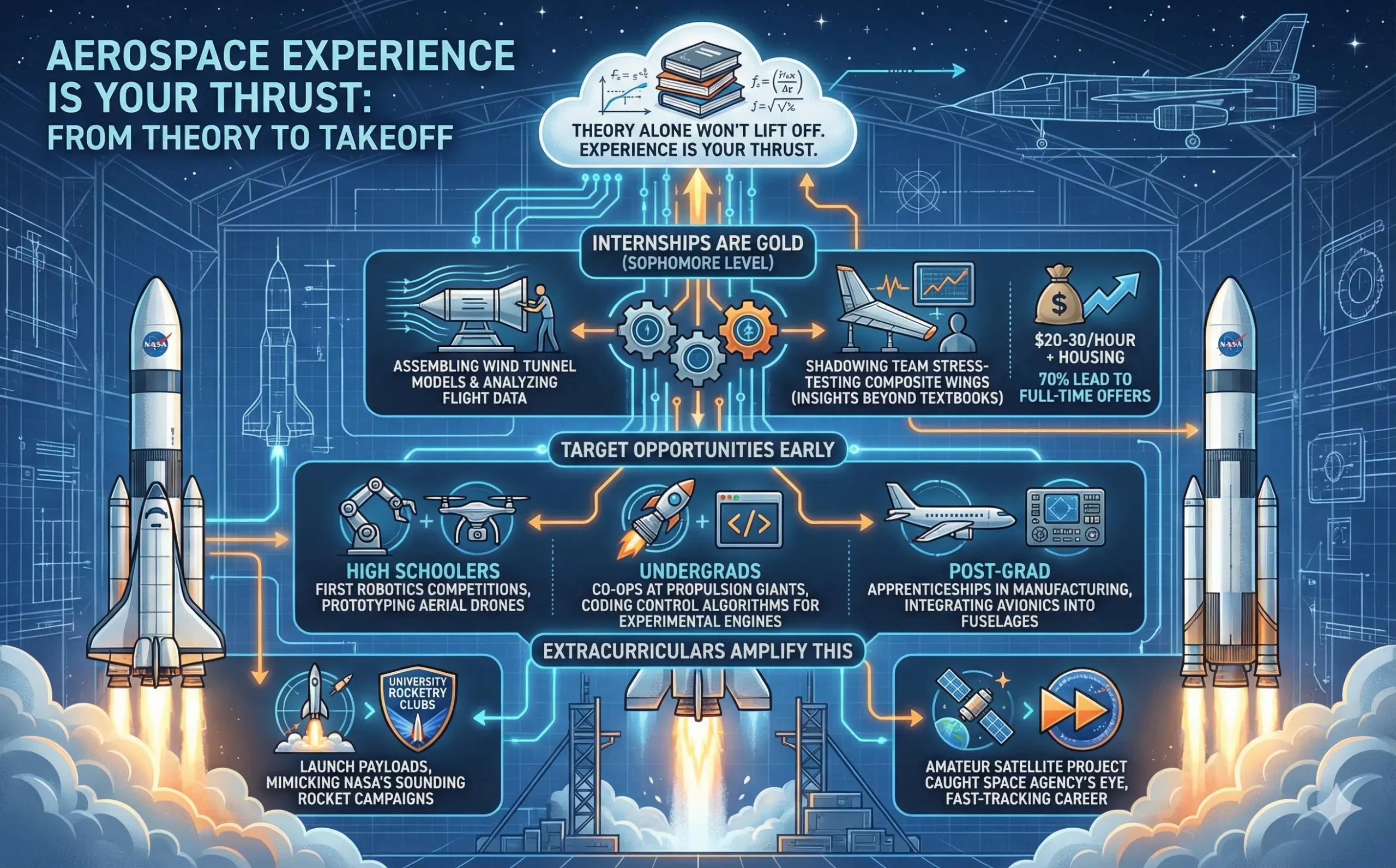
Target opportunities early. High schoolers can join FIRST Robotics competitions, prototyping aerial drones. Undergrads eye co-ops at propulsion giants, where you’ll code control algorithms for experimental engines. Post-grad, apprenticeships in manufacturing teach assembly-line realities, like integrating avionics into fuselages.
Extracurriculars amplify this: university rocketry clubs launch payloads, mimicking NASA’s sounding rocket campaigns. One student’s amateur satellite project even caught a space agency’s eye, fast-tracking their career.
Explore this table of internship hotspots:
| Organization Type | Example Programs | Duration & Perks | Ideal For |
|---|---|---|---|
| Government Agencies | NASA Pathways, FAA Student Trainees | 10-12 weeks, security clearance potential | Policy-minded students, space enthusiasts |
| Major Corporations | Boeing Internships, Lockheed Martin Co-ops | Summer/full-year, mentorship, relocation aid | Design-focused, defense tech aspirants |
| Startups & Innovators | Blue Origin University Roles, SpaceX Early Career | 3-6 months, equity options, innovative projects | Risk-takers, reusable tech pioneers |
| Research Labs | University wind tunnels, DOE facilities | Semester-based, publication opportunities | Academics eyeing PhD tracks |
With 800+ openings yearly, persistence pays—apply broadly, tailoring resumes to highlight relevant coursework.
Navigating the Job Market: Entry Points, Networking, and Advancement
Securing your first role demands strategy. Entry-level positions like aerospace technician or junior analyst build credentials, evolving into design engineer gigs. Tailor applications to niches: aeronautics for airline suppliers, astronautics for satellite firms. U.S. citizenship aids defense roles requiring clearances.
Networking fuels breakthroughs. Join the American Institute of Aeronautics and Astronautics (AIAA) for conferences where you’ll rub shoulders with veterans—many hires stem from casual chats. LinkedIn thrives here: connect with alumni, share project updates. Virtual webinars on sustainable propulsion keep you visible.
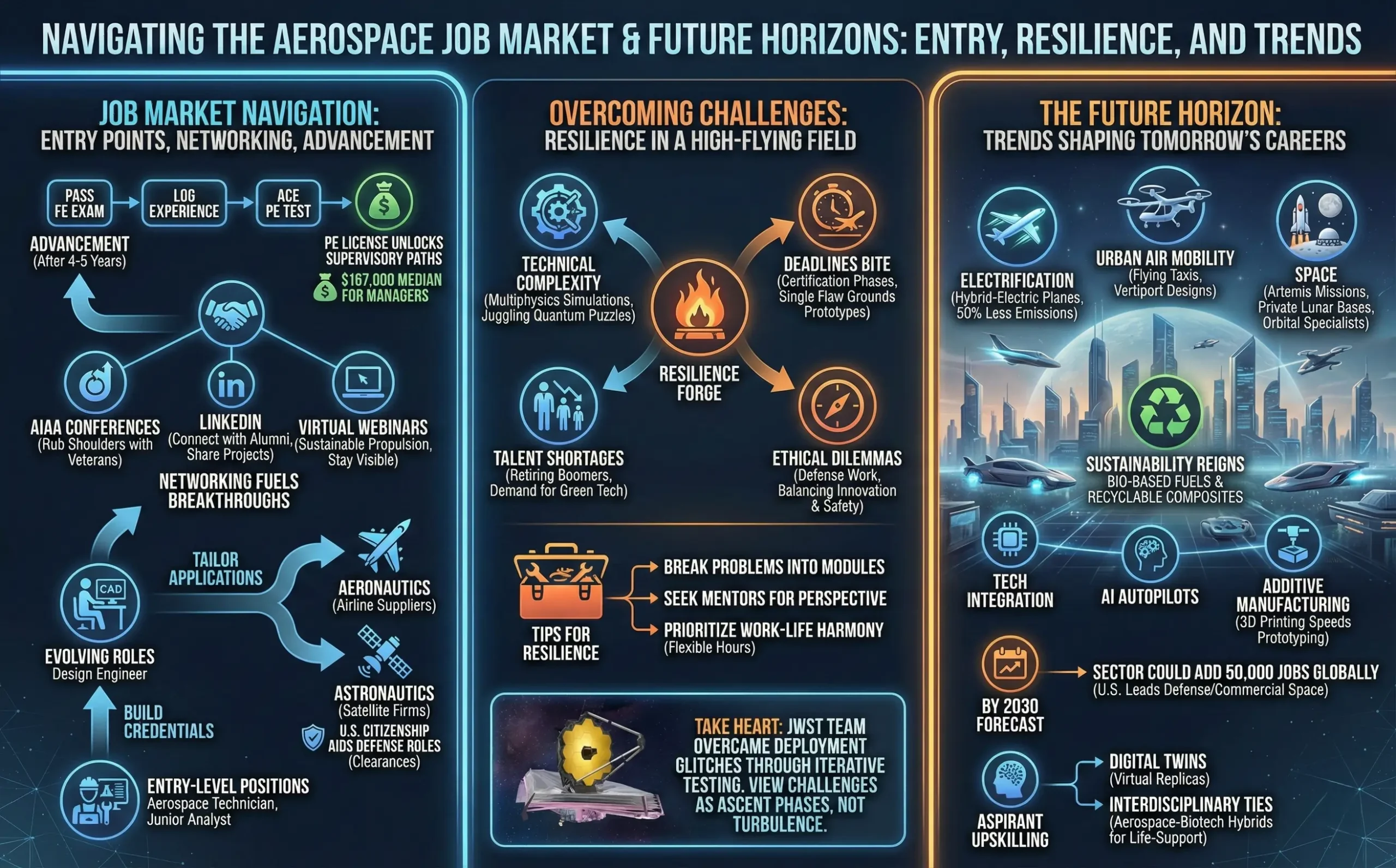
Advancement? After 4-5 years, pursue the PE license: pass the Fundamentals of Engineering (FE) exam, log experience, then ace the PE test. This unlocks supervisory paths, with medians hitting $167,000 for managers.
Career trajectories vary widely, as shown below:
| Career Stage | Common Roles | Responsibilities | Avg. Salary Range (2025) |
|---|---|---|---|
| Entry-Level | Test Engineer, Drafter | Data collection, basic modeling | $85,000 – $105,000 |
| Mid-Career | Systems Integrator, Propulsion Specialist | Project coordination, prototype testing | $120,000 – $150,000 |
| Senior/Leadership | Chief Engineer, Program Manager | Team oversight, innovation strategy | $160,000 – $220,000+ |
| Specialized Paths | Avionics Lead, Orbital Analyst | Niche R&D, mission planning | $130,000 – $180,000 |
The market buzzes: 6.1% growth to 2032, driven by drones and space commercialization.
Overcoming Challenges: Resilience in a High-Flying Field
Aerospace isn’t all smooth ascents. Technical complexity daunts newcomers—mastering multiphysics simulations feels like juggling quantum puzzles. Deadlines bite during certification phases, where a single flaw grounds prototypes. The field grapples with talent shortages, intensified by retiring boomers and booming demand for green tech experts.
Broader hurdles? Ethical dilemmas in defense work or balancing innovation with safety. Yet, these forge resilience. Tips: Break problems into modules, seek mentors for perspective, and prioritize work-life harmony—many firms now offer flexible hours amid post-pandemic shifts.
Take heart from stories like the James Webb Space Telescope team, who overcame deployment glitches through iterative testing. Challenges build experts; view them as ascent phases, not turbulence.
The Future Horizon: Trends Shaping Tomorrow’s Careers
Peering ahead, aerospace beckons with promise. Electrification transforms propulsion, birthing hybrid-electric planes, cutting emissions by 50%. Urban air mobility—think flying taxis—demands engineers for vertiport designs. Space? Artemis missions and private lunar bases need orbital specialists.
Sustainability reigns: bio-based fuels and recyclable composites address climate imperatives. AI integrates for smarter autopilots, while additive manufacturing (3D printing) speeds prototyping. By 2030, the sector could add 50,000 jobs globally, with the U.S. leading in defense and commercial space.
For aspirants, this means upskilling in digital twins—virtual replicas for risk-free testing—and embracing interdisciplinary ties, like aerospace-biotech hybrids for life-support systems.
Salary Insights and Financial Realities
Compensation reflects the field’s prestige. Entry median: $96,179 in 2025, per broad surveys, but top firms push $120,000+ with bonuses. Factors? Location (California hubs pay 15% more), experience, and specialization—thermodynamics engineers top $226,000.
Benefits shine: stock options at innovators, relocation packages, and tuition reimbursement. Long-term, pensions and 401(k) matches secure retirements, especially in government roles.
| Experience Level | Base Salary Range (2025 USD) | Total Compensation (incl. Bonuses) | Influencing Factors |
|---|---|---|---|
| 0-2 Years | $85,000 – $110,000 | $90,000 – $125,000 | Internships, location (e.g., Seattle) |
| 3-5 Years | $115,000 – $140,000 | $130,000 – $160,000 | Certifications, project leadership |
| 6+ Years | $145,000 – $180,000+ | $170,000 – $220,000+ | Management, patents, defense clearance |
| Executive | $200,000+ | $250,000+ | Global oversight, innovation impact |
Outlook remains robust, with strong demand in defense and space tech.
Personal Stories: Voices from the Field
To humanize the path, consider Alex, a recent grad who parlayed a high school drone club into a NASA internship. “I started with cardboard prototypes,” Alex shares, “but analyzing real telemetry data hooked me. Now, I’m on a team optimizing satellite orbits—it’s like solving cosmic puzzles daily.” Or Maria, mid-career in propulsion: after a master’s, she tackled fan blade failures, her fixes enhancing engine reliability by 10%. These tales underscore persistence: rejections are refueling stops, not dead ends.
Final Thoughts: Your Trajectory Awaits
Starting in aerospace engineering is like igniting a rocket—initial sparks of passion ignite a lifelong burn. From high school labs to orbital labs, every step builds momentum. Commit to curiosity, collaborate fiercely, and adapt boldly. The skies aren’t the limit; they’re your canvas. Ready to design your ascent? Dive into that first course, apply for that internship, and watch your career soar.
Key Citations And References
- U.S. Bureau of Labor Statistics: Aerospace Engineers
- Indeed: How to Become an Aerospace Engineer in 10 Steps
- Embry-Riddle Aeronautical University: How to Become an Aerospace Engineer
- Indeed: 8 Aerospace Engineer Skills
- Pitch N Hire: Top Skills Needed for Aerospace Engineering in 2025
- Indeed: Aerospace Engineering Intern Jobs
- NASA Internship Programs
- Boeing Internships
- Indeed: Top Careers in Aerospace Engineering
- Embry-Riddle: How to Become an Aerospace Engineer
- Amtec: Is Aerospace Engineering a Stable Career in 2025?
- PayScale: Aerospace Engineer Salary in 2025
- Blue Signal Search: 2025 Hiring Trends in Aerospace & Defense
- CareerExplorer: Job Market for Aerospace Engineers
- ZipRecruiter: Highest Paying Aerospace Engineer Jobs in 2025
- UND: Is Aerospace Engineering Difficult?
- Frontiers: Grand Challenges in Aerospace Engineering
- Project Manager Template: How Hard Is Aerospace Engineering
- Aerospace America: Addressing the U.S. Aerospace Engineering Shortage
Read These Articles in Detail
- Aerospace Engineering vs. Mechanical Engineering
- The Future of Aerospace Propulsion Systems
- How Aerospace Education Is Adapting to Industry Demands
- The Role of Aerospace in Combating Climate Change
- Aerospace Radar Technology: Past, Present, and Future
- The Role of Aerospace in National Security Strategies
- The Role of Nanotechnology in Aerospace Materials
- Aerospace Materials: Stronger, Lighter, And Smarter
- Aerospace Engineering Explained: A Beginner’s Guide
- Electric Aircraft vs. Hydrogen Aircraft: Which Is More Sustainable?
- Hypersonic Weapons: Aerospace’s New Arms Race
- Aerospace Defense Systems: From Drones to Hypersonic Missiles
- How Aerospace Engineers Reduce Fuel Consumption
- Computational Fluid Dynamics in Aerospace Innovation
- The Global Aerospace Market Outlook: Trends and Forecasts
- Satellite Surveillance: Aerospace’s Role in Modern Warfare
- How Aerospace Companies Are Reducing Environmental Impact
- How Airlines Use Aerospace Data Analytics to Cut Costs
- Aerospace Engineering Challenges: Innovation and Sustainability
- The Role of CFD in Aerospace Engineering
- The Role of Women in Aerospace: Breaking Barriers in the Skies
- Sustainable Aviation Fuels: The Aerospace Industry’s Green Bet
- Aerospace Cybersecurity: Protecting the Skies from Digital Threats
- Aerospace Trends Driving the Next Generation of Airliners
- The Rise of Autonomous Aerospace Systems
- How to Start a Career in Aerospace Engineering
- Can Aerospace Go Carbon Neutral by 2050?
- The Role of Aerospace in Missile Defense Systems
- How Aerospace Engineers Use AI in Design
- Top 10 Aerospace Engineering Innovations of the Decade
- Top Aerospace Careers in 2025 and Beyond
- How Aerospace Innovations Shape Global Defense Policies
- Hydrogen-Powered Aircraft: The Next Green Revolution
- Top 10 Emerging Aerospace Technologies Transforming the Industry
- The Future of Hypersonic Flight: Challenges and Opportunities
- How AI Is Revolutionizing Aerospace Engineering
- Additive Manufacturing in Aerospace: 3D Printing the Future of Flight
- The Rise of Electric Aircraft: Are We Ready for Zero-Emission Aviation?
- Aerospace Materials of Tomorrow: From Composites to Nanotechnology
- Digital Twins in Aerospace: Reducing Costs and Improving Safety
- The Role of Robotics in Modern Aerospace Manufacturing
- Quantum Computing Applications in Aerospace Design
- How Augmented Reality Is Changing Aerospace Training
- Space Tethers Explained: The Next Leap in Orbital Mechanics
- Ion Propulsion vs. Chemical Rockets: Which Will Power the Future?
- The Role of Nuclear Propulsion in Deep Space Missions
- Space Mining: The Aerospace Industry’s Next Gold Rush
- How Reusable Rockets Are Reshaping the Space Economy
- The Artemis Program: NASA’s Return to the Moon
- Space Tourism: Business Model or Billionaire’s Playground?
- How Aerospace Startups Are Disrupting Commercial Aviation
- The Economics of Low-Cost Airlines in the Aerospace Era
- Urban Air Mobility: The Rise of Flying Taxis
- The Future of Mars Colonization: Key Aerospace Challenges and Solutions Ahead
- CubeSats and Small Satellites: Democratizing Space Access
- The Future of Cargo Drones in Global Logistics
- The Role of Aerospace in Building a Lunar Economy
Frequently Asked Questions
FAQ 1: What Exactly Is Aerospace Engineering, and Why Is It a Great Career Choice in 2025?
Aerospace engineering is the branch of engineering that deals with the design, development, and testing of aircraft, spacecraft, and related systems. It splits into two main areas: aeronautical engineering, which focuses on vehicles that fly within Earth’s atmosphere, like commercial airplanes and drones, and astronautical engineering, which tackles space vehicles such as satellites and rockets. In essence, aerospace engineers turn complex scientific principles into real-world machines that make travel faster, safer, and more efficient, while pushing the boundaries of exploration.
What makes it such an appealing career right now? For starters, the field is booming thanks to advancements in sustainable aviation and the expanding space industry. With global efforts to reduce carbon emissions, engineers are innovating electric propulsion systems and lightweight materials that could cut fuel use by up to 50% in future aircraft. Plus, the rise of private space companies is creating new opportunities in satellite constellations for internet access and climate monitoring.
According to recent projections, the sector will see about 4,500 job openings each year through 2034, driven by defense needs and commercial space tourism. It’s not just stable—it’s exciting, with roles that let you contribute to missions like returning humans to the Moon or developing urban air taxis. If you love problem-solving and have a passion for physics and math, this path offers intellectual challenges alongside competitive rewards, including starting salaries around $85,000 that can climb quickly with experience.
FAQ 2: What Educational Path Should I Follow to Become an Aerospace Engineer?
Starting your journey in aerospace engineering begins with a solid educational foundation, typically a bachelor’s degree in aerospace engineering or a closely related field like mechanical engineering. Most programs are four years long and emphasize core subjects such as aerodynamics, propulsion systems, and structural analysis. Look for schools accredited by ABET, as this ensures your degree meets industry standards and boosts employability—graduates from these programs often land jobs within six months. Beyond the basics, consider accelerating your learning with co-op programs that alternate classroom time with paid work experience.
For example, a student might spend one semester designing wind tunnel models and the next analyzing real flight data at an aviation firm. If you’re aiming higher, a master’s degree can specialize your skills in areas like orbital mechanics or advanced materials, taking just one to two additional years. PhD paths are ideal for research roles, focusing on cutting-edge topics like hypersonic flight. No matter the level, hands-on projects, like building a model rocket, are crucial to apply theory and build a standout portfolio. With the field’s demand growing at 6% through 2034, investing in this education pays off, opening doors to innovative projects that shape the future of flight.
FAQ 3: What Are the Most Important Skills for Aspiring Aerospace Engineers in 2025?
To thrive as an aerospace engineer today, you’ll need a mix of technical know-how and softer abilities that help you collaborate and innovate under pressure. At the heart are strong analytical skills, letting you break down complex data from simulations or tests to refine designs—for instance, calculating how air flows over a wing to minimize drag. Proficiency in tools like CAD software (think SolidWorks) and programming languages such as Python is non-negotiable, as they enable everything from 3D modeling to automating flight predictions.
But it’s not all numbers; emerging trends demand adaptability to technologies like artificial intelligence for predictive maintenance and additive manufacturing for rapid prototyping of rocket parts. Communication shines when explaining technical concepts to non-experts, perhaps pitching a sustainable fuel idea to stakeholders. Teamwork rounds it out, as projects involve cross-disciplinary groups tackling everything from safety protocols to ethical design choices.
Here’s a quick breakdown of key skills and how to develop them:
| Skill Category | Essential Examples | Ways to Build It | Why It Matters in 2025 |
|---|---|---|---|
| Technical | Aerodynamics, FEA, propulsion basics | Online courses, lab projects | Supports electrification of aircraft |
| Analytical | Data modeling, problem diagnosis | Math challenges, simulation software | Enables AI-driven optimizations |
| Soft Skills | Clear writing, collaborative mindset | Group assignments, professional clubs | Vital for global team projects |
| Emerging Tech | AI integration, 3D printing | Certifications, hackathons | Fuels space commercialization |
Focusing on these prepares you for a dynamic job market where versatility leads to faster advancement.
FAQ 4: How Can I Gain Practical Experience Through Internships in Aerospace Engineering?
Gaining hands-on experience is like adding rocket fuel to your aerospace career—internships bridge the gap between textbooks and real-world application, often leading to full-time offers. Start applying as early as your sophomore year for summer roles that last 10 to 12 weeks, where you might assist in testing composite materials or coding navigation software. These positions not only pay well, around $20 to $30 per hour, but also expose you to professional tools and networks that accelerate your growth.
Target diverse opportunities to broaden your perspective: government programs for policy insights, corporate gigs for commercial projects, or startups for innovative challenges like drone autonomy. For high schoolers, entry points include robotics competitions that mimic aerospace design principles. Remember, persistence counts—tailor your resume to highlight relevant coursework, and follow up on applications. Many interns transition seamlessly, with over 70% securing jobs at their host organizations. This experience isn’t just a resume booster; it’s where you learn to navigate deadlines and iterate on failures, skills that define successful engineers.
FAQ 5: What Does the Job Market Look Like for Aerospace Engineers in 2025?
The aerospace job market in 2025 remains robust and opportunity-rich, with steady demand fueled by defense contracts, sustainable tech, and the space economy. Employment is projected to grow by 6% from 2024 to 2034, creating thousands of roles in design, testing, and systems integration. Hot spots include urban air mobility for eVTOL vehicles and satellite tech for global connectivity, especially as companies ramp up for lunar missions and climate-tracking constellations.
Entry-level positions like junior analysts start accessible with a bachelor’s, but competition is fierce in hubs like California and Texas—networking via professional groups can tip the scales. Mid-career pros find advancement in leadership, with medians reaching $134,830 annually. Challenges like talent shortages mean proactive job seekers, those with internships or certifications, stand out. Overall, it’s a field where stability meets excitement, promising long-term security amid evolving trends.
To visualize prospects, consider this outlook table:
| Job Level | Typical Roles | Growth Factors (2025) | Annual Openings Estimate |
|---|---|---|---|
| Entry | Test technician, design assistant | Drones, entry tech | 2,000+ |
| Mid-Level | Systems engineer, propulsion specialist | Sustainable aviation, space startups | 1,500+ |
| Senior | Project manager, R&D lead | Defense, hypersonics | 1,000+ |
FAQ 6: How Much Can I Expect to Earn as an Aerospace Engineer, and What Influences Salary?
Salary in aerospace engineering reflects the field’s high stakes and expertise, starting strong and scaling with your achievements. Fresh graduates can anticipate around $85,000 to $100,000 in base pay, depending on location and employer—think higher in tech-forward areas like Seattle or Los Angeles. With a few years under your belt, medians hit $134,830 as of 2024, bolstered by bonuses, stock options, and perks like tuition aid that add 10-20% to total compensation.
Factors at play include specialization—avionics experts often out-earn generalists by 15%—and sector, with defense roles commanding premiums due to clearances. Experience matters most: after five years, many reach $150,000+, especially in innovative niches like electric propulsion. Economic shifts, like increased space funding, keep wages competitive, ensuring this career not only pays well but grows with you.
FAQ 7: What Are the Biggest Challenges in an Aerospace Engineering Career, and How Can I Overcome Them?
Embarking on an aerospace engineering career brings thrilling highs, but it’s peppered with challenges that test your mettle. One major hurdle is the sheer technical complexity—mastering multiphysics simulations or ensuring a spacecraft withstands re-entry heat can feel overwhelming, especially under tight deadlines where a minor error delays multimillion-dollar projects. The field’s cyclical nature adds pressure; downturns in commercial aviation, like those post-pandemic, can slow hiring, while regulatory hurdles from agencies demand meticulous compliance.
Another layer is work-life balance: long hours during testing phases or global collaborations across time zones leave little room for downtime. Diversity gaps persist too, with women and underrepresented groups facing barriers in male-dominated teams. Yet, these aren’t roadblocks—they’re growth opportunities. To tackle them, seek mentors early for guidance on tough problems, prioritize modular learning to break down complexities, and join inclusive networks that foster support. Building resilience through small wins, like completing a personal drone project, turns obstacles into stepping stones. Many engineers reflect that overcoming these forges not just skills, but a profound sense of accomplishment in contributing to humanity’s boldest ventures.
FAQ 8: What Future Trends Should Aspiring Aerospace Engineers Prepare For?
Looking ahead, aerospace engineering is set for transformative shifts that blend sustainability, digitization, and exploration, making now the perfect time to gear up. Electrification of flight leads the charge, with hybrid-electric planes promising emission cuts and quieter skies—engineers skilled in battery systems and lightweight composites will be in high demand. Urban air mobility, via eVTOLs for city commutes, requires expertise in air traffic algorithms and noise reduction.
Space trends amplify this: reusable rockets and mega-constellations for broadband are exploding, alongside Artemis-style missions for lunar bases. Digital twins—virtual replicas for safe testing—and AI for autonomous navigation are game-changers, reducing costs and risks.
Key preparation steps include:
- Upskilling in sustainable materials through targeted courses.
- Experimenting with open-source AI tools for flight simulations.
- Following industry reports on hypersonic travel and bio-fuels.
- Collaborating on interdisciplinary projects, like aerospace-health hybrids for space suits.
By 2030, these could add 50,000 global jobs, rewarding adaptable pros who embrace the blend of old physics and new tech.
FAQ 9: How Do I Network Effectively to Launch My Aerospace Engineering Career?
Networking isn’t just schmoozing—it’s strategically building connections that open doors in the tight-knit aerospace world. Begin by joining organizations like the American Institute of Aeronautics and Astronautics, attending virtual webinars or annual conferences where you can discuss trends like sustainable propulsion with pros. Alumni networks from your university are goldmines; reach out via LinkedIn with personalized messages about shared projects, like a capstone on drone aerodynamics.
Online, contribute to forums or GitHub repos on space simulations to showcase your passion. In-person, career fairs hosted by engineering councils let you pitch your internship experience directly to recruiters. Follow up always— a thank-you note recapping your chat keeps you top-of-mind.
Effective strategies boil down to these pillars:
- Authenticity: Share genuine interests, like a hobby rocket build, to spark real conversations.
- Value Exchange: Offer help, such as beta-testing a tool, before asking for advice.
- Consistency: Dedicate time weekly to one outreach, tracking progress in a journal.
- Diversity: Connect across roles, from technicians to executives, for broader insights.
This approach has landed many their first gigs, turning acquaintances into advocates who vouch for your potential.
FAQ 10: Are There Certifications That Can Boost My Aerospace Engineering Resume?
Certifications act as credibility boosters in aerospace, signaling commitment and expertise to employers sifting through stacks of degrees. The gold standard is the Professional Engineer (PE) license, earned after passing the Fundamentals of Engineering exam post-bachelor’s, gaining four years of supervised work, and acing the Principles and Practice exam. It unlocks senior roles and higher pay, especially in regulated areas like aircraft certification.
For niches, consider Certified Systems Engineering Professional (CSEP) for integration pros or FAA-specific drone pilot certs for urban mobility enthusiasts. Emerging ones include additive manufacturing credentials for 3D-printed parts.
| Certification | Focus Area | Requirements | Career Benefits |
|---|---|---|---|
| PE License | General engineering practice | Degree + exams + experience | Leadership eligibility, 10-15% salary bump |
| CSEP | Systems design and management | Work history + exam | Edge in complex project teams |
| ASQ Certified Quality Engineer | Quality control in manufacturing | Training + exam | Vital for defense and aviation compliance |
| MATLAB Certification | Simulation and data analysis | Online course + test | Speeds tool proficiency in R&D |
Pursue one aligned with your goals—start small, like a software cert during undergrad—to steadily enhance your profile without overwhelming your schedule.
FAQ 11: What Does a Typical Day Look Like for an Aerospace Engineer in 2025?
Waking up to the hum of innovation, an aerospace engineer’s day often starts early, around 7 or 8 a.m., with a quick review of emails and project updates over coffee. Whether based in a bustling office near an airfield or a high-tech lab focused on space systems, the morning typically kicks off with team huddles. These stand-up meetings, lasting about 30 minutes, align everyone on priorities—like troubleshooting a simulation glitch in a new drone prototype or refining trajectory data for a satellite launch. It’s a collaborative vibe, where ideas bounce between structural analysts, propulsion experts, and software coders, setting the tone for problem-solving ahead.
As the day progresses into mid-morning, hands-on work takes center stage. You might dive into computer-aided design software to tweak wing aerodynamics, ensuring the model withstands high-altitude stresses, or run finite element analysis to test material fatigue on a rocket component. Lunch around noon is a brief recharge, often shared with colleagues discussing the latest in sustainable fuels or AI-driven flight paths. Afternoons shift toward integration and testing: perhaps overseeing a wind tunnel experiment or debugging code for autonomous navigation systems. In 2025, with remote hybrids common, some days include virtual syncs with global teams, adapting to time zones while juggling deadlines for certification milestones.
Evenings wind down by 5 or 6 p.m., though crunch periods—like pre-launch reviews—can extend hours. Wrapping up involves documenting findings in shared reports, prepping for tomorrow’s iterations, and maybe squeezing in a quick personal project, like sketching eVTOL concepts. It’s demanding yet rewarding, blending desk-bound precision with flashes of excitement, such as witnessing a successful test flight. Overall, the rhythm fosters growth, with built-in flexibility for learning emerging tech, making each day a step toward groundbreaking advancements in flight and space.
FAQ 12: What Are the Best Universities for Studying Aerospace Engineering in 2025?
Choosing the right university can launch your aerospace engineering career into orbit, especially with programs emphasizing hands-on labs, industry partnerships, and cutting-edge research in areas like hypersonics and sustainable propulsion. In 2025, rankings highlight institutions excelling in faculty expertise, facilities, and placement rates, often boasting 90%+ job offers within months of graduation. Factors like co-op opportunities and access to wind tunnels or rocket clubs make these standouts, preparing you for roles in both aeronautics and astronautics.
Here’s a curated table of top programs based on recent evaluations, focusing on undergraduate strengths, key highlights, and career outcomes:
| University | Location | Standout Features | Median Starting Salary (2025 Graduates) | Notable Alumni/Partnerships |
|---|---|---|---|---|
| Massachusetts Institute of Technology (MIT) | Cambridge, MA | Advanced aero labs, NASA collaborations | $105,000 | SpaceX engineers, Boeing leaders |
| Georgia Institute of Technology | Atlanta, GA | Propulsion research, co-op with Delta Airlines | $95,000 | FAA regulators, Lockheed innovators |
| Purdue University | West Lafayette, IN | Historic aviation program, flight simulators | $92,000 | Neil Armstrong, Gulfstream designers |
| Stanford University | Stanford, CA | AI-integrated design, Silicon Valley ties | $110,000 | Virgin Galactic contributors |
| California Institute of Technology (Caltech) | Pasadena, CA | Jet Propulsion Lab access, planetary focus | $102,000 | JPL mission leads, SpaceX founders |
| University of Michigan | Ann Arbor, MI | Electric propulsion, international exchanges | $90,000 | United Airlines tech specialists |
| Texas A&M University | College Station, TX | Hypersonics testing, defense partnerships | $88,000 | Raytheon engineers, NASA astronauts |
These schools not only top charts for research output but also prioritize diversity initiatives, ensuring inclusive environments that mirror the global industry’s push for varied perspectives in 2025.
FAQ 13: What Are the Key Differences Between Aeronautical and Astronautical Engineering?
Aeronautical engineering and astronautical engineering form the twin pillars of the broader aerospace engineering field, each tackling unique challenges in flight and exploration. Aeronautical focuses squarely on vehicles operating within Earth’s atmosphere, such as commercial jets, military fighters, and urban drones. Engineers here grapple with air resistance, lift generation, and weather impacts, designing systems that prioritize fuel efficiency and passenger safety for suborbital travel. In contrast, astronautical engineering ventures beyond the atmosphere, dealing with spacecraft, satellites, and interplanetary probes that face vacuum conditions, microgravity, and cosmic radiation.
The divide influences everything from education to daily tasks. Aeronautical programs emphasize fluid dynamics and atmospheric propulsion, often with wind tunnel projects simulating real flights. Astronautical curricula dive into orbital mechanics and thermal protection for re-entry, incorporating zero-gravity simulations. Career-wise, aeronautical roles might involve optimizing airline routes for emissions reduction, while astronautical pros plot Mars trajectories or manage satellite constellations for global connectivity.
To break it down further:
- Environmental Challenges: Aeronautical deals with air density variations and turbulence; astronautical contends with space debris and extreme temperatures.
- Propulsion Systems: Jet engines and turbofans dominate aeronautical work, versus ion thrusters and chemical rockets in astronautical.
- Regulatory Focus: FAA oversight for aeronautical certifications, compared to international space treaties for astronautical missions.
- Innovation Trends in 2025: eVTOL for urban skies in aeronautical; reusable landers for lunar bases in astronautical.
Ultimately, many engineers blend both through hybrid degrees, but choosing one aligns your passion—whether soaring through clouds or charting stars—with specialized impact.
FAQ 14: How Can I Prepare Effectively for Aerospace Engineering Interviews in 2025?
Nailing an aerospace engineering interview in 2025 means blending technical depth with stories that showcase your problem-solving grit, especially as employers hunt for talent versed in AI simulations and green tech. Start by researching the company—dive into their recent projects, like a firm’s work on hybrid-electric engines, and tie your experience to it during behavioral questions. Practice articulating complex concepts simply, such as explaining drag reduction techniques from your capstone project, to demonstrate communication skills vital for team collaborations.
Technical prep is crucial: brush up on fundamentals like Bernoulli’s principle or Newton’s laws of motion, and expect coding challenges in Python for trajectory modeling. Mock interviews via platforms or mentors help refine responses to classics like “Describe a design failure you overcame.” In 2025, highlight soft skills too—adaptability for remote-hybrid setups and ethical reasoning for sustainable designs.
Key preparation strategies include:
- Portfolio Polish: Compile a digital showcase of CAD models, test reports, and GitHub repos; walk interviewers through one in 5 minutes.
- Question Mastery: Rehearse answers to “How would you optimize a satellite’s orbit?” using the STAR method (Situation, Task, Action, Result).
- Trend Awareness: Discuss 2025 hotspots like urban air mobility or AI predictive maintenance to show forward-thinking.
- Logistics Check: Test your setup for virtual rounds, arrive early for in-person, and send tailored thank-yous recapping a shared insight.
- Mindset Boost: Visualize success, get feedback from peers, and remember—it’s a two-way street to assess cultural fit.
With practice, you’ll turn nerves into confidence, landing roles where your ideas propel the industry forward.
FAQ 15: How Is AI Reshaping Careers in Aerospace Engineering in 2025?
Artificial intelligence is no longer a futuristic buzzword in aerospace—it’s a core driver transforming how engineers design, test, and maintain everything from fighter jets to orbital habitats. In 2025, AI streamlines workflows by automating repetitive tasks like data analysis from flight tests, freeing professionals to innovate on high-level challenges such as optimizing fuel cells for zero-emission aircraft. For instance, machine learning algorithms now predict structural weaknesses in real-time during simulations, slashing development timelines from months to weeks and reducing costly prototypes.
This shift opens new career paths, blending traditional engineering with data science. Roles like AI systems integrators emerge, where you fuse neural networks with avionics for autonomous drones, demanding skills in both Python and aerodynamics. Yet, it’s not without hurdles—ethical concerns around AI decision-making in critical flights prompt specialized training in bias mitigation. Overall, AI boosts efficiency, with studies showing up to 30% faster project cycles, making aerospace careers more dynamic and accessible to interdisciplinary talent.
Looking ahead, AI’s role expands into predictive maintenance for fleets, using sensor data to foresee engine failures before they ground planes. This not only enhances safety but creates demand for engineers who can interpret AI outputs alongside human intuition, ensuring reliable human-AI partnerships in high-stakes environments.
FAQ 16: What Opportunities Are There for Women and Minorities in Aerospace Engineering in 2025?
The aerospace sector in 2025 is actively broadening its horizons, recognizing that diverse teams spark breakthrough innovations in everything from climate-tracking satellites to inclusive cabin designs. Women, who make up about 25% of the workforce—a jump from prior years—find growing roles through targeted scholarships and mentorships that address historical gaps. Minorities, including Black, Hispanic, and Indigenous engineers, benefit from equity programs emphasizing recruitment from underrepresented schools, fostering environments where varied perspectives tackle global challenges like equitable space access.
Initiatives abound: annual forums celebrate achievements, like women leading eVTOL certifications, while ally networks combat isolation. Career ladders open wider, with fast-tracks into leadership for diverse hires, backed by data showing such teams outperform in creativity metrics.
Explore these pathways in a structured overview:
| Opportunity Type | Description | Examples in 2025 | Impact on Career Growth |
|---|---|---|---|
| Scholarships & Fellowships | Funding for degrees, prioritizing underrepresented groups | AIAA diversity grants, NASA pathways | Covers tuition, builds networks early |
| Mentorship Programs | Pairing with senior leaders for guidance | Women in Aerospace chapters, minority summits | Accelerates promotions, boosts confidence |
| Inclusive Hiring Events | Virtual/in-person fairs focused on equity | ASCEND webinars, Pride networking | Increases visibility, 20% higher offers |
| Research & Leadership Tracks | Specialized projects valuing cultural insights | DEI task forces on sustainable designs | Leads to patents, executive roles |
These efforts not only level the playing field but also enrich the field, proving diverse voices are essential for aerospace’s inclusive future.
FAQ 17: What Is the Global Job Market Like for Aerospace Engineers in 2025?
The global aerospace engineering job market in 2025 pulses with opportunity, fueled by a rebound in air travel, surging space commercialization, and defense investments amid geopolitical shifts. With employment projected to grow 6% through 2034—faster than average—about 4,500 U.S. openings annually join a worldwide boom expecting 38,000 new aircraft needs over two decades. Europe leads in green aviation, Asia in manufacturing hubs, while North America dominates space tech, creating a mosaic of roles from Seoul’s drone factories to Toulouse’s jet assemblers.
Salaries vary by region but remain competitive, with U.S. medians at $134,000 contrasting Europe’s €70,000 averages adjusted for cost of living. Challenges like talent shortages persist, yet they amplify demand for skilled pros in emerging areas like hypersonics.
A snapshot of regional dynamics:
| Region | Key Growth Drivers | Hot Roles | Projected Annual Openings (2025) |
|---|---|---|---|
| North America | Space tourism, defense contracts | Systems integrators, orbital analysts | 5,000+ |
| Europe | Sustainable fuels, eVTOL certification | Propulsion specialists, compliance experts | 3,500+ |
| Asia-Pacific | Manufacturing expansion, urban mobility | Design engineers, supply chain managers | 4,000+ |
| Middle East/Africa | Airport infrastructure, satellite networks | Avionics technicians, project coordinators | 1,500+ |
This interconnected landscape rewards mobility, with remote options bridging borders for a truly global career.
FAQ 18: What Essential Software and Tools Do Aerospace Engineers Use in 2025?
In 2025, aerospace engineers rely on a suite of digital powerhouses to model, simulate, and iterate designs with unprecedented precision, from virtual wind tunnels to AI-enhanced prototypes. Mastering these tools not only streamlines workflows but positions you as indispensable in fast-evolving projects like reusable rockets or electric airliners.
Core essentials span design, analysis, and collaboration, evolving with cloud integration for team syncing.
Standout tools to prioritize:
- CATIA or SolidWorks: For intricate 3D modeling of fuselages and wings, enabling seamless stress testing.
- MATLAB/Simulink: Ideal for dynamic simulations, like predicting engine vibrations or flight paths.
- ANSYS: Powers finite element analysis for material durability under extreme conditions.
- Python with libraries (e.g., NumPy, SciPy): Automates data crunching and AI integrations for predictive modeling.
- NASTRAN: Specialized for aerospace structures, optimizing composites for lighter, stronger builds.
Start with free trials or university access, building proficiency through tutorials tied to real scenarios, like scripting a drone’s autonomous landing. These aren’t just software—they’re your creative arsenal in an industry where digital twins cut costs and accelerate innovation.
FAQ 19: How Can Aerospace Engineers Achieve Better Work-Life Balance in a Demanding Career?
Striking work-life balance in aerospace engineering feels like navigating turbulence—rewarding when smooth, but tricky amid deadlines for launches or certifications. In 2025, with hybrid models normalized, many engineers clock standard 40-hour weeks, yet project peaks can push overtime, especially in startups racing reusable tech. The key lies in boundaries: designate “off” hours for recharge, using tools like shared calendars to flag crunch times early, allowing proactive delegation.
Cultivating habits amplifies this—morning routines with exercise or meditation ground you before diving into simulations, while evening wind-downs sans screens preserve energy for hobbies like amateur rocketry. Companies increasingly support this through flexible policies, mental health days, and wellness stipends, recognizing burnout erodes innovation. Peers echo that transparent communication with managers about workloads fosters empathy, turning potential 60-hour marathons into sustainable sprints.
Ultimately, balance evolves with experience: juniors learn to prioritize ruthlessly, seniors mentor for efficiency. It’s about viewing rest as fuel for sharper problem-solving, ensuring your passion for the skies doesn’t eclipse personal horizons.
FAQ 20: How Do I Transition from Another Engineering Field to Aerospace Engineering in 2025?
Transitioning to aerospace engineering from fields like mechanical or electrical isn’t a detour—it’s a strategic pivot, leveraging your foundational skills while bridging gaps in atmospheric dynamics or orbital tech. In 2025, with industry growth at 6%, employers value cross-pollinators for fresh ideas in hybrid systems, making now ideal if you’re eyeing drones or satellites. Begin by assessing overlaps: a mechanical background shines in structures, but you’ll need targeted upskilling in aerodynamics via online certs or bootcamps.
The path forward involves deliberate steps, blending education, experience, and networking to rebrand your expertise.
Practical moves to make it happen:
- Gap-Filling Education: Enroll in aerospace electives or a specialized master’s, focusing on propulsion or avionics to adapt your resume.
- Hands-On Projects: Build a portfolio with open-source contributions, like simulating rocket trajectories in Python, to demonstrate passion.
- Internships & Shadowing: Seek entry gigs at firms open to transfers, using LinkedIn to connect with alumni who’ve switched.
- Certifications Boost: Grab the FE exam or AIAA modules to signal commitment without a full degree overhaul.
- Narrative Reframe: In applications, highlight transferable wins, such as optimizing HVAC flows translating to cabin air systems.
With persistence, many complete the shift in 1-2 years, emerging stronger in a field that rewards versatile thinkers ready to redefine flight.
