

Key Points on Aerospace Radar Technology
- Research indicates that radar technology originated in the late 19th century, with experiments demonstrating that radio waves reflected off objects, evolving into critical tools for detection in aviation and defense by the 1930s.
- It seems likely that World War II accelerated the growth of radar, with systems like early warning networks playing pivotal roles in battles; however, developments varied across nations due to technological and strategic differences.
- Evidence suggests that current radar systems, such as electronically scanned arrays, offer enhanced detection and multitasking capabilities, but challenges like electronic interference highlight ongoing debates regarding reliability in modern aerospace applications.
- Future trends suggest that the integration of AI and quantum methods could transform radar for improved accuracy and autonomy; however, experts emphasize the importance of ethical considerations and potential limitations in contested environments.
A Brief History
Radar began with foundational discoveries in electromagnetism, leading to practical systems in the early 20th century. By the 1930s, nations developed pulsed radars for military use, with significant wartime advancements shaping aviation surveillance.
Today’s Innovations
Modern aerospace radars emphasize multifunction capabilities, using advanced materials and digital processing to handle complex scenarios in air traffic control and defense operations.
Looking Ahead
Emerging technologies point to smarter, more adaptive radars, potentially revolutionizing how we monitor skies, though adoption depends on addressing technical and regulatory hurdles.
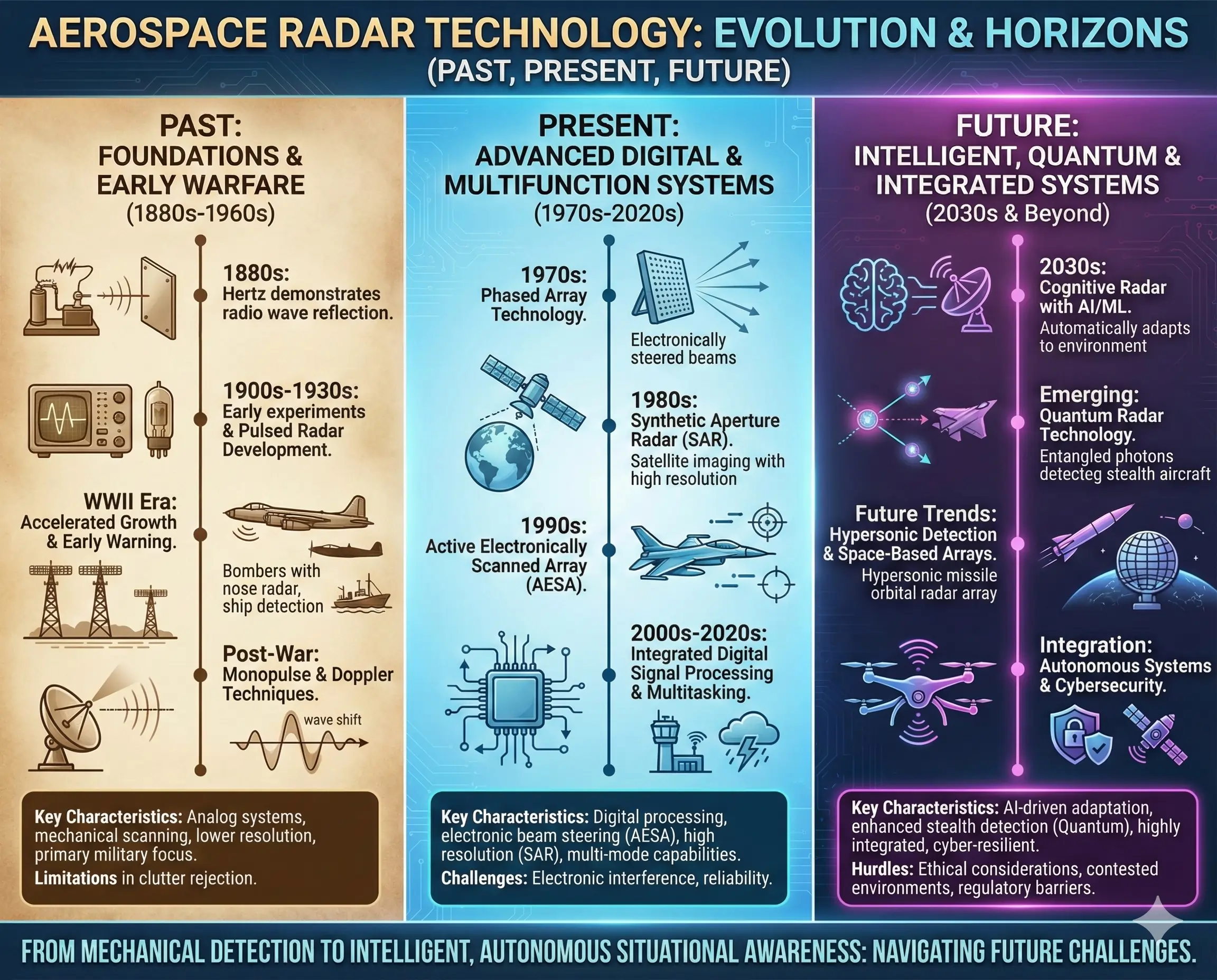
Table of Contents
Radar technology has become an indispensable part of aerospace, guiding aircraft through foggy skies, detecting distant threats, and even mapping terrain from above. From its humble beginnings as a scientific curiosity to its role in modern fighter jets and air traffic systems, radar continues to evolve, blending physics, engineering, and now artificial intelligence. This article explores the journey of aerospace radar, highlighting key developments, real-world examples, and what lies ahead in this dynamic field.
The Origins of Radar Technology
The story of radar starts in the late 1800s with groundbreaking work in electromagnetism. Heinrich Hertz, a German physicist, demonstrated in 1886 that radio waves could reflect off metallic surfaces, laying the theoretical groundwork for what would become radar. This discovery was built on James Clerk Maxwell’s equations, which predicted such behavior of electromagnetic waves. While Hertz’s experiments were more about proving principles than practical applications, they sparked interest among inventors.
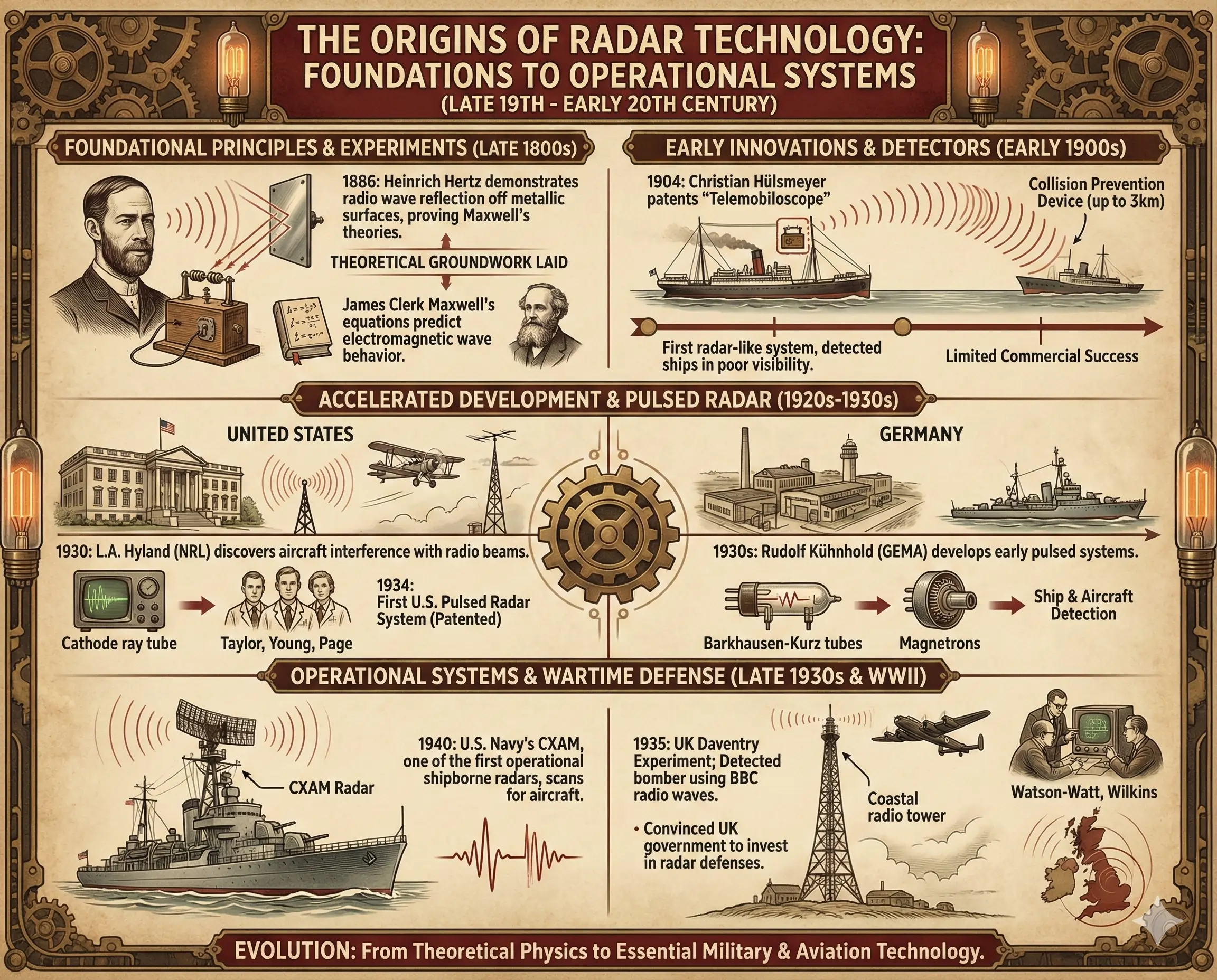
In the early 1900s, innovators began experimenting with radio-based detection. Christian Hülsmeyer, another German engineer, patented the telemobiloscope in 1904, a device using spark-gap transmitters to detect ships up to 3 kilometers away and prevent collisions in poor visibility. Though it wasn’t commercially successful due to limited interest from shipping companies, it represented the first radar-like system. Around the same time, other countries explored similar ideas, but progress was slow until military needs arose.
By the 1920s and 1930s, radar development accelerated amid growing tensions in Europe and Asia. In the United States, researchers at the Naval Research Laboratory (NRL) rediscovered radar principles in 1930 when L.A. Hyland noticed aircraft interfering with radio beams. This led to the first U.S. pulsed radar system by Albert Taylor, Leo Young, and Robert Page in 1934, patented later that year. In Germany, Rudolf Kühnhold and his team at GEMA built early pulsed systems using Barkhausen-Kurz tubes and magnetrons for detecting ships and aircraft.
These early systems were bulky and limited in range, but they set the stage for aerospace applications. For instance, the U.S. Navy’s CXAM radar in 1940 became one of the first operational shipborne radars, scanning for aircraft at sea. Similarly, in the UK, Robert Watson-Watt and Arnold Wilkins conducted the Daventry Experiment in 1935, detecting a bomber using BBC radio waves, which convinced the government to invest in radar defenses.
Radar in World War II: A Game-Changer
World War II transformed radar from experimental tech to a battlefield essential, particularly in aerospace. The UK’s Chain Home network, operational by 1937 with 20 stations, provided early warning against Luftwaffe attacks during the Battle of Britain in 1940. These tall towers used long-wavelength radio to detect aircraft up to 100 miles away, giving RAF pilots precious minutes to scramble.
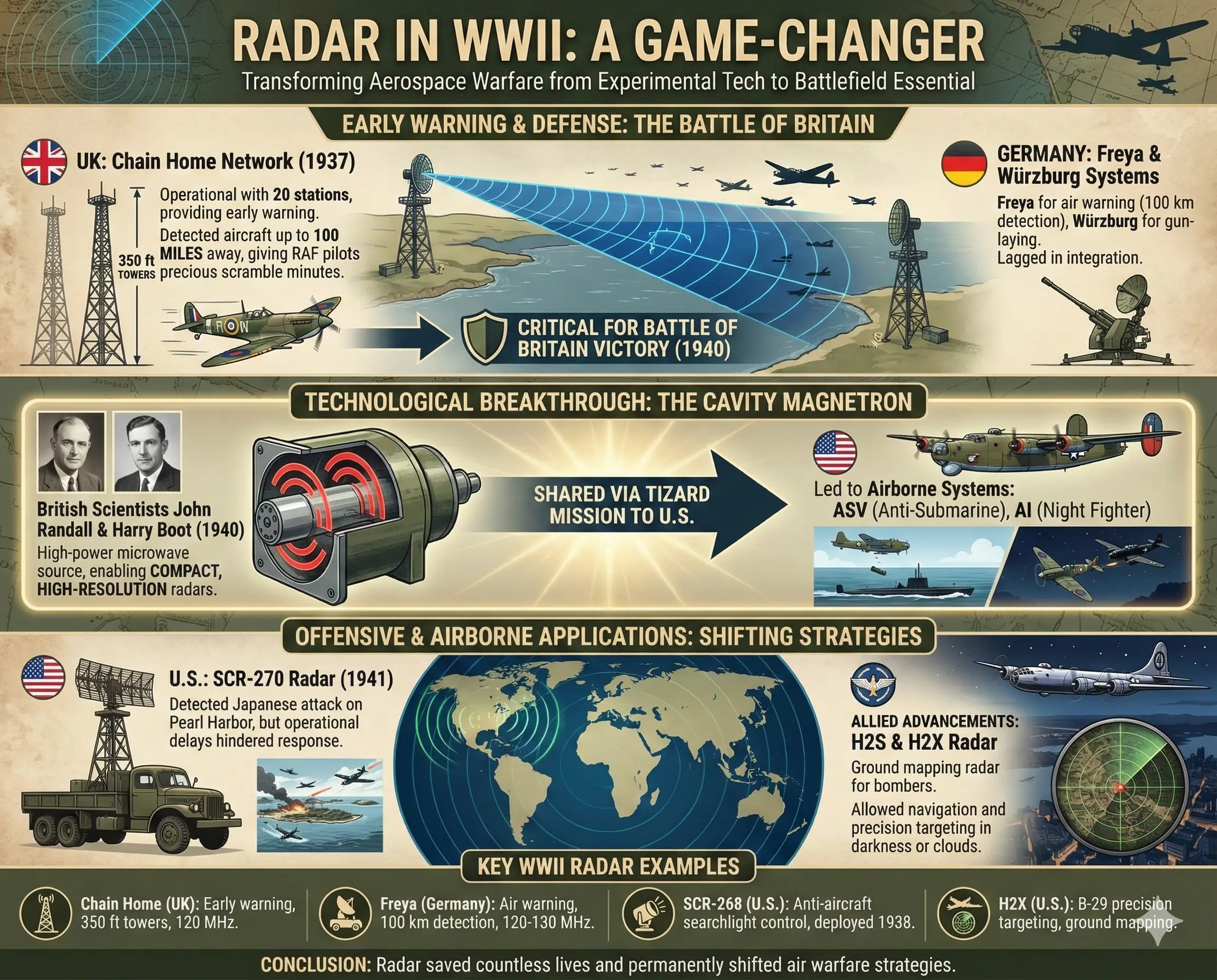
Germany countered with systems like Freya for air warning and Würzburg for gun-laying, but they lagged in integration. A pivotal breakthrough came in 1940 when British scientists John Randall and Harry Boot invented the cavity magnetron, a high-power microwave source enabling compact radars with better resolution. Shared with the U.S. via the Tizard Mission, it led to airborne systems like ASV radar for anti-submarine patrols and AI radar for night fighters.
In the Pacific, the U.S. used SCR-270 radars to detect the Japanese attack on Pearl Harbor in 1941, though response delays highlighted operational challenges. Allied advancements included H2S radar for ground mapping, allowing bombers to navigate in darkness or clouds. By war’s end, radar had saved countless lives and shifted air warfare strategies.
- Key WWII Radar Examples:
- Chain Home: Early warning system with 350-foot towers, detecting at 120 MHz frequencies.
- Freya: German radar operating at 120-130 MHz, used for aircraft detection up to 100 km.
- SCR-268: U.S. Army anti-aircraft radar, first deployed in 1938 for searchlight control.
- H2X: U.S. version of H2S, used on B-29 bombers for precision targeting.
Post-War Advancements and the Cold War Era
After WWII, radar expanded beyond military uses into civil aviation. In 1946, the U.S. Civil Aeronautics Administration tested radar for air traffic control, making it routine by 1952. By 1960, aircraft carried transponders for identification, revolutionizing flight safety.
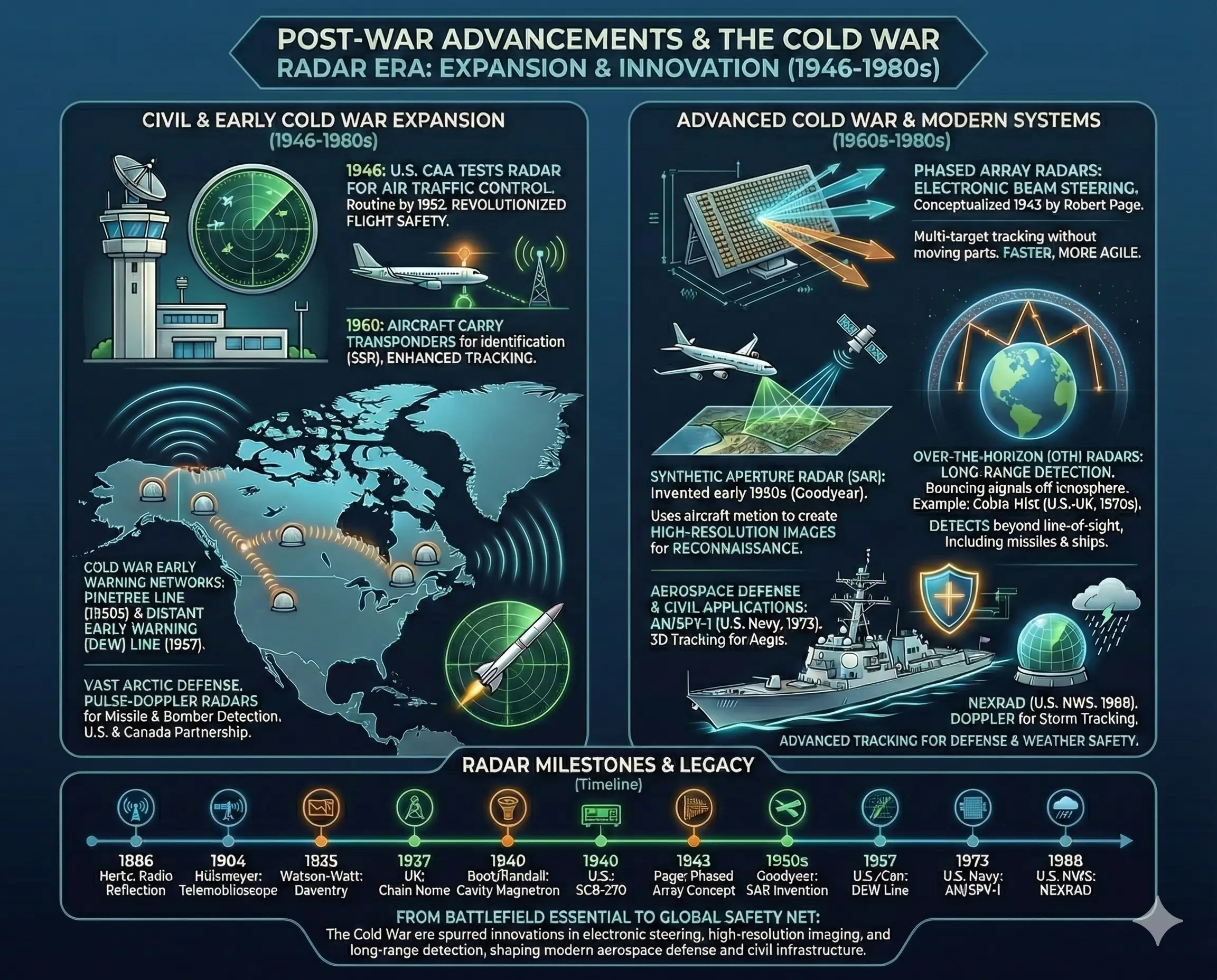
The Cold War drove further innovations. The U.S. and USSR built vast early-warning networks, like Canada’s Pinetree Line in the 1950s and the Distant Early Warning (DEW) Line by 1957, using pulse-Doppler radars for missile detection. Phased array radars, conceptualized in 1943 by Robert Page, allowed electronic beam steering without moving parts, enabling multi-target tracking.
Synthetic Aperture Radar (SAR), invented in the early 1950s at Goodyear, used aircraft motion to create high-resolution images, aiding reconnaissance. Over-the-Horizon (OTH) radars emerged in the 1950s, bouncing signals off the ionosphere for long-range detection, like the U.S.-UK Cobra Mist in the 1970s.
In aerospace, these advancements supported systems like the AN/SPY-1 on U.S. Navy ships in 1973, providing 3D tracking for Aegis defenses. Civil applications grew too, with weather radars like NEXRAD in 1988 using Doppler for storm tracking.
| Milestone | Year | Description | Key Innovator/Location |
|---|---|---|---|
| Hertz’s Experiments | 1886 | Demonstrated radio wave reflection | Heinrich Hertz, Germany |
| Telemobiloscope Patent | 1904 | First ship detection device | Christian Hülsmeyer, Germany |
| Daventry Experiment | 1935 | Aircraft detection via radio waves | Robert Watson-Watt, UK |
| Cavity Magnetron | 1940 | High-power microwave source | John Randall and Harry Boot, UK |
| Chain Home Network | 1937-1940 | Early warning system | UK Air Ministry |
| SCR-270 Deployment | 1940 | Mobile aircraft detection | U.S. Army Signal Corps |
| Phased Array Concept | 1943 | Electronic beam steering | Robert Page, U.S. NRL |
| SAR Invention | Early 1950s | High-resolution imaging | Goodyear Aircraft Corporation, U.S. |
| DEW Line Completion | 1957 | Arctic early warning | U.S. and Canada |
| AN/SPY-1 Radar | 1973 | Aegis system component | U.S. Navy |
| NEXRAD Weather Radar | 1988 | Doppler-based storm tracking | U.S. National Weather Service |
Current State of Aerospace Radar
Today, aerospace radar is more versatile and powerful, driven by digital advancements. Active Electronically Scanned Array (AESA) radars dominate, using thousands of transmit/receive modules for rapid beam steering and multifunction operations like detection, tracking, and jamming. They excel in all-weather conditions, providing 360-degree coverage and superior resolution.
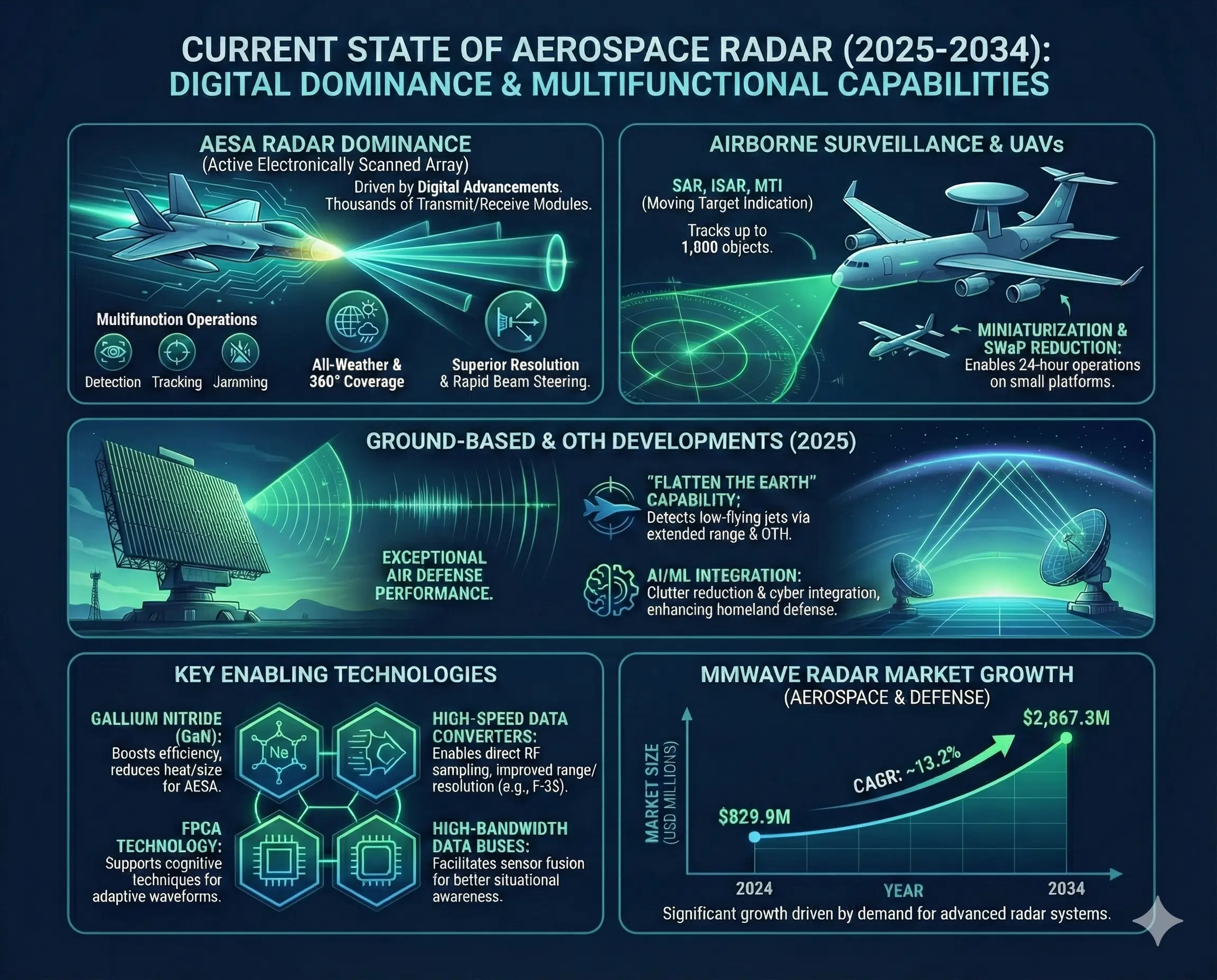
In airborne surveillance, systems like Leonardo’s Osprey 30 support SAR, ISAR, and moving target indication (MTI), tracking up to 1,000 objects. Miniaturization has enabled radars on small UAVs, with SWaP reductions allowing 24-hour operations. Ground-based radars, such as Lockheed Martin’s long-range systems, offer exceptional performance for air defense.
Recent developments in 2025 include radars that “flatten the earth,” making low-flying jets detectable via extended ranges and OTH capabilities. Raytheon’s next-generation OTHR uses AI/ML for clutter reduction and cyber integration, enhancing homeland defense.
Key enabling technologies include:
- Gallium Nitride (GaN): Boosts efficiency in RF amplifiers, reducing heat and size for AESA systems.
- High-Speed Data Converters: Enable direct RF sampling, improving range and resolution in fighters like the F-35.
- FPGA Technology: Supports cognitive techniques for adaptive waveforms.
- High-Bandwidth Data Buses: Facilitate sensor fusion for better situational awareness.
The market for mmWave radars in aerospace and defense is growing from $829.9 million in 2024 to $2,867.3 million by 2034, at a CAGR of about 13.2%.
Applications in Aviation and Defense
In civil aviation, radars ensure safe skies through Airport Surveillance Radars (ASR) like ASR-11, combining primary and secondary systems for 3D tracking and weather data. Military uses include fire control on fighters, such as the AN/APG-81 on the F-35 for air-to-air superiority.
Examples abound: The Boeing 737 AEW&C uses MESA radar for surveillance. In conflicts like Ukraine, radars highlight the need for layered defenses against drones.
| Radar Type | Advantages | Disadvantages | Example Applications |
|---|---|---|---|
| Mechanical Scan | Simple design, lower cost | Slower scanning, mechanical failures | Early air traffic control towers |
| AESA | Fast electronic steering, multifunction | Higher cost, complex electronics | F-22 Raptor, modern fighters |
| OTH | Long-range beyond the horizon | Lower resolution, ionospheric dependency | Homeland missile defense |
| SAR | High-resolution imaging | Requires motion, processing intensive | Reconnaissance UAVs |
| Pulse-Doppler | Detects moving targets in clutter | Limited against stationary objects | Weather forecasting, MTI in aircraft |
Future Horizons: Emerging Trends
Looking ahead, aerospace radar will integrate AI for smarter operations. AI enhances signal processing, reducing noise and classifying echoes with neural networks. In autonomous threat detection, it enables ATR and multi-target tracking, fusing radar with EO/IR data.
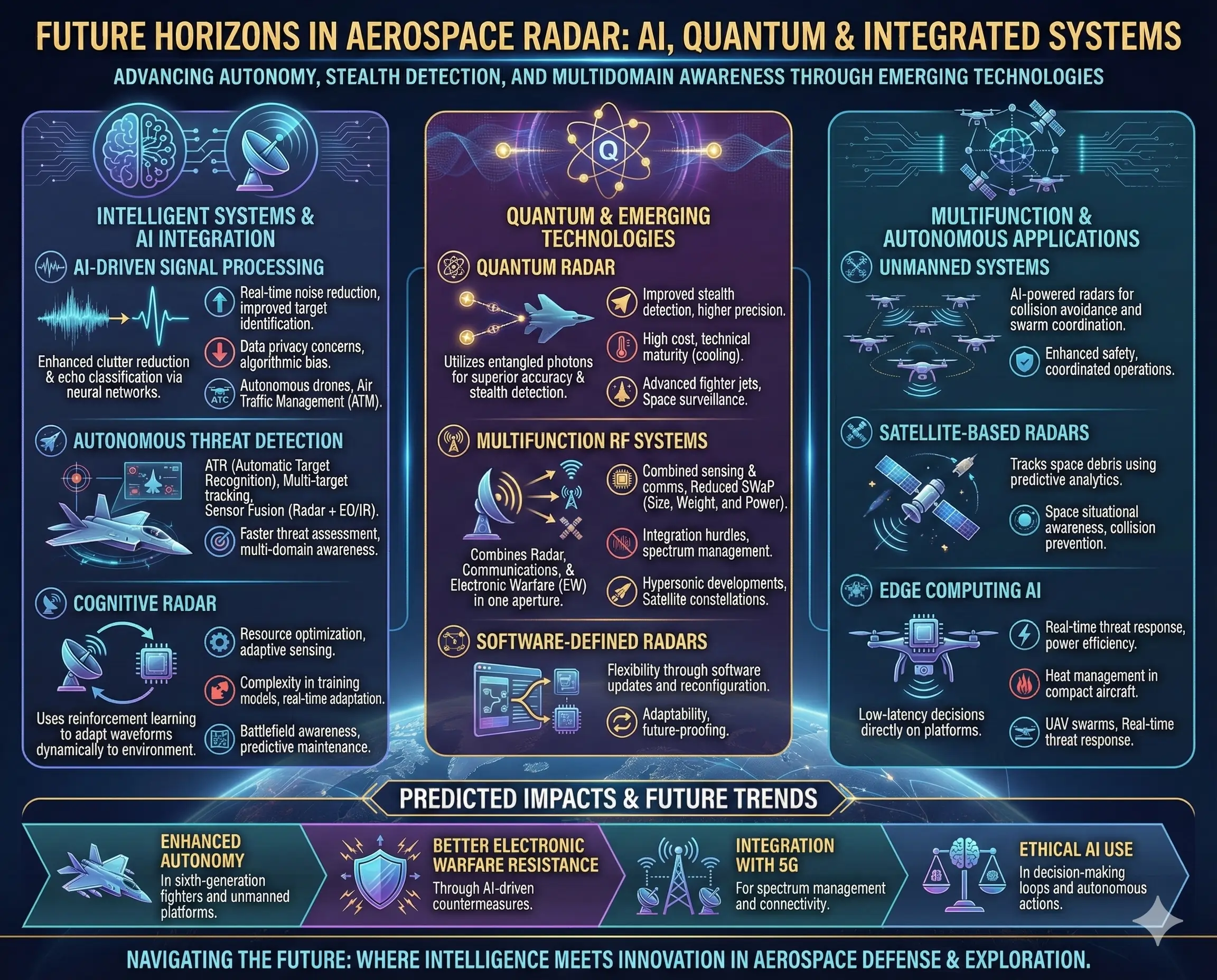
Cognitive radar uses reinforcement learning to adapt waveforms dynamically. Quantum radar promises stealth detection via entangled photons for superior accuracy. Multifunction RF systems combine radar, communications, and EW in one aperture, as seen in hypersonic developments.
In unmanned systems, AI-powered radars aid collision avoidance and swarm coordination. Satellite-based radars will track space debris with predictive analytics. Challenges include data overload and interoperability, but trends like software-defined radars offer flexibility.
- Predicted Impacts:
- Enhanced autonomy in sixth-generation fighters.
- Better electronic warfare resistance through AI countermeasures.
- Integration with 5G for spectrum management.
- Ethical AI use in decision-making loops.
| Future Technology | Key Benefits | Potential Challenges | Aerospace Applications |
|---|---|---|---|
| AI-Driven Processing | Real-time clutter reduction, echo classification | Data privacy, algorithm bias | Autonomous drones, air traffic management |
| Quantum Radar | Improved stealth detection, higher precision | High cost, technical maturity | Advanced fighter jets, space surveillance |
| Cognitive Systems | Adaptive waveforms, resource optimization | Complexity in training models | Battlefield awareness, predictive maintenance |
| Multifunction RF | Combined sensing and comms, reduced SWaP | Integration hurdles | Hypersonic vehicles, satellite constellations |
| Edge Computing AI | Low-latency decisions, power efficiency | Heat management in aircraft | UAV swarms, real-time threat response |
Challenges and Considerations
Despite progress, issues like spectrum congestion from 5G and ethical AI use persist. Cybersecurity is vital, as radars integrate into networks. Sustainability efforts focus on energy-efficient designs.
Wrapping Up the Radar Revolution
From Hertz’s lab to AI-enhanced skies, aerospace radar has redefined how we navigate and protect airspace. As technology advances, it promises safer flights and stronger defenses, but balanced development is key to addressing complexities.
Key Citations And References
- The History of Radar | Spartan College
- History of radar – Wikipedia
- Radar – Detection, Military, Technology – Britannica
- History of RADAR – NWS Training Portal
- This Month in Physics History | American Physical Society
- The Evolution of Radar Systems: A Cornerstone of Modern …
- The Birth of Radar and the 2nd World War
- Radar Is First Demonstrated | Research Starters – EBSCO
- NRL History – RADAR > U.S. Naval Research Laboratory > NRL News
- The Current State of Airborne Radar Surveillance in 2025 and Beyond
- New Radar Tech Has Flattened the Earth, Making Low Jets Targets
- Active Electronically Scanned Array (AESA) Radars
- Game-Changing Technologies for Advanced Radar – NI
- Next Generation Over-the-Horizon Radar | Raytheon – RTX
- Ground-Based Air Surveillance Radars – Lockheed Martin
- Future Trends in Radar Technology and How SkySim Prepares You
- Top 10 Aerospace and Defense Industry Trends – PTC
- Aerospace & Defense mmWave Radars Market
- Future Trends in Radar Technology and How SkySim Prepares You
- Game-Changing Technologies for Advanced Radar – NI
- [PDF] Emerging Trends in Radar
- An Inside Look at the Airborne Fire Control Radar Market
- Top 10 Aerospace and Defense Industry Trends – PTC
- Advancements in Radar and Air Traffic Control Systems – AVI-8
- The Current State of Airborne Radar Surveillance in 2025 and Beyond
- Future of Radar Systems Market: AI Integration Explained
- Space Technology Trends 2025 | Lockheed Martin
- Radar Technology Advancements and New Applications – Pasternack
- Active Electronically Scanned Array (AESA) Radars | Northrop Grumman
- History of radar – Wikipedia
- Next Generation Over-the-Horizon Radar
- Game-Changing Technologies for Advanced Radar – NI
- An Inside Look at the Airborne Fire Control Radar Market: The Sky’s AI
- New radar and missile tech have ‘flattened the earth,’ making even low-flying jets easy targets, Royal Air Force officer warns
- Future of Radar Systems Market: AI Integration Explained
- The Current State of Airborne Radar Surveillance in 2025 and Beyond — CarteNav – The Future of ISR Mission Software
Read These Articles in Detail
- Aerospace Engineering vs. Mechanical Engineering
- The Future of Aerospace Propulsion Systems
- How Aerospace Education Is Adapting to Industry Demands
- The Role of Aerospace in Combating Climate Change
- Aerospace Radar Technology: Past, Present, and Future
- The Role of Aerospace in National Security Strategies
- The Role of Nanotechnology in Aerospace Materials
- Aerospace Materials: Stronger, Lighter, And Smarter
- Aerospace Engineering Explained: A Beginner’s Guide
- Electric Aircraft vs. Hydrogen Aircraft: Which Is More Sustainable?
- Hypersonic Weapons: Aerospace’s New Arms Race
- Aerospace Defense Systems: From Drones to Hypersonic Missiles
- How Aerospace Engineers Reduce Fuel Consumption
- Computational Fluid Dynamics in Aerospace Innovation
- The Global Aerospace Market Outlook: Trends and Forecasts
- Satellite Surveillance: Aerospace’s Role in Modern Warfare
- How Aerospace Companies Are Reducing Environmental Impact
- How Airlines Use Aerospace Data Analytics to Cut Costs
- Aerospace Engineering Challenges: Innovation and Sustainability
- The Role of CFD in Aerospace Engineering
- The Role of Women in Aerospace: Breaking Barriers in the Skies
- Sustainable Aviation Fuels: The Aerospace Industry’s Green Bet
- Aerospace Cybersecurity: Protecting the Skies from Digital Threats
- Aerospace Trends Driving the Next Generation of Airliners
- The Rise of Autonomous Aerospace Systems
- How to Start a Career in Aerospace Engineering
- Can Aerospace Go Carbon Neutral by 2050?
- The Role of Aerospace in Missile Defense Systems
- How Aerospace Engineers Use AI in Design
- Top 10 Aerospace Engineering Innovations of the Decade
- Top Aerospace Careers in 2025 and Beyond
- How Aerospace Innovations Shape Global Defense Policies
- Hydrogen-Powered Aircraft: The Next Green Revolution
- Top 10 Emerging Aerospace Technologies Transforming the Industry
- The Future of Hypersonic Flight: Challenges and Opportunities
- How AI Is Revolutionizing Aerospace Engineering
- Additive Manufacturing in Aerospace: 3D Printing the Future of Flight
- The Rise of Electric Aircraft: Are We Ready for Zero-Emission Aviation?
- Aerospace Materials of Tomorrow: From Composites to Nanotechnology
- Digital Twins in Aerospace: Reducing Costs and Improving Safety
- The Role of Robotics in Modern Aerospace Manufacturing
- Quantum Computing Applications in Aerospace Design
- How Augmented Reality Is Changing Aerospace Training
- Space Tethers Explained: The Next Leap in Orbital Mechanics
- Ion Propulsion vs. Chemical Rockets: Which Will Power the Future?
- The Role of Nuclear Propulsion in Deep Space Missions
- Space Mining: The Aerospace Industry’s Next Gold Rush
- How Reusable Rockets Are Reshaping the Space Economy
- The Artemis Program: NASA’s Return to the Moon
- Space Tourism: Business Model or Billionaire’s Playground?
- How Aerospace Startups Are Disrupting Commercial Aviation
- The Economics of Low-Cost Airlines in the Aerospace Era
- Urban Air Mobility: The Rise of Flying Taxis
- The Future of Mars Colonization: Key Aerospace Challenges and Solutions Ahead
- CubeSats and Small Satellites: Democratizing Space Access
- The Future of Cargo Drones in Global Logistics
- The Role of Aerospace in Building a Lunar Economy
Frequently Asked Questions
FAQ 1: What Are the Key Milestones in the Evolution of Aerospace Radar Technology?
The journey of aerospace radar technology began in the late 19th century with foundational experiments that set the stage for modern systems. In 1886, Heinrich Hertz proved that radio waves could reflect off metallic objects, a discovery that sparked interest in using electromagnetic waves for detection. This principle remained largely theoretical until the early 20th century, when inventors started applying it practically. By 1904, Christian Hülsmeyer patented a device called the telemobiloscope, designed to prevent ship collisions by detecting vessels up to a few kilometers away, though it didn’t gain widespread adoption due to limited interest at the time.
Advancements accelerated in the 1930s as global tensions rose. In the United States, researchers at the Naval Research Laboratory observed aircraft interfering with radio signals in 1930, leading to the first pulsed radar patent in 1934. Meanwhile, in the UK, the 1935 Daventry Experiment successfully detected a bomber using radio waves, prompting government investment in defensive networks. World War II marked a turning point, with radars like the UK’s Chain Home system providing early warnings during the Battle of Britain. Post-war, the technology expanded into civil aviation, with radar-based air traffic control becoming standard by the 1950s.
In recent decades, digital innovations have transformed radar. The shift to phased array systems in the 1960s allowed for electronic beam steering, improving tracking efficiency. Today, with integrations like gallium nitride amplifiers, radars offer enhanced performance in aerospace applications, from surveillance to weather monitoring. Looking ahead, AI and quantum enhancements promise even greater accuracy, making radar indispensable for future space and defense operations.
FAQ 2: How Has Radar Technology Advanced in Aerospace Applications by 2025?
| Advancement | Description | Key Benefits | Examples in Use |
|---|---|---|---|
| Gallium Nitride (GaN) Integration | Modern radars incorporate GaN for higher power efficiency and reduced size in transmit/receive modules. | Improves range and reliability while lowering heat output, ideal for aircraft. | RTX’s APG-82(V)X radar for fighter jets, enhancing detection in contested environments. |
| Multi-Mode Ultra-Wideband Systems | Radars now combine synthetic aperture radar (SAR) with ground-penetrating capabilities for versatile sensing. | Allows detection of buried objects and persistent tracking in varied terrains. | Airborne surveillance systems used in border security and disaster response. |
| Over-the-Horizon Enhancements | New tech “flattens” the Earth’s curvature for better low-altitude detection using advanced signal processing. | Increases threat identification for low-flying aircraft and missiles. | Royal Air Force systems for integrated air defense. |
| AI-Driven Analytics | Integration of artificial intelligence for real-time data processing and predictive modeling. | Reduces false positives and speeds up decision-making in dynamic scenarios. | Aviation tech for hyper-personalization in air traffic management. |
| SPY-7 Radar Variants | Next-generation radars with threefold performance boosts in tracking and resolution. | Enhances multi-threat handling for naval and aerospace platforms. | Lockheed Martin’s systems for missile defense integration. |
FAQ 3: What Role Did Radar Play in Shaping Aviation During World War II?
Radar emerged as a pivotal tool in aviation during World War II, fundamentally altering aerial strategies and outcomes. Initially developed for detection, it quickly became essential for both offense and defense. The UK’s Chain Home network, with its towering antennas, detected incoming German aircraft from over 100 miles away, giving pilots critical time to respond during the 1940 Battle of Britain. This early warning capability shifted the balance in favor of the Allies, preventing surprise attacks and coordinating fighter intercepts effectively.
As the war progressed, innovations like the cavity magnetron allowed for compact, high-resolution radars that fit on aircraft. These enabled night fighting and anti-submarine operations, with systems such as ASV radar helping Allied forces locate U-boats in the Atlantic. In the Pacific theater, U.S. radars like the SCR-270 provided alerts during Pearl Harbor, though procedural issues limited their impact. Overall, radar’s evolution during the conflict not only saved lives but also laid the groundwork for post-war aerospace advancements, influencing everything from jet navigation to missile guidance.
FAQ 4: What Are the Primary Applications of Radar in Aerospace and Defense Today?
Radar serves as a cornerstone in aerospace and defense, enabling precise detection and monitoring across various domains. In military contexts, it excels at early warning and threat identification, spotting aircraft, missiles, and ground targets from vast distances. For instance, air defense radars like those in integrated systems provide 360-degree coverage, crucial for protecting borders and assets during conflicts. Beyond combat, radar supports reconnaissance through synthetic aperture imaging, which maps terrain and identifies hidden installations, aiding strategic planning.
In civil aerospace, radar ensures flight safety by guiding air traffic control. Systems track aircraft positions, prevent collisions, and monitor weather patterns to avoid turbulence or storms. Defense applications extend to naval and space domains, where radars detect submarines or orbital debris, enhancing overall security.
- Surveillance and Tracking: Monitors airspace for unauthorized intrusions, with pulse-Doppler tech distinguishing moving targets from clutter.
- Navigation and Guidance: Assists in precision landing and missile targeting, using fire control radars on fighter jets.
- Environmental Monitoring: Detects weather phenomena or environmental changes, supporting disaster response in aerospace operations.
- Electronic Warfare: Jams enemy signals or evades detection, integrated into modern platforms for tactical advantages.
FAQ 5: How Is Artificial Intelligence Influencing the Future of Aerospace Radar Systems?
| AI Application | How It Works | Potential Impact | Challenges Addressed |
|---|---|---|---|
| Real-Time Signal Processing | AI algorithms analyze radar data to filter noise and classify objects using machine learning models. | Speeds up threat detection in crowded airspace, reducing operator workload. | Handles data overload from high-resolution sensors. |
| Predictive Analytics | Uses historical data to forecast trajectories and potential collisions in aviation. | Enhances safety in autonomous drones and space traffic management. | Mitigates risks in dynamic environments like hypersonic flights. |
| Adaptive Waveforms | Cognitive radar adjusts signals based on AI feedback for optimal performance. | Improves stealth detection and jamming resistance. | Counters electronic countermeasures in defense scenarios. |
| Sensor Fusion | Integrates radar with IR and optical data via AI for comprehensive situational awareness. | Enables multi-domain operations in naval and aerospace warfare. | Overcomes limitations of single-sensor reliance. |
| Autonomous Systems | AI enables self-learning radars for swarm coordination in UAVs. | Revolutionizes reconnaissance and combat efficiency. | Addresses human error in high-stakes missions. |
FAQ 6: What Challenges Do Engineers Face When Developing Modern Aerospace Radar Systems?
Developing modern aerospace radar systems involves navigating a complex landscape of technical and operational hurdles. One major issue is integrating advanced components like active electronically scanned arrays into existing aircraft without compromising performance or adding excessive weight. This requires precise engineering to ensure compatibility, especially as radars must handle multiple functions such as tracking and electronic warfare simultaneously. Additionally, the congested electromagnetic spectrum poses risks of interference from commercial signals like 5G, demanding sophisticated filtering techniques to maintain accuracy.
Another challenge lies in detecting stealth technologies, where low radar cross-section designs make targets harder to spot. Engineers are countering this with multi-band operations and AI-enhanced processing, but it remains an ongoing battle in defense applications. Coverage gaps in remote areas further complicate deployment, as logistical constraints limit radar placement and maintenance.
- Signal Processing Demands: High-speed data from wideband radars overwhelms systems, requiring advanced algorithms to manage clutter and false alarms.
- Cybersecurity Vulnerabilities: Networked radars are prone to hacking, necessitating robust encryption for secure operations.
- Environmental Factors: Harsh conditions like ionospheric disturbances affect over-the-horizon radars, calling for adaptive designs.
- Cost and Sustainability: Balancing high performance with energy efficiency is key, as greener materials become a priority in aerospace.
FAQ 7: How Does Quantum Technology Promise to Revolutionize Aerospace Radar in the Coming Years?
Quantum technology is poised to transform aerospace radar by leveraging principles like entanglement and superposition for unprecedented detection capabilities. Traditional radars rely on classical waves, but quantum radar uses entangled photons to achieve higher sensitivity, potentially spotting stealth aircraft that evade conventional systems. This could involve hybrid setups where quantum sensors complement existing radars, improving resolution in noisy environments like dense fog or electronic jamming.
In practice, quantum radar might enable “noiseless” amplification, reducing errors in long-range tracking for space surveillance or missile defense. While still in early stages, research suggests it could detect micro-debris in low Earth orbit, aiding satellite safety. However, challenges like high costs and technical maturity mean widespread adoption may take years, with initial applications likely in high-stakes military scenarios.
Combined with AI, quantum systems could process vast datasets faster, fostering innovations in naval warfare and beyond. As the field matures, it may redefine aerospace boundaries, making skies and space more secure through precise, interference-resistant sensing.
FAQ 8: What Are the Different Types of Radar Used in Aerospace and Their Specific Functions?
| Radar Type | Primary Function | Key Features | Aerospace Examples |
|---|---|---|---|
| Pulse-Doppler Radar | Detects moving targets amid background noise using frequency shifts. | High accuracy in velocity measurement, resistant to clutter. | Air traffic control and fighter jet tracking systems. |
| Synthetic Aperture Radar (SAR) | Creates high-resolution images by simulating a large antenna through motion. | All-weather, day-night operation for mapping. | Reconnaissance on UAVs and satellites for terrain analysis. |
| Over-the-Horizon (OTH) Radar | Bounces signals off the ionosphere for beyond-line-of-sight detection. | Extended range up to thousands of kilometers. | Missile early warning in defense networks. |
| Active Electronically Scanned Array (AESA) | Electronically steers beams for rapid scanning without mechanical parts. | Multi-target tracking and jamming capabilities. | Modern fighters like the F-35 for air superiority. |
| Ground-Penetrating Radar | Probes subsurface structures from airborne platforms. | Detects buried objects or voids. | Search and rescue or military mine detection operations. |
FAQ 9: Why Is Radar Essential for Air Traffic Management in Modern Aviation?
Radar has become the backbone of air traffic management, ensuring safe and efficient skies amid growing global flights. Primary surveillance radars emit pulses to locate aircraft positions, while secondary systems use transponders for identification and altitude data. This dual approach allows controllers to maintain separation, preventing mid-air collisions even in poor visibility. With advancements like mode-S transponders, radars now provide enhanced data for precise routing, reducing delays and fuel consumption.
In busy airspace, radar integrates with automation for conflict resolution, alerting pilots to potential issues. It also supports weather avoidance by detecting storms, and guiding reroutes for passenger safety. As aviation adopts sustainable practices, radar’s role in optimizing flight paths helps lower emissions, making it indispensable for future growth.
FAQ 10: How Have Sustainability Trends Affected Aerospace Radar Development?
Sustainability is increasingly shaping aerospace radar development, pushing for eco-friendly designs that minimize environmental impact. Engineers are focusing on energy-efficient materials like gallium nitride, which reduce power consumption in radars while maintaining high performance. This shift not only cuts operational costs but also aligns with global decarbonization goals in aviation. For instance, lighter radar systems contribute to fuel savings in aircraft, extending range and lowering carbon footprints.
Another aspect involves recycling radar components and using additive manufacturing to produce parts with less waste. AI optimizations further enhance efficiency by adapting radar operations to conserve energy during low-threat periods. While challenges like balancing performance with green tech persist, these trends are fostering radars that support sustainable aerospace, from electric vertical takeoff vehicles to space missions.
Key Developments in Aerospace Radar Technology
Aerospace radar has evolved from basic radio wave experiments in the late 1800s to sophisticated systems powering modern aviation and defense. Key milestones include the invention of pulsed radar in the 1930s and wartime innovations like the cavity magnetron during World War II, which enabled compact airborne detection. Today, advancements such as active electronically scanned arrays and AI integration enhance precision in surveillance and threat detection, while future trends point toward quantum radar for superior stealth capabilities.
Research suggests that by 2025, radar markets in aerospace and defense are expanding rapidly, driven by demands for better air traffic control and missile defense. It seems likely that AI will play a pivotal role in processing complex data, though challenges like spectrum congestion persist. Evidence leans toward gallium nitride components boosting efficiency in fighter jets, highlighting ongoing debates in material science for radar reliability.
Current Applications
In aviation, radar ensures safe navigation and weather monitoring, with systems like airport surveillance radars preventing collisions. Defense uses include tracking hypersonic threats, where new technologies “flatten” detection horizons for low-flying targets.
Emerging Trends
Future systems may incorporate multifunction RF for combined sensing and communications, potentially revolutionizing space exploration by detecting orbital debris more accurately.
Aerospace radar technology continues to shape how we monitor and navigate the skies, blending historical innovations with cutting-edge developments. From its origins in electromagnetic experiments to its critical role in modern conflicts and commercial flights, radar remains a cornerstone of safety and strategy. This comprehensive overview delves into the past achievements, present capabilities, and future possibilities, incorporating insights from recent market analyses and technological breakthroughs as of 2025.
The technology’s foundation was laid in 1886 when Heinrich Hertz demonstrated radio wave reflection, a principle that evolved into practical detection systems by the early 1900s. Christian Hülsmeyer’s 1904 telemobiloscope patent marked an early attempt at collision avoidance, though it saw limited use. The 1930s brought pulsed radar advancements, with U.S. Naval Research Laboratory patents and the UK’s Daventry Experiment proving aircraft detection via radio waves. World War II accelerated progress, with the UK’s Chain Home network providing early warnings during the Battle of Britain and the cavity magnetron enabling airborne radars for night operations.
Post-war, radar transitioned to civil applications, standardizing air traffic control by the 1950s. The Cold War era introduced phased arrays for electronic beam steering and synthetic aperture radar for high-resolution imaging. By 2025, the airborne radar market is growing due to demands for side-looking systems, foliage penetration, and AI enhancements, with projections showing significant expansion in space radar from USD 689.82 million to over USD 1.4 billion by 2034.
Advancements include gallium nitride integration for efficient RF amplifiers, boosting range in fighter jets like the F-35. AI is reshaping signal processing, reducing clutter and enabling autonomous threat detection. New over-the-horizon radars “flatten the earth” for better low-altitude detection, addressing hypersonic missile threats. In space, trends focus on AI/ML for satellite communications and advanced sensing.
Challenges involve detecting stealth aircraft, with quantum radar promising entangled photon use for higher precision. Sustainability efforts emphasize energy-efficient designs, while global markets like air and missile defense radar are projected to reach USD 24.1 billion by 2034. China’s progress in gallium oxide materials signals a shift, offering superior stability for next-gen systems.
| Radar Evolution Stage | Key Innovations | Applications | Market Impact by 2025 |
|---|---|---|---|
| Historical (Pre-1940s) | Radio wave reflection, pulsed systems | Early ship detection, military warnings | Foundation for modern tech, limited commercial use |
| WWII Era | Cavity magnetron, Chain Home network | Airborne surveillance, anti-submarine ops | Shifted warfare outcomes, spurred post-war growth |
| Post-War/Cold War | Phased arrays, SAR, OTH radars | Air traffic control, missile detection | Expanded civil aviation, defense networks |
| Current (2020s) | AESA, GaN amplifiers, AI processing | Fighter jets, weather monitoring | Market growth to billions, enhanced efficiency |
| Future Projections | Quantum radar, cognitive systems | Stealth detection, autonomous UAVs | AI-driven expansion, space applications surge |
FAQ 11: What Are the Main Differences Between AESA and PESA Radars in Aerospace?
Active electronically scanned array radars represent a leap over passive electronically scanned arrays by using individual transmit/receive modules for each antenna element, allowing independent phase and amplitude control. This enables rapid beam steering without mechanical movement, improving multitasking like simultaneous tracking and jamming. In contrast, passive arrays rely on a central transmitter, limiting flexibility and increasing vulnerability to failures.
In aerospace, AESA systems, found in fighters like the F-22, offer better resolution and resistance to electronic warfare, though they come at higher costs due to complex electronics. PESA radars, used in earlier models, are simpler and cheaper but slower in response, making them less ideal for dynamic combat scenarios. As of 2025, AESA dominance grows with GaN enhancements for reduced size and heat.
The shift to AESA reflects broader trends in digital processing, where software-defined capabilities allow upgrades without hardware changes, extending system lifespan in fast-evolving aerospace environments.
FAQ 12: How Does Radar Technology Contribute to Missile Defense Systems?
| Component | Role in Missile Defense | Advancements by 2025 | Examples |
|---|---|---|---|
| Early Warning Radars | Detect incoming threats at long ranges | OTH enhancements for hypersonic tracking | TPY-4 radar delivery to U.S. Air Force |
| Fire Control Radars | Guide interceptors to targets | AI for precise classification | AN/APG-81 on F-35 for multi-threat handling |
| Surveillance Radars | Monitor airspace continuously | Foliage penetration and side-looking | Airborne systems for border security |
| Integrated Networks | Fuse data from multiple sensors | Advanced communications with AI/ML | Aegis systems with SPY-7 variants |
| Quantum-Enabled | Improve stealth missile detection | Entangled photons for accuracy | Emerging research for future defenses |
FAQ 13: What Recent Advancements Have Been Made in Airborne Radar by 2025?
Airborne radar has seen significant progress by 2025, with markets expanding due to heightened security needs. Innovations include side-looking radars for wide-area surveillance and foliage-penetrating systems that detect hidden targets in dense environments. AI integration automates data analysis, reducing operator workload and improving real-time decisions in complex scenarios.
Another key development is the “flattening of the earth” through advanced signal processing, making low-flying jets more detectable and countering terrain-hugging tactics. Gallium nitride components enhance power efficiency, as seen in upgraded radars for fighters, extending range while minimizing heat. These strides support diverse applications, from disaster response to military reconnaissance, with miniaturization enabling UAV deployment.
FAQ 14: How Is AI Transforming Aerospace Radar Operations?
Artificial intelligence is revolutionizing radar by enhancing signal processing and threat identification. Traditional systems struggle with data overload, but AI algorithms filter noise, classify objects, and predict trajectories using machine learning. This leads to faster, more accurate responses in air traffic management and defense.
In aerospace, AI enables cognitive radars that adapt waveforms dynamically, optimizing performance in jammed environments. It also facilitates sensor fusion, combining radar with infrared for comprehensive awareness.
- Clutter Reduction: AI minimizes false alarms in crowded airspace.
- Autonomous Detection: Supports UAV swarms for coordinated surveillance.
- Predictive Maintenance: Analyzes data to foresee system failures.
- Ethical Considerations: Ensures balanced decision-making in high-stakes scenarios.
FAQ 15: What Role Does Radar Play in Space Exploration and Satellite Technology?
| Aspect | Function | 2025 Trends | Challenges |
|---|---|---|---|
| Orbital Debris Tracking | Detects small objects to prevent collisions | AI/ML for predictive analytics | High-speed debris requires ultra-precision |
| Remote Sensing | Maps planetary surfaces from orbit | Advanced satellite radars for all-weather imaging | Data processing in remote environments |
| Communication Support | Integrates with networks for data relay | Multifunction RF systems | Spectrum interference from ground signals |
| Navigation Aids | Guides spacecraft docking and landing | Quantum enhancements for accuracy | Extreme distances and radiation effects |
| Market Growth | Drives commercial space ops | Projected to USD 1.4B by 2034 | Balancing cost with technological maturity |
FAQ 16: How Do Engineers Address Stealth Detection Challenges in Radar Design?
Stealth technology reduces radar cross-sections, making detection difficult, but engineers counter this with multi-band operations and low-frequency radars that exploit longer wavelengths for better penetration. AI assists by analyzing subtle echoes, improving classification in cluttered settings.
Over-the-horizon systems bounce signals off the ionosphere for extended range, detecting low-observable aircraft beyond visual lines. Future quantum radars use entangled particles to achieve noiseless detection, potentially revolutionizing countermeasures.
- Networked Arrays: Combine multiple radars for 3D tracking.
- Adaptive Algorithms: Adjust to environmental changes dynamically.
- Material Innovations: GaN and gallium oxide for stronger signals.
- Testing Protocols: Simulate real-world scenarios for validation.
FAQ 17: What Distinguishes Commercial from Military Aerospace Radars?
Commercial radars prioritize safety and efficiency in aviation, focusing on weather detection and traffic management with systems like ADS-B for precise aircraft positioning. They operate in regulated spectra, emphasizing cost-effectiveness and reliability for daily operations.
Military radars, however, emphasize survivability and versatility, incorporating electronic warfare features and high-resolution tracking for threats. By 2025, distinctions blur with dual-use tech, but military versions often include classified enhancements like anti-jamming.
The convergence supports innovations, where commercial advancements in miniaturization benefit military UAVs, fostering shared progress in aerospace.
FAQ 18: What Potential Does Quantum Radar Hold for Future Aerospace?
Quantum radar leverages quantum mechanics, using entangled photons to detect objects with minimal signal loss, offering advantages over classical systems in noisy or stealth-heavy environments. This could enable precise tracking of hypersonic vehicles or space debris, enhancing security.
While still emerging, prototypes show promise for higher resolution and resistance to countermeasures. Integration with AI could automate complex analyses, though high costs and technical hurdles delay widespread adoption until the 2030s.
In aerospace, it may transform satellite surveillance and fighter operations, marking a new era in detection technology.
FAQ 19: How Are Sustainability Concerns Influencing Radar Development in Aerospace?
Sustainability drives radar design toward energy-efficient materials like gallium nitride, reducing power use and emissions in aircraft systems. Additive manufacturing minimizes waste in production, while software-defined radars allow upgrades without full replacements.
AI optimizes operations to conserve energy during low-activity periods, aligning with aviation’s decarbonization goals. Recycling initiatives for radar components further support eco-friendly practices.
- Green Materials: Shift to low-impact semiconductors.
- Efficiency Gains: AI for resource management.
- Lifecycle Focus: Designs for longer service life.
- Regulatory Push: Compliance with global standards.
FAQ 20: What Are the Global Market Trends for Aerospace Radar in 2025?
| Trend | Description | Projections | Drivers |
|---|---|---|---|
| Market Expansion | Rapid growth in the defense and space sectors | Air defense to USD 24.1B by 2034 | Increased threats, tech investments |
| Material Shifts | Adoption of gallium oxide and nitride | Superior performance in extreme conditions | China’s advancements in 4th-gen crystals |
| AI Integration | Widespread use for analytics | CAGR of 10.6% for emerging systems | Automation in surveillance |
| Regional Focus | Asia-Pacific leading innovations | New labs in India for RF tech | Geopolitical needs, R&D hubs |
| Sustainability | Eco-friendly designs and gaining traction | Reduced SWaP in systems | Global emission targets |
