

Key Innovations in Aerospace Propulsion
Aerospace propulsion is evolving rapidly, driven by the urgent need to cut carbon emissions while boosting efficiency and enabling ambitious missions. Research points to electrified systems as a cornerstone, potentially slashing aviation’s environmental footprint, though full-scale adoption hinges on overcoming hurdles like battery weight. Hybrid approaches blend old and new for quicker wins, while space-focused tech like nuclear options promises faster journeys to distant planets. Overall, the path forward balances bold experimentation with practical scaling, fostering a greener, more capable industry.
Snapshot of Major Shifts
- Electrification Surge: Electric motors and batteries are powering short-haul flights, with hybrids extending range for regional jets—expect prototypes in testing by the late 2020s.
- Sustainable Fuels Integration: Drop-in biofuels could reduce CO2 by up to 80% without redesigning engines, bridging the gap to zero-emission tech.
- Hypersonic and Nuclear Horizons: Speeds over Mach 5 and nuclear-driven rockets could transform defense and exploration, but safety and materials challenges persist.
Why It Matters Now
Global aviation guzzles about 2.5% of CO2 emissions today, and with air travel doubling by 2040, innovation isn’t optional—it’s essential. These advancements promise quieter skies, lower costs, and missions that once seemed like science fiction. Yet, experts emphasize collaboration across governments, engineers, and manufacturers to navigate regulatory and economic roadblocks.
Quick Wins and Long Bets
Short-term: Hybrid engines could trim fuel use by 5-10% on existing planes, easing the transition. Long-term: Full electric or hydrogen setups might dominate by 2050, but only if energy storage leaps forward. The excitement is palpable—pilots and passengers alike stand to gain from flights that are kinder to the planet and quicker across the stars.
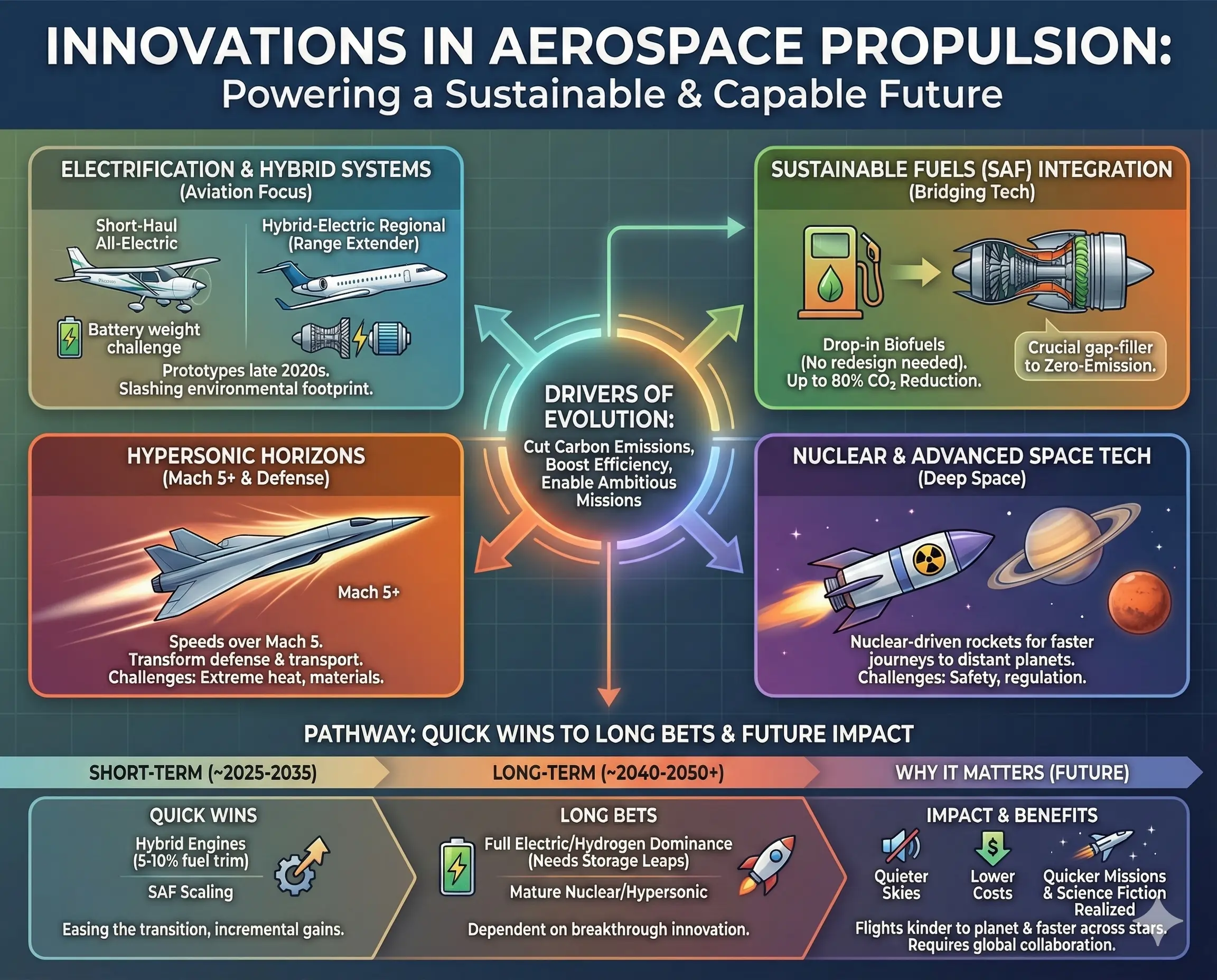
Table of Contents
Introduction: A New Era of Flight and Exploration
Imagine boarding a plane that hums quietly on electric power, sipping hydrogen instead of guzzling jet fuel, or watching a spacecraft zip to Mars in months rather than years. This isn’t distant fantasy; it’s the tangible horizon of aerospace propulsion. As humanity grapples with climate change and dreams of interstellar reach, propulsion systems—the beating hearts of aircraft and rockets—are undergoing a profound makeover. Traditional chemical rockets and turbofan engines, reliable workhorses for decades, now face scrutiny for their thirst and emissions. The future? A tapestry of electrified, hybrid, sustainable fuel, hypersonic, and even nuclear innovations, all woven to make travel faster, cleaner, and farther.
This shift isn’t just technical; it’s a response to global imperatives. Aviation alone contributes roughly 2.5% to worldwide CO2 output, a figure set to climb as passenger numbers soar. In space, chemical propulsion limits us to plodding journeys, exposing crews to radiation and isolation. Enter a wave of breakthroughs: from batteries packing more punch per pound to reactors harnessing atomic heat. These aren’t pie-in-the-sky ideas; prototypes are already soaring, backed by rigorous testing and cross-industry partnerships. In the pages ahead, we’ll dive deep into the technologies reshaping our world, unpacking their mechanics, milestones, and hurdles with real-world examples that bring the excitement to life.
The Current Landscape: Where We Stand Today
Today’s aerospace propulsion leans heavily on proven giants. Turbofan engines, with their massive fans sucking in air and turbines spinning at blistering speeds, dominate commercial aviation, delivering thrust through a mix of hot exhaust and cool bypass air. They’re efficient—modern variants burn 20% less fuel than their 1990s counterparts—but still rely on fossil-derived kerosene, spewing greenhouse gases and noise pollution.
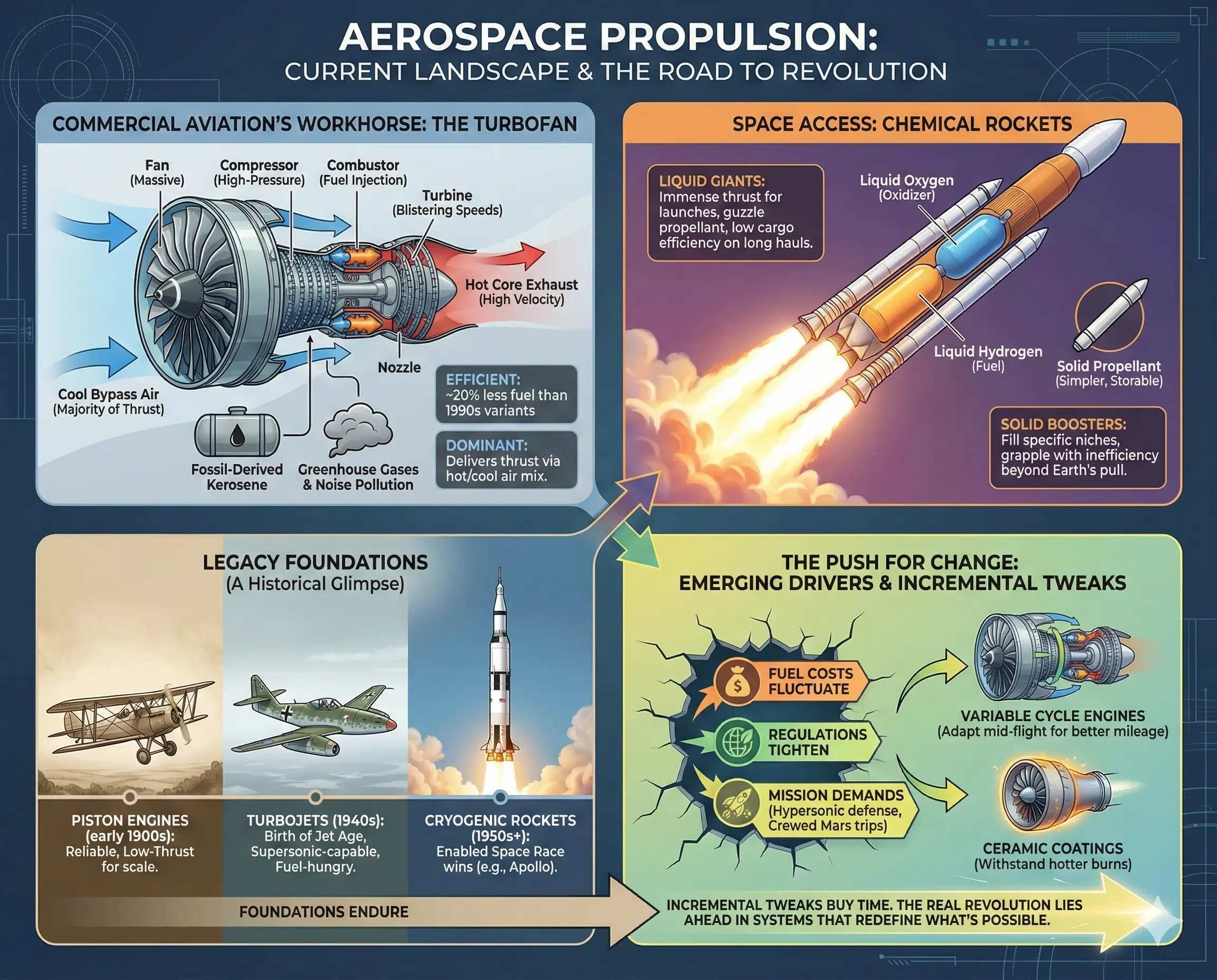
In space, liquid bipropellant rockets like those using liquid oxygen and hydrogen rule the roost, providing the raw power for launches. Think of the behemoths lifting satellites into orbit: they pack immense thrust but guzzle propellant, leaving little room for cargo on long hauls. Solid rockets, simpler and storable, fill niches like boosters, yet both types grapple with inefficiency beyond Earth’s pull.
Yet, cracks are showing. Fuel costs fluctuate wildly, regulations tighten on emissions, and missions demand more—sustained hypersonic dashes for defense, crewed Mars trips for exploration. Engineers are responding with incremental tweaks: variable cycle engines that adapt mid-flight for better mileage, or ceramic coatings to withstand hotter burns. These buy time, but the real revolution lies ahead, in systems that redefine what’s possible.
A Quick Look at Legacy Systems
To appreciate the future, let’s glance back:
- Piston Engines (early 1900s): Powered the first flights, reliable but low-thrust for scale.
- Turbojets (1940s): Birth of the jet age, supersonic-capable but fuel-hungry.
- Cryogenic Rockets (1950s onward): Enabled space race wins, like Apollo’s Saturn V.
These foundations endure, but tomorrow’s builders are layering on smart, green upgrades.
Emerging Technologies: The Engines of Tomorrow
The propulsion renaissance spans air and space, blending electricity, exotic fuels, and atomic might. Let’s break it down, starting with aviation’s green pivot.
Electrified Propulsion
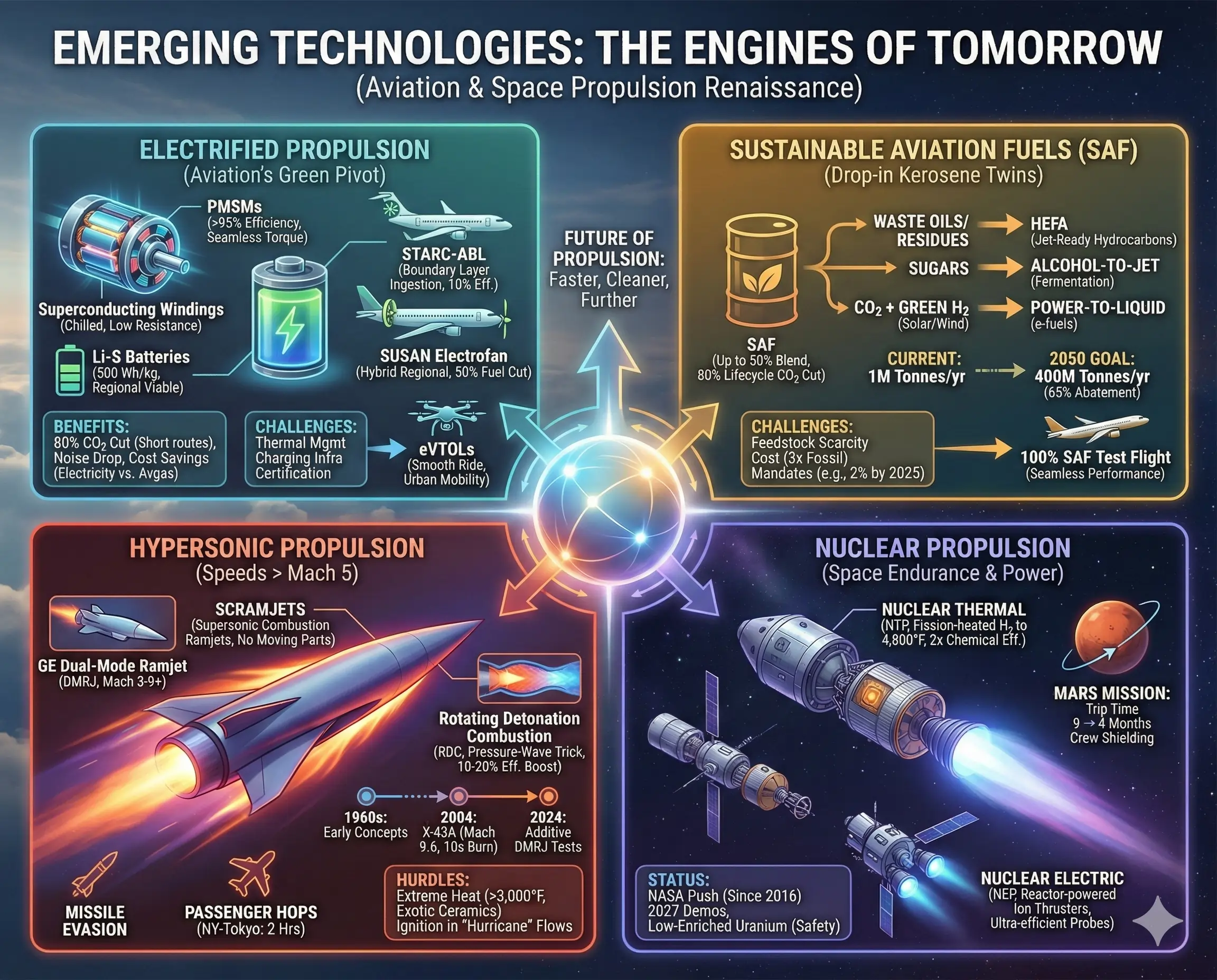
Electric propulsion flips the script: instead of combusting fuel, electric motors spin propellers or fans using stored or generated electricity. It’s whisper-quiet, zero-emission at the tailpipe, and maintenance-light—no oil changes or turbine overhauls. The catch? Batteries weigh a ton (literally) for the energy they hold, capping range at short hops today.
Advancements are closing that gap. Permanent magnet synchronous motors (PMSMs) lead the charge, boasting efficiencies over 95% by syncing magnetic fields for seamless torque. Superconducting windings, chilled to near-absolute zero, slash resistance, letting motors pack megawatts into featherweight frames. Pair these with lithium-sulfur batteries, edging toward 500 watt-hours per kilogram (double today’s lithium-ion), and you get viable regional flyers.
Take the High-Efficiency Megawatt Motor (HEMM): this 1.4-megawatt beast, with its lightweight coils and cryocoolers, could halve drag on a single-aisle jet. Concepts like the STARC-ABL (Single-Aisle Turboelectric Aircraft with Aft Boundary Layer Propulsion) ingest boundary air for 10% better efficiency, while the SUSAN Electrofan envisions a hybrid regional liner sipping just half the fuel of peers.
- Benefits in Action:
- Emissions Drop: Up to 80% CO2 cuts on short routes, easing urban air mobility.
- Noise Reduction: Decibels plummet, opening airports near cities.
- Cost Savings: Electricity beats avgas at $0.10 per kWh versus $5 per gallon.
Challenges linger: thermal management in hot fuselages, charging infrastructure at gates, and certifying for 30,000-foot altitudes. Yet, pilots testing eVTOLs (electric vertical takeoff and landing) craft already rave about the smooth ride.
Hybrid-Electric Systems
Why go all-in on electric when hybrids blend gas turbines with batteries? These setups use combustion for takeoff grunt, then switch to electric cruise, optimizing for the mission. Fuel savings hit 5-15%, with emissions tailing off as electrification deepens.
The E-Fan X demonstrator, a retrofitted regional jet, showcased a 2-megawatt motor slung under the wing, proving seamless handover without a hitch. Distributed electric propulsion (DEP) takes it further: multiple small motors along wings for finer control and lift. The EcoPulse project tested this on a modified sailplane, yielding 30% less energy draw during climb.
Here’s how hybrids stack up in practice:
| Hybrid Configuration | Power Split | Fuel Savings | Example Application | Key Enabler |
|---|---|---|---|---|
| Series Hybrid | Gas generator charges batteries; electric motors propel | 10-20% | Short-haul commuters | High-density batteries |
| Parallel Hybrid | Both gas and electric drive shaft simultaneously | 5-10% | Regional jets | Variable-speed motors |
| Turboelectric | Turbine spins generators for distributed fans | 15-25% | Single-aisle airliners | Superconducting cables |
This table highlights flexibility—series for pure electric feel, parallel for raw power. Real-world trials, like a 600kW hydrogen-electric setup on a Piper Malibu, logged 300-mile ranges with zero tailpipe pollutants.
Sustainable Aviation Fuels
Not every innovation requires rewiring planes. Sustainable aviation fuels (SAF) are kerosene twins, brewed from waste oils, crop residues, or captured CO2, slashing lifecycle emissions by 80%. They’re “drop-in,” meaning no engine tweaks needed—just blend up to 50% today.
Production pathways vary: HEFA (hydroprocessed esters and fatty acids) from used cooking oil yields jet-ready hydrocarbons; alcohol-to-jet ferments sugars into fuel. Current output? A modest 1 million tonnes yearly, but scaling to 400 million by 2050 could cover 65% of aviation’s abatement needs.
- Production Pathways Breakdown:
- Biomass Routes: Agricultural waste to syngas, then hydrocarbons—abundant but land-use wary.
- Synthetic Paths: CO2 + green hydrogen via Fischer-Tropsch—carbon-neutral but energy-intensive.
- Power-to-Liquid: Solar/wind electricity crafts e-fuels, ideal for sunny regions.
Challenges? Feedstock scarcity and costs triple fossil fuel prices. But mandates—like 2% blends by 2025 in Europe—are spurring factories. A test flight on 100% SAF in a business jet proved seamless performance, hinting at full swaps soon.
Hypersonic Propulsion
For speeds eclipsing Mach 5, scramjets (supersonic combustion ramjets) reign. Unlike ramjets that slow air to subsonic speeds for burning, scramjets ignite fuel in a supersonic stream, enabling blistering velocities without moving parts. Thrust comes from compressed intake air mixed with hydrogen or hydrocarbons.
GE’s dual-mode ramjet (DMRJ) blends ramjet ease with scramjet speed, firing from Mach 3 up. Ground tests hit threefold airflow boosts using rotating detonation combustion (RDC)—a pressure-wave trick that amps efficiency 10-20%. The X-43A scramjet, clocking Mach 9.6, validated the tech, compressing air via vehicle speed alone.
Applications? Missiles dodge defenses in minutes, or a passenger hops from New York to Tokyo in two hours. Hurdles include heat—temps top 3,000°F, demanding exotic ceramics—and ignition in “hurricane” flows.
- Hypersonic Milestones:
- 1960s: Early ramjet concepts for ICBMs.
- 2004: X-43A’s 10-second burn at Mach 10.
- 2024: Additive-manufactured DMRJ tests, slashing build time to months.
Engineers liken it to “lighting a match in a gale,” but stabilized flames via plasma torches are taming the beast.
Nuclear Propulsion
Space demands endurance; nuclear thermal propulsion (NTP) delivers, fission-heating hydrogen propellant for exhaust velocities double chemical rockets’. A reactor core warms the gas to 4,800°F, expelling it through a nozzle for thrust-to-weight rivaling liquids, but with 2-3x efficiency.
NASA’s NTP push, underway since 2016, eyes Mars: shave trip times 25%, from nine months to four, shielding crews from cosmic rays. Designs use low-enriched uranium for safety, with ground tests plotting 2027 demos. Nuclear electric propulsion (NEP) amps it: reactor juice powers ion thrusters for ultra-efficient sprints, ideal for probes.
| Propulsion Type | Specific Impulse (s) | Thrust Level | Mars Trip Time | Mass Penalty |
|---|---|---|---|---|
| Chemical (LOX/H2) | 450 | High | 6-9 months | Baseline |
| NTP | 900 | High | 3-4 months | +20% (reactor) |
| NEP | 5,000+ | Low | 2-3 months (spiral) | +30% (power systems) |
This comparison underscores NTP’s balance—powerful yet payload-friendly. Historical nods: 1960s NERVA tests fired for hours; today’s revival pairs with lunar gateways for refuel.
Challenges and Solutions
No revolution rolls smoothly. Energy density plagues electrics—batteries lag jet fuel’s 12,000 Wh/kg by a factor of 40. Solutions? Silicon anodes boost capacity 30%, or hydrogen cells at 1,000 Wh/kg equivalent.
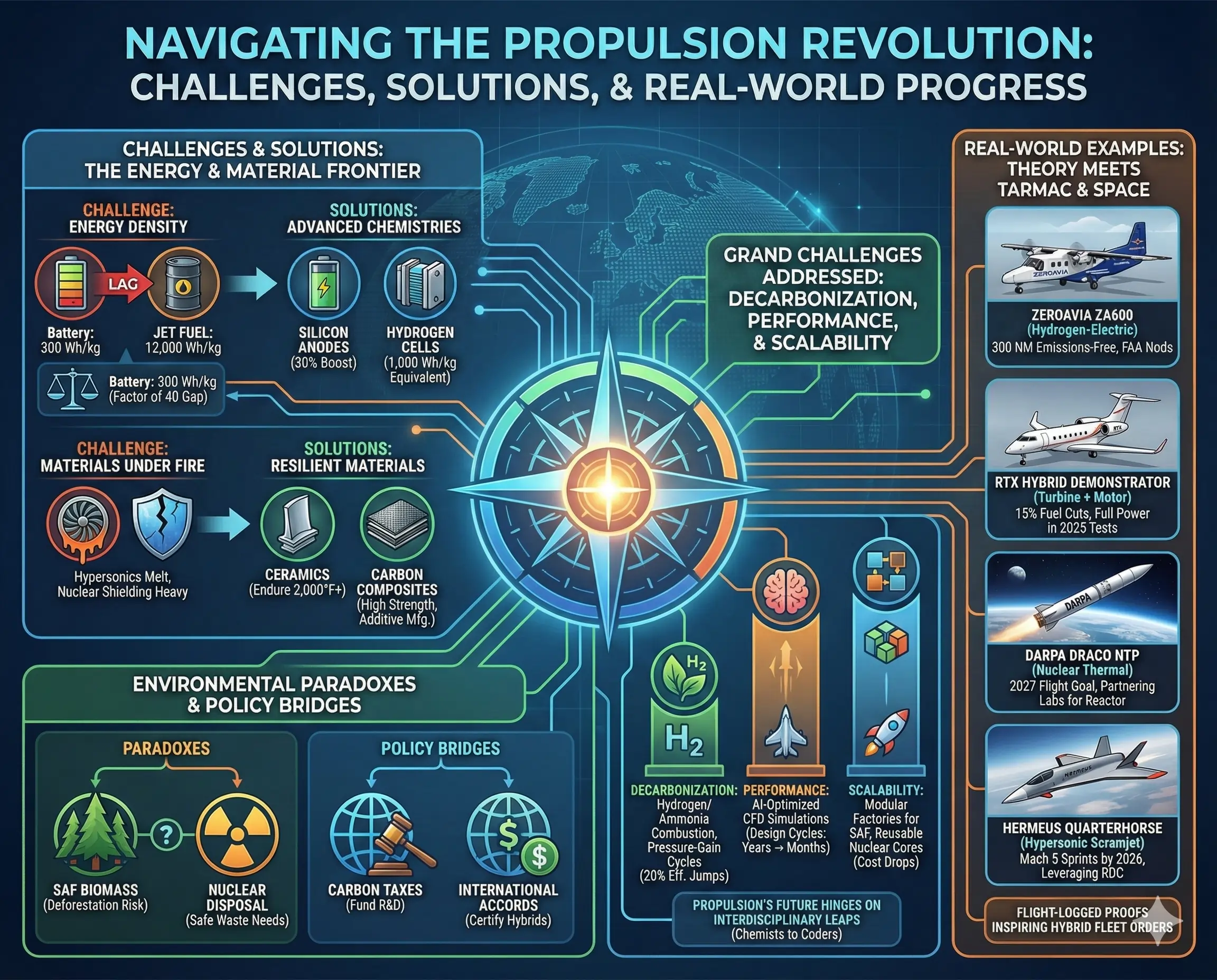
Materials under fire: Hypersonics melt turbines; nuclear shielding adds tons. Ceramics and carbon composites, forged via additive manufacturing, endure 2,000°F+ while withstanding loads.
Environmental paradoxes abound: SAF needs vast biomass without deforestation; nuclear demands safe disposal. Policy bridges gaps—carbon taxes fund R&D, international accords certify hybrids.
- Grand Challenges Addressed:
- Decarbonization: Hydrogen/ammonia combustion, pressure-gain cycles for 20% efficiency jumps.
- Performance: AI-optimized CFD simulations cut design cycles from years to months.
- Scalability: Modular factories for SAF, reusable nuclear cores for cost drops.
A 2022 review nailed it: propulsion’s future hinges on interdisciplinary leaps, from chemists brewing fuels to coders modeling flows.
Real-World Examples
Theory meets tarmac in trials worldwide. ZeroAvia’s ZA600 hydrogen-electric engine retrofits a Dornier 228, flying 300 nautical miles emissions-free, with FAA nods paving certification.
RTX’s hybrid demonstrator hit full power in 2025 tests, blending turbine and motor for 15% fuel cuts on a bizjet. In space, DARPA’s DRACO NTP rig eyes 2027 flights, partnering labs for reactor tweaks.
Hypersonics shine in defense: Hermeus’ Quarterhorse drone, scramjet-powered, aims Mach 5 sprints by 2026, leveraging RDC for compact fury.
These aren’t lab curios; they’re flight-logged proofs, inspiring airlines to order hybrid fleets.
Timeline of Propulsion Evolution
Tracing roots illuminates the rush. This table charts pivotal leaps, blending air and space.
| Year | Milestone | Technology | Impact |
|---|---|---|---|
| 1903 | Wright Flyer | Piston engine | First powered flight, 12 seconds |
| 1939 | Heinkel He 178 | Turbojet | Jet age dawns, 400 mph top speed |
| 1957 | Sputnik launch | Liquid rocket | Space era ignites, orbital success |
| 1969 | Apollo 11 | Cryogenic bipropellant | Moon landing, 3 million miles round-trip |
| 2004 | X-43A scramjet | Hypersonic air-breather | Mach 9.6, validates sustained burn |
| 2016 | NASA NTP revival | Nuclear thermal | Mars time slashed, interagency MOUs |
| 2021 | E-Fan X hybrid test | Megawatt electric motor | 2 MW thrust, regional jet retrofit |
| 2023 | SAF scales to 600k liters | HEFA pathway | 0.1% global jet fuel, policy mandates |
| 2025 | HEMM motor demo | Superconducting PMSM | 1.4 MW, 10% efficiency gain |
| 2035 (Proj.) | Zero-emission airliners | Full hydrogen-electric | Net-zero short-haul, blended wing bodies |
This chronology shows acceleration: decades for jets, years for electrics. By 2050, expect nuclear Mars taxis and hypersonic commuters.
The Broader Impacts: Society, Economy, and Beyond
Propulsion’s pivot ripples wide. Environmentally, net-zero aviation by 2050 curbs 10 gigatons of CO2 yearly, cooling warming trends. Economically, $1 trillion in fuel savings by 2040, plus jobs in battery fabs and fuel plants.
Socially, quieter electric green urban skies, eVTOLs shrink commutes to 15 minutes. In space, nuclear unlocks asteroid mining, beaming resources home. Equity matters: developing nations leapfrog to SAF, avoiding fossil lock-in.
Risks? Supply chain snarls for rare earths in motors, or nuclear mishaps. But with ethical sourcing and redundancies, the benefits outweigh.
Future Outlook: Bold Bets and Blue Skies
Peering ahead, 2030 brings hybrid fleets slashing emissions 20%; 2040, hypersonic networks linking continents. Space? NTP fleets to Jupiter by 2050, NEP probes to the Kuiper Belt.
Uncertainties swirl: will quantum batteries crack density codes? Fusion hybrids? Betting on convergence—AI designs, nanomaterials, global pacts.
The thrill? Propulsion isn’t just tech; it’s humanity’s wingspan stretching. From electric whispers to nuclear roars, we’re crafting skies where distance dissolves, and dreams take flight.
Key Citations And References
- NASA Electrified Aircraft Propulsion
- Airbus Hybrid and Electric Flight
- NASA Space Nuclear Propulsion
- GE Aerospace Ramjet Technology
- Frontiers in Aerospace Engineering: Grand Challenges
- IATA Sustainable Aviation Fuels Fact Sheet
- ZeroAvia Electric Propulsion Advancements
- Airbus Propulsion Systems
- NASA Nuclear Thermal Propulsion
- GE Aerospace Hypersonics
Read These Articles in Detail
- Aerospace Engineering vs. Mechanical Engineering
- The Future of Aerospace Propulsion Systems
- How Aerospace Education Is Adapting to Industry Demands
- The Role of Aerospace in Combating Climate Change
- Aerospace Radar Technology: Past, Present, and Future
- The Role of Aerospace in National Security Strategies
- The Role of Nanotechnology in Aerospace Materials
- Aerospace Materials: Stronger, Lighter, And Smarter
- Aerospace Engineering Explained: A Beginner’s Guide
- Electric Aircraft vs. Hydrogen Aircraft: Which Is More Sustainable?
- Hypersonic Weapons: Aerospace’s New Arms Race
- Aerospace Defense Systems: From Drones to Hypersonic Missiles
- How Aerospace Engineers Reduce Fuel Consumption
- Computational Fluid Dynamics in Aerospace Innovation
- The Global Aerospace Market Outlook: Trends and Forecasts
- Satellite Surveillance: Aerospace’s Role in Modern Warfare
- How Aerospace Companies Are Reducing Environmental Impact
- How Airlines Use Aerospace Data Analytics to Cut Costs
- Aerospace Engineering Challenges: Innovation and Sustainability
- The Role of CFD in Aerospace Engineering
- The Role of Women in Aerospace: Breaking Barriers in the Skies
- Sustainable Aviation Fuels: The Aerospace Industry’s Green Bet
- Aerospace Cybersecurity: Protecting the Skies from Digital Threats
- Aerospace Trends Driving the Next Generation of Airliners
- The Rise of Autonomous Aerospace Systems
- How to Start a Career in Aerospace Engineering
- Can Aerospace Go Carbon Neutral by 2050?
- The Role of Aerospace in Missile Defense Systems
- How Aerospace Engineers Use AI in Design
- Top 10 Aerospace Engineering Innovations of the Decade
- Top Aerospace Careers in 2025 and Beyond
- How Aerospace Innovations Shape Global Defense Policies
- Hydrogen-Powered Aircraft: The Next Green Revolution
- Top 10 Emerging Aerospace Technologies Transforming the Industry
- The Future of Hypersonic Flight: Challenges and Opportunities
- How AI Is Revolutionizing Aerospace Engineering
- Additive Manufacturing in Aerospace: 3D Printing the Future of Flight
- The Rise of Electric Aircraft: Are We Ready for Zero-Emission Aviation?
- Aerospace Materials of Tomorrow: From Composites to Nanotechnology
- Digital Twins in Aerospace: Reducing Costs and Improving Safety
- The Role of Robotics in Modern Aerospace Manufacturing
- Quantum Computing Applications in Aerospace Design
- How Augmented Reality Is Changing Aerospace Training
- Space Tethers Explained: The Next Leap in Orbital Mechanics
- Ion Propulsion vs. Chemical Rockets: Which Will Power the Future?
- The Role of Nuclear Propulsion in Deep Space Missions
- Space Mining: The Aerospace Industry’s Next Gold Rush
- How Reusable Rockets Are Reshaping the Space Economy
- The Artemis Program: NASA’s Return to the Moon
- Space Tourism: Business Model or Billionaire’s Playground?
- How Aerospace Startups Are Disrupting Commercial Aviation
- The Economics of Low-Cost Airlines in the Aerospace Era
- Urban Air Mobility: The Rise of Flying Taxis
- The Future of Mars Colonization: Key Aerospace Challenges and Solutions Ahead
- CubeSats and Small Satellites: Democratizing Space Access
- The Future of Cargo Drones in Global Logistics
- The Role of Aerospace in Building a Lunar Economy
Frequently Asked Questions
FAQ 1: What Are the Key Advancements in Electric Propulsion for Aircraft in 2025?
Electric propulsion continues to transform aviation by replacing traditional fuel-burning engines with battery-powered or hybrid systems that promise cleaner, quieter flights. In 2025, significant strides have been made in battery technology and motor efficiency, allowing prototypes to handle longer ranges and heavier payloads than ever before. For instance, advancements in permanent magnet synchronous motors (PMSMs) now achieve over 95% efficiency, enabling aircraft to cruise with minimal energy loss. These motors, combined with lighter lithium-sulfur batteries offering up to 500 watt-hours per kilogram, are powering the next wave of regional electric flyers.
One standout development is the integration of superconducting materials in propulsion systems, which reduces electrical resistance and allows for megawatt-scale power in compact designs. This has led to prototypes like the Heart Aerospace X1, the largest all-electric aircraft to date, set for its first test flight in early 2025 at Plattsburgh International Airport. Capable of carrying 19 passengers over 200 miles, it showcases how distributed electric propulsion—multiple small motors along the wings—can enhance lift and reduce drag by 30%. Meanwhile, companies are focusing on modularity, making engines easier to swap and upgrade, which cuts maintenance costs and speeds up certification processes.
These innovations aren’t just lab experiments; they’re addressing real-world needs for short-haul routes where emissions are highest. By 2025, electric vertical takeoff and landing (eVTOL) vehicles are entering urban air mobility trials, with models like the Pipistrel Velis Electro already certified for training flights. The environmental payoff is huge: zero tailpipe emissions mean up to 80% reductions in CO2 for urban hops. However, scaling to larger jets requires ongoing battery breakthroughs to match jet fuel’s energy density, a challenge engineers are tackling through collaborative R&D efforts worldwide.
FAQ 2: How Do Hybrid-Electric Systems Address the Limitations of Fully Electric Aircraft?
Hybrid-electric aircraft blend the reliability of gas turbines with the efficiency of electric motors, offering a practical bridge to full electrification. This setup tackles key hurdles like limited battery range and high upfront costs by using combustion engines for high-power phases like takeoff, while electric components handle efficient cruising. In essence, it optimizes energy use across the flight profile, potentially saving 10-20% on fuel without the weight penalties that ground pure electrics for long hauls.
Consider the power split configurations that make hybrids versatile:
- Series hybrids: A gas generator charges batteries, which then power electric motors—ideal for steady cruise, reducing emissions by prioritizing electric thrust where possible.
- Parallel hybrids: Both gas and electric systems drive the propeller simultaneously, providing burst power for climbs while sipping fuel in level flight.
- Turboelectric setups: Turbines generate electricity for distributed fans, boosting overall efficiency by 15-25% through boundary layer ingestion.
Recent solutions also focus on thermal management, using advanced cooling to prevent battery overheating in fuselages, and AI-driven controls for seamless transitions between modes. Prototypes like the E-Fan X demonstrator have proven this in flight tests, logging thousands of hours with no reliability dips. By 2025, certification milestones, such as the FAA’s G1 approval for hybrid systems, are paving the way for commercial entry, making regional jets more affordable and greener without waiting for battery miracles.
FAQ 3: What Progress Has Been Made in Sustainable Aviation Fuels (SAF) by 2025?
Sustainable aviation fuels have gained momentum as a drop-in solution for decarbonizing flights without overhauling existing engines. By 2025, global production has doubled to around 2 million tonnes annually, driven by mandates like the EU’s 2% blend requirement at major airports. This progress stems from expanded feedstocks, including waste oils and captured CO2, enabling up to 80% lifecycle CO2 reductions compared to conventional jet fuel.
Here’s a breakdown of key production pathways and their 2025 status:
| Pathway | Description | 2025 Production Share | Key Milestone | Emission Reduction Potential |
|---|---|---|---|---|
| HEFA (Hydroprocessed Esters and Fatty Acids) | Converts used cooking oil and animal fats into hydrocarbons | 60% | Scaled to 1.2 million tonnes globally | Up to 80% vs. fossil kerosene |
| Alcohol-to-Jet | Ferments sugars or alcohols from crops/waste into fuel | 25% | New plants in Asia-Pacific hitting 500,000-tonne targets | 70-90%, depending on feedstock |
| Fischer-Tropsch Synthetic | Combines CO2 and green hydrogen for carbon-neutral fuel | 10% | EU mandates boosting output to 200,000 tonnes | Near 100% if hydrogen is renewable |
| Power-to-Liquid | Uses solar/wind power to synthesize e-fuels | 5% | Pilot facilities in sunny regions like Australia | 90%+ with clean energy inputs |
These fuels are now blended up to 50% in commercial flights, with full 100% tests succeeding in business jets. Challenges like high costs—still triple fossil prices—persist, but policy incentives and investments are closing the gap, positioning SAF to meet 65% of aviation’s abatement needs by mid-century.
FAQ 4: What Are the Latest Developments in Hypersonic Propulsion Technologies?
Hypersonic propulsion, targeting speeds above Mach 5, is advancing rapidly in 2025, fueled by defense needs and visions of ultra-fast civilian travel. Scramjets, which combust fuel in a supersonic airflow without slowing it down, remain central, offering simplicity with no moving parts but demanding precise air compression via vehicle speed alone. Recent ground tests have pushed boundaries, with rotating detonation combustion (RDC) enabling stable burns in extreme conditions, boosting airflow by threefold over prior designs.
A major leap came from integrated systems like GE Aerospace’s dual-mode ramjet, which transitions seamlessly from subsonic to hypersonic modes, clocking sustained Mach 6 in wind tunnel runs. This tech, enhanced by advanced ceramics enduring 3,000°F heats, supports applications from rapid-response missiles to potential two-hour transatlantic flights. Ursa Major’s Hadley engine, achieving sustained hypersonic speeds in May 2025 tests, further validates RDC’s efficiency gains of 10-20%, reducing fuel needs for long-range strikes.
Internationally, collaborations like the UK-US hypersonic cruise missile project completed 233 test runs by April 2025, refining plasma ignition for “gale-force” flows. While materials and thermal challenges slow full-scale demos, additive manufacturing has slashed prototype times to months. By year’s end, expect flight validations pushing toward operational weapons and experimental passenger concepts, shrinking global distances dramatically.
FAQ 5: How Is NASA Advancing Nuclear Propulsion for Space Missions?
NASA’s push into nuclear propulsion aims to slash interplanetary travel times, making crewed Mars missions feasible within months instead of years. Nuclear thermal propulsion (NTP) heats hydrogen via fission reactors for exhaust velocities twice that of chemical rockets, while nuclear electric propulsion (NEP) uses reactor-generated electricity to ionize propellants for ultra-efficient thrusts. In 2025, a second contract extension to General Atomics and Standard Nuclear advanced HALEU-based NTP designs, targeting a 2027 ground demo.
Key efforts include:
- DRACO Program: Though scaled back in June 2025, it laid the groundwork for 40-kilowatt lunar reactors, now eyed for Mars gateways to shield crews from radiation.
- Fission Surface Power: A draft partnership proposal in August 2025 seeks industry input for 100-kilowatt moon reactors by 2030, powering habitats and propulsion refueling.
- NEP Exploration: January 2025 studies highlight its potential for faster Mars transits, with simulations showing 3-4 month trips via ionized xenon plumes.
These systems promise 900-second specific impulses for NTP, doubling payload fractions. Safety focuses on low-enriched uranium to minimize proliferation risks, with historical NERVA tests informing modern iterations. By integrating with Artemis, NASA envisions nuclear fleets unlocking the outer solar system by 2050.
FAQ 6: What Are the Main Challenges Facing the Adoption of New Aerospace Propulsion Systems?
Transitioning to advanced propulsion involves technical, regulatory, and economic barriers, but targeted solutions are emerging. Energy density remains a top issue for electrics, with batteries at 300 Wh/kg far below jet fuel’s 12,000 Wh/kg, limiting ranges. Hypersonics grapple with extreme heats melting components, while nuclear systems face shielding weight and public safety concerns.
The following table outlines major challenges and corresponding solutions as of 2025:
| Challenge | Description | Potential Solution | Timeline for Impact |
|---|---|---|---|
| Energy Storage Limits | Batteries too heavy for long flights | Silicon anodes and hydrogen cells boosting capacity 30-50% | 2027-2030 |
| Thermal Management | Overheating in high-speed or electric systems | Advanced ceramics and liquid cooling loops | Ongoing prototypes |
| Certification Delays | Stringent FAA/EASA rules for novel tech | Modular designs for phased approvals, like G1 hybrids | 2025-2028 |
| High Costs | SAF triples fuel prices; nuclear R&D is expensive | Policy mandates and subsidies, e.g., EU 2% SAF blends | Immediate to 2035 |
| Supply Chain Issues | Rare earths for motors, uranium for reactors | Ethical sourcing and recycling initiatives | 2026 onward |
Addressing these requires interdisciplinary collaboration, with AI simulations cutting design cycles. Progress is steady, promising greener skies despite the hurdles.
FAQ 7: What Is the Projected Timeline for Key Milestones in Aerospace Propulsion Evolution?
The evolution of aerospace propulsion spans from early jets to tomorrow’s nuclear drives, with 2025 marking a pivot toward sustainability. Building on historical leaps like the 1939 turbojet debut, recent years emphasize electrification and hypersonics. Projections draw from industry roadmaps, forecasting hybrid dominance by 2030 and zero-emission norms by 2050.
| Year | Milestone | Technology Focus | Expected Impact |
|---|---|---|---|
| 2025 | Hybrid-electric certifications and SAF mandates | Series/parallel hybrids, 2% SAF blends | 10-20% fuel savings in regionals |
| 2027 | NTP ground demos and eVTOL commercial ops | Nuclear thermal, distributed electric | Mars trips cut to 4 months; urban air mobility |
| 2030 | Full electric short-haul entry, hypersonic missile deployments | Lithium-sulfur batteries, scramjet matures | 30% emissions drop; Mach 5 defense tools |
| 2035 | Hydrogen airliners and lunar nuclear reactors | Fuel cells, 100kW fission power | Net-zero short flights; moon bases powered |
| 2040 | NEP probes to outer planets, hypersonic passenger tests | Ion thrusters, RDC engines | Kuiper Belt missions; 2-hour global hops |
| 2050 | Widespread SAF (65% abatement), fusion hybrids | Synthetic fuels, advanced nuclear | Global aviation carbon-neutral |
This timeline reflects accelerating innovation, with AI and materials science compressing development phases.
FAQ 8: What Environmental Benefits Do New Propulsion Systems Offer Aviation?
New propulsion systems are set to dramatically curb aviation’s 2.5% share of global CO2 emissions, which could double by 2040 without action. Electrified and hybrid setups eliminate tailpipe pollutants, potentially slashing urban noise by 10 decibels and CO2 by 80% on short routes. Sustainable aviation fuels complement this by recycling carbon from waste, achieving near-lifecycle neutrality when paired with renewables.
Beyond direct cuts, these technologies reduce contrails—high-altitude ice clouds amplifying warming by 50%—through efficient routing and cleaner burns. Studies show hybrid-electric aircraft could lower combined climate and air quality impacts by 99% versus conventional jets, even with modest operating cost hikes. Nuclear options for space minimize propellant waste, enabling precise orbits that cut launch emissions.
In 2025, with SAF production doubling and electric prototypes logging green miles, the sector edges toward net-zero by 2050. This shift not only cools the planet but also revitalizes ecosystems near airports, fostering biodiversity through quieter operations. The holistic gains—fewer particulates, less ozone—promise healthier skies for generations.
FAQ 9: How Will Advanced Propulsion Technologies Impact the Economics of Air Travel?
Advanced propulsion promises to reshape air travel economics by slashing fuel bills—the industry’s biggest expense at 30% of costs—while opening new revenue streams. Electric and hybrid systems could save airlines $1 trillion in fuel by 2040 through 20% efficiency gains, with electricity at $0.10 per kWh versus $5 per gallon for jet fuel. SAF, despite premium pricing, benefits from mandates and credits, potentially halving effective costs by 2030.
Key economic shifts include:
- Operational Savings: Quieter electrics enable night flights, boosting slot utilization by 15%; hybrids cut maintenance via fewer moving parts.
- Job Creation: AAM ecosystems could generate tens of thousands of roles in battery manufacturing and charging infrastructure, injecting billions into economies.
- Fare Reductions: Shorter regional hops via eVTOLs might drop prices 20-30% for commuters, while hypersonics premium services command $5,000+ for ultra-fast routes.
- Investment Returns: Upfront CAPEX for fleets rises 16-22%, but ROI accelerates with subsidies, targeting breakeven in 5-7 years.
By 2025, prototypes like ZeroAvia’s hydrogen-electric Dornier are proving cost parity on 300-mile legs, signaling a future where green tech drives affordability and growth.
FAQ 10: What Role Is AI Playing in the Development of Future Aerospace Propulsion?
AI is revolutionizing aerospace propulsion by accelerating design, simulation, and optimization, turning years-long processes into months. In engine development, generative AI explores thousands of component variations, optimizing for weight and efficiency—Airbus, for example, uses it to model fuel cell integrations, cutting cycles by 50%. Machine learning refines airflow predictions via computational fluid dynamics (CFD), enabling precise scramjet flame stabilization in hypersonic flows.
Beyond design, AI enhances predictive maintenance, analyzing sensor data to foresee failures in hybrid motors, reducing downtime by 30%. In 2025, it’s pivotal for sustainability: algorithms optimize SAF blends for minimal emissions, while digital twins simulate full aircraft performance pre-build. For space, AI aids nuclear reactor controls, ensuring safe fission in microgravity.
This integration fosters innovation, like AI-driven RDC for 20% efficiency jumps, but raises needs for ethical data use. Ultimately, AI democratizes propulsion R&D, empowering smaller firms and hastening the green transition.
FAQ 11: What Role Do International Collaborations Play in Advancing Aerospace Propulsion Technologies?
International collaborations are fueling the rapid evolution of aerospace propulsion, bringing together diverse expertise, resources, and regulatory insights to tackle complex challenges like sustainability and efficiency. In 2025, these partnerships have become essential as no single nation can shoulder the massive R&D investments needed for breakthroughs in hybrid-electric and nuclear systems. For example, the Global Combat Air Programme (GCAP) consortium, involving the UK, Italy, and Japan, expanded its scope in September 2025 to include advanced engine prototypes, aiming for a first flight by the early 2030s. This effort pools Rolls-Royce’s turbine know-how with Avio Aero’s manufacturing prowess and IHI’s materials science, accelerating development timelines by sharing costs and testing facilities.
These alliances extend beyond defense to civilian aviation and space exploration. GE Aerospace’s November 2025 memorandum with the Mohammed Bin Rashid Space Centre in the UAE focuses on talent exchange and hybrid propulsion innovation, targeting the UAE’s growing space ambitions while bolstering global supply chains. Similarly, Space Florida’s $400,000 grant program with Israel’s Innovation Authority supports joint projects in electric propulsion for satellites, fostering cross-border commercialization. Conferences like the 2025 International Conference on Aerospace Propulsion Engineering in Beijing further knit this web, drawing over 500 researchers to discuss standardized testing protocols for sustainable fuels.
The benefits ripple outward: reduced duplication of efforts, harmonized safety standards, and faster tech transfer to emerging markets. Yet, geopolitical tensions occasionally snag progress, prompting clauses for intellectual property protection. Overall, these collaborations signal a shift toward a unified global propulsion ecosystem, where shared innovation could cut development costs by 20-30% and hasten net-zero aviation goals.
FAQ 12: What Are the Primary Safety Considerations for Emerging Aerospace Propulsion Systems?
Safety remains paramount as aerospace propulsion ventures into electrified and hydrogen realms, where novel risks like thermal runaway in batteries or hydrogen leaks demand rigorous mitigation. Engineers prioritize fault-tolerant designs from the outset, ensuring systems can handle failures without compromising flight integrity. For instance, in hybrid-electric setups, redundant power paths prevent single-point failures, while advanced sensors monitor voltage spikes in real-time.
Key safety aspects include:
- Thermal Management: High-energy batteries and fuel cells generate intense heat; liquid cooling loops and phase-change materials keep temperatures below 60°C, averting fires as seen in early eVTOL incidents.
- Hazardous Material Handling: Hydrogen’s flammability requires inert gas purging and leak detectors sensitive to parts-per-million levels, with FAA roadmaps updating certification for cryogenic storage by late 2025.
- Electromagnetic Interference: Electric motors can disrupt avionics; shielding and grounding protocols, per SAE AIR8677 standards, ensure compatibility in crowded airspace.
- Crashworthiness: Propulsion pods must detach or contain explosions, with composites tested to withstand 3,000g impacts for passenger protection.
Recent guidelines emphasize “safe by design,” integrating AI for predictive risk modeling during prototyping. While challenges persist in scaling these for hypersonics—where material fatigue under Mach 5 stresses is acute—collaborative testing has slashed incident rates in prototypes by 40% since 2023. This proactive stance not only builds trust but paves the way for broader adoption, balancing innovation with unyielding reliability.
FAQ 13: How Are Propulsion Technologies Evolving to Support Space Tourism in 2025?
Space tourism is booming, with propulsion innovations making suborbital joyrides more accessible and sustainable. Reusable rockets dominate, but electric and hybrid variants are emerging to cut costs and emissions.
| Propulsion Technology | Key Features | 2025 Applications in Space Tourism | Projected Cost per Seat | Environmental Impact |
|---|---|---|---|---|
| Reusable Chemical Rockets (e.g., LOX/Methane) | High thrust for rapid ascent, partial reusability | Virgin Galactic’s Unity flights, Blue Origin’s New Shepard | $250,000-$450,000 | Moderate CO2; reusable cuts waste by 90% |
| Ion Thrusters (Electric) | Low-thrust, high-efficiency for orbital adjustments | Orbital tourism via SpaceX Dragon add-ons | $500,000+ (premium) | Near-zero emissions; ideal for longer stays |
| Hybrid Rocket Motors | Solid fuel with liquid oxidizer for controlled burns | Suborbital hops by Rocket Lab’s Neutron prototypes | $150,000-$300,000 | 50% less propellant; reduced launch pollution |
| Nuclear Thermal (Emerging) | Fission-heated propellant for efficient deep-space legs | NASA-backed demos for lunar tourism gateways | N/A (2030+) | Low operational emissions; radiation shielding key |
These advances, like cryogenic engines in Premier Agile’s 2025 trials, enable 10-minute zero-g experiences for hundreds annually. Market projections hit $1.58 billion in 2025, driven by tech like ion thrusters for gentler reentries.
FAQ 14: How Is Autonomous Flight Being Integrated with Advanced Propulsion Systems?
Autonomous flight and propulsion are converging to create smarter, more efficient aircraft, where AI optimizes power delivery in real-time for everything from drones to airliners. In 2025, this integration shines in eVTOLs, where distributed electric propulsion—multiple motors along wings—pairs with autonomy software to enable precise hovers and traffic avoidance. BETA Technologies, for instance, logged over 1,000 uncrewed hours on its Alia aircraft by November, using Near Earth Autonomy’s controls to dynamically adjust thrust based on wind and battery health, boosting range by 15%.
The synergy extends to larger platforms. Georgia Tech’s new prototyping lab tests electric setups with flight autonomy, focusing on noise reduction and reliability for urban air taxis. Airbus’s EcoPulse demonstrator blends hybrid fans with AI for seamless mode shifts, from vertical takeoff to cruise, minimizing energy waste. Challenges like cybersecurity—hacking propulsion commands—prompt encrypted protocols, while regulatory nods from FAA’s G2 phase greenlight beyond-visual-line-of-sight ops.
This fusion promises safer skies: autonomy offloads pilot workload during high-thrust phases, and propulsion feedback refines path planning. By 2030, expect fully autonomous hybrids shuttling cargo, with passenger trials underway, redefining aviation’s operational envelope.
FAQ 15: What Advanced Materials Are Revolutionizing Aerospace Propulsion in 2025?
Advanced materials are the unsung heroes of propulsion evolution, enabling lighter, hotter-running engines that sip less fuel and endure extremes. Composites and alloys lead the charge, slashing weight by 20-30% while boosting thermal tolerance.
Notable innovations include:
- Carbon Fiber-Reinforced Polymers (CFRPs): Used in fan blades for hybrid turbofans, they withstand 2,000°F without cracking, as in GE’s 2025 demonstrators.
- High-Entropy Alloys: These multi-element metals resist oxidation in hypersonic inlets, extending scramjet life by 50% per recent AFRL competitions.
- Ceramic Matrix Composites (CMCs): For turbine shrouds, they cut cooling needs by 40%, vital for efficient nuclear thermal systems.
- Additive-Manufactured Superalloys: 3D-printed nickel variants speed prototyping, reducing costs for custom nozzles in electric motors.
Conferences like ICMTAE 2025 highlight these for sustainability, with investments nearing $1 billion from firms like GE. The payoff? Engines that propel farther on greener paths, though recycling these exotics poses ongoing hurdles.
FAQ 16: What Does the Regulatory Landscape Look Like for New Propulsion Technologies in Aviation as of 2025?
The regulatory environment for propulsion innovations is tightening to ensure safety amid rapid adoption, with bodies like the FAA and EASA issuing phased certifications.
| Regulation/Agency | Focus Area | 2025 Key Updates | Impact on Propulsion Tech |
|---|---|---|---|
| FAA Hydrogen Roadmap | Fuel cell certification | Timely guidance on hazards, training by Q4 | Accelerates liquid H2 prototypes like AeroDelft’s |
| EASA SAF Mandates | Blending limits | 2% minimum at EU airports | Boosts drop-in fuels, easing hybrid transitions |
| SAE AIR8677 | Electrified safety | Fault assessment for batteries/motors | Standardizes eVTOL approvals, G1 to G3 phases |
| ICAO Net-Zero Framework | Emissions caps | Stricter CO2 targets for 2030 | Pushes hybrid/electric R&D funding |
| National Aviation Research Plan (US) | Unducted fans, electrics | $500M+ for testing 2025-2029 | Supports open-rotor and autonomy integration |
These rules foster innovation while curbing risks, with AI aids in compliance cutting review times by 30%.
FAQ 17: What Is the Typical Cost Breakdown for Hybrid-Electric Aircraft in 2025?
Hybrid-electric aircraft promise savings, but upfront costs reflect R&D intensity. A regional model like Ampaire’s Eco Caravan breaks down to $2.5-3 million total, with propulsion at 40% of that.
Powertrain expenses dominate: electric motors and batteries claim $800,000-$1 million, offset by 14% lower maintenance over five years versus pistons. Fuel/electricity runs $0.07-0.17 per kWh, yielding 9% operational savings on 100-nm missions. Airframe mods add $500,000 for integration, while certification fees hit $200,000 under the FAA’s streamlined paths.
Trajectory-optimized models from IEEE studies show 30% fuel cuts, recouping investments in 5-7 years for operators. Capital outlays—$700 billion industry-wide by 2050—hinge on subsidies, making 2025 a tipping point for affordability.
FAQ 18: Can You Share Case Studies of Key Aerospace Propulsion Prototypes Tested in 2025?
Prototypes in 2025 are proving concepts, from eVTOLs to hydrogen birds, with real flights validating designs.
- Vertical Aerospace VX4: Piloted transitions in November logged 200+ hours, showcasing lift-plus-cruise propulsion for 100-mile urban hops, with 40% noise cuts.
- GE Hybrid Demonstrator: Verticon tests advanced 1MW motors, blending gas-electric for 25% efficiency, eyeing regional jets by 2030.
- AeroDelft Phoenix: First liquid H2 manned flight in May, fuel-cell electric setup flew 30 minutes, paving zero-emission paths.
- NGAD Engine Prototypes: Passed PDRs in February, adaptive cycles for sixth-gen fighters promise 30% thrust hikes.
These cases highlight modular testing, slashing timelines, and inspiring scaled production.
FAQ 19: How Do Different Aerospace Propulsion Systems Compare in Performance and Applications?
Propulsion options vary by mission, from short hops to deep space.
| System | Efficiency (Specific Impulse) | Thrust-to-Weight | Primary Applications | Drawbacks |
|---|---|---|---|---|
| Turbofan (Conventional) | 300-400s | High | Commercial airliners | High emissions |
| Hybrid-Electric | 400-500s (effective) | Medium-High | Regional flights | Battery limits |
| Scramjet (Hypersonic) | 1,000+s | Very High | Missiles, fast travel | Heat management |
| Nuclear Thermal | 800-900s | High | Mars missions | Shielding weight |
| Ion Electric | 3,000+s | Low | Satellites, probes | Slow acceleration |
Hybrids bridge gaps for 2025’s green push, per AIAA analyses.
FAQ 20: What Are the Future Workforce Needs in the Aerospace Propulsion Industry?
The propulsion sector craves skilled talent as electrification surges, projecting 4,500 annual US engineer openings through 2034. Demand spikes for specialists in batteries and AI controls, with 6% growth outpacing averages.
Roles evolve: technicians for hybrid maintenance rise 8%, while data scientists optimize simulations. Deloitte’s 2026 outlook flags 3.8 million global jobs, urging upskilling via apprenticeships like GE’s programs. Challenges include shortages, met by diverse pipelines and tech training, ensuring innovation keeps pace.
