

Aerospace technologies have long served as a cornerstone of national security, enabling surveillance, rapid response, and global power projection while shaping geopolitical dynamics. From the tense standoffs of the Cold War to today’s multifaceted threats, these capabilities provide nations with strategic edges in contested environments. Research suggests that investments in aerospace not only deter aggression but also foster alliances and economic growth, though challenges like technological proliferation and ethical concerns add layers of complexity.
Key Insights
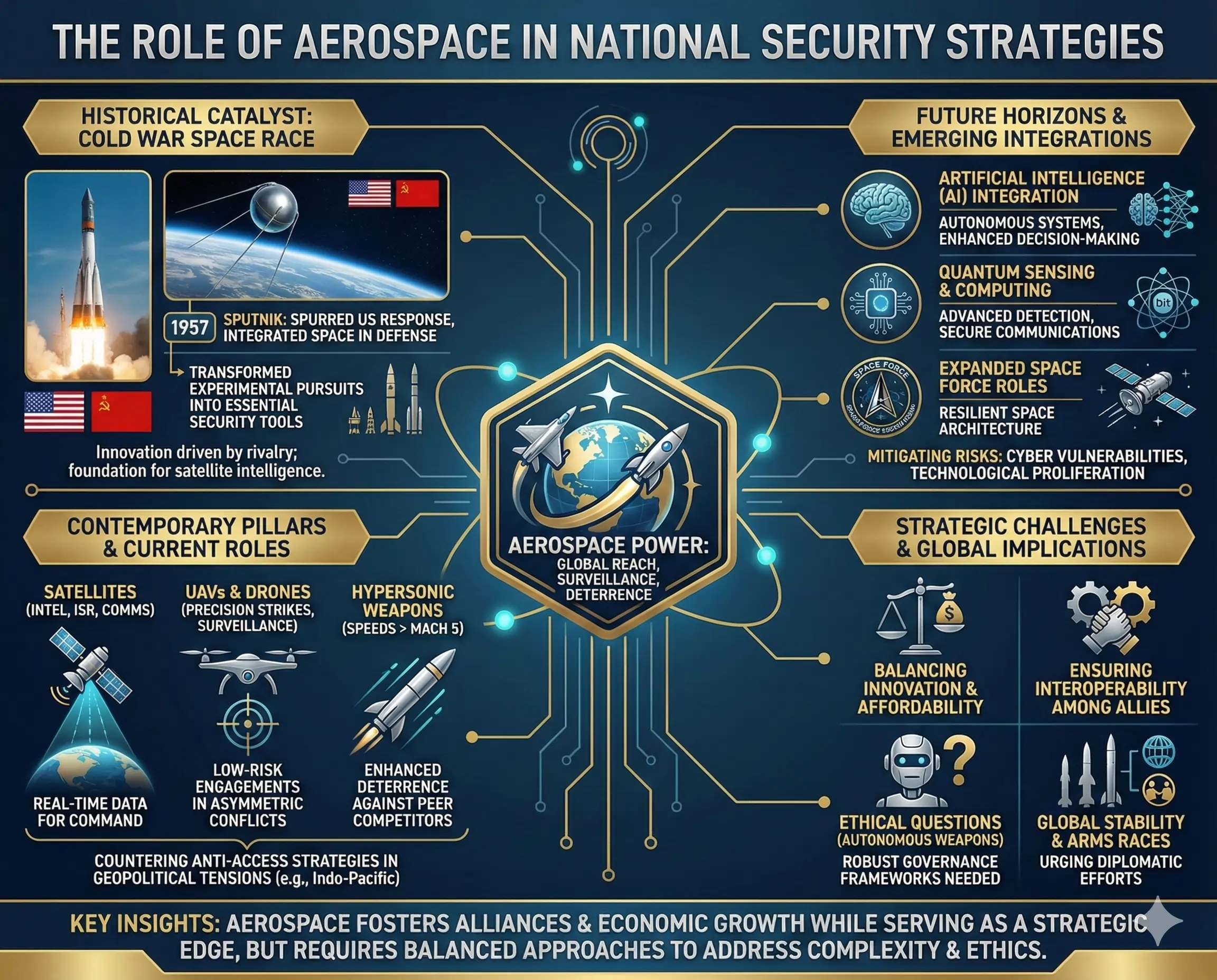
- Historical Catalyst: The Cold War Space Race transformed aerospace from experimental pursuits into essential security tools, with milestones like Sputnik in 1957 spurring U.S. responses that integrated space into defense strategies.
- Current Pillars: Satellites for intelligence, unmanned aerial vehicles (UAVs) or drones for precision strikes, and hypersonic weapons traveling at speeds exceeding Mach 5 dominate modern arsenals, enhancing deterrence against peer competitors.
- Future Horizons: Emerging integrations of artificial intelligence (AI), quantum sensing, and expanded roles for entities like the U.S. Space Force promise resilient, autonomous systems, but require balanced approaches to mitigate risks like cyber vulnerabilities.
- Global Implications: While aerospace bolsters security for leading powers, it raises concerns over arms races and accessibility, urging diplomatic efforts to maintain stability.
Historical Foundations
The roots of aerospace in national security trace back to early 20th-century aviation, but the Cold War era crystallized its strategic value. The launch of Sputnik by the Soviet Union shocked the world, revealing gaps in U.S. missile technology and prompting the creation of NASA and dedicated military space programs. This rivalry drove innovations in rocketry and reconnaissance, laying the groundwork for satellite-based intelligence that remains vital today.
Contemporary Roles
Today, aerospace underpins operations from border surveillance to missile defense. Drones enable low-risk engagements in asymmetric conflicts, while constellations of satellites provide real-time data for command decisions. Geopolitical tensions, including those in the Indo-Pacific, underscore the need for agile aerospace assets to counter adversaries’ anti-access strategies.
Strategic Challenges
Balancing innovation with affordability poses ongoing hurdles, as does ensuring interoperability among allies. Ethical questions around autonomous weapons further complicate deployment, demanding robust governance frameworks to align technological advances with international norms.
Table of Contents
Aerospace stands at the intersection of innovation, power, and protection, weaving a narrative that spans from the stars above to the battlefields below. In an era where threats evolve faster than ever, understanding the profound role of aerospace in national security strategies reveals not just the machinery of defense but the very architecture of global stability.
This exploration delves deeply into the historical underpinnings, current applications, emerging frontiers, and broader implications, drawing on a tapestry of achievements and lessons to illuminate why aerospace remains indispensable. As nations navigate multipolar challenges, from cyber intrusions to hypersonic incursions, the skies offer both a shield and a sword—one that demands vigilant stewardship to safeguard peace.
The Dawn of Aerospace Power
The story of aerospace in national security begins with the audacious dreams of flight, but it truly ignites in the fires of conflict. During World War II, aviation shifted from novelty to necessity, with bombers and fighters altering the tides of battle and underscoring the value of air superiority. Yet, it was the postwar Cold War that elevated aerospace to a domain of existential strategy. The Space Race, a proxy for superpower rivalry, encapsulated this shift, turning celestial exploration into a high-stakes contest for military primacy.
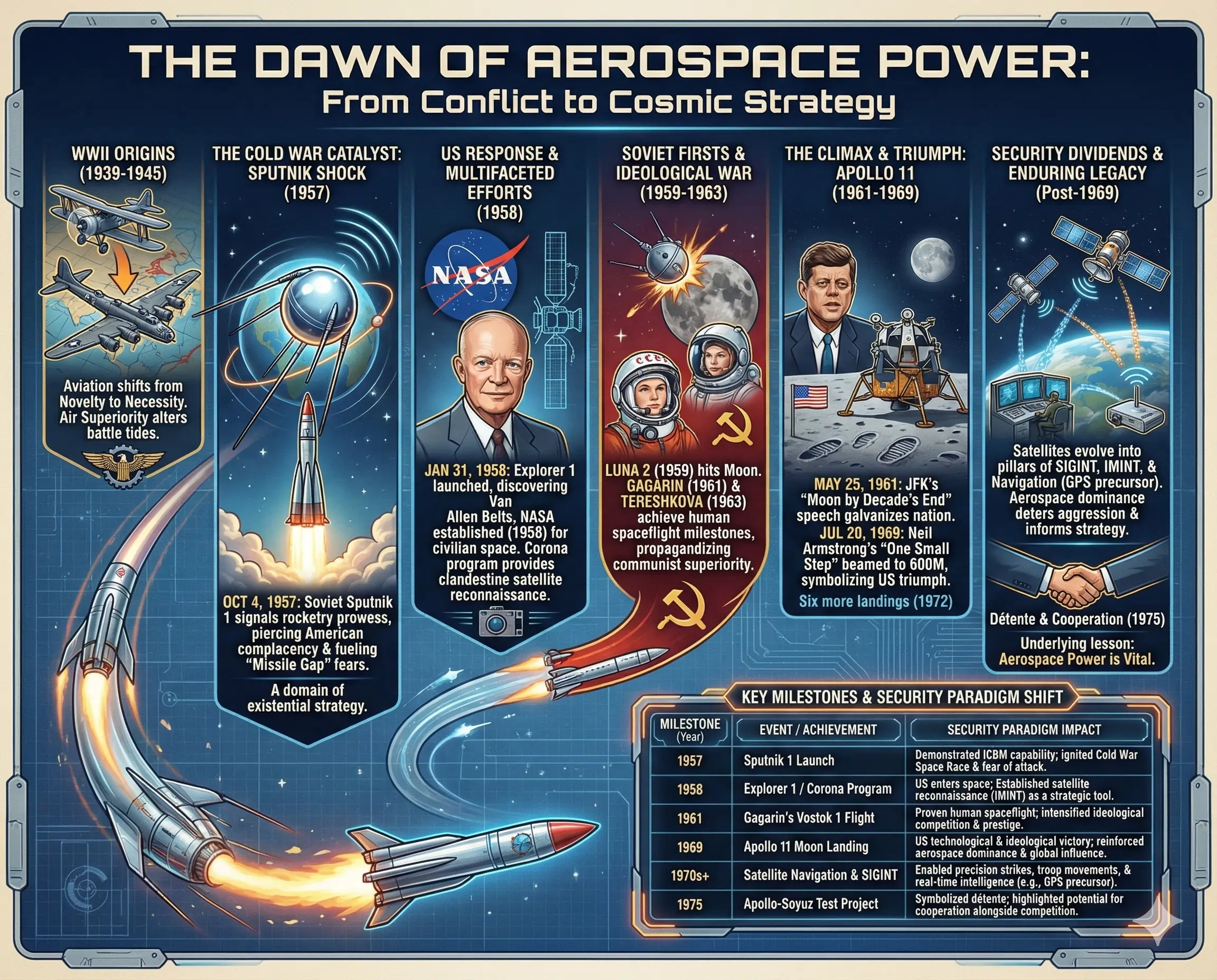
Consider the pivotal moment of October 4, 1957, when the Soviet Union orbited Sputnik 1, the first artificial satellite. This beeping sphere, launched atop an R-7 intercontinental ballistic missile (ICBM), pierced American complacency, signaling Soviet prowess in rocketry that could deliver nuclear payloads across oceans. The U.S. response was swift and multifaceted: President Dwight D. Eisenhower established NASA in 1958 to coordinate civilian efforts, while military initiatives like the Corona program—a clandestine satellite reconnaissance effort—began photographing Soviet installations, yielding intelligence that traditional spies could not match. By January 31, 1958, the U.S. countered with Explorer 1, which discovered the Van Allen radiation belts and kick-started a barrage of orbital feats.
This competition extended beyond hardware to ideology. The Soviets, under the secretive veil of their military-industrial complex, achieved stunning firsts: Luna 2 crashed onto the Moon in 1959, Yuri Gagarin became the first human in space aboard Vostok 1 on April 12, 1961, and Valentina Tereshkova followed as the first woman in orbit in 1963. Each milestone propagandized the superiority of communism, eroding Western confidence and fueling fears of a “missile gap.” The U.S., embracing transparency to rally public support, poured resources into the Mercury, Gemini, and Apollo programs. President John F. Kennedy’s May 25, 1961, speech committing to a Moon landing “before this decade is out” galvanized a nation, tripling NASA’s budget and mobilizing 400,000 workers.
The climax arrived on July 20, 1969, with Apollo 11: Neil Armstrong’s “one small step” on the lunar surface, beamed live to 600 million viewers, symbolizing American triumph. Six more landings followed in 1972, but the race’s security dividends were immediate and enduring. Satellites evolved into pillars of signals intelligence (SIGINT), imagery intelligence (IMINT), and navigation, with systems like the precursor to GPS enabling precise strikes and troop movements. The détente symbolized by the 1975 Apollo-Soyuz docking hinted at cooperation, yet the underlying lesson persisted: aerospace dominance deters aggression and informs strategy.
To chart this evolution, the following table outlines key historical milestones, illustrating how each advanced national security paradigms.
| Year | Event | Key Players | Security Impact |
|---|---|---|---|
| 1957 | Sputnik 1 Launch | Soviet Union (Sergei Korolev) | Exposed U.S. vulnerabilities in ICBM tech; spurred the National Defense Education Act for STEM investment. |
| 1958 | Explorer 1 and NASA Formation | U.S. (Wernher von Braun, Eisenhower) | Initiated satellite reconnaissance; integrated space into defense doctrine. |
| 1961 | Yuri Gagarin‘s Orbital Flight | Soviet Union | Heightened U.S. urgency led to Kennedy’s Moon Pledge and accelerated manned programs. |
| 1962 | John Glenn Orbits Earth | U.S. (Project Mercury) | Restored public morale; advanced human spaceflight for potential military applications like orbital reconnaissance. |
| 1969 | Apollo 11 Moon Landing | U.S. (Armstrong, Aldrin, Collins) | Demonstrated technological supremacy; paved way for reusable systems influencing modern launch vehicles. |
| 1975 | Apollo-Soyuz Test Project | U.S.-Soviet Joint | Fostered early arms control talks; prototype for international space station collaborations. |
| 1983 | GPS Operational | U.S. Air Force | Revolutionized navigation for military precision; now global standard for secure positioning. |
This timeline not only marks technological leaps but also strategic pivots, where aerospace transitioned from tactical asset to strategic deterrent.
Aerospace in the Modern Arsenal: Surveillance, Strike, and Sustainment
Fast-forward to the 21st century, and aerospace permeates every facet of national security, from peering into adversarial shadows to delivering payloads with surgical precision. Satellites form the backbone, orbiting in low Earth, geostationary, and highly elliptical orbits to provide uninterrupted coverage. Geosynchronous satellites relay secure communications for joint operations, while synthetic aperture radar (SAR) imaging penetrates clouds for all-weather monitoring of troop movements or nuclear sites. In 2025, with over 5,000 active satellites—many constellations like Starlink analogs enhancing resilience—these assets underpin all-domain operations, integrating air, sea, land, space, and cyber realms.
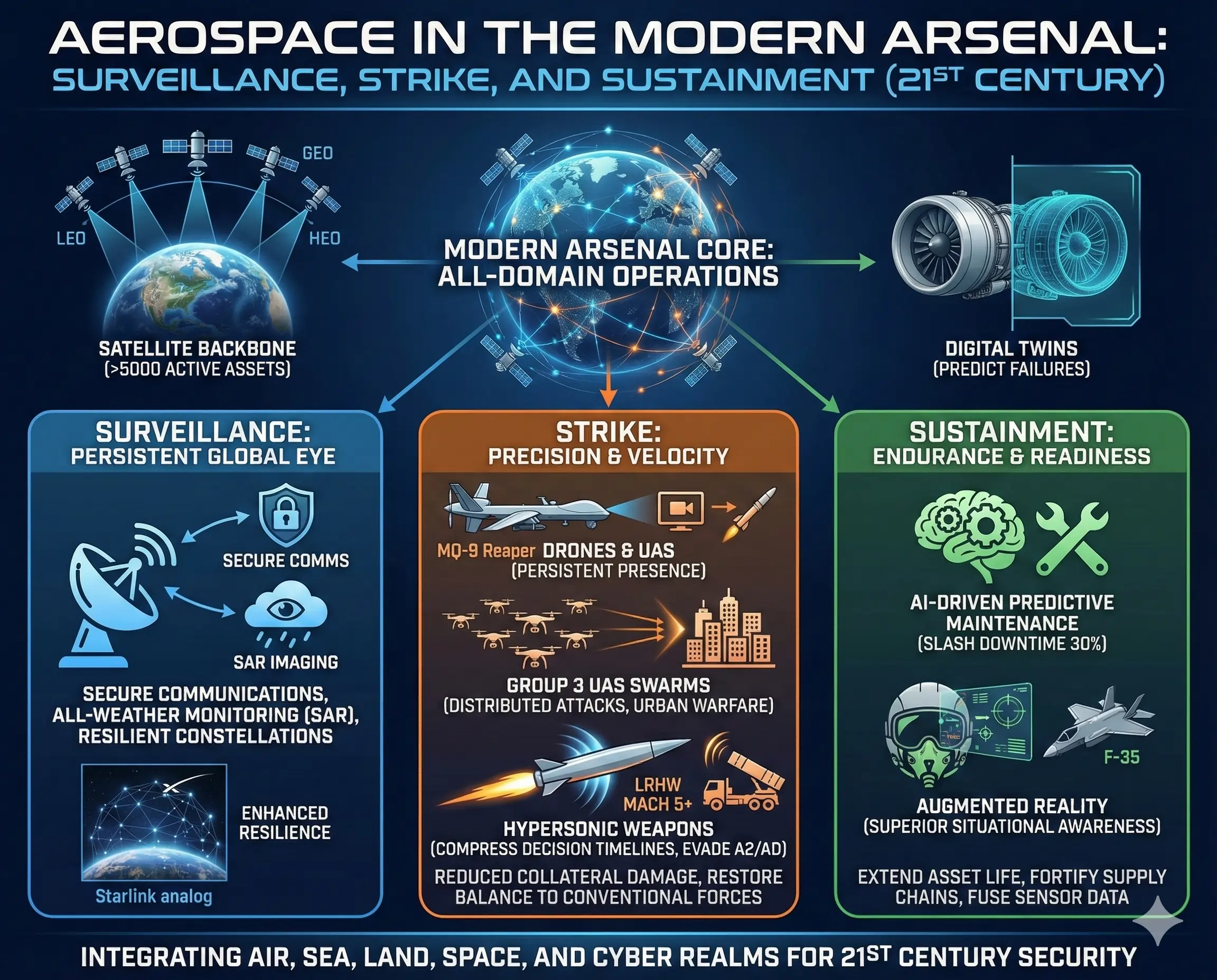
Drones, or unmanned aerial systems (UAS), represent another leap, offering a persistent presence without risking lives. The MQ-9 Reaper, for instance, conducts armed overwatch in counterterrorism, streaming high-definition video to analysts thousands of miles away. Swarms of smaller group 3 UAS enable distributed attacks, overwhelming defenses in scenarios like urban warfare. Recent conflicts demonstrate their efficacy: in precision strikes against high-value targets, drones reduce collateral damage while maintaining operational tempo.
Hypersonics add velocity to this equation, gliding at speeds above Mach 5 with maneuverability that evades traditional interceptors. Systems like the U.S. Long-Range Hypersonic Weapon (LRHW), slated for fielding by 2026, compress decision timelines, allowing strikes on anti-access/area-denial (A2/AD) networks—mobile launchers or command centers—that shield adversaries. Russia’s Kinzhal and China’s DF-17 have proliferated, prompting a global arms dynamic where hypersonics restore balance to conventional forces facing peer threats.
Sustainment technologies ensure these platforms endure. Digital twins—virtual replicas—predict failures in aircraft engines, while AI-driven predictive maintenance slashes downtime by 30%. In defense fleets, aging F-35 Lightning II jets benefit from augmented reality overlays for pilots, fusing sensor data for superior situational awareness. These integrations not only extend asset life but fortify supply chains against disruptions, a lesson amplified by recent geopolitical volatilities.
The table below categorizes current aerospace technologies by function, highlighting their security contributions and examples.
| Technology Category | Primary Function | Key Examples | National Security Role |
|---|---|---|---|
| Satellite Systems | Intelligence, Surveillance, Reconnaissance (ISR) | Corona (historical), Modern National Reconnaissance Office (NRO) birds | Real-time global monitoring; early warning for missile launches. |
| Unmanned Aerial Vehicles (UAVs) | Persistent Strike and Recon | MQ-9 Reaper, RQ-4 Global Hawk | Low-risk operations in denied areas; counter-insurgency support. |
| Hypersonic Weapons | Rapid Global Strike | LRHW/Dark Eagle, AGM-183A ARRW | Penetrate A2/AD bubbles; deter escalation with prompt effects. |
| Directed Energy Weapons | Defense and Interception | High-Energy Laser (HEL) systems on ships | Counter drone swarms; cost-effective vs. kinetic missiles. |
| Autonomous Systems | Swarm Tactics | Collaborative Combat Aircraft (CCA) | Overwhelm adversaries; enhance manned-unmanned teaming. |
These tools, when orchestrated, create layered defenses that adapt to hybrid threats, from state-sponsored hacks to non-state actor incursions.
Navigating Emerging Frontiers: AI, Quantum, and the Space Domain
Looking ahead, aerospace’s role in national security is poised for exponential growth, fueled by convergent technologies that blur lines between human and machine ingenuity. Artificial intelligence (AI) emerges as a force multiplier, enabling agentic AI—autonomous agents that plan missions, avoid collisions, and target dynamically. The U.S. Department of Defense’s Combined Joint All-Domain Command and Control (CJADC2) envisions AI-orchestrated battlespaces, where algorithms sift petabytes of satellite data to predict enemy maneuvers. By 2026, scaled deployments could automate logistics, from spare parts routing to pilot training simulations, though regulatory hurdles around certification temper enthusiasm.
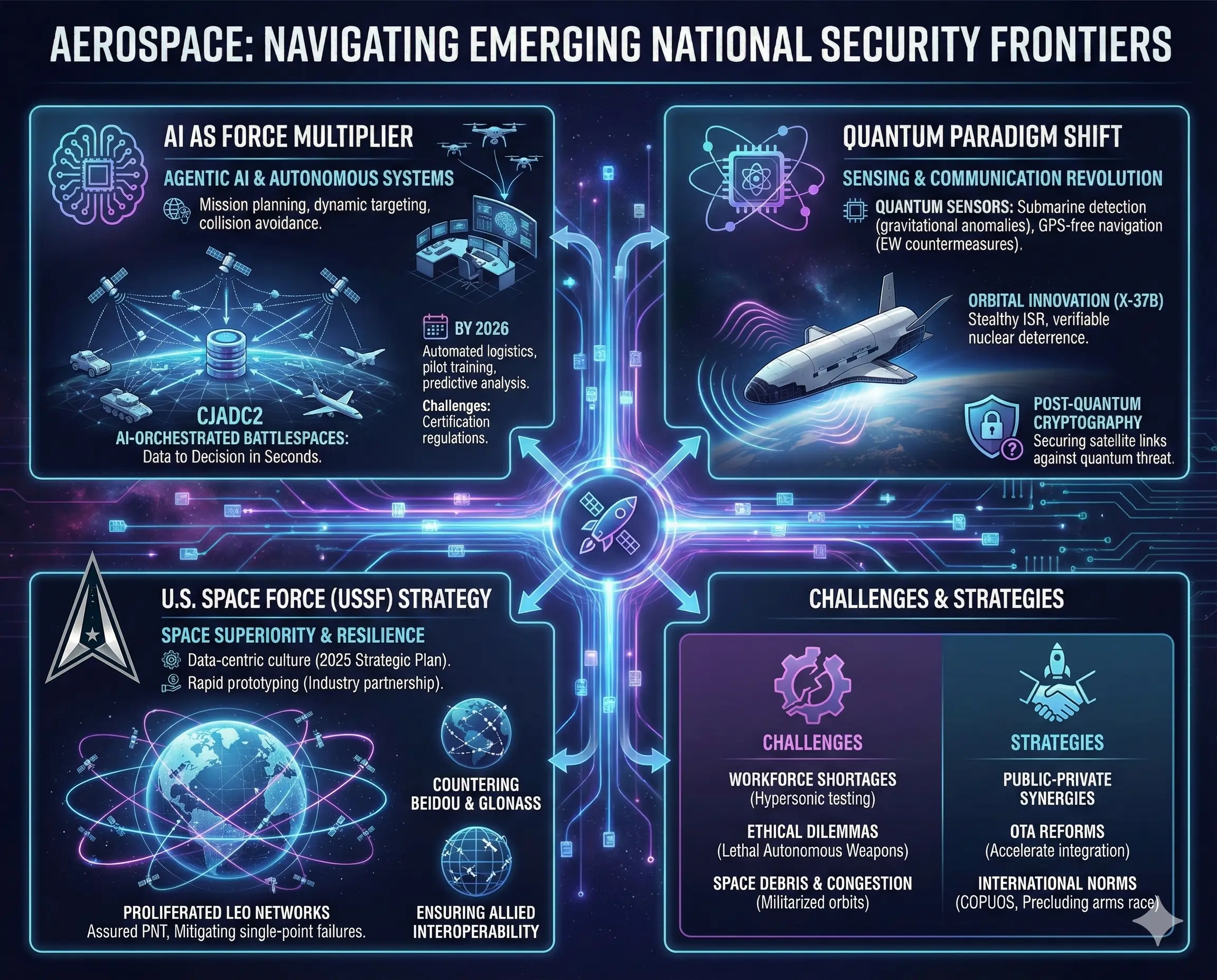
Quantum technologies introduce paradigm shifts, particularly in sensing and communication. Quantum sensors detect submarines via gravitational anomalies or navigate without GPS amid jamming, countering electronic warfare (EW) tactics. In space, they enhance X-37B orbital test vehicles for stealthy ISR, potentially revolutionizing nuclear deterrence by verifying compliance without on-site inspections. Yet, the quantum threat to encryption looms large, necessitating post-quantum cryptography to secure satellite links.
The U.S. Space Force, established in 2019, embodies this forward thrust, prioritizing space superiority through resilient architectures. Its 2025 Data and AI Strategic Action Plan fosters a data-centric culture, partnering with industry for rapid prototyping. Future visions include proliferated low-Earth orbit (LEO) networks for assured positioning, navigation, and timing (PNT), mitigating single-point failures. Geopolitically, this counters China’s Beidou and Russia’s GLONASS, ensuring allied interoperability.
Challenges abound: workforce shortages in hypersonic testing, ethical dilemmas in lethal autonomous weapons, and the specter of space debris from militarized orbits. Strategies emphasize public-private synergies, with reforms like Other Transaction Authority (OTA) accelerating non-traditional supplier integration. International norms, via forums like the United Nations Committee on the Peaceful Uses of Outer Space (COPUOS), aim to preclude an arms race, though enforcement remains elusive.
A prospective table maps future trends to their security implications, underscoring investment priorities.
| Trend | Description | Projected Timeline | Security Implications |
|---|---|---|---|
| Agentic AI Integration | Autonomous decision-making in cockpits and command centers | 2026-2030 | Faster OODA loops; risk of algorithmic bias in targeting. |
| Quantum Sensing | Ultra-precise detection beyond classical limits | 2027-2035 | Enhanced stealth countermeasures; vulnerability to quantum decryption. |
| Proliferated LEO Constellations | Thousands of small sats for redundancy | 2025-2040 | Resilient comms; increased collision risks in crowded orbits. |
| Reusable Hypersonic Platforms | Aircraft for ISR and strike from the space edge | 2030+ | Persistent global reach; high costs demand scalable production. |
| Directed Energy in Space | Lasers for debris mitigation and ASAT defense | 2028-2035 | Domain awareness; escalation risks if weaponized. |
These trajectories suggest a future where aerospace not only reacts but anticipates, embedding security into the fabric of daily operations.
Case Studies: Aerospace in Action Across Conflicts and Crises
Real-world applications breathe life into these concepts, revealing aerospace’s adaptability. During the Gulf War (1991), coalition forces leveraged GPS-guided munitions for the first time, achieving a 90% hit rate that minimized ground casualties and hastened liberation. Satellites provided battlefield mapping, while AWACS aircraft coordinated air traffic, exemplifying integrated aerospace command.
In the Ukraine conflict (2022 onward), drones like the Turkish Bayraktar TB2 democratized precision strikes, allowing outnumbered forces to target Russian armor effectively. Commercial satellite imagery from firms akin to Maxar offered open-source intelligence, empowering global assessments and sanctions. Hypersonics entered the fray with Russia’s Kinzhal deployments, testing Western air defenses and accelerating allied R&D.
The Indo-Pacific theater presents a forward-looking case: China’s expansion of A2/AD capabilities around Taiwan prompts U.S. investments in hypersonic glide vehicles for rapid reinforcement. Exercises like Pacific Dragon simulate multi-domain ops, with B-21 Raider bombers—stealthy and AI-augmented—projecting power without provocation. These scenarios highlight aerospace’s role in deterrence, where presence alone shapes adversary calculations.
- Counterterrorism Evolution: Post-9/11, Predator drones conducted over 1,800 strikes in Pakistan, disrupting al-Qaeda networks while informing rules of engagement debates.
- Disaster Response Synergies: In Hurricane Katrina (2005), satellites mapped flood zones for rapid aid, blending security assets with humanitarian needs and building dual-use resilience.
- Arctic Security: Melting ice opens new routes; P-8 Poseidon patrols monitor Russian subs, with quantum-enhanced sonar on horizon for submerged threats.
- Allied Interoperability: NATO’s Allied Future Surveillance and Control (AFSC) integrates UAV feeds, ensuring collective defense against hybrid incursions.
These vignettes underscore a truth: aerospace excels in ambiguity, turning information asymmetries into strategic advantages.
Broader Implications: Economic, Ethical, and Global Dimensions
Beyond the tactical, aerospace weaves into the economic tapestry of nations. The U.S. aerospace sector, employing millions, drives a $500 billion industry that funds R&D spilling into civilian realms—like sustainable aviation fuels (SAF), reducing emissions while powering military transports. Leadership here secures supply chains for rare earths in avionics, countering dependencies on adversarial sources.
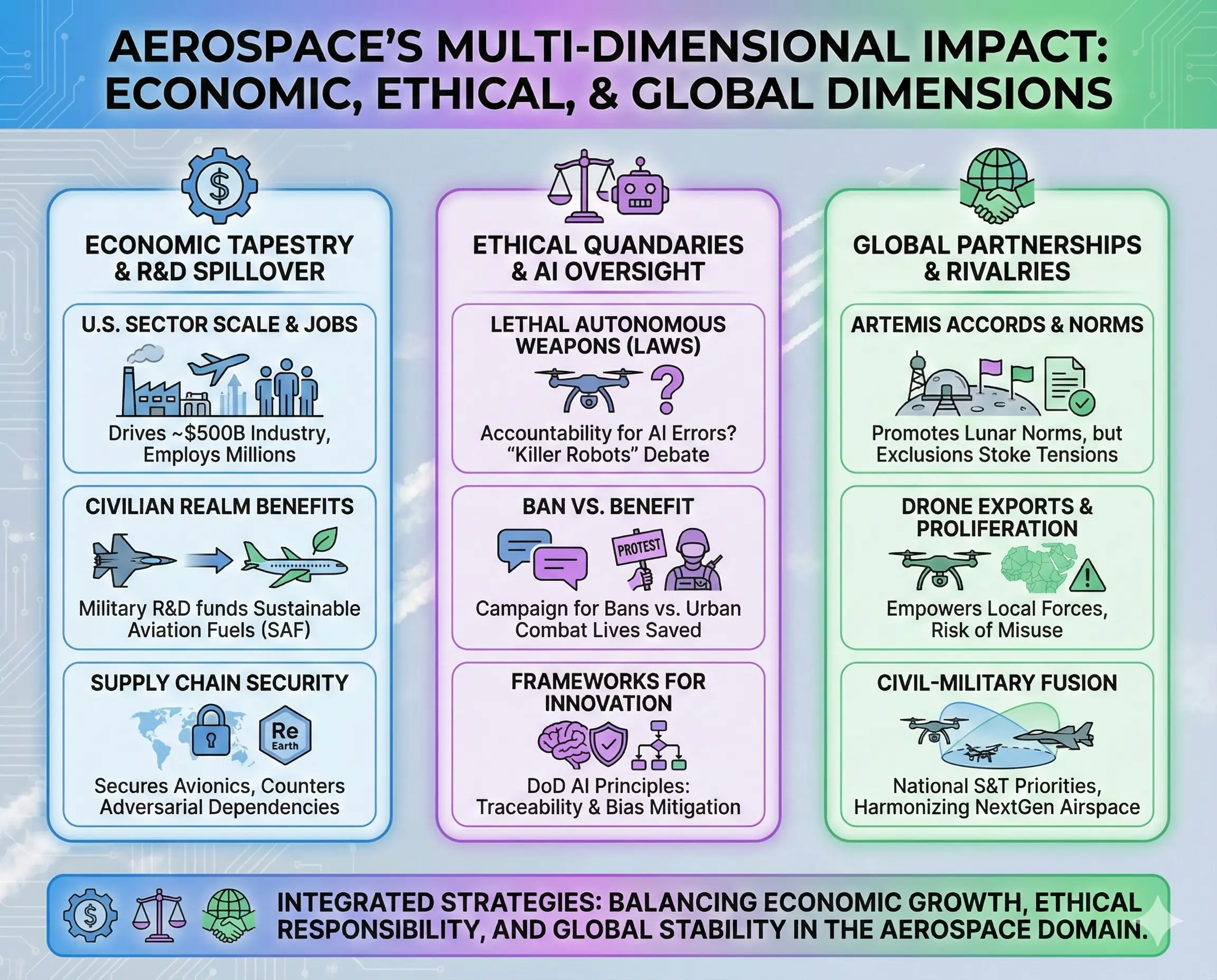
Ethically, the terrain grows thornier. Lethal autonomous weapon systems (LAWS), or “killer robots,” raise accountability quandaries—who bears responsibility for AI errors? Initiatives like the Campaign to Stop Killer Robots advocate bans, yet proponents argue they save lives in urban fights. Balancing innovation with human oversight demands frameworks like the DoD’s AI Ethical Principles, emphasizing traceability and bias mitigation.
Globally, aerospace fosters partnerships yet fuels rivalries. The Artemis Accords, signed by 40+ nations, promote lunar norms, but exclusions stoke tensions. In Africa and the Middle East, drone exports empower local forces against extremism, though proliferation risks misuse. Sustainable strategies integrate civil-military fusion, as in the National Aeronautics Science and Technology Priorities, harmonizing NextGen airspace for drones and fighters alike.
Conclusion
Aerospace’s role in national security is not static but symphonic—a harmony of history, hardware, and foresight. From Sputnik’s shadow to quantum’s promise, it equips nations to confront uncertainties with clarity and resolve. Yet, true strength lies in wisdom: investing boldly while governing justly, collaborating widely while deterring firmly. As horizons expand, so must our commitment to a secure, equitable aerospace domain—one where the stars guide us toward peace, not peril. This enduring legacy invites ongoing dialogue, ensuring that the skies remain a realm of aspiration for all.
Key Citations And References
- National Security | Aerospace Center for Space Policy and Strategy
- The Space Race: Timeline, Cold War & Facts
- 2026 Aerospace and Defense Industry Outlook | Deloitte Insights
- NATIONAL AERONAUTICS SCIENCE & TECHNOLOGY PRIORITIES
- Defense Tech Boom: Autonomous Drones, Lasers, And Hypersonic Missiles
- The imperative for hypersonic strike weapons and counterhypersonic defenses
- Quantum Sensing and the Future of Warfare: Five Essential Reforms
- Space Technology Trends 2025 | Lockheed Martin
Read These Articles in Detail
- Aerospace Engineering vs. Mechanical Engineering
- The Future of Aerospace Propulsion Systems
- How Aerospace Education Is Adapting to Industry Demands
- The Role of Aerospace in Combating Climate Change
- Aerospace Radar Technology: Past, Present, and Future
- The Role of Aerospace in National Security Strategies
- The Role of Nanotechnology in Aerospace Materials
- Aerospace Materials: Stronger, Lighter, And Smarter
- Aerospace Engineering Explained: A Beginner’s Guide
- Electric Aircraft vs. Hydrogen Aircraft: Which Is More Sustainable?
- Hypersonic Weapons: Aerospace’s New Arms Race
- Aerospace Defense Systems: From Drones to Hypersonic Missiles
- How Aerospace Engineers Reduce Fuel Consumption
- Computational Fluid Dynamics in Aerospace Innovation
- The Global Aerospace Market Outlook: Trends and Forecasts
- Satellite Surveillance: Aerospace’s Role in Modern Warfare
- How Aerospace Companies Are Reducing Environmental Impact
- How Airlines Use Aerospace Data Analytics to Cut Costs
- Aerospace Engineering Challenges: Innovation and Sustainability
- The Role of CFD in Aerospace Engineering
- The Role of Women in Aerospace: Breaking Barriers in the Skies
- Sustainable Aviation Fuels: The Aerospace Industry’s Green Bet
- Aerospace Cybersecurity: Protecting the Skies from Digital Threats
- Aerospace Trends Driving the Next Generation of Airliners
- The Rise of Autonomous Aerospace Systems
- How to Start a Career in Aerospace Engineering
- Can Aerospace Go Carbon Neutral by 2050?
- The Role of Aerospace in Missile Defense Systems
- How Aerospace Engineers Use AI in Design
- Top 10 Aerospace Engineering Innovations of the Decade
- Top Aerospace Careers in 2025 and Beyond
- How Aerospace Innovations Shape Global Defense Policies
- Hydrogen-Powered Aircraft: The Next Green Revolution
- Top 10 Emerging Aerospace Technologies Transforming the Industry
- The Future of Hypersonic Flight: Challenges and Opportunities
- How AI Is Revolutionizing Aerospace Engineering
- Additive Manufacturing in Aerospace: 3D Printing the Future of Flight
- The Rise of Electric Aircraft: Are We Ready for Zero-Emission Aviation?
- Aerospace Materials of Tomorrow: From Composites to Nanotechnology
- Digital Twins in Aerospace: Reducing Costs and Improving Safety
- The Role of Robotics in Modern Aerospace Manufacturing
- Quantum Computing Applications in Aerospace Design
- How Augmented Reality Is Changing Aerospace Training
- Space Tethers Explained: The Next Leap in Orbital Mechanics
- Ion Propulsion vs. Chemical Rockets: Which Will Power the Future?
- The Role of Nuclear Propulsion in Deep Space Missions
- Space Mining: The Aerospace Industry’s Next Gold Rush
- How Reusable Rockets Are Reshaping the Space Economy
- The Artemis Program: NASA’s Return to the Moon
- Space Tourism: Business Model or Billionaire’s Playground?
- How Aerospace Startups Are Disrupting Commercial Aviation
- The Economics of Low-Cost Airlines in the Aerospace Era
- Urban Air Mobility: The Rise of Flying Taxis
- The Future of Mars Colonization: Key Aerospace Challenges and Solutions Ahead
- CubeSats and Small Satellites: Democratizing Space Access
- The Future of Cargo Drones in Global Logistics
- The Role of Aerospace in Building a Lunar Economy
Frequently Asked Questions
FAQ 1: What Was the Historical Significance of the Space Race in Shaping Aerospace and National Security Strategies?
The Space Race during the Cold War marked a pivotal turning point in how nations viewed aerospace not just as a realm of exploration but as a critical arena for national security and global influence. Sparked by the Soviet Union’s launch of Sputnik 1 in 1957, this competition between the United States and the Soviet Union transformed space from a distant dream into a strategic battleground. It began with mutual fears over technological superiority, where each satellite or manned flight symbolized potential military dominance, prompting massive investments in rocketry, reconnaissance, and propulsion systems. This era laid the foundation for integrating aerospace capabilities into defense doctrines, emphasizing the need for orbital assets to monitor adversaries and project power without direct confrontation.
As the rivalry intensified, key milestones like Yuri Gagarin‘s 1961 orbital flight and the United States’ Apollo 11 Moon landing in 1969 showcased how aerospace innovations could rally domestic support and deter enemies through demonstrated prowess. The U.S. response to Sputnik included creating NASA and accelerating military programs, which resulted in systems like the early precursors to GPS and reconnaissance satellites. These developments shifted national security strategies toward space-based intelligence, reducing reliance on ground-based spies and enabling real-time global surveillance. By the 1970s, the race’s legacy influenced arms control treaties, recognizing space as a shared domain that required mutual restraint to prevent escalation.
Today, the Space Race’s impact endures in modern strategies, where lessons in rapid innovation and international competition inform responses to emerging threats. It underscored the dual-use nature of aerospace technologies, blending civilian and military applications to bolster economic growth alongside security. Nations continue to draw from this history, investing in resilient satellite networks and hypersonic vehicles to maintain edges in contested environments, ensuring that the stars remain a symbol of strategic foresight rather than vulnerability.
FAQ 2: How Do Satellites Contribute to Modern National Security Efforts?
Satellites play an indispensable role in contemporary national security by providing unparalleled visibility and connectivity in an increasingly complex global landscape. These orbiting platforms enable intelligence, surveillance, and reconnaissance (ISR) operations that detect missile launches, track troop movements, and monitor maritime activities in real time, far surpassing the capabilities of traditional ground or air-based systems. In 2025, with thousands of satellites in low-Earth orbit forming resilient constellations, they ensure continuous coverage even amid disruptions like jamming or anti-satellite attacks, supporting everything from border patrols to counterterrorism missions.
Beyond surveillance, satellites underpin secure communications and navigation, allowing military forces to coordinate across vast distances without interruption. For instance, geosynchronous satellites facilitate encrypted data links for joint operations, while global navigation satellite systems (GNSS) like GPS guide precision-guided munitions and autonomous vehicles. This integration enhances decision-making cycles, compressing response times in crises and deterring aggression through assured access to space-based assets.
Key contributions of satellites to national security include:
- Early Warning Systems: Detecting ballistic missile threats via infrared sensors, providing minutes of advance notice to activate defenses.
- Disaster Response Integration: Mapping affected areas post-natural calamities, blending security resources with humanitarian aid for dual-purpose resilience.
- Economic Safeguards: Protecting supply chains by monitoring shipping routes, which indirectly bolsters defense logistics against disruptions.
- Allied Interoperability: Sharing data through international partnerships, strengthening collective defense pacts like those in the Indo-Pacific region.
As threats evolve, advancements in small satellite swarms promise even greater redundancy, making satellites a cornerstone of layered defense architectures that adapt to hybrid warfare.
FAQ 3: What Are Hypersonic Weapons and Their Strategic Role in National Defense?
Hypersonic weapons represent a game-changing category of aerospace technology, traveling at speeds exceeding Mach 5—over 3,800 miles per hour—while maneuvering unpredictably to evade traditional missile defenses. Unlike conventional ballistic missiles that follow predictable arcs, these systems combine high velocity with agility, allowing them to strike high-value targets like command centers or mobile launchers with minimal warning. In 2025, nations like the United States, Russia, and China are accelerating deployments, with the U.S. allocating nearly $4 billion in its fiscal year 2026 budget for hypersonic research and production.
The strategic role of hypersonics lies in restoring balance to deterrence strategies amid proliferating anti-access/area-denial (A2/AD) capabilities. They enable prompt global strike options, compressing enemy decision timelines and complicating invasion plans in regions like the Indo-Pacific. For defense, hypersonics counter peer competitors by penetrating fortified zones, supporting distributed forces without exposing manned assets to risk.
| Aspect | Description | Examples in 2025 Strategies | Security Implications |
|---|---|---|---|
| Boost-Glide Vehicles | Launched by rockets, glide at hypersonic speeds for extended range | U.S. Army Long-Range Hypersonic Weapon (LRHW), fielded in prototypes | Overwhelms air defenses; deters escalation by threatening rapid retaliation. |
| Hypersonic Cruise Missiles | Air-launched, scramjet-powered for sustained flight | Russia’s Kinzhal, integrated into Su-34 bombers | Enhances naval strike power; counters carrier groups in contested seas. |
| Defense Countermeasures | Interceptors designed for high-speed tracking | U.S. Glide Phase Interceptor (GPI) development | Protects assets from adversary hypersonics; fosters arms control dialogues. |
| Integration Challenges | High costs and thermal management issues | China’s DF-17 deployments in exercises | Drives international norms to prevent unchecked proliferation. |
| Budget and Timeline | FY2026 U.S. funding at $3.9 billion | Operational testing by 2026 for key systems | Accelerates R&D race, emphasizing allied co-development for affordability. |
These weapons underscore a shift toward velocity-based superiority, where possession alone influences geopolitical calculations and alliance formations.
FAQ 4: How Have Drones Transformed Contemporary Conflicts and National Security?
Drones, or unmanned aerial vehicles (UAVs), have fundamentally altered the dynamics of modern warfare by offering persistent, low-risk options for surveillance and strikes in high-threat environments. Emerging prominently in post-9/11 operations, their evolution into affordable, AI-enhanced platforms has democratized precision capabilities, allowing even smaller forces to challenge larger adversaries. In conflicts like those in the Middle East and Ukraine, drones have shifted tactics from large-scale maneuvers to targeted disruptions, minimizing human casualties while maximizing psychological impact on enemies.
This transformation extends to national security through enhanced border monitoring and counter-narcotics efforts, where swarms of small UAVs provide real-time feeds to command centers, enabling proactive responses to incursions. The integration of autonomous flight algorithms further amplifies their utility, allowing operations in GPS-denied zones and reducing operator workload. However, their proliferation raises challenges, including vulnerability to electronic warfare and the ethical tightrope of remote decision-making.
As of 2025, drones continue to evolve with hybrid designs that blend fixed-wing endurance and rotorcraft agility, supporting everything from urban counterinsurgency to maritime patrols. Their cost-effectiveness—often under $10,000 per unit for commercial models—has spurred non-state actors to adopt them, prompting defenses like counter-UAS networks. Ultimately, drones exemplify how aerospace innovation levels the playing field, fostering strategies that prioritize adaptability over sheer firepower in an era of asymmetric threats.
FAQ 5: What Are the Primary Objectives of the U.S. Space Force in 2025?
The U.S. Space Force (USSF), established in 2019, focuses on safeguarding American interests in orbit through a blend of warfighting, innovation, and partnerships. In 2025, its objectives center on achieving space superiority amid rising competitions, as outlined in the newly released Vector 2025 strategy, which synchronizes efforts to deter aggression and ensure resilient operations. This includes protecting critical satellite networks that underpin military communications, navigation, and intelligence.
A core goal is enhancing data-driven decision-making via the FY2025 Data and AI Strategic Action Plan, which aims to unify disparate datasets for faster threat analysis. The USSF is also finalizing a 15-year force design by early 2026, projecting needs for platforms like proliferated low-Earth orbit constellations to counter anti-satellite threats.
Notable objectives for 2025 encompass:
- Resilient Architectures: Developing dynamic space operations for satellite refueling and on-orbit repairs to maintain uptime during conflicts.
- Allied Integration: Deepening collaborations through initiatives like the International Partnership Strategy, sharing ISR data with NATO allies.
- Talent and Innovation: Expanding the workforce with STEM recruits and leveraging commercial tech for rapid prototyping.
- Threat Mitigation: Countering adversarial advancements in hypersonics and cyber tools via joint exercises and policy advocacy.
These priorities position the USSF as a guardian of the ultimate high ground, blending military rigor with technological agility to secure national interests for decades ahead.
FAQ 6: What Are the Key Ethical Concerns Surrounding Autonomous Weapons in Aerospace?
Autonomous weapons in aerospace, often termed lethal autonomous weapon systems (LAWS), spark intense debate over their alignment with humanitarian principles and accountability in warfare. A primary concern is the delegation of life-and-death decisions to algorithms, which may lack the nuanced judgment humans provide, potentially leading to errors in distinguishing combatants from civilians amid chaotic battlefields. Proponents argue these systems could reduce overall casualties by executing strikes with superhuman precision, yet critics highlight the risk of unintended escalations if AI misinterprets inputs.
Another ethical dilemma involves proliferation: as costs drop, non-state actors could access drone swarms capable of autonomous targeting, eroding state monopolies on force and complicating international law enforcement. The International Committee of the Red Cross emphasizes meaningful human control to uphold the Geneva Conventions, advocating constraints on full autonomy to preserve moral agency.
| Ethical Concern | Description | Potential Mitigations | Real-World Examples |
|---|---|---|---|
| Accountability Gaps | Difficulty assigning blame for AI errors, blurring lines between programmer and operator responsibility | Require human-in-the-loop protocols and traceable decision logs | Debates over U.S. drone strikes in Yemen, where collateral incidents fuel calls for oversight. |
| Bias in Algorithms | Training data reflecting historical prejudices could perpetuate discriminatory targeting | Diverse datasets and regular audits by ethicists | Concerns in facial recognition for UAVs, mirroring broader AI biases in security applications. |
| Escalation Risks | Rapid, autonomous responses shortening de-escalation windows | International treaties limiting deployment thresholds | Simulations showing swarm attacks overwhelming human commanders in Indo-Pacific scenarios. |
| Humanitarian Impact | Erosion of war’s “human element,” potentially lowering barriers to conflict | Global campaigns for bans, like those from Human Rights Watch | Ongoing discussions at UN forums on regulating LAWS akin to chemical weapons. |
| Proliferation Dangers | Accessibility enabling rogue use by terrorists | Export controls and tech-sharing pacts among allies | Reports of modified commercial drones in asymmetric conflicts, heightening non-state threats. |
Addressing these issues demands a balanced framework, integrating ethical reviews into development to harness autonomy’s benefits while safeguarding human values.
FAQ 7: How Does the Aerospace Industry Impact National Security Economically?
The aerospace sector serves as a powerful economic engine intertwined with national security, generating trillions in value while fortifying defense postures through innovation and jobs. In 2025, it contributes over $500 billion annually to the U.S. economy alone, with defense-related activities accounting for more than half, funding advancements in satellites and fighters that spill over into commercial aviation. This dual-use model amplifies returns, as military R&D in materials like composites reduces costs for civilian airliners, creating a virtuous cycle of growth and resilience.
Economically, aerospace bolsters supply chains critical to security, employing millions in high-skill roles that sustain technological edges against competitors. Disruptions, such as those from geopolitical tensions, highlight vulnerabilities, yet they also drive diversification efforts, like reshoring rare earth processing for avionics. Investments yield multipliers: every defense dollar spent generates up to $2.50 in broader economic activity, supporting communities and STEM pipelines that replenish talent pools.
Looking forward, sustainability initiatives in aerospace—such as sustainable aviation fuels—align economic imperatives with security by mitigating climate risks to bases and operations. International trade in aerospace components fosters alliances, but it requires safeguards against espionage, ensuring that economic vitality translates to unassailable strategic advantages.
FAQ 8: What Are the Emerging Future Trends in Aerospace Technology for National Security?
As aerospace evolves, several trends are set to redefine national security by 2030 and beyond, emphasizing speed, autonomy, and sustainability in response to multifaceted threats. Artificial intelligence (AI) integration stands out, enabling predictive analytics for threat detection and autonomous swarm tactics that overwhelm defenses without human risk. In 2025, AI-driven digital twins simulate entire missions, slashing development timelines and costs for next-gen fighters.
Quantum technologies promise breakthroughs in secure communications and sensing, rendering GPS jamming obsolete through inertial navigation that defies electronic interference. Meanwhile, hypersonic platforms and reusable launch vehicles expand rapid deployment options, supporting global reach in contested domains.
Prominent trends shaping aerospace security include:
- Proliferated Satellite Networks: Thousands of small sats for redundant ISR, countering single-point failures in cyber-vulnerable orbits.
- Directed Energy Weapons: Lasers for precise, cost-effective intercepts against drones and missiles, scaling to space-based variants.
- Sustainable Propulsion: Electric and hybrid engines reducing logistical footprints, enhancing endurance in prolonged operations.
- Human-Machine Teaming: Augmented reality cockpits fusing pilot intuition with AI insights for superior battlefield awareness.
- Cyber-Resilient Designs: Blockchain-secured data links protecting against hacks in multi-domain warfare.
These advancements, fueled by public-private collaborations, ensure aerospace remains a proactive shield, adapting to uncertainties like climate-driven migrations or space debris proliferation.
FAQ 9: How Has Aerospace Technology Influenced the Ukraine Conflict in 2025?
Aerospace has profoundly shaped the ongoing Ukraine conflict, turning the skies into a decisive theater where drones, satellites, and missiles dictate tactical outcomes. Ukrainian forces, leveraging Western-supplied UAVs, have conducted thousands of precision strikes on Russian armor, disrupting advances and conserving ground troops. In 2025, as stalemates persist, commercial satellite imagery provides open-source intelligence, informing global sanctions and aid allocations while exposing logistical chokepoints.
Russian escalations with upgraded fighters like the Su-30SM2 highlight aerospace’s role in sustaining air superiority, though Ukrainian air defenses have adapted, downing hypersonic threats and forcing tactical shifts.
| Aerospace Element | Ukrainian Application | Russian Counter | 2025 Impact on Conflict |
|---|---|---|---|
| Commercial Drones | Bayraktar TB2 for real-time targeting | Electronic jamming pods | Democratized strikes, slowing Russian offensives by 20-30% in key sectors. |
| Satellite ISR | Imagery for artillery spotting | Anti-satellite tests | Enabled precise HIMARS use, destroying 500+ Russian assets since 2022. |
| Hypersonic Missiles | Limited defensive intercepts | Kinzhal deployments over Black Sea | Heightened escalation risks, prompting NATO air patrols. |
| Fighter Upgrades | F-16 integrations for intercepts | Su-30SM2 naval strikes | Balanced airpower, protecting coastal routes vital for grain exports. |
| Swarm Tactics | Low-cost FPV drones in urban fights | Counter-UAS lasers | Transformed infantry support, with 80% of frontline kills attributed to UAVs. |
This aerial asymmetry underscores aerospace’s capacity to prolong defenses, influencing peace negotiations by amplifying Ukraine’s resilience against numerical disadvantages.
FAQ 10: In What Ways Does Aerospace Foster International Alliances for Global Security?
Aerospace serves as a bridge for international alliances, uniting nations through shared technologies and joint exercises that enhance collective security without overt militarization. Collaborative programs like the Artemis Accords, now involving over 40 countries, establish norms for lunar exploration while embedding defense interoperability, such as standardized satellite data sharing for disaster response and threat monitoring. These partnerships build trust, deterring unilateral actions by demonstrating unified resolve in domains like space and cyber.
In 2025, initiatives such as the U.S. Space Force’s International Partnership Strategy deepen ties with allies, co-developing resilient constellations to counter adversarial disruptions. This fosters economic interdependencies, with joint ventures in hypersonic testing distributing costs and expertise across borders.
By pooling resources, aerospace alliances amplify deterrence: NATO’s enhanced forward presence includes integrated UAV feeds, ensuring seamless operations from the Arctic to the Mediterranean. Such cooperation not only secures critical infrastructure but also promotes stability through transparency, like confidence-building measures on orbital activities, paving the way for enduring peace in a multipolar world.
FAQ 11: What Are the Key Objectives of the U.S. Space Force in 2025?
The U.S. Space Force continues to solidify its position as a vital component of national security in 2025, with a sharpened focus on maintaining space superiority amid escalating global competitions. Released in November 2025, the Vector 2025 strategy outlines a comprehensive roadmap that synchronizes the service’s purpose with practical steps for deterrence and resilience. This document emphasizes competitive endurance, ensuring that space assets remain operational even under duress from adversarial actions like jamming or kinetic attacks. By integrating lessons from recent exercises, the Space Force aims to expand its operational test infrastructure, fostering a more agile force capable of rapid adaptation in contested environments.
Building on this foundation, the service is finalizing a 15-year force design by the end of 2025, set for public release in 2026, which will detail infrastructure needs, system requirements, and personnel strategies through 2040. Achievements so far include enhanced partnerships with commercial entities for proliferated satellite networks, reducing vulnerabilities to single-point failures. The FY2025 Data and AI Strategic Action Plan further advances a data-centric culture, promoting AI adoption for threat prediction and mission planning, while addressing talent gaps through targeted recruitment in STEM fields.
Key objectives for the remainder of 2025 include:
- Strengthening allied interoperability via shared intelligence platforms to counter peer threats in the Indo-Pacific.
- Developing offensive capabilities to deter space-enabled attacks, including advanced counterspace tools.
- Expanding training regimens with part-time Guardians to build a flexible workforce.
- Prioritizing sustainable operations, such as debris mitigation, to safeguard long-term orbital access.
These efforts not only enhance immediate security but also position the Space Force as a model for integrated multi-domain warfare.
FAQ 12: How Is the Global Hypersonic Weapons Race Progressing in 2025?
The global race for hypersonic weapons has intensified in 2025, with major powers accelerating deployments to gain strategic advantages in rapid strike capabilities. Russia and China maintain leads, with Russia projecting production of nearly 2,500 high-precision missiles, including hypersonics, while China’s missile stockpiles have surged by 50% since 2020, focusing on anti-ship and land-attack variants. The United States, though trailing in operational fielding, achieved a milestone in August 2025 with the deployment of the Long-Range Hypersonic Weapon during multinational exercises, signaling progress toward full integration by 2026.
This competition raises concerns over escalation risks, as hypersonics compress response times to mere minutes, potentially destabilizing deterrence frameworks. Budgets reflect the urgency: the U.S. FY2026 request stands at $3.9 billion, down from prior years but still robust for testing and countermeasures like the Glide Phase Interceptor. International dialogues, including arms control proposals, aim to mitigate an unchecked arms race, though geopolitical tensions hinder progress.
| Nation | Key Developments in 2025 | Production/Deployment Status | Strategic Focus |
|---|---|---|---|
| United States | LRHW prototype fielded in exercises; ARRW testing advances | Initial batteries operational by late 2025; full rollout 2026 | Counter A2/AD in Pacific; allied co-development |
| Russia | Kinzhal upgrades integrated into air forces; Avangard ICBM variants | 2,500+ missiles planned, including hypersonics | Asymmetric warfare; exports to allies like Iran |
| China | DF-17 and DF-27 expansions; new test sites revealed | 50% stockpile increase; mass production underway | Taiwan Strait deterrence; naval strike emphasis |
| United Kingdom | Tempest program hypersonic integration trials | Early-stage R&D; joint with U.S./Australia | European theater defense; tech sharing pacts |
| India | BrahMos-II scramjet tests successful | Prototype flights; operational by 2027 | Regional balancing against China/Pakistan |
These advancements underscore the need for balanced investment in both offensive and defensive hypersonic technologies to preserve global stability.
FAQ 13: What Role Does Artificial Intelligence Play in Aerospace Defense Strategies in 2025?
Artificial intelligence has emerged as a transformative force in aerospace defense by 2025, enabling faster, more precise operations across surveillance, maintenance, and combat scenarios. In the defense sector, AI algorithms process vast datasets from satellites and drones in real time, predicting adversary movements and optimizing resource allocation during missions. This shift toward AI fluency across workforces—rather than siloed specialists—allows for resilient systems that adapt to evolving threats, with spending on user-facing AI solutions projected to grow 15% annually through 2030.
The integration of AI extends to autonomous systems, where machine learning enhances pilot training simulations and unmanned vehicle swarms, reducing human error in high-stakes environments. For national security, AI bolsters cybersecurity by detecting anomalies in satellite communications, while predictive analytics forecast equipment failures, cutting downtime by up to 30% in fleets like the F-35. However, ethical considerations persist, with frameworks emphasizing human oversight to prevent biases in targeting decisions.
Market projections highlight AI’s economic momentum: the global AI in aerospace and defense sector is valued at $27.95 billion in 2025, expected to reach $65.43 billion by 2034, driven by applications in robotics and data analytics. This growth fosters innovation but demands robust governance to align with international norms, ensuring AI augments rather than supplants human judgment in securing the skies.
FAQ 14: What Are the Main Impacts of Space Debris on National Security?
Space debris poses a growing hazard to national security in 2025, with over 40,000 tracked objects in orbit threatening critical satellite infrastructure essential for intelligence and communications. As constellations proliferate, the risk of collisions escalates, potentially cascading into Kessler syndrome—a chain reaction rendering low-Earth orbit unusable for years. This vulnerability could disrupt GPS navigation, early warning systems, and financial networks, leading to economic losses in the trillions and compromising military readiness.
Recent assessments reveal uneven mitigation efforts, often secondary to commercial priorities, exacerbating the crisis. Nations like the U.S. face heightened exposure, as debris impacts could blind reconnaissance assets, tilting balances in conflicts. International cooperation, through guidelines like those from the European Space Agency, urges deorbiting protocols, yet enforcement lags amid rising launches.
The security ramifications extend to hybrid threats, where adversaries might exploit debris fields for plausible deniability in attacks. Mitigation strategies include active removal technologies and resilient satellite designs, but sustained investment is crucial to preserve space as a strategic domain.
Key impacts include:
- Operational Disruptions: Loss of ISR satellites hampers real-time decision-making in crises.
- Economic Vulnerabilities: Interruptions to global positioning affect supply chains and markets.
- Escalation Risks: Debris from tests could provoke retaliatory actions, fueling arms races.
- Long-Term Denial: Potential for uninhabitable orbits, forcing costly ground-based alternatives.
Addressing debris demands a blend of policy, technology, and diplomacy to safeguard national interests.
FAQ 15: What Cyber Threats Are Targeting Aerospace Systems in 2025?
Cyber threats to aerospace systems have surged in 2025, with state-sponsored actors and cybercriminals exploiting vulnerabilities in satellites, aircraft networks, and supply chains. The sector recorded 879 claimed attacks worldwide from September 2024 to 2025, targeting everything from passenger data to military command links, underscoring the high stakes of interconnected operations.
Iran and non-state groups have notably pursued disruptions against satellite infrastructure, complicating attribution amid sophisticated tactics like AI-enhanced phishing. Aviation giants faced breaches, such as the June 2025 Qantas incident exposing customer records, highlighting risks to operational continuity.
| Threat Type | Examples in 2025 | Affected Systems | Mitigation Strategies |
|---|---|---|---|
| State-Sponsored Attacks | Iranian hacks on aerospace firms; Russian jamming tests | Satellite ground stations, UAV controls | Zero-trust architectures; AI anomaly detection |
| Ransomware Incidents | Disruptions to airline booking systems | Commercial aviation IT estates | Regular audits; segmented networks |
| Supply Chain Compromises | Embedded malware in avionics parts | Defense contractor logistics | Vendor vetting; blockchain tracking |
| Insider Threats | Data exfiltration via compromised credentials | Military drone fleets | Training programs; behavioral analytics |
| DDoS Overloads | Overwhelming air traffic control feeds | Global navigation networks | Redundant cloud backups; traffic filtering |
These threats demand vigilant, layered defenses to protect aerospace’s role in national security.
FAQ 16: How Do International Space Treaties Shape Aerospace Security?
International space treaties form the bedrock of aerospace security, promoting peaceful exploration while curbing militarization since the 1960s. The cornerstone Outer Space Treaty of 1967 prohibits nuclear weapons in orbit and military bases on celestial bodies, fostering a framework for cooperation that has endured through over 100 signatories. This agreement underpins modern strategies by emphasizing non-appropriation, ensuring space remains a global commons rather than a contested frontier.
Complementing it, the Rescue Agreement and Liability Convention address practical security needs, like astronaut repatriation and compensation for damages from launches, which indirectly bolsters trust in joint missions. However, gaps persist: the treaties predate hypersonic and cyber threats, prompting calls for updates via forums like the UN Committee on the Peaceful Uses of Outer Space. In 2025, initiatives such as the Artemis Accords build on these foundations, with 40+ nations agreeing to interoperable norms for lunar activities, enhancing collective defense against debris and interference.
While effective in preventing overt arms races, treaties struggle with enforcement, as dual-use technologies blur lines between civilian and military applications. Strengthening them through confidence-building measures could mitigate risks, aligning security with sustainable access for all.
FAQ 17: How Does Climate Change Affect Aerospace National Security Strategies?
Climate change profoundly influences aerospace national security by altering operational environments and straining resources in unpredictable ways. Rising sea levels and extreme weather threaten coastal air bases and launch sites, potentially displacing assets and complicating logistics in regions like the Indo-Pacific. By 2025, assessments indicate these shifts exacerbate migration and resource conflicts, indirectly fueling instability that demands enhanced surveillance from orbital platforms.
The Department of Defense’s 2024-2027 Climate Adaptation Plan highlights how warming oceans disrupt submarine patrols and satellite thermal management, while wildfires and floods hinder training exercises. This necessitates resilient designs, such as elevated runways and AI-optimized flight paths to evade turbulence.
Broader implications include heightened Arctic competition as ice melts, opening new routes for hypersonic testing, but also cyber-vulnerable infrastructure. Strategies now integrate climate modeling into threat assessments, blending environmental foresight with traditional defense to maintain superiority amid evolving risks.
FAQ 18: What Is the Economic Impact of the Aerospace Industry on National Security in 2025?
The aerospace industry drives substantial economic value that directly fortifies national security in 2025, generating over $995 billion in U.S. business activity alone through jobs, innovation, and exports. This sector supports 2.2 million high-skill positions, fueling R&D that spills into defense technologies like advanced composites for stealth aircraft, creating a multiplier effect where each dollar invested yields broader societal benefits.
Global projections show the space economy hitting $613 billion in 2024, with 2025 growth tied to commercial-military synergies that enhance supply chain resilience against disruptions. In regions like the Middle East, aviation’s expansion could double economic contributions by 2043, bolstering alliances through joint ventures.
| Metric | 2025 U.S. Impact | Global Projection | Security Linkage |
|---|---|---|---|
| Total Output | $995 billion in sales | $650+ billion space economy | Funds hypersonic and AI R&D |
| Employment | 2.2 million jobs | 1 million+ new roles by 2030 | Builds a skilled workforce for defense |
| Exports | $150 billion annually | 20% growth in A&D deals | Strengthens international partnerships |
| R&D Investment | $50 billion+ | CAGR 8% through 2030 | Innovates resilient satellite networks |
| Supply Chain Value | $300 billion indirect | Reshoring adds $100 billion | Mitigates geopolitical risks |
This economic engine not only sustains military edges but also promotes stability through shared prosperity.
FAQ 19: What Are the Primary Workforce Challenges in Aerospace and Defense in 2025?
Workforce challenges in aerospace and defense persist into 2025, driven by retirements, skill gaps, and rapid technological demands that strain recruitment efforts. With 25% of employees over 55 facing a retirement cliff, the industry grapples with replacing expertise in critical areas like avionics and cybersecurity, amid a projected shortage of 100,000 engineers by 2033.
Geopolitical pressures and modernization backlogs exacerbate these issues, requiring agile talent strategies that attract Gen Z through flexible roles and AI training. Despite growth, production delays highlight the need for upskilling programs to embed digital fluency across teams.
| Challenge | Description | 2025 Statistics | Proposed Solutions |
|---|---|---|---|
| Talent Shortages | Lack of STEM graduates for AI and hypersonics | 100,000 engineer gap projected | University partnerships; apprenticeships |
| Retention Issues | High turnover in high-stress roles | 15% annual attrition rate | Flexible work; mental health support |
| Diversity Gaps | Underrepresentation in leadership | Women/minorities at 20% | Inclusive hiring; bias training |
| Skills Mismatch | Outdated training vs. emerging tech | 40% workforce needs reskilling | VR simulations; certification programs |
| Geographic Barriers | Concentration in a few hubs | 70% jobs in 5 states | Remote collaboration tools; relocation aid |
Overcoming these hurdles is essential for sustaining innovation and security imperatives.
FAQ 20: What Emerging Trends Are Shaping Aerospace National Security in 2025?
Emerging trends in aerospace national security for 2025 revolve around digital transformation and geopolitical adaptations, positioning the sector for resilient growth. AI and digital sustainment lead, with tools like predictive maintenance revolutionizing fleet longevity and enabling autonomous operations that outpace adversaries.
Regulatory shifts and supply chain restructurings address vulnerabilities, as friendshoring gains traction amid trade tensions. The Space Agenda 2025 highlights policy needs for counterspace defenses, while climate-aligned innovations ensure sustainable basing.
Influential trends include:
- Proliferated Architectures: Small satellite swarms for redundant ISR, countering debris risks.
- Quantum Integration: Secure comms resistant to cyber threats, enhancing command reliability.
- Sustainable Fuels: Reducing emissions in military aviation, aligning with global norms.
- Human-Machine Synergies: Augmented cockpits for pilots, boosting decision speeds.
- Global Partnerships: Co-development pacts to share hypersonic costs and expertise.
These developments promise a more adaptive aerospace landscape, safeguarding interests in an uncertain world.
