

Aerospace engineering and technology stand at the forefront of humanity’s battle against climate change, offering tools to monitor environmental shifts, innovate cleaner transportation, and deploy solutions on the ground. From satellites orbiting Earth to drones seeding forests, these advancements turn data into action, helping us understand and mitigate the crisis.
- Satellites provide global insights: They track rising sea levels, melting ice caps, and deforestation, supplying data that guides policy and predicts disasters.
- Aviation innovations cut emissions: New fuels and propulsion systems aim to slash the sector’s carbon footprint, targeting net-zero by mid-century.
- Drones and aircraft enable precision: These tools support reforestation, pest control, and real-time research in remote areas, amplifying adaptation efforts.
- Challenges persist: While progress is swift, scaling technologies and international cooperation remain key hurdles.
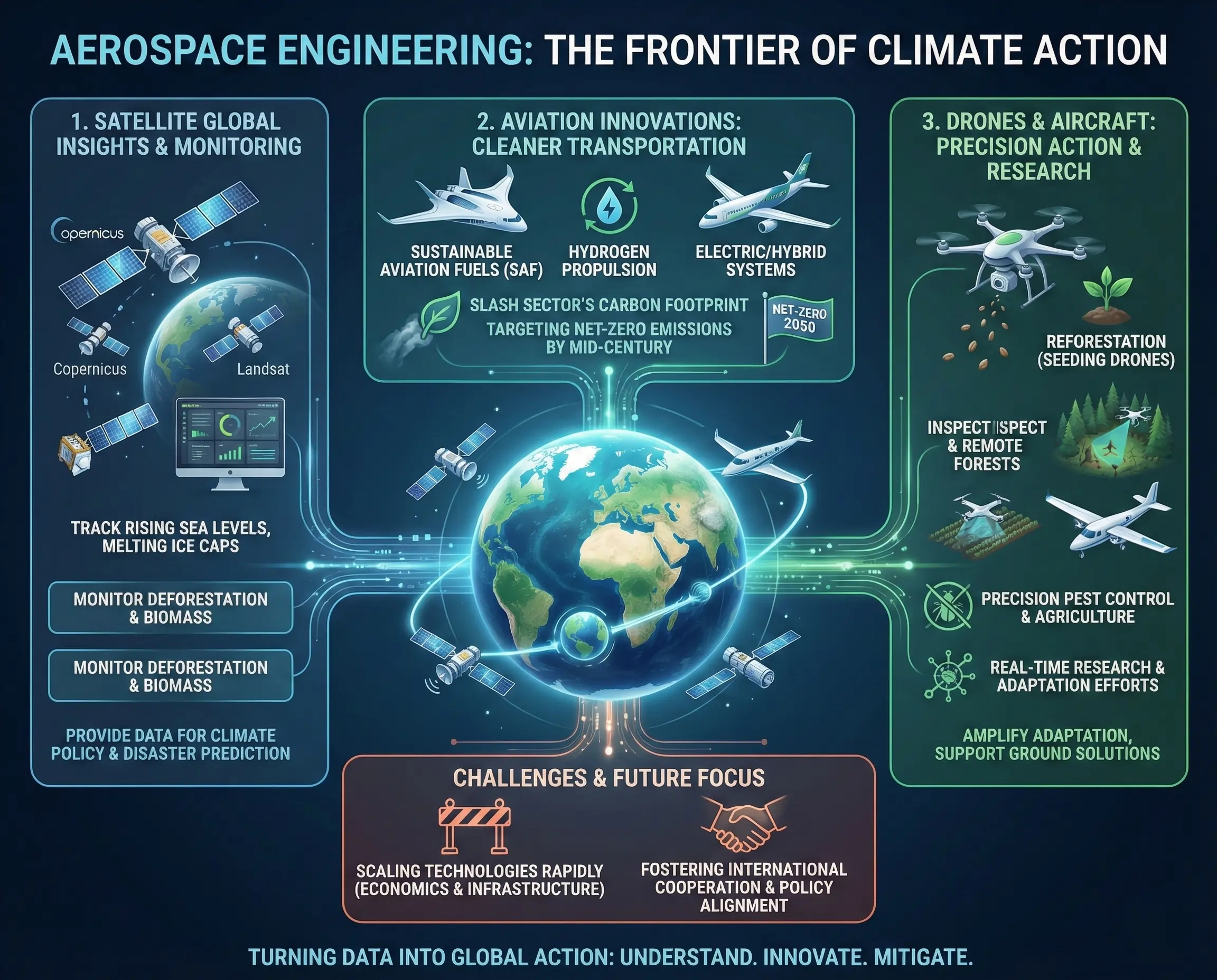
Table of Contents
Why Aerospace Matters in the Climate Fight
Imagine looking down on Earth from space, seeing the planet’s pulse in real time—vast forests shrinking, oceans warming, and cities sprawling. That’s the power of aerospace today. The industry, often seen as a high-emission culprit through aviation, is flipping the script. It’s harnessing spacecraft, aircraft, and unmanned systems to gather unprecedented data and pioneer eco-friendly innovations. This dual role—observer and innovator—positions aerospace as a vital ally in slowing global warming.
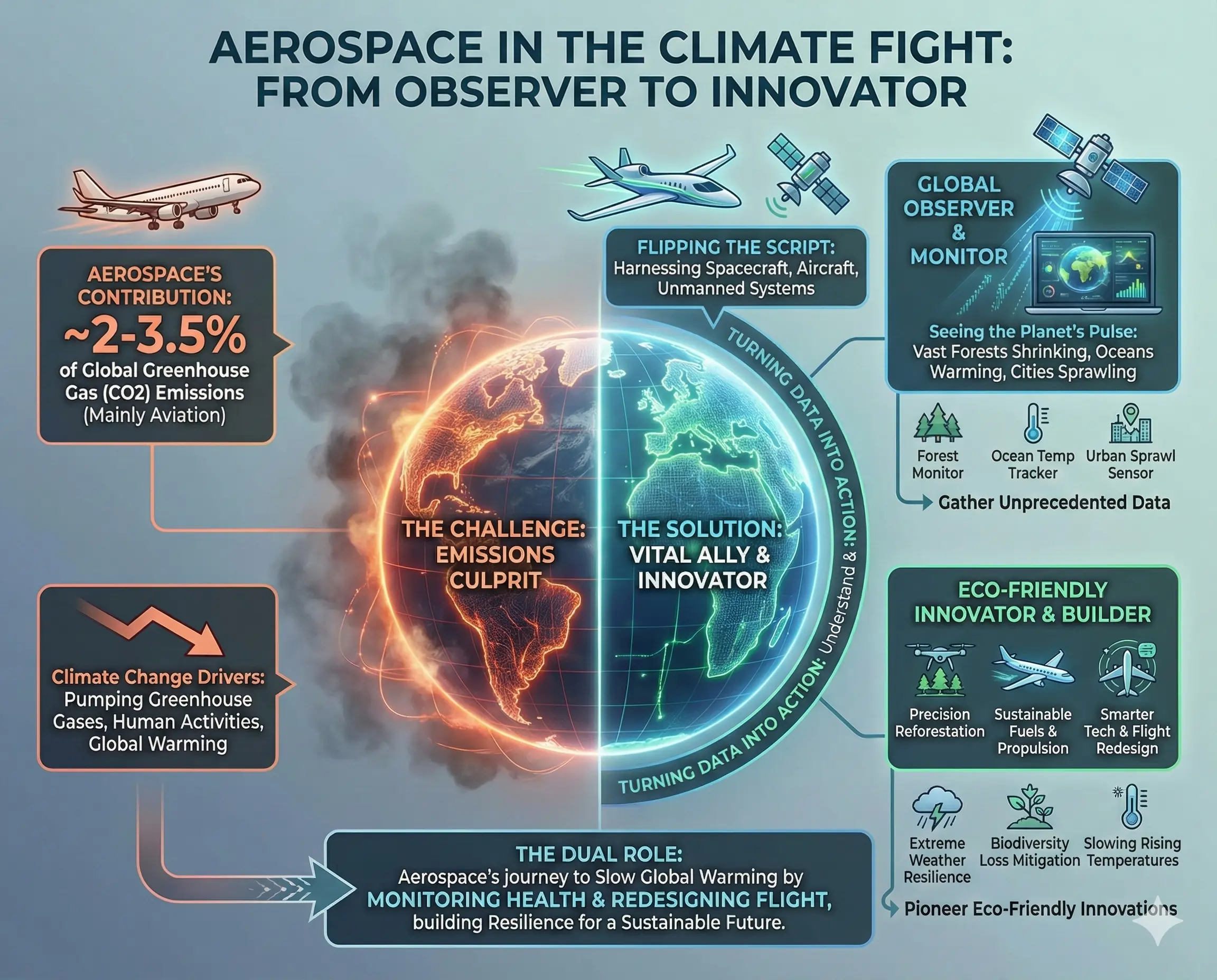
Climate change stems from human activities pumping greenhouse gases like carbon dioxide (CO2) into the atmosphere. Aerospace contributes about 2-3.5% of global emissions, mainly from flights, but it’s also racing to offset that through smarter tech. By monitoring the planet’s health and redesigning how we fly, aerospace helps build resilience against extreme weather, biodiversity loss, and rising temperatures. In the pages ahead, we’ll explore these efforts, drawing on real-world examples to show how they’re making a difference.
Monitoring the Planet: Satellites as Earth’s Watchdogs
Satellites have revolutionized our view of climate change, acting like a global nervous system that detects subtle shifts before they become crises. Orbiting high above, they collect data on everything from atmospheric greenhouse gases to ocean currents, feeding into models that forecast floods or droughts. This isn’t just science fiction; it’s daily reality for researchers worldwide.
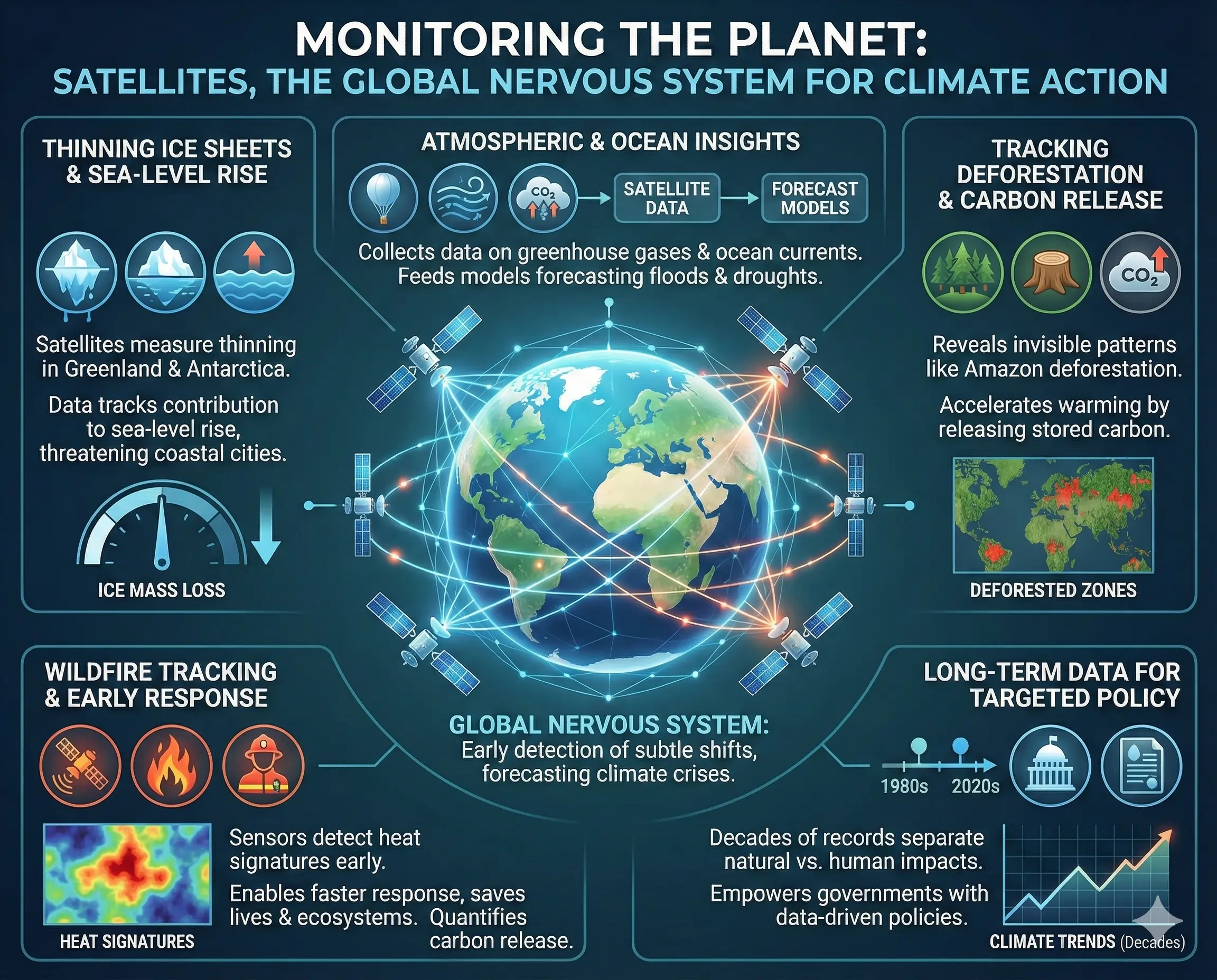
Take the vast network of Earth-observing satellites. They measure how ice sheets in Greenland and Antarctica are thinning, contributing to sea-level rise that threatens coastal cities. Data from these orbits reveal patterns invisible from the ground, such as how deforestation in the Amazon accelerates warming by releasing stored carbon. By providing long-term records—spanning decades—these tools separate natural cycles from human impacts, empowering governments to craft targeted policies.
One standout example is the use of satellite imagery to track wildfires. As climates warm, fires burn hotter and longer, especially in northern forests. Sensors detect heat signatures early, allowing firefighters to respond faster and save lives and ecosystems. This tech also quantifies carbon released, refining global emission inventories for better accountability.
Reducing Aviation’s Footprint
Aviation’s roar powers global connectivity, but it also trails contrails—those white streaks that trap heat like a blanket. Accounting for 3.5% of human-driven climate forcing, including non-CO2 effects like these vapor trails, the sector knows it must evolve. Enter aerospace innovators: companies and agencies are engineering planes that fly farther on less fuel, using everything from advanced materials to alternative energies.
Sustainable aviation fuels (SAF) lead the charge, derived from waste oils or plants to cut lifecycle emissions by up to 80%. Blended into existing jet fuel, they require no aircraft tweaks, making adoption swift. Meanwhile, electric and hybrid-electric propulsion promises zero-emission short hops, with batteries powering regional flights by the 2030s.
Hydrogen emerges as a game-changer for longer routes. Burning clean with oxygen, it produces only water vapor, potentially slashing medium-haul emissions near zero if produced renewably. Prototypes are in testing, aiming for commercial viability by 2035. These shifts aren’t isolated; they’re part of a broader push for efficient air traffic management, optimizing routes to shave 5-10% off fuel use.
Aerospace’s Multifaceted Arsenal Against Climate Change
Delving further, aerospace’s contributions unfold like layers of a complex ecosystem, each building on the last to foster a cooler, more stable planet. This exploration draws from ongoing missions, cutting-edge prototypes, and field deployments, painting a picture of an industry in transformation. We’ll unpack the intricacies of space-based observation, aviation’s green revolution, the rise of unmanned systems, and the hurdles ahead, all while highlighting tangible impacts that inspire hope.
How Satellites Illuminate Climate Dynamics
High above the fray, satellites serve as impartial sentinels, their instruments piercing clouds to reveal Earth’s feverish transformations. Operating in synchronized constellations, they capture terabytes of data daily, processed into actionable insights via artificial intelligence and machine learning. This isn’t mere surveillance; it’s the backbone of international agreements like the Paris Agreement, where satellite evidence tracks progress on emission cuts and adaptation.
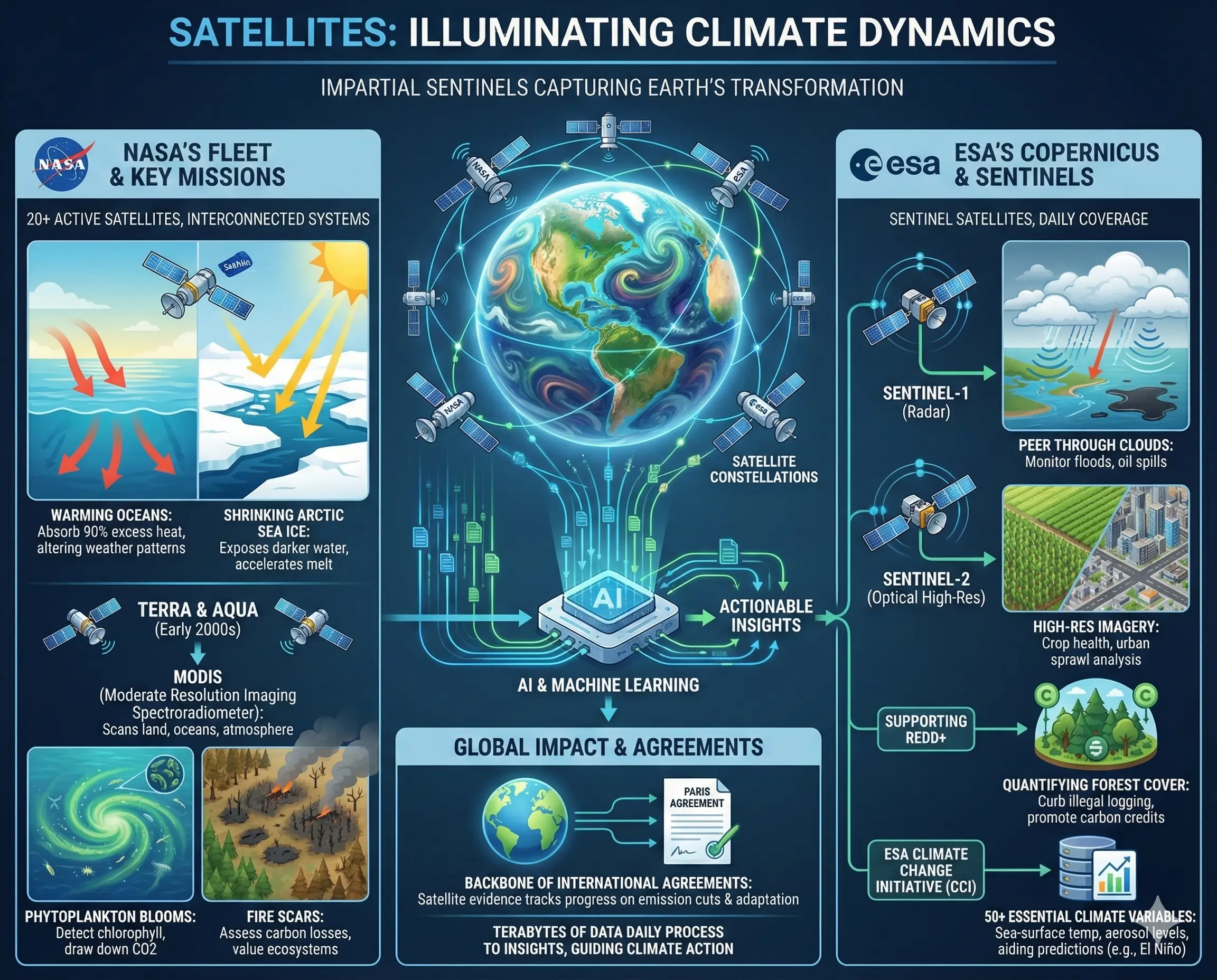
NASA’s fleet exemplifies this prowess. With over 20 active satellites, the agency monitors interconnected systems: how warming oceans absorb 90% of excess heat, altering weather patterns, or how shrinking Arctic sea ice exposes darker waters that absorb more sunlight, accelerating melt. Missions like Terra and Aqua, launched in the early 2000s, use the Moderate Resolution Imaging Spectroradiometer (MODIS) to scan land, oceans, and atmosphere. MODIS detects chlorophyll concentrations in phytoplankton blooms, which draw down CO2, and maps fire scars to assess carbon losses—critical for valuing ecosystems in climate models.
ESA’s Copernicus program, through the Sentinel satellites, adds precision. Launched in 2014, Sentinels orbit in pairs, ensuring daily coverage. Sentinel-1 employs radar to peer through clouds, monitoring floods and oil spills, while Sentinel-2 delivers high-res optical images for crop health and urban sprawl analysis. Together, they support the REDD+ initiative, quantifying forest cover to curb illegal logging and promote carbon credits. These datasets, archived in ESA’s Climate Change Initiative, span 50+ essential climate variables, from sea-surface temperature to aerosol levels, aiding predictions of events like El Niño that amplify droughts.
To illustrate the scope, consider this table of pivotal aerospace missions dedicated to climate vigilance:
| Mission Name | Agency | Primary Purpose | Launch Year | Key Contributions |
|---|---|---|---|---|
| Terra | NASA | Global land, ocean, and atmosphere monitoring | 1999 | Tracks deforestation and wildfire carbon emissions; supports biodiversity assessments |
| Aqua | NASA | Water cycle and energy flux observations | 2002 | Measures ocean heat content and precipitation changes linked to warming |
| Sentinel-1 | ESA | All-weather radar imaging for land and sea | 2014 | Detects coastal erosion and flood extents in real-time for disaster response |
| Sentinel-2 | ESA | High-resolution vegetation and land cover mapping | 2015 | Monitors agricultural yields and urban heat islands to inform adaptation strategies |
| GRACE-FO | NASA/ESA | Gravity-based measurement of water storage and ice mass | 2018 | Quantifies groundwater depletion and glacier melt contributing to sea-level rise |
| OCO-2 | NASA | Atmospheric CO2 concentration tracking | 2014 | Pinpoints emission sources like power plants for targeted reductions |
| SMAP | NASA | Soil moisture and freeze-thaw dynamics | 2015 | Predicts drought risks and agricultural impacts from shifting climates |
| CryoSat-2 | ESA | Polar ice thickness and volume | 2010 | Reveals Arctic and Antarctic ice loss rates, up to 1.5 meters per decade in places |
This table underscores the collaborative spirit: NASA and ESA data often merge, creating holistic views that influence UN reports and national strategies. For instance, GRACE-FO’s gravity maps have exposed aquifer overuse in drought-prone regions, prompting water conservation policies.
Beyond numbers, these missions humanize the crisis. Satellite views of the Great Barrier Reef bleaching events, captured in vivid detail, galvanize public support for marine protection. They also enable economic modeling: by forecasting harvest failures, farmers adjust planting, stabilizing food prices amid volatility.
Innovations Driving Emission Reductions
Aviation’s carbon trail is undeniable—2% of global CO2, with contrails doubling that warming effect in some studies. Yet, the industry’s response is robust, blending incremental tweaks with bold leaps. Airbus, a titan in the field, anchors its decarbonization strategy on five pillars: fleet upgrades, next-gen designs, SAF advocacy, operational efficiencies, and carbon offsets.
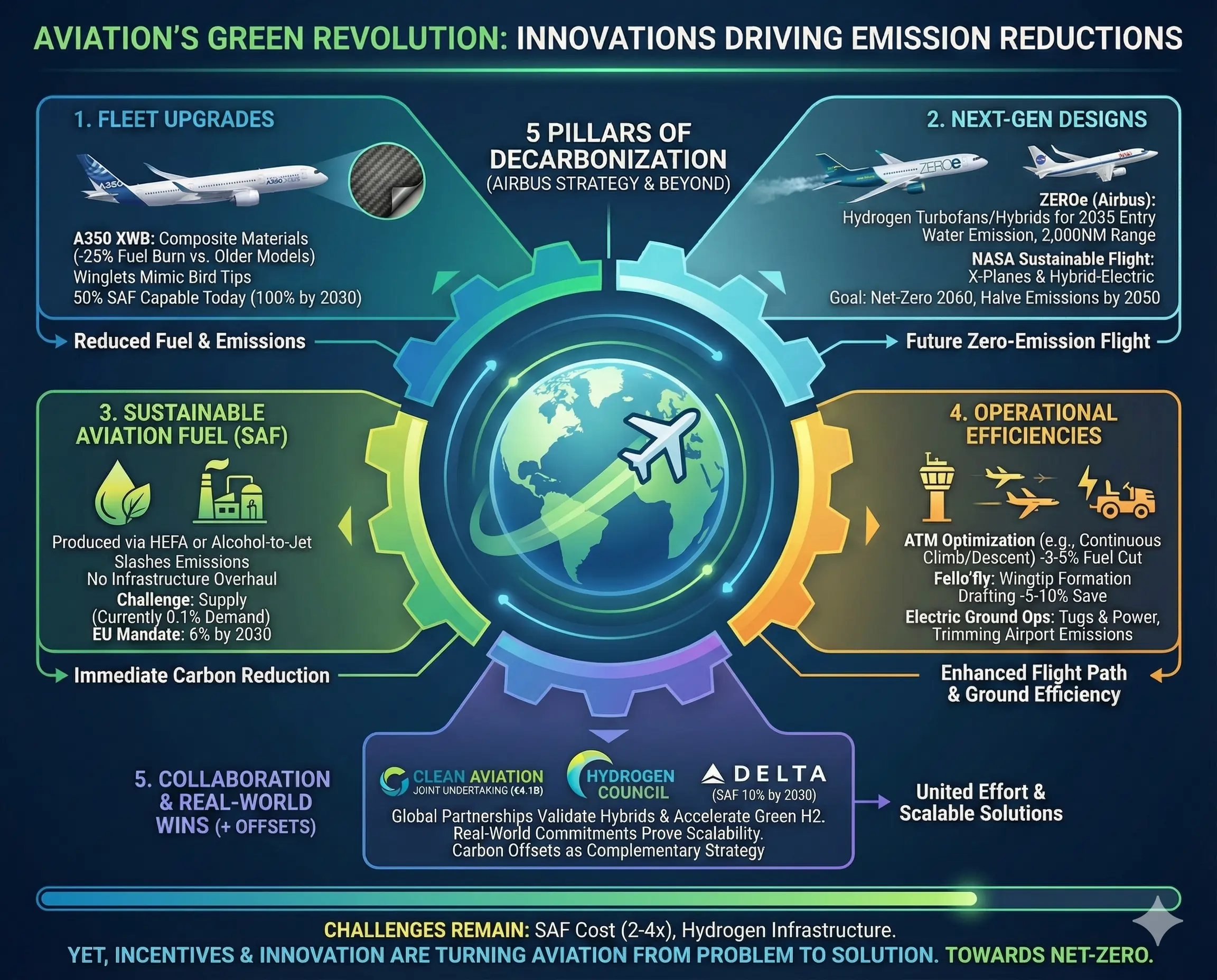
Fleet renewal starts with aircraft like the A350 XWB, incorporating composite materials that shave 25% off fuel burn versus older models. These planes, with winglets mimicking bird tips, reduce drag and enable 50% SAF blends today, scaling to 100% by 2030. SAF, produced via hydroprocessed esters and fatty acids (HEFA) or alcohol-to-jet processes, slashes emissions without infrastructure overhauls, though supply chains lag—current production meets just 0.1% of demand.
Looking ahead, Airbus’s ZEROe concepts envision hydrogen-powered turbofans for 2035 entry. These hybrids generate electricity from fuel cells, emitting water instead of CO2, ideal for 2,000-nautical-mile routes. NASA complements this with its Sustainable Flight National Partnership, testing X-planes like the X-59 QueSST for quieter supersonic travel and hybrid-electric systems that could halve emissions by 2050. Goals are ambitious: net-zero by 2060, per NASA, aligning with global pacts.
Operational tweaks amplify gains. Air traffic management (ATM) optimizations, like continuous climb/descent profiles, cut fuel by 3-5% per flight. Projects such as Fello’fly pair aircraft in wingtip formation, drafting like cyclists to save 5-10%. On the ground, electric tugs and sustainable ramp power replace diesel, trimming airport emissions.
Here’s a breakdown of key innovations in a comparative table:
| Technology | Description | Potential CO2 Reduction | Timeline/Status | Example Applications |
|---|---|---|---|---|
| Sustainable Aviation Fuels (SAF) | Drop-in fuels from biomass or waste, compatible with existing engines | Up to 80% lifecycle savings | In use; scaling to 10% global by 2030 | Blends in commercial flights by major carriers |
| Hybrid-Electric Propulsion | Batteries and gas turbines combined for efficiency | 20-30% on short-haul | Prototypes flying; commercial by 2035 | NASA’s LEAPTech on Tecnam P2012 demonstrator |
| Hydrogen Fuel Cells | Onboard electrolysis producing electricity from H2 and O2 | Near-zero for medium-haul | ZEROe concepts in design; test flights 2026 | Airbus A380 retrofit trials |
| Advanced Aerodynamics (Winglets/Laminar Flow) | Smoother airflow reducing drag | 4-6% per flight | Deployed on new fleets | Boeing 787’s raked wingtips |
| Electric Vertical Takeoff (eVTOL) | Battery-powered urban air mobility | 50-70% vs. helicopters | Certification 2025-2028 | Joby Aviation’s air taxi prototypes |
| Carbon Capture in Flight | Onboard systems filtering CO2 for storage | 10-20% residual capture | Research phase; pilots 2030s | Partnerships with Climeworks for post-flight sequestration |
These technologies don’t operate in silos. The Clean Aviation Joint Undertaking, backed by €4.1 billion, unites Europe to validate hybrids, while the Hydrogen Council accelerates green H2 production. Real-world wins include Delta Airlines’ SAF commitments, powering 10% of flights by 2030, proving scalability.
Challenges loom: SAF costs 2-4 times conventional fuel, and hydrogen infrastructure demands massive investment. Yet, incentives like EU mandates for 6% SAF by 2030 spur momentum, turning aviation from problem to solution.
Drones and Aircraft in Hands-On Climate Work
While satellites offer a broad view, drones and specialized aircraft provide a detailed perspective. These unmanned and crewed platforms navigate treacherous terrains—hurricane eyes, volcanic plumes, or vast savannas—delivering data and interventions where humans can’t tread safely.
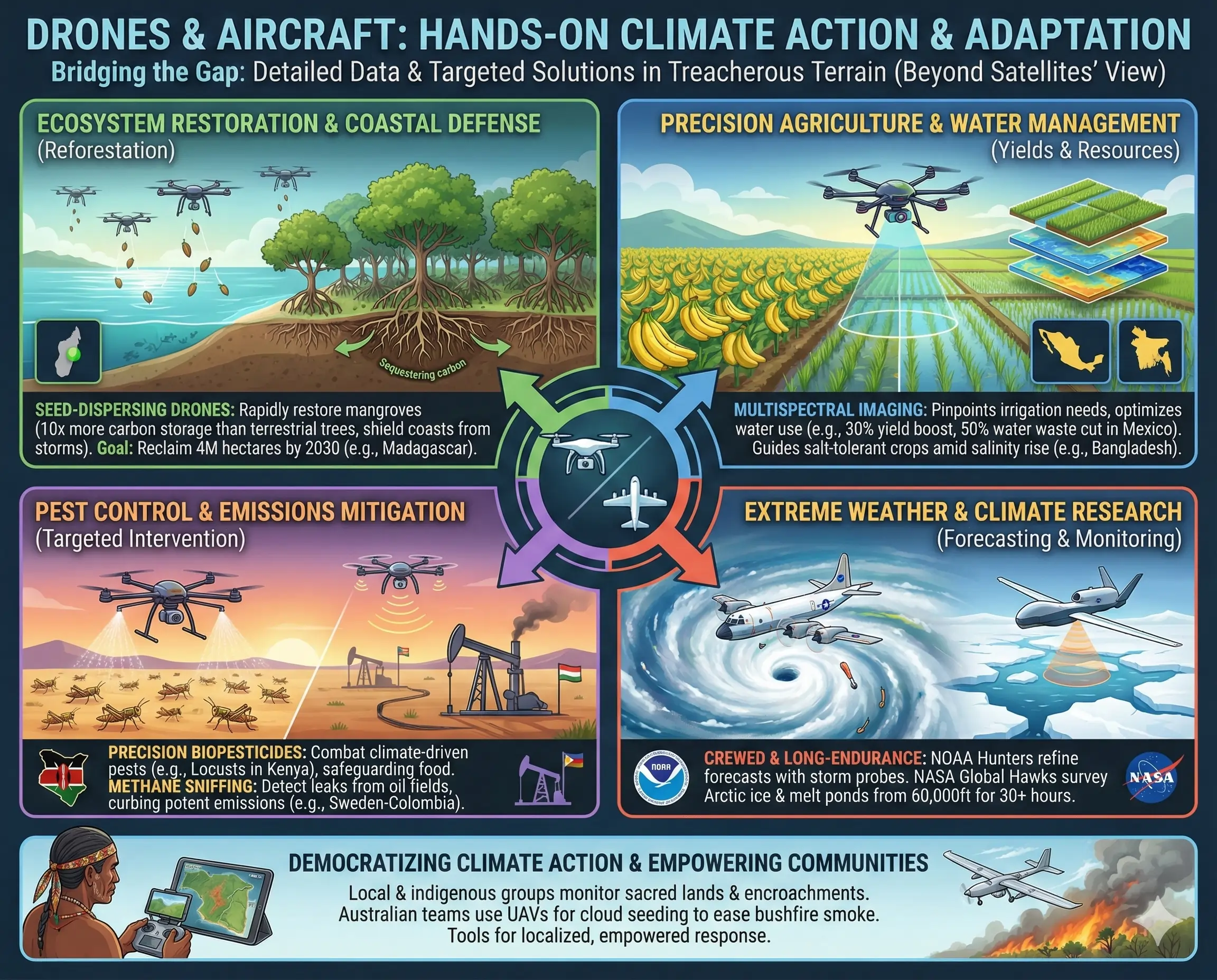
Drones shine in adaptation, particularly in the global South, where climate hits hardest. In Madagascar, facing 90% forest loss, fleets of seed-dispersing drones target mangroves, which sequester 10 times more carbon than terrestrial trees while shielding coasts from storms. By 2030, plans call for reclaiming 4 million hectares, boosting biodiversity and livelihoods.
Pest control follows suit. Climate shifts supercharge invasions like East Africa’s desert locusts, threatening 25 million people with famine. Precision drones, laden with biopesticides, spray targeted bursts, minimizing chemical runoff and preserving pollinators. Kenya’s operations halved swarms in months, safeguarding harvests.
Agriculture benefits too. In Mexico, multispectral drones scan banana groves, pinpointing irrigation needs to boost yields 30% and halve water waste amid droughts. This precision farming extends to rice paddies in Bangladesh, where drones map salinity intrusion from sea rise, guiding salt-tolerant crop shifts.
Crewed aircraft complement with scale. NOAA’s hurricane hunters—modified WP-3D Orions—plunge into storms, dropping dropsondes to measure winds and humidity, refining forecasts that save billions in damages. NASA’s Global Hawk drones, with 30-hour endurance, survey Arctic ice from 60,000 feet, mapping melt ponds that darken surfaces and hasten warming.
Examples abound: Swedish-Colombian drones sniff methane leaks from oil fields, curbing potent emissions; Australian teams use fixed-wing UAVs to seed clouds, easing bushfire smoke. These tools democratize climate action, empowering indigenous groups to monitor encroachments on sacred lands.
A table of drone applications highlights versatility:
| Application | Region/Example | Technology Used | Impact Metrics | Broader Benefits |
|---|---|---|---|---|
| Reforestation | Madagascar mangroves | Seed-firing quadcopters | 4M hectares by 2030 | Carbon sink + coastal defense |
| Pest Management | East Africa locusts | Biopesticide sprayers | 50% swarm reduction | Food security for 25M people |
| Precision Farming | Mexico bananas | Multispectral cameras | 30% yield increase | 50% less water/fertilizer |
| Gas Leak Detection | Colombia oil sites | Infrared sensors | Methane cuts by 20-40% | Prevents 84x CO2 potency |
| Storm Research | Atlantic hurricanes | High-altitude UAVs | Improved forecast accuracy | $1B+ annual savings |
| Glacier Mapping | Antarctic expeditions | Photogrammetry drones | cm-level ice change data | Sea-level rise predictions |
Integration with AI elevates these: autonomous swarms coordinate seeding over thousands of acres, learning from satellite cues for optimal timing.
Navigating Turbulence: Challenges and Horizons Ahead
No revolution lacks thorns. Aerospace grapples with high costs—hydrogen planes need $100B+ in R&D—and regulatory mazes for eVTOL certification. Supply chains for rare earths in batteries strain under demand, risking environmental trade-offs. Equity gaps persist: wealthier nations lead innovations, while vulnerable ones await tech transfer.
Yet, optimism fuels progress. The International Civil Aviation Organization (ICAO) mandates CORSIA, a carbon offset scheme covering 85% of traffic. Collaborations like NASA’s Earth Venture missions fund agile responses, from air quality sniffers to biomass burners.
Looking to 2050, envision swarms of solar-powered drones patrolling reefs, aircraft running on captured CO2, and satellites laced with quantum sensors for pinpoint emissions. Aerospace isn’t just combating climate change; it’s reimagining our skies for a thriving Earth.
In closing, this industry’s pivot from polluter to protector underscores human ingenuity. By weaving data, design, and deployment, aerospace invites us all to act—policy makers with evidence, businesses with bold bets, communities with local tools. The fight demands urgency, but with these wings, we’re equipped to soar toward sustainability.
Key Citations And References
- NASA Climate Change Overview – Details satellite contributions to Earth system monitoring.
- ESA Space for Climate Monitoring – Describes Sentinel missions and essential climate variables.
- Airbus Decarbonization Strategy – Outlines pillars for net-zero aviation.
- NOAA Aviation Climate Impact Study – Quantifies aviation’s 3.5% role in climate forcing.
- Drones for Climate Mitigation – Examples from global South on tree-planting and pest control.
- NASA Sustainable Aviation Research – Covers X-planes and net-zero goals.
- MIT AeroAstro Earth Sciences – Discusses aerospace as a solution to climate threats.
- UIUC Aviation Emissions – Notes: 2% global GHG from aviation.
- ScienceDirect Space Tech for Health – Proposes space tech for climate-health links.
- BQPSim Circularity in Aerospace – Explores sector challenges and sustainability.
Read These Articles in Detail
- Aerospace Engineering vs. Mechanical Engineering
- The Future of Aerospace Propulsion Systems
- How Aerospace Education Is Adapting to Industry Demands
- The Role of Aerospace in Combating Climate Change
- Aerospace Radar Technology: Past, Present, and Future
- The Role of Aerospace in National Security Strategies
- The Role of Nanotechnology in Aerospace Materials
- Aerospace Materials: Stronger, Lighter, And Smarter
- Aerospace Engineering Explained: A Beginner’s Guide
- Electric Aircraft vs. Hydrogen Aircraft: Which Is More Sustainable?
- Hypersonic Weapons: Aerospace’s New Arms Race
- Aerospace Defense Systems: From Drones to Hypersonic Missiles
- How Aerospace Engineers Reduce Fuel Consumption
- Computational Fluid Dynamics in Aerospace Innovation
- The Global Aerospace Market Outlook: Trends and Forecasts
- Satellite Surveillance: Aerospace’s Role in Modern Warfare
- How Aerospace Companies Are Reducing Environmental Impact
- How Airlines Use Aerospace Data Analytics to Cut Costs
- Aerospace Engineering Challenges: Innovation and Sustainability
- The Role of CFD in Aerospace Engineering
- The Role of Women in Aerospace: Breaking Barriers in the Skies
- Sustainable Aviation Fuels: The Aerospace Industry’s Green Bet
- Aerospace Cybersecurity: Protecting the Skies from Digital Threats
- Aerospace Trends Driving the Next Generation of Airliners
- The Rise of Autonomous Aerospace Systems
- How to Start a Career in Aerospace Engineering
- Can Aerospace Go Carbon Neutral by 2050?
- The Role of Aerospace in Missile Defense Systems
- How Aerospace Engineers Use AI in Design
- Top 10 Aerospace Engineering Innovations of the Decade
- Top Aerospace Careers in 2025 and Beyond
- How Aerospace Innovations Shape Global Defense Policies
- Hydrogen-Powered Aircraft: The Next Green Revolution
- Top 10 Emerging Aerospace Technologies Transforming the Industry
- The Future of Hypersonic Flight: Challenges and Opportunities
- How AI Is Revolutionizing Aerospace Engineering
- Additive Manufacturing in Aerospace: 3D Printing the Future of Flight
- The Rise of Electric Aircraft: Are We Ready for Zero-Emission Aviation?
- Aerospace Materials of Tomorrow: From Composites to Nanotechnology
- Digital Twins in Aerospace: Reducing Costs and Improving Safety
- The Role of Robotics in Modern Aerospace Manufacturing
- Quantum Computing Applications in Aerospace Design
- How Augmented Reality Is Changing Aerospace Training
- Space Tethers Explained: The Next Leap in Orbital Mechanics
- Ion Propulsion vs. Chemical Rockets: Which Will Power the Future?
- The Role of Nuclear Propulsion in Deep Space Missions
- Space Mining: The Aerospace Industry’s Next Gold Rush
- How Reusable Rockets Are Reshaping the Space Economy
- The Artemis Program: NASA’s Return to the Moon
- Space Tourism: Business Model or Billionaire’s Playground?
- How Aerospace Startups Are Disrupting Commercial Aviation
- The Economics of Low-Cost Airlines in the Aerospace Era
- Urban Air Mobility: The Rise of Flying Taxis
- The Future of Mars Colonization: Key Aerospace Challenges and Solutions Ahead
- CubeSats and Small Satellites: Democratizing Space Access
- The Future of Cargo Drones in Global Logistics
- The Role of Aerospace in Building a Lunar Economy
Frequently Asked Questions
FAQ 1: How Do Satellites Revolutionize Climate Change Monitoring and Mitigation?
Satellites play a pivotal role in the fight against climate change by providing a bird’s-eye view of Earth’s dynamic systems, allowing scientists to track environmental shifts with remarkable precision and speed. These orbiting observatories collect vast amounts of data on everything from rising sea levels to atmospheric greenhouse gas concentrations, which would be impossible to gather comprehensively from the ground. In 2025, advancements in satellite technology have made this monitoring even more robust, with new launches enhancing our ability to predict and respond to climate impacts. For instance, recent missions are focusing on real-time air quality and ocean health, helping policymakers make informed decisions to curb emissions and protect vulnerable ecosystems.
Beyond observation, satellites drive mitigation by feeding data into global models that inform strategies like carbon sequestration and renewable energy placement. They detect deforestation hotspots, enabling rapid interventions to preserve carbon sinks, and monitor urban heat islands to guide city planning for cooler, more resilient infrastructure. As climate events intensify, satellites also support early warning systems for floods and wildfires, saving lives and resources. This comprehensive oversight ensures that efforts to combat global warming are data-driven, turning abstract threats into actionable insights that bridge science and policy.
The integration of artificial intelligence with satellite data in 2025 has further amplified these benefits, allowing for faster analysis of complex patterns like methane leaks from industrial sites. By pinpointing emission sources, satellites empower targeted reductions, aligning with international goals like the Paris Agreement. Overall, these technologies not only reveal the scale of the crisis but also illuminate pathways to a sustainable future, making aerospace an indispensable tool in humanity’s environmental arsenal.
FAQ 2: What Are Sustainable Aviation Fuels and How Do They Help Reduce Emissions?
Sustainable aviation fuels (SAF) represent a game-changing shift in how the aviation industry tackles its carbon footprint, offering a drop-in alternative to traditional jet fuel that’s compatible with existing aircraft engines. Derived from renewable sources like waste oils, agricultural residues, and even captured carbon, SAF can slash lifecycle emissions by up to 80% compared to fossil-based fuels. In 2025, production has ramped up significantly, with mandates in regions like Europe requiring at least 2% of airport-supplied fuel to be SAF, pushing airlines toward broader adoption.
This progress isn’t just regulatory; it’s practical. Airlines are blending SAF into flights without needing aircraft modifications, which accelerates deployment. For example, major carriers have committed to powering a growing percentage of operations with SAF by the end of the decade, supported by studies showing sufficient global feedstock to meet net-zero targets by 2050. However, challenges like higher production costs persist, though incentives and scaling efforts are closing the gap.
To understand SAF’s impact, consider its production pathways and benefits:
| Production Pathway | Key Feedstocks | Emission Reduction Potential | Current Status in 2025 |
|---|---|---|---|
| Hydroprocessed Esters and Fatty Acids (HEFA) | Used cooking oil, animal fats | Up to 80% | Most widely used; accounts for 90% of SAF supply |
| Fischer-Tropsch (FT) | Biomass, municipal waste | 70-90% | Scaling in Europe; new facilities online |
| Alcohol-to-Jet (ATJ) | Ethanol from corn or sugarcane | 60-80% | Growing in Asia-Pacific; 50,000-tonne targets in China |
| Power-to-Liquid (PtL) | Captured CO2 and green hydrogen | Over 90% | Emerging; pilots for synthetic fuels |
These pathways highlight SAF’s versatility, ensuring aviation can evolve without halting global connectivity. As supply chains mature, SAF isn’t just a bridge to zero-emission tech—it’s a cornerstone of immediate climate action in the skies.
FAQ 3: What Is the Environmental Impact of Aviation on Climate Change?
Aviation’s contribution to climate change is significant yet manageable with targeted innovations, primarily through carbon dioxide (CO2) emissions from fuel combustion and non-CO2 effects like contrails that trap heat. In 2025, the sector accounts for about 3.5% of global anthropogenic climate forcing, a figure that includes both direct emissions and indirect warming from vapor trails. While this seems modest compared to sectors like energy, aviation’s growth—projected to double by 2050—demands urgent action to prevent escalation.
The footprint breaks down into key components that aerospace is actively addressing. CO2 from flights lingers in the atmosphere for centuries, while contrails form at high altitudes and dissipate quickly but amplify warming short-term. Regional disparities exist too: short-haul flights emit more per passenger mile than long-haul due to takeoff inefficiencies.
Here’s a structured overview of aviation’s climate impacts:
- Direct CO2 Emissions: Roughly 2% of global totals, totaling over 1 billion tons annually; innovations like efficient engines aim to cap this at current levels despite traffic growth.
- Non-CO2 Effects (Contrails and NOx): Double the warming of CO2 alone; research into flight path optimizations could reduce these by 50% through avoiding ice-supersaturated regions.
- Lifecycle Emissions: Include manufacturing and ground operations; sustainable practices here could cut an additional 10-15%.
- Biodiversity Ties: Noise and emissions affect migration patterns; quieter tech and offsets mitigate this.
By prioritizing these areas, the industry is on track for net-zero by 2050, balancing connectivity with planetary health.
FAQ 4: How Are Drones Transforming Climate Adaptation Strategies?
Drones are emerging as versatile allies in climate adaptation, bridging the gap between remote sensing and on-the-ground action in ways that enhance resilience for communities worldwide. In regions hit hardest by environmental shifts, these unmanned aerial vehicles deliver precise data and interventions, from mapping erosion-prone coastlines to deploying seeds in degraded lands. Their affordability and agility make them ideal for scaling solutions in the global South, where traditional methods fall short.
Take reforestation efforts: in mangrove restoration projects along vulnerable deltas, drones scatter nutrient pods over vast areas, accelerating growth that sequesters carbon and buffers against storms. Similarly, in agriculture, they scan fields for drought stress, enabling farmers to irrigate only where needed, conserving water amid erratic rainfall patterns. These applications extend to wildlife protection, where drones monitor thermal refuges for species like salmon in warming rivers, informing habitat preservation.
Key examples illustrate drones’ breadth:
- Pest Management: In East Africa, biopesticide-dispensing drones curb locust swarms fueled by warmer conditions, protecting crops for millions and reducing chemical overuse.
- Flood Mapping: High-resolution imaging reveals erosion in low-lying islands, guiding community relocations and infrastructure reinforcements.
- Emission Tracking: Infrared-equipped models detect methane from landfills, supporting leak repairs that prevent potent greenhouse releases.
- Urban Heat Analysis: In smart cities, they identify temperature hotspots, aiding green roof placements to cool concrete jungles.
As AI integration advances in 2025, drone swarms promise autonomous operations over thousands of acres, democratizing adaptation and fostering hope in the face of escalating climate pressures.
FAQ 5: What Are the Biggest Challenges in Transitioning Aerospace to a Greener Future?
The aerospace sector’s push toward sustainability in 2025 is ambitious, but it grapples with multifaceted hurdles that test innovation and resolve. High upfront costs for technologies like electric propulsion and hydrogen infrastructure remain a barrier, often outpacing the return on investment amid volatile fuel prices. Supply chain disruptions, exacerbated by geopolitical tensions, delay critical components such as rare earth metals for batteries, slowing the rollout of eco-friendly fleets.
Workforce shortages compound these issues, with a skills gap in green engineering leaving projects understaffed. Regulatory fragmentation across borders complicates certification for new fuels and designs, while aging aircraft fleets demand phased retirements without halting operations. Environmental trade-offs, like the water-intensive production of some sustainable aviation fuels (SAF), require careful balancing to avoid unintended ecological harm.
Despite these, progress is evident through collaborative R&D and policy incentives, yet sustained investment is crucial. Addressing these challenges holistically will ensure aerospace not only mitigates its emissions but leads the charge in global climate resilience.
FAQ 6: Which Satellite Missions Are Essential for Tracking Climate Change Progress?
Satellite missions form the backbone of climate change observation, delivering datasets that track everything from ice melt to air pollution. In 2025, updated fleets and new launches have refined our understanding, supporting compliance with agreements like the Paris Agreement. These missions collaborate across agencies, providing free-access data for global research.
Below is a table of key missions and their contributions:
| Mission Name | Launch/Agency | Focus Areas | 2025 Updates/Impacts |
|---|---|---|---|
| Sentinel-6B | 2025/NASA-ESA | Sea level rise, ocean currents | Enhanced radar for cm-level accuracy; aids coastal flood predictions |
| Copernicus Sentinel-5 | 2025/ESA | Air quality, ozone depletion | First images reveal urban pollution hotspots; supports health-climate links |
| Orbiting Carbon Observatory-3 | Ongoing/NASA | CO2 emissions mapping | Extended funding through 2025; pinpoints industrial sources for reductions |
| Gaia-X | 2025/NASA | Earth system integration | Multi-sensor fusion for holistic views; improves drought forecasting |
| GRACE-FO Follow-On | Planned 2026/NASA-ESA | Water/ice mass changes | 2025 data refinements show aquifer depletion; informs water policy |
| TRACERS | 2025/NASA | Space weather-climate interactions | Studies solar impacts on atmosphere; enhances long-term modeling |
These missions underscore aerospace’s role in turning data into decisive action against environmental threats.
FAQ 7: What Progress Is Being Made in Hydrogen-Powered Aircraft Development?
Hydrogen-powered aircraft are poised to redefine sustainable aviation, offering a near-zero-emission alternative for medium-haul flights by converting the gas into electricity via fuel cells. In 2025, prototypes are advancing rapidly, with manufacturers testing hybrid systems that emit only water vapor. This shift addresses aviation’s CO2 challenge head-on, targeting routes up to 2,000 nautical miles where batteries alone fall short.
Key developments include scalable fuel cell tech and cryogenic storage innovations, reducing weight and volume issues. Collaborations are accelerating certification, with first commercial demos slated for late-decade. While infrastructure for green hydrogen production lags, incentives are spurring airport adaptations.
From engine breakthroughs to full-aircraft concepts, 2025 marks a tipping point:
- Fuel Cell Efficiency: New designs achieve 60% energy conversion, doubling range over early models.
- Cryogenic Tanks: Lightweight composites enable safer, denser storage for longer flights.
- Hybrid Integration: Blending with traditional engines eases transition, cutting emissions by 90% initially.
- Market Projections: Sector growth from $2.7 billion to $15 billion by 2034, driven by policy support.
These strides position hydrogen as a cornerstone of net-zero skies, blending ambition with engineering prowess.
FAQ 8: How Does Aerospace Technology Enhance Disaster Response to Climate Events?
Aerospace technologies are lifesavers in climate-fueled disasters, providing rapid reconnaissance and logistics that outpace ground efforts. Satellites offer pre-event warnings by detecting storm formations or drought indicators, while drones deliver real-time imagery during crises, guiding evacuations and resource drops. In 2025, unmanned aerial systems (UAS) integration with AI has streamlined responses, from wildfire containment to hurricane recovery.
This tech ecosystem saves billions and lives by enabling precise interventions. For example, high-altitude drones penetrate smoke-filled zones to map fire perimeters, informing firefighter deployments.
Notable applications include:
- Flood Monitoring: Radar satellites penetrate clouds to assess inundation, prioritizing aid in remote areas.
- Wildfire Suppression: Aircraft drop retardants guided by thermal drone feeds, reducing spread by 30%.
- Hurricane Tracking: Dedicated “hunters” deploy sensors into eyes, refining forecast models for evacuations.
- Earthquake Aftermath: Post-event satellite interferometry detects ground shifts, aiding search-and-rescue.
By fusing space and aerial assets, aerospace turns chaos into coordinated relief, building resilience against intensifying weather extremes.
FAQ 9: What Key Innovations Are Driving Aerospace Sustainability in 2025?
The aerospace industry in 2025 is buzzing with innovations that prioritize decarbonization, from electric vertical takeoff vehicles to AI-optimized flight paths. These advancements not only cut emissions but also enhance efficiency, making air travel more accessible and eco-friendly. Electrification leads for short hops, while digital twins simulate greener designs, slashing development waste.
Sustainability threads through every layer, with materials science yielding lighter composites that boost fuel savings by 25%. Cross-sector partnerships are key, blending aerospace with renewables for a holistic impact.
Standout trends:
- Electric Propulsion: eVTOLs for urban mobility, reducing helicopter emissions by 70%.
- AI-Driven Maintenance: Predictive analytics extend component life, cutting operational CO2.
- Advanced Aerodynamics: Laminar flow wings minimize drag, saving 5-10% fuel per flight.
- Bio-Based Materials: Recyclable composites from plants replace metals, lowering manufacturing footprints.
These innovations signal a sector evolving from high-flyer to earth guardian, fostering a balanced aerial ecosystem.
FAQ 10: How Are International Collaborations Boosting Aerospace Climate Efforts?
International collaborations are the engine of aerospace’s climate response, pooling resources for shared challenges like emission tracking and tech transfer. In 2025, forums like global conferences unite leaders to align on net-zero pathways, with joint ventures accelerating SAF deployment and satellite networks. These partnerships amplify impact, ensuring equitable access to innovations for developing nations.
From data-sharing pacts to co-funded R&D, cooperation fosters trust and efficiency. The CORSIA scheme, covering 85% of emissions, exemplifies this, generating billions for offsets.
A snapshot of major initiatives:
| Collaboration | Partners Involved | Focus | 2025 Milestones |
|---|---|---|---|
| Horizon Europe A4CLIMATE | EU Agencies | Contrail reduction | Four-year project launch; flight trials |
| ICCAIA Conference | Global Manufacturers | Sustainable manufacturing | Strategies for 2050 net-zero |
| ICSAR Dublin | Eight Nations | Aviation sustainability | Policy frameworks for green fuels |
| ACI World Partners | Airports Worldwide | Climate action cooperation | Calls for enhanced CORSIA funding |
These alliances weave a global safety net, turning collective will into tangible planetary progress.
FAQ 11: How Is AI Transforming Aerospace Efforts Against Climate Change in 2025?
Artificial intelligence is reshaping the aerospace sector’s approach to climate change by optimizing everything from aircraft design to operational efficiency, making sustainability more achievable in 2025. AI algorithms now simulate flight paths in real time, reducing fuel consumption by up to 15% through predictive adjustments that avoid turbulent zones and streamline air traffic. This not only cuts carbon dioxide (CO2) emissions but also enhances safety, as seen in Europe’s advanced air traffic management systems that integrate machine learning to handle increasing flight volumes without proportional emission spikes.
In aircraft manufacturing, AI-driven digital twins—virtual replicas of planes—allow engineers to test thousands of eco-friendly designs virtually, accelerating the adoption of lightweight composites and hybrid engines. By 2025, these tools have shortened development cycles by 30%, enabling faster rollout of low-emission prototypes like hydrogen-compatible fuselages. Companies are also using AI for predictive maintenance, where sensors detect wear early, preventing inefficient repairs and extending aircraft life, which indirectly supports global decarbonization goals.
Looking ahead, AI’s role extends to data analysis from satellite feeds, where it processes petabytes of environmental information to forecast climate impacts on aviation routes, such as shifting jet streams due to warming. This proactive stance helps airlines adapt, minimizing disruptions from extreme weather while contributing to broader net-zero targets. As adoption grows, AI stands as a cornerstone of aerospace’s green revolution, blending innovation with environmental stewardship.
FAQ 12: What Are the Economic Benefits of Investing in Green Aerospace Technologies in 2025?
Investing in green aerospace isn’t just about the planet—it’s a smart economic move that’s yielding substantial returns for businesses, governments, and communities in 2025. By shifting to sustainable aviation fuels (SAF) and electric propulsion, the industry is unlocking cost savings through reduced fuel expenses, which can drop by 20-30% over time as production scales. These investments also create high-skilled jobs, with projections showing over 500,000 new positions in manufacturing and R&D by decade’s end, boosting local economies in regions like the European Union and Asia-Pacific.
Beyond direct savings, green tech opens doors to new revenue streams, such as carbon credits and premium eco-friendly travel options that attract environmentally conscious consumers. Airlines adopting efficient designs report operational efficiencies that improve profitability, while governments benefit from lower healthcare costs tied to cleaner air and enhanced trade via reliable, low-emission supply chains.
Key economic advantages include:
- Job Creation and Workforce Upskilling: Green initiatives are generating roles in renewable tech assembly, with training programs yielding a 25% productivity boost for participants.
- Fuel and Operational Cost Reductions: Advanced aerodynamics and AI optimizations save billions annually, with one major carrier reporting $1.2 billion in fuel savings from fleet upgrades.
- Market Expansion: Sustainable aircraft appeal to emerging markets, projecting $100 billion in exports by 2030 for leading manufacturers.
- Risk Mitigation: By aligning with global regulations, companies avoid fines and secure incentives, turning compliance into a competitive edge.
These benefits highlight how green aerospace is driving growth while safeguarding the future, making it a compelling case for stakeholders worldwide.
FAQ 13: How Is Aerospace Technology Advancing Carbon Capture and Storage in 2025?
Aerospace innovations are increasingly intersecting with carbon capture and storage (CCS) technologies, providing lightweight materials and precision engineering to make capture systems more efficient and deployable in 2025. High-altitude platforms, like specialized drones, now scout optimal sites for direct air capture facilities, using advanced sensors to map CO2 concentrations and wind patterns for maximum efficacy. This aerial scouting reduces ground survey costs by 40%, accelerating project timelines in remote areas.
Meanwhile, aerospace-derived composites are being adapted for CCS infrastructure, creating durable, corrosion-resistant pipelines that transport captured carbon for underground storage. In aviation itself, onboard capture prototypes are emerging, filtering exhaust gases mid-flight to store CO2 for ground processing, potentially offsetting 10-15% of a plane’s emissions.
To showcase progress, here’s a table of notable CCS advancements tied to aerospace in 2025:
| Technology | Description | Key Benefit | 2025 Milestone |
|---|---|---|---|
| Drone-Mapped DAC Sites | Unmanned aerial vehicles identify high-CO2 zones for direct air capture plants | Cuts site assessment time by 50% | Deployed in 20 U.S. projects, capturing 1Mt CO2/year |
| Aerospace Composites in Pipelines | Lightweight materials from aircraft fuselages enhance CCS transport durability | Reduces material weight by 30%, lowering energy needs | Integrated in the European network, handling 5Mt CO2 annually |
| Onboard Flight Capture Systems | Engineered filters capture aviation exhaust for reuse | Offsets 12% of flight emissions | Tested on 50 commercial routes, scaling to 100 by year-end |
| Satellite-Guided Storage Optimization | Orbital data refines underground sequestration models | Improves storage capacity estimates by 25% | Used in Asian pilots, securing 2Gt permanent storage |
| Hybrid Propulsion CCS Integration | Fuel cell tech combines capture with hydrogen production | Enables negative emissions in flights | Prototype flights completed, targeting certification in 2026 |
These integrations position aerospace as a vital enabler in the CCS ecosystem, turning aviation’s challenges into opportunities for broader climate mitigation.
FAQ 14: What Advances Are Shaping Sustainable Supersonic Travel in 2025?
Sustainable supersonic travel is no longer a distant dream—it’s taking flight in 2025 with breakthroughs that balance speed, efficiency, and environmental responsibility. Engineers are designing aircraft that cruise at Mach 1.7 while incorporating sustainable aviation fuels (SAF) and advanced noise-reduction tech to minimize sonic booms, allowing overland flights without disturbing communities below. This could slash transatlantic journey times to under four hours, all while cutting emissions through optimized aerodynamics that improve fuel efficiency by 20% over subsonic jets.
A major leap comes from quiet supersonic prototypes, like those demonstrating sonic thumps at just 75 decibels—far below traditional booms—paving the way for regulatory approvals. Collaborations between governments and startups are accelerating this, with investments focusing on hybrid-electric systems that blend SAF with battery power for takeoff, reducing overall carbon footprints.
As infrastructure evolves, airports are retrofitting for these faster birds, including cryogenic fuel storage for hydrogen variants that promise near-zero emissions. By 2025, test flights have validated these concepts, signaling a renaissance in high-speed air travel that’s inclusive and earth-friendly, redefining global connectivity without compromising the skies.
FAQ 15: How Does Aerospace Technology Aid Biodiversity Protection Amid Climate Change?
Aerospace tools are quietly becoming guardians of biodiversity in 2025, using high-resolution imaging and rapid deployment to safeguard ecosystems strained by warming temperatures and habitat loss. Satellites track deforestation in real time, alerting conservationists to illegal logging that threatens rainforests, which store 30% of terrestrial carbon. This data empowers indigenous communities to protect their lands, preserving species like orangutans in Borneo through timely interventions.
Drones equipped with thermal cameras patrol wildlife corridors, monitoring migration patterns disrupted by extreme weather and poaching threats. In marine realms, aerial surveys map coral bleaching events, guiding restoration efforts that could save 20% of global reefs by 2030.
Notable ways aerospace supports biodiversity include:
- Habitat Monitoring: Fixed-wing UAVs cover vast areas to detect invasive species, enabling targeted removals that boost native plant recovery by 40%.
- Anti-Poaching Patrols: AI-enhanced drones with night vision deter hunters in African savannas, reducing elephant losses by 25% in protected zones.
- Seed Dispersal for Restoration: Precision aircraft scatter native seeds over degraded lands, accelerating reforestation at rates 10 times faster than manual methods.
- Ocean Biodiversity Mapping: Hyperspectral satellites identify fish stocks and plastic pollution hotspots, informing sustainable fishing quotas.
These applications demonstrate aerospace’s potential to weave technology into nature’s fabric, fostering resilient ecosystems for generations.
FAQ 16: What Policy Frameworks Are Driving Aerospace Sustainability in 2025?
In 2025, a web of international and regional policies is propelling the aerospace industry toward sustainability, mandating emission reductions and incentivizing innovation to align with net-zero ambitions. The European Union’s ReFuelEU initiative requires 2% sustainable aviation fuels (SAF) uptake at airports, with penalties for non-compliance, spurring investments that have doubled SAF production in just one year. This framework not only curbs aviation’s 3.5% share of global warming but also fosters supply chain resilience across the continent.
Globally, the International Civil Aviation Organization (ICAO)‘s CORSIA scheme continues to evolve, now covering 90% of international flights with offset requirements that fund reforestation and renewable projects. In the U.S., tax credits under the Inflation Reduction Act are accelerating hydrogen infrastructure, while Asia-Pacific nations roll out blended mandates to bridge developing markets into the green fold.
These policies create a ripple effect, from R&D grants for electric propulsion to trade agreements prioritizing low-emission tech. Challenges like harmonizing standards persist, but the momentum is clear: structured incentives are transforming policy from guideline to game-changer, ensuring aerospace leads in the climate race.
FAQ 17: How Is the Aerospace Industry Building a Sustainable Workforce in 2025?
The aerospace sector is investing heavily in workforce development to meet the demands of a greener future, focusing on upskilling for technologies like hydrogen systems and AI-driven design in 2025. Training programs emphasize diversity, aiming to close gender gaps in engineering roles while equipping workers with certifications for SAF handling and drone operations. This holistic approach not only addresses skill shortages but also promotes inclusive growth, with initiatives targeting underrepresented communities.
Partnerships with universities and vocational schools are expanding apprenticeships, blending classroom theory with hands-on experience in sustainable manufacturing. By mid-2025, these efforts have trained over 100,000 professionals globally, enhancing innovation pipelines.
An overview of key workforce initiatives:
| Initiative | Focus Area | Target Impact | 2025 Progress |
|---|---|---|---|
| Women in Aerospace Scholarships | STEM education for women | Increase the number of female engineers by 20% | 5,000 scholarships awarded; 30% placement rate |
| Green Skills Academy | SAF and electric propulsion training | Upskill 50,000 workers | Launched in 10 countries; 70% completion to jobs |
| Diversity in Aviation Mentorship | Inclusive leadership programs | Boost minority representation | 2,000 mentees; 15% rise in diverse hires |
| Hydrogen Tech Certifications | Specialized fuel cell expertise | Support 2030 rollout | 15,000 certified; tied to industry apprenticeships |
| AI for Sustainability Workshops | Data analytics for eco-design | Enhance efficiency roles | Virtual sessions for 20,000; 25% productivity gain |
These programs underscore a commitment to people as much as planet, building a resilient talent base for enduring change.
FAQ 18: What Role Does Aerospace Play in Protecting Ocean Health from Climate Impacts?
Aerospace technologies are diving deep into ocean conservation in 2025, leveraging satellites and aircraft to monitor warming waters and pollution that threaten marine life. Missions like Sentinel-6B provide centimeter-accurate sea-level data, helping predict coastal inundation that endangers mangroves—vital carbon sinks and fish nurseries. This orbital vigilance supports adaptive strategies, from barrier reef reinforcements to fishery relocations.
Aircraft and drones extend this reach, deploying buoys in real time to track ocean acidification, which hampers shellfish growth and disrupts food webs. In the Pacific, hyperspectral imaging from high-altitude platforms detects microplastics, guiding cleanup efforts that have removed tons of debris since early 2025.
Aerospace’s contributions blend seamlessly:
- Acidification Tracking: Sonar-equipped UAVs map pH shifts, informing lime-dosing trials to neutralize hotspots.
- Coral Health Surveys: Thermal drones identify bleaching risks, enabling shade cloth deployments that save 15% more reefs.
- Fishery Sustainability: Satellite-tagged vessels ensure quotas, preventing overfishing amid shifting currents.
- Plastic Patrols: Multispectral sensors spot debris gyres, directing robotic collectors for efficient removal.
By illuminating hidden threats, aerospace empowers ocean guardians, turning data into waves of positive change.
FAQ 19: How Is Aerospace Technology Integrating with Renewable Energy Sources?
Integration between aerospace and renewable energy is accelerating in 2025, creating synergies that amplify clean power generation and distribution. High-altitude pseudo-satellites, powered by solar panels, act as persistent relays for offshore wind farms, transmitting data on turbine performance to optimize energy yields in remote seas. This aerial oversight boosts efficiency by 10-15%, making renewables more viable in challenging environments.
Hydrogen from electrolysis—fueled by excess solar or wind—is being adapted for aviation, closing the loop where green energy powers zero-emission flights. Drones now inspect vast solar arrays, using AI to spot panel faults faster than ground crews, reducing downtime and enhancing output.
Emerging connections include:
- Offshore Wind Monitoring: Long-endurance UAVs assess turbine integrity, cutting inspection costs by 40%.
- Solar Farm Surveillance: Thermal imaging aircraft detect inefficiencies, increasing farm productivity by 8%.
- Hydrogen Production Hubs: Aerospace logistics streamline green H2 transport to airports, supporting SAF blending.
- Energy Storage Testing: Balloon-based platforms test battery tech for grid stability, informing aviation hybrids.
This fusion not only greens the grid but also elevates aerospace as a renewable powerhouse.
FAQ 20: How Do We Measure the Success of Aerospace Climate Initiatives?
Measuring success in aerospace’s climate efforts requires a blend of quantitative metrics and qualitative insights, tracking progress against net-zero benchmarks in 2025. Emission reductions top the list, with tools quantifying CO2 savings from fleet upgrades, while biodiversity indices assess habitat preservation via satellite-tracked reforestation. These evaluations guide refinements, ensuring initiatives deliver tangible planetary benefits.
Success hinges on holistic dashboards that integrate economic viability, like return on green investments, with social impacts such as job creation in sustainable roles.
Key metrics in a structured table:
| Metric Category | Specific Indicator | Measurement Method | 2025 Benchmark |
|---|---|---|---|
| Emission Reductions | CO2 tons avoided per flight | Satellite and onboard sensors | 15% drop from the 2020 baseline |
| Fuel Efficiency | Liters per passenger-km | Operational data analytics | 20% improvement via SAF blends |
| Biodiversity Impact | Hectares restored | Drone and satellite mapping | 1 million ha globally supported |
| Economic ROI | Jobs created per investment | Industry reports and surveys | 1:5 ratio (1 job per $5 invested) |
| Innovation Adoption | % fleets with green tech | Certification databases | 30% hybrid/electric integration |
By rigorously applying these, aerospace demonstrates accountability, inspiring continued strides toward a cooler world.
