

Key Strategies for Reducing Fuel Consumption in Aerospace Engineering
Aerospace engineers tackle fuel consumption through a mix of smarter designs, lighter materials, and cutting-edge engines, leading to aircraft that burn up to 30% less fuel than older models. Research suggests that innovations like winglets and carbon composites could slash emissions by over 50% in the coming decades, though challenges like high development costs remain. It seems likely that hybrid propulsion will dominate short-haul flights soon, while sustainable fuels bridge the gap for long-haul routes.
- Aerodynamic Tweaks: Engineers streamline aircraft shapes to cut drag, such as adding winglets that reduce vortex drag by 5-7%. Examples include the Boeing 787 Dreamliner, which uses blended wings for smoother airflow.
- Lighter Builds: Swapping heavy metals for carbon fiber composites drops weight by 20%, boosting efficiency. The Airbus A350 incorporates these for a 25% fuel savings over predecessors.
- Smarter Engines: Geared turbofan engines improve thrust by 16%, as seen in the Pratt & Whitney PW1000G series. Hybrid-electric systems promise even more, potentially halving fuel use on regional jets.
- Operational Wins: Adjusting the center of gravity and using AI for flight paths can trim 2-5% off burn rates, with green taxiing avoiding engine idling.
These approaches, drawn from ongoing industry advancements, highlight a balanced push toward sustainability without compromising safety or speed.
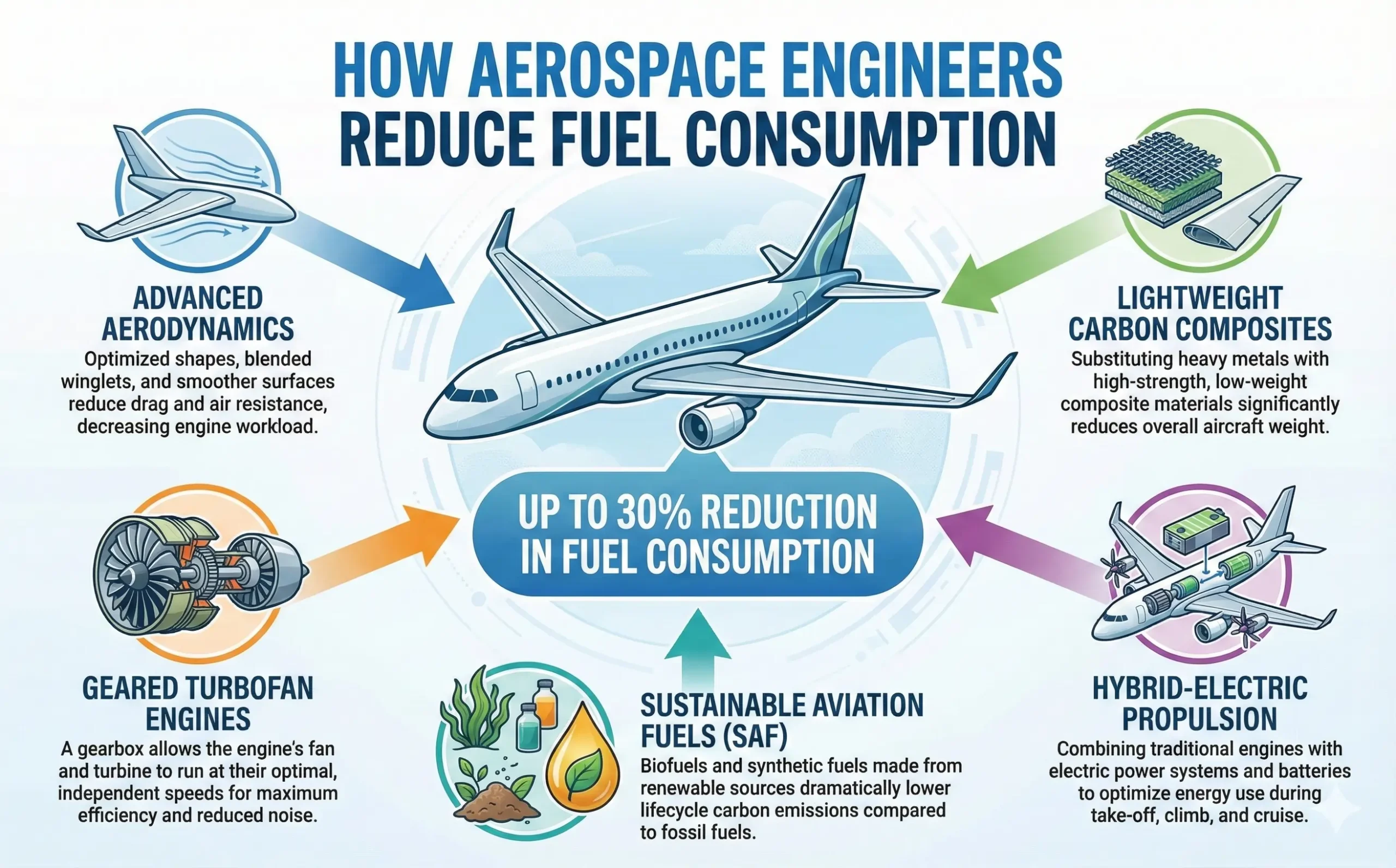
Table of Contents
In the high-stakes world of aviation, where every gallon of fuel counts toward both profitability and planetary health, aerospace engineers stand as the unsung heroes driving efficiency forward. Imagine a commercial jet slicing through the sky, carrying hundreds of passengers across continents while sipping fuel like a compact car on a highway. That’s not science fiction—it’s the reality engineers are crafting today through relentless innovation. Over the past six decades, aircraft fuel efficiency has soared by more than 70%, transforming what was once a guzzling behemoth into a lean, green machine. But how do they do it? From reshaping wings to rethinking engines, these experts blend physics, materials science, and clever software to shave off precious pounds and drag.
This deep dive explores the multifaceted strategies reshaping the skies, backed by real-world examples and data that show just how far we’ve come—and how much further we can go.
Why Fuel Efficiency Matters More Than Ever
Fuel isn’t just a line item on an airline’s balance sheet; it’s the lifeblood of global connectivity, and its inefficiency ripples out to climate change, economic pressures, and even geopolitical tensions. With aviation accounting for about 2-3% of worldwide carbon emissions, the pressure is on to decarbonize without grounding flights. Engineers respond by targeting the core equation of flight: lift versus drag, thrust versus weight. A mere 1% reduction in fuel burn can save airlines millions annually and curb thousands of tons of CO2.
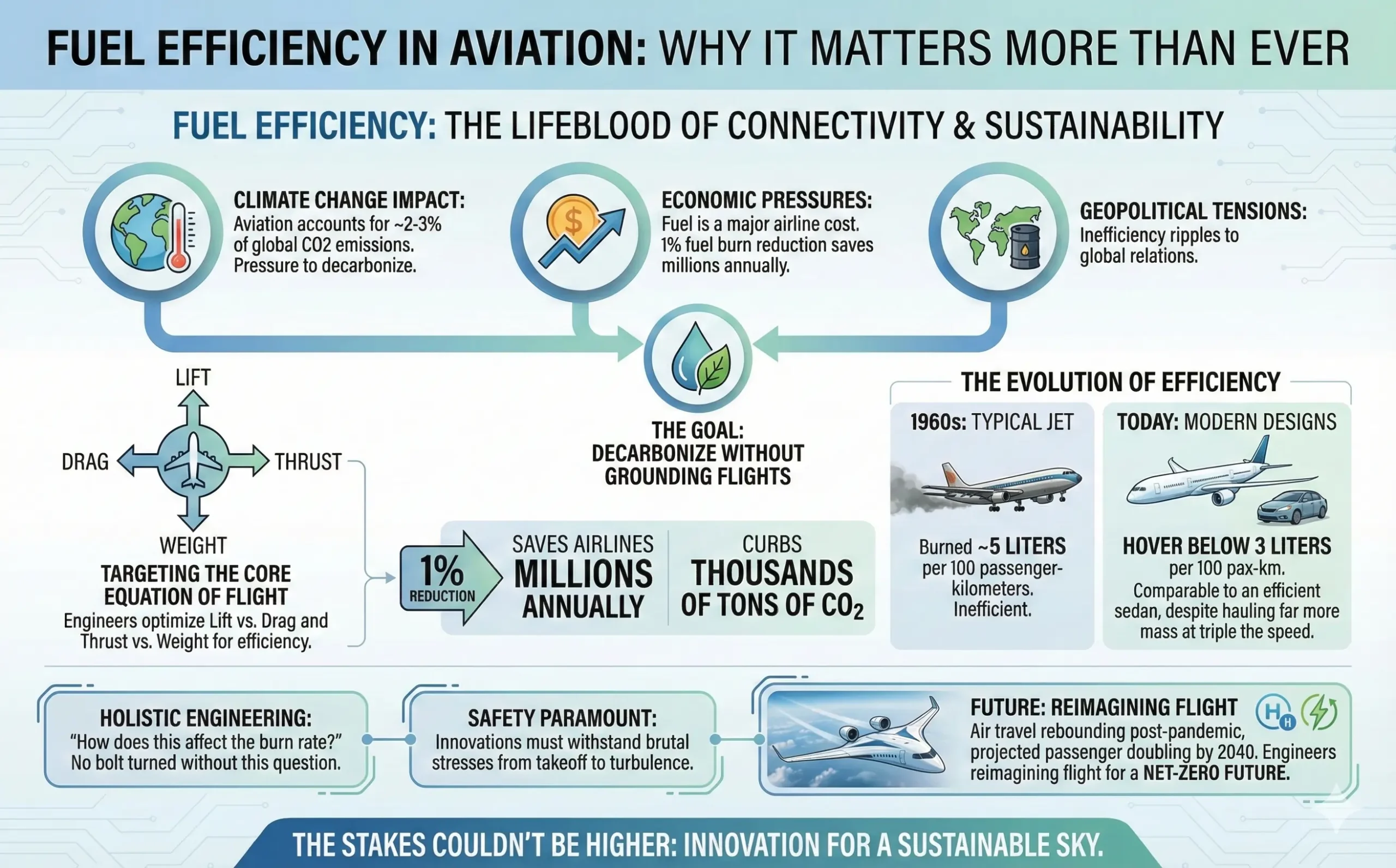
Consider the evolution: In the 1960s, a typical jet burned around 5 liters of fuel per 100 passenger-kilometers. Today, modern designs hover below 3 liters—comparable to an efficient sedan, despite hauling far more mass at triple the speed. This leap stems from holistic engineering, where no bolt is turned without asking, “How does this affect the burn rate?” Safety remains paramount, of course—innovations must withstand brutal stresses from takeoff to turbulence. Yet, as air travel rebounds post-pandemic, with passenger numbers projected to double by 2040, the stakes couldn’t be higher. Engineers aren’t just optimizing; they’re reimagining flight for a net-zero future.
Mastering Aerodynamics: Slicing Through the Air with Precision
Fuel savings lie in aerodynamics, the art of minimizing resistance as air rushes over an aircraft. Drag—the invisible enemy—devours up to 50% of an engine’s output, so engineers wage war on it through clever shaping and airflow tricks. One timeless tactic? Winglets, those upturned tips at wing ends that look like afterthoughts but pack a punch. By curbing wingtip vortices—swirling air pockets that create extra drag—these add-ons can trim fuel use by 4-6% on long hauls.
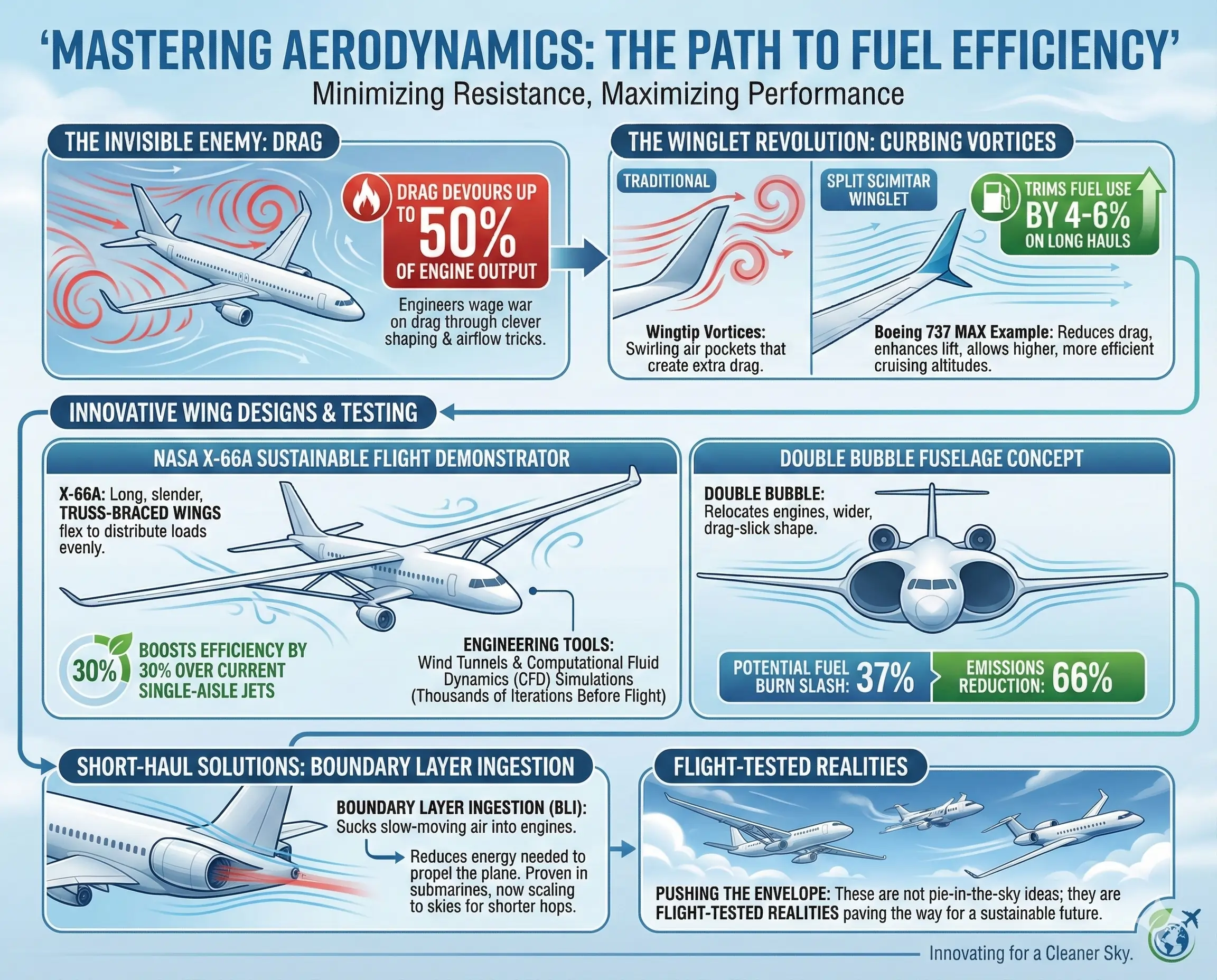
Take the Boeing 737 MAX, where split scimitar winglets not only reduce drag but also enhance lift during cruise, allowing pilots to fly slightly higher where air is thinner, and engines sip less fuel. Or consider NASA’s bold X-66A Sustainable Flight Demonstrator, a long, slender-winged experimental plane designed to boost efficiency by 30% over current single-aisle jets. Its truss-braced wings flex like a bird’s, distributing loads more evenly and cutting induced drag. Engineers test these in wind tunnels and computational fluid dynamics (CFD) simulations, iterating thousands of times before metal meets sky.
Beyond wings, fuselage redesigns play a starring role. The double bubble concept from NASA relocates engines atop the tail, blending passenger cabin and cargo hold into a wider, drag-slick shape. This could slash fuel burn by 37% and emissions by 66% compared to today’s workhorses. For shorter hops, boundary layer ingestion sucks slow-moving air into engines, reducing the energy needed to propel the plane—a technique proven in submarines but now scaling to the skies. These aren’t pie-in-the-sky ideas; they’re flight-tested realities pushing the envelope.
To illustrate the impact, here’s a table comparing aerodynamic features across key aircraft models:
| Aircraft Model | Key Aerodynamic Feature | Estimated Fuel Savings | Real-World Benefit Example |
|---|---|---|---|
| Boeing 787 Dreamliner | Blended winglets and raked wingtips | 5-7% | Enables non-stop ultra-long flights like New York to Singapore with less refueling. |
| Airbus A350 | Smooth composite fuselage for laminar flow | 25% over previous gen | Reduces drag on transatlantic routes, saving 4,000 tons of fuel per aircraft annually. |
| NASA X-66A | Truss-braced flexible wings | Up to 30% | Demonstrates potential for regional jets to cut emissions by half on short routes. |
| Boeing 737 MAX | Advanced split scimitar winglets | 4-6% | Lowers operating costs for high-frequency domestic flights. |
This table underscores how targeted tweaks compound into massive gains, turning theoretical physics into practical pound-sters.
Lightweighting: Shedding Pounds Without Sacrificing Strength
Weight is the silent saboteur of efficiency—every extra kilogram demands more thrust, more fuel, more everything. Aerospace engineers counter with lightweight materials, swapping dense metals for high-tech composites that deliver strength at a fraction of the heft. Carbon fiber reinforced polymers (CFRP) lead the charge: five times stronger than steel yet 40% lighter, they’ve revolutionized builds since their debut in the 1970s.
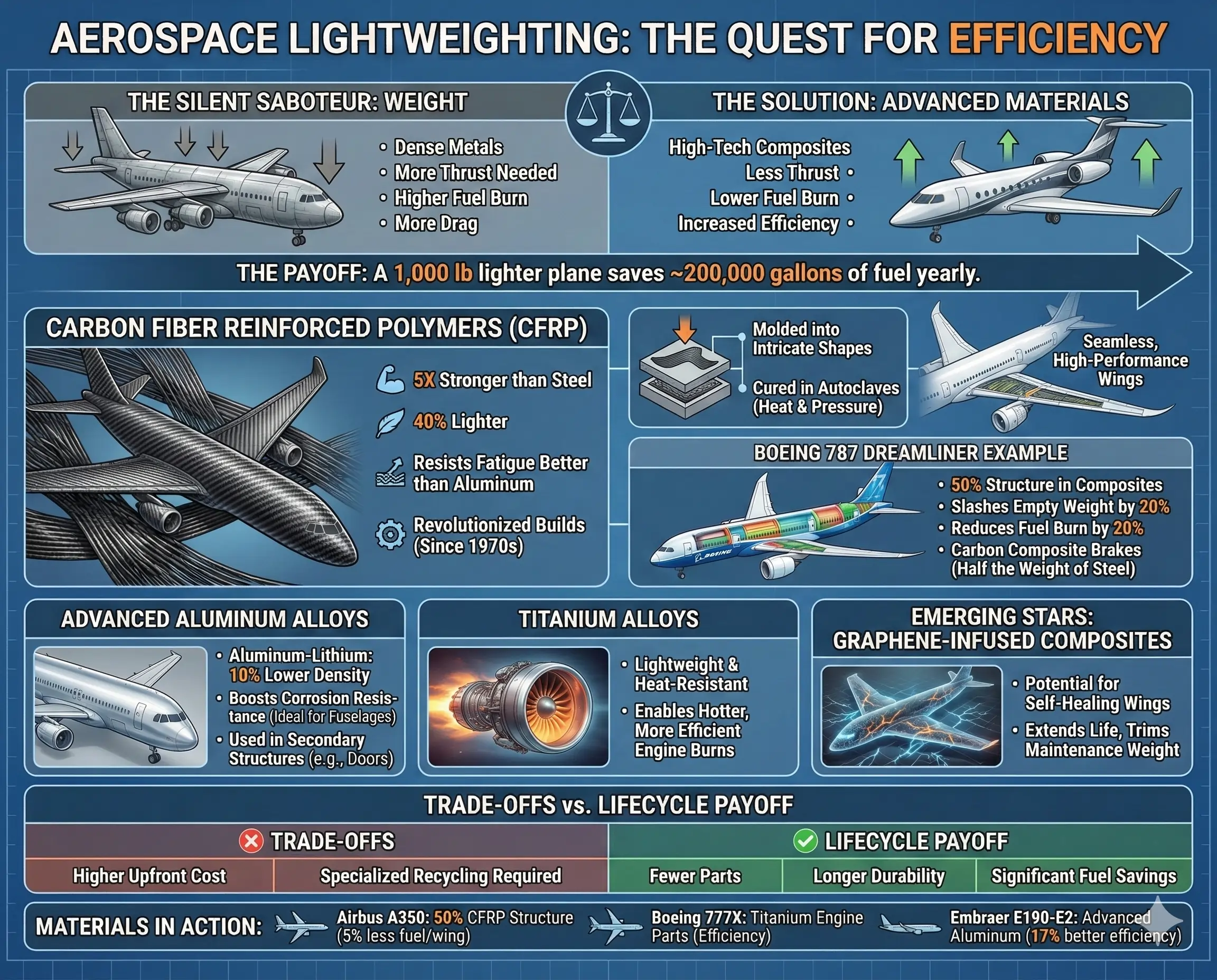
The Boeing 787 exemplifies this shift, with 50% of its structure in composites, slashing empty weight by 20% and fuel burn by a matching margin. Engineers mold these fibers into intricate shapes—think seamless wings that resist fatigue better than aluminum—using autoclaves that cure them under heat and pressure. Beyond airframes, brakes now use carbon composites too, matching steel’s stopping power at half the weight, which means less mass to haul around.
Aluminum alloys haven’t been sidelined; advanced variants like aluminum-lithium cut density by 10% while boosting corrosion resistance, ideal for fuselages exposed to salty skies. And emerging stars like graphene-infused composites promise even wilder leaps—imagine wings that self-heal micro-cracks, extending life and trimming maintenance weight. The payoff? A 1,000-pound lighter plane saves about 200,000 gallons of fuel yearly on a busy route.
But lightweighting demands trade-offs. Composites cost more upfront and require specialized recycling, yet their lifecycle savings—fewer parts, longer durability—tip the scales. Here’s a breakdown of common materials in action:
- Carbon Fiber Composites: Used in 50% of the Airbus A350’s primary structure; reduces fuel by 5% per wing alone.
- Titanium Alloys: Lightweight and heat-resistant for engine parts; in the Boeing 777X, they enable hotter, more efficient burns.
- Advanced Aluminum: In secondary structures like doors; the Embraer E190-E2 leverages it for 17% better efficiency.
For a clearer view, this table contrasts traditional versus modern materials:
| Material Type | Density (g/cm³) | Strength-to-Weight Ratio | Fuel Impact Example | Adoption Rate in New Aircraft |
|---|---|---|---|---|
| Traditional Aluminum | 2.7 | Moderate | Baseline for 1960s jets; high drag from added reinforcements. | <20% |
| Carbon Fiber Composites | 1.6 | High | Boeing 787: 20% weight cut, 20% fuel savings. | 50%+ |
| Titanium Alloys | 4.5 | Very High | Engine nacelles in A350: Allows 15% hotter operation for efficiency. | 10-15% |
| Graphene-Enhanced | ~1.8 | Exceptional | Experimental wings: Potential 10% further reduction in burn. | Emerging (<5%) |
These shifts aren’t just technical; they’re economic game-changers, letting airlines stretch routes and cut tickets.
Propulsion Powerhouses: Engines That Think Lean
No discussion of fuel frugality skips propulsion systems, where the real magic—and muscle—happens. Traditional jet engines guzzle fuel to generate thrust, but engineers are engineering them to do more with less. High-bypass turbofans, with massive fans that move air around rather than through the core, already boost efficiency by 20-30% over older low-bypass designs.
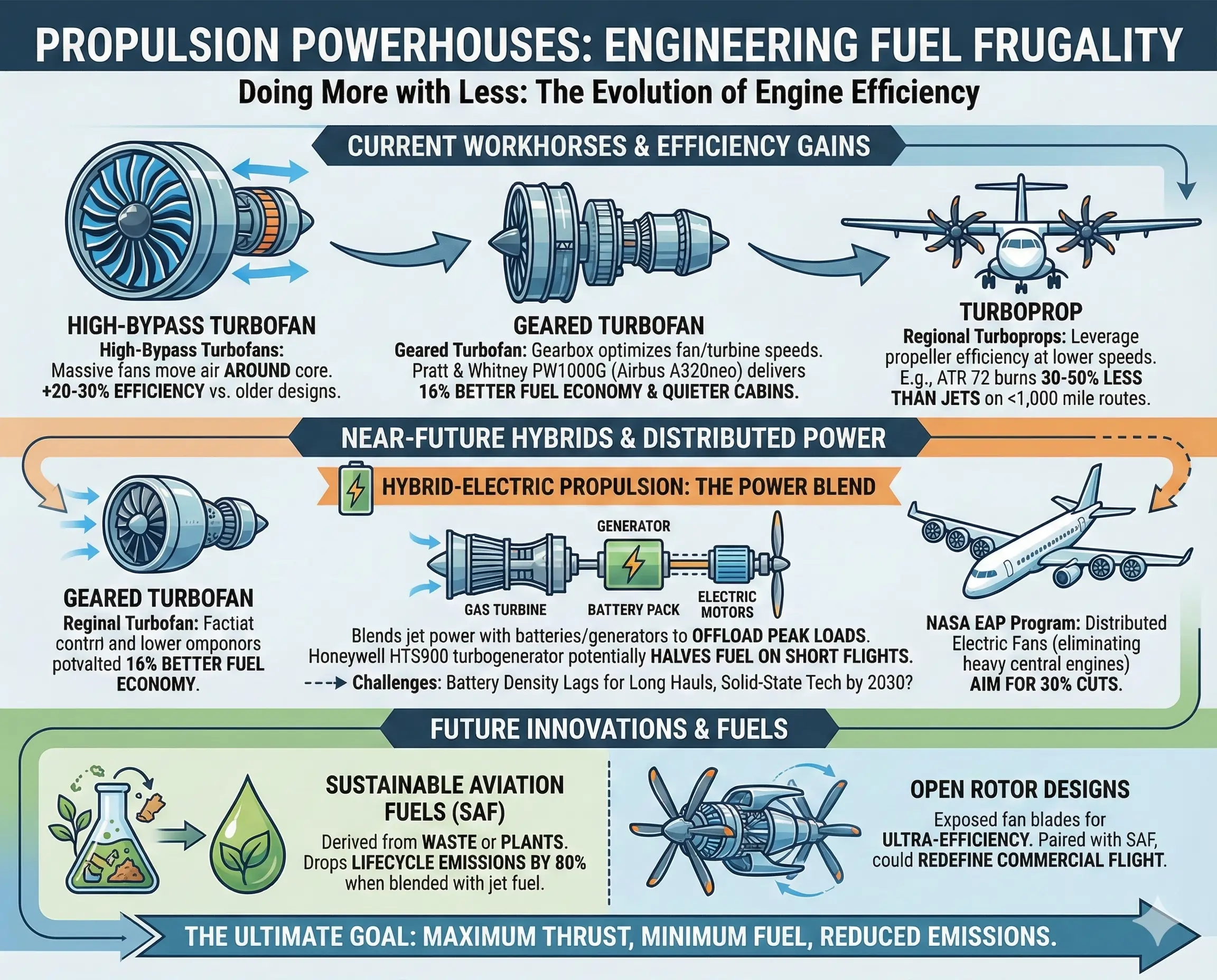
The geared turbofan takes it further: A gearbox lets the fan spin slower than the turbine, optimizing each for peak performance. Pratt & Whitney’s PW1000G series, powering the Airbus A320neo, delivers 16% better fuel economy, quieting cabins as a bonus. For regional routes, turboprops like those on the ATR 72 shine, burning 30-50% less than jets on distances under 1,000 miles by leveraging propeller efficiency at lower speeds.
Looking ahead, hybrid-electric propulsion blends jet power with batteries or generators, offloading peak loads to electricity. Honeywell’s HTS900 turbogenerator pairs a small gas turbine with electric motors, potentially halving fuel on short flights. NASA’s Electrified Aircraft Propulsion (EAP) program tests these, aiming for 30% cuts via distributed electric fans that eliminate heavy central engines. Challenges? Battery density lags for long hauls, but breakthroughs in solid-state tech could change that by 2030.
Engineers also tweak fuels: Sustainable Aviation Fuels (SAF), derived from waste or plants, drop lifecycle emissions by 80% when blended with jet fuel. Pair that with open rotor designs—exposed fan blades for ultra-efficiency—and you’ve got engines that could redefine commercial flight.
A comparative table of propulsion eras:
| Propulsion Type | Efficiency Gain Over Predecessor | Key Example | Fuel Burn (L/100 pax-km) | Noise Reduction |
|---|---|---|---|---|
| Low-Bypass Turbofan (1960s) | Baseline | Early Boeing 707 | ~5.0 | Minimal |
| High-Bypass Turbofan (1990s) | 20-30% | CFM56 on Boeing 737 NG | ~3.5 | 50% |
| Geared Turbofan (2010s) | 15-20% | PW1000G on A320neo | ~2.8 | 75% |
| Hybrid-Electric (Future) | Up to 50% | NASA X-57 Maxwell | <2.0 | 90%+ |
This progression shows how iterative genius compounds into transformative tech.
Operational Smarts: Beyond the Blueprint
Designs alone don’t cut fuel; how planes fly does too. Engineers collaborate with pilots on procedural optimizations, like the continuous climb operations that avoid level-offs, saving 100-200 kg per flight. Adjusting the center of gravity forward reduces trim drag, potentially trimming 2% off burn—critical for cargo haulers.
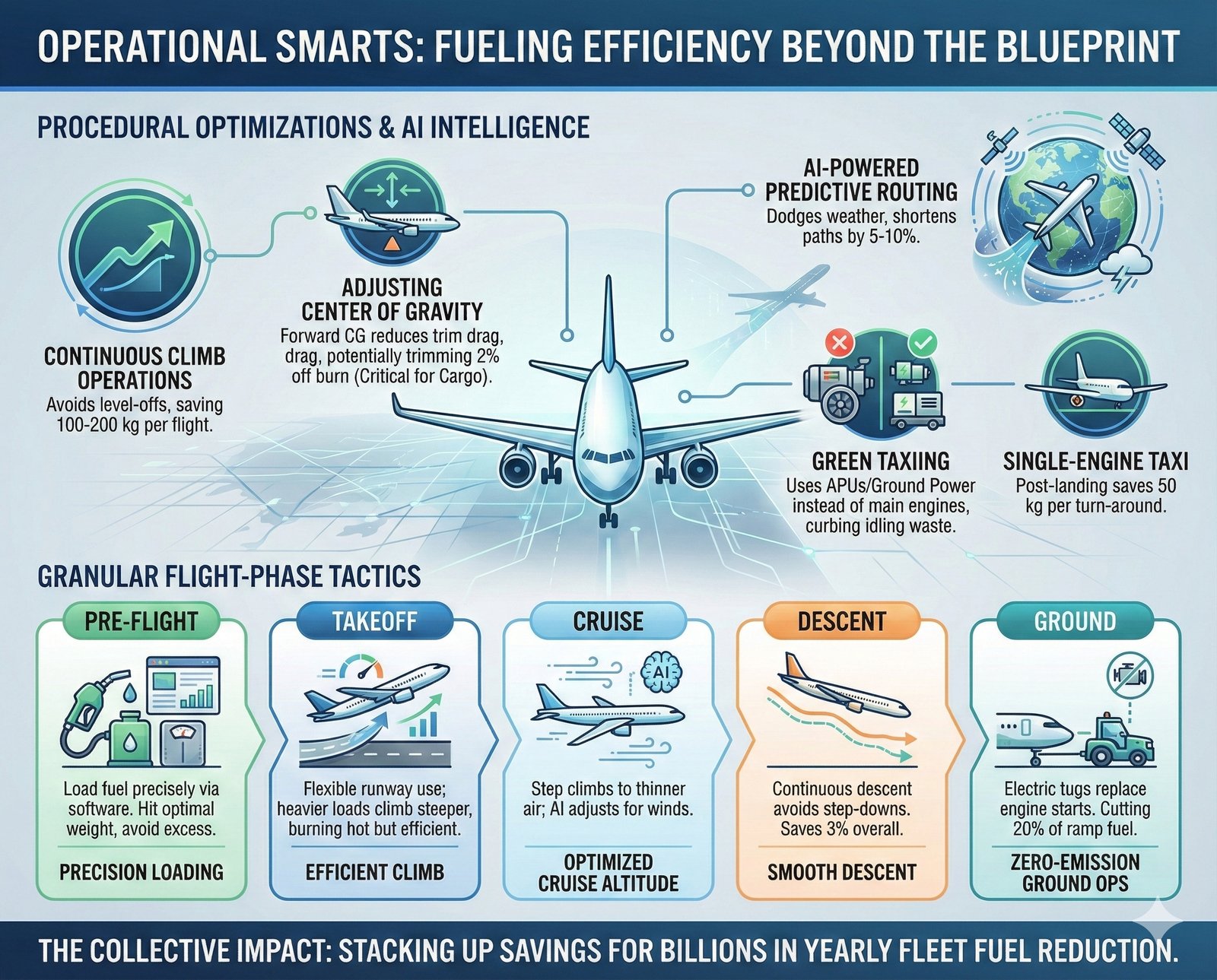
AI steps in with predictive routing, dodging weather to shorten paths by 5-10%. Ground ops matter: Green taxiing uses auxiliary power units instead of main engines, curbing idling waste. And single-engine taxi post-landing saves another 50 kg per turnaround.
For a granular look, consider these flight-phase tactics:
- Pre-Flight: Load fuel precisely via software to hit optimal weight, avoiding excess.
- Takeoff: Flexible runway use lets heavier loads climb steeper, burning hot but efficient.
- Cruise: Step climbs to thinner air; AI adjusts for winds.
- Descent: Continuous descent avoids step-downs, saving 3% overall.
- Ground: Electric tugs replace engine starts, cutting 20% of ramp fuel.
These aren’t flashy, but they stack up: A fleet adopting them could save billions in fuel yearly.
Peering into the Future: Electric Skies and Beyond
The horizon buzzes with promise. Hydrogen-powered aircraft, like Airbus’s ZEROe concepts, could zero out CO2 on short routes by 2035, using fuel cells for clean thrust. Fully electric? Viable for 500-mile hops, with NASA’s X-57 proving distributed propulsion halves drag. Blended wing bodies merge fuselage and wings for 50% less drag, while laminar flow control—suction slots keeping air smooth—adds another 10-15%.
Yet hurdles loom: Infrastructure for SAF and charging, regulatory approvals, and the sheer cost of R&D. Engineers counter with simulations, cutting prototyping waste. By 2050, net-zero flight seems achievable, blending these threads into a tapestry of sustainable soar.
In wrapping up, aerospace engineers’ quest to tame fuel consumption is a testament to human ingenuity—turning the physics of flight into a force for good. From the whisper-quiet hum of a geared turbofan to the feather-light touch of composite wings, each advance invites us to dream bigger, fly greener. As the industry hurtles toward tomorrow, one truth holds: Efficiency isn’t just engineering; it’s our ticket to the stars, sustainably.
Key Citations And References
- 4 Ways Changes in Aircraft Design and Components Reduce Fuel Consumption
- Optimising Aerospace Product Design for Fuel Economy
- Efficient technology – Aviation: Benefits Beyond Borders
- NASA’s newest X-plane is the long-winged X-66A
- Fuel economy in aircraft – Wikipedia
- Materials Matter: The Science of Lightweighting in Aerospace
- Sustainable Aviation Fuels and Advanced Propulsion Tech
- Electrified Aircraft Propulsion – NASA
Read These Articles in Detail
- Aerospace Engineering vs. Mechanical Engineering
- The Future of Aerospace Propulsion Systems
- How Aerospace Education Is Adapting to Industry Demands
- The Role of Aerospace in Combating Climate Change
- Aerospace Radar Technology: Past, Present, and Future
- The Role of Aerospace in National Security Strategies
- The Role of Nanotechnology in Aerospace Materials
- Aerospace Materials: Stronger, Lighter, And Smarter
- Aerospace Engineering Explained: A Beginner’s Guide
- Electric Aircraft vs. Hydrogen Aircraft: Which Is More Sustainable?
- Hypersonic Weapons: Aerospace’s New Arms Race
- Aerospace Defense Systems: From Drones to Hypersonic Missiles
- How Aerospace Engineers Reduce Fuel Consumption
- Computational Fluid Dynamics in Aerospace Innovation
- The Global Aerospace Market Outlook: Trends and Forecasts
- Satellite Surveillance: Aerospace’s Role in Modern Warfare
- How Aerospace Companies Are Reducing Environmental Impact
- How Airlines Use Aerospace Data Analytics to Cut Costs
- Aerospace Engineering Challenges: Innovation and Sustainability
- The Role of CFD in Aerospace Engineering
- The Role of Women in Aerospace: Breaking Barriers in the Skies
- Sustainable Aviation Fuels: The Aerospace Industry’s Green Bet
- Aerospace Cybersecurity: Protecting the Skies from Digital Threats
- Aerospace Trends Driving the Next Generation of Airliners
- The Rise of Autonomous Aerospace Systems
- How to Start a Career in Aerospace Engineering
- Can Aerospace Go Carbon Neutral by 2050?
- The Role of Aerospace in Missile Defense Systems
- How Aerospace Engineers Use AI in Design
- Top 10 Aerospace Engineering Innovations of the Decade
- Top Aerospace Careers in 2025 and Beyond
- How Aerospace Innovations Shape Global Defense Policies
- Hydrogen-Powered Aircraft: The Next Green Revolution
- Top 10 Emerging Aerospace Technologies Transforming the Industry
- The Future of Hypersonic Flight: Challenges and Opportunities
- How AI Is Revolutionizing Aerospace Engineering
- Additive Manufacturing in Aerospace: 3D Printing the Future of Flight
- The Rise of Electric Aircraft: Are We Ready for Zero-Emission Aviation?
- Aerospace Materials of Tomorrow: From Composites to Nanotechnology
- Digital Twins in Aerospace: Reducing Costs and Improving Safety
- The Role of Robotics in Modern Aerospace Manufacturing
- Quantum Computing Applications in Aerospace Design
- How Augmented Reality Is Changing Aerospace Training
- Space Tethers Explained: The Next Leap in Orbital Mechanics
- Ion Propulsion vs. Chemical Rockets: Which Will Power the Future?
- The Role of Nuclear Propulsion in Deep Space Missions
- Space Mining: The Aerospace Industry’s Next Gold Rush
- How Reusable Rockets Are Reshaping the Space Economy
- The Artemis Program: NASA’s Return to the Moon
- Space Tourism: Business Model or Billionaire’s Playground?
- How Aerospace Startups Are Disrupting Commercial Aviation
- The Economics of Low-Cost Airlines in the Aerospace Era
- Urban Air Mobility: The Rise of Flying Taxis
- The Future of Mars Colonization: Key Aerospace Challenges and Solutions Ahead
- CubeSats and Small Satellites: Democratizing Space Access
- The Future of Cargo Drones in Global Logistics
- The Role of Aerospace in Building a Lunar Economy
Frequently Asked Questions
FAQ 1: What Are the Main Ways Aerospace Engineers Reduce Fuel Consumption in Aircraft?
Aerospace engineers approach fuel reduction as a multifaceted challenge, blending design innovations, material science, and operational tweaks to make flying more efficient without sacrificing safety or performance. At the core, they focus on cutting down the two biggest culprits: drag from air resistance and the overall weight of the plane. By streamlining shapes and shedding pounds, even small changes can lead to big savings over thousands of miles. For instance, modern jets now use about half the fuel per passenger compared to those from the 1960s, thanks to these combined efforts.
One key area is aerodynamics, where engineers reshape wings and fuselages to let air flow smoother, reducing the energy needed to push through the sky. Features like curved wingtips help break up turbulent air pockets that waste fuel. Then there’s propulsion, where smarter engines squeeze more thrust from less fuel, often by mixing traditional jets with electric boosts for shorter flights. Materials play a huge role too, with lightweight composites replacing heavy metals to make planes easier to lift and sustain in the air.
Looking ahead, engineers are eyeing sustainable fuels made from plants or waste, which burn cleaner and cut emissions by up to 80 percent when blended with regular jet fuel. These methods don’t just save money for airlines—they help the planet by lowering the aviation sector’s carbon footprint, which hovers around 2 to 3 percent of global totals. As travel booms, these strategies ensure we can keep connecting the world responsibly.
FAQ 2: How Do Lightweight Materials Contribute to Fuel Efficiency in Aerospace Design?
| Material Type | Key Properties | Fuel Savings Potential | Example Aircraft Application | Environmental Benefit |
|---|---|---|---|---|
| Carbon Fiber Composites | High strength, low density (about 1.6 g/cm³) | Up to 20% reduction in overall aircraft weight | Fuselage and wings on the Boeing 787 Dreamliner | Lowers CO2 emissions by thousands of tons per year per plane |
| Aluminum-Lithium Alloys | 10% lighter than standard aluminum, corrosion-resistant | 5-10% improvement in efficiency | Skin panels on the Airbus A350 | Reduces manufacturing energy use and extends service life |
| Titanium Alloys | Heat-resistant, very high strength-to-weight ratio | 15% hotter engine operation for better burn | Engine components in the Boeing 777X | Minimizes fuel waste in high-stress areas like turbines |
| Graphene-Enhanced Polymers | Exceptional durability, self-healing potential | Emerging 10% further weight cut | Experimental wing structures | Cuts lifecycle emissions through longer durability and recyclability |
This table highlights how shifting to advanced materials transforms aircraft from fuel hogs to efficient flyers, with each option tailored to specific parts for maximum impact.
FAQ 3: In What Ways Do Aerodynamic Improvements Help Cut Aircraft Fuel Use?
Aerodynamic enhancements are like giving planes a sleeker swimsuit—they let aircraft glide through the air with less resistance, directly translating to lower fuel burn. Engineers use wind tunnel tests and computer simulations to fine-tune every curve, ensuring minimal turbulence that could otherwise sap engine power. A standout example is the addition of winglets, those elegant upward curls at wing ends that disrupt swirling air vortices, saving 4 to 6 percent on long flights.
Beyond basics, innovative designs like blended wing bodies merge the fuselage seamlessly with wings, potentially slashing drag by 50 percent and allowing for quieter, more efficient cabins. These aren’t just theoretical; they’re proven in models like the NASA-inspired X-66A, which aimed for 30 percent better efficiency before a strategic pivot to thinner wings in 2025. Operational perks include flying at optimal altitudes where thinner air reduces resistance further.
To break it down further:
- Wingtip Devices: Reduce induced drag by containing wingtip vortices, common on the Boeing 737 MAX for daily short-haul savings.
- Laminar Flow Control: Uses tiny suction ports to keep airflow smooth over surfaces, adding 10 to 15 percent efficiency on test wings.
- Fuselage Optimization: Smoother contours via composites minimize skin friction, as seen in the Airbus A350’s 25 percent leap over older jets.
- Flexible Wings: Truss-braced designs that bend in flight distribute loads better, cutting fuel needs on regional routes.
These layered tactics show how aerodynamics turns physics into practical green flying.
FAQ 4: What Role Do Geared Turbofan Engines Play in Modern Fuel Savings?
Geared turbofan engines represent a clever evolution in propulsion, allowing aircraft to burn less fuel while delivering the same punch. Unlike traditional setups where the fan and turbine spin at the same speed, these engines use a gearbox to decouple them, letting the massive front fan rotate slower for better air intake efficiency while the core turbine revs high for power. This mismatch optimizes each part’s job, boosting overall thrust by up to 16 percent with 15 to 20 percent less fuel.
Introduced in the 2010s, they’ve powered hits like the Airbus A320neo, where airlines report noticeable drops in operating costs and emissions. The design also quiets the roar, making them friendlier for noise-sensitive airports. As of 2025, refinements continue, with AI models aiding in real-time adjustments for even finer tuning during flights.
Engineers face hurdles like gearbox durability under extreme heat, but advances in materials have made them reliable for commercial use. Pairing them with sustainable fuels amplifies benefits, pushing toward net-zero goals. In essence, geared turbofans bridge today’s tech with tomorrow’s dreams, proving that a simple mechanical tweak can reshape the skies.
FAQ 5: How Has Hybrid-Electric Propulsion Advanced in Aircraft by 2025?
| Development Milestone | Year | Key Players | Efficiency Gain | Status/Impact |
|---|---|---|---|---|
| EcoPulse Demonstrator | 2025 | Airbus, Daher, Safran | Up to 30% fuel reduction via distributed props | Flight-tested; paves way for hybrid regional jets |
| RTX Hybrid-Electric Program | June 2025 | RTX (Raytheon) | Full power achieved in batteries and systems | Milestone for scalable electric boosts on turbofans |
| VoltAero HPU 210 | July 2025 | VoltAero | Enhanced safety with hybrid series setup | Debuted at airshows; targets general aviation entry by 2026 |
| NASA EAP Initiatives | Ongoing 2025 | NASA | 20-50% cuts through electrified fans | Ground tests advancing; focuses on short-haul viability |
| ZeroAvia Propulsion Tech | April 2025 | ZeroAvia | Enables eVTOL and fixed-wing hybrids | Certified components for zero-emission flights under 600 miles |
These milestones illustrate the rapid stride toward electrified skies, blending batteries with traditional power for cleaner, quieter aviation.
FAQ 6: What Is Sustainable Aviation Fuel and Why Is It Gaining Traction?
Sustainable aviation fuel, often called SAF, is a game-changer in the quest for greener flights, produced from renewable sources like used cooking oil, agricultural waste, or even captured carbon dioxide instead of crude oil. It drops in like a seamless substitute, blending up to 50 percent with conventional jet fuel without needing engine tweaks, and slashes lifecycle emissions by 80 percent by avoiding fossil extraction’s heavy carbon toll.
Production pathways vary, from hydroprocessed esters and fatty acids that turn plant oils into drop-in fuel, to alcohol-to-jet processes fermenting sugars into kerosene-like liquids. By late 2025, global output hit 2 million tonnes, doubled from prior years through mandates like the UK’s 10 percent target by 2030. Airlines love it for cutting costs long-term and meeting regulations, while it revitalizes rural economies via local feedstocks.
Yet, scaling remains tricky—high prices and supply chains lag demand. Still, projects like ethanol-to-jet facilities in the UK signal momentum, positioning SAF as the quickest path to decarbonizing aviation’s 2-3 percent slice of global emissions.
To explore its edges:
- Feedstock Flexibility: From municipal waste to algae, diversifying sources builds resilience against shortages.
- Certification Ease: Approved by standards bodies, ensuring safety parity with jet A-1 fuel.
- Policy Boosts: Incentives worldwide accelerate adoption, aiming for 65 percent of net-zero contributions.
- Blending Limits: Current tech caps at 50 percent, but research pushes for 100 percent pure SAF flights.
This fuel isn’t a silver bullet, but it’s fueling real progress toward sustainable soar.
FAQ 7: How Is Artificial Intelligence Revolutionizing Fuel Optimization in Aviation?
Artificial intelligence is quietly transforming how planes sip fuel, acting like an invisible co-pilot that crunches vast data for smarter decisions mid-flight. By analyzing weather patterns, wind currents, and even engine vibes in real time, AI suggests route tweaks that shave 3 to 5 percent off burn rates—small per trip, but massive fleet-wide. Tools like predictive models forecast consumption down to the gallon, helping crews load just enough without excess weight.
In 2025, adoption surged with systems like those optimizing 55 percent of flights for major carriers, dodging storms for smoother, shorter paths. Beyond routing, AI fine-tunes engine performance, adjusting thrust based on live telemetry to avoid wasteful spikes. It’s also aiding design, simulating thousands of wing shapes overnight to pick the drag-busters.
Challenges include data privacy and integration with legacy systems, but the payoff is clear: lower emissions and bills. As quantum computing edges in, expect even sharper predictions, making AI not just a tool, but aviation’s efficiency backbone.
FAQ 8: What Are the Key Challenges Facing Fuel Efficiency Innovations in Aerospace?
| Challenge Category | Description | Impact on Innovation | Potential Solutions | 2025 Status |
|---|---|---|---|---|
| High Development Costs | R&D for new engines or materials runs into billions, deterring smaller firms | Slows adoption of hybrids or SAF | Government subsidies and public-private partnerships | Increased funding via EU Flightpath 2050, targeting 20% efficiency jumps |
| Supply Chain Limitations | Scarce rare earths for batteries or composites bottleneck production | Delays hybrid-electric rollout | Recycling programs and alternative sourcing | SAF production doubled, but still only 1% of jet fuel globally |
| Regulatory Hurdles | Stringent certification for safety prolongs testing phases | Pushes timelines for electric designs | Streamlined FAA/EASA processes for green tech | X-66A paused in May 2025 to refocus on wing tech |
| Infrastructure Gaps | Airports lack charging or SAF blending facilities | Limits operational scalability | Mandates for retrofits by 2030 | Policy frameworks emerging in APAC for 10% SAF mandates |
| Technical Trade-Offs | Lighter materials may compromise durability in extremes | Balances efficiency vs. longevity | AI simulations for predictive maintenance | Advanced alloys tested, showing 10% weight cuts without fatigue |
This overview captures the hurdles turning bold ideas into everyday flights, with ongoing shifts toward collaborative fixes.
FAQ 9: What Future Trends Are Shaping Propulsion Systems for Lower Fuel Use?
Propulsion trends in aerospace are hurtling toward a hybrid horizon, where electric and hydrogen elements team up with traditional jets to slash fuel dependency. By 2030, expect hybrid-electric setups on regional planes, offloading takeoff power to batteries for 30 to 50 percent savings on short hops, as demonstrated in 2025’s EcoPulse tests. Hydrogen fuel cells, zero-emission powerhouses, target entry by 2035, powering clean thrust from liquid stores.
Open rotor engines, with exposed blades for ultra-thrust, promise 20 percent gains but need noise fixes. Quantum AI will supercharge trajectory planning, weaving in real-time data for optimal climbs. These aren’t distant; 2025 saw full-power hybrid milestones, signaling a pivot from fossil reliance.
Diving deeper:
- Distributed Propulsion: Multiple small fans spread lift, cutting drag as in NASA’s EAP program.
- Bio-Based Hybrids: Pairing SAF with electrics for 80 percent emission drops.
- Series vs. Parallel Hybrids: Series for full electric modes during cruise; parallel for seamless boosts.
- Hydrogen Infrastructure: Cryogenic tanks evolving for safer, lighter storage.
These currents promise a propulsion renaissance, blending innovation with practicality for skies that run on tomorrow’s energy.
FAQ 10: How Do Operational Procedures Enhance Fuel Efficiency Beyond Aircraft Design?
Operational procedures act as the fine polish on fuel-efficient designs, turning engineering smarts into daily wins through smart flying habits and ground ops. Pilots use continuous climb and descent profiles to avoid wasteful level-offs, saving 100 to 200 kilograms per flight by maintaining steady momentum. Adjusting the center of gravity forward trims drag from stabilizing tails, eking out another 2 percent savings—vital for loaded freighters.
AI-driven routing dodges headwinds, shortening paths by 5 to 10 percent, while green taxiing swaps engine idles for electric carts, curbing ramp waste. Precise fuel loading via software hits sweet spots, preventing overload penalties. These tweaks compound: a fleet-wide shift could save billions annually.
In practice:
- Step Climbs: Gradual altitude gains to thinner air, optimizing cruise burn.
- Single-Engine Taxi: Post-landing efficiency, cutting 50 kilograms per turnaround.
- Weather Integration: Real-time forecasts for 3 to 5 percent emission reductions.
- Maintenance Scheduling: Predictive analytics keep engines peak, avoiding inefficiency creep.
By weaving human and tech savvy, operations ensure designs deliver their full green potential, one flight at a time.
FAQ 11: What Are the Environmental Benefits of Reducing Fuel Consumption in Aviation?
Reducing fuel consumption in aviation goes far beyond just saving money for airlines; it plays a pivotal role in tackling climate change by directly lowering the sector’s greenhouse gas emissions. With aviation responsible for around 2 to 3 percent of global carbon dioxide output, even modest efficiency gains translate to massive environmental wins. For every percentage point drop in fuel burn, airlines avoid releasing thousands of tons of CO2 into the atmosphere annually, helping to curb warming trends and improve air quality near airports.
One of the standout benefits is the ripple effect on other pollutants. Less fuel means fewer nitrogen oxides, sulfur oxides, and particulate matter spewing from engines, which can reduce smog formation and respiratory health risks for communities below flight paths. Studies show that modern efficient designs have already avoided billions of tons of emissions since the 1990s, equivalent to taking millions of cars off the road. As we push toward net-zero by 2050, these reductions buy time for broader shifts like electric propulsion.
Moreover, efficiency improvements pave the way for sustainable aviation fuels, amplifying the green impact. When paired with fuels that cut lifecycle emissions by up to 80 percent, the combo could slash aviation’s footprint by half on key routes. It’s a holistic approach: lighter planes, smarter routes, and cleaner burns create a virtuous cycle, fostering biodiversity by easing pressure on land for fuel crops and oceans from shipping alternatives.
FAQ 12: How Do ICAO Regulations Drive Fuel Efficiency Improvements in Aircraft?
The International Civil Aviation Organization, or ICAO, sets global benchmarks that push manufacturers and airlines toward greener skies, with 2025 marking a key milestone in tightening standards for fuel use and noise. These rules aren’t just suggestions; they’re binding for new aircraft designs, ensuring steady progress without stifling innovation. By focusing on metrics like cruise fuel burn, ICAO’s framework encourages holistic upgrades, from wing shapes to engine tech, aiming for a 10 percent overall reduction by the early 2030s.
What makes these regulations effective is their phased rollout, giving industry time to adapt while holding feet to the fire. For instance, the latest agreements target a 10 percent drop in fuel consumption for certified planes starting in 2031, building on earlier CO2 caps that already trimmed emissions by 4 percent fleet-wide since 2015. This not only levels the playing field internationally but also spurs investment in R&D, with billions funneled into compliant tech.
To see the impact in action:
- CO2 Emissions Standard: Mandates efficiency baselines for new types, exceeding 2028 targets by 8 percent in 2024 models to accelerate decarbonization.
- Noise Reduction Ties: Links quieter flights to fuel savings, as streamlined designs cut both drag and decibels.
- SAF Integration: Encourages blending mandates, like the UK’s 2 percent minimum in 2025, to amplify regulatory fuel cuts.
- Global Enforcement: Harmonizes rules across 193 member states, preventing a patchwork that could slow adoption.
These steps ensure aviation evolves sustainably, balancing growth with planetary health.
FAQ 13: What Fuel Savings Has the Boeing 787 Dreamliner Achieved in Real-World Operations?
| Aspect | Details | Estimated Savings | Operational Example |
|---|---|---|---|
| Overall Efficiency | 50% composite structure reduces weight, enabling 20-25% less fuel burn than predecessors like the 767 | Up to 25% on long-haul routes | Non-stop Pacific crossings save 4,000 tons annually per aircraft |
| Engine Performance | High-bypass turbofans with geared tech improve thrust by 15-20% | 21% per flight for 220-250 passengers | ANA reports consistent gains on Tokyo-LA runs |
| Aerodynamic Features | Blended winglets and raked tips cut drag by 5-7% | 15% over older Boeing 777 variants | LOT Polish Airlines: 35 kg saved per Warsaw landing via optimized taxi |
| Predictive Analytics | AI models forecast consumption, adjusting loads for Trent 1000 engines | 5-10% via data-driven planning | SAS integrates for 80% CO2 cuts with SAF blends |
| Fleet-Wide Impact | Lifecycle savings compound with maintenance tweaks | Millions of gallons yearly per fleet | Global operators avoid 14.6 billion tons CO2 since 1990 |
This table draws from operational data, showing how the Dreamliner’s design delivers tangible, compounding benefits across diverse fleets.
FAQ 14: How Do Airbus and Boeing Compare in Fuel Efficiency for Their Latest 2025 Models?
When pitting Airbus against Boeing in the fuel efficiency arena for 2025, it’s a close race where both giants leverage composites and advanced engines, but subtle differences emerge based on model focus and tech choices. Boeing edges ahead in wide-body efficiency with the 787 series, boasting up to 25 percent savings over legacy jets thanks to its 50 percent composite build and optimized aerodynamics. Meanwhile, Airbus shines in the narrow-body segment, where the A320neo family claims a slight 1-2 percent lead over the 737 MAX, hitting 0.682 nautical miles per gallon with LEAP-1A engines.
Market dynamics play into this: Airbus holds about 60 percent share in single-aisle orders, driven by its 20 percent burn reduction that helped dominate during high-fuel eras. Boeing counters with broader range flexibility in the MAX line, offering 14-20 percent gains that suit diverse routes. For larger birds, the A350’s smooth fuselage delivers 25 percent over prior gens, neck-and-neck with the 777X’s titanium alloys enabling hotter, thriftier burns.
Looking at economics, Airbus’s ACJ320neo nudges a lower cost per nautical mile at $11.67 versus Boeing’s BBJ MAX 8 at $11.89, factoring in fuel and maintenance. Both push boundaries, but Airbus’s edge in volume production tips scalability, while Boeing’s material innovations promise longevity. As 2025 unfolds, hybrid integrations could blur lines further, making the choice route-specific.
FAQ 15: What Role Does Wind Tunnel Testing Play in Boosting Aerospace Fuel Efficiency?
Wind tunnel testing remains a cornerstone of aerospace engineering, simulating real-flight conditions to refine designs that minimize drag and maximize lift, directly feeding into fuel savings of 5 to 30 percent on new models. These facilities blast air at speeds up to Mach 1 over scale prototypes, revealing turbulence hotspots that computational models might miss, ensuring every curve contributes to smoother airflow.
Advancements in 2025 have supercharged this process, with pressurized tunnels hitting 500 psi to mimic high-altitude thin air, accelerating tests from months to weeks. NASA’s setups, like the 14-by-22-foot tunnel, validated concepts such as the D8’s laminar flow, doubling smooth airflow extents for 20 percent efficiency jumps.
Key ways it drives progress:
- Drag Reduction Validation: Measures induced and friction drag, guiding winglet tweaks for 4-6 percent burns cuts.
- Laminar Flow Experiments: Tests suction ports to extend smooth air layers, adding 10-15 percent savings on fuselages.
- Hybrid Tech Integration: Evaluates electric props in flow, optimizing for 30 percent less fuel in demonstrators.
- Sustainability Focus: Simulates SAF combustion effects, linking aero gains to emission drops.
By bridging lab and sky, wind tunnels turn theory into flyable efficiency.
FAQ 16: What Economic Impacts Do Fuel Efficiency Improvements Have on Airlines?
| Improvement Type | Cost Savings Mechanism | Annual Impact Estimate | Airline Example |
|---|---|---|---|
| Fleet Modernization | Newer planes cut burn by 20%, lowering fuel bills | $2-4 billion fleet-wide | United: 5 million gallons saved via single-engine taxi |
| Operational Tweaks | AI routing and precise loading trim 3-5% waste | 10-20% maintenance reduction | AirAsia: GE Fuel Insight yields millions in optimizations |
| Weight Reductions | Composites drop mass, easing thrust needs | Up to 15% on high-frequency routes | LOT: 35 kg per 787 taxi-in |
| SAF Blending | 80% lifecycle emission cuts with policy incentives | Offsets rising fuel prices | SAS: 55% efficiency gain since 1990 |
| Predictive Tools | Early issue spotting avoids downtime | Double-digit lease cost drops | Global carriers: $4B by 2043 via AI |
These enhancements not only buffer against volatile oil prices but also boost competitiveness through lower fares and greener branding.
FAQ 17: Can Supersonic Flights Become Fuel-Efficient in the Coming Years?
Supersonic travel, once synonymous with guzzling fuel like the Concorde, is staging a comeback with innovations aimed at making speed sustainable, though challenges persist in balancing velocity with efficiency. By 2025, designs like Boom’s Overture target carbon-neutral ops using sustainable aviation fuels, potentially cutting emissions per passenger to match subsonic levels on transoceanic routes. Hybrid engines promise 18 percent less fuel and 31 percent fewer NOx across phases, a far cry from legacy jets that burned seven times more.
Yet, the physics of breaking sound barriers demand more energy, with estimates showing 2-3 times the fuel per mile versus today’s cruisers. Companies counter this through drag-busting shapes and distributed propulsion, aiming for net-zero by 2025 via renewable manufacturing. NASA’s quiet boom research could lift overland bans, expanding markets and spreading costs.
Ultimately, viability hinges on scaling SAF and electric assists; without them, supersonic might niche to elite hops. But with 2025 tests like XB-1’s drag materials succeeding, it seems likely that efficient Mach 2 could redefine long-haul without dooming the planet.
FAQ 18: What Are NASA’s Major Contributions to Aviation Fuel Efficiency in 2025?
NASA’s fingerprints are all over modern aviation’s green push, from pioneering winglets that save 5 percent fuel globally to 2025’s Sustainable Flight National Partnership driving 30 percent burn cuts. Their ultra-efficient tech roadmap collaborates with Boeing on demonstrators like the X-66A, testing truss-braced wings for single-aisle thrift.
In 2025, investments hit $425 million in Boeing’s project, matching with $725 million private funds for seven-year R&D yielding greener midsize liners. Electrified propulsion programs slash engine NOx, while wind tunnel validations prove 20 percent gains on concepts like the D8.
Highlighting their edge:
- Wing Innovations: Transonic designs for 30 percent less fuel on efficient singles.
- Hybrid Systems: EAP initiatives for 50 percent regional savings.
- Partnerships: SFNP coordinates industry for net-zero tech by 2050.
- Quiet Tech: Boom mitigation enables efficient supersonic revival.
These efforts ensure NASA’s role as the efficiency vanguard endures.
FAQ 19: What Challenges Are Slowing Sustainable Aviation Fuel Production in 2025?
| Challenge | Description | Impact on Scaling | 2025 Outlook |
|---|---|---|---|
| High Production Costs | Feedstock and conversion run 2-4x conventional fuel | Limits to 0.7% of needs despite doubling to 2M tonnes | Incentives aim for 15M tonnes by 2030 |
| Feedstock Shortages | Reliance on waste oils strains supply chains | Bottlenecks advanced pathways like ethanol-to-jet | APAC policies boost local sourcing |
| Capital Intensity | Facilities cost billions, deterring investors | Delays commercial plants | $141M US capacity add, but gaps remain |
| Policy Gaps | Mandates like 2% UK blend lack enforcement | Slows voluntary uptake | EU targets 10% by 2030 to accelerate |
| Tech Maturity | Blends cap at 50%, full SAF unproven | Hinders 80% emission cuts | Demo projects eye 100% by 2030 |
Despite progress, these hurdles keep SAF nascent, urging faster policy and investment.
FAQ 20: How Is AI-Driven Predictive Maintenance Helping Aviation Save Fuel?
AI-driven predictive maintenance is revolutionizing aviation by spotting engine wear before it spikes fuel use, potentially saving carriers up to 5 percent on burns through timely tweaks. By 2025, tools analyze telemetry in real-time, forecasting failures that could otherwise guzzle extra gallons during inefficient runs, with airlines reporting $2.3 million annual savings per fleet from optimized flights.
This tech extends beyond engines to airframes, using machine learning to predict drag from micro-damage, integrating with routing for holistic efficiency. Airbus forecasts $4 billion yearly global cuts by 2043, as AI slashes AOG events that idle planes and waste fuel. In practice, 55 percent of flights now leverage it for 3-5 percent reductions on longs, blending with SAF for compounded greens.
The beauty lies in its proactive nature: no more reactive overhauls that bloat costs and emissions. As quantum boosts sharpen predictions, AI cements its spot as aviation’s fuel guardian, making skies smarter and leaner.
