

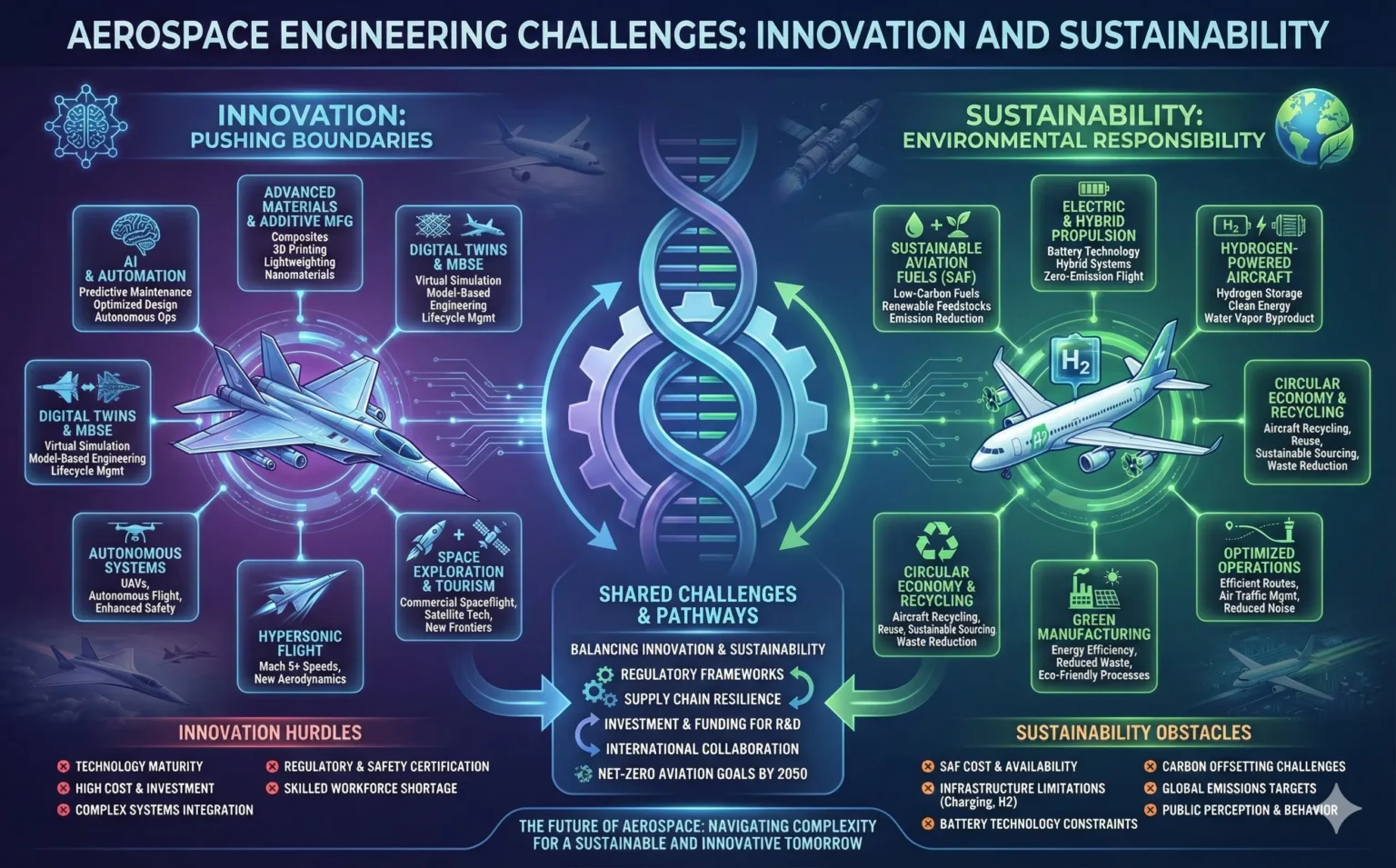
Key Challenges Facing Aerospace Engineers Today
Aerospace engineering stands at the crossroads of groundbreaking discovery and daunting obstacles. As we push boundaries in commercial flight, space exploration, and defense systems, several core issues dominate the field. Here’s a snapshot of the most pressing ones:
- Workforce Shortages: The industry faces a critical gap, with estimates suggesting a need for over 123,000 additional technicians in the U.S. commercial sector alone by the mid-2040s. This stems from retiring experts and insufficient new talent, threatening project timelines and innovation.
- Supply Chain Vulnerabilities: Geopolitical tensions, material shortages like titanium, and labor disruptions have doubled production times for some original equipment manufacturers (OEMs), amplifying costs and delays.
- Sustainability Demands: Achieving net-zero carbon emissions by 2050 requires revolutionary shifts, including sustainable aviation fuels (SAF) and hydrogen propulsion, but regulatory hurdles and high development costs pose significant barriers.
- Technical Complexities: From turbulent aerodynamics to advanced materials enduring extreme conditions, engineers grapple with integrating AI, ensuring fault-tolerant controls, and scaling propulsion for hypersonic speeds.
These challenges are interconnected, demanding multidisciplinary approaches. While they slow progress, they also spark ingenuity, as seen in AI-driven simulations that cut design times and collaborative efforts to diversify suppliers.
The Talent Crunch
The aerospace workforce shortage isn’t just a numbers game; it’s a bottleneck for ambition. With aging fleets and booming space ventures, demand surges, yet education pipelines lag. Programs like apprenticeships and diversity initiatives offer hope, but scaling them requires industry-wide commitment.
Supply Chain Strains
Disruptions from pandemics to trade wars have exposed fragilities. Diversifying sources and leveraging digital traceability can mitigate risks, ensuring components arrive on time for everything from jet engines to satellite arrays.
Sustainability Imperative
Aviation contributes about 2-3% of global CO2, but growth amplifies urgency. Innovations like electric vertical takeoff and landing (eVTOL) vehicles promise cleaner skies, though battery weight and infrastructure gaps remain hurdles.
Technical Frontiers
Core engineering puzzles, such as modeling fluid-structure interactions or developing recyclable composites, demand computational power and creative testing. Historical triumphs, like solving pogo oscillations in Saturn rockets, remind us that persistence pays off.
Table of Contents
Aerospace engineering has always been a realm where human ingenuity collides with the unforgiving laws of physics, turning dreams of flight into reality. From the Wright brothers’ fragile glider to reusable rockets piercing the atmosphere, the field thrives on solving problems that seem insurmountable. Yet, in 2025, as commercial air travel rebounds, space tourism takes off, and defense needs evolve, the challenges have never been more multifaceted.
This article delves deep into the labyrinth of issues confronting aerospace engineers, drawing on historical lessons, current innovations, and forward-looking strategies. We’ll explore everything from the human element of talent shortages to the nitty-gritty of propulsion energetics, weaving in real-world examples, expert insights, and data-driven analyses. Whether you’re a student eyeing a career in the stars or a professional navigating these turbulent skies, understanding these hurdles equips us to soar higher.
The Human Factor: Tackling the Aerospace Talent Shortage
Any engineering feat is the people who design, build, and fly it. Today, the aerospace industry stares down a talent abyss that’s widening with every launch delay and unfilled vacancy. Projections indicate that the U.S. commercial aerospace segment will need an additional 123,000 technicians over the next two decades just to keep pace with production backlogs and aging fleets. This isn’t hyperbole; it’s a ripple effect from decades of underinvestment in STEM education, compounded by the retirement of baby boomers who cut their teeth on Apollo-era projects.
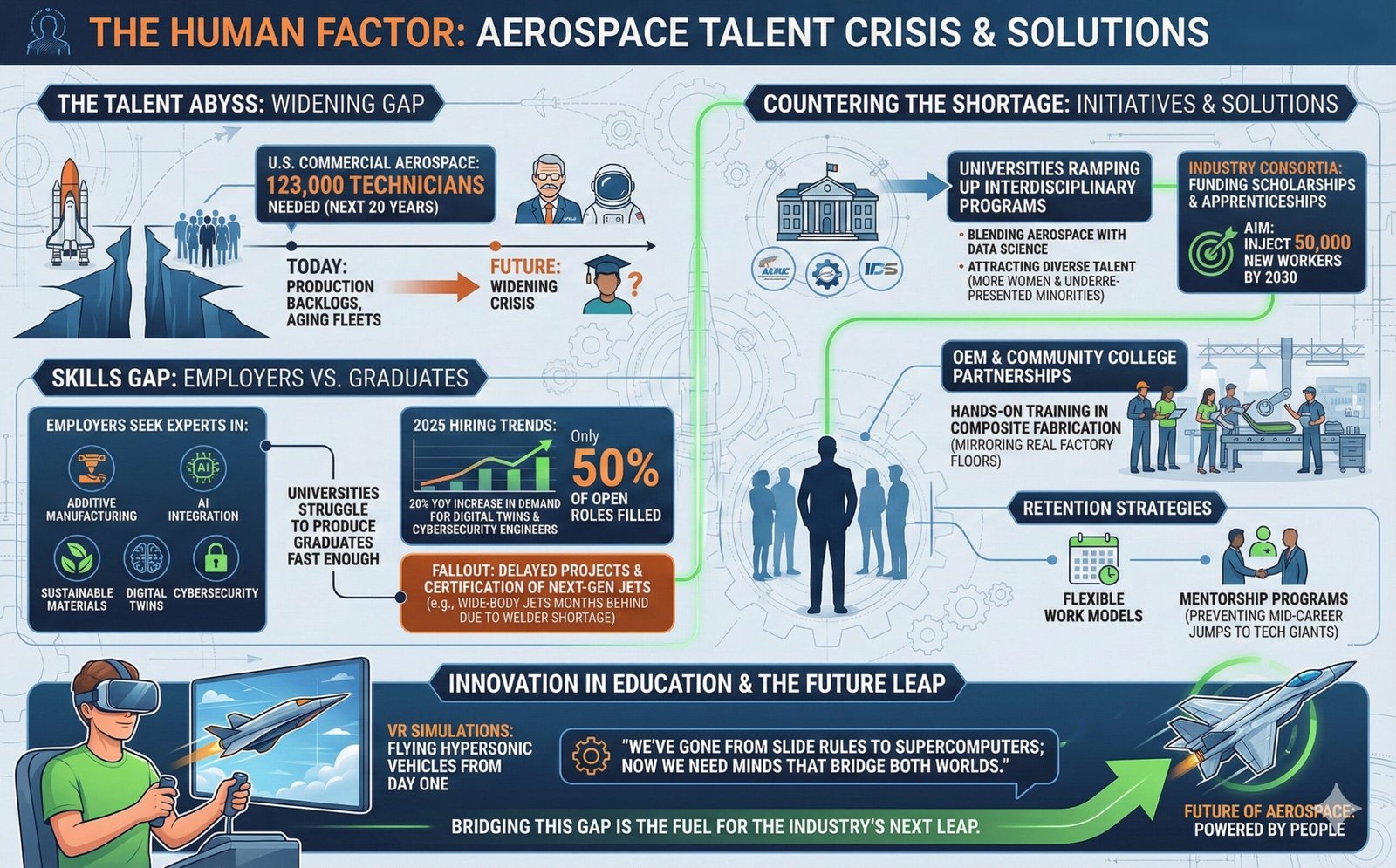
Consider the skills gap: Employers seek experts in additive manufacturing, AI integration, and sustainable materials, but universities struggle to produce graduates fast enough. In 2025, hiring trends reveal a 20% year-over-year increase in demand for aerospace engineers proficient in digital twins and cybersecurity, yet only half of open roles are filled. The fallout? Delayed projects, like the protracted certification of next-gen wide-body jets, where a lack of specialized welders has pushed timelines back by months.
To counter this, initiatives abound. Universities are ramping up interdisciplinary programs, blending aerospace with data science to attract diverse talent pools, including more women and underrepresented minorities who bring fresh perspectives. Industry consortia are funding scholarships and apprenticeships, aiming to inject 50,000 new workers by 2030. One standout example is the partnership between major OEMs and community colleges, offering hands-on training in composite fabrication that mirrors real factory floors. Retention strategies, too, are key: Flexible work models and mentorship programs help keep mid-career engineers from jumping ship to tech giants.
But it’s not all gloom. The shortage fosters innovation in education, like virtual reality simulations that let students “fly” hypersonic vehicles from day one. As one veteran engineer noted, “We’ve gone from slide rules to supercomputers; now we need minds that bridge both worlds.” Bridging this gap isn’t optional—it’s the fuel for the industry’s next leap.
| Aspect of Talent Shortage | Current Impact | Proposed Solutions | Expected Outcomes by 2030 |
|---|---|---|---|
| Quantitative Demand | 123,000 U.S. technicians needed; 65% of firms report shortages | Expand apprenticeships to 10,000 annually | Fill 80% of roles, reduce delays by 30% |
| Skill-Specific Gaps | Expertise in AI and composites is lacking; 20% hiring increase | Interdisciplinary university programs | 50% more graduates in digital engineering |
| Diversity Challenges | Underrepresentation (women: 15%, minorities: 10%) | Scholarships and inclusive recruitment | 25% diverse workforce boost |
| Retention Issues | 15% annual turnover due to burnout | Mentorship and flexible policies | 20% lower attrition rates |
This table highlights how targeted actions can transform a crisis into a catalyst for inclusive growth.
Supply Chain Resilience: Weaving a Stronger Web for Global Flight
No aircraft leaves the ground without a symphony of parts from across the globe—titanium from Australia, semiconductors from Asia, composites from Europe. Yet, in recent years, this intricate web has frayed under geopolitical strains, raw material scarcities, and logistical snarls. Labor strikes alone have nearly doubled production timelines for some OEMs, turning what should be a 12-month build into a two-year odyssey. In 2025, 65% of supply chain managers cite personnel shortages as their top woe, a stubborn holdover from pandemic disruptions.
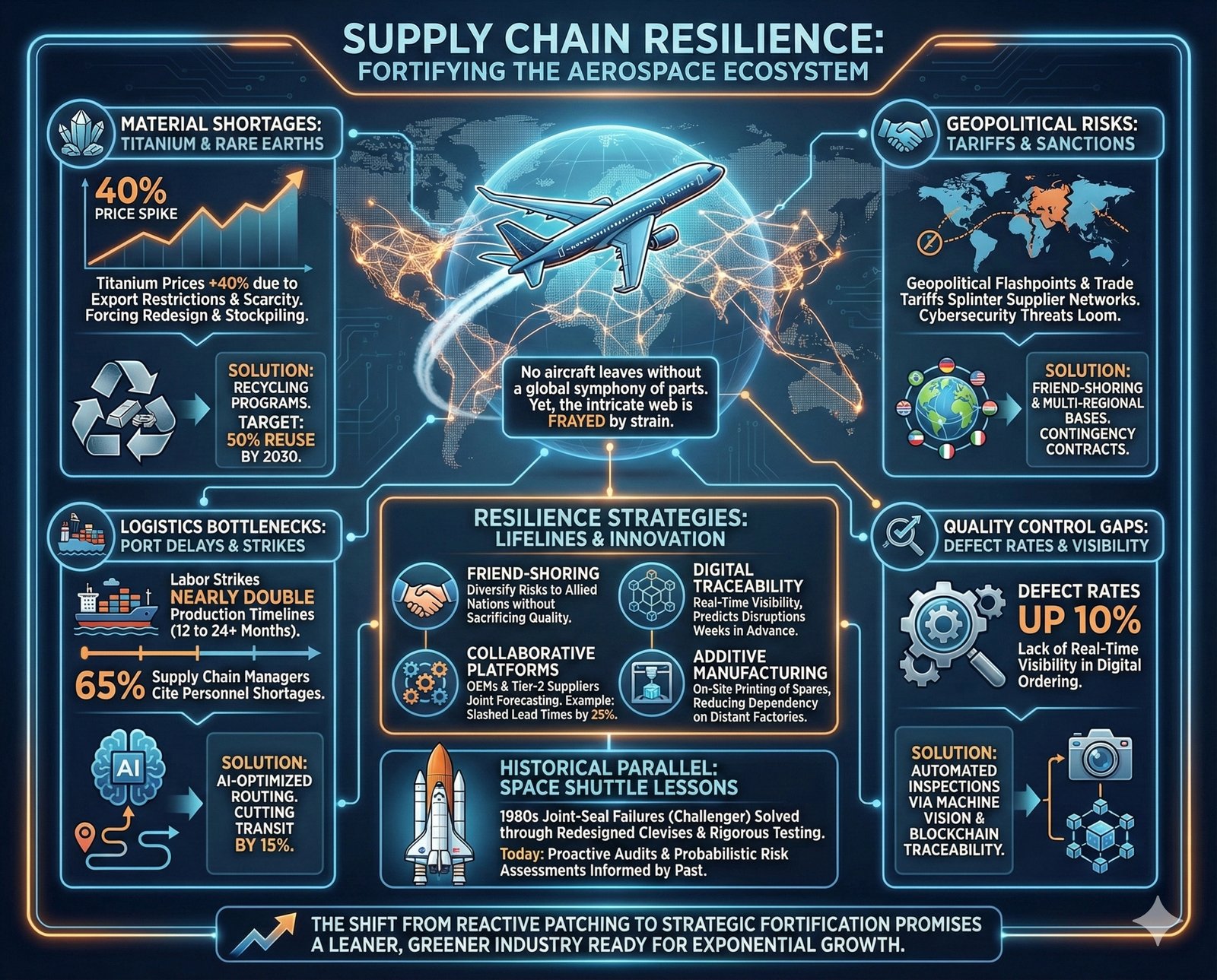
Take titanium, a cornerstone of airframes: Export restrictions from key producers have spiked prices by 40%, forcing engineers to redesign components or stockpile at premiums. Geopolitical flashpoints, like trade tariffs and regional conflicts, splinter supplier networks, while cybersecurity threats loom over digital ordering systems. The result? Backlogs exceeding 10,000 unfilled orders for commercial jets, costing billions in lost revenue.
Resilience strategies are emerging as lifelines. Friend-shoring—shifting suppliers to allied nations—diversifies risks without sacrificing quality. Digital traceability tools, powered by blockchain, offer real-time visibility, predicting disruptions weeks in advance. Collaborative platforms connect OEMs with tier-2 suppliers for joint forecasting, as seen in a consortium that slashed lead times for engine blades by 25%. Additive manufacturing shines here too, allowing on-site printing of spares, reducing dependency on distant factories.
Historical parallels abound: The Space Shuttle’s solid rocket boosters faced similar joint-seal failures in the 1980s, solved through redesigned clevises and rigorous testing. Today, those lessons inform proactive audits and probabilistic risk assessments. As supply chains evolve into adaptive ecosystems, they promise not just survival, but a leaner, greener industry ready for exponential growth.
Bullet-pointing key vulnerabilities and fixes:
- Material Shortages: Titanium and rare earths; Solution: Recycling programs targeting 50% reuse by 2030.
- Geopolitical Risks: Tariffs and sanctions; Solution: Multi-regional supplier bases with contingency contracts.
- Logistics Bottlenecks: Port delays; Solution: AI-optimized routing, cutting transit by 15%.
- Quality Control Gaps: Defect rates up 10%; Solution: Automated inspections via machine vision.
These steps underscore a shift from reactive patching to strategic fortification.
Sustainability in the Stratosphere: Engineering a Greener Trajectory
Aviation’s allure—swift, soaring travel—comes with a heavy environmental toll. Responsible for roughly 2.5% of global CO2 emissions, the sector aims for net-zero by 2050, but 2025 marks a pivotal reckoning. Contrails, fuel burn, and manufacturing footprints amplify urgency, with surveys showing 65% of stakeholders ranking sustainability as their top concern. Sustainable aviation fuels (SAF) from waste feedstocks could slash emissions by 80%, yet production scales too slowly, mired in feedstock limits and certification mazes.
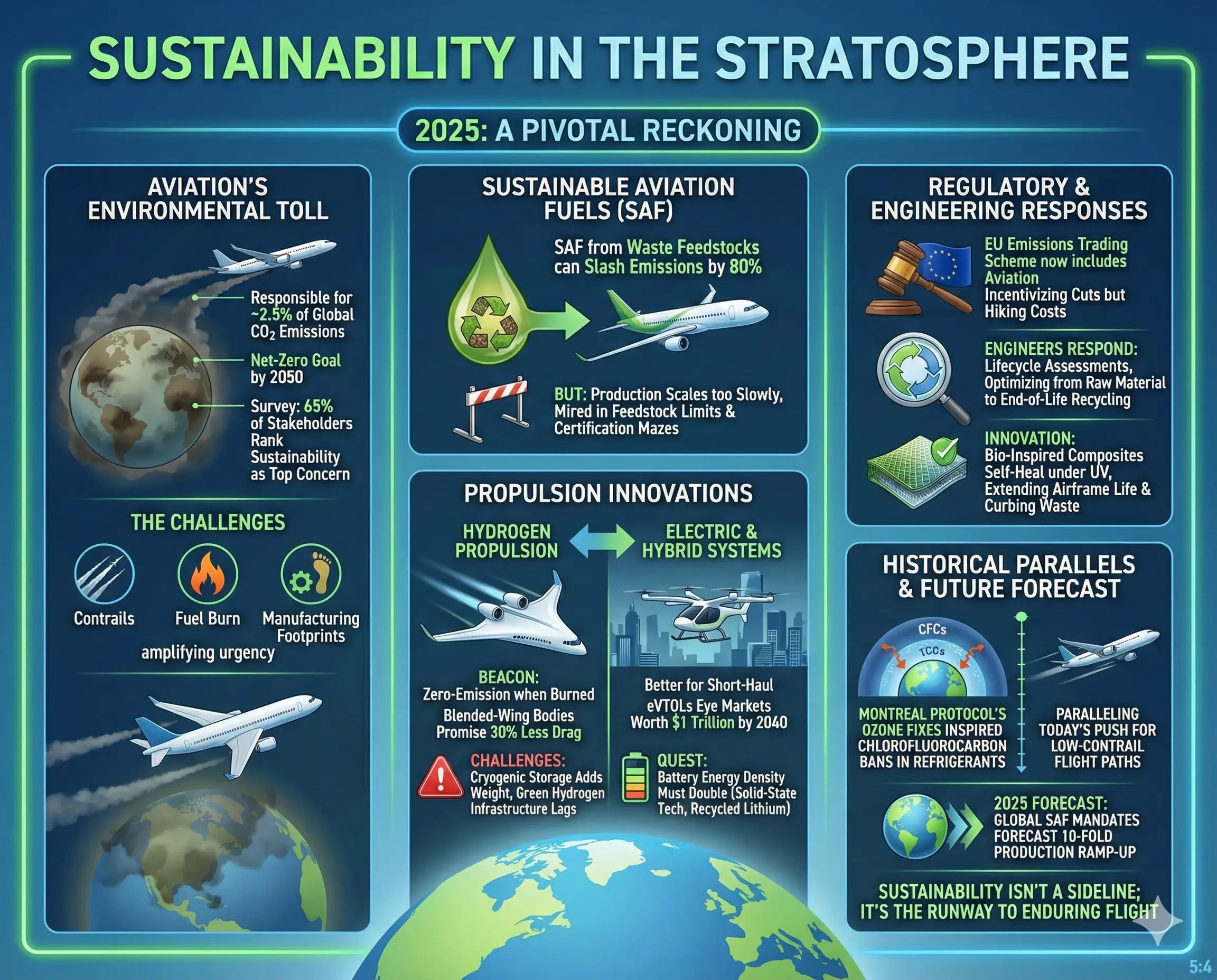
Hydrogen propulsion emerges as a beacon: Zero-emission when burned, it powers prototypes like blended-wing bodies that promise 30% less drag. Challenges persist, though—cryogenic storage adds weight, and infrastructure for green hydrogen lags. Electric and hybrid systems fare better for short-haul, with eVTOLs like urban air taxis eyeing markets worth $1 trillion by 2040. Battery energy density must double to compete, a quest involving solid-state tech and recycled lithium.
Regulatory pressures mount: The European Union’s emissions trading scheme now includes aviation, incentivizing cuts but hiking costs. Engineers respond with lifecycle assessments, optimizing from raw material extraction to end-of-life recycling. One innovation: Bio-inspired composites that self-heal under UV exposure, extending airframe life and curbing waste.
Drawing from history, the Montreal Protocol’s ozone fixes inspired chlorofluorocarbon bans in refrigerants, paralleling today’s push for low-contrail flight paths. In 2025, collaborations like global SAF mandates forecast a 10-fold production ramp-up. Sustainability isn’t a sideline; it’s the runway to enduring flight.
| Sustainability Metric | 2025 Baseline | 2050 Target | Key Enablers | Barriers |
|---|---|---|---|---|
| CO2 Emissions | 1 Gt annually | Net-zero | SAF (10% blend), hydrogen aircraft | Feedstock scarcity, infrastructure costs |
| Fuel Efficiency | 20% improvement since 2000 | 50% gain | Aerodynamic tweaks, lightweight materials | High R&D investment ($100B needed) |
| Noise Reduction | 5 dB below 2000 levels | 15 dB cut | Electric propulsion, advanced nacelles | Urban integration for eVTOLs |
| Waste Recycling | 40% of composites | 90% circularity | Additive manufacturing, bio-resins | Supply chain adoption lags |
This framework illustrates the quantifiable path forward, grounded in engineering prowess.
Aerodynamics and Flight Mechanics: Mastering the Invisible Winds
Aerodynamics remains the poetic core of aerospace, where air’s invisible dance dictates every wing’s curve and rocket’s plume. Yet, challenges abound in modeling turbulent flows, fluid-structure interactions, and high-lift systems for efficient, quiet flight. Bluff bodies generate wakes that buffet fuselages, while laminar-to-turbulent transitions defy precise prediction, complicating designs for supersonic low-boom aircraft.
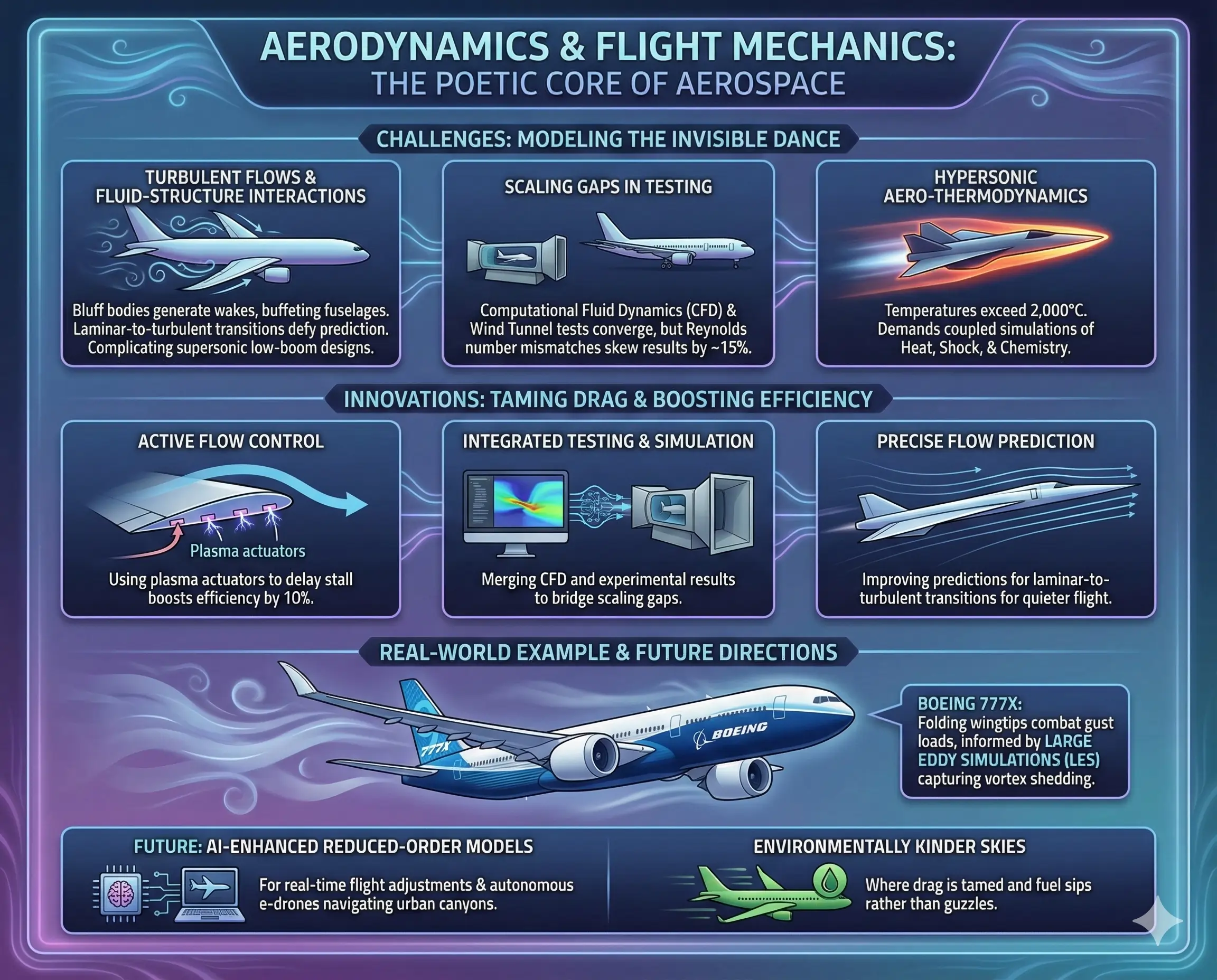
Computational fluid dynamics (CFD) and wind tunnel tests converge here, but scaling from models to full aircraft reveals gaps—Reynolds number mismatches skew results by 15%. Innovations like active flow control, using plasma actuators to delay stall, boost efficiency by 10%. For hypersonics, aero-thermodynamics challenge materials with temperatures exceeding 2,000°C, demanding coupled simulations of heat, shock, and chemistry.
Real-world example: The Boeing 777X folding wingtips combat gust loads, informed by large eddy simulations (LES) that captured vortex shedding. Future directions eye AI-enhanced reduced-order models for real-time flight adjustments, enabling e-drones to navigate urban canyons autonomously. These efforts promise environmentally kinder skies, where drag is tamed and fuel sips rather than guzzles.
Materials and Structures: Forging the Unbreakable Backbone
Lightweight yet tough, recyclable yet resilient—the mantra of modern materials engineering. Aerospace demands composites that shrug off UV rays, impacts, and cosmic radiation, all while slashing weight by 20% to extend range. Challenges peak in space: Hyper-velocity debris pummels satellites, while cryogenic fuels embrittle tanks.
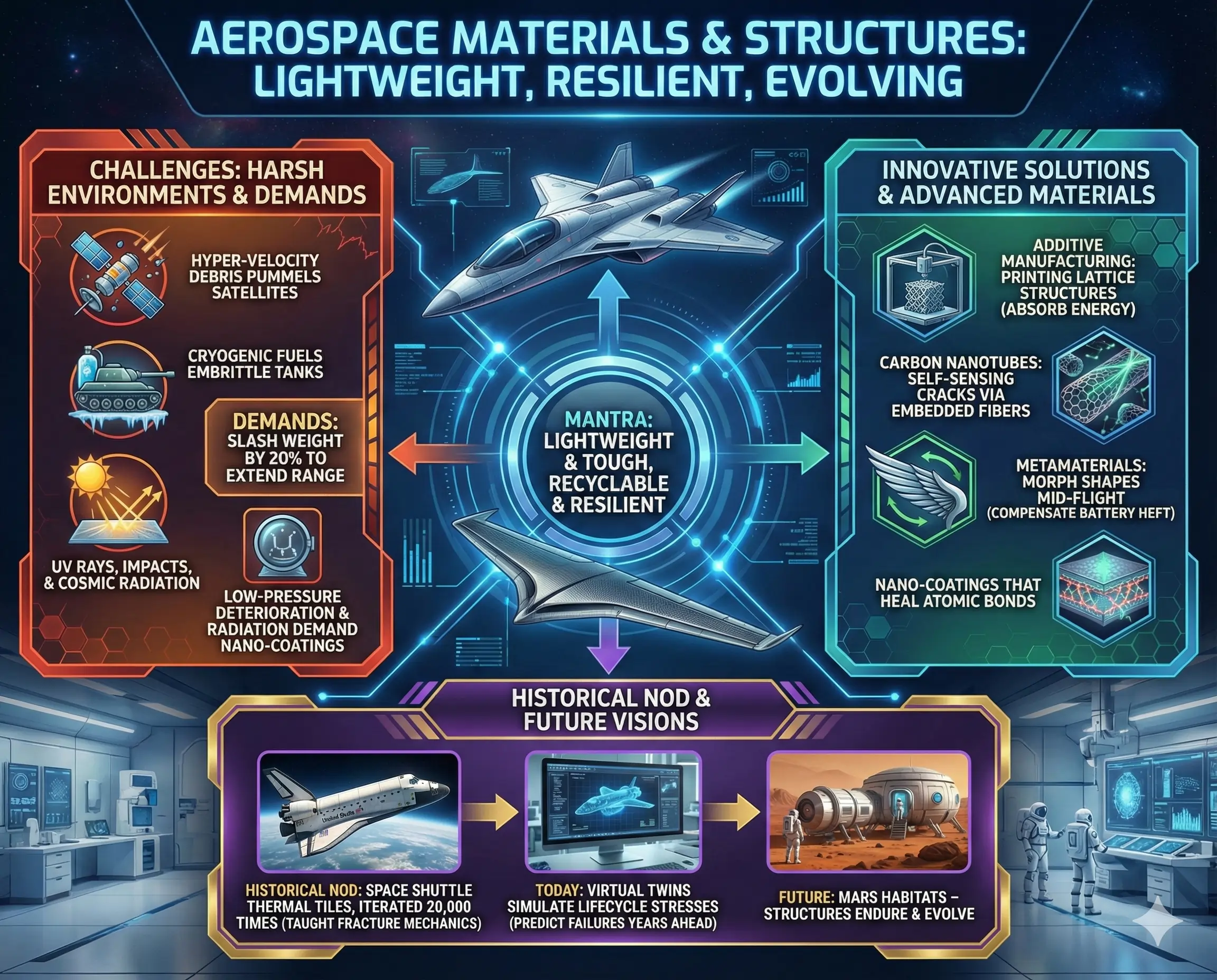
Additive manufacturing revolutionizes this, printing lattice structures that absorb energy like honeycomb. Carbon nanotubes infuse polymers with multifunctionality—self-sensing for cracks via embedded fibers. For eVTOLs, metamaterials morph shapes mid-flight, compensating battery heft. Harsh environments test limits: Low-pressure deterioration and radiation demand nano-coatings that heal atomic bonds.
Historical nod: The Space Shuttle’s thermal tiles, iterated 20,000 times post-debris strikes, taught fracture mechanics’ value. Today, virtual twins simulate lifecycle stresses, predicting failures years ahead. As we eye Mars habitats, these advances ensure structures not just endure, but evolve.
| Material Type | Key Properties | Applications | Challenges | Innovations |
|---|---|---|---|---|
| Carbon Fiber Composites | High strength-to-weight (5x steel) | Airframes, wings | Corrosion in humidity | Nano-infused for self-healing |
| Titanium Alloys | Heat-resistant to 600°C | Engines, fasteners | Supply shortages | 3D-printed custom parts |
| Ceramic Matrix Composites | Withstands 1,500°C | Turbine blades | Brittle fracture | Fiber reinforcements for toughness |
| Bio-Based Polymers | Recyclable, low CO2 footprint | Interiors, non-structural | Lower stiffness | Hybrid blends with metals |
Such tables map the material mosaic, guiding engineers toward sustainable strength.
Propulsion and Energetics: Igniting the Engines of Tomorrow
Propulsion’s quest for green power defines aerospace’s energy conundrum. Fossil fuels’ reign ends with hybrids, hydrogen, and electrics, but hurdles like power density and safety loom large. Air-breathing hypersonics battle supersonic combustion instability, where fuel-air mixing falters at Mach 5+, generating shocks that erode nozzles.
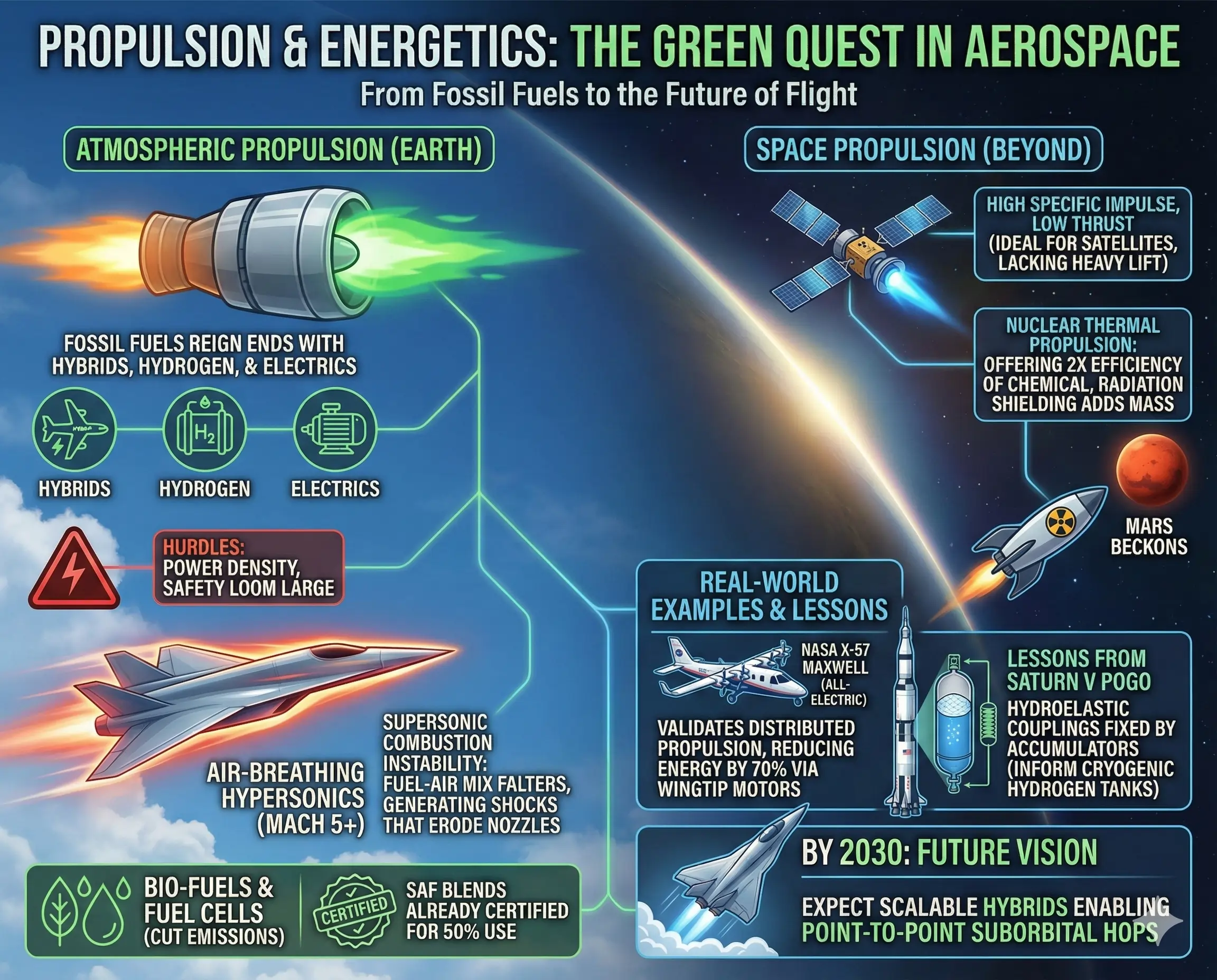
Electric thrusters for space—Hall thrusters, ion thrusters—offer high specific impulse but low thrust, ideal for satellites yet lacking for heavy lift. Nuclear thermal propulsion beckons for Mars, offering twice the efficiency of chemical propulsion, though radiation shielding adds mass. Bio-fuels and fuel cells cut emissions, with SAF blends already certified for 50% use.
Example: NASA’s X-57 Maxwell all-electric plane validates distributed propulsion, reducing energy by 70% via wingtip motors. Lessons from Saturn V pogo—hydroelastic couplings fixed by accumulators—inform cryogenic hydrogen tanks. By 2030, expect scalable hybrids enabling point-to-point suborbital hops.
Guidance, Navigation, and Control: Steering Through Uncertainty
In an era of swarms and autonomy, GNC systems must fuse multi-sensor data amid faults and threats. Challenges include loss-of-control in-flight (LOC-I), where upset recovery algorithms lag human intuition. For UAVs, cyber-physical networks demand resilient autonomy, detecting anomalies via machine learning.
AI shines in predictive envelope protection, averting stalls by 20% in simulations. Historical fix: TSS-1 tether resonances, damped by thrusters and Kalman filters. Future: Evolvable controls for deep-space probes, adapting to uncharted voids.
Intelligent Systems and Human Factors: Harmonizing Man and Machine
AI’s infusion births trustworthy autonomy, from air mobility markets ($1.9T by 2050) to space tourism. Hurdles: Certifying non-deterministic AI, resilient to hacks, and optimizing human-AI teams. Prognostics health management foresees failures, extending missions.
Example: Crew Dragon’s touchscreens blend pilot input with autonomous docking. Life support challenges—zero-g sloshing, radiation—echo Skylab corrosion fixes via guarded heaters. Ahead: Augmented reality for training, ensuring seamless synergy.
Manufacturing and Sustainment: From Blueprint to Lifelong Legacy
Complexity cascades costs; traditional silos yield to integrated product development. Systems engineering models link aerodynamics to lifecycle costs, slashing cycles by 40%. Additive and digital twins enable “lights-out” factories, but SE lacks robust tools for trade-offs.
Spacelab rack interferences, solved by match-drill techniques, highlight verification’s role. Future: Lean concepts reduce ownership costs, fostering reusable ecosystems for sustainable orbits.
Digital Transformation and AI Integration: The Code Behind the Cockpit
Digital threads weave data from design to decommissioning, but legacy systems resist. AI accelerates prototyping, yet 65% of efforts stall at proof-of-concept due to compliance. Certification for explainable AI in UAVs demands transparency, bridging tech-business divides.
Digital twins simulate Shuttle welds, predicting fatigue. In 2025, AI optimizes routes, cutting fuel 5%. Challenges: Data silos and skills mismatches, tackled by upskilling platforms.
| AI Application | Benefits | Challenges | Adoption Rate (2025) |
|---|---|---|---|
| Predictive Maintenance | 30% downtime reduction | Data privacy | 40% in commercial |
| Design Optimization | 25% faster iterations | Certification | 55% in defense |
| Autonomous Flight | Enhanced safety | Ethical decisions | 20% for drones |
| Supply Forecasting | 15% cost savings | Integration legacy | 35% industry-wide |
This snapshot reveals AI’s transformative edge, tempered by prudent rollout.
Regulations and Compliance: The Guardrails of Innovation
Stringent FAA and ITAR rules ensure safety but stifle speed. ALM/PLM tools streamline audits, tracing changes digitally. EASA harmonization aids globals, yet regional variances persist.
Example: Boeing 737 MAX recertification post-MCAS flaws emphasized fault-tolerant design. Forward: Agile frameworks for hypersonic regs.
Accelerating Innovation: From Slower Cycles to Swift Breakthroughs
Precision trumps haste, but AI-embedded software halves testing. Digital engineering responds to needs, as in rapid Starship iterations. Balancing risks yields 20% efficiency gains.
In wrapping this expansive survey, aerospace challenges mirror our collective aspirations: Bold, complex, urgent. Yet, history—from X-15 jitters to ISS triumphs—proves solutions emerge from collaboration and curiosity. As 2025 unfolds, engineers aren’t just fixing flaws; they’re forging futures where skies and stars beckon equitably, sustainably, and thrillingly.
Key Citations And References
- Addressing the U.S. Aerospace Engineering Shortage
- 9 Challenges Facing the Aerospace and Defense Industry
- Environmental Sustainability – Aerospace Industries Association
- Grand challenges in aerospace engineering – Frontiers
- A History of Aerospace Problems, Their Solutions, Their Lessons – NASA
- Aerospace supply chain report 2025: Is the crisis over?
- Scaling AI Adoption in Aerospace Engineering
- Global Aviation Sustainability Outlook 2025
Read These Articles in Detail
- Aerospace Engineering vs. Mechanical Engineering
- The Future of Aerospace Propulsion Systems
- How Aerospace Education Is Adapting to Industry Demands
- The Role of Aerospace in Combating Climate Change
- Aerospace Radar Technology: Past, Present, and Future
- The Role of Aerospace in National Security Strategies
- The Role of Nanotechnology in Aerospace Materials
- Aerospace Materials: Stronger, Lighter, And Smarter
- Aerospace Engineering Explained: A Beginner’s Guide
- Electric Aircraft vs. Hydrogen Aircraft: Which Is More Sustainable?
- Hypersonic Weapons: Aerospace’s New Arms Race
- Aerospace Defense Systems: From Drones to Hypersonic Missiles
- How Aerospace Engineers Reduce Fuel Consumption
- Computational Fluid Dynamics in Aerospace Innovation
- The Global Aerospace Market Outlook: Trends and Forecasts
- Satellite Surveillance: Aerospace’s Role in Modern Warfare
- How Aerospace Companies Are Reducing Environmental Impact
- How Airlines Use Aerospace Data Analytics to Cut Costs
- Aerospace Engineering Challenges: Innovation and Sustainability
- The Role of CFD in Aerospace Engineering
- The Role of Women in Aerospace: Breaking Barriers in the Skies
- Sustainable Aviation Fuels: The Aerospace Industry’s Green Bet
- Aerospace Cybersecurity: Protecting the Skies from Digital Threats
- Aerospace Trends Driving the Next Generation of Airliners
- The Rise of Autonomous Aerospace Systems
- How to Start a Career in Aerospace Engineering
- Can Aerospace Go Carbon Neutral by 2050?
- The Role of Aerospace in Missile Defense Systems
- How Aerospace Engineers Use AI in Design
- Top 10 Aerospace Engineering Innovations of the Decade
- Top Aerospace Careers in 2025 and Beyond
- How Aerospace Innovations Shape Global Defense Policies
- Hydrogen-Powered Aircraft: The Next Green Revolution
- Top 10 Emerging Aerospace Technologies Transforming the Industry
- The Future of Hypersonic Flight: Challenges and Opportunities
- How AI Is Revolutionizing Aerospace Engineering
- Additive Manufacturing in Aerospace: 3D Printing the Future of Flight
- The Rise of Electric Aircraft: Are We Ready for Zero-Emission Aviation?
- Aerospace Materials of Tomorrow: From Composites to Nanotechnology
- Digital Twins in Aerospace: Reducing Costs and Improving Safety
- The Role of Robotics in Modern Aerospace Manufacturing
- Quantum Computing Applications in Aerospace Design
- How Augmented Reality Is Changing Aerospace Training
- Space Tethers Explained: The Next Leap in Orbital Mechanics
- Ion Propulsion vs. Chemical Rockets: Which Will Power the Future?
- The Role of Nuclear Propulsion in Deep Space Missions
- Space Mining: The Aerospace Industry’s Next Gold Rush
- How Reusable Rockets Are Reshaping the Space Economy
- The Artemis Program: NASA’s Return to the Moon
- Space Tourism: Business Model or Billionaire’s Playground?
- How Aerospace Startups Are Disrupting Commercial Aviation
- The Economics of Low-Cost Airlines in the Aerospace Era
- Urban Air Mobility: The Rise of Flying Taxis
- The Future of Mars Colonization: Key Aerospace Challenges and Solutions Ahead
- CubeSats and Small Satellites: Democratizing Space Access
- The Future of Cargo Drones in Global Logistics
- The Role of Aerospace in Building a Lunar Economy
Frequently Asked Questions
FAQ 1: What are the biggest aerospace engineering challenges in 2025?
The aerospace industry in 2025 is buzzing with excitement over new frontiers like space tourism and electric flight, but it’s also grappling with some tough hurdles that keep engineers up at night. At the top of the list is the ongoing talent shortage, where the demand for skilled workers far outpaces what’s available, leading to delays in everything from aircraft production to satellite launches. This isn’t just about numbers; it’s about finding people who can handle cutting-edge tech like AI-driven design and sustainable materials, which many traditional programs aren’t fully equipped to teach yet.
Another major issue is supply chain disruptions, which have been lingering since the pandemic and are now worsened by geopolitical tensions and raw material shortages. For instance, delays in titanium deliveries have pushed back jet engine builds by months, costing airlines billions in extra expenses. Sustainability pressures add to the mix, with the push for net-zero emissions by 2050 forcing rapid shifts to green fuels and lighter structures, but scaling these innovations affordably remains a puzzle. Aerodynamics and propulsion are evolving too, with hypersonic speeds and electric systems testing the limits of physics and engineering know-how.
Looking ahead, these challenges are pushing the industry toward smarter solutions, like collaborative training programs and resilient supplier networks. While they slow things down, they’re also sparking creativity that could redefine how we fly and explore space.
FAQ 2: How is the talent shortage affecting the aerospace industry today?
The talent crunch in aerospace engineering has been building for years, but in 2025, it’s hitting critical levels, with projections showing the U.S. alone needing over 123,000 more technicians in the coming decades just to keep up with commercial demands. Retirements among veteran engineers who worked on iconic projects like the Space Shuttle are leaving huge knowledge gaps, while the rise of complex fields like digital twins and cybersecurity means new hires need specialized skills that aren’t always covered in standard curricula.
This shortage ripples through the entire sector, from design firms struggling to prototype next-gen drones to manufacturers facing production bottlenecks because of unfilled roles in composite fabrication. Airlines and space companies report that 65% of their projects are delayed due to staffing issues, which not only inflates costs but also hampers innovation in areas like urban air mobility.
Efforts to bridge this gap are gaining traction, with industry leaders partnering with universities for hands-on apprenticeships and diversity initiatives to bring in fresh perspectives from underrepresented groups. These programs aim to boost the workforce by 50,000 skilled workers by 2030, focusing on practical training in AI integration and sustainable design. Ultimately, addressing this human element is key to unlocking the industry’s potential for safer, greener flights.
| Impact Area | Description | Estimated Cost/Delay | Mitigation Strategies |
|---|---|---|---|
| Production Delays | Lack of technicians slows assembly lines for jets and satellites. | Up to 20% timeline extension | Apprenticeship programs with OEMs |
| Innovation Stalls | Shortage of AI and data experts hinders R&D in autonomous systems. | $5-10B annual industry loss | University-industry scholarships |
| Diversity Gaps | Only 15% women and 10% minorities in roles, limiting ideas. | Reduced creativity in problem-solving | Inclusive recruitment drives |
| Retention Challenges | High burnout leads to 15% turnover yearly. | Recruitment costs double | Mentorship and flexible work policies |
FAQ 3: What supply chain vulnerabilities are aerospace engineers facing in 2025?
Supply chains in aerospace have always been a global puzzle, piecing together parts from dozens of countries, but 2025 has amplified vulnerabilities that could ground dreams of faster, cleaner travel. Geopolitical tensions, like export restrictions on critical metals, have spiked prices for essentials such as titanium by 40%, forcing redesigns and stockpiling that eat into budgets and timelines. Labor shortages at key suppliers compound this, with strikes and skill gaps doubling production times for complex components like engine blades.
Beyond materials, cybersecurity threats are sneaking into the mix, targeting digital ordering systems and potentially halting deliveries mid-stream. The backlog of over 17,000 aircraft orders means even small disruptions cascade into massive delays, with airlines facing an extra $11 billion in costs this year alone from grounded fleets waiting for parts. Environmental factors, including climate-driven shipping route changes, add unpredictability to logistics.
Engineers are countering these pains with smart strategies: diversifying suppliers through friend-shoring to stable allies, using blockchain for real-time tracking, and ramping up additive manufacturing to print parts on-site. These steps not only build resilience but also pave the way for more efficient, transparent networks that support the industry’s growth spurt.
FAQ 4: Why is sustainability such a pressing challenge for aerospace engineering?
Sustainability isn’t just a buzzword in aerospace—it’s a survival imperative as the sector accounts for about 2.5% of global CO2 emissions, a figure set to climb with rising air travel. In 2025, the drive toward net-zero by 2050 hinges on breakthroughs like sustainable aviation fuels (SAF), which could cut emissions by up to 80%, but scaling production is bogged down by high costs—often three to five times pricier than traditional jet fuel—and limited feedstocks from waste materials.
Regulatory landscapes add pressure, with schemes like the European Union’s emissions trading forcing airlines to invest heavily in greener tech, yet fragmented policies worldwide slow global adoption. Innovations in electric propulsion and lightweight composites promise efficiency gains of 30% or more, but challenges like battery weight for long-haul flights and infrastructure for hydrogen refueling persist, demanding massive R&D investments estimated at $100 billion over the next decade.
This push is fostering collaboration across the board, from biofuel producers to aircraft designers, creating a ripple of optimism. By tackling these hurdles head-on, aerospace engineers are not only reducing environmental footprints but also opening doors to quieter, more affordable skies for everyone.
FAQ 5: How are advances in aerospace materials helping overcome engineering challenges?
Materials science is quietly revolutionizing aerospace, turning what were once stubborn obstacles into opportunities for lighter, tougher, and greener aircraft. In 2025, carbon fiber composites dominate, offering strength-to-weight ratios five times better than steel, which slashes fuel use and extends range on everything from commercial jets to Mars rovers. Yet, issues like humidity-induced corrosion and high production costs have spurred innovations such as nano-infused self-healing variants that repair micro-cracks autonomously under UV light.
Titanium alloys and ceramic matrix composites handle extreme heats up to 1,500°C in engines, but supply shortages and brittleness call for 3D-printed custom solutions that cut waste by 50%. Bio-based polymers are emerging for interiors, providing recyclable options with low CO2 footprints, though their lower stiffness requires hybrid blends with metals for structural integrity.
These advancements aren’t without trials—certification for space-grade durability takes years—but they’re enabling feats like reusable rockets and eVTOLs. As the market for advanced materials grows to $42.9 billion by 2029, engineers are blending tradition with tech to build vehicles that endure harsher environments while treading lighter on the planet.
| Material Innovation | Key Benefit | Current Challenge | Future Application |
|---|---|---|---|
| Carbon Nanotubes in Polymers | Self-sensing for early crack detection | Scalability in mass production | Hypersonic aircraft skins |
| Additive-Manufactured Titanium | 30% weight reduction | Post-processing defects | Satellite components |
| Bio-Resins for Composites | 90% recyclability | Stiffness limitations | Cabin interiors |
| Metamaterials | Shape-morphing for aerodynamics | High R&D costs | Adaptive wings on drones |
FAQ 6: What future propulsion technologies are aerospace engineers excited about?
Propulsion tech is the beating heart of aerospace progress, and in 2025, engineers are eyeing a shift from fossil fuels to electric and hybrid systems that could transform travel. Hybrid-electric propulsion, like NASA’s X-57 demonstrator, distributes motors along wings to boost efficiency by 70%, making short-haul flights quieter and greener, though battery density still limits range to under 500 miles.
Hydrogen fuel cells offer zero-emission promise for longer routes, with prototypes achieving 30% less drag in blended-wing designs, but cryogenic storage challenges add weight and require new airport infrastructure. For space, nuclear thermal systems double chemical rocket efficiency, ideal for Mars missions, yet radiation shielding and regulatory approvals pose safety hurdles.
- Electric Thrusters: High specific impulse for satellites, reducing launch costs by 20%.
- Sustainable Aviation Fuels (SAF): Blends up to 50% certified, cutting CO2 by 65% with scalable production on the horizon.
- Hypersonic Air-Breathing Engines: Mach 5+ speeds for point-to-point travel, tackling combustion instability through AI modeling.
These technologies signal a cleaner era, but integrating them demands overcoming energy supply and certification barriers to make supersonic hops and orbital jaunts routine.
FAQ 7: What role does guidance, navigation, and control play in modern aerospace challenges?
Guidance, navigation, and control (GNC) systems are the unsung heroes keeping aircraft and spacecraft on course amid chaos, but 2025’s complexities—from urban drone swarms to deep-space probes—are stretching them thin. Fault-tolerant algorithms must now predict and recover from in-flight upsets like stalls, where human pilots once relied on instinct, cutting loss-of-control incidents by 20% in simulations.
Cyber threats and sensor failures add layers of risk, requiring AI-fused multi-source data for resilient autonomy, as seen in UAV networks that self-heal during jams. Historical fixes, like damping tether resonances on space missions with Kalman filters, inform today’s evolvable controls that adapt to unknown environments.
In commercial aviation, GNC enables precise eVTOL landings in cityscapes, but certifying non-deterministic AI remains a regulatory maze. As autonomy grows, these systems promise safer skies, blending human oversight with machine precision to navigate everything from thunderstorms to asteroid fields.
FAQ 8: How is AI transforming aerospace engineering, and what challenges does it bring?
Artificial intelligence is weaving its way into every corner of aerospace, from optimizing wing shapes in hours instead of weeks to predicting maintenance failures before they ground a fleet. In 2025, AI-driven digital twins simulate entire aircraft lifecycles, slashing design iterations by 25% and aiding sustainability by fine-tuning fuel-efficient paths. Yet, trustworthiness lags—non-deterministic models make certification tricky, as regulators demand explainable decisions to avoid ethical pitfalls like biased flight routing.
Workforce shifts pose another hurdle: While AI boosts productivity, it risks displacing routine jobs, necessitating upskilling in data ethics and integration for 14% more roles requiring analysis skills by 2028. Data silos and privacy concerns further complicate adoption, with 65% of projects stalling at proof-of-concept.
Despite these, AI’s promise shines in autonomous systems and supply forecasting, saving 15% on costs. By fostering transparent, collaborative frameworks, engineers can harness it to propel the industry toward innovative, equitable heights.
| AI Application | Transformation | Key Challenge | Projected Impact by 2030 |
|---|---|---|---|
| Predictive Maintenance | 30% less downtime | Data privacy issues | $50B savings in operations |
| Design Optimization | 25% faster prototyping | Certification delays | 40% more efficient aircraft |
| Autonomous Navigation | Enhanced safety in swarms | Ethical decision-making | 20% reduction in accidents |
| Supply Chain AI | 15% cost cuts via forecasting | Legacy system integration | Resilient global networks |
FAQ 9: What regulatory hurdles are slowing aerospace innovation in 2025?
Regulations keep the skies safe, but in 2025, they’re a double-edged sword for aerospace engineers chasing breakthroughs in electric flight and hypersonics. Strict bodies like the FAA demand exhaustive testing for novel systems, such as AI autopilots, where proving fault-tolerance can stretch timelines by years, as evidenced by the prolonged recertification of updated flight controls on certain jets.
International variances add friction—Europe’s emissions trading pushes SAF adoption, while U.S. policies lag on incentives, fragmenting global standards and hiking compliance costs by 10-15% for cross-border projects. Cybersecurity mandates for connected aircraft further complicate designs, requiring embedded protections that inflate development budgets.
- Certification Bottlenecks: EASA and FAA harmonization efforts aim to streamline, but regional differences persist.
- Sustainability Rules: Net-zero mandates drive innovation but penalize slow adapters with fines.
- Export Controls: ITAR restrictions limit tech sharing, stalling international collaborations.
Agile frameworks and digital auditing tools are easing these pains, allowing faster iterations while upholding safety, ensuring regulations evolve as swiftly as the tech they govern.
FAQ 10: How is digital transformation addressing manufacturing challenges in aerospace?
Digital transformation is reshaping aerospace manufacturing from rigid assembly lines to agile, data-smart factories that tackle longstanding issues like cost overruns and waste. In 2025, digital threads connect design to decommissioning, enabling real-time tweaks that cut production cycles by 40% and predict defects via AI analytics.
Legacy systems resist integration, with 65% of digital efforts hitting snags from outdated software, but cloud-based platforms are bridging gaps, as in lights-out factories printing custom parts on demand. This shift supports sustainability by optimizing material use, reducing scrap by 30% through virtual simulations.
Challenges include upskilling workers for these tools and securing vast data flows against breaches, yet benefits like 20% efficiency gains in ownership costs make it worthwhile. From rapid Starship prototypes to lean sustainment for aging fleets, digital tools are forging a future where manufacturing matches the pace of innovation.
FAQ 11: What are the primary engineering challenges in developing hypersonic aircraft in 2025?
Hypersonic aircraft, capable of speeds exceeding Mach 5, represent the next frontier in aerospace engineering, promising rapid global travel and advanced defense capabilities. However, achieving stable flight at such velocities brings a host of technical hurdles that engineers are actively tackling this year. One of the most daunting is managing extreme aerodynamic heating, where friction with the atmosphere generates temperatures over 2,000°C, risking structural meltdown unless advanced thermal protection systems are perfected. Materials like ultra-high-temperature ceramics are in testing, but scaling them for full-scale vehicles remains tricky due to brittleness and manufacturing inconsistencies.
Another key issue lies in propulsion systems, particularly air-breathing engines that must ignite and sustain combustion amid supersonic airflow, often plagued by instability and inefficient fuel mixing. Engineers are turning to computational models and wind tunnel experiments to refine scramjet designs, yet transitioning from subsonic to hypersonic speeds without flameouts continues to demand innovative solutions like plasma ignition aids. Control and stability add further complexity, as shock waves and plasma sheaths disrupt sensors and communication, complicating navigation in real-time.
In 2025, collaborative efforts, including student challenges focused on high-speed video analysis of wind tunnel tests, are fostering fresh ideas to bridge these gaps. While prototypes show promise, full certification and economic viability could still be years away, underscoring the need for sustained investment in simulation-driven R&D.
FAQ 12: How is space debris creating sustainability issues for aerospace operations in 2025?
With over 10,800 tons of debris orbiting Earth as of mid-2025, space debris has escalated from a niche concern to a critical threat, endangering satellites, crewed missions, and emerging constellations like those for global internet coverage. The exponential growth, fueled by anti-satellite tests and satellite breakups, heightens collision risks, potentially triggering the Kessler syndrome—a cascade of fragments rendering orbits unusable. Mitigation strategies, such as passivation to prevent post-mission explosions, are gaining traction, but enforcement lags due to varying international guidelines.
Active removal technologies, including robotic arms and laser nudges, face engineering bottlenecks like precise targeting and cost-effectiveness, with demonstrations planned but not yet scaled. In-orbit servicing for repairs offers a dual benefit, yet regulatory frameworks for ownership and liability remain underdeveloped.
| Debris Management Aspect | Current Challenge | 2025 Progress | Projected Impact |
|---|---|---|---|
| Collision Risk | 36,000+ trackable objects; probability up 20% yearly | Enhanced tracking via ESA reports | 15% more mission aborts without action |
| Removal Tech | High costs ($100M+ per operation) | First demos by private firms | 10% debris reduction by 2030 |
| Regulatory Gaps | No global binding treaties | UN guidelines updates | Slower adoption in emerging space nations |
| Design Standards | Legacy satellites lack deorbit features | New passivation mandates | 50% compliance in launches by 2027 |
This table outlines the multifaceted battle against orbital clutter, emphasizing proactive design and international coordination.
FAQ 13: What obstacles are holding back urban air mobility with eVTOL vehicles in 2025?
Urban air mobility, powered by electric vertical takeoff and landing (eVTOL) vehicles, envisions transforming city commutes with quiet, emission-free flights, but 2025 reveals persistent barriers that could delay widespread adoption. Battery limitations continue to cap range at around 100-150 miles, insufficient for many metro routes, while payload constraints hinder carrying more than two passengers comfortably. Infrastructure gaps, particularly the scarcity of vertiports—dedicated landing pads integrated into urban landscapes—exacerbate this, with zoning laws and community pushback slowing site approvals.
Safety and airspace integration pose equally thorny issues, as eVTOLs must share skies with drones and helicopters under detect-and-avoid systems still maturing. Cybersecurity vulnerabilities in remote operations add risk, demanding robust encryption amid dense traffic.
Progress is evident in regulatory shifts, like FAA’s streamlined certification paths, yet full commercialization hinges on overcoming these. Here’s a breakdown of targeted approaches:
- Battery Advancements: Solid-state tech to double energy density, extending flights by 50%.
- Vertiport Development: Modular designs for rooftops, aiming for 500 global sites by 2030.
- Air Traffic Management: AI-driven UTM systems to handle 1,000+ daily operations per city.
- Public Acceptance: Noise demos and pilot programs to address equity concerns in low-income areas.
These steps signal a maturing ecosystem, poised for takeoff once hurdles clear.
FAQ 14: Why has cybersecurity become a critical focus for aerospace engineers in 2025?
Cybersecurity in aerospace has surged to the forefront in 2025, driven by the sector’s deepening reliance on interconnected systems—from smart cockpits to satellite networks—that make them prime targets for state-sponsored hacks and ransomware. Aircraft software updates, once isolated, now connect via cloud platforms, exposing vulnerabilities that could compromise flight controls or passenger data, as seen in simulated attacks disrupting navigation mid-flight. Space assets face even graver threats, with counterspace weapons evolving to jam signals or spoof GPS, endangering missions worth billions.
The challenge intensifies with legacy systems lacking modern defenses, clashing against new IoT integrations, while supply chain breaches allow malware insertion at the component level. Engineers are responding with zero-trust architectures and AI anomaly detection, but certifying these for safety-critical use demands rigorous, time-intensive audits.
Geopolitical tensions amplify urgency, as reports highlight rising incidents tied to hybrid warfare. By fostering cross-domain defenses that link ground and orbital security, the industry is building resilience, though talent shortages in cyber-aerospace expertise slow full implementation. This evolution promises safer skies, but only if innovation outpaces adversaries.
FAQ 15: What economic pressures are aerospace projects facing in terms of cost management this year?
Cost overruns plague aerospace endeavors in 2025, with supply chain snarls and labor shortages inflating budgets by up to 20% on major programs, turning ambitious visions into financial quagmires. Tariffs on critical imports like aluminum have added 10-15% to material expenses, while production delays from backlogs—exceeding 17,000 aircraft—pile on $11 billion in carrier losses through excess fuel and leasing fees.
| Cost Factor | 2025 Impact | Contributing Elements | Mitigation Tactics |
|---|---|---|---|
| Supply Disruptions | $11B airline hit; 65% cite personnel gaps | Geopolitical tariffs, strikes | Friend-shoring, digital forecasting |
| Project Overruns | 15-20% budget creep | Expertise shortages, legacy tech | Lean manufacturing, AI optimization |
| Regulatory Compliance | 10% added via audits | Evolving safety standards | Integrated PLM tools |
| Sustainability Shifts | $100B R&D demand | Green fuel transitions | Lifecycle costing models |
These dynamics highlight the need for agile financial strategies to sustain innovation amid fiscal strain.
FAQ 16: How is international collaboration helping address global aerospace engineering challenges?
International collaboration stands as a cornerstone for tackling aerospace’s sprawling issues in 2025, pooling resources and expertise to surmount barriers no single nation can conquer alone. Joint ventures, like those harmonizing emissions standards across continents, accelerate sustainable tech adoption, while shared R&D on hypersonics fosters breakthroughs in materials that withstand global threats.
Geopolitical frictions sometimes hinder progress, yet platforms for supply chain resilience enable diversified sourcing, reducing single-point failures.
Key benefits include:
- Knowledge Exchange: Cross-border apprenticeships filling talent voids with 20% more diverse hires.
- Regulatory Alignment: Unified certification speeding eVTOL market entry by 18 months.
- Innovation Acceleration: Co-funded space debris removal tech cutting costs 30%.
- Sustainability Pacts: Global SAF mandates boosting production 10-fold.
Such partnerships not only mitigate risks but amplify collective ambition, charting a unified path to stellar advancements.
FAQ 17: In what ways are advanced simulations revolutionizing aerospace testing in 2025?
Advanced simulations are reshaping aerospace testing in 2025, offering virtual proving grounds that slash physical trial costs and timelines while enhancing precision for complex scenarios like hybrid propulsion under real-world stresses. Digital twins, powered by AI and high-fidelity models, replicate entire aircraft behaviors—from aerodynamic loads to material fatigue—allowing engineers to iterate designs rapidly without the hazards of full-scale crashes.
This shift addresses traditional wind tunnel limitations, where scaling effects distort results; now, large-scale quantum-inspired models explore millions of variables, optimizing for decarbonization goals like 50% fuel savings. At events showcasing these tools, innovations in data analytics have cut certification phases by 40%, enabling faster rollout of urban air taxis.
Yet, validation against physical data remains essential to build trust, with hybrid approaches blending sims and tests yielding safer outcomes. As adoption grows, simulations democratize access, empowering smaller firms to compete and driving the industry toward more efficient, innovative horizons.
FAQ 18: What key human factors do aerospace engineers need to integrate into modern designs?
Human factors engineering ensures that aerospace systems align with pilot and crew capabilities, preventing errors in high-stakes environments, but 2025’s push for autonomy amplifies the need to blend human intuition with machine aids seamlessly.
| Human Factor | Design Challenge | Integration Strategy | 2025 Relevance |
|---|---|---|---|
| Cognitive Load | Overloaded interfaces in cockpits | Adaptive displays via AI | Reduces errors in eVTOL ops by 25% |
| Ergonomics | Fatigue from long-haul G-forces | Bio-monitored seating | Enhances space tourism comfort |
| Team Dynamics | Human-AI trust gaps | Simulation training | Vital for drone swarm control |
| Error Recovery | Upset recovery in autonomy | Haptic feedback cues | Cuts LOC-I incidents 20% |
These elements underscore a holistic approach, prioritizing people in tech-forward designs.
FAQ 19: What engineering difficulties arise with reusable spacecraft development in 2025?
Reusable spacecraft promise to slash launch costs dramatically, but engineering reusable components withstands repeated thermal cycles and micro-vibrations, with heat shields degrading after just a handful of missions despite ablative coatings.
Propulsion reusability challenges engine throats to endure cryogenic stresses without cracks, while landing precision demands advanced GNC to handle variable reentry profiles.
- Thermal Management: Iterative tile repairs to prevent breaches, targeting 100-flight lifespans.
- Structural Integrity: Fatigue monitoring via embedded sensors for 30% weight savings.
- Economic Viability: Balancing $50M per vehicle against 10x reuse economics.
- Regulatory Hurdles: FAA recerts for each variant, delaying fleets.
These trials, drawn from ongoing prototypes, propel the sector toward routine orbital access.
FAQ 20: How is climate change influencing aerospace engineering strategies today?
Climate change is reshaping aerospace engineering in 2025, not just as a emissions culprit but as a disruptor altering flight dynamics and infrastructure resilience. Rising temperatures expand air molecules, reducing lift and extending takeoff distances by up to 10% at high-altitude airports, while intensified turbulence from jet stream shifts heightens structural stresses on airframes.
A thinner upper atmosphere, warmed by greenhouse gases, slows satellite drag, complicating deorbiting and exacerbating debris woes, with models predicting 20% fewer safe orbits by 2050. Engineers counter with adaptive designs, like variable-geometry wings for efficiency in warmer climes, and lifecycle analyses prioritizing low-impact materials.
This interplay demands proactive shifts, from electrified fleets to resilient supply chains against extreme weather, ensuring the industry mitigates its footprint while adapting to a changing planet.
