An IRS tax form is an official document used in the United States to report income, claim credits, calculate tax, and tell the government and employers how much tax should be withheld or paid. The word IRS stands for the Internal Revenue Service, which is the U.S. tax agency. A tax form is not just one single paper. It is a whole family of forms and schedules, each designed for a specific job in the tax process.
For example, Form 1040 is the main individual income tax return, Form W-4 helps an employer withhold the right amount of federal income tax from a paycheck, Form W-2 reports wages paid to an employee, and Form W-9 is used to request a taxpayer identification number.
For many people, tax forms feel confusing at first. That is normal. The system is built around gathering information in pieces, then combining those pieces into one final return. Think of it like this. Your employer, bank, freelance clients, and sometimes you yourself all provide parts of the story. The IRS tax forms are the structure that brings those parts together. That is why understanding the basic form types makes tax filing much less stressful.
Table of Contents
What an IRS tax form actually does
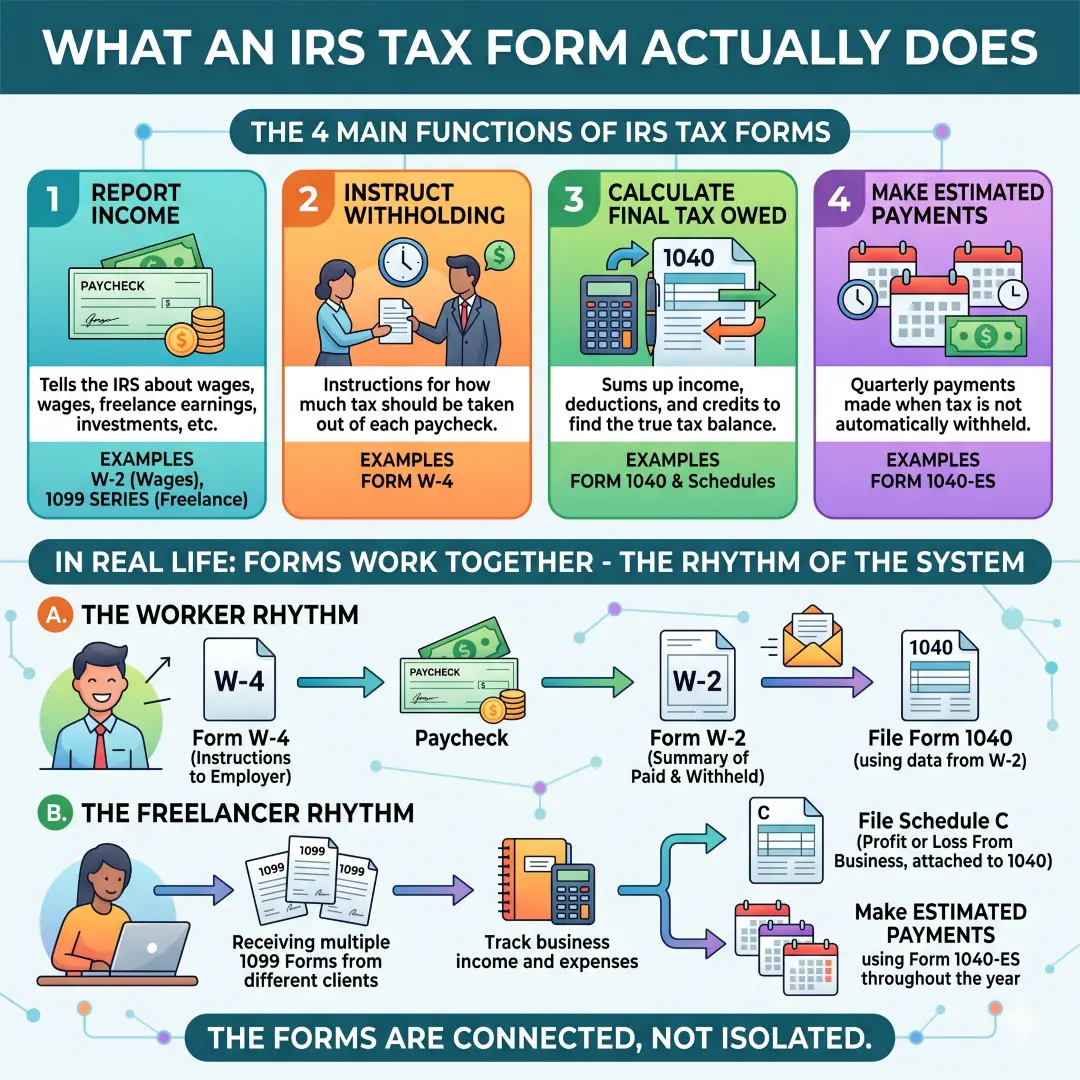
An IRS tax form does one of four things.
It may report income, such as wages or freelance earnings. It may tell a payer how much to withhold, such as with Form W-4. It may summarize what was paid to you, such as with Form W-2 or many information returns. Or it may calculate and report the final tax owed, such as with Form 1040 and its schedules. The IRS also uses forms for estimated tax, which is money paid during the year when tax is not already being withheld from income. Form 1040-ES is the standard form for that purpose.
In real life, most taxpayers do not use just one form. They use a small stack of forms that work together. A worker might fill out Form W-4, receive a Form W-2, and later file Form 1040. A freelancer might receive Form 1099-type information from clients, track business income and expenses, file Schedule C, and possibly pay estimated tax using Form 1040-ES. That is the rhythm of the system. The forms are connected, not isolated.
Why IRS tax forms matter so much
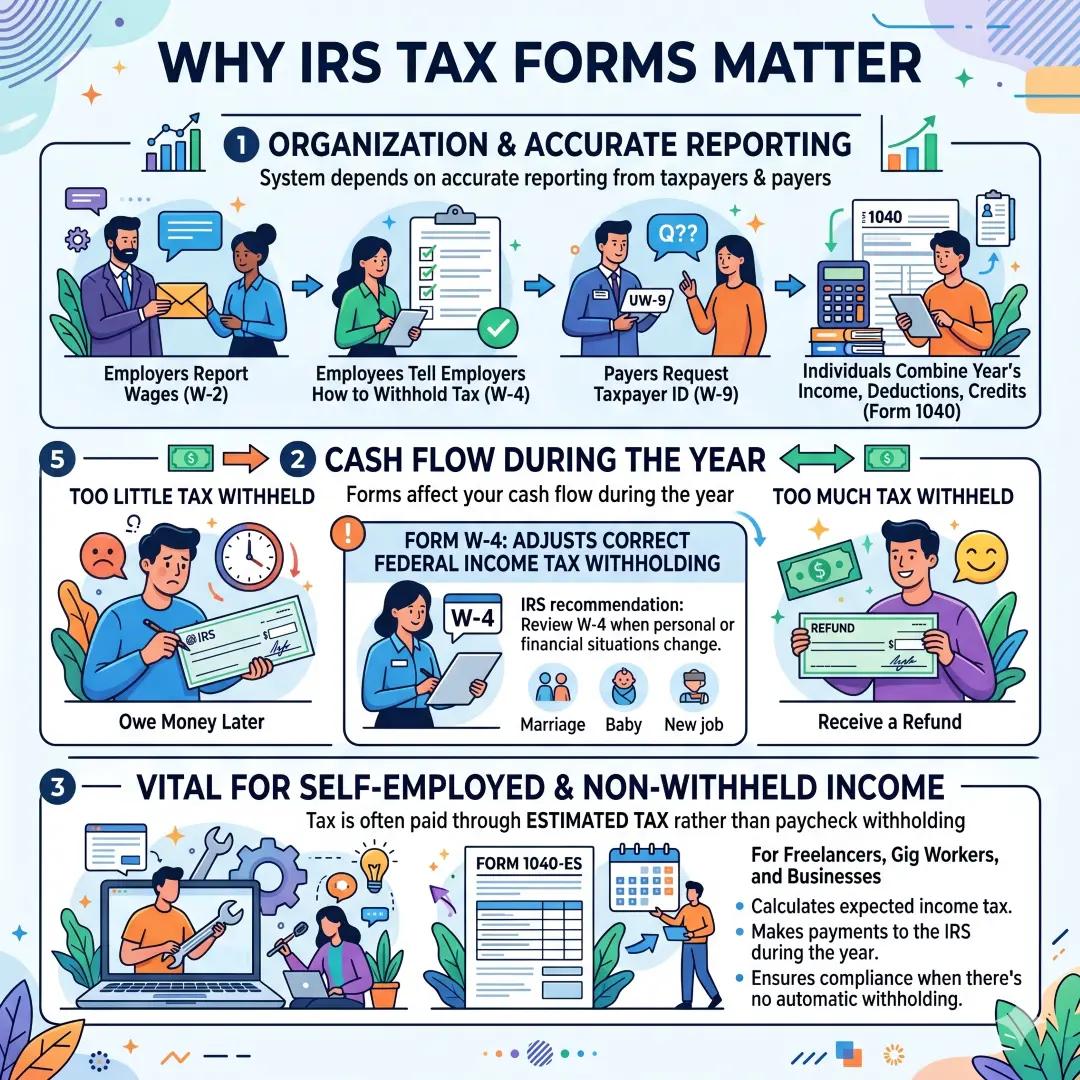
Tax forms matter because they keep the tax system organized. The U.S. income tax system depends on accurate reporting from both taxpayers and payers. Employers report wages on Form W-2. Employees tell employers how to withhold tax on Form W-4. Payers may request a taxpayer identification number using Form W-9. Individuals then use Form 1040 to bring the year’s income, deductions, credits, and tax payments together into one return.
They also matter because tax forms can affect your cash flow during the year. If too little tax is withheld, you may owe money later. If too much is withheld, you may receive a refund. The IRS says Form W-4 is used so your employer can withhold the correct federal income tax from your pay, and it recommends reviewing it when your personal or financial situation changes.
And for people who are self-employed or who earn income without withholding, tax forms matter even more. In those cases, tax is often paid through estimated tax rather than through paycheck withholding. The IRS uses Form 1040-ES for that purpose.
The main IRS tax forms you should know
The IRS has many forms, but a small group shows up again and again in ordinary life. The table below gives a practical overview.
Table 1. Common IRS tax forms and what they do
| Form | Main purpose | Who usually uses it | Why it matters |
|---|---|---|---|
| Form 1040 | Files an annual individual income tax return | Most U.S. taxpayers | This is the main return where income, deductions, credits, and taxes are reported. |
| Form 1040-SR | Alternative individual return for taxpayers age 65 or older | Older taxpayers who prefer it | It uses the same schedules and instructions as Form 1040. |
| Form W-4 | Tells an employer how much federal income tax to withhold | Employees | It helps make withholding match your situation more closely. |
| Form W-2 | Reports wages and tax information for employees | Employers and employees | It is one of the key forms used to prepare an individual tax return. |
| Form W-9 | Requests a taxpayer identification number for reporting | Payers and contractors | It helps a payer collect the correct taxpayer details for an information return. |
| Form 1040-ES | Calculates and pays estimated tax | Self-employed people and others with untaxed income | It is used when income is not subject to withholding. |
| Schedule C | Reports profit or loss from a sole proprietorship | Self-employed individuals and sole proprietors | It is used for business income and expenses. |
| Schedule SE | Figures for self-employment tax | Self-employed taxpayers | It is used to calculate self-employment tax on net earnings. |
| Schedule D | Reports capital gains and losses | Investors and people selling capital assets | It covers sales, exchanges, and some involuntary conversions. |
| Schedule E | Reports rental, royalty, partnership, S corporation, estate, and trust income | Landlords and certain investors | It handles income beyond simple wages. |
| Schedule B | Reports interest and ordinary dividends | People with investment income | It is used when those income items need to be listed. |
| Schedule F | Reports farm income and expenses | Farmers | It is used for farming businesses. |
| Schedule H | Reports household employment taxes | Household employers | It covers taxes for domestic workers. |
| Schedule 8812 | Figures the additional child tax credit | Families claiming qualifying children and dependents | It can increase a refund even when no tax is owed. |
This table shows the big idea clearly. Form 1040 is the center of the individual tax return, while the schedules and supporting forms fill in the details.
How an IRS tax form works, step by step
Table 2. The tax form process from start to finish
| Step | What happens | Typical forms involved | Simple example |
|---|---|---|---|
| 1. Income happens | You earn wages, freelance income, investment income, or business income | None yet | You work a job, run a side business, or earn interest. |
| 2. Information is reported during the year | Employers, clients, banks, and payers issue tax documents | W-2, 1099-type forms, W-9 | Your employer prepares a W-2. A client may request a W-9 before paying you. |
| 3. Withholding is set up | Your employer uses your withholding information to take the right amount from your paychecks | W-4 | You complete Form W-4 so the employer can withhold the correct tax. |
| 4. Estimated tax may be paid | If tax is not withheld, you may need to pay during the year | 1040-ES | A freelancer pays estimated tax because no employer is withholding tax. |
| 5. Final return is prepared | You combine income, deductions, credits, and payments into one return | 1040, schedules | You attach Schedule C or Schedule D if needed. |
| 6. Return is filed | You send the completed return to the IRS | Paper filing or e-file | You submit the return online or by mail. |
| 7. Refund or balance due is settled | The IRS compares the tax owed with the tax already paid | Refund, payment, or both | If too much was withheld, you may get a refund. If too little was paid, you may owe. |
This is the basic flow behind most IRS forms. The exact route changes depending on whether you are a wage earner, freelancer, investor, landlord, or small business owner, but the structure is always similar. Information is gathered, tax is calculated, and the final return shows what was paid and what is still due.
Form 1040, the main individual tax return
Form 1040 is the core individual income tax return for U.S. taxpayers. The IRS says it is used to file an annual income tax return, and Form 1040-SR is an optional alternative for taxpayers age 65 or older. Both use the same schedules and instructions.
This form collects the most important year-end numbers in one place. It asks about income, deductions, credits, and taxes already paid through withholding or estimated tax. In plain language, Form 1040 answers a simple question. After everything is counted, do you still owe tax, or have you already paid enough?
Many people do not realize that the main form is only the starting point. Depending on your situation, you may need schedules that provide more detail. The IRS lists schedules for interest and dividends, business income, capital gains, rental income, self-employment tax, household employment taxes, and more.
Form W-4, the paycheck form
Form W-4 is the form employees complete so an employer can withhold the correct federal income tax from wages. The IRS also says to consider completing a new Form W-4 each year and whenever personal or financial circumstances change.
This is one of the most practical forms in the whole system. It does not calculate your full tax return. Instead, it helps your employer estimate how much tax should be taken from each paycheck. That is why a new job, marriage, a new child, or a second source of income can all make it worthwhile to review the form again.
A good W-4 does not guarantee perfection, but it does reduce surprises later. Without it, you may withhold too little or too much, and both can be inconvenient in different ways.
Form W-2, the wage statement
Form W-2 reports wages and tax information for employees. The IRS states that an employer who pays remuneration of $600 or more for the year, including certain noncash payments, must file a Form W-2 for each employee from whom income tax, Social Security tax, or Medicare tax was withheld, or would have been withheld under certain conditions.
For employees, Form W-2 is one of the most important documents at tax time because it summarizes how much was earned and how much tax was withheld. It is often the key source document used to start a personal tax return.
For employers, it is a reporting duty. For employees, it is proof of income and withholding. That is why this form matters so much on both sides.
Form W-9, the taxpayer identification request
Form W-9 is used to request a taxpayer identification number for reporting the amount paid on an information return. In everyday language, a business or payer may ask a contractor or vendor to complete Form W-9 so the payer has the right name and taxpayer identification information before making reports to the IRS.
This form is especially common in freelance work, independent contracting, and vendor relationships. It is not usually filed by the worker with the IRS in the same way a return is filed. Instead, it is collected by the payer so the payer can do its own reporting correctly.
Form 1040-ES, estimated tax for people without withholding
Form 1040-ES is used by people whose income is not subject to withholding to figure and pay estimated tax. That usually includes many freelancers, independent contractors, and business owners, but it can also apply to people with other income that is not automatically taxed through payroll withholding.
This is an important form because taxes do not wait until the end of the year. If no money is being withheld from income as you earn it, estimated tax payments help spread the tax burden across the year instead of leaving the whole bill for April.
The schedules that attach to Form 1040
The IRS lists many schedules for Form 1040 and Form 1040-SR, and each one serves a specific purpose. Here is a quick, practical view of the ones many taxpayers run into.
Table 3. Common Form 1040 schedules and what they mean
| Schedule | What it is for | Who might need it |
|---|---|---|
| Schedule B | Interest and ordinary dividends | People with bank interest or dividend income. |
| Schedule C | Profit or loss from a sole proprietorship | Self-employed people and side business owners. |
| Schedule D | Capital gains and losses | Investors and people who sold stocks or other capital assets. |
| Schedule E | Supplemental income and loss | Landlords, royalty earners, and some partnership or trust recipients. |
| Schedule F | Farm income and expenses | Farmers. |
| Schedule H | Household employment taxes | Household employers. |
| Schedule J | Income averaging for farming or fishing | Certain farming or fishing taxpayers. |
| Schedule R | Credit for the elderly or the disabled | Eligible older or disabled taxpayers. |
| Schedule SE | Self-employment tax | Self-employed individuals. |
| Schedule 8812 | Additional child tax credit | Taxpayers claiming qualifying children and dependents. |
A useful way to think about schedules is this. Form 1040 is the main frame, and schedules are the detailed rooms added onto it when your financial life needs more space.
Three real-world examples of how IRS tax forms work
Example 1. A regular employee
Imagine someone who works a salaried job. At the start of employment, they complete Form W-4 so the employer can withhold federal income tax correctly. During the year, the employer keeps withholding tax from paychecks and later issues Form W-2. When tax season arrives, the employee uses the W-2 to prepare Form 1040.
This is the most common tax-form pattern in the country. It is simple on the surface, but it still depends on the right paperwork. If the W-4 is wrong, withholding may be off. If the W-2 has an error, the tax return can be delayed or need correction.
Example 2. A freelancer or self-employed person
Now, imagine a freelance writer or consultant. Clients may ask for Form W-9 before paying the writer. The writer may receive 1099-type information returns from payers later, depending on the situation. Because no employer is withholding tax from freelance income, the writer may need to pay estimated tax using Form 1040-ES during the year. When filing the annual return, the writer may use Schedule C for business profit or loss and Schedule SE for self-employment tax.
This is where tax forms become more active, not less. The more your income comes from nontraditional work, the more likely you are to deal with multiple forms and schedules.
Example 3. A person with investments and rental income
Consider someone who earns wages, owns rental property, and also receives dividends. That person might get Form W-2 from a job, report dividends on Schedule B, report rental activity on Schedule E, and file everything with Form 1040. If they also sold stocks, Schedule D may come into play, too.
This is a good reminder that tax life can be layered. One person can use several forms in the same year because each form describes a different kind of income or tax event.
Which forms of people usually need, based on their life situation
Table 4. Life situations and the IRS forms they often trigger
| Life situation | Forms you may see | Why do those forms show up |
|---|---|---|
| Starting a new job | W-4, later W-2 | W-4 controls withholding, and W-2 reports the year’s wages and taxes. |
| Working as an employee only | W-2, 1040 | Wages are reported to you, then included in the annual return. |
| Freelancing or side gigs | W-9, 1040-ES, Schedule C, Schedule SE | These forms handle contractor reporting, estimated tax, business profit, and self-employment tax. |
| Owning rental property | Schedule E, 1040 | Rental income and expenses are reported through Schedule E. |
| Owning investments | Schedule B, Schedule D, 1040 | Interest, dividends, and capital gains are reported through the relevant schedules. |
| Running a farm | Schedule F, 1040 | Farm income and expenses go on Schedule F. |
| Hiring a household worker | Schedule H | Household employment taxes may need to be reported. |
| Claiming child-related credits | Schedule 8812 | This helps figure out the additional child tax credit. |
| Being age 65 or older | 1040-SR | This is an optional alternative to Form 1040. |
For a worldwide blog audience, this table is helpful because it shows the logic behind U.S. tax paperwork. The forms are not random. They follow life events, work type, and income type.
How to file an IRS tax form
The IRS says you can file an original Form 1040 series return electronically, and it notes that filing electronically is faster, safer, and more accurate than mailing a paper return because the return is transmitted electronically to IRS systems.
That is one reason e-file has become the default choice for many taxpayers. It reduces manual handling, speeds up processing, and helps cut down on math errors. The IRS also offers free filing options for many taxpayers, including Free File programs and related tools.
Table 5. Filing methods at a glance
| Method | What it means | Good point | Tradeoff |
|---|---|---|---|
| E-file | Submit your return electronically | Faster and generally more accurate | You need access to a compatible service or preparer. |
| Paper filing | Mail the return to the IRS | Familiar to some taxpayers | Slower and more prone to handling delays. |
For most people, the filing method matters less than one key habit. Get the forms right before filing. A clean, complete return is easier to process than a rushed one.
Deadlines, extensions, and timing
For 2025 tax returns, the IRS states that the filing deadline is April 15, 2026. The IRS also says some taxpayers may have more time if they were affected by a federally declared disaster, lived outside the country on the due date, or were serving in or supporting work in a designated combat zone.
If you need more time, the IRS says taxpayers should request an extension by the April 15 deadline, and a timely extension can give you until October 15 to file without penalties. But the extension does not give extra time to pay tax owed. Taxes due are still due by the original deadline to avoid penalties and interest.
That distinction matters a lot. Many people hear the word extension and assume it delays everything. It does not. It usually delays the paperwork, not the payment.
Table 6. Filing timing in plain English
| Situation | What the IRS says | What it means in practice |
|---|---|---|
| Normal year-end return | The deadline for 2025 returns is April 15, 2026 | File your annual return by that date unless you qualify for more time. |
| Need more time to prepare | Request an extension by April 15 | You can usually file later, up to October 15, without filing penalties. |
| Still owe tax | An extension does not extend the payment time | Pay by the original deadline to avoid penalties and interest. |
| Live abroad or in a combat zone | You may get more time | Special rules can apply to your filing date. |
Common mistakes people make with IRS tax forms
One common mistake is using the wrong form or forgetting a schedule. Since Form 1040 can be paired with many schedules, people sometimes file an incomplete return simply because they did not realize another form was needed. The IRS schedule list shows how many situations require extra detail, including dividends, business income, capital gains, rental income, household employment, and self-employment tax.
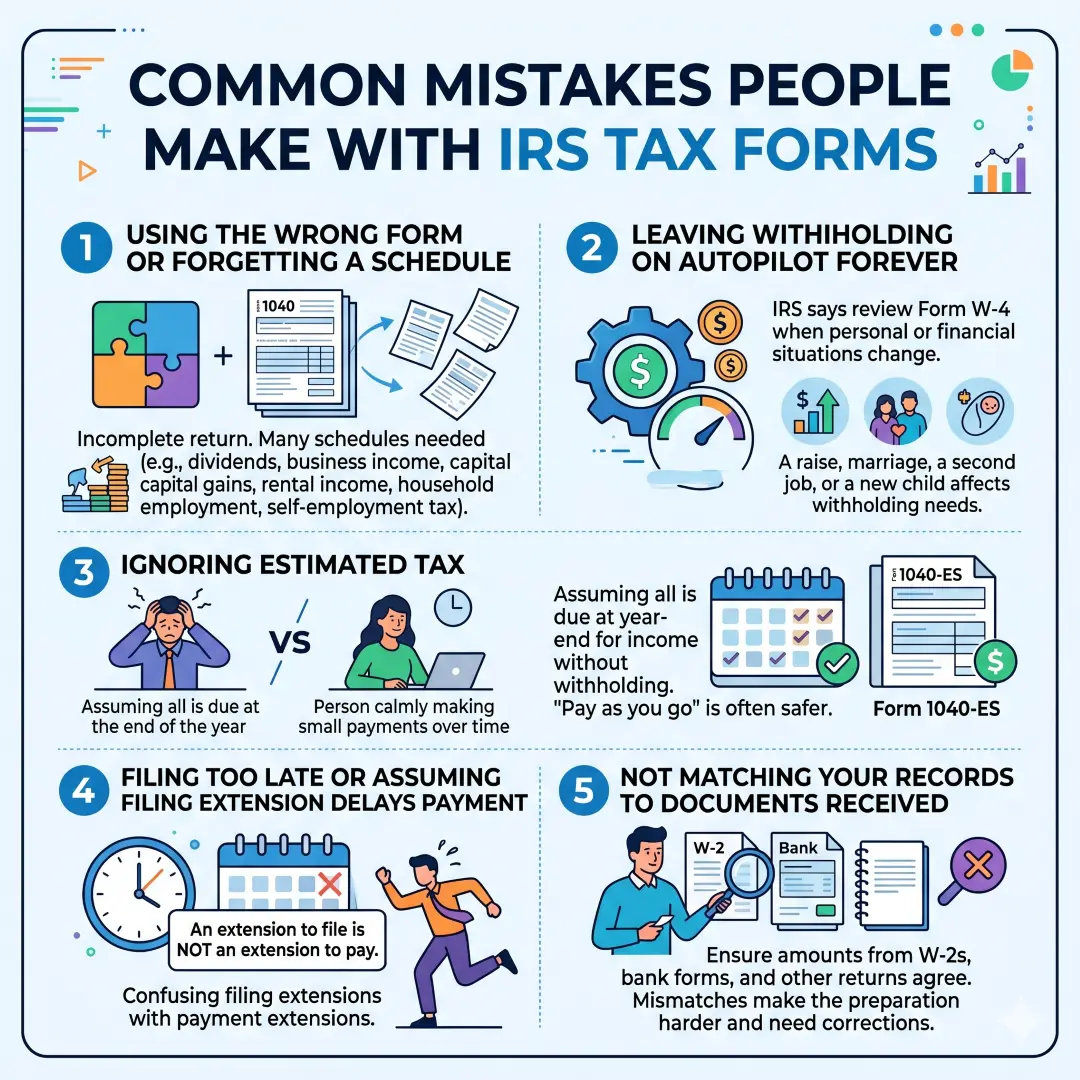
Another mistake is leaving withholding on autopilot forever. The IRS specifically says to review Form W-4 when your personal or financial situation changes. A raise, marriage, a second job, or a new child can all affect your withholding needs.
A third mistake is ignoring estimated tax. People who earn money without withholding sometimes assume they can handle everything at year-end, but Form 1040-ES exists because that is not always practical. Paying as you go is often the safer path.
A fourth mistake is filing too late or assuming a filing extension also delays payment. The IRS is very clear that an extension to file is not an extension to pay.
A fifth mistake is not matching your records to the documents you receive. W-2 amounts, bank forms, and other information returns should agree with your records. If they do not, the return can become harder to prepare and may need correction.
A smart way to keep your tax form process organized
There is nothing glamorous about tax paperwork, but a little structure helps a lot. Start by gathering income documents, then check whether any withholding forms or estimated tax forms apply to you. After that, determine whether your return needs any schedules. Only then should you fill out the main return. That approach matches the way the IRS system is built.
Here is a simple personal checklist you can use.
- Collect W-2s, 1099s, and similar income records.
- Review your W-4 if your job or household situation has changed.
- Check whether you need Schedule C, Schedule D, Schedule E, Schedule SE, or another schedule.
- See whether estimated tax payments should be made with Form 1040-ES.
- File Form 1040 once the return is complete.
This simple sequence helps turn a messy task into a manageable one.
Why IRS tax forms still confuse so many people
Even though the system is logical, it can still feel overwhelming because tax forms mix together three different jobs at once. They collect income data, tell the IRS what happened during the year, and calculate what should happen next. That is a lot for one paperwork system to carry.
There is also the issue of changing life stages. A student might only need a simple return one year, then suddenly need W-2, Schedule C, or Schedule D the next year. A household can go from easy filing to more complex filing very quickly. That is normal. It does not mean the taxpayer is doing anything wrong. It just means the tax form system is matching real life.
And because tax rules change over time, even familiar forms can get updated. The IRS posts current revisions and instructions for its forms, which is another reason it is wise to use the latest version instead of an old copy saved from a previous year.
Final thoughts
An IRS tax form is really a set of tools, not a single document. Form W-4 helps set withholding, Form W-2 reports wages, Form W-9 gathers taxpayer information for reporting, Form 1040-ES handles estimated tax, and Form 1040 brings everything together at the end of the year. Schedules such as Schedule C, Schedule D, Schedule E, and Schedule SE add detail when your income or tax situation needs it.
Once you see the structure, the system becomes easier to understand. Tax forms are not there to confuse people on purpose. They are there to track income, withholding, deductions, credits, and payments in a way the IRS can process. For a worldwide reader, that is the main lesson. Every tax system needs a way to turn real life into numbers, and IRS forms are the U.S. version of that process.
If you understand the purpose of each form and how the pieces fit together, tax season stops feeling like a mystery and starts feeling like a process. And once a process is clear, it is much easier to handle.
Article’s References and Sources
- Internal Revenue Service (IRS): About Form 1040 (U.S. Individual Income Tax Return)
- Internal Revenue Service (IRS): About Form W-4 (Employee’s Withholding Certificate)
- Internal Revenue Service (IRS): About Form W-2 (Wage and Tax Statement)
- Internal Revenue Service (IRS): Forms and Instructions (General IRS Forms Directory)
- Internal Revenue Service (IRS): Schedules for Form 1040 and Form 1040-SR
- Internal Revenue Service (IRS): Electronic Filing (E-file) FAQs
- Internal Revenue Service (IRS): File Your Taxes for Free (IRS Free File Program)
- Internal Revenue Service (IRS): How to File Your Taxes (Individuals)
- Internal Revenue Service (IRS): Tax Filing Extensions Guidance
Frequently Asked Questions
FAQ 1. What is an IRS tax form, and why is it important?
An IRS tax form is an official form used in the United States to report income, calculate tax, claim credits, and show how much tax has already been paid through withholding or estimated payments. The IRS stands for the Internal Revenue Service, which is the U.S. government agency that handles federal taxes.
The reason these forms matter is simple. They help connect the money you earn with the tax you owe. Without tax forms, there would be no clear record of wages, freelance income, investment income, deductions, or tax payments. That would make the whole system hard to manage for both taxpayers and the government.
Most people deal with a few common tax forms every year. For example, an employee may fill out Form W-4 when starting a job, receive Form W-2 at the end of the year, and then use Form 1040 to file a tax return. A freelancer might also use Form W-9, Form 1040-ES, and Schedule C. These forms work together like pieces of one larger puzzle.
An IRS tax form is not just paperwork. It is part of the process that tells the story of your yearly finances. If the forms are correct, your return is more likely to be accurate, too. And that can help you avoid delays, mistakes, or surprise tax bills.
FAQ 2. What is the main IRS tax form most people use?
The main IRS tax form for most individuals is Form 1040, also called the U.S. Individual Income Tax Return. This is the central form used to report your annual income, deductions, credits, and final tax result. It is the form that pulls everything together at tax time.
Think of Form 1040 as the main summary page of your tax return. It is where your income from work, self-employment, interest, dividends, and other sources is brought into one place. It is also where the tax already paid during the year is compared with the tax you actually owe. If you paid too much, you may get a refund. If you paid too little, you may owe more.
Some taxpayers use Form 1040-SR instead of the regular version. This form is available for older taxpayers and uses the same basic rules and schedules as
Form 1040. The difference is mostly in presentation and readability.
But Form 1040 is rarely used completely alone. Many people need extra schedules, such as Schedule C for business income, Schedule D for capital gains, or Schedule E for rental income. These extra forms give the IRS more detail about your financial situation.
So, if you want to understand the U.S. tax system, Form 1040 is the place to start. It is the backbone of the individual tax return, and most other forms support it in one way or another.
FAQ 3. What is the difference between Form W-4, Form W-2, and Form 1040?
These three forms are connected, but they do very different jobs.
Form W-4 is filled out by an employee when starting a job or when personal circumstances change. It tells the employer how much federal income tax to withhold from each paycheck. This form affects your pay throughout the year. It does not file your taxes. It helps set up withholding.
Form W-2 is given to you by your employer after the year ends. It shows how much you earned, how much tax was withheld, and how much Social Security and Medicare tax was taken out. This is one of the key forms you use when preparing your tax return.
Form 1040 is the actual annual tax return that you file with the IRS. It combines the information from your income forms, deductions, credits, and withholding records. This form helps determine whether you get a refund, owe more tax, or end up even.
A simple way to remember the difference is this.
1. W-4 tells your employer how much tax to take out.
2. W-2 reports what happened during the year.
3. 1040 is the final return you file.
That is why these forms often appear together in a normal tax season. They are part of one process, but each one has its own purpose.
FAQ 4. What is Form W-4 used for, and when should I update it?
Form W-4 is used to tell your employer how much federal income tax should be withheld from your paycheck. It matters because withholding affects how much tax you pay during the year. If the form is set correctly, you are less likely to owe a large amount later or receive a very large refund that is really just money you overpaid earlier.
You should review and update your W-4 when your life changes in a way that affects taxes. Common examples include:
1. Starting a new job
2. Getting married
3. Having a child
4. Taking on a second job
5. Becoming self-employed on the side
6. Experiencing a big change in income
A lot of people forget about Form W-4 after they submit it once. But tax life changes. If your situation changes and the form stays the same, your withholding may no longer match your real tax picture.
For example, someone who starts a second job may find that not enough tax is being withheld overall. Someone who gets married may need to think differently about withholding depending on how both incomes fit together. That is why the IRS recommends reviewing the form from time to time.
So, Form W-4 is not a one-time form for life. It is a form you should revisit when your income or family situation changes.
FAQ 5. What is Form W-2, and why is it so important at tax time?
Form W-2 is a wage and tax statement that employers give to employees after the end of the year. It shows how much money you earned as an employee and how much tax was already withheld from your paychecks.
This form is important because it gives you the numbers you need to prepare your tax return. Your wages, federal tax withholding, Social Security tax, and Medicare tax are all reported here. In other words, Form W-2 is one of the main documents that tells the IRS what you earned and what was already paid in tax.
Most employees need this form to file Form 1040 accurately. If the W-2 is wrong, the return can also be wrong. That is why people should keep their W-2s safe and compare them carefully with their own records.
It is also important because it helps prove income. If you apply for a loan, a mortgage, or certain financial services, your W-2 may be used as income evidence. So even outside tax season, it can matter in practical ways.
For employees, Form W-2 is one of the most valuable tax documents of the year. It is the bridge between your paycheck and your tax return.
FAQ 6. What is Form W-9, and who usually fills it out?
Form W-9 is used to provide a taxpayer identification number to a person or business that needs it for reporting purposes. It is most often used by freelancers, independent contractors, vendors, and other nonemployee workers.
Unlike Form W-4, which is given to an employer for payroll withholding, Form W-9 is usually given to a client, business, or payer. The payer uses the information from the form to prepare tax reporting documents later. That is why it is so common in freelance work and independent contracting.
For example, if a company hires you to write, design, consult, or provide another service as an independent contractor, they may ask you to complete a W-9 before paying you. This helps them collect the correct legal name and taxpayer identification number. It reduces reporting mistakes later.
The form is not usually something you file directly with your tax return. It is more of a background document used to support accurate reporting. Still, it plays a big role in the tax process because it helps businesses report payments correctly.
So, if Form W-4 belongs more to employees, Form W-9 belongs more to nonemployees. It is a simple form, but it is very important in the world of freelance and contract work.
FAQ 7. What is estimated tax, and who needs to pay it?
Estimated tax is the tax you pay during the year on income that is not subject to enough withholding. It is common for self-employed people, freelancers, business owners, investors, and others who earn money without automatic payroll withholding.
The IRS uses Form 1040-ES to help figure and pay estimated tax. The reason this matters is that the U.S. tax system expects tax to be paid as income is earned, not just at the end of the year. If no tax is taken out automatically, estimated tax payments help keep things on track.
A good example is a freelancer. If you write articles, design websites, or consult for clients, those payments may not have tax withheld from them. That means you may need to set aside money yourself and send tax payments during the year using the estimated tax system.
Another example is someone who has investment income or rental income that is not fully covered by withholding. That person may also need to make estimated payments.
Estimated tax can feel awkward at first, but it is actually useful. It spreads out the tax burden instead of forcing one large payment at the end of the year. That can make budgeting easier and help reduce surprises.
So, if your income is not fully taxed through a paycheck, estimated tax is probably something you should understand.
FAQ 8. What are IRS schedules, and why do some people need them?
IRS schedules are extra forms that attach to Form 1040 and give more detail about specific types of income, deductions, or taxes. They are used when your tax situation is more than just simple wages from a single employer.
For example:
1. Schedule C reports business income or loss from a sole proprietorship.
2. Schedule D reports capital gains and losses.
3. Schedule E reports rental income, royalties, and some partnership or trust income.
4. Schedule SE calculates self-employment tax.
5. Schedule B reports interest and ordinary dividends.
These schedules are important because they keep Form 1040 from becoming too crowded and confusing. Instead of putting everything on one page, the IRS separates different topics into different forms.
People often need schedules when they have side income, investment income, rental properties, or self-employment earnings. A full-time employee with one W-2 may need fewer schedules than someone who also runs a business or owns investment property.
A helpful way to think about schedules is this. Form 1040 is the main form, and the schedules are the supporting pages that explain the details. If your finances are simple, you may need only a few. If your finances are more complex, you may need several.
That is not unusual. It just means your tax return needs more room to explain your income.
FAQ 9. How do IRS tax forms work together during the tax year?
IRS tax forms work like a connected system. One form does not usually stand alone. Instead, each form plays a role at a different stage of the year.
Here is the basic flow.
At the beginning of a job, you may complete Form W-4 so your employer knows how much tax to withhold. During the year, your employer uses that information to process your paychecks. At the end of the year, the employer gives you Form W-2, which shows what you earned and what tax was withheld.
If you are self-employed or earn income that is not automatically taxed, you may use Form W-9 for reporting purposes and Form 1040-ES to pay estimated tax. If you run a business, you may also need Schedule C and Schedule SE.
When tax season arrives, you use all those records to prepare Form 1040. If your financial life includes investments, rental property, or certain other income sources, you may also need schedules like Schedule B, Schedule D, or Schedule E.
So the forms are not random. They are connected in a logical order.
1. W-4 helps set withholding.
2. W-2 reports wages.
3. W-9 supports reporting for nonemployees.
4. 1040-ES covers estimated tax.
5. 1040 is the final yearly return.
Once you understand that chain, the whole process becomes easier to follow.
FAQ 10. What is the easiest way to keep IRS tax forms organized and avoid mistakes?
The easiest way to stay organized is to keep your tax forms and income records together throughout the year, not just at the last minute. Tax season becomes much easier when you already know where everything is.
A good system usually includes these habits:
1. Save every W-2, 1099, and other tax document as it arrives.
2. Keep copies of your W-4 and any updated payroll forms.
3. Track freelance or side income carefully.
4. Save receipts for business expenses if you are self-employed.
5. Watch for estimated tax deadlines if tax is not withheld from your income.
6. Review your forms before filing so names, numbers, and amounts match.
It also helps to understand what each form is for. Many mistakes happen because people try to file quickly without knowing whether they need an extra schedule or a correction. For example, someone might forget Schedule C for side business income or overlook Schedule D for investment sales.
Another smart habit is to update your withholding when life changes. A new job, marriage, or second income can all affect your tax picture. That means a fresh W-4 may be necessary.
And finally, do not wait until the deadline to begin. The earlier you collect your forms, the easier it is to spot missing information or errors.
The goal is not perfection. The goal is a clean, accurate return that reflects your real financial life. That is what IRS tax forms are for in the first place.
Article Disclaimer
The information provided in this article, “What Is an IRS Tax Form and How It Works,” is intended for general informational and educational purposes only. It is not meant to serve as legal, financial, or tax advice. While every effort has been made to present accurate and up-to-date information about IRS tax forms, including Form 1040, Form W-4, Form W-2, Form W-9, and related schedules, tax laws and regulations can change over time and may vary depending on individual circumstances.
Tax situations are often unique and can be influenced by many factors such as income type, residency status, business activity, investments, deductions, and credits. Because of this, the guidance in this article may not fully apply to your specific situation. You should not rely solely on this content when making important tax decisions or filing your tax return.
Readers are strongly encouraged to consult a qualified tax professional, such as a certified public accountant (CPA), tax advisor, or licensed financial expert, for personalized advice tailored to their individual financial situation. A professional can help interpret complex tax rules, ensure compliance with current regulations, and reduce the risk of errors or penalties.
Additionally, official instructions and updates provided by the Internal Revenue Service (IRS) should always be reviewed when preparing or filing any tax-related documents. Government-issued forms, instructions, and publications are the most reliable sources for the latest rules and requirements.
The author and publisher of this article do not assume any responsibility or liability for errors, omissions, or any actions taken based on the information presented. By reading this content, you acknowledge that any reliance on the material is at your own discretion and risk.
Finally, this article does not establish any client–advisor relationship between the reader and the author. It is designed to simplify complex topics and improve general understanding, not to replace professional guidance.
