

Apple’s success under Tim Cook is not just a story about stylish devices or clever marketing. It is a story about a carefully designed business model that combines premium hardware, a powerful services layer, an extremely efficient global supply chain, strong customer loyalty, and a disciplined approach to capital allocation. Cook became Apple’s CEO in August 2011, after previously serving as the company’s chief operating officer, where he was responsible for worldwide sales, operations, supply chain management, and support. That background matters because Apple under Cook has often looked less like a company chasing hype and more like a company refining a system.
What makes this model so effective is that Apple does not depend on one single source of strength. It earns money from hardware, but it also earns heavily from Services such as the App Store, AppleCare, iCloud, Apple Music, Apple TV+, Apple Pay, and Apple Card. It sells through a blend of direct and indirect channels. It builds its own chips for greater control over performance. It protects its brand with a strong privacy message. It also uses sustainability and environmental goals as part of the company identity, not as an afterthought.
Apple’s own annual report says the company designs, manufactures, and markets its devices and related services, and it manages its business across global regions while selling directly through retail and online stores, plus indirect channels like carriers, wholesalers, retailers, and resellers.
Table of Contents
1. Apple’s Business Model in One Clear Idea
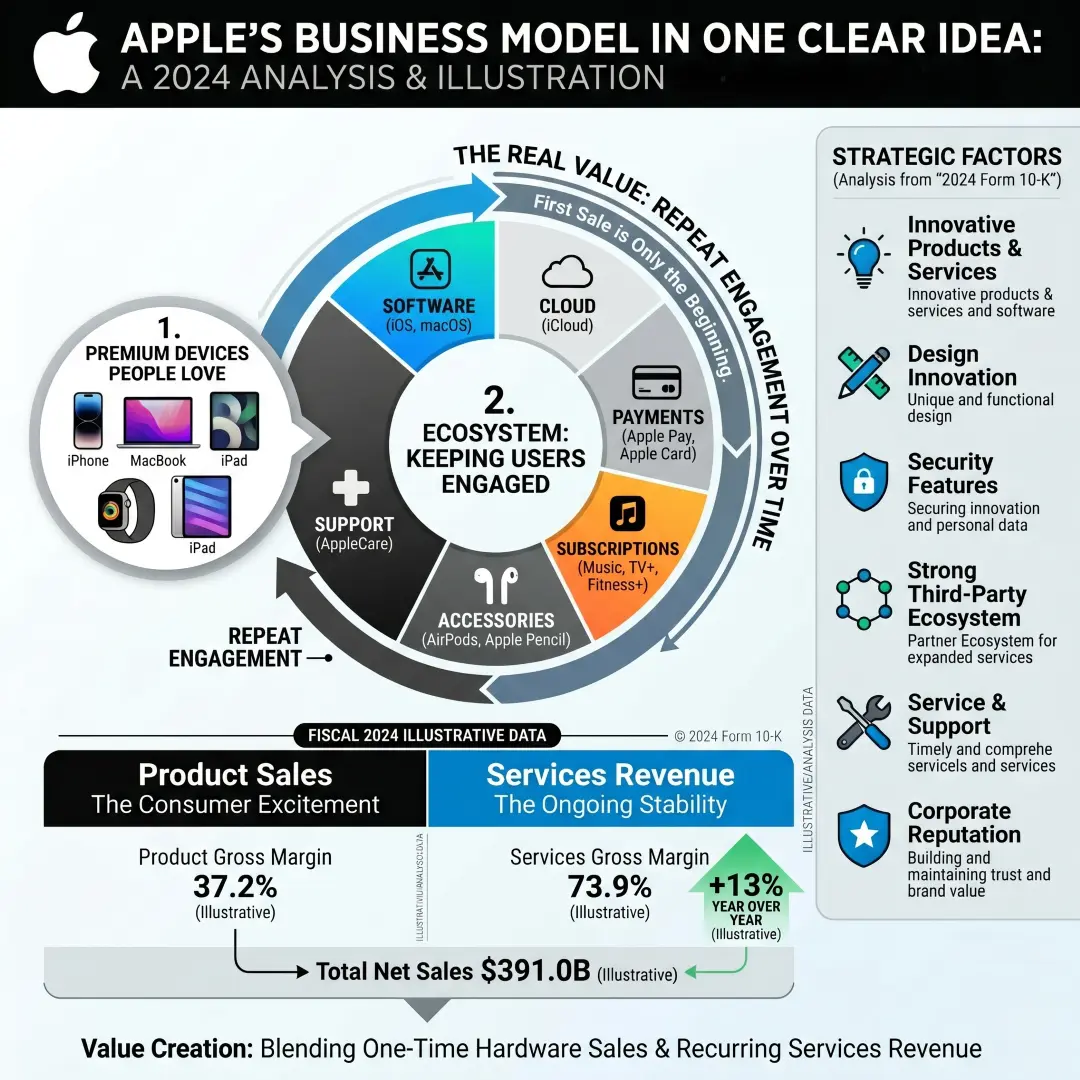
At the center of Apple’s model is a simple formula. Apple sells premium devices that people love, then keeps those users inside a broader ecosystem of software, cloud services, payments, subscriptions, accessories, and support. That means the first sale is only the beginning. The real value comes from repeat engagement over time. Apple’s 2024 Form 10-K shows that the company believes its competitive strength depends on the timely introduction of innovative products, services, and technologies, along with design innovation, security features, a strong third-party ecosystem, service and support, and corporate reputation.
This model is powerful because it blends one-time product sales with recurring revenue. In practice, that gives Apple both the excitement of consumer hardware and the stability of ongoing services revenue. In fiscal 2024, Apple reported total net sales of $391.0 billion, with Services alone contributing $96.2 billion, up 13 percent year over year. Services’ gross margin was 73.9 percent, far higher than the product’s gross margin at 37.2 percent. That gap is one of the clearest signs of how Apple’s business model creates value.
2. The Core Pillars of Apple’s Tim Cook Era
| Business Pillar | How Apple Uses It | Why It Matters | Evidence |
|---|---|---|---|
| Premium hardware | Sells iPhone, Mac, iPad, Apple Watch, AirPods, Vision Pro, and related accessories | Hardware creates the installed base and the first customer relationship | D18RN0P25NWR6D Cloudfront |
| Services layer | Monetizes users through App Store, AppleCare, cloud, digital content, and payments | Recurring, high-margin revenue increases profitability | D18RN0P25NWR6D Cloudfront |
| Ecosystem lock-in | Connects hardware, software, and services across devices | Makes the user experience smoother and switching harder | D18RN0P25NWR6D Cloudfront |
| Direct distribution | Sells through Apple Stores, online stores, and direct sales teams | Controls the customer experience and brand presentation | D18RN0P25NWR6D Cloudfront |
| Indirect distribution | Uses carriers, wholesalers, retailers, and resellers | Extends reach across global markets | D18RN0P25NWR6D Cloudfront |
| Custom silicon | Designs Apple silicon for key products | Improves performance, control, and platform integration | Apple Newsroom |
| Privacy and trust | Positions privacy as a core value | Strengthens brand trust and product differentiation | Apple Newsroom |
| Capital returns | Buys back shares and pays dividends | Rewards shareholders and signals financial strength | D18RN0P25NWR6D Cloudfront |
| Sustainability | Pushes carbon neutrality and supply chain decarbonization | Supports brand, operations, and long-term resilience | Apple Newsroom |
3. Why Hardware Still Matters So Much
Some people describe Apple as a services company now, but that is only partly true. Apple is still deeply a hardware company. Its devices are the gateway to everything else. The annual report lists iPhone, Mac, iPad, wearables, home products, and accessories as the company’s major product categories. In fiscal 2024, iPhone net sales were $201.2 billion, Mac was $30.0 billion, iPad was $26.7 billion, and Wearables, Home, and Accessories were $37.0 billion.
The brilliance of Apple’s model is that even when one category grows slowly, the ecosystem keeps working. In 2024, iPhone sales were relatively flat, yet Apple still delivered total growth because Services increased strongly and Mac grew modestly. That is a key Cook-era lesson. A mature hardware line can still power a growing business if it feeds a healthy services layer and keeps the installed base active.
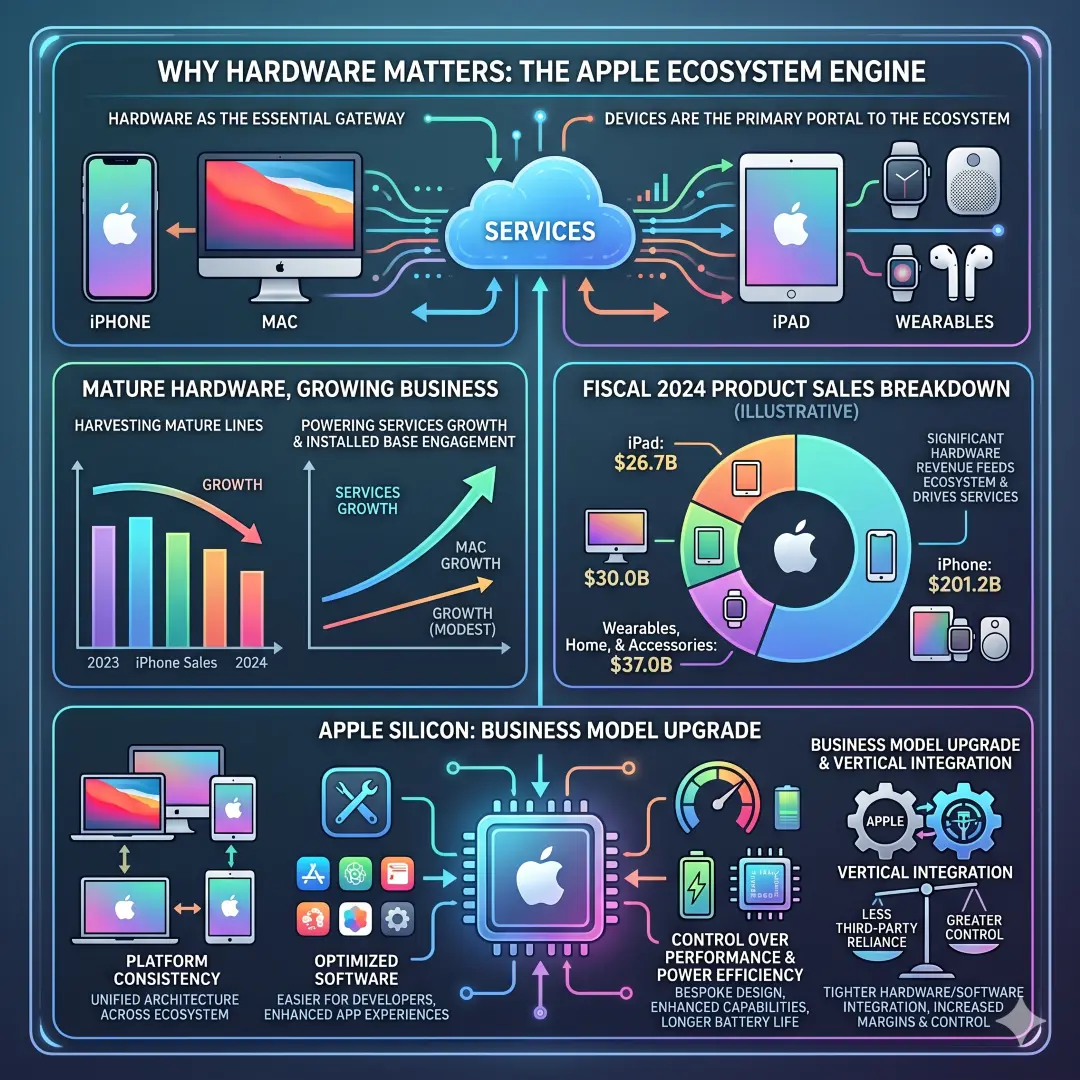
Apple also deepened the value of its hardware by transitioning the Mac to Apple silicon. In 2020, Apple said the shift would create a common architecture across Apple products and make it easier for developers to optimize software for the ecosystem. That move was more than a product upgrade. It was a business-model upgrade because it gave Apple more control over performance, power efficiency, and platform consistency.
4. Services Are the Real Profit Engine
The most important transformation under Tim Cook is the rise of Services. Apple’s annual report includes advertising, AppleCare, cloud services, digital content, and payment services under this umbrella. It also lists platforms such as the App Store, subscription products like Apple Music, Apple TV+, Apple Arcade, Apple Fitness+, and payment services like Apple Pay and Apple Card.
This is where Apple’s model becomes especially elegant. Once a customer buys an iPhone, Apple can continue to earn revenue from apps, subscriptions, storage, warranties, payments, and content. That is why the installed base matters so much. In Apple’s words, its active installed base reached new all-time highs across products and geographic segments in 2024 and again in 2025. In fiscal Q1 2026, Apple said its installed base had grown to more than 2.5 billion active devices, while Services revenue reached a record and grew 14 percent year over year.
That installed base acts like a flywheel. More devices in use means more service opportunities. More service subscriptions mean higher lifetime value per customer. Higher customer satisfaction means better retention. Apple’s own language repeatedly connects installed base growth to customer loyalty and satisfaction, which is a strong signal that Apple sees retention as part of the revenue engine, not just a customer service metric.
5. Apple’s Revenue Mix Shows the Model in Action
| FY2024 Category | Net Sales | Year-over-Year Change | What It Tells Us |
|---|---|---|---|
| iPhone | $201.2B | Flat | The flagship remains huge even without explosive growth. |
| Mac | $30.0B | Up 2% | Apple silicon and product refreshes supported growth. |
| iPad | $26.7B | Down 6% | Some product lines can soften without breaking the model. |
| Wearables, Home and Accessories | $37.0B | Down 7% | Category pressure is offset by services and ecosystem strength. |
| Services | $96.2B | Up 13% | The most important growth and margin driver. |
| Total net sales | $391.0B | Up 2% | The whole system remains enormous and resilient. |
Apple’s Services gross margin was 73.9 percent in fiscal 2024, compared with 37.2 percent for Products. That difference matters because high-margin revenue gives Apple more room to invest in research, marketing, retail experience, chip design, and shareholder returns.
6. Distribution Is Part of the Strategy, Not Just Logistics
Apple’s business model under Cook is also built on unusually strong control over distribution. The company says it sells directly to customers through its retail and online stores and its direct sales force, while also using indirect channels such as carriers, wholesalers, retailers, and resellers. In 2024, direct channels accounted for 38 percent of total net sales and indirect channels for 62 percent.
That mix matters because Apple is not just selling products. It is shaping how people experience the brand. Direct retail allows Apple to control presentation, education, support, and premium positioning. Indirect channels let it scale globally and reach more customers. The result is a highly flexible distribution system that protects brand value while still reaching mass markets.
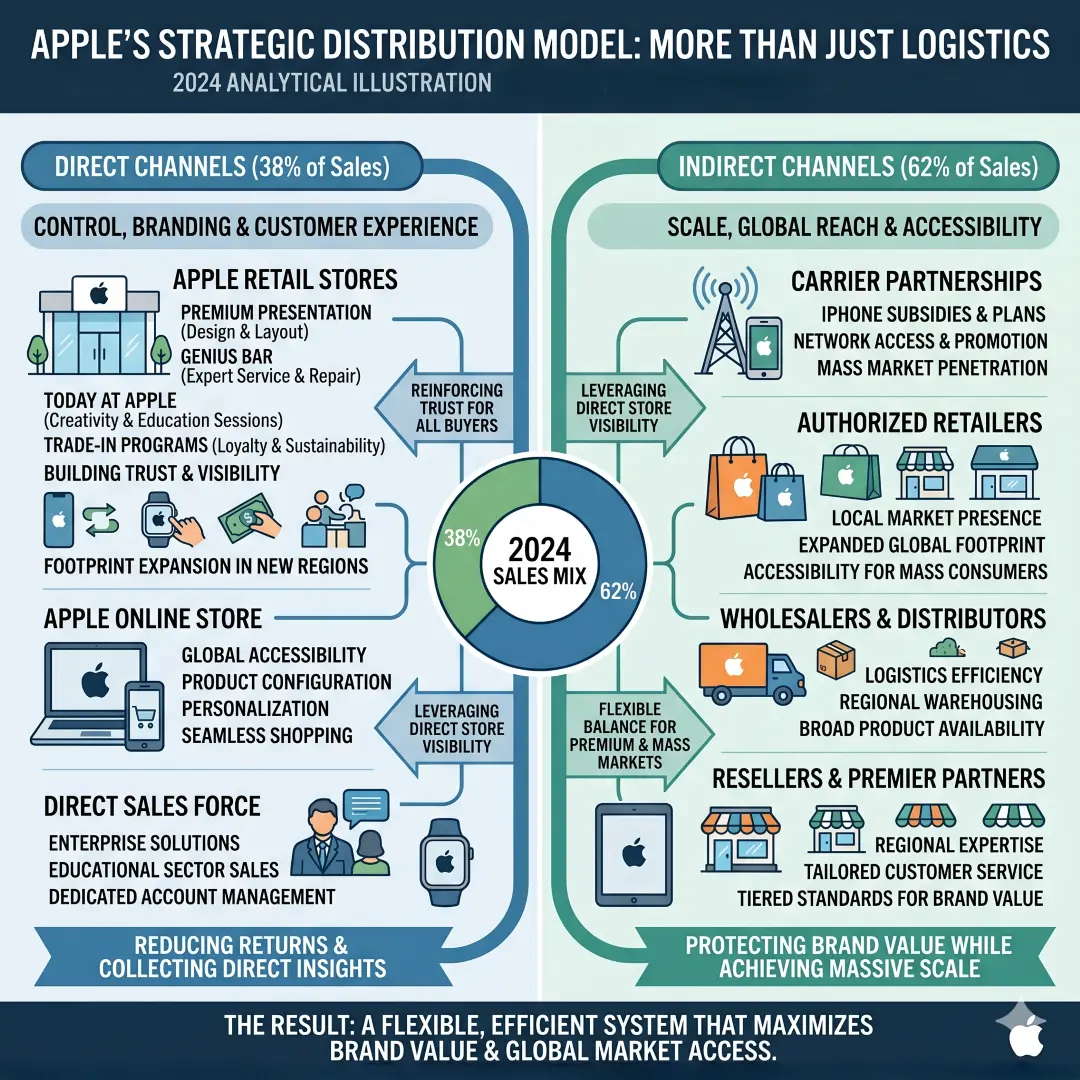
Apple’s retail presence also helps reinforce trust. The company’s store ecosystem includes the Apple Store, Genius Bar, Today at Apple sessions, trade-in programs, and, in many regions, expanding retail footprints. Even when consumers buy through carriers or third-party retailers, Apple still benefits from the visibility and credibility built by its own stores.
7. Why Tim Cook’s Supply Chain Mindset Changed Everything
Tim Cook’s background is central to understanding Apple’s success. Before becoming CEO, he was the executive most closely associated with the company’s supply chain, sales, operations, and support. Under Cook, Apple became famous for running one of the world’s most sophisticated global operations systems. That discipline allows Apple to manage enormous scale while still launching highly complex products across multiple regions.
The annual report shows how deeply operations matter to Apple. It says Apple competes through innovation, pricing, product quality, service and support, distribution capability, and a strong ecosystem. It also notes that many components are sourced from limited or single sources, which is why supply chain management is so critical. Apple’s ability to coordinate custom components, manufacturing partners, logistics, and product launches is not just an operational strength. It is part of the business model itself.
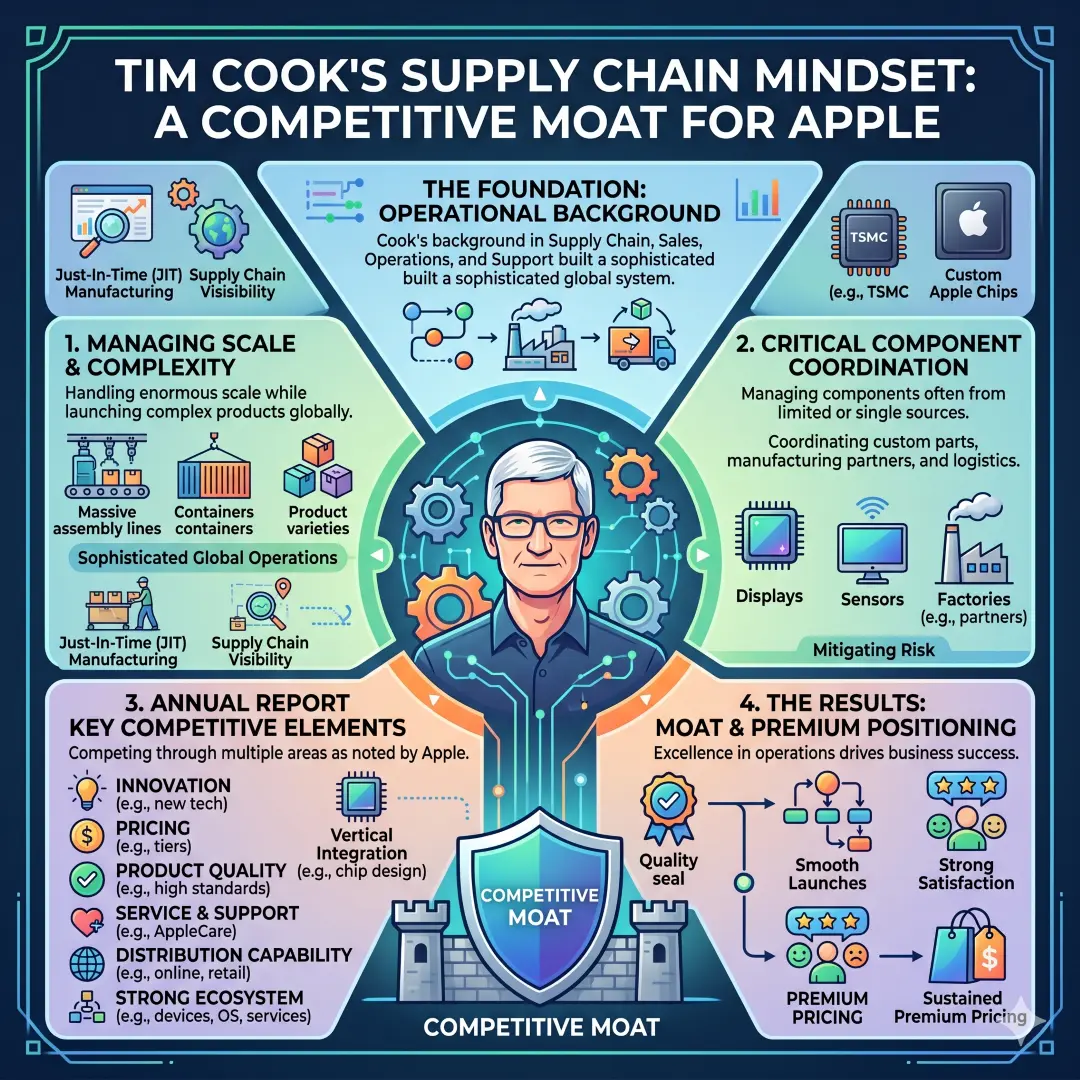
This is one reason Apple can keep premium pricing. When operations are excellent, quality stays high, launches are smoother, and customer satisfaction stays strong. In business terms, Cook turned supply chain excellence into a competitive moat.
8. Apple’s Global Business Model Is Truly Worldwide
Apple does not depend on one region. Its 2024 report breaks the business into the Americas, Europe, Greater China, Japan, and the Rest of Asia Pacific. In fiscal 2024, the Americas brought in $167.0 billion, Europe $101.3 billion, Greater China $67.0 billion, Japan $25.1 billion, and the Rest of Asia Pacific $30.7 billion.
| Region | FY2024 Net Sales | Year-over-Year Change | What Happened | Source |
|---|---|---|---|---|
| Americas | $167.0B | Up 3% | Growth was driven primarily by higher Services sales. | D18RN0P25NWR6D Cloudfront |
| Europe | $101.3B | Up 7% | Stronger Services and iPhone sales helped lift the region. | D18RN0P25NWR6D Cloudfront |
| Greater China | $67.0B | Down 8% | Lower iPhone and iPad sales, plus currency weakness, weighed on results. | D18RN0P25NWR6D Cloudfront |
| Japan | $25.1B | Up 3% | Higher iPhone sales helped offset currency pressure. | D18RN0P25NWR6D Cloudfront |
| Rest of Asia Pacific | $30.7B | Up 4% | Service growth was a key driver. | D18RN0P25NWR6D Cloudfront |
This table shows something important about Apple’s model. It is global, but not uniform. Different regions contribute differently, and Services often provide balance when hardware demand varies. That regional flexibility makes Apple less dependent on any single market.
9. Privacy Is Not Just a Value, It Is a Product Advantage
Apple often talks about privacy as a core value, and that message is not just branding. It is part of the company’s business identity. Apple says privacy is a fundamental human right and that it designs products and services to protect it. The company also says it gives users transparency and control over data, and that apps need permission to access sensitive functions like tracking, microphone, and camera access.
Why does this matter for the business model? Because trust sells. In markets where people are more worried about data use, surveillance, and tracking, Apple’s privacy positioning can support brand loyalty and premium pricing. This does not mean privacy alone drives demand, but it clearly strengthens Apple’s broader promise that its ecosystem is built around user experience and user control.
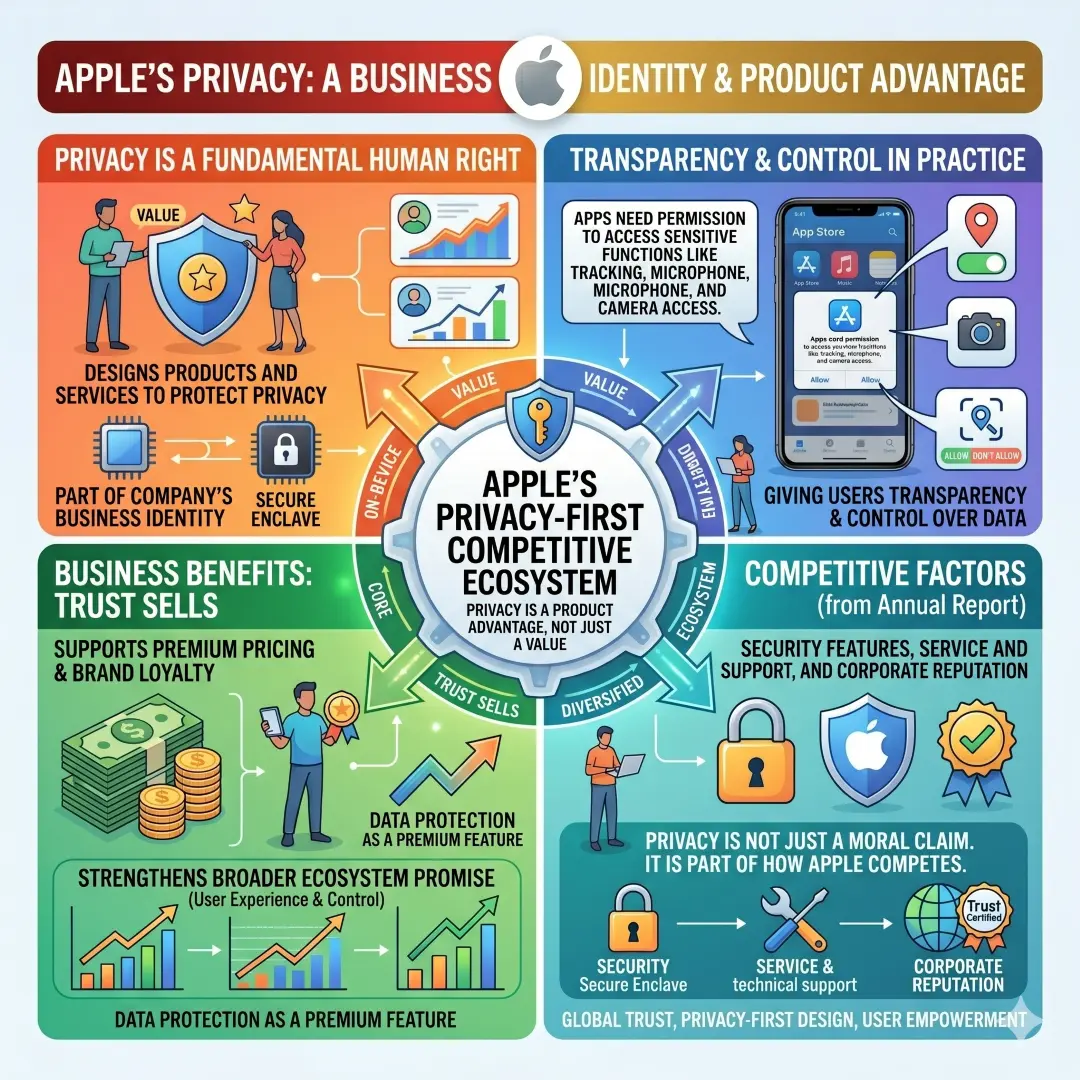
The annual report also says that security features, service and support, and corporate reputation are important competitive factors. That means privacy is not just a moral claim. It is part of how Apple competes.
10. Sustainability Has Become Part of the Operating Model
Apple’s environmental strategy is another reason the company’s model feels durable. Apple says it aims to be carbon neutral across its global footprint by 2030, and that it plans to reduce greenhouse gas emissions by 75 percent compared with 2015 before balancing the remainder with nature-based solutions. Apple also said in 2020 that it planned to become carbon neutral across its supply chain and products by 2030.
The company’s supplier network is also part of this effort. Apple said in 2023 that its manufacturing partners supported over 13 gigawatts of renewable electricity across the globe and that more than 250 suppliers in 28 countries were committed to renewable energy for Apple production by 2030. Apple described this as representing more than 85 percent of its direct manufacturing spend.
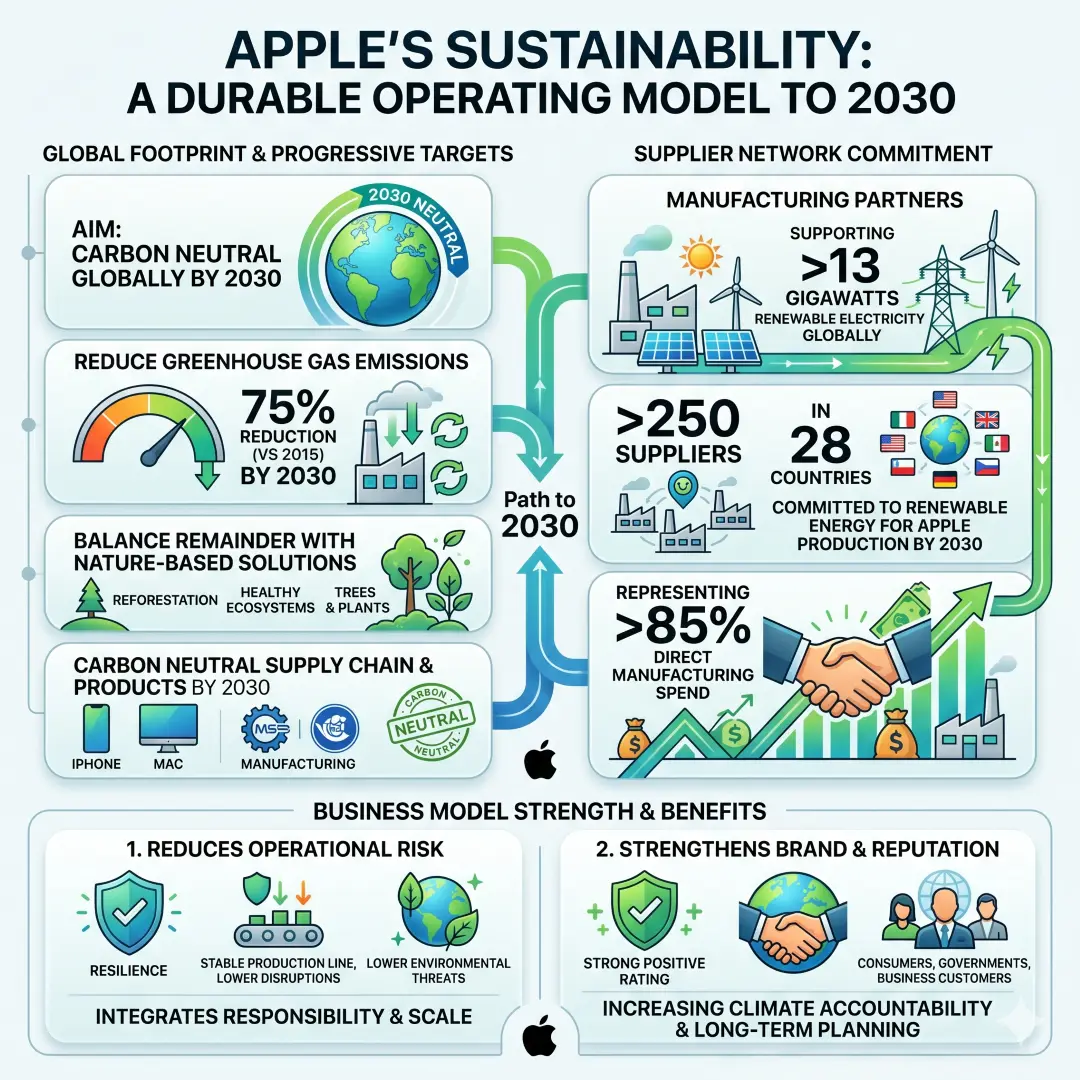
This matters to the business model for two reasons. First, it reduces operational risk over time. Second, it strengthens Apple’s brand with consumers, governments, and business customers who increasingly care about climate accountability. Sustainability becomes part of the company’s reputation for scale, responsibility, and long-term planning.
11. Capital Returns Show Apple’s Cash Discipline
A major part of Apple’s success under Tim Cook is the company’s disciplined use of cash. Apple is not only a growth company. It is also one of the world’s most aggressive return-of-capital machines. In fiscal 2024, Apple repurchased $95.0 billion of common stock and paid $15.2 billion in dividends and dividend equivalents. In May 2024, the company announced a new $110 billion share repurchase program and raised its quarterly dividend to $0.25 per share.
Apple continued that pattern in 2025. In its fiscal Q2 2025 results, the company said it generated $24 billion in operating cash flow and returned $29 billion to shareholders, while also authorizing an additional $100 billion share repurchase program. In fiscal Q1 2026, Apple reported nearly $54 billion in operating cash flow and returned almost $32 billion to shareholders.
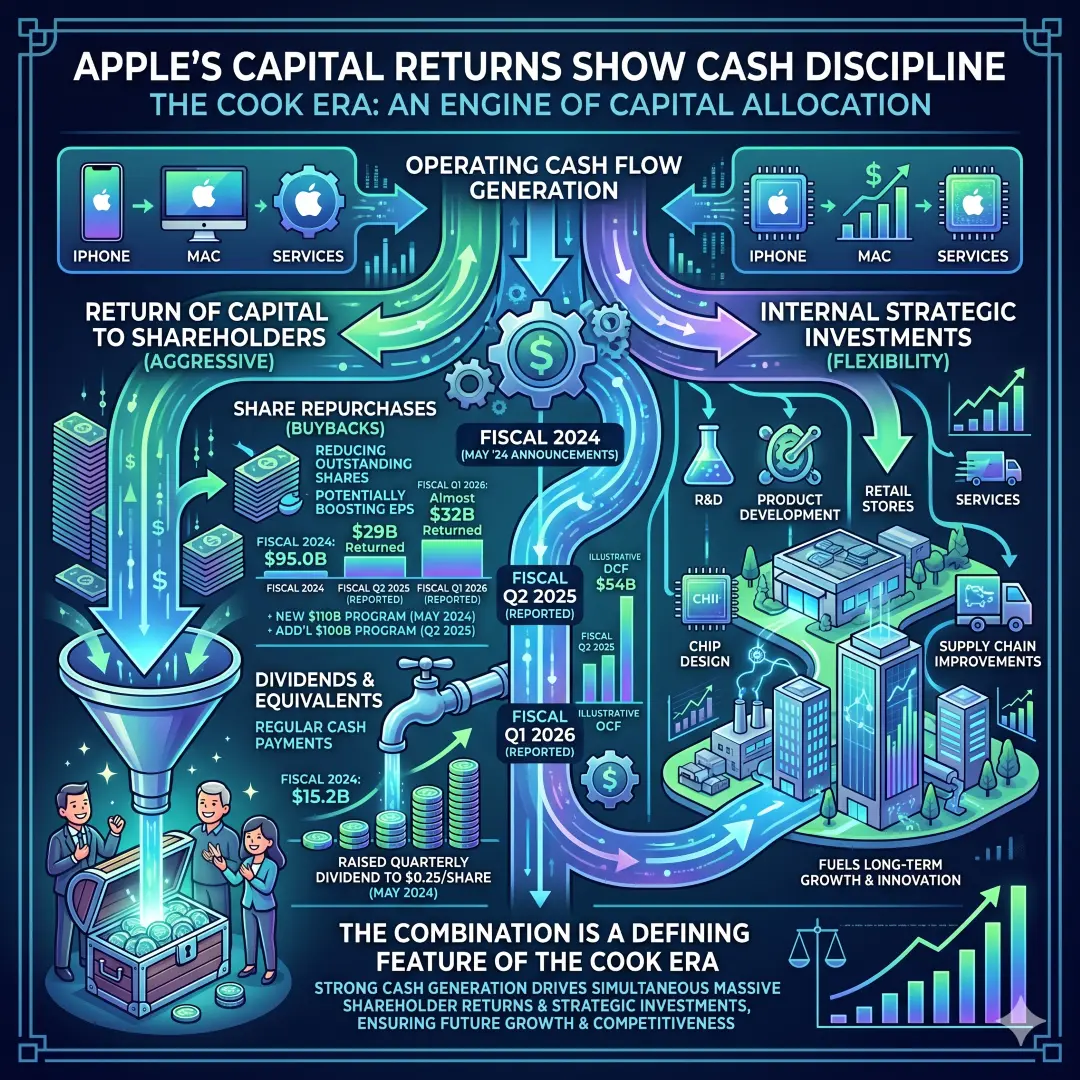
This matters because strong cash generation gives Apple flexibility. It can invest in R&D, product development, retail, chips, services, and supply chain improvements while still rewarding shareholders at a massive scale. That combination is a defining feature of the Cook era.
12. The Model Keeps Repeating Because the Flywheel Keeps Spinning
Apple’s latest results show that the model is still working. In fiscal Q2 2025, Apple reported $95.4 billion in revenue, double-digit Services growth, and a new all-time high for the installed base of active devices. In fiscal Q1 2026, the company reported $143.8 billion in revenue, record iPhone and Services revenue, and an installed base of more than 2.5 billion active devices.
That is the real secret behind Apple’s success under Tim Cook. The company’s business model does not depend on a single blockbuster year. It depends on a system that keeps compounding. Great devices lead to loyal users. Loyal users lead to service revenue. Services revenue leads to stronger margins. Strong margins allow for R&D, supply chain investment, sustainability programs, and shareholder returns. Those investments then help Apple produce better products and deepen the ecosystem again.
What Other Businesses Can Learn From Apple
| Lesson | Apple’s Example | Why It Works |
|---|---|---|
| Build a platform, not just a product | Devices connect to services, software, and support | Increases lifetime value per customer. |
| Make recurring revenue a priority | Services have become a major growth and margin driver | Improves predictability and profitability. |
| Control the customer experience | Apple runs stores, online sales, and direct support | Helps protect brand and pricing power. |
| Own critical technology | Apple Silicon gives more control over performance | Strengthens product integration and differentiation. |
| Treat trust as a feature | Privacy is built into the brand story | Supports loyalty and premium positioning. |
| Use cash strategically | Apple returns huge amounts to shareholders while still investing heavily | Demonstrates financial discipline and confidence. |
Apple’s lesson is not that every company should copy Apple exactly. That would be impossible. The deeper lesson is that the strongest companies often build a business model where each part reinforces the others. Hardware supports software. Software supports services. Services support loyalty. Loyalty supports margin. Margin supports investment. Investment improves the whole ecosystem.
Conclusion
The business model behind Apple’s success under Tim Cook is a masterclass in modern company building. It is built on premium hardware, but it does not stop there. It uses Services to create recurring revenue, Apple silicon to deepen control, privacy to strengthen trust, supply chain discipline to protect quality, global distribution to scale reach, sustainability to support resilience, and capital returns to reward shareholders. Apple’s 2024 and 2025 results show that this model still works at an extraordinary scale.
That is why Apple under Tim Cook is often studied so closely by investors, founders, and business students. The company is not only selling products. It is running a tightly connected economic system, one that turns customer satisfaction into repeat revenue and repeat revenue into long-term power.
Also, Read these Articles in Detail
- Tim Cook’s Leadership Strategy at Apple
- How Tim Cook Built Apple Into a Financial Powerhouse
- Tim Cook and Apple’s Corporate Strategy
Article’s References and Sources
- Apple Leadership: Tim Cook Profile
- Apple Newsroom: Apple Reports First Quarter Results (2025)
- Apple Newsroom: Apple Reports Second Quarter Results (2025)
- Apple Privacy Page
- Apple Environmental Progress & Sustainability Goals
- Apple Newsroom: Carbon Neutral Commitment (2030 Goal)
- Apple Newsroom: Apple Silicon Announcement (Mac Transition)
- Apple Newsroom: Renewable Energy Expansion with Suppliers
- Apple Inc. Form 10-K (Fiscal Year 2024 Annual Report)
Frequently Asked Questions
FAQ 1: What is the business model behind Apple’s success under Tim Cook?
Apple’s business model under Tim Cook is built on a simple but very powerful idea. The company sells premium hardware that people love, then keeps those same customers inside a larger ecosystem of software, services, support, and connected devices. This means Apple is not only making money when someone buys an iPhone, Mac, iPad, or Apple Watch. It also earns from the same customer again and again through Services such as subscriptions, cloud storage, app sales, payments, warranties, and digital content.
This is one of the main reasons Apple has become so successful. A single product sale creates the first relationship, but the ecosystem creates the long-term value. Once a customer starts using Apple products together, the experience becomes smooth, convenient, and familiar. That makes it harder to leave and easier to keep buying more Apple products over time.
Tim Cook also strengthened the business model by focusing on operations, supply chain efficiency, and global scale. These are not always visible to customers, but they matter a great deal. Better operations help Apple launch products smoothly, maintain quality, manage costs, and serve millions of people across the world. In simple terms, Apple’s model under Tim Cook works because it combines great products, high customer loyalty, strong recurring revenue, and disciplined execution.
Another important part of the model is Apple’s focus on brand trust, privacy, and premium positioning. Apple does not try to compete by being the cheapest option. Instead, it competes by being one of the most trusted and best-integrated technology brands in the world. That strategy has allowed the company to stay highly profitable while serving both individual consumers and enterprise customers.
So, the business model is not just about selling devices. It is about building a lasting relationship with the customer and then creating many layers of value around that relationship. That is the real engine behind Apple’s success under Tim Cook.
FAQ 2: Why are Apple’s Services so important to its business under Tim Cook?
Apple’s Services business is one of the most important parts of the company’s success today. It includes products and platforms such as the App Store, iCloud, Apple Music, Apple TV+, Apple Arcade, Apple Fitness+, Apple Pay, and AppleCare. These services bring in revenue after the customer has already bought a device, which makes them a major source of recurring income.
This matters because hardware sales can rise and fall depending on upgrade cycles, market conditions, and consumer spending. Services, on the other hand, can grow more steadily because customers keep paying for them month after month or year after year. That gives Apple a stronger and more predictable financial base.
Services are also very profitable. They usually have higher margins than hardware, which means Apple keeps a larger share of the money it earns from this segment. That helps the company fund research, design, retail expansion, chip development, and shareholder returns. In other words, Services do not just add revenue. They improve the overall economics of the entire business.
Another reason Services are important is that they deepen customer loyalty. When someone uses iCloud, buys apps through the App Store, listens to Apple Music, and pays with Apple Pay, they become more connected to the Apple ecosystem. That makes the whole experience more useful and more difficult to replace with a different brand.
Services also help Apple smooth out growth when one hardware category slows down. If iPad sales weaken or iPhone growth becomes flatter, strong Services growth can help support the company’s overall results. This is why many analysts see Services as the heart of Apple’s modern business model. It transforms Apple from a device maker into a full ecosystem company.
FAQ 3: How did Tim Cook change Apple’s supply chain and operations?
Tim Cook’s background in operations and supply chain management had a huge effect on Apple’s success. Before becoming CEO, he was deeply involved in making Apple’s global operations more efficient. That experience shaped how he later led the company as chief executive. Under Cook, Apple became known for extremely strong control over production, inventory, logistics, and global distribution.
A major reason this matters is that Apple makes highly complex products on a massive scale. To do that successfully, it needs careful coordination with suppliers, manufacturers, shipping partners, and retailers around the world. Tim Cook helped turn this into one of Apple’s biggest strengths. The company is able to manage huge launch events, deliver products to many countries, and maintain premium quality at the same time.
This kind of operational discipline is part of the business model itself. It allows Apple to reduce waste, improve efficiency, and keep product launches running smoothly. It also helps the company respond better to supply constraints or changes in demand. For example, when a product is in high demand, Apple’s operations expertise helps it scale faster. When a product line faces pressure, the company can adjust more effectively.
Cook’s supply chain focus also supports Apple’s profit margins. Efficient operations reduce unnecessary costs and help protect the company’s financial performance. That is one reason Apple can continue selling premium products while still generating huge profits. Good operations are not just a back-office function for Apple. They are a core strategic advantage.
In simple terms, Tim Cook changed Apple by making it not only creative but also highly organized, highly efficient, and extremely disciplined. That combination has been a major reason for the company’s long-term strength.
FAQ 4: Why does Apple’s ecosystem make customers stay longer?
Apple’s ecosystem is one of the strongest reasons customers stay loyal for so long. The ecosystem means that Apple products and services work especially well together. For example, someone who owns an iPhone may also choose an Apple Watch, Mac, iPad, AirPods, and iCloud because the products connect smoothly. Messages, photos, files, calls, payments, and media can move across devices with very little friction.
This creates a strong sense of convenience. Once a user gets used to how everything works together, switching to another brand becomes more difficult and less appealing. That does not mean customers cannot switch. It means the benefits of staying often feel bigger than the effort of leaving. This is a major strength in Apple’s business model.
The ecosystem also increases the total value of each customer over time. A person may first buy a phone, but later subscribe to Apple Music, pay for extra iCloud storage, buy apps, upgrade to a Mac, and then purchase accessories. Each additional product or service strengthens the relationship between Apple and the user. This is how Apple turns one sale into a much larger long-term business relationship.
Another reason the ecosystem works so well is that Apple controls many parts of the experience. It designs the hardware, the operating system, many of the software features, and a large part of the digital services environment. That level of integration gives Apple a smoother and more polished user experience than many competitors can offer.
The ecosystem is valuable not just for convenience but for trust. Customers know their devices will work together reliably, updates will be coordinated, and support will be available through Apple’s own channels. That trust is a huge reason people stay in the Apple world for years.
FAQ 5: How important is Apple’s focus on privacy in its business strategy?
Apple’s focus on privacy is very important because it helps the company build trust. In today’s digital world, many users worry about how their data is collected, stored, and used. Apple has made privacy part of its brand identity by telling customers that their personal information should remain under their control. That message helps the company stand out in a crowded technology market.
Privacy is not only a moral or public relations issue for Apple. It is also a business advantage. When customers trust a brand with their data, they are more likely to use its services, keep their devices, and recommend the company to others. Trust supports loyalty, and loyalty supports revenue. That is why privacy is deeply connected to Apple’s commercial success.
Apple also uses privacy as part of its product design. Features like app tracking permissions, device security, and data transparency help reinforce the idea that the company respects user choice. This improves the overall customer experience and strengthens Apple’s premium image.
Another reason privacy matters is that it helps Apple compete on values, not just on specifications. Many companies can offer powerful technology. Fewer can offer powerful technology while also making privacy part of the core message. That gives Apple a unique position in the marketplace.
In the broader business model, privacy supports brand reputation, customer retention, and premium pricing. People often pay more for products when they believe the company behind them is trustworthy. For Apple, privacy is not a side issue. It is one of the pillars supporting the entire brand.
FAQ 6: Why does Apple keep selling premium products instead of competing mainly on price?
Apple sells premium products because that strategy fits its brand, its ecosystem, and its business model. The company does not try to be the cheapest option in the market. Instead, it aims to offer a high-end experience that combines design, performance, software integration, customer support, and long-term value. This premium positioning has helped Apple build one of the strongest brands in the world.
One reason this works is that Apple customers are not only buying hardware. They are buying an experience. That includes the look and feel of the device, the ease of setup, the quality of support, the software ecosystem, and the confidence that the device will continue to work well for years. When a product delivers that kind of experience, many people are willing to pay more.
Premium pricing also helps Apple maintain strong gross margins. That gives the company more money to invest in research, chip development, software, services, retail stores, and marketing. In this way, premium pricing supports innovation. The company can keep improving its products while remaining profitable.
Another key point is that premium products reinforce the brand. When people see Apple as a high-quality, highly desirable brand, that image supports all of its other businesses. It helps with Services, accessories, wearables, and even trade-in and upgrade programs. The entire ecosystem benefits from the perception that Apple products are worth the price.
Apple’s premium strategy is successful because it is supported by real value. It is not just about charging more. It is about giving customers a product and experience that feels worth it. That is why the company can keep this model working year after year.
FAQ 7: How did Apple Silicon strengthen the company’s business model?
Apple silicon became an important part of the company’s strategy because it gave Apple much more control over performance, power efficiency, and product integration. By designing its own chips for many of its devices, Apple reduced its dependence on outside chip suppliers and created a more unified technology platform across its products.
This move matters for several reasons. First, it helps Apple improve the performance of its devices in ways that are specifically designed for its own software. That leads to smoother user experiences, better battery life, and stronger hardware-software integration. Second, it allows Apple to align the Mac more closely with the rest of its product ecosystem. This makes it easier for developers to build apps that work well across Apple devices.
Apple Silicon also strengthens the business model because it creates a deeper technological moat. When a company controls its own critical components, it can differentiate itself more clearly from competitors. That control helps Apple move faster, innovate more strategically, and manage its product roadmap more effectively.
From a financial perspective, custom silicon can also improve efficiency over time. Better performance and tighter integration often support stronger customer satisfaction, which can lead to more upgrades and more ecosystem engagement. That means Apple silicon is not just a technical decision. It is also a business decision that supports loyalty and long-term growth.
In simple terms, Apple silicon helped Apple turn its hardware into a more powerful, more unified, and more profitable platform. It is one of the best examples of how Apple thinks about business and technology as parts of the same system.
FAQ 8: What role does Apple’s global distribution network play in its success?
Apple’s global distribution network is a major part of its success because it allows the company to reach customers in many different ways and in many different markets. Apple sells directly through its own retail stores, online stores, and direct sales teams, but it also works with carriers, retailers, wholesalers, and resellers. This mixed model gives the company both control and scale.
The direct channel lets Apple create a premium experience. In its own stores, the company can showcase products in a carefully designed way, provide expert support, and reinforce the brand image. This makes the buying experience feel personal and high-quality. It also helps Apple educate customers and build loyalty.
The indirect channel is equally important because it expands Apple’s reach. By working with carriers and third-party retailers, Apple can sell in more places and reach more consumers across the world. This is especially important in large and diverse markets where customers prefer to buy through familiar local channels.
The business value of this network is that it allows Apple to serve different customer types without losing brand strength. A customer can buy from Apple directly for the full experience or through a partner for convenience. Either way, Apple still benefits from the sale and the future services relationship.
This structure also supports resilience. If one channel faces pressure, the others can help balance the business. That makes Apple less dependent on any single retail path. In a global company, that flexibility is extremely valuable.
FAQ 9: Why are Apple’s capital returns so important to investors?
Apple’s capital returns are important because they show that the company generates enormous cash and knows how to use it effectively. Tim Cook’s Apple has consistently returned large sums to shareholders through share buybacks and dividends. This matters to investors because it signals financial strength, confidence in the business, and disciplined capital management.
Share repurchases reduce the number of outstanding shares, which can increase earnings per share over time. Dividends provide direct cash returns to shareholders. Together, these actions make Apple attractive to investors who want both growth and steady financial rewards.
Capital returns are also important because they show that Apple does not waste its cash. Instead of keeping excess money idle, the company puts it to work in a way that benefits shareholders while still leaving room for investment in research, products, services, and operations. That balance is one of the reasons Apple is admired as a financial powerhouse.
Another reason capital returns matter is that they reflect trust in the business model. A company does not normally buy back so much stock and keep paying dividends unless it believes its future cash generation is strong. Apple’s long record of returning capital tells investors that the business is not only profitable, but also durable.
For many investors, Apple is attractive because it combines innovation with financial discipline. That combination is rare, and it is one of the clearest marks of the Tim Cook era.
FAQ 10: What can other businesses learn from Apple’s success under Tim Cook?
Other businesses can learn a great deal from Apple’s success under Tim Cook. The biggest lesson is that a strong business is usually not built on one idea alone. It is built on several connected strengths that support one another. Apple shows how product quality, customer experience, ecosystem design, recurring revenue, operational excellence, and brand trust can all work together.
One lesson is the importance of building a business around the customer’s long-term relationship with the brand, not just the first purchase. Apple does this by turning hardware buyers into service users, accessory buyers, and loyal ecosystem customers. That creates more stable and valuable revenue over time.
Another lesson is that operations matter just as much as innovation. Many companies focus only on product ideas, but Apple proves that great execution, supply chain management, and channel control can be just as important as the product itself. Without strong operations, even a great product can fail to scale properly.
A third lesson is the value of trust. Apple uses privacy, security, and brand reputation to strengthen customer confidence. This shows that trust can be a major business asset, not just a public relations talking point.
A fourth lesson is the power of focus. Apple does not try to be everything to everyone. It chooses a premium identity and supports that identity with design, technology, services, and disciplined pricing. That focus gives the company clarity and consistency.
Finally, Apple teaches that long-term success often comes from building systems, not shortcuts. The company’s business model is durable because each part feeds the next. That is a valuable lesson for any business that wants to grow steadily and stay competitive for years.
Article Disclaimer
The information provided in this article, “The Business Model Behind Apple’s Success Under Tim Cook,” is intended for educational and informational purposes only. While every effort has been made to ensure accuracy and relevance, the content is based on publicly available data, general business analysis, and widely accepted industry insights. It should not be interpreted as professional financial, investment, or business advice.
This article discusses the strategies and performance of Apple Inc. and leadership insights related to Tim Cook. However, all opinions, interpretations, and conclusions expressed are subjective in nature and may not reflect the official views, strategies, or plans of Apple or its management. Business environments can change rapidly, and past performance does not guarantee future results.
Readers are strongly encouraged to conduct their own independent research and consult with qualified professionals before making any financial, investment, or strategic decisions based on the information presented. The article does not take into account individual financial situations, risk tolerance, or specific business circumstances.
Additionally, while this content references data derived from credible and reputable sources, there may be unintentional errors, omissions, or outdated information. The author and publisher make no guarantees regarding the completeness, reliability, or timeliness of the information provided.
This article may also include discussions of products, services, and strategies that are subject to change without notice. No responsibility is assumed for any losses, damages, or outcomes that may arise from the use of this information, whether directly or indirectly.
By reading this article, you acknowledge that the content is provided on an “as-is” basis and that you are solely responsible for how you interpret and use the information within your own personal or professional context.
