

Key Differences at a Glance
- Aerospace Engineering specializes in designing aircraft, spacecraft, and related systems, with an emphasis on aerodynamics, propulsion, and flight dynamics. Mechanical Engineering, on the other hand, covers a broader range of machines, from engines to robotics, with a focus on energy conversion and manufacturing.
- Educationally, aerospace programs dive deeper into fluid mechanics and orbital mechanics, whereas mechanical curricula prioritize thermodynamics and materials science for versatile applications.
- Career-wise, aerospace engineers often earn higher salaries—around $134,830 annually—due to the specialized demand in aviation and space, compared to $96,310 for mechanical engineers, although the latter offers more job flexibility across various industries.
- Both fields share foundational math and physics skills, but aerospace demands stronger problem-solving in high-stakes environments like space travel. At the same time, mechanical engineering thrives on creative integration in everyday tech.
Quick Career Comparison
Aerospace roles might involve testing rocket components under extreme conditions, appealing to those passionate about exploration. Mechanical engineering, on the other hand, could mean optimizing factory robots for efficiency, suiting innovators in sustainable manufacturing. If you’re drawn to the stars, aerospace beckons; for grounded impact, mechanical fits seamlessly.
Why Choose One Over the Other?
Research suggests aerospace suits adventure-seekers with a tolerance for cyclical job markets, while mechanical engineering provides steadier opportunities in diverse sectors like automotive and energy. Evidence leans toward mechanical for broader employability, but aerospace’s growth in space tourism adds excitement.
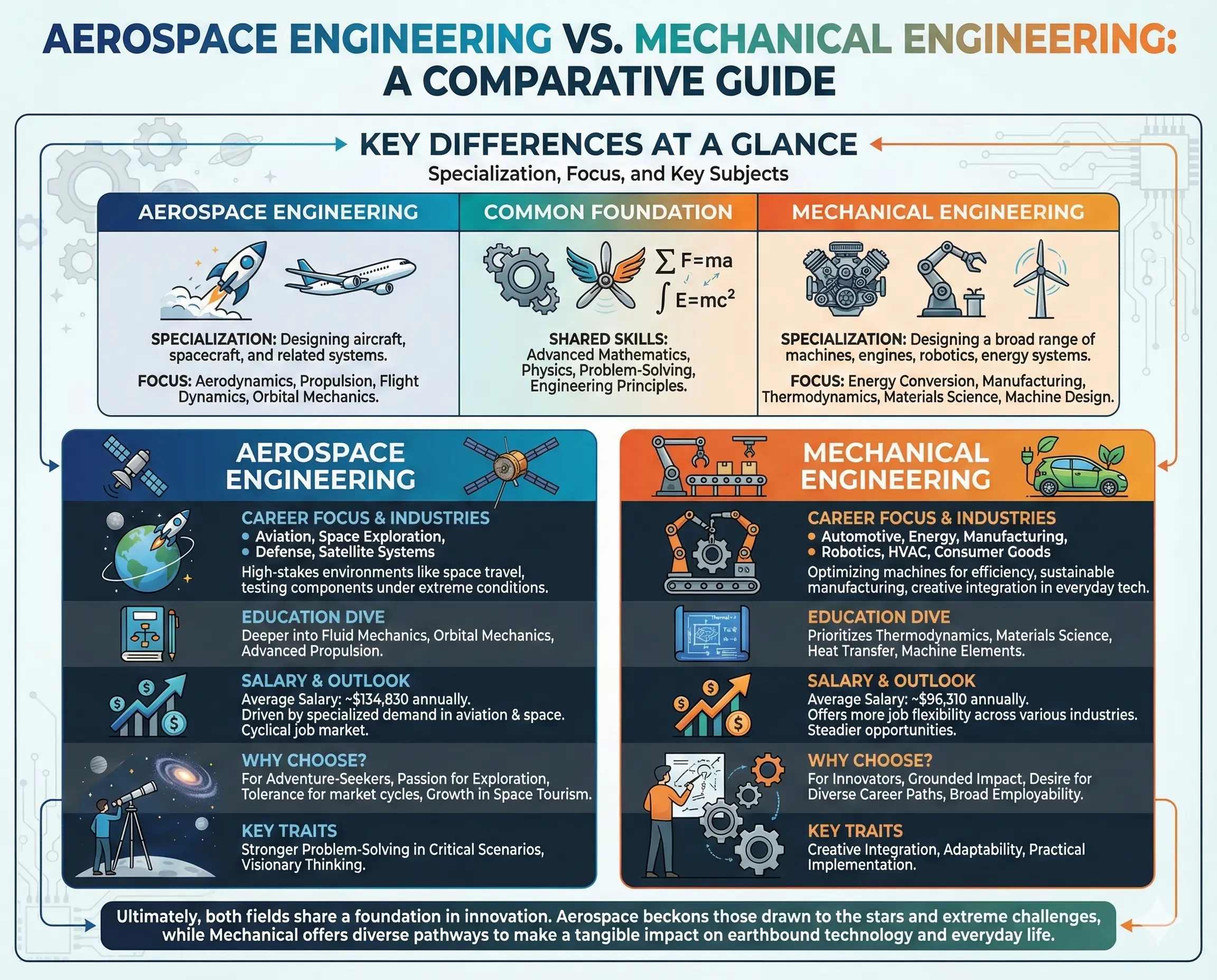
Table of Contents
Imagine standing on a windswept airfield, watching a sleek jet slice through the clouds, or deep in a bustling factory, where massive gears hum in perfect harmony to birth the next electric vehicle. These scenes capture the essence of two powerhouse fields in engineering: aerospace engineering and mechanical engineering. Both draw from the same well of curiosity about how things move and endure, yet they branch into worlds as distinct as the skies above and the earth below.
In this comprehensive exploration, we’ll dissect their foundations, spotlight the nuances that set them apart, and chart paths for aspiring engineers. Whether you’re a high school student pondering majors, a career changer eyeing new horizons, or simply fascinated by the machinery that powers our world, this guide aims to illuminate the choices ahead with clarity and inspiration.
The Foundations of Mechanical Engineering: Building the Backbone of Modern Life
Mechanical engineering stands as one of the oldest and most versatile branches of engineering, often called the “mother of all engineering disciplines.” At its heart, it involves the design, analysis, manufacturing, and maintenance of mechanical systems—everything from the engines in your car to the turbines spinning in wind farms. Picture a mechanical engineer as the ultimate problem-solver, turning abstract ideas into tangible machines that improve daily life. This field emerged during the Industrial Revolution, when innovators like James Watt refined the steam engine in the late 1700s, slashing fuel use by 75% and fueling factories worldwide. Watt’s work not only powered the era’s economic boom but also laid the groundwork for thermodynamics, a cornerstone of the discipline today.
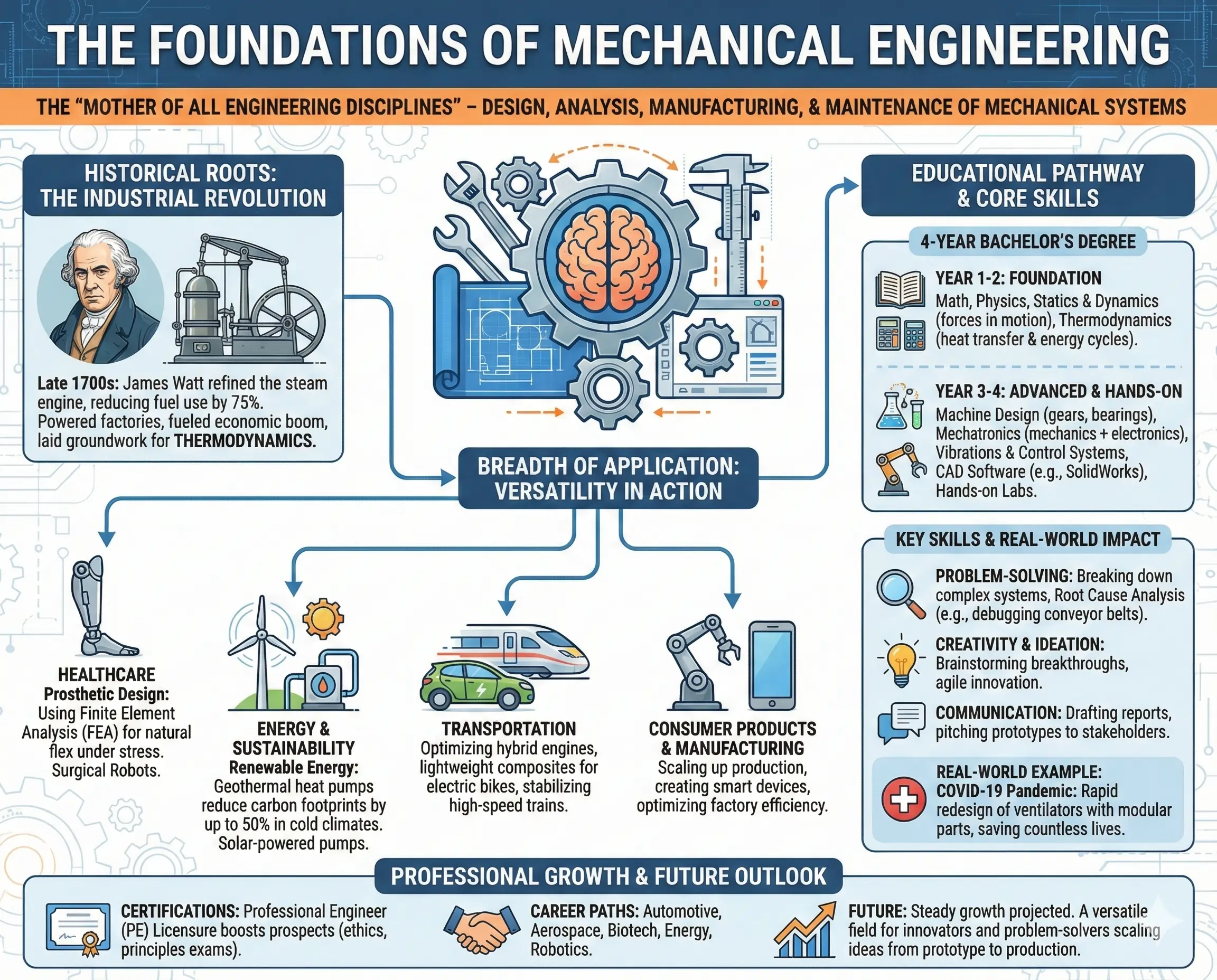
What makes mechanical engineering so enduring? It’s the breadth. Engineers in this field tackle challenges in energy, transportation, healthcare, and consumer products. For instance, consider the development of prosthetic limbs: a mechanical engineer might use finite element analysis to simulate how materials flex under stress, ensuring the device feels natural during a marathon run. Or think about renewable energy—designing geothermal heat pumps that extract warmth from the earth to heat homes efficiently, reducing carbon footprints by up to 50% in cold climates.
Delving into education, a typical bachelor’s degree in mechanical engineering spans four years and builds a robust foundation. Core courses include statics and dynamics, where students learn to predict how forces affect objects in motion; thermodynamics, exploring heat transfer and energy cycles; and machine design, teaching the creation of gears, bearings, and linkages. Labs often involve hands-on projects, like assembling a small internal combustion engine or programming a robotic arm using CAD software such as SolidWorks. Advanced electives might cover mechatronics, blending mechanics with electronics for smart devices, or vibrations and control systems, essential for stabilizing machinery in earthquakes or high-speed trains.
The skills honed here are practical gold. Mechanical engineers master problem-solving by breaking complex systems into manageable parts, often employing root cause analysis to debug failures, like why a conveyor belt jams in a warehouse. Creativity shines in ideation phases, where brainstorming sessions yield breakthroughs, such as lightweight composites for electric bikes that extend battery life. Communication is key too; engineers draft reports or pitch prototypes to stakeholders, ensuring ideas translate from blueprint to boardroom. Real-world example: During the COVID-19 pandemic, mechanical engineers at medical device firms rapidly redesigned ventilators, incorporating modular parts for quick assembly, saving countless lives through agile innovation.
Beyond the classroom, certifications like Professional Engineer (PE) licensure boost prospects, requiring exams on ethics and principles. Graduates enter a field projected to grow steadily, with roles in automotive giants optimizing hybrid engines or in biotech firms crafting surgical robots. It’s a career where versatility reigns— one day prototyping a solar-powered water pump for rural villages, the next scaling up production for wind turbine blades.
| Core Mechanical Engineering Curriculum Components | Description | Typical Credit Hours | Example Project |
|---|---|---|---|
| Statics and Dynamics | Studies forces on stationary and moving bodies | 3-4 | Bridge truss model testing load capacity |
| Thermodynamics | Heat, work, and energy conversion principles | 3-4 | Building a Stirling engine prototype |
| Fluid Mechanics | Behavior of liquids and gases in motion | 3 | Wind tunnel simulation for pipe flow |
| Materials Science | Properties and selection of metals, polymers | 3 | Fatigue testing of alloy samples |
| Machine Design | Component assembly and failure prevention | 4 | Gearbox design for a mini-robot |
| Manufacturing Processes | Casting, welding, and CNC machining | 3 | 3D-printed impeller for a pump |
| Control Systems | Feedback loops for automation | 3 | PID controller for drone stability |
This table highlights how the curriculum emphasizes integration, preparing engineers for roles where systems must work seamlessly across scales—from microchips to megastructures.
Soaring into Aerospace Engineering: Engineering the Frontiers of Flight and Space
Shift your gaze skyward, and aerospace engineering comes alive, a thrilling fusion of physics and daring that propels humanity beyond gravity’s grasp. This discipline focuses on the science and technology of flight, encompassing aircraft, spacecraft, satellites, and even drones. It’s about conquering the atmosphere and vacuum of space, where every design must withstand supersonic speeds or zero-gravity voids. The field’s roots trace to the early 1900s, with the Wright brothers achieving the first powered flight in 1903 at Kitty Hawk, North Carolina. Their bicycle-shop ingenuity—wind tunnel tests and wing-warping controls—proved that controlled, heavier-than-air flight was possible, igniting a global race.
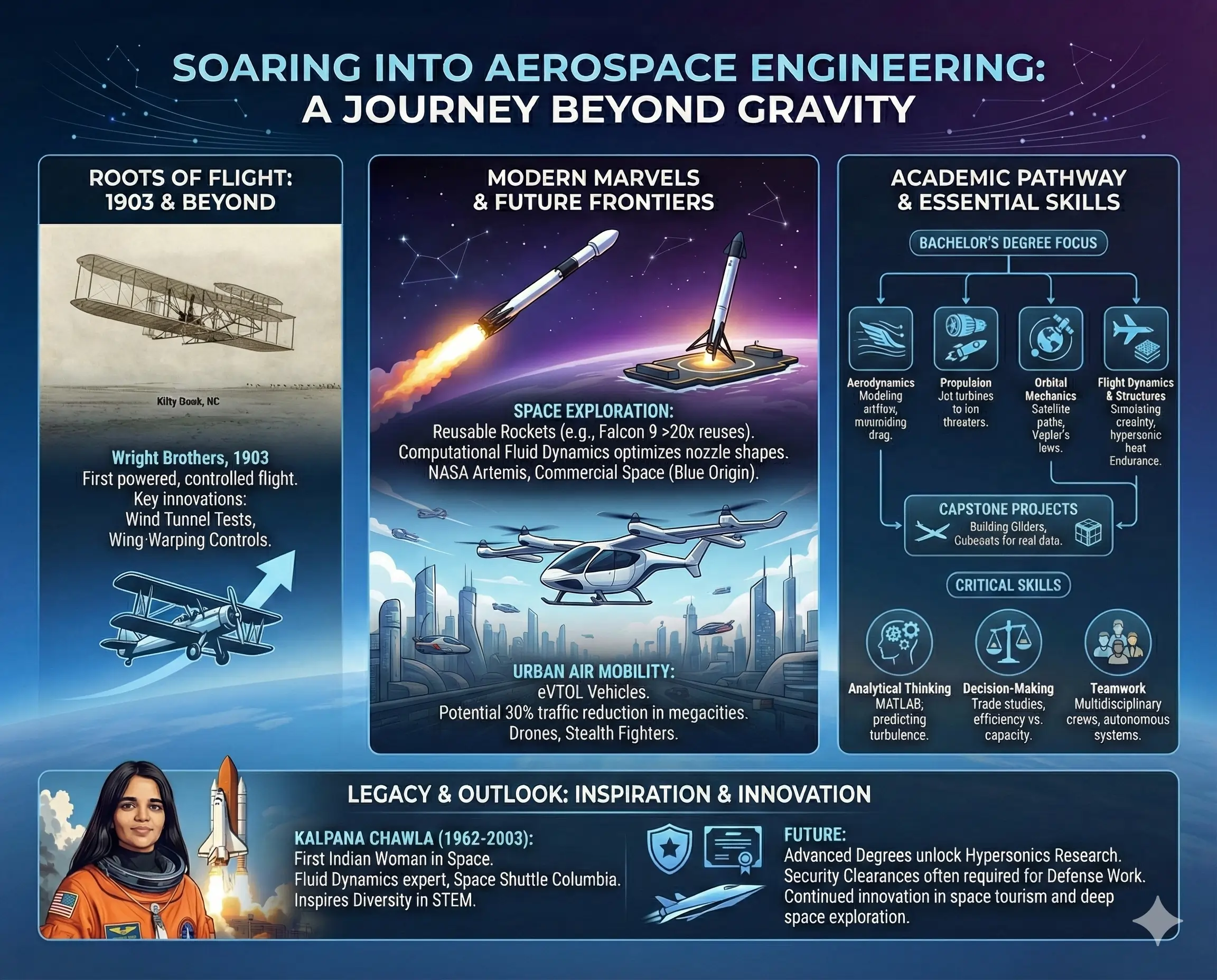
Today, aerospace engineers dream big: from stealth fighters evading radar to reusable rockets slashing launch costs. Take SpaceX’s Falcon 9, where engineers apply computational fluid dynamics to optimize nozzle shapes, enabling pinpoint landings that reuse boosters more than 20 times, democratizing space access. Or consider urban air mobility—developing eVTOL vehicles (electric vertical takeoff and landing) for city commutes, which could potentially cut traffic by 30% in megacities like Los Angeles.
Academically, a bachelor’s degree in aerospace engineering mirrors mechanical engineering in basics but zooms into flight-specific realms. Expect heavy emphasis on aerodynamics, modeling airflow over wings to minimize drag; propulsion, from jet turbines to ion thrusters; and orbital mechanics, calculating satellite paths with Kepler’s laws. Courses like flight dynamics simulate aircraft stability, while structures and materials address composites that endure hypersonic heat. Capstone projects often culminate in building gliders or CubeSats—tiny satellites launched to low Earth orbit for real data collection.
Skills here demand precision under pressure. Analytical thinking is paramount, as engineers use MATLAB to predict turbulence in reentry vehicles. Decision-making shines in trade studies, weighing fuel efficiency against payload capacity for Mars missions. Teamwork thrives in multidisciplinary crews, where aerodynamics experts collaborate with avionics pros on autonomous drones. A poignant example: Kalpana Chawla, the first Indian woman in space, whose aerospace background in fluid dynamics informed her work on the Space Shuttle Columbia—though tragically lost in 2003, her legacy inspires diversity in STEM.
Job entry often requires security clearances for defense work, and advanced degrees unlock research in hypersonics. The field pulses with innovation, from NASA’s Artemis program returning humans to the Moon to commercial ventures like Blue Origin’s orbital tourism.
| Core Aerospace Engineering Curriculum Components | Description | Typical Credit Hours | Example Project |
|---|---|---|---|
| Aerodynamics | Airflow analysis for lift and drag | 3-4 | Wing design optimization in a wind tunnel |
| Propulsion Systems | Engines from turbofans to rockets | 4 | Thrust vectoring test on model thruster |
| Flight Dynamics and Control | Stability and maneuvering equations | 3 | Simulator for autopilot algorithms |
| Orbital Mechanics | Trajectories and gravitational influences | 3 | Satellite orbit planner software |
| Aerospace Structures | Lightweight frames under extreme loads | 4 | Fuselage stress analysis via FEA |
| Avionics and Instrumentation | Electronics for navigation and sensors | 3 | Drone telemetry system integration |
| Spacecraft Design | Thermal protection and life support | 3 | CubeSat deployment mechanism |
This structured overview shows the specialized tilt toward aerial and cosmic challenges, fostering engineers ready for the next frontier.
Dissecting the Key Differences: Where Paths Diverge
While both fields orbit the same physics-based universe, their trajectories diverge in focus, rigor, and application. Let’s unpack these contrasts layer by layer, drawing from industry insights to highlight what sets them apart.
Specialization vs. Versatility
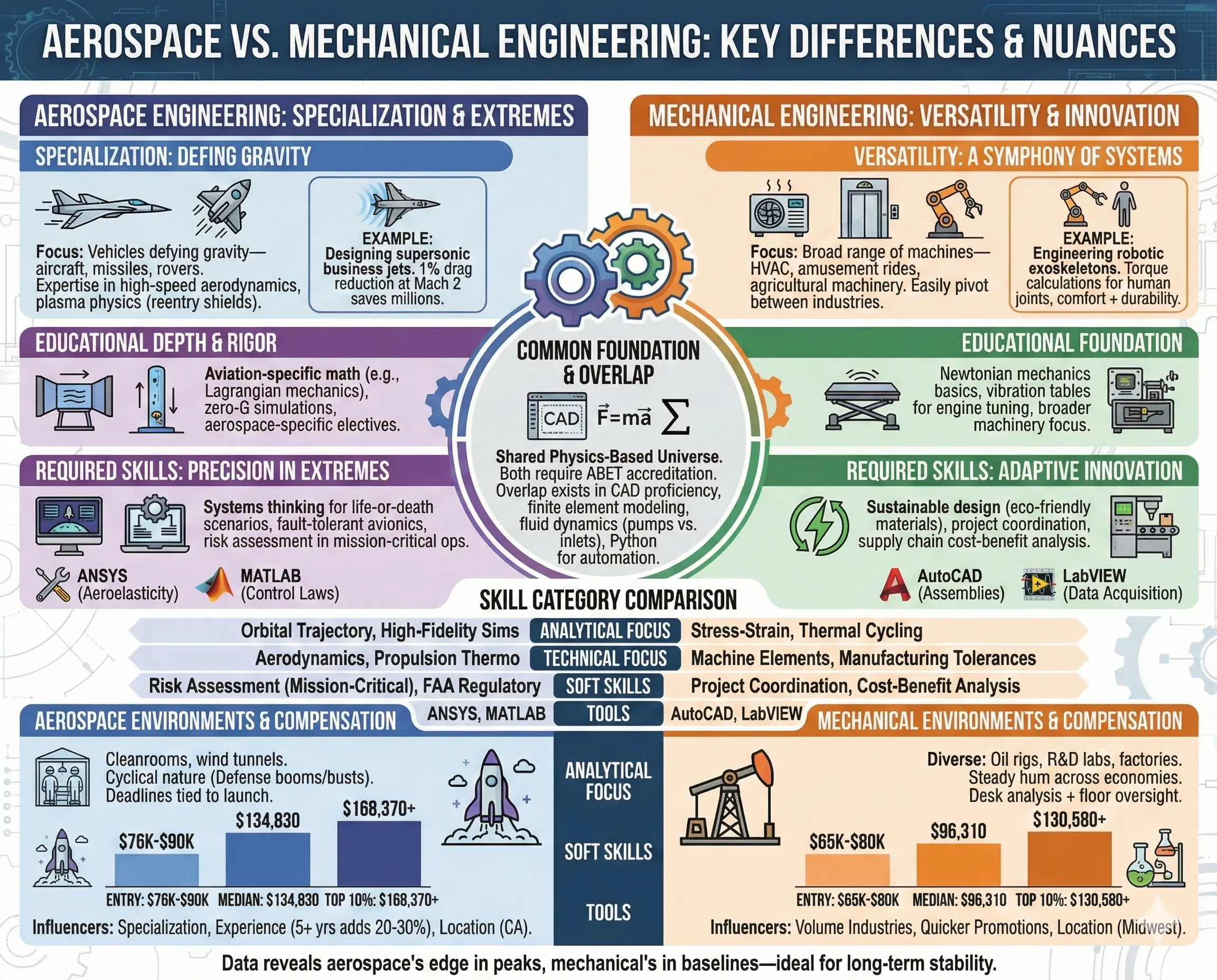
Aerospace engineering homes in on vehicles that defy gravity—aircraft, missiles, rovers—demanding expertise in high-speed aerodynamics and plasma physics for reentry shields. Mechanical engineers, conversely, orchestrate a symphony of systems: HVAC units, elevators, and even amusement park rides. This breadth means mechanical pros pivot easily; an aerospace specialist might struggle adapting to, say, agricultural machinery without retraining.
- Aerospace Example: Designing a supersonic business jet requires modeling shockwaves at Mach 2, where even a 1% drag reduction saves millions in fuel.
- Mechanical Example: Engineering a robotic exoskeleton for rehabilitation involves torque calculations for human joints, blending comfort with durability.
Educational Depth and Rigor
Aerospace curricula layer on aviation-specific math, like Lagrangian mechanics for satellite attitudes, while mechanical sticks to Newtonian basics for broader machinery. Aerospace labs simulate zero-G with drop towers; mechanical ones feature vibration tables for engine tuning. Both require ABET accreditation, but aerospace often mandates aerospace-specific electives, extending programs slightly.
Required Skills: Precision in Extremes vs. Adaptive Innovation
Aerospace calls for systems thinking in life-or-death scenarios—think fault-tolerant avionics preventing mid-flight failures. Mechanical emphasizes sustainable design, like eco-friendly plastics in packaging machines. Overlap exists in CAD proficiency, but aerospace adds CFD software for virtual wind tests.
| Skill Category | Aerospace Engineering Focus | Mechanical Engineering Focus | Overlap Example |
|---|---|---|---|
| Analytical | Orbital trajectory optimization; high-fidelity simulations | Stress-strain in components; thermal cycling | Finite element modeling for structural integrity |
| Technical | Aerodynamics, propulsion thermodynamics | Machine elements, manufacturing tolerances | Fluid dynamics in pumps vs. jet inlets |
| Soft Skills | Risk assessment in mission-critical ops; regulatory compliance (FAA) | Project coordination in supply chains; cost-benefit analysis | Team-based prototyping and iteration |
| Tools | ANSYS for aeroelasticity; MATLAB for control laws | AutoCAD for assemblies; LabVIEW for data acquisition | Both use Python for automation scripts |
This table underscores how aerospace sharpens niche tools, while mechanical builds a Swiss Army knife of competencies.
Work Environments and Daily Realities
Aerospace engineers often toil in cleanrooms or wind tunnels at firms like Boeing, facing deadlines tied to launch windows. Mechanical counterparts thrive in diverse settings—from oil rigs to R&D labs at General Electric—balancing desk analysis with floor oversight. Aerospace’s cyclical nature (booms in defense spending, busts in recessions) contrasts with mechanical’s steady hum across economies.
Salary and Compensation Nuances
Entry-level aerospace roles command premiums for specialization, but mechanical offers quicker promotions in volume industries. Factors like location (California for aero, Midwest for mech) and experience tilt the scales.
| Compensation Comparison (U.S. Median, 2024 Data) | Aerospace Engineer | Mechanical Engineer | Key Influencers |
|---|---|---|---|
| Annual Salary | $134,830 | $96,310 | Experience (5+ years adds 20-30%) |
| Hourly Rate | $64.82 | $46.30 | Industry (Defense vs. Automotive) |
| Entry-Level | $76,000-$90,000 | $65,000-$80,000 | Location (High in tech hubs) |
| Top 10% Earners | $168,370+ | $130,580+ | Advanced degrees/certifications |
Data reveals aerospace’s edge in peaks, mechanical’s in baselines—ideal for long-term stability.
Surprising Similarities That Unite Them
Don’t let differences overshadow common ground. Both fields are anchored in calculus, physics, and engineering ethics, fostering innovators who debug the world. Shared tools like 3D printing prototype parts for jets or gears alike. Culturally, both champion sustainability—mechanical in green manufacturing, aerospace in fuel-efficient planes cutting emissions 20%. Graduates often cross-pollinate: many aerospace pros start with mechanical degrees, leveraging that foundation for flight specials.
Navigating Careers: Opportunities, Challenges, and Horizons
Career Paths in Mechanical Engineering
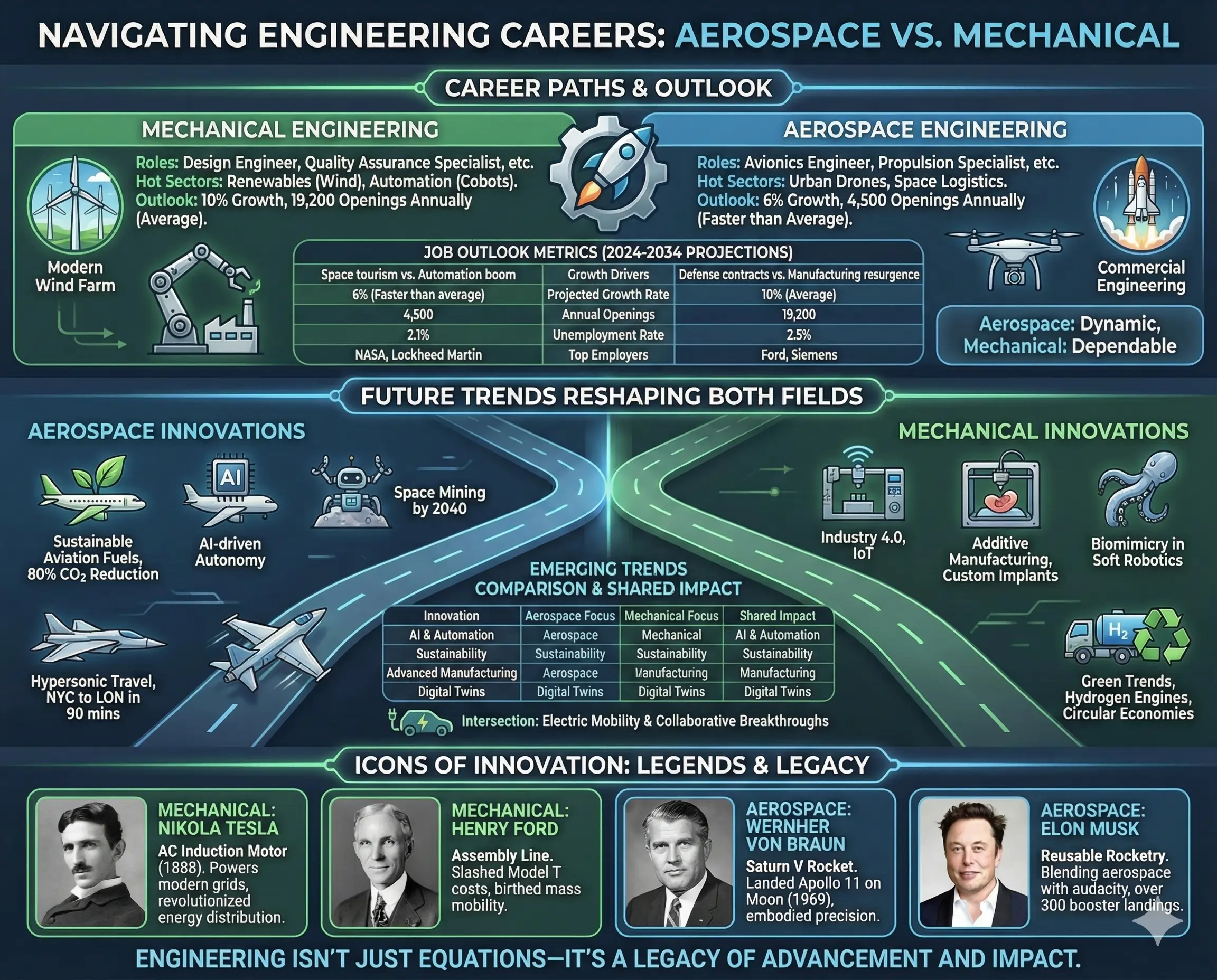
From design engineer sketching HVAC blueprints to quality assurance specialist vetting assembly lines, options abound. Hot sectors include renewables (wind turbine tech) and automation (cobots in factories). Job growth hovers at 10% through 2032, with 19,200 annual openings.
Career Paths in Aerospace Engineering
Roles span avionics engineer, wiring satellite comms to propulsion specialist, tweaking rocket fuels. Thriving areas: urban drones and space logistics. Outlook: 6% growth, 4,500 openings yearly, fueled by commercial space.
| Job Outlook Metrics (2024-2034 Projections) | Aerospace Engineering | Mechanical Engineering | Growth Drivers |
|---|---|---|---|
| Projected Growth Rate | 6% (Faster than average) | 10% (Average) | Space tourism vs. Automation boom |
| Annual Openings | 4,500 | 19,200 | Defense contracts vs. Manufacturing resurgence |
| Unemployment Rate | 2.1% | 2.5% | Cyclical vs. Stable demand |
| Top Employers | NASA, Lockheed Martin | Ford, Siemens | Government vs. Private sector |
These figures paint aerospace as dynamic, mechanical as dependable.
Future Trends Reshaping Both Fields
The horizon buzzes with convergence. Aerospace engineering eyes sustainable aviation fuels, slashing CO2 by 80%, AI-driven autonomy for pilotless cargo planes, and hypersonic travel zipping New York to London in 90 minutes. Space mining for rare metals could boom by 2040.
Mechanical engineering surges with Industry 4.0—IoT sensors predicting machine failures, additive manufacturing printing custom implants, and biomimicry in soft robotics inspired by octopuses. Green trends dominate: hydrogen engines for trucks, circular economies recycling 90% of parts.
| Emerging Trends Comparison | Aerospace Innovations | Mechanical Innovations | Shared Impact |
|---|---|---|---|
| AI and Automation | Predictive maintenance for engines | Robotic assembly lines | Efficiency gains of 25% |
| Sustainability | Electric propulsion for drones | Bio-based materials in gears | Net-zero goals by 2050 |
| Advanced Manufacturing | 3D-printed rocket nozzles | Topology optimization for frames | Cost reductions up to 40% |
| Digital Twins | Virtual flight testing | Simulated factory flows | Accelerated R&D cycles |
Both fields intersect in electric mobility, promising collaborative breakthroughs.
Icons of Innovation: Stories from Legends in Each Field
Inspiration flows from trailblazers. Mechanical Engineering boasts Nikola Tesla, whose AC induction motor (1888) powers modern grids, revolutionizing energy distribution. Or Henry Ford, whose assembly line slashed Model T costs from $850 to $260, birthing mass mobility.
Aerospace reveres Wernher von Braun, architect of the Saturn V rocket that landed Apollo 11 on the Moon in 1969, embodying precision amid Cold War stakes. Elon Musk, blending aerospace with audacity, leads reusable rocketry, landing over 300 boosters to date.
These figures remind us: engineering isn’t just equations—it’s a legacy.
Making the Choice: Pros, Cons, and Personal Fit
Pros of Aerospace: Thrilling projects, higher pay, cutting-edge tech. Cons: Narrower market, travel demands, security hurdles.
Pros of Mechanical: Job security, variety, and work-life balance. Cons: Slower innovation pace, competitive entry.
Advice? Assess passions—if skies call, pursue aerospace with a mechanical minor for flexibility. Internships clarify: shadow a drone tester or factory optimizer. Both promise fulfillment; choose where your curiosity ignites.
In wrapping this journey, remember: whether grounding innovations or launching dreams, these fields propel progress. Dive in, iterate, and engineer your future—one bold design at a time.
Key Citations And References
- Indeed: Mechanical vs. Aerospace Engineering
- BLS: Aerospace Engineers Outlook
- UND: Aerospace vs. Mechanical
- Thomasnet: Famous Aerospace Engineers
- Sphero: Famous Mechanical Engineers
- Deloitte: Aerospace Trends 2026
- Case Western: Mechanical Trends
- BLS: Mechanical Engineers
- IIAEIT: Careers Guide
- MTU: Curriculum Comparison
Read These Articles in Detail
- Aerospace Engineering vs. Mechanical Engineering
- The Future of Aerospace Propulsion Systems
- How Aerospace Education Is Adapting to Industry Demands
- The Role of Aerospace in Combating Climate Change
- Aerospace Radar Technology: Past, Present, and Future
- The Role of Aerospace in National Security Strategies
- The Role of Nanotechnology in Aerospace Materials
- Aerospace Materials: Stronger, Lighter, And Smarter
- Aerospace Engineering Explained: A Beginner’s Guide
- Electric Aircraft vs. Hydrogen Aircraft: Which Is More Sustainable?
- Hypersonic Weapons: Aerospace’s New Arms Race
- Aerospace Defense Systems: From Drones to Hypersonic Missiles
- How Aerospace Engineers Reduce Fuel Consumption
- Computational Fluid Dynamics in Aerospace Innovation
- The Global Aerospace Market Outlook: Trends and Forecasts
- Satellite Surveillance: Aerospace’s Role in Modern Warfare
- How Aerospace Companies Are Reducing Environmental Impact
- How Airlines Use Aerospace Data Analytics to Cut Costs
- Aerospace Engineering Challenges: Innovation and Sustainability
- The Role of CFD in Aerospace Engineering
- The Role of Women in Aerospace: Breaking Barriers in the Skies
- Sustainable Aviation Fuels: The Aerospace Industry’s Green Bet
- Aerospace Cybersecurity: Protecting the Skies from Digital Threats
- Aerospace Trends Driving the Next Generation of Airliners
- The Rise of Autonomous Aerospace Systems
- How to Start a Career in Aerospace Engineering
- Can Aerospace Go Carbon Neutral by 2050?
- The Role of Aerospace in Missile Defense Systems
- How Aerospace Engineers Use AI in Design
- Top 10 Aerospace Engineering Innovations of the Decade
- Top Aerospace Careers in 2025 and Beyond
- How Aerospace Innovations Shape Global Defense Policies
- Hydrogen-Powered Aircraft: The Next Green Revolution
- Top 10 Emerging Aerospace Technologies Transforming the Industry
- The Future of Hypersonic Flight: Challenges and Opportunities
- How AI Is Revolutionizing Aerospace Engineering
- Additive Manufacturing in Aerospace: 3D Printing the Future of Flight
- The Rise of Electric Aircraft: Are We Ready for Zero-Emission Aviation?
- Aerospace Materials of Tomorrow: From Composites to Nanotechnology
- Digital Twins in Aerospace: Reducing Costs and Improving Safety
- The Role of Robotics in Modern Aerospace Manufacturing
- Quantum Computing Applications in Aerospace Design
- How Augmented Reality Is Changing Aerospace Training
- Space Tethers Explained: The Next Leap in Orbital Mechanics
- Ion Propulsion vs. Chemical Rockets: Which Will Power the Future?
- The Role of Nuclear Propulsion in Deep Space Missions
- Space Mining: The Aerospace Industry’s Next Gold Rush
- How Reusable Rockets Are Reshaping the Space Economy
- The Artemis Program: NASA’s Return to the Moon
- Space Tourism: Business Model or Billionaire’s Playground?
- How Aerospace Startups Are Disrupting Commercial Aviation
- The Economics of Low-Cost Airlines in the Aerospace Era
- Urban Air Mobility: The Rise of Flying Taxis
- The Future of Mars Colonization: Key Aerospace Challenges and Solutions Ahead
- CubeSats and Small Satellites: Democratizing Space Access
- The Future of Cargo Drones in Global Logistics
- The Role of Aerospace in Building a Lunar Economy
Frequently Asked Questions
FAQ 1: What Are the Main Differences Between Aerospace Engineering and Mechanical Engineering?
When comparing aerospace engineering and mechanical engineering, the core distinction lies in their scope and application. Aerospace engineering zeroes in on the design, development, and testing of aircraft, spacecraft, and related systems, grappling with unique challenges like extreme altitudes, supersonic speeds, and the vacuum of space. This means a heavy emphasis on aerodynamics, propulsion systems, and orbital mechanics, where every calculation can mean the difference between a successful launch and a catastrophic failure. For instance, an aerospace engineer might spend months simulating how a rocket’s heat shield withstands reentry temperatures exceeding 2,000 degrees Fahrenheit, ensuring crew safety on missions like those planned for NASA’s Artemis program.
In contrast, mechanical engineering casts a wider net, covering the creation and optimization of a vast array of mechanical devices and systems used in everyday industries, from automotive engines to medical devices and renewable energy setups. It’s all about converting energy into motion efficiently, often in more grounded environments. A mechanical engineer could be refining the gears in an electric vehicle battery pack to boost range by 15 percent or designing earthquake-resistant bridges that flex without breaking. While both fields share foundational principles like physics and materials science, aerospace demands a laser focus on flight dynamics, making it feel like a high-stakes adventure, whereas mechanical engineering rewards versatile problem-solving across sectors like manufacturing and healthcare.
These differences extend to daily workflows too. Aerospace projects often involve strict regulatory compliance with bodies overseeing aviation safety, leading to iterative testing in wind tunnels or zero-gravity simulators. Mechanical roles, however, might blend desk analysis with hands-on factory tweaks, allowing for quicker prototypes using tools like 3D printing. Ultimately, if your passion skews toward pushing humanity’s boundaries in the skies and beyond, aerospace calls; for innovating the machines that power our world on solid ground, mechanical engineering delivers broad impact.
FAQ 2: Which Engineering Field Pays More in 2025—Aerospace or Mechanical?
Salary is a big draw for many entering engineering, and in 2025, aerospace engineering edges out mechanical engineering in median pay, reflecting its specialized demands in high-tech sectors like defense and space exploration. However, mechanical roles offer more consistent earning potential across diverse industries, with opportunities for rapid advancement in booming areas like automation.
Here’s a breakdown of key salary metrics based on the latest labor data, showing how factors like experience and location influence earnings:
| Metric | Aerospace Engineering | Mechanical Engineering | Key Notes |
|---|---|---|---|
| Median Annual Salary (2025 Projection) | $138,500 | $99,200 | Aerospace benefits from defense contracts; mechanical sees gains in renewables. |
| Entry-Level (0-2 Years) | $78,000–$92,000 | $68,000–$82,000 | Urban hubs like Seattle boost aero starts by 10-15%. |
| Mid-Career (5-10 Years) | $120,000–$155,000 | $95,000–$125,000 | Certifications like PE add $10k–$20k annually in both. |
| Top 10% Earners | $175,000+ | $140,000+ | Aero peaks in space firms; mech in executive manufacturing roles. |
| Hourly Rate (National Avg.) | $66.60 | $47.70 | Overtime is common in aero project deadlines. |
These figures highlight aerospace’s premium for niche expertise, but mechanical engineering’s broader job market often leads to steadier bonuses and perks, especially in growing fields like electric vehicles. Location matters too—coastal tech centers inflate both, while Midwest manufacturing hubs keep mechanical competitive.
FAQ 3: What Educational Requirements Do You Need for Aerospace vs. Mechanical Engineering?
Pursuing a career in either aerospace or mechanical engineering starts with a solid bachelor’s degree, but the paths diverge in focus to match each field’s demands. Both typically require a four-year program accredited by bodies ensuring rigorous standards, blending math, science, and hands-on labs. However, aerospace curricula dive deeper into flight-specific topics, while mechanical emphasizes versatile machinery principles.
To give you a clear roadmap:
- Core Prerequisites: High school courses in calculus, physics, and chemistry lay the groundwork for both. Expect to maintain a GPA above 3.0 for competitive programs.
- Bachelor’s Degree Breakdown: Aerospace often includes specialized tracks in avionics or astrodynamics; mechanical covers broader electives like robotics or HVAC design. Total credits: 120-130 for each.
- Advanced Options: A master’s boosts prospects—essential for research roles in aerospace (e.g., hypersonics) and valuable in mechanical for leadership in sustainable tech. PhDs suit academia or cutting-edge R&D.
- Certifications and Experience: Both benefit from internships; aerospace may require FAA knowledge tests, while mechanical pros pursue Six Sigma for manufacturing efficiency. Co-op programs during undergrad can fast-track job offers.
Graduates from top schools often land roles faster, but community college transfers or online hybrids make entry accessible. Whichever you choose, capstone projects—like building a drone for aerospace or a solar prototype for mechanical—build portfolios that employers love.
FAQ 4: How Do Job Outlooks Compare for Aerospace and Mechanical Engineers Through 2034?
The job market for engineers remains robust, but aerospace and mechanical fields show nuanced growth driven by innovation and global needs. Aerospace’s outlook ties to space commercialization and defense, while mechanical thrives on manufacturing resurgence and green tech. Projections indicate steady demand, with mechanical offering more openings due to its versatility.
| Outlook Factor | Aerospace Engineering | Mechanical Engineering | Influencing Trends |
|---|---|---|---|
| Projected Growth Rate (2024-2034) | 6% (Faster than average) | 9% (Much faster than average) | Aero: Space tourism; Mech: Automation boom. |
| Annual Job Openings | 4,500 | 18,100 | Replacements from retirements fuel both. |
| Unemployment Rate (2025 Est.) | 2.0% | 2.3% | Low across board; skills gaps widen opportunities. |
| Top Growth Sectors | Commercial space, drones | Renewables, EVs | AI integration accelerates hiring in both. |
| Geographic Hotspots | California, Texas | Midwest, Southeast | Remote options rising post-2025. |
These stats suggest mechanical edges in volume, ideal for stability seekers, while aerospace promises excitement in niche booms like reusable rockets. Upskilling in digital tools will be key to tapping these prospects.
FAQ 5: What Key Skills Are Essential for Success in Aerospace Engineering?
Thriving in aerospace engineering goes beyond textbooks—it’s about blending technical prowess with the grit to innovate under pressure. At the foundation, strong math and physics chops are non-negotiable, particularly in differential equations for modeling flight paths or vector calculus for thrust calculations. But what sets top performers apart is their ability to wield software like ANSYS for stress simulations on wing structures, ensuring they withstand G-forces during maneuvers.
Beyond the numbers, soft skills shine in collaborative environments, where aerospace projects span teams from materials experts to software coders. Effective communication turns complex data into compelling briefs for stakeholders, like pitching a satellite design to funding boards. Problem-solving under deadlines is crucial too—recall how engineers at SpaceX iterated Falcon rocket landings in real-time, adapting to wind shifts mid-descent. Adaptability extends to regulatory savvy, navigating FAA guidelines that evolve with tech like urban air taxis.
Looking ahead, emerging competencies like AI integration for predictive maintenance on aircraft fleets are game-changers, reducing downtime by up to 30 percent. Hands-on experience through internships or clubs builds these, turning theoretical knowledge into the confidence that launches careers sky-high.
FAQ 6: Can a Mechanical Engineer Easily Transition to Aerospace Engineering?
Transitioning from mechanical engineering to aerospace engineering is not only possible but increasingly common, thanks to the overlapping foundations in mechanics, thermodynamics, and design principles. Many mechanical grads find their broad toolkit—honed on projects like engine optimization—translates well to aerospace’s specialized demands, such as airfoil shaping or thermal shielding. However, bridging the gap requires targeted upskilling to handle flight-unique elements like compressible flows or astrodynamics.
Here’s how to make the switch smoother:
- Leverage Shared Ground: Start by applying mechanical expertise in aero-adjacent roles, like turbine design at aviation firms, where your CAD proficiency accelerates adaptation.
- Pursue Specialized Training: Enroll in graduate certificates in aerodynamics or propulsion; online courses from platforms covering orbital mechanics can fill gaps in weeks.
- Build Relevant Experience: Seek internships at aerospace suppliers—mechanical backgrounds excel in composites testing, a hot area for lightweight fuselages.
- Network and Certify: Join professional groups for mentorship; earning an ASME endorsement in aerospace materials signals readiness to recruiters.
- Address Challenges: Be prepared for steeper learning curves in high-stakes simulations, but your mechanical versatility often makes you a quick study.
Countless pros have pivoted successfully, like those contributing to hybrid-electric planes, proving the fields’ synergy fuels rewarding career leaps.
FAQ 7: What Emerging Trends Are Shaping Aerospace Engineering in 2025?
The aerospace engineering landscape in 2025 is buzzing with transformative shifts, propelled by sustainability mandates and digital leaps that promise to redefine flight and space travel. At the forefront, sustainable aviation fuels (SAF) are gaining traction, with blends reducing lifecycle emissions by 80 percent, as airlines race to meet net-zero pledges by 2050. Engineers are innovating biofuel integrations for existing jets, balancing cost with performance to make green skies viable.
Electric and hybrid propulsion systems mark another leap, powering eVTOL urban air taxis that could slash city commutes by half, while additive manufacturing—or 3D printing—speeds up complex parts like turbine blades, cutting production times by 40 percent. AI weaves through it all, from autonomous drone swarms for delivery to predictive analytics averting engine failures mid-flight.
- Hypersonics and Supersonics: Reviving faster-than-sound travel, with prototypes eyeing New York-to-London in under two hours.
- Digital Twins: Virtual replicas of aircraft for real-time testing, accelerating designs without physical builds.
- Space Sustainability: Orbital debris mitigation tech, like magnetic tethers, ensuring safe expansion for satellite constellations.
These trends not only challenge engineers to think bolder but also open doors to interdisciplinary roles blending aero with AI and environmental science.
FAQ 8: How Is Mechanical Engineering Driving Sustainability Efforts in 2025?
Mechanical engineering plays a pivotal role in sustainability, engineering solutions that minimize waste and maximize efficiency across industries, from energy to consumer goods. In 2025, this means pioneering circular economy designs where products like wind turbine blades are recyclable, extending lifespans and curbing landfill overflow. Engineers are optimizing HVAC systems in buildings to cut energy use by 25 percent through smart sensors that adjust flows in real-time, proving small tweaks yield big environmental wins.
Renewable integration is booming too—think mechanical tweaks to solar trackers that follow the sun precisely, boosting output by 30 percent in variable climates. Biomimicry inspires innovations, like robot grippers modeled on gecko feet for delicate, energy-efficient handling in factories, reducing material damage and resource strain.
The field’s holistic approach extends to policy influence, with engineers advocating for standards that embed life-cycle assessments into manufacturing. As global pressures mount, mechanical pros are the unsung heroes turning eco-ambitions into actionable tech, fostering a greener industrial backbone.
FAQ 9: Who Are Some Iconic Figures in Aerospace and Mechanical Engineering?
History’s engineering giants inspire today’s innovators, with aerospace and mechanical fields boasting trailblazers whose inventions reshaped society. From moon landings to mass production, their legacies highlight the power of bold ideas.
| Engineer | Field | Key Contribution | Lasting Impact |
|---|---|---|---|
| Wernher von Braun | Aerospace | Developed the Saturn V rocket for the Apollo missions | Enabled the first Moon landing in 1969, the foundation for modern rocketry. |
| Kalpana Chawla | Aerospace | Advanced fluid dynamics in space shuttles | First Indian woman in space; promoted STEM diversity pre-2003 tragedy. |
| James Watt | Mechanical | Improved steam engine efficiency by 75% | Sparked the Industrial Revolution; basis for thermodynamics. |
| Nikola Tesla | Mechanical | Invented the AC induction motor in 1888 | Powers global electricity grids; enabled wireless tech. |
| Elon Musk | Aerospace (Modern) | Pioneered reusable Falcon rockets | Over 300 successful landings by 2025; slashed space costs. |
| Henry Ford | Mechanical | Assembly line for Model T vehicles | Democratized cars; model for modern manufacturing. |
These pioneers remind us that engineering blends vision with rigor, influencing everything from daily commutes to cosmic exploration.
FAQ 10: How Do You Choose Between Aerospace and Mechanical Engineering as a Career?
Deciding between aerospace engineering and mechanical engineering boils down to aligning your interests with each field’s vibe—sky-high thrills versus grounded versatility. Start by reflecting on what excites you: Do visions of starships or sustainable cities light your fire? Aerospace suits dreamers tackling gravity-defying puzzles, while mechanical appeals to builders crafting everyday solutions.
To navigate the choice thoughtfully:
- Assess Your Passions: If flight simulations or space news hook you, lean towards aerospace; for robotics tinkering or eco-gadgets, mechanical fits.
- Weigh Lifestyle Factors: Aerospace often means travel and deadlines tied to launches; mechanical offers more nine-to-five balance in varied locales.
- Explore Hands-On: Intern or volunteer—shadow an aero tester or mech designer to feel the daily grind.
- Consider Long-Term Goals: Aerospace for niche prestige and higher peaks; mechanical for job security and pivots into biotech or energy.
- Seek Guidance: Chat with alumni or career counselors; online quizzes can spark insights too.
Whichever path calls, both promise purpose—dive in with curiosity, and you’ll engineer a fulfilling trajectory.
FAQ 11: Top Universities for Aerospace Engineering in 2025
Choosing the right university can launch your career in aerospace engineering sky-high, with programs blending cutting-edge research, hands-on labs, and industry ties. In 2025, standout schools emphasize innovation in spacecraft design and sustainable flight, often ranking high for facilities like wind tunnels and satellite simulators. These institutions not only boast strong faculty but also placement rates exceeding 90 percent in roles at NASA or Boeing.
Here’s a curated list of top programs based on recent rankings, highlighting key strengths and acceptance insights:
| University | Location | Key Strengths | Acceptance Rate (2025 Est.) | Notable Features |
|---|---|---|---|---|
| Massachusetts Institute of Technology (MIT) | Cambridge, MA | Aerodynamics, propulsion research | 4% | Collaborations with SpaceX; AeroAstro labs for CubeSat projects |
| Georgia Institute of Technology | Atlanta, GA | Affordable, diverse tracks in avionics | 17% | Wind tunnel access; co-op with Delta Airlines |
| Purdue University | West Lafayette, IN | Astronautics focus, alumni network | 53% | Zucrow Labs for rocket testing; strong in hypersonics |
| Stanford University | Stanford, CA | Interdisciplinary with AI integration | 4% | Proximity to Silicon Valley; drone autonomy research |
| University of Michigan | Ann Arbor, MI | Structures and composites | 18% | Plasmadynamics lab; international study abroad options |
| California Institute of Technology (Caltech) | Pasadena, CA | Theoretical astrophysics tie-ins | 3% | JPL partnerships for Mars rover tech |
| University of Colorado Boulder | Boulder, CO | Space weather, satellite systems | 81% | LASP for real-time orbital mechanics projects |
These programs often require strong STEM prep, with scholarships favoring high GPAs and research experience. Selecting one aligns your path with emerging trends like electric propulsion.
FAQ 12: How Is AI Impacting Aerospace and Mechanical Engineering in 2025?
Artificial intelligence is reshaping both aerospace and mechanical engineering, accelerating designs and predicting failures in ways that save time and resources. In aerospace, AI optimizes flight paths to cut fuel use by 10-15 percent, using machine learning to analyze vast datasets from sensors on jets or satellites. This means engineers spend less time on manual simulations and more on creative breakthroughs, like autonomous drones for disaster relief.
Mechanical engineering benefits similarly, with AI-driven tools enhancing manufacturing precision—think predictive maintenance that spots wear in factory robots before breakdowns occur, boosting uptime by 20 percent. Across both fields, AI fosters sustainability, from greener materials in car engines to lighter aircraft composites that reduce emissions.
Key applications include:
- Predictive Analytics: In aerospace, AI forecasts turbulence for safer routes; in mechanical, it simulates stress on bridges to prevent collapses.
- Design Optimization: Generative AI creates thousands of prototypes virtually, slashing development cycles from months to weeks.
- Supply Chain Efficiency: AI models demand for parts, minimizing delays in rocket builds or automotive assembly lines.
- Quality Assurance: Computer vision inspects welds or wing joints with 99 percent accuracy, far surpassing human checks.
As 2025 unfolds, ethical AI use—like bias-free algorithms—remains crucial, ensuring these tools amplify human ingenuity without replacing jobs.
FAQ 13: What Is the Current Representation of Women in Aerospace vs. Mechanical Engineering?
The push for diversity in engineering continues, but aerospace and mechanical engineering lag behind other fields, with women comprising just 10-17 percent of professionals in 2025. This underrepresentation stems from historical barriers like limited STEM encouragement in schools, yet progress is evident through initiatives like mentorship programs that have boosted female enrollment by 5 percent annually. In aerospace, the figure hovers at 13.6 percent of the workforce, up from 7.8 percent a decade ago, driven by role models in space tourism and defense projects.
Mechanical engineering fares slightly better at 17.3 percent for degrees awarded to women in 2022, reflecting broader applications in consumer products that attract diverse talent. However, challenges persist: women report higher attrition rates due to work cultures emphasizing long hours over flexibility. Organizations are countering this with targeted scholarships and inclusive hiring, projecting 20 percent female participation by 2030 if trends hold.
These stats underscore a field ripe for change, where women’s contributions—from leading electric aircraft designs to sustainable manufacturing—promise innovation. Aspiring engineers can join networks to amplify voices and shatter ceilings.
FAQ 14: Entry-Level Jobs in Aerospace vs. Mechanical Engineering: A Comparison
Kicking off your career in aerospace or mechanical engineering means targeting roles that build skills through real-world application, often starting with salaries around $70,000-$85,000. Aerospace entry points focus on testing and support in high-tech environments, while mechanical offers quicker access to varied industries like automotive or energy.
| Job Title | Field | Typical Responsibilities | Required Skills | Avg. Starting Salary (2025) | Growth Potential |
|---|---|---|---|---|---|
| Junior Design Engineer | Aerospace | Assist in CAD modeling for aircraft components | Aerodynamics basics, SolidWorks | $78,000 | High; leads to lead designer in 3-5 years |
| Test Technician | Aerospace | Conduct wind tunnel experiments, data logging | Lab safety, MATLAB | $65,000 | Moderate; pathways to R&D roles |
| Manufacturing Engineer | Mechanical | Optimize assembly lines for machinery | Lean principles, AutoCAD | $72,000 | Strong; to senior in manufacturing firms |
| Product Development Intern | Mechanical | Prototype testing for consumer devices | Thermodynamics, prototyping | $68,000 (full-time equiv.) | Excellent; broad industry jumps |
| Systems Analyst | Both | Simulate system performance | Python scripting, FEA tools | $75,000 | Versatile; cross-field mobility |
These positions emphasize internships for a competitive edge, with aerospace demanding security clearances early on.
FAQ 15: What Does the Global Job Market Look Like for Aerospace and Mechanical Engineers in 2025?
The global job market for aerospace and mechanical engineers in 2025 is robust yet nuanced, with aerospace riding a wave of space commercialization and mechanical fueling green manufacturing booms. Aerospace sees 6 percent growth, adding 4,500 U.S. jobs yearly amid demand for 38,000 new aircraft worldwide, concentrated in hubs like the U.S., Europe, and Asia-Pacific where firms like Airbus expand. Challenges include supply chain hiccups, but opportunities in eVTOLs and satellites project 1.3 million aviation roles by 2036.
Mechanical engineering outpaces with 9-11 percent growth, yielding 18,000+ U.S. openings annually, driven by renewables and automation in China and India. Salaries average $99,200 in the U.S., higher in Europe at €60,000 equivalents, with versatility allowing pivots to biotech. Globally, emerging markets like Brazil offer entry via infrastructure projects.
Both fields face talent shortages, favoring skilled pros with AI literacy. Networking via international conferences can unlock visas and remote gigs, painting a picture of expansive, interconnected opportunities.
FAQ 16: Exploring Research Opportunities in Aerospace vs. Mechanical Engineering
Diving into research elevates aerospace and mechanical engineering beyond routine design, offering grants and publications that shape industries. Aerospace research thrives on federally funded projects like NASA’s hypersonics, where engineers model plasma flows for reentry vehicles, often collaborating with universities on orbital debris solutions. Mechanical counterparts explore biomimicry, developing soft robots inspired by nature for medical applications, with funding from NSF grants exceeding $100 million yearly.
These paths intersect in areas like additive manufacturing, but diverge in scope: aerospace emphasizes high-risk, high-reward simulations, while mechanical prioritizes scalable prototypes.
- Funding Sources: Aerospace taps DoD contracts; mechanical leverages industry partnerships like GE.
- Academic Ties: PhD programs at MIT offer aerospace fellowships; Purdue excels in mechanical vibrations research.
- Industry Labs: Boeing’s Phantom Works for aero; Siemens for mech energy systems.
- Global Angles: EU Horizon programs fund joint aero-mech sustainability studies.
Pursuing research hones expertise, often leading to patents and leadership roles.
FAQ 17: Work-Life Balance: Aerospace Engineers vs. Mechanical Engineers
Balancing ambition and well-being varies by field, with mechanical engineers generally enjoying steadier schedules in diverse settings. In 2025, surveys show 70 percent of mechanical pros log under 45 hours weekly, thanks to flexible manufacturing roles, though peaks hit 50 during product launches.
Aerospace demands more intensity, with 40 percent reporting overtime tied to deadlines like rocket tests, yet remote options in simulation work mitigate this.
| Aspect | Aerospace Engineering | Mechanical Engineering | Tips for Improvement |
|---|---|---|---|
| Average Weekly Hours | 42-50 | 38-45 | Prioritize boundary-setting in contracts |
| Travel Frequency | High (30% roles) | Moderate (15%) | Opt for simulation-heavy positions |
| Flexibility Rating (Out of 10) | 6.5 | 8.0 | Use hybrid models post-pandemic |
| Burnout Risk | Elevated in defense | Lower in consumer goods | Wellness programs at firms like Lockheed |
| Parental Leave Access | 75% coverage | 85% coverage | Advocate via unions |
Both benefit from evolving norms, emphasizing recharge for sustained creativity.
FAQ 18: How Can High School Students Prepare for Aerospace or Mechanical Engineering?
Preparing in high school sets a strong foundation for aerospace or mechanical engineering, focusing on STEM rigor and extracurriculars that spark passion. Start with advanced classes to build analytical muscles, then layer in projects that showcase initiative—essential for college apps boasting 3.5+ GPAs.
To gear up effectively:
- Core Classes: Enroll in AP Calculus, Physics C, and Chemistry; these prerequisites ease college transitions.
- Hands-On Activities: Join robotics clubs or build model rockets via FIRST programs for practical skills.
- Summer Programs: Attend camps at universities like Purdue for aero simulations or mech prototyping.
- Online Resources: Use Khan Academy for fluid dynamics or Coursera for intro CAD.
- Mentorship: Shadow engineers through local AIAA chapters to explore career realities.
This proactive approach not only boosts admissions but ignites lifelong curiosity.
FAQ 19: Essential Software Tools for Aerospace vs. Mechanical Engineering
Mastering the right software tools streamlines workflows in aerospace and mechanical engineering, from drafting to simulation. Aerospace leans on specialized suites for flight dynamics, while mechanical favors versatile platforms for broad machinery.
| Category | Aerospace Tools | Mechanical Tools | Common Uses | Learning Curve |
|---|---|---|---|---|
| CAD Design | CATIA, NX | SolidWorks, Inventor | 3D modeling of wings or engines | Medium; tutorials abundant |
| Simulation (FEA/CFD) | ANSYS, Fluent | Abaqus, COMSOL | Stress analysis on fuselages or gears | High; requires math proficiency |
| Programming/Analysis | MATLAB, Python | LabVIEW, Simulink | Control systems for drones or robots | Low to medium; open-source options |
| Project Management | Siemens Teamcenter | AutoCAD Mechanical | Workflow tracking in teams | Low; integrates with CAD |
Proficiency in these boosts employability, with certifications validating skills.
FAQ 20: How Is Climate Change Influencing Aerospace Engineering?
Climate change poses both challenges and catalysts for aerospace engineering, amplifying the need for resilient, low-emission designs. Rising temperatures already curb takeoff weights at airports like Denver by 5-10 percent on hot days, forcing engineers to rethink aerodynamics for hotter, thinner air. Storms intensify turbulence, hiking fuel burn by 3-5 percent on transatlantic routes, per recent studies.
Yet, this urgency spurs innovation: sustainable aviation fuels now cut CO2 by 80 percent, with engineers optimizing blends for existing fleets. Sea-level rise threatens coastal hubs, prompting elevated runway prototypes and adaptive materials.
Aviation’s 2-3.5 percent share of global emissions underscores the pivot to electric hybrids, projected to dominate by 2040. Engineers must balance these with economic viability, collaborating on global standards to fly greener.
