

Imagine a world where the roar of jet engines gives way to the hum of electric propulsion systems, and where engineers design spacecraft not just for governments, but for everyday adventurers heading to orbital hotels. This isn’t science fiction—it’s the aerospace industry today, transforming at a breakneck pace driven by sustainability goals, digital revolutions, and the dawn of commercial space travel. But behind these innovations lies a critical question: how are the educators shaping tomorrow’s aerospace professionals, equipped to keep up?
Aerospace education is undergoing a profound shift, blending traditional engineering principles with cutting-edge technologies and real-world collaborations. This adaptation isn’t just about updating textbooks; it’s about creating resilient, innovative thinkers who can tackle the complex challenges of a multi-billion-dollar sector projected to add thousands of jobs in the coming years.
In this article, we’ll dive deep into the forces driving these changes, the strategies educators are employing, real-world examples that bring it all to life, and a glimpse into what lies ahead.
The aerospace field has always been a beacon of human ambition, from the Wright brothers’ first flight in 1903 to the reusable rockets landing upright like something out of a dream. Yet, today’s demands are more urgent than ever. Global air travel is rebounding, with forecasts calling for over 35,000 new aircraft by 2032, fueled by emerging markets and a push for greener skies. Add to that the explosive growth in space exploration—private companies are now vying for contracts alongside national agencies—and you have an industry hungry for talent that can innovate under pressure. Educators are rising to the occasion, weaving in skills like data analytics and ethical design to ensure graduates don’t just fill seats, but steer the course.
Table of Contents
The Evolving Aerospace Landscape
The aerospace sector isn’t standing still; it’s hurtling forward on wings of technological and environmental imperatives. This evolution is Industry 4.0, a paradigm that fuses physical production with digital intelligence through tools like the Internet of Things (IoT) and big data analytics. Factories once reliant on manual assembly lines now hum with interconnected machines that predict failures before they happen, slashing downtime and boosting efficiency. In aircraft design, this means virtual simulations using augmented reality (AR) and virtual reality (VR) to test prototypes without building a single physical part, cutting costs and accelerating development cycles.
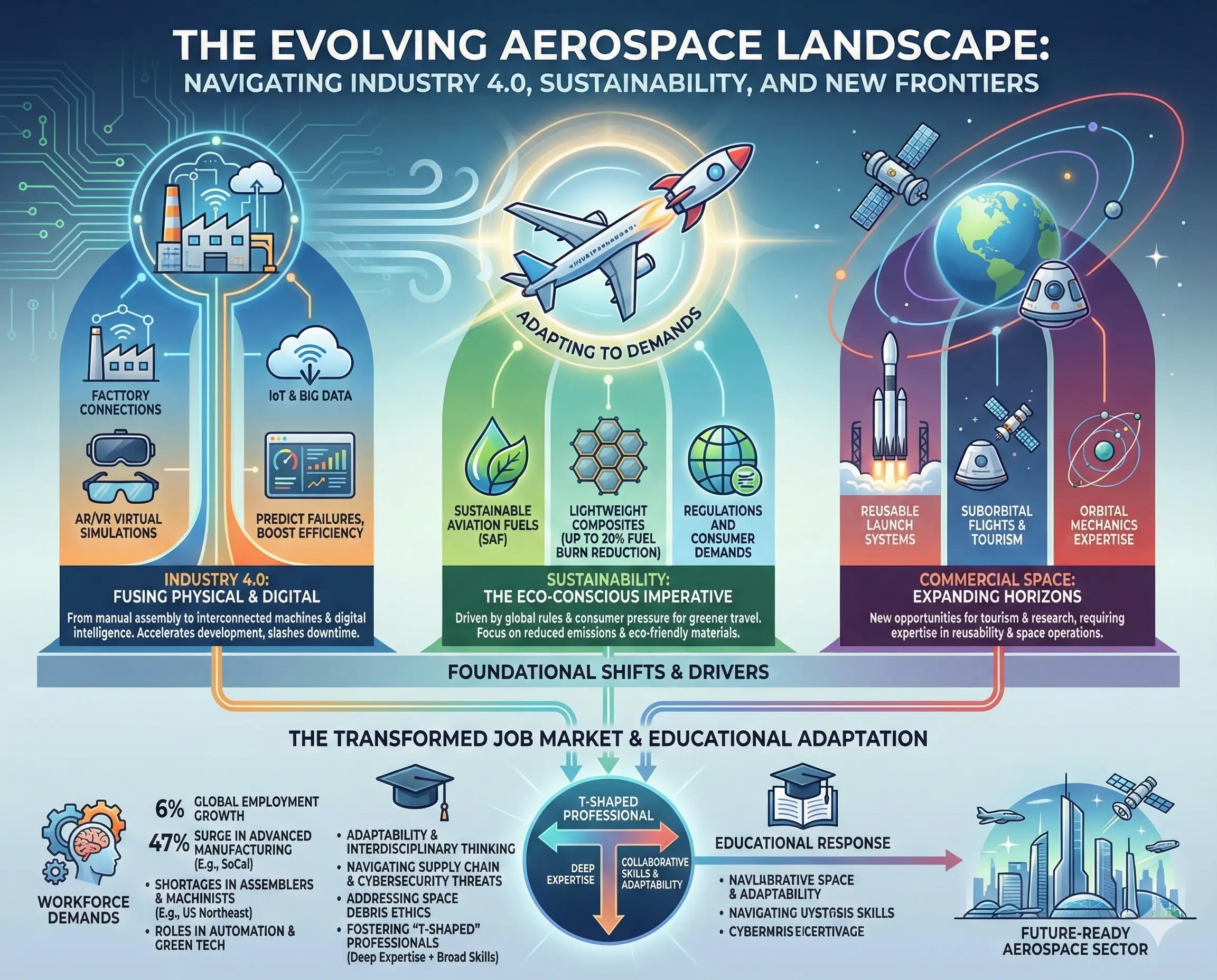
Sustainability has emerged as another powerhouse trend, propelled by global regulations and consumer demands for eco-conscious travel. Airlines and manufacturers are racing to develop sustainable aviation fuels (SAF) from waste materials and lightweight composites that reduce fuel burn by up to 20%. Commercial space travel adds another layer, with suborbital flights becoming viable for tourists and researchers alike, demanding expertise in reusable launch systems and orbital mechanics. These shifts aren’t abstract—they’re creating a job market that’s both expansive and selective. Projections show a 6% global growth in aerospace employment over the next several years, with roles in automation and green tech leading the charge.
Consider the ripple effects: in regions like the U.S. Northeast, assemblers and machinists are in short supply, while Southern California eyes a 47% surge in advanced manufacturing positions by the late 2010s. This isn’t just about numbers; it’s about preparing a workforce that can navigate supply chain disruptions, cybersecurity threats in avionics, and the ethical dilemmas of space debris. Educators are tuning their programs to these realities, fostering not just technical prowess but adaptability and interdisciplinary thinking. As one expert notes, the industry needs “T-shaped” professionals—deep experts in one area with broad collaborative skills.
To illustrate the breadth of these trends, here’s a table outlining major drivers and their implications for education:
| Trend | Key Technologies Involved | Educational Implications | Projected Impact on Jobs |
|---|---|---|---|
| Industry 4.0 | AI, IoT, Robotics, Big Data | Integration of digital twins and simulation labs | +17% growth in CNC operations by 2025 |
| Sustainability | SAF, Lightweight Composites, Additive Manufacturing | Courses on eco-materials and life-cycle analysis | 15.7% rise in aerospace assembly roles |
| Commercial Space | Reusable Rockets, Orbital Habitats | Specialized modules in astrodynamics and ethics | 11.7% increase in industrial maintenance |
| Digital Transformation | AR/VR, Cybersecurity in Avionics | Hands-on VR training for predictive maintenance | 5.9% expansion in machine tool operations |
This table highlights how interconnected these elements are, with education serving as the bridge between today’s innovations and tomorrow’s workforce.
Key Industry Demands
What exactly does the aerospace world need from its next generation? It’s a cocktail of hard tech skills and soft human elements, all tailored to an environment where a single miscalculation can cost millions—or lives. Top of the list is proficiency in artificial intelligence (AI) for everything from optimizing flight paths to automating quality inspections. Workers must master virtual twin technology, digital replicas of physical assets that allow real-time monitoring and tweaks, reducing the need for costly physical tests.
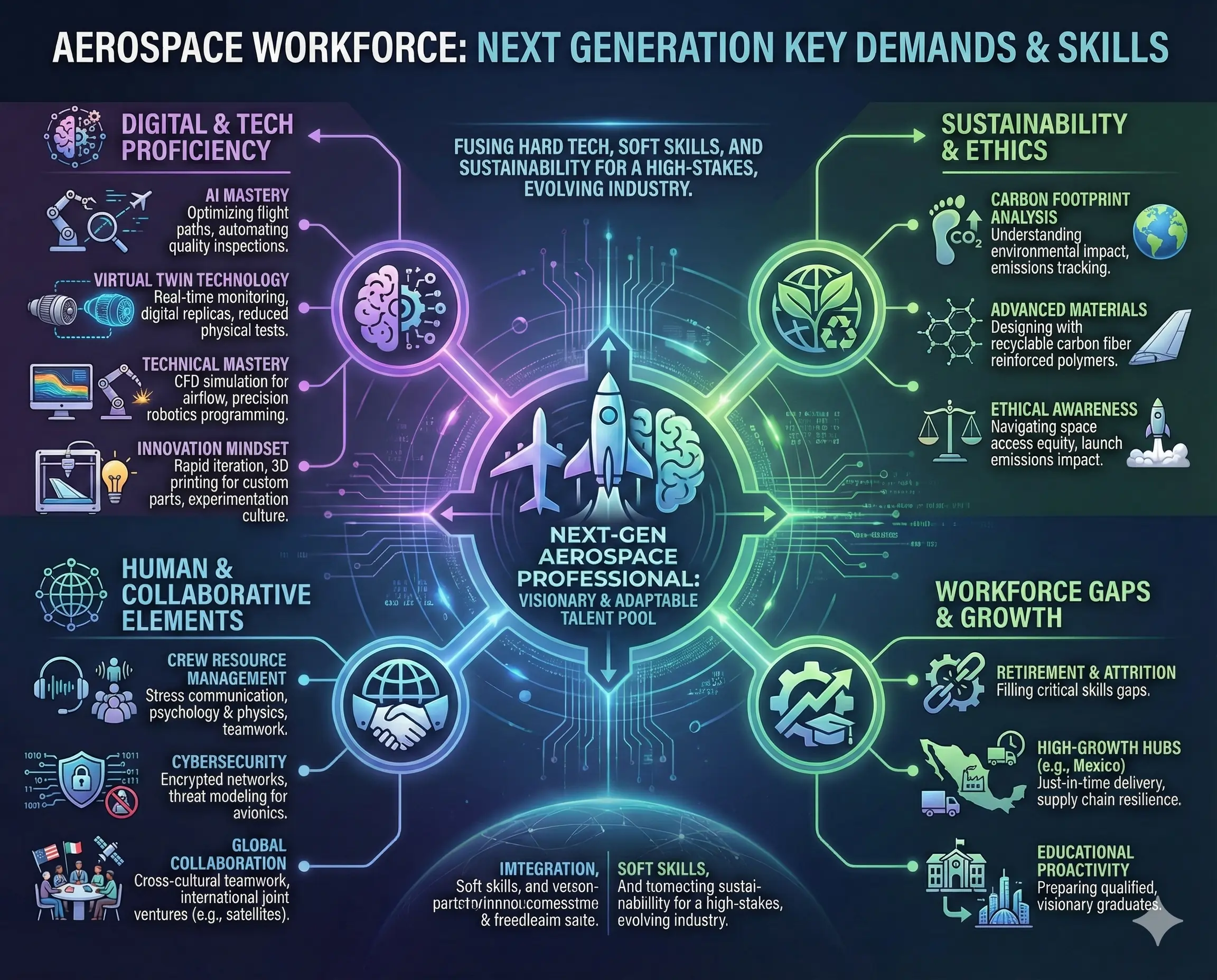
Sustainability skills are non-negotiable too: understanding carbon footprint analysis and designing with recyclable advanced materials like carbon fiber reinforced polymers. Then there’s the human side—crew resource management, which teaches teams to communicate under stress, drawing from psychology as much as physics. Cybersecurity looms large as well, with avionics systems increasingly vulnerable to hacks, demanding knowledge of encrypted networks and threat modeling.
- Technical Mastery: Expertise in computational fluid dynamics (CFD) for simulating airflow, or programming robots for precision welding in fuselages.
- Innovation Mindset: Ability to iterate rapidly using 3D printing for custom parts, fostering a culture of experimentation.
- Global Collaboration: Skills in cross-cultural teamwork are essential for international projects like joint ventures in satellite deployment.
- Ethical Awareness: Navigating dilemmas such as equitable access to space resources or the environmental impact of launch emissions.
These demands aren’t static; they’re amplified by retirements and attrition, leaving gaps that education must fill proactively. In high-growth areas like Mexico’s manufacturing hubs, for instance, programs emphasize just-in-time delivery and supply chain resilience, preparing grads for roles where efficiency is king. The result? A talent pool that’s not just qualified, but visionary.
Educational Innovations
Aerospace education is shedding its ivory-tower image, embracing a hands-on, industry-aligned approach that’s as dynamic as the field itself. Curricula are evolving from rote memorization of aerodynamics to immersive experiences where students build and test their own drones or analyze data from real satellite feeds. Universities and technical schools are incorporating digital twins into core courses, allowing learners to “fly” virtual aircraft and debug issues in simulated environments before touching hardware.
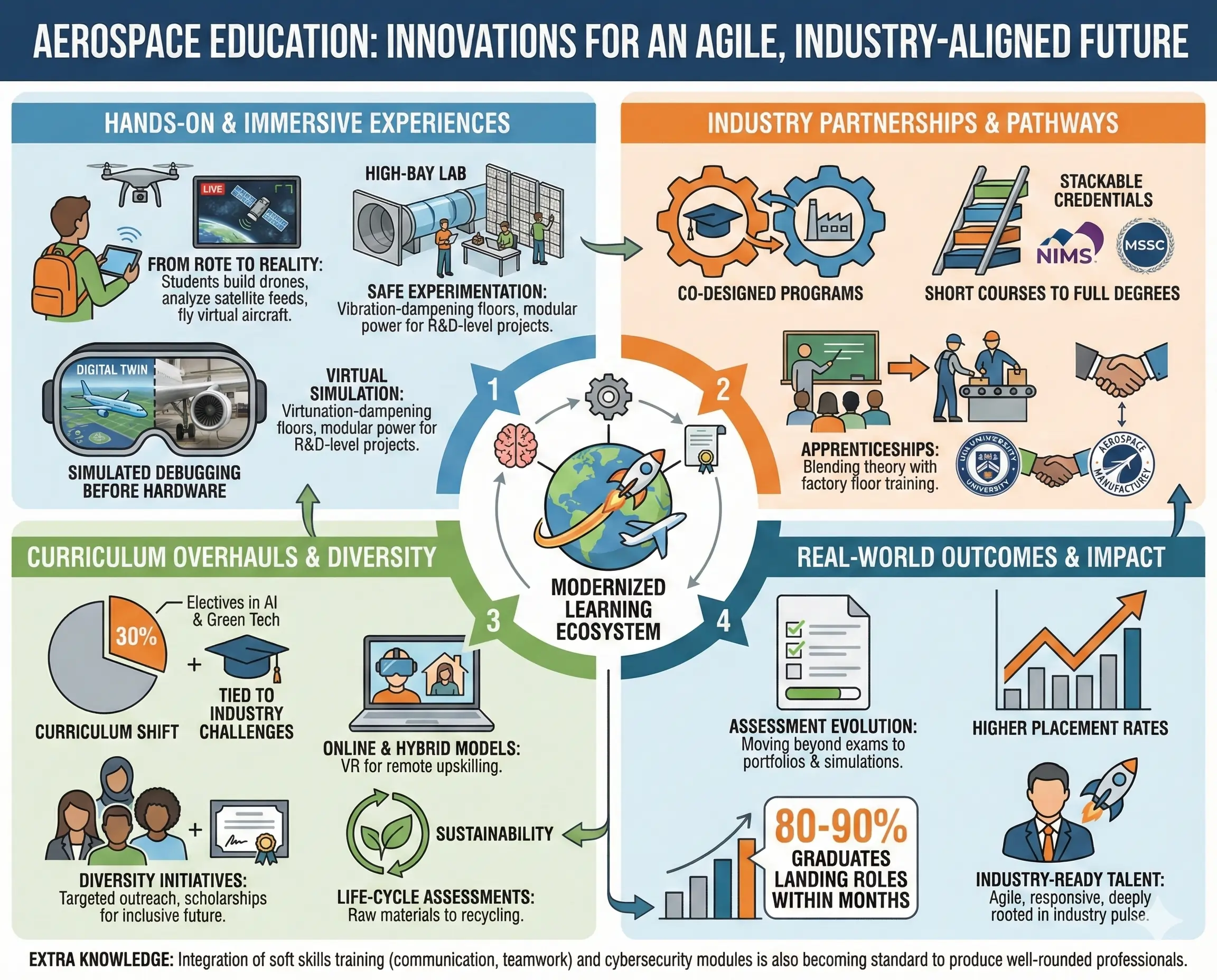
Partnerships are the secret sauce here. Academic institutions team up with manufacturers to co-design programs, ensuring alignment with on-the-job needs. Certification tracks, like those in the National Institute for Metalworking Skills (NIMS) or the Manufacturing Skill Standards Council (MSSC) credentials, provide stackable qualifications that ladder up from short courses to full degrees. In vocational settings, apprenticeships blend classroom theory with factory floors, where novices shadow experts on assembly lines.
One standout adaptation is the rise of immersive learning environments. High-bay labs equipped with vibration-dampening floors and modular power grids let students experiment with wind tunnels or composite molding without safety risks. These spaces double as research hubs, blurring lines between student projects and professional R&D. For sustainability, modules now cover life-cycle assessments, teaching how to minimize waste from raw materials to end-of-life recycling.
- Curriculum Overhauls: Shifting 30% of engineering credits toward electives in AI and green tech, with capstone projects tied to industry challenges.
- Online and Hybrid Models: VR-based modules for remote access, ideal for upskilling working professionals without halting careers.
- Diversity Initiatives: Targeted outreach to underrepresented groups, including women and minorities, through scholarships and mentorships focused on aerospace’s inclusive future.
- Assessment Evolution: Moving beyond exams to portfolios of real-world simulations, measuring not just knowledge but application.
These innovations are paying off: programs report higher placement rates, with 80-90% of graduates landing roles within months. It’s education that’s agile, responsive, and deeply rooted in the industry’s pulse.
Case Studies: Real-World Wins in Adaptation
Nothing drives home adaptation like stories from the front lines. Take the collaboration in France between engineering schools and tech providers, where over 7,000 students now train on integrated platforms that simulate full aircraft lifecycles. This initiative has slashed training time by 25% while boosting employability, as grads step into roles at major firms ready to innovate on sustainable designs.
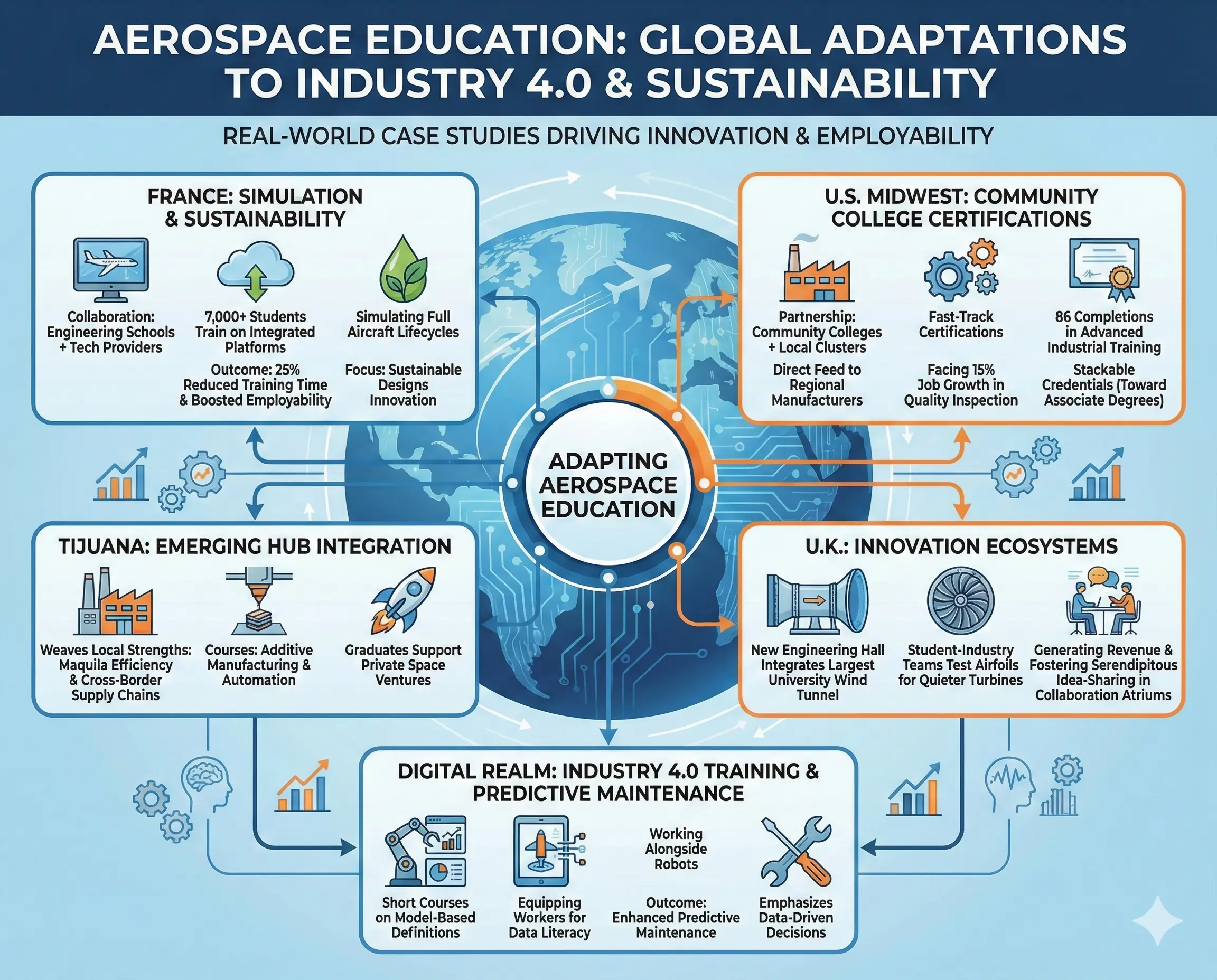
Across the Atlantic, community colleges in the U.S. Midwest have revamped assembly programs, partnering with local clusters to offer fast-track certifications. One such effort saw 86 completions in advanced industrial training, directly feeding into regional manufacturers, facing 15% job growth in quality inspection. Students don’t just learn theory; they earn credentials that stack toward associate degrees, making education accessible and career-focused.
In emerging hubs like Tijuana, education weaves in local strengths—maquila efficiency and cross-border supply chains—with courses on additive manufacturing and automation. Graduates contribute to a market booming with private space ventures, applying IoT skills to streamline production and cut costs through shared resources. These cases show adaptation in action: targeted, collaborative, and transformative.
Another compelling example comes from the U.K., where a new engineering hall integrates one of the world’s largest university wind tunnels. Opening soon, it will host student-industry teams testing airfoils for quieter turbines, generating revenue while honing practical skills. This facility isn’t just a building; it’s an ecosystem for collaboration, with atriums fostering serendipitous idea-sharing.
Even in digital realms, Industry 4.0 training shines. Short courses on model-based definitions equip workers to thrive alongside robots, emphasizing data literacy over manual labor. Outcomes? Enhanced predictive maintenance that keeps fleets flying safer and longer.
To compare these efforts, consider this table of select programs:
| Program/Initiative | Location/Partners | Core Focus Areas | Outcomes Achieved |
|---|---|---|---|
| 3DEXPERIENCE Edu Partnership | France (ISAE Group) | Digital twins, sustainable design | 7,000 students trained; 25% faster skill acquisition |
| Aerospace Assembly Certificates | U.S. Midwest (Community Colleges) | CNC machining, quality inspection | 86 completions; 90% job placement |
| Wind Tunnel Integration | U.K. (University Hall) | Aerodynamics testing, industry R&D | Revenue from commercial tests; interdisciplinary projects |
| IoT and Automation Tracks | Mexico (Tijuana Hubs) | Supply chain efficiency, 3D printing | Cost reductions via just-in-time delivery; market growth support |
| Model-Based Definition Courses | U.S. (Professional Ed Centers) | Robotics programming, data analytics | Upskilling for 17% job growth in automation |
These examples underscore a global mosaic of adaptation, each tailored to local needs yet united by a commitment to excellence.
Advanced Training
For those already in the field, advanced training is the accelerator. Simulator-based programs replicate emergencies, honing decision-making without real risks—pilots emerge sharper, crews more cohesive. Maintenance courses leverage AR overlays for repairs, visualizing hidden components and slashing error rates by half.
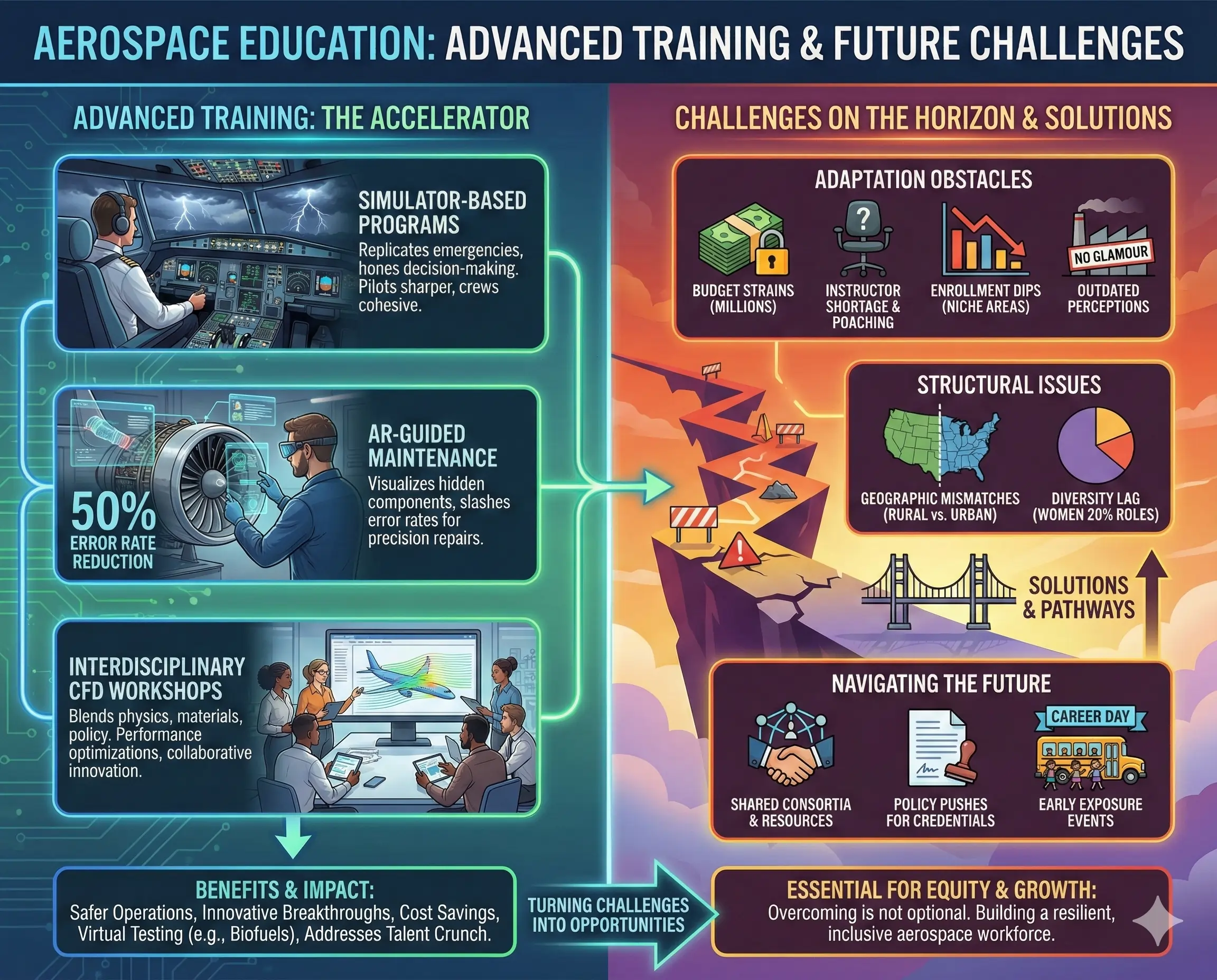
Engineering tracks dive into CFD workshops, where teams collaborate on performance optimizations, blending math with hands-on tweaks. These aren’t siloed; they’re interdisciplinary, pulling in physics, materials science, and even policy for holistic prep.
Benefits ripple outward: safer operations, innovative breakthroughs, and cost savings from fewer prototypes. In regulated skies, this training ensures compliance while pushing boundaries—think biofuels tested in virtual engines before real flights.
- Simulator Immersion: Full-flight scenarios building resilience.
- AR-Guided Maintenance: Interactive repairs for precision.
- Collaborative CFD: Group projects mirroring industry teams.
Such programs address the talent crunch head-on, turning challenges into opportunities.
Challenges on the Horizon
Adaptation isn’t seamless. Budget strains hit hard—specialized labs cost millions, and recruiting expert instructors is tough amid industry poaching. Enrollment dips in niche areas like quality inspection, often below viability thresholds, while outdated perceptions paint manufacturing as unglamorous.
Geographic mismatches exacerbate issues: rural programs struggle to connect with urban hubs. Diversity lags too, with women holding just 20% of roles, demanding targeted outreach.
Yet, solutions emerge: shared resources via consortia, policy pushes for credential recognition, and early exposure events like career days. Overcoming these isn’t optional—it’s essential for equity and growth.
Future Directions
Looking ahead, aerospace education will lean heavily on AI-driven personalization, tailoring paths via adaptive learning algorithms. Expect more space analog facilities—Earth-based simulations of Martian habitats—for aspiring astronauts and engineers.
Global networks will expand, with virtual exchanges linking U.S. labs to Asian innovation centers. Sustainability will infuse every corner, from carbon-neutral campuses to curricula on circular economies.
The outlook? A sector where education doesn’t just adapt—it anticipates, propelling us toward sustainable orbits and beyond. As demands evolve, so will the classrooms, ensuring aerospace remains a launchpad for human potential.
Key Citations And References
- Educational Innovations in Aerospace
- Aerospace Education for Emerging Trends
- Critical Skills for Next-Gen Workers
- Soaring Demand Report
- Designing Future Aerospace Education
- Industry 4.0 Impact on Aerospace
- Advanced Training in Aerospace
- Emerging trends in aerospace and defense 2025
- Top Trends Shaping the Aerospace Industry in 2025
- A Transformative Year in Aerospace
- 8 Aerospace Trends to Watch in 2025
- Addressing the U.S. Aerospace Engineering Shortage
- Accelerating progress: Maximizing the return on talent in A&D
- 2026 Aerospace and Defense Industry Outlook
- GE Aerospace Foundation Launches Next Engineers
- Rowan partners with NARTP and ACEA
- Embry-Riddle and Pratt & Whitney Announce New Educational Partnership
- Aviation and Aerospace Sustainability
- Sustainable Aviation STEM Toolkit
- Aerospace Engineering | Sustainable Aircraft Design and Operation
- Master’s Degree in Aviation and Aerospace Sustainability
- AI and Digital Twins Set to Redefine Aerospace by 2035
- Digital Twins: Accelerating aerospace innovation
- How AI in aerospace is redefining the skies in 2025
- A post-pandemic plan for aerospace education
- Identifying the Challenges Aerospace Engineers Face
- Rethinking U.S. STEM Education Amid the Aerospace
- How Is Aerospace Education Preparing for Emerging Trends?
- What Aerospace Engineers Do: Essential Career Guide for 2025
- Aviation and Aerospace Industry Trends 2025+
Read These Articles in Detail
- Aerospace Engineering vs. Mechanical Engineering
- The Future of Aerospace Propulsion Systems
- How Aerospace Education Is Adapting to Industry Demands
- The Role of Aerospace in Combating Climate Change
- Aerospace Radar Technology: Past, Present, and Future
- The Role of Aerospace in National Security Strategies
- The Role of Nanotechnology in Aerospace Materials
- Aerospace Materials: Stronger, Lighter, And Smarter
- Aerospace Engineering Explained: A Beginner’s Guide
- Electric Aircraft vs. Hydrogen Aircraft: Which Is More Sustainable?
- Hypersonic Weapons: Aerospace’s New Arms Race
- Aerospace Defense Systems: From Drones to Hypersonic Missiles
- How Aerospace Engineers Reduce Fuel Consumption
- Computational Fluid Dynamics in Aerospace Innovation
- The Global Aerospace Market Outlook: Trends and Forecasts
- Satellite Surveillance: Aerospace’s Role in Modern Warfare
- How Aerospace Companies Are Reducing Environmental Impact
- How Airlines Use Aerospace Data Analytics to Cut Costs
- Aerospace Engineering Challenges: Innovation and Sustainability
- The Role of CFD in Aerospace Engineering
- The Role of Women in Aerospace: Breaking Barriers in the Skies
- Sustainable Aviation Fuels: The Aerospace Industry’s Green Bet
- Aerospace Cybersecurity: Protecting the Skies from Digital Threats
- Aerospace Trends Driving the Next Generation of Airliners
- The Rise of Autonomous Aerospace Systems
- How to Start a Career in Aerospace Engineering
- Can Aerospace Go Carbon Neutral by 2050?
- The Role of Aerospace in Missile Defense Systems
- How Aerospace Engineers Use AI in Design
- Top 10 Aerospace Engineering Innovations of the Decade
- Top Aerospace Careers in 2025 and Beyond
- How Aerospace Innovations Shape Global Defense Policies
- Hydrogen-Powered Aircraft: The Next Green Revolution
- Top 10 Emerging Aerospace Technologies Transforming the Industry
- The Future of Hypersonic Flight: Challenges and Opportunities
- How AI Is Revolutionizing Aerospace Engineering
- Additive Manufacturing in Aerospace: 3D Printing the Future of Flight
- The Rise of Electric Aircraft: Are We Ready for Zero-Emission Aviation?
- Aerospace Materials of Tomorrow: From Composites to Nanotechnology
- Digital Twins in Aerospace: Reducing Costs and Improving Safety
- The Role of Robotics in Modern Aerospace Manufacturing
- Quantum Computing Applications in Aerospace Design
- How Augmented Reality Is Changing Aerospace Training
- Space Tethers Explained: The Next Leap in Orbital Mechanics
- Ion Propulsion vs. Chemical Rockets: Which Will Power the Future?
- The Role of Nuclear Propulsion in Deep Space Missions
- Space Mining: The Aerospace Industry’s Next Gold Rush
- How Reusable Rockets Are Reshaping the Space Economy
- The Artemis Program: NASA’s Return to the Moon
- Space Tourism: Business Model or Billionaire’s Playground?
- How Aerospace Startups Are Disrupting Commercial Aviation
- The Economics of Low-Cost Airlines in the Aerospace Era
- Urban Air Mobility: The Rise of Flying Taxis
- The Future of Mars Colonization: Key Aerospace Challenges and Solutions Ahead
- CubeSats and Small Satellites: Democratizing Space Access
- The Future of Cargo Drones in Global Logistics
- The Role of Aerospace in Building a Lunar Economy
Frequently Asked Questions
FAQ 1: What Are the Key Trends Shaping Aerospace Education in 2025?
Aerospace education is evolving rapidly to keep pace with an industry that’s pushing boundaries in sustainability, digital innovation, and global connectivity. One of the most prominent shifts is the integration of electric propulsion systems into curricula, reflecting the widespread adoption expected across aircraft and spacecraft designs this year. Educators are incorporating hands-on modules where students simulate battery-powered flight paths and analyze energy efficiency, preparing them for a future where emissions reductions are non-negotiable. This trend isn’t just theoretical; it’s driven by real-world demands, with programs now emphasizing cross-disciplinary approaches that blend engineering with environmental science to tackle climate goals.
Beyond electrification, AI-driven design tools are becoming standard in classrooms, allowing students to optimize aircraft structures virtually before any physical build. Universities are updating their labs with software that predicts material fatigue or streamlines supply chains, mirroring how manufacturers use these technologies to cut production times. In parallel, the rise of advanced manufacturing techniques, like additive manufacturing for lightweight components, is fostering maker spaces where learners prototype parts for drones or satellite housings. These adaptations ensure graduates enter a job market projected to grow by 6% globally, with hotspots in defense and commercial space seeing even steeper increases.
Looking at the bigger picture, aerospace education is also addressing geopolitical influences, such as supply chain vulnerabilities from international tensions. Courses now include scenario-based learning on resilient sourcing and ethical global collaboration, helping students navigate a landscape where U.S. defense spending alone could fuel thousands of new roles. Overall, these trends signal a move toward proactive, tech-infused learning that not only equips students with skills but inspires them to innovate in an industry that’s as exciting as it is essential.
FAQ 2: How Is the Aerospace Skills Gap Being Addressed Through Education in 2025?
The aerospace industry is grappling with a significant talent shortage, with estimates suggesting over 123,000 additional technicians needed in the U.S. commercial sector alone over the next two decades. This gap stems from a combination of retiring experts—a so-called “retirement cliff” affecting 25% of the workforce over age 55—and surging demand for specialized roles in automation and data analysis. Educational institutions are stepping up with targeted programs that bridge this divide, focusing on upskilling current workers while building pipelines for newcomers. For instance, community colleges and universities are rolling out accelerated certifications in areas like predictive maintenance and robotics programming, often in partnership with employers to guarantee job placement.
To illustrate the scope of these efforts, consider the following table outlining major skills gaps and corresponding educational responses:
| Skills Gap Area | Projected Demand Increase by 2028 | Educational Responses in 2025 | Example Outcomes |
|---|---|---|---|
| Data Analysis & AI Proficiency | From 9% to 14% of job postings | Hybrid courses with real-time analytics labs | 80% of graduates certified in Python for aerospace data |
| Technician & Assembly Roles | 15.7% rise in assembly positions | Apprenticeships blending vocational training and simulations | 90% placement rate in manufacturing hubs |
| Sustainability Expertise | Tied to global emissions regs | Modules on SAF lifecycle and carbon modeling | Reduced training time by 20% via VR tools |
| Cybersecurity in Avionics | Driven by rising digital threats | Interdisciplinary tracks with ethical hacking sims | Addressing 9% vacancy spike in secure systems |
| Supply Chain Resilience | Impacted by geopolitical shifts | Scenario planning workshops with industry case studies | Enhanced productivity in 63% of partnered programs |
These initiatives are proving effective, with reports showing a 17% uptick in entry-level hires from revamped programs. By prioritizing practical, stackable credentials, education is not only filling immediate voids but also fostering long-term workforce stability in a sector where innovation hinges on human capital.
FAQ 3: What Role Do Industry Partnerships Play in Modernizing Aerospace Education?
Industry partnerships are the backbone of aerospace education’s transformation, creating a seamless flow from classroom concepts to career-ready expertise. These collaborations allow educators to align curricula directly with employer needs, ensuring students gain exposure to cutting-edge tools and real-world problems without the trial-and-error of traditional learning. For example, joint ventures between universities and manufacturers are common, where companies provide funding for state-of-the-art labs in exchange for talent pipelines. This symbiotic relationship not only boosts enrollment but also enhances research output, as faculty and industry experts co-develop projects on topics like reusable rocket systems.
Key benefits of these partnerships include accelerated skill acquisition and diversified access to opportunities. Here’s a breakdown:
- Access to Advanced Resources: Partners often donate equipment, such as digital twin simulators, enabling students to test designs virtually and reduce prototyping costs by up to 30%.
- Internship and Mentorship Programs: Structured placements give hands-on experience, with 70% of participants transitioning to full-time roles post-graduation.
- Curriculum Co-Design: Industry input shapes electives, incorporating emerging needs like autonomous flight controls, keeping programs relevant amid rapid tech shifts.
- Diversity and Inclusion Efforts: Targeted scholarships and outreach draw underrepresented groups, addressing the fact that women hold only 20% of aerospace positions.
- Global Networking: Cross-border alliances expose learners to international standards, vital for a sector where 40% of jobs involve multinational teams.
In 2025, these ties are expanding, with new consortia focusing on innovation hubs that blend academia, government, and private sectors. The result is a more agile education system that turns theoretical knowledge into tangible industry impact, preparing graduates to thrive in a competitive landscape.
FAQ 4: How Is Sustainability Being Integrated Into Aerospace Curricula Today?
Sustainability has moved from a buzzword to a core pillar of aerospace education, reflecting the industry’s urgent push toward net-zero emissions by 2050. Universities and technical schools are weaving environmental considerations into every layer of their programs, starting with foundational courses that explore the full lifecycle of aircraft—from raw material sourcing to end-of-life recycling. Students learn to calculate carbon footprints using specialized software, applying these skills to redesign fuselages with bio-based composites that slash fuel use by 15-20%. This holistic approach ensures graduates view sustainability not as an add-on, but as integral to ethical engineering.
Advanced programs delve deeper, offering certificates in sustainable aviation fuels (SAF) and policy frameworks that address global regulations like the EU’s emissions trading system. For instance, multidisciplinary tracks combine aeronautics with ecology, where teams develop strategies for quieter electric vertical takeoff vehicles suited for urban air mobility. These efforts are supported by toolkits and simulations that model real scenarios, such as optimizing flight routes to minimize contrail formation—a hidden contributor to climate change.
The impact is measurable: institutions report a 25% increase in student projects focused on green tech, aligning with industry forecasts for 35,000 new eco-friendly aircraft by 2032. By embedding sustainability, aerospace education is cultivating leaders who can balance innovation with planetary responsibility, making the skies cleaner for generations to come.
FAQ 5: What Essential Skills Do Aspiring Aerospace Professionals Need in 2025?
In 2025, the aerospace job market rewards a blend of technical depth and versatile soft skills, as the industry demands innovators who can handle everything from AI-optimized designs to ethical supply chain decisions. Core technical proficiencies include mastery of computational fluid dynamics (CFD) for airflow simulations and familiarity with additive manufacturing to create complex, lightweight parts on demand. Beyond these, data literacy is surging, with roles increasingly requiring the ability to harness big data for predictive maintenance, potentially saving manufacturers millions in downtime.
Soft skills are equally critical in this collaborative field. Effective communication ensures teams align on high-stakes projects, while adaptability helps navigate shifts like the pivot to hybrid-electric propulsion. Ethical reasoning rounds out the profile, equipping professionals to address dilemmas such as equitable space access amid commercial booms.
To break it down further:
- Technical Foundations: Proficiency in CAD software and robotics for automated assembly lines.
- Digital Fluency: Skills in AR/VR for virtual prototyping and training.
- Sustainability Savvy: Knowledge of life-cycle assessments to minimize environmental impact.
- Team and Leadership: Experience in cross-functional projects, often gained through capstones.
- Problem-Solving Agility: Ability to iterate under constraints, like budget-limited satellite deployments.
With a median salary of around $134,000 and 6% job growth, honing these skills through targeted education positions candidates for success in a dynamic sector.
FAQ 6: How Are Digital Twins and AI Revolutionizing Aerospace Training?
Digital twins and artificial intelligence (AI) are at the forefront of aerospace training’s future, offering virtual replicas of complex systems that allow for risk-free experimentation and hyper-personalized learning. A digital twin acts as a living model of an aircraft or spacecraft, updating in real-time with sensor data to predict failures or optimize performance—think simulating a turbine’s wear over years in minutes. In education, this means students can “fly” prototypes in immersive environments, debugging issues collaboratively without costly hardware.
AI amplifies this by automating routine tasks and providing insights, such as generating optimal wing shapes based on vast datasets. Training programs now use AI tutors that adapt to individual paces, offering feedback on simulations that mimic emergencies. By 2035, experts predict these technologies will redefine 70% of development processes, from design to sustainment.
The table below compares traditional versus tech-enhanced training:
| Aspect | Traditional Training Approach | AI and Digital Twins Approach | Key Advantages |
|---|---|---|---|
| Simulation Fidelity | Basic models with limited variables | Real-time, physics-based virtual replicas | 50% faster iteration cycles |
| Personalization | One-size-fits-all lectures | Adaptive algorithms tailoring challenges | 30% improvement in skill retention |
| Cost Efficiency | High due to physical prototypes | Virtual testing reduces expenses by 40% | Scalable for global access |
| Risk Management | Real-world trials with potential hazards | Safe, repeatable scenarios for edge cases | Enhanced safety in high-stakes prep |
| Collaboration | In-person team sessions | Cloud-based twins for remote, multi-site teamwork | Broader expertise integration |
These tools are already in labs worldwide, training the next wave of engineers to push aerospace into sustainable, efficient frontiers.
FAQ 7: What Challenges Are Aerospace Educators Facing in Adapting to Industry Needs?
Adapting aerospace education to industry demands presents a host of hurdles, from resource constraints to shifting learner expectations in a post-pandemic world. Funding remains a persistent issue, as outfitting labs with Industry 4.0 tech like IoT sensors can cost millions, straining budgets at public institutions. This often leads to inequities, where under-resourced programs lag in offering cutting-edge courses on topics like orbital debris management, widening the talent gap in underserved regions.
Another layer is the balance between teaching, research, and administrative duties, which leaves faculty stretched thin amid rising enrollment pressures. The retirement of seasoned educators exacerbates this, creating a knowledge vacuum just as demand spikes for expertise in green propulsion. Diversity challenges persist too, with efforts to include more women and minorities facing cultural barriers and limited outreach.
Despite these, proactive steps like shared consortia for equipment and online hybrid models are gaining traction, helping educators foster inclusive, resilient programs that better serve the industry’s evolving needs.
FAQ 8: Can You Share Case Studies of Successful Aerospace Education Adaptations?
Successful adaptations in aerospace education often hinge on innovative collaborations that deliver measurable results. One standout is the partnership between a major engine manufacturer and an aviation university, which launched a safety management degree pathway for employees. This online program integrates practical modules on risk assessment and regulatory compliance, resulting in over 200 certifications issued in its first year and a 15% boost in participant retention rates.
In another example, a Midwestern U.S. community college consortium revamped its assembly training with industry-backed simulations, achieving 86 completions and 90% job placement in quality roles amid 15% regional growth. Across the ocean, a French engineering group adopted integrated platforms for 7,000 students, cutting skill acquisition time by 25% through digital twins focused on sustainable designs.
These cases highlight a pattern: targeted, tech-forward initiatives that prioritize employability and innovation, proving that adaptation yields both talent and progress for the sector.
FAQ 9: How Is Commercial Space Travel Influencing Aerospace Education Programs?
The boom in commercial space travel is injecting fresh energy into aerospace education, shifting focus from government-led missions to entrepreneurial ventures like orbital tourism and private satellite networks. Programs are now including dedicated modules on astrodynamics and reusable launch economics, where students design cost-effective payloads for suborbital flights. This reflects the sector’s growth, with private firms capturing 40% of launch contracts and creating demand for 11.7% more maintenance specialists.
Hands-on experiences, such as building CubeSats in university clean rooms, prepare learners for roles in companies pioneering space habitats. Ethical discussions on debris mitigation and resource equity are also rising, ensuring graduates consider the broader implications of accessible space.
In essence, this influence is democratizing aerospace, drawing diverse talent into a field once seen as elite and fostering curricula that blend business acumen with technical prowess.
FAQ 10: What Career Paths Are Emerging in Sustainable Aviation for 2025 Graduates?
Sustainable aviation is opening dynamic career avenues for 2025 graduates, from SAF developers to urban air mobility planners, in a market eyeing 35,000 new aircraft with eco-features. Roles in emissions modeling use data tools to forecast and reduce flight impacts, offering salaries starting at $90,000 with rapid advancement. Propulsion specialists focus on hybrid-electric systems, testing biofuels in simulated engines to meet regulatory hurdles.
Policy advisors bridge tech and governance, shaping incentives for green tech adoption. Here’s a snapshot of promising paths:
- Aero-Environmental Analyst: Assesses lifecycle emissions; 20% job growth projected.
- Sustainable Design Engineer: Crafts lightweight, recyclable airframes; key in 47% of advanced manufacturing roles.
- Operations Optimizer: Uses AI for efficient routing; addresses rising data skills demand.
- Certification Specialist: Ensures compliance with global standards; vital for SAF rollout.
These paths not only promise stability but also fulfillment, as professionals contribute to a greener skies legacy.
FAQ 11: What Are the Emerging Trends in Aerospace Education for 2025?
Aerospace education in 2025 is riding a wave of transformation, fueled by the industry’s sprint toward sustainability and digital prowess. At the forefront, programs are embedding electric propulsion systems into core curricula, allowing students to explore battery-driven designs that promise to slash emissions in both aircraft and spacecraft. This shift mirrors the sector’s broader pivot, where widespread adoption of these technologies is expected to redefine flight efficiency and open doors to greener operations. Universities are updating labs with simulation software that lets learners model energy flows in real-time, bridging the gap between theory and the practical demands of companies racing to meet net-zero targets by mid-century.
Another powerhouse trend is the fusion of AI-driven design tools with traditional engineering, enabling rapid prototyping and predictive analytics right in the classroom. Students aren’t just learning equations; they’re using machine learning to optimize wing shapes or forecast material failures, skills that directly tackle the talent crunch in a market projected to need 123,000 more technicians by 2040. This hands-on approach extends to advanced air mobility, with courses on urban drone networks and electric vertical takeoff vehicles preparing grads for the urban skies of tomorrow. As geopolitical tensions reshape supply chains, education is also weaving in resilience training, teaching how to source materials ethically amid global disruptions.
These trends aren’t happening in isolation—they’re backed by collaborations that ensure relevance. For instance, initiatives like Toronto’s Downsview Aerospace Innovation hub unite academia, industry, and government to align skills with priorities like sovereign tech capabilities. The result? A workforce that’s not only technically sharp but adaptable, with projections showing a 6% global job surge, particularly in AI and data roles. Looking ahead, expect even deeper integration of space commercialization, where curricula will simulate private orbital missions, fostering the innovators who’ll make space tourism routine.
FAQ 12: How Are Universities Adapting Aerospace Programs to Meet Florida’s Booming Industry Needs?
Florida’s aerospace sector is exploding, thanks to heavyweights like NASA and SpaceX, and universities are hustling to keep pace with tailored programs that turn students into immediate assets. Take the University of South Florida’s new aerospace engineering major, rolled out in fall 2025—it’s a full 120-credit powerhouse that evolved from a modest minor, packing in specialized tracks on rocketry, drones, and space systems. This isn’t fluff; it’s designed with wind tunnel experiments and drone labs that mimic real-world challenges, ensuring grads hit the ground running at firms like Lockheed Martin or Honeywell right here in the state.
Adaptations like these address a glaring skills gap, where Florida’s aviation jobs are concentrated but underserved by local talent. Programs now prioritize hands-on research, from high-speed flow tests to urban mobility prototypes, all while forging ties with industry for funding and internships. The payoff? Higher retention of homegrown engineers, boosting the local economy and filling roles in everything from satellite deployment to sustainable flight tech.
Here’s how key adaptations are playing out:
- Curriculum Expansion: From basic aerodynamics to advanced electives in propulsion and avionics, with 16 new courses emphasizing practical simulations over lectures.
- Industry Partnerships: Collaborations with transportation hubs and companies provide real-project access, like developing shock tubes for hypersonic research.
- Research Integration: As an R1 institution, students dive into funded projects, gaining credentials that make them stand out in competitive hiring pools.
- Job Market Alignment: Focus on Florida-specific opportunities, aiming for 90% placement rates in high-demand areas like Cape Canaveral’s launch facilities.
These moves are strategic, turning education into a launchpad for a sector that’s not just growing—it’s soaring, with students emerging ready to innovate and stay local.
FAQ 13: What Diversity Initiatives Are Driving Inclusion in Aerospace Education This Year?
Inclusion in aerospace education is gaining serious momentum in 2025, with targeted initiatives closing the gap for underrepresented voices in a field that’s historically been less than diverse. Programs are prioritizing sense of belonging from day one, using surveys and workshops to track how students from varied backgrounds feel integrated into engineering cohorts. This matters because diverse teams spark better innovations, yet women hold only about 20% of roles, and minorities even less—initiatives are flipping that script by design.
To map out the landscape, consider this table of standout efforts reshaping access and equity:
| Initiative | Focus Area | Key Activities in 2025 | Impact Highlights |
|---|---|---|---|
| NASA MSI Grants | Engineering & STEM for Minorities | $7.2M funding for HBCUs and tribal colleges in aerospace projects | Boosted enrollment by 15% in partner schools |
| AOPA You Can Fly | K-12 Outreach in Underserved Areas | 144 Oklahoma schools teaching aviation basics, up from 117 | Increased female participation by 25% |
| Sense of Belonging Studies | Undergraduate Retention | AIAA-led research on curriculum-wide inclusion metrics | Reduced dropout rates by 10% for diverse students |
| 25by2025 Campaign | Gender Equity in Airlines | IATA push for 25% female representation via scholarships | 20% rise in women-led aerospace startups |
| DEI Workshops | Professional Development | SKYbrary online resources on bias and accessibility | Trained 5,000+ educators globally |
These programs aren’t checkboxes—they’re building pipelines where everyone thrives, from scholarships for first-gen students to mentorships that pair novices with trailblazers. The endgame? A more equitable industry that’s stronger for it.
FAQ 14: How Is VR and AR Revolutionizing Hands-On Training in Aerospace?
Virtual reality and augmented reality are no longer sci-fi add-ons in aerospace training—they’re essential tools reshaping how professionals master complex skills without the high stakes of real aircraft. In 2025, VR plunges trainees into fully simulated cockpits for emergency drills, like engine failures during turbulent landings, building muscle memory in a zero-risk zone. AR, meanwhile, layers digital overlays on physical setups, guiding mechanics through engine repairs with holographic checklists that highlight hidden bolts or fault lines. This duo is exploding in popularity, with the aviation VR/AR market hitting $2 billion this year and eyeing $12 billion by 2033.
The magic lies in personalization and efficiency. Imagine a pilot practicing night flights tailored to their weak spots, or ground crew simulating baggage mishaps in a virtual hangar—retention jumps 3.75 times over classroom methods, and costs drop 52% by ditching fuel-guzzling live sessions. Case in point: Embry-Riddle’s VR program shaved 30% off solo flight times for 58 students, while Airbus uses AR for A350 cockpit familiarization, letting crews interact with 3D models mid-training. Even cabin staff at Emirates are honing evacuations in immersive cabins, prepping for rare but critical scenarios.
As we push forward, AI integration will supercharge these techs, creating adaptive scenarios that evolve with user performance. Haptic feedback for tool sensations and multi-user sessions for team drills are on the horizon, making training not just safer and cheaper, but downright engaging. It’s a game-changer for an industry where precision saves lives, ensuring the next gen of aerospace pros are ready for anything the skies throw their way.
FAQ 15: Which Certifications Are Must-Haves for Aerospace Careers in 2025?
Staying certified is your ticket to thriving in aerospace’s fast lane, especially as 2025 brings demands for hybrid skills in AI, sustainability, and digital twins. Start with the FAA’s Airframe & Powerplant (A&P) license—it’s the gold standard for maintenance pros, covering inspections and repairs that keep fleets airborne. Pair it with SpaceTEC’s Aerospace Manufacturing Competency Certification, which validates hands-on prowess in composites and precision machining, directly feeding into the 15% job boom in assembly roles.
For engineers eyeing design and innovation, MIT’s Certificate in Aerospace Innovation stands out, blending entrepreneurship with tech domains like aerodynamics and space systems. It’s a 12-18 unit flex program with workshops pitching startup ideas to VCs—perfect for the entrepreneurial wave in drones and CubeSats. Don’t sleep on ANSYS certifications in simulation, either; their associate-to-professional tracks hone CFD and structural analysis, crucial for the 14% spike in data-savvy postings by 2028.
To round out your profile:
- Professional Engineer (PE) License: Essential for leading projects, proving expertise in ethics and advanced math.
- Certified Aerospace Technician (CAT): Focuses on quality control, aligning with Industry 4.0’s automation push.
- Six Sigma Green Belt: Boosts efficiency in supply chains, a hot skill amid geopolitical reshuffles.
- Aviation Safety Professional Certificate: From DOT, it covers investigations and risk management for safety-critical roles.
These creds aren’t just resume fillers—they’re bridges to salaries averaging $134,000 and roles in cutting-edge fields like urban air mobility. Invest in them early, and watch your career take off.
FAQ 16: How Is AI Personalizing Learning in Aerospace Education Programs?
Artificial intelligence is quietly revolutionizing aerospace education by tailoring experiences to individual learners, making complex topics like orbital mechanics accessible and engaging for all. In 2025, AI algorithms analyze student performance in real-time during simulations, adjusting difficulty on the fly—struggling with CFD? It dials back to basics before ramping up. This personalization boosts retention by 30%, turning passive lectures into dynamic paths that fit diverse learning styles, from visual drones to kinesthetic rocket builds.
Programs are leveraging AI tutors embedded in platforms, offering instant feedback on design flaws or ethical dilemmas in space resource allocation. At places like the Space Force’s FY2025 AI Plan, academia-industry ties are fostering data-driven cultures, where entry-level students grasp machine learning alongside aerodynamics. It’s addressing the skills gap head-on, with job postings for AI-fluent roles jumping from 9% to 14% by 2028, ensuring grads aren’t just knowledgeable but versatile.
The broader ripple? More inclusive education, as AI flags barriers for underrepresented students and suggests targeted resources. Challenges like middle management’s AI skepticism are met with literacy modules, building confidence through hybrid teams. Ultimately, this tech isn’t replacing teachers—it’s empowering them to ignite passion in a field where innovation hinges on human ingenuity amplified by smart systems.
FAQ 17: What’s the Impact of Advanced Air Mobility on Aerospace Curricula?
Advanced air mobility, think eVTOLs zipping through city skies, is injecting urgency into aerospace curricula, demanding programs that blend autonomy with urban planning. By 2025, courses are evolving to cover vertiport design and noise mitigation, preparing students for a market set to deliver 35,000 eco-aircraft by 2032. This focus tackles sustainability head-on, integrating SAF simulations with traffic algorithms to ease congestion in airspace.
The table below captures how curricula are shifting:
| Curriculum Element | Traditional Focus | AAM Adaptation in 2025 | Projected Benefits |
|---|---|---|---|
| Autonomous Systems | Basic flight controls | AI for drone swarms and collision avoidance | 40% faster certification processes |
| Urban Integration | Rural aerodynamics | Vertiport logistics and equity access | Supports 20% job growth in ops roles |
| Sustainability Modules | Fuel efficiency basics | eVTOL battery lifecycle and emissions | Aligns with net-zero by 2050 goals |
| Regulatory Training | FAA overviews | Global standards for urban air traffic | Reduces compliance risks by 25% |
| Interdisciplinary Ties | Engineering silos | Partnerships with policy and transport | Broader innovation in 63% of projects |
These updates aren’t optional—they’re fueling a sector where AAM could add billions to economies, with education ensuring safe, equitable rollout.
FAQ 18: What Funding and Scholarship Opportunities Exist for Aerospace Students in 2025?
Securing funding can make or break an aerospace dream, and 2025 is packed with opportunities tailored to fuel diverse talents amid rising tuition and industry needs. NASA’s $7.2 million MSI grants are channeling resources to HBCUs for STEM pipelines, covering tuition and research in propulsion or astrodynamics. Similarly, the GE Aerospace Foundation’s Next Engineers program partners with universities for scholarships targeting K-12 to undergrad transitions, emphasizing hands-on labs.
For grad-level pursuits, MIT’s innovation certificate offers stipends for entrepreneurial projects, while IATA’s 25by2025 provides women-specific awards up to $10K for aviation studies. State initiatives, like Oklahoma’s AOPA expansion, fund flight training for 144 schools, prioritizing rural and minority applicants.
Standout options include:
- Aerospace Medical Association Scholarships: Up to $5K for physiology-focused studies, ideal for human factors careers.
- Rowan-NARTP Consortium Grants: $20K+ for innovation in manufacturing, with internship guarantees.
- Embry-Riddle DEI Funds: Cover 50% of costs for underrepresented students in safety programs.
- Deloitte A&D Talent Awards: Merit-based for AI tracks, including mentorship from execs.
These aren’t just checks—they’re gateways to networks and jobs, easing the 42% talent attraction hurdle firms face. Apply early; the competition’s fierce, but the rewards launch lifelong trajectories.
FAQ 19: How Does Aerospace Education in the US Compare to Europe in 2025?
US aerospace education in 2025 leans heavily into entrepreneurial grit, with programs like MIT’s innovation certificate churning out startup-savvy engineers through pitch workshops and VC feedback. This aligns with America’s commercial space boom, emphasizing rapid prototyping and private ventures, but it grapples with funding inequities that hit public schools hardest. Europe’s approach, by contrast, shines in collaborative ecosystems—think the EU’s IRIS2 satellite push, where unis like those in the ESA network integrate policy and sustainability from the jump, fostering multinational teams for sovereign tech.
Both regions tackle skills gaps, but styles differ: the US favors flexible, stackable certs like SpaceTEC for quick workforce entry, while Europe bets on holistic master’s in systems engineering, backed by €10.5B investments in reusable launches. Diversity efforts? US leads with NASA grants for MSIs, boosting minority enrollment 15%, whereas Europe’s 25by2025 targets gender parity through IATA-wide scholarships.
Challenges unite them—talent wars amid AI demands, with 75% of leaders citing attraction woes. Yet, cross-Atlantic ties, like USF’s Florida hubs mirroring Airbus’s French labs, hint at hybrid futures. The US edges in innovation speed, Europe in equitable scale; together, they’re prepping a global workforce for the stars.
FAQ 20: What Role Do Hypersonics Play in Shaping Future Aerospace Curricula?
Hypersonics—speeds over Mach 5—are hurtling into aerospace curricula, driven by defense needs and commercial potential for ultra-fast travel. In 2025, programs are adding modules on thermal management and scramjet engines, using USF’s shock tubes to simulate extreme flows, prepping students for roles in next-gen systems projected to grow 17% by 2028.
This focus addresses geopolitical demands, like resilient supply chains for materials that withstand blistering heat. Curricula blend it with ethics, debating militarization versus civilian apps like transpacific flights in hours.
A quick overview:
| Hypersonics Topic | Integration Method | Industry Tie-In | Student Outcomes |
|---|---|---|---|
| Propulsion Design | CFD simulations and wind tunnel labs | DoD contracts for missile tech | 25% faster mastery of high-speed dynamics |
| Materials Science | Composites testing for heat resistance | Boeing/GE advanced manufacturing | Preps for 47% surge in specialist jobs |
| Ethical Frameworks | Case studies on global regs | ESA’s space law for traffic management | Builds balanced decision-makers |
| Interdisciplinary Labs | AI for trajectory optimization | Lockheed urban hypersonic concepts | Enhances collaborative skills |
| Capstone Projects | Prototype builds with partners | NASA hypersonic research grants | 80% placement in R&D roles |
By weaving hypersonics in, education isn’t just adapting—it’s accelerating toward a supersonic future.
