

Key Innovations in Aerospace Materials
- Carbon fiber composites now form over 50% of modern aircraft structures, slashing weight and boosting fuel efficiency by up to 25% compared to traditional aluminum designs.
- Smart materials like shape memory alloys enable self-adapting wings and health-monitoring systems, enhancing safety and reducing maintenance needs.
- Nanomaterials and sustainable bio-based options are emerging trends, promising even lighter, eco-friendlier aircraft while addressing environmental challenges in aviation.
- Research suggests these advancements could cut global aviation emissions by 20-30% by 2050, though challenges like high costs and recycling persist.
A Quick Look at the Evolution
Aerospace materials have come a long way since the early days of wood and fabric. Starting with aluminum in the 1930s for its strength-to-weight balance, the industry shifted to titanium for high-heat applications in the 1950s. By the 1970s, carbon fiber reinforced polymers (CFRPs) revolutionized designs, powering aircraft like the Boeing 787. Today, innovations focus on “smarter” features, such as self-healing composites that repair minor damage autonomously.
Why Stronger, Lighter, Smarter Matters
Lighter materials mean less fuel burn—critical as aviation accounts for about 2-3% of global CO2 emissions. Stronger ones withstand extreme stresses, from hypersonic speeds to space re-entry. Smarter variants, integrated with sensors, predict failures before they happen, potentially saving billions in downtime. For instance, the Airbus A350 uses over half composites, flying farther on less fuel than predecessors.
Spotlight on Composites and Smart Tech
Carbon fiber dominates, used in fuselages and wings for its five times strength over steel at one-fifth the weight. In smart materials, piezoelectric ceramics harvest energy from vibrations to power onboard sensors, as seen in the Boeing 777. Looking ahead, nanomaterials like carbon nanotubes could make structures 100 times stronger without added bulk.
Path to Sustainability
Bio-based resins from sugarcane and recycled carbon fiber are gaining traction, with companies exploring fully circular designs. These could reduce waste by 40% in manufacturing, aligning with net-zero goals by 2050.
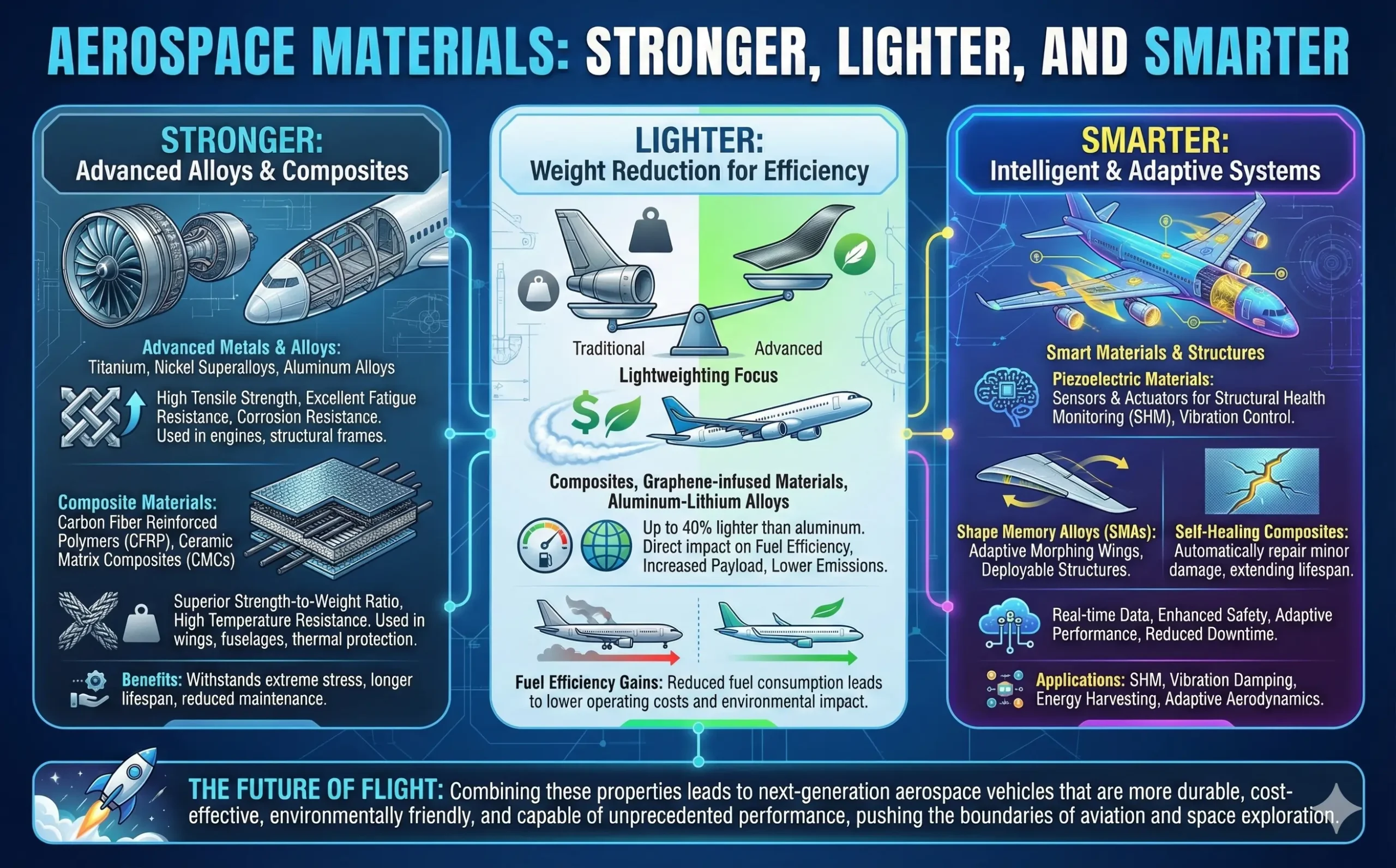
Table of Contents
Imagine boarding a plane that not only soars higher and faster but does so with less environmental footprint, thanks to materials that think, adapt, and endure like never before. The aerospace industry, a cornerstone of modern travel and exploration, has always pushed the boundaries of engineering. At its heart lies the quest for materials that are stronger to handle brutal forces, lighter to sip fuel sparingly, and smarter to respond to the unpredictable skies. From the Wright brothers’ fragile wood frames to today’s hypersonic vehicles, these innovations aren’t just technical feats—they’re reshaping how we connect the world and reach for the stars.
This article dives deep into the world of aerospace materials, tracing their evolution, unpacking the science behind the big three pillars—strength, lightness, and intelligence—and spotlighting real-world applications. We’ll explore historical milestones, cutting-edge composites, adaptive smart tech, nanoscale wonders, and the green revolution brewing in labs worldwide. Backed by rigorous research and examples from iconic aircraft, it’s a comprehensive guide for anyone curious about the invisible heroes keeping us aloft. Whether you’re an aviation enthusiast, engineer, or just love a good story of human ingenuity, buckle up—this journey through materials is as expansive as the horizon.
A Timeline of Material Milestones
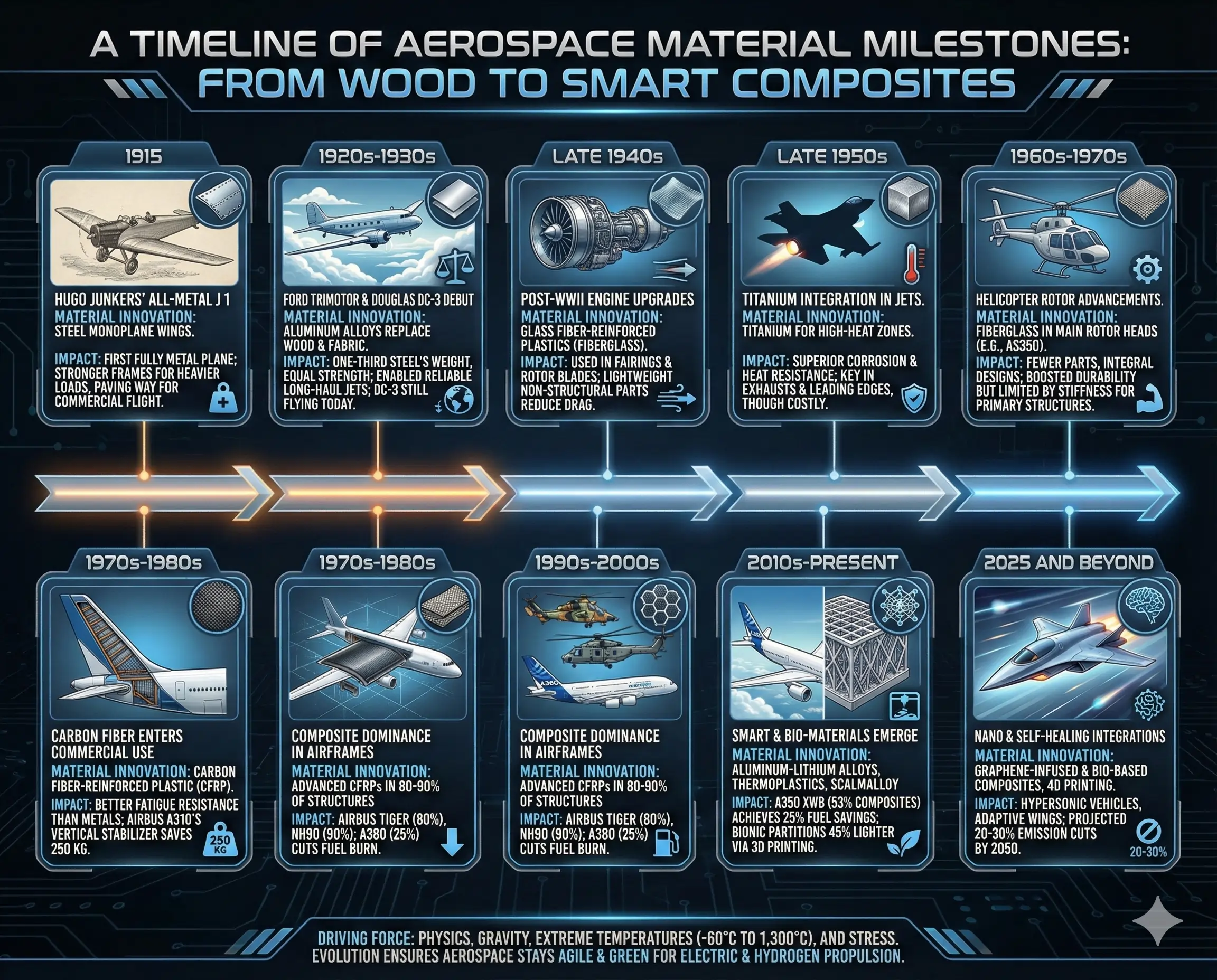
Every great leap in aerospace starts with a breakthrough in what we build it from. Early aviators relied on natural bounty, but as ambitions grew, so did the need for engineered excellence. Here’s a chronological walkthrough of how materials evolved, turning rickety biplanes into sleek space shuttles. This timeline highlights pivotal shifts, showing how each era built on the last to deliver progressively tougher, trimmer builds.
| Era | Key Milestone | Material Innovation | Impact on Aerospace |
|---|---|---|---|
| 1915 | Hugo Junkers’ all-metal J 1 aircraft | Steel monoplane wings | First fully metal plane; stronger frames for heavier loads, paving way for commercial flight. |
| 1920s-1930s | Ford Trimotor and Douglas DC-3 debut | Aluminum alloys replace wood and fabric | One-third steel’s weight but equal strength; enabled reliable long-haul passenger jets, with DC-3 still flying today. |
| Late 1940s | Post-WWII engine upgrades | Glass fiber-reinforced plastics (fiberglass) | Used in fairings and rotor blades; lightweight non-structural parts reduce drag. |
| Late 1950s | Titanium integration in jets | Titanium for high-heat zones | Superior corrosion and heat resistance; key in exhausts and leading edges, though costly. |
| 1960s-1970s | Helicopter rotor advancements | Fiberglass in main rotor heads (e.g., AS350) | Fewer parts, integral designs; boosted durability but limited by stiffness for primary structures. |
| 1970s-1980s | Carbon fiber enters commercial use | Carbon fiber-reinforced plastic (CFRP) | Better fatigue resistance than metals; Airbus A310’s vertical stabilizer saves 250 kg. |
| 1990s-2000s | Composite dominance in airframes | Advanced CFRPs in 80-90% of structures | Airbus Tiger (80% composites), NH90 (90%); A380 (25% composites) cuts fuel burn. |
| 2010s-Present | Smart and bio-materials emerge | Aluminum-lithium alloys, thermoplastics | A350 XWB (53% composites) achieves 25% fuel savings; bionic partitions 45% lighter via 3D-printed Scalmalloy. |
| 2025 and Beyond | Nano and self-healing integrations | Graphene-infused and bio-based composites | Hypersonic vehicles with adaptive wings; projected 20-30% emission cuts by 2050. |
This progression isn’t linear—it’s a mosaic of trial, error, and triumph. Take the Douglas DC-3 from 1935: its aluminum skin made it a workhorse for airlines, flying millions of passengers before World War II escalated demands for heat-proof titanium in fighter jets. By the 1970s, carbon fiber burst onto the scene, not just lighter but less prone to the cracks that plague metals over time. Fast-forward to today, and we’re on the cusp of “4D printing,” where materials morph with heat or moisture, potentially ditching heavy hydraulics for fluid, responsive designs.
What drives this relentless upgrade? Physics, plain and simple. Aircraft must defy gravity while battling winds, temperatures from -60°C at cruising altitude to 1,300°C in engines, and stresses that would snap everyday steel. Each material leap solves one puzzle while unlocking another, like balancing lightness with repair ease. As we eye electric and hydrogen propulsion, these evolutions ensure aerospace stays agile and green.
Traditional Materials That Laid the Foundation
Before the dazzle of composites and nanos, aerospace leaned on metals that turned dreams into a durable reality. These “old reliables” still play starring roles, especially where cost and proven performance trump bleeding-edge novelty.
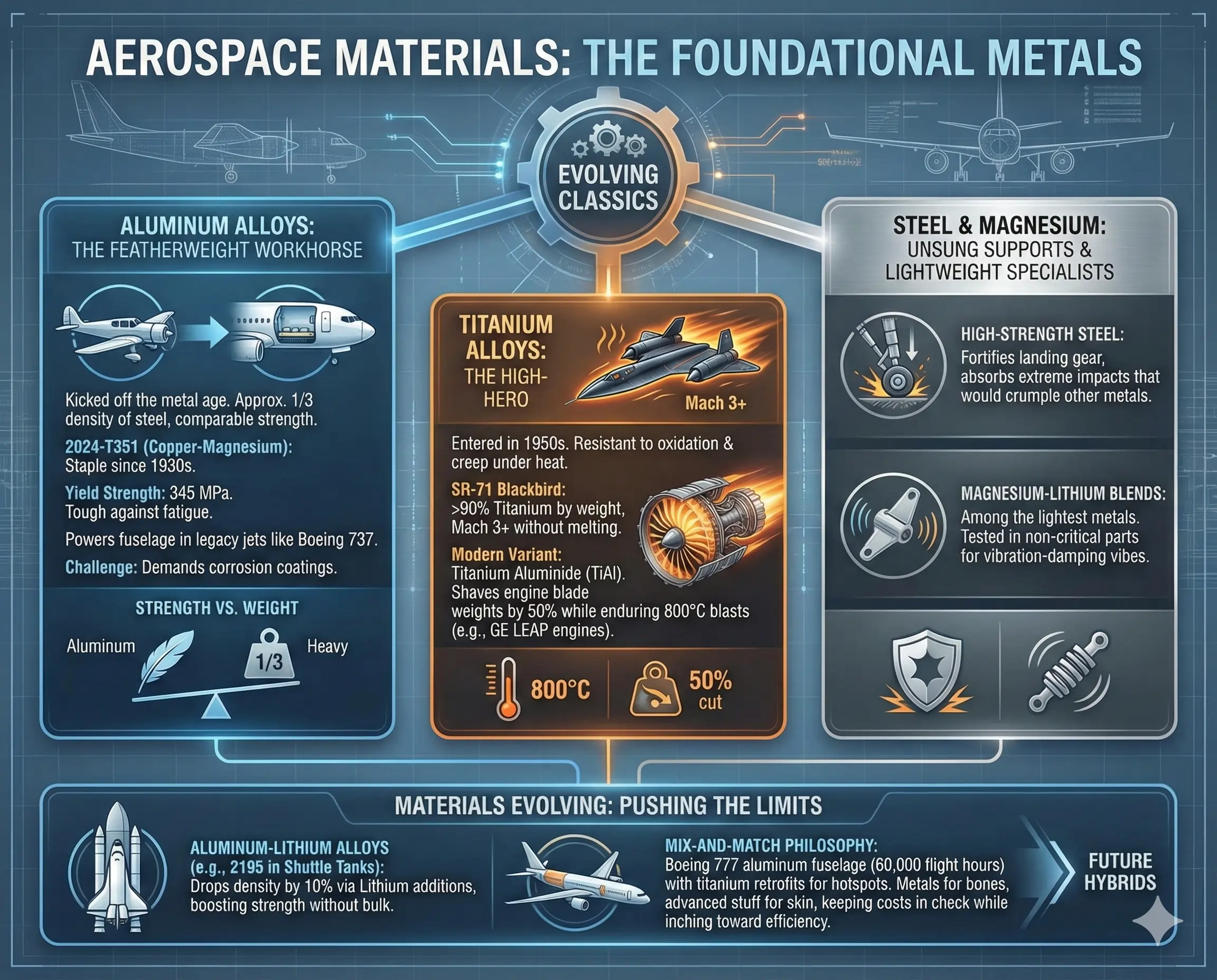
Aluminum alloys kicked off the metal age, prized for their featherweight punch—about one-third steel’s density yet boasting comparable strength. The 2024-T351 aluminum alloy, a copper-magnesium staple since the 1930s, powers fuselages in legacy jets like the Boeing 737. Its yield strength hits 345 MPa, making it tough against fatigue, though it demands corrosion coatings for humid ops.
Titanium entered the fray in the 1950s, a high-temperature hero for its resistance to oxidation and creep under heat. The SR-71 Blackbird, that Cold War speed demon, was over 90% titanium by weight, clocking Mach 3+ without melting. Modern variants like titanium aluminide (TiAl) shave engine blade weights by 50% while enduring 800°C blasts, as seen in GE’s LEAP engines.
Then there’s steel and magnesium, the unsung supports. High-strength steels fortify landing gear, absorbing impacts that would crumple lesser metals, while magnesium-lithium blends—among the lightest metals—test in non-critical parts for their vibration-damping vibes.
These classics aren’t fading; they’re evolving. Aluminum-lithium alloys, like the 2195 used in Space Shuttle tanks, drop density by 10% via lithium additions, boosting strength without bulk. Yet, as demands for 20%+ weight cuts grow, metals cede ground to hybrids, blending their reliability with composite flair.
Consider the Boeing 777: its aluminum fuselage endures 60,000 flight hours, but retrofits now layer in titanium for hotspots. This mix-and-match philosophy—metals for bones, advanced stuff for skin—keeps costs in check while inching toward efficiency goals.
The Composite Revolution: Lighter Than Air, Tougher Than Nails
If traditional metals are the skeleton, composites are the sinew—layered wonders that flex without folding. Born from 1940s fiberglass experiments, they’ve exploded since the 1970s, now comprising 50%+ of new airframes. Why? A single carbon fiber filament packs 3,500 MPa tensile strength, five times that of steel, at a whisper of the weight.
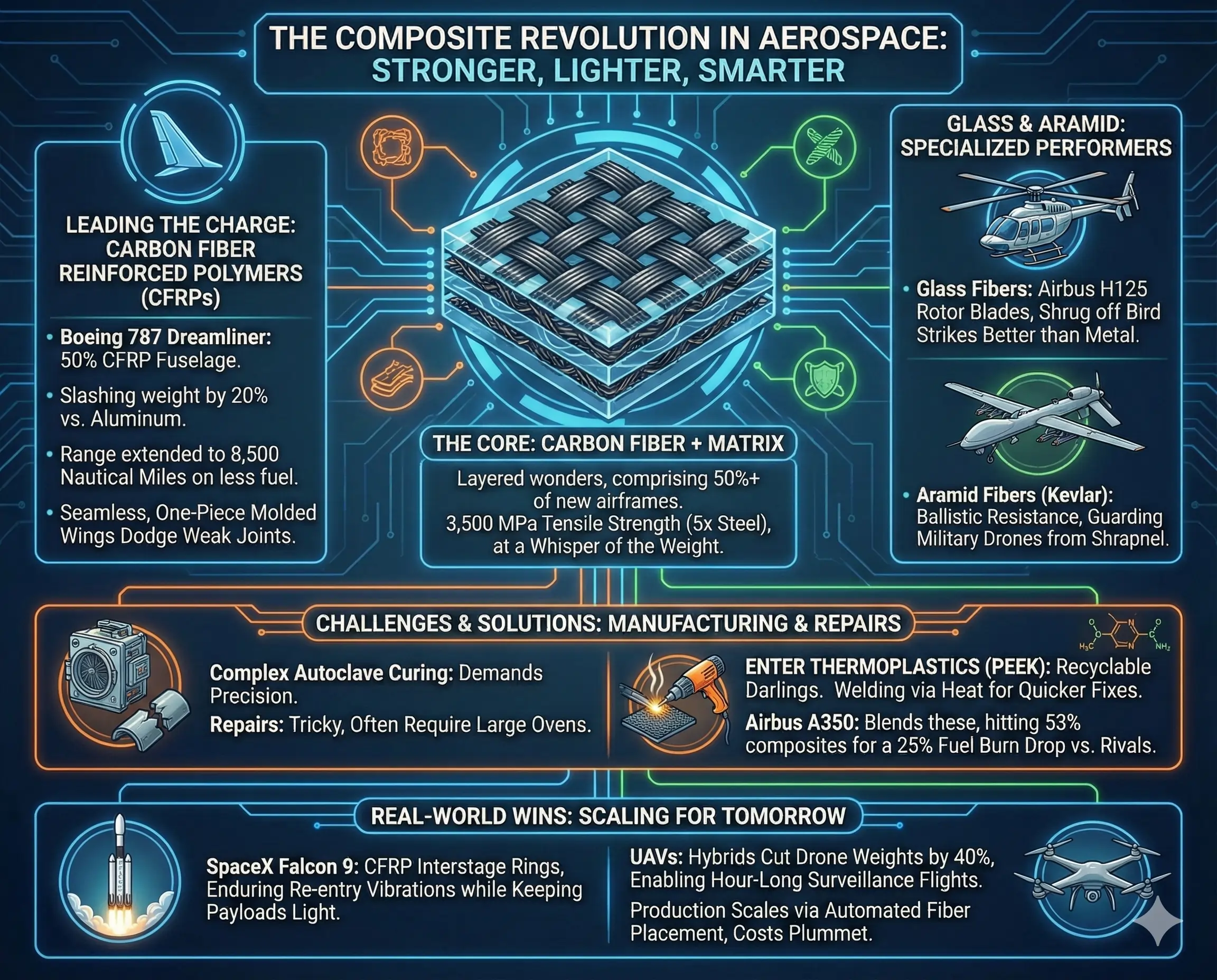
Carbon fiber reinforced polymers (CFRPs) lead the charge, weaving carbon strands into epoxy or thermoplastic matrices. The Boeing 787 Dreamliner? A poster child, with 50% CFRP fuselage slashing weight by 20% over aluminum kin, stretching range to 8,500 nautical miles on less fuel. Inside, wings curve seamlessly, molded in one piece to dodge weak joints.
Glass fibers, humbler cousins, shine in helicopters like the Airbus H125, where rotor blades shrug off bird strikes better than metal. Aramid fibers (Kevlar) add ballistic resistance, guarding military drones from shrapnel.
But composites aren’t flawless. Manufacturing’s complex—autoclave curing demands precision to avoid voids—and repairs? Tricky, often needing ovens the size of garages. Enter thermoplastics: recyclable darlings like PEEK (polyether ether ketone), welding via heat for quicker fixes. The Airbus A350 blends these, hitting 53% composites for a 25% fuel burn drop versus rivals.
Real-world wins abound. SpaceX’s Falcon 9 uses CFRP interstage rings, enduring re-entry vibrations while keeping payloads light. In UAVs, hybrids cut drone weights by 40%, enabling hour-long surveillance flights. As production scales—via automated fiber placement—costs plummet, making composites the default for tomorrow’s fleets.
| Composite Type | Key Properties (Example Values) | Primary Applications | Advantages Over Metals | Challenges |
|---|---|---|---|---|
| Carbon Fiber (CFRP) | Density: 1.6 g/cm³; Tensile Strength: 3,500 MPa | Fuselages, wings (Boeing 787) | 5x strength/weight; fatigue-resistant | High initial cost; delamination risk |
| Glass Fiber | Density: 2.5 g/cm³; Modulus: 70 GPa | Rotor blades (Airbus H125) | Corrosion-proof; impact absorption | Lower stiffness; heavier than carbon |
| Aramid (Kevlar) | Density: 1.4 g/cm³; Impact Resistance: High | Military drone skins | Ballistic protection; vibration damping | UV degradation; moisture sensitivity |
| Thermoplastic (PEEK) | Density: 1.3 g/cm³; Heat Tolerance: 250°C | Engine cowlings (A350) | Recyclable; weldable repairs | Processing temps up to 400°C |
This table underscores why composites rule: superior specific strength (strength per density) lets planes carry more with less. Yet, ongoing R&D tackles flaws, like nano-infusions for self-healing cracks—picture a wing patching itself mid-flight.
Smart Materials: When Structures Think for Themselves
Enter the “smarter” era: materials that sense, adapt, and heal, blurring lines between structure and sensor. These aren’t sci-fi; they’re in prototypes today, promising safer, more efficient skies.
Shape memory alloys (SMAs) top the list, alloys like nitinol (nickel-titanium) that “remember” shapes, reverting under heat or stress. Properties? A whopping 8% strain recovery, dwarfing steel’s 0.2%. Applications shine in adaptive wings: NASA’s Mission Adaptive Wing twists surfaces sans hinges, optimizing lift for gusty conditions. In rotorcraft, SMAs damp vibrations, cutting noise by 10 dB.
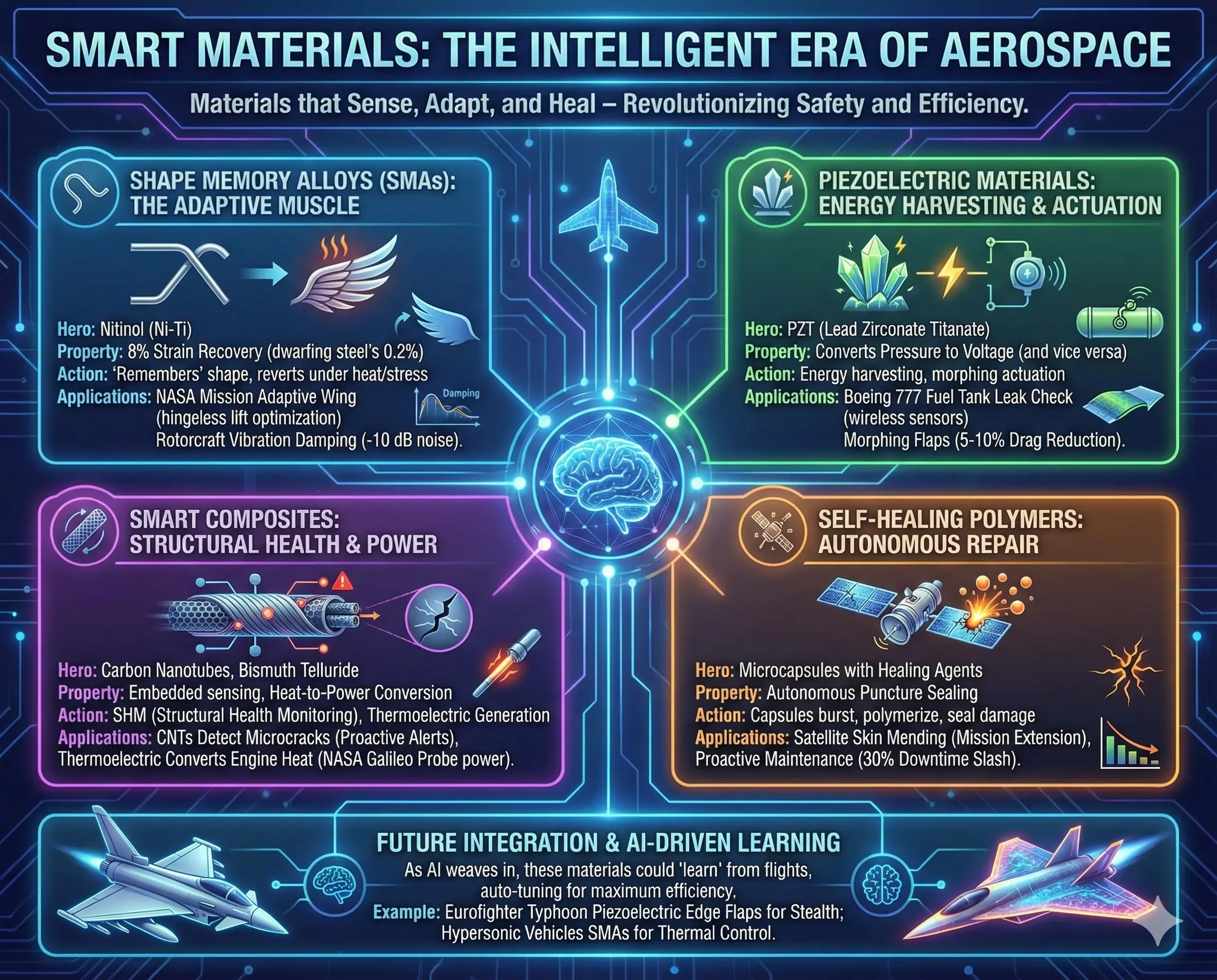
Piezoelectric materials, crystals like lead zirconate titanate (PZT), generate voltage from squeezes—ideal for energy harvesting. The Boeing 777 embeds them in fuel tanks for ultrasonic leak checks, powering wireless sensors without batteries. Bend them with electric fields, and they morph, enabling morphing flaps that adjust camber mid-flight for 5-10% drag reduction.
Smart composites amp this up, embedding fibers with sensors for structural health monitoring (SHM). CFRPs laced with carbon nanotubes detect microcracks via conductivity shifts, alerting pilots before failures. Thermoelectric variants, like bismuth telluride, convert engine heat to juice, as in NASA’s Galileo probe, sustaining deep-space ops.
Self-healing polymers seal punctures autonomously, using microcapsules that burst and polymerize. Imagine a satellite skin mending micrometeorite hits, extending missions by years. Challenges? Integration costs and reliability in extremes, but payoffs—proactive maintenance slashing downtime 30%—make them irresistible.
Examples proliferate: The Eurofighter Typhoon uses piezoelectric actuators for stealthy edge flaps, while hypersonic concepts employ SMAs for thermal expansion control at Mach 5+. As AI weaves in, these materials could “learn” from flights, auto-tuning for efficiency.
| Smart Material Type | Stimulus/Response Mechanism | Key Properties | Aerospace Example | Benefits |
|---|---|---|---|---|
| Shape Memory Alloys | Heat/stress → Shape recovery (up to 8% strain) | High force-to-weight; corrosion-resistant | Adaptive wings (NASA MAW) | Hinge-less controls; vibration damping |
| Piezoelectric | Electric field → Deformation; stress → Voltage | Energy conversion efficiency: 20-30% | Fuel tank sensors (Boeing 777) | Wireless power; damage detection |
| Smart Composites | Embedded sensors → Real-time monitoring | Fatigue life: 2x metals | Airframe SHM (A350 prototypes) | Predictive maintenance; weight savings |
| Thermoelectric | Temperature gradient → Electricity | Seebeck coefficient: 200 μV/K | Waste heat recovery (Galileo spacecraft) | Sustainable energy in extremes |
These tables reveal a pattern: smart tech multiplies utility, turning passive parts active. In a field where a single failure costs millions, their foresight is priceless.
Nanoscale Frontiers: The Tiny Titans Reshaping Aerospace
Zoom in a billion-fold, and nanomaterials emerge as the next disruptors—atoms arranged for superpowers unattainable at macro scales. Carbon nanotubes (CNTs), tubes of rolled graphene a nanometer wide, boast 100 GPa modulus, 50x steel’s strength. Infused in resins, they yield composites 30% tougher, as in experimental drone frames carrying double payloads.
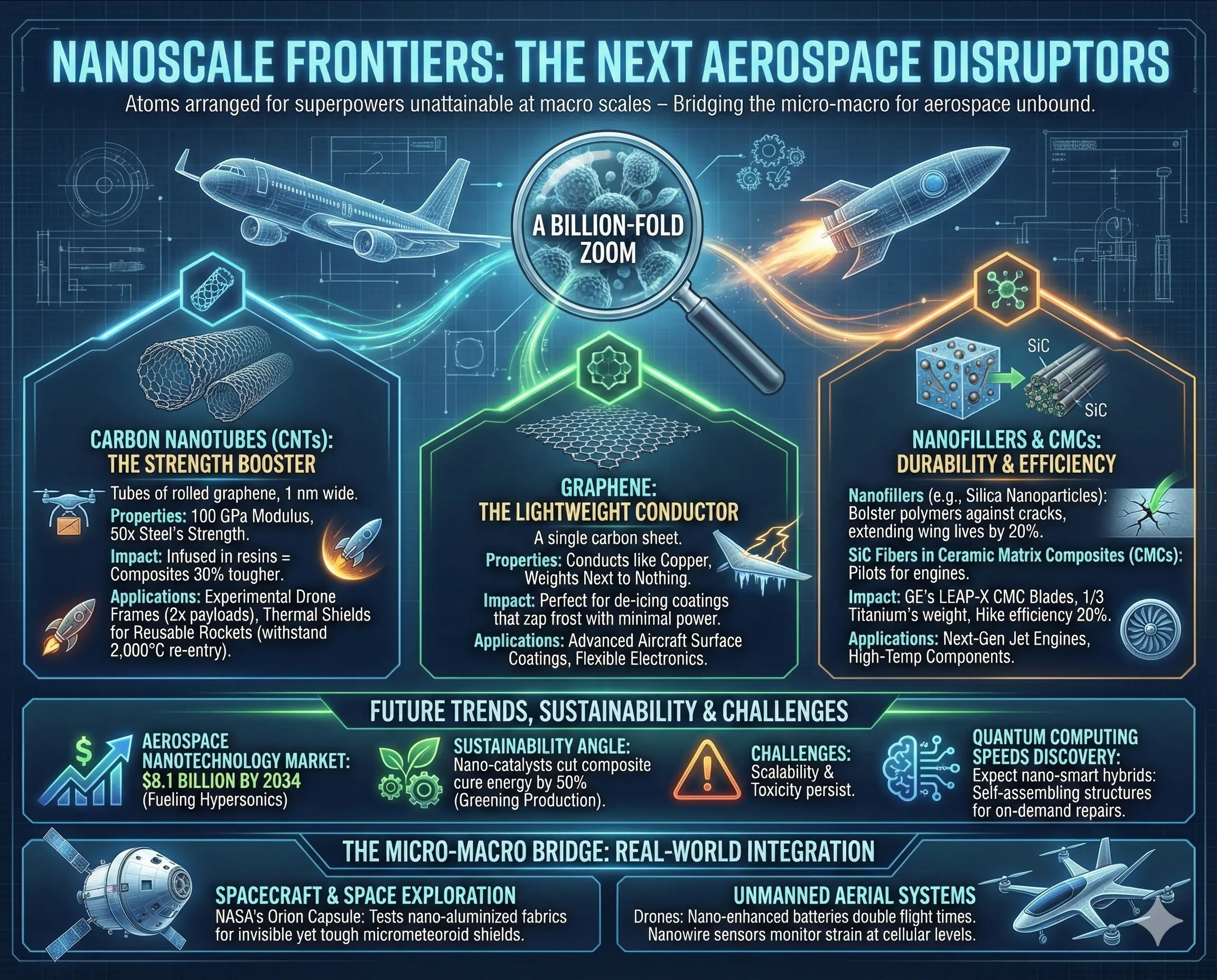
Graphene, a single carbon sheet, conducts like copper but weighs next to nothing, perfect for de-icing coatings that zap frost with minimal power. Nanofillers like silica nanoparticles bolster polymers against cracks, extending wing lives by 20%.
Future trends? Aerospace nanotechnology markets hit $8.1 billion by 2034, fueling hypersonics. CNTs in thermal shields withstand 2,000°C re-entries for reusable rockets, while nanowire sensors monitor strain at cellular levels. Sustainability angles: Nano-catalysts cut composite cure energy by 50%, greening production.
Challenges loom—scalability and toxicity—but pilots like silicon carbide (SiC) fibers in ceramic matrix composites (CMCs) for engines prove the viability: GE’s CMC blades, 1/3 of titanium’s weight, hike efficiency 20% in the LEAP-X. As quantum computing speeds discovery, expect nano-smart hybrids: self-assembling structures for on-demand repairs.
In spacecraft, NASA’s Orion capsule tests nano-aluminized fabrics for micrometeoroid shields, layering invisibly tough. Drones benefit too—nano-enhanced batteries double flight times. This micro-macro bridge promises aerospace unbound by old limits.
Sustainability in Material Design
Aviation’s carbon conundrum—projected 16 GtCO2 by 2050—demands eco-savvy materials. Enter the sustainability surge: bio-based, recyclable options that perform without pillaging the planet.
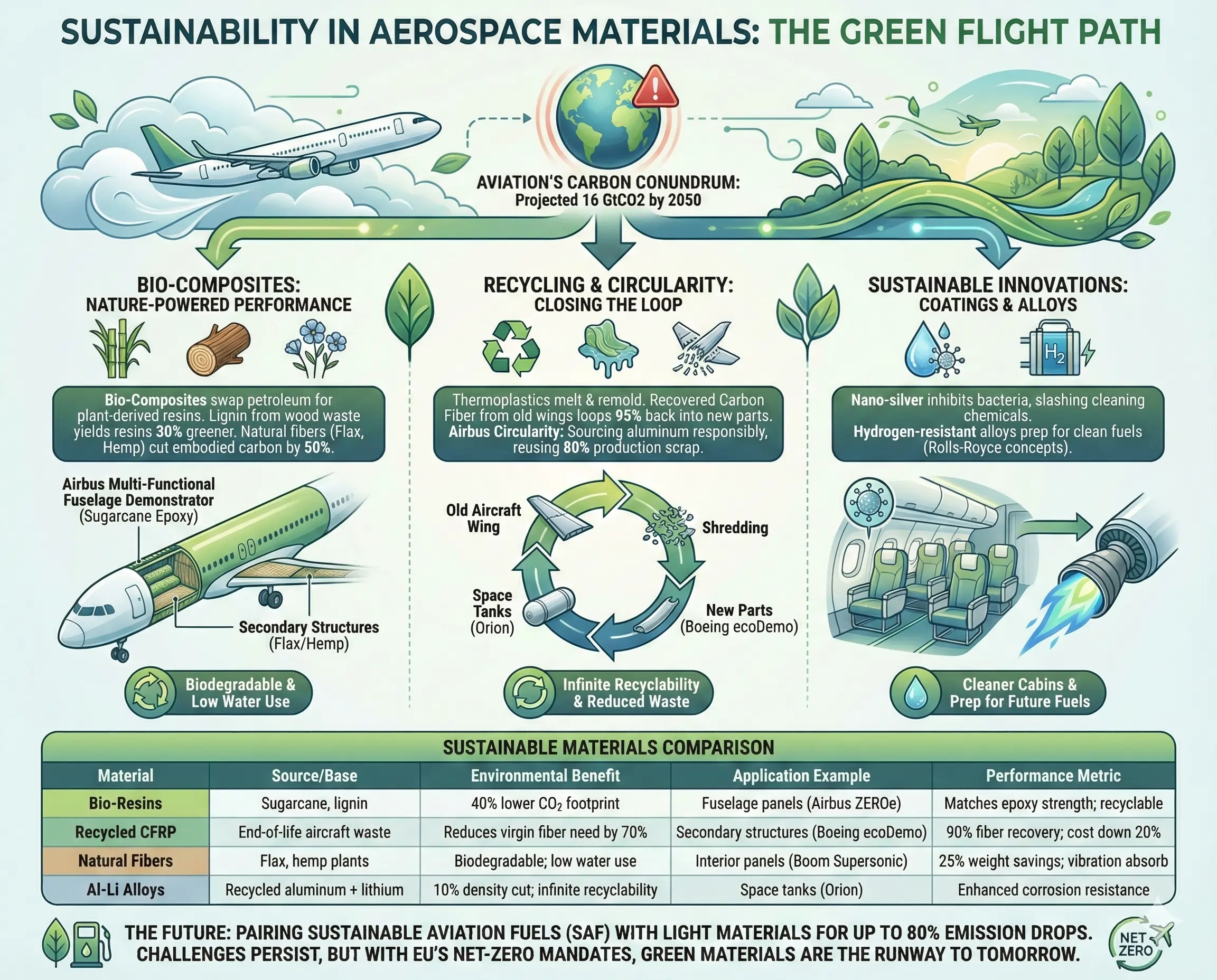
Bio-composites swap petroleum resins for plant-derived ones, like sugarcane epoxy in Airbus’ Multi-Functional Fuselage Demonstrator. Lignin from wood waste yields resins 30% greener, matching virgin strength. Natural fibers—flax, hemp—fortify secondary structures, cutting embodied carbon by 50%.
Recycling’s ramping: Thermoplastics melt and remold, unlike thermosets. Recovered carbon fiber from old wings feeds new parts, looping 95% back in. Airbus eyes “circularity,” sourcing aluminum responsibly and reusing 80% of production scrap.
Coatings evolve too: Nano-silver inhibits bacteria on cabins, slashing cleaning chemicals. Hydrogen-resistant alloys prep for clean fuels, as in Rolls-Royce concepts.
| Sustainable Material | Source/Base | Environmental Benefit | Application Example | Performance Metric |
|---|---|---|---|---|
| Bio-Resins | Sugarcane, lignin | 40% lower CO2 footprint | Fuselage panels (Airbus ZEROe) | Matches epoxy strength; recyclable |
| Recycled CFRP | End-of-life aircraft waste | Reduces virgin fiber need by 70% | Secondary structures (Boeing ecoDemo) | 90% fiber recovery; cost down 20% |
| Natural Fibers | Flax, hemp plants | Biodegradable; low water use | Interior panels (Boom Supersonic) | 25% weight savings; vibration absorb |
| Al-Li Alloys | Recycled aluminum + lithium | 10% density cut; infinite recyclability | Space tanks (Orion) | Enhanced corrosion resistance |
These aren’t compromises; sustainable aviation fuels (SAF) pair with light materials for 80% emission drops. Challenges like supply chains persist, but with regs like the EU’s net-zero mandates, green materials aren’t optional—they’re the runway to tomorrow.
Real-World Applications
Theory meets thrust in applications that wow. Commercial: The Airbus A380 blends 25% composites with aluminum-lithium, hauling 550 passengers 8,000 miles efficiently. Military: F-35’s CFRP skin, laced with piezo sensors, morphs for stealth.
Space: SpaceX’s Starship prototypes use stainless steel for heat, but CFRP domes for lightness. Hypersonics: NASA’s X-43A, titanium-carbide coated, hit Mach 9.6.
Drones and eVTOLs: Lilium’s jets employ thermoplastic composites for urban air mobility, quiet and green. Engines: Pratt & Whitney’s PW1000G turbofans, with TiAl blades, sip 15% less fuel.
These cases illustrate synergy: A 787’s CFRP wings, smart-monitored, extend intervals 2x. As additive manufacturing prints multi-material parts—metal lattices inside composites—customization soars.
Challenges and the Horizon: What’s Next in the Material Skies?
No revolution skips hurdles. Composites’ high upfront costs—$100/kg vs. aluminum’s $3—slow adoption, though volumes drop that to $5 by 2030. Smart integration risks cyber-vulns; nanos raise health flags.
Yet optimism reigns. By 2040, 70% airframes could be composites, with AI-optimized nanos yielding 40% lighter designs. Hybrid-electric props demand flexible materials; space tourism craves reusable toughness.
In sum, aerospace materials embody progress: from brute force to brainy resilience. They’re not just stronger, lighter, smarter—they’re our ticket to sustainable, boundless flight. As engineers fuse bio, nano, and smart, the skies grow friendlier, faster, and farther.
Key Citations And References
- https://blog.bccresearch.com/advanced-aerospace-materials-in-2025-innovations-reshaping-the-industry
- https://www.smicomposites.com/carbon-fiber-in-the-aerospace-industry-past-present-and-future/
- https://www.azom.com/article.aspx?ArticleID=23562
- https://www.samaterials.com/blog/the-future-of-aerospace-materials-whats-next.html
- https://www.airbus.com/en/innovation/future-aircraft/future-materials
- https://www.airbus.com/en/newsroom/news/2017-02-aviations-material-evolution
- https://eaglepubs.erau.edu/introductiontoaerospaceflightvehicles/chapter/aerospace-materials/
- https://ntrs.nasa.gov/api/citations/20180001137/downloads/20180001137.pdf
- https://www.sglcarbon.com/en/markets-solutions/markets/aerospace/
- https://www.researchgate.net/publication/379054145_Carbon_Composites_in_Aerospace_Application_-A_Comprehensive_Review
- https://www.sciencedirect.com/science/article/abs/pii/S2214785319336247
- https://pmc.ncbi.nlm.nih.gov/articles/PMC11652470/
- https://www.rff.org/publications/explainers/sustainable-aviation-101/
- https://aiaa.org/about-aiaa/history-heritage/aerospace-history-timeline/
- https://www.imetalloys.com/news/a-brief-history-of-aerospace-materials/
Read These Articles in Detail
- Aerospace Engineering vs. Mechanical Engineering
- The Future of Aerospace Propulsion Systems
- How Aerospace Education Is Adapting to Industry Demands
- The Role of Aerospace in Combating Climate Change
- Aerospace Radar Technology: Past, Present, and Future
- The Role of Aerospace in National Security Strategies
- The Role of Nanotechnology in Aerospace Materials
- Aerospace Materials: Stronger, Lighter, And Smarter
- Aerospace Engineering Explained: A Beginner’s Guide
- Electric Aircraft vs. Hydrogen Aircraft: Which Is More Sustainable?
- Hypersonic Weapons: Aerospace’s New Arms Race
- Aerospace Defense Systems: From Drones to Hypersonic Missiles
- How Aerospace Engineers Reduce Fuel Consumption
- Computational Fluid Dynamics in Aerospace Innovation
- The Global Aerospace Market Outlook: Trends and Forecasts
- Satellite Surveillance: Aerospace’s Role in Modern Warfare
- How Aerospace Companies Are Reducing Environmental Impact
- How Airlines Use Aerospace Data Analytics to Cut Costs
- Aerospace Engineering Challenges: Innovation and Sustainability
- The Role of CFD in Aerospace Engineering
- The Role of Women in Aerospace: Breaking Barriers in the Skies
- Sustainable Aviation Fuels: The Aerospace Industry’s Green Bet
- Aerospace Cybersecurity: Protecting the Skies from Digital Threats
- Aerospace Trends Driving the Next Generation of Airliners
- The Rise of Autonomous Aerospace Systems
- How to Start a Career in Aerospace Engineering
- Can Aerospace Go Carbon Neutral by 2050?
- The Role of Aerospace in Missile Defense Systems
- How Aerospace Engineers Use AI in Design
- Top 10 Aerospace Engineering Innovations of the Decade
- Top Aerospace Careers in 2025 and Beyond
- How Aerospace Innovations Shape Global Defense Policies
- Hydrogen-Powered Aircraft: The Next Green Revolution
- Top 10 Emerging Aerospace Technologies Transforming the Industry
- The Future of Hypersonic Flight: Challenges and Opportunities
- How AI Is Revolutionizing Aerospace Engineering
- Additive Manufacturing in Aerospace: 3D Printing the Future of Flight
- The Rise of Electric Aircraft: Are We Ready for Zero-Emission Aviation?
- Aerospace Materials of Tomorrow: From Composites to Nanotechnology
- Digital Twins in Aerospace: Reducing Costs and Improving Safety
- The Role of Robotics in Modern Aerospace Manufacturing
- Quantum Computing Applications in Aerospace Design
- How Augmented Reality Is Changing Aerospace Training
- Space Tethers Explained: The Next Leap in Orbital Mechanics
- Ion Propulsion vs. Chemical Rockets: Which Will Power the Future?
- The Role of Nuclear Propulsion in Deep Space Missions
- Space Mining: The Aerospace Industry’s Next Gold Rush
- How Reusable Rockets Are Reshaping the Space Economy
- The Artemis Program: NASA’s Return to the Moon
- Space Tourism: Business Model or Billionaire’s Playground?
- How Aerospace Startups Are Disrupting Commercial Aviation
- The Economics of Low-Cost Airlines in the Aerospace Era
- Urban Air Mobility: The Rise of Flying Taxis
- The Future of Mars Colonization: Key Aerospace Challenges and Solutions Ahead
- CubeSats and Small Satellites: Democratizing Space Access
- The Future of Cargo Drones in Global Logistics
- The Role of Aerospace in Building a Lunar Economy
Frequently Asked Questions
FAQ 1: What Is the Evolution Timeline of Aerospace Materials?
Understanding the progression of materials in aerospace is like tracing the story of human flight itself, from fragile beginnings to robust, high-tech builds that conquer the skies and space. It started simply, with early pioneers crafting planes from whatever nature provided, and has since layered in engineered wonders that balance extreme demands like speed, heat, and weight.
The journey kicked off in the pre-1900s era, where wood frames wrapped in fabric formed the backbone of aircraft, offering flexibility but little durability against weather or stress. By 1915, the first all-metal plane emerged, using steel for its tubular strength, marking a shift toward industrialization. The 1920s and 1930s brought aluminum alloys into the spotlight, revolutionizing commercial aviation with their lightweight punch—think the iconic Douglas DC-3, which carried passengers across continents without the creaks of wooden predecessors.
Post-World War II, the focus turned to speed and heat resistance, introducing titanium in the late 1940s for jet engines and high-velocity frames, as seen in military fighters enduring Mach speeds. The 1970s ushered in composites, with carbon fiber making its commercial debut in tail sections, slashing weights while boosting fatigue life. By the 1990s, these materials dominated, comprising up to 50% of structures in planes like the Boeing 787. Today, we’re blending in smart and nano elements, with projections for self-healing surfaces by 2030 that could extend aircraft lifespans dramatically.
This evolution isn’t random; each step responds to physics’ unyielding rules—gravity pulls harder on heavier builds, while aerodynamics favors sleek, light designs. Looking ahead, sustainable twists like bio-resins from plant sources promise to weave environmental care into this legacy, ensuring aerospace grows without grounding the planet.
To visualize this path clearly, here’s a structured timeline highlighting major milestones:
| Era | Key Development | Material Highlight | Notable Impact |
|---|---|---|---|
| Pre-1900s | Wright Brothers’ gliders | Wood and fabric | Enabled first powered flight; low cost but fragile. |
| 1915-1920s | First all-metal aircraft | Steel tubing | Increased load capacity; foundation for metal era. |
| 1930s-1940s | Commercial airliners rise | Aluminum alloys (e.g., Duralumin) | DC-3 flew millions; 1/3 steel’s weight, same strength. |
| 1950s-1960s | Jet age and space race | Titanium for heat zones | SR-71 Blackbird hit Mach 3; corrosion-resistant. |
| 1970s-1980s | Composites enter mainstream | Carbon fiber reinforced polymers (CFRP) | Airbus A310 saved 250 kg per tail; fatigue-resistant. |
| 1990s-2010s | Full airframe integration | Advanced CFRPs and hybrids | Boeing 787: 50% composites, 20% weight reduction. |
| 2020s and Beyond | Smart, nano, and bio-materials | Shape memory alloys, graphene | A350 XWB: 25% fuel savings; self-healing potential. |
This table captures how each innovation built on the last, turning aviation from a daring experiment into a global lifeline.
FAQ 2: What Are the Key Advantages of Carbon Fiber Composites in Modern Aircraft?
Carbon fiber composites have transformed aircraft design, offering a perfect blend of power and poise that traditional metals struggle to match. At their core, these materials weave ultra-thin carbon strands into a resin matrix, creating structures that are not just light but remarkably resilient, ideal for the relentless demands of flight.
One standout benefit is the incredible strength-to-weight ratio, where carbon fiber delivers five times the tensile strength of steel while weighing a mere fraction—about 40% less than aluminum. This lightness directly translates to fuel savings; for instance, planes built with these composites burn up to 25% less fuel over long hauls, stretching ranges and cutting operational costs. Beyond weight, they resist corrosion beautifully, dodging the rust and fatigue that plague metal parts in humid or salty air, which means fewer maintenance headaches and longer service lives.
Design flexibility adds another layer of appeal. Unlike rigid metals that require welding or riveting, composites can be molded into complex, seamless shapes—like the sweeping wings of the Boeing 787—that reduce drag and enhance aerodynamics. This seamlessness minimizes weak points, boosting overall structural integrity. In vibration-heavy environments, such as turbine blades, carbon fiber dampens noise and shakes better, leading to quieter cabins and smoother rides for passengers.
However, these perks come with thoughtful trade-offs, like higher upfront costs offset by lifecycle savings. Real-world examples abound: the Airbus A350 uses over 50% composites, achieving 25% better fuel efficiency than older models, proving how this material isn’t just an upgrade—it’s a game-changer for efficient, enduring flight.
- Fuel Efficiency Gains: Up to 20-25% reduction in consumption due to lighter airframes, directly lowering emissions.
- Durability Enhancements: Superior fatigue resistance extends part life by 2-3 times compared to aluminum.
- Aerodynamic Improvements: Custom molding cuts drag by 5-10%, enabling faster, more stable flights.
- Maintenance Savings: Corrosion-proof nature reduces inspections by 30%, saving airlines millions annually.
- Versatility in Applications: From fuselages to interiors, adapts to diverse needs without compromising performance.
FAQ 3: How Do Smart Materials Improve Safety and Efficiency in Aviation?
Smart materials represent a leap forward in aviation, where structures don’t just endure—they actively respond to threats and optimize performance in real time. These innovative substances, embedded with sensors or adaptive properties, turn passive aircraft parts into dynamic systems that sense stress, heal minor damage, and even adjust shapes mid-flight, all contributing to safer journeys and smarter resource use.
Consider shape memory alloys, like nitinol, which “remember” their original form and snap back after deformation triggered by heat or electricity. In practice, this means variable-geometry wings that morph to handle turbulence, reducing fuel burn by optimizing lift without bulky hydraulics. On the Boeing 777, such alloys control engine chevrons, quietly directing exhaust to cut noise pollution while enhancing thrust efficiency. This adaptability not only boosts safety by preventing flutter-induced failures but also trims operational costs through predictive maintenance—sensors flag issues before they escalate, potentially averting delays that cost airlines billions yearly.
Piezoelectric materials take this further by generating electricity from mechanical stress, powering onboard diagnostics without extra batteries. Integrated into composite skins, they monitor cracks via subtle voltage changes, as trialed in Airbus prototypes, where early detection has slashed downtime by up to 30%. Self-healing polymers, another star, release repairing agents from embedded capsules when punctured, mimicking biological wound closure to maintain airtight integrity during flights. NASA’s experiments show these could extend satellite lifespans in harsh space by years, a principle scaling to commercial jets for fewer unscheduled repairs.
Efficiency shines through energy harvesting too—vibrations from engines convert to power for sensors, reducing reliance on heavy fuel cells. Yet, integration demands precision; over-reliance on these could introduce electronic vulnerabilities, though redundancies mitigate risks. Overall, smart materials weave intelligence into the airframe, fostering a proactive aviation ecosystem where safety and sustainability converge seamlessly.
The ripple effects are profound: quieter skies from vibration-damped cabins, greener ops via optimized aerodynamics, and resilient designs that weather extremes from Arctic routes to desert runs. As research advances, expect widespread adoption, making flights not just routine but remarkably responsive.
FAQ 4: What Role Do Nanomaterials Play in Revolutionizing Aerospace Design?
Nanomaterials, engineered at the atomic scale—often just a few billionths of a meter wide—are quietly reshaping aerospace by infusing everyday components with extraordinary capabilities. These tiny titans, like carbon nanotubes or graphene sheets, amplify strength, conductivity, and resilience without piling on weight, addressing the eternal quest for planes that fly higher on less.
In structural applications, carbon nanotubes laced into resins create composites 50 times stronger than steel at a fraction of the heft, ideal for fuselages enduring hypersonic stresses. NASA’s Orion capsule employs nano-aluminized fabrics as micrometeoroid shields, layering invisible barriers that absorb impacts better than bulky metals, ensuring crew safety on deep-space treks. Thermal management benefits hugely too; graphene coatings dissipate heat from re-entry at 2,000°C, preventing meltdowns in reusable rockets like SpaceX’s Starship prototypes.
Sensors get a nanoscale boost, with nanowires detecting strains at cellular levels for ultra-precise health monitoring—imagine a wing “feeling” fatigue before pilots do, alerting ground crews via conductivity shifts. This proactive edge could cut failure rates by 40%, per industry studies. Environmentally, nano-catalysts speed up composite curing, slashing energy use in manufacturing by half, while anti-corrosion nanoparticles extend part lives, reducing scrap.
Challenges persist, like scaling production without toxicity risks, but payoffs are immense: lighter drones with doubled flight times, efficient engines via ceramic matrix composites with silicon carbide fibers. As quantum-inspired designs emerge, nanomaterials promise self-assembling repairs, blurring lines between material and machine in a lighter, smarter aerospace era.
FAQ 5: How Are Sustainable Materials Shaping the Future of Aerospace?
Sustainability in aerospace materials isn’t a buzzword—it’s a necessity, driven by the industry’s push to slash its 2-3% share of global emissions while maintaining sky-high performance. By swapping petroleum-heavy options for eco-friendly alternatives, engineers are crafting aircraft that perform without plundering resources, blending innovation with environmental stewardship.
Bio-composites lead this charge, deriving resins from renewable sources like sugarcane or lignin from wood waste, matching traditional epoxies in strength but with 40% lower carbon footprints. Airbus’s ZEROe concepts integrate these into fuselages, aiming for net-zero flights by 2035. Recycled carbon fiber, reclaimed from retired planes, loops back into new wings, recovering 90% of material and cutting virgin production needs by 70%. Natural fibers such as flax or hemp reinforce interiors, offering biodegradability and vibration absorption at 25% less weight than synthetics.
Coatings evolve too, with nano-silver for antimicrobial cabin surfaces that minimize cleaning chemicals, and hydrogen-compatible alloys prepping for clean-fuel eras. These shifts demand holistic thinking—lifecycle assessments ensure end-of-life recyclability, turning waste into wings.
Here’s a breakdown of prominent sustainable options and their contributions:
| Material Type | Primary Source | Key Benefit | Example Application | Environmental Win |
|---|---|---|---|---|
| Bio-Resins | Sugarcane, plant oils | 30-40% CO2 reduction | Fuselage panels in hybrid-electric jets | Renewable, low-energy production |
| Recycled CFRP | End-of-life aircraft fibers | 70% less virgin material | Wing spars in regional airliners | Circular economy, waste diversion |
| Natural Fibers | Flax, hemp crops | Biodegradable, low water footprint | Cabin interiors and fairings | Reduces mining impacts, carbon-neutral |
| Advanced Alloys | Recycled aluminum-lithium | Infinite recyclability, 10% lighter | Engine mounts in sustainable fleets | Energy savings in remelting |
This table illustrates how these materials weave green threads into aerospace fabric, promising fleets that soar responsibly.
FAQ 6: What Challenges Do Engineers Face When Adopting Advanced Aerospace Materials?
Adopting advanced materials in aerospace is a thrilling pursuit, but it’s fraught with hurdles that test even the sharpest engineering minds. These innovations promise lighter, stronger builds, yet bridging the gap from lab to launch involves navigating a maze of technical, economic, and practical obstacles.
High costs top the list—carbon composites can run $100 per kilogram versus aluminum’s $3, demanding upfront investments that airlines scrutinize closely. Manufacturing complexity adds fuel to the fire; curing composites requires massive autoclaves and precise controls to avoid defects like voids, slowing production and inflating timelines. Repairs pose another puzzle: patching a delaminated carbon wing demands specialized skills and equipment, unlike straightforward metal welding, leading to 20-30% higher maintenance bills initially.
Environmental and regulatory pressures compound this. While sustainable variants shine, scaling bio-resins risks supply chain volatility from crop-dependent sources, and nano-materials raise toxicity concerns during handling. Extreme conditions—think -60°C cruises or 1,300°C engine blasts—expose weaknesses, like composites’ vulnerability to impacts or smart sensors’ electronic glitches in electromagnetic storms.
Yet, solutions emerge through collaboration: automated fiber placement cuts costs by 50%, and AI-driven simulations predict flaws early. Balancing these challenges ensures advanced materials don’t just fly—they thrive, fostering an industry that’s as resilient as the skies it conquers.
- Economic Barriers: Initial premiums offset by 15-20% lifecycle savings, but certification delays extend ROI.
- Technical Hurdles: Integration with legacy systems requires hybrid designs, adding design iterations.
- Regulatory Demands: FAA approvals demand exhaustive testing, spanning years for novel composites.
- Supply Chain Risks: Rare earths in smart alloys face geopolitical squeezes, urging diversification.
- Performance Trade-offs: Enhanced lightness can mean brittleness, necessitating layered reinforcements.
FAQ 7: What Emerging Trends Are Defining the Future of Aerospace Materials?
The future of aerospace materials pulses with excitement, where trends like multifunctionality and circularity are redefining what’s possible in the skies. As we hurtle toward 2040, expect a fusion of digital smarts, atomic precision, and green ingenuity that makes today’s jets look quaint.
Additive manufacturing, or 3D printing, leads the pack, layering metals and composites into bespoke parts that shave weights by 40%—think lattice-structured titanium brackets that are strong yet airy. Nanotech weaves in next, with graphene-infused skins that conduct heat away from hypersonic noses, enabling Mach 5+ travel without melting. Smart hybrids, blending shape memory polymers with embedded AI, will enable “morphing” airframes that auto-adjust for efficiency, potentially trimming drag by 10% across varying altitudes.
Sustainability surges forward too, with fully recyclable thermoplastics and mycelium-based foams for interiors, aligning with net-zero mandates. Electric propulsion demands flexible conductors, like silver nanowire films, powering batteries without excess bulk. Market forecasts peg the sector at $8 billion by 2034, driven by space tourism’s reusable needs.
These trends converge in concepts like Airbus’s blended-wing bodies, where bio-nano composites enable silent, efficient urban air taxis. Challenges like standardization linger, but the trajectory points to materials that not only endure but evolve with every mission, democratizing flight for a connected world.
FAQ 8: Which Aircraft Models Showcase the Best Use of Advanced Materials?
Advanced materials aren’t abstract—they’re the unsung stars in aircraft that redefine travel, from whisper-quiet cabins to globe-spanning efficiency. Several standout models harness these technologies, proving their worth in real operations.
The Boeing 787 Dreamliner pioneered with 50% CFRP construction, its one-piece wings molded for seamless strength, yielding 20% less weight and 8,500-mile ranges on sips of fuel. Similarly, the Airbus A350 XWB clocks 53% composites, blending thermoplastics for quick repairs and 25% burn reductions, making long-haul economics soar.
Military icons like the F-35 Lightning II embed piezoelectric sensors in aramid skins for stealthy morphing, detecting threats via nano-strains while resisting shrapnel. In space, SpaceX’s Falcon 9 deploys CFRP interstage rings for vibration-proof reusability, landing boosters flawlessly.
Emerging eVTOLs, such as Lilium’s jets, favor thermoplastic composites for lightweight agility in city hops, cutting noise for urban acceptance. These examples highlight a pattern: advanced materials turn ambitious designs into everyday realities.
- Boeing 787 Dreamliner: CFRP fuselage for corrosion-free longevity and fuel savings.
- Airbus A350 XWB: Hybrid composites with smart monitoring for predictive safety.
- F-35 Lightning II: Nano-enhanced skins for adaptive stealth and durability.
- SpaceX Falcon 9: Recyclable CFRP for cost-effective orbital access.
- Lilium Jet: Bio-thermoplastics enabling quiet, electric urban mobility.
FAQ 9: How Do the Costs of Composites Compare to Traditional Aerospace Materials?
Cost comparisons between composites and traditional materials like aluminum reveal a nuanced picture: higher entry fees for composites yield long-term wins through efficiency and durability. While metals win on simplicity, the scales tip as volumes grow and tech matures.
Upfront, aerospace-grade carbon fiber hits $1,000-$10,000 per kilogram due to intricate prepregging and autoclave processes, dwarfing aluminum’s $2-5. Yet, over an aircraft’s 30-year life, composites’ lightness curbs fuel costs by 20%, and corrosion resistance halves maintenance—net savings of 15-25% per Infosys analyses.
Recycled variants narrow the gap, dropping CFRP to $20-50/kg, competitive with titanium’s $30+. Lifecycle models show a Boeing 787 recouping premiums via 1 billion gallons of saved fuel fleet-wide.
| Aspect | Composites (CFRP) | Traditional (Aluminum) | Long-Term Cost Insight |
|---|---|---|---|
| Initial Material Cost | $100-200/kg (virgin); $20-50/kg (recycled) | $2-5/kg | Composites are higher, but the scale reduces. |
| Manufacturing | Complex (autoclave: $50-100/part) | Simple (extrusion: $10-20/part) | Automation cuts the composite gap by 50%. |
| Fuel & Operations | 20-25% savings over lifecycle | Baseline; higher burn | Composites save $millions per plane. |
| Maintenance | Lower corrosion; 30% fewer checks | Prone to fatigue; frequent inspections | Net 15% advantage for composites. |
| Total Ownership | Higher upfront, 15-25% lower overall | Lower entry, higher running | Breakeven at 5-7 years for wide-bodies. |
This overview underscores why airlines bet big on composites despite the sticker shock.
FAQ 10: What Is the Key Comparison Between Traditional and Advanced Aerospace Materials?
Comparing traditional and advanced aerospace materials highlights a clash of reliables versus revolutionaries—metals like aluminum offer proven punch, while composites and smart variants deliver tailored excellence. Each shines in context, but advances increasingly steal the show for modern demands.
Traditional options, rooted in aluminum and titanium, excel in familiarity: aluminum’s 345 MPa yield strength and easy machinability suit quick builds, as in the Boeing 737’s fuselage. Titanium withstands 800°C for engines, but at three times the cost and weight of aluminum. They’re recyclable, but corrosion and fatigue demand vigilant upkeep.
Advanced materials flip the script—CFRP boasts 3,500 MPa tensile at 1.6 g/cm³ density, enabling 50% airframe shares in the A350 for drag-free designs. Smart integrations add responsiveness, like piezoelectric energy harvesting for sensor power, absent in metals. Nanofillers boost thermal tolerance, but repairs lag metals’ simplicity.
Hybrids bridge worlds, layering aluminum bones with composite skin for balanced economics. Ultimately, advances win on efficiency—25% fuel cuts versus metals’ status quo—though costs and certification trail.
| Category | Traditional Materials (e.g., Aluminum) | Advanced Materials (e.g., CFRP, Smart) | Winner for Future Use |
|---|---|---|---|
| Weight | Moderate (2.7 g/cm³) | Ultra-light (1.3-1.6 g/cm³) | Advanced: 20-40% reductions. |
| Strength | Good (up to 500 MPa) | Exceptional (3,000+ MPa) | Advanced: 5x steel’s ratio. |
| Cost | Low initial ($3/kg) | Higher ($100+/kg) but lifecycle savings | Traditional short-term; advanced long-term. |
| Durability | Fatigue-prone, corrodes | Corrosion-resistant, self-healing options | Advanced: 2x lifespan. |
| Versatility | Standard shapes | Custom molding, adaptive features | Advanced: Morphing designs. |
This side-by-side reveals why the shift feels inevitable, blending old wisdom with new wizardry.
Expanding Horizons in Aerospace Materials: More Essential Questions Answered
Building on the foundations of stronger, lighter, and smarter aerospace materials, these additional frequently asked questions explore deeper layers—from enduring metals like titanium to cutting-edge electric propulsion and military uses. Drawing from the latest insights as of late 2025, they offer practical guidance for enthusiasts, professionals, and anyone intrigued by how these innovations propel us forward. Each question unpacks complexities with clarity, blending historical context, real applications, and forward-thinking details to make the science accessible and engaging.
FAQ 11: What Role Do Titanium Alloys Play in Modern Aerospace Applications?
Titanium alloys have long been a powerhouse in aerospace, prized for their exceptional balance of strength, lightness, and resilience in the face of extreme conditions. These materials, primarily composed of titanium mixed with elements like aluminum, vanadium, and molybdenum, emerged prominently in the 1950s as jets pushed speed and altitude limits, but their relevance has only grown with today’s demands for efficiency and durability. In modern aircraft, they account for critical components where weight savings directly translate to fuel economy, while their natural corrosion resistance ensures longevity in harsh environments like salty coastal flights or high-humidity routes.
One of the most celebrated titanium alloys, Ti-6Al-4V, dominates applications due to its high strength-to-weight ratio—nearly as strong as steel but half the density—making it ideal for airframes, engine parts, and landing gear. For instance, in the Lockheed Martin F-35 fighter jet, titanium forms over 40% of the airframe, enabling stealthy designs that withstand supersonic stresses without cracking. Beyond fixed-wing planes, titanium shines in rotary craft; helicopter rotor hubs use alloys like Ti-10V-2Fe-3Al for their fatigue resistance, reducing vibration and extending service life by up to 30%. In engines, such as those in the GE9X turbofan for the Boeing 777X, titanium blades endure temperatures exceeding 1,000°C, boosting thrust while cutting weight by 20% compared to nickel-based alternatives.
The push toward sustainability amplifies titanium’s appeal, as its recyclability—up to 95% recovery rates—aligns with net-zero goals, though challenges like high extraction costs persist. As hypersonic travel advances, newer variants like titanium aluminides promise even lighter, heat-proof structures for vehicles hitting Mach 5, potentially revolutionizing rapid global connectivity. Overall, titanium alloys aren’t just holding up the skies; they’re evolving to make flight smarter and greener.
FAQ 12: How Do Self-Healing Materials Enhance Aviation Safety?
Self-healing materials mark a transformative step in aviation, where aircraft components can autonomously detect and mend minor damages, much like human skin clotting a cut, thereby minimizing risks from wear and tear during flights. These innovative substances, often integrated into composites, rely on embedded microcapsules or vascular networks that release healing agents upon impact or stress, restoring structural integrity without ground intervention. Developed from early concepts in the 2000s, they’ve matured by 2025 into viable prototypes, addressing the aviation industry’s zero-tolerance for failures in high-stakes environments.
In practice, extrinsic self-healing polymers—common in aerospace—encapsulate resins or catalysts within the matrix; when a crack forms, say from bird strikes or fatigue, the capsules rupture, filling the void and polymerizing to bond it shut, often regaining 70-90% of original strength. NASA’s research on puncture-resistant polymers for spacecraft skins demonstrates this in action, simulating micrometeoroid hits and achieving repairs in minutes, which could extend mission durations by years. For commercial jets, University of Alabama teams are embedding these in wing spars, where real-time sensors trigger healing, potentially cutting maintenance costs by 25% and averting incidents like the 1988 Aloha Airlines roof failure.
Intrinsic approaches, using reversible chemical bonds in the polymer chains, offer repeated healing without depletes, ideal for dynamic parts like flaps. While challenges like activation temperatures limit widespread use—requiring 60-80°C for some—the payoff in safety is immense: fewer diversions, longer intervals between checks, and enhanced passenger confidence. As integration with AI monitoring advances, self-healing could become standard, turning potential disasters into seamless recoveries and paving the way for bolder explorations.
FAQ 13: How Have Advancements in Aerospace Materials Impacted Space Exploration?
Advancements in aerospace materials have profoundly shaped space exploration, enabling lighter payloads, tougher re-entry shields, and sustainable habitats that stretch missions farther and safer than ever before. From the aluminum-lithium alloys of the Space Shuttle’s external tank, which shaved thousands of pounds to boost cargo capacity, to today’s carbon composites in reusable rockets, these innovations directly amplify what humanity can achieve beyond Earth’s atmosphere. By 2025, the focus has shifted to multi-functional materials that not only endure vacuum, radiation, and thermal extremes but also support in-situ resource utilization, like mining lunar regolith for construction.
Key impacts shine in propulsion and structures: titanium alloys in Mars rovers withstand -140°C nights and abrasive dust, extending operational life from months to years, as seen in NASA’s Perseverance rover. Composites like CFRP in SpaceX’s Starship reduce launch mass by 30%, allowing more satellites or crew per flight, while ceramic matrix composites in heat shields handle 2,000°C re-entries without ablation, cutting refurbishment times dramatically. Radiation-protective nanomaterials, layered into suits and habitats, shield against cosmic rays, a critical leap for deep-space jaunts to Europa or Mars.
Sustainability drives further: bio-inspired aerogels insulate with minimal weight, and 3D-printable alloys enable on-orbit repairs, as tested on the ISS. These materials haven’t just facilitated Artemis lunar returns; they’ve democratized access, fueling private ventures like Blue Origin’s New Glenn. Challenges remain, such as atomic oxygen erosion, but the trajectory points to self-assembling habitats by 2030, making interstellar dreams tangible.
To illustrate the progression:
| Material Advancement | Space Application Example | Key Impact on Exploration |
|---|---|---|
| Aluminum-Lithium Alloys | Space Shuttle tanks | 30% weight reduction; increased payload to orbit |
| Carbon Composites | Falcon 9 fairings | Reusability; cost drop from $60M to $28M per launch |
| Ceramic Matrix Composites | Orion capsule heat shield | Withstands 2,800°C; enables crewed Mars missions |
| Nanomaterials | Radiation shielding in suits | 50% better protection; safer long-duration stays |
| Aerogels | Mars habitat insulation | Ultra-low thermal conductivity; energy efficiency |
This table highlights how each breakthrough builds resilience for the stars.
FAQ 14: What Are the Primary Manufacturing Processes for Carbon Fiber Composites in Aerospace?
Manufacturing carbon fiber composites for aerospace demands precision to harness their superior strength while ensuring flaw-free integration into airframes and engines. These processes, refined since the 1970s, involve layering carbon fibers with resins to form laminates that cure into rigid, lightweight structures, now comprising over 50% of new aircraft by weight. As demand surges for sustainable production, techniques evolve to minimize waste and energy, aligning with 2025’s green mandates.
Autoclave molding remains the gold standard for high-performance parts like the Boeing 787’s fuselage: pre-impregnated fibers (prepregs) are laid in molds, vacuum-bagged, and heated under pressure (up to 100 psi) at 180°C, eliminating voids for seamless strength. Out-of-autoclave (OOA) methods, such as resin transfer molding (RTM), gain traction for cost savings—infusing dry fibers with liquid resin in closed molds—used in Airbus A350 wing panels, slashing cure times by 40%. Filament winding, ideal for cylindrical components like rocket bodies, winds fibers around mandrels before resin infusion, as in SpaceX fairings.
Additive twists like automated fiber placement (AFP) layer tapes robotically, boosting efficiency for complex geometries. Recycling integration, via thermoplastic variants, allows remelting for circular loops.
- Autoclave Curing: High-pressure heat for zero-defect laminates; used in 70% of primary structures.
- Resin Transfer Molding: Closed-mold infusion; reduces volatiles, eco-friendlier by 20%.
- Filament Winding: Continuous fiber wrapping; excels in pressure vessels, 50% faster for tubes.
- Automated Layup: Robotic precision; cuts labor by 60%, error rates below 1%.
- Compression Molding: Quick for small parts; thermoplastics enable welds over adhesives.
These processes ensure composites fly true, lighter, and longer.
FAQ 15: What Are the Environmental Impacts of Traditional Versus Advanced Aerospace Materials?
The environmental footprint of aerospace materials tells a story of progress and persistent challenges, where traditional metals like aluminum and steel have paved the way but often at higher ecological costs, while advanced composites and alloys offer greener paths forward. Traditional options, dominant until the 1990s, rely on energy-intensive mining and smelting—aluminum production alone guzzles 15% of global electricity—leading to significant CO2 emissions, water pollution from bauxite extraction, and end-of-life landfill burdens due to corrosion-driven scrapping.
In contrast, advanced materials like carbon fiber reinforced polymers (CFRP) cut in-flight emissions by 20-25% through weight reductions, but their manufacturing—requiring petroleum-based resins—emits up to 10 kg CO2 per kg of material, double aluminum’s. Recycling hurdles exacerbate this; thermoset composites are tough to break down, contributing to 1.2 million tons of annual waste. Yet, 2025 innovations tilt the scales: bio-resins from plant sources slash embodied carbon by 40%, and recycled CFRP recovers 90% fibers, as in Airbus’s closed-loop pilots.
Lifecycle analyses reveal hybrids win: aluminum-lithium alloys recycle infinitely with 95% efficiency, while titanium’s durability extends part lives, reducing replacements. Overall, advanced materials promise 30% lower total impacts by 2030, but scaling sustainable supply chains is key to aviation’s net-zero pledge.
| Impact Category | Traditional Materials (e.g., Aluminum) | Advanced Materials (e.g., CFRP) |
|---|---|---|
| Production Emissions | 12-15 kg CO2/kg; high energy mining | 8-10 kg CO2/kg; improving with bio-resins |
| In-Use Efficiency | Baseline fuel burn; heavier designs | 20% lower emissions via lightness |
| End-of-Life Waste | 70% recyclable; corrosion shortens life | 50% recycle rate; advancing to 90% |
| Resource Use | High water/land for bauxite | Petroleum-dependent; shifting to renewables |
| Overall Lifecycle | Moderate; steady improvements | Lower potential; 25-40% gains by 2035 |
This comparison underscores the shift toward eco-conscious skies.
FAQ 16: What Key Materials Are Driving Electric Aircraft Development in 2025?
Electric aircraft are redefining aviation in 2025, powered by materials that prioritize energy density, thermal management, and lightness to make battery-heavy designs viable for regional hops and urban air mobility. Lithium-ion batteries remain central, but evolutions like lithium nickel manganese cobalt oxide (NMC) cells deliver 300 Wh/kg, enabling 200-mile ranges in prototypes like the Pipistrel Velis Electro. Superconducting wires, using high-temperature variants cooled to -200°C, minimize motor losses, as in ZeroAvia’s hydrogen-electric hybrids.
Lightweight composites, such as thermoplastic CFRP, form airframes 40% lighter than aluminum, crucial for offsetting battery mass—NASA’s X-57 Maxwell uses these for 500% efficiency gains. Soft magnetic alloys in motors, like silicon steels, boost torque density, shrinking sizes by 30%. Fuel cells emerge too: MIT’s 2025 anion-exchange membranes triple energy per pound over batteries, pairing with titanium frames for corrosion-free longevity in humid ops.
Challenges like thermal runaway persist, addressed by ceramic-coated separators. These materials collectively promise zero-emission flights, with market projections hitting $10 billion by 2030.
- High-Density Batteries: NMC and solid-state; 250-400 Wh/kg for extended endurance.
- Superconducting Materials: YBCO ceramics; reduce wiring weight by 50%.
- Advanced Composites: Thermoplastics; enable foldable wings for storage.
- Magnetic Alloys: For efficient PMSMs; cut energy draw by 20%.
- Membrane Tech: In fuel cells; supports hybrid ranges over 500 miles.
FAQ 17: How Are New Aerospace Materials Tested and Certified for Safety?
Testing and certification of new aerospace materials form a rigorous gauntlet designed to guarantee unflinching performance under flight’s unforgiving trials, from subzero altitudes to supersonic blasts. This multi-phase process, overseen by bodies like the FAA and EASA, spans material qualification to full-system validation, often taking 3-5 years and costing millions, ensuring no weak links in the chain.
Initial lab phases involve mechanical tests—tensile, fatigue, and impact—using standards like ASTM E8 for strength, simulating 50,000 cycles to mimic decades of service. Environmental chambers replicate -65°C to 350°C swings, assessing corrosion via salt fog exposure, while non-destructive methods like ultrasonics hunt microcracks. For composites, interlaminar shear tests per ASTM D2344 verify delamination resistance.
Certification escalates to component trials: bird-strike simulations hurl gelatin at 500 mph, and fire tests per FAR 25.853 gauge smoke toxicity. Full-scale fatigue rigs, like those at NASA’s Langley, flex wings millions of times. Digital twins accelerate this, predicting failures via AI.
By 2025, additive-manufactured parts face extra scrutiny for anisotropy, but streamlined digital approvals cut timelines by 20%.
Here’s a step-by-step overview:
| Testing Phase | Key Methods and Standards | Purpose and Outcomes |
|---|---|---|
| Material Qualification | Tensile (ASTM E8), thermal cycling | Baseline properties; identifies flaws early |
| Environmental Exposure | Salt fog (ASTM B117), UV/radiation | Simulates real-world degradation |
| Component Validation | Impact (FAR 25.571), NDT (ultrasonics) | Ensures integration without weak points |
| System Certification | Full-scale fatigue, bird-strike | FAA/EASA approval; safety sign-off |
| Ongoing Monitoring | In-service data analytics | Post-certification tweaks for longevity |
This framework keeps innovations skyworthy.
FAQ 18: What Economic Impacts Do Advanced Materials Have on the Aviation Industry?
Advanced materials are injecting vitality into the aviation economy, driving down operational costs while spurring a $28.6 billion market in 2025, projected to hit $49 billion by 2035 through efficiency gains and new revenue streams. By lightening airframes 20-30%, they slash fuel bills—aviation’s biggest expense at 30% of totals—saving airlines $50 billion annually globally, per industry analyses.
Job creation follows: U.S. aerospace supports 2.2 million roles, with materials R&D adding 100,000 high-skill positions yearly. Supply chains boom too; composite production hubs in Europe and Asia generate $10 billion in exports. For manufacturers, reduced maintenance—composites last 2x longer—frees capital for fleet expansions, boosting passenger numbers 5% yearly.
Sustainability pays dividends: emission cuts enable carbon credit sales, worth $2 billion by 2030. Challenges like $100/kg premiums for CFRP yield 15% ROI over lifecycles.
- Fuel Savings: 20-25% reductions; $200M per wide-body over 25 years.
- Maintenance Efficiencies: 30% fewer checks; $5B industry-wide annually.
- Market Growth: 8.8% CAGR; new electric segments add $15B.
- Job and Export Boost: 500K global jobs; $20B trade surplus.
- Sustainability Revenue: Credits and green financing; $3B potential.
These dynamics fuel a thriving, resilient sector.
FAQ 19: How Are Smart Materials Applied in Military Aerospace Operations?
Smart materials are revolutionizing military aerospace, embedding adaptability and intelligence into platforms for superior stealth, endurance, and responsiveness on the battlefield. Shape memory alloys in drone wings morph for optimal aerodynamics, extending loiter times by 25% without extra fuel, as in U.S. Air Force UAVs. Piezoelectric sensors in F-35 skins harvest vibration energy to power embedded diagnostics, detecting stealth coating wear in real-time.
In engines, thermoelectric materials recover waste heat for onboard electronics, enhancing jam-resistant comms. Self-healing composites repair shrapnel hits autonomously, maintaining airworthiness mid-mission—critical for hypersonic missiles hitting Mach 5. By 2025, AI-integrated variants predict threats, auto-adjusting radar-absorbent layers for evasion.
These applications cut logistics: fewer spares, 40% downtime reductions. Ethical concerns around autonomy persist, but benefits in precision strikes and troop safety dominate.
- Adaptive Structures: SMAs in flaps; 15% drag cut for stealthy pursuits.
- Energy Harvesting: Piezoelectrics; self-powered surveillance up to 48 hours.
- Damage Repair: Vascular networks; restores 80% integrity post-impact.
- Thermal Management: Phase-change materials; stable ops in -50°C to 200°C.
- Sensor Fusion: Nanowire arrays; threat detection with 95% accuracy.
FAQ 20: What Are the Latest 3D Printing Innovations for Aerospace Materials in 2025?
3D printing, or additive manufacturing, is surging in aerospace by 2025, crafting intricate parts from advanced materials that traditional methods can’t match, slashing weights 40% and prototyping times from months to days. Metal powder bed fusion dominates for titanium engines, layering Ti-6Al-4V for GE’s LEAP blades, enduring 1,200°C with internal cooling channels impossible via casting.
Hybrid processes blend printing with machining for hybrid composites, as in Airbus’s lattice wings—45% lighter via Scalmalloy. NASA’s ISS printer extrudes bio-resins for on-demand tools, supporting Mars habitat mocks. Sustainability leaps: recycled powders cut waste 90%, and multi-material prints fuse metals with polymers for vibration-dampening mounts.
Market hits $5 billion, with directed energy deposition for large repairs on F-35 fuselages.
| Innovation | Material Focus | Aerospace Benefit |
|---|---|---|
| Powder Bed Fusion | Titanium, nickel alloys | Complex internals; 30% fuel savings |
| Hybrid Composites | CFRP with metals | Lighter structures; rapid customization |
| Bio-Resin Extrusion | Plant-based thermoplastics | In-space production; zero-waste potential |
| Directed Energy | High-temp ceramics | On-site repairs; downtime cut 50% |
| Multi-Material | Gradient alloys | Tailored properties; enhanced durability |
These breakthroughs print the future of flight.
