

Key Insights into Aerospace Engineering
Aerospace engineering is a dynamic field that designs and builds aircraft and spacecraft, blending physics, math, and innovation to enable flight and space travel. It splits into aeronautical engineering for atmospheric vehicles and astronautical engineering for space systems, with growing emphasis on sustainability in 2025.
- Historical Foundations: From the Wright brothers’ first flight in 1903 to recent milestones like NASA’s Artemis program launches, the field has evolved through wars, space races, and private innovation.
- Core Principles: Relies on aerodynamics for lift and drag, propulsion for thrust, structures for durability, and materials for lightweight strength—essential for everything from jets to reusable rockets.
- Career Opportunities: Entry-level roles start around $100,000 annually, with experienced engineers earning up to $200,000 by 2025, fueled by demand in defense and commercial space.
- Future Directions: Trends like electric vertical takeoff and landing (eVTOL) vehicles, hydrogen propulsion, and very low Earth orbit (VLEO) satellites promise greener, faster travel and deeper exploration.
Quick Overview of Branches
Aeronautical engineering focuses on planes and drones within Earth’s atmosphere, optimizing for efficiency and safety. Astronautical engineering tackles spacecraft challenges like vacuum propulsion and radiation shielding. Both integrate emerging tech like AI for autonomous flight.
Why It Matters Today
In 2025, aerospace drives global connectivity—think commercial space tourism and urban air mobility—while addressing climate goals through sustainable fuels. It’s a field where curiosity meets real-world impact, from reducing aviation emissions to landing on the Moon again.
Getting Started
A bachelor’s in aerospace engineering opens doors, covering math, physics, and hands-on design. Free resources like NASA’s beginner guides make learning accessible for enthusiasts.
Table of Contents
Imagine soaring through the clouds in a sleek jet or watching a rocket pierce the atmosphere toward distant stars—that’s the magic of aerospace engineering. This field isn’t just about building machines that fly; it’s about pushing the boundaries of human possibility, solving problems that once seemed impossible, and shaping how we connect, explore, and live on this planet and beyond. As we stand in late 2025, with electric aircraft taking to the skies and reusable rockets becoming routine, aerospace engineering feels more relevant than ever. It’s a blend of creativity and rigor, where engineers turn dreams into durable designs that withstand extreme speeds, temperatures, and pressures.
Whether you’re a student eyeing a career, a hobbyist tinkering with drones, or simply someone fascinated by the night sky, this guide breaks it all down. We’ll explore the basics, dive into history, unpack the science, spotlight real-world examples, discuss paths to entry, and gaze at tomorrow’s horizons. By the end, you’ll see why aerospace isn’t a dusty textbook subject—it’s a living, evolving adventure that’s transforming our world one flight at a time.
What Is Aerospace Engineering?
Aerospace engineering is the science and art of designing, constructing, testing, and maintaining vehicles that navigate Earth’s atmosphere or the vacuum of space. These aren’t just planes or rockets; they include everything from commercial airliners carrying thousands of passengers to satellites beaming internet signals worldwide, and even experimental drones scouting disaster zones. The discipline demands a multidisciplinary approach, drawing from physics to predict motion, materials science to endure harsh environments, and computer modeling to simulate flights before a single bolt is tightened.
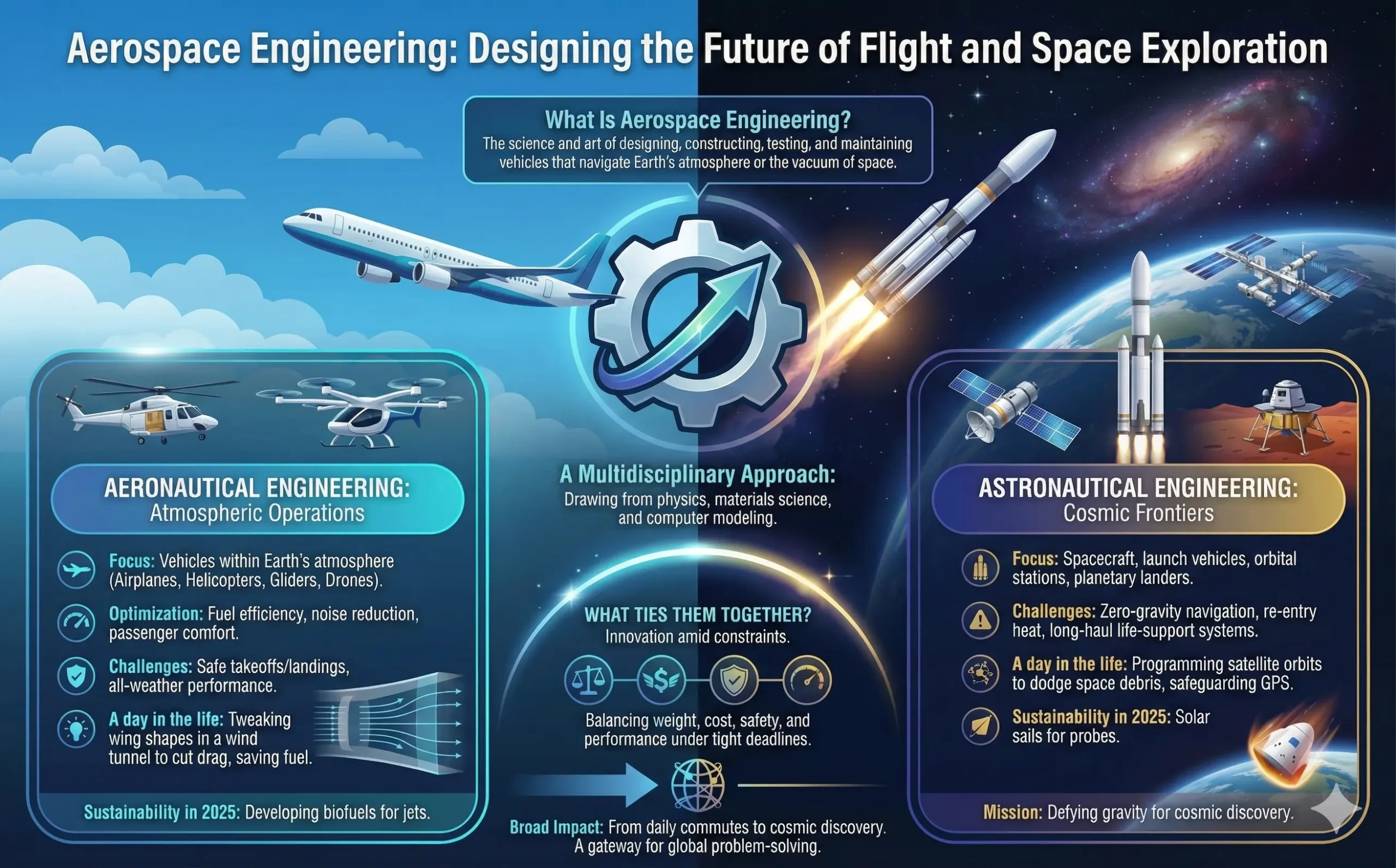
The field naturally divides into two interconnected branches, each with its unique flavor but sharing a passion for defying gravity:
- Aeronautical Engineering: This branch zeroes in on vehicles operating within our planet’s atmosphere—think airplanes, helicopters, gliders, and increasingly, urban air taxis. Engineers here optimize for factors like fuel efficiency, noise reduction, and passenger comfort, ensuring safe takeoffs and landings in all weather.
- Astronautical Engineering: Focused on the cosmos, this side handles spacecraft, launch vehicles, orbital stations, and planetary landers. Challenges include zero-gravity navigation, re-entry heat, and life-support systems for long-haul missions.
What ties them together? A commitment to innovation amid constraints. Every design must balance weight, cost, safety, and performance, often under tight deadlines from governments or private firms. In 2025, with climate pressures mounting, sustainability weaves through both branches—like developing biofuels for jets or solar sails for probes. It’s a field where failure isn’t an option, but learning from near-misses, like the early Space Shuttle tests, builds resilience and breakthroughs.
Consider a day in the life: An aeronautical engineer might tweak wing shapes in a wind tunnel to cut drag by 5%, saving airlines millions in fuel. Meanwhile, an astronautical counterpart could program a satellite’s orbit to dodge space debris, safeguarding global GPS networks. These roles highlight aerospace’s broad impact—from daily commutes to cosmic discovery—making it a gateway for those who love problem-solving on a grand scale.
The History of Aerospace Engineering
The story of aerospace engineering is one of relentless human ambition, from ancient kite experiments to today’s hypersonic prototypes. It didn’t emerge overnight; it unfolded through centuries of trial, error, and triumph, accelerated by wars, rivalries, and sheer wonder.
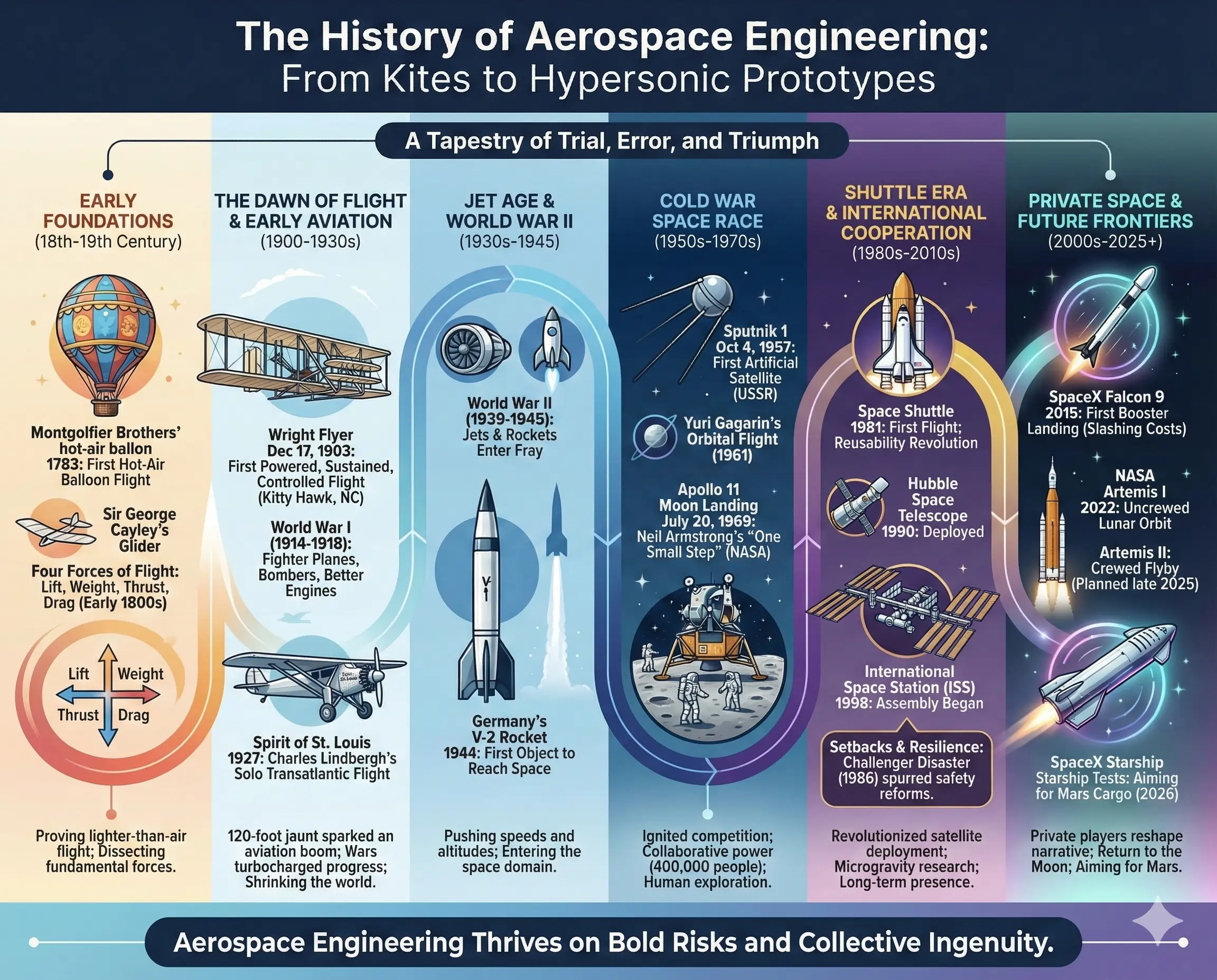
Roots trace back to the 18th and 19th centuries, when visionaries like the Montgolfier brothers launched the first hot-air balloon in 1783, proving lighter-than-air flight was possible. But the modern era was ignited with Sir George Cayley, often called the father of aeronautics, who in the early 1800s dissected the four fundamental forces of flight: lift (upward pull), weight (downward pull), thrust (forward push), and drag (backward resistance). His gliders paved the way for controlled flight.
The true launchpad was December 17, 1903, when Orville and Wilbur Wright piloted the Wright Flyer for 12 seconds over Kitty Hawk, North Carolina—the first powered, sustained, controlled airplane flight. This 120-foot jaunt sparked an aviation boom, turning bicycles into blueprints for global travel.
World War I (1914-1918) turbocharged progress, birthing fighter planes and bombers that demanded better engines and materials. The 1920s and 1930s saw commercial leaps, like Charles Lindbergh’s solo transatlantic flight in 1927 aboard the Spirit of St. Louis, which shrank the world and inspired mass air travel. By World War II (1939-1945), jets and rockets entered the fray, with Germany’s V-2 rocket in 1944 as the first object to reach space.
Post-war, the Cold War Space Race defined the 1950s-1970s. The Soviet Union’s Sputnik 1 launch on October 4, 1957—the first artificial satellite—ignited competition, followed by Yuri Gagarin’s orbital flight in 1961. The U.S. responded with NASA’s Apollo program, culminating in Apollo 11’s Moon landing on July 20, 1969, where Neil Armstrong uttered those immortal words: “That’s one small step for man, one giant leap for mankind.” Over 400,000 people collaborated on Apollo, showcasing engineering’s collaborative power.
The 1980s-2010s brought reusability with the Space Shuttle (first flight 1981), which deployed the Hubble Space Telescope in 1990 and helped assemble the International Space Station (ISS) starting in 1998. The shuttle’s 135 missions revolutionized satellite deployment and microgravity research.
Entering the 21st century, private players like SpaceX reshaped the narrative. Elon Musk’s Falcon 1 reached orbit in 2008, and by 2015, the Falcon 9 had successfully landed its first booster, slashing launch costs. By 2025, milestones include NASA’s Artemis I uncrewed lunar orbit in 2022, which paves the way for Artemis II’s crewed flyby planned for late 2025, and SpaceX’s Starship tests aiming for Mars cargo in 2026.
This timeline isn’t linear—it’s a tapestry of setbacks, like the Challenger disaster in 1986, which spurred safety reforms, and triumphs that remind us: Aerospace engineering thrives on bold risks and collective ingenuity.
| Era | Key Milestone | Impact on the Field |
|---|---|---|
| 1783 | Montgolfier brothers’ hot-air balloon | Demonstrated buoyancy, inspiring lighter-than-air designs |
| 1800s | Sir George Cayley’s glider principles | Established core forces of flight, foundational for all vehicles |
| 1903 | Wright Flyer first powered flight | Birth of controlled aviation, enabling commercial and military use |
| 1914-1918 | World War I aircraft advancements | Scaled production, improved engines for speed and range |
| 1927 | Lindbergh’s transatlantic solo | Proved long-haul feasibility, boosting public and investor confidence |
| 1939-1945 | Jet engines and V-2 rocket | Introduced supersonic flight and ballistic missiles |
| 1957 | Sputnik 1 launch | Sparked Space Race, accelerating satellite and propulsion tech |
| 1961 | Yuri Gagarin’s first human spaceflight | Validated human space endurance, leading to orbital stations |
| 1969 | Apollo 11 Moon landing | Mastered lunar navigation, inspiring deep-space ambitions |
| 1981 | Space Shuttle first flight | Enabled reusable access, fostering ISS and Hubble |
| 1998 | ISS construction begins | Hub for international collaboration and long-term habitation |
| 2008 | Falcon 1 orbital success | Private sector entry, democratizing space access |
| 2015 | Falcon 9 booster landing | Revolutionized reusability, cutting costs by up to 90% |
| 2022 | Artemis I lunar orbit | Revived Moon program with sustainable goals for 2025+ |
| 2025 | Planned Artemis II crewed mission | Steps toward lunar bases and Mars prep |
Core Principles of Aerospace Engineering
Aerospace engineering rests on a quartet of pillars—aerodynamics, propulsion, structures, and materials—each a science unto itself, interdependent like gears in a jet engine. These principles ensure vehicles not only fly but do so reliably, efficiently, and safely. Let’s unpack them, with real-world ties to make the concepts click.
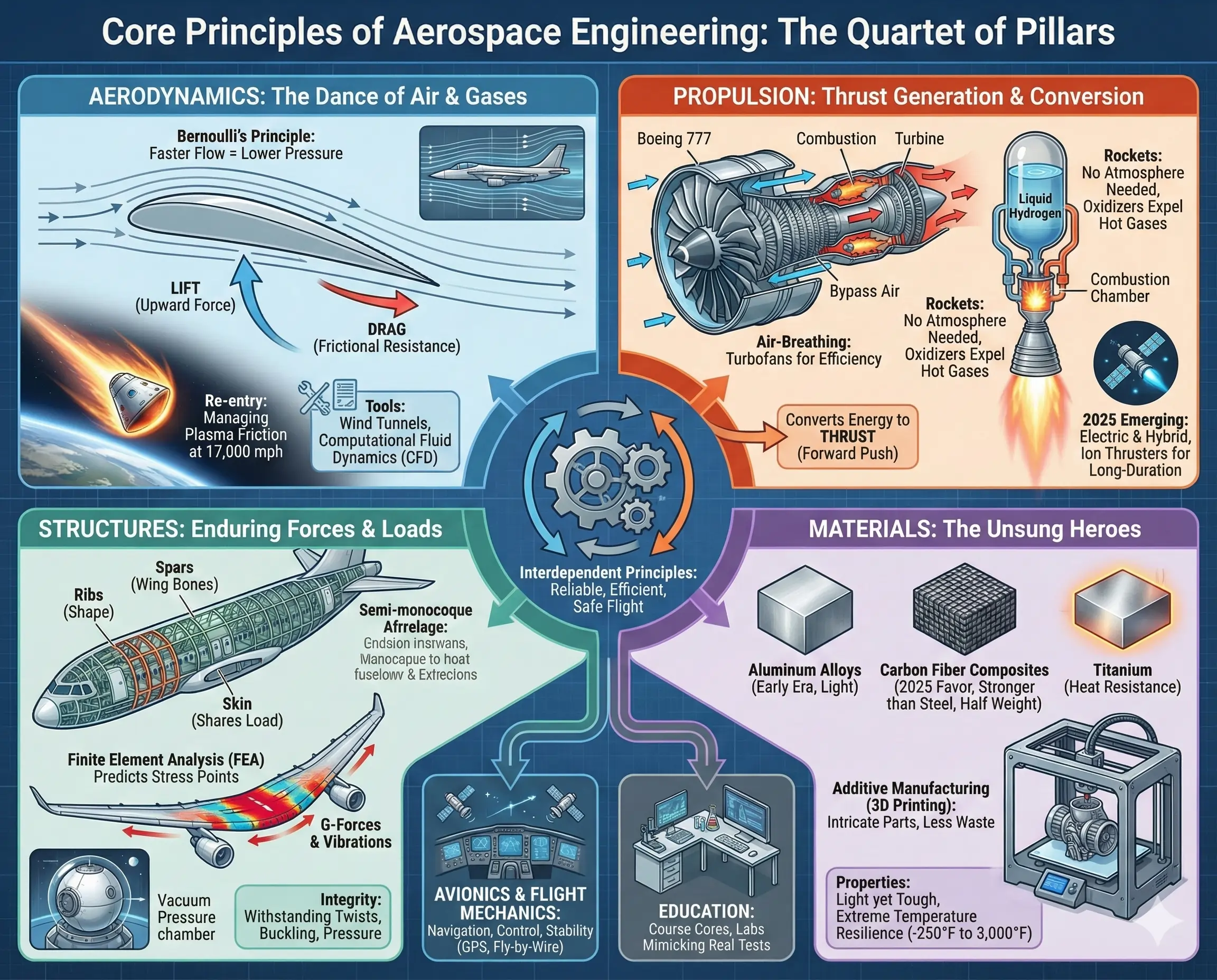
Aerodynamics: This is the dance of air (or gases) around a moving object, dictating how vehicles slice through the sky. The Bernoulli’s principle, which states that faster fluid flow lowers pressure, explains why curved wings generate lift as air rushes more quickly over the top. Engineers combat drag (frictional resistance) with streamlined shapes, like the teardrop fuselage of modern jets. In practice, wind tunnels and computational fluid dynamics (CFD) software simulate flows at Mach speeds. For spacecraft, aerodynamics flips during re-entry, where heat shields manage plasma friction at 17,000 mph.
Propulsion: No flight without forward oomph. This principle covers systems converting energy into thrust, from propellers sucking air backward to rockets expelling hot gases at escape velocity. Air-breathing engines, like turbofans on the Boeing 777, mix bypass air for efficiency at subsonic speeds. Rockets, needing no atmosphere, carry oxidizers—liquid hydrogen-oxygen combos in the Space Launch System (SLS) produce millions of pounds of thrust. By 2025, electric and hybrid systems emerge, like ion thrusters for satellites, sipping power for months-long boosts.
Structures: Vehicles must endure twists, vibrations, and G-forces without buckling. This involves frameworks like spars (wing bones) and ribs (shaping supports) in a semi-monocoque design, where the skin shares load. Finite element analysis (FEA) predicts stress points, ensuring a 747’s wings flex 20 feet mid-flight without snapping. Spacecraft add pressure vessels for cabin integrity, tested in vacuum chambers.
Materials: The unsung heroes—light yet tough substances that shrug off -250°F cryogenic fuels or 3,000°F re-entry blaze. Aluminum alloys dominated early eras, but 2025 favors carbon fiber composites (stronger than steel, half the weight) and titanium for heat resistance. Additive manufacturing (3D printing) crafts intricate parts, like Airbus’s 25,000+ flight-ready components, reducing waste and enabling custom geometries.
These principles interplay: A drone’s propeller (propulsion) spins in turbulent air (aerodynamics), supported by a carbon frame (structures and materials). Mastery here turns theory into flight.
| Principle | Key Concepts | Aircraft Application | Spacecraft Application | 2025 Innovation |
|---|---|---|---|---|
| Aerodynamics | Lift, drag, Bernoulli’s principle, CFD | Winglets on A350 for 4% fuel savings | Re-entry heat management on the Orion capsule | AI-optimized shapes for eVTOLs, reducing noise by 50% |
| Propulsion | Thrust, turbofans, ion drives | GE9X engine on 777X, 10% more efficient | Raptor engines on Starship, full reusability | Hydrogen-electric hybrids for zero-emission regional flights |
| Structures | Spars, monocoque, FEA | Fuselage withstands 2.5G maneuvers | Habitable modules on ISS expansions | 3D-printed lattices for lighter, stronger satellite booms |
| Materials | Composites, alloys, add-manufacturing | 50% composites in Boeing 787 | Ablative shields on SLS | Bio-inspired metamaterials for self-healing surfaces |
Expanding further, avionics—electronics for navigation and control—integrates with these, using GPS and fly-by-wire systems for precision. Flight mechanics adds stability math, ensuring a helicopter hovers steadily. In education, these form course cores, with labs mimicking real tests.
Legendary Vehicles and Projects
Aerospace shines brightest in its creations—tangible proofs of engineering prowess. From vintage warbirds to 2025’s electric wonders, these icons blend heritage with foresight.
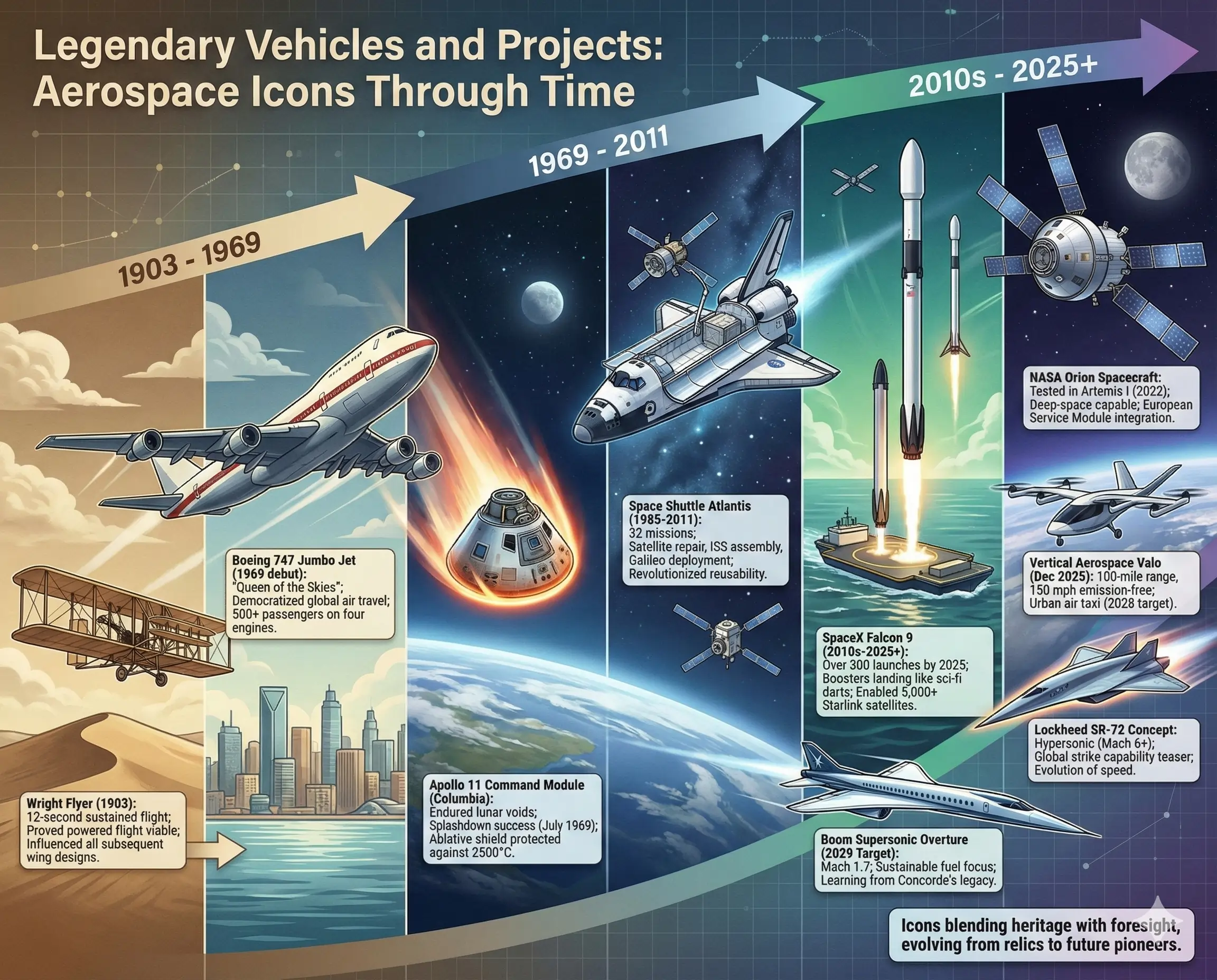
The Wright Flyer (1903) was rudimentary—a 190-pound biplane of spruce and fabric—but it proved powered flight viable, influencing every wing since. Fast-forward to the Boeing 747 Jumbo Jet (1969 debut), which democratized air travel, carrying 500+ passengers across oceans on four engines.
In space, the Apollo 11 Command Module (Columbia) endured lunar voids, its ablative shield glowing during splashdown. The Space Shuttle Atlantis (1985-2011) flew 32 missions, deploying probes like Galileo to Jupiter.
Modern marvels include SpaceX’s Falcon 9, with over 300 launches by 2025, its boosters landing like sci-fi darts to enable Starlink’s 5,000+ satellites. NASA’s Orion spacecraft, tested in Artemis I (2022), features a European service module for deep-space jaunts.
2025 spotlights eVTOLs: Vertical Aerospace’s Valo, unveiled December 2025, zips 100 miles at 150 mph emission-free, eyeing urban routes by 2028. Joby’s air taxi, FAA-certified, promises 200 mph hops. Hypersonics like Lockheed’s SR-72 concept tease Mach 6 global strikes.
These aren’t relics; they’re evolutions. The Concorde (1976-2003) broke sound barriers but retired on noise—lessons fueling Boom Supersonic’s Overture, targeting 2029 service at Mach 1.7.
| Vehicle/Project | Debut Year | Key Features | Legacy/2025 Status |
|---|---|---|---|
| Wright Flyer | 1903 | Powered biplane, 12-sec flight | Inspired aviation; museums preserve replicas |
| Boeing 747 | 1969 | Quad-engine widebody, 400+ pax | Queen of the Skies; freighters active in 2025 |
| Apollo 11 Columbia | 1969 | Lunar module interface, heat shield | Moon landing icon; Artemis draws from its design |
| Space Shuttle Atlantis | 1985 | Reusable orbiter, 17-ton payload | 32 missions; retired, but tech in Starship |
| Falcon 9 | 2010 | Reusable booster, 22-ton LEO | 300+ launches; Starlink backbone in 2025 |
| Orion Spacecraft | 2014 | Deep-space crew vehicle, abort system | Artemis II prep for 2025 crewed lunar flyby |
| Valo eVTOL | 2025 | Electric, 150 mph, zero emissions | Urban mobility pioneer; certification underway |
| Starship | 2023 tests | Full reusability, Mars-capable | 2025 orbital refueling demos planned |
Each tells a story: Innovation amid adversity, like the ISS’s 25-year endurance despite leaks, fostering breakthroughs in closed-loop life support.
Careers in Aerospace Engineering
Dreaming of a cubicle with a view of the launch pad? Aerospace careers blend intellectual thrill with tangible impact, from sketching concepts to overseeing assembly lines. Demand surges in 2025, with 6% job growth projected through 2032, driven by space commercialization and green aviation.
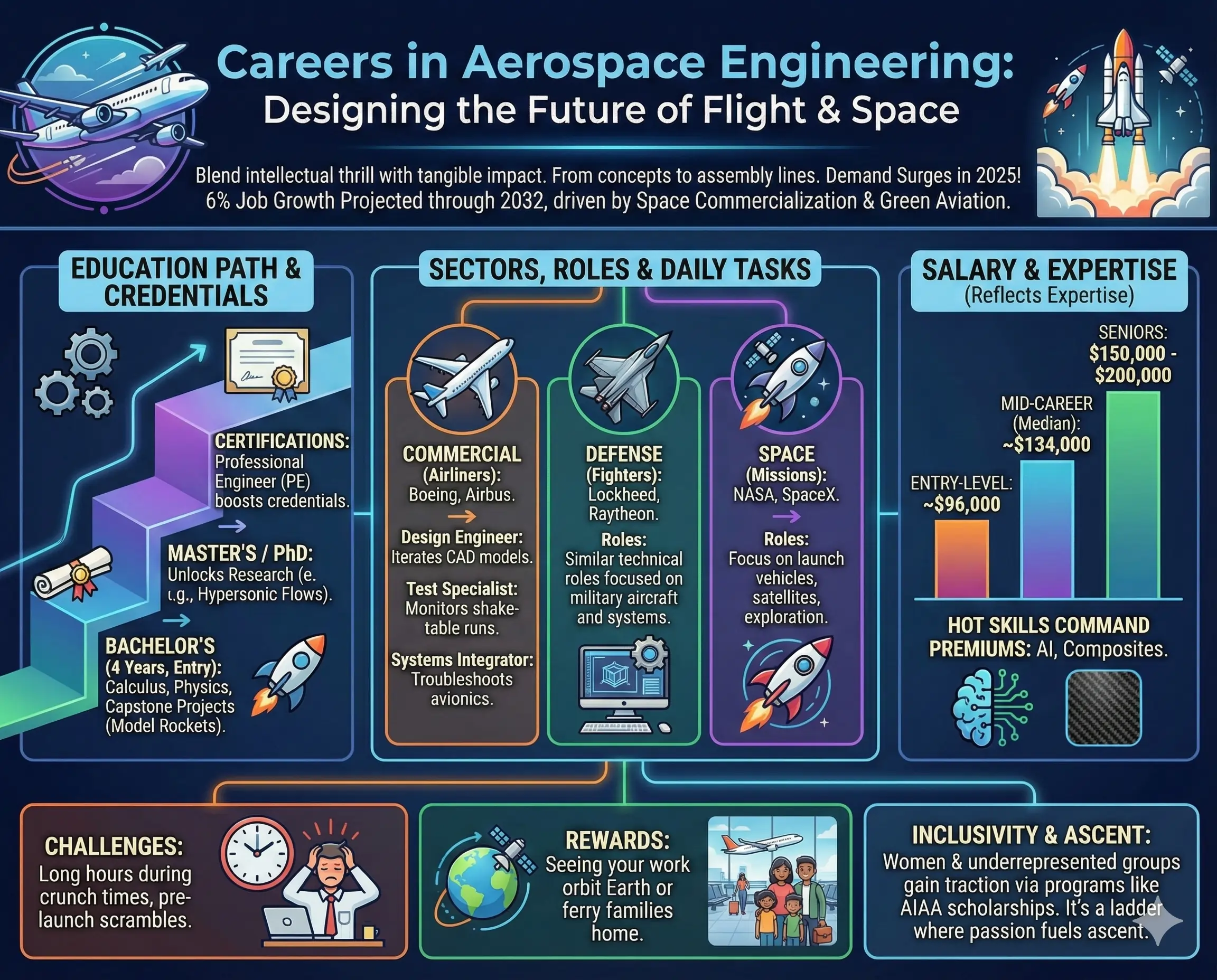
Entry typically requires a bachelor’s in aerospace or mechanical engineering—four years of calculus, physics, and capstone projects building model rockets. Master’s or PhDs unlock research, like optimizing hypersonic flows. Certifications, such as Professional Engineer (PE), boost credentials.
Roles span sectors: Commercial (Boeing, Airbus) for airliners; defense (Lockheed, Raytheon) for fighters; space (NASA, SpaceX) for missions. Daily tasks? A design engineer iterates CAD models; a test specialist monitors shake-table runs; a systems integrator troubleshoots avionics.
Salaries reflect expertise: Entry-level around $96,000, mid-career $134,000 median, seniors $150,000-$200,000. Hot skills—AI, composites—command premiums. Women and underrepresented groups gain traction via programs like AIAA scholarships.
Challenges? Long hours during crunch times, like pre-launch scrambles. Rewards? Seeing your work orbit Earth or ferry families home. It’s a ladder where passion fuels ascent.
| Education Level | Common Roles | Median Salary (2025 USD) | Growth Factors |
|---|---|---|---|
| Bachelor’s | Junior design/test engineer | $96,000 – $120,000 | Hands-on projects, internships key |
| Master’s | Avionics/systems specialist | $130,000 – $160,000 | Specialization in propulsion or AI |
| PhD | Research lead, professor | $150,000 – $200,000+ | Publications, grants for innovation |
| Certifications (e.g., PE) | Project manager | +10-20% premium | Leadership in safety-critical teams |
Diversity initiatives, like NASA’s Artemis push for inclusive crews, enrich the field, ensuring fresh perspectives.
The Future of Aerospace Engineering
As 2025 closes, aerospace hurtles toward a greener, more accessible era. Sustainability tops agendas: Aviation, 2-3% of global CO2, eyes sustainable aviation fuels (SAF) and electric propulsion. Beyond Aero’s hydrogen-electric factory in Toulouse prototypes business jets with 1,000-mile ranges, zero emissions.
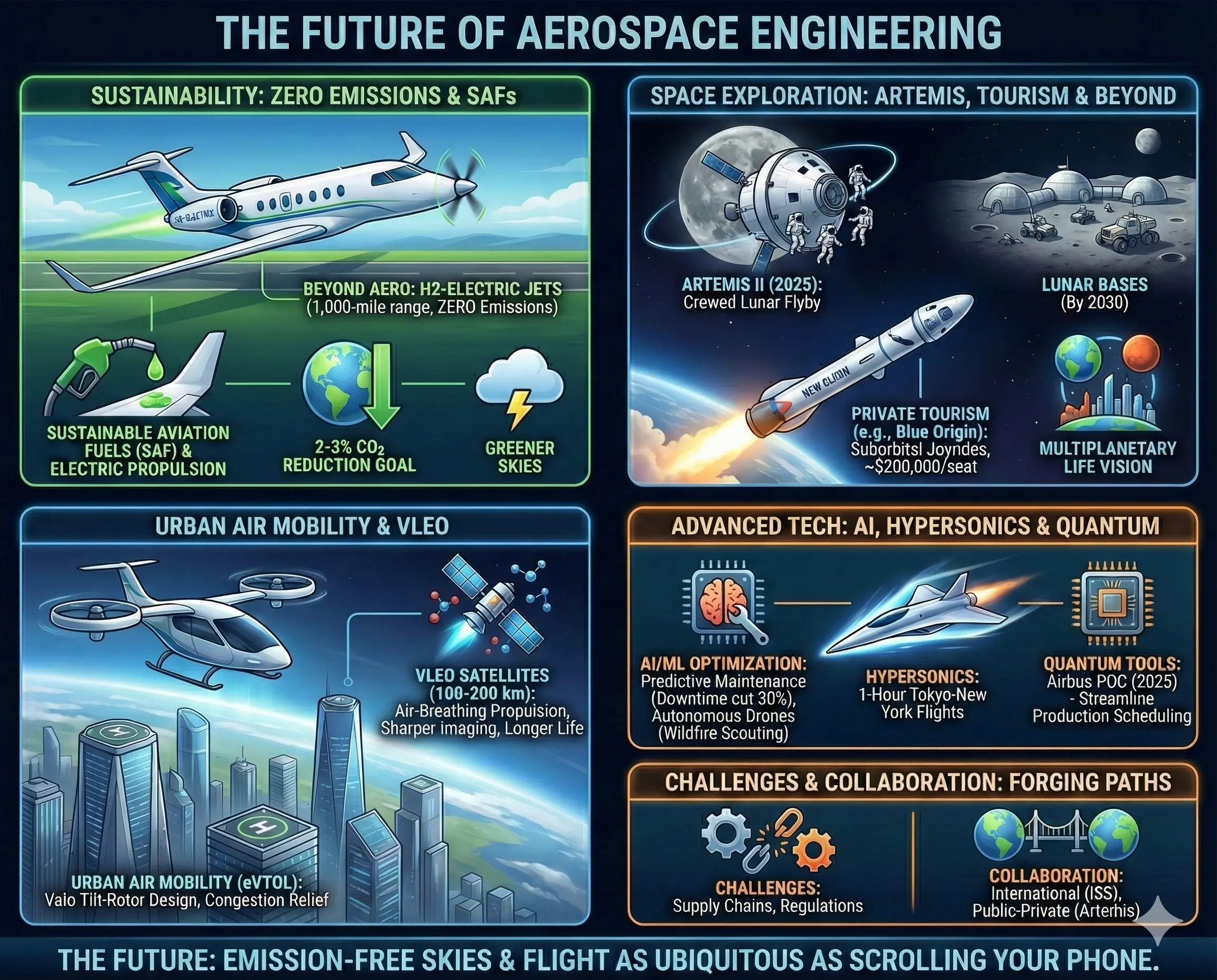
Space exploration reignites with Artemis II’s 2025 crewed lunar loop, targeting bases by 2030. Private ventures like Blue Origin’s New Glenn enable tourism, with suborbital joyrides at $200,000 a pop.
Urban air mobility explodes via eVTOLs—Valo’s tilt-rotor design eases city congestion. VLEO satellites, hugging 100-200 km altitudes, leverage air-breathing propulsion for sharper imaging and longer life.
AI/ML optimizes everything: Predictive maintenance cuts downtime 30%; autonomous drones scout wildfires. Hypersonics promise hour-long Tokyo-New York flights. Quantum tools, like Airbus’s 2025 POC, streamline production scheduling.
Challenges loom—supply chains, regulations—but collaboration, from international ISS to public-private Artemis, forges paths. The future? Multiplanetary life, emission-free skies, and flight as ubiquitous as scrolling your phone.
| Trend | Description | Projected Impact by 2030 | Key Players/Examples |
|---|---|---|---|
| Sustainable Aviation | SAF, hydrogen/electric engines | 10% emission cut | Beyond Aero factory, Airbus ZEROe concepts |
| Reusable Space Systems | Booster landings, orbital refueling | Launch costs to $100/kg | SpaceX Starship, Blue Origin New Glenn |
| Urban Air Mobility (UAM) | eVTOL networks for cities | 1M annual flights | Vertical Valo, Joby Aviation certifications |
| AI and Autonomy | Self-flying vehicles, predictive analytics | 20% efficiency gains | Lockheed AI drones, NASA autonomous ops |
| VLEO Satellites | Low-orbit constellations | Enhanced Earth observation | Breakthroughs in electric propulsion materials |
| Hypersonic Travel | Mach 5+ global links | 90-min transatlantics | Boom Overture, DARPA projects |
| Quantum Optimization | Faster design simulations | 50% production speedup | Airbus-4colors POC for assembly lines |
| Deep Space Habitation | Lunar/Mars outposts | Sustainable human presence | Artemis bases, Starship Mars cargo |
These threads weave a tapestry of possibility, where aerospace engineering doesn’t just transport us—it redefines what home means.
In wrapping up, aerospace engineering captivates because it mirrors our spirit: Curious, resilient, boundless. From Cayley’s sketches to Valo’s hum, it’s a testament to what happens when we look up and build toward it. Whether you’re inspired to study, innovate, or stargaze with new appreciation, remember: The next giant leap starts with one small step into understanding.
Key Citations And References
- NASA Glenn Research Center: Beginners Guide to Aeronautics
- AIAA Aerospace History Timeline
- EveryEngineer: Basics of Aerospace Engineering
- U.S. Bureau of Labor Statistics: Aerospace Engineers Outlook
- Sourcing International: Top Trends Shaping Aerospace 2025
- Satellite Today: VLEO Frontier December 2025
- Fuel Cells Works: Hydrogen-Electric Aviation 2025
- Vertical Aerospace: Valo eVTOL Unveil
- Lockheed Martin: Space Technology Trends 2025
- Deloitte: 2026 Aerospace Outlook
- StartUs Insights: Top 10 Aerospace Trends 2026
- Saxonaerospace: Top 10 Exciting Projects 2025
- RC Engineering: Aerospace Careers 2025
- PayScale: Aerospace Engineer Salary 2025
- Glassdoor: Aerospace Salaries 2025
- Britannica: Aerospace Industry History
- ThomasNet: Aeronautical Engineering Principles
- UND: What is Aerospace Engineering
- Plunkett Research: 8 Major Aerospace Trends 2025
- KPMG: Emerging Trends in Aerospace 2025
Read These Articles in Detail
- Aerospace Engineering vs. Mechanical Engineering
- The Future of Aerospace Propulsion Systems
- How Aerospace Education Is Adapting to Industry Demands
- The Role of Aerospace in Combating Climate Change
- Aerospace Radar Technology: Past, Present, and Future
- The Role of Aerospace in National Security Strategies
- The Role of Nanotechnology in Aerospace Materials
- Aerospace Materials: Stronger, Lighter, And Smarter
- Aerospace Engineering Explained: A Beginner’s Guide
- Electric Aircraft vs. Hydrogen Aircraft: Which Is More Sustainable?
- Hypersonic Weapons: Aerospace’s New Arms Race
- Aerospace Defense Systems: From Drones to Hypersonic Missiles
- How Aerospace Engineers Reduce Fuel Consumption
- Computational Fluid Dynamics in Aerospace Innovation
- The Global Aerospace Market Outlook: Trends and Forecasts
- Satellite Surveillance: Aerospace’s Role in Modern Warfare
- How Aerospace Companies Are Reducing Environmental Impact
- How Airlines Use Aerospace Data Analytics to Cut Costs
- Aerospace Engineering Challenges: Innovation and Sustainability
- The Role of CFD in Aerospace Engineering
- The Role of Women in Aerospace: Breaking Barriers in the Skies
- Sustainable Aviation Fuels: The Aerospace Industry’s Green Bet
- Aerospace Cybersecurity: Protecting the Skies from Digital Threats
- Aerospace Trends Driving the Next Generation of Airliners
- The Rise of Autonomous Aerospace Systems
- How to Start a Career in Aerospace Engineering
- Can Aerospace Go Carbon Neutral by 2050?
- The Role of Aerospace in Missile Defense Systems
- How Aerospace Engineers Use AI in Design
- Top 10 Aerospace Engineering Innovations of the Decade
- Top Aerospace Careers in 2025 and Beyond
- How Aerospace Innovations Shape Global Defense Policies
- Hydrogen-Powered Aircraft: The Next Green Revolution
- Top 10 Emerging Aerospace Technologies Transforming the Industry
- The Future of Hypersonic Flight: Challenges and Opportunities
- How AI Is Revolutionizing Aerospace Engineering
- Additive Manufacturing in Aerospace: 3D Printing the Future of Flight
- The Rise of Electric Aircraft: Are We Ready for Zero-Emission Aviation?
- Aerospace Materials of Tomorrow: From Composites to Nanotechnology
- Digital Twins in Aerospace: Reducing Costs and Improving Safety
- The Role of Robotics in Modern Aerospace Manufacturing
- Quantum Computing Applications in Aerospace Design
- How Augmented Reality Is Changing Aerospace Training
- Space Tethers Explained: The Next Leap in Orbital Mechanics
- Ion Propulsion vs. Chemical Rockets: Which Will Power the Future?
- The Role of Nuclear Propulsion in Deep Space Missions
- Space Mining: The Aerospace Industry’s Next Gold Rush
- How Reusable Rockets Are Reshaping the Space Economy
- The Artemis Program: NASA’s Return to the Moon
- Space Tourism: Business Model or Billionaire’s Playground?
- How Aerospace Startups Are Disrupting Commercial Aviation
- The Economics of Low-Cost Airlines in the Aerospace Era
- Urban Air Mobility: The Rise of Flying Taxis
- The Future of Mars Colonization: Key Aerospace Challenges and Solutions Ahead
- CubeSats and Small Satellites: Democratizing Space Access
- The Future of Cargo Drones in Global Logistics
- The Role of Aerospace in Building a Lunar Economy
Frequently Asked Questions
FAQ 1: What Is the Difference Between Aeronautical and Astronautical Engineering?
Aeronautical engineering and astronautical engineering are two essential branches under the broader umbrella of aerospace engineering, each focusing on distinct yet interconnected aspects of flight and exploration. Aeronautical engineering centers on the design, development, and operation of vehicles that stay within Earth’s atmosphere, such as airplanes, helicopters, and drones. These engineers tackle challenges like optimizing wing shapes for better fuel efficiency or ensuring aircraft can handle turbulent weather conditions safely. On the other hand, astronautical engineering deals with spacecraft and systems that venture beyond the atmosphere, including rockets, satellites, and space probes. Here, the emphasis is on overcoming vacuum environments, extreme temperatures, and precise orbital trajectories to enable missions to the Moon or Mars.
While the two fields overlap in areas like materials science and control systems, their environmental demands set them apart significantly. Aeronautical projects often prioritize speed and passenger comfort within gravity’s pull, whereas astronautical ones focus on long-duration survival in microgravity. For instance, aeronautical engineers might refine a commercial jet’s landing gear for rough runways, while their astronautical counterparts design heat shields to withstand fiery re-entries. This distinction allows for specialized expertise but encourages collaboration on hybrid technologies like hypersonic vehicles that blur the lines between air and space travel.
To illustrate these differences more clearly, here’s a comparison table highlighting key aspects:
| Aspect | Aeronautical Engineering | Astronautical Engineering |
|---|---|---|
| Environment | Within Earth’s atmosphere (up to 100 km altitude) | Beyond Earth’s atmosphere (space vacuum) |
| Primary Vehicles | Airplanes, drones, gliders | Rockets, satellites, space capsules |
| Key Challenges | Drag reduction, lift generation, weather resistance | Radiation protection, propulsion in zero gravity |
| Common Tools | Wind tunnels, flight simulators | Vacuum chambers, orbital modeling software |
| Career Flexibility | Broader job market in aviation and defense | Specialized roles in space agencies and startups |
Understanding these branches can help aspiring engineers choose a path that aligns with their interests, whether it’s the thrill of soaring through clouds or charting courses among the stars.
FAQ 2: What Are the Key Historical Milestones in Aerospace Engineering?
The history of aerospace engineering is a captivating journey of human ingenuity, marked by breakthroughs that transformed impossible dreams into everyday realities. It all began in the late 19th century with early experiments in flight, but the field truly took off in 1903 when the Wright brothers achieved the first powered, controlled airplane flight at Kitty Hawk, covering just 120 feet but proving the feasibility of sustained aerial travel. This moment sparked a wave of innovation, leading to rapid advancements during World War I, where aircraft evolved from fragile biplanes to reconnaissance tools that reshaped warfare tactics.
By the 1920s and 1930s, transatlantic crossings and commercial aviation emerged, with Charles Lindbergh’s solo Spirit of St. Louis flight in 1927 capturing global imagination and highlighting the need for reliable long-distance designs. The mid-20th century brought the jet age and space race, ignited by the Soviet Union’s launch of Sputnik 1 in 1957, the first artificial satellite, which prompted massive U.S. investments in rocketry. This culminated in the Apollo 11 moon landing in 1969, a monumental achievement involving over 400,000 engineers who solved complex problems in propulsion and life support systems to place humans on another world.
The late 20th and early 21st centuries saw reusability and privatization take center stage. The Space Shuttle program, debuting in 1981, revolutionized access to orbit with its 135 missions, while private ventures like SpaceX’s first Falcon 1 orbital flight in 2008 slashed costs through reusable boosters. More recently, in 2021, NASA’s Ingenuity helicopter became the first powered flight on Mars, demonstrating aerial scouting in thin atmospheres and opening doors to planetary exploration.
These milestones not only advanced technology but also inspired ethical considerations, such as international space treaties post-Apollo. Today, they underscore aerospace’s role in connecting our world, from GPS satellites to climate-monitoring drones, reminding us that each step builds on the last toward bolder horizons.
For a quick visual timeline of these pivotal events:
| Year | Milestone | Significance |
|---|---|---|
| 1903 | Wright Brothers’ first flight | Birth of powered aviation |
| 1927 | Lindbergh’s transatlantic flight | Dawn of commercial air travel |
| 1957 | Sputnik 1 launch | Start of the space age |
| 1969 | Apollo 11 moon landing | First human steps on the Moon |
| 1981 | Space Shuttle debut | Era of reusable spacecraft |
| 2008 | Falcon 1 orbital success | Rise of private spaceflight |
| 2021 | Ingenuity’s Mars flight | Extraterrestrial aviation pioneer |
FAQ 3: What Are the Core Principles of Aerodynamics in Aerospace Engineering?
Aerodynamics forms the backbone of aerospace engineering, governing how air interacts with vehicles to enable efficient, safe flight. At its core, this discipline revolves around four fundamental forces: lift, which keeps aircraft aloft by creating pressure differences over wings; drag, the resistance that slows motion and must be minimized through sleek designs; thrust, the forward push from engines countering drag; and weight, the downward pull of gravity that structures must overcome. These forces balance in steady flight, but engineers manipulate them for maneuvers like climbs or turns, using principles like Bernoulli’s theorem to explain how faster airflow over a curved wing generates lift.
Delving deeper, aerodynamics also encompasses concepts like boundary layers, the thin film of air near a surface where friction slows flow, and shock waves that form at supersonic speeds, compressing air and increasing drag. In practice, these principles guide everything from airfoil shapes—curved structures mimicking bird wings—to vortex generators, small fins that disrupt disruptive air swirls at wingtips. For example, modern jets like the Boeing 787 incorporate computational fluid dynamics (CFD) simulations to predict airflow, reducing fuel use by up to 20% compared to older models.
- Lift Generation: Achieved via cambered airfoils; angle of attack must be optimized to avoid stalls where flow separates.
- Drag Management: Parasitic drag from skin friction and induced drag from lift creation; streamlined fuselages and winglets help.
- Compressibility Effects: At high speeds, air behaves like a fluid, leading to Mach waves; critical for supersonic designs.
- Stability and Control: Yaw, pitch, and roll are influenced by tail surfaces and control surfaces like ailerons.
These principles aren’t abstract—they save lives and resources, evolving with tools like wind tunnels to test real-world scenarios. As climate concerns grow, aerodynamics now prioritizes laminar flow for greener flights, ensuring aerospace remains both innovative and sustainable.
FAQ 4: What Careers Are Available in Aerospace Engineering, and What Is the Salary Outlook?
Aerospace engineering offers a diverse array of careers, blending creativity with technical precision across aviation, defense, and space sectors. From designing next-generation fighters to plotting satellite orbits, professionals find roles that match their passions while contributing to global connectivity and exploration. The field is projected to grow steadily, with about 6% job increase through 2031, driven by demand for sustainable aircraft and space tourism. Salaries are competitive, reflecting the specialized skills required; the median annual wage hovers around $126,880, with top earners exceeding $180,000 in leadership positions at major firms.
Here’s an overview of prominent career paths, including typical responsibilities, required qualifications, and salary ranges based on recent data:
| Career Title | Key Responsibilities | Education/Experience Needed | Median Salary Range (USD) |
|---|---|---|---|
| Aerospace Design Engineer | Develop aircraft components using CAD software | Bachelor’s in Aerospace Eng. | $90,000 – $130,000 |
| Propulsion Specialist | Test and optimize engines for efficiency | Bachelor’s + Thermodynamics | $100,000 – $140,000 |
| Systems Integrator | Coordinate avionics and structures for seamless operation | Bachelor’s in Systems Eng. | $110,000 – $150,000 |
| Flight Test Engineer | Conduct in-flight validations and data analysis | Bachelor’s + Certifications | $95,000 – $135,000 |
| Space Mission Analyst | Plan trajectories and simulate orbital mechanics | Master’s in Astronautics | $120,000 – $160,000 |
| Avionics Technician | Maintain electronic navigation systems | Associate’s + On-the-Job | $70,000 – $100,000 |
Entry-level positions often start with internships, building toward senior roles that involve project management. With the rise of electric propulsion and AI integration, opportunities in emerging areas like urban air mobility are expanding, offering not just financial rewards but the satisfaction of shaping humanity’s reach into the skies.
FAQ 5: How Do I Become an Aerospace Engineer? What Education Is Required?
Becoming an aerospace engineer is an exciting path that rewards curiosity and persistence, starting with a solid educational foundation and hands-on experience. Most professionals begin in high school, focusing on strong performance in math, physics, and computer science to build the analytical skills needed for complex simulations. A bachelor’s degree in aerospace engineering or a related field like mechanical engineering is the standard entry point, typically taking four years and covering essentials like fluid dynamics, structures, and propulsion through lectures, labs, and capstone projects where students design model aircraft.
After graduation, many pursue internships at companies or agencies to gain practical exposure, such as testing prototypes in wind tunnels. For advanced roles, a master’s degree—one to two years—allows specialization in areas like astronautics, while a PhD suits research-focused careers in hypersonics or space systems. Licensing, like the Fundamentals of Engineering exam, can boost credentials, especially for consulting work. Beyond academics, joining clubs like rocketry teams or certifications in software like MATLAB hones skills employers value.
The journey doesn’t end at certification; continuous learning through professional societies keeps engineers current with trends like sustainable fuels. With dedication, this path opens doors to innovative work, from satellite deployment to drone fleets, turning theoretical knowledge into tangible flights of fancy.
Key steps to get started:
- High School Prep: Excel in STEM courses; participate in science fairs.
- Undergraduate Studies: Enroll in an accredited program with co-op opportunities.
- Gain Experience: Secure internships or co-ops during summers.
- Advanced Education: Pursue grad school for specialization.
- Professional Development: Earn certifications and network at conferences.
FAQ 6: What Are Some Famous Aerospace Engineering Projects That Shaped the Industry?
Famous aerospace engineering projects stand as testaments to collaborative genius, pushing technological boundaries and inspiring generations. One iconic example is the Apollo program (1961-1972), NASA’s ambitious effort to land humans on the Moon. Engineers overcame immense hurdles, from developing the massive Saturn V rocket—standing 363 feet tall with enough thrust to launch 140 tons—to creating the lunar module that enabled Neil Armstrong’s historic steps in 1969. This project not only achieved the impossible but also birthed spin-offs like advanced computers and fire-resistant fabrics that permeate daily life.
Shifting to reusability, SpaceX’s Falcon 9 rocket, which first successfully landed its booster in 2015, revolutionized space access by cutting launch costs by up to 30%. Its grid fins and autonomous droneships for recovery exemplify precise engineering in real-time control systems, enabling frequent missions for satellites and crewed flights. Similarly, the James Webb Space Telescope, launched in 2021, represents optical mastery: its 18-segment gold-coated mirror unfolds in space to peer 13 billion years back, thanks to vibration-dampening structures and cryogenic cooling that maintain -223°C temperatures.
In aviation, the Concorde supersonic jet (1976-2003) broke speed barriers at Mach 2, ferrying passengers across the Atlantic in under four hours, though noise regulations grounded it. More recently, NASA’s Artemis program, targeting a 2026 lunar return, integrates sustainable tech like the SLS rocket for diverse crews, addressing past oversights in inclusivity. These projects highlight aerospace’s blend of risk and reward, from moon dust to orbital selfies, fueling ongoing quests like Mars habitats.
Each endeavor teaches resilience—think of the Challenger’s lessons refining safety protocols—proving that great projects evolve through iteration and global teamwork.
FAQ 7: What Are the Future Trends in Aerospace Engineering for 2025 and Beyond?
Looking ahead, aerospace engineering in 2025 and beyond promises transformative shifts toward sustainability, autonomy, and efficiency, addressing climate imperatives while expanding human frontiers. A major trend is the rise of electric and hybrid propulsion, with batteries enabling quieter, emission-free short-haul flights; companies are testing eVTOL air taxis for urban commutes, potentially reducing traffic congestion by 20% in dense cities. Alongside this, advanced materials like self-healing composites and metamaterials will lighten structures, boosting fuel savings and enabling hypersonic travel at Mach 5+ for rapid global connectivity.
AI integration is another game-changer, optimizing flight paths in real-time to dodge weather and predict maintenance, while digital twins—virtual replicas—accelerate design cycles by 30%. In space, in-situ resource utilization, mining asteroids for fuel, supports deep-space missions, aligning with net-zero goals through hydrogen tech.
- Sustainable Aviation: Biofuels and hydrogen engines targeting 50% CO2 cuts by 2050.
- Autonomous Systems: Drone swarms for cargo and surveillance, minimizing human error.
- Space Commercialization: Reusable rockets and orbital habitats for tourism and manufacturing.
- Cybersecurity Enhancements: Protecting avionics from digital threats in connected fleets.
These trends, fueled by collaborations, could make space routine by 2040, but challenges like regulatory hurdles and supply chain ethics demand thoughtful navigation.
| Trend | Expected Impact by 2030 | Key Challenges |
|---|---|---|
| Electric Propulsion | 40% of regional flights electric | Battery energy density |
| AI-Driven Autonomy | 25% reduction in accidents | Ethical decision-making |
| Hypersonic Vehicles | 3-hour intercontinental trips | Thermal management |
FAQ 8: What Materials Are Commonly Used in Aerospace Structures?
In aerospace structures, material selection is a delicate balance of strength, weight, and resilience to extreme conditions, ensuring vehicles withstand launches, flights, and re-entries without failure. Aluminum alloys remain a staple for their lightweight corrosion resistance and cost-effectiveness, forming the fuselages of many commercial jets where they provide structural integrity at altitudes up to 40,000 feet. Titanium alloys, prized for their high strength-to-weight ratio and heat tolerance up to 1,600°C, are essential in engine components and supersonic frames, enduring the intense stresses of high-speed travel.
Composites, blending fibers like carbon or glass with resins, have surged in use, comprising over 50% of modern aircraft by weight for their fatigue resistance and design flexibility—think the Boeing 787’s wings that flex without cracking. Emerging options include magnesium alloys for vibration damping in satellites and advanced ceramics for thermal barriers in rocket nozzles, protecting against molten-hot exhausts.
These choices evolve with needs: early wood-and-fabric planes gave way to metals in the 1930s, then composites in the 1980s for efficiency gains. Today, sustainability drives recycled variants, reducing environmental footprints while maintaining performance.
- Aluminum Alloys: Affordable, weldable; used in 70% of airframes.
- Titanium: Heat-resistant; ideal for fasteners and landing gear.
- Carbon Fiber Composites: Ultra-light; enhances fuel economy.
- Ceramics and Aerogels: Insulate against extremes in space probes.
FAQ 9: What Are the Main Types of Propulsion Systems in Aerospace?
Propulsion systems are the hearts of aerospace vehicles, converting energy into motion tailored to atmospheric or space demands. Chemical rockets dominate launches with their high thrust from fuel combustion, while air-breathing jets power atmospheric flight by ingesting oxygen for efficiency.
| Type | Description | Applications | Advantages/Disadvantages |
|---|---|---|---|
| Turbofan Engine | Bypasses air around the core for quiet thrust | Commercial airliners | Fuel-efficient; noisier at takeoff |
| Ramjet/Scramjet | Uses vehicle speed to compress air | Hypersonic missiles, experimental jets | High-speed capable; no low-speed use |
| Solid Rocket Booster | Burns pre-packed fuel for instant power | Space launch vehicles | Simple, reliable; non-throttleable |
| Liquid Bipropellant | Mixes fuel and oxidizer for controlled burns | Orbital insertion rockets | Adjustable thrust; complex plumbing |
| Ion Thruster | Electrically accelerates ions for a steady push | Satellites, deep-space probes | Highly efficient; low acceleration |
| Electric/Hybrid | Batteries or fuel cells for an eco-friendly drive | eVTOL drones, short-haul planes | Zero emissions; limited range |
From turboprops on regional planes to plasma drives eyeing Mars, these systems evolve toward greener, smarter options like hydrogen hybrids.
FAQ 10: What Is the Role of Avionics in Aerospace Engineering?
Avionics, the fusion of aviation and electronics, serves as the nervous system of aerospace vehicles, integrating sensors, computers, and displays to ensure precise navigation, communication, and control. In aircraft, avionics manage everything from autopilot systems that stabilize flights amid turbulence to radar for collision avoidance, allowing pilots to focus on decision-making rather than manual adjustments. For spacecraft, it extends to star trackers that orient probes using distant constellations and telemetry that beams data back to Earth, vital for missions like Voyager’s 47-year journey.
This field’s evolution from analog dials to digital fly-by-wire has slashed weights by 20% and boosted reliability, with redundant systems preventing single failures. Modern avionics incorporate AI for predictive analytics, forecasting engine issues before they arise, and cybersecurity protocols to guard against hacks in an era of connected fleets. Engineers in this niche design interfaces that blend human intuition with machine precision, from cockpit heads-up displays projecting flight paths to ground control software orchestrating satellite constellations.
Ultimately, avionics democratizes aerospace, enabling safer, smarter operations that extend from hobbyist drones to international space stations, where seamless data flow sustains life in orbit.
FAQ 11: What Are the Biggest Challenges Facing Aerospace Engineering in 2025?
Aerospace engineering stands at a thrilling yet demanding crossroads in 2025, where rapid technological leaps clash with practical hurdles like talent shortages and supply chain strains. One of the most pressing issues is attracting and retaining skilled workers, as the industry grapples with a widening gap between job openings and qualified candidates. With global demand for engineers surging due to commercial space ventures and defense needs, companies report that over 40% of executives struggle to fill roles, pushing for innovative training programs and partnerships with universities to build the next generation of talent.
Sustainability remains a top concern, edging out even recruitment in some surveys, as the sector races toward net-zero emissions by 2050. Engineers must innovate with eco-friendly materials and propulsion while navigating regulatory pressures that demand greener manufacturing without inflating costs. Supply chain disruptions, lingering from recent global events, add another layer, delaying projects and hiking expenses for critical components like semiconductors and rare earth metals. These challenges test resilience, but they also spark creativity, from AI-driven predictive maintenance to localized sourcing strategies that bolster security and efficiency.
Compliance with evolving standards, particularly in defense and export controls, poses ethical and operational dilemmas, ensuring intellectual property stays safe amid rising geopolitical tensions. As aerospace expands into urban air mobility and deep space, balancing innovation speed with safety becomes paramount, reminding us that true progress lies in collaborative problem-solving across borders and disciplines.
FAQ 12: What Are the Typical Costs Associated with Major Aerospace Projects?
Developing major aerospace projects involves staggering investments, often spanning billions, influenced by factors like scale, technology novelty, and regulatory hurdles. From clean-sheet aircraft designs to ambitious space missions, costs break down into research, prototyping, testing, and production phases, with overruns common due to unforeseen engineering tweaks. For instance, a new commercial jet program might tally $10-15 billion, while reusable rocket systems aim to slash per-launch expenses through iteration.
Understanding these figures helps aspiring engineers appreciate the high-stakes budgeting in the field. Here’s a table outlining estimated costs for select high-profile projects, drawn from industry analyses:
| Project Example | Type | Estimated Total Cost (USD) | Key Cost Drivers |
|---|---|---|---|
| Boeing 787 Dreamliner | Commercial Aircraft | $32 billion | Composites R&D, global supply chain |
| SpaceX Starship Development | Reusable Space Vehicle | $5-10 billion (ongoing) | Prototyping, engine testing |
| NASA Artemis Program (Phase 1) | Lunar Mission | $93 billion (to 2025) | SLS rocket, Orion capsule |
| F-35 Joint Strike Fighter | Military Aircraft | $428 billion (lifecycle) | Software integration, variants |
| James Webb Space Telescope | Space Observatory | $10 billion | Mirror tech, cryogenic systems |
These examples highlight how initial investments yield long-term savings, like Starship’s goal of under $10 million per launch, transforming accessibility in space exploration.
FAQ 13: How Does Software Play a Crucial Role in Modern Aerospace Engineering?
In the intricate world of aerospace engineering, software has evolved from a supporting tool to the invisible backbone that powers everything from design sketches to orbital maneuvers. Engineers rely on it for computational fluid dynamics (CFD) simulations, which virtually test airflow over wings millions of times faster than physical wind tunnels, saving millions in prototypes and accelerating timelines for projects like next-gen fighters. This digital prowess extends to embedded systems in aircraft, where flight control algorithms process sensor data in real-time to prevent stalls or optimize fuel burn, ensuring safer skies.
Beyond simulation, software facilitates seamless integration across teams, using platforms for collaborative modeling that blend mechanical and electrical designs into cohesive systems. In spacecraft, autonomous navigation code charts trajectories through asteroid fields, as seen in probes relying on AI for course corrections without human input. The rise of digital twins—virtual replicas of physical assets—allows predictive maintenance, spotting wear in engines before failures occur, a game-changer for commercial fleets facing aging aircraft challenges.
Yet, this reliance demands rigorous validation, with standards like DO-178C ensuring code reliability under extreme conditions. As aerospace embraces machine learning for anomaly detection, software not only enhances efficiency but redefines what’s possible, from swarming drone formations to self-healing habitats on Mars, proving that lines of code can propel humanity further than any thruster alone.
FAQ 14: What Are the Key Trends in Sustainability for Aerospace Engineering?
Sustainability has surged to the forefront of aerospace engineering priorities in 2025, driven by industry-wide pledges to halve emissions by 2030 and reach net-zero by 2050. Engineers are pioneering sustainable aviation fuels (SAF) derived from waste and crops, which can cut lifecycle carbon by up to 80% when blended with traditional jet fuel, already powering test flights for major carriers. This shift addresses the sector’s outsized footprint, responsible for about 2-3% of global CO2, by rethinking supply chains to favor recycled materials and circular economies.
Electric and hydrogen propulsion systems mark another leap, with hybrid-electric planes entering certification trials to slash noise and fuel use on short routes, while hydrogen offers promise for long-haul without combustion byproducts. Digital tools like AI-optimized flight paths further trim waste, predicting weather to shorten routes by 5-10%.
- Advanced Materials: Lightweight composites from bio-resins reduce aircraft weight, boosting efficiency by 15-20%.
- Life Cycle Assessments: Cradle-to-grave analyses guide designs, minimizing end-of-life waste through modular components.
- Regulatory Alignment: Compliance with ICAO standards incentivizes innovation, with tax breaks for low-emission tech.
- Collaborative Initiatives: Partnerships like Europe’s Clean Sky program pool resources for breakthrough prototypes.
These efforts weave environmental stewardship into core engineering, ensuring aerospace grows responsibly amid climate urgency.
FAQ 15: What Is the Current State of Women in Aerospace Engineering?
The landscape for women in aerospace engineering shows promising strides amid ongoing underrepresentation, with 2025 data revealing about 17-20% of the workforce identifying as female, up from 10% a decade ago. This progress stems from targeted scholarships and mentorship programs that dismantle barriers, yet challenges like work-life balance and implicit biases persist, particularly in male-dominated R&D teams. Trailblazers, from NASA’s chief engineers to startup founders, exemplify how diverse perspectives enhance innovation, like inclusive designs improving cockpit ergonomics for all pilots.
Educational pipelines are strengthening, with female enrollment in aerospace programs climbing to 25-30% at leading universities, fueled by STEM outreach that highlights role models and combats stereotypes. Industry initiatives, including flexible policies and equity audits, aim to retain talent, projecting a 5-7% annual growth in women’s participation if trends hold. Globally, regions like Europe lead with 22% representation, offering lessons in policy for broader adoption.
Celebrating these women not only boosts morale but drives better outcomes—studies link gender-diverse teams to 20% higher problem-solving efficacy—paving a more equitable path to the stars.
FAQ 16: What Are the Primary Testing Methods Used in Aerospace Engineering?
Testing forms the rigorous core of aerospace engineering, validating designs against real-world extremes without compromising safety. Methods range from non-destructive inspections that probe for flaws in composites to full-scale simulations mimicking launch vibrations. These ensure components like turbine blades endure 10,000 cycles, or fuselages resist bird strikes at 500 mph.
The following table summarizes key testing approaches, their applications, and benefits:
| Testing Method | Description | Applications | Benefits |
|---|---|---|---|
| Ultrasonic Testing (UT) | High-frequency sound waves detect internal defects | Welds, composites, engine parts | Fast, portable, no radiation |
| Radiographic Testing (RT) | X-rays or gamma rays reveal hidden flaws | Castings, welds in critical structures | Detailed imaging, permanent records |
| Magnetic Particle Inspection (MPI) | Magnetic fields highlight surface cracks in ferromagnetics | Landing gear, fasteners | Quick, cost-effective for metals |
| Fluorescent Penetrant Inspection (FPI) | Dye seeps into cracks under UV light | Turbine blades, non-porous surfaces | Simple, versatile for various materials |
| Fatigue and Vibration Testing | Cyclic loading simulates operational stresses | Wings, airframes in shake tables | Predicts longevity, identifies weaknesses |
| Environmental Chamber Testing | Exposes parts to temperature, pressure extremes | Avionics, space suits | Replicates space or high-altitude conditions |
Integrating these with digital twins enhances accuracy, cutting development time by 25% while upholding standards like Nadcap for quality assurance.
FAQ 17: How Do International Collaborations Shape Aerospace Engineering?
International collaborations infuse aerospace engineering with diverse expertise, accelerating breakthroughs that no single nation could achieve alone. In 2025, partnerships like the U.S.-Japan Aviation Forum foster joint R&D on sustainable propulsion, pooling resources to prototype hydrogen engines faster and cheaper. These alliances extend to space, where post-ISS frameworks envision shared lunar gateways, blending NASA’s tech with ESA’s robotics for cost-shared habitats.
Geopolitical shifts underscore their value, as allied nations counter supply vulnerabilities through co-developed satellites for Earth observation, enhancing climate monitoring and disaster response. Educational exchanges, like MIT’s global innovation certificates, train multicultural teams, injecting fresh ideas into hypersonic designs.
From Airbus’s transatlantic assembly lines to India’s ISRO collaborating on Mars missions, these ties democratize access, mitigate risks, and amplify impact—proving that unified vision lifts all toward a connected cosmos.
FAQ 18: What Are the Main Applications of Drones and UAVs in Aerospace Engineering?
Drones and unmanned aerial vehicles (UAVs) have revolutionized aerospace engineering by extending human reach into hazardous or expansive domains, from precision agriculture to disaster reconnaissance. In engineering contexts, they serve as scalable testbeds for autonomous flight algorithms, allowing rapid iteration on swarming behaviors that inform larger aircraft formations for efficient air traffic.
Beyond testing, UAVs drive applications in infrastructure inspection, scanning wind turbines or bridges with thermal cameras to detect micro-cracks without scaffolding risks. Military uses evolve toward collaborative systems, where drone fleets provide real-time intel, honed by engineers optimizing payload integration.
- Agricultural Monitoring: Multispectral sensors map soil health, enabling targeted irrigation to boost yields by 15-20%.
- Environmental Surveys: Track wildlife migrations or deforestation, supporting conservation models with high-res data.
- Delivery and Logistics: Urban prototypes navigate no-fly zones, refining battery tech for longer ranges.
- Search and Rescue: Thermal imaging aids in locating survivors, with AI enhancing decision speed in dynamic terrains.
As regulations mature, these tools promise safer, smarter skies, blurring lines between hobbyist builds and professional fleets.
FAQ 19: What Role Does Space Law and Ethics Play in Aerospace Engineering?
Space law and ethics guide aerospace engineering like invisible guardrails, ensuring innovations serve humanity without sowing discord among stars. Core treaties, such as the 1967 Outer Space Treaty, prohibit weapons in orbit and mandate peaceful use, compelling engineers to design satellites with debris-minimizing orbits to curb the 36,000+ tracked objects cluttering low Earth. Ethical frameworks extend this, debating equitable resource access—like asteroid mining—urging inclusive designs that benefit developing nations.
In practice, these principles influence everything from AI governance in autonomous probes to privacy in commercial constellations beaming global internet. As private players like SpaceX proliferate, engineers navigate dual-use dilemmas, where dual-purpose tech risks militarization, prompting voluntary codes for transparency.
This blend of law and morals fosters trust, averting tragedies like Kessler syndrome from unchecked launches, while inspiring ventures that prioritize long-term stewardship over short-term gains.
FAQ 20: What Are the Best Certifications for Aspiring Aerospace Engineers in 2025?
Certifications sharpen skills and signal expertise in aerospace engineering, bridging academia to industry demands. In 2025, options range from broad fundamentals to niche specializations, often online for flexibility. Pursuing them boosts employability, with certified pros earning 10-15% more on average.
Below is a curated table of top certifications, including focus areas, providers, and perks:
| Certification Name | Focus Area | Provider/Duration | Key Benefits |
|---|---|---|---|
| Fundamentals of Engineering (FE) | Core engineering principles | NCEES / Exam-based | Prerequisite for PE licensure |
| Certified Aerospace Technician (CAT) | Assembly and maintenance | AIAA / 6-12 months | Hands-on credibility for tech roles |
| Digital Twin in Aerospace | Simulation and modeling | Coursera (MIT) / 4-6 months | AI integration for design efficiency |
| Systems Engineering Professional (SEP) | Project integration | INCOSE / Self-study + exam | Leadership edge in complex programs |
| Propeller Design and Analysis | Aerodynamics specifics | Udemy / 20-30 hours | Niche for propulsion specialists |
Selecting based on career goals—say, SEP for managers—maximizes ROI, complementing degrees with practical validation.
