

Key Insights on Aerospace Defense Evolution
- Rapid Advancements: Aerospace defense has shifted from basic reconnaissance tools to high-speed, autonomous systems, with drones providing persistent surveillance and hypersonic missiles enabling rapid strikes that challenge traditional defenses.
- Strategic Impact: Drones reduce human risk in “dull, dirty, or dangerous” missions, while hypersonics travel over Mach 5 speeds, making interception difficult and reshaping global power dynamics.
- Current Trends in 2025: Integration of artificial intelligence (AI) in both domains enhances targeting and autonomy, though supply chain complexities and ethical concerns persist.
A Glimpse into Drones
Unmanned aerial vehicles (UAVs), commonly known as drones, trace their roots to early 20th-century experiments but gained widespread use during conflicts such as the Gulf War of 1991. Today, they range from small tactical units for battlefield intel to large platforms like the MQ-9 Reaper, which can loiter for over 24 hours while carrying precision-guided munitions.
The Rise of Hypersonics
Hypersonic weapons represent the cutting edge, with glide vehicles and cruise missiles designed to maneuver at extreme velocities. Nations like the United States and Russia lead development, with systems like the AGM-183A ARRW aiming to penetrate advanced air defenses by 2026.
Bridging the Gap
The progression from drones to hypersonics underscores a blend of persistence and speed in modern warfare, where hybrid systems are poised to dominate future battlefields, although countermeasures like directed-energy weapons are evolving in response.
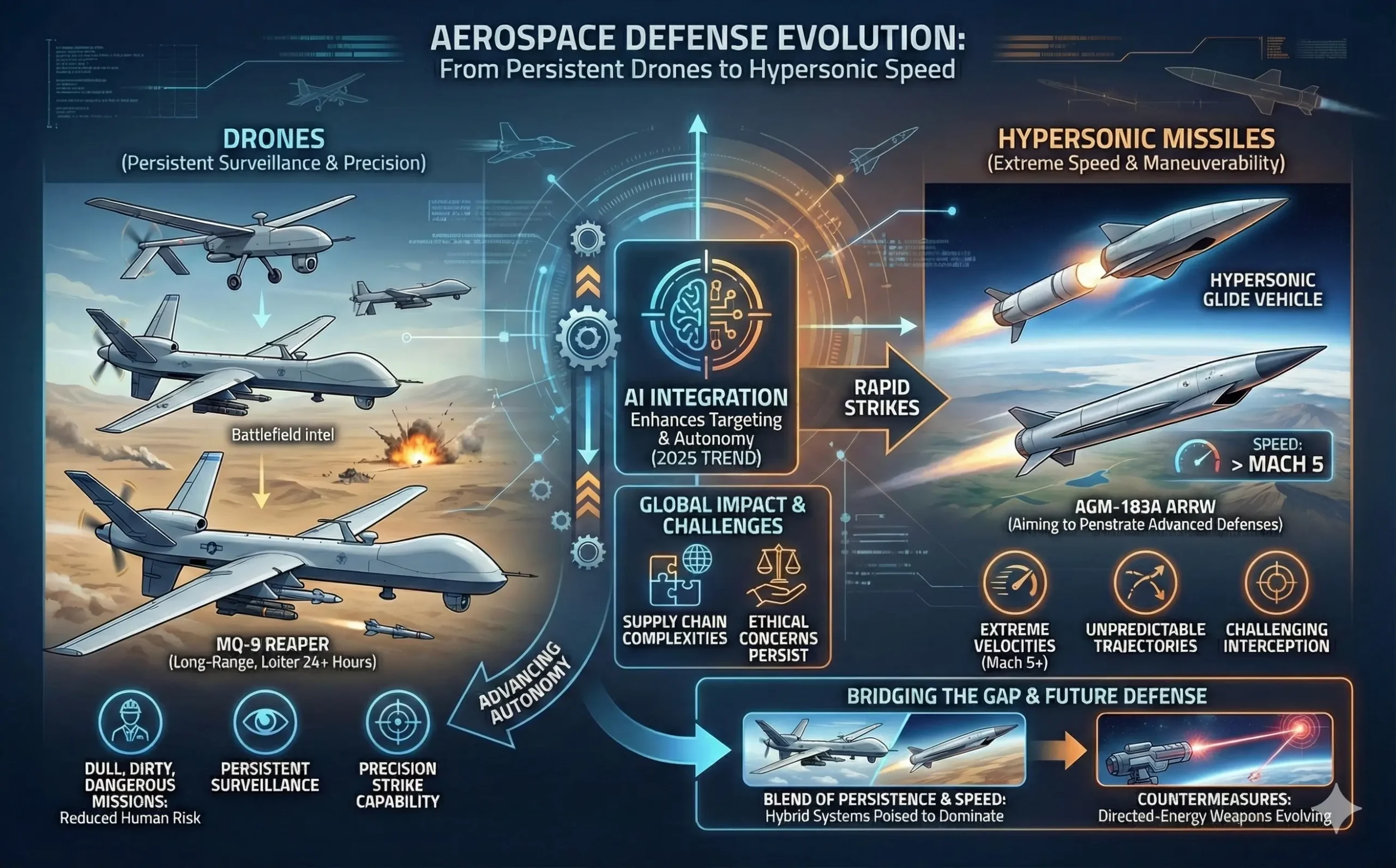
Table of Contents
In the ever-shifting landscape of global security, aerospace defense systems stand as the invisible guardians of nations, blending cutting-edge technology with strategic foresight. From the humble beginnings of unmanned scouts in the skies to the blistering fury of weapons that outpace sound itself, these innovations have redefined how conflicts are fought and won. Imagine a world where pilots no longer risk their lives in routine patrols, or where a single projectile can cross continents in minutes, evading radars like ghosts in the machine.
This article delves deep into that world, exploring the journey from drones—those tireless eyes in the sky—to hypersonic missiles, the swift arbiters of power. We’ll unpack their histories, dissect their mechanics, and peer into a future where these technologies converge, all while grounding our discussion in real-world examples and data-driven insights. Whether you’re a defense enthusiast, a policymaker, or simply curious about the machinery of modern warfare, buckle up—this is a comprehensive tour through the aerial arsenal that’s shaping our tomorrow.
A Historical Overview of Aerospace Defense
Aerospace defense didn’t emerge overnight; it’s the product of decades of trial, error, and ingenuity, spurred by the brutal lessons of warfare. At its core, aerospace defense encompasses everything from radar networks and interceptor aircraft to sophisticated missile shields, all aimed at protecting airspace from intruders. The Cold War era marked a pivotal shift, as superpowers raced to dominate the skies, leading to the birth of integrated air defense systems that could detect, track, and neutralize threats in real time.
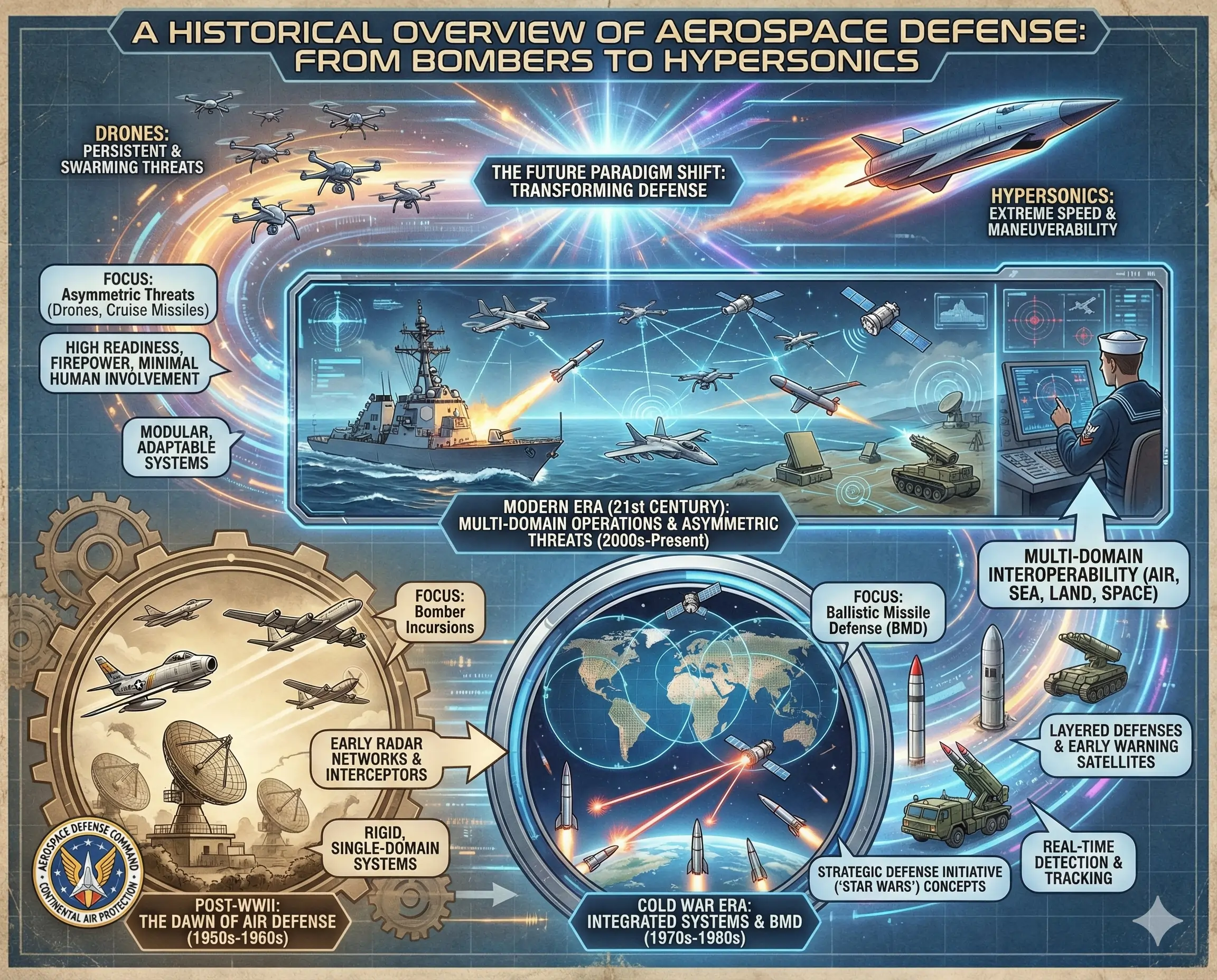
Consider the early days: Post-World War II, nations like the United States established commands such as the Aerospace Defense Command in 1957, focused on continental air protection against bomber incursions. This evolved into layered defenses, incorporating ground-based radars and early warning satellites. By the 1980s, the advent of ballistic missile defense (BMD) programs introduced concepts like the Strategic Defense Initiative, often dubbed “Star Wars,” which envisioned space-based lasers to zap incoming warheads. Though ambitious, these efforts laid the groundwork for today’s multi-domain operations, where air, sea, land, and space assets interoperate seamlessly.
Fast-forward to the 21st century, and the focus has intensified on asymmetric threats—think low-flying cruise missiles or swarms of small drones. According to defense analyses, modern systems prioritize high readiness, firepower, and short reaction times, often with minimal human involvement. For instance, ship-based defenses like the Aegis Combat System can now engage multiple targets simultaneously, drawing on a web of sensors to create a “kill chain” from detection to destruction.
What makes this evolution compelling is its adaptability. Early systems were rigid, built for predictable foes; today’s are modular, allowing quick swaps of components to counter emerging dangers like low-observable stealth aircraft. This historical thread weaves directly into our core focus: drones and hypersonics, which aren’t just tools but transformers of the entire defense paradigm.
Drones: The Persistent Sentinels of the Skies
Drones, or unmanned aerial vehicles (UAVs), have come a long way from their origins as glorified target dummies. Picture this: In 1849, Austrian forces floated explosive-laden balloons over Venice in one of history’s first unmanned attacks—a crude precursor to today’s precision machines. But it wasn’t until World War I that true drones took flight, with radio-controlled biplanes like the British Aerial Target used for gunnery practice.
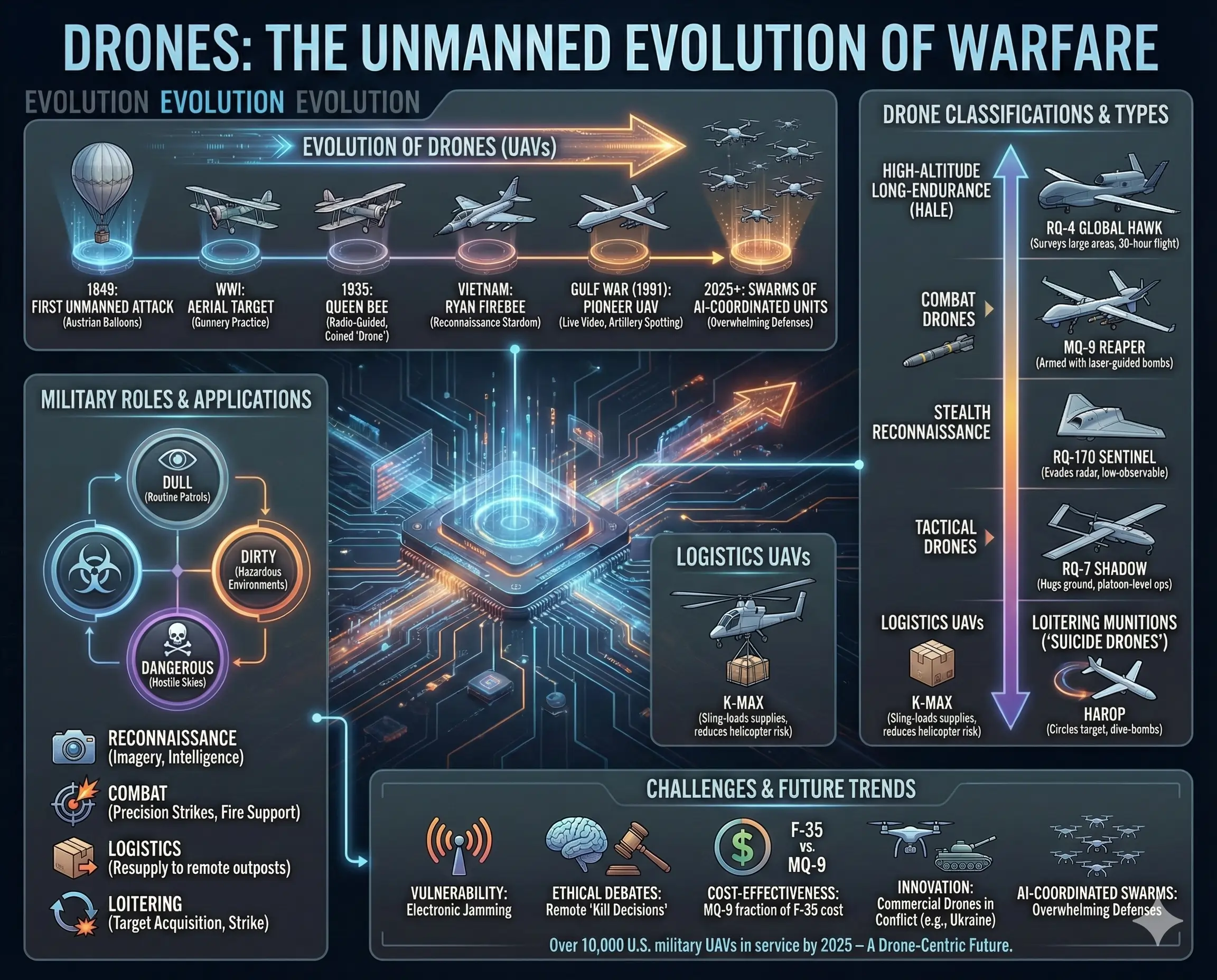
The real breakthrough came in the interwar period. The British Queen Bee in 1935 was a radio-guided biplane that mimicked enemy aircraft for training, coining the term “drone” after its buzzing engine sound. World War II saw limited use, but the Vietnam War in the 1960s catapulted drones into reconnaissance stardom. The U.S. Ryan Firebee flew thousands of risky sorties over hostile territory, capturing imagery without endangering pilots.
By the Gulf War of 1991, drones like the Pioneer UAV provided live video feeds, spotting Iraqi Scud launches and guiding artillery. This marked a sea change: Drones weren’t just spies; they were force multipliers. Fast-forward to the 2000s, and armed variants like the MQ-1 Predator entered the fray in Afghanistan, launching Hellfire missiles with pinpoint accuracy from thousands of miles away.
Today, in 2025, drones dominate defense strategies worldwide. They’re categorized by the U.S. Department of Defense into five groups based on size, weight, and altitude:
| Group | Max Takeoff Weight | Operating Altitude | Typical Range | Example Missions |
|---|---|---|---|---|
| Group 1 | <20 lbs | <1,200 ft | <5 km | Tactical ISR (Intelligence, Surveillance, Reconnaissance) in urban areas |
| Group 2 | 21-55 lbs | <3,500 ft | 5-50 km | Battlefield scouting, small payload delivery |
| Group 3 | 56-1,320 lbs | <18,000 ft | 50-200 km | Medium-range strikes, electronic warfare |
| Group 4 | >1,320 lbs (non-payload) | <18,000 ft | 200+ km | Long-endurance surveillance, like border patrol |
| Group 5 | >1,320 lbs (with payload) | >18,000 ft | Global | Strategic bombing, as in the MQ-9 Reaper for counter-terrorism |
These classifications highlight drones’ versatility. Take the RQ-4 Global Hawk, a high-altitude, long-endurance (HALE) beast that can survey an area the size of Afghanistan in a single 30-hour flight, beaming back high-res imagery via satellite links. In contrast, tactical drones like the RQ-7 Shadow hug the ground at 50 feet, ideal for platoon-level ops where stealth trumps endurance.
But drones aren’t without challenges. They’re vulnerable to electronic jamming, and ethical debates swirl around remote “kill decisions.” Still, their cost-effectiveness shines: A single MQ-9 Reaper sortie costs a fraction of a manned F-35 mission, enabling persistent presence in denied environments. In recent conflicts, such as Ukraine’s defense against Russian advances, cheap commercial drones modified for kamikaze runs have neutralized high-value tanks, proving that innovation often trumps budget.
Looking deeper, subtypes abound. Reconnaissance drones like the RQ-170 Sentinel—the stealthy “Beast of Kandahar”—evade radar with composite materials and low-observable designs. Combat drones, armed with laser-guided bombs, turn the skies into a remote-control battlefield. Then there are logistics UAVs, such as the K-MAX, which sling-load supplies to remote outposts, reducing helicopter risks. And don’t forget loitering munitions, or “suicide drones,” like Israel’s Harop, which circle targets for hours before diving in with explosive finality.
In essence, drones embody the “three D’s” of military ops: dull (routine patrols), dirty (hazardous environments), and dangerous (hostile skies). Their proliferation—over 10,000 U.S. military UAVs in service by 2025—signals a drone-centric future, where swarms of AI-coordinated units overwhelm defenses through sheer numbers.
The Missile Era: Building Blocks to Hypersonic Supremacy
Before hypersonics stole the spotlight, traditional missiles formed the backbone of aerospace defense. These rocket-powered projectiles evolved from World War II V-2s to intercontinental behemoths capable of nuclear delivery. Surface-to-air missiles (SAMs) like the Soviet S-75 Dvina downed U.S. aircraft over Vietnam, while air-to-air variants such as the AIM-120 AMRAAM ensure dogfight dominance.
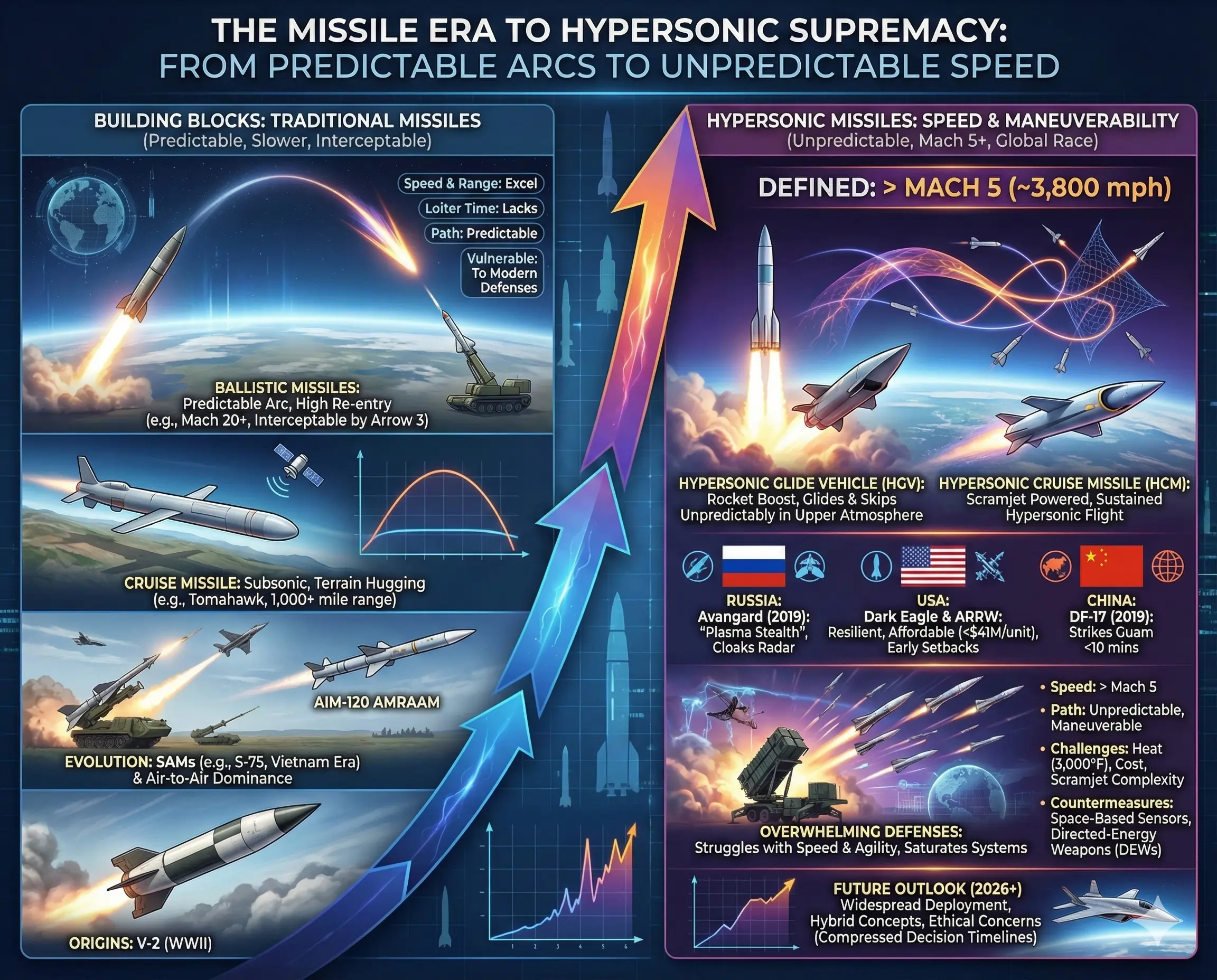
Missiles excel in speed and range but lack drones’ loiter time. A typical cruise missile, like the U.S. Tomahawk, hugs terrain at subsonic speeds, using GPS and inertial navigation for 1,000+ mile journeys. Ballistic missiles arc high into space, reentering at Mach 20+, but their predictable paths make them interceptable by systems like Israel’s Arrow 3.
The leap to hypersonics builds on this foundation, addressing the need for unpredictable, ultra-fast delivery. Defined as weapons exceeding Mach 5 (about 3,800 mph at sea level), hypersonics combine ballistic boosts with aerodynamic glide, allowing mid-flight maneuvers that foil defenses.
Hypersonic Missiles: Speed, Maneuverability, and Global Race
Hypersonic missiles aren’t just faster; they’re smarter, weaving through atmospheres like heat-shielded acrobats. Development traces to the 1960s with NASA’s X-15 rocket plane, but military focus intensified post-2010 amid U.S.-China-Russia rivalries. By 2025, over a dozen programs vie for supremacy, with costs soaring into billions due to exotic materials like carbon composites that withstand 3,000°F temps.
Two main types dominate: hypersonic glide vehicles (HGVs) and hypersonic cruise missiles (HCMs). HGVs launch via rocket, then detach to “skip” along the upper atmosphere, adjusting trajectories unpredictably. HCMs use scramjet engines—supersonic combustion ramjets—for sustained powered flight.
Here’s a snapshot of major players:
| Country | System | Type | Speed (Mach) | Range (km) | Status (2025) | Key Features |
|---|---|---|---|---|---|---|
| Russia | Avangard | HGV | 20+ | 6,000+ | Operational | Nuclear-capable, deployed on SS-19 ICBMs; evades BMD with plasma sheath |
| Russia | Kinzhal | Air-launched HGV | 10 | 2,000 | Operational | Carried by MiG-31; used in Ukraine for high-speed strikes on infrastructure |
| Russia | Zircon | HCM | 8-9 | 1,000 | Testing | Ship/sub-launched; anti-ship focus with Mach 9 terminal velocity |
| United States | AGM-183A ARRW | Air-launched HGV | 5-12 | 1,600 | Testing | B-52 compatible; canceled in 2023 but revived with $1B funding |
| United States | Dark Eagle | Ground-launched HGV | 5+ | 3,000 | Development | Army’s Long-Range Hypersonic Weapon; integrates with HIMARS for mobile fires |
| China | DF-17 | HGV | 10 | 1,800-2,500 | Operational | “Carrier killer”; maneuvers to target U.S. naval assets in Pacific |
| China | YJ-21 | Air-launched HCM | 6+ | 1,500 | Operational | Deployed on H-6 bombers; dual anti-ship/land-attack role |
| India | BrahMos-II | HCM | 7-8 | 600 | Development | Joint with Russia; supersonic precursor BrahMos already in service |
Russia leads operationally, with Avangard entering service in 2019, boasting a “plasma stealth” effect where ionized air cloaks radar signals. The U.S., after setbacks like the ARRW’s 2023 cancellation, pivoted to resilient designs, emphasizing affordability—each Dark Eagle unit targets under $41 million. China’s DF-17, unveiled in 2019, underscores Asia-Pacific tensions, capable of striking Guam from mainland bases in under 10 minutes.
These weapons upend defenses. Traditional interceptors like the Patriot PAC-3 struggle with hypersonics’ speed and agility, prompting investments in space-based sensors and directed-energy weapons (DEWs) like lasers. In simulations, a single HGV salvo could saturate U.S. BMD, highlighting vulnerabilities in layered protection.
Yet, challenges abound. Scramjets demand precise airflows, and heat management risks structural failure. Ethically, their “hair-trigger” speeds compress decision timelines, raising accidental escalation fears. Still, by 2026, experts predict widespread deployment, with hybrid drone-hypersonic concepts—like recoverable hypersonic scouts—on the horizon.
Bridging Drones and Hypersonics: Hybrid Systems and Modern Warfare Dynamics
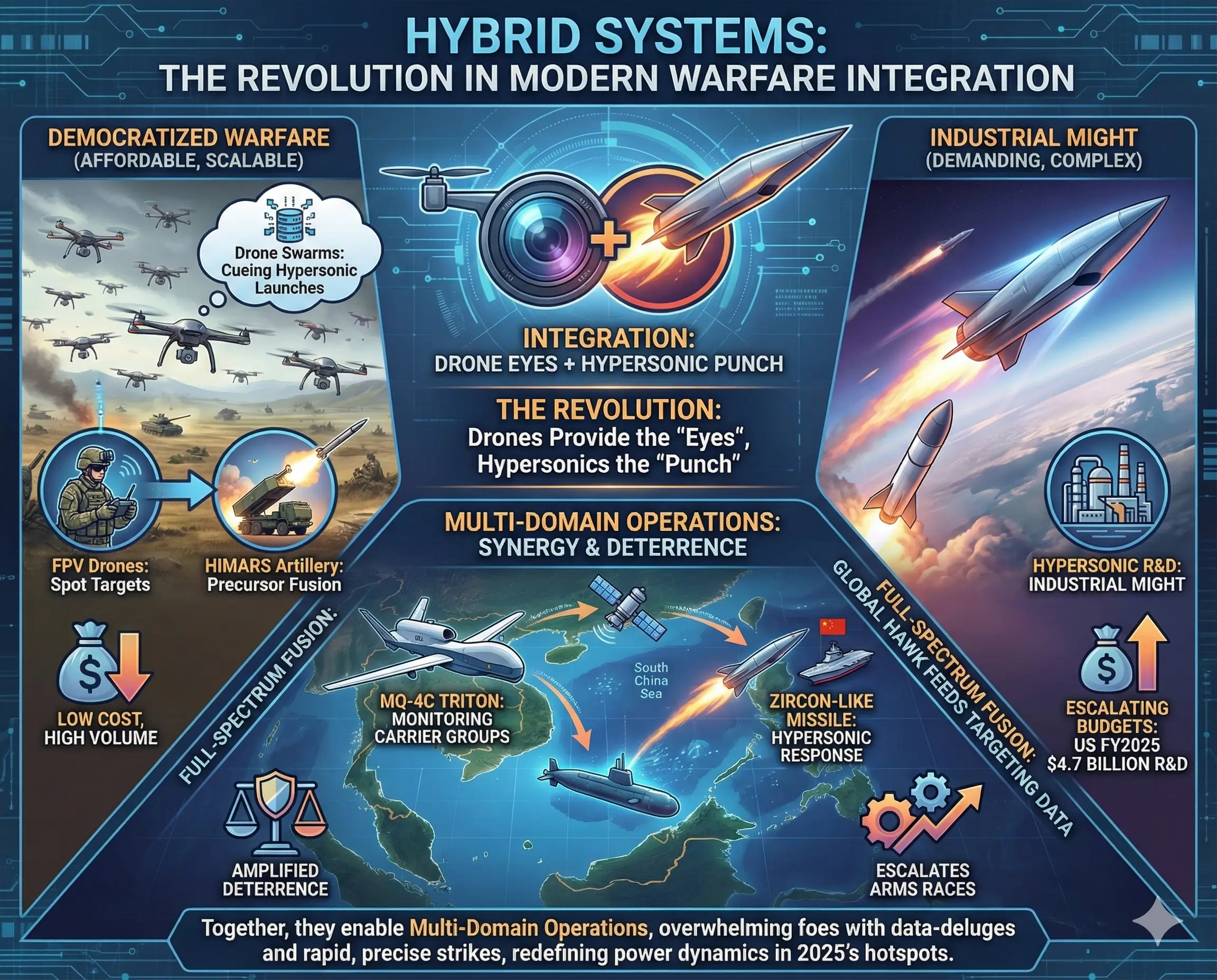
The true revolution lies in integration. Drones provide the “eyes,” hypersonics the “punch.” In Ukraine, cheap FPV (first-person view) drones spot targets for HIMARS rocket artillery, a precursor to full-spectrum fusion. Future visions include drone swarms cueing hypersonic launches, overwhelming foes with data deluges.
Compare the two in action:
| Aspect | Drones (e.g., MQ-9 Reaper) | Hypersonic Missiles (e.g., Kinzhal) |
|---|---|---|
| Speed | Subsonic (up to Mach 0.9) | Hypersonic (Mach 5-20) |
| Endurance/Loiter Time | 24+ hours | Minutes (one-way trip) |
| Maneuverability | High (evasive flight paths) | Extreme (atmospheric skips) |
| Cost per Unit | $30 million (full system) | $10-40 million |
| Payload | 3,800 lbs (mixed sensors/weapons) | 1,000+ lbs warhead |
| Vulnerabilities | Jamming, visual detection | Thermal stress, high cost |
| Role in Warfare | Persistent ISR, precision strikes | Rapid, deep-penetration attacks |
Drones democratize warfare—affordable and scalable—while hypersonics demand industrial might. Together, they enable “multi-domain operations,” where a Global Hawk feeds targeting data to a submerged sub firing Zircon-like missiles.
In 2025’s hotspots, like the South China Sea, U.S. MQ-4C Triton drones monitor Chinese carrier groups, potentially guiding hypersonic responses. This synergy amplifies deterrence but escalates arms races, with budgets ballooning: U.S. hypersonic R&D hit $4.7 billion in FY2025.
Emerging Technologies and Future Horizons
As we gaze ahead, AI infuses both realms. Autonomous drone swarms, using machine learning for collision avoidance and target ID, could number in the thousands, mimicking insect flocks to saturate defenses. Hypersonics benefit from AI-optimized trajectories, predicting intercept paths in milliseconds.
Other frontiers include quantum sensors for unbreakable comms and additive manufacturing for rapid prototyping. Reusable hypersonic vehicles, like the U.S. Air Force’s SR-72 concept, promise scout-and-strike duality by 2040. Ethical guardrails, such as international bans on lethal autonomous weapons, lag behind tech, urging global dialogues.
Sustainability enters the chat too: Electric propulsion for drones cuts emissions, while hypersonic materials recycle space debris. Yet, cyber threats loom—hacked drones could turn against owners, and EMPs might fry missile electronics.
In summary, from drone whispers to hypersonic roars, aerospace defense embodies human ambition’s dual edge: protection and peril. As these systems proliferate, balancing innovation with restraint will define peace in the skies.
Key Citations And References
- Air Defense System Overview
- History of Unmanned Aerial Vehicles
- Hypersonic Weapons Background
- U.S. Missile Defense Programs
- 2026 Aerospace and Defense Outlook
- Evolution of Air Defense
- Brief History of Drones
- Types of Military UAVs
- Hypersonic Missile Update 2025
- Drones in Modern Warfare
- Defense Tech Boom 2025
- UAV Classification
- Hypersonics Past and Present
- World Drone Comparison
- Adapting to Hypersonics and Drones
Read These Articles in Detail
- Aerospace Engineering vs. Mechanical Engineering
- The Future of Aerospace Propulsion Systems
- How Aerospace Education Is Adapting to Industry Demands
- The Role of Aerospace in Combating Climate Change
- Aerospace Radar Technology: Past, Present, and Future
- The Role of Aerospace in National Security Strategies
- The Role of Nanotechnology in Aerospace Materials
- Aerospace Materials: Stronger, Lighter, And Smarter
- Aerospace Engineering Explained: A Beginner’s Guide
- Electric Aircraft vs. Hydrogen Aircraft: Which Is More Sustainable?
- Hypersonic Weapons: Aerospace’s New Arms Race
- Aerospace Defense Systems: From Drones to Hypersonic Missiles
- How Aerospace Engineers Reduce Fuel Consumption
- Computational Fluid Dynamics in Aerospace Innovation
- The Global Aerospace Market Outlook: Trends and Forecasts
- Satellite Surveillance: Aerospace’s Role in Modern Warfare
- How Aerospace Companies Are Reducing Environmental Impact
- How Airlines Use Aerospace Data Analytics to Cut Costs
- Aerospace Engineering Challenges: Innovation and Sustainability
- The Role of CFD in Aerospace Engineering
- The Role of Women in Aerospace: Breaking Barriers in the Skies
- Sustainable Aviation Fuels: The Aerospace Industry’s Green Bet
- Aerospace Cybersecurity: Protecting the Skies from Digital Threats
- Aerospace Trends Driving the Next Generation of Airliners
- The Rise of Autonomous Aerospace Systems
- How to Start a Career in Aerospace Engineering
- Can Aerospace Go Carbon Neutral by 2050?
- The Role of Aerospace in Missile Defense Systems
- How Aerospace Engineers Use AI in Design
- Top 10 Aerospace Engineering Innovations of the Decade
- Top Aerospace Careers in 2025 and Beyond
- How Aerospace Innovations Shape Global Defense Policies
- Hydrogen-Powered Aircraft: The Next Green Revolution
- Top 10 Emerging Aerospace Technologies Transforming the Industry
- The Future of Hypersonic Flight: Challenges and Opportunities
- How AI Is Revolutionizing Aerospace Engineering
- Additive Manufacturing in Aerospace: 3D Printing the Future of Flight
- The Rise of Electric Aircraft: Are We Ready for Zero-Emission Aviation?
- Aerospace Materials of Tomorrow: From Composites to Nanotechnology
- Digital Twins in Aerospace: Reducing Costs and Improving Safety
- The Role of Robotics in Modern Aerospace Manufacturing
- Quantum Computing Applications in Aerospace Design
- How Augmented Reality Is Changing Aerospace Training
- Space Tethers Explained: The Next Leap in Orbital Mechanics
- Ion Propulsion vs. Chemical Rockets: Which Will Power the Future?
- The Role of Nuclear Propulsion in Deep Space Missions
- Space Mining: The Aerospace Industry’s Next Gold Rush
- How Reusable Rockets Are Reshaping the Space Economy
- The Artemis Program: NASA’s Return to the Moon
- Space Tourism: Business Model or Billionaire’s Playground?
- How Aerospace Startups Are Disrupting Commercial Aviation
- The Economics of Low-Cost Airlines in the Aerospace Era
- Urban Air Mobility: The Rise of Flying Taxis
- The Future of Mars Colonization: Key Aerospace Challenges and Solutions Ahead
- CubeSats and Small Satellites: Democratizing Space Access
- The Future of Cargo Drones in Global Logistics
- The Role of Aerospace in Building a Lunar Economy
Frequently Asked Questions
FAQ 1: What is the historical evolution of drones in aerospace defense systems?
Drones, or unmanned aerial vehicles, have transformed from simple experimental tools into essential components of modern aerospace defense. Their story begins in the early 20th century, with pioneers experimenting with radio-controlled aircraft during World War I. These early models served primarily as targets for anti-aircraft training, helping gunners hone their skills without real combat risks. By World War II, advancements allowed for more sophisticated reconnaissance missions, though limitations in technology kept them from widespread use.
The post-war era saw significant leaps, especially during the Cold War, when superpowers invested heavily in unmanned systems to spy on adversaries without pilot casualties. The Vietnam War marked a turning point, with drones like the Ryan Firebee conducting high-risk photo-reconnaissance over enemy territory, gathering intelligence that shaped bombing campaigns. This period highlighted drones’ value in “dull, dirty, or dangerous” operations, paving the way for armed variants in the 1990s Gulf War, where they provided real-time video feeds to guide strikes.
Today, in 2025, drones integrate artificial intelligence for autonomous navigation and targeting, expanding their roles in persistent surveillance and precision attacks. Conflicts like those in the Middle East and Ukraine demonstrate their adaptability, with small commercial drones repurposed for explosive deliveries, underscoring how aerospace defense systems now blend military-grade tech with off-the-shelf innovations. This evolution reflects a broader shift toward reducing human involvement in high-threat environments while enhancing operational efficiency.
FAQ 2: How do different types of drones contribute to aerospace defense strategies?
In aerospace defense, drones are classified by size, altitude, and mission capabilities, allowing forces to tailor them to specific needs like intelligence gathering or direct engagement. These categories, often outlined by military standards, ensure versatility across battlefields.
| Drone Type | Key Characteristics | Primary Roles in Defense | Examples |
|---|---|---|---|
| Small Tactical Drones | Lightweight (under 20 pounds), low-altitude flight (below 1,200 feet), short range | Battlefield reconnaissance, immediate threat detection in urban settings | Black Hornet Nano, used for soldier-level scouting |
| Medium Drones | 20-55 pounds, altitudes up to 3,500 feet, moderate endurance | Electronic warfare support, payload delivery for small strikes | RQ-11 Raven, ideal for platoon operations |
| High-Altitude Long-Endurance (HALE) Drones | Heavy payloads over 1,320 pounds, flying above 18,000 feet, global reach via satellites | Strategic surveillance, persistent monitoring over vast areas | RQ-4 Global Hawk, providing 30+ hour flights for wide-area intel |
| Combat Drones | Armed with missiles or bombs, variable sizes, focus on maneuverability | Precision strikes, suppression of enemy air defenses | MQ-9 Reaper, capable of launching Hellfire missiles remotely |
This classification helps defense planners deploy drones effectively, from frontline tactical support to overarching strategic oversight, making them indispensable in layered aerospace defense systems.
FAQ 3: What advantages do hypersonic missiles offer over traditional missiles in defense applications?
Hypersonic missiles represent a game-changer in aerospace defense due to their incredible speed and agility, traveling faster than Mach 5 while maneuvering unpredictably. Unlike conventional ballistic missiles that follow fixed arcs, hypersonics can alter paths mid-flight, making them notoriously hard to intercept and ideal for penetrating advanced air defenses.
One major edge is their reduced flight time, allowing strikes on distant targets in minutes rather than hours, which compresses enemy response windows and enhances surprise. This is particularly vital in scenarios involving time-sensitive assets like aircraft carriers or command centers. Additionally, their ability to operate within the atmosphere using advanced propulsion like scramjets provides better control and payload delivery compared to space-bound trajectories.
In practice, these advantages shift strategic balances; for instance, systems like Russia’s Kinzhal have been deployed to target fortified positions swiftly, challenging traditional radar networks. However, the technology demands cutting-edge materials to endure extreme heat, pushing innovations in aerospace defense that could eventually lead to countermeasures like high-powered lasers.
FAQ 4: Which countries are leading the development of hypersonic missiles, and what are their key systems?
The global race for hypersonic supremacy involves several nations investing billions in aerospace defense technologies, driven by the need for superior strike capabilities. Here’s a detailed overview of frontrunners and their flagship programs as of 2025.
| Country | Leading Systems | Development Focus | Notable Achievements |
|---|---|---|---|
| United States | AGM-183A ARRW, Dark Eagle | Air-launched and ground-based hypersonic glide vehicles for rapid global response | Successful tests in 2023; integration with existing platforms like B-52 bombers |
| Russia | Avangard, Zircon, Kinzhal | Nuclear-capable gliders and cruise missiles for anti-ship and land attacks | Avangard operational since 2019; Zircon nearing full deployment on naval vessels |
| China | DF-17, YJ-21 | Mobile ground launchers and air-launched variants targeting Pacific assets | DF-17 paraded in 2019; extensive testing for carrier-killing precision |
| India | BrahMos-II (with Russia) | Supersonic-to-hypersonic transition for regional deterrence | Building on proven BrahMos; expected operational by late 2020s |
These efforts highlight a competitive landscape where hypersonic missiles enhance national security postures, though international arms control discussions aim to mitigate escalation risks.
FAQ 5: How are drones and hypersonic missiles integrated in modern aerospace defense operations?
The synergy between drones and hypersonic missiles creates a powerful framework for contemporary warfare, where drones act as forward observers and hypersonics deliver decisive blows. In integrated systems, unmanned aerial vehicles provide real-time intelligence, surveillance, and reconnaissance, feeding data directly into command networks that cue hypersonic launches.
This combination amplifies effectiveness in multi-domain battles, as seen in simulations where drone swarms overwhelm enemy sensors, creating openings for hypersonic penetrations. For example, high-endurance drones like the MQ-4C Triton monitor maritime threats, relaying coordinates to submarine-launched hypersonics for preemptive strikes, reducing reliance on vulnerable manned assets.
Looking ahead, artificial intelligence bridges these technologies further, enabling autonomous decision loops that shorten engagement times. Such integrations not only boost precision but also minimize collateral damage, though they require robust cybersecurity to prevent adversarial hacks. Overall, this fusion redefines aerospace defense as a seamless, technology-driven ecosystem.
FAQ 6: What are the main challenges faced in developing and deploying hypersonic missiles?
Developing hypersonic missiles for aerospace defense involves overcoming significant technical, logistical, and strategic hurdles that test the limits of current engineering. High speeds generate intense frictional heat, necessitating advanced thermal protection systems like ablative coatings, which add weight and complexity to designs.
Testing poses another barrier, as hypersonic regimes demand specialized facilities such as wind tunnels capable of simulating Mach 5+ conditions, leading to high costs and infrequent trials. Supply chain issues, including rare materials for engines, further delay programs, as evidenced by setbacks in various national initiatives.
Strategically, the short warning times these weapons create raise concerns about accidental conflicts, prompting calls for better detection technologies. Here’s a breakdown of key challenges:
- Technical Difficulties: Propulsion instability in scramjet engines requires precise fuel-air mixing at supersonic speeds.
- Cost Overruns: Individual units can exceed tens of millions, straining defense budgets amid competing priorities.
- Countermeasure Evolution: Adversaries are advancing interceptors like directed-energy weapons, potentially neutralizing hypersonic advantages.
- Ethical and Regulatory Issues: International treaties lag, complicating export and deployment in allied operations.
Addressing these demands requires collaborative R&D and innovative funding models to sustain progress in hypersonic capabilities.
FAQ 7: How do drones compare to hypersonic missiles in terms of operational roles and limitations?
When evaluating drones versus hypersonic missiles within aerospace defense systems, their complementary yet distinct profiles become clear, with drones excelling in endurance and flexibility while hypersonics prioritize velocity and penetration power.
| Feature | Drones | Hypersonic Missiles |
|---|---|---|
| Primary Strength | Long loiter times for ongoing monitoring (e.g., 24+ hours) | Ultra-high speeds (Mach 5+) for quick, hard-to-intercept strikes |
| Flexibility | Reusable, recoverable for multiple missions; adaptable payloads | Single-use, focused on one-way high-impact delivery |
| Detection Risk | Vulnerable to jamming or visual spotting at lower altitudes | Stealthier due to speed and plasma sheaths obscuring radar |
| Cost Efficiency | Lower per-operation costs with scalable commercial tech | High development expenses, but strategic value in deterrence |
| Limitations | Limited speed and payload compared to missiles; weather-sensitive | Extreme heat management challenges; limited maneuver endurance post-boost |
This comparison underscores how drones provide persistent presence, ideal for ISR tasks, whereas hypersonics offer shock-and-awe kinetics, together forming a balanced defense arsenal.
FAQ 8: What future trends are shaping the next generation of aerospace defense systems involving drones and hypersonics?
The horizon for aerospace defense is buzzing with innovations that promise to elevate drones and hypersonic missiles into even more capable entities. Artificial intelligence integration stands out, enabling drone swarms to operate autonomously, coordinating attacks without human input and adapting to threats in real time.
Hypersonics are evolving toward reusability, with concepts like hypersonic air-breathing vehicles that could loiter before striking, blending drone-like persistence with missile speed. Directed-energy defenses, such as laser systems, are advancing to counter both, creating an arms race in countermeasures.
Sustainability efforts include electric or hybrid propulsion for drones to extend ranges eco-friendly, while hypersonic materials draw from space tech for efficiency. Geopolitically, alliances like AUKUS foster joint developments, accelerating tech sharing. These trends point to a future where aerospace defense becomes smarter, faster, and more interconnected, though ethical frameworks must evolve to guide their use responsibly.
FAQ 9: What ethical considerations arise from the use of drones and hypersonic missiles in warfare?
The deployment of drones and hypersonic missiles in aerospace defense raises profound ethical questions about accountability, proportionality, and the human cost of remote warfare. Drones, with operators making life-or-death calls from afar, blur lines between soldier and gamer, potentially desensitizing decision-makers to violence and complicating rules of engagement.
Hypersonics exacerbate this by shortening reaction times to mere minutes, increasing risks of miscalculation or escalation in tense regions. Key concerns include:
- Autonomy and Lethal Decisions: AI-driven systems could err in target identification, leading to civilian casualties without direct human oversight.
- Proliferation Risks: Easier access to drone tech via commercial markets democratizes warfare, empowering non-state actors.
- Arms Race Dynamics: Rapid advancements fuel global tensions, diverting resources from diplomacy.
- Post-Strike Accountability: Remote operations hinder investigations into violations of international humanitarian law.
Balancing these requires robust guidelines, training, and transparency to ensure technologies serve defensive purposes without eroding moral standards.
FAQ 10: How have drones and hypersonic missiles been utilized in recent conflicts to enhance aerospace defense?
In recent conflicts, drones and hypersonic missiles have proven pivotal in bolstering aerospace defense, adapting to asymmetric warfare and high-intensity clashes. During the ongoing Ukraine conflict, inexpensive drones like modified quadcopters have been swarm-deployed for reconnaissance and kamikaze attacks, disrupting Russian advances and protecting Ukrainian airspace by spotting incoming threats early.
Hypersonics entered the fray with Russia’s Kinzhal deployments, aimed at Ukrainian infrastructure to test defenses and demonstrate rapid response capabilities, though many were intercepted by advanced Western-supplied systems like Patriot batteries. This highlighted hypersonics’ role in suppressing air defenses while exposing interception challenges.
In the Middle East, U.S. drones such as the MQ-9 Reaper have conducted precision strikes against terrorist networks, providing persistent overwatch that integrates with missile defenses for layered protection. These applications showcase how such systems extend reach without risking personnel, evolve tactics through real-world data, and force adversaries to invest in countermeasures, ultimately reshaping conflict dynamics toward technology-dominated battlefields.
FAQ 11: What are the latest advancements in hypersonic missile technology as of late 2025?
As of November 2025, hypersonic missile development has accelerated, driven by geopolitical tensions and breakthroughs in materials and propulsion. China has made headlines with a civilian firm achieving a 90% cost reduction in producing Mach 7 missiles, enabling mass production that could flood markets and alter export dynamics. This follows their unveiling of the YKJ-1000, a private-sector hypersonic system with automatic target recognition and evasion capabilities, showcasing how non-state actors are entering the fray.
Japan, meanwhile, tested its first hypersonic missile deployment in mid-November, incorporating enhanced glide technologies to extend range against regional threats. The U.S. counters with the Dark Eagle, now in advanced trials for mobile hypersonic strikes up to 1,700 miles, integrated with Army launchers for flexible battlefield use. Russia’s Zircon and North Korea’s Hwasong-20 ICBM variants add to the mix, with the latter paraded in early November as a deterrent signal.
These innovations build on the foundational types discussed in the article—hypersonic glide vehicles (HGVs) and cruise missiles (HCMs)—but emphasize affordability and AI-guided maneuvers. Challenges persist, like thermal management, yet the FY2025 U.S. budget’s $7 billion for hypersonics underscores a global push toward operational maturity by 2026. This race not only heightens deterrence but risks escalation, as shorter flight times compress decision-making windows.
FAQ 12: How is AI being integrated into drones and hypersonic systems in 2025?
AI integration in aerospace defense has surged in 2025, transforming drones from remote-controlled scouts into semi-autonomous decision-makers and hypersonics from blunt instruments into precision-guided threats. For drones, AI enables swarm coordination, where hundreds of units analyze terrain in real-time to evade defenses, as seen in U.S. programs like Gremlins for recoverable swarms. In hypersonics, machine learning optimizes flight paths mid-mission, countering intercepts by predicting radar blind spots.
The table below outlines key AI applications across both technologies, highlighting 2025 trends:
| Technology | AI Application | 2025 Example | Benefits | Challenges |
|---|---|---|---|---|
| Drones | Autonomous targeting | U.S. Army’s FPV drone swarms with real-time object recognition | Reduces operator workload; enables 24/7 ops | Ethical risks in lethal decisions; vulnerability to hacking |
| Drones | Predictive maintenance | AI diagnostics on MQ-9 Reaper fleets | Cuts downtime by 30%; extends mission life | Data privacy in shared networks |
| Hypersonics | Trajectory optimization | China’s DF-27 with AI evasion algorithms | Improves hit probability to 95% | High computational needs during plasma blackout |
| Hypersonics | Sensor fusion | U.S. Dark Eagle integrating satellite AI feeds | Enhances accuracy in jammed environments | Integration costs exceeding $1B per program |
| Hybrids | Swarm-hypersonic cueing | DARPA’s AI-linked drone-missile chains | Overwhelms defenses with data overload | Standardization across allies |
This fusion, per industry outlooks, could drive a 15% annual growth in AI defense spending through 2030, but it demands robust ethical frameworks to prevent unintended escalations.
FAQ 13: What environmental impacts do hypersonic missiles and drones have on modern battlefields?
Hypersonic missiles and drones, while revolutionizing warfare, carry significant environmental footprints that extend from production to deployment. High-speed flight in hypersonics generates intense heat, contributing to atmospheric pollution through exhaust emissions and potential ozone depletion from scramjet fuels—estimates suggest their climate impact could be 8-20 times that of subsonic aircraft due to contrail formation at extreme altitudes. On the ground, failed tests or strikes release heavy metals from ablative heat shields, contaminating soil and water in test ranges.
Drones, often seen as greener alternatives, still pose issues: Battery-powered small UAVs reduce emissions but e-waste from rapid obsolescence piles up, while larger models like the Global Hawk burn jet fuel equivalent to small aircraft, adding to carbon outputs in prolonged surveillance missions.
Key environmental concerns include:
- Air quality degradation: Missile and drone attacks, as in Ukraine, spike PM2.5 particulate levels by disrupting urban infrastructure and burning debris, leading to respiratory health crises in affected areas.
- Noise pollution: Drone swarms create persistent low-frequency hums that disrupt wildlife migration patterns, while hypersonic booms shatter glass and stress ecosystems over vast radii.
- Resource strain: Rare earth metals for electronics drive mining pollution, with global demand projected to double by 2030 from defense needs.
- Long-term legacy: Unexploded ordnance from loitering munitions contaminates farmland, mirroring Vietnam-era dioxin issues but amplified by precision tech failures.
Mitigation efforts, like electric propulsion for drones, show promise, yet the article’s emphasis on persistent ops underscores the need for sustainable designs to balance security with planetary health.
FAQ 14: What are the economic effects of investing in hypersonic weapons development in 2025?
The economic ripple effects of hypersonic development in 2025 are profound, fueling job creation while straining budgets and sparking trade tensions. The U.S. alone allocated $3.9 billion in FY2026 for R&D, down from $6.9 billion prior, aiming to curb costs through digital engineering—yet total program expenses could hit $17.9 billion for a comparable arsenal, one-third more than traditional missiles. This investment boosts sectors like advanced materials, creating 50,000+ high-tech jobs domestically.
Globally, China’s mass production push, slashing costs by 90%, could undercut exports and pressure allies, with market growth at 16% CAGR through 2032. Tariffs on components may inflate prices, but they also spur innovation in supply chains.
A breakdown of economic impacts:
| Aspect | Positive Effects | Negative Effects | 2025 Projection |
|---|---|---|---|
| Budget Allocation | Stimulates $30B+ in missile defense funding | Diverts from social programs; U.S. deficit up 2% | $7B global R&D surge |
| Industry Growth | 15% rise in aerospace manufacturing | Supply chain vulnerabilities from rare materials | 100,000 new jobs worldwide |
| Trade Dynamics | Export opportunities for allies like Japan | Escalation in tariffs; China dominates low-cost segment | Market value to $15B |
| Innovation Spillover | Advances in composites benefit civilian aviation | Opportunity costs for green tech | ROI debated at 1.5:1 |
Ultimately, while hypersonics promise strategic edges, their economics highlight a delicate balance between deterrence and fiscal prudence.
FAQ 15: How are military drone technologies finding applications in civilian sectors?
Military drone tech, honed for reconnaissance and strikes as detailed in the article, is spilling over into civilian life with transformative speed in 2025. Once confined to battlefields, UAVs now aid disaster response, where rugged designs from systems like the RQ-7 Shadow enable rapid mapping of flood zones, delivering aid to remote areas without risking human teams—a tactic refined in Ukraine’s conflict adaptations.
In agriculture, precision spraying tech from combat drones optimizes pesticide use, reducing chemical runoff by 30% on vast farms, while energy sectors deploy them for inspecting wind turbines, cutting maintenance costs through thermal imaging borrowed from ISR missions. Search-and-rescue ops benefit too, with AI autonomy allowing drones to navigate smoke-filled wildfires, spotting survivors faster than helicopters.
This dual-use trend democratizes benefits: Law enforcement uses modified tactical drones for crowd monitoring, and journalism leverages loitering capabilities for live event coverage. However, privacy concerns echo military ethical debates, prompting regulations to ensure safe integration. By bridging defense and daily life, these technologies promise efficiency gains worth billions, proving warfare’s unwanted gifts can foster peace.
FAQ 16: What international regulations govern hypersonic missiles in 2025?
International regulations on hypersonic missiles remain fragmented in 2025, lacking a comprehensive treaty akin to those for ballistic missiles, which creates a patchwork of voluntary norms and bilateral pacts. The UN’s discussions via UNIDIR have produced reports on emerging threats since 2019, but no binding agreements exist, leaving gaps that fuel proliferation fears.
Key regulatory aspects include:
- Export controls: U.S. policies restrict full-system exports, focusing on controlled tech transfers to allies, while Russia’s sales to partners like India bypass broader scrutiny.
- Arms control talks: Stalled dialogues between the U.S., Russia, and China emphasize non-export of complete HGVs, but enforcement is weak amid the FY2025 budget’s $6.9 billion U.S. push.
- Regional initiatives: Asia-Pacific nations like Japan advocate for norms via ASEAN forums, tying hypersonics to maritime security.
- Nuclear linkages: Treaties like New START indirectly apply, but hypersonics’ dual-use blurs lines, heightening escalation risks.
This regulatory vacuum, as the article implies, through global races, urges multilateral efforts to prevent an unchecked arms spiral.
FAQ 17: How has military training for drone operators evolved in 2025?
Training for drone operators has shifted from classroom theory to immersive, tech-driven simulations in 2025, responding to the article’s note on autonomy’s rise. The U.S. Army’s new Unmanned Advanced Lethality Course, launched in August, trains soldiers in FPV tactics and 3D printing custom drones, compressing years of development into weeks.
The following table compares traditional vs. modern approaches:
| Training Element | Traditional (Pre-2025) | 2025 Evolutions | Key Programs |
|---|---|---|---|
| Duration | 6-12 months | 10-30 days | Army’s Lightning Labs FPV course |
| Methods | Lecture-based; basic flight sims | VR/AR with threat scenarios; 3D printing | Pentagon’s “Top Drone” school |
| Focus Areas | Manual piloting | AI-assisted swarms; cyber defense | SOCOM’s 10-day UAS assembly |
| Outcomes | Basic certification | Lethal employment proficiency | Marines’ drone experimentation units |
This evolution ensures operators master hybrid ops, blending drone intel with hypersonic cues for future battlefields.
FAQ 18: What role does space technology play in enhancing drone and hypersonic operations?
Space technology is the unseen backbone amplifying drones and hypersonics, providing the orbital eyes that turn tactical tools into strategic assets. Satellites like the U.S. HBTSS constellation track hypersonic launches in real-time, feeding data to ground systems for intercepts, a leap from the article’s satellite-linked Global Hawk. For drones, GPS and comms relays enable beyond-line-of-sight control, extending MQ-9 ranges globally.
China’s satellite-guided hypersonics, integrated with Beidou networks, exemplify this synergy, allowing mid-flight corrections that evade defenses. Future hybrids could see space-launched drones scouting for hypersonic barrages, reshaping multi-domain warfare by 2030.
Yet, vulnerabilities like anti-satellite weapons pose risks, underscoring the need for resilient orbits to sustain these integrations.
FAQ 19: How do U.S. and Chinese hypersonic programs compare in 2025?
The U.S. and Chinese hypersonic programs diverge in philosophy—America’s on interoperability and cost control, China’s on volume and innovation—mirroring the article’s global race overview. As of late 2025, China leads in deployments, with the DF-27 tested for carrier strikes, while U.S. efforts focus on allied integration.
Comparative overview:
| Criterion | U.S. Programs | Chinese Programs | 2025 Edge |
|---|---|---|---|
| Deployment Status | Testing (Dark Eagle operational trials) | Multiple operational (DF-17, YJ-21) | China |
| Budget (Annual) | $3.9B (FY2026) | Est. $10B+ (state-backed) | China |
| Speed/Range | Mach 5-12 / 1,600km | Mach 10+ / 2,500km | China |
| Innovation Focus | AI countermeasures | Shape-shifting designs | Tie |
| Export/Allies | Restricted to partners | Limited, but mass production | U.S. |
This rivalry drives mutual advancements, but collaborative norms could temper the intensity.
FAQ 20: How do hypersonic missiles influence nuclear deterrence strategies?
Hypersonic missiles are reshaping nuclear deterrence by blurring conventional and strategic lines, offering rapid, hard-to-stop delivery that compresses response times to minutes. Unlike the article’s ballistic focus, hypersonics like Russia’s Avangard enable “prompt global strike,” deterring aggression through uncertainty—adversaries can’t confidently intercept, per 2025 analyses.
This shift prompts doctrines emphasizing survivability, with the U.S. exploring hypersonic nuclear variants for enduring credibility. However, it risks miscalculation, as speed erodes de-escalation windows, urging updated arms talks.
In essence, hypersonics fortify deterrence but demand vigilant stability measures to avoid unintended escalations.
