

Rapid Growth Amid Innovation and Challenges
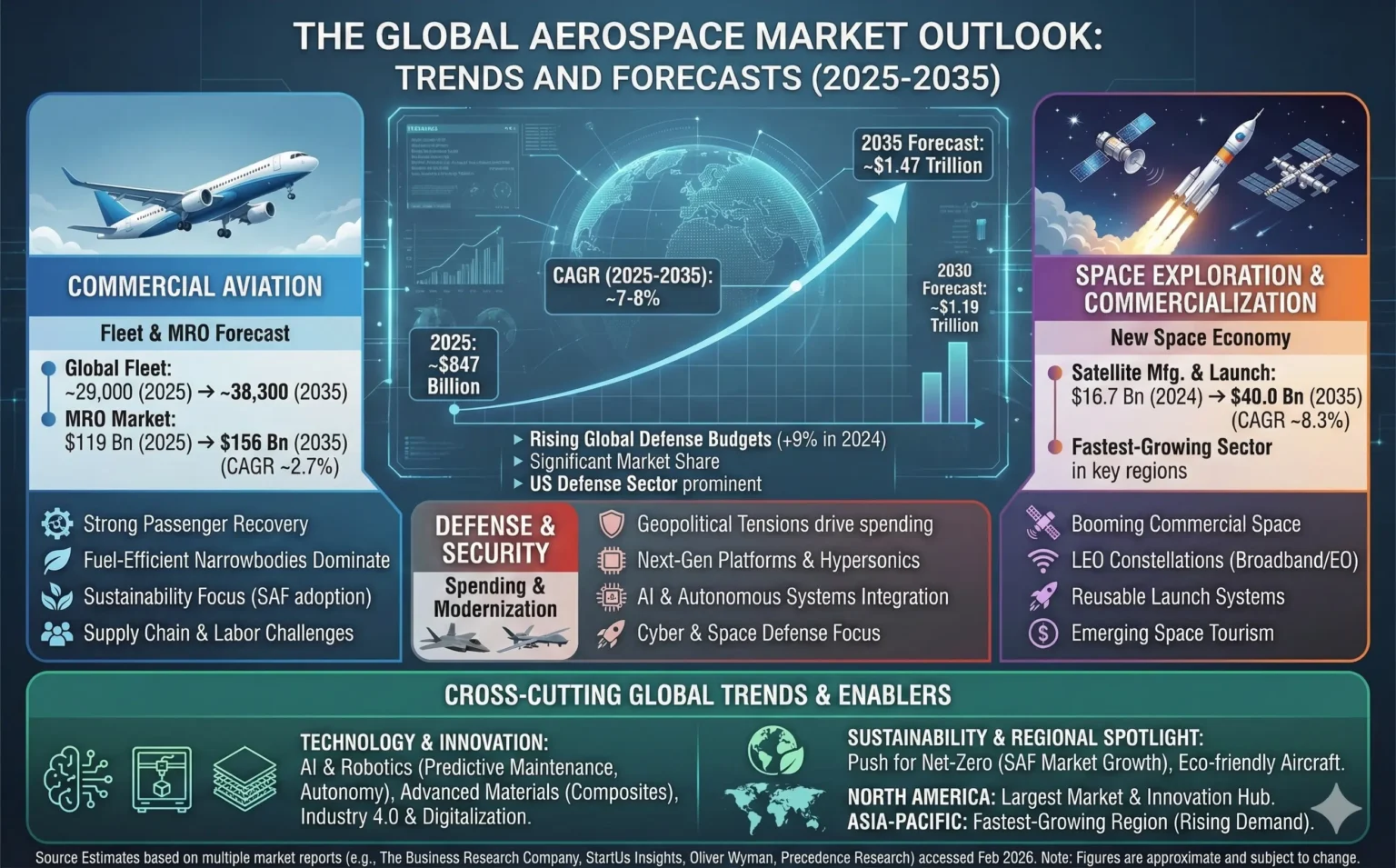
The global aerospace industry is surging forward, with 2024 revenues hitting a record $922 billion across top companies, setting the stage for a 12% year-over-year increase in 2025. This boom reflects resilient demand for air travel, defense capabilities, and space exploration, despite lingering supply chain hurdles and geopolitical tensions.
- Fleet Expansion: Commercial aircraft fleets are projected to grow from 29,079 units in 2025 to 38,309 by 2035, representing a 2.8% compound annual growth rate (CAGR), driven primarily by the expansion of narrowbody jets.
- Delivery Surge: Expect 43,600 new airplanes delivered worldwide by 2044, including 33,285 single-aisle models, fueled by emerging market traffic.
- Sustainability Push: Airlines and manufacturers are ramping up sustainable aviation fuel (SAF) adoption and electric propulsion to meet net-zero goals, though regional regulations vary.
Current Market Snapshot
In 2024, passenger air travel rebounded to 99% of pre-pandemic levels, with revenue passenger kilometers (RPKs) poised for 6.1% growth in 2025. Defense spending topped $2.2 trillion globally, emphasizing AI and autonomous systems, while the space sector saw $127 billion in government outlays. Business aviation remains buoyant, with 91% of operators planning to maintain or increase flights in 2025.
MRO (maintenance, repair, and overhaul) demand is exploding, projected at $119 billion in 2025 and climbing to $156 billion by 2035 at a 2.7% CAGR, as fleets age and utilization rises. Yet, production lags behind orders, with backlogs exceeding 14,000 commercial units—equivalent to a decade’s output—highlighting labor and parts shortages.
Emerging Trends Shaping the Horizon
Artificial intelligence (AI) is revolutionizing operations, from predictive maintenance to autonomous drones, with U.S. aerospace AI spending forecasted to hit $5.8 billion by 2029—a 3.5-fold jump from 2025. Supply chains are diversifying through “friendshoring” to counter tariffs and disruptions, while workforce upskilling targets AI and data skills amid talent gaps.
Geopolitical shifts, including conflicts in Ukraine and the Middle East, are boosting defense budgets and M&A activity, projected to expand from $218 billion in 2025 to $382 billion by 2030 at an 11.86% CAGR. On the sustainability front, the industry eyes a circular economy for parts recycling, with space commercialization targeting a $1.8 trillion economy by 2035.
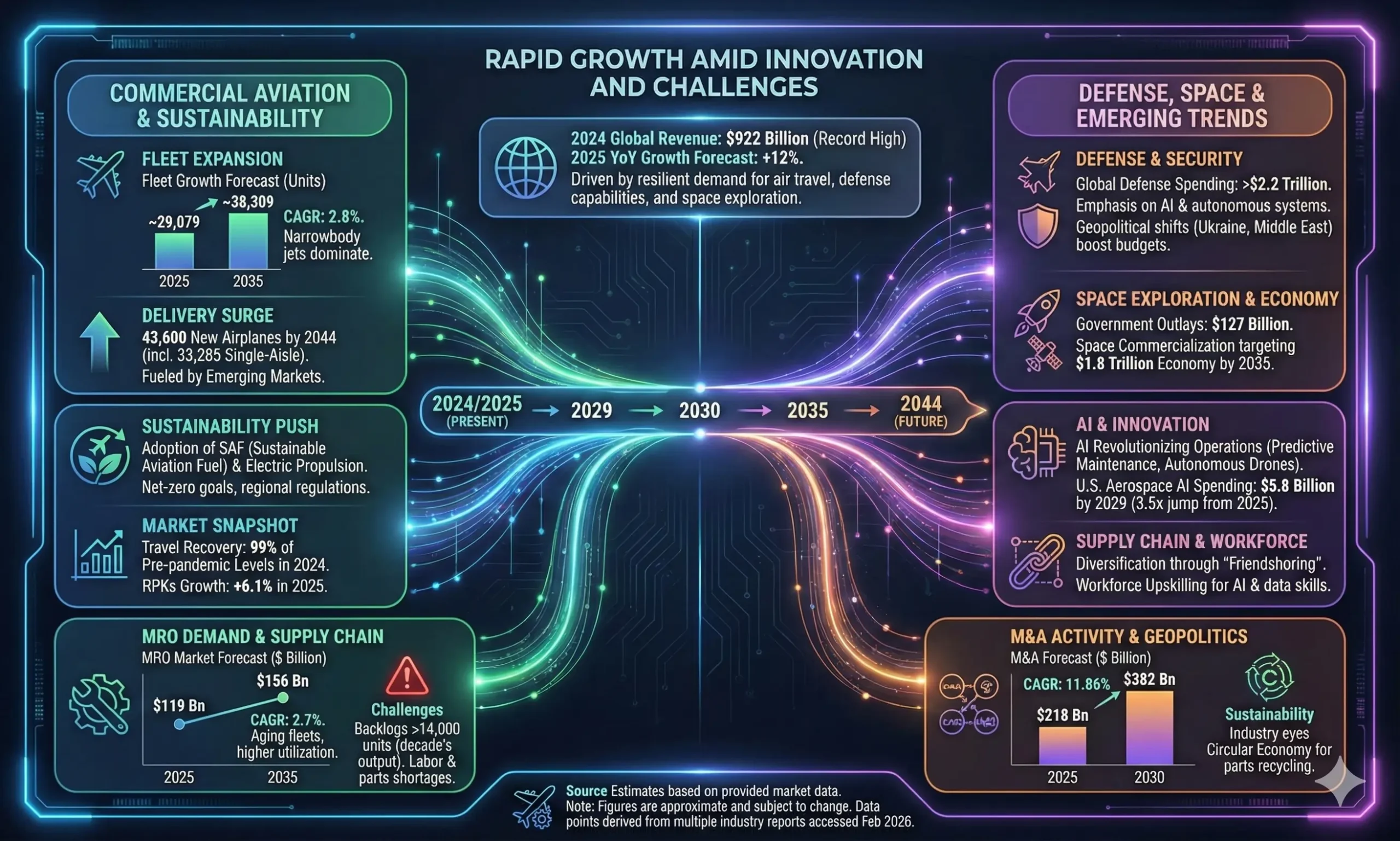
Table of Contents
Introduction
The aerospace sector stands at a pivotal crossroads, blending breathtaking innovation with formidable challenges. As we peer into 2025 and beyond, the global market pulses with optimism: air travel demand is roaring back, defense needs are sharpening amid global uncertainties, and the stars seem closer than ever with booming space ventures. Yet, this ascent isn’t without headwinds—supply chain snarls, skilled labor shortages, and the urgent call for greener skies test the industry’s mettle. Drawing from comprehensive analyses, this outlook unpacks the forces propelling the sector, from fleet modernizations to AI-driven efficiencies, offering a roadmap for stakeholders navigating this dynamic landscape.
The aerospace market encompasses commercial aviation, defense systems, business jets, unmanned aerial vehicles (UAVs), and the burgeoning space economy. In 2024 alone, the industry’s top players generated $922 billion in revenue, a testament to the post-pandemic recovery and sustained investments. Looking ahead, projections paint a picture of steady expansion, with global GDP growth at 3.2% in 2025 fueling aviation’s rise, particularly in Asia-Pacific, where India and China lead with 6.6% and 4.7% respective gains. But growth isn’t uniform; emerging markets will shoulder over 50% of the global fleet by 2044, while mature regions like North America focus on renewal.
This article delves deep into current dynamics, pivotal trends, regional nuances, technological leaps, sustainability imperatives, and long-term forecasts. Through data-rich tables, real-world examples, and structured insights, this website aims to equip readers—whether executives, investors, or enthusiasts—with a comprehensive view. The message is clear: the aerospace future is bright, but it demands agility, collaboration, and foresight.
Current Market Overview: Resilience in Recovery
The aerospace arena has clawed back from the shadows of 2020, with 2024 marking a watershed year. Passenger traffic, measured in RPKs, edged to 99% of 2019 benchmarks, setting up a 6.1% surge for 2025 as borders reopen and leisure travel rebounds. Airlines posted operating profits exceeding $75 billion last year, bolstered by disciplined costs and premium yields, with net profits eyed at $36.6 billion in 2025—a 16.2% uptick.
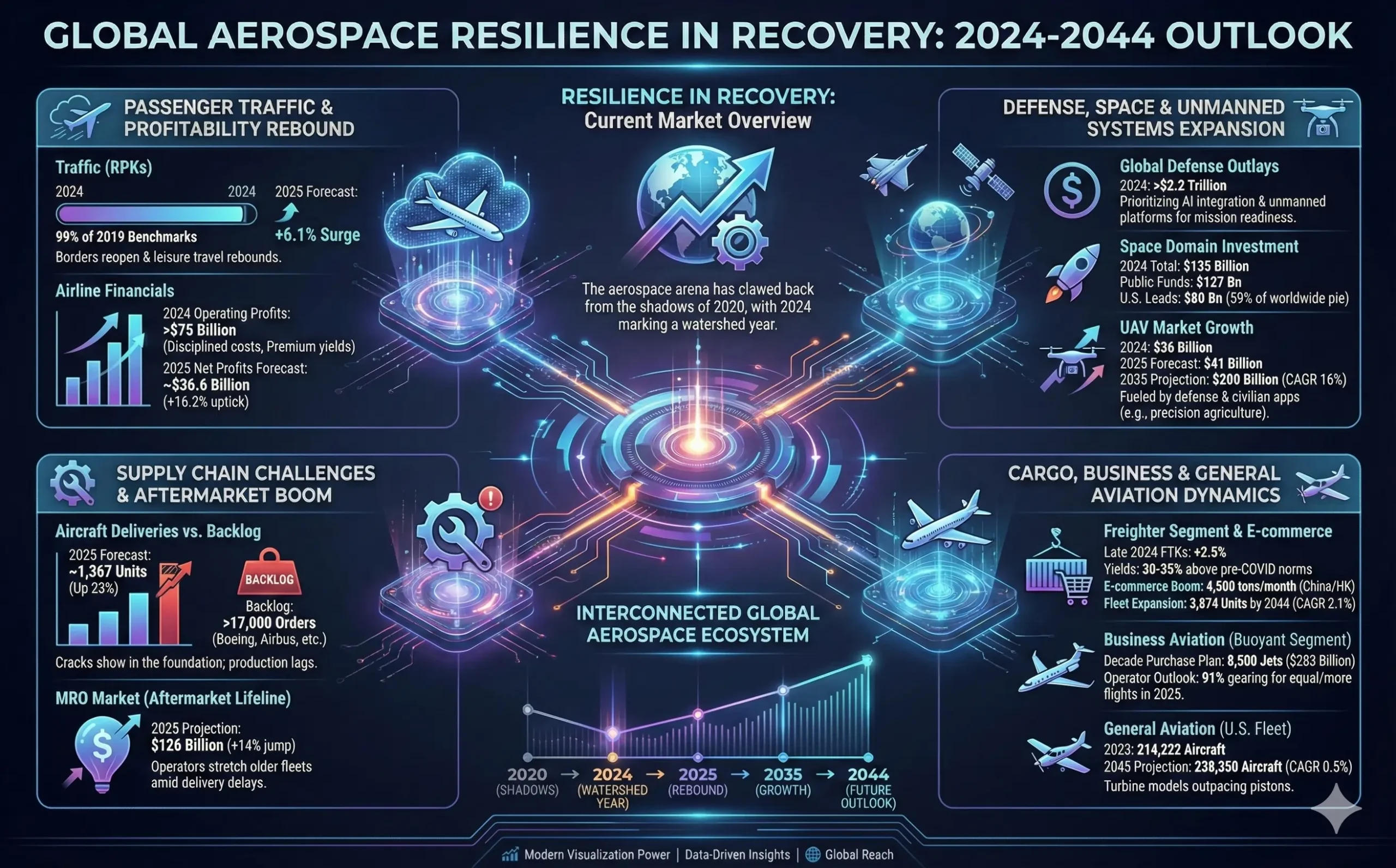
Commercial aviation dominates, but defense and space are no slouches. Global defense outlays crossed $2.2 trillion in 2024, prioritizing AI integration and unmanned platforms for mission readiness. The space domain attracted $127 billion in public funds, with total investments hitting $135 billion, led by the U.S. at $80 billion—59% of the worldwide pie. UAVs, valued at $36 billion in 2024, are sprinting toward $41 billion next year and a staggering $200 billion by 2035, thanks to a 16% CAGR fueled by defense and civilian apps like precision agriculture.
Yet, cracks show in the foundation. Aircraft deliveries, while up 23% in 2025 to around 1,367 units from majors like Boeing and Airbus, trail a backlog of over 17,000 orders. MRO, the aftermarket lifeline, is ballooning to $126 billion in 2025—a 14% jump—as operators stretch older fleets amid delays. Business aviation shines brighter, with 8,500 jets worth $283 billion slated for purchase over the decade, and 91% of operators gearing for equal or more flights next year.
Consider the freighter segment: global freight tonne kilometers (FTKs) inched up 2.5% in late 2024, with yields 30-35% above pre-COVID norms, supporting a fleet expansion to 3,874 units by 2044 at 2.1% annually. E-commerce giants, shipping 4,500 tons of low-value goods from China and Hong Kong monthly, underscore cargo’s e-tail boom. General aviation, meanwhile, sees its U.S. fleet creep from 214,222 aircraft in 2023 to 238,350 by 2045 at a modest 0.5% clip, with turbine models outpacing pistons.
To visualize the segment breakdown, here’s a snapshot of 2024 market values and 2025 projections:
| Segment | 2024 Value (USD Billion) | 2025 Projection (USD Billion) | Key Driver |
|---|---|---|---|
| Commercial Aviation | 860 (overall market) | 963 (12% growth) | Passenger rebound, fleet upgrades |
| Defense | 2,200 (spending) | 2,400 (9% rise) | Geopolitics, AI systems |
| MRO/Aftermarket | 105 | 126 (14% increase) | Aging fleets, utilization spikes |
| UAVs | 36 | 41 | Defense apps, commercial uses |
| Space | 127 (gov’t) | 135 (total invest) | Commercialization, satellites |
This table highlights the diversified revenue streams cushioning the sector against single-point failures.
Key Trends: Innovation as the New Thrust
Trends in aerospace aren’t just buzzwords—they’re the engines driving transformation. At the forefront is digitalization, where AI and agentic AI promise to overhaul 36% of manufacturing tasks, from crew scheduling to drone autonomy. In defense, AI sharpens mission planning; commercially, it predicts maintenance, slashing downtime. By 2026, scaled AI deployments could permeate procurement and logistics, though full factory rollout lags until 2028.
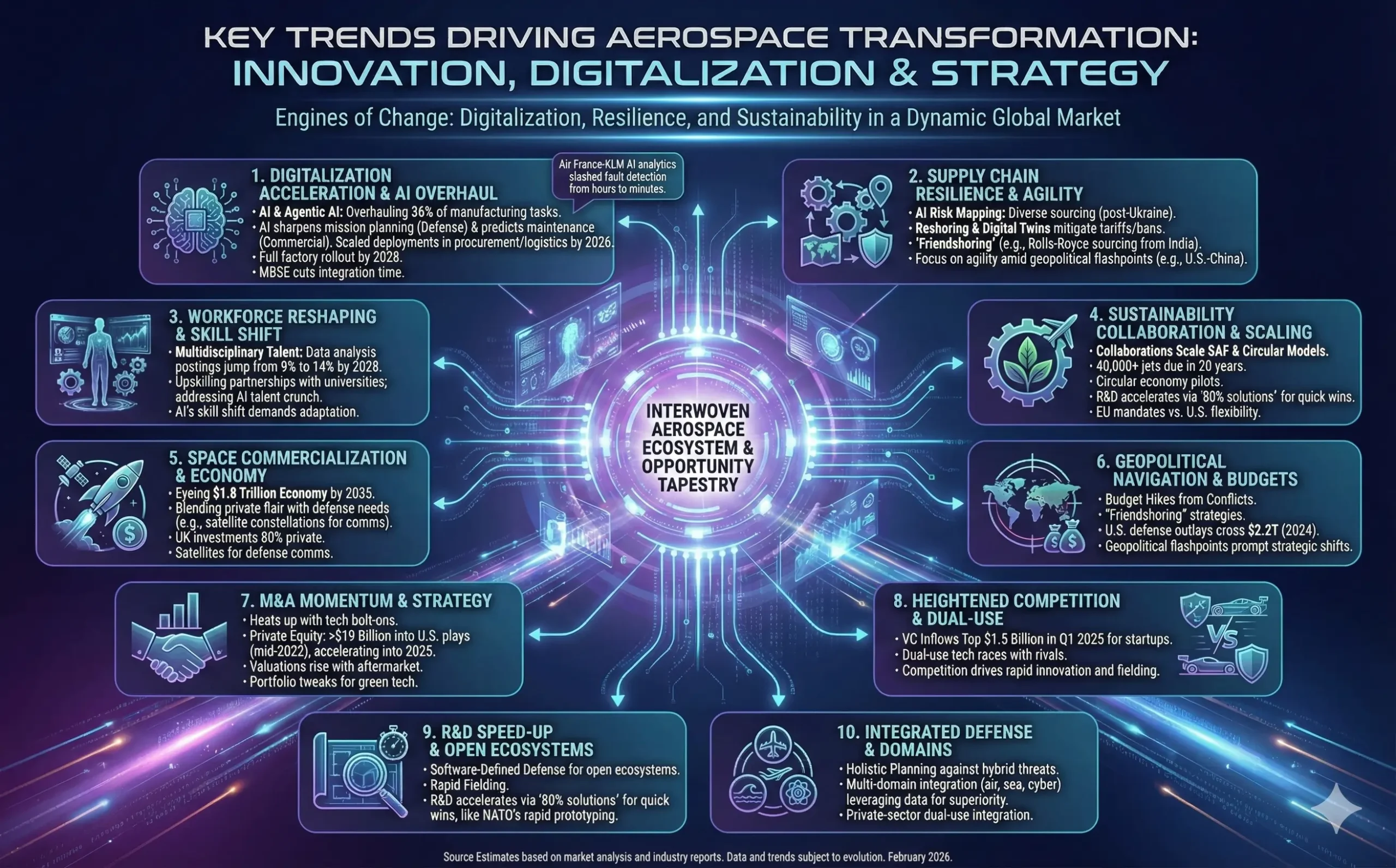
Supply chain resilience tops the agenda, with reshoring and digital twins mitigating risks from tariffs and bans. Geopolitical flashpoints—like U.S.-China trade frictions—prompt “friendshoring,” as seen in Rolls-Royce sourcing from India. M&A heats up too, with deals targeting tech bolt-ons; private equity poured over $19 billion into U.S. plays by mid-2022, a trend accelerating into 2025.
Workforce evolution demands multidisciplinary talent: data analysis postings jump from 9% to 14% by 2028, underscoring AI’s skill shift. Space commercialization, aiming for $1.8 trillion by 2035, blends private flair with defense needs—think satellite constellations that enhance comms.
Sustainability isn’t optional: with 40,000+ jets due in 20 years, collaborations scale SAF and circular models, though EU mandates clash with U.S. flexibility. R&D accelerates through “80% solutions” for quick wins, such as NATO’s rapid prototyping. Defense trends toward multi-domain integration—air, sea, cyber—leveraging data for superiority.
Here’s a curated list of the 10 emerging trends reshaping aerospace, with real-world ties:
- Supply Chain Resilience: Agility via AI risk mapping; example: diversified sourcing post-Ukraine disruptions.
- Heightened Competition: VC inflows top $1.5 billion in Q1 2025 for startups; dual-use tech races with rivals.
- Digitalization Acceleration: Model-based systems engineering (MBSE) cuts integration time; early adopters gain an edge.
- Workforce Reshaping: Upskilling partnerships with unis; addressing AI talent crunch.
- Space Commercialization: UK investments 80% private; satellites for defense comms.
- Geopolitical Navigation: Budget hikes from conflicts; friendshoring strategies.
- R&D Speed-Up: Software-defined defense for open ecosystems; rapid fielding.
- Sustainability Collaboration: SAF scaling amid production boom; circular economy pilots.
- M&A Momentum: Valuations rise with the aftermarket; portfolio tweaks for green tech.
- Integrated Defense: Holistic planning against hybrid threats; private-sector dual-use.
These trends interweave, creating a tapestry of opportunity. For instance, Air France-KLM’s AI analytics slashed fault detection from hours to minutes, exemplifying digital-sustainability synergy.
Regional Insights: A World of Varied Velocities
Aerospace’s global footprint varies wildly by region, mirroring economic pulses. Asia-Pacific steals the show: South and Southeast Asia forecast 7.0% annual traffic growth, with fleets ballooning at 6.7% and 6.6% respectively, driven by India’s middle-class boom and China’s e-commerce freight. China’s fleet swells 40% by 2035, while India’s doubles, underscoring manufacturing shifts to Vietnam and beyond.
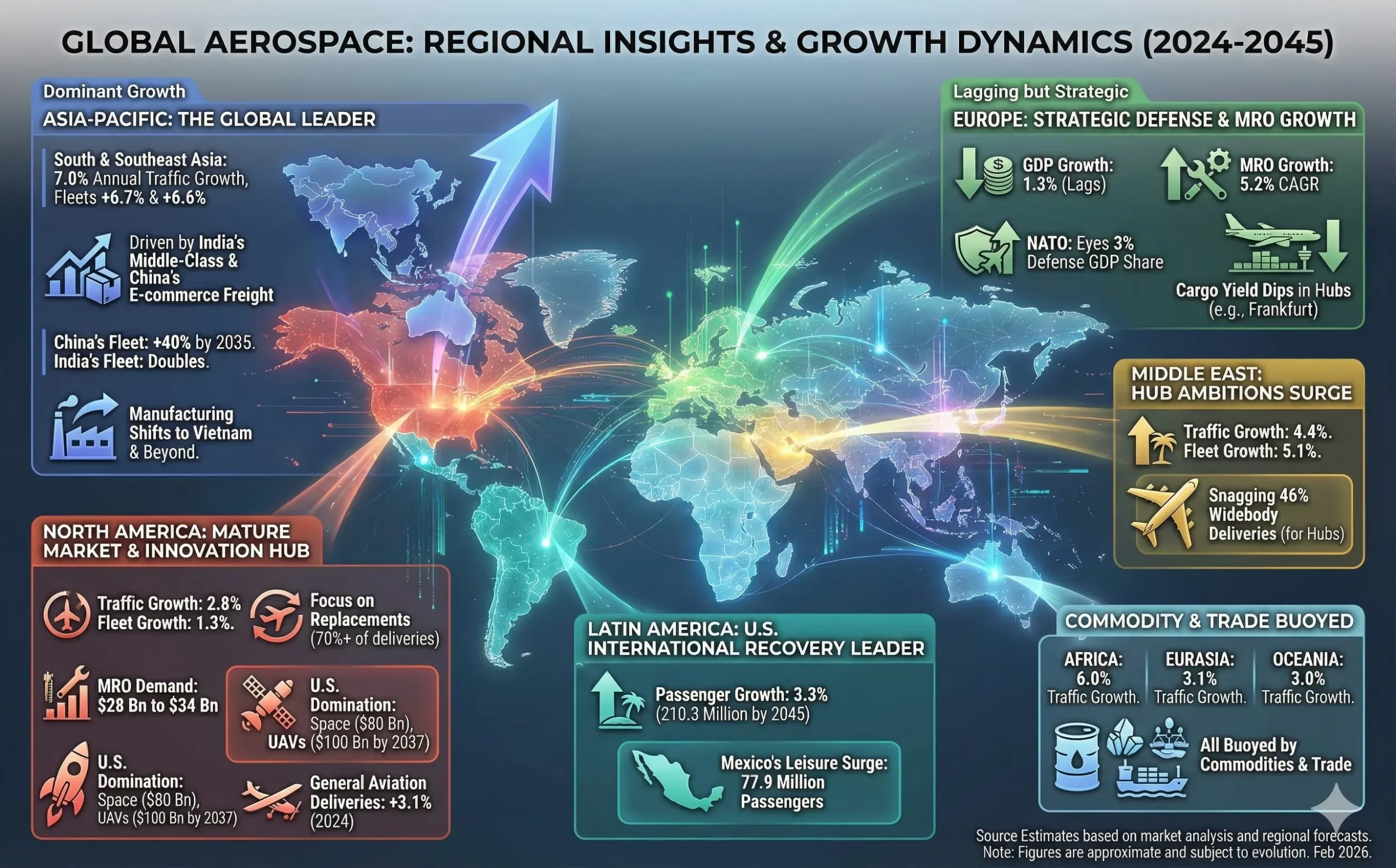
North America tempers growth at 2.8% traffic and 1.3% fleet, focusing on replacements (70%+ of deliveries) and MRO demand climbing from $28 billion to $34 billion. The U.S. dominates space ($80 billion) and UAVs ($100 billion by 2037), with general aviation deliveries up 3.1% in 2024.
Europe lags at 1.3% GDP, but NATO eyes 3% defense GDP share; MRO grows at 5.2% CAGR, though hubs like Frankfurt face cargo yield dips. Middle East surges with 4.4% traffic and 5.1% fleet growth, snagging 46% widebody deliveries for hub ambitions.
Latin America leads U.S. international recovery at 3.3% passenger growth, hitting 210.3 million by 2045, thanks to Mexico’s leisure surge (77.9 million). Africa clocks 6.0% traffic, Eurasia 3.1%, and Oceania 3.0%, all buoyed by commodities and trade.
A comparative table of regional fleet and traffic projections (2025-2044) illustrates these disparities:
| Region | Annual Traffic Growth (%) | Annual Fleet Growth (%) | Key Highlight | Projected Fleet Share by 2044 (%) |
|---|---|---|---|---|
| South Asia | 7.0 | 6.7 | India’s doubling by 2035 | 10 |
| Southeast Asia | 7.0 | 6.6 | E-commerce freight boom | 8 |
| Africa | 6.0 | 4.4 | Commodity-driven expansion | 4 |
| China | 5.3 | 4.0 | 40% fleet growth by 2035 | 15 |
| Middle East | 4.4 | 3.9 | Widebody dominance (46% deliveries) | 7 |
| Latin America | 4.3 | 3.0 | Mexico leisure traffic (77.9M pax) | 6 |
| Eurasia | 3.1 | 2.4 | Steady replacement demand | 5 |
| Oceania | 3.0 | 2.2 | Trade route enhancements | 3 |
| North America | 2.8 | 1.3 | MRO surge to $34B | 25 |
| Northeast Asia | 2.4 | 1.6 | Japan/Europe maturity | 17 |
This data underscores emerging regions’ outsized role, potentially reshaping global supply dynamics.
Technological Advancements: From Wings to Algorithms
Technology isn’t evolving the aerospace game—it’s rewriting the rules. AI-enabled systems dominate, with agentic variants boosting productivity in decision-making and logistics. Predictive maintenance, powered by digital twins, exemplifies this: GE Aerospace’s AI Wingmate optimizes workflows, while Alaska Airlines trims fuel via route AI.
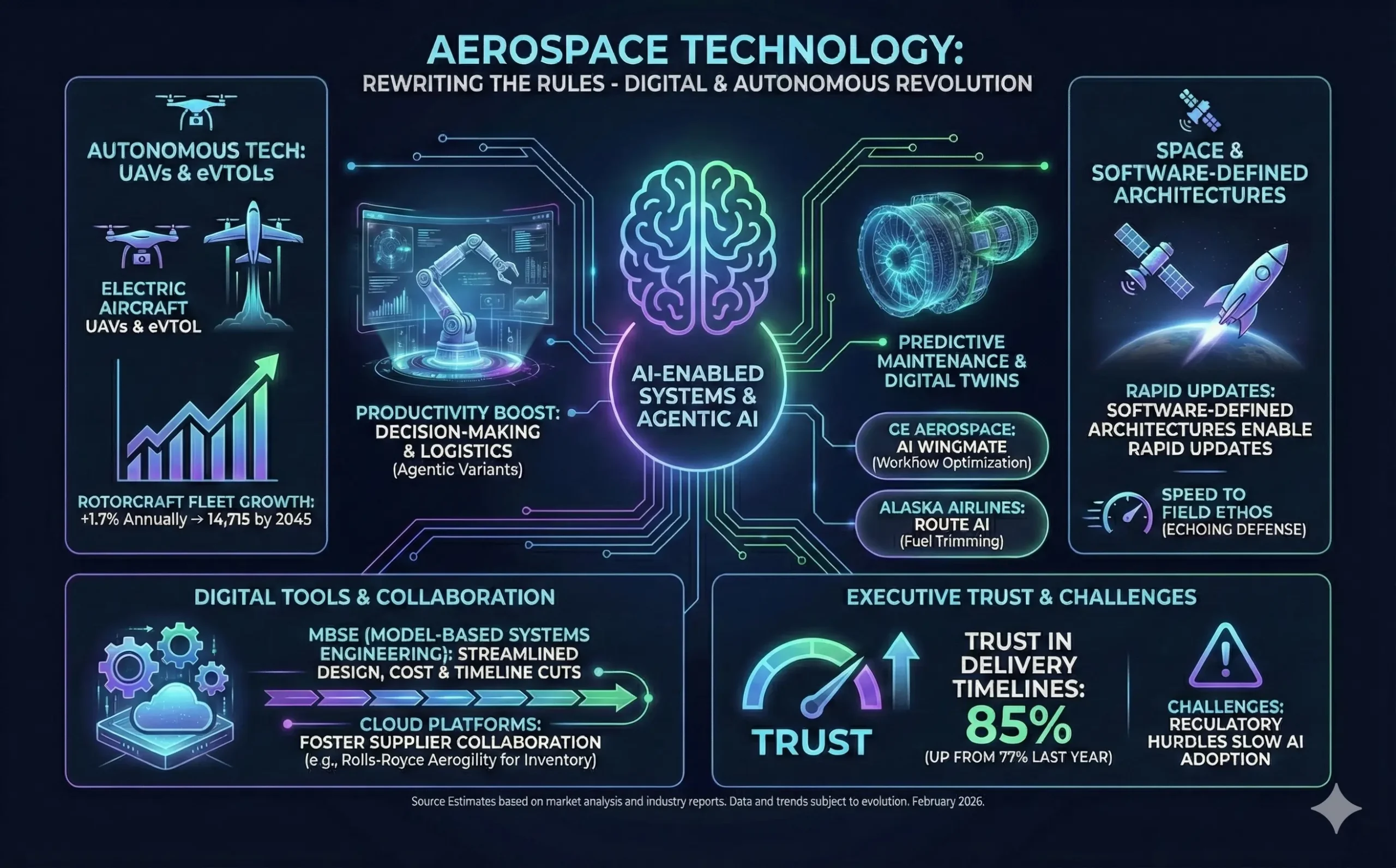
Autonomous tech extends to UAVs and eVTOLs (electric vertical takeoff and landing), with rotorcraft fleets growing 1.7% annually to 14,715 by 2045. In space, software-defined architectures enable rapid updates, echoing defense’s “speed to field” ethos.
Digital tools like MBSE streamline design, cutting costs and timelines. Cloud platforms foster supplier collaboration, as in Rolls-Royce’s Aerogility for inventory tracking. Challenges persist—regulatory hurdles slow AI adoption—but 85% of executives now trust delivery timelines, up from 77% last year.
A breakdown of tech impacts by segment:
| Technology | Commercial Impact | Defense/Space Impact | Adoption Forecast (by 2029) |
|---|---|---|---|
| AI/Gen AI | Predictive MRO, scheduling (36% tasks) | Autonomous missions, command AI | $5.8B U.S. spend |
| Digital Twins | Supply visibility, fault prediction | Risk simulation, rapid prototyping | Widespread by 2028 |
| MBSE | Design efficiency, integration speed | Multi-domain ops planning | Early adopters lead 2026 |
| eVTOL/UAV | Urban air mobility, cargo drones | Surveillance, strike capabilities | $200B UAV market by 2035 |
| Cloud Platforms | Supplier collab, data sharing | Secure comms, ecosystem openness | 76% exec optimism (1-yr) |
These advancements promise not just efficiency but safer, smarter skies.
Sustainability Efforts: Greening the Jet Stream
The clarion call for sustainability echoes loudly, with net-zero pledges demanding action. SAF scaling is critical, yet production lags; collaborations aim to bridge this, especially as 40,000 jets enter service soon. Circular economy practices—recycling composites and engines—gain traction, reducing waste in aging fleets averaging 13.4 years by 2025.
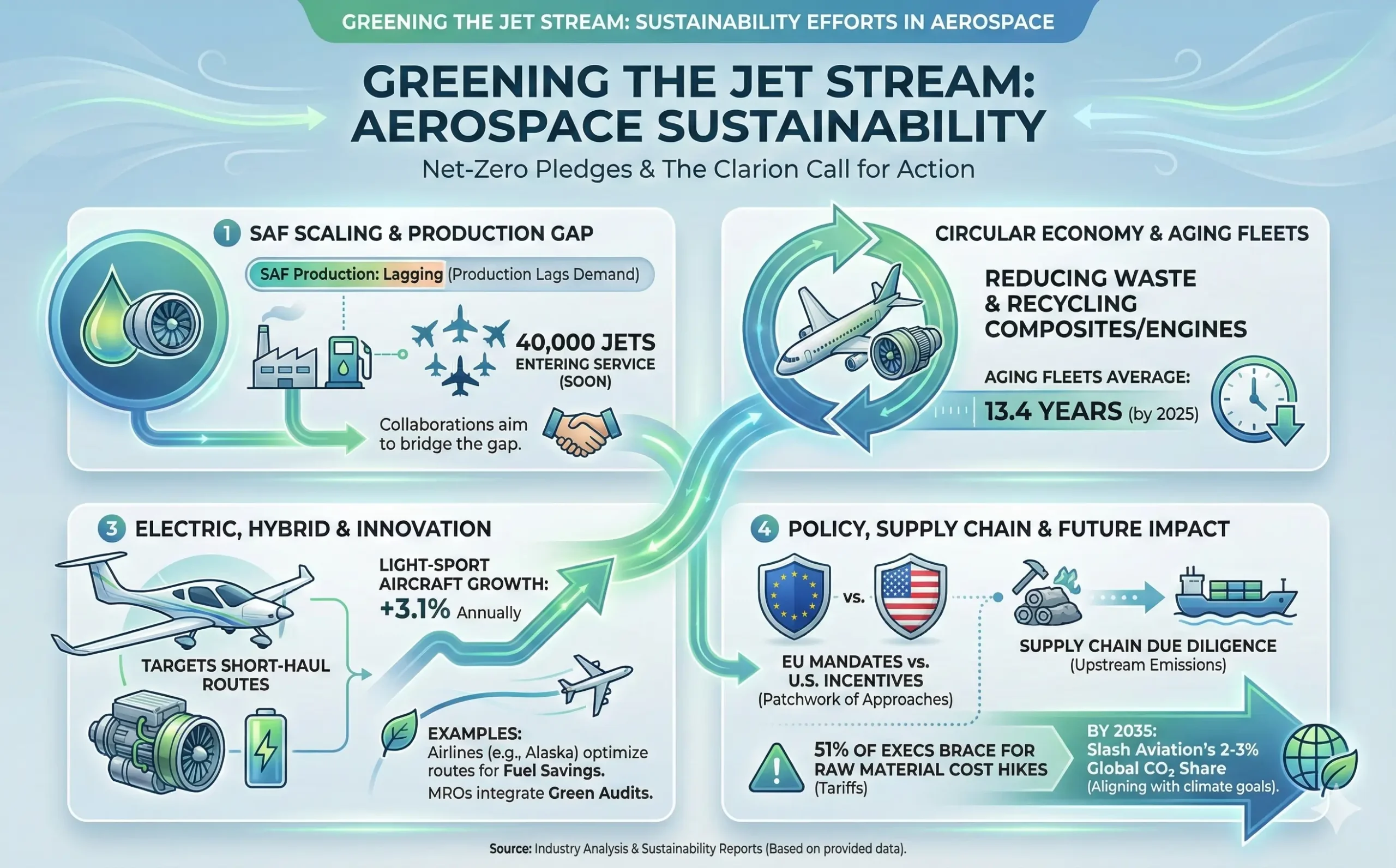
Electric and hybrid propulsion targets short-haul routes, with light-sport aircraft growing 3.1% annually. EU’s stringent mandates contrast with U.S. incentives, fostering a patchwork of approaches. Examples abound: airlines like Alaska optimize routes for fuel savings, while MROs integrate green audits.
Supply chain due diligence tackles emissions upstream, with 51% of execs bracing for raw material cost hikes from tariffs. By 2035, these efforts could slash aviation’s 2-3% global CO2 share, aligning with broader climate goals.
Challenges and Opportunities
No ascent is smooth. Supply bottlenecks—engines, aerostructures—delay ramps, like Airbus’s A320 to 2027. Labor shortages plague MRO, with 49% of execs eyeing spend hikes amid backlogs. Geopolitics adds fuel to the fire: 40+ elections in 2025 stir uncertainties, yet spur defense M&A.
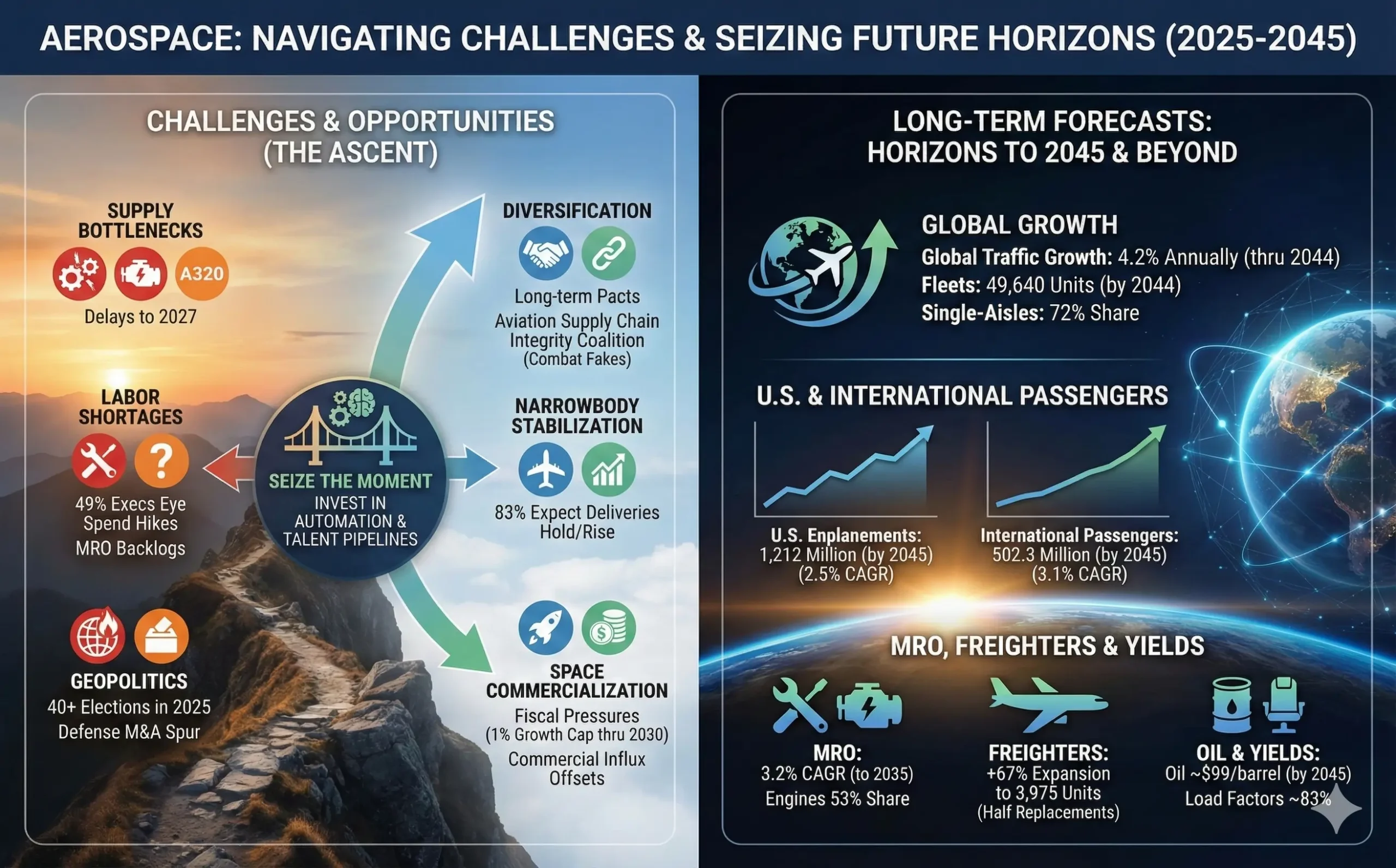
Opportunities gleam in diversification: long-term supplier pacts and Aviation Supply Chain Integrity Coalition combat fakes. 83% expect narrowbody deliveries to hold or rise, signaling stabilization. For space, fiscal pressures cap budgets at 1% growth through 2030, but the commercial influx offsets.
Stakeholders can seize these by investing in automation and talent pipelines, turning headwinds into tailwinds.
Long-Term Forecasts: Horizons to 2045 and Beyond
The crystal ball shines bright: global traffic grows 4.2% annually through 2044, ballooning fleets to 49,640 units with single-aisles at 72% share. U.S. enplanements hit 1,212 million by 2045 (2.5% CAGR), international passengers 502.3 million (3.1%).
MRO sustains at 3.2% CAGR to 2035, engines claiming 53% share. Freighters expand 67% to 3,975 units, half replacements. Oil at $99/barrel by 2045 tempers yields, but load factors hover near 83%.
A forecast table for key metrics:
| Metric | 2025 Value | 2035 Projection | 2045 Projection | CAGR (2025-2045) |
|---|---|---|---|---|
| Global Fleet (Commercial) | 29,079 units | 38,309 units | 49,640 units | 2.7% |
| Annual Deliveries | ~1,300 units | >2,400 units | N/A (avg 2,180/yr) | 3.1% growth |
| MRO Market | $119 billion | $156 billion | N/A | 2.7% |
| Passenger Numbers (Global) | 5.2 billion | N/A | ~10 billion (est) | 4.2% traffic |
| UAV Market | $41 billion | $200 billion | N/A | 16% (to 2035) |
| Space Economy | $135 billion (invest) | $1.8 trillion | N/A | ~15% est |
These numbers herald a robust trajectory, contingent on resolving near-term kinks.
Conclusion
The global aerospace market’s outlook is one of exhilarating potential, where trends like AI and sustainability converge to redefine possibilities. From Asia’s explosive growth to North America’s steady reinvention, the sector’s mosaic promises prosperity—if leaders embrace resilience and innovation. As fleets swell and stars beckon, the call is for bold, collaborative strides.
Key Citations And References
- 2026 Aerospace and Defense Industry Outlook | Deloitte Insights
- 2025 Aerospace Industry Market Analysis – UHY
- Emerging trends in aerospace and defense 2025
- Aerospace and defense industry performance and outlook – PwC
- 2025 Global Business Aviation Outlook – Honeywell Aerospace
- FAA Aerospace Forecast Fiscal Years 2025–2045
- Global Fleet And MRO Market Forecast 2025-2035 – Oliver Wyman
- Commercial Market Outlook | 2025-2044 – Boeing
- Commercial Aerospace Insight Report | Accenture
Read These Articles in Detail
- Aerospace Engineering vs. Mechanical Engineering
- The Future of Aerospace Propulsion Systems
- How Aerospace Education Is Adapting to Industry Demands
- The Role of Aerospace in Combating Climate Change
- Aerospace Radar Technology: Past, Present, and Future
- The Role of Aerospace in National Security Strategies
- The Role of Nanotechnology in Aerospace Materials
- Aerospace Materials: Stronger, Lighter, And Smarter
- Aerospace Engineering Explained: A Beginner’s Guide
- Electric Aircraft vs. Hydrogen Aircraft: Which Is More Sustainable?
- Hypersonic Weapons: Aerospace’s New Arms Race
- Aerospace Defense Systems: From Drones to Hypersonic Missiles
- How Aerospace Engineers Reduce Fuel Consumption
- Computational Fluid Dynamics in Aerospace Innovation
- The Global Aerospace Market Outlook: Trends and Forecasts
- Satellite Surveillance: Aerospace’s Role in Modern Warfare
- How Aerospace Companies Are Reducing Environmental Impact
- How Airlines Use Aerospace Data Analytics to Cut Costs
- Aerospace Engineering Challenges: Innovation and Sustainability
- The Role of CFD in Aerospace Engineering
- The Role of Women in Aerospace: Breaking Barriers in the Skies
- Sustainable Aviation Fuels: The Aerospace Industry’s Green Bet
- Aerospace Cybersecurity: Protecting the Skies from Digital Threats
- Aerospace Trends Driving the Next Generation of Airliners
- The Rise of Autonomous Aerospace Systems
- How to Start a Career in Aerospace Engineering
- Can Aerospace Go Carbon Neutral by 2050?
- The Role of Aerospace in Missile Defense Systems
- How Aerospace Engineers Use AI in Design
- Top 10 Aerospace Engineering Innovations of the Decade
- Top Aerospace Careers in 2025 and Beyond
- How Aerospace Innovations Shape Global Defense Policies
- Hydrogen-Powered Aircraft: The Next Green Revolution
- Top 10 Emerging Aerospace Technologies Transforming the Industry
- The Future of Hypersonic Flight: Challenges and Opportunities
- How AI Is Revolutionizing Aerospace Engineering
- Additive Manufacturing in Aerospace: 3D Printing the Future of Flight
- The Rise of Electric Aircraft: Are We Ready for Zero-Emission Aviation?
- Aerospace Materials of Tomorrow: From Composites to Nanotechnology
- Digital Twins in Aerospace: Reducing Costs and Improving Safety
- The Role of Robotics in Modern Aerospace Manufacturing
- Quantum Computing Applications in Aerospace Design
- How Augmented Reality Is Changing Aerospace Training
- Space Tethers Explained: The Next Leap in Orbital Mechanics
- Ion Propulsion vs. Chemical Rockets: Which Will Power the Future?
- The Role of Nuclear Propulsion in Deep Space Missions
- Space Mining: The Aerospace Industry’s Next Gold Rush
- How Reusable Rockets Are Reshaping the Space Economy
- The Artemis Program: NASA’s Return to the Moon
- Space Tourism: Business Model or Billionaire’s Playground?
- How Aerospace Startups Are Disrupting Commercial Aviation
- The Economics of Low-Cost Airlines in the Aerospace Era
- Urban Air Mobility: The Rise of Flying Taxis
- The Future of Mars Colonization: Key Aerospace Challenges and Solutions Ahead
- CubeSats and Small Satellites: Democratizing Space Access
- The Future of Cargo Drones in Global Logistics
- The Role of Aerospace in Building a Lunar Economy
Frequently Asked Questions
FAQ 1: What is the projected size and growth rate of the global aerospace market from 2025 to 2035?
The global aerospace market is on a strong upward trajectory, reflecting robust demand across commercial aviation, defense, and emerging space sectors. In 2025, the overall market value is estimated at around $963 billion, building on the $922 billion recorded in 2024. This growth is propelled by factors like rising passenger traffic, geopolitical investments in defense, and advancements in unmanned systems. Projections indicate a compound annual growth rate (CAGR) of approximately 2.7% through 2035, potentially pushing the market to exceed $1.3 trillion by that year. Commercial segments alone could expand from $1,011 billion in 2025 to $1,300 billion by 2035, highlighting the sector’s resilience amid economic fluctuations.
Key drivers include fleet expansions and technological integrations, but challenges like supply chain constraints may temper short-term gains. For stakeholders, this forecast underscores opportunities in aftermarket services and sustainable innovations, positioning the aerospace industry as a cornerstone of global economic activity.
To break it down further, here’s a table summarizing market projections by major segments:
| Segment | 2025 Value (USD Billion) | 2035 Projection (USD Billion) | CAGR (%) |
|---|---|---|---|
| Commercial Aviation | 1,011 | 1,300 | 2.5 |
| Defense and Space | 2,400 | 3,800 | 4.7 |
| MRO and Aftermarket | 126 | 163 | 2.7 |
| UAVs and Emerging Tech | 41 | 200 | 16.0 |
| Total Aerospace | 963 | 1,300+ | 2.7 |
This table illustrates the diversified growth, with UAVs leading the charge due to dual-use applications in defense and civilian operations.
FAQ 2: How is artificial intelligence (AI) influencing key trends in the aerospace industry for 2025 and beyond?
Artificial intelligence is rapidly becoming a game-changer in the aerospace sector, enhancing everything from design processes to operational efficiencies. In 2025, AI adoption is expected to accelerate, with U.S. spending on aerospace AI projected to reach significant levels, driven by applications in predictive maintenance and autonomous systems. For instance, AI algorithms are optimizing flight paths to reduce fuel consumption, while in manufacturing, they automate quality checks to minimize defects.
One major trend is the integration of AI in supply chain management, where machine learning forecasts disruptions and streamlines inventory. This not only cuts costs but also improves delivery timelines for critical components. Additionally, AI-powered digital twins—virtual replicas of aircraft—allow for real-time simulations, speeding up testing and certification phases that traditionally take years.
- Autonomous Operations: Drones and unmanned aerial vehicles (UAVs) benefit from AI for navigation in complex environments, boosting applications in surveillance and logistics.
- Sustainability Boost: AI analyzes data to optimize engine performance, potentially reducing emissions by up to 10% on long-haul flights.
- Workforce Enhancement: By handling repetitive tasks, AI frees engineers for creative problem-solving, addressing the industry’s talent shortage.
- Cybersecurity Edge: Advanced AI detects threats in real-time, safeguarding connected aircraft systems against evolving digital risks.
As we look to 2026 and later, the convergence of AI with other technologies like 5G will further transform aerospace, making operations smarter and more adaptive. Companies investing early in AI infrastructure stand to gain a competitive edge in this evolving landscape.
FAQ 3: What role does sustainable aviation fuel (SAF) play in the aerospace industry’s push toward net-zero emissions?
Sustainable aviation fuel (SAF) is emerging as a cornerstone in the aerospace industry’s efforts to decarbonize, offering a drop-in alternative to traditional jet fuel that can slash lifecycle emissions by up to 80%. By 2025, global SAF production is forecasted to hit around 2 million tons, representing just 0.7% of total aviation fuel needs, but this marks a critical ramp-up from previous years. Airlines are committing to blends starting at 2% in 2025, with mandates in regions like Europe pushing for progressive increases to 70% by 2050.
The appeal of SAF lies in its compatibility with existing aircraft and infrastructure, requiring no major modifications, which accelerates adoption. Produced from waste oils, agricultural residues, and even municipal solid waste, SAF diversifies supply chains and supports circular economy principles. However, scaling remains challenging due to high production costs—often two to four times that of conventional fuel—and limited feedstock availability.
In practice, carriers like Air Canada plan to incorporate over 77 million liters of SAF in 2025, equivalent to 1% of their fuel use, signaling a broader industry shift. Governments are stepping in with incentives, such as tax credits and procurement policies, to bridge the cost gap. Looking ahead, SAF could account for 10-20% of aviation fuels by 2030 if investments continue, playing a pivotal role in aligning the sector with global climate goals while maintaining connectivity.
FAQ 4: How does aerospace market growth vary across regions like Asia, Europe, and North America in 2025?
Regional dynamics in the aerospace market highlight stark contrasts, with emerging economies outpacing mature ones in expansion rates. Asia-Pacific leads with explosive growth, fueled by urbanization and rising middle classes, while North America focuses on innovation and defense. Europe, meanwhile, grapples with regulatory pressures but benefits from established manufacturing hubs.
For a clear comparison, consider this table outlining key growth indicators for 2025:
| Region | Projected Traffic Growth (%) | Fleet Expansion (CAGR %) | Market Value Contribution (2025, USD Billion) | Key Growth Factor |
|---|---|---|---|---|
| Asia-Pacific | 7.0 | 6.5 | 350 | E-commerce and domestic travel |
| North America | 2.8 | 1.3 | 400 | Defense spending and MRO |
| Europe | 3.5 | 2.0 | 250 | Sustainability mandates |
| Middle East | 4.4 | 3.9 | 100 | Hub expansions |
Asia’s dominance stems from countries like India and China, where fleets are expected to double by 2035, driving demand for narrowbody aircraft. North America’s strength lies in its $80 billion space investments, while Europe’s emphasis on green tech positions it for long-term gains despite slower near-term traffic recovery.
FAQ 5: What are the latest forecasts for the unmanned aerial vehicle (UAV) market within aerospace through 2030?
The unmanned aerial vehicle (UAV) market, often synonymous with drones in aerospace contexts, is poised for remarkable expansion, transitioning from niche military uses to widespread commercial applications. Valued at $36 billion in 2024, the sector is projected to surge to $41 billion in 2025 and climb to over $200 billion by 2035, with a staggering 16% CAGR. By 2030, estimates vary but converge around $40-102 billion, reflecting optimism in defense integrations and civilian innovations like delivery services.
Growth is anchored in technological leaps, such as improved battery life and AI autonomy, enabling beyond-visual-line-of-sight operations. Defense remains a powerhouse, with UAVs enhancing reconnaissance, but commercial sectors like agriculture and infrastructure inspection are catching up rapidly.
- Defense Applications: Expected to dominate 60% of the market, with payloads for surveillance growing to $6.69 billion by 2030.
- Commercial Expansion: Drones for logistics could add $54.6 billion by 2030, led by e-commerce giants.
- Regulatory Tailwinds: FAA and EASA approvals for urban air mobility will unlock new revenue streams.
- Challenges and Mitigations: Cybersecurity risks are rising, but blockchain integrations offer robust solutions.
This trajectory positions UAVs as a high-growth subset of aerospace, blending efficiency with versatility for a connected future.
FAQ 6: What does the outlook look like for the aerospace maintenance, repair, and overhaul (MRO) market from 2025 to 2035?
The maintenance, repair, and overhaul (MRO) market in aerospace is set for steady, indispensable growth, serving as the backbone for fleet reliability amid expanding operations. Starting at $119 billion in 2025, the sector is forecasted to reach $156 billion by 2035, growing at a 2.7% CAGR. This expansion mirrors the global fleet’s 2.8% annual increase, with aging aircraft—averaging 13.4 years old—demanding more intensive upkeep.
Engines will claim the lion’s share, around 53% of MRO spend, due to their complexity and high-value nature. Digital tools like predictive analytics are revolutionizing the field, reducing unplanned downtime by up to 30% and shifting focus from reactive to proactive strategies. Regional hubs in Asia and the Middle East are emerging as cost-effective alternatives to traditional North American and European centers.
Yet, labor shortages pose a hurdle, with 65% of providers citing skilled technician gaps as a top concern. Investments in training and automation will be key to sustaining this growth, ensuring the MRO ecosystem supports the industry’s ambitious fleet targets without compromising safety.
FAQ 7: How is the space economy expected to evolve and contribute to the broader aerospace market by 2035?
The space economy, increasingly intertwined with traditional aerospace, represents one of the most dynamic growth stories, projected to balloon from $135 billion in total investments in 2025 to a whopping $1.8 trillion by 2035. This near-tripling in value outpaces global GDP growth, driven by satellite constellations, space tourism, and resource utilization.
Commercialization is the engine here, with private ventures funding over 80% of activities in some regions, while governments focus on exploration. By 2030, over 60,000 satellites could orbit Earth, enhancing global connectivity and Earth observation services.
Here’s a segmented forecast table to illustrate the breakdown:
| Space Segment | 2025 Value (USD Billion) | 2035 Projection (USD Billion) | Key Driver |
|---|---|---|---|
| Satellite Communications | 100 | 800 | Broadband expansion |
| Launch Services | 20 | 300 | Reusable rockets |
| Space Tourism | 5 | 150 | Suborbital flights |
| Earth Observation | 10 | 200 | Climate monitoring |
| Total Space Economy | 135 | 1,800 | Commercial innovation |
This growth not only amplifies aerospace revenues but also fosters cross-sector synergies, like dual-use technologies for aviation.
FAQ 8: What are the primary supply chain and labor challenges facing the global aerospace industry in 2025?
Supply chain vulnerabilities and labor constraints continue to cast shadows over the aerospace industry’s recovery and expansion in 2025, despite optimistic forecasts. Persistent disruptions, from raw material shortages to geopolitical tensions, have inflated costs and delayed deliveries, with airlines facing an estimated $11 billion hit this year alone. Over 17,000 aircraft orders backlog underscores the strain, as production ramps lag behind demand.
Labor issues compound this, with 65% of firms reporting acute shortages in skilled roles like machinists and engineers, exacerbated by retirements and competition from tech sectors. These challenges slow MRO operations and innovation timelines.
- Mitigation Strategies for Supply Chains: Diversifying suppliers through friendshoring and adopting digital twins for visibility.
- Addressing Labor Gaps: Partnerships with vocational programs and AI-assisted training to upskill workers faster.
- Cost Implications: Expect 5-10% hikes in component prices, but long-term contracts can stabilize budgets.
- Innovation Opportunities: Blockchain for traceability and automation to reduce human dependency in repetitive tasks.
Navigating these hurdles requires collaborative ecosystems, turning potential pitfalls into avenues for resilience and efficiency.
FAQ 9: What are the long-term forecasts for commercial aircraft deliveries from 2025 to 2045?
Commercial aircraft deliveries are anticipated to accelerate significantly over the next two decades, aligning with surging global air travel demand. In 2025, around 1,300 units are expected, rising to over 2,400 annually by the early 2030s as backlogs clear and production stabilizes. By 2044, the total could reach 43,600 new airplanes, with single-aisle models comprising 76% due to their efficiency for high-frequency routes.
This influx supports a fleet growth from 29,000 units in 2025 to nearly 50,000 by 2045, at a 2.7% CAGR, predominantly in emerging markets. Freighters will see a 67% expansion to 3,975 aircraft, catering to e-commerce booms. However, sustainability norms may shift preferences toward hybrid-electric designs post-2030.
OEMs like Airbus and Boeing aim for 800-900 deliveries each in 2025, but supply constraints could cap this at 20% below targets initially. Overall, these forecasts signal a vibrant era, provided investments in workforce and green tech keep pace.
FAQ 10: What emerging trends are shaping the business aviation sector in 2025?
Business aviation, encompassing private jets and corporate charters, is experiencing a refined evolution in 2025, balancing post-pandemic highs with sustainable maturity. Deliveries are up 12% from 2024, with 90% of operators planning stable or increased activity, driven by flexibility for high-net-worth individuals and executives.
To capture the landscape, this table highlights pivotal trends:
| Trend | Impact in 2025 | Projected Growth Driver |
|---|---|---|
| Sustainability Focus | SAF integration in 30% of fleets | Net-zero mandates |
| Digital Connectivity | AI for route optimization | Enhanced in-flight productivity |
| Market Expansion | Emerging buyers from Asia (15% rise) | Global trade recovery |
| Fleet Modernization | 30% planning new purchases | Efficiency upgrades |
| Overall Sector Value | $283 billion over decade | Subscription models |
Subscription-based access and urban air mobility are democratizing the sector, while cybersecurity bolsters trust in connected cockpits. This positions business aviation as agile and forward-looking.
FAQ 11: What are the latest projections for global defense spending in the aerospace sector heading into 2026?
Global defense spending continues to climb amid ongoing geopolitical tensions and technological advancements, directly fueling the aerospace industry’s growth. As of late 2025, total worldwide defense outlays are estimated to reach around $2.4 trillion in 2026, marking a roughly 9% increase from 2025 levels. This surge is largely driven by investments in advanced aircraft, unmanned systems, and AI-integrated platforms, with the U.S. alone projecting a 13% budget hike to $1.01 trillion for fiscal 2026. In Europe and Asia, similar trends are evident, as nations bolster air superiority capabilities in response to regional conflicts.
The focus on multi-domain operations—integrating air, space, and cyber elements—is accelerating procurement of next-generation fighters and bombers. For example, major allocations include $10.3 billion for the B-21 bomber program and $11 billion for Columbia-class submarines with aerospace ties. While this bodes well for contractors, it also heightens competition for resources, potentially straining supply chains further. Overall, these projections signal a robust pipeline for aerospace defense, with long-term implications for innovation and job creation.
To illustrate the breakdown, here’s a table of key regional defense spending forecasts for 2026:
| Region | Projected Spending (USD Trillion) | YoY Growth (%) | Primary Focus Areas |
|---|---|---|---|
| United States | 1.01 | 13 | AI systems, bombers, submarines |
| Europe | 0.45 | 8 | NATO commitments, multi-domain ops |
| Asia-Pacific | 0.60 | 10 | Regional security, UAVs |
| Middle East | 0.15 | 7 | Air defense enhancements |
| Global Total | 2.4 | 9 | Advanced aerospace tech |
This data highlights how defense remains a cornerstone of the aerospace market’s expansion.
FAQ 12: How is the eVTOL market evolving and what growth can we expect from 2025 to 2030?
The electric vertical takeoff and landing (eVTOL) market is transforming urban transportation, offering quieter, greener alternatives to traditional helicopters and ground vehicles. In 2025, the sector is valued at approximately $1.19 billion, with early certifications paving the way for commercial air taxi services in major cities like Los Angeles and Dubai. By 2030, projections indicate a leap to $4.36 billion, fueled by a staggering 54.9% compound annual growth rate (CAGR), as regulatory approvals accelerate and battery technology improves.
Urban air mobility is at the heart of this evolution, with eVTOLs promising to cut commute times dramatically—think a 30-minute helicopter ride reduced to 10 minutes with electric efficiency. Companies are testing vertiports and integrating AI for safe, automated flights, addressing noise and emission concerns that plague conventional aviation. However, challenges like infrastructure buildout and public acceptance persist, though pilot programs in 2025 are building momentum.
Looking further, the North American market leads with rapid adoption, expecting exponential growth through 2030 due to supportive FAA policies. Globally, eVTOLs could capture 10-15% of short-haul travel by decade’s end, reshaping cityscapes and boosting aerospace innovation.
FAQ 13: What are the main workforce challenges facing the aerospace industry in 2025 and how can they be addressed?
Workforce shortages remain a critical bottleneck in the aerospace sector as demand for skilled labor outpaces supply, exacerbated by an aging demographic and rapid technological shifts. In 2025, surveys indicate that 56% of manufacturers cite recruiting qualified personnel as their top hurdle, with shortages in engineers, machinists, and technicians threatening production ramps. High turnover rates, driven by competitive offers from tech giants, compound the issue, potentially delaying fleet deliveries and inflating costs.
To counter this, industry leaders are turning to strategic upskilling programs and partnerships with educational institutions. For instance, apprenticeships blending classroom learning with hands-on experience are gaining traction, aiming to fill 100,000+ vacancies projected through 2030. Diversity initiatives are also key, targeting underrepresented groups to broaden the talent pool.
- Upskilling Initiatives: Online platforms and certifications in AI and composites to reskill existing workers quickly.
- Retention Strategies: Competitive benefits like flexible hours and mental health support to reduce burnout.
- Global Talent Mobility: Visa reforms and remote collaboration tools to tap international expertise.
- Tech Integration: Automation for routine tasks, freeing humans for complex roles.
By 2026, these efforts could stabilize the workforce, ensuring the sector meets its ambitious growth targets without compromising quality.
FAQ 14: What M&A trends are shaping the aerospace and defense landscape in 2025?
Mergers and acquisitions in aerospace and defense are surging in 2025, driven by the need for consolidation amid supply chain pressures and technological convergence. Deal volume hit 250 transactions in the first half of the year, a notable rise from 2025’s earlier quarters, with private equity and strategic buyers focusing on aftermarket services and green tech. Valuations are climbing, particularly for firms with AI or sustainable capabilities, as buyers seek to secure resilient portfolios.
Strategic imperatives include vertical integration to mitigate disruptions, as seen in deals bolstering engine and avionics supply. Geopolitical factors, like the “Golden Dome” missile defense push, are spurring over $175 billion in potential contracts, attracting international players. Looking to 2026, expect a steady stream of private equity exits, with emphasis on dual-use technologies blending commercial and defense applications.
Here’s a snapshot of Q3 2025 M&A activity:
| Deal Type | Number of Deals | Avg. Value (USD Billion) | Key Sectors Involved |
|---|---|---|---|
| Strategic | 150 | 2.5 | Supply chain, defense systems |
| Private Equity | 100 | 1.8 | Aftermarket, sustainability |
| Cross-Border | 50 | 3.2 | Avionics, UAV integration |
| Total | 300 | 2.2 | Tech-enabled growth |
This trend underscores M&A as a vital tool for navigating the sector’s complexities.
FAQ 15: How is the circular economy gaining traction in the aerospace industry for 2026?
The circular economy is reshaping aerospace by emphasizing reuse, recycling, and waste reduction, aligning with net-zero ambitions and resource scarcity. In 2026, initiatives like closed-loop aluminum recycling for end-of-life aircraft are set to expand, with companies committing to process 100% of site-generated metals by year-end. This approach not only cuts emissions but also lowers costs, as recycled titanium and nickel alloys can be 20-30% cheaper than virgin materials.
Partnerships between manufacturers and recyclers are accelerating progress, transforming scrapped fuselages into high-performance parts for new builds. Sustainability certifications are becoming mandatory, driving innovation in design-for-disassembly principles. By fostering a collaborative ecosystem, the industry aims to divert 50% more waste from landfills by 2030.
Challenges include scaling infrastructure for composites, but digital tracking tools are emerging to trace materials’ lifecycles. Ultimately, these efforts position aerospace as a leader in sustainable manufacturing, benefiting both the planet and profitability.
FAQ 16: What does the global air cargo market forecast look like from 2025 to 2035?
The global air cargo market is primed for steady expansion, supported by e-commerce proliferation and resilient supply chains. Valued at $141.3 billion in 2024, it’s projected to grow at a 5.1% CAGR, reaching $239 billion by 2035. Freight tonne kilometers (FTKs) are expected to rise 4-6% annually through 2025, outpacing capacity growth and sustaining high yields.
E-commerce remains the powerhouse, with Asia-Pacific leading due to cross-border shipments from manufacturing hubs. Freighter fleets will expand to 3,975 units by 2044, with 67% as replacements for efficiency gains. However, tariffs and fuel volatility could moderate gains post-2026.
- Regional Highlights: Asia at 6% CAGR, driven by trade volumes; North America focusing on express logistics.
- Tech Drivers: Drones and automation for last-mile delivery, enhancing speed.
- Sustainability Angle: SAF adoption in cargo to meet emission targets.
- Risk Factors: Geopolitical disruptions potentially slowing 0.7% growth in 2025.
This outlook reinforces air cargo’s role in global connectivity.
FAQ 17: What is the outlook for general aviation in 2026?
General aviation, encompassing private and recreational flying, is set for moderate yet promising growth in 2026, buoyed by recovering leisure demand and business flexibility. The U.S. fleet is forecasted to edge up to 238,350 aircraft by 2045, with a 0.5% annual clip starting from 214,222 in 2023, emphasizing turbine over piston models for efficiency. Deliveries in 2026 could rise 3.1%, supported by 91% of operators planning stable or increased flights.
Economic factors like steady GDP growth at 1.7% will underpin this, though supply constraints may cap expansions. Innovations in light-sport aircraft and electric options are drawing younger pilots, diversifying the user base.
A table of key projections:
| Metric | 2025 Value | 2026 Projection | Growth Driver |
|---|---|---|---|
| U.S. Fleet Size | 220,000 units | 222,000 units | Turbine upgrades |
| Annual Deliveries | 1,200 units | 1,237 units | Leisure rebound |
| Market Value | $31.9 billion | $33.8 billion | 6.1% CAGR start |
This segment offers accessible entry to aviation’s broader ecosystem.
FAQ 18: What key regulatory updates are impacting the aerospace industry in 2025?
Regulatory landscapes in aerospace are evolving swiftly in 2025 to enhance safety, sustainability, and innovation. The FAA’s maintenance compliance overhaul introduces stricter digital documentation and inspection tracking, effective January 2025, aiming to reduce errors by 15% through enhanced audits. Similarly, updated medical rules mandate digital color vision tests for pilots, streamlining certifications while upholding standards.
On the international front, ICAO’s circular economy guidelines promote lifecycle assessments for aircraft materials, influencing design phases. EU tariffs and U.S. trade pacts add layers, with a 15% levy on certain imports reshaping supply dynamics.
- Safety Enhancements: Expanded eIPP for powered-lift vehicles to fast-track eVTOL approvals.
- Environmental Mandates: SAF blend requirements rising to 2% globally.
- Trade Implications: Bilateral agreements easing cross-Atlantic dealings.
- Compliance Tools: AI-assisted reporting to ease administrative burdens.
These changes foster a more adaptive industry, balancing growth with accountability.
FAQ 19: What investment opportunities are emerging in the aerospace sector for 2026?
As aerospace rebounds, 2026 presents compelling investment avenues, particularly in high-growth niches like space and sustainable tech. The sector’s projected $750 billion valuation by 2030 offers entry points in satellite constellations and reusable launch systems, with low-Earth orbit investments drawing $1.5 billion in VC funding quarterly. Defense stocks, buoyed by $2.4 trillion spending, stand out for stability.
Commercial aerospace shines with 25% delivery hikes, favoring suppliers in MRO and parts manufacturing, expected to hit $1.41 trillion by 2032. Emerging markets like eVTOL urban mobility promise 62% CAGR returns.
Here’s a prioritized list:
| Opportunity Area | Projected ROI (CAGR %) | Risk Level | Example Focus |
|---|---|---|---|
| Space Commercialization | 15-20 | Medium | LEO satellites, tourism |
| Defense Tech | 10-12 | Low | AI drones, missile systems |
| Sustainable Aviation | 25+ | High | SAF production, eVTOL |
| Supply Chain | 8-10 | Medium | Resilient manufacturing |
Diversified portfolios here could yield strong, long-term gains.
FAQ 20: How are geopolitical factors influencing aerospace trends in 2026?
Geopolitical tensions are profoundly shaping aerospace, from heightened defense procurements to disrupted supply routes. Conflicts in key regions have spiked budgets, with a 22% real-term increase in global spending from 2022-2025, extending into 2026 via NATO’s 3% GDP targets. Trade frictions, like U.S.-EU tariffs, are prompting friendshoring, boosting Asian manufacturing hubs.
These dynamics accelerate dual-use tech development, blending civilian and military applications for agility. However, they also risk inflation in raw materials, with titanium prices up 10% due to sanctions.
In commercial realms, rerouted cargo flows from tariffs could slow 0.7% demand growth in 2025, but resilience through diversified alliances prevails. Stakeholders must prioritize scenario planning to thrive amid uncertainty.
