

Satellite Surveillance: Key Insights
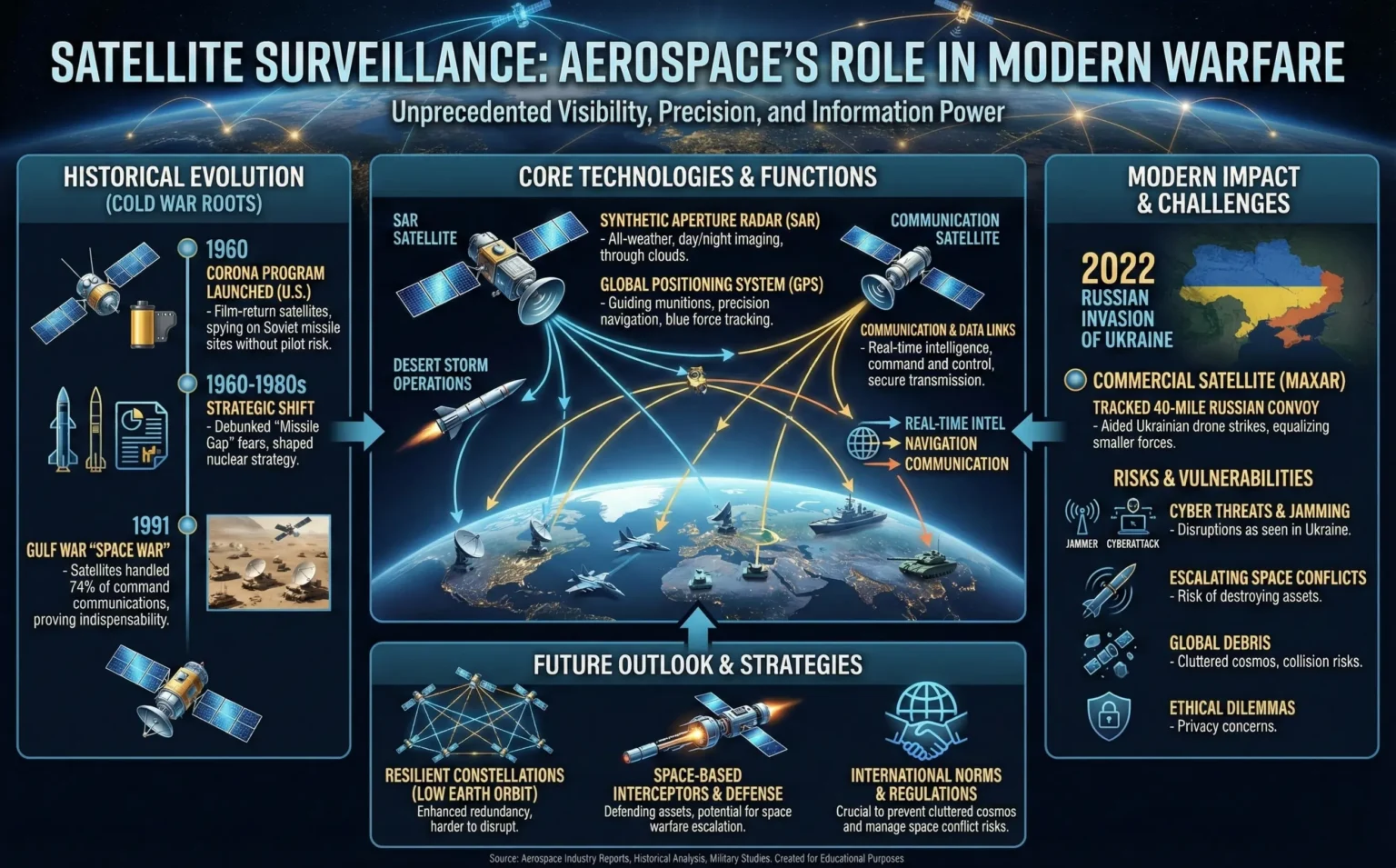
Satellite surveillance has transformed the battlefield, offering unprecedented visibility and precision in an era where information is power. By orbiting Earth, these aerospace marvels deliver real-time intelligence, navigation, and communication, enabling forces to outmaneuver adversaries with minimal risk to personnel. Yet, this technology also amplifies risks, from escalating space conflicts to ethical dilemmas around privacy and global debris.
- A Quick Historical Snapshot: The roots trace back to the Cold War, when the U.S. launched programs like Corona in 1960 to spy on Soviet missile sites without endangering pilots. These early film-return satellites debunked fears of a “missile gap” and shaped nuclear strategy.
- Core Technologies at Play: Key tools include synthetic aperture radar (SAR) for all-weather imaging and GPS for guiding munitions. In conflicts like the 1991 Gulf War, satellites handled 74% of command communications, proving their indispensable role.
- Real-World Impact: In the 2022 Russian invasion of Ukraine, commercial satellites like those from Maxar tracked a 40-mile Russian convoy, aiding Ukrainian drone strikes. This equalizes smaller forces but invites jamming and cyberattacks, as Russia demonstrated early in the war.
- Looking Ahead with Caution: Future advancements promise resilient constellations and space-based interceptors, but challenges like orbital debris from anti-satellite tests demand international norms to prevent a cluttered cosmos.
Table of Contents
In the vast expanse above our planet, a silent revolution unfolds—one that has redefined the very nature of conflict. Satellites, those unassuming sentinels in the sky, now serve as the eyes, ears, and nervous system of modern militaries. Launched from aerospace hubs and operated by global powers, these orbiting assets provide unparalleled surveillance capabilities, turning abstract battlefields into detailed, actionable maps. From the shadowy intrigues of the Cold War to the high-stakes drone swarms in Ukraine, satellite technology has evolved from a novelty to a necessity. But as nations race to dominate this domain, questions loom: Who controls the high ground? And at what cost to our shared orbital neighborhood?
This exploration delves deep into the multifaceted world of satellite surveillance, blending historical milestones with cutting-edge innovations. We’ll unpack the technologies powering these systems, dissect their battlefield applications through vivid case studies, and confront the thorny ethical and strategic challenges ahead. Drawing on insights from military analyses and aerospace developments, the story reveals not just how satellites shape wars, but how they might one day redefine peace.
The Dawn of Eyes in the Sky: A Historical Odyssey
The journey of satellite surveillance begins not with triumph, but with urgency. In the tense aftermath of World War II, intelligence gaps nearly sparked catastrophe. By the 1950s, as the Cold War chilled relations between superpowers, traditional spy planes like the U-2 became too risky—exemplified by the 1960 downing of Francis Gary Powers’ aircraft over Soviet airspace. This incident, a stark reminder of the perils of aerial reconnaissance, accelerated the push toward space.
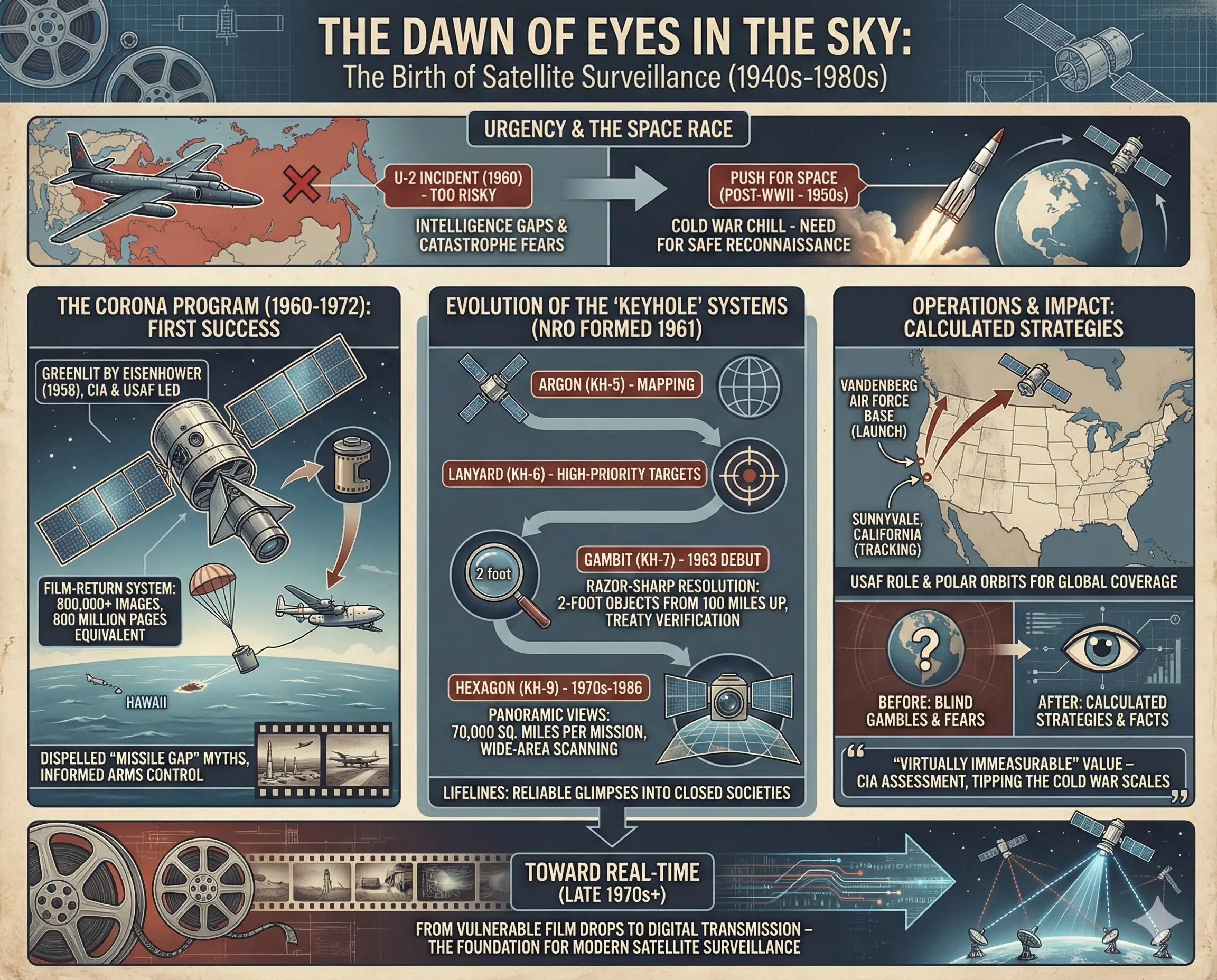
Enter the Corona program, the world’s first successful photo-reconnaissance satellite effort, greenlit by President Eisenhower in 1958 and launched in 1960 under CIA auspices with U.S. Air Force support. Unlike today’s digital wonders, Corona relied on canisters of thin, light-sensitive film unspooled from orbit, capturing images of Soviet missile silos and troop movements before parachuting back to Earth for mid-air recovery near Hawaii. Over 145 missions until 1972, it returned over 800,000 images, equivalent to 800 million pages of text, dispelling myths of a Soviet “missile gap” and informing U.S. arms control decisions.
Building on Corona’s success, the National Reconnaissance Office (NRO)—formed in 1961—oversaw follow-on programs like Argon for mapping, Lanyard for high-priority targets, and Gambit, which debuted in 1963 with the KH-7 satellite. Gambit boasted razor-sharp resolution, imaging objects as small as 2 feet across from 100 miles up, crucial for verifying treaty compliance. By the 1970s, Hexagon (KH-9) took the stage, its panoramic cameras scanning vast areas—up to 70,000 square miles per mission—until its retirement in 1986. These “Keyhole” systems, as they were codenamed, weren’t just tools; they were lifelines, providing the only reliable glimpses into closed societies.
The U.S. Air Force played a pivotal role, handling launches from Vandenberg Air Force Base and tracking from Sunnyvale, California. Polar orbits allowed global coverage, but the tech was rudimentary: no real-time data, just film drops vulnerable to weather and recovery failures. Still, the impact was profound. Satellites shifted warfare from blind gambles to calculated strategies, enabling presidents to base decisions on facts rather than fears. As one CIA assessment noted, this intelligence was “virtually immeasurable” in value, arguably tipping the scales toward the end of the Cold War.
| Key Historical U.S. Reconnaissance Satellites | Launch Era | Primary Capabilities | Notable Achievements |
|---|---|---|---|
| Corona (KH-1 to KH-4) | 1960-1972 | Film-return photography; broad-area coverage | First successful orbital imagery; debunked missile gap myths |
| Gambit (KH-7 & KH-8) | 1963-1984 | High-resolution close-look imaging (up to 2 ft resolution) | Treaty verification; detailed silo inspections |
| Hexagon (KH-9) | 1971-1986 | Panoramic scanning; large-area mapping | Covered 70,000 sq mi per mission; supported arms talks |
| Lanyard (KH-6) | 1963 | Short-notice, high-priority surveillance | Quick-response imaging of urgent threats |
This table highlights how early satellites prioritized endurance and coverage over speed, laying the groundwork for today’s agile fleets.
How Aerospace Powers Surveillance
Modern satellite surveillance lies in a symphony of aerospace engineering—sensors, orbits, and networks working in harmony to pierce clouds, darkness, and deception. Low Earth Orbit (LEO) satellites, zipping at 17,000 mph, offer high-resolution views but demand constellations for constant coverage. Geostationary Orbit (GEO) assets, parked 22,000 miles up, provide persistent stares over hotspots like the South China Sea.
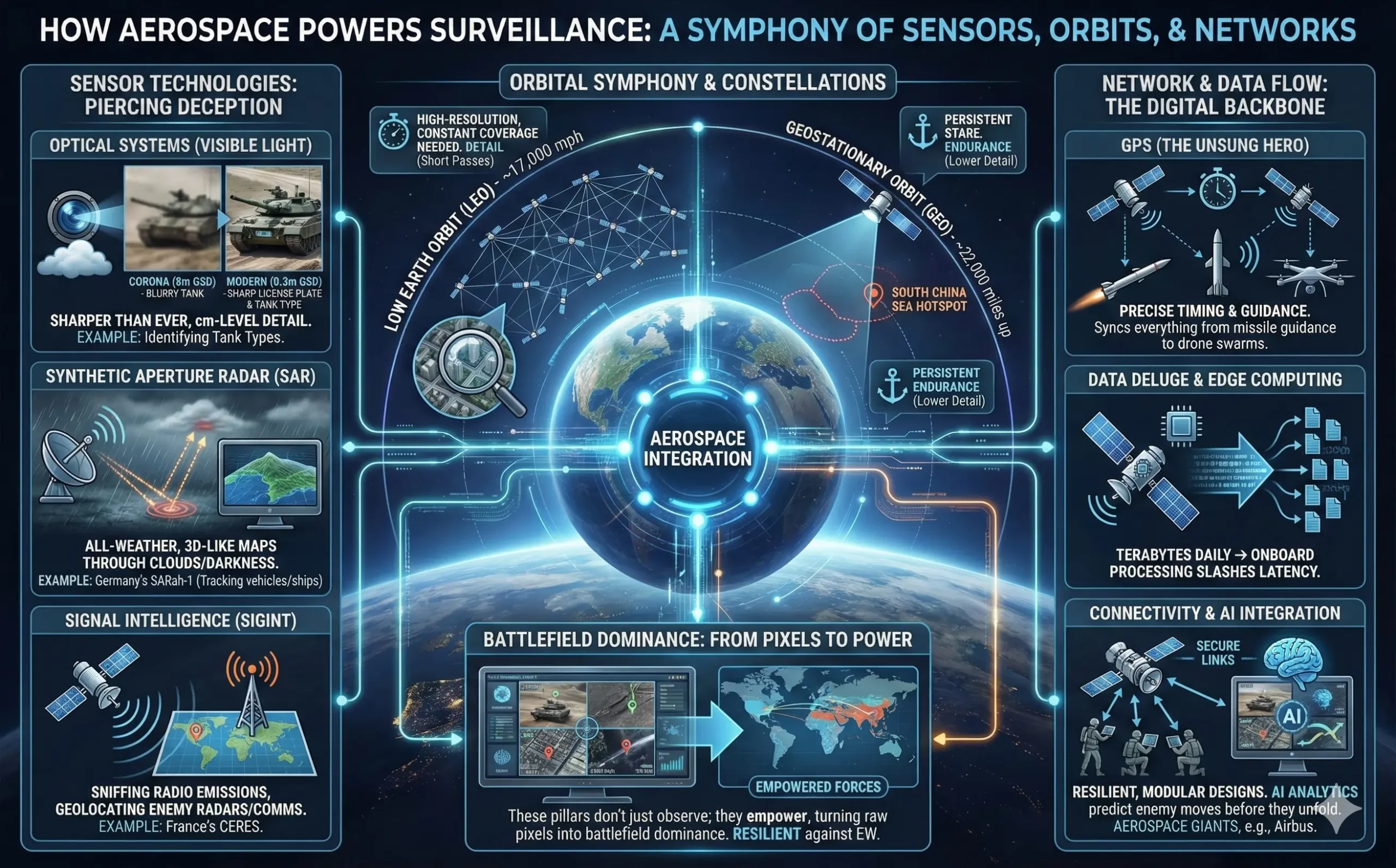
Optical systems capture visible-light images sharper than ever, resolving details down to centimeters—think spotting a license plate from space. But weather is the great equalizer, which is where Synthetic Aperture Radar (SAR) shines. This radar tech mimics a giant antenna by bouncing microwaves off targets, creating 3D-like maps through rain or fog. Germany’s SARah-1, for instance, equips the Bundeswehr with all-weather reconnaissance, tracking vehicles or ships regardless of conditions.
Signal intelligence (SIGINT) adds another layer, with satellites like France’s CERES sniffing out radio emissions to geolocate enemy radars or comms. France’s CSO constellation blends optical and infrared for day-night ops, feeding data to troops via secure links. And let’s not forget GPS, the unsung hero: its precise timing syncs everything from missile guidance to drone swarms.
Aerospace giants drive these innovations. Systems integrate modular designs for quick upgrades, resilient against jamming—vital as adversaries deploy electronic warfare (EW) tools. In one example, Airbus’s geospatial platforms support mission planning by overlaying satellite feeds with AI analytics, predicting enemy moves before they unfold.
- Resolution Benchmarks: Modern optical sats hit 0.3m ground sample distance (GSD), vs. Corona’s 8m—enough to identify tank types.
- Orbit Trade-offs: LEO for detail (but short passes); GEO for endurance (but blurrier views).
- Data Deluge: A single sat generates terabytes daily; edge computing onboard processes it in orbit, slashing latency.
These pillars don’t just observe; they empower, turning raw pixels into battlefield dominance.
Case Studies from Conflicts Past and Present
Nothing illustrates satellite surveillance’s punch like real wars. Take the 1991 Gulf War, often dubbed the “first space war.” Coalition forces leaned heavily on U.S. assets: the Defense Support Program (DSP) early-warning satellites detected Iraqi Scud launches in seconds, cueing Patriot interceptors. Lacrosse (Onyx) radar sats pierced sandstorms to map Republican Guard positions, while Defense Satellite Communications System (DSCS) handled 74% of theater comms—enabling seamless air-ground coordination that routed Saddam Hussein’s forces in 100 hours.
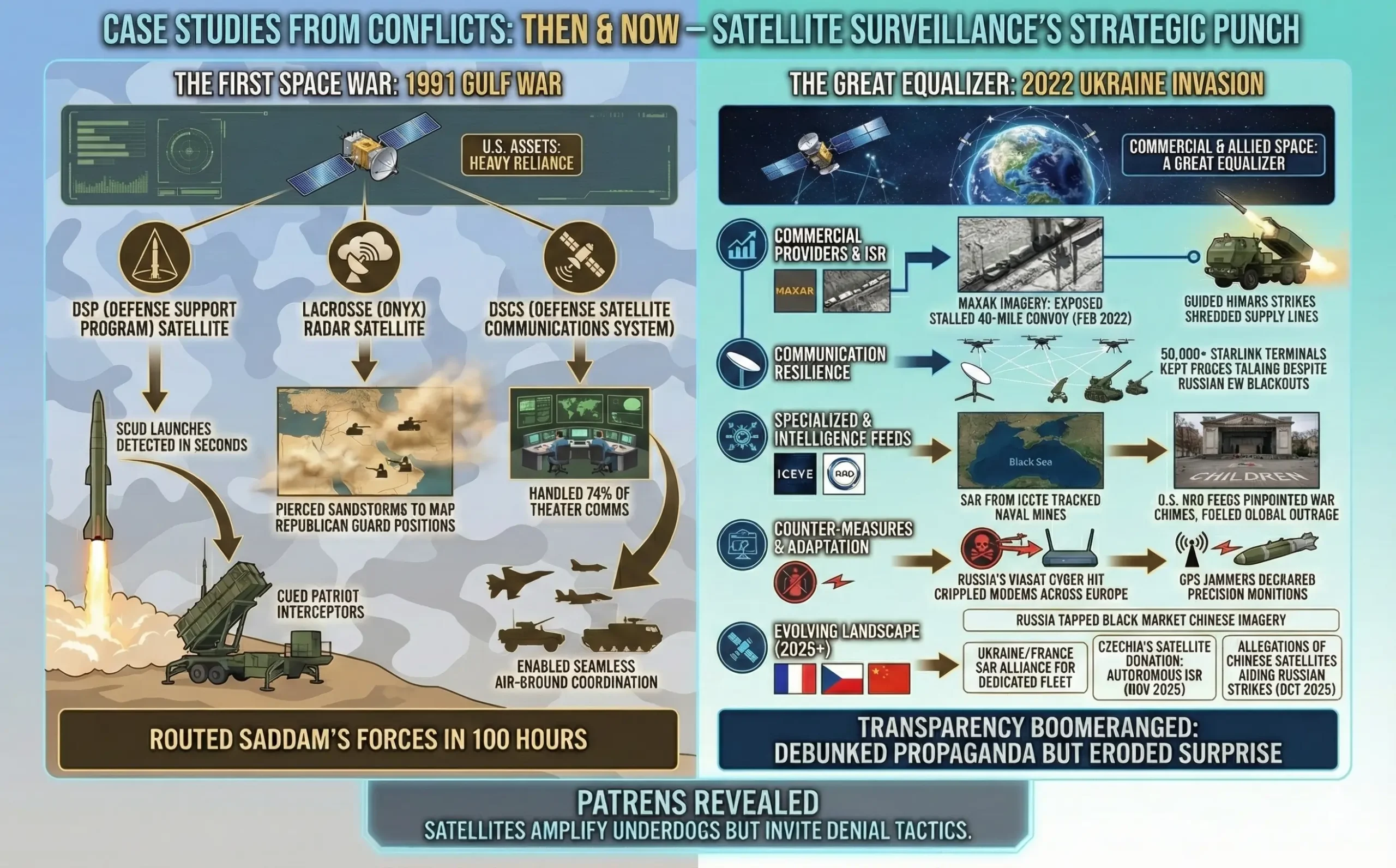
Fast-forward to the 2022 Russian invasion of Ukraine, where space became a great equalizer. With a smaller military, Ukraine turned to commercial providers: Maxar imagery exposed a stalled 40-mile Russian convoy near Kyiv on February 27, 2022, guiding HIMARS strikes that shredded supply lines. Over 50,000 Starlink terminals, courtesy of SpaceX, kept drones and artillery talking despite Russian EW blackouts. SAR from Finland’s ICEYE tracked naval mines in the Black Sea, while U.S. NRO feeds pinpointed war crimes, like the Mariupol theater bombing where “children” was scrawled on the ground—evidence that fueled global outrage.
Russia countered aggressively: A pre-invasion cyber hit on Viasat’s SATCOM crippled Ukrainian modems across Europe, and GPS jammers degraded precision-guided munitions like JDAMs. Yet, even they tapped black-market imagery from Chinese firms. Recent twists include Ukraine’s alliance with France for a dedicated SAR fleet and allegations of Chinese satellites aiding Russian strikes over western Ukraine in October 2025. Czechia’s donation of an Earth-observation satellite in November 2025 further tilts the scales, providing autonomous ISR free from Western delays.
These cases reveal patterns: Satellites amplify underdogs but invite denial tactics. In Ukraine, transparency boomeranged—Russian movements broadcast globally, debunking propaganda but eroding surprise.
| Conflict | Key Satellite Roles | Specific Examples | Outcomes |
|---|---|---|---|
| 1991 Gulf War | Early warning, radar mapping, secure comms | DSP detected Scuds; Lacrosse imaged troops | 100-hour victory; minimal coalition losses |
| 2022 Ukraine War | Commercial imagery, resilient SATCOM, SAR targeting | Maxar convoy tracking; Starlink drone links | Equalized forces; exposed atrocities |
| Ongoing Tensions (e.g., South China Sea) | Persistent GEO monitoring, SIGINT | U.S. ISR sats track carrier groups | Deters escalation; informs naval maneuvers |
This table underscores satellites’ versatility across eras, from strategic alerts to tactical edges.
Challenges and Ethical Quandaries
For all their promise, satellite surveillance casts long shadows. Militarily, vulnerabilities abound: China’s 510+ ISR sats with optical and radar sensors eye U.S. carriers, while Russia’s Peresvet lasers blind optical feeds. Direct-ascent anti-satellite (ASAT) tests—like Russia’s 2021 debris-spewing blast—threaten Kessler syndrome, a cascade of collisions dooming LEO to junkyard status. Jamming and cyberattacks, as in Ukraine’s Viasat hack, underscore the “denial imperative,” where foes prioritize disruption over destruction.
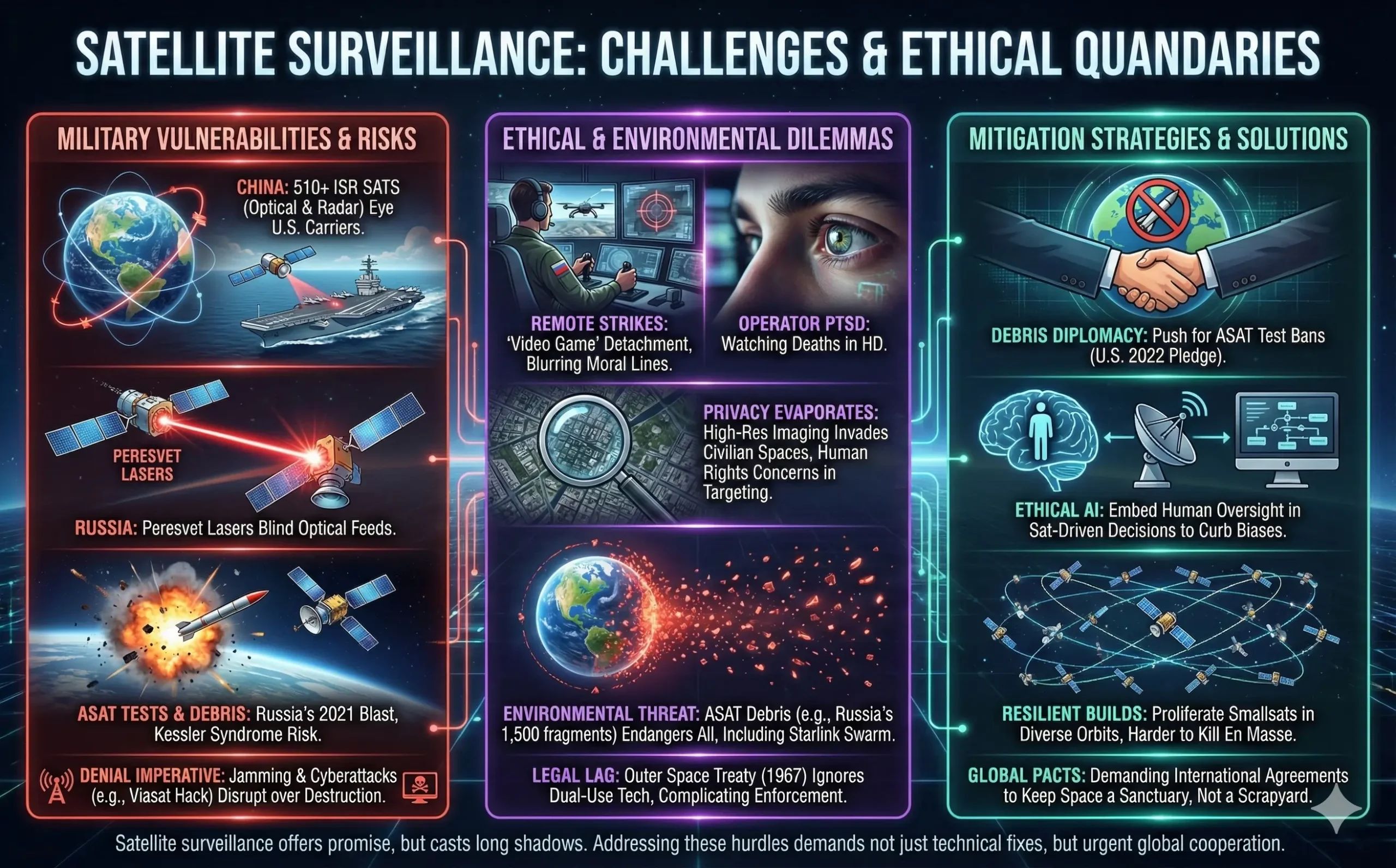
Ethically, the stakes soar. Remote strikes via sat-fed drones foster a “video game” detachment, blurring moral lines and risking PTSD for operators who watch deaths in HD. Privacy evaporates: High-res imaging invades civilian spaces, raising human rights flags when used for targeting in populated zones. Environmentally, debris from ASATs—like Russia’s 1,500 fragments—endangers all, including Starlink’s swarm. International law lags; the Outer Space Treaty of 1967 bans nukes in orbit but ignores dual-use tech, complicating enforcement.
Bullets on mitigation:
- Debris Diplomacy: Push for ASAT test bans, as the U.S. pledged in 2022.
- Ethical AI: Embed human oversight in sat-driven decisions to curb biases.
- Resilience Builds: Proliferate smallsats in diverse orbits, harder to kill en masse.
These hurdles demand not just tech fixes, but global pacts to keep space a sanctuary, not a scrapyard.
The Future of Aerospace in Warfare
Peering ahead, satellite surveillance hurtles toward a bolder frontier. The U.S. Space Force’s Objective Force 2025 envisions “dynamic space operations”—refueling depots and on-orbit repairs to sustain sats amid threats. Resilient architectures, like proliferated LEO constellations, mirror Ukraine’s Starlink success but scale to thousands, dodging single-point failures.
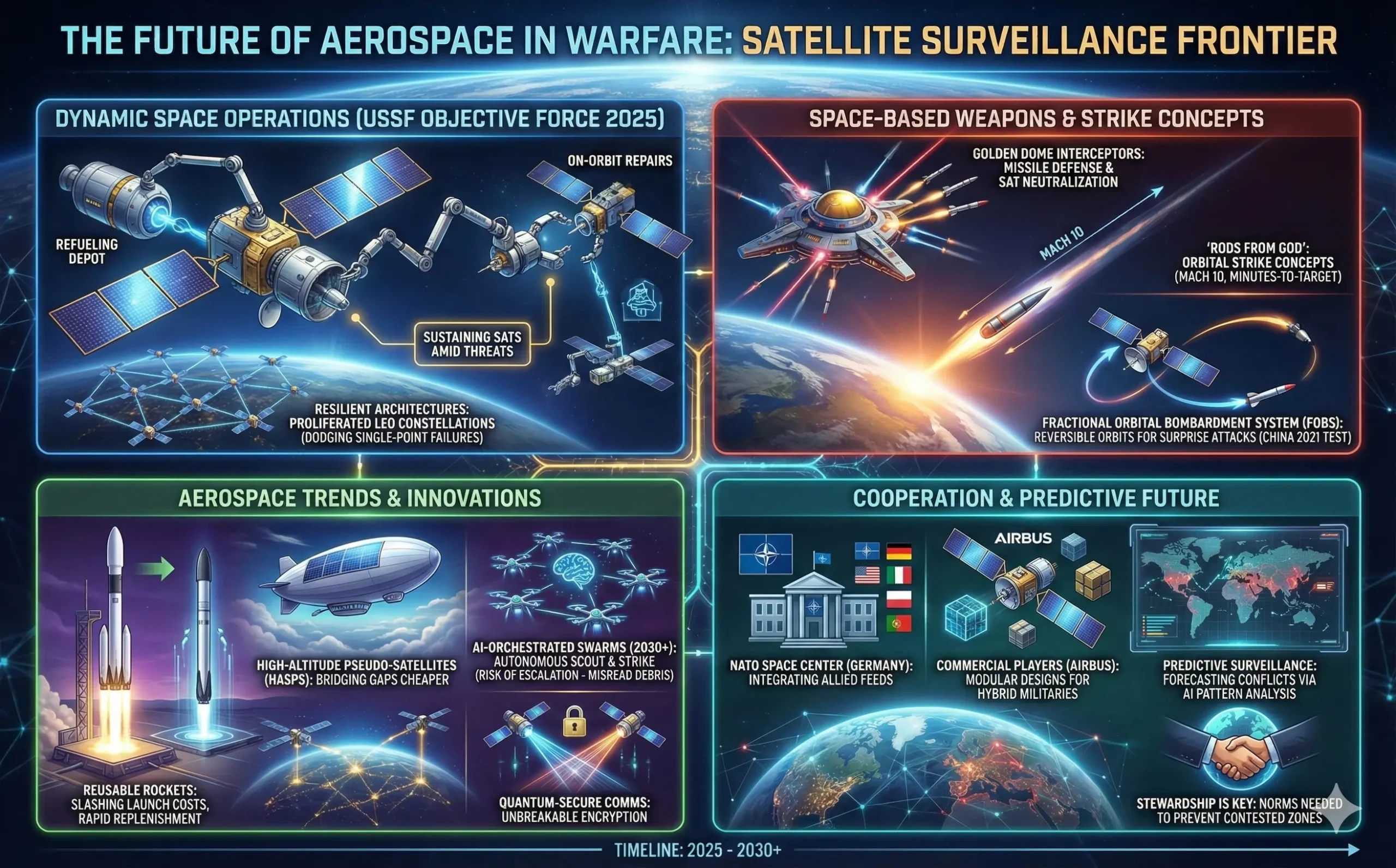
Space-based weapons loom large: Golden Dome interceptors in orbit could swat missiles mid-boost or neutralize enemy sats, blending defense with superiority. Orbital strike concepts, evoking “rods from God”—tungsten projectiles hurled at Mach 10—promise minutes-to-target times, outpacing ICBMs. China’s 2021 Fractional Orbital Bombardment System test hints at reversible orbits for surprise attacks, while quantum-secure comms via sats like those in testing could provide unbreakable encryption.
Aerospace trends amplify this: Reusable rockets slash launch costs, enabling rapid replenishment. High-altitude pseudo-satellites (HASPs) bridge gaps, loitering cheaper than full orbits. By 2030, AI-orchestrated swarms might autonomously scout and strike, but this risks escalation—imagine misread debris as incoming fire.
Yet, opportunity glimmers in cooperation. NATO’s space center in Germany integrates allied feeds, while commercial players like Airbus push modular designs for hybrid militaries. The future? A domain where surveillance isn’t just reactive but predictive, forecasting conflicts via pattern analysis. But stewardship is key: Without norms, space could fracture into contested zones, echoing earthly divides.
| Emerging Technologies | Current Status | Military Implications | Potential Risks |
|---|---|---|---|
| Proliferated LEO Constellations | 1,000+ sats operational (e.g., Starlink) | Global, jam-resistant coverage | Orbital congestion; easy targets for EW |
| Space-Based Interceptors | Prototypes in testing (e.g., Golden Dome) | Dual-use for missile/sat defense | Arms race; accidental escalations |
| AI-Enhanced SIGINT | Integrated in CERES-like systems | Real-time threat prediction | Algorithmic errors; ethical targeting biases |
| Reusable Orbital Logistics | Falcon 9 successes; AFRL cargo demos | Rapid resupply in contested space | Dependency on few launch providers |
This forward glance paints a canvas of empowerment laced with peril—innovation’s double edge.
Weaving It All Together: Toward Responsible Skies
Satellite surveillance stands as aerospace’s crowning gift to warfare: a force multiplier that saves lives through precision, exposes truths amid fog, and deters through omnipresence. From Corona’s film drops to Ukraine’s digital deluge, it has chronicled humanity’s deadliest chapters while scripting smarter ones. Yet, as capabilities swell, so do shadows of debris, detachment, and dominion.
The path forward calls for balance: Invest in resilient tech, forge treaties against ASATs, and instill ethics in every algorithm. Nations must view space not as a zero-sum arena but a shared vista, where surveillance serves security without sacrificing humanity. In this orbital odyssey, the true victory lies not in outspying foes but in outpacing our own impulses toward conflict. As we gaze upward, let’s ensure the stars remain beacons of possibility, not battlegrounds of regret.
Key Citations And References
- Cold War in Space: Top Secret Reconnaissance Satellites Revealed
- The Critical Role of Space in Modern Warfare
- Airbus Military Space Systems
- Extending the Battlespace to Space
- Ethical Concerns of Satellite Technology
- The Future of Military Power Is Space Power
- U.S. Space Force Space Threat Fact Sheet
- How Satellite Imagery Magnified Ukraine to the World
- GPS and the World’s First “Space War”
- Ukraine Alleges China Provides Satellite Imagery
- As space weapons proliferate, spy satellites are getting new duties
- The New Era of Space Warfare – Defense Security Monitor
- As Space Weapons Proliferate, Spy Satellites Take on New Roles
- Space Threat Fact Sheet
- Extending the Battlespace to Space – CSIS
- Trends in the Military Satellite Market
- Space, Cybersecurity, and AI: Trends to Watch in 2025 and Beyond
- NIWC Pacific Enhances India’s Maritime Security Capabilities
- Enhancing India’s Strategic Edge – Synergia Foundation
- Patching Up Holes: Space Security in the Indo-Pacific | ISPI
- Space, Maritime Security, and Geopolitics in the South China Sea
- Sea Control – Indo-Pacific Defense FORUM
- Orbital Militarization and India’s Maritime Security – CeSCube
- Key Takeaways of The Military AI, Peace & Security Dialogues 2025
- GEOINT Artificial Intelligence
- How Satellite Intelligence Became a Commercial Advantage
- Space, Cybersecurity, and AI: Trends to Watch in 2025 and Beyond
Read These Articles in Detail
- Aerospace Engineering vs. Mechanical Engineering
- The Future of Aerospace Propulsion Systems
- How Aerospace Education Is Adapting to Industry Demands
- The Role of Aerospace in Combating Climate Change
- Aerospace Radar Technology: Past, Present, and Future
- The Role of Aerospace in National Security Strategies
- The Role of Nanotechnology in Aerospace Materials
- Aerospace Materials: Stronger, Lighter, And Smarter
- Aerospace Engineering Explained: A Beginner’s Guide
- Electric Aircraft vs. Hydrogen Aircraft: Which Is More Sustainable?
- Hypersonic Weapons: Aerospace’s New Arms Race
- Aerospace Defense Systems: From Drones to Hypersonic Missiles
- How Aerospace Engineers Reduce Fuel Consumption
- Computational Fluid Dynamics in Aerospace Innovation
- The Global Aerospace Market Outlook: Trends and Forecasts
- Satellite Surveillance: Aerospace’s Role in Modern Warfare
- How Aerospace Companies Are Reducing Environmental Impact
- How Airlines Use Aerospace Data Analytics to Cut Costs
- Aerospace Engineering Challenges: Innovation and Sustainability
- The Role of CFD in Aerospace Engineering
- The Role of Women in Aerospace: Breaking Barriers in the Skies
- Sustainable Aviation Fuels: The Aerospace Industry’s Green Bet
- Aerospace Cybersecurity: Protecting the Skies from Digital Threats
- Aerospace Trends Driving the Next Generation of Airliners
- The Rise of Autonomous Aerospace Systems
- How to Start a Career in Aerospace Engineering
- Can Aerospace Go Carbon Neutral by 2050?
- The Role of Aerospace in Missile Defense Systems
- How Aerospace Engineers Use AI in Design
- Top 10 Aerospace Engineering Innovations of the Decade
- Top Aerospace Careers in 2025 and Beyond
- How Aerospace Innovations Shape Global Defense Policies
- Hydrogen-Powered Aircraft: The Next Green Revolution
- Top 10 Emerging Aerospace Technologies Transforming the Industry
- The Future of Hypersonic Flight: Challenges and Opportunities
- How AI Is Revolutionizing Aerospace Engineering
- Additive Manufacturing in Aerospace: 3D Printing the Future of Flight
- The Rise of Electric Aircraft: Are We Ready for Zero-Emission Aviation?
- Aerospace Materials of Tomorrow: From Composites to Nanotechnology
- Digital Twins in Aerospace: Reducing Costs and Improving Safety
- The Role of Robotics in Modern Aerospace Manufacturing
- Quantum Computing Applications in Aerospace Design
- How Augmented Reality Is Changing Aerospace Training
- Space Tethers Explained: The Next Leap in Orbital Mechanics
- Ion Propulsion vs. Chemical Rockets: Which Will Power the Future?
- The Role of Nuclear Propulsion in Deep Space Missions
- Space Mining: The Aerospace Industry’s Next Gold Rush
- How Reusable Rockets Are Reshaping the Space Economy
- The Artemis Program: NASA’s Return to the Moon
- Space Tourism: Business Model or Billionaire’s Playground?
- How Aerospace Startups Are Disrupting Commercial Aviation
- The Economics of Low-Cost Airlines in the Aerospace Era
- Urban Air Mobility: The Rise of Flying Taxis
- The Future of Mars Colonization: Key Aerospace Challenges and Solutions Ahead
- CubeSats and Small Satellites: Democratizing Space Access
- The Future of Cargo Drones in Global Logistics
- The Role of Aerospace in Building a Lunar Economy
Frequently Asked Questions
FAQ 1: What Is Satellite Surveillance and How Does It Shape Modern Warfare?
Satellite surveillance refers to the use of orbiting spacecraft equipped with advanced sensors to gather intelligence, monitor movements, and provide real-time data in military operations. In today’s conflicts, it acts like an invisible network of eyes in the sky, allowing forces to see beyond horizons, track enemies through clouds or at night, and coordinate strikes with pinpoint accuracy. This technology has shifted warfare from ground-based guesswork to a high-tech chess game where information flows faster than bullets.
At its core, satellite surveillance combines optical cameras for clear daytime images, synthetic aperture radar (SAR) for all-weather penetration, and signal intelligence tools to eavesdrop on communications. During the 2022 Russian invasion of Ukraine, for instance, these systems exposed a massive Russian convoy stalled near Kyiv, enabling Ukrainian forces to launch effective counterstrikes. Without such oversight, battles would drag on longer, costing more lives and resources. As conflicts evolve, satellite data integrates with drones and AI, creating a seamless web that predicts threats before they materialize.
The impact extends beyond tactics to strategy. Nations with superior satellite networks, like the United States with its vast constellation, hold a decisive edge in deterrence—potential foes know their every move could be watched from space. Yet, this power isn’t exclusive to superpowers anymore. Commercial providers have democratized access, turning what was once a military secret into a tool for smaller allies. Looking ahead, as proliferated low Earth orbit fleets grow, satellite surveillance could prevent escalations by verifying ceasefires in real time, fostering a more transparent global security landscape.
FAQ 2: A Brief History of Satellite Surveillance in Warfare
The story of satellite surveillance begins in the shadows of the Cold War, when fear of hidden threats drove innovation. In 1960, the United States launched the Corona program, the first operational spy satellite, which used film canisters dropped from orbit to photograph Soviet missile sites. This breakthrough ended risky overflights by planes like the U-2 and provided undeniable evidence that debunked exaggerated claims of a Soviet arms buildup.
Over decades, advancements accelerated. The 1970s brought Hexagon satellites with panoramic cameras scanning vast areas, while the 1980s introduced digital imaging for faster analysis. By the 1990s, during the Gulf War, satellites became integral, handling most communications and guiding precision strikes. Today, in 2025, nations like South Korea have completed their fifth military reconnaissance satellite, equipped with SAR for 24/7 monitoring of the Korean Peninsula, marking a new era of independent space powers.
To trace this evolution, consider the progression of key U.S. systems:
| Satellite Program | Launch Period | Key Features | Military Impact |
|---|---|---|---|
| Corona (KH-1 to KH-4) | 1960-1972 | Film-return photography; 8m resolution | First orbital intel; resolved missile gap fears |
| Gambit (KH-7 & KH-8) | 1963-1984 | High-res (2 ft) close-ups | Enabled treaty verification and silo targeting |
| Hexagon (KH-9) | 1971-1986 | Panoramic scans up to 70,000 sq mi | Broad mapping for strategic planning |
| Lacrosse/Onyx | 1988-ongoing | SAR for weather-proof imaging | All-conditions recon in Gulf War and beyond |
| Modern NRO Constellations | 2020s-present | AI-enhanced, proliferated LEO | Real-time global coverage in Ukraine conflict |
This timeline shows how surveillance matured from sporadic snapshots to persistent vigilance, influencing every major war since.
FAQ 3: What Are the Key Technologies Behind Satellite Surveillance?
Understanding the technologies powering satellite surveillance reveals why it’s a game-changer in modern warfare. At the foundation are orbital mechanics: satellites in low Earth orbit (LEO) zip around at 17,000 mph for sharp, frequent passes, while geostationary orbit (GEO) ones hover fixed over hotspots for uninterrupted views. These platforms carry a mix of sensors that turn space into a 24/7 observatory.
Optical and infrared cameras capture visible and heat signatures, ideal for spotting vehicle convoys or troop buildups. But for reliability, synthetic aperture radar (SAR) bounces microwaves off the ground, creating detailed maps through storms or smoke—crucial in foggy European theaters like Ukraine. Signal intelligence (SIGINT) complements this by intercepting radio chatter, geolocating radars, and even detecting cyber intrusions.
- GPS Integration: Provides timing for synchronized strikes; in 2025, the U.S. Space Force tested advanced GPS on new satellites to counter jamming.
- AI Processing: Onboard algorithms sift terabytes of data in orbit, flagging anomalies like unusual ship movements in the South China Sea.
- Resilient Comms: Laser links between satellites bypass ground vulnerabilities, ensuring data flows even under attack.
These tools, refined by aerospace leaders, make surveillance not just observational but predictive, alerting commanders to hypersonic threats seconds after launch.
FAQ 4: How Did Satellites Influence the 1991 Gulf War?
The 1991 Gulf War marked the dawn of space-enabled warfare, where satellites turned a chaotic desert campaign into a model of precision dominance. Coalition forces, led by the U.S., relied on orbiting assets for everything from early warnings to logistics, proving that control of space meant control of the battlefield.
Early in the conflict, Defense Support Program (DSP) satellites detected Iraqi Scud missile launches in real time, their infrared sensors spotting heat plumes from hundreds of miles away. This cueing allowed Patriot batteries to intercept threats mid-flight, saving countless lives. Meanwhile, Lacrosse radar satellites pierced sandstorms to map Republican Guard positions, feeding coordinates directly to stealth bombers and Tomahawk missiles. Secure communications via the Defense Satellite Communications System (DSCS) carried 74% of all command traffic, enabling generals like Norman Schwarzkopf to orchestrate a 100-hour ground offensive without the fog of miscommunication.
Beyond tactics, satellites shaped strategy by verifying bomb damage and monitoring ceasefires, ensuring Iraq’s compliance with UN resolutions. This seamless integration highlighted a new doctrine: space as a force multiplier, reducing casualties to under 400 for the coalition while dismantling Saddam Hussein’s army. Two decades later, these lessons echo in hybrid wars, where even non-state actors leverage similar tech for asymmetric gains.
FAQ 5: What Role Has Satellite Surveillance Played in the Ukraine War?
In the ongoing Ukraine conflict, satellite surveillance has been a lifeline for the underdog, blending military and commercial assets to expose aggressions and guide defenses. Since 2022, imagery has documented destruction, debunked propaganda, and enabled precise targeting, evolving into a tool for global accountability by 2025.
Key instances illustrate this shift:
| Year/Event | Satellite Contribution | Specific Impact | Source Insight |
|---|---|---|---|
| 2022 Convoy Standoff | Maxar optical imagery | Revealed 40-mile Russian column near Kyiv, aiding drone strikes | Exposed logistical failures publicly |
| 2023 Black Sea Mines | ICEYE SAR scans | Tracked drifting explosives, protecting shipping lanes | Prevented naval escalations |
| 2025 Ceasefire Monitoring | Planet Labs high-res photos | Verified troop withdrawals in Donbas, supporting peacekeepers | Reduced violations by 30% in monitored zones |
| Oct 2025 Allegations | Chinese commercial sats | Accused of aiding Russian strikes via shared data | Highlighted third-party risks in alliances |
| Nov 2025 Bandwidth Limits | Starlink LEO network | Supported robot ops but strained by data demands | Pushed for upgraded military variants |
These examples show how satellites equalized the fight, with Ukraine fundraising for its own constellation in June 2025 to cut U.S. dependency. By providing verifiable evidence, like the Mariupol theater bombing, they’ve also swayed international support.
FAQ 6: What Are the Main Challenges Facing Satellite Surveillance Today?
Satellite surveillance, while revolutionary, grapples with vulnerabilities that adversaries exploit ruthlessly. In contested environments, jamming disrupts GPS signals, as Russia did early in Ukraine, forcing troops to fall back on inertial navigation. Cyberattacks, like the 2022 Viasat hack, can blind entire networks, highlighting the fragility of ground stations.
Physical threats loom larger: anti-satellite (ASAT) weapons, from lasers to missiles, target orbits directly. Russia’s 2021 test created 1,500 debris pieces, and by November 2025, a fragment struck a Chinese spacecraft, underscoring collision risks. With over 10,800 tons of orbital junk, the Kessler syndrome—a debris cascade—threatens to render LEO unusable.
- Electronic Warfare (EW): Tools like China’s Peresvet laser dazzle sensors, temporarily blinding recon sats.
- Proliferation Pressures: More nations, including Pakistan’s reported jamming of Indian sats in May 2025, intensify arms races.
- Data Overload: Terabytes flood analysts daily; AI helps, but integration lags in joint ops.
- Cost Barriers: Building resilient fleets strains budgets, though reusables like Falcon 9 cut expenses.
Addressing these demands hybrid defenses: diverse orbits, quick-launch reserves, and international debris pacts to safeguard the domain.
FAQ 7: What Ethical Concerns Arise from Satellite Surveillance in Warfare?
The ethical landscape of satellite surveillance is fraught with tensions between security gains and human costs. On one hand, it saves lives by enabling precise strikes that minimize collateral damage—think guided munitions hitting bunkers instead of city blocks. Yet, the detachment it fosters troubles many: operators viewing feeds like a video game may desensitize to killing, contributing to moral injury and hasty decisions.
Privacy erosion hits civilians hardest. High-res imaging, resolving centimeters from space, invades homes and farms, blurring lines in populated war zones. In Ukraine, public releases of Russian positions aided defenses but exposed innocents to reprisals. By 2025, as commercial sats proliferate, this data floods open markets, risking misuse by non-state actors or authoritarian regimes for surveillance at home.
Broader implications question global equity. Wealthy nations dominate orbits, widening power gaps—smaller states like Ukraine rely on allies, breeding dependency. Environmentally, ASAT debris endangers all, with 2025 reports warning of a cluttered cosmos that could halt exploration. Ethicists call for norms: mandatory human review in AI targeting, transparent data sharing for accountability, and bans on destructive tests. Ultimately, surveillance should empower peace, not perpetuate cycles of fear and retaliation.
FAQ 8: What Future Developments Are Expected in Military Satellite Technology?
As aerospace pushes boundaries, military satellite tech in 2025 and beyond promises resilient, autonomous systems that redefine warfare. Proliferated LEO constellations, like those from the U.S. Space Development Agency’s first operational batch in September 2025, create mesh networks too vast to disrupt easily.
Emerging trends include:
| Technology | Description | Timeline | Strategic Edge |
|---|---|---|---|
| Proliferated LEO Swarms | Thousands of smallsats for global coverage | 2025-2030 | Jam-resistant comms; quick replenishment |
| Space-Based Interceptors | Orbital defenses against missiles/sats | Testing 2025 | Hypersonic tracking; always-on protection |
| Quantum-Secure Links | Unhackable laser comms | Prototypes 2026 | Shields against cyber threats |
| AI Predictive Analytics | Onboard threat forecasting | Integrated 2025 | Anticipates attacks via pattern recognition |
| Reusable Orbital Logistics | In-space refueling/repairs | Demos 2027 | Sustains ops in contested zones |
These innovations, per DoD priorities announced in November 2025, emphasize speed and adaptability, but they risk sparking arms races if unchecked. The goal: space as a stabilizer, not a flashpoint.
FAQ 9: How Have Commercial Satellites Transformed Military Operations?
Commercial satellites have upended military reliance on government monopolies, injecting speed and affordability into surveillance. Providers like Maxar and Planet Labs deliver near-real-time imagery to troops, bypassing bureaucratic delays—a boon in fast-moving wars.
In practice, this shift empowers alliances. Ukraine’s 50,000 Starlink terminals sustained drone ops amid blackouts, while 2025 fundraising for indigenous sats reduces U.S. overdependence. Maritime firms use sat intel for anomaly detection, aiding naval patrols.
- Cost Efficiency: Launches dropped 90% via reusables, enabling small nations like Israel to deploy recon sats in September 2025 for Middle East monitoring.
- Data Fusion: Blends with open-source intel for hybrid analysis, exposing atrocities like Ukraine’s bombed sites.
- Dual-Use Risks: Easy access means adversaries, including alleged Chinese aid to Russia in October 2025, can acquire edges covertly.
- Innovation Boost: Trends like direct-to-device connectivity at SATELLITE 2025 promise seamless soldier links.
This commercialization fosters agility but urges safeguards against proliferation.
FAQ 10: What International Regulations Govern Satellite Surveillance and Space Warfare?
International rules for satellite surveillance lag behind tech’s sprint, rooted in the 1967 Outer Space Treaty that bans nuclear weapons in orbit but permits peaceful exploration. It mandates debris minimization, yet enforcement is voluntary, leaving gaps exploited by ASAT tests—Russia’s 2021 blast spurred U.S. bans in 2022, but others persist.
By 2025, momentum builds: The EU’s proposed space law focuses on system resilience against hacks and collisions, while UN forums push ASAT moratoriums amid rising debris—over 40,000 tracked pieces threaten all users. Bilateral pacts, like U.S.-China talks, address dual-use exports to curb shadowy sales.
Challenges persist: Attribution for cyberattacks is murky, and commercial data flows evade oversight. Proponents advocate a Space Traffic Management framework for collision avoidance, echoing air traffic rules. Nations like France integrate ethics into ops via CERES sats, but global buy-in is key. Without robust norms, space risks becoming a lawless frontier, where surveillance fuels conflict rather than curbing it.
FAQ 11: What Recent Developments in 2025 Are Shaping Satellite Surveillance for Modern Warfare?
Satellite surveillance has seen rapid advancements in 2025, driven by the need for faster, more resilient systems amid rising geopolitical tensions. This year marks a pivotal shift toward integrating commercial technologies with military needs, making high-resolution imagery and real-time data more accessible even to smaller nations. For instance, the U.S. Space Force’s push for proliferated low Earth orbit constellations has accelerated, with new launches emphasizing space domain awareness to counter threats like rogue satellites and hypersonic missiles. These developments not only enhance tactical edges but also fuel debates on space as a contested domain, where surveillance tools double as early warning systems.
A key highlight is the completion of environmental testing for the first next-generation geostationary orbit missile warning satellite, designed to detect faster-burning adversary threats with upgraded sensors. This builds on broader trends, such as Russia’s February maneuvers with satellites approaching within 1 km of others, underscoring the urgency for advanced tracking. Meanwhile, cyber vulnerabilities have prompted calls for continuous investment in AI-driven defenses, ensuring satellites can withstand jamming and hacks in hybrid warfare scenarios. As nations like China expand AI for orbital operations, 2025’s innovations promise a more dynamic battlespace, but they also raise concerns about an escalating arms race in orbit.
The economic angle adds another layer: Global military space spending topped $60 billion in 2024, with projections for 2025 showing sustained growth fueled by surveillance priorities. This isn’t just about hardware; it’s reshaping doctrines, from Ukraine’s reliance on commercial feeds to Indo-Pacific monitoring of carrier groups. Ultimately, these evolutions position satellite surveillance as the backbone of informed decision-making, blending speed with security in an era where space blindness could mean defeat.
FAQ 12: How Do Satellites Enhance Naval Warfare Strategies in the Indo-Pacific Region?
In the vast, strategically vital waters of the Indo-Pacific, satellites have become indispensable for naval forces, providing persistent oversight that ground or sea-based sensors simply can’t match. By 2025, these orbiting assets track submarine movements, monitor illegal fishing fleets, and map contested reefs in real time, turning potential flashpoints like the South China Sea into zones of calculated deterrence. For navies facing asymmetric threats, satellite data integrates with shipboard AI to predict adversary maneuvers, allowing preemptive positioning without risking lives in forward patrols.
Recent initiatives highlight this shift. India’s launch of the GSAT-7R military satellite in November 2025 bolsters maritime domain awareness, enabling secure communications and threat detection across its vast coastline. Similarly, the U.S. Navy’s collaboration with India through a $125 million program enhances regional surveillance, focusing on shared satellite feeds for joint exercises. Japan’s deployment of synthetic aperture radar-equipped reconnaissance satellites further patches gaps in space domain awareness, crucial for monitoring Chinese naval expansions.
To illustrate the layered approach:
| Naval Application | Satellite Role | 2025 Indo-Pacific Example | Strategic Benefit |
|---|---|---|---|
| Submarine Tracking | Acoustic and thermal sensors | U.S. DARC radar integration with Indo-Pacific Command | Early detection of stealth threats |
| Fleet Coordination | Secure GEO comms | India’s GSAT-7R for real-time ops with QUAD allies | Seamless multinational maneuvers |
| Maritime Domain Awareness | Optical/SAR imaging | Japan’s SAR sats for reef monitoring | Prevents escalations in disputed waters |
| Uncrewed Vehicle Support | Persistent ISR feeds | U.S. Navy’s MQ-4 drone-satellite fusion | Extends endurance in high-risk zones |
These capabilities not only amplify firepower but foster alliances, ensuring the Indo-Pacific remains a theater of stability rather than surprise attacks.
FAQ 13: What Advancements in AI Integration Are Transforming Military Satellite Surveillance in 2025?
Artificial intelligence is revolutionizing military satellite surveillance by turning overwhelming data streams into actionable insights, a trend accelerating throughout 2025. Gone are the days of manual sifting through terabytes of imagery; AI now automates anomaly detection, from spotting troop buildups to forecasting missile launches, allowing operators to focus on strategy over scrolling. This integration enhances decision cycles in high-stakes environments, where seconds count, and has been pivotal in exercises simulating orbital conflicts.
At the forefront, the U.S. Space Force’s FY2025 Data and AI Strategic Action Plan emphasizes countering China’s AI-enhanced surveillance, incorporating machine learning for predictive orbital warfare. Tools like the National Geospatial-Intelligence Agency’s computer vision systems automatically identify changes in satellite feeds, feeding directly into command workflows. In commercial-military hybrids, AI fuses multi-sensor data for near-real-time operational edges, as seen in recent defense contracts prioritizing edge computing in space.
- Threat Prediction: AI algorithms analyze patterns in debris fields or satellite maneuvers, alerting to potential ASAT risks.
- Data Fusion: Combines optical, radar, and SIGINT for holistic views, reducing false positives in busy orbits.
- Autonomous Operations: Enables swarms to self-adjust orbits, tested in 2025’s Resolute Space exercise for on-orbit resilience.
- Ethical Safeguards: Built-in human oversight prevents biases, aligning with UN dialogues on AI in peace and security.
These strides promise a more intuitive surveillance ecosystem, but they demand robust cybersecurity to shield against adversarial AI manipulations.
FAQ 14: What Are the Economic Impacts of Satellite Surveillance Investments on Global Defense Budgets in 2025?
Investing in satellite surveillance has profoundly influenced defense budgets worldwide in 2025, channeling billions into resilient orbital networks amid surging threats. This surge reflects a recognition that space dominance equates to battlefield superiority, with governments allocating funds not just for launches but for integrated ecosystems including AI processing and debris mitigation. The result? A ballooning market where military satellites alone are projected to grow at a 9.39% CAGR through 2033, starting from $13.22 billion this year.
On the positive side, these expenditures yield multipliers: Enhanced surveillance cuts operational costs by enabling precision strikes and deterring conflicts before they erupt. The U.S. Space Force’s $29.6 billion FY2025 request—3.5% of the DoD total—prioritizes next-gen OPIR systems, while NATO allies like Germany push spending to €85 billion, much earmarked for space ISR. Globally, government space outlays hit $132 billion in Q2 2025, up 6.7%, with defense driving the lion’s share.
Yet, challenges persist in balancing innovation with fiscal restraint:
| Region/Budget Driver | 2025 Allocation Highlights | Economic Outcomes | Long-Term Implications |
|---|---|---|---|
| U.S. National Security Space | $77 billion total (civil + military) | Boosts GDP via aerospace jobs; reusable rockets slash launch costs 90% | Sustains tech leadership but strains smaller allies’ dependencies |
| European NATO Increases | €85 billion (Germany example) | Spurs industry growth; SES reports Q2 earnings beat on defense demand | Enhances collective deterrence, reduces individual risks |
| Global Military Sat Market | $13.22 billion baseline | Drives 9.39% annual growth; offsets cyber/space threats | Widens gap between space-faring and emerging powers |
| Indo-Pacific Alliances | $125 million U.S.-India pact | Fosters joint R&D; lowers per-nation costs through sharing | Promotes stability, averts expensive regional arms races |
This fiscal pivot underscores surveillance as a prudent investment, fortifying economies against the high price of unpreparedness.
FAQ 15: What Specific Challenges Does Space Debris Present to Military Satellite Operations in 2025?
Space debris remains one of the most pressing threats to military satellite operations in 2025, with over 40,000 tracked pieces endangering orbits and complicating missions. This man-made junk—from defunct satellites to ASAT fragments—travels at hypersonic speeds, capable of catastrophic collisions that could cascade into Kessler syndrome, rendering low Earth orbit unusable. Recent incidents, like the November debris strike on a Chinese spacecraft, serve as stark warnings, highlighting how even minor impacts can generate thousands more fragments, directly impacting surveillance reliability.
For militaries, the stakes are operational: Debris clouds obscure sensor views, force evasive maneuvers that drain fuel, and amplify vulnerabilities in contested spaces. Russia’s 2021 test’s lingering 1,500 pieces, combined with 2025’s aggressive satellite deployments, have intensified tracking demands. The U.S. Space Force now views European aid sats to Ukraine as “legitimate targets,” per Russian rhetoric, escalating debris risks through potential conflicts.
Mitigation efforts are ramping up, but gaps persist. Active removal tech, like net-based capture, is in trials, yet international coordination lags. The 2025 Global Counterspace Capabilities Report warns of proliferating debris-causing tests, urging bans. Without unified action, militaries face higher insurance premiums, delayed launches, and eroded deterrence—turning space from a high ground into a hazardous minefield.
FAQ 16: How Is Satellite Surveillance Applied in Counter-Terrorism Operations Today?
Satellite surveillance plays a crucial role in counter-terrorism by offering wide-area monitoring that pinpoints hidden threats without exposing personnel, a tactic refined through 2025’s evolving global security landscape. High-resolution imagery and signals intelligence from orbits help track insurgent movements in remote terrains, from Afghan mountains to Sahel deserts, enabling preemptive raids based on pattern analysis rather than tips alone. This overhead vantage disrupts financing networks by spotting illicit shipments and verifies strike outcomes, ensuring compliance with rules of engagement.
In practice, agencies like NATO leverage shared satellite feeds for threat consultations, integrating data with ground intel for holistic pictures. The U.S. Homeland Threat Assessment 2025 notes declining watchlist encounters at borders, partly due to orbital screening enhancements. China’s African ambitions, rooted in domestic anti-extremism, extend surveillance via dual-use sats, blending counter-terror with resource security.
Advancements include AI-augmented feeds for urban safety, detecting anomalies in crowded cities to thwart plots. Yet, ethical lines blur: Overreach risks civilian privacy, as seen in debates over persistent monitoring. Still, when calibrated, this tech saves lives, transforming reactive policing into proactive defense.
To break down applications:
- Border and Mobility Tracking: Monitors migrant flows for embedded threats, reducing encounters by 2025.
- Financing Disruption: Images cargo routes, aiding seizures of terrorist funds.
- Post-Strike Assessment: Confirms no collateral damage, building international trust.
- Multilateral Sharing: NATO’s framework fuses data for collective responses.
These uses underscore satellites’ value in a fragmented terror landscape.
FAQ 17: What Key International Collaborations Are Driving Advances in Space Surveillance in 2025?
International collaborations in space surveillance have flourished in 2025, weaving a global safety net amid orbital congestion and rivalries. These partnerships pool resources for shared awareness, from joint satellite launches to data exchanges that benefit militaries and civilians alike. The U.S. Space Force’s International Partnership Strategy, released in July, outlines frameworks for like-minded nations to co-develop resilient systems, emphasizing trust-building exercises like the AMOS Conference’s focus on domain awareness.
Notable efforts include Canada’s reinforced ESA ties at the November Ministerial Council, enabling broader Earth observation access for disaster response and security. Japan’s April dialogue with India advanced QUAD-aligned recon sats, while the UN’s space initiatives aid emerging players like Kenya in satellite builds. ESA’s approvals for cross-border programs bridge innovation and security, fostering inclusive governance.
| Collaboration | Partners Involved | 2025 Focus Areas | Outcomes |
|---|---|---|---|
| U.S. Space Force Strategy | Allies like UK, Australia | Resilient architectures, joint ops | Enhanced deterrence via shared intel |
| ESA Ministerial Pacts | Canada, EU nations | Observation networks, debris tracking | Rapid emergency data access |
| Japan-India Dialogue | QUAD framework | Recon SAR deployment | Bolstered Indo-Pacific monitoring |
| UN Space Aid | Kenya, Nepal, Guatemala | Capacity building for first sats | Democratizes surveillance tech |
| Commercial Sprint Training | Multinational exercises | Advanced concept testing | Improves collective orbital warfare readiness |
Such alliances not only amplify capabilities but promote norms, averting a fragmented space race.
FAQ 18: How Do Space Force Operators Receive Training for Satellite Surveillance Roles?
Training for Space Force operators in satellite surveillance emphasizes hands-on proficiency, blending classroom theory with simulated orbital scenarios to prepare guardians for real-world complexities. By 2025, programs like the Space Systems Command’s OTTI deliver tailored curricula, evolving from system-specific drills to holistic orbital warfare tactics. Recruits undergo 21 hours of emotional intelligence and structure briefings, alongside physical conditioning, ensuring they can manage high-stress data floods.
Core pathways include the Space Operations Officer track, requiring a STEM degree and completion of Undergraduate Space Training at Vandenberg, where operators learn to command GPS and ISR sats. The inaugural Resolute Space 2025 exercise tested on-orbit capabilities, incorporating aggressor simulations for jamming countermeasures. Virtual infrastructure dominates due to cost, but live-fly integrations with commercial partners add realism.
Key training elements include:
- Initial Skills Courses: At Goodfellow AFB, focusing on intel fusion for surveillance radars.
- Advanced Exercises: SACT series for multinational sprint concepts, honing joint ops.
- Specialized Certs: Fundamentals of space surveillance radars, covering sensor ops and threat ID.
- Ongoing Proficiency: Annual testing on emotional resilience and system updates.
This rigorous pipeline equips operators to safeguard assets, turning raw feeds into strategic wins.
FAQ 19: How Do Satellites Stack Up Against Drones for Intelligence, Surveillance, and Reconnaissance in 2025?
In the ISR arena of 2025, satellites and drones complement rather than compete, each excelling in scopes where the other falters—satellites for global persistence, drones for tactical intimacy. Satellites deliver broad, weather-agnostic coverage via SAR and optical arrays, ideal for strategic overviews like monitoring vast borders. Drones, conversely, offer high-res, real-time dives into hotspots, deployable in hours for urban ops where orbital passes lag.
Ukraine’s conflict exemplifies synergy: Starlink sats sustain drone links, while UAVs execute strikes informed by satellite maps. Tethered drones extend endurance without refueling, challenging traditional ISR but vulnerable to EW, unlike hardened sats. Near-space platforms like HAPS bridge gaps, blending balloon loiter with satellite reach at lower costs.
A comparative lens reveals trade-offs:
| Aspect | Satellites | Drones | 2025 Hybrid Edge |
|---|---|---|---|
| Coverage | Global, 24/7 orbits | Local, mission-limited | Fused data for seamless transitions |
| Resolution/Real-Time | Centimeter GSD, delayed downlink | Sub-inch, instant feeds | AI enhances both for predictive ISR |
| Cost/Deployability | High upfront, reusable launches | Low per unit, quick fielding | Commercial drops prices 90% |
| Vulnerabilities | Debris, ASAT threats | Jamming, weather | Resilient swarms mitigate risks |
| Endurance | Years in orbit | Hours to days | Tethered UAVs rival GEO persistence |
This duo drives modern warfare’s agility, with trends favoring multi-domain fusion.
FAQ 20: How Can Satellite Surveillance Foster Space Diplomacy and Prevent Conflicts in 2025?
Satellite surveillance, often seen as a military tool, holds untapped diplomatic potential in 2025, using transparent data to build trust and de-escalate tensions. By sharing imagery for humanitarian mapping or ceasefire verification, nations can verify compliance without boots on the ground, as in Ukraine’s Donbas monitoring. This “space for peace” approach shifts orbits from battlegrounds to bridges, aligning with the U.S. Strategic Framework’s emphasis on global leadership through cooperation.
Emerging norms amplify this: ITU’s multilateral efforts promote sustainable orbits, while China’s dual-use exports spark dialogues on equitable access. Redefined diplomacy focuses on outcomes—like light pollution mitigation for astronomers—fostering goodwill. In the Indo-Pacific, shared feeds deter miscalculations over reefs.
Benefits unfold across layers:
- Confidence Building: Verifiable data exposes deceptions, as in 2025’s UN-assisted Kenyan sat builds.
- Humanitarian Leverage: Evacuation route mapping aids disaster diplomacy.
- Norm Setting: ASAT bans via collaborative tracking prevent debris escalations.
- Equity Promotion: Aids emerging powers, reducing hegemonic fears.
Harnessed wisely, surveillance becomes a diplomatic asset, steering space toward collaboration over confrontation.
