

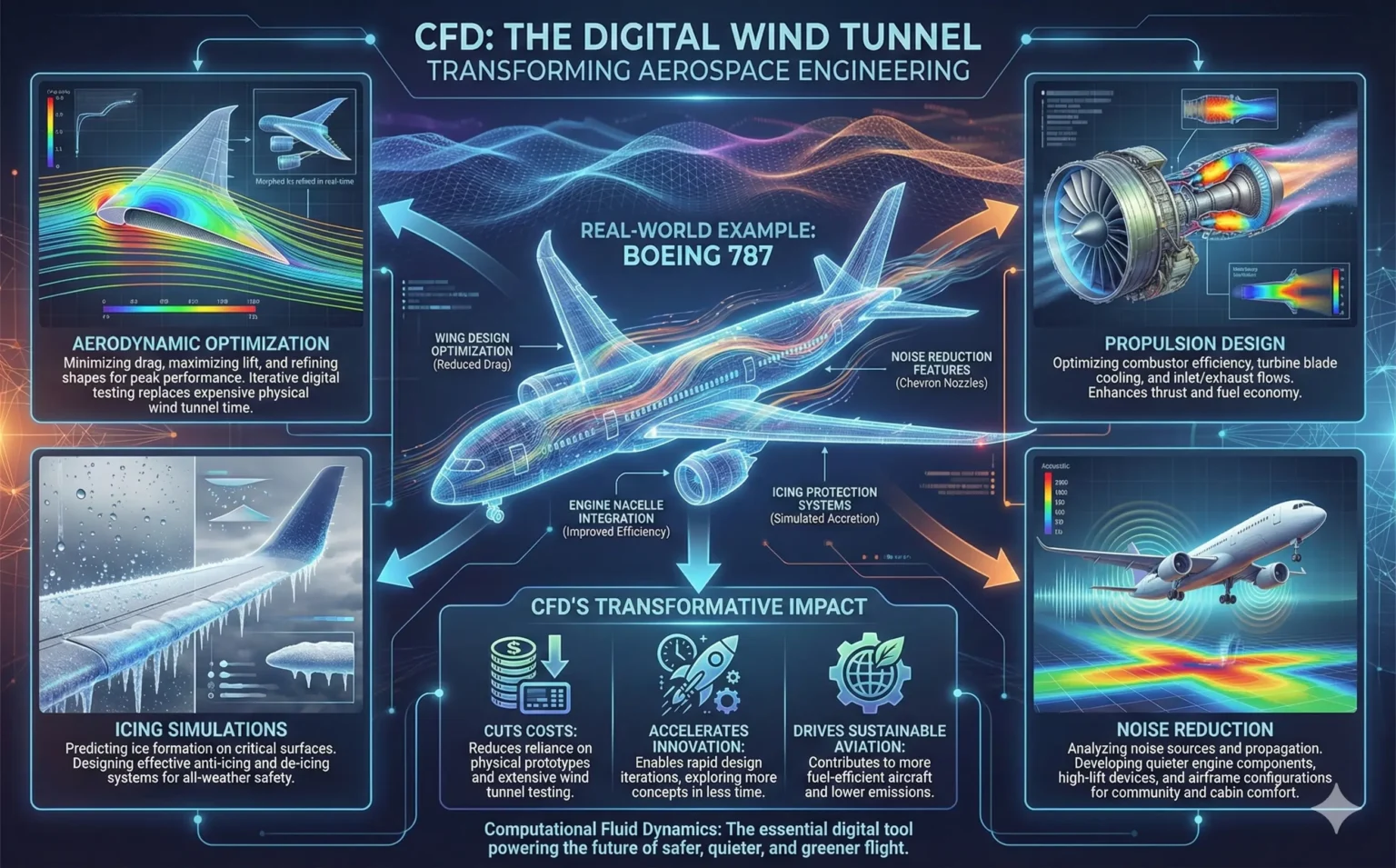
Computational Fluid Dynamics (CFD) has transformed how engineers design and optimize aircraft, spacecraft, and everything in between. By simulating the complex dance of air and fluids around vehicles, CFD allows teams to predict performance, spot issues early, and iterate designs without building endless prototypes. It’s not just a tool—it’s a game-changer that saves time, cuts costs, and pushes the boundaries of what’s possible in the skies.
Key Insights
- CFD stands at the heart of modern aerospace, enabling virtual testing of aerodynamics, propulsion, and even icing conditions to enhance safety and efficiency.
- From optimizing wing shapes for fuel savings to modeling engine combustion for cleaner burns, its applications span every phase of design, though challenges like computational demands persist.
- Real-world examples, such as Boeing’s use in the 737 engine integration, show how CFD has evolved from niche calculations to a certification staple.
- While it reduces reliance on wind tunnels, future advancements in AI and GPU computing promise even faster, more accurate simulations.
What Is CFD and Why Does It Matter?
CFD uses numerical methods and algorithms to solve and analyze problems involving fluid flows. In aerospace, this means modeling how air behaves over wings at supersonic speeds or how exhaust plumes interact with a rocket’s structure during launch. It matters because traditional testing—like wind tunnels—is expensive and limited. CFD lets engineers explore “what if” scenarios virtually, leading to sleeker, more efficient designs that perform better in real flight.
Core Applications in Aerospace
- Aerodynamic Optimization: Simulates airflow to minimize drag and maximize lift, crucial for commercial jets.
- Propulsion System Design: Analyzes combustion and turbine flows to boost thrust while cutting emissions.
- Safety Features: Predicts icing buildup on wings, helping prevent stalls in icy conditions.
Benefits and Limitations
CFD slashes development costs by up to 50% in some projects and accelerates timelines, but it requires massive computing power and skilled users. As aerospace pushes toward sustainable aviation, CFD’s role in noise reduction and electric propulsion will only grow.
Table of Contents
In the vast expanse of aerospace engineering, where every gram counts and every second of flight efficiency translates to millions in savings, Computational Fluid Dynamics (CFD) emerges as an indispensable ally.
Imagine engineers peering into the invisible chaos of air rushing over a wing at Mach 0.8, or the fiery swirl inside a jet engine’s combustion chamber—all without a single drop of wind or a spark of flame. This is the power of CFD: a digital wind tunnel that doesn’t blow, but computes. Born from the combination of mathematics, physics, and ever-advancing computing, CFD has quietly revolutionized how we build machines that defy gravity. From the sleek fuselages of commercial airliners to the heat-shielded behemoths hurling satellites into orbit, CFD isn’t just helping design these marvels—it’s redefining the very limits of human ingenuity in the air and beyond.
A Brief History: From Pencil Sketches to Supercomputers
The story of CFD in aerospace begins in the mid-20th century, when pioneers like John von Neumann and early NASA researchers grappled with the Navier-Stokes equations—the mathematical backbone of fluid motion—using room-sized computers. By the 1970s, as Moore’s Law kicked in, rudimentary simulations emerged for simple airfoil shapes. The real leap came in the 1980s, when Boeing integrated CFD into the 737 program, using it to optimize engine nacelle placement and reduce drag by several percent. This wasn’t just tinkering; it marked CFD’s shift from academic curiosity to industrial powerhouse.
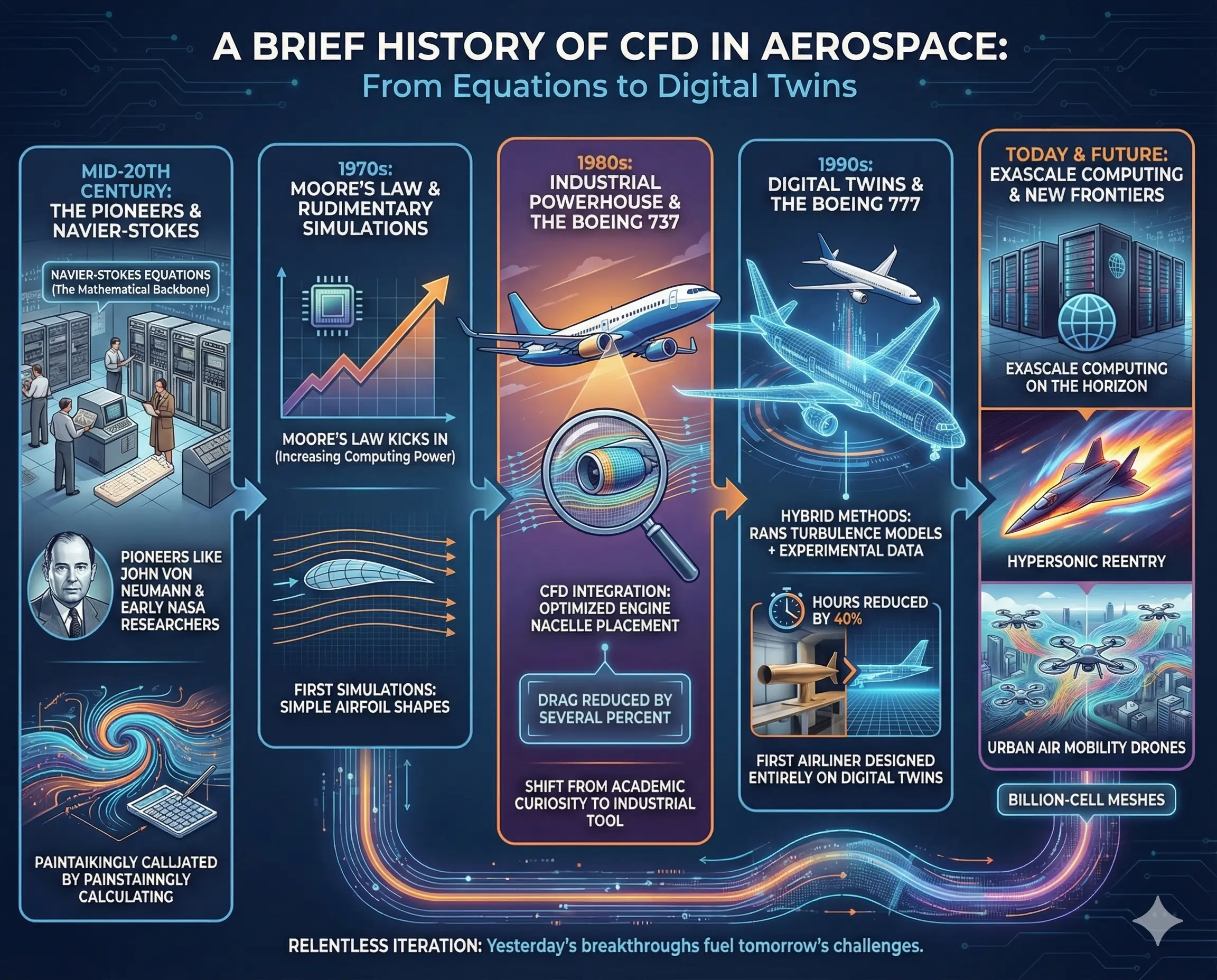
Fast-forward to the 1990s: Hybrid methods blending Reynolds-Averaged Navier-Stokes (RANS) turbulence models with experimental data became standard, enabling full-aircraft simulations. The Boeing 777, launched in 1995, was the first airliner designed entirely on digital twins powered by CFD, slashing wind tunnel hours by 40%. Today, with exascale computing on the horizon, CFD handles billion-cell meshes, simulating everything from hypersonic reentry to urban air mobility drones. Yet, its evolution isn’t linear—it’s a testament to relentless iteration, where yesterday’s breakthroughs fuel tomorrow’s challenges.
The Nuts and Bolts: How CFD Works in Aerospace
CFD discretizes the continuous world of fluids into a grid of tiny cells, solving partial differential equations for velocity, pressure, and temperature at each point. In aerospace, this starts with geometry import—think a 3D model of a fighter jet’s wing. Engineers apply boundary conditions: freestream air at 30,000 feet, turbulent eddies from engine wakes. Solvers like Ansys Fluent or OpenFOAM crunch the numbers, often using implicit schemes for stability in high-speed flows.
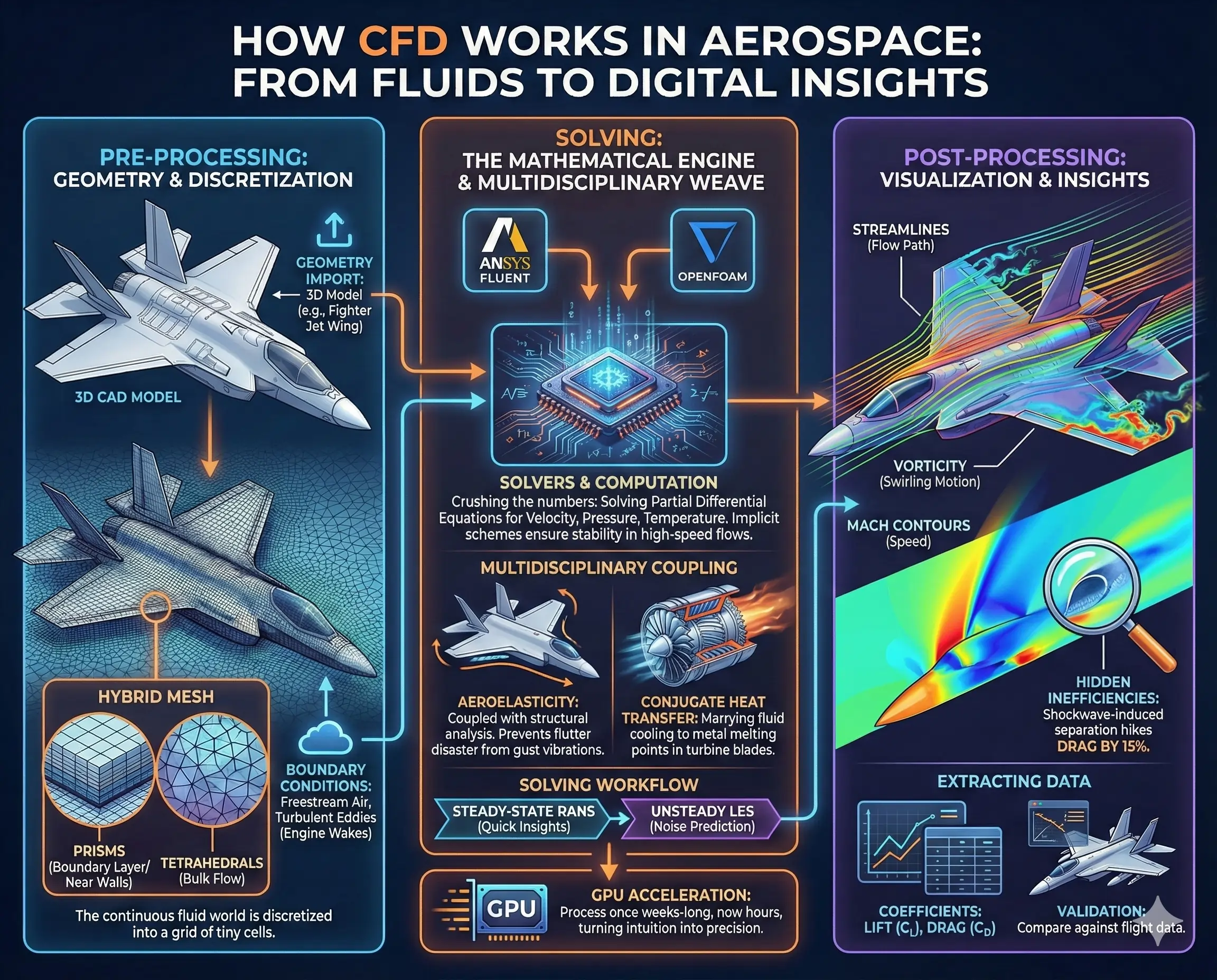
What sets aerospace CFD apart is its multidisciplinary weave. It’s not just air over a wing; it’s coupled with structural analysis for aeroelasticity, where vibrations from gusts could spell flutter disaster. Or conjugate heat transfer, marrying fluid cooling to metal melting points in turbine blades. The output? Color-coded visualizations of streamlines, vorticity, and Mach contours that reveal hidden inefficiencies—like a shockwave-induced separation that hikes drag by 15%.
To illustrate, consider a typical workflow:
- Pre-Processing: Clean CAD geometry, generate hybrid meshes (prisms near walls for boundary layers, tetrahedrals elsewhere).
- Solving: Run steady-state RANS for quick insights, then unsteady Large Eddy Simulation (LES) for noise prediction.
- Post-Processing: Extract coefficients like lift (CL) or drag (CD), validate against flight data.
This process, once weeks-long, now zips by in hours thanks to GPU acceleration, turning intuition into precision.
Diving Deep: Key Applications of CFD in Aerospace Design
CFD’s versatility shines across aerospace domains, from subsonic transports to hypersonic vehicles. Let’s unpack the big ones, laced with real-world examples that show its tangible impact.
Aerodynamic Shape Optimization
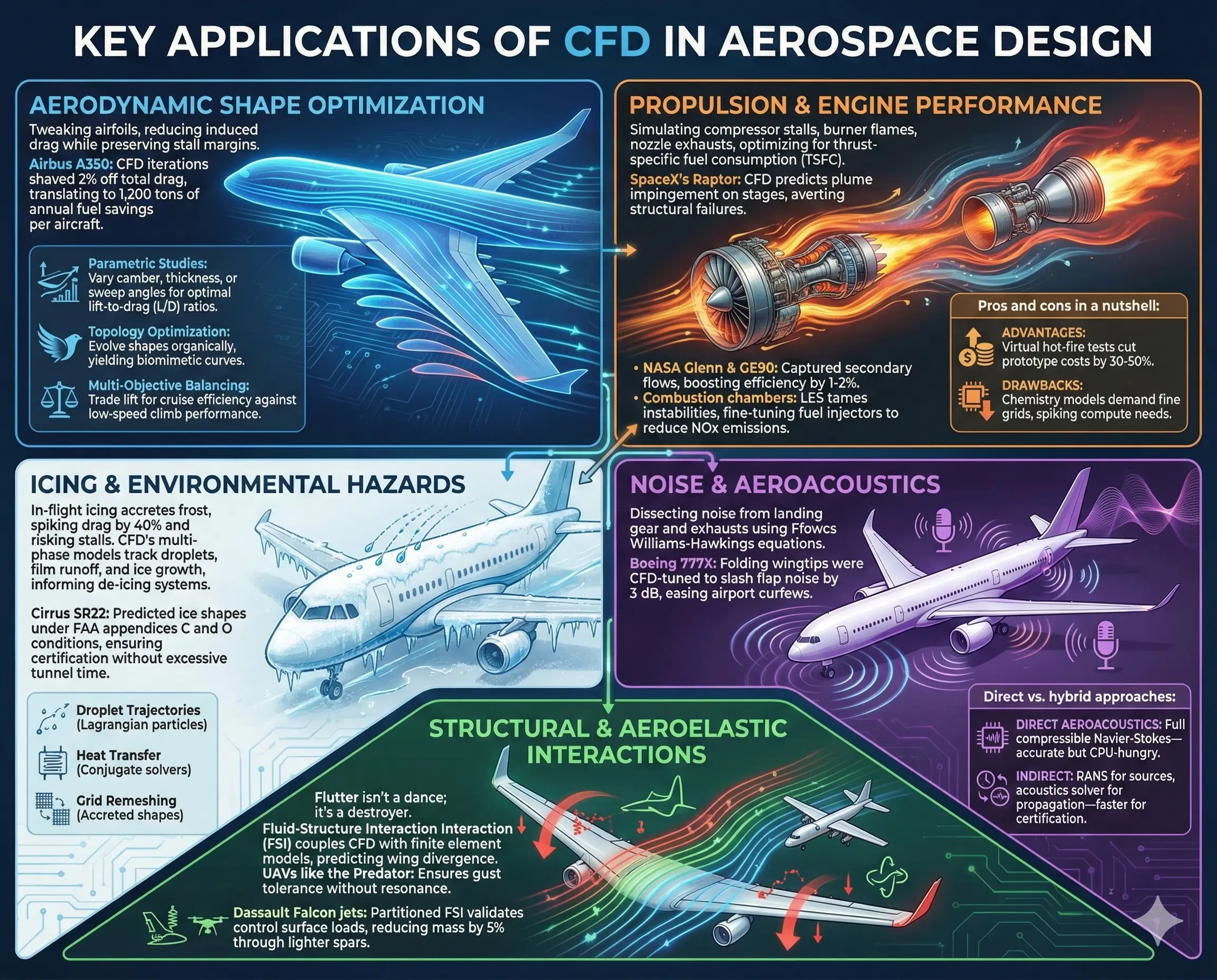
Wings aren’t born efficient—they’re sculpted. CFD simulates airflow to tweak airfoils, reducing induced drag while preserving stall margins. For instance, in the design of the Airbus A350, CFD iterations shaved 2% off total drag, translating to 1,200 tons of annual fuel savings per aircraft. Engineers use adjoint methods here: sensitivity analysis flags high-drag zones, like wingtips, for winglet additions.
Bullet-point breakdown of techniques:
- Parametric Studies: Vary camber, thickness, or sweep angles to hit optimal lift-to-drag (L/D) ratios.
- Topology Optimization: Evolve shapes organically, yielding biomimetic curves inspired by bird wings.
- Multi-Objective Balancing: Trade lift for cruise efficiency against low-speed climb performance.
A table of common aerodynamic targets:
| Design Phase | CFD Focus | Key Metrics | Example Outcome |
|---|---|---|---|
| Conceptual | Overall Fuselage Drag | C_D Reduction | 5-10% Fuel Savings in Early Boeing 787 Iterations |
| Preliminary | Wing-Fuselage Interference | Interference Drag | Optimized NASA X-59 Supersonic Quiet Wing for Low Boom |
| Detailed | High-Lift Devices (Flaps) | Max C_L at Stall | Enhanced Takeoff Performance in Embraer E-Jets |
Propulsion and Engine Performance
Engines are CFD’s proving ground, where hot gases whirl at velocities defying intuition. Simulations model compressor stalls, burner flames, and nozzle exhausts, optimizing for thrust-specific fuel consumption (TSFC). In rocket development, like SpaceX’s Raptor, CFD predicts plume impingement on stages, averting structural failures during separation.
Notable example: NASA’s Glenn Research Center validated CFD for a GE90 turbofan, capturing secondary flows that boost efficiency by 1-2%. Combustion chambers benefit from Large Eddy Simulation (LES) to tame instabilities, reducing NOx emissions by fine-tuning fuel injectors.
Pros and cons in a nutshell:
- Advantages: Virtual hot-fire tests cut prototype costs by 30-50%.
- Drawbacks: Chemistry models demand fine grids, spiking compute needs.
Icing and Environmental Hazards
Flight in clouds isn’t poetic—it’s perilous. In-flight Icing accretes frost on leading edges, spiking drag by 40% and risking stalls. CFD’s multi-phase models track supercooled droplets, film runoff, and ice growth, informing de-icing boots or thermal systems.
A landmark case: Simulations for the Cirrus SR22 predicted ice shapes under FAA appendices C and O conditions, ensuring certification without excessive tunnel time. Phases include droplet trajectories via Lagrangian particles, heat transfer via conjugate solvers, and grid remeshing for accreted shapes.
Table of icing simulation stages:
| Stage | Physics Modeled | Tools/Methods | Validation Source |
|---|---|---|---|
| Droplet Impingement | Trajectory Tracking (Lagrangian) | Dispersed Multiphase Model | NASA LEWICE Data |
| Ice Accretion | Freezing Fraction Calculation | Stefan Problem Solvers | Icing Wind Tunnel Tests |
| Aerodynamic Impact | Post-Ice Drag/Lift Penalty | RANS with Rough Walls | Flight Test Correlations |
| Shedding Dynamics | Fracture and Detachment | Coupled FSI | High-Speed Camera Footage |
Noise and Aeroacoustics
Quiet skies are a regulatory must. CFD dissects noise from landing gear cavities or jet exhausts, using Ffowcs Williams-Hawkings equations to propagate waves. For the Boeing 777X, folding wingtips were CFD-tuned to slash flap noise by 3 dB, easing airport curfews.
Direct vs. hybrid approaches:
- Direct Aeroacoustics: Full compressible Navier-Stokes—accurate but CPU-hungry.
- Indirect: RANS for sources, acoustics solver for propagation—faster for certification.
Structural and Aeroelastic Interactions
Flutter isn’t a dance; it’s a destroyer. Fluid-Structure Interaction (FSI) couples CFD with finite element models, predicting wing divergence at transonic speeds. In UAVs like the Predator, this ensures gust tolerance without resonance.
Example: Dassault Falcon jets use partitioned FSI to validate control surface loads, reducing mass by 5% through lighter spars.
Challenges: The Roadblocks CFD Must Overcome
No tool is flawless, and CFD’s hurdles are as turbulent as the flows it models. Computational thirst tops the list: A full LES of a business jet might demand 109 cells, running days on clusters. Grid generation? A black art, with “dirty” geometries from CAD imports causing weeks of cleanup.
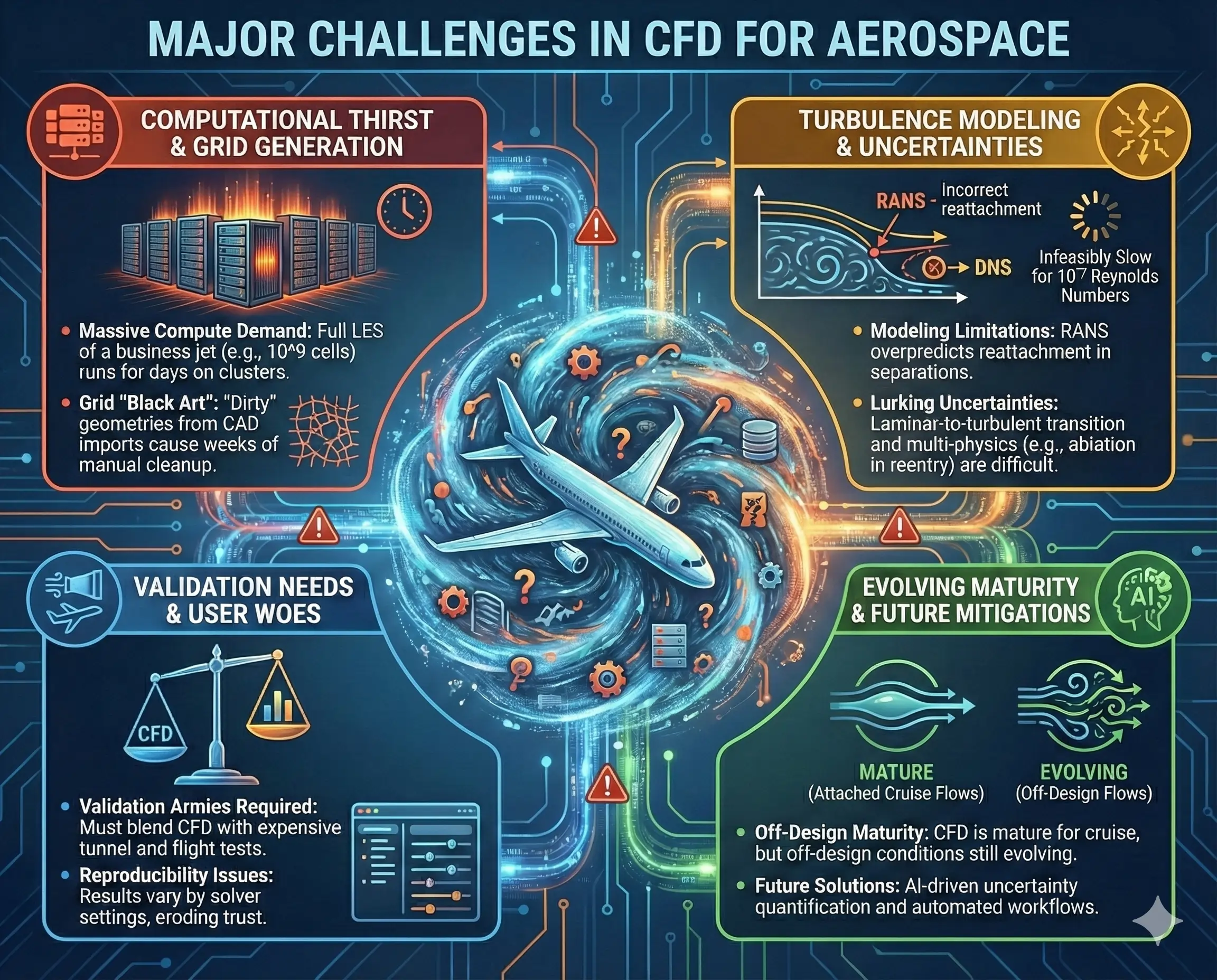
Turbulence modeling falters in separations—RANS overpredicts reattachment, while DNS is infeasibly slow for Reynolds numbers in the 107 range. Uncertainties lurk: Transition from laminar to turbulent? Multi-physics like ablation in reentry vehicles? These demand validation armies, blending CFD with tunnels and flights.
User-side woes compound: Reproducibility varies by solver settings, eroding trust. As one expert notes, “CFD is mature for attached cruise flows, but off-design? It’s still evolving.” Future mitigations? AI-driven uncertainty quantification and automated workflows.
Table of major challenges and countermeasures:
| Challenge Category | Specific Issue | Impact on Aerospace | Emerging Solutions |
|---|---|---|---|
| Computational | Exascale Needs for LES | Delays in Hypersonic Design | GPU Solvers (e.g., NVIDIA A100 Clusters) |
| Modeling | Turbulence in Separation | Inaccurate Stall Prediction | Hybrid WMLES with ML Tuning |
| Integration | FSI Coupling Convergence | Aeroelastic Instability Risks | Monolithic Solvers in Ansys Suites |
| Validation | Uncertainty Quantification | Certification Hurdles | Bayesian Frameworks for Error Bounds |
| Workflow | Manual Meshing Labor | Bottlenecks in Iteration | Octree Automation with Prism Layers |
The Future Horizon: CFD’s Next Frontier
Peering ahead, CFD will entwine with AI for “push-button” simulations—think neural networks approximating RANS at LES fidelity. Quantum computing? It could crack DNS for full engines. Sustainability drives it too: Electric vertical takeoff (eVTOL) like Joby Aviation’s rely on CFD for distributed propulsion, optimizing battery cooling amid rotor wakes.
By 2040, expect routine hybrid RANS-LES for certification, zonal models for transition, and digital twins mirroring entire fleets in real-time. Challenges like ethical AI in design or equitable access to computing will arise, but the payoff? Greener skies, bolder explorations—perhaps even Mars-bound habitats simulated flawlessly.
Case in point: NASA’s X-59 QueSST uses CFD to shape a low-boom sonic jet, proving simulations can quiet the sound barrier. As aerospace grapples with climate imperatives, CFD isn’t just computing flows—it’s charting courses for a sustainable soar.
In wrapping this expansive look, CFD embodies aerospace’s spirit: precise yet audacious, grounded in equations but reaching for stars. It’s the unseen force lifting us higher, faster, quieter—and with innovations brewing, its role only deepens.
Key Citations And References
- CFD in Aerodynamic & Aerospace Engineering
- Application of CFD in Aerospace Engineering
- Accelerating Aerospace CFD Workflows With Simulation
- The Role of Computational Fluid Dynamics (CFD) in Modern Aircraft Design
- On the role and challenges of CFD in the aerospace industry
- 5 Ready-to-Use CFD Simulations for Aircraft Design
- 3 CFD Simulations in Space Answer Big Questions
- CFD Simulation for Defense and Aerospace
- The 6 biggest and unsolved challenges in CFD
- Progress and future prospects of CFD in aerospace
Read These Articles in Detail
- Aerospace Engineering vs. Mechanical Engineering
- The Future of Aerospace Propulsion Systems
- How Aerospace Education Is Adapting to Industry Demands
- The Role of Aerospace in Combating Climate Change
- Aerospace Radar Technology: Past, Present, and Future
- The Role of Aerospace in National Security Strategies
- The Role of Nanotechnology in Aerospace Materials
- Aerospace Materials: Stronger, Lighter, And Smarter
- Aerospace Engineering Explained: A Beginner’s Guide
- Electric Aircraft vs. Hydrogen Aircraft: Which Is More Sustainable?
- Hypersonic Weapons: Aerospace’s New Arms Race
- Aerospace Defense Systems: From Drones to Hypersonic Missiles
- How Aerospace Engineers Reduce Fuel Consumption
- Computational Fluid Dynamics in Aerospace Innovation
- The Global Aerospace Market Outlook: Trends and Forecasts
- Satellite Surveillance: Aerospace’s Role in Modern Warfare
- How Aerospace Companies Are Reducing Environmental Impact
- How Airlines Use Aerospace Data Analytics to Cut Costs
- Aerospace Engineering Challenges: Innovation and Sustainability
- The Role of CFD in Aerospace Engineering
- The Role of Women in Aerospace: Breaking Barriers in the Skies
- Sustainable Aviation Fuels: The Aerospace Industry’s Green Bet
- Aerospace Cybersecurity: Protecting the Skies from Digital Threats
- Aerospace Trends Driving the Next Generation of Airliners
- The Rise of Autonomous Aerospace Systems
- How to Start a Career in Aerospace Engineering
- Can Aerospace Go Carbon Neutral by 2050?
- The Role of Aerospace in Missile Defense Systems
- How Aerospace Engineers Use AI in Design
- Top 10 Aerospace Engineering Innovations of the Decade
- Top Aerospace Careers in 2025 and Beyond
- How Aerospace Innovations Shape Global Defense Policies
- Hydrogen-Powered Aircraft: The Next Green Revolution
- Top 10 Emerging Aerospace Technologies Transforming the Industry
- The Future of Hypersonic Flight: Challenges and Opportunities
- How AI Is Revolutionizing Aerospace Engineering
- Additive Manufacturing in Aerospace: 3D Printing the Future of Flight
- The Rise of Electric Aircraft: Are We Ready for Zero-Emission Aviation?
- Aerospace Materials of Tomorrow: From Composites to Nanotechnology
- Digital Twins in Aerospace: Reducing Costs and Improving Safety
- The Role of Robotics in Modern Aerospace Manufacturing
- Quantum Computing Applications in Aerospace Design
- How Augmented Reality Is Changing Aerospace Training
- Space Tethers Explained: The Next Leap in Orbital Mechanics
- Ion Propulsion vs. Chemical Rockets: Which Will Power the Future?
- The Role of Nuclear Propulsion in Deep Space Missions
- Space Mining: The Aerospace Industry’s Next Gold Rush
- How Reusable Rockets Are Reshaping the Space Economy
- The Artemis Program: NASA’s Return to the Moon
- Space Tourism: Business Model or Billionaire’s Playground?
- How Aerospace Startups Are Disrupting Commercial Aviation
- The Economics of Low-Cost Airlines in the Aerospace Era
- Urban Air Mobility: The Rise of Flying Taxis
- The Future of Mars Colonization: Key Aerospace Challenges and Solutions Ahead
- CubeSats and Small Satellites: Democratizing Space Access
- The Future of Cargo Drones in Global Logistics
- The Role of Aerospace in Building a Lunar Economy
Frequently Asked Questions
FAQ 1: What is Computational Fluid Dynamics (CFD) in Aerospace Engineering?
Computational Fluid Dynamics, or CFD, is essentially a digital way to study how fluids like air move around and interact with aerospace vehicles. In the world of aerospace engineering, it acts like a virtual laboratory where engineers can simulate the invisible forces at play during flight, from the gentle breeze over a drone’s wings to the scorching heat of reentry for a spacecraft. By breaking down complex fluid behaviors into mathematical equations and solving them on powerful computers, CFD helps predict things like lift, drag, and turbulence without needing to build and test physical models every time.
This technology has become a cornerstone of modern aircraft design because it allows for endless experimentation in a controlled digital environment. For example, when designing a new commercial jet, engineers use CFD to visualize airflow patterns that could cause inefficiencies or safety issues, tweaking the shape of the fuselage or wings right there on the screen. It’s not just about speed; it’s about precision, enabling designs that are lighter, more fuel-efficient, and safer overall. Over the years, as computing power has exploded, CFD has evolved from basic 2D simulations to full 3D models that incorporate real-world variables like varying altitudes and weather conditions.
What makes CFD so vital in aerospace is its ability to handle multidisciplinary challenges. It doesn’t stop at aerodynamics; it integrates with heat transfer analysis to ensure engine parts don’t melt under extreme temperatures or with structural simulations to prevent vibrations that could lead to fatigue. In essence, CFD bridges the gap between theory and reality, turning abstract equations into actionable insights that propel the industry forward. For aspiring engineers, understanding CFD opens doors to innovative projects, like optimizing urban air taxis or sustainable electric propulsion systems, proving it’s more than a tool—it’s the future of flight design.
FAQ 2: How Has the History of CFD Shaped Modern Aerospace Engineering?
The journey of CFD in aerospace engineering is a fascinating tale of human curiosity meeting computational might, starting from humble mathematical sketches in the early 20th century and accelerating into the powerhouse it is today. It all began with pioneers like Lewis Fry Richardson in the 1920s, who hand-calculated weather patterns using pencil and paper, laying the groundwork for numerical weather prediction that later influenced fluid simulations. By the 1950s and 1960s, as electronic computers emerged, researchers at places like NASA turned to these machines to solve the Navier-Stokes equations, the fundamental laws governing fluid motion, for simple airfoil problems.
Key milestones marked CFD’s rise in aerospace:
- 1970s Breakthroughs: Early codes like NASA’s FLO22 in 1974 enabled the first practical simulations of transonic flows, helping optimize wing designs for efficiency.
- 1980s Industrial Adoption: Boeing integrated CFD into the 737 program, reducing drag and proving its value in cutting physical testing costs.
- 1990s Digital Revolution: The Boeing 777 became the first fully digitally designed airliner, relying on CFD for 40% fewer wind tunnel hours and faster certification.
- 2000s Multiphysics Expansion: Advances in hybrid models allowed simulations of coupled phenomena, like aeroelasticity in fighter jets.
- 2010s to Present: GPU acceleration and open-source tools democratized access, fueling applications in UAVs and hypersonic vehicles.
This evolution wasn’t without hurdles—early limitations in computing power meant approximations that sometimes missed real-world complexities—but each era built on the last, transforming CFD from an experimental aid to a certification staple. Today, as we push toward net-zero emissions, historical lessons from these developments guide sustainable innovations, reminding us that CFD’s past is the blueprint for greener skies ahead.
FAQ 3: What Are the Key Steps in the CFD Workflow for Aerospace Simulations?
Running a CFD simulation in aerospace engineering follows a structured workflow that turns raw geometry into predictive insights, much like following a recipe for the perfect flight design. It starts with pre-processing, where engineers import 3D models of aircraft components and generate computational grids to discretize the space around them. Then comes the solving phase, crunching equations for flow variables, and finally post-processing to interpret results visually.
Here’s a detailed breakdown of the typical CFD workflow stages in a table format:
| Stage | Description | Key Tools/Methods | Aerospace Example Outcome |
|---|---|---|---|
| Pre-Processing | Import CAD geometry, clean surfaces, and create meshes (e.g., hybrid grids for boundary layers). | Mesh generators like ICEM CFD or Pointwise | Accurate wing mesh for drag prediction on a Boeing 787 fuselage. |
| Boundary Setup | Define conditions like freestream velocity, turbulence intensity, and wall roughness. | Solver inputs in Ansys Fluent | Simulating takeoff at sea level for lift validation. |
| Solving | Iterate numerical solvers (steady RANS for quick runs or unsteady LES for details) until convergence. | Parallel computing on clusters | Capturing shockwaves in supersonic flows for NASA X-59. |
| Post-Processing | Extract metrics like C_L and C_D, visualize streamlines and contours. | Paraview or Tecplot software | Identifying high-drag zones for winglet optimization in the Airbus A350. |
| Validation | Compare against experimental data from tunnels or flights, quantify uncertainties. | Error metrics and sensitivity studies | Ensuring <5% discrepancy in fuel burn predictions for certification. |
This workflow, while iterative and often refined multiple times, ensures reliability, with each step building trust in the simulation’s ability to mirror real flight dynamics.
FAQ 4: What Are the Primary Applications of CFD in Aerodynamic Optimization for Aircraft?
CFD shines brightest in aerodynamic optimization, where it empowers engineers to fine-tune aircraft shapes for peak performance, slicing through air with minimal resistance and maximum lift. By simulating airflow over wings, fuselages, and control surfaces, CFD uncovers inefficiencies that traditional methods might overlook, leading to designs that burn less fuel and fly farther. In commercial aviation, this means iterating thousands of virtual prototypes to achieve that elusive sweet spot between speed and stability.
Beyond the basics, CFD’s applications extend to specialized scenarios, enhancing everything from takeoff performance to cruise efficiency. For instance, it models wing-fuselage interactions to reduce interference drag, a common culprit in older designs.
Here are some standout applications with real-world ties:
- Wing Design Refinement: Predicts stall behavior and optimizes twist or camber, as seen in the Embraer E-Jets for better short-field performance.
- High-Lift Systems: Simulates flap deployment to maximize C_L during landing, cutting runway needs for regional jets.
- Supersonic Flow Analysis: Tracks shockwaves for low-boom profiles, crucial for the NASA X-59 quiet supersonic project.
- UAV and Drone Aerodynamics: Balances payload with agility in turbulent urban winds, aiding delivery drones’ stability.
These uses not only boost operational savings but also align with global pushes for sustainable aviation, where every percentage point in drag reduction counts toward lower emissions.
FAQ 5: How Does CFD Enhance Propulsion System Design in Aerospace?
In propulsion design, CFD serves as the engineer’s crystal ball, forecasting how air and fuel mix, ignite, and accelerate to create thrust in everything from turbofans to rocket nozzles. It dives deep into the chaotic internals of engines, simulating compressor stages where blades spin at blistering speeds and combustion chambers where flames dance at thousands of degrees. This virtual testing reveals hotspots that could lead to failures or inefficiencies, allowing tweaks that squeeze more power from less fuel.
The real magic happens in multi-phase simulations, where CFD tracks fuel droplets vaporizing in swirling air or exhaust plumes interacting with vehicle structures during launch. Take rocket engines like those in modern launch vehicles: CFD predicts plume impingement that might scorch nearby components, informing shield placements and saving costly redesigns. In aviation, it optimizes turbine cooling flows, ensuring blades withstand heat without extra weight, which directly translates to longer engine life and reduced maintenance downtimes.
Moreover, as the industry shifts toward greener tech, CFD is pivotal in modeling hybrid-electric propulsion, where it balances airflow around distributed fans while managing thermal loads on batteries. This not only accelerates development—cutting prototype tests by up to half—but also ensures compliance with emission standards, paving the way for quieter, cleaner flights that don’t compromise on performance.
FAQ 6: What Role Does CFD Play in Simulating Aircraft Icing Conditions?
CFD is a lifesaver when it comes to aircraft icing, turning what could be a deadly hazard into a manageable design feature by predicting how ice forms and affects flight. During flight through supercooled clouds, water droplets freeze on leading edges, altering aerodynamics and potentially causing stalls; CFD maps this process in detail, from droplet impact to ice shedding, helping engineers craft effective anti-icing systems like heated mats or bleed air ducts.
The simulation breaks down into interconnected physics, ensuring comprehensive coverage for certification under strict regulations.
A structured overview of CFD icing simulation components:
| Component | Physics Involved | Simulation Approach | Practical Impact in Aerospace |
|---|---|---|---|
| Droplet Trajectories | Particle tracking in airflow | Lagrangian methods with splash models | Accurate impingement limits for wing de-icers on Cirrus SR22. |
| Ice Accretion Growth | Freezing and sublimation rates | Thermodynamic solvers like Stefan equations | Shapes ice ridges to test drag penalties up to 40%. |
| Aerodynamic Penalty | Altered lift/drag post-accretion | RANS with modified wall functions | Validates stall margins for FAA Appendix C compliance. |
| Shedding and Runback | Detachment and film flow dynamics | Coupled fluid-structure interaction | Prevents tailplane stalls in regional jets. |
By validating these against tunnel data, CFD ensures safer winter operations, reducing incidents and enhancing passenger confidence in all-weather travel.
FAQ 7: How Is CFD Used for Noise Reduction in Aerospace Vehicles?
Noise reduction in aerospace is more than a courtesy—it’s a regulatory necessity for expanding flight paths and community harmony, and CFD leads the charge by dissecting the sources of unwanted sound from landing gear to jet wakes. It models acoustic waves propagating from turbulent flows, pinpointing hotspots like flap edges where air rushes create broadband roars, then suggests geometric fixes like serrated trailing edges to break up vortices.
This aeroacoustics expertise extends to full-vehicle predictions, coupling flow simulations with wave propagation equations for holistic assessments.
Effective CFD strategies for quieter skies include:
- Source Identification: Using hybrid RANS-LES to locate gear cavity resonances, as in the Boeing 777X flap noise cuts.
- Propagation Modeling: Applying Ffowcs Williams-Hawkings equations to forecast far-field decibels, aiding airport planning.
- Design Iteration: Testing porous liners or chevrons on nacelles for exhaust mixing, reducing 3-5 dB in modern turbofans.
- Urban Air Mobility Focus: Simulating rotor harmonics in eVTOLs for city-compatible whisper-quiet operations.
Through these, CFD not only meets noise abatement goals but fosters innovative quiet tech, making aviation a better neighbor to the ground below.
FAQ 8: What Are the Main Challenges Faced in Implementing CFD for Aerospace Engineering?
Implementing CFD in aerospace engineering brings immense power, but it’s not without its storms—challenges that test even seasoned teams and drive ongoing innovation. At the heart is the computational demand: simulating a full aircraft at high fidelity can gobble petabytes of data and weeks of supercomputer time, especially for unsteady flows like those in hypersonic regimes. Then there’s turbulence modeling, where approximations like RANS often falter in separated flows, leading to overpredicted reattachments that skew safety margins.
Grid generation adds another layer of complexity, as irregular geometries from CAD imports demand manual tweaks to avoid errors, sometimes delaying projects by days. Validation remains tricky too, with uncertainties from experimental discrepancies requiring Bayesian methods to build confidence for certification bodies.
Common hurdles and paths forward:
- Resource Intensity: High-res LES needs exascale power; countered by cloud GPUs for scalable runs.
- Model Accuracy: Transition prediction gaps in off-design; addressed via machine learning hybrids.
- Integration Issues: FSI convergence in aeroelasticity; mitigated by monolithic solvers.
- Workflow Bottlenecks: Reproducibility across teams; improved with standardized open-source protocols.
Navigating these keeps CFD evolving, ensuring it delivers reliable predictions amid the push for faster, greener aerospace advancements.
FAQ 9: What Are the Benefits and Limitations of CFD in Aircraft Design?
CFD has redefined aircraft design by offering a window into fluid behaviors that once required expensive physical trials, delivering benefits that ripple through cost, time, and innovation. It slashes development expenses by minimizing wind tunnel reliance—up to 50% in some programs—while accelerating iterations to days instead of months, fostering bolder designs like blended wing bodies for superior efficiency.
Yet, limitations persist, from accuracy dips in complex multiphysics to the steep expertise curve, reminding us it’s a complement, not a replacement, for experiments.
A comparative table highlights the balance:
| Aspect | Benefits | Limitations |
|---|---|---|
| Cost Efficiency | Reduces prototypes; e.g., Boeing 777 saved millions in testing. | High upfront compute costs for startups. |
| Time Savings | Virtual what-ifs speed optimization; fuel savings of 2% in A350. | Long setup for grids in novel geometries. |
| Design Innovation | Enables radical shapes like low-boom supersonic. | Turbulence models miss rare events like bursts. |
| Safety & Compliance | Predicts icing/loads for certification. | Uncertainty quantification demands extra validation. |
| Sustainability | Optimizes for lower emissions via efficient flows. | Scalability issues for fleet-wide digital twins. |
Weighing these, CFD’s pros overwhelmingly tip the scales, especially as hardware advances bridge the gaps.
FAQ 10: What Future Trends Are Emerging for CFD in Aerospace Engineering?
Looking ahead, CFD in aerospace engineering is poised for a renaissance, fueled by symbiotic leaps in artificial intelligence, high-performance computing, and sustainability imperatives that will make simulations not just faster, but smarter and more accessible. By 2030, AI integration could automate turbulence modeling, slashing solve times from weeks to hours while boosting accuracy through data-driven corrections, enabling real-time optimizations during design reviews. Cloud-based platforms will democratize exascale power, letting small firms simulate full hypersonic vehicles without owning supercomputers.
Sustainability will steer much of this evolution, with CFD tackling hybrid-electric architectures by modeling battery thermal management alongside propeller wakes in eVTOLs, supporting the net-zero flight goals set for 2050. Market projections hint at robust growth, with the CFD sector expanding at over 10% annually, driven by defense needs for stealthy UAVs and commercial demands for quieter, greener jets.
Emerging frontiers include quantum-assisted solvers for intractable problems like direct numerical simulations of combustion, and digital twins that mirror operational fleets for predictive maintenance. Challenges like ethical AI use and equitable compute access loom, but the trajectory points to CFD as the enabler of bold visions—from Mars habitats to supersonic passenger travel—ensuring aerospace remains at the cutting edge of human exploration.
FAQ 11: What Are the Most Popular CFD Software Tools Used in Aerospace Engineering?
Diving into the world of CFD software for aerospace engineering feels like stepping into a high-tech toolbox where each tool is engineered to tackle the unique challenges of flight. These programs aren’t just calculators; they’re virtual wind tunnels that let engineers simulate everything from subsonic glides to hypersonic dashes, all while integrating seamlessly with other design software. As of 2025, the landscape has matured with a mix of commercial heavyweights and open-source gems, each shining in specific areas like mesh generation, solver speed, or multiphysics coupling.
Among the top contenders, Ansys Fluent stands out for its robust handling of complex turbulent flows, making it a go-to for optimizing aircraft wings and engine inlets. It’s prized for its user-friendly interface that balances power with accessibility, allowing teams to run high-fidelity simulations on everything from commercial jets to experimental drones. On the open-source front, OpenFOAM has gained massive traction thanks to its flexibility and zero cost, enabling custom solvers for niche problems like rotorcraft aerodynamics. Then there’s Simcenter STAR-CCM+, which excels in polyhedral meshing for irregular geometries, speeding up workflows for full-vehicle analyses.
What ties these tools together is their evolution toward cloud integration and GPU acceleration, cutting simulation times from days to hours. For aerospace pros, choosing the right one often boils down to project scale—Fluent for detailed propulsion studies, OpenFOAM for innovative startups tweaking UAV designs. As the industry leans harder into sustainable tech, these softwares are incorporating modules for emission modeling, ensuring that efficiency gains translate to real-world green benefits. Whether you’re a student prototyping a model rocket or a veteran refining a fighter jet, mastering one of these can unlock doors to cutting-edge careers in the skies.
FAQ 12: How Is CFD Applied in Spacecraft and Rocket Design?
CFD plays a pivotal role in spacecraft and rocket design, where the stakes are cosmic and the margins for error are razor-thin. Unlike atmospheric flight, space vehicles grapple with vacuum transitions, extreme reentry heats, and plume dynamics during launch, all of which CFD simulates with precision to prevent catastrophic failures. Engineers use it to model the bow shock during orbital reentry, predicting heat flux on thermal shields that could mean the difference between a safe splashdown and a fiery demise.
In rocket propulsion, CFD dissects the intricate flows inside nozzles and combustion chambers, optimizing injector patterns to maximize thrust while minimizing instabilities like acoustic oscillations. For instance, during the design of reusable launch systems, simulations reveal how exhaust plumes interact with booster stages, informing separation mechanisms that ensure clean detachments at Mach speeds. This virtual foresight reduces the need for destructive ground tests, saving millions and accelerating iterations from concept to orbit.
Beyond the hardware, CFD extends to mission planning, forecasting aerodynamic loads on fairings or satellite deployment in low-Earth orbit wakes. As private space ventures boom, tools like these are democratizing access, allowing smaller teams to validate designs against historical data from missions like the Space Shuttle. Ultimately, CFD isn’t just crunching numbers—it’s the invisible architect shaping humanity’s reach beyond the blue marble, one fluid particle at a time.
FAQ 13: What Are the Key Differences Between CFD and Wind Tunnel Testing in Aerospace?
When pitting CFD against wind tunnel testing in aerospace engineering, it’s less a rivalry and more a dynamic duo, each bringing strengths that the other can’t match alone. Wind tunnels offer tangible, real-world validation—blowing actual air over scale models to capture phenomena like boundary layer transitions that digital models sometimes approximate. They’re gold-standard for certification, providing empirical data that regulators trust, but they come with hefty price tags and scalability limits, often restricting tests to specific conditions like steady-state flows.
CFD, on the flip side, unleashes boundless flexibility, letting engineers tweak variables on the fly—imagine altering altitudes or turbulence intensities mid-simulation without resetting hardware. It excels in parametric studies, exploring thousands of designs virtually to pinpoint optimal shapes, slashing costs by up to 70% in early phases.
Here’s a comparative table breaking down the essentials:
| Aspect | CFD Advantages | Wind Tunnel Advantages | Best Use Case Example |
|---|---|---|---|
| Cost and Speed | Low-cost iterations; results in hours/days | High initial setup; weeks for full campaigns | CFD for conceptual wing tweaks; tunnels for final loads on Boeing 787 |
| Flexibility | Unlimited scenarios (e.g., hypersonic transients) | Fixed scales and conditions | CFD for rare events like bird strikes; tunnels for baseline aero data |
| Accuracy | Improving with AI hybrids; great for internals | Captures unmodeled effects like wall interference | Coupled approach: CFD informs tunnel configs for NASA X-59 quiet boom |
| Scalability | Full-vehicle meshes up to billions of cells | Model size constraints (e.g., 10% scale limits) | CFD for fleet-wide digital twins; tunnels for high-Reynolds validation |
| Environmental Impact | Zero physical waste; sustainable virtual testing | Energy-intensive fans and models | CFD driving green designs in eVTOL optimization |
Blending both—using CFD to guide tunnel runs—yields the sharpest insights, as seen in modern programs where simulations predict 90% of behaviors before physical proof.
FAQ 14: How Does CFD Contribute to Sustainable Aviation Practices?
CFD is quietly revolutionizing sustainable aviation by enabling designs that sip fuel like a miser, cutting emissions without sacrificing performance. At its heart, it optimizes aerodynamics for minimal drag, allowing aircraft to glide farther on less jet fuel, a critical step toward net-zero goals by 2050. By simulating airflow over blended-wing bodies or laminar-flow wings, engineers can shave grams of weight and percentages of consumption, turning theoretical green concepts into flyable realities.
This goes beyond efficiency; CFD models the combustion of sustainable aviation fuels (SAFs), tweaking injectors to burn cleaner and reduce NOx outputs, addressing urban air quality alongside climate change. In electric and hybrid propulsion, it balances cooling flows for batteries amid propeller wakes, ensuring longevity in hot, high-altitude ops.
Key contributions include:
- Drag Reduction Strategies: Iterating surface textures virtually to mimic shark skin, boosting lift-to-drag ratios by 5-10%.
- Noise Mitigation for Eco-Routes: Predicting quieter paths over noise-sensitive areas, easing expansion of green corridors.
- Life-Cycle Analysis: Coupling with thermal models to minimize material use in composites, lowering production footprints.
- SAF Compatibility Testing: Forecasting spray patterns for drop-in fuels, accelerating certification for widespread adoption.
As aviation pledges deeper cuts, CFD’s predictive power ensures innovations like hydrogen-powered craft aren’t just dreams—they’re data-backed paths to skies that heal rather than harm.
FAQ 15: Can You Share a Case Study on CFD’s Role in the Boeing 787 Dreamliner Design?
The Boeing 787 Dreamliner stands as a testament to CFD‘s transformative impact, where digital simulations slashed development risks and costs while birthing one of the most efficient widebodies ever. Launched in the early 2000s, the program leaned heavily on CFD to pioneer composite airframes, using it to validate unconventional shapes like raked wingtips that cut induced drag by 20%, directly fueling the jet’s vaunted 20% efficiency edge over predecessors.
Engineers ran over 10 million CFD hours, modeling transonic flows to refine the fuselage’s smooth contours, reducing wave drag and enabling higher cruise speeds with less thrust. This virtual vetting minimized wind tunnel dependency, compressing timelines by months and avoiding costly redesigns mid-build.
A deeper look reveals CFD’s multiphysics prowess: It coupled aero loads with structural responses to ensure composites withstood flutter, while thermal analyses optimized engine bay cooling for 15% better fuel burn. Post-certification, ongoing simulations via digital twins monitor fleet performance, tweaking ops for even greener flights.
In numbers, CFD contributed to a 1,200-ton annual fuel savings per plane, underscoring its ROI. The 787’s success didn’t just fly passengers—it elevated CFD from support act to star, inspiring a wave of simulation-driven marvels in the industry.
FAQ 16: What Are the Main Applications of CFD in UAV and Drone Design?
Unmanned aerial vehicles (UAVs) and drones are buzzing with potential, and CFD is the aerodynamic whisper guiding their evolution from hobbyist toys to industrial workhorses. In design, it simulates rotor downwash and fuselage interactions, optimizing blade pitches for stable hovers in gusty winds, crucial for delivery or surveillance missions. By dissecting tip vortices that sap energy, CFD helps craft efficient props that extend flight times by 30%, turning short hops into endurance feats.
For fixed-wing drones, it fine-tunes airfoils for high-altitude loitering, predicting stall margins under payload shifts. Multirotor configs benefit from transient simulations of collective maneuvers, revealing wake instabilities that could topple a quadcopter mid-turn.
Standout applications:
- Hover Efficiency: Modeling ground-effect cushions to boost lift near surfaces, ideal for urban inspections.
- Transition Dynamics: For hybrid VTOLs, capturing wing-rotor interference during mode switches.
- Payload Integration: Assessing drag penalties from sensors, informing streamlined housings.
- Extreme Conditions: Simulating dust ingestion in desert ops to safeguard intakes.
As swarms and autonomy rise, CFD’s role expands to fleet aerodynamics, ensuring safe formations. It’s not hyperbole—CFD is the unsung hero keeping drones aloft, safer, and smarter.
FAQ 17: How Can Aspiring Aerospace Engineers Learn CFD Effectively?
Learning CFD as an aerospace engineering hopeful is like unlocking a superpower: It demands patience but rewards with the ability to shape the future of flight. Start with the fundamentals—grasp fluid mechanics and numerical methods through accessible texts or online primers, building intuition for why air clings to wings or swirls in engines. Hands-on practice follows, diving into free tools like OpenFOAM for simple pipe flows before scaling to airfoil lifts.
A structured path keeps momentum:
- Foundation Building: Enroll in Coursera specials on applied CFD, blending theory with mini-projects like drag calcs.
- Software Mastery: Tackle Ansys tutorials tailored to aero, simulating wing stalls to see convergence in action.
- Project-Driven Learning: Join forums for real challenges, like optimizing a drone prop, fostering community feedback.
- Advanced Dives: Pursue certs in multiphysics coupling, applying to reentry heats for that resume glow.
By 2025, AI-assisted platforms make entry smoother, auto-meshing grids so you focus on insights. Remember, it’s iterative—fail a sim, debug, fly again. This journey not only equips you for roles at majors but ignites passion for the elegant math behind soaring machines.
FAQ 18: What Is the Coupling of CFD and Finite Element Analysis (FEA) in Aerospace Applications?
Coupling CFD with finite element analysis (FEA) in aerospace is like giving wings a backbone—merging fluid forces with structural responses to predict how aircraft endure real-world stresses. This multiphysics handshake simulates aeroelastic phenomena, where airloads bend wings, altering flows in a feedback loop that could trigger flutter or fatigue. In turbine blades, it maps cooling air against thermal expansions, ensuring integrity under blazing exhausts.
The process starts with partitioned schemes: CFD feeds pressures to FEA for deformation calcs, then updates geometries iteratively until equilibrium. Monolithic approaches solve all equations simultaneously for tighter accuracy in transient events like gust encounters.
Benefits shine in:
- Vibration Control: Forecasting resonances in control surfaces to avert in-flight shakes.
- Heat-Structure Interactions: Validating reentry shields where ablation reshapes profiles mid-descent.
- Lightweight Optimization: Trimming mass in composites while respecting load paths from simulated winds.
- Certification Support: Providing holistic data for fatigue life predictions under variable ops.
As exascale computing matures, this duo powers bolder designs, from flexible morphing wings to resilient hypersonics, proving that in aerospace, fluids and solids dance in perfect, simulated harmony.
FAQ 19: How Does CFD Support Certification Processes in Aerospace Engineering?
Certification in aerospace is a gauntlet of rigor, and CFD serves as a trusted navigator, supplying the predictive evidence that regulators demand for airworthiness. Bodies like the FAA mandate proof of safe performance across envelopes, from takeoff stalls to supersonic booms, where CFD delivers validated models correlating to tunnel or flight tests within 5% tolerances. It accelerates dossiers by simulating edge cases—like bird strikes or icing—without endless prototypes.
In practice, CFD underpins type certification through grid convergence studies and uncertainty quantifications, ensuring results aren’t just pretty pictures but defensible data. For novel tech like eVTOLs, it forecasts noise footprints for community approvals, blending aeroacoustics with urban models.
A snapshot of certification touchpoints:
| Phase | CFD Contribution | Regulatory Tie-In |
|---|---|---|
| Conceptual Review | Preliminary drag/lift envelopes | EASA/FAA conceptual design reports |
| Detailed Analysis | Full-vehicle loads and stability | Part 25 airworthiness criteria |
| Environmental Compliance | Emission and noise predictions | ICAO Annex 16 standards |
| Post-Cert Updates | Digital twin evolutions for fleet mods | Supplemental type certificates |
This integration not only streamlines approvals but builds confidence, turning CFD from optional enhancer to certification cornerstone in an era of rapid innovation.
FAQ 20: What Emerging Trends Involve AI Integration with CFD in Aerospace Engineering?
The fusion of AI with CFD in aerospace engineering is sparking a renaissance, where machine learning doesn’t just assist—it anticipates, slashing solve times and unearthing optimizations humans might miss. By 2025, surrogate models trained on CFD datasets approximate full simulations in seconds, ideal for real-time design explorations like adaptive wing shapes responding to live weather data. Neural networks refine turbulence closures, boosting RANS accuracy for separated flows without the compute grind.
This synergy shines in automated workflows: AI-driven meshing generates optimal grids overnight, while reinforcement learning iterates nozzle geometries for greener burns. In hypersonics, it predicts transition points from vast datasets, guiding scramjet tunes.
Pioneering trends:
- Uncertainty Quantification: Bayesian nets flag simulation risks, enhancing cert trust.
- Digital Twins: AI-infused CFD mirrors ops for predictive maintenance on engines.
- Multifidelity Optimization: Blending low-res AI proxies with high-fid runs for hybrid efficiency.
- Sustainability Boosts: Modeling SAF blends to tailor combustors for low-carbon flights.
As quantum horizons loom, this AI-CFD tandem promises not just faster skies but smarter ones, democratizing advanced aero for startups chasing the next big leap.
