

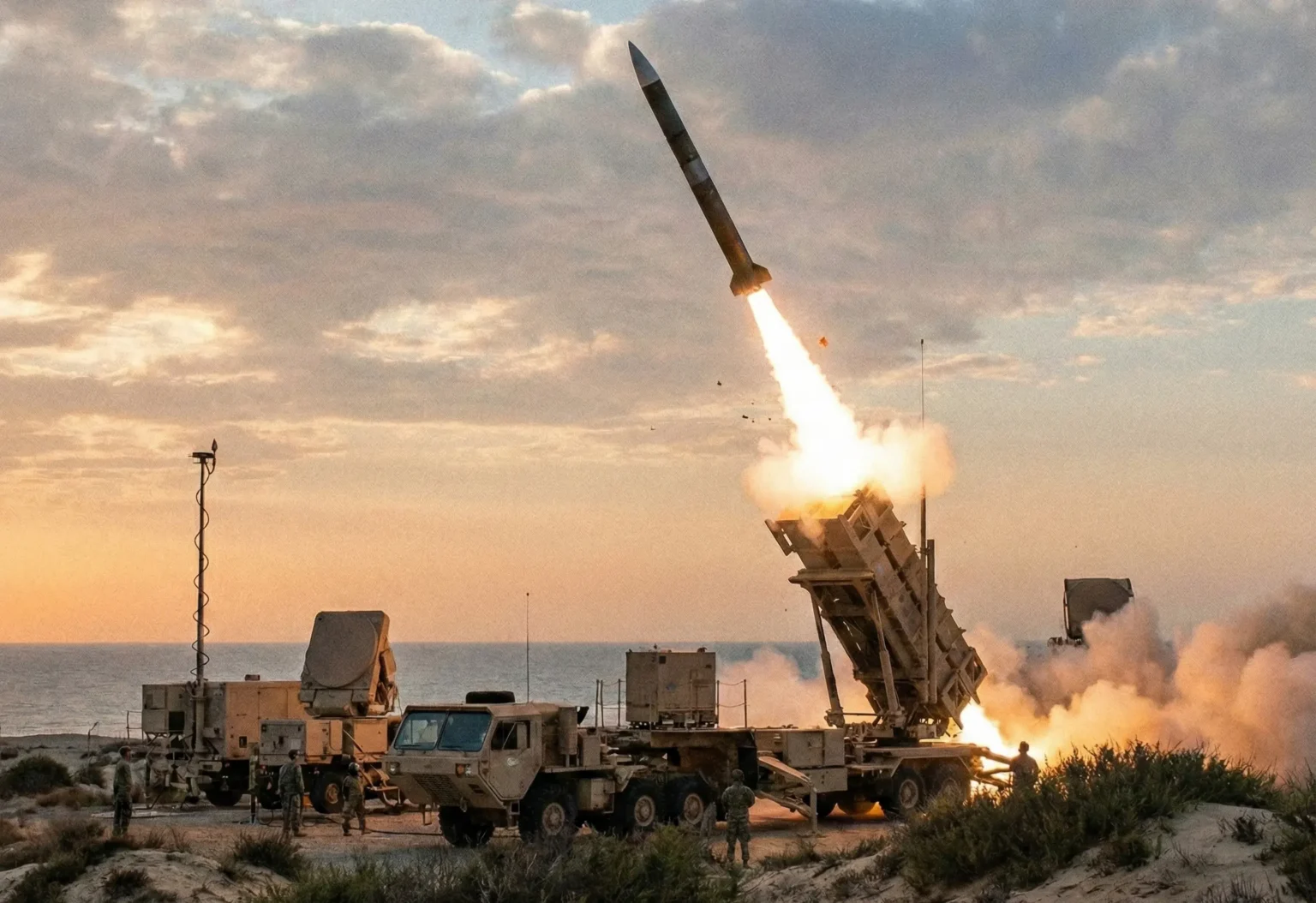
Key Points on the Role of Aerospace in Missile Defense Systems
- Aerospace technology plays a central role in detecting, tracking, and intercepting missile threats, utilizing satellites, radars, aircraft, and advanced sensors to provide early warnings and enable effective defensive actions.
- Systems like satellites offer global coverage for monitoring launches, while airborne platforms and ground-based radars ensure precise targeting and interception, helping protect against ballistic and cruise missiles.
- Historical efforts, dating back to World War II, have evolved into modern integrated defenses, with examples such as the U.S. Patriot and Israeli Iron Dome demonstrating how aerospace integration enhances effectiveness against real-world threats.
- Challenges include dealing with hypersonic missiles and electronic warfare, but ongoing advancements in AI and space-based systems suggest improved resilience in the future.
- While highly effective in many scenarios, these systems are not foolproof, and their success often depends on layered defenses combining multiple aerospace elements.
Understanding the Basics
Aerospace technology forms the backbone of missile defense by enabling the early detection of threats from space or the air. For instance, satellites can spot missile launches from thousands of miles away, giving defenders precious minutes to respond. This integration helps countries safeguard their territories, military assets, and populations from attacks that could otherwise cause massive damage.
Real-World Applications
In conflicts like the Gulf War, aerospace systems were crucial for intercepting incoming missiles, saving lives, and protecting infrastructure. Today, nations collaborate on these technologies, sharing data from radars and aircraft to create a unified shield against evolving dangers such as drone swarms or advanced ballistic missiles.
Looking Ahead
Research suggests that future systems will incorporate more automation and space-based interceptors, making defenses faster and more adaptive. However, experts note the importance of international cooperation to address global threats without escalating arms races.
Table of Contents
Aerospace technology has become indispensable in the realm of missile defense, weaving together elements from space, air, and ground-based operations to create robust protective shields against incoming threats.
At its core, this involves a symphony of satellites orbiting Earth, high-flying aircraft equipped with sensors, and sophisticated radars that scan the skies for any signs of danger. These components work in harmony to detect launches, track trajectories, and guide interceptors to neutralize missiles before they reach their targets. The evolution of these systems reflects decades of innovation driven by the need to counter increasingly sophisticated weaponry, from short-range tactical missiles to long-range intercontinental ballistic missiles that can cross oceans in minutes. By integrating aerospace advancements, nations can achieve layered defenses that provide multiple opportunities to thwart attacks, enhancing overall security in an unpredictable world.
The significance of aerospace in missile defense extends beyond mere technology; it represents a strategic imperative for global stability. Consider how satellites provide persistent surveillance over vast areas, allowing for real-time data sharing among allies. This capability not only deters potential aggressors but also enables rapid response in crises.
For example, during heightened tensions, aerospace systems can monitor hotspots like contested borders or volatile regions, offering decision-makers critical intelligence to de-escalate or defend. Moreover, the economic implications are profound, as investments in these technologies spur advancements in related fields such as telecommunications and weather forecasting, benefiting civilian life while bolstering military readiness.
Historical Development of Missile Defense Systems
The journey of missile defense systems began in the shadows of World War II, when the first guided missiles, like the German V-2 rocket, terrorized cities and prompted Allied forces to explore countermeasures. By the late 1940s, as the Cold War dawned, both the United States and the Soviet Union recognized the need for defenses against ballistic threats. Early efforts focused on anti-aircraft systems adapted for missiles, but it was the 1950s that saw the birth of dedicated programs. The U.S. Army’s Nike Ajax became the world’s first operational surface-to-air missile system in 1953, capable of intercepting high-altitude bombers and early missiles.
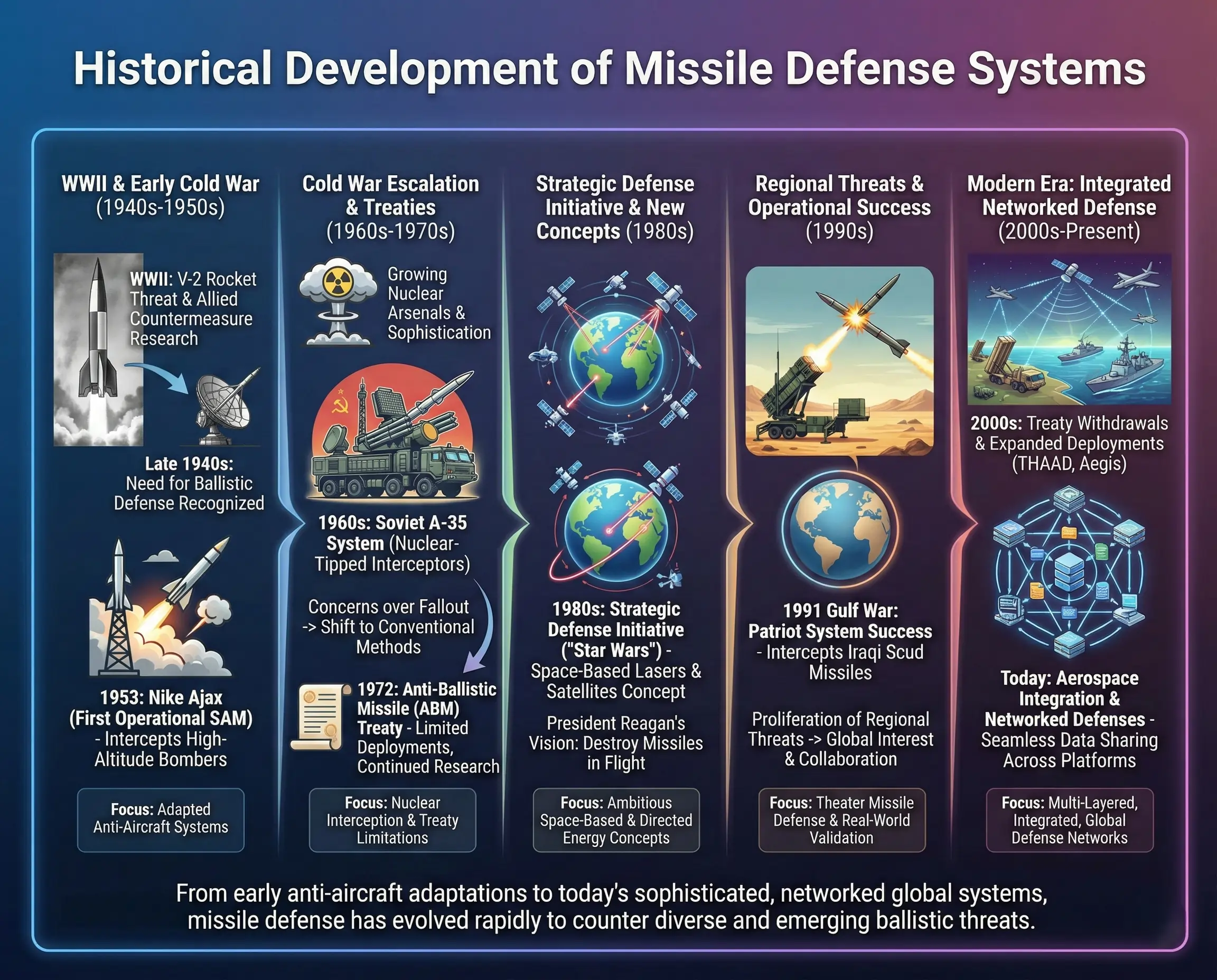
As nuclear arsenals grew, so did the sophistication of defenses. The 1960s brought nuclear-tipped interceptors like the Soviet A-35 system, designed to detonate near incoming warheads. However, concerns over fallout led to shifts toward conventional methods. The 1972 Anti-Ballistic Missile Treatybetween the U.S. and USSR limited deployments, but research continued underground. The 1980s marked a turning point with President Reagan’s Strategic Defense Initiative, often called “Star Wars,” which envisioned space-based lasers and satellites to destroy missiles in flight. Although many concepts proved too ambitious, they laid the groundwork for today’s technologies.
The post-Cold War era saw a proliferation of regional threats, prompting systems like the U.S. Patriot to shine during the 1991 Gulf War, where it intercepted Iraqi Scud missiles. This success spurred global interest, leading to collaborations and exports. In the 2000s, withdrawals from treaties allowed expanded deployments, with systems like THAAD and Aegis emerging to counter medium-range threats. Today, aerospace integration has transformed these into networked defenses, capable of sharing data across platforms for seamless operations.
To illustrate this evolution, consider the following timeline of key milestones:
| Year | Event | Description | Key Aerospace Contribution |
|---|---|---|---|
| 1944 | Launch of V-2 Rocket | First ballistic missile used in combat by Germany, prompting early defense studies. | Initial radar tracking experiments. |
| 1953 | Deployment of Nike Ajax | U.S. introduces the first operational anti-aircraft missile system. | Ground-based radars for guidance. |
| 1961 | Soviet ABM Test | Successful interception of a ballistic missile using nuclear warhead. | Early satellite reconnaissance for threat assessment. |
| 1972 | ABM Treaty Signed | U.S. and USSR limit missile defenses to reduce arms race. | Shift to research on space-based sensors. |
| 1983 | Strategic Defense Initiative Announced | Proposal for space-based defenses against ICBMs. | Concepts for orbital lasers and satellites. |
| 1991 | Gulf War Patriot Success | Intercepts Scud missiles, proving real-world efficacy. | Airborne warning systems integrated with ground interceptors. |
| 2002 | U.S. Withdraws from ABM Treaty | Enables full development of ground-based midcourse defense. | Enhanced satellite networks for global coverage. |
| 2010 | Iron Dome Operational | Israeli system counters short-range rockets with high success rate. | Advanced radars and command systems linked to aerospace surveillance. |
| 2020s | Hypersonic Defense Focus | Systems adapt to faster threats with AI-driven tracking. | Proliferating low-Earth orbit satellites for rapid detection. |
This table highlights how aerospace elements, from radars to satellites, have been pivotal at every stage, adapting to new challenges and incorporating lessons from past conflicts.
Key Aerospace Components in Missile Defense
Aerospace technology underpins missile defense through a variety of interconnected components that ensure comprehensive protection. At the forefront are satellites, which serve as the eyes in the sky. Systems like the U.S. Defense Support Program and its successor, Space-Based Infrared System (SBIRS), detect missile launches by sensing heat signatures from plumes, providing warnings within seconds. These satellites enable midcourse tracking, where missiles are followed through space, allowing ground systems to predict impact points and deploy interceptors accurately. Nanosatellites are emerging as cost-effective additions, offering resilient networks that can withstand jamming or attacks.
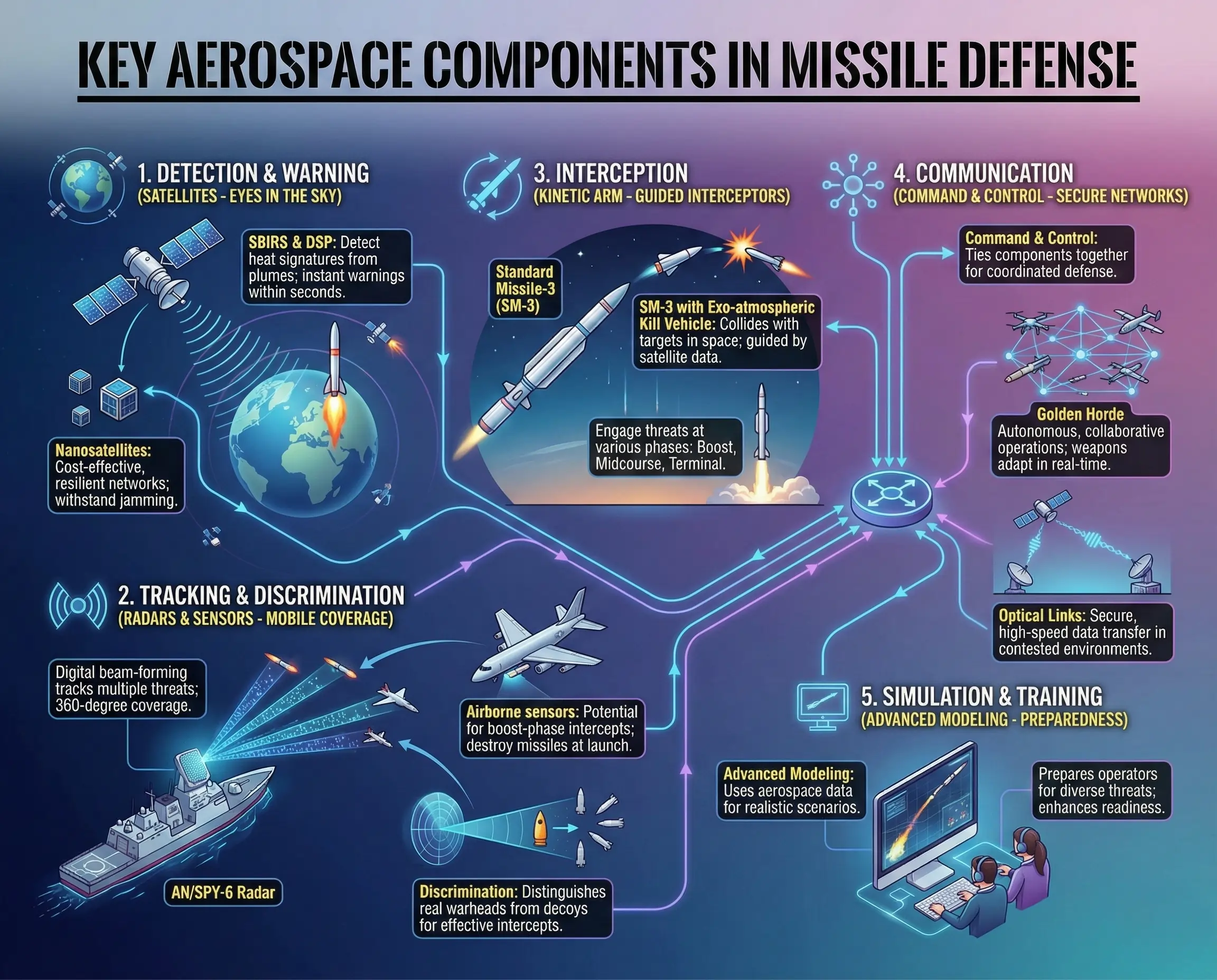
Radars and sensors form another critical layer, often mounted on aircraft or ships for mobility. The AN/SPY-6 radar, for instance, uses digital beam-forming to track multiple threats simultaneously, integrating with aerospace platforms for 360-degree coverage. Airborne sensors on platforms like the Airborne Laser prototype demonstrated the potential for boost-phase intercepts, destroying missiles shortly after launch while they are most vulnerable.
Interceptors, the kinetic arm of defense, rely on aerospace guidance for precision. Missiles like the Standard Missile-3 (SM-3) use exo-atmospheric kill vehicles to collide with targets in space, guided by satellite data and onboard sensors. Command and control systems tie it all together, using networks like Golden Horde for autonomous, collaborative operations where weapons adapt in real-time.
Here are some specific roles of these components:
- Detection and Warning: Satellites spot launches globally, relaying data to ground stations for immediate alerts.
- Tracking and Discrimination: Radars distinguish real warheads from decoys, crucial for effective intercepts.
- Interception: Aircraft-launched or space-guided missiles engage threats at various phases—boost, midcourse, or terminal.
- Communication: Optical links between platforms ensure secure, high-speed data transfer in contested environments.
- Simulation and Training: Advanced modeling uses aerospace data to prepare operators for scenarios.
These elements create a resilient architecture, as seen in exercises where fused sensor data reduced response times dramatically.
Major Missile Defense Systems Worldwide
Missile defense systems vary by country, each incorporating aerospace technologies tailored to specific threats. The United States leads with integrated systems like Ground-Based Midcourse Defense (GMD), which uses interceptors in Alaska and California to counter long-range missiles, supported by satellite networks for tracking. Aegis Ballistic Missile Defense, deployed on ships, leverages radars and SM-3 interceptors for sea-based protection, extending aerospace reach over oceans.
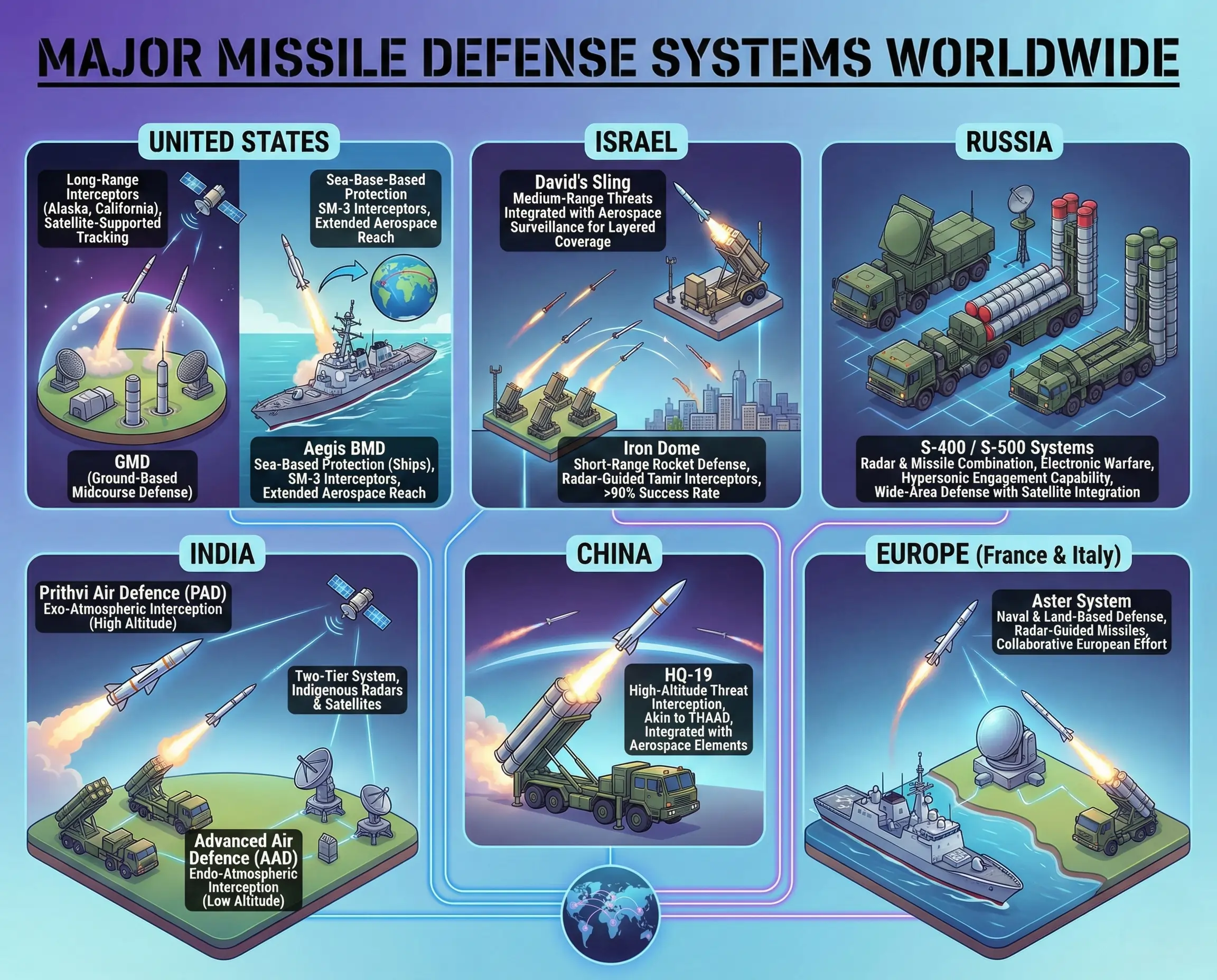
Israel’s Iron Dome exemplifies short-range defense, using radars to detect rockets and guide Tamir interceptors, achieving over 90% success rates in conflicts. David’s Sling handles medium-range threats, integrating with aerospace surveillance for layered coverage. Russia’s S-400 and emerging S-500 systems combine radars, missiles, and electronic warfare, capable of engaging hypersonics, with satellite integration for wide-area defense.
India’s Prithvi Air Defence and Advanced Air Defence form a two-tier system, using indigenous radars and satellites for ballistic missile interception. China’s defenses include the HQ-19, akin to THAAD, with aerospace elements for high-altitude threats. European collaborations, like the Aster system used by France and Italy, focus on naval defenses with radar-guided missiles.
For a comprehensive overview, the following table compares major systems:
| System | Country | Range | Key Aerospace Features | Notable Examples |
|---|---|---|---|---|
| Patriot (PAC-3) | USA and Allies | Short to Medium | Advanced radars for tracking, integrated with aircraft sensors. | Gulf War intercepts of Scuds; exported to over 15 countries. |
| THAAD | USA | Medium to Intermediate | High-altitude interceptors guided by satellite data. | Deployed in South Korea against North Korean threats. |
| Iron Dome | Israel | Short (up to 70 km) | Mobile radars and command systems linked to aerospace surveillance. | Defended against thousands of rockets in recent conflicts. |
| S-400 Triumf | Russia | Long (up to 400 km) | Multi-target radars with electronic warfare integration. | Sold to Turkey, causing NATO tensions. |
| Aegis BMD | USA | Medium to Long | Ship-based radars and SM-3 interceptors with space cuing. | Successful tests against ballistic targets in Pacific. |
| David’s Sling | Israel | Medium (up to 300 km) | Co-developed radars for hypersonic threats. | Integrated with U.S. systems for joint operations. |
| Arrow-3 | Israel | Long (exo-atmospheric) | Satellite-guided kill vehicles for ballistic missiles. | Intercepted threats from Yemen in recent incidents. |
| HQ-9 | China | Medium to Long | Indigenous radars similar to S-300, with satellite support. | Deployed along borders for regional defense. |
| Aster 30 | France/Italy | Medium | Naval radars for anti-air and missile roles. | Used in European naval fleets for collective security. |
| Prithvi Air Defence | India | Long | High-altitude interceptors with radar and satellite tracking. | Tested successfully against simulated ICBMs. |
This table underscores the diversity of approaches, with aerospace playing a unifying role in enhancing accuracy and response times across systems.
In practice, these systems have proven their worth. During the 2020s, Israel’s Arrow-3 intercepted long-range missiles from distant adversaries, relying on aerospace data for precise hits outside the atmosphere. Similarly, U.S. THAAD deployments in allied nations have deterred potential launches by providing credible defense umbrellas.
The Role of Key Organizations and Collaborations
Organizations like NORAD exemplify aerospace’s defensive role, monitoring North American airspace with satellites, radars, and fighter jets to detect missile or aircraft threats. Its bi-national structure with Canada ensures seamless data sharing, using systems like CF-18 Hornets for intercepts.
The U.S. Air Force contributes through sensors and command systems, with programs like SBIRS providing global warnings. Labs such as Johns Hopkins APL develop technologies like the SM-6 for sea-based defenses, conducting tests that validate aerospace integration.
International partnerships amplify effectiveness. NATO allies share aerospace assets, while collaborations like U.S.-Japan on SM-3 Block IIA blend technologies for mutual benefit. Private firms also play a part, innovating in areas like directed energy weapons.
Challenges and Limitations in Aerospace Missile Defense
Despite advancements, challenges persist. Hypersonic missiles, traveling at speeds over Mach 5, evade traditional radars due to their maneuverability, requiring faster aerospace sensors. Electronic warfare can jam signals, disrupting satellite communications.
Cost is another hurdle; deploying satellite constellations demands billions, and maintenance in space is complex. Geopolitical tensions arise from deployments, as seen with Russia’s objections to U.S. systems in Europe. Moreover, no system is infallible—decoys can overwhelm defenses, highlighting the need for layered approaches.
To address these:
- Enhance AI for threat discrimination.
- Develop resilient satellite networks against anti-satellite weapons.
- Invest in directed energy for cost-effective intercepts.
- Foster international norms to prevent arms races.
These strategies aim to mitigate risks while advancing aerospace capabilities.
Future Trends in Aerospace for Missile Defense
Looking forward, aerospace in missile defense is poised for transformative changes. Artificial intelligence will automate threat analysis, enabling agentic systems that predict and respond autonomously. Hypersonic defenses, like the U.S. Golden Dome initiative, will incorporate space-based interceptors to engage threats early in flight.
Sustainability trends include decarbonizing operations with electric propulsion for aircraft and eco-friendly satellite launches. 3D printing will speed up component production, reducing costs for radars and interceptors. Supply chain resilience will prioritize domestic manufacturing to avoid disruptions.
Space will see expanded roles, with low-Earth orbit constellations providing persistent coverage against emerging threats like drone-missile hybrids. Directed energy weapons, such as lasers on aircraft, promise unlimited “ammunition” for intercepts.
Potential developments include:
- Integration of quantum sensors for unbreakable communications.
- Collaborative swarms of unmanned aerial vehicles for distributed defense.
- Global partnerships for shared satellite data, enhancing collective security.
- Focus on cyber defenses to protect aerospace networks from hacks.
These trends suggest a future where aerospace not only defends but anticipates, making missile threats far less viable.
In conclusion, aerospace technology’s role in missile defense continues to expand, offering hope for a safer world amid rising complexities. By building on historical foundations and embracing innovations, these systems stand as guardians of peace.
Key Citations And References
- Exploring Aerospace Defense: What You Need to Know – NSTXL
- Air and Missile Defense – Johns Hopkins APL
- Space weapons and missile defence technology
- About NORAD
- Integrated Air and Missile Defense | Lockheed Martin
- The Air Force and Missile Defense | Air & Space Forces Magazine
- 2026 Aerospace and Defense Industry Outlook | Deloitte Insights
- Missile defense systems by country – Wikipedia
- Missile Defense Systems by Country 2025 – World Population Review
- Current U.S. Missile Defense Programs at a Glance
- Top 10 Air Defence Systems In The World In 2025; Demand Analysis
- Strategic ballistic missile defense | American Physical Society
- Defense Systems | Missile Threat – CSIS
- The Global Missile Defense Race
- Top 10 air defence systems in the world
- What Can 24 Satellites Do for U.S. Missile Defense? – CSIS
- Military satellite program highlights role of ‘mission integrators’
- Nanosatellites Could Play Pivotal Role in Defense Against Enemy Missiles
- Space-based Missile Warning & Defense | L3Harris® Fast. Forward.
- Top 10 Functions of Defense and Military Satellites – ESI Motion
- Missile defense – Wikipedia
- US Ballistic Missile Defense Timeline – Union of Concerned Scientists
- Missile Defense Systems at a Glance | Arms Control Association
- The Evolution of Mobile Air and Missile Defense Systems
- Timeline – Missile Defense, 1944-2002 | FRONTLINE – PBS
- A brief history of US missile defense systems – ABC News
- The Rise of America’s Missile Defense System – The History Reader
- Emerging trends in aerospace and defense 2025
- New Technology Trends in Aerospace and Defense Industry [2025]
- Top 10 Aerospace and Defense Industry Trends – PTC
- Pentagon advances Golden Dome missile defense with new Space Force contracts
- 8 Aerospace Trends to Watch in 2025 – O’Day Aviation Consulting
- Aerospace and Defense Products: The Future of Innovation, Technology, and Talent
Read These Articles in Detail
- Aerospace Engineering vs. Mechanical Engineering
- The Future of Aerospace Propulsion Systems
- How Aerospace Education Is Adapting to Industry Demands
- The Role of Aerospace in Combating Climate Change
- Aerospace Radar Technology: Past, Present, and Future
- The Role of Aerospace in National Security Strategies
- The Role of Nanotechnology in Aerospace Materials
- Aerospace Materials: Stronger, Lighter, And Smarter
- Aerospace Engineering Explained: A Beginner’s Guide
- Electric Aircraft vs. Hydrogen Aircraft: Which Is More Sustainable?
- Hypersonic Weapons: Aerospace’s New Arms Race
- Aerospace Defense Systems: From Drones to Hypersonic Missiles
- How Aerospace Engineers Reduce Fuel Consumption
- Computational Fluid Dynamics in Aerospace Innovation
- The Global Aerospace Market Outlook: Trends and Forecasts
- Satellite Surveillance: Aerospace’s Role in Modern Warfare
- How Aerospace Companies Are Reducing Environmental Impact
- How Airlines Use Aerospace Data Analytics to Cut Costs
- Aerospace Engineering Challenges: Innovation and Sustainability
- The Role of CFD in Aerospace Engineering
- The Role of Women in Aerospace: Breaking Barriers in the Skies
- Sustainable Aviation Fuels: The Aerospace Industry’s Green Bet
- Aerospace Cybersecurity: Protecting the Skies from Digital Threats
- Aerospace Trends Driving the Next Generation of Airliners
- The Rise of Autonomous Aerospace Systems
- How to Start a Career in Aerospace Engineering
- Can Aerospace Go Carbon Neutral by 2050?
- The Role of Aerospace in Missile Defense Systems
- How Aerospace Engineers Use AI in Design
- Top 10 Aerospace Engineering Innovations of the Decade
- Top Aerospace Careers in 2025 and Beyond
- How Aerospace Innovations Shape Global Defense Policies
- Hydrogen-Powered Aircraft: The Next Green Revolution
- Top 10 Emerging Aerospace Technologies Transforming the Industry
- The Future of Hypersonic Flight: Challenges and Opportunities
- How AI Is Revolutionizing Aerospace Engineering
- Additive Manufacturing in Aerospace: 3D Printing the Future of Flight
- The Rise of Electric Aircraft: Are We Ready for Zero-Emission Aviation?
- Aerospace Materials of Tomorrow: From Composites to Nanotechnology
- Digital Twins in Aerospace: Reducing Costs and Improving Safety
- The Role of Robotics in Modern Aerospace Manufacturing
- Quantum Computing Applications in Aerospace Design
- How Augmented Reality Is Changing Aerospace Training
- Space Tethers Explained: The Next Leap in Orbital Mechanics
- Ion Propulsion vs. Chemical Rockets: Which Will Power the Future?
- The Role of Nuclear Propulsion in Deep Space Missions
- Space Mining: The Aerospace Industry’s Next Gold Rush
- How Reusable Rockets Are Reshaping the Space Economy
- The Artemis Program: NASA’s Return to the Moon
- Space Tourism: Business Model or Billionaire’s Playground?
- How Aerospace Startups Are Disrupting Commercial Aviation
- The Economics of Low-Cost Airlines in the Aerospace Era
- Urban Air Mobility: The Rise of Flying Taxis
- The Future of Mars Colonization: Key Aerospace Challenges and Solutions Ahead
- CubeSats and Small Satellites: Democratizing Space Access
- The Future of Cargo Drones in Global Logistics
- The Role of Aerospace in Building a Lunar Economy
Frequently Asked Questions
FAQ 1: What Is Boost-Phase Missile Defense and Its Role in Aerospace Technology?
Boost-phase missile defense refers to the strategy of intercepting enemy missiles right after launch, while their engines are still burning and they are ascending. This phase lasts only a few minutes, making it a challenging but potentially effective window for neutralization because the missile is most vulnerable then, with its bright plume easily detectable by sensors. Aerospace technology is central here, as it relies on airborne or space-based platforms to detect and engage threats quickly over vast distances.
In practice, systems like airborne lasers or space-based interceptors use advanced radars and infrared sensors to track the missile’s heat signature from afar. These aerospace elements allow for rapid response, potentially destroying the missile before it releases warheads or decoys, which complicates later interception phases. However, challenges include the short time frame and the need for platforms to be positioned close to launch sites, often requiring international cooperation or forward-deployed assets.
Advancements in aerospace have revived interest in boost-phase defenses, with concepts like the Golden Dome proposing orbital interceptors to cover global threats. While not foolproof due to geographic limitations and countermeasures like fast-burn boosters, this approach complements layered defenses, enhancing overall security against proliferating missile technologies.
FAQ 2: How Do Directed Energy Weapons Contribute to Missile Defense?
Directed energy weapons, such as high-energy lasers, represent a cutting-edge addition to missile defense by using focused beams of light to disable threats without traditional ammunition. These systems can engage multiple targets rapidly and at a lower cost per shot compared to kinetic interceptors, making them ideal for countering swarms of drones or missiles.
Their contributions include:
- Boost-Phase Neutralization: Lasers mounted on aircraft or ships can target missiles during ascent, melting critical components before they gain speed.
- Cost Efficiency: With unlimited “shots” as long as power is available, they reduce the expense of defending against saturation attacks.
- Integration with Aerospace Sensors: Combined with satellite tracking, these weapons provide precise, real-time engagement in layered defenses.
- Adaptability to Emerging Threats: Effective against hypersonics and drones, they address gaps in conventional systems.
- Testing and Deployment: Ongoing trials show promise for ground, air, and naval platforms, enhancing overall missile shield resilience.
FAQ 3: What Are the Key International Collaborations in Missile Defense Systems?
International partnerships strengthen missile defense by pooling resources, sharing intelligence, and co-developing technologies to address global threats. These collaborations often involve joint exercises, technology transfers, and shared deployments, fostering collective security.
| Collaboration | Participating Countries | Key Focus | Notable Outcomes |
|---|---|---|---|
| NATO Missile Defense | USA, European Allies | Integrated shield against ballistic threats | Shared radar networks and interceptor sites in Europe. |
| US-Israel Arrow Program | USA, Israel | High-altitude intercepts | Co-developed Arrow-3 for exo-atmospheric defense. |
| AUKUS Pact | Australia, UK, USA | Advanced hypersonic countermeasures | Technology sharing for Pacific region security. |
| US-Japan Aegis BMD | USA, Japan | Sea-based defenses | Joint SM-3 missile upgrades against North Korean threats. |
| Five Eyes Intelligence Sharing | USA, UK, Canada, Australia, New Zealand | Data fusion for early warning | Enhanced satellite and radar information exchange. |
| European Sky Shield Initiative | Germany, Multiple EU Nations | Air and missile protection | Procurement of systems like Patriot for unified coverage. |
| US-South Korea THAAD | USA, South Korea | Medium-range intercepts | Deployment amid regional tensions, with joint operations. |
| Quadrilateral Security Dialogue | USA, Japan, India, Australia | Indo-Pacific missile threats | Collaborative exercises and tech development. |
These efforts highlight how aerospace integration across borders improves detection and response times.
FAQ 4: What Is the Cost of Developing and Deploying Missile Defense Systems?
The financial investment in missile defense systems is substantial, reflecting their complexity and the need for cutting-edge aerospace technology. Development costs often run into billions, covering research, testing, and integration of satellites, radars, and interceptors. For instance, the US Ground-Based Midcourse Defense has accumulated expenses exceeding hundreds of billions over decades, with annual budgets in the billions for maintenance and upgrades.
Deployment adds further layers, including site construction, personnel training, and international partnerships that can share but also inflate costs due to customization. Systems like Iron Dome demonstrate relative affordability per interception, but scaling up for global coverage, such as proposed space-based networks, could reach trillions. Factors like inflation, technological risks, and geopolitical shifts influence these figures, making precise estimates challenging.
Despite high upfront costs, proponents argue the long-term value in deterrence and protection justifies the expenditure, especially as threats evolve. Ongoing efforts focus on cost-reduction through modular designs and private sector involvement to make these systems more sustainable.
FAQ 5: How Effective Have Missile Defense Systems Been in Real-World Conflicts?
Missile defense systems have shown varying degrees of success in actual combat, often excelling in limited scenarios but facing limitations against overwhelming or advanced attacks. In conflicts like the Gulf War, early Patriot systems intercepted some Scuds, proving the concept but highlighting accuracy issues.
Effectiveness factors include:
- Intercept Rates: Systems like Iron Dome have achieved over 90% success against short-range rockets in recent Middle East conflicts.
- Layered Approaches: Combining aerospace elements improves outcomes, as seen in Ukraine where integrated defenses neutralized many Russian missiles.
- Challenges with Advanced Threats: Hypersonics and drones reduce efficacy, with gaps exposed in saturated attacks.
- Operational Lessons: Real-world use drives improvements, such as better sensor fusion for higher hit rates.
- Overall Assessment: While not infallible, they provide critical protection, with success depending on threat type and preparation.
FAQ 6: What Role Do Space-Based Interceptors Play in Missile Defense?
Space-based interceptors are emerging as a pivotal component in advanced missile defense, positioned in orbit to engage threats early and from advantageous vantage points. They leverage aerospace superiority for global reach and rapid response.
| Aspect | Description | Advantages | Challenges | Examples |
|---|---|---|---|---|
| Detection | Use satellites to spot launches via infrared. | Global coverage without geographic limits. | Vulnerability to anti-satellite weapons. | SBIRS constellation. |
| Interception | Deploy kill vehicles from orbit. | Hits during boost or midcourse phases. | High deployment costs. | Golden Dome prototypes. |
| Integration | Link with ground systems for layered defense. | Faster reaction times. | Technical complexity in orbital mechanics. | Proposed SBI networks. |
| Resilience | Constellations of small satellites. | Redundancy against failures. | Space debris risks. | Midcourse defense concepts. |
| Future Potential | AI-enhanced targeting. | Adaptability to hypersonics. | Arms race concerns. | Reagan-era SDI evolutions. |
This role underscores space as the new frontier in defense.
FAQ 7: How Does Electronic Warfare Integrate with Missile Defense Systems?
Electronic warfare enhances missile defense by disrupting enemy communications, jamming guidance systems, and protecting friendly assets from detection. In aerospace contexts, it involves airborne platforms that emit signals to confuse incoming missiles, diverting them from targets.
Integration occurs through multi-domain operations, where electronic warfare systems work alongside radars and satellites to create a comprehensive shield. For example, aircraft-equipped jammers can suppress adversary radars, allowing interceptors clearer paths. This synergy is vital in contested environments, where threats employ advanced countermeasures.
As technology evolves, electronic warfare incorporates AI for adaptive jamming, making defenses more robust against sophisticated attacks like hypersonics. While not a standalone solution, its role in degrading enemy effectiveness complements kinetic intercepts, ensuring higher survival rates for defended areas.
FAQ 8: What Is the Environmental Impact of Missile Defense Systems?
Missile defense systems, while crucial for security, can have notable environmental effects during construction, testing, and operation. Site development for radars and launchers often involves land clearing, potentially disrupting ecosystems and wildlife habitats.
Impacts include:
- Resource Consumption: High energy use for operations contributes to carbon emissions.
- Pollution Risks: Testing may release hazardous materials, affecting soil and water.
- Noise and Visual Disturbance: Launches and radars can impact local communities and animals.
- Long-Term Effects: Orbital deployments add to space debris concerns.
- Mitigation Efforts: Environmental assessments guide sustainable practices, like habitat restoration.
FAQ 9: How Is the Private Sector Involved in Missile Defense Technology?
The private sector drives innovation in missile defense through contracts, research, and commercialization of aerospace technologies. Companies collaborate with governments to develop components like sensors and interceptors.
| Company Role | Examples | Contributions | Impact |
|---|---|---|---|
| System Integration | Lockheed Martin, Raytheon | Build integrated defenses like THAAD. | Enhanced capabilities through R&D. |
| Satellite Development | SpaceX, Northrop Grumman | Deploy constellations for tracking. | Cost-effective launches and networks. |
| Directed Energy | Boeing, General Atomics | Laser systems for intercepts. | Affordable, high-tech alternatives. |
| Startups in Autonomy | Anduril, Shield AI | AI-driven drones and sensors. | Rapid innovation for emerging threats. |
| Supply Chain | Various SMEs | Components and materials. | Resilience and efficiency in production. |
This involvement accelerates advancements while sharing costs.
FAQ 10: What Are the Differences in Defending Against Ballistic vs. Cruise Missiles Using Aerospace Technology?
Defending against ballistic missiles involves countering high-arc trajectories that often exit and re-enter the atmosphere, requiring space-based sensors for early detection and high-altitude interceptors. Aerospace technology excels here with satellites providing global monitoring and guiding ground or sea-based systems to engage during midcourse or terminal phases.
In contrast, cruise missiles fly low and maneuver like aircraft, hugging terrain to evade radars, which demands agile airborne platforms and advanced electronic warfare for disruption. Aerospace integration uses drones or aircraft for close-range tracking, complemented by ground radars for precision.
The key distinction lies in predictability: ballistics follow parabolic paths, allowing pre-planned intercepts, while cruises require real-time adaptability. Layered defenses combining both approaches ensure comprehensive protection against diverse threats.
FAQ 11: What is the Primary Role of Satellites in Missile Defense Systems?
Satellites play a foundational role in modern missile defense by providing early detection and continuous monitoring of potential threats across vast distances. These orbiting platforms use advanced sensors to identify missile launches through infrared signatures, allowing defense systems to respond quickly. Without satellites, ground-based radars alone would struggle to cover global threats, making space-based assets essential for comprehensive protection.
In addition to detection, satellites facilitate precise tracking during a missile’s flight phases. They relay real-time data to command centers, enabling accurate predictions of trajectories and impact zones. This integration enhances the effectiveness of interceptors, ensuring they can engage threats at optimal points. As technology advances, constellations of smaller satellites are being deployed to create resilient networks that resist jamming or destruction, further solidifying their importance in layered defenses.
FAQ 12: How Have Missile Defense Systems Evolved Historically?
Missile defense has undergone significant transformations since its early days, driven by technological advancements and geopolitical needs. Starting in the mid-20th century, initial efforts focused on countering basic ballistic threats with rudimentary systems. Over time, these have grown into sophisticated networks incorporating aerospace elements for better accuracy and coverage.
Key milestones include:
- World War II Era: Early experiments with anti-aircraft systems adapted for incoming rockets like the V-2.
- Cold War Developments: Introduction of nuclear-tipped interceptors and treaties limiting deployments to prevent arms races.
- Modern Integrations: Shift to AI-enhanced, multi-layered systems capable of handling diverse threats including hypersonics.
This evolution reflects a move from isolated defenses to interconnected global shields.
