A job interview is more than a conversation. It is the moment when an employer checks your skills, communication, professionalism, and overall fit for the role. Career resources from Harvard explain that interviews help employers judge your qualifications, your transferable skills, and how clearly you explain your value, while also giving you a chance to evaluate whether the organization matches your goals. Harvard and SHRM also note that many interviewers use behavioral questions because past behavior is often treated as a strong clue to future performance. That is why preparation matters so much.
This guide is written to help you answer the top interview questions in a natural, confident, and professional way. It uses simple language, practical examples, and a structure that works for freshers, experienced candidates, career changers, and people preparing for phone, video, panel, or in-person interviews. It also brings together proven advice from reputable career resources such as Harvard, SHRM, and Indeed.
Table of Contents
Why Interview Preparation Matters
A strong interview answer is not about sounding perfect. It is about sounding prepared, clear, and honest. Employers usually want to understand three things very quickly.
- Can you do the job?
- Will you do the job well with others?
- Do you genuinely understand the role and the company?
Harvard notes that interviewers often want evidence of your fit, your reasons for applying, and your ability to communicate your contribution clearly. SHRM adds that many organizations use behavioral and situational questions to learn how candidates think, act, and solve problems.
That means the best answers are usually:
- Specific
- Relevant
- Short enough to stay focused
- Backed by a real example
- Positive in tone
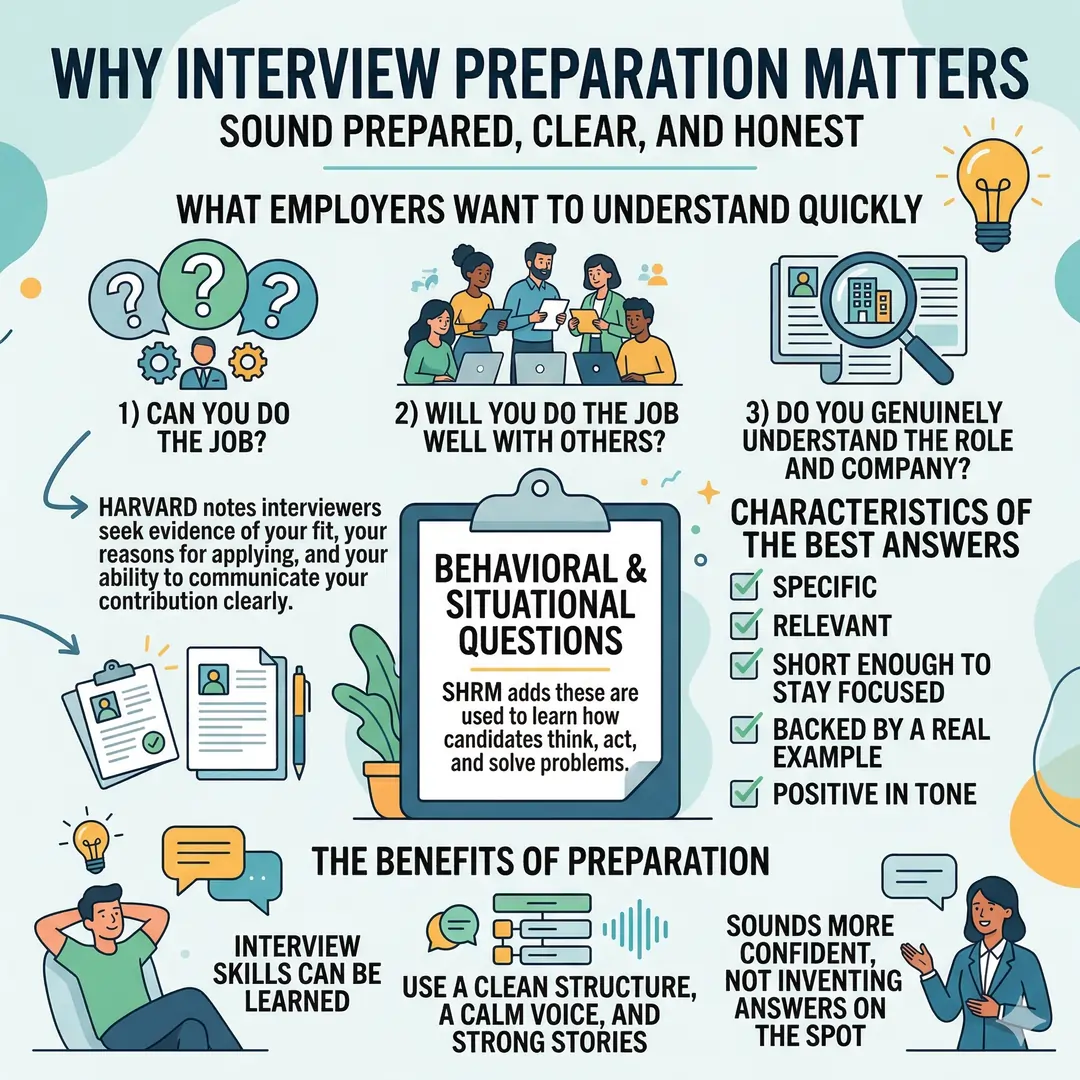
The good news is that interview skills can be learned. You do not need fancy words. You need a clean structure, a calm voice, and a few strong stories from your own experience. A well-prepared candidate often sounds more confident because they are not inventing answers on the spot. They are simply choosing the right example and telling it well.
How to Use This Interview Questions and Answers Guide
This article is designed to help you prepare practically. Start by reading the question list once, then think about your own work history, college projects, volunteer work, internships, or leadership experience. Harvard’s interview guidance and Indeed’s interview advice both emphasize using real examples and matching your answer to the role. CareerOneStop also recommends researching the employer and job, practicing answers out loud, and preparing questions to ask at the end.
A good way to use this guide is:
- Read the question.
- Think about what the interviewer really wants to know.
- Choose one strong example.
- Keep your answer clear and natural.
- Practice speaking it aloud.
- Adjust the details so they fit the job you want.
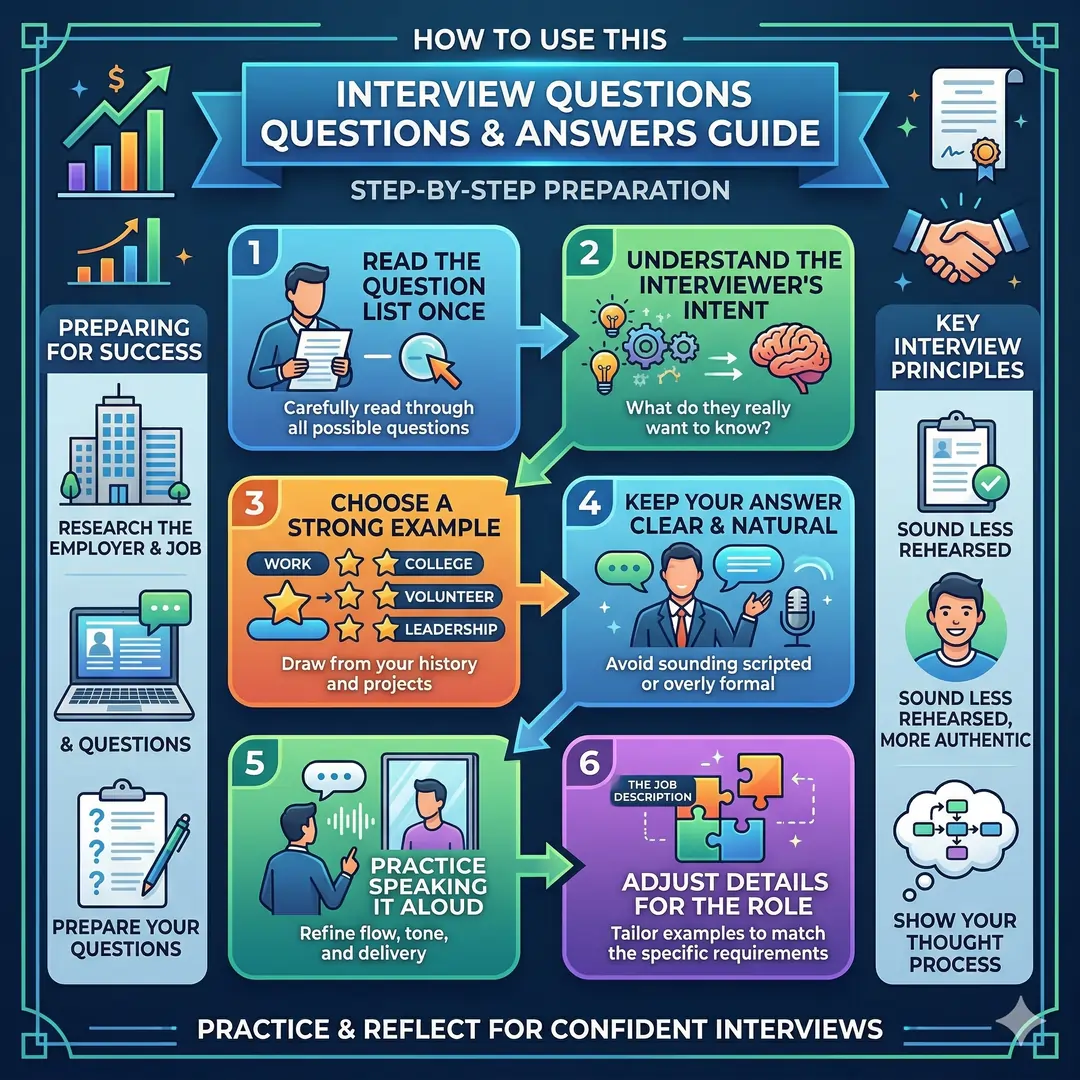
If you do that, your answers will start to sound less rehearsed and more authentic. That is exactly what interviewers want to hear. SHRM notes that the thought process behind your answer often matters as much as the answer itself.
The Best Formula for Answering Interview Questions
One of the most useful methods in interviews is the STAR method. Harvard’s interviewing guide recommends it for behavioral questions. STAR stands for Situation, Task, Action, and Result. It helps you tell a story without wandering off topic. SHRM also explains that behavioral interviewing focuses on past experiences, while Harvard says the action and result should be the core of your answer.
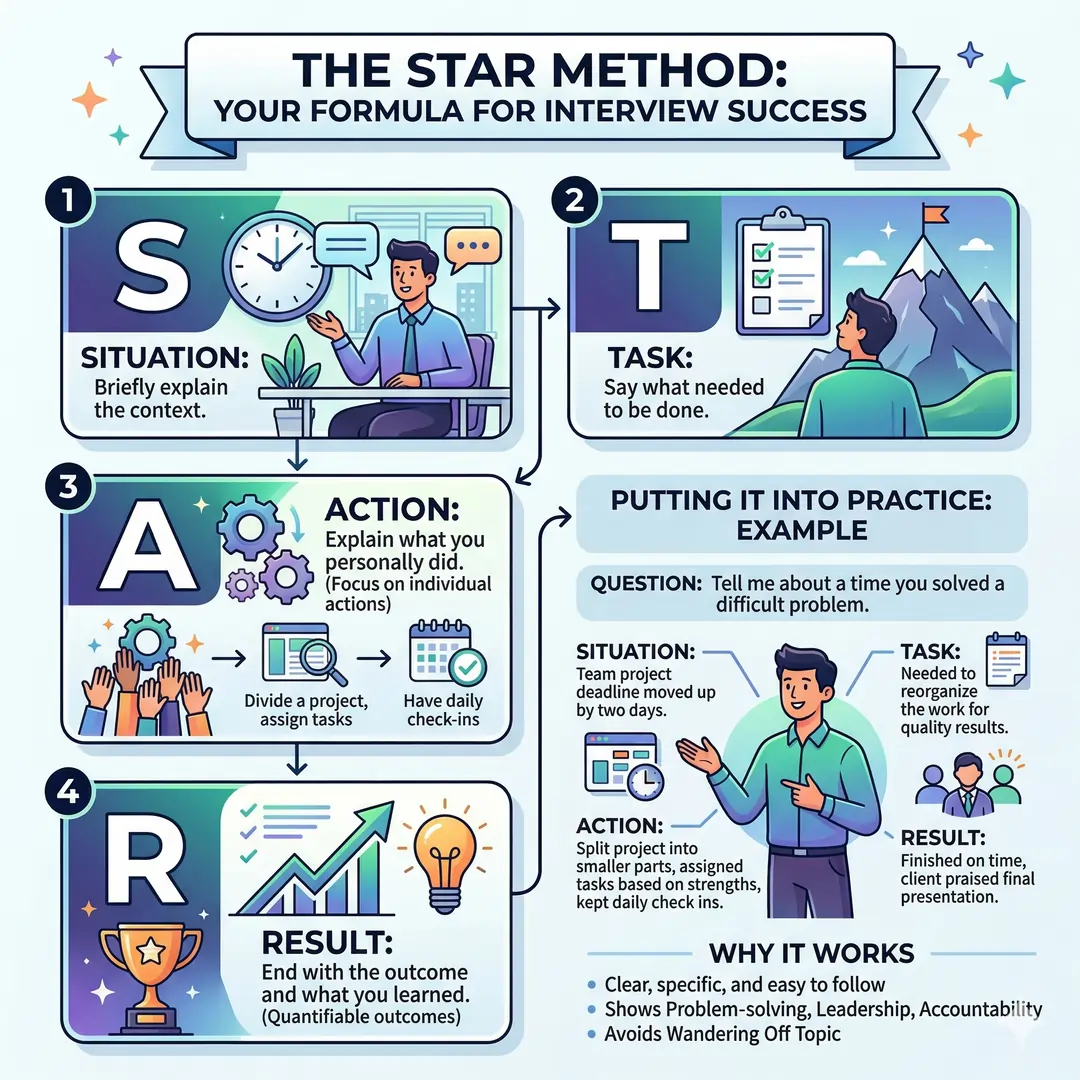
Here is the simplest version of the formula:
- Situation: Briefly explain the context.
- Task: Say what needs to be done.
- Action: Explain what you personally did.
- Result: End with the outcome and what you learned.
Example of STAR in action
Question: Tell me about a time you solved a difficult problem.
Answer structure:
- Situation: My team had a project deadline moved up by two days.
- Task: I needed to reorganize the work so we could still deliver quality results.
- Action: I split the project into smaller parts, assigned tasks based on strengths, and kept daily check-ins.
- Result: We finished on time, and the client praised the final presentation.
That is a strong answer because it is clear, specific, and easy to follow. It also shows problem-solving, leadership, and accountability.
Top Interview Questions and Strong Answer Ideas
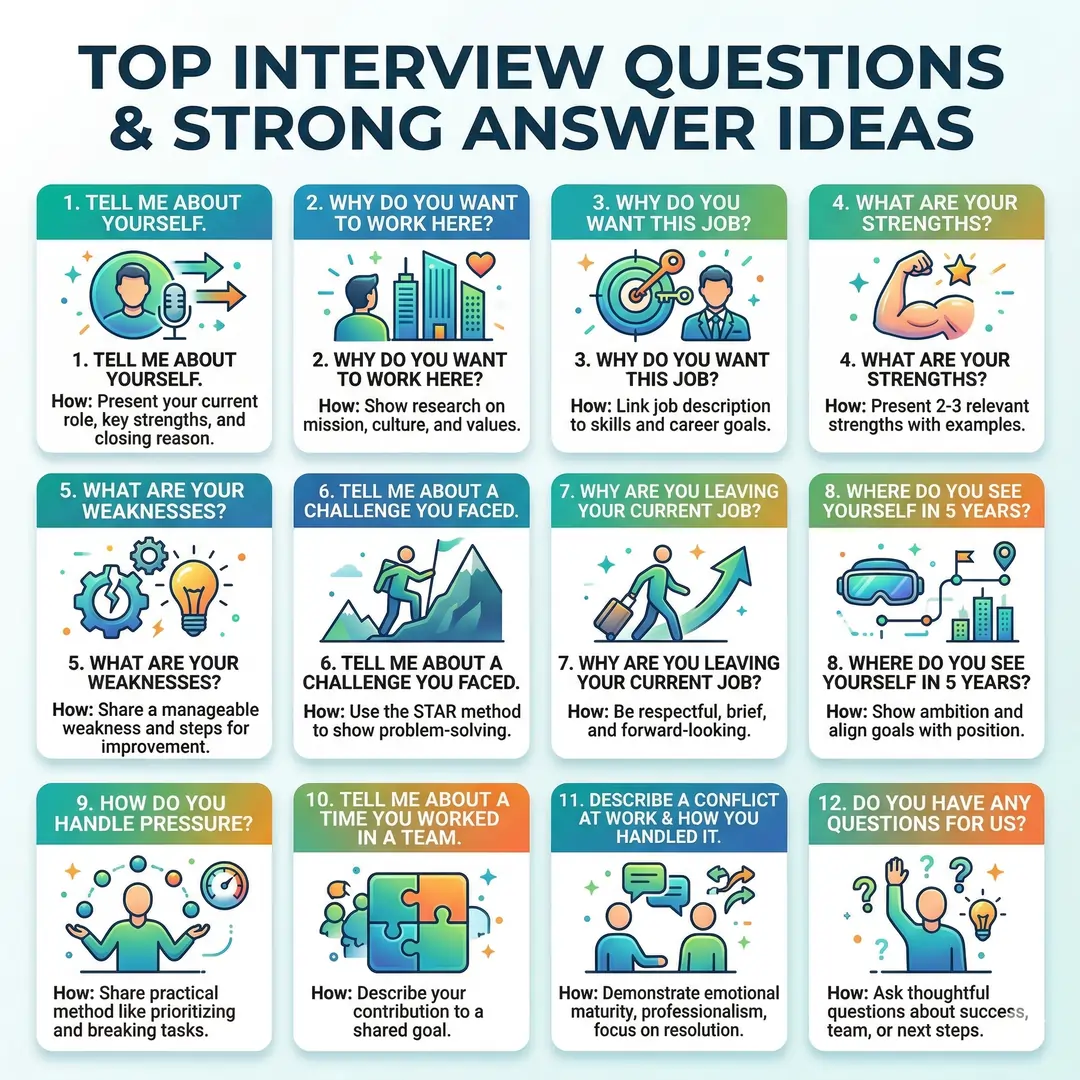
The questions below are among the most common across career resources from Harvard, SHRM, and Indeed. They show up often because they reveal motivation, self-awareness, communication style, and job readiness.
Large Interview Questions and Answers Table
| Interview Question | What the Interviewer Wants to Know | How to Answer Well | Example Answer Angle |
|---|---|---|---|
| Tell me about yourself. | A short summary of your background and fit for the role | Start with your current role or most recent experience, then mention key strengths, and close with why you are here | “I have worked in customer support for four years, and I enjoy solving problems and improving customer experience.” |
| Why do you want to work here? | Whether you researched the company and care about its mission | Mention something specific about the company, its work, culture, products, or values | “I admire your focus on innovation and practical solutions in the education space.” |
| Why do you want this job? | Whether you understand the role and want it for the right reasons | Connect the job description to your skills and career goals | “This role matches my experience in coordination and gives me room to grow in operations.” |
| What are your strengths? | What value do you bring to the team | Choose 2 or 3 strengths and back them with examples | “I am organized, reliable, and good at handling deadlines.” |
| What are your weaknesses? | Whether you are self-aware and improving | Mention a real but manageable weakness and explain how you are working on it | “I used to take on too much at once, so now I set clearer priorities.” |
| Tell me about a challenge you faced. | How you handle pressure and problem-solving | Use STAR and keep the focus on what you did | “Our timeline changed suddenly, so I reorganized the plan and kept the team aligned.” |
| Why are you leaving your current job? | Whether you are moving forward for a positive reason | Stay respectful, brief, and forward-looking | “I learned a lot there, and I am now looking for a role with more responsibility.” |
| Where do you see yourself in five years? | Whether your goals align with the position | Show ambition without sounding unrealistic | “I hope to grow into a role where I lead projects and mentor others.” |
| How do you handle pressure? | Your ability to stay calm and productive | Show a real method, like planning, prioritizing, or asking for clarity | “I break tasks into steps, focus on urgent work first, and keep communication open.” |
| Tell me about a time you worked in a team. | Collaboration and communication skills | Show how you contributed to a shared goal | “I coordinated with three teammates to complete a report before the deadline.” |
| Describe a conflict at work and how you handled it. | Emotional maturity and professionalism | Stay respectful toward others and focus on resolution | “I listened first, clarified the misunderstanding, and suggested a practical next step.” |
| Do you have any questions for us? | Whether you are engaged and thoughtful | Ask smart questions about the team, success measures, or next steps | “What does success look like in the first 90 days?” |
These are not the only questions that may come up, but they are among the most common. Indeed highlights questions such as Tell me about yourself, Why are you interested in our company?, What are your strengths?, and What are your weaknesses? Harvard and SHRM also emphasize behavioral and competency-based questioning.
Detailed Answers for Common Interview Questions
1. Tell me about yourself
This is usually the opening question, and it often sets the tone for the rest of the interview. Indeed explains that the interviewer wants a summary of your career path and relevant experience, not your entire life story. A strong answer should connect your background to the job. Indeed also recommends keeping it focused on professional life and avoiding unnecessary personal details.
Good answer style:
- Present role or most recent experience
- Key strengths
- One or two achievements
- Why does the role interest you
Example:
“I have spent the last five years working in operations support, where I learned how to manage schedules, solve problems quickly, and keep communication smooth across teams. I enjoy work that is organized, practical, and people-focused. Right now, I am looking for a role where I can use those skills in a more growth-oriented environment.”
This kind of answer works because it is simple, professional, and relevant.
2. Why do you want to work here?
Interviewers ask this to see whether you researched the company and can explain why it stands out. Indeed recommends reviewing the company website, social media, and news before the interview. CareerOneStop likewise advises researching the employer and the job before you walk in.
Good answer style:
- Mention a specific fact about the company
- Connect it to your interests or goals
- Show genuine enthusiasm
Example:
“I want to work here because your organization has a strong reputation for solving real customer problems with practical solutions. I also value the way your team seems to combine innovation with a clear service mindset. That combination fits the kind of environment where I do my best work.”
3. Why do you want this position?
This question checks whether you understand the role, not just the company. Indeed explains that interviewers want to know whether you will stay engaged and find the job meaningful.
Good answer style:
- Reference the job description
- Mention your relevant skills
- Show a reason to grow in the role
Example:
“This position appeals to me because it combines coordination, communication, and problem-solving, which are all areas where I have practical experience. It also gives me a chance to grow further in a role where I can take on more responsibility and contribute to team results.”
4. What are your strengths?
This is your chance to show value. The best strengths are the ones that match the job. Indeed recommends choosing two or three skills and supporting them with examples.
Good strengths to mention:
- Communication
- Problem solving
- Adaptability
- Time management
- Teamwork
- Attention to detail
- Leadership
Example:
“One of my biggest strengths is staying organized under pressure. I am also good at communicating clearly with different kinds of people, whether that is a manager, a client, or a team member. In my previous role, those strengths helped me keep projects on track and avoid last-minute confusion.”
5. What are your weaknesses?
This question is tricky, but it is also an opportunity to show maturity. Indeed explains that interviewers want to see self-awareness and a willingness to improve. The safest approach is to choose a real weakness that does not block the core responsibilities of the job, then explain how you are managing it.
Good weaknesses to mention:
- Taking on too much at once
- Being overly detail-oriented
- Hesitating to delegate
- Nervousness about public speaking is improving
- Being slow to ask for help in the past
Example:
“I used to take on too many tasks at the same time because I wanted to be helpful. I have learned that better prioritization leads to better results, so now I review my workload earlier and communicate more clearly when I need to set expectations.”
That answer sounds honest without sounding careless.
6. Tell me about a challenge you faced at work
This is a classic behavioral question. Harvard and SHRM both explain that behavioral questions ask for specific examples of past experiences so the interviewer can predict future behavior. Harvard also recommends using STAR to keep the answer focused.
Example:
“Last year, our team had a project deadline that was moved forward by several days. I reorganized the task list, identified the most urgent items, and checked in with teammates each morning to remove blockers. We completed the project on time, and the client was happy with the quality.”
This is effective because it shows calm action and a clear result.
7. Tell me about a time you worked in a team
Teamwork questions are common because most workplaces depend on collaboration. Harvard’s interview guide notes that employers look at skills like communication and professionalism, and SHRM’s competency list includes relationship management, communication, and leadership.
Example:
“In one project, I worked with people from operations, design, and support. My role was to keep everyone aligned on deadlines and make sure questions were answered early. That helped us avoid confusion and finish the work smoothly.”
Keep your answer focused on your role, not just the team result.
8. Tell me about a time you disagreed with someone
The interviewer wants to see how you handle conflict without becoming defensive. Indeed includes this kind of question among common interview topics. The strongest answers stay calm and respectful.
Example:
“I once disagreed with a teammate about the order of tasks in a project. Instead of arguing, I suggested we compare deadlines and workload. Once we looked at the facts, we agreed on a better plan, and the project moved forward without tension.”
This answer works because it shows maturity and practical thinking.
9. Where do you see yourself in five years?
This question checks whether you have direction and whether that direction fits the role. Indeed notes that interviewers use this question to understand motivation and long-term fit.
Example:
“In five years, I hope to have built deep experience in this field, taken on more responsibility, and become someone my team can rely on for solid execution and support. I want to continue learning and growing into larger projects over time.”
This sounds ambitious without sounding unrealistic.
10. Why should we hire you?
Harvard states that, in essence, interviewers want to know why they should hire you. This question gives you a direct chance to connect your skills to the role.
Example:
“You should hire me because I bring a mix of reliability, fast learning, and strong communication. I understand the kind of work this role requires, and I have experience handling similar responsibilities with care and consistency. I would come in ready to contribute and keep improving.”
11. Do you have any questions for us?
This is not a formality. It is part of the interview. Harvard says interviews are also your chance to evaluate whether the organization fits your professional interests, values, and goals. CareerOneStop also recommends preparing questions in advance.
Good questions to ask:
- What does success look like in the first 90 days?
- What are the biggest challenges in this role?
- How does the team measure performance?
- What kind of growth does this department support?
- What would you like the next person in this role to improve first?
Asking thoughtful questions makes you look prepared and curious.
Answering Behavioral Questions the Right Way
Behavioral questions often begin with phrases like:
- Tell me about a time
- Describe a situation where
- Give me an example of
- What did you do when
- How did you handle
Harvard explains that behavioral interviews ask you to refer back to a particular situation and describe how you responded. SHRM says these questions are built to predict future behavior from past behavior. That means vague answers are not enough. You need a real example.
A simple behavioral answer template
Use this structure:
“In this situation, I had to… I took these steps… The result was…”
Or use the full STAR:
- Situation
- Task
- Action
- Result
Behavioral question examples
- Tell me about a time you solved a problem under pressure.
- Describe a time you handled a difficult customer.
- Tell me about a time you made a mistake.
- Give an example of when you had to learn something quickly.
- Describe a time you had to prioritize several tasks.
What to include in every behavioral answer
- A real example
- Your exact role
- The actions you took
- The result
- A short lesson learned
What to avoid
- Talking too much
- Blaming other people
- Giving a story with no result
- Using one example for every question
- Turning the answer into a speech
Harvard specifically advises keeping the situation brief and focusing on action and result, while also staying on topic and ending with what you learned.
Common Interview Mistakes and Better Alternatives
| Common Mistake | Why It Hurts Your Answer | Better Approach | Example of a Better Response |
|---|---|---|---|
| Talking too long | The main point gets lost | Keep it short and focused | “I handled the issue by reassigning tasks and checking progress daily.” |
| Giving a generic answer | It sounds rehearsed and weak | Use a real story | “In my last project, I…” |
| Speaking negatively about a former boss or company | It can sound unprofessional | Stay respectful and positive | “The role was a good experience, and I am now ready for a new challenge.” |
| Not knowing the company | Shows low interest | Research the employer before the interview | “I noticed your focus on sustainability and innovation.” |
| Memorizing answers word for word | Makes you sound stiff | Learn the structure, not the script | “I prepare key points, then speak naturally.” |
| Skipping the result | The story feels unfinished | End with outcome and lesson | “We delivered on time, and I learned how useful early communication can be.” |
| Choosing a weak weakness | It sounds fake | Pick a real but manageable weakness | “I used to overcommit, so I now set clearer limits.” |
| Not asking questions back | You may seem uninterested | Prepare thoughtful questions | “What does success look like in this role?” |
A polished answer is not the same as a perfect answer. It is an honest answer shaped with care. SHRM notes that when interviewers evaluate answers, the reasoning process behind the response is often as important as the answer itself.
Interview Preparation Checklist
CareerOneStop recommends researching the employer and job, practicing your answers, and making a list of questions to ask. Harvard’s interview guide adds practical basics like confirming the location, arriving 10 to 15 minutes early, bringing extra resume copies, and sending a thank-you email afterward.
Large Interview Preparation Table
| Preparation Task | Why It Matters | What to Do | Example |
|---|---|---|---|
| Research the company | Helps you answer “Why us?” well | Read the website, recent news, and job posting | Note the company’s mission and major products |
| Study the job description | Shows how your skills match the role | Highlight required skills and responsibilities | Match your experience to 3 key requirements |
| Prepare STAR stories | Helps with behavioral questions | Draft a few examples from work, school, or volunteer work | Leadership, conflict, teamwork, problem-solving |
| Practice aloud | Improves flow and confidence | Say answers out loud, not only in your head | Time your answers to stay concise |
| Prepare questions | Shows interest and judgment | Write 4 to 6 thoughtful questions | Ask about success metrics and team culture |
| Plan logistics | Reduces stress on interview day | Confirm time, place, and format | Check address, link, and interview panel names |
| Bring essentials | Keeps you prepared | Carry resume copies, notes, and ID if needed | Keep documents neat and easy to access |
| Follow up afterward | Shows professionalism | Send a short thank-you email | Mention one specific point from the conversation |
Harvard’s guide also reminds candidates to smile, make eye contact, keep the phone off, and send a thank-you email after the interview. These are small actions, but they help create a strong professional impression.
How to Answer Tricky Interview Questions
Some questions feel uncomfortable because they are broad or slightly personal. Indeed notes that open-ended questions like Tell me about yourself are often asked at the start of an interview, and the ambiguity gives you room to shape the answer. Indeed also advises focusing on strengths, outcomes, and job-related details rather than personal life.
- What is your biggest weakness?
- Pick a real weakness, then explain how you are improving.
- Why did you leave your last job?
- Stay positive. Focus on growth, learning, or a better fit.
- What makes you unique?
- Choose one or two qualities that actually help in the job.
- What is your biggest accomplishment?
- Use a result-driven story with numbers if possible.
- How do you handle stress?
- Share a practical system, such as planning, prioritizing, or communication.
- Why do you have a gap in your resume?
- Explain it simply and confidently, then move back to your strengths.
The key is to stay calm and keep the answer connected to the role. Personal details that do not help the employer understand your fit should usually stay out of the answer. Indeed specifically advises avoiding unnecessary personal information such as marital status, children, political views, or religious views in this kind of response.
Examples of Strong Interview Answer Styles
Below are sample answer patterns you can adapt for your own experience.
Example 1: Tell me about yourself
“I am an organized and detail-focused professional with experience in administration and customer support. In my recent role, I handled scheduling, communication, and day-to-day problem-solving. I enjoy roles that require both people skills and practical thinking, which is why this opportunity interests me.”
Example 2: Why should we hire you?
“You should hire me because I bring a strong work ethic, fast learning, and clear communication. I am comfortable working with deadlines, I handle responsibility well, and I focus on doing quality work consistently.”
Example 3: Describe a challenge you handled
“We had a project change at the last minute, so I updated the plan, rechecked the priorities, and coordinated with the team to keep everyone aligned. We still delivered on time, and the experience taught me the value of staying flexible.”
Example 4: Tell me about a weakness
“I sometimes spend too much time refining small details. I have been working on this by setting time limits and asking myself whether the extra time will improve the outcome in a meaningful way.”
These examples are not meant to sound dramatic. They are meant to sound believable, clear, and ready to adapt.
Best Ways to Make Your Answers Sound Natural
A natural interview answer is often better than a polished but robotic one. Here are a few simple habits that help.
- Use short sentences.
- Pause before answering.
- Speak at a steady pace.
- Keep your tone calm and friendly.
- Use real examples, not buzzwords.
- Do not try to impress with complicated vocabulary.
- End with the result or lesson learned.
Harvard’s guide specifically says to show, don’t tell, stay on topic, and include a conclusion. That is a useful reminder for any interview answer.
A strong answer should feel like a confident conversation, not a memorized performance.
Different Types of Interviews and How to Handle Them
- Phone interviews
- These often focus on basic fit, communication, salary expectations, and availability. Since the interviewer cannot see you, your voice and clarity matter even more.
- Video interviews
- Keep your background neat, test your camera and audio, and look at the camera occasionally to simulate eye contact. Maintain the same professionalism you would use in person.
- Panel interviews
- Address the whole group, not just one person. Make eye contact with everyone and answer each question clearly.
- Behavioral interviews
- These rely heavily on STAR and specific examples. Harvard and SHRM both emphasize this style of questioning.
- Situational interviews
- SHRM describes situational questions as hypothetical questions that ask how you would respond to a scenario. These are common when employers want to see judgment and reasoning.
No matter the format, the goal is the same. Show that you are prepared, thoughtful, and professional.
Final Interview Day Tips That Really Help
The day of the interview is not the time to be guessing. It is time to stay calm and follow your plan. Harvard’s interview guide recommends confirming the location, arriving early, bringing extra resume copies, and sending a thank-you email afterward. It also reminds candidates to smile, shake hands, make eye contact, and keep the phone off before the interview starts.
A simple final checklist
- Review your key stories
- Read the job description again
- Check the company website once more
- Prepare your questions
- Dress neatly and appropriately
- Leave early
- Breathe slowly before going in
Small details matter because they help you feel composed. And when you feel composed, you speak more clearly.
Quick Reference FAQ Table
| Question | Short Answer |
|---|---|
| What is the best way to answer behavioral questions? | Use STAR, which means Situation, Task, Action, and Result. |
| How long should an interview answer be? | Long enough to be clear, usually around one to two minutes for common questions. |
| Should I memorize answers? | No. Learn the structure and speak naturally. |
| What if I do not have direct work experience? | Use school projects, volunteer work, internships, or group assignments. Harvard notes that examples can come from work, school, activity, or volunteer experience. |
| What should I ask at the end? | Ask about success, expectations, team culture, or next steps. |
| How important is follow-up? | Very important. Harvard recommends sending a thank-you email after the interview. |
Conclusion
A great interview is built on preparation, not luck. When you understand the most common interview questions, learn the STAR method, research the company, and practice your answers out loud, you give yourself a real advantage. Harvard, SHRM, CareerOneStop, and Indeed all point toward the same idea, which is that clear, specific, and thoughtful answers work better than vague or overly scripted ones.
The best interview answers sound human. They are calm, honest, and focused on real value. They show that you understand the role, respect the employer, and know how to contribute. That is what hiring managers remember.
Article References And Citations
- Harvard University – Career Services. Prepare for an Interview: Complete Guide for Job Seekers.
https://careerservices.fas.harvard.edu/channels/prepare-for-an-interview/ - Harvard Extension School. Interviewing Guide (PDF): Strategies, STAR Method, and Preparation Tips.
https://cdn-careerservices.fas.harvard.edu/wp-content/uploads/sites/161/2024/08/2024-HES-interviewing-edited-1.pdf - Indeed Career Guide. Top 20 Interview Questions and Answers (With Examples).
https://www.indeed.com/career-advice/interviewing/top-20-interview-questions - Indeed India. Interview Question: Tell Me About Yourself (With Tips and Examples).
https://in.indeed.com/career-advice/interviewing/interview-question-tell-me-about-yourself - Society for Human Resource Management (SHRM). Interview Questions and Competency-Based Interviewing Guide.
https://www.shrm.org/topics-tools/tools/interview-questions - CareerOneStop (U.S. Department of Labor). Get Ready for Your Interview: Preparation Checklist.
https://www.careeronestop.org/JobSearch/Interview/get-ready.aspx
Frequently Asked Questions
FAQ 1. What are the most common interview questions asked in a job interview?
The most common interview questions usually focus on your background, your strengths, your weaknesses, your goals, and your ability to handle real work situations. Questions like “Tell me about yourself,” “Why do you want this job?”, “What are your strengths?”, and “Where do you see yourself in five years?” appear again and again because they help the interviewer understand who you are beyond your resume.
Many employers also ask behavioral questions, which means they want examples from your past experience. These questions often begin with phrases like “Tell me about a time” or “Describe a situation where.” The best way to prepare is to think of a few real stories from your work, studies, internships, or volunteer experience that show your skills, attitude, and problem solving ability.
FAQ 2. How should I answer the question “Tell me about yourself”?
This question is usually the first one in an interview, so it is important to answer it clearly and calmly. A strong answer should give a short summary of your professional background, your main strengths, and the reason you are interested in the role. It should not sound like your full life story. Keep it focused on your career and what makes you a good fit for the job.
A simple way to answer is to talk about your current or recent experience, one or two important strengths, and then connect those points to the role you are applying for. For example, you can mention your experience in customer support, administration, teaching, sales, operations, or any other relevant area. The goal is to sound natural, confident, and relevant, not rehearsed or robotic.
FAQ 3. What is the best way to answer behavioral interview questions?
The best way to answer behavioral interview questions is to use the STAR method, which stands for Situation, Task, Action, and Result. This method helps you give a complete answer without wandering off topic. First, explain the situation. Then describe the task or challenge. After that, say what action you took. Finally, finish with the result and what you learned.
This structure works well because it helps the interviewer clearly see how you think and act in real situations. Instead of giving a vague answer like “I handled it well,” you give a real example that proves your point. Behavioral answers are stronger when they are specific, honest, and focused on what you actually did.
FAQ 4. Why do interviewers ask about strengths and weaknesses?
Interviewers ask about your strengths to understand what kind of value you can bring to the team. They want to know whether your abilities match the requirements of the role. For example, if the job needs strong communication, then it helps to explain how you are a good communicator. If the role needs organization, then you should share a strength that proves you can manage tasks well.
Weakness questions are asked to test your self-awareness and your willingness to improve. A good answer does not try to sound perfect. Instead, it shows that you understand your own growth areas and are working on them. A strong weakness answer should be honest but safe, meaning it should not damage your chances for the role. It is best to choose a real weakness and then explain how you are improving it.
FAQ 5. How long should an interview answer be?
A good interview answer is usually long enough to be complete but short enough to stay interesting. Most answers should take around one to two minutes, depending on the question. Short factual questions may need only a few sentences, while behavioral questions may need a little more detail because they require a story.
The main thing is to avoid answers that are too brief or too long. If your answer is too short, the interviewer may think you are unprepared. If it is too long, you may lose focus and make your point less clear. A balanced answer shows that you can communicate well, stay organized, and respect the interviewer’s time.
FAQ 6. What should I say when asked why I want this job?
When asked why you want the job, you should explain why the role matches your skills, interests, and career goals. This is not the time to give a general answer like “I need a job” or “It sounds nice.” Instead, connect the job description to your experience and explain what excites you about the position.
You can mention the type of work, the growth opportunities, the team environment, or the company’s mission if it genuinely appeals to you. A strong answer sounds thoughtful and specific. It shows that you did your homework and that you are applying for a real reason, not just sending out random applications.
FAQ 7. How do I answer “Why should we hire you?”
This question is your chance to give a short and powerful summary of your value. The best answer highlights your skills, experience, work ethic, and fit for the role. You should explain why you are ready to contribute and why you are a strong match for the team.
A strong response usually includes three parts. First, mention your most relevant strengths. Second, connect those strengths to the job. Third, show confidence without sounding arrogant. For example, you can say that you bring reliability, fast learning, and strong communication, and that these qualities will help you succeed in the role from day one.
FAQ 8. What is the STAR method, and why is it useful?
The STAR method is a simple format for answering interview questions that ask for examples from the past. It stands for Situation, Task, Action, and Result. It is useful because it keeps your answer focused, structured, and easy to understand. Many interviewers prefer this kind of answer because it gives them a clear picture of how you handle real work situations.
Using STAR also helps you avoid rambling. You do not need to tell every detail of the story. Instead, you only share the parts that matter most. When you use this method well, your answer sounds confident, organized, and professional. It also helps you show the result of your work, which is often the most important part.
FAQ 9. What should I do if I do not have much work experience?
If you do not have much work experience, do not panic. You can still answer interview questions by using examples from school projects, internships, volunteer work, group assignments, part-time jobs, or leadership roles in clubs and activities. Employers often care more about your ability to learn, communicate, and solve problems than about the exact source of the example.
The key is to choose stories that show useful skills. For example, you can talk about a group presentation where you handled planning, a volunteer event where you managed communication, or a college project where you solved a problem under pressure. These examples can still prove that you are dependable, capable, and ready to grow.
FAQ 10. How do I handle questions about my weakness without sounding negative?
The safest way to answer weakness questions is to choose a real weakness that is honest but not harmful to the job. Then explain what you are doing to improve it. This creates a balanced answer that shows self-awareness and a growth mindset. You should avoid fake weaknesses that sound like strengths in disguise, because interviewers usually notice that quickly.
For example, you might say that you used to take on too many tasks at once, or that you sometimes focused too much on small details. Then explain how you are improving by setting priorities, asking for feedback, or managing your time better. This approach shows maturity and responsibility, which are both qualities employers respect.
FAQ 11. How do I answer questions about a conflict at work?
When answering conflict questions, stay calm and respectful. The interviewer is not looking for drama. They want to know whether you can handle disagreement in a professional way. The best answers focus on listening, communication, and problem-solving rather than blame.
A strong response should show that you tried to understand the other person’s point of view and worked toward a practical solution. You can explain that you clarified the issue, kept the conversation professional, and found a way forward that helped the team. This shows that you are mature, cooperative, and able to protect workplace relationships.
FAQ 12. What kind of questions should I ask the interviewer at the end?
At the end of the interview, it is smart to ask questions that show interest and seriousness. Good questions help you learn more about the role, the team, and the expectations for success. They also show that you are thinking like a future team member instead of just a candidate waiting for approval.
You can ask about what success looks like in the first 90 days, what challenges the role involves, how the team works together, or what skills are most important for this position. These questions help you understand whether the job is a good fit for you, and they leave a strong final impression.
FAQ 13. How can I make my interview answers sound more natural?
To sound natural in an interview, do not memorize every word of your answers. Instead, learn the main points you want to cover and speak in a calm, conversational way. This helps your answer feel human and honest instead of stiff and overly practiced.
It also helps to use simple words, short sentences, and a friendly tone. Pause before answering if needed. Think about the question first, then give a clear response. A natural answer is not perfect, but it feels real. That is often what interviewers respond to best.
FAQ 14. What should I avoid saying in a job interview?
There are several things you should avoid in an interview. Do not speak badly about a previous boss, company, or coworker. Even if you had a bad experience, it is better to stay respectful and focus on what you learned. Negative comments can make you seem unprofessional.
You should also avoid vague answers, filler words, and long stories that do not connect to the question. Try not to lie, exaggerate, or give answers that sound copied from the internet. Interviewers value honesty, clarity, and relevance. A good answer is usually simple, direct, and backed by a real example.
FAQ 15. How should I prepare before going for a job interview?
Good interview preparation starts with understanding the company, reading the job description carefully, and thinking about how your experience matches the role. You should prepare answers for common questions, especially about your strengths, weaknesses, career goals, and examples of problem-solving or teamwork.
It is also helpful to practice speaking your answers aloud. This improves your confidence and helps you catch any confusing parts before the real interview. On the day of the interview, dress neatly, arrive on time, keep your documents ready, and stay calm. Preparation does not just improve your answers. It also helps you feel more confident, and confidence can make a big difference.
