Situational interview questions are a major part of modern hiring because they help employers understand how a candidate may respond in real workplace situations. In a structured interview, employers may ask about past behavior or about how a candidate would handle a hypothetical challenge. These interviews are designed to measure job-related competencies and to give every candidate equal opportunity to respond under the same standards.
That is why many job seekers find situational interview questions difficult. The questions are not always about what you know. They are often about how you think, how you solve problems, how you communicate, and how you act under pressure. The good news is that these questions can be mastered with the right preparation, clear examples, and a simple answer structure.
In this article, you will learn what situational interview questions are, why employers ask them, how to answer them with confidence, and how to prepare strong examples in advance. You will also find detailed sample answers, practical tables, and useful tips that can make your next interview much easier to handle.
Table of Contents
What Are Situational Interview Questions?
Situational interview questions are questions that place you in a hypothetical workplace scenario and ask how you would respond. For example, an interviewer may ask, “What would you do if a team member missed an important deadline?” or “How would you handle a difficult customer complaint?” These questions help employers see your judgment, problem-solving style, and ability to stay calm under pressure.
These questions are common in structured interviews because they help employers compare candidates fairly. A structured interview usually uses the same questions, in the same order, with the same scoring standards. That consistency is useful because it reduces guesswork and helps employers assess the competencies that matter most for the role.
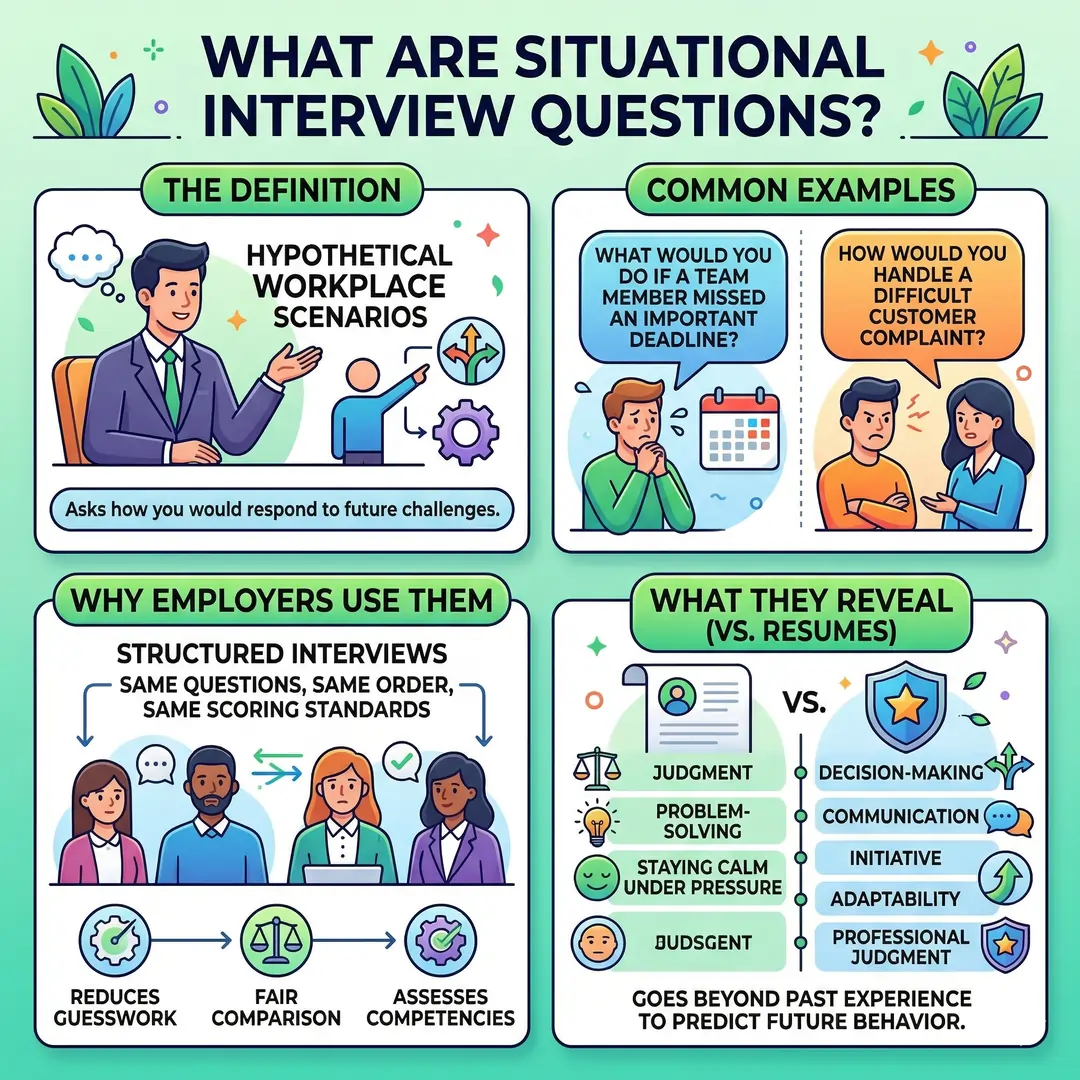
Situational questions are useful because they reveal more than a polished resume ever could. A resume can show experience, but a situational answer shows decision-making, communication, initiative, adaptability, and professional judgment. Employers often use these questions to understand how a candidate may behave in the future based on how they reason through the situation in front of them.
Why Employers Ask Situational Interview Questions
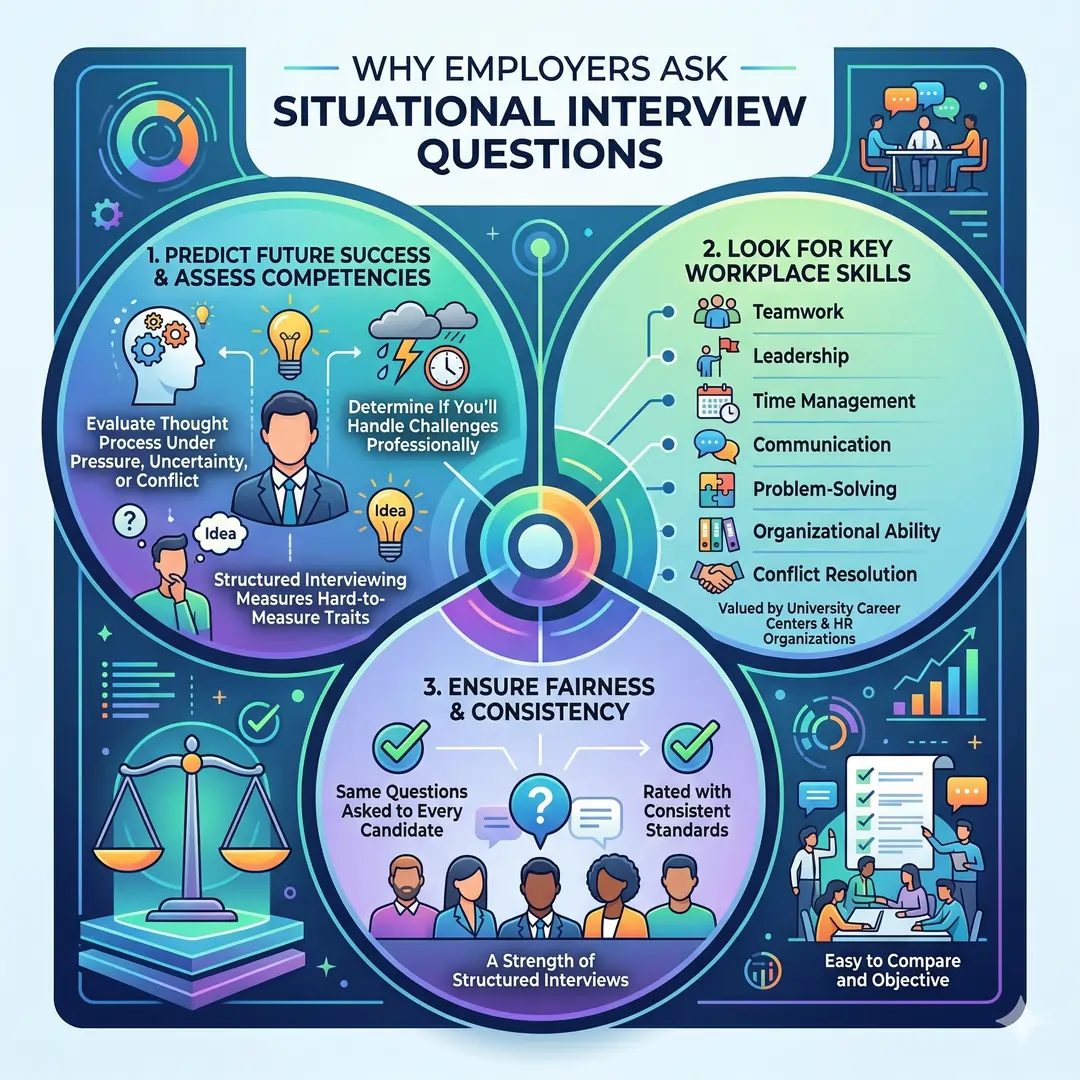
Employers ask situational interview questions because they want to know how you think when faced with pressure, uncertainty, or conflict. They are often trying to predict whether you will succeed in the role, fit the team, and handle real work challenges in a professional way. Structured interviewing is popular partly because it helps assess competencies that are harder to measure through simple conversation alone.
These questions also help employers look for skills such as teamwork, leadership, time management, communication, problem-solving, organizational ability, and conflict resolution. University career centers and HR organizations consistently point to these skills as common targets in behavioral and situational interviews.
Another reason employers rely on situational questions is fairness. When the same type of question is asked to every candidate and rated with the same standards, the interview becomes easier to compare and more consistent overall. That is one of the main strengths of structured interviews.
Situational vs. Behavioral Interview Questions
Many candidates confuse situational and behavioral interview questions, but the difference is simple. Situational questions ask what you would do in a future scenario. Behavioral questions ask what you did in a real situation from your past. Both types are common, and both are usually answered best with a clear story structure like STAR.
A behavioral question sounds like, “Tell me about a time you handled a conflict at work.” A situational question sounds like, “What would you do if two teammates disagreed about a project decision?” In both cases, the interviewer wants to know how you think, how you communicate, and how you behave when things become complicated.
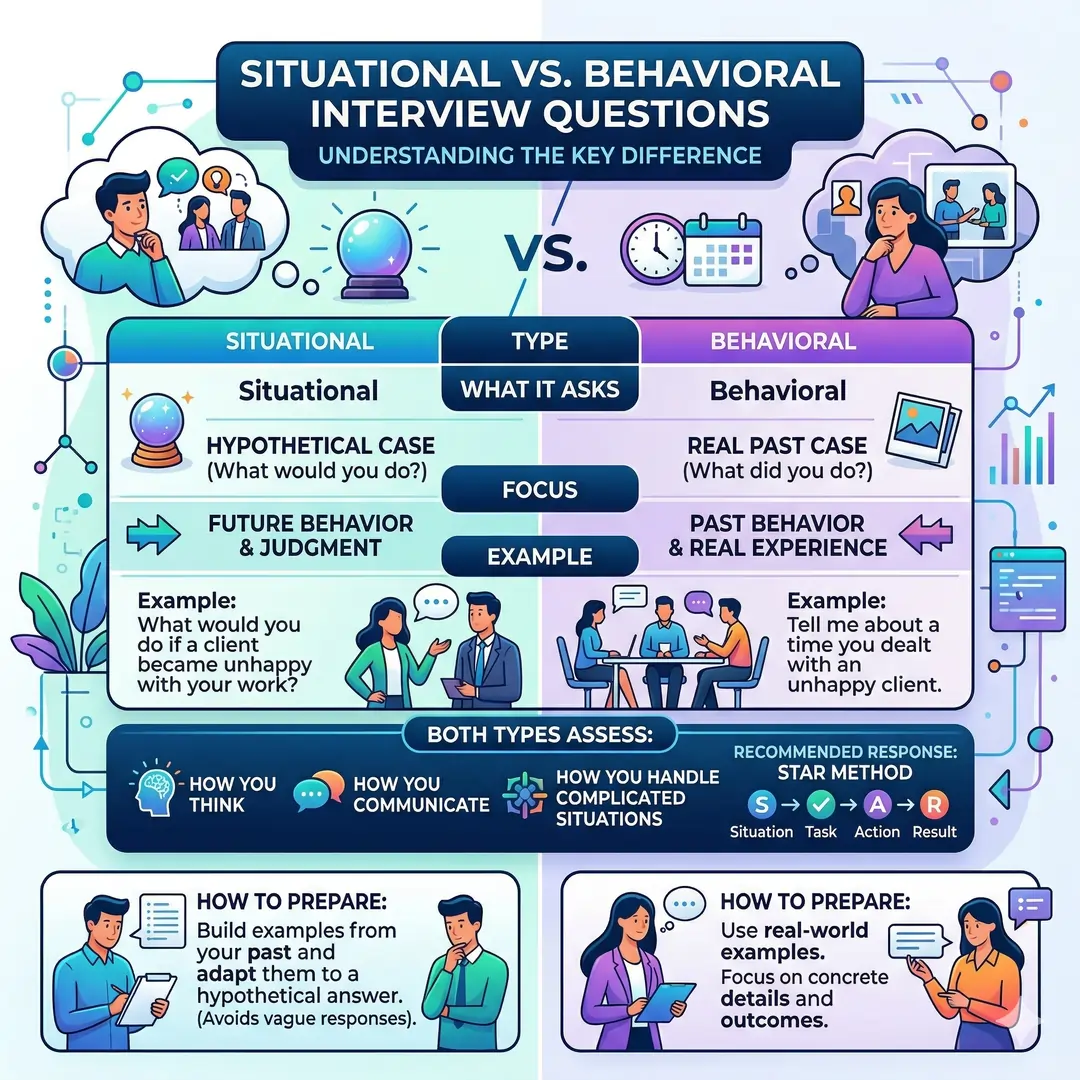
Simple Difference Table
| Type of Question | What It Asks | Focus | Example |
|---|---|---|---|
| Situational | What would you do in a hypothetical case? | Future behavior and judgment | What would you do if a client became unhappy with your work? |
| Behavioral | What did you do in a real past case? | Past behavior and real experience | Tell me about a time you dealt with an unhappy client. |
This difference matters because it changes how you prepare. For situational questions, you should build examples from your past and adapt them to a hypothetical answer. That way, your response feels realistic instead of vague.
The Best Way to Answer Situational Interview Questions
The most effective answer structure is the STAR method, which stands for Situation, Task, Action, and Result. Career centers and HR guidance repeatedly recommend this framework because it helps candidates give a clear, organized, and specific answer instead of drifting into vague speech.
Here is the simplest way to think about it:
- Situation: Set the scene
- Task: Explain what needs to be done
- Action: Describe what you did
- Result: Show the outcome
MIT’s career guidance notes that the Action part should take the most space in your answer, and it also encourages candidates to use specific examples, speak from the first person, and highlight measurable results where possible.
STAR Method Table
| STAR Part | What to Include | What the Interviewer Wants to Hear |
|---|---|---|
| Situation | The context, background, and setting | That you understand the problem clearly |
| Task | Your responsibility or the goal | That you know what had to be achieved |
| Action | The exact steps you took | That you can think and act effectively |
| Result | The outcome, impact, or lesson learned | That your actions created value |
A strong STAR answer is not a dramatic speech. It is a clear, focused story with a beginning, middle, and end. The best answers are specific, relevant to the job, and easy to follow.
How to Prepare Before the Interview
Preparation makes a huge difference. One practical strategy is to build a small bank of five to seven recent examples from your work, internships, class projects, volunteering, athletics, or leadership activities. Career guidance suggests that these examples should be varied, recent, and based on real experiences, so you can adapt to different questions.
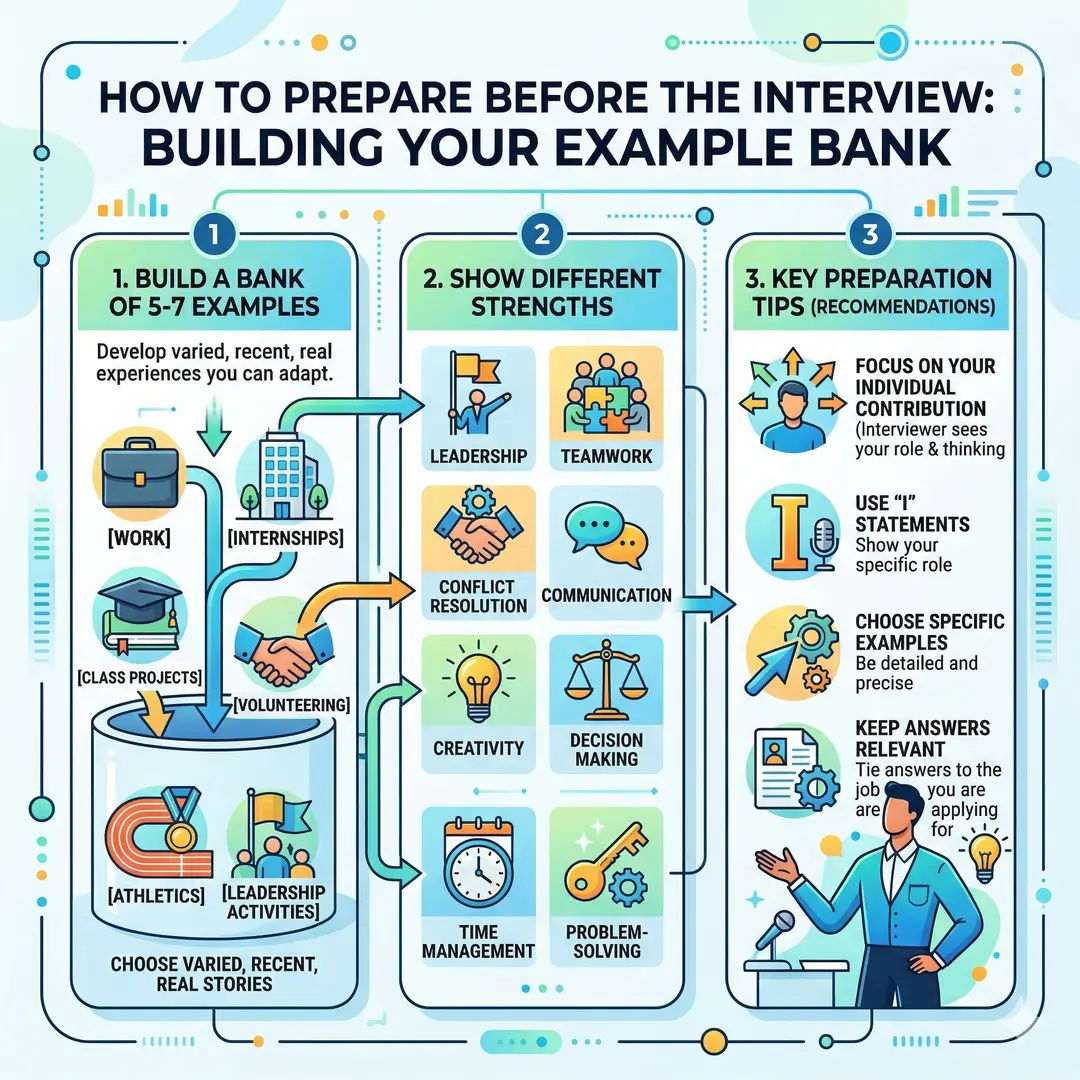
It helps to choose stories that show different strengths, such as:
- Leadership
- Teamwork
- Conflict resolution
- Communication
- Creativity
- Decision making
- Time management
- Problem-solving
MIT also recommends that you focus on your own contribution, even if the story involved a team. Use I statements so the interviewer can clearly see your role and your thinking. It also recommends choosing specific examples and keeping the answer tied to the job you are applying for.
Preparation Checklist Table
| Preparation Step | What to Do | Why It Helps |
|---|---|---|
| Review the job description | Match your examples to the role’s core skills | Keeps your answers relevant |
| Pick 5 to 7 stories | Choose different situations from your past | Gives you flexibility |
| Use recent examples | Prefer current or recent work and study experiences | Makes your answer stronger |
| Write the STAR outline | Prepare a short version for each example | Helps you stay organized |
| Add results | Include numbers, outcomes, or lessons learned | Makes your answer more convincing |
| Practice aloud | Rehearse your answer naturally | Improves confidence and flow |
A great interview answer sounds natural, but it is usually built through practice. The more examples you prepare in advance, the easier it becomes to adapt them to different questions. Career guidance also notes that one example can often work for more than one question, which gives you useful flexibility.
Large Table of Common Situational Interview Questions and What They Test
Below is a detailed table that can help you see the pattern behind common questions. Many of these questions are aligned with the areas employers frequently evaluate, such as planning, organization, initiative, interpersonal skills, communication, leadership, creativity, and decision-making.
| Situational Question | Skill Being Tested | What the Interviewer Wants to Learn | Best Answer Direction |
|---|---|---|---|
| What would you do if you had multiple deadlines at the same time? | Time management | Can you prioritize and stay organized? | Explain how you rank tasks, communicate early, and track progress |
| How would you handle a team member who was not contributing equally? | Teamwork | Can you solve group problems professionally? | Mention respectful communication, clarity of responsibilities, and follow-up |
| What would you do if a customer became angry with you? | Communication | Can you stay calm and professional? | Show empathy, active listening, and solution-focused behavior |
| How would you respond if your manager disagreed with your idea? | Adaptability | Can you take feedback and stay respectful? | Show openness, discussion, and willingness to refine the idea |
| What would you do if you made a mistake on an important task? | Accountability | Can you own errors and correct them quickly? | Admit the mistake, fix it, learn from it, and prevent repeat issues |
| How would you handle a sudden change in priorities? | Flexibility | Can you adjust without losing focus? | Explain how you reassess, communicate, and replan work |
| What would you do if two coworkers were in conflict? | Conflict resolution | Can you mediate calmly and fairly? | Show neutrality, listening, and a focus on shared goals |
| How would you manage a project with limited information? | Problem-solving | Can you move forward with uncertainty? | Show how you gather facts, ask questions, and make informed decisions |
| What would you do if you were given a task you had never done before? | Initiative | Can you learn quickly and take ownership? | Mention research, asking for help, and structured learning |
| How would you react if a deadline looked impossible? | Pressure handling | Can you remain calm and communicate early? | Explain how you assess risk, communicate, and negotiate priorities |
Sample Answers to Situational Interview Questions
The sample answers below are written in simple language, but they still show the kind of thinking employers want. Use them as models, not scripts. Your own answer should always reflect your real experience and the job you are applying for. The strongest responses stay specific, honest, and relevant.
1. What would you do if you had several urgent tasks due at the same time?
I would first list every task and identify what is most urgent, what has the biggest impact, and what depends on other people. Then I would speak with my manager or team if needed to confirm priorities and make sure I was spending time on the right work first. After that, I would break the tasks into smaller steps, set a realistic timeline for each one, and keep track of progress so nothing gets missed. If I saw that one deadline could slip, I would communicate early instead of waiting until the last minute.
This answer works well because it shows prioritization, organization, and communication. It also shows that you do not panic when work becomes busy. You stay structured and proactive.
2. What would you do if a team member was not contributing fairly?
I would try to understand the reason first. Sometimes a person is struggling, confused, or dealing with something outside the project. I would speak with them privately and respectfully, explain what I noticed, and ask whether anything is blocking their work. If the issue continued, I would bring the matter to the team or manager in a calm and professional way so the project could stay on track. My goal would be to protect the team’s results while still treating the person with respect.
This answer shows emotional intelligence, teamwork, and professional communication. Employers often value candidates who can solve group problems without creating unnecessary tension.
3. What would you do if a customer was angry or upset?
I would stay calm, listen carefully, and let the customer explain the problem without interrupting. Then I would acknowledge their frustration and try to understand exactly what went wrong. After that, I would explain the next step clearly, whether that means solving the issue myself, finding the right person to help, or giving a realistic timeline for a solution. I would keep my tone respectful and focused on resolution.
This kind of response is strong because it highlights active listening, patience, and customer service mindset. Employers want to see that you can handle pressure without becoming defensive.
4. What would you do if your manager disagreed with your idea?
I would listen carefully to understand their concern, because disagreement is often useful and can improve the final result. I would ask questions, explain my reasoning clearly, and be open to feedback. If my manager had a better approach, I would support it. If I still believed my idea had value, I would present supporting facts or examples in a respectful way. The most important thing to me would be finding the best solution, not simply winning the argument.
This answer reflects maturity, flexibility, and respect for authority. It shows you can hold your point of view without becoming stubborn.
5. What would you do if you made a serious mistake?
I would take responsibility quickly, correct the issue as soon as possible, and inform the right person if the mistake affected other people or the project. Then I would look at what caused the error and think about how to prevent it in the future. I believe the best response to a mistake is honesty, fast action, and learning from it.
This answer is powerful because it shows accountability and problem-solving. Employers do not expect perfection. They do expect honesty and good judgment.
6. What would you do if your deadline became impossible?
I would review the remaining work, identify what can still be done, and communicate early with the relevant people. I would explain the situation clearly, not emotionally, and suggest practical options such as adjusting scope, asking for help, or changing the timeline. My goal would be to protect quality while avoiding last-minute surprises. I would rather raise the issue early than pretend everything is fine.
This answer shows professional communication and time management. It also demonstrates that you are realistic and responsible.
7. What would you do if you were assigned a task you had never done before?
I would begin by learning the basics quickly through trusted resources, asking smart questions, and looking at examples of similar work if available. Then I would break the task into steps and start with the part I understood best. If I needed guidance, I would ask early instead of wasting time guessing. I enjoy learning new things, so I would see the assignment as an opportunity to grow while still delivering reliable work.
This answer highlights initiative, learning agility, and self-management. It also reassures the interviewer that you will not freeze when faced with something unfamiliar.
8. What would you do if two coworkers were in conflict?
I would avoid taking sides too quickly. First, I would try to understand the issue from both perspectives. If appropriate, I would encourage a respectful conversation focused on the work problem rather than personal criticism. I would help them return to shared goals and practical next steps. If the conflict was affecting performance or becoming serious, I would involve the right supervisor or manager.
This answer shows conflict resolution, neutrality, and maturity. Employers like candidates who can reduce tension instead of adding to it.
9. What would you do if you had to make a decision with limited information?
I would identify the most important facts, ask the right questions, and weigh the risks and benefits of each option. If I had enough information to make a reasonable decision, I would move forward and document my reasoning. If the decision carried serious consequences, I would escalate it or ask for more support before acting. I try to be thoughtful without becoming stuck.
This is a good answer because it shows judgment, analysis, and practical thinking.
10. What would you do if a project member missed a deadline that affected your work?
I would first understand why the deadline was missed. Then I would determine how it affected the larger project and what could be adjusted right away. If I needed to, I would update the team and propose a plan to recover lost time. I would focus on solutions, not blame, because the main goal is to keep the work moving.
This answer shows collaboration, responsibility, and solution orientation.
More Situational Interview Questions You Should Practice
These additional questions appear often because they connect to the core skills employers want. University career resources commonly group them around planning, initiative, interpersonal skills, flexibility, communication, leadership, creativity, and decision making.
- How would you prioritize tasks when everything feels important?
- What would you do if you had to deal with a difficult teammate?
- How would you respond if a client rejected your proposal?
- What would you do if you noticed an error in a report just before submission?
- How would you handle a situation where your instructions were unclear?
- What would you do if you had to learn a new tool quickly?
- How would you support a team that was losing motivation?
- What would you do if you strongly disagreed with a policy or process?
These questions are not random. They are usually designed to reveal the skills most connected to success in the role. That is why your best preparation is not memorizing perfect lines. It is building real examples that demonstrate the behavior the interviewer wants to see.
Large Table of Answer Frameworks You Can Use in Real Interviews
This table gives you a practical format you can reuse for many different questions. Think of it as a simple answer map. It keeps your response organized and prevents you from rambling.
| Interview Situation | Strong Response Structure | Useful Phrases to Include |
|---|---|---|
| Workload pressure | Explain how you ranked tasks, set priorities, and kept communication open | prioritize, deadline, timeline, update the team |
| Conflict in a team | Show calm listening, private discussion, and focus on common goals | respectfully, shared goal, solution, collaboration |
| Customer complaint | Show empathy, listening, clarification, and resolution | I understand, let me help, next step, follow up |
| Mistake or failure | Admit the issue, fix it fast, and describe what you learned | accountability, corrected, prevent, lesson learned |
| Unclear task | Explain that you asked questions, gathered facts, and confirmed expectations | clarify, confirm, investigate, ask for direction |
| New task or tool | Show curiosity, research, practice, and willingness to learn | adapt quickly, learned fast, took initiative |
| Leadership situation | Show how you guided others, set direction, and kept momentum | motivated, organized, supported, delegated |
| Decision making | Show how you weighed options and considered consequences | analyzed, evaluated, balanced, decided carefully |
You can use this table as a mental shortcut during interview practice. When the question arrives, match it to the skill area, then shape your answer around the strongest action you took and the result that followed.
Common Mistakes to Avoid
Even good candidates sometimes weaken their answers by rushing, rambling, or giving the wrong type of example. The most common mistake is speaking too generally. Interviewers want specifics, not broad claims like “I am a hard worker” or “I always solve problems well.” Career guidance repeatedly stresses that examples should be specific, clear, and focused on your own actions.
Another mistake is turning the answer into a team story where your own role becomes invisible. That makes it hard for the interviewer to judge your skills. MIT specifically recommends using I statements and describing your individual contribution, even if the work was done with others.
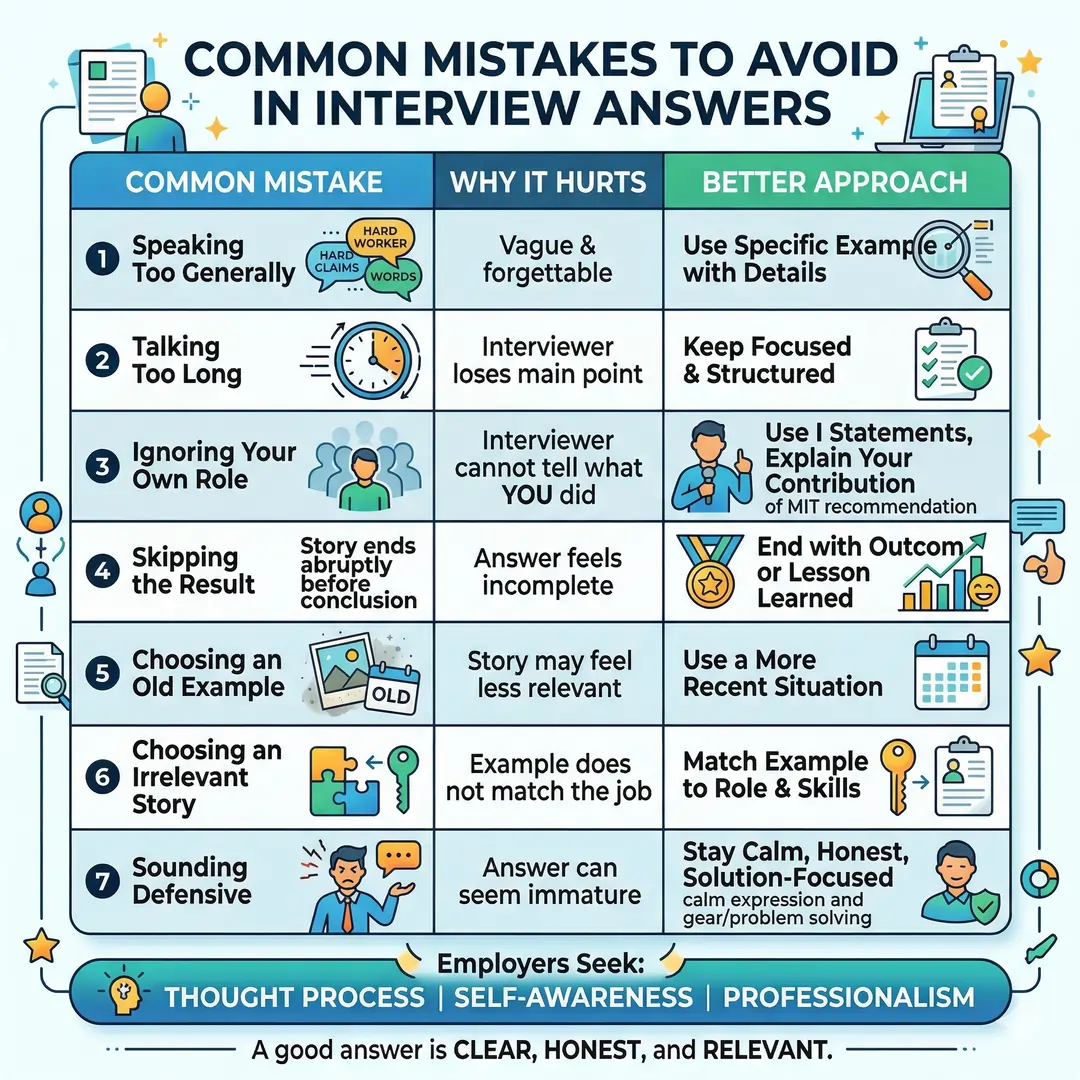
Mistakes and Better Approaches Table
| Common Mistake | Why It Hurts Your Answer | Better Approach |
|---|---|---|
| Speaking too generally | The answer sounds vague and forgettable | Use one specific example with clear details |
| Talking too long | The interviewer loses the main point | Keep the answer focused and structured |
| Ignoring your own role | The interviewer cannot tell what you did | Use I statements and explain your actions |
| Skipping the result | The answer feels incomplete | End with the outcome or lesson learned |
| Choosing an old example | The story may feel less relevant | Use a more recent situation when possible |
| Choosing an irrelevant story | The example does not match the job | Match the example to the role and skills |
| Sounding defensive | The answer can seem immature | Stay calm, honest, and solution-focused |
A good answer does not have to be perfect. It just has to be clear, honest, and relevant. Employers are usually looking for thought process, self-awareness, and professionalism more than a rehearsed performance.
How to Build Strong Examples from Your Past
A useful way to prepare is to look at your own history and pull out moments where you solved a problem, handled conflict, supported a team, or adapted to a change. These examples can come from jobs, internships, college projects, volunteer work, sports, or even community activities. Career guidance encourages this broader approach because the skills employers value can be shown in many parts of life, not only in formal employment.
Here is a simple method:
- Write down a situation.
- Note the challenge or goal.
- List the action you personally took.
- Add the result.
- Match the story to a skill such as leadership, communication, or problem-solving.
If you practice this way, you will enter the interview with a flexible story bank instead of a blank mind. That is one of the biggest confidence boosters you can give yourself.
Industry Examples of Situational Questions
Different jobs emphasize different competencies. A manager may hear more questions about leadership and team conflict. A customer service candidate may hear more questions about complaints and empathy. A project or operations role may get more questions about deadlines, coordination, and planning. Career resources show that interviewers usually tailor questions to the competencies required by the position.
Role-Based Question Table
| Job Area | Likely Situational Focus | Example Question |
|---|---|---|
| Customer service | Patience, empathy, communication | What would you do if a customer remained unhappy after you tried to help? |
| Project coordination | Organization, deadlines, collaboration | How would you handle a delayed deliverable from another team? |
| Sales | Persuasion, resilience, confidence | What would you do if a prospect was interested but hesitant? |
| Administration | Accuracy, multitasking, prioritization | How would you manage multiple urgent requests at once? |
| Leadership roles | Conflict resolution, delegation, judgment | How would you address performance issues in your team? |
| Entry-level roles | Learning ability, teamwork, reliability | What would you do if you were assigned a task you had never done before? |
This is why the best preparation is always job-specific. The more you understand the role, the easier it is to predict the types of situations the interviewer may bring up.
Power Words That Strengthen Your Answers
Using the right language can make your answer sound more polished and professional. Here are useful words and phrases that often fit situational interview answers naturally.
- prioritize
- collaborate
- communicate clearly
- stay calm
- analyze
- resolve
- adapt
- support
- follow up
- take initiative
- learn quickly
- measure results
These words work best when they describe real actions, not when they are used just to sound impressive. The strongest answers show behavior first and vocabulary second.
A Simple 30-Second Formula You Can Remember
When you are nervous, keep your answer short and steady using this pattern:
First, describe the situation.
Second, explain the task or challenge.
Third, tell what you did.
Finally, share the result.
This version is easy to remember and works well when the interview question is direct. It keeps your answer clear and helps you avoid wandering off topic. It is also closely aligned with the STAR method, which is widely recommended by career centers and HR resources.
Final Thoughts
Situational interview questions can feel intimidating at first, but they are actually an opportunity. They let you show how you think, how you solve problems, and how you handle real-world pressure. Employers use these questions because they help them assess job-related competencies in a fair and structured way.
The best way to prepare is to study the job description, build a few strong stories, practice the STAR method, and keep your answers specific. Focus on your own actions, stay calm, and always end with a result or lesson learned. If you do that, your answers will sound natural, confident, and memorable.
The real goal of a situational interview is not to trap you. It is to understand how you work. Once you see it that way, preparation becomes much easier and much more effective.
Also, Read these Articles in Detail
- Top Interview Questions and Answers Guide
- Interview Questions and Answers for Freshers and Experienced Candidates
- Common Interview Questions and Best Answers for Job Seekers
- “Tell me about yourself” Interview Answer Examples and Tips
- Strengths and Weaknesses Interview Questions and Sample Answers
- Behavioral Interview Questions and Answers Using the STAR Method
- How to Answer “Why Should We Hire You” in a Job Interview
- How to Answer “Why Do You Want This Job?” with Examples
Article References and Sources
- U.S. Office of Personnel Management. (n.d.). Structured Interviews. Retrieved from:
https://www.opm.gov/policy-data-oversight/assessment-and-selection/structured-interviews/ - Northeastern University Career Services. (n.d.). Behavioral and Situational Interviews. Retrieved from:
https://careers.northeastern.edu/article/interview-type-behavioral-and-situational/ - Colorado State University Career Center. (2024). Situational vs. Behavioral Interview Questions. Retrieved from:
https://bizcareers.colostate.edu/blog/2024/02/06/situational-vs-behavioral-interview-questions/ - Massachusetts Institute of Technology Career Advising & Professional Development. (n.d.). The STAR Method for Behavioral Interviews. Retrieved from:
https://capd.mit.edu/resources/the-star-method-for-behavioral-interviews/ - Concordia University Wisconsin Career Services. (n.d.). Interviewing Techniques Guide. Retrieved from:
https://www.cuw.edu/Academics/services/student-academic-resources/caace/student-resources/_assets/interviewing/interviewing-techniques.pdf - University of San Francisco Career Services. (n.d.). Sample Behavioral Interview Questions. Retrieved from:
https://myusf.usfca.edu/career-services/career-resources/interviews-offers/interviews/sample-behavioral-questions
Frequently Asked Questions
FAQ 1: What are situational interview questions, and why do employers ask them?
Situational interview questions are questions that ask how you would respond to a realistic work-related problem. Instead of asking about something that already happened, the interviewer gives you a hypothetical situation and wants to hear how you would deal with it. For example, they may ask what you would do if a team member missed a deadline, if a customer became upset, or if your manager disagreed with your idea. These questions help employers understand your thinking style, your judgment, and the way you handle pressure.
Employers ask these questions because they want to predict how you may behave in the workplace. A resume can show your skills and experience, but it cannot fully show how you react in difficult moments. Situational questions give interviewers a better picture of your problem-solving ability, communication style, teamwork, and adaptability. They are especially useful in structured interviews because they help employers compare candidates in a fair and consistent way.
A strong answer should sound calm, practical, and thoughtful. The goal is not to give a perfect speech. The goal is to show that you can think clearly, act responsibly, and make good decisions when challenges appear. That is why preparation matters so much for this type of interview.
FAQ 2: What is the best way to answer situational interview questions?
The best way to answer situational interview questions is by using the STAR method, which stands for Situation, Task, Action, and Result. This method helps you organize your answer in a simple and logical way. First, you briefly explain the situation. Then you describe the task or challenge. After that, you talk about the action you would take or took. Finally, you share the result or expected outcome.
Using the STAR method keeps your answer focused and easy to follow. It also helps you avoid rambling or giving a vague response. Interviewers usually appreciate answers that are clear, specific, and directly connected to the question. If you use this structure well, your response will sound more confident and professional.
It also helps to keep the answer practical. Do not try to sound overly dramatic or use too many complicated words. Simple, honest, and direct language often works best. When your answer feels natural and organized, it becomes much easier for the interviewer to trust your judgment and understand your strengths.
FAQ 3: How is a situational interview question different from a behavioral interview question?
A situational interview question asks what you would do in a future or imaginary work situation. A behavioral interview question asks what you did do in a real situation from your past. Both types are used to judge your skills, but they focus on slightly different things. Situational questions test your reasoning and future behavior. Behavioral questions test your actual past behavior.
For example, a situational question might be, “What would you do if two coworkers were arguing during a project?” A behavioral question might be, “Tell me about a time you handled a conflict between coworkers.” The first asks about a possible future response. The second asks about a real event that already happened. Both can reveal how you think, how you communicate, and how you solve problems.
Knowing the difference helps you prepare better. For situational questions, you can still use real experiences as a guide, but you should frame your answer as a thoughtful response to the hypothetical problem. For behavioral questions, you should speak more directly about what happened in the past. In both cases, the STAR method is still very useful.
FAQ 4: What are some common situational interview questions I should practice?
There are many common situational interview questions, and most of them focus on workplace skills that employers value highly. Some questions may ask how you would manage deadlines, while others may focus on customer service, teamwork, conflict resolution, or handling mistakes. These questions are designed to see how you behave when work becomes difficult or uncertain.
Some examples include: What would you do if you had multiple deadlines at the same time? How would you handle a difficult customer? What would you do if a team member was not doing their share of the work? How would you respond if you made a mistake on an important task? What would you do if your manager disagreed with your idea? Each of these questions tests a different skill, such as time management, communication, accountability, or flexibility.
It is a smart idea to practice a variety of these questions before the interview. That way, you will not be surprised if the interviewer asks something unexpected. Even if the exact wording is different, many situational questions follow the same pattern. Once you understand the pattern, it becomes much easier to respond well.
FAQ 5: How can I prepare strong examples before a situational interview?
A good way to prepare is to think of several real experiences from your work, studies, internships, volunteer activities, or group projects. Try to choose examples that show different strengths, such as leadership, teamwork, problem-solving, communication, and time management. Having a few solid examples ready will help you answer many different questions with confidence.
You should also write a short outline for each example using the STAR method. Start with the situation, then define the task, explain the action, and end with the result. This does not mean memorizing a script. It means having a clear idea of what you want to say so your answer flows naturally. A short preparation note can save you from freezing during the interview.
It is also helpful to choose examples that are recent and relevant to the job. If you are applying for a customer service role, use stories that show empathy, patience, and communication. If you are applying for a project role, use stories that show planning, organization, and teamwork. The more closely your example matches the job, the stronger your answer will feel.
FAQ 6: What should I avoid when answering situational interview questions?
One of the biggest mistakes is being too general. If you say something vague like “I would just handle it professionally,” the interviewer will not learn much about you. Another mistake is talking too long without structure. A long answer without clear points can confuse the interviewer and make you sound unprepared. A good response should be focused, specific, and easy to follow.
You should also avoid making yourself sound passive. The interviewer wants to hear what you would do, not what the team might do in general. Use I statements when explaining your thinking and actions. At the same time, do not sound defensive or negative, especially if the question is about conflict, mistakes, or criticism. Stay calm, respectful, and solution-focused.
Another mistake is forgetting the result. Even if the question is hypothetical, your answer should show what outcome you are aiming for. The result does not always need a number or statistic, but it should show that your action solves the problem, improves the situation, or prevents future issues. That final part makes your answer feel complete.
FAQ 7: How long should my answer be in a situational interview?
A strong situational interview answer should usually be long enough to explain your thinking clearly, but short enough to stay focused. In most cases, a response of about one to two minutes is a good target. That gives you enough time to cover the situation, task, action, and result without drifting off topic. A very short answer may sound incomplete, while a very long answer may lose the interviewer’s attention.
The best answer length depends on the question. A simple question may need a shorter response, while a more complex question may need more detail. The important thing is to stay organized. If your answer has a clear beginning, middle, and end, it will usually feel the right length even if it is slightly shorter or longer than expected.
It is better to give a clear and thoughtful answer than a long one filled with extra details. Interviewers are looking for judgment and communication, not a speech. If you can explain your point clearly and confidently, your answer will make a much stronger impact.
FAQ 8: Can I use the same example for more than one interview question?
Yes, you can absolutely use the same example for more than one question if it fits the skill being tested. Many strong examples can work in different situations. For example, one project where you solved a problem as a team could be used to answer a question about teamwork, leadership, or problem-solving. The key is to adjust the way you tell the story so it matches the question being asked.
This is a very smart interview strategy because it saves preparation time and gives you more flexibility. You do not need dozens of examples. A smaller number of strong, adaptable stories is often enough. What matters is that your answer stays relevant and highlights the right part of the story for the question.
Before the interview, it is helpful to practice each example in a few different ways. Think about which skill each story shows best. Then, when the question comes, you can choose the version that fits most naturally. This approach makes you sound more prepared and more confident.
FAQ 9: How do I answer a situational question if I have little work experience?
If you have limited work experience, do not worry. You can still answer situational interview questions well by using examples from school, internships, volunteer work, group assignments, extracurricular activities, or part-time jobs. Interviewers understand that not every candidate has a long work history. What matters most is how you think and how you handle situations.
For example, if you have no formal job experience, you could describe how you handled a difficult group project, solved a problem during a class presentation, or organized a volunteer activity. These experiences can still show communication, responsibility, initiative, and problem-solving. The setting matters less than the thinking behind your answer.
If you are still building experience, focus on maturity and learning ability. Say what you would do, how you would approach the issue, and why that approach makes sense. A thoughtful answer based on school or life experience can still be very strong if it is clear and honest.
FAQ 10: What are employers really looking for in situational interview answers?
Employers are mainly looking for evidence that you can think clearly and act professionally when problems appear. They want to see whether you can handle stress, work with others, stay organized, and make sensible decisions. In other words, they are trying to understand how you would perform in the real job, not just how well you can talk about it.
They also want to see self-awareness. If you can explain your reasoning, show respect for others, and recognize the importance of communication, that tells the interviewer a lot about your work style. A strong answer shows that you can solve problems without blaming others, panicking, or avoiding responsibility.
At a deeper level, employers are looking for trust. They want to feel confident that you will act responsibly, follow through, and represent the organization well. That is why clear, honest, and practical answers matter so much. When you answer situational interview questions with confidence and structure, you show that you are ready for real workplace challenges.
