
Hiring the right person starts long before the final interview. It begins with a clear, careful, and fair process for screening and shortlisting candidates. When this stage is done well, recruiters save time, managers make better decisions, and candidates get a more professional experience. When it is done badly, strong applicants are overlooked, bias can creep in, and the hiring process becomes slow and inconsistent. Official guidance from organizations such as the CIPD, EEOC, and SHRM consistently points toward structured, job-related, and consistent selection methods as the foundation of better hiring.
In simple terms, screening means checking whether a candidate meets the basic requirements of the job. Shortlisting means narrowing the pool down to the strongest applicants who should move to the next stage. The best systems use the same criteria for everyone, rely on job-related evidence, and avoid unnecessary subjectivity. The CIPD describes selection as having two main parts: shortlisting and then assessing applicants for the final decision.
Table of Contents
Why screening and shortlisting matter
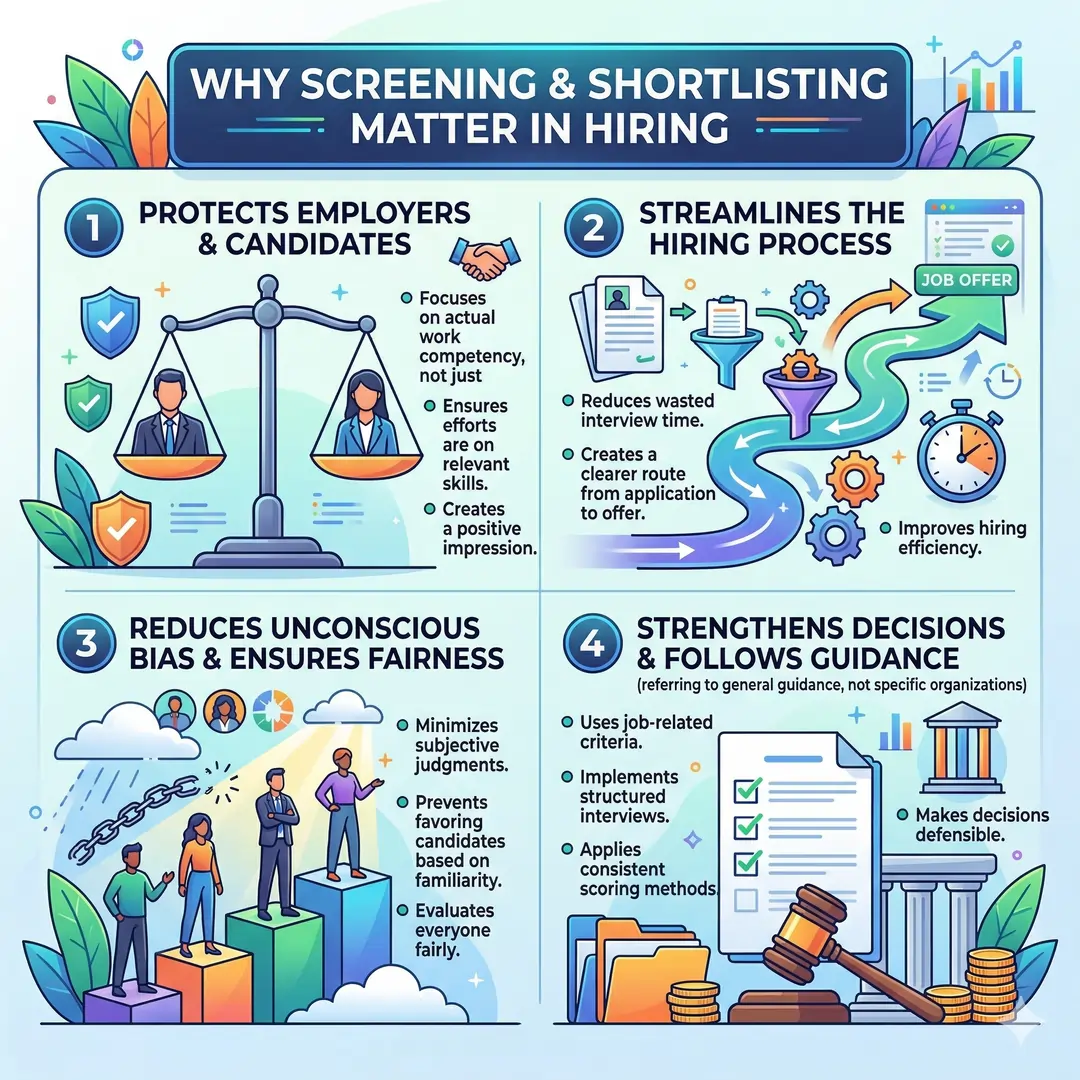
A good screening process protects both the employer and the candidate. It helps employers focus on people who can actually do the work, not just people who look impressive on paper. It also helps reduce wasted interview time and creates a clearer route from job application to offer. The EEOC also warns that hiring practices should be examined carefully when they unfairly exclude people, especially when tests, rankings, interviews, or automated tools are involved.
There is another reason this stage matters. Hiring decisions can be influenced by unconscious bias, in which people unknowingly favor candidates who seem familiar or similar to themselves. Guidance from the EEOC and CIPD supports using job-related criteria, structured interviews, and consistent scoring because these approaches reduce subjectivity and make the process easier to defend.
What a strong screening and shortlisting process looks like
A strong process is not complicated, but it is deliberate. It usually follows these stages:
- Define the role clearly
- Decide the must-have and nice-to-have criteria
- Review applications against those criteria
- Score candidates consistently
- Shortlist only the strongest matches
- Move selected candidates to interviews or assessments
- Document the reasons for each decision
This approach reflects the broader recruitment process described by the CIPD and the selection guidance from SHRM, which both emphasize consistency, clarity, and alignment with the job requirements.
Step-by-step guide to screening candidates
1. Start with a clear job description
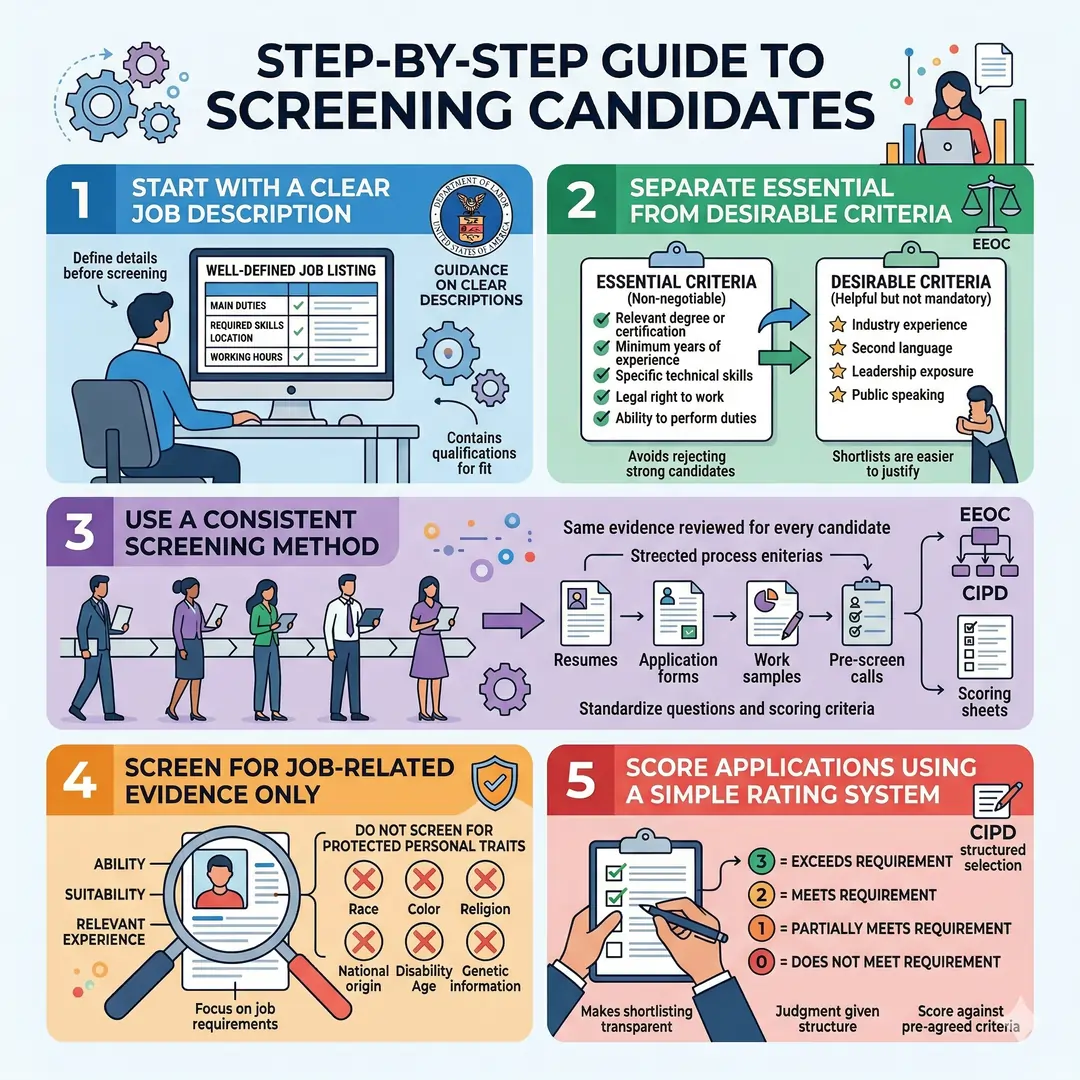
Everything begins with the role itself. If the job description is vague, the screening process will also be vague. A strong job description should explain the main duties, required skills, experience level, location, working hours, and any special conditions. The U.S. Department of Labor advises applicants to read the job announcement carefully because it contains qualifications, eligibility requirements, duties, salary, and other details needed to judge fit. That same logic applies to employers, who should define those details clearly before screening begins.
2. Separate essential criteria from desirable criteria
One of the most useful hiring habits is to divide your criteria into two groups.
Essential criteria are non-negotiable. For example:
- Relevant degree or certification
- Minimum years of experience
- Specific software or technical skill
- Legal right to work where required
- Ability to perform key duties
Desirable criteria are helpful but not mandatory. For example:
- Experience in the same industry
- Knowledge of a second language
- Leadership exposure
- Public speaking experience
This simple split helps recruiters avoid rejecting strong candidates for not having every nice extra. It also makes the shortlist easier to justify because the reasons are tied directly to the role. The EEOC advises employers to focus on job requirements such as education, experience, skills, and licenses, rather than irrelevant personal characteristics.
3. Use a consistent screening method
Consistency matters. The same evidence should be reviewed for every candidate, and the same standard should be applied to everyone. That can include resumes, application forms, work samples, pre-screen calls, and scoring sheets. The EEOC recommends structuring the interview process to reduce subjectivity and standardizing questions as much as possible, while the CIPD explains that structured interviews use the same questions in the same order with consistent scoring criteria.
4. Screen for job-related evidence only
A candidate should be screened for ability, suitability, and relevant experience. They should not be screened on protected personal traits such as race, color, religion, sex, national origin, age, disability, or genetic information. The EEOC specifically advises employers to avoid asking about protected characteristics during hiring.
5. Score applications using a simple rating system
A numerical scoring system makes shortlisting more transparent. For example:
- 0 = does not meet the requirement
- 1 = partially meets the requirement
- 2 = meets requirement
- 3 = exceeds requirement
This does not replace judgment, but it gives judgment a structure. The CIPD notes that candidate responses in structured selection should be scored against pre-agreed criteria.
Table 1. Common screening methods and how to use them
| Screening method | What it helps check | Best use case | Main advantage | Watch out for |
|---|---|---|---|---|
| Resume review | Work history, skills, progression | Early filtering | Fast and familiar | Can reward polished writing over real ability |
| Application form | Standardized answers, eligibility | High-volume hiring | Easy to compare | Overly long forms can scare candidates away |
| Phone or video pre-screen | Communication, interest, basic fit | Final screening before the interview | Saves interview time | Should stay job-related and consistent |
| Work sample test | Real job performance | Skilled roles | Often more predictive than opinions | Must match the actual job |
| Structured interview | Job-related behaviors and competencies | Final selection stages | More fair and comparable | Needs planning and training |
| Background check | Verified history where legally allowed | Sensitive roles or final checks | Helps confirm facts | Must be job-related and compliant |
| AI or ATS screening | Keyword match, pattern matching | Large applicant pools | Speeds up triage | Needs monitoring for bias and adverse impact |
The EEOC notes that employment tests and selection procedures can be useful, but they can also violate anti-discrimination laws if they are intentionally discriminatory or if they disproportionately exclude protected groups without proper justification. The EEOC also says hiring AI and automated systems can be part of recruiting, screening, and hiring, so employers should treat these tools with care.
How to shortlist candidates fairly
Shortlisting is not about finding the “best-looking” resume. It is about finding the candidates who meet the role’s real needs. A fair shortlist depends on a job-related scorecard, not instinct alone. The CIPD defines shortlisting as one of the two main processes in selection, and it recommends scoring against agreed criteria.
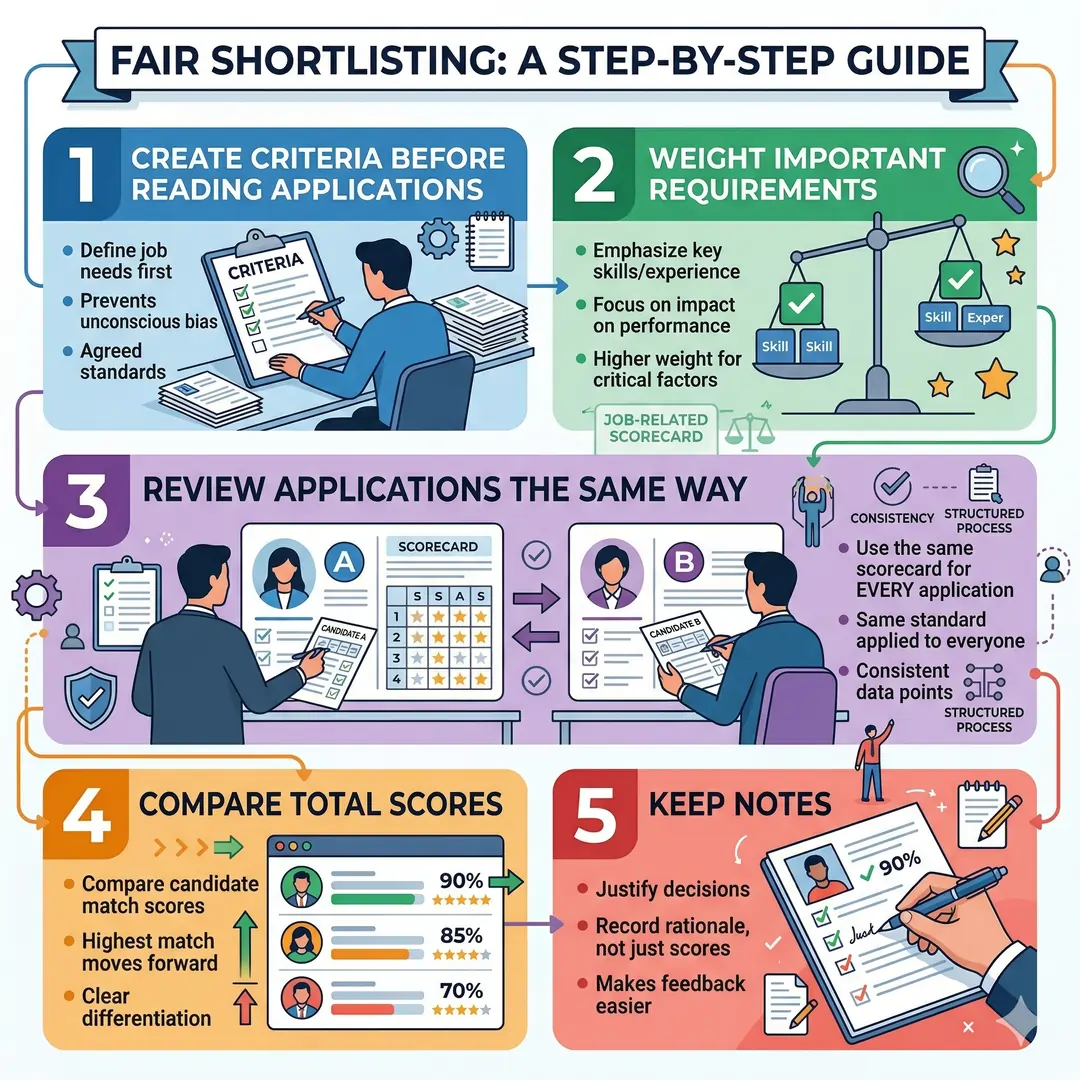
A practical shortlisting method looks like this:
- Step 1: Create criteria before reading applications
- Write the criteria first so you are not unconsciously changing the standard as you read.
- Step 2: Weight the most important requirements
- Put more importance on skills and experience that directly affect performance.
- Step 3: Review each application the same way
- Use the same scorecard for every candidate.
- Step 4: Compare total scores
- Candidates with the strongest match should move forward.
- Step 5: Keep notes
- Brief notes make it easier to explain decisions later.
Table 2. Sample shortlisting scorecard
| Criterion | Weight | What to look for | Score guide |
|---|---|---|---|
| Relevant experience | 30% | Similar work, industry exposure, achievement history | 1 to 5 |
| Core technical skills | 25% | Tools, software, methods, certifications | 1 to 5 |
| Communication | 15% | Clarity, structure, professionalism | 1 to 5 |
| Problem-solving ability | 15% | Evidence of handling challenges, fixing issues, and making decisions | 1 to 5 |
| Cultural add | 10% | Values alignment without sameness bias | 1 to 5 |
| Availability and logistics | 5% | Notice period, location, work schedule | 1 to 5 |
This is only a sample framework. The exact weights should reflect the role. A technical role may give more weight to skills and work samples, while a client-facing role may place more emphasis on communication and problem-solving. The key is to decide the weighting before reviewing the pool. That helps reduce bias and improve consistency.
Examples of effective screening in real hiring
Example 1: Hiring a customer support specialist
Suppose a company needs someone who can answer customer questions, manage complaints, and use a ticketing system.
A fair screen might focus on:
- Experience in customer support
- Writing clarity
- Familiarity with support software
- Patience and conflict handling
- Availability for shift work
A strong shortlisting decision would not depend on where the candidate studied or whether their resume design looks fancy. It would depend on whether they have the practical ability to do the job.
Example 2: Hiring a junior data analyst
Suppose a company needs a junior analyst with Excel, reporting, and data cleanup skills.
A good screen might include:
- Spreadsheet experience
- Attention to detail
- Basic analytical thinking
- A short task or work sample
- Communication of findings
The EEOC and CIPD guidance both support the idea that selection should be tied to job requirements and assessed consistently. A work sample is often a better sign of future performance than a vague conversation.
Table 3. Common screening mistakes and better alternatives
| Common mistake | Why is it a problem | Better alternative |
|---|---|---|
| Relying on gut feeling alone | Increases subjectivity and bias | Use a scorecard with clear criteria |
| Changing standards mid-process | Makes the shortlist unfair | Decide on the criteria before reviewing candidates |
| Asking unrelated personal questions | Can create legal risk and weak decisions | Ask only job-related questions |
| Overvaluing pedigree | Misses capable candidates from different backgrounds | Focus on evidence of ability |
| Using social media casually to judge applicants | Can introduce irrelevant information | Stick to formal hiring evidence |
| Ignoring adverse impact | May unfairly exclude groups | Review outcomes and test for patterns |
| Treating AI as automatically neutral | Automated tools can still create bias | Audit tools and monitor results |
| Skipping documentation | Makes decisions harder to defend | Keep concise notes and scores |
The EEOC warns that employers should review hiring practices that have an especially negative effect on protected groups unless the practice can be justified as job-related and consistent with business necessity. It also notes that AI and automated tools can contribute to bias if they are not tested and monitored.
How to keep the process fair and professional
A fair screening process is not just a legal concern. It also improves candidate trust and employer reputation. The CIPD suggests using structured interviews, making scheduling accessible, and reducing bias in automated sifting. It also advises caution when using social media to sift applicants.
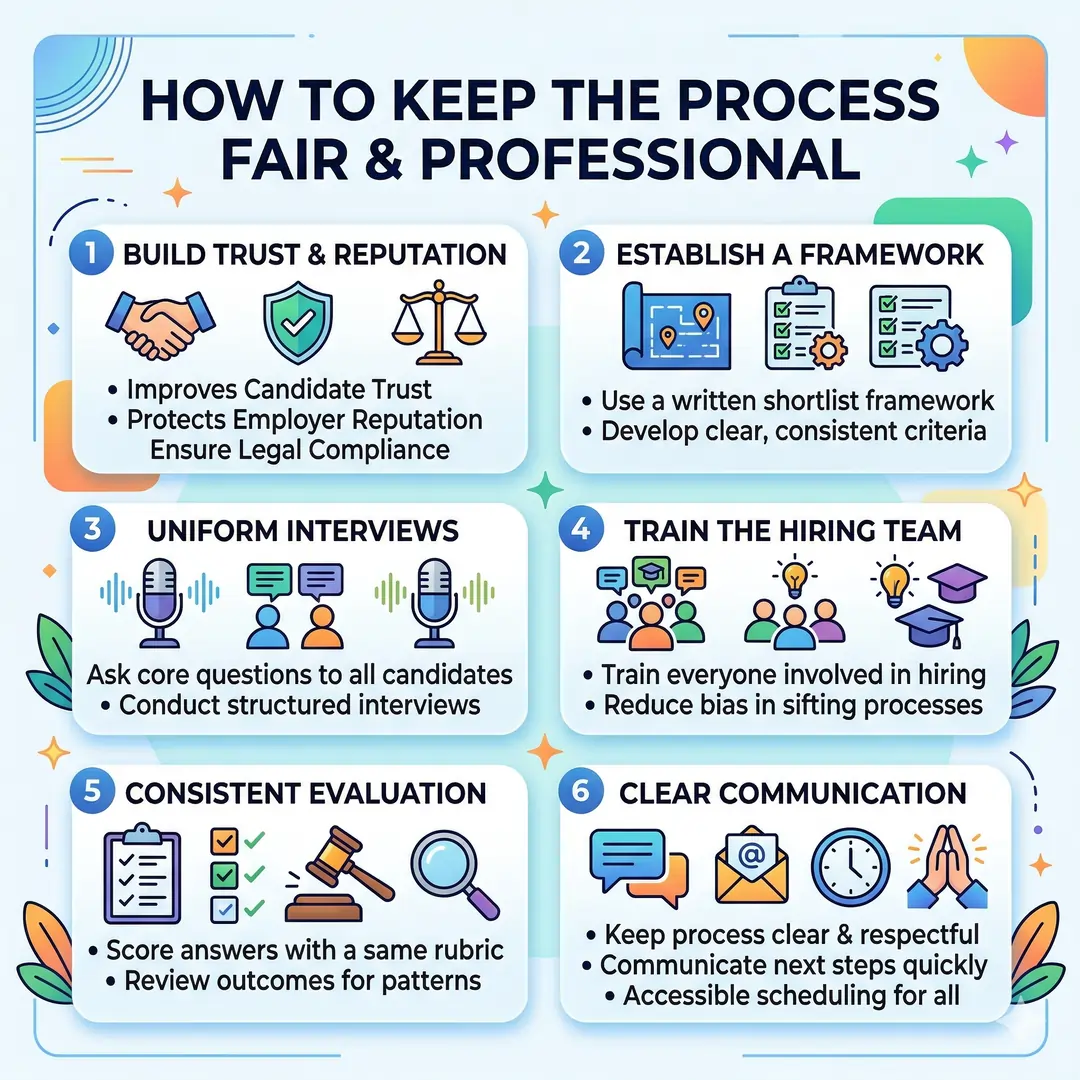
Here are some practical habits that help:
- Use a written shortlist framework
- Train everyone involved in hiring
- Ask the same core questions to all candidates
- Score answers using the same rubric
- Review outcomes for patterns
- Keep the process clear and respectful
- Communicate next steps quickly
When employers are transparent about the process, candidates are more likely to trust it. The CIPD evidence review also notes that applicants respond better when they receive clear and official information about the selection process.
What about background checks?
Background checks can be part of hiring, but they should be used carefully. The EEOC says employers may ask about background and may require a background check, but they cannot use that information in a discriminatory way. The FTC says that when a background report comes from a reporting company, employers generally need clear written disclosure and written authorization under the Fair Credit Reporting Act.
The safest approach is to:
- Use background checks only where relevant
- Apply the same policy to similar roles
- Wait until later in the process when possible
- Match any exclusion to the duties of the job
- Follow local laws and consent rules
The EEOC also recommends a narrowly tailored policy for criminal records, along with clear identification of the essential job requirements and the specific circumstances of the role.
How AI and ATS tools fit into screening
Many companies now use an Applicant Tracking System or AI-powered tools to sort large volumes of applications. These tools can save time, but they are not automatically fair. The EEOC states that AI and other automated systems are used in recruiting, screening, and hiring, and that they can create discrimination concerns if they generate unjustified disparate impact.
That means employers should:
- Check whether the tool is truly job-related
- Test whether it disadvantages certain groups
- Review outputs regularly
- Avoid treating vendor claims as proof of fairness
- Keep humans responsible for final decisions
This is especially important because a third-party vendor does not remove employer responsibility. The EEOC has made clear that employers may still be accountable for adverse impact caused by algorithmic selection tools.
Table 4. A practical shortlist workflow
| Stage | Action | Owner | Output |
|---|---|---|---|
| 1. Role definition | Finalize must-have and nice-to-have criteria | Hiring manager and HR | Job profile and scorecard |
| 2. Application review | Check resumes and forms against the criteria | Recruiter | Initial pass list |
| 3. Scoring | Rate each candidate consistently | Recruiter and panel | Ranked candidates |
| 4. Verification | Confirm essential facts such as certification or availability | HR | Verified shortlist |
| 5. Pre-screen call | Ask core job-related questions | Recruiter | Final interview list |
| 6. Interview preparation | Prepare structured questions and an evaluation sheet | Hiring panel | Interview pack |
| 7. Selection review | Compare scores and note evidence | Hiring panel | Final candidate recommendation |
Best practices that make shortlisting stronger
The most reliable hiring teams usually do a few things very well:
- They define success before they look at applicants.
- They use evidence instead of assumptions.
- They keep a record of why each candidate advanced or did not advance.
- They train interviewers to stay on topic.
- They check whether their process is producing unfair patterns.
One especially useful practice is the structured interview. According to the CIPD, it means every candidate gets the same predefined questions in the same order, and responses are scored against agreed criteria. That makes comparisons much easier and usually more defensible than an informal, unstructured conversation.
Final thoughts
Screening and shortlisting are not administrative chores. They are the heart of good hiring. When done properly, they help organizations find people who can perform well, fit the role, and grow with the team. When done carelessly, they can waste time, damage trust, and exclude excellent candidates. The strongest approach is always the same. Keep the criteria clear, keep the process consistent, and keep the focus on job-related evidence. That is the most practical path to hiring that is faster, fairer, and much more effective.
Read These Articles in Detail
- Importance of Recruitment Strategy
- How to Write a Job Description
- Structured Interview Techniques
- How to Improve Candidate Experience
- Employee Onboarding Process: Strong, Confident, and Productive New Hires
- Recruitment Metrics and KPIs: A Guide to Measuring Hiring Success
- Best Recruitment Channels: A Guide to Hiring Better Talent
- Reducing Hiring Bias: A Guide to Fairer And Smarter Recruitment
- Employee Referral Programs: A Guide to Building Better Hires
- Recruitment Strategies and Best Practices for Hiring Better Talent
- How to Find Employees: Hiring the Right People for Your Business
- Detailed Hiring Process Workflow for Smarter, Fairer, and Faster Hiring
Article References and Sources
- Chartered Institute of Personnel and Development (CIPD)
Selection Methods Factsheet
This source explains structured selection processes, including shortlisting and scoring methods.
https://www.cipd.org/en/knowledge/factsheets/selection-factsheet/ - Chartered Institute of Personnel and Development (CIPD)
Recruitment Factsheet
Covers recruitment planning, candidate attraction, and structured hiring processes.
https://www.cipd.org/en/knowledge/factsheets/recruitment-factsheet/ - Chartered Institute of Personnel and Development (CIPD)
Inclusive Recruitment Guide for Employers (PDF)
Guides reducing bias and improving fairness in hiring.
https://www.cipd.org/globalassets/media/knowledge/knowledge-hub/guides/2023-pdfs/inclusive-recruitment-employers-guide_tcm18-112787.pdf - Chartered Institute of Personnel and Development (CIPD)
Fair Selection Evidence Review (Scientific Summary)
Discusses research-backed hiring practices and candidate fairness.
https://www.cipd.org/globalassets/media/knowledge/knowledge-hub/evidence-reviews/2023-pdfs/fair-selection-evidence-scientific-summary.pdf
- U.S. Equal Employment Opportunity Commission (EEOC)
Employment Tests and Selection Procedures
Explains how hiring tests and screening methods must be job-related and non-discriminatory.
https://www.eeoc.gov/laws/guidance/employment-tests-and-selection-procedures - U.S. Equal Employment Opportunity Commission (EEOC)
Best Practices for Employers and Human Resources
Offers practical guidance on fair hiring and structured decision-making.
https://www.eeoc.gov/best-practices-private-sector-employers - U.S. Equal Employment Opportunity Commission (EEOC)
What You Should Not Ask When Hiring
Lists prohibited questions and protected characteristics to avoid during screening.
https://www.eeoc.gov/employers/small-business/what-shouldnt-i-ask-when-hiring - U.S. Equal Employment Opportunity Commission (EEOC)
Background Checks: What Employers Need to Know
Covers legal and fair use of background checks in hiring.
https://www.eeoc.gov/background-checks - U.S. Equal Employment Opportunity Commission (EEOC)
Criminal Records and Employment Decisions
Guides fair use of criminal history in hiring.
https://www.eeoc.gov/employers/small-business/criminal-records - U.S. Equal Employment Opportunity Commission (EEOC)
AI and Algorithmic Decision-Making in Hiring (PDF)
Explains risks and responsibilities when using AI in recruitment.
https://www.eeoc.gov/sites/default/files/2024-04/20240429_What%20is%20the%20EEOCs%20role%20in%20AI.pdf
- U.S. Department of Labor (DOL)
How to Apply for a Job
Provides insights into job requirements, qualifications, and hiring expectations.
https://www.dol.gov/general/jobs/how-to-apply
- Mayer Brown (Legal Analysis)
EEOC Guidance on AI and Algorithmic Hiring Tools
Offers expert legal interpretation of AI use in hiring decisions.
https://www.mayerbrown.com/en/insights/publications/2023/07/eeoc-issues-title-vii-guidance-on-employer-use-of-ai-other-algorithmic-decisionmaking-tools
Frequently Asked Questions
FAQ 1. What is screening and shortlisting candidates in hiring?
Screening and shortlisting candidates is the process of reviewing job applications and narrowing the list down to the people who are most likely to succeed in the role. Screening is usually the first step. It means checking whether a candidate meets the basic requirements such as experience, qualifications, skills, location, and availability. Shortlisting comes after that. It means selecting the strongest applicants from the larger pool so they can move to the next stage, such as an interview or a work test.
This part of the hiring process is very important because it saves time, improves decision-making, and helps employers focus on the candidates who are truly relevant to the job. A good screening process is not based on guesswork. It is based on job-related criteria, clear expectations, and consistent evaluation. When companies do this well, they usually find better matches, make faster hiring decisions, and create a fairer experience for applicants.
FAQ 2. Why is a structured screening process better than making decisions by gut feeling?
A structured screening process is better because it keeps hiring decisions clear, fair, and easy to compare. When recruiters depend only on instinct or personal preference, they may overlook strong candidates who do not look impressive on paper but actually have the right skills. They may also give too much weight to things that are not directly related to job performance, such as a familiar school name or an attractive resume design.
A structured process solves this problem by using a fixed set of criteria for every applicant. Each candidate is reviewed the same way, and each score is based on the same standards. This makes the process more professional and more reliable. It also reduces the risk of bias, which can happen when people unknowingly favor someone because they seem familiar, confident, or similar to them. In simple terms, structure helps employers make hiring choices based on evidence instead of emotion.
FAQ 3. What should employers look for when screening candidates?
Employers should look for details that are directly connected to the job. The most important things usually include relevant experience, required skills, education, certifications, and availability. If the role needs technical knowledge, then that should be checked carefully. If the role involves communication with customers, then communication skills should matter more. If the work needs teamwork, problem-solving, or attention to detail, those abilities should also be part of the review.
It is also important to separate must-have criteria from nice-to-have criteria. Must-have criteria are the things a candidate must have in order to do the job properly. Nice-to-have criteria are extra strengths that are helpful but not essential. This distinction makes screening much easier and prevents good candidates from being rejected for missing something minor. A strong screening process always stays focused on the actual needs of the job.
FAQ 4. How can employers shortlist candidates fairly?
Employers can shortlist candidates fairly by using a clear scoring system and applying the same standard to every applicant. Before reviewing applications, the hiring team should decide what matters most in the role. For example, they may give more weight to experience, technical ability, or communication skills depending on the position. Once those rules are set, every candidate should be measured against them in the same way.
Fair shortlisting also depends on good documentation. Hiring teams should keep short notes about why a candidate was selected or not selected. This helps make the process more transparent and easier to explain later. It also protects the organization if questions come up about the decision. A fair shortlist is not about choosing people who feel right. It is about choosing people who show the strongest job fit based on relevant evidence.
FAQ 5. What are the most common mistakes in candidate screening?
One of the most common mistakes is using gut feeling instead of clear criteria. Another mistake is changing the standard while reviewing candidates, which makes the process inconsistent. Some employers also spend too much time on small details that have little connection to the actual job. For example, they may focus on the appearance of the resume instead of the content, or they may prefer candidates who simply sound confident even when they have little experience.
Another major mistake is asking questions or making decisions based on personal information that has nothing to do with the role. This can lead to unfair hiring and unnecessary legal risk. A good screening process should avoid irrelevant assumptions and stay focused on work-related evidence. It is also a mistake to skip documentation or use the same approach for every position without thinking about the specific job. Hiring works best when each role gets a tailored but still structured review.
FAQ 6. How do structured interviews support better shortlisting?
A structured interview supports better shortlisting because it gives every candidate the same opportunity to show their strengths. In a structured interview, the same core questions are asked in the same order, and answers are scored using a fixed scale. This makes it much easier to compare candidates fairly. It also reduces the risk that one person gets a better result simply because they were easier to talk to or more similar to the interviewer.
Structured interviews are especially useful after screening because they turn the shortlist into a smaller, more manageable group. At that point, the employer already knows the candidates meet the basic requirements. The interview then helps reveal deeper qualities such as problem-solving, work style, communication, and motivation. When done properly, structured interviews make the hiring process more professional, more consistent, and more likely to identify the best person for the role.
FAQ 7. Can applicant tracking systems and AI help with screening candidates?
Yes, Applicant Tracking Systems and AI tools can help with screening, especially when there are many applications. These tools can sort resumes, organize candidate data, and sometimes help identify people who match a job description. That can save time and make the early stages of hiring more efficient. For high-volume recruitment, these tools are often very helpful.
However, they should not be treated as perfect or neutral. Automated systems still depend on the data and rules they are built on, and that means they can sometimes miss good candidates or create unfair patterns. A smart hiring team should always monitor the tool, review its results, and make sure human judgment stays involved. In other words, technology can support screening, but it should not fully replace careful human review.
FAQ 8. What is the role of job descriptions in screening and shortlisting?
A job description is the foundation of the entire screening process. If the job description is clear, screening becomes much easier. It tells recruiters what skills, experience, and qualifications are truly important. It also helps candidates understand whether they should apply in the first place. A weak or vague job description often leads to weak applications and confused hiring decisions.
A strong job description should clearly explain the responsibilities, the required skills, the working conditions, and the expectations for success. It should also separate essential requirements from optional preferences. This clarity helps the hiring team shortlist candidates based on the right things. In practical terms, the better the job description, the better the shortlist. A clear role definition always leads to a stronger and more focused hiring process.
FAQ 9. Why is fairness so important in screening and shortlisting candidates?
Fairness is important because it helps ensure that every applicant is judged by the same standard. When hiring is fair, the process becomes more trustworthy, more professional, and more effective. It also helps employers avoid excluding strong candidates for the wrong reasons. Fair screening gives the organization access to a wider range of talent and helps improve the quality of hiring decisions over time.
Fairness also protects the employer. If a company uses inconsistent methods, irrelevant questions, or biased scoring, it can create serious problems. A fair process uses job-related criteria, consistent evaluation, and proper records. It does not rely on stereotypes or personal preference. It respects the candidate while also protecting the business. That is why fairness should never be treated as an extra feature. It should be built into the process from the beginning.
FAQ 10. What is the best way to improve screening and shortlisting over time?
The best way to improve screening and shortlisting is to review the process regularly and learn from each hiring cycle. Employers should ask whether the shortlist led to good hires, whether the criteria were realistic, and whether any strong candidates were missed. If the process feels too slow, too rigid, or too subjective, it should be adjusted. Small improvements over time can make a big difference in hiring quality.
It also helps to use feedback from recruiters, hiring managers, and even candidates when possible. If several people say the process is confusing or unfair, that is a sign that something needs to change. Employers can improve by refining the scorecard, updating the job description, training interviewers, and checking whether the process is producing balanced results. A good hiring system is never finished. It keeps improving as the organization learns what works best.
