
Recruitment is much more than posting a job and waiting for applications. A strong hiring process helps you attract the right people, improve the quality of hire, reduce avoidable turnover, and create a better candidate experience from the first job ad to the first day on the job. Reputable hiring guidance from EEOC, SHRM, Indeed, and LinkedIn consistently points to the same foundation: define the role clearly, use objective and job-related criteria, keep the process structured, and make the experience respectful and transparent.
At its best, recruitment is not a guessing game. It is a repeatable system that helps employers find people with the right skills, behavioral strengths, and fit for the role, while also making candidates feel informed and valued. That matters because the hiring journey shapes how people perceive your organization long before they become employees, and those early impressions can influence engagement and retention later on.
Table of Contents
What Recruitment Strategy Really Means
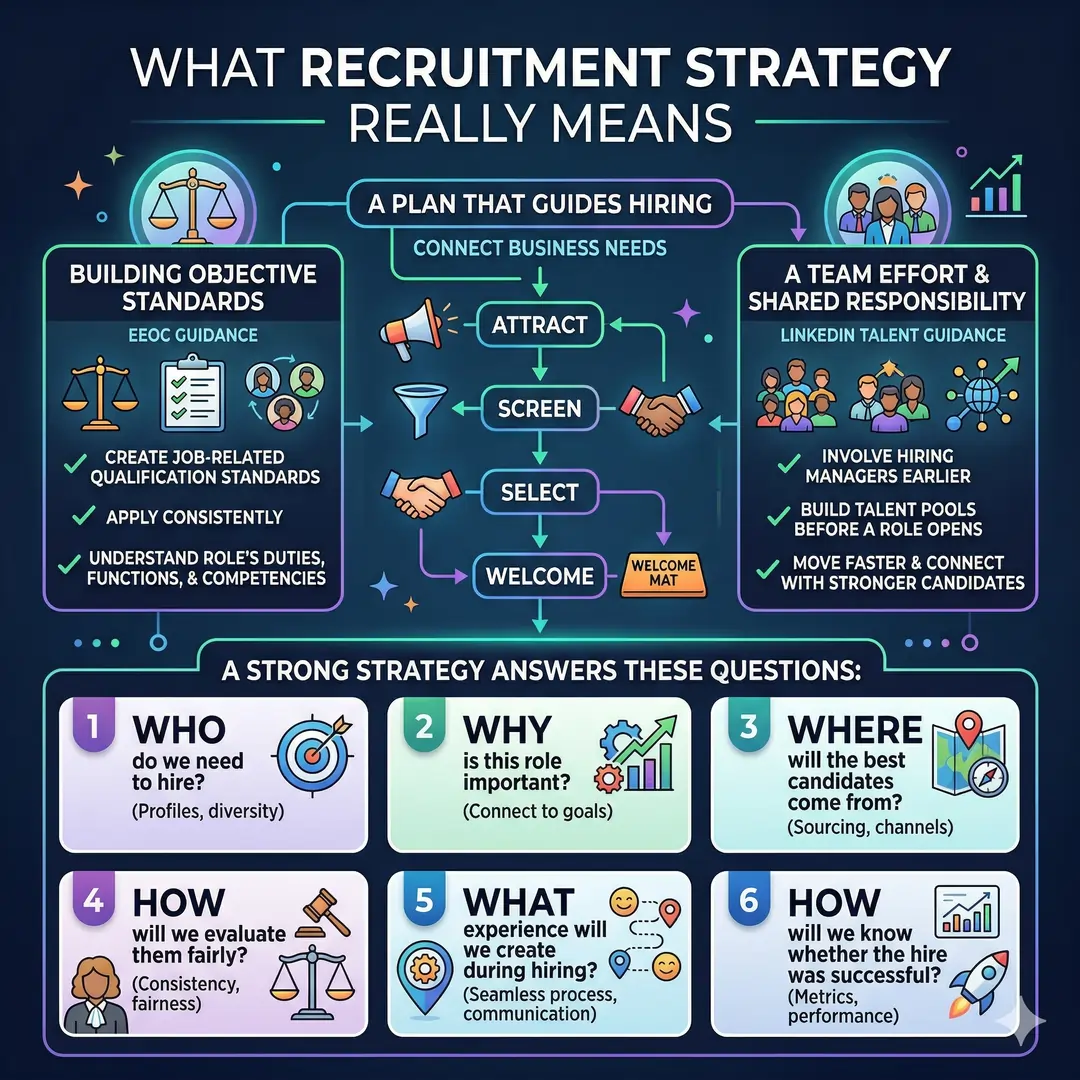
A recruitment strategy is the plan that guides how an organization attracts, screens, selects, and welcomes new employees. It connects the hiring process to business needs, so every step supports a clear purpose. That starts with understanding the role’s duties, functions, and competencies, then building objective standards around them. EEOC guidance specifically recommends creating job-related qualification standards and applying them consistently when choosing among candidates.
A good strategy also recognizes that recruitment is a team effort. LinkedIn’s talent guidance encourages employers to involve hiring managers earlier, build talent pools before a role opens, and treat recruiting as a shared responsibility rather than an HR-only task. That approach helps organizations move faster and connect with stronger candidates.
In simple terms
A strong recruitment strategy answers these questions:
- Who do we need to hire?
- Why is this role important?
- Where will the best candidates come from?
- How will we evaluate them fairly?
- What experience will we create for them during hiring?
- How will we know whether the hire was successful?
Why Recruitment Best Practices Matter
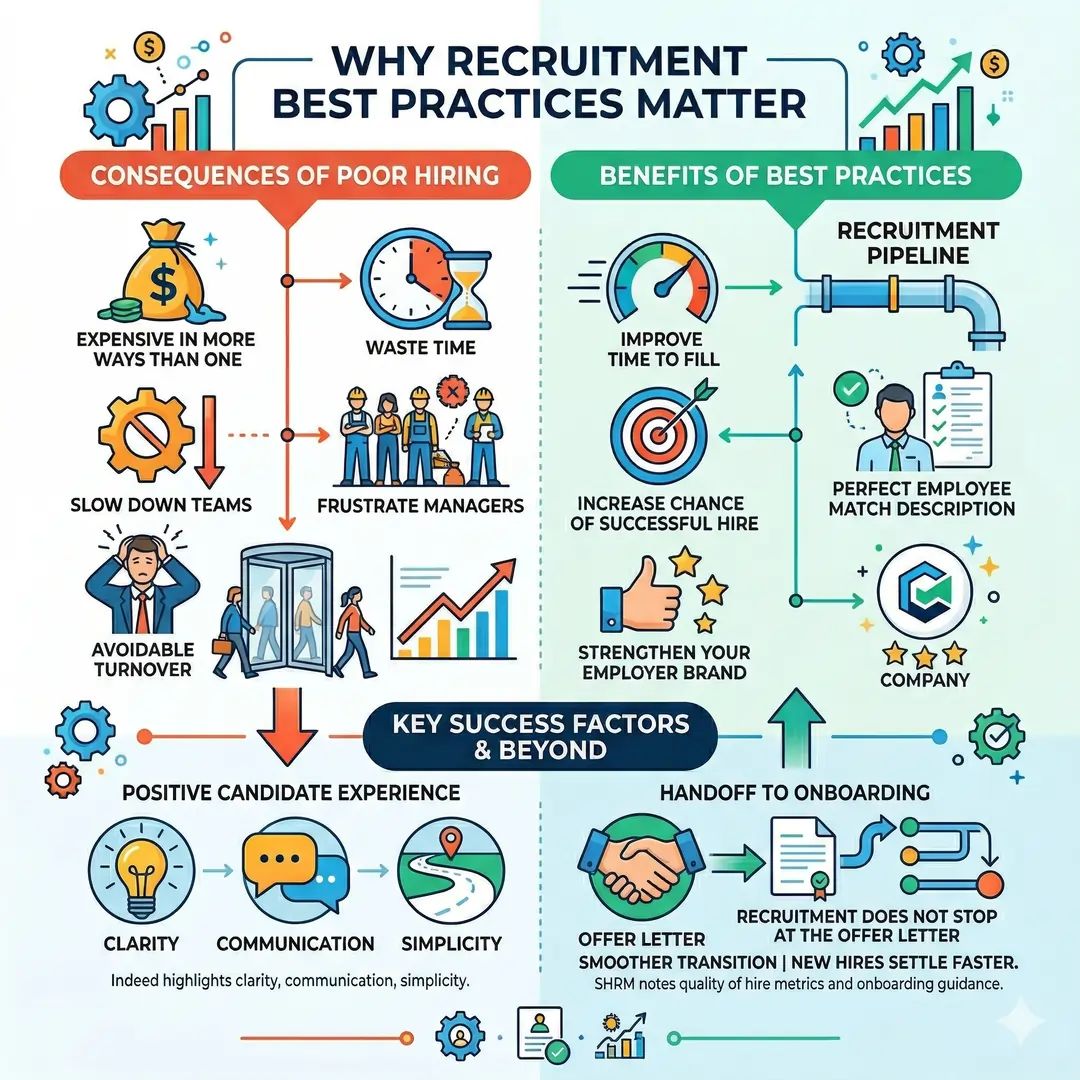
Poor hiring is expensive in more ways than one. It can waste time, slow down teams, frustrate managers, and create turnover that could have been avoided. On the other hand, a structured and thoughtful hiring process can improve time to fill, increase the chance of a successful hire, and strengthen your employer brand. SHRM notes that organizations often use recruiting metrics such as quality of hire, while Indeed highlights the role of clarity, communication, and simplicity in creating a positive candidate experience.
The better your process, the more likely you are to attract people who are a good match for the job and stay longer after they join. SHRM’s onboarding guidance also shows that recruitment does not stop at the offer letter. The handoff into onboarding is part of the overall employee journey, and a smoother transition can help new hires settle in faster.
Core Recruitment Principles That Work
Before looking at tactics, it helps to understand the principles behind effective recruitment. These are the ideas that keep a hiring process fair, efficient, and human.
1. Start with job analysis
A clear job analysis helps you define the role in terms of duties, skills, knowledge, and competencies. EEOC guidance recommends analyzing the job first, then creating objective standards tied directly to that role. This reduces guesswork and helps prevent hiring decisions based on vague impressions.
2. Use structured interviews
Structured interviewing means asking candidates the same core questions in the same order and evaluating them against the same criteria. SHRM explains that structured interviews standardize questioning around job competencies, helping reduce bias and support more equitable decisions. LinkedIn also recommends using a structured format and the STAR method to draw out evidence of skills and experience.
3. Make the process candidate-friendly
Candidates judge your organization by the way you communicate, how long the process takes, and how easy it is to apply. Indeed recommends clear job descriptions, simple application steps, mobile-friendly processes, and timely confirmation messages.
4. Hire for both skills and potential
Skills matter, but so do problem-solving ability, communication, and adaptability. LinkedIn recommends identifying the exact skills needed for the role, including both technical and soft skills, and then building interview questions around them.
5. Measure what matters
Recruitment should be reviewed with data, not just feelings. SHRM notes that quality of hire is one of the most meaningful recruiting metrics, and organizations often assess it through turnover, performance, engagement, and cultural fit indicators.
Table 1: Core Recruitment Strategy Framework
| Recruitment Stage | What It Means | Best Practice | Why It Matters |
|---|---|---|---|
| Job analysis | Define the role clearly before hiring | List duties, skills, behaviors, and success measures | Helps keep the process objective and job-related. |
| Job description | Explain what the role is and who it is for | Use clear language, bullet points, and realistic expectations | Improves applications and candidate understanding. |
| Sourcing | Find candidates from the right channels | Use referrals, job boards, social media, and internal talent pools | Expands reach and improves match quality. |
| Screening | Narrow the applicant pool | Screen using job-related criteria only | Supports fairness and consistency. |
| Interviewing | Evaluate candidates through conversation | Use structured questions and scoring | Reduces bias and improves comparison. |
| Selection | Decide who gets the offer | Compare candidates against the same standards | Improves objectivity and defensibility. |
| Onboarding | Help the new hire settle in | Use preboarding, support, and early integration | Strengthens retention and productivity. |
| Measurement | Check whether hiring worked | Track quality of hire, time to hire, and retention | Shows what is working and what needs improvement. |
Step-by-Step Recruitment Process That Feels Organized and Human
A practical recruitment process does not need to be complicated. It needs to be clear, repeatable, and respectful.
Step 1: Define the hiring need
Start with the business problem. Are you hiring to replace someone, support growth, cover a new market, or bring in specialized expertise? This step should also define what success looks like after the person joins. EEOC guidance supports building qualification standards from actual job duties and competencies, not from assumptions.
Step 2: Write a strong job description
A good job description is one of the most valuable recruitment tools you have. Indeed recommends clear language, bullet points, and information about salary, benefits, and company culture when possible. Candidates should quickly understand what the role involves and whether they match it.
Step 3: Choose the right sourcing channels
Different roles require different channels. Some will come through job boards, some through referrals, some through LinkedIn outreach, and some through internal promotions or talent pools. LinkedIn’s recruiting guidance emphasizes that managers should stay active in sourcing and build relationships before a position even opens.
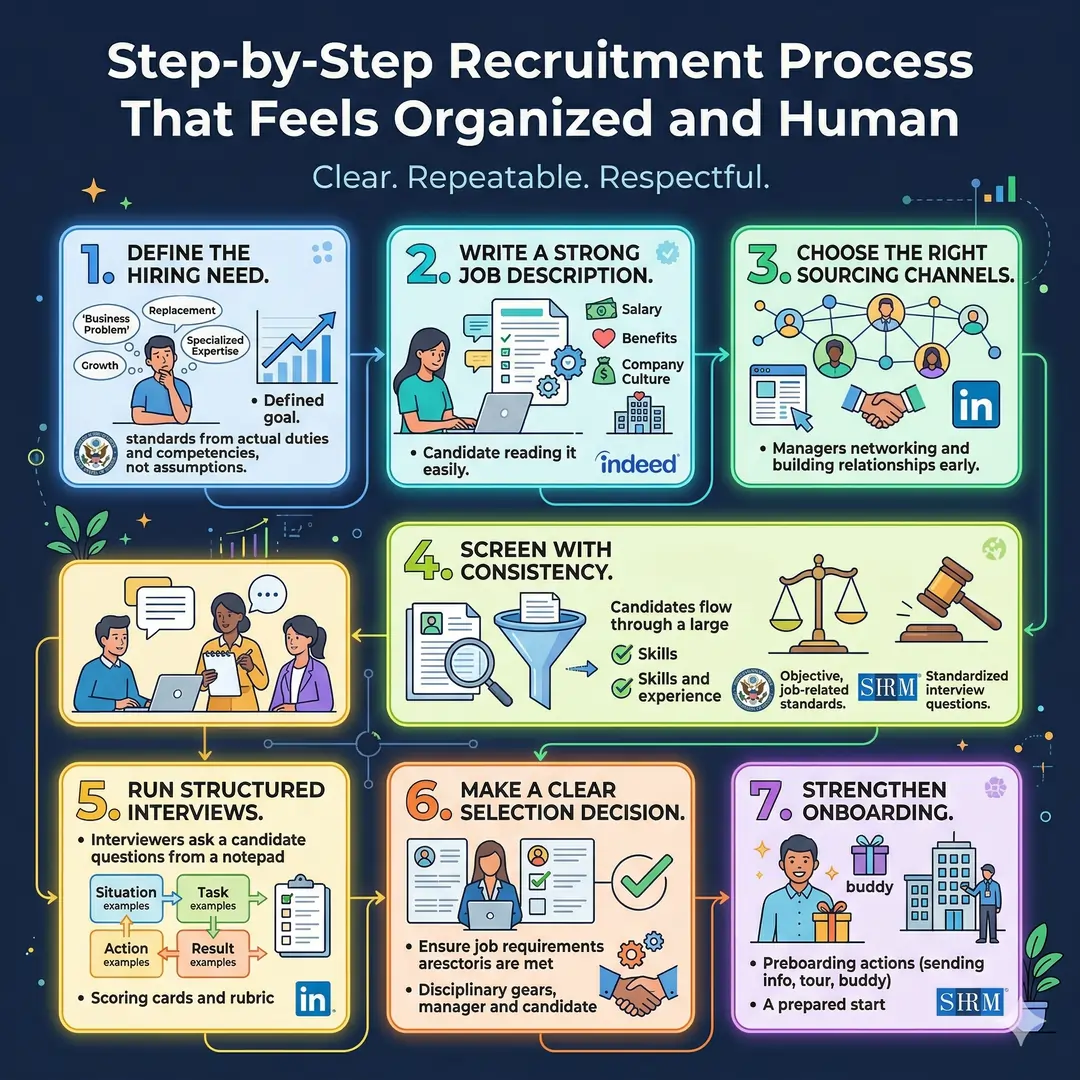
Step 4: Screen with consistency
Screening should filter for role-relevant experience, skills, and minimum qualifications. It should not depend on arbitrary impressions or untested assumptions. EEOC guidance stresses objective, job-related standards, and SHRM highlights standardized interview questions as a way to keep evaluations fair.
Step 5: Run structured interviews
Use the same core questions for every candidate, score answers against a clear rubric, and train interviewers to stay on topic. LinkedIn recommends the STAR method for building questions, which helps candidates give specific examples of past behavior and results.
Step 6: Make a clear selection decision
Once interviews are complete, compare candidates using the same criteria you used at the start. A candidate who interviews well but does not meet the job requirements is still not the right hire. That sounds obvious, but structured processes make it easier to stay disciplined.
Step 7: Strengthen onboarding
Recruitment should flow naturally into onboarding. SHRM recommends preboarding actions such as sending information, offering a facility tour, and assigning a buddy to help the new employee integrate. That early support helps the employee feel prepared before day one.
Table 2: Recruitment Channels and When to Use Them
| Channel | Best For | Strengths | Watch Outs |
|---|---|---|---|
| Employee referrals | Trusted, culture-aware candidates | Often faster and supported by internal trust networks | Can become too narrow if used alone. |
| Job boards | Broad entry-level or mid-level hiring | Large reach and easy visibility | May produce many unqualified applicants. |
| LinkedIn and social recruiting | Professional and passive candidates | Helps build employer visibility and ongoing talent pools | Requires active outreach and regular content. |
| Internal talent pools | Promotions and transfers | Faster ramp-up and higher familiarity | Needs transparent internal mobility policies. |
| Career page | Candidates researching the company | Gives applicants a central place for open roles and company information | Must be updated often to stay useful. |
| Hiring manager networking | Specialized or hard-to-fill roles | Builds relationships before a vacancy appears | Needs manager involvement and discipline. |
| Campus recruitment | Early-career and graduate hiring | Helps build long-term talent pipelines | Works best with a strong development plan. |
How to Write Job Descriptions That Attract Better Applicants
A job description is not just an administrative document. It is a marketing and filtering tool. Indeed notes that a clear description helps applicants decide whether a role fits their qualifications, and it suggests including salary ranges, benefits, and company culture where possible. That extra clarity can make your process feel more trustworthy.
A strong job description should include:
- Job title that reflects the actual role
- Short summary of the position
- Core responsibilities
- Essential skills and experience
- Preferred qualifications
- Reporting line
- Location and work setup
- Salary or salary range when possible
- Benefits and growth opportunities
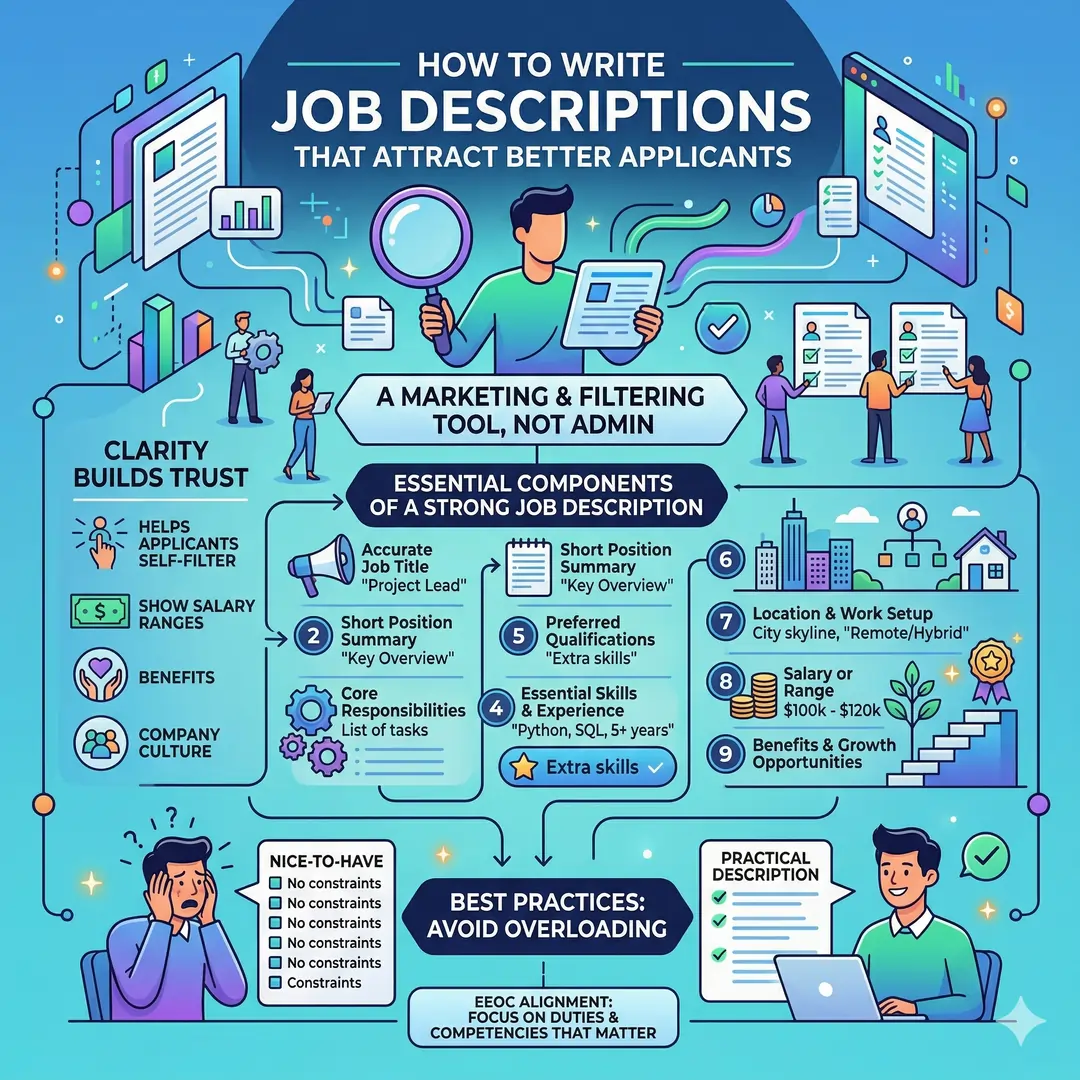
Avoid overloading the description with every possible nice-to-have qualification. When a role sounds impossible to fill, good candidates may not apply. A practical description focuses on what is truly needed for success. That aligns with the EEOC’s recommendation to base standards on the duties and competencies that matter for the role.
Why Structured Interviews Are So Effective
Many hiring problems begin when interviewers improvise too much. One interviewer asks about teamwork, another asks about hobbies, and a third focuses on gut feeling. That may feel casual, but it is hard to compare candidates fairly that way. SHRM explains that structured interviews standardize questioning around competencies, while LinkedIn recommends asking the same questions in the same order and scoring answers consistently.
The STAR method is especially useful because it keeps answers concrete. It helps candidates describe the Situation, Task, Action, and Result, which makes their answers easier to evaluate. LinkedIn recommends this method for skills-based interviewing because it surfaces specific evidence of problem-solving, leadership, conflict handling, and work ethic.
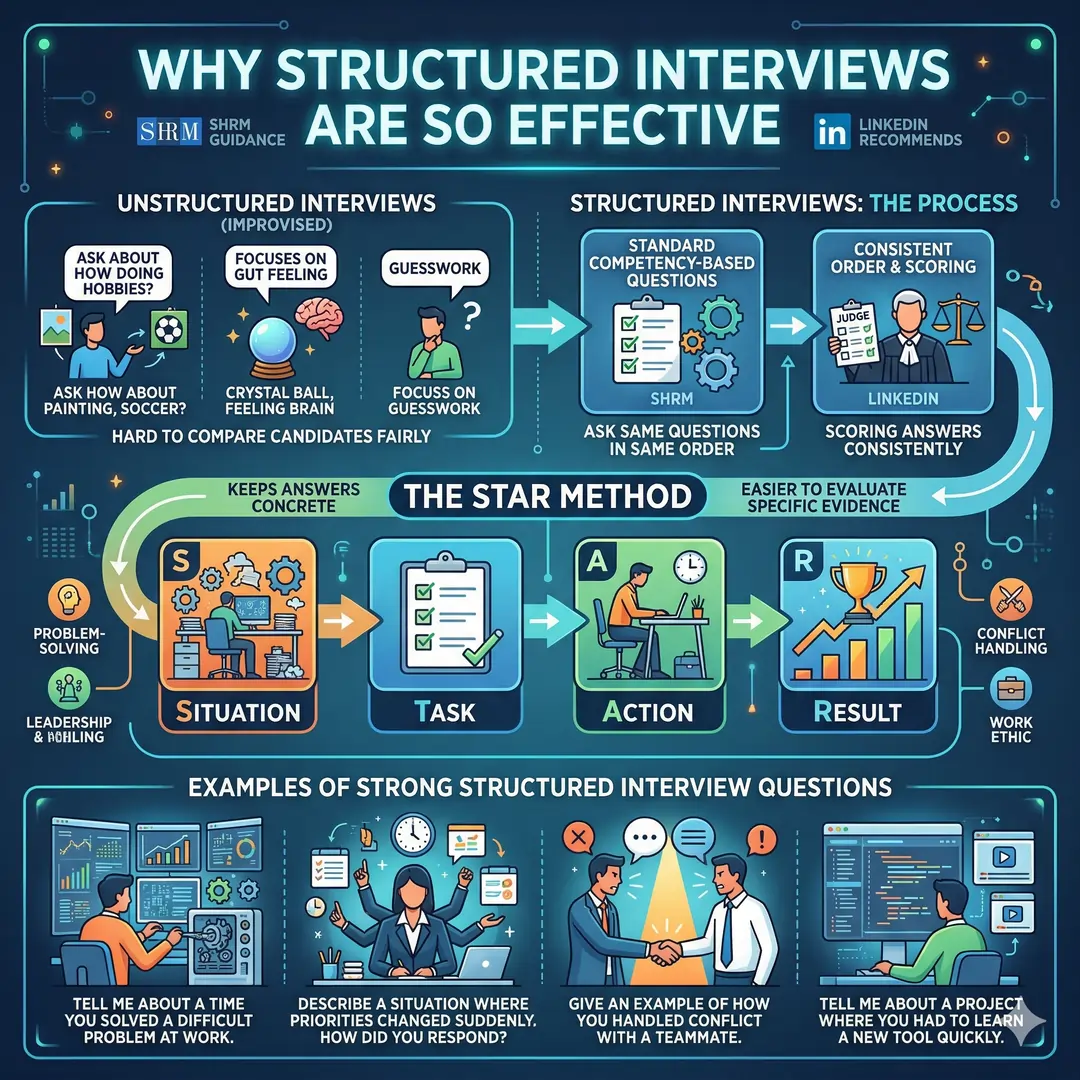
Examples of strong structured interview questions
- Tell me about a time you solved a difficult problem at work.
- Describe a situation where priorities changed suddenly. How did you respond?
- Give an example of how you handled conflict with a teammate.
- Tell me about a project where you had to learn a new tool quickly.
Table 3: Interview Methods Compared
| Interview Method | What It Looks Like | Best Use Case | Main Benefit |
|---|---|---|---|
| Unstructured interview | Free-flowing conversation | Informal early chat | Easy to start, but hard to compare fairly. |
| Semi-structured interview | A mix of fixed and flexible questions | General hiring needs | Balances consistency and conversation. |
| Structured interview | Same questions and scoring for every candidate | Most professional hiring processes | Improves fairness and comparability. |
| Skills-based interview | Questions tied to actual skills and scenarios | Technical or role-specific hiring | Reveals real capability, not just confidence. |
| Work sample test | Candidate completes a practical task | Jobs with measurable output | Shows how the candidate actually works. |
A strong hiring process often uses more than one method. For example, you might combine a structured interview with a work sample or skills assessment. LinkedIn notes that take-home assignments and skills tests can help show whether a person can perform the job, while EEOC guidance reminds employers to keep all selection tools job-related and applied consistently.
How to Improve Candidate Experience
The candidate experience is the way a job seeker perceives your hiring process. Indeed explains that it includes the job description, application process, screening, interviews, communication timing, and even onboarding. A positive experience usually comes from a process that is simple, clear, and respectful.
This matters because candidates talk. A well-run process strengthens your employer brand and can improve trust before the first day on the job. Indeed also notes that the candidate experience continues after hiring, since onboarding influences how the new employee settles in.
Practical ways to improve candidate experience
- Write clear job descriptions
- Simplify the application form
- Make the process mobile-friendly
- Send confirmation emails after the application
- Give realistic timelines
- Communicate outcomes respectfully
- Keep interview logistics organized
- Share the next steps clearly after each stage
A simple rule
If a process feels confusing, slow, or impersonal to a candidate, it probably needs improvement.
How to Build Fairness and Reduce Bias in Hiring
Fair hiring is not only about legal compliance. It is also about making better decisions. EEOC guidance recommends focusing on objective, job-related standards and ensuring that everyone involved in recruitment understands their responsibilities. SHRM’s structured interviewing guidance adds that standardized questions and recorded responses can help safeguard decisions.
A fair process typically includes:
- Clear qualifications based on the role
- Standard interview questions
- Scoring rubrics
- Trained interviewers
- Consistent evaluation criteria
- Documented hiring decisions
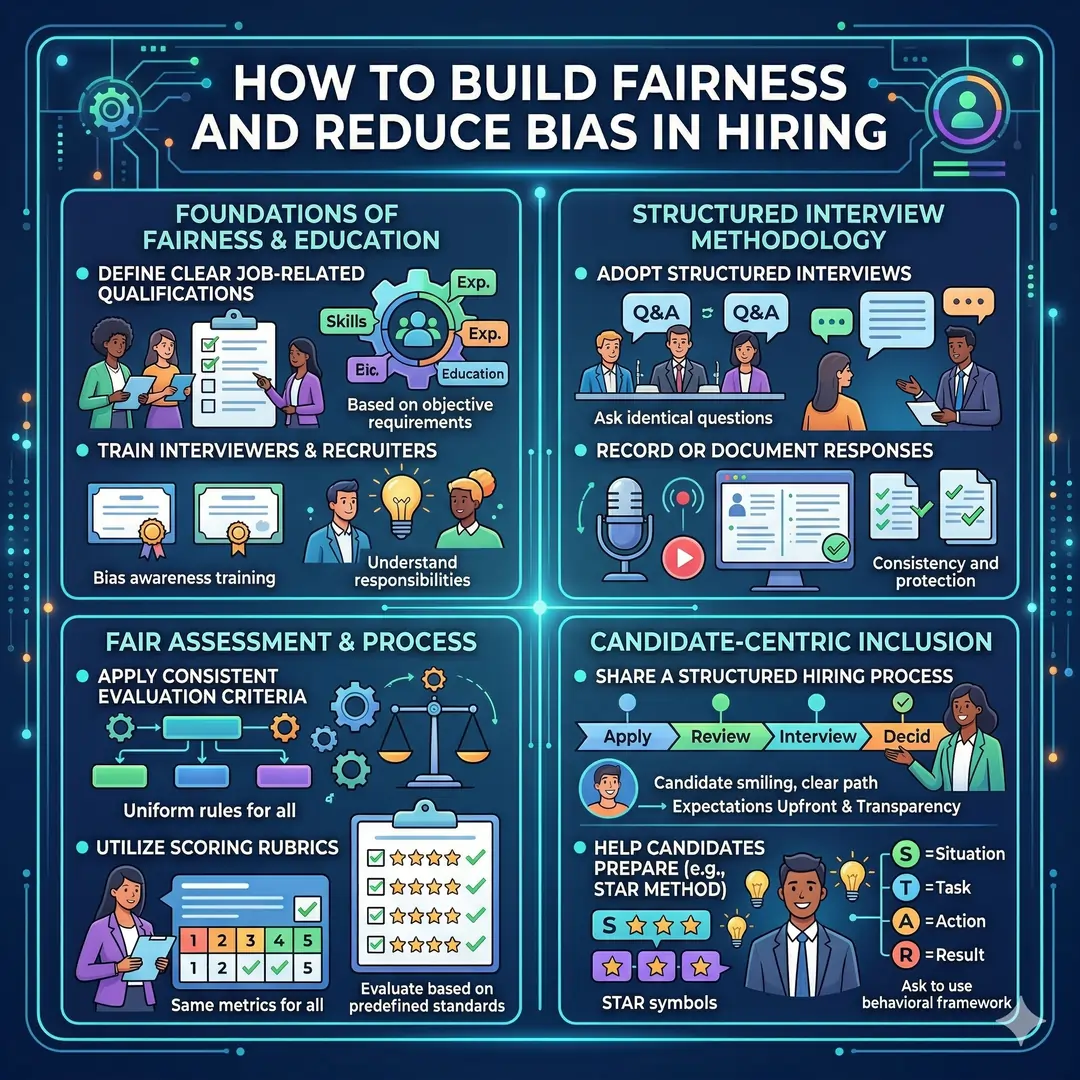
LinkedIn also notes that asking candidates to prepare with the STAR method and sharing a structured process can help create a more inclusive experience. That is especially useful for candidates who do better when expectations are clear upfront.
How to Use Employee Referrals Without Limiting Diversity
Employee referral programs are popular because they can help surface trusted candidates quickly. LinkedIn’s recruiting guidance says referrals are one of the best ways to source candidates, and it encourages companies to involve managers and employees more directly in generating leads.
That said, referrals should not be the only hiring channel. If a company relies on a narrow internal network, it may unintentionally reduce the variety of backgrounds and experiences in the applicant pool. The strongest approach is to use referrals alongside broader sourcing methods, like career pages, social recruiting, and job boards.
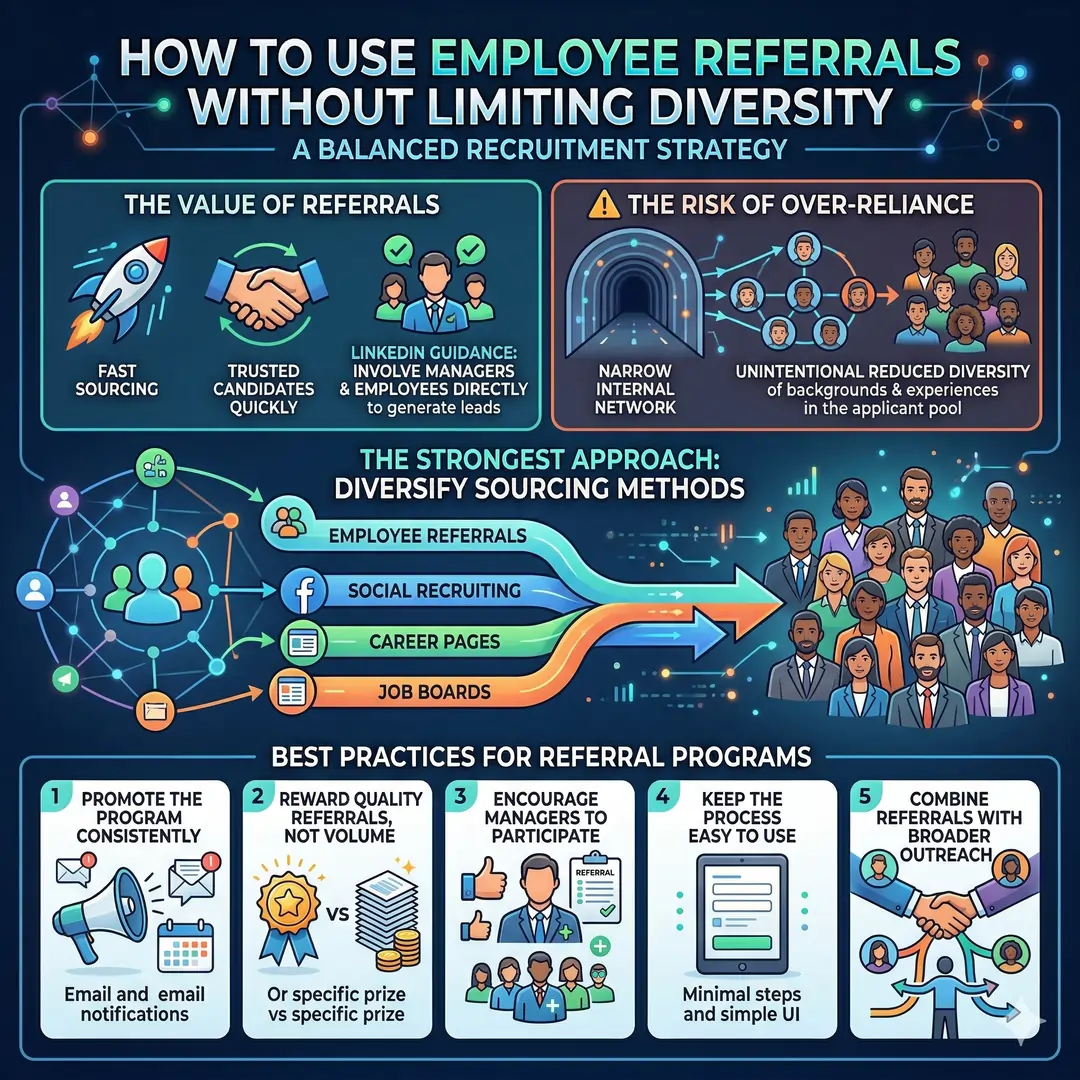
Best practices for referral programs
- Promote the program consistently
- Reward quality referrals, not just volume
- Encourage managers to participate
- Keep the process easy to use
- Combine referrals with broader outreach
Table 4: Recruitment Metrics Worth Tracking
| Metric | What It Measures | Why It Helps | How to Improve It |
|---|---|---|---|
| Time to fill | How long a role stays open | Shows process speed and bottlenecks | Simplify approvals and improve scheduling. |
| Time to hire | How long it takes to move a candidate through the process | Measures hiring efficiency | Reduce unnecessary steps and delays. |
| Quality of hire | Whether the hire succeeds after joining | Connects recruiting to business outcomes | Use better screening and stronger onboarding. |
| Offer acceptance rate | How many offers are accepted | Shows how competitive and appealing the role is | Improve pay, clarity, and candidate experience. |
| Candidate drop-off rate | How many candidates leave the process | Reveals friction in applications or interviews | Simplify forms and improve communication. |
| Source of hire | Where successful hires came from | Helps identify the best channels | Invest more in channels that work. |
| First-year retention | Whether new hires stay | Indicates hiring and onboarding quality | Improve selection and onboarding. |
| Manager satisfaction | How hiring managers rate the process | Shows whether the process meets team needs | Improve communication and candidate fit. |
SHRM notes that quality of hire is often seen as the most meaningful recruiting metric, even if it is one of the hardest to calculate cleanly. Common measures include turnover, performance, engagement, and cultural fit. That is why recruitment analysis should look beyond the hiring date and include what happens after the person joins.
The Role of Onboarding in Recruitment Success
A lot of companies treat onboarding as a separate HR task, but it is really the final step of recruitment. SHRM’s onboarding guidance shows that the process can begin before day one through preboarding, such as sharing information, giving a tour, sending a welcome package, or assigning a buddy.
This matters because the hiring experience does not end when someone accepts the offer. Indeed states that candidate experience continues into onboarding, and SHRM notes that structured onboarding can support retention and productivity. In other words, a strong hiring strategy should be designed to carry people smoothly from application to contribution.
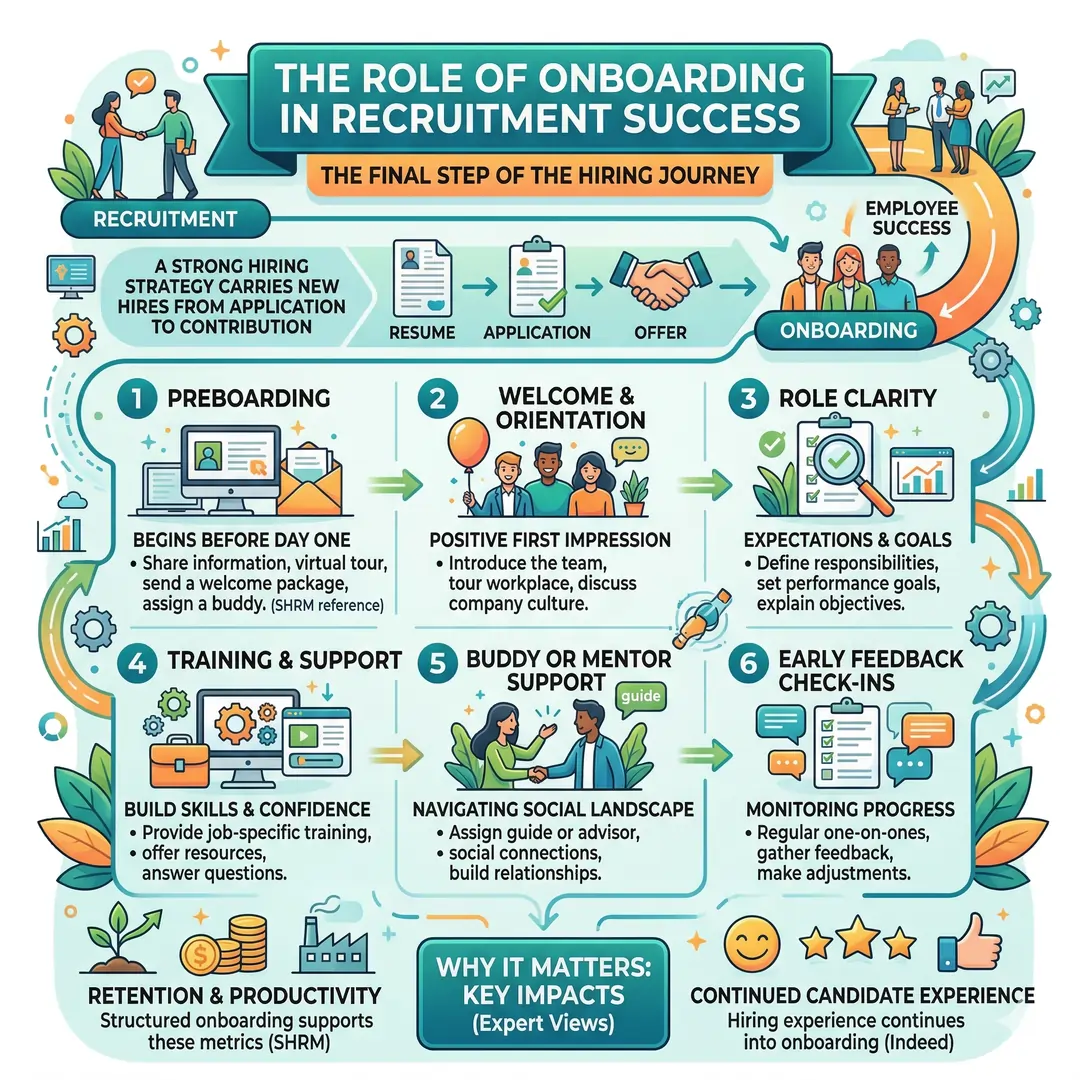
Strong onboarding usually includes
- Preboarding
- Welcome and orientation
- Role clarity
- Training and support
- Buddy or mentor support
- Early feedback check-ins
Common Recruitment Mistakes to Avoid
Even well-meaning hiring teams make avoidable mistakes. The good news is that most of them can be fixed with structure and discipline.
1. Writing vague job descriptions
A vague description invites the wrong applicants and confuses the right ones. Clear, realistic descriptions attract better matches.
2. Relying on gut feeling
Gut feeling can be influenced by bias and inconsistency. Structured interviews and objective criteria are safer and more effective.
3. Making applications too long
If the application feels like a burden, strong candidates may abandon it. Indeed recommends simplifying the process and removing redundant steps.
4. Moving too slowly
Delays can cost you great candidates. Recruitment should be organized so that screening, interviews, and decision-making happen efficiently.
5. Ignoring the candidate experience
People remember how they were treated. A respectful process improves your employer brand and may support retention after hire.
6. Stopping after the offer
The hire is not complete until the person is truly integrated. Strong onboarding closes the loop and reduces the risk of early turnover.
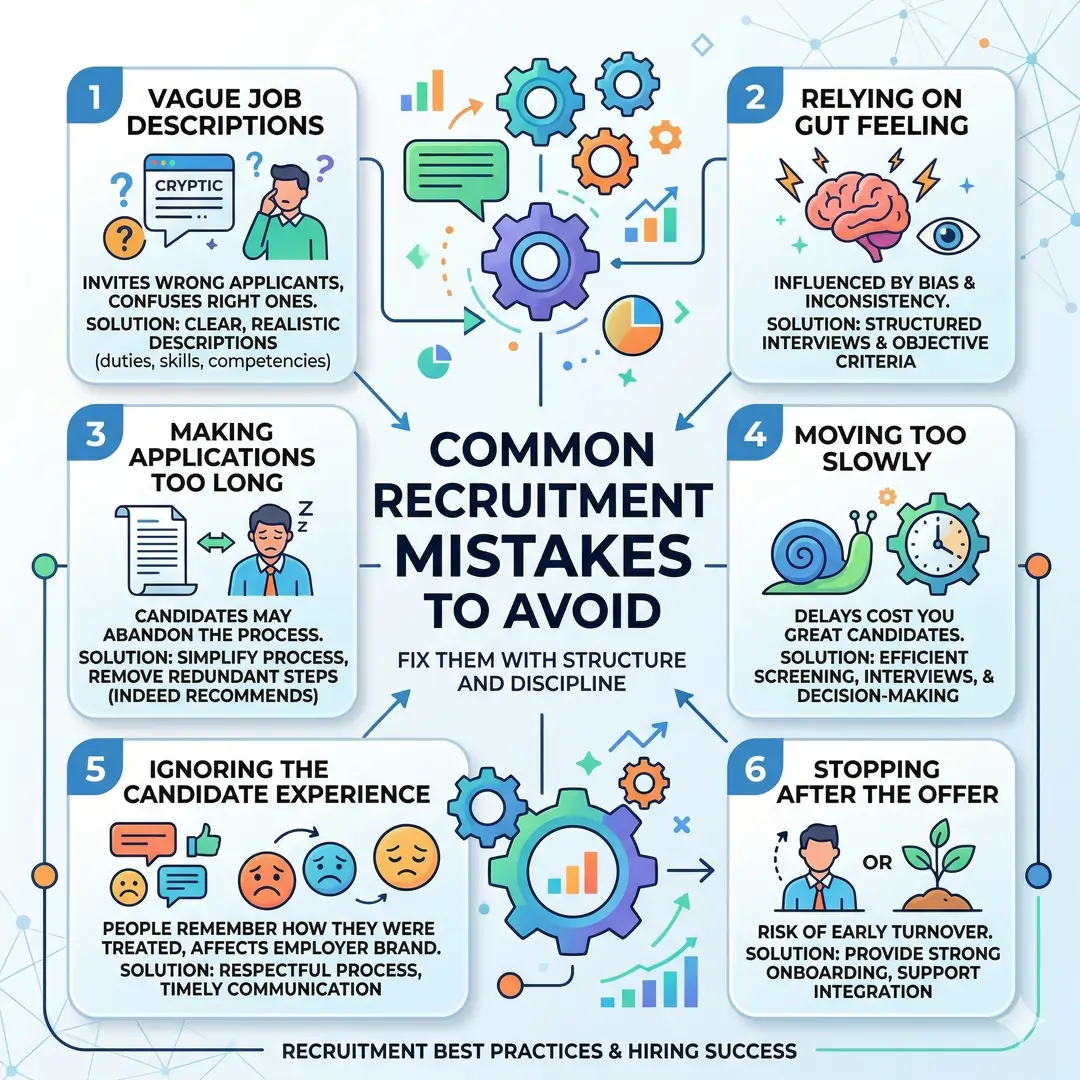
Table 5: Common Recruitment Problems and Better Fixes
| Problem | What It Looks Like | Better Fix |
|---|---|---|
| Unclear role requirements | Applicants do not know what success looks like | Use a job analysis and competency-based standards. |
| Too many interview rounds | Candidates feel exhausted and frustrated | Keep interviews purposeful and structured. |
| Untrained interviewers | Questions vary wildly and judgments become inconsistent | Train interviewers and use a scoring rubric. |
| Slow communication | Candidates wait days or weeks for updates | Send quick confirmations and timeline updates. |
| Weak sourcing strategy | The same type of candidate keeps showing up | Combine referrals, social recruiting, and active outreach. |
| Poor onboarding | New hires feel lost during the first weeks | Use preboarding, buddy support, and structured onboarding. |
A Sample Modern Recruitment Plan
Here is a simple model that many organizations can adapt. It is not flashy, but it is effective.
Stage 1: Preparation
- Confirm the business need
- Define the role
- Write a job description
- Set interview criteria and scoring rules
Stage 2: Attraction
- Post the role on relevant channels
- Use referrals
- Share it through social and professional networks
- Make the application easy to complete
Stage 3: Evaluation
- Screen using objective standards
- Use structured interviews
- Use role-relevant skills questions
- Compare candidates against the same rubric
Stage 4: Offer and transition
- Communicate quickly and clearly
- Make the offer process smooth
- Begin preboarding right away
- Support the first 90 days with onboarding and manager check-ins
Table 6: Recruitment Strategy Checklist
| Area | Checklist Item | Done? |
|---|---|---|
| Role clarity | Job duties and success outcomes are clearly defined | ☐ |
| Job description | Posting is clear, realistic, and easy to read | ☐ |
| Sourcing | Multiple channels are used, not just one | ☐ |
| Screening | Criteria are job-related and consistent | ☐ |
| Interviews | Questions are structured and scored | ☐ |
| Candidate experience | Communication is prompt and respectful | ☐ |
| Selection | Final decisions are tied to documented criteria | ☐ |
| Onboarding | Preboarding and first-week support are planned | ☐ |
| Metrics | Time to fill, quality of hire, and retention are tracked | ☐ |
Final Thoughts
The best recruitment strategies are not based on luck. They are built on clarity, consistency, fairness, and good communication. When you define the role carefully, write a strong job description, use structured interviews, source from multiple channels, and support the new hire after the offer, you build a hiring process that is more professional and more effective. That approach is supported by guidance from EEOC, SHRM, Indeed, and LinkedIn, and it is just as relevant for small teams as it is for large organizations.
In the end, recruitment is really about one thing: finding the right person for the right role at the right time, and giving them a process that feels human from start to finish. When companies do that well, they do not just fill vacancies. They build stronger teams, stronger cultures, and stronger results.
Frequently Asked Questions
FAQ 1: What are recruitment strategies, and why are they important?
A recruitment strategy is the planned approach a company uses to attract, screen, select, and hire the right people for open roles. It is important because hiring is not just about filling a vacancy. It is about finding someone who matches the job requirements, fits the team, and can grow with the organization.
A good recruitment strategy helps businesses save time, reduce hiring mistakes, and improve the quality of hire. It also creates a better experience for candidates, which matters because people often judge a company by how they are treated during the hiring process. When the strategy is clear and organized, the company can hire more confidently and build a stronger workforce over time.
FAQ 2: What are the best recruitment practices for hiring the right candidate?
The best recruitment practices usually begin with a clear job analysis. This means understanding what the role actually requires before writing the job description or speaking to candidates. From there, companies should use a detailed but simple job post, source candidates through different channels, and screen applications using fair and job-related criteria.
Another important practice is using structured interviews. Instead of asking random questions, the interviewer should ask the same core questions to each candidate and score the answers consistently. It is also wise to check both technical skills and soft skills, such as communication, teamwork, and problem-solving. Finally, a smooth onboarding process helps the new hire settle in and perform well after joining.
FAQ 3: How can a company improve the candidate experience during recruitment?
A company can improve the candidate experience by making the hiring process clear, respectful, and easy to follow. This starts with a job description that explains the role in simple language and gives a realistic idea of what the job involves. The application process should also be short and mobile-friendly so candidates do not feel frustrated before they even apply.
Good communication is another key part of the experience. Candidates should receive confirmation after applying, updates during the process, and a clear response at the end. Interview steps should be well organized, and timelines should be shared whenever possible. When candidates feel informed and respected, they are more likely to stay interested in the role and speak positively about the company, even if they are not selected.
FAQ 4: Why are structured interviews better than unstructured interviews?
Structured interviews are better because they make hiring more fair, consistent, and reliable. In a structured interview, every candidate is asked the same important questions in the same order, and their answers are judged using the same scoring system. This makes it easier to compare candidates based on skills and experience instead of personal impressions.
Unstructured interviews often lead to uneven decisions because different interviewers may ask different questions or focus on different things. That can increase the risk of bias and make it harder to choose the best person objectively. Structured interviews also help employers stay focused on the job requirements, which improves the chances of selecting someone who can actually succeed in the role.
FAQ 5: What recruitment metrics should companies track to improve hiring results?
Companies should track several important recruitment metrics to understand whether their hiring process is working well. One useful metric is time to fill, which shows how long it takes to close an open role. Another is time to hire, which measures how long it takes to move a candidate from application to offer. These numbers help identify delays in the process.
A very important metric is quality of hire, which looks at how well the new employee performs after joining. Companies can also track offer acceptance rate, candidate drop-off rate, source of hire, and first-year retention. Together, these metrics give a clearer picture of what is working and what needs improvement. When businesses review these numbers regularly, they can make smarter hiring decisions and build a stronger recruitment system.
FAQ 6: How does a strong job description improve recruitment results?
A strong job description plays a major role in attracting the right candidates and reducing poor applications. It gives people a clear idea of what the role involves, what skills are needed, and what kind of experience is expected. When the description is written in simple and honest language, it helps serious applicants decide quickly whether they are a good match for the position.
A good job description also saves time for recruiters and hiring managers. Instead of reviewing applications from people who do not understand the role, they are more likely to hear from candidates who already meet the core requirements. It can also improve the candidate experience because people appreciate transparency. When salary details, responsibilities, and expectations are clearly explained, the hiring process feels more professional and trustworthy.
FAQ 7: What is the role of employee referrals in a recruitment strategy?
Employee referrals are an important part of many recruitment strategies because current employees can help recommend people they trust and respect. These referrals often lead to candidates who already have some understanding of the company culture, the job environment, and the type of work involved. That can make the hiring process faster and more effective.
At the same time, referrals should not be the only hiring method a company uses. A smart recruitment strategy combines referrals with other channels such as job boards, social media, career pages, and internal talent pools. This helps the organization reach a wider range of candidates and avoid hiring from only one narrow network. When used well, referrals can improve hiring quality without limiting diversity or fresh thinking.
FAQ 8: How can employers reduce bias in the hiring process?
Employers can reduce bias in hiring by making the process more structured and objective. One of the best ways to do this is by using clear job-related criteria from the start. Instead of making decisions based on personal opinions or first impressions, the hiring team should focus on the skills, experience, and competencies that are truly needed for the role.
Another helpful step is to use structured interviews with the same questions for every candidate. This makes comparisons more fair and reduces the chance that one applicant is judged more favorably just because the interviewer felt more comfortable with them. Training interviewers is also important, because it helps them understand how bias can appear in the hiring process. When companies document their decisions and score candidates consistently, they create a more reliable and fair recruitment system.
FAQ 9: Why is onboarding considered part of the recruitment process?
Onboarding is considered part of the recruitment process because hiring does not truly end when a candidate accepts the offer. The first days and weeks after joining are a continuation of the employee journey, and they strongly affect how well the new hire adjusts to the role. A well-planned onboarding process helps the employee feel welcomed, informed, and supported.
Good onboarding can begin even before the first day through preboarding, which may include sending useful information, sharing schedules, preparing documents, or assigning a buddy. This makes the transition smoother and reduces confusion. When onboarding is done well, new employees are more likely to feel confident, become productive sooner, and stay with the company longer. That is why recruitment and onboarding should always work together as one connected process.
FAQ 10: What are the most important signs of a successful recruitment strategy?
A successful recruitment strategy is usually easy to notice through the quality of the people hired and the overall smoothness of the process. One of the biggest signs is that the company consistently attracts candidates who match the job requirements and perform well after joining. Another sign is that hiring managers feel satisfied with the candidates they receive and the speed of the process.
Other signs include a good offer acceptance rate, low candidate drop-off, and strong first-year retention. If new hires stay longer, adapt well, and contribute positively to the team, the recruitment process is likely working as intended. A successful strategy also creates a positive candidate experience, which means applicants feel respected, informed, and fairly evaluated. In the long run, that helps the organization build a stronger employer reputation and attract even better talent in the future.
FAQ 11: What is the difference between recruitment and selection?
Recruitment and selection are closely related, but they are not the same thing. Recruitment is the process of attracting people to apply for a job. It includes writing the job description, posting the vacancy, sharing it through different channels, and encouraging suitable candidates to apply. In simple terms, recruitment is about creating interest and bringing people into the hiring process.
Selection, on the other hand, begins after people apply. This is the stage where the employer reviews applications, screens candidates, conducts interviews, checks skills, and decides who is the best fit for the role. Recruitment creates the candidate pool, while selection helps the company choose the right person from that pool. A strong hiring process needs both parts to work well, because even the best selection system cannot succeed if the recruitment stage does not attract good applicants in the first place.
FAQ 12: How can small businesses build an effective recruitment strategy?
Small businesses can build a strong recruitment strategy even without a large HR team or a big budget. The first step is to be very clear about the role. When a small business knows exactly what kind of person it needs, it becomes much easier to write a useful job description and avoid unnecessary hiring mistakes. Clear expectations also help attract candidates who are genuinely interested in the work.
Small businesses should also focus on a few high-quality hiring channels instead of trying everything at once. For example, they may use employee referrals, social media, local job boards, and their own website. It is also important to keep the process simple, responsive, and respectful. Candidates notice when a small business communicates clearly and moves quickly. Because smaller teams often rely heavily on each new hire, a thoughtful hiring decision can have a very big impact on long-term success.
FAQ 13: Why is candidate experience so important in modern recruitment?
Candidate experience matters because it shapes how people feel about the company during the hiring process. A candidate may not be selected for the role, but they will still remember how they were treated. If the process is slow, confusing, or impersonal, it can damage the company’s reputation. If it is clear, respectful, and well organized, it can strengthen trust and interest in the brand.
A positive candidate experience also helps employers attract stronger applicants in the future. People talk about their experiences, especially when they feel either very satisfied or very disappointed. Clear communication, simple applications, timely feedback, and professional interviews all contribute to a better experience. In today’s competitive hiring market, this is not just a nice extra. It is a major part of recruitment best practices and can influence how many good people choose to apply.
FAQ 14: What role does employer branding play in recruitment success?
Employer branding plays a major role in attracting the right candidates because it shows people what the company is like to work for. A strong employer brand helps candidates understand the organization’s values, work culture, growth opportunities, and overall reputation. When job seekers trust the brand, they are more likely to apply and stay engaged during the hiring process.
A weak or unclear employer brand can make recruitment harder, even if the salary and job title look attractive. People often look for signs of stability, fairness, and respect before they apply. A company can improve its employer brand by sharing real employee stories, keeping its careers page updated, writing honest job descriptions, and treating candidates well. In many cases, employer branding works quietly in the background, but it has a powerful effect on the quality and quantity of applicants a business receives.
FAQ 15: How do companies measure the quality of hire?
Quality of hire is one of the most useful recruitment metrics because it shows whether the hiring decision actually worked after the person joined. It is not enough for a candidate to look good on paper or perform well in the interview. A company also wants to know whether the employee performs well, fits the team, and stays in the role for a reasonable period of time.
Companies often measure quality of hire by looking at performance reviews, manager feedback, productivity, engagement, and retention. Some also compare the employee’s results against the goals that were set during hiring. The exact method may vary, but the purpose is the same. It helps employers see whether their recruitment process is bringing in people who truly succeed in the role. This makes hiring decisions more strategic and less based on guesswork.
FAQ 16: What are the benefits of using structured interviews?
Structured interviews offer many benefits because they make hiring more consistent and fair. In a structured interview, every candidate answers the same core questions, and the interviewer uses the same evaluation criteria for everyone. This reduces confusion and makes it much easier to compare people based on their actual responses instead of personal impressions.
Another benefit is that structured interviews help reduce bias. When the interview process is more controlled, hiring teams are less likely to be influenced by random conversation style, first impressions, or unrelated factors. Structured interviews also improve decision-making because they focus on the skills and behaviors that matter for the job. This makes them one of the most effective recruitment best practices for companies that want to hire in a professional and reliable way.
FAQ 17: How can job descriptions attract stronger candidates?
A well-written job description can attract stronger candidates by giving them a clear and honest picture of the role. People are more likely to apply when they understand the responsibilities, skills, reporting structure, salary, and work expectations. If the job description is too vague or too complicated, serious candidates may lose interest or assume the company is disorganized.
To attract better applicants, the description should focus on the most important tasks and qualifications. It should avoid overloading the reader with unnecessary requirements that are not truly needed for the role. Simple language works best because it helps candidates quickly decide whether they are a fit. A good job description also reflects the tone and culture of the company, which helps the right people feel more connected to the opportunity before they even apply.
FAQ 18: Why should recruitment teams use more than one hiring channel?
Using more than one hiring channel helps companies reach a wider and more diverse pool of candidates. If a business depends only on one source, such as referrals or a single job board, it may miss out on excellent people who are searching in other places. A multi-channel approach improves visibility and gives the role a better chance of being seen by the right audience.
Different channels work better for different roles. For example, some jobs may attract talent through social media, while others may perform better on specialized job boards, internal job postings, or employee referral programs. Using more than one channel also makes the hiring process more flexible. If one source does not produce enough qualified applicants, another source can help fill the gap. This is why a strong recruitment strategy usually combines several channels instead of relying on just one.
FAQ 19: What makes onboarding an important part of recruitment?
Onboarding is important because the hiring process does not truly end when the offer is accepted. The first days and weeks after joining are part of the employee’s transition, and they strongly affect whether the new hire feels confident, welcomed, and prepared. A poor start can create stress and confusion, while a strong onboarding process helps the employee settle in more quickly.
Effective onboarding can begin even before the employee’s first day through preboarding. This may include sending useful documents, explaining what to expect, introducing the team, or assigning a mentor. When onboarding is done well, it improves retention, reduces early turnover, and helps new employees become productive sooner. That is why many hiring experts treat onboarding as a natural extension of recruitment rather than a separate process.
FAQ 20: What are the biggest mistakes companies make during recruitment?
One of the biggest recruitment mistakes is writing unclear job descriptions. When a role is not explained properly, it can attract the wrong people and discourage the right ones. Another common mistake is relying too much on instinct instead of using objective criteria. While experience and intuition can help, hiring decisions should still be based on job-related skills, structured interviews, and clear evaluation standards.
Other mistakes include moving too slowly, failing to communicate with candidates, and ignoring the importance of onboarding. Some companies also make the process too long or too complicated, which causes strong candidates to drop out. Another major mistake is not measuring the results of hiring at all. Without metrics such as time to hire, quality of hire, and retention, it is difficult to know whether the recruitment process is actually working. A better approach is to keep the process simple, fair, transparent, and focused on real job success.
