

Recruitment metrics and KPIs are the numbers that show whether your hiring process is working, where it is slowing down, and how well it is helping the business grow. In simple terms, they help you measure the speed, cost, quality, candidate experience, and business impact of hiring. Good metrics make recruitment less dependent on guesswork and more dependent on evidence, which is why they are widely used to improve hiring practices, reduce time-to-hire, optimize resources, and strengthen talent decisions.
What makes this topic even more important today is that many talent teams are moving beyond basic activity numbers and focusing more on outcome-based KPIs. LinkedIn’s recruiting research shows that teams still commonly track tactical measures like time to hire, candidates per hire, and offer acceptance rate, but the future is expected to lean more heavily on strategic metrics such as quality of hire, sourcing channel effectiveness, and candidate experience. SHRM also notes that quality of hire is often the most meaningful recruiting metric, while also being one of the hardest to measure well.
Table of Contents
What Recruitment Metrics and KPIs Actually Mean
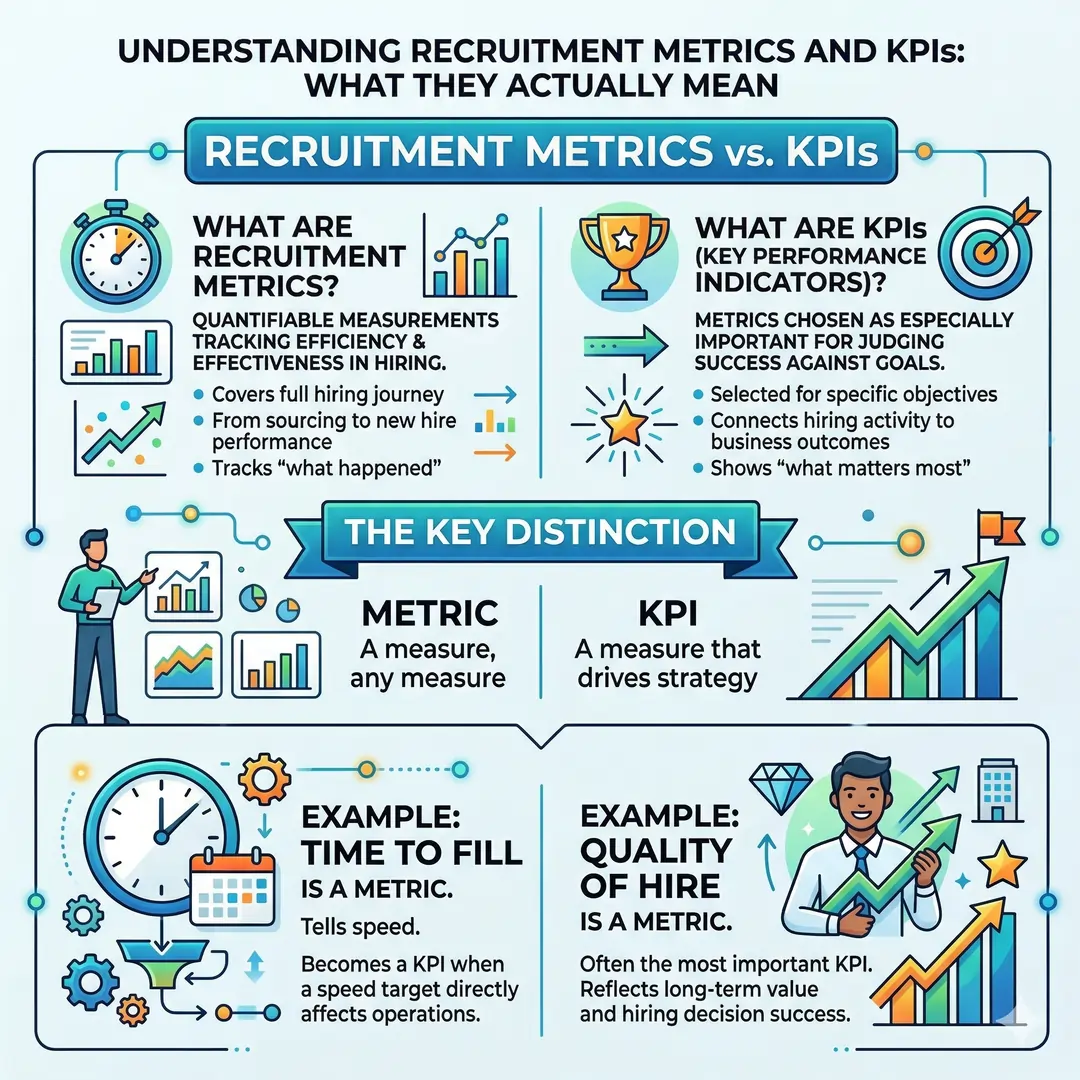
Recruitment metrics are quantifiable measurements that track and evaluate how efficiently and effectively an organization hires people. They cover the full hiring journey, from sourcing candidates to filling roles and evaluating how new hires perform after joining. A KPI or Key Performance Indicator is a metric that has been chosen as especially important for judging success against a specific goal. In recruitment, that means not every metric becomes a KPI. The most useful KPIs are the ones that connect hiring activity to business outcomes.
A simple way to think about the difference is this. A metric tells you what happened. A KPI tells you what matters most. For example, time to fill is a metric. It becomes a KPI when your team has set a hiring speed target that directly affects business operations. Quality of hire is also a metric, but for many organizations, it is the most important KPI because it reflects whether hiring decisions are creating long-term value.
Why Recruitment Metrics Matter So Much
Recruitment metrics give hiring teams a clearer picture of the whole process. They help leaders understand the speed of hiring, the cost of acquiring talent, the quality of new hires, and the impact of recruitment on overall business performance. They also help identify bottlenecks, cut waste, and improve candidate experience. That makes them useful not only for recruiters, but also for hiring managers, finance teams, and business leaders who need hiring to support growth.
There is also a strong strategic reason to use them. LinkedIn’s future-focused recruiting research says recruiting leaders are increasingly expected to measure outcomes, not just activity. The same report shows that metrics such as quality of hire, candidate experience rating, sourcing channel effectiveness, and hiring manager satisfaction are seen as highly useful because they reveal whether the hiring process is actually producing better employees, not just faster activity.
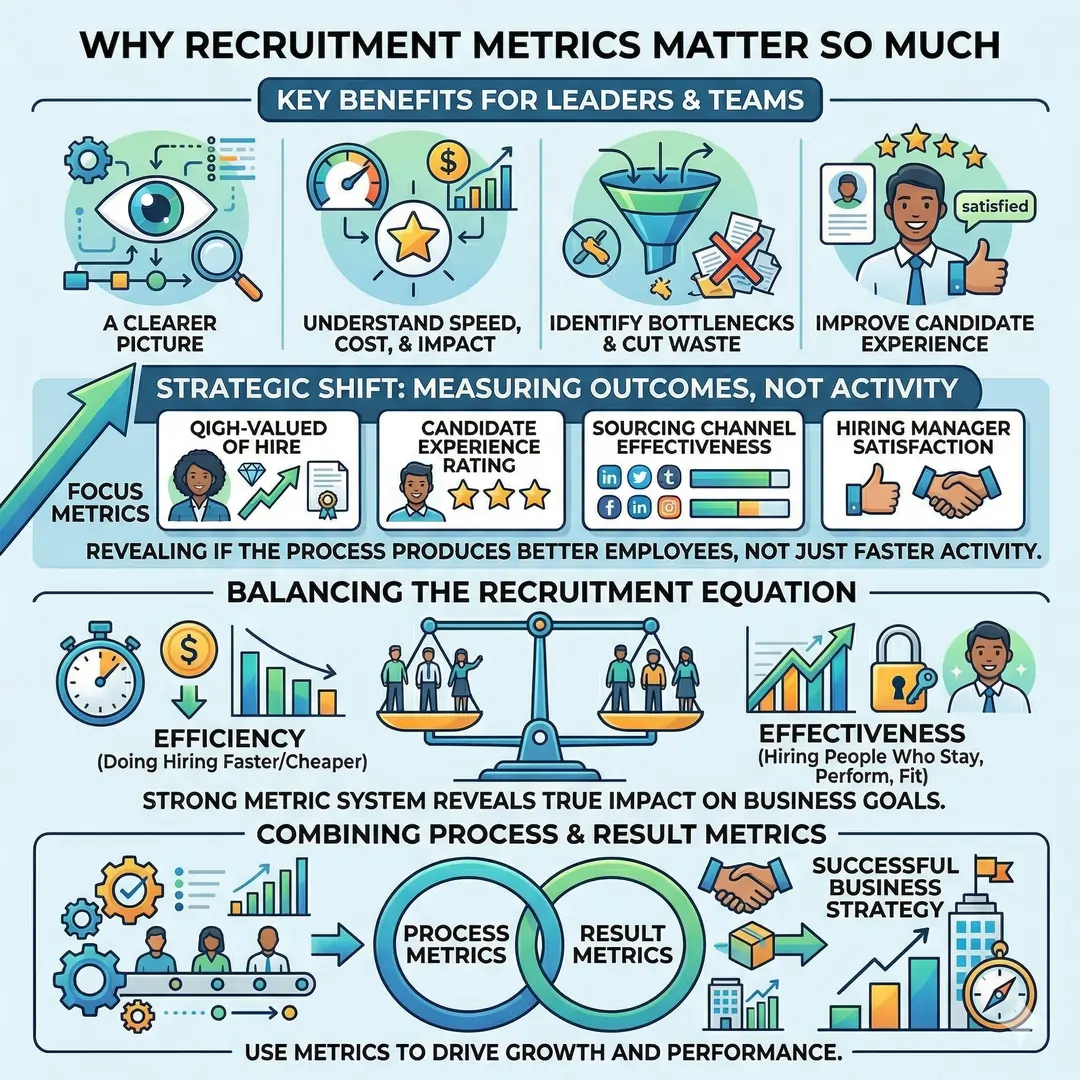
A strong metric system also helps organizations balance efficiency and effectiveness. Efficiency means hiring faster or at a lower cost. Effectiveness means hiring people who stay, perform well, and fit the role. SHRM points out that speed and cost alone do not reveal the true impact of hiring decisions on business goals. That is why strong recruitment reporting should always combine process metrics with result metrics.
The Most Important Recruitment Metrics and KPIs
| Metric | What it measures | Simple formula | Why it matters | Best use case |
|---|---|---|---|---|
| Time to fill | The number of days from job requisition opening to offer acceptance | Offer accepted date minus requisition opening date | Shows how quickly the hiring process moves and whether vacancies are staying open too long | Workforce planning, urgent hiring, high-volume roles |
| Time to hire | The number of days from candidate engagement or application stage to offer acceptance, depending on company definition | Usually measured from first application or first contact to offer acceptance | Helps track recruiter efficiency and candidate movement through the pipeline | Sourcing and process speed analysis |
| Cost per hire | The total hiring cost for each new employee | Total recruiting cost divided by number of hires | Shows how expensive it is to bring in talent and where hiring budget is going | Budgeting, sourcing comparison, cost control |
| Quality of hire | How well a new employee performs and contributes over time | Often a composite of performance, retention, engagement, or manager satisfaction | Shows whether the hiring process is producing strong long-term talent | Strategic hiring, leadership roles, scarce-skill roles |
| Source of hire | Which channels produce successful hires | Hires from source divided by total hires, or source share of hires | Shows which recruiting channels give the best results | Job board comparison, referral strategy, campaign ROI |
| Offer acceptance rate | Percentage of offers accepted by candidates | Accepted offers divided by total offers made × 100 | Reveals whether pay, role, culture, or candidate experience is competitive | Final-stage hiring review |
| Candidate experience | How candidates feel about the hiring process | Usually measured through surveys and feedback scores | Strong candidate experiences support employer brand and future applications | Employer branding, process improvement |
| Application completion rate | How many candidates finish an application after starting it | Completed applications divided by started applications × 100 | Shows whether the application process is too long or frustrating | Careers site and application form optimization |
| Hiring manager satisfaction | How satisfied hiring managers are with candidates and the process | Survey score or feedback rating | Shows whether recruiters are delivering people the business actually wants | Post-hire and process review |
| Retention rate | How long new hires stay with the company | New hires remaining after a set period divided by total new hires | Reveals whether the hire was a good fit and whether onboarding worked | Quality-of-hire tracking |
| Diversity of candidate pool | Representation of different groups in the pipeline | Depends on the organization’s diversity reporting model | Helps track whether hiring is broad, fair, and inclusive | Inclusive hiring and workforce planning |
| Funnel conversion rate | How many candidates move from one stage to the next | Candidates reaching next stage divided by candidates in prior stage × 100 | Identifies drop-off points and process bottlenecks | Interview pipeline analysis |
How to Calculate the Most Useful Metrics
The formulas below turn recruitment data into practical business insight. SHRM’s benchmarking guidance gives clear definitions for time to fill and cost per hire, including the fact that time to fill runs from requisition opening to offer acceptance, and cost per hire includes items such as advertising, agency fees, employee referrals, travel, relocation, and recruiter pay and benefits, divided by the number of hires.
| Metric | Formula | Example | What the result tells you |
|---|---|---|---|
| Time to fill | Offer accepted date minus requisition open date | Requisition opened on 1 May, offer accepted on 20 May, so time to fill is 19 days | A lower number usually means the hiring process is moving efficiently |
| Cost per hire | Total recruiting cost divided by number of hires | If recruiting cost is $48,000 for 12 hires, cost per hire is $4,000 | Helps compare hiring efficiency across teams, roles, or channels |
| Offer acceptance rate | Accepted offers divided by total offers × 100 | If 18 of 20 offers are accepted, the rate is 90 percent | A low rate may signal weak compensation, poor role fit, or a candidate experience problem |
| Application completion rate | Completed applications divided by started applications × 100 | If 300 people begin an application and 225 finish it, the rate is 75 percent | A low rate often means the application process is too long or confusing |
| Quality of hire | Composite score based on chosen indicators | A company may combine performance review score, retention after 12 months, and manager satisfaction into one score | Shows whether the hire actually created value after joining |
A Closer Look at the Metrics That Matter Most
1. Time to Fill
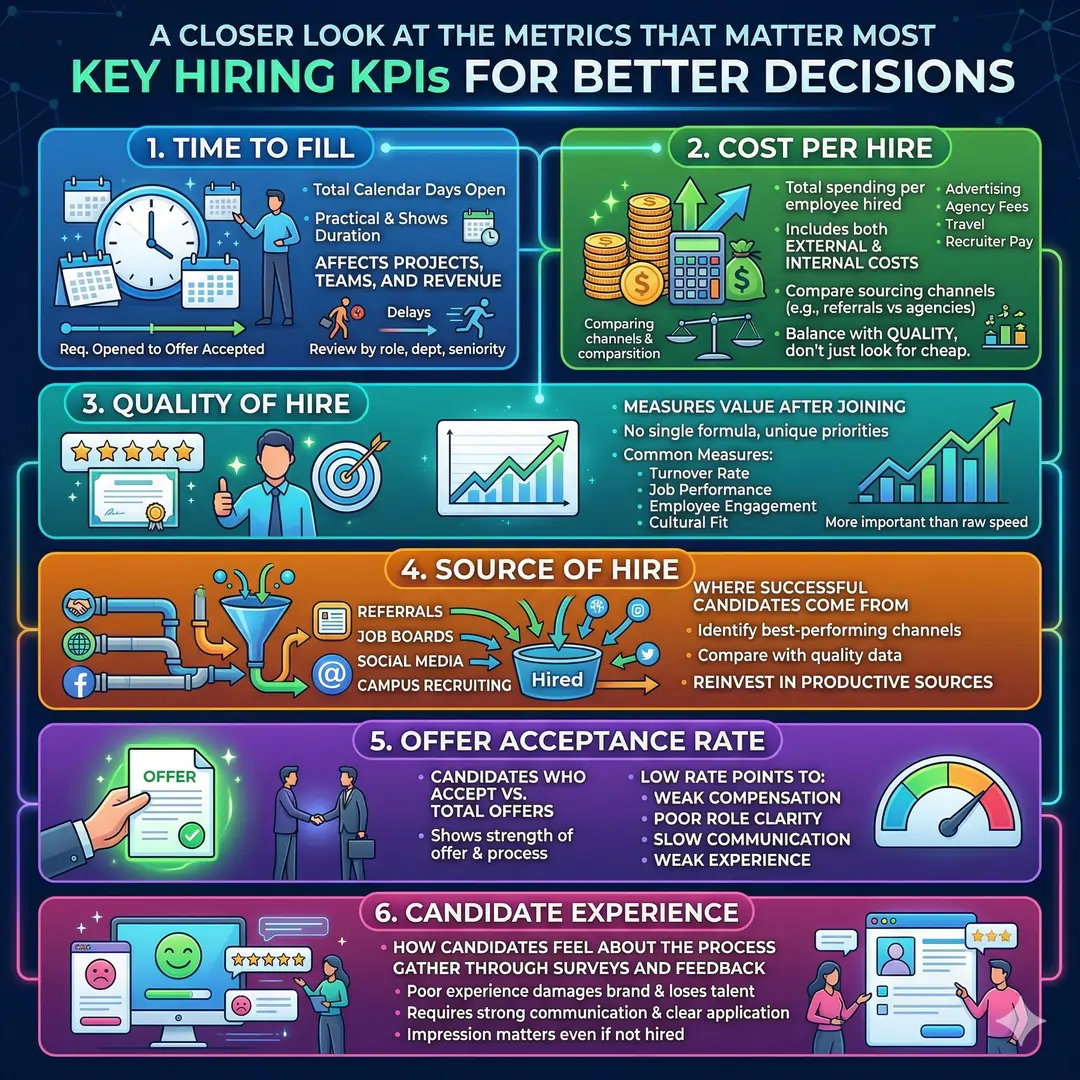
Time to fill is one of the most practical hiring KPIs because it shows how long a role stays open. SHRM defines it as the number of days from when the job requisition is opened until the offer is accepted, using calendar days. A long time to fill can delay projects, burden existing teams, and increase the chance that strong candidates accept other offers first.
For example, a sales role left open for six weeks can affect revenue, while a software engineering role left open too long can delay product delivery. That is why the time to fill should be reviewed by role type, department, and seniority instead of as one single company-wide number.
2. Cost per Hire
Cost per hire shows how much a company spends to bring in one new employee. SHRM’s benchmark definition includes both external and internal costs such as advertising, agency fees, employee referrals, travel, relocation, and recruiter pay and benefits. LinkedIn also highlights that cost per hire should be balanced against quality of hire, because the cheapest hire is not always the best hire.
This metric is especially useful when comparing sourcing channels. For instance, employee referrals may produce lower costs than agency hires, while agency sourcing might still make sense for niche or leadership roles. The best approach is to look at cost alongside quality of hire, speed, and retention, not in isolation.
CIPD’s 2024 resource and talent planning report also shows that recruitment costs vary significantly by role and market. In that UK report, the median cost of recruiting senior managers was £2,000, and the median cost for other employees was £1,500, which is a useful reminder that benchmark values change by seniority and context.
3. Quality of Hire
Quality of hire is the metric that tells you whether your hiring decisions are paying off after the person joins. SHRM notes that there is no single universal formula for it because priorities differ from company to company. Common proxy measures include turnover rates, job performance, employee engagement, and cultural fit measured by 360 ratings.
LinkedIn’s 2025 research says quality of hire is often measured using a combination of job performance ratings, new hire retention, and hiring manager satisfaction. The same research shows that talent teams increasingly view quality of hire as more important than raw speed metrics, which makes sense because a fast hire who performs poorly is still an expensive mistake.
4. Source of Hire
Source of hire tells you where your successful candidates came from, such as job boards, referrals, social media, campus recruiting, or agencies. This matters because some channels may generate a high volume of applicants but a low number of strong hires, while others may be quieter but much more effective. LinkedIn recommends using source data to identify the channels that deliver the best hiring outcomes and to reinvest in the most productive sources.
This metric becomes very powerful when paired with quality of hire. A channel that produces cheaper applications is not necessarily the best source if those candidates do not stay or perform well. A referral program, for example, may produce fewer applicants but stronger long-term hires in many organizations.
5. Offer Acceptance Rate
The offer acceptance rate shows how many candidates actually say yes after receiving an offer. A low acceptance rate can point to weak compensation, poor role clarity, slow communication, or a weak candidate experience. It is one of the clearest signs that something in the final stage of recruitment needs attention.
If a company is sending many offers but getting few acceptances, the problem may not be sourcing. It may be the employer value proposition, the salary band, or how the interview process is being managed. That is why the offer acceptance rate should always be reviewed alongside candidate feedback and hiring manager expectations.
6. Candidate Experience
Candidate experience measures how people feel about the hiring process. LinkedIn says it can be gathered through surveys and feedback forms, and that a poor experience can damage an employer’s brand while a positive one can attract future talent and referrals. In modern hiring, candidate experience is no longer just a nice extra. It is part of the recruiting result itself.
This matters because candidates often compare multiple employers at the same time. A slow response, confusing application form, or poor interview communication can cause strong candidates to walk away. Even when a candidate is not hired, they still leave with an impression of your brand.
How to Build a Strong Recruitment KPI Dashboard
A good recruitment dashboard does more than list numbers. It helps hiring leaders see trends, spot bottlenecks, and make faster decisions. SHRM says recruiting dashboards are useful because they turn hiring data into intelligence that can guide action. In practice, the best dashboards combine process metrics and outcome metrics, not just one or the other.
A simple dashboard can include:
- Speed metrics like time to fill and time to hire
- Cost metrics like cost per hire
- Quality metrics like quality of hire and new hire retention
- Experience metrics like candidate experience and offer acceptance rate
- Channel metrics like source of hire and funnel conversion rate
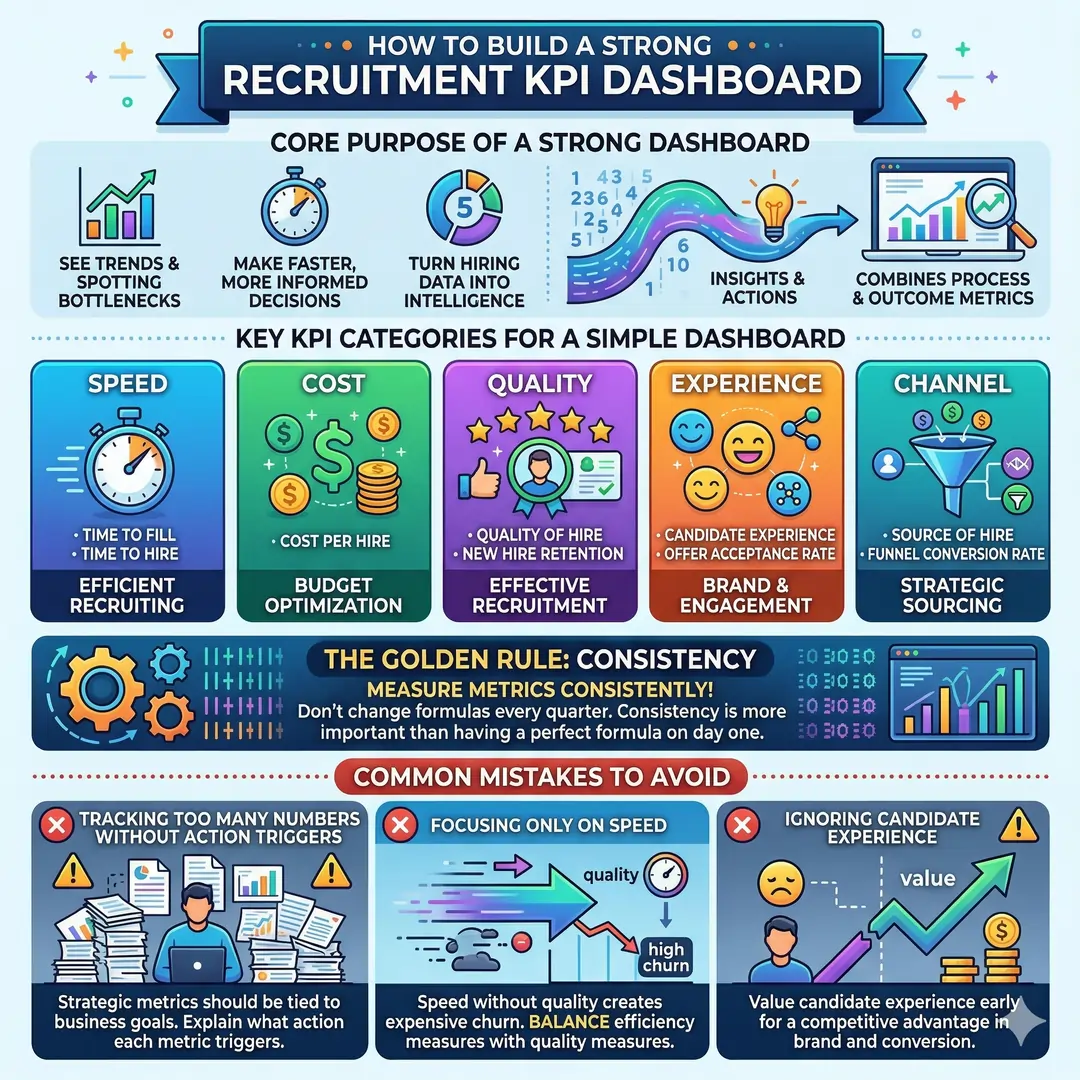
The most important dashboard rule is consistency. If your team changes the formula every quarter, the numbers stop being useful. LinkedIn’s 2025 report emphasizes that the quality of hire should be measured consistently, even when the exact formula differs by organization. Consistency matters more than having a perfect formula on day one.
Common Mistakes Companies Make with Recruitment Metrics
One common mistake is tracking too many numbers without knowing which ones actually matter. A dashboard full of data can look impressive, but it may not help decision-making if the team cannot explain what action each metric should trigger. Strategic metrics should be tied to business goals, not collected just because they are available.
Another mistake is focusing only on speed. Fast hiring feels productive, but it can create hidden problems if the new hires are not strong performers or do not stay long. SHRM and LinkedIn both stress that quality measures should sit beside efficiency measures, because speed without quality can create expensive churn.
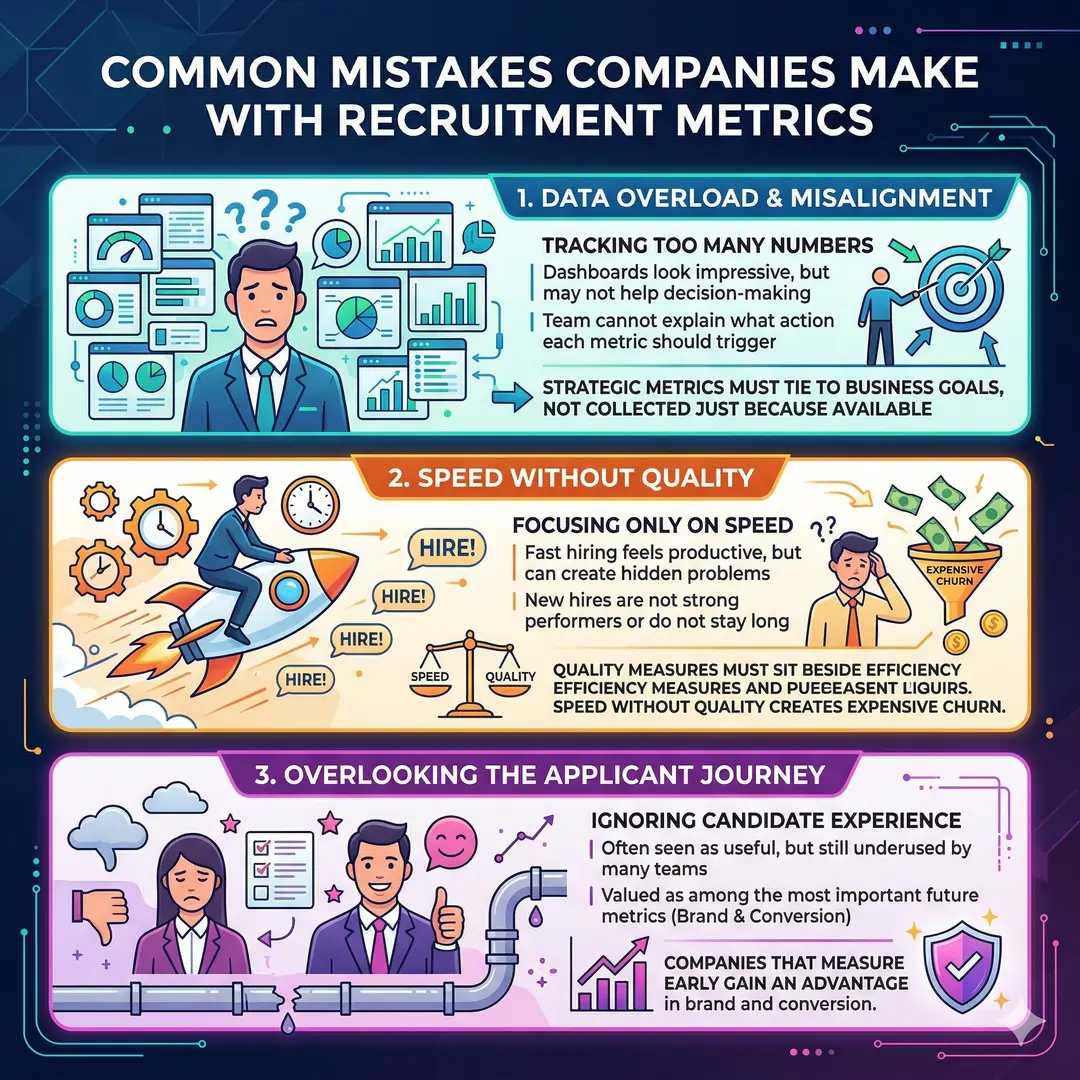
A third mistake is ignoring the candidate experience. LinkedIn’s recruiting guidance shows that candidate experience is increasingly seen as a useful metric, and its 2025 research says it is among the most valuable future metrics, even though many teams still underuse it. That means companies that measure it early can gain an advantage in brand and conversion.
Best Practices for Improving Recruitment Metrics
To improve recruitment results, start by deciding which metrics support the business goals most directly. For urgent or high-volume hiring, time to fill and offer acceptance rate may deserve priority. For leadership or specialist hiring, the quality of hire and source of hire may matter more. For employer brand, candidate experience should not be ignored.
A few practical habits can make a big difference:
- Review hiring data by role, department, and level, not only at the company level.
- Combine quantitative data with candidate feedback and manager feedback.
- Track metrics at each stage of the funnel so you can find drop-off points.
- Compare sources by both cost and quality, not just volume.
- Revisit the metrics regularly so they keep matching business priorities.
LinkedIn’s 2025 research also shows that generative AI is starting to change hiring workflows. Among talent acquisition professionals using or experimenting with generative AI, the average time saved is about 20 percent of the work week, which is roughly a full workday saved weekly. That does not replace good metrics, but it can free recruiters to spend more time on higher-value work such as assessment quality, skills matching, and candidate communication.
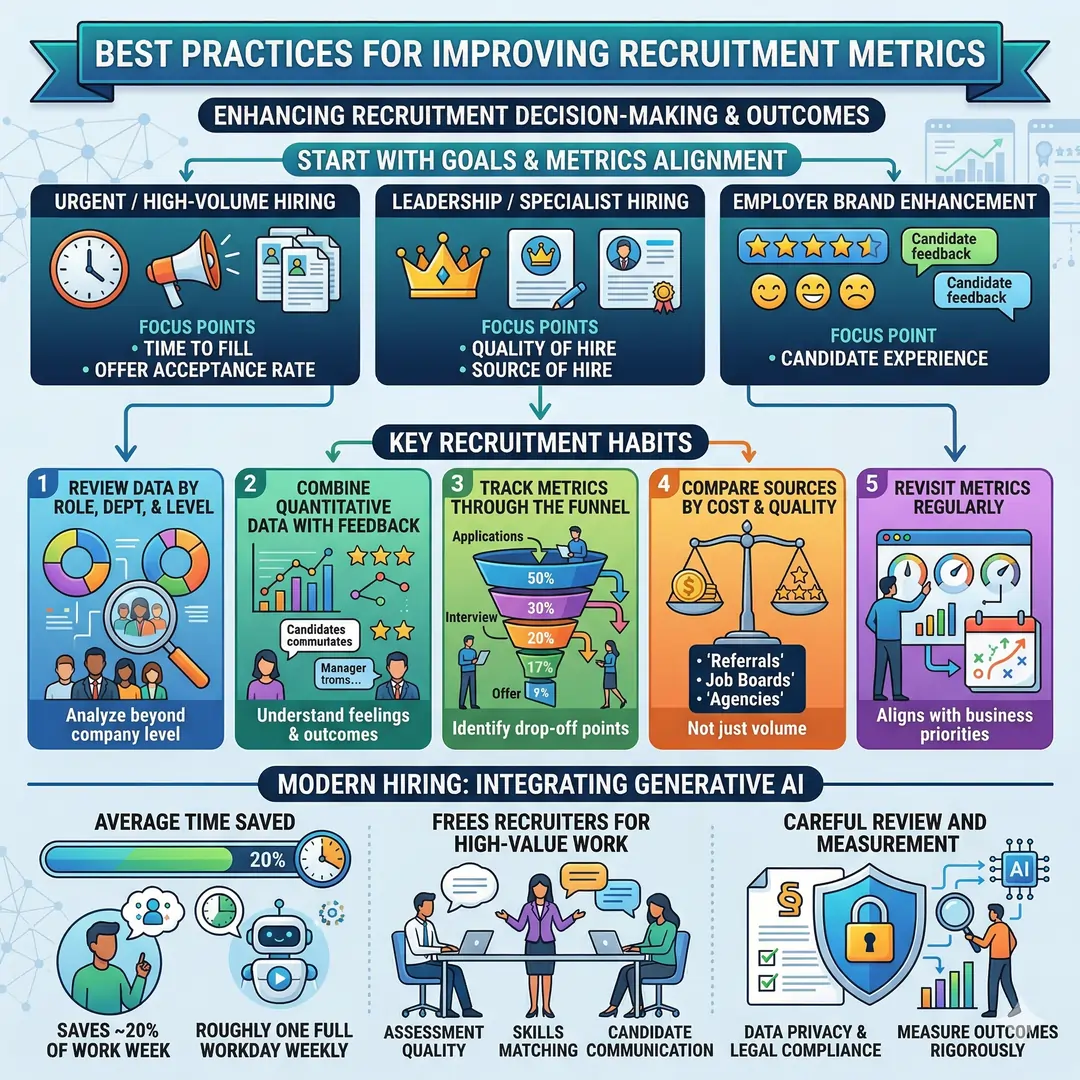
At the same time, the report also notes concerns around data privacy and legal compliance, which means any AI-supported recruiting workflow should still be reviewed carefully and measured just as rigorously as any other process. New tools are useful only when they improve outcomes in a visible, measurable way.
A Practical Example of Smart Recruitment Reporting
Imagine a company hires 40 people in one quarter. Its dashboard shows that time to fill dropped from 38 days to 24 days, which looks great at first glance. But the offer acceptance rate also dropped from 88 percent to 69 percent, and the quality of hire after six months is poorer than before. That pattern suggests the company may be moving faster but lowering the quality of final decisions.
In another case, a company may discover that referrals make up only 20 percent of applications but produce 45 percent of top-performing hires. That would be a strong sign to invest more in the referral program. This is exactly why the source of hire should be linked to quality outcomes instead of being treated as a simple volume metric.
Final Thoughts
Recruitment metrics and KPIs are not just reporting numbers. They are decision tools. When used well, they help organizations hire faster, spend smarter, improve candidate experience, and make better long-term talent choices. The strongest recruiting teams do not rely on one metric alone. They use a balanced scorecard that combines speed, cost, quality, source effectiveness, and candidate experience into one clear picture.
The real goal is not to measure hiring for the sake of measurement. The real goal is to understand which recruiting actions create the best business results. Once a team can do that consistently, recruitment stops being a support function and becomes a strategic advantage.
Read These Articles in Detail
- Importance of Recruitment Strategy
- How to Write a Job Description
- Structured Interview Techniques
- How to Improve Candidate Experience
- Employee Onboarding Process
Key Citations and Article References
- LinkedIn Talent Solutions. Recruitment Metrics: Definition and Examples. Available at:
https://business.linkedin.com/in/en/hire/resources/hr-glossary/recruitment-metrics - LinkedIn Talent Solutions. Future of Recruiting Report. Available at:
https://business.linkedin.com/content/dam/me/business/en-us/talent-solutions/resources/pdfs/future-of-recruiting-report.pdf - LinkedIn Talent Solutions. Recruiting Metrics for SMBs Cheat Sheet. Available at:
https://business.linkedin.com/content/dam/me/business/en-us/talent-solutions/resources/pdfs/cheatsheet-recruiting-metrics-for-smbs_v2.pdf - LinkedIn Talent Solutions. Measuring Quality of Hire. Available at:
https://business.linkedin.com/in/en/hire/resources/measuring-quality-of-hire - SHRM (Society for Human Resource Management). Human Capital Benchmarking Report. Available at:
https://www.shrm.org/content/dam/en/shrm/topics-tools/news/talent-acquisition/09-0620_Human_Cap_Benchmark_FULL_FNL.pdf - SHRM. The Holy Grail of Recruiting: How to Measure Quality of Hire. Available at:
https://www.shrm.org/topics-tools/news/talent-acquisition/holy-grail-recruiting-how-to-measure-quality-hire - SHRM. Recruiting Dashboards Turn Hiring Data into Useful Intelligence. Available at:
https://www.shrm.org/topics-tools/news/talent-acquisition/recruiting-dashboards-turn-hiring-data-useful-intelligence - SHRM. Assessing Recruitment Conversion Rates Can Lead to Better Hires. Available at:
https://www.shrm.org/topics-tools/news/talent-acquisition/assessing-recruitment-conversion-rates-can-lead-to-better-hires - SHRM. Targeted Recruiting Metrics Will Improve Hiring. Available at:
https://www.shrm.org/topics-tools/news/talent-acquisition/targeted-recruiting-metrics-will-improve-hiring - CIPD (Chartered Institute of Personnel and Development). Resource and Talent Planning Report 2024. Available at:
https://www.cipd.org/globalassets/media/knowledge/knowledge-hub/reports/2024-pdfs/8662-resource-and-talent-planning-2024-report-web.pdf
Frequently Asked Questions (FAQs)
FAQ 1: What are recruitment metrics and KPIs, and why do they matter?
Recruitment metrics and KPIs are the measurements used to understand how well the hiring process is working. In simple terms, they help a company see whether it is hiring the right people, hiring fast enough, spending wisely, and creating a good experience for candidates. These numbers turn hiring from guesswork into something that can be clearly tracked and improved.
They matter because recruitment is not only about filling jobs. It is also about finding people who will stay, perform well, and support business goals. When companies use the right metrics and key performance indicators, they can spot problems early, improve their hiring process, and make better decisions for the future.
FAQ 2: What is the difference between a recruitment metric and a recruitment KPI?
A recruitment metric is any number that measures something in the hiring process. For example, time to fill, cost per hire, and offer acceptance rate are all recruitment metrics. They show what is happening in the hiring funnel and give useful data to the HR or talent acquisition team.
A KPI, or Key Performance Indicator, is a metric that has been chosen as especially important for business success. This means all KPIs are metrics, but not all metrics become KPIs. For example, if a company wants to improve hiring speed, then time to fill may become a KPI. If the company wants long-term hiring quality, then quality of hire may become one of the main KPIs.
FAQ 3: Why is time to fill such an important hiring metric?
Time to fill is important because it shows how long it takes to hire someone after a job is opened. If this number is too high, the company may struggle with empty roles, delayed projects, overworked employees, and lost productivity. A long hiring cycle can also make strong candidates lose interest and accept other offers.
This metric is especially useful for roles that are critical to business performance. For example, if a sales role stays open too long, revenue may suffer. If a technical role remains unfilled, product development may slow down. That is why time to fill is often seen as one of the most practical and closely watched recruitment KPIs.
FAQ 4: What does cost per hire tell us about the recruitment process?
Cost per hire tells us how much money the company spends to bring in one new employee. This includes things like job advertising, recruiter time, agency fees, referral rewards, travel expenses, and sometimes relocation support. It is a very useful metric for understanding how efficiently a company is spending its recruitment budget.
A low cost per hire is not always the best result if the quality of candidates is poor. That is why this metric should always be reviewed together with quality of hire and retention rate. A company may spend more on one hiring channel, but if that channel brings in better long-term employees, the higher cost may still be worth it.
FAQ 5: How is the quality of hire measured practically?
Quality of hire is one of the most valuable recruitment metrics because it shows whether a new employee is actually successful after joining. It is often measured using a mix of different factors such as job performance, manager satisfaction, retention, and sometimes employee engagement. There is no single universal formula, so companies usually build a version that fits their goals.
For example, one company may measure the quality of hire by checking whether a new employee meets performance targets within six months. Another company may combine performance reviews, turnover data, and hiring manager feedback into one score. The main idea is simple. A good hire is not just someone who accepts the offer. A good hire is someone who contributes real value after joining.
FAQ 6: Why should companies track the source of hire?
The source of hire shows where the best candidates and hires are coming from. This could include job boards, referrals, social media, career fairs, internal promotions, campus hiring, or recruitment agencies. Tracking this metric helps companies understand which channels work best and where to invest more effort and budget.
This is important because some sources may bring in a lot of applicants but very few strong hires. Other sources may bring in fewer candidates but much better results. When companies track the source of hire carefully, they can improve recruitment strategy, reduce wasted spending, and focus more on the channels that deliver stronger talent.
FAQ 7: What does the offer acceptance rate tell a company?
The offer acceptance rate shows how many job offers are accepted by candidates. It is a strong signal of whether the company is competitive in the market and whether the hiring process has been effective up to the final stage. A high acceptance rate usually means candidates feel positive about the role, compensation, and experience. A low rate may point to problems that need attention.
For example, if many candidates reject offers, the issue may be salary, benefits, role clarity, company reputation, or slow communication during the interview process. This metric is valuable because it helps employers understand what happens after the offer is made and whether their hiring approach is convincing enough to close the right talent.
FAQ 8: How does candidate experience affect recruitment success?
Candidate experience refers to how people feel about the hiring process. It includes everything from how easy the application form is to how clearly the company communicates during interviews and follow-up stages. A smooth, respectful, and well-organized process creates a better impression of the employer.
Good candidate experience matters because top candidates often have several options. If the process feels slow, confusing, or impersonal, they may lose interest and move on. On the other hand, a strong candidate experience can improve the employer brand, increase offer acceptance, and make it more likely that candidates recommend the company to others, even if they are not selected.
FAQ 9: What should a good recruitment dashboard include?
A good recruitment dashboard should give a clear view of both hiring speed and hiring quality. It should include important measures such as time to fill, time to hire, cost per hire, quality of hire, offer acceptance rate, and source of hire. It should also show candidate experience and conversion rates so the team can see where people are moving through the funnel and where they are dropping off.
The best dashboards do not just display numbers. They help hiring teams make decisions. For example, if the dashboard shows that one source is bringing many applications but very few strong hires, the team can adjust its strategy. If it shows that offer acceptance is falling, the team can review compensation or communication. A good dashboard turns raw data into action.
FAQ 10: How can companies improve their recruitment metrics over time?
Companies can improve recruitment metrics by reviewing hiring data regularly and using that data to make small but smart changes. For example, they can shorten the application process, train interviewers better, improve job descriptions, use stronger sourcing channels, and communicate more clearly with candidates. These improvements can have a direct effect on speed, cost, and quality.
It also helps to focus on the metrics that match business goals. A company hiring for urgent roles may care most about time to fill. A company building a leadership pipeline may focus more on quality of hire and retention. The best results usually come when recruitment teams track the right numbers, understand the story behind them, and keep improving the process step by step.
