A phone interview is often the first real conversation between a job seeker and an employer. In many hiring processes, it serves as a screening interview, meaning the employer uses it to decide whether you should move on to the next stage. Because the interviewer cannot see your body language, your voice, words, and timing matter even more than usual. Recruiters also use this stage to assess your interest in the role, your communication style, your basic qualifications, and whether your expectations align with the job.
This is why strong phone interview answers are so important. A short call can open the door to a full interview, while a weak one can close the opportunity very quickly. The good news is that phone interviews are highly manageable when you prepare the right way. Career guidance sources consistently recommend reviewing the job description, practicing common questions, preparing your own questions, and presenting yourself clearly and professionally.
Table of Contents
Why Phone Interviews Matter So Much
A phone interview may feel less formal than an in-person meeting, but it still carries real weight. Employers often use it to narrow the candidate pool and identify the people who deserve deeper consideration. Indeed notes that a successful phone screen can fast-track you to the next stage, and that candidates should prepare as seriously as they would for an in-person interview.
The phone format creates a unique challenge. Since the interviewer cannot rely on facial expressions or posture, they listen closely for clarity, confidence, enthusiasm, and professionalism in your voice. That means a calm pace, thoughtful answers, and a focused message can make a big difference. Indeed specifically advises speaking thoughtfully and professionally, speaking slowly enough to be heard clearly, and showing enthusiasm through vocal tone.
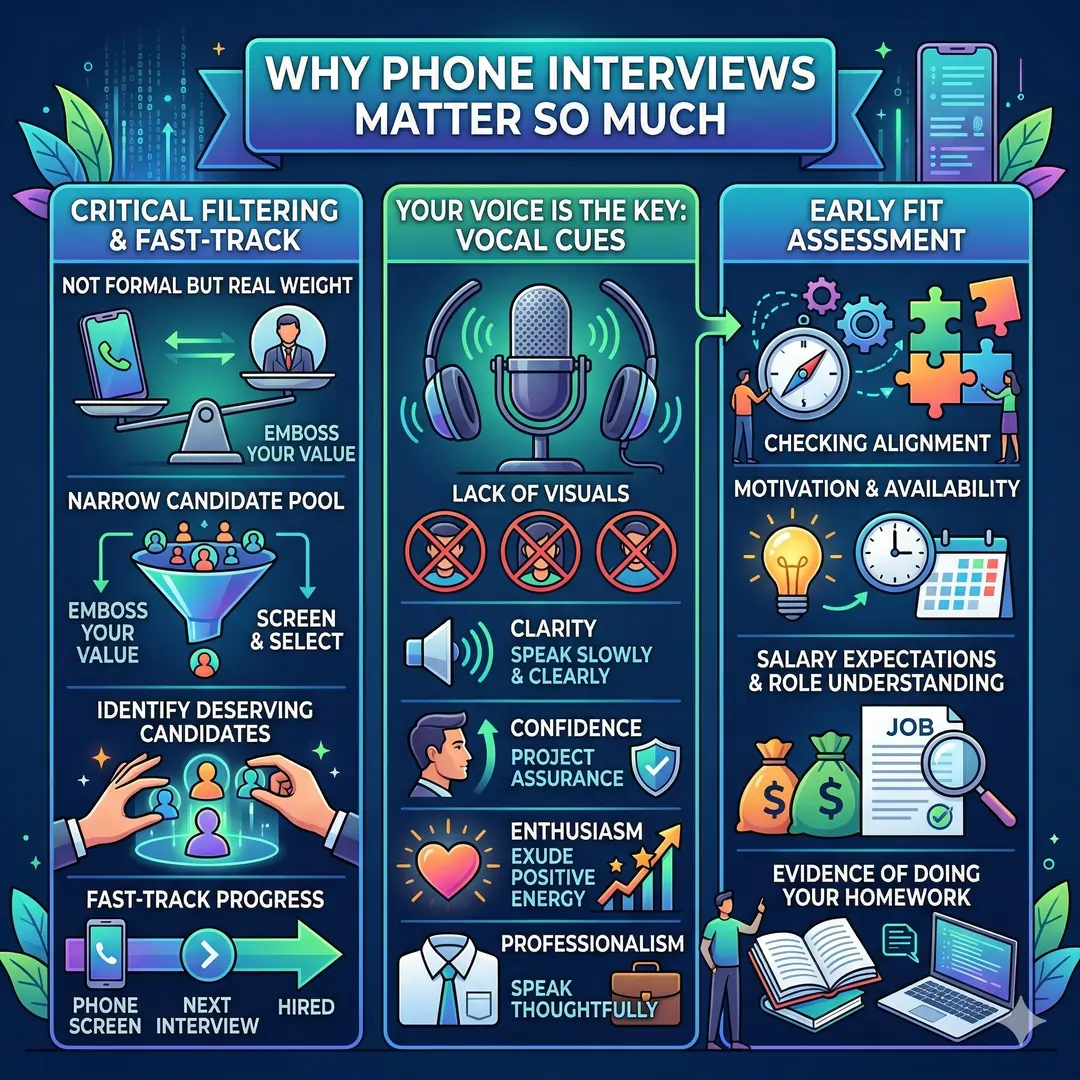
Another reason phone interviews matter is that they help employers check fit early. They may ask about your motivation, your availability, your salary expectations, and your understanding of the role. They are often looking for simple signs that you did your homework and that your background makes sense for the position.
How to Prepare for a Phone Interview
Preparation is what separates a nervous answer from a polished one. The best approach is simple. Read the job description carefully, research the company, review your resume, and prepare short stories that show your skills in action. SHRM recommends reviewing the job description, examining your application materials, and organizing your questions in advance so the conversation stays focused and useful. CareerOneStop also advises reviewing common interview questions, practicing your answers with someone else or in front of a mirror, and using stories from your background that show your skills and qualities.
Here is a practical preparation routine.
- Read the job description twice and underline the skills, tools, and responsibilities that appear most often.
- Match your resume to those requirements and think of one clear example for each major skill.
- Research the company by looking at its website, mission, services, and recent news.
- Prepare a quiet place with a stable connection, your resume, a notebook, and water.
- Practice aloud so your answers sound natural, not memorized.
- Prepare questions to ask the interviewer at the end.
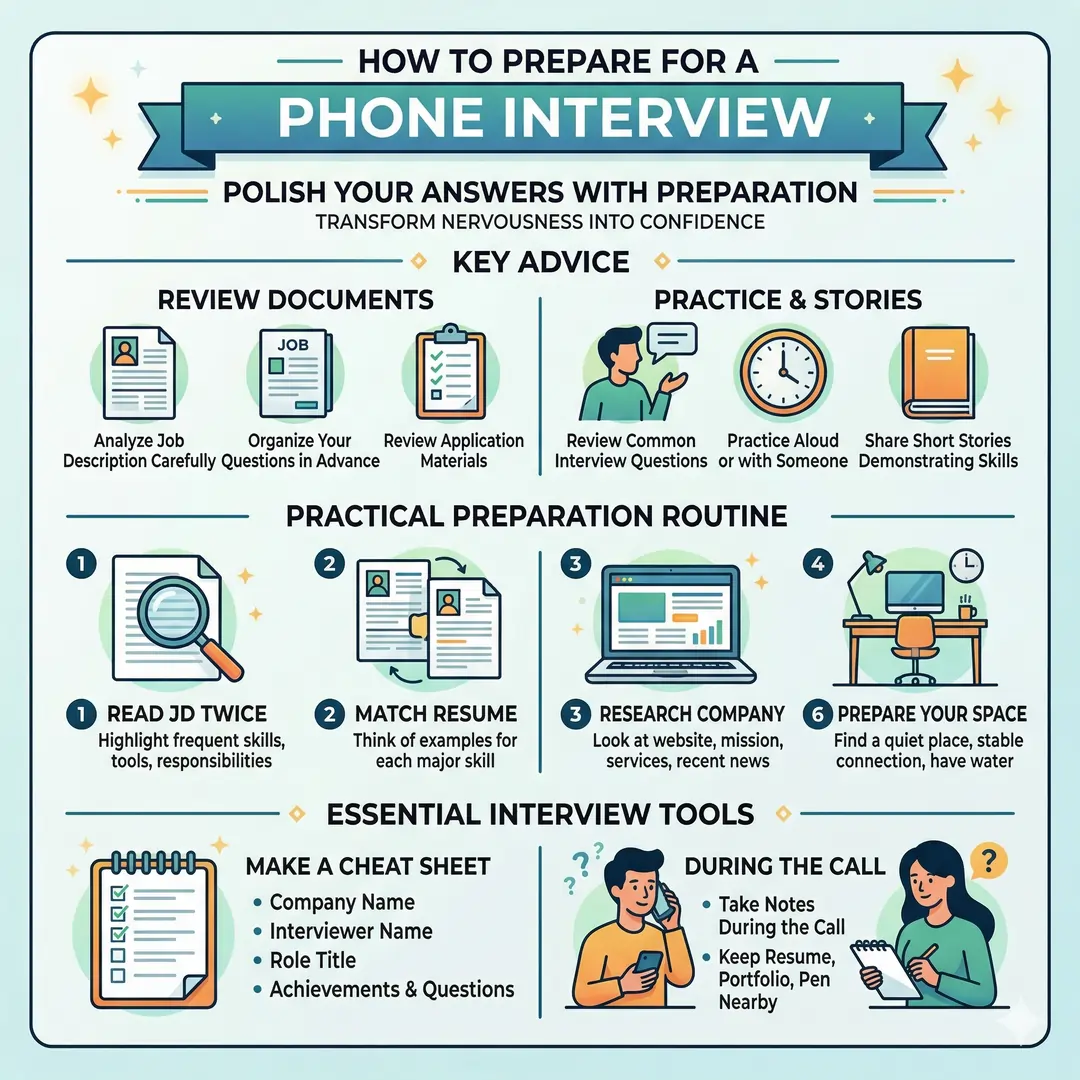
One of the smartest preparation habits is making a cheat sheet. A phone interview allows you to keep notes nearby, so write down the company name, the interviewer’s name, the role title, a few achievements, and several questions you may want to ask. Indeed specifically notes that taking notes during the call is useful and that you should keep essentials like your resume, portfolio, and pen nearby.
Phone Interview Preparation Checklist
| Item | Why It Matters | What to Prepare |
|---|---|---|
| Resume copy | Helps you answer experience questions accurately | Printed copy or a file open on your screen |
| Job description | Helps you tailor answers to the role | Underlined skills and responsibilities |
| Company notes | Shows real interest in the employer | Mission, products, services, recent updates |
| Notebook and pen | Lets you capture details during the call | Interview date, next steps, names, follow-up notes |
| Water | Helps keep your voice clear | Small bottle or glass nearby |
| Quiet space | Reduces distractions and background noise | Closed door, silence notifications, no multitasking |
| Charged phone | Prevents unexpected call drops | Full charge or charger plugged in |
| Question list | Shows curiosity and preparation | 3 to 5 thoughtful questions |
| Achievement examples | Makes answers stronger and more specific | 4 to 6 short stories with results |
| Time buffer | Prevents a rushed start | Log in early and be ready before the call starts |
What Employers Usually Want to Learn in a Phone Interview
Employers often use phone interviews to test a few key things quickly. They want to know whether you understand the role, whether your background fits, whether you can communicate clearly, and whether your goals match the company’s needs. Indeed’s phone interview guidance repeatedly points to questions like Tell me about yourself, Why do you want this job, What do you know about the role, and Why do you want to work here. CareerOneStop also encourages candidates to prepare honest, direct answers and to keep responses relevant and brief.
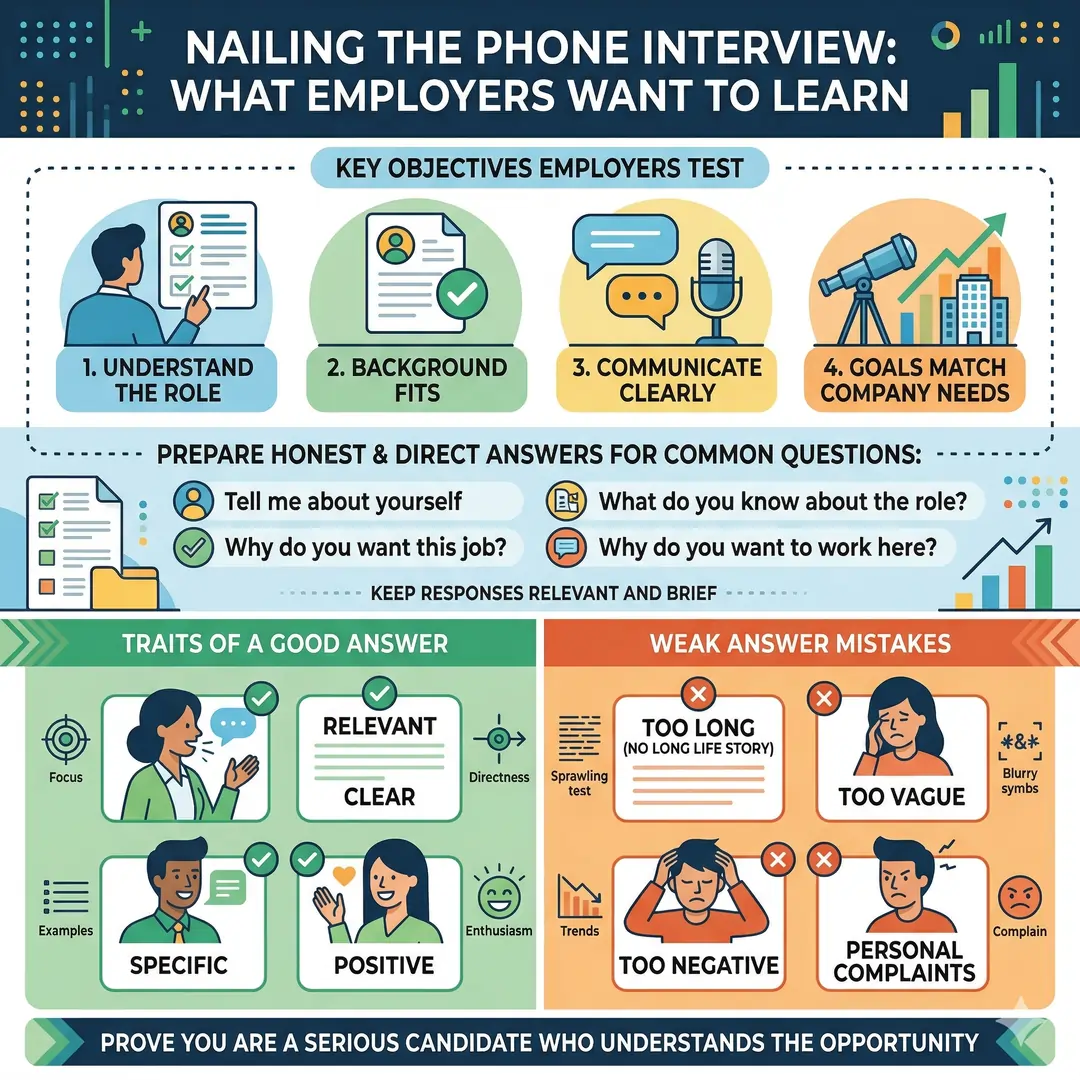
A good answer usually has four traits.
- It is clear
- It is relevant
- It is specific
- It is positive
A weak answer is usually too long, too vague, too negative, or too focused on personal complaints. The phone screen is not the place to tell a long life story. It is the place to prove that you are a serious candidate who understands the opportunity.
Common Phone Interview Questions and Strong Ways to Answer Them
Below is a practical table that explains what each question usually means and how to respond in a simple, effective way.
| Phone Interview Question | What the Interviewer Is Testing | How to Answer Well | Sample Answer Starter |
|---|---|---|---|
| Tell me about yourself. | Your background, focus, and communication style | Give a short career summary, current role, and why you fit the job | “I currently work as…” |
| Why are you applying for this position? | Your genuine interest and motivation | Mention role duties, growth, and company fit | “This role matches my experience in…” |
| Why do you want this job? | Your career direction and fit | Stay positive and connect the role to your goals | “I am looking for a position where…” |
| What do you know about the role? | Whether you read the job description | Mention key duties and ask one smart follow-up question | “From the posting, I understand…” |
| Why do you want to work here? | Company research and values fit | Refer to mission, products, reputation, or growth | “I was drawn to your work in…” |
| Why are you looking for a job? | Career stability and possible red flags | Explain your reasons professionally and without blame | “I am ready for a role with…” |
| What are your strengths? | Self-awareness and relevance to the job | Choose strengths that match the role | “One strength I bring is…” |
| What is your biggest weakness? | Honesty and self-improvement | Share a real but manageable weakness and how you improve | “I used to struggle with…” |
| What is your salary expectation? | Market awareness and flexibility | Give a range or say you are open to discussion | “Based on the role and my background…” |
| When can you start? | Availability | Be direct and realistic | “I could start after…” |
| Do you have questions for me? | Interest and preparation | Ask about the team, priorities, and next steps | “Could you tell me more about…” |
How to Answer the Most Common Questions
1. Tell Me About Yourself
This is often the opening question. The interviewer is not asking for your life story. They want a short and useful summary of your professional background. A strong answer usually starts with your current role, adds one or two important achievements, and ends with a sentence about why you are interested in this new opportunity. Indeed explains that candidates should focus on relevant experience, current work, and qualifications.
Example answer:
“I currently work as a customer support specialist, where I handle around 40 cases a day and help improve response time for our team. Before that, I studied communication and completed an internship in client services. I am now looking for a role where I can use my communication skills in a more growth-focused environment.”
2. Why Are You Applying for This Position?
This question checks whether your motivation is real. Employers want to know that you did more than send out random applications. A strong answer ties your background to the role and points out why this job makes sense for your next step. Indeed suggests using details from the job description and showing genuine interest in the company or industry.
Example answer:
“I applied because the role combines project coordination and client communication, which are both areas where I have experience. I also like that your team works on growth-focused projects, and that fits the direction I want to take in my career.”
3. Why Do You Want to Work Here?
This is where company research matters. The interviewer wants to know whether you understand the organization and whether your values match theirs. Indeed recommends reading the company page, website, and recent press releases or news stories before the interview.
Example answer:
“I am interested in your company because of the way you combine customer service with innovation. I read about your recent product expansion, and I like that you seem committed to both quality and growth. That kind of environment is where I would like to contribute.”
4. What Do You Know About the Role?
This question checks preparation. The interviewer is looking to see whether you studied the posting carefully. Indeed recommends referring to the duties listed in the job description and mentioning any matching qualifications.
Example answer:
“From the posting, I understand that this role involves scheduling, internal communication, and handling basic reporting. My background in administrative support has given me experience in each of those areas, especially coordination and follow-up.”
5. What Are Your Strengths?
This is your chance to connect your strengths to the role. CareerOneStop and Indeed both emphasize using examples and relevant stories. Do not list every strength you have. Pick two or three that clearly support the job you want.
Example answer:
“One strength I bring is organization. In my current role, I manage multiple deadlines every week, so I have learned how to stay calm and keep projects moving. Another strength is communication, especially when I need to explain complex information simply.”
6. What Is Your Biggest Weakness?
A good weakness answer is honest but controlled. It should show that you are self-aware and improving. The goal is not to sound perfect. The goal is to sound real and responsible. Career guidance sources commonly recommend giving a brief answer that shows growth and maturity.
Example answer:
“I used to be too cautious about asking for help, because I wanted to solve everything on my own. Over time, I learned that good teamwork means asking questions early, so now I communicate sooner and solve problems faster.”
7. Why Are You Looking for a Job?
This question can reveal red flags if you answer it carelessly. Indeed recommends staying focused on career reasons and avoiding negative talk about your current employer. If you lost a job or left a role, the safest approach is to stay professional and future-focused.
Example answer:
“I am looking for a role where I can take on more responsibility and keep growing. I have learned a lot in my current position, and now I am ready for a job that gives me a bigger chance to contribute and develop.”
8. What Are Your Salary Expectations?
A phone interview often includes early salary screening. This question checks whether your expectations are in the right range for the role. A smart answer is calm and flexible. You can give a range, or you can say you would like to learn more about the full package before naming a final number. CareerOneStop also encourages candidates to think ahead about the offer, schedule, benefits, and role details.
Example answer:
“Based on the responsibilities and my experience, I would expect something in the range of X to Y, but I am open to discussing the full compensation package and the overall fit.”
9. When Can You Start?
The employer wants a practical answer. Be honest about notice periods, relocation needs, or other commitments. This should be short and clear.
Example answer:
“I can start two weeks after receiving an offer, since I would like to give my current employer proper notice.”
10. Do You Have Any Questions for Me?
This is one of the most important moments in the phone interview. Asking thoughtful questions shows interest, preparation, and maturity. Indeed says to prepare questions in advance, and CareerOneStop suggests preparing about two to three questions, often focused on responsibilities, expectations, and the team.
Good questions include:
- What would success look like in the first 90 days?
- What are the most important priorities for this role?
- How is the team structured?
- What are the next steps in the hiring process?
- What skills separate strong performers in this position?
A Simple Answer Formula You Can Use for Almost Any Question
When you feel nervous, use this easy structure.
- 1. Answer the question directly
- 2. Add one short example
- 3. End by linking back to the job
Here is a simple pattern you can follow.
- Answer: State the point clearly.
- Example: Share a result, task, or situation.
- Connection: Explain why that matters for this role.
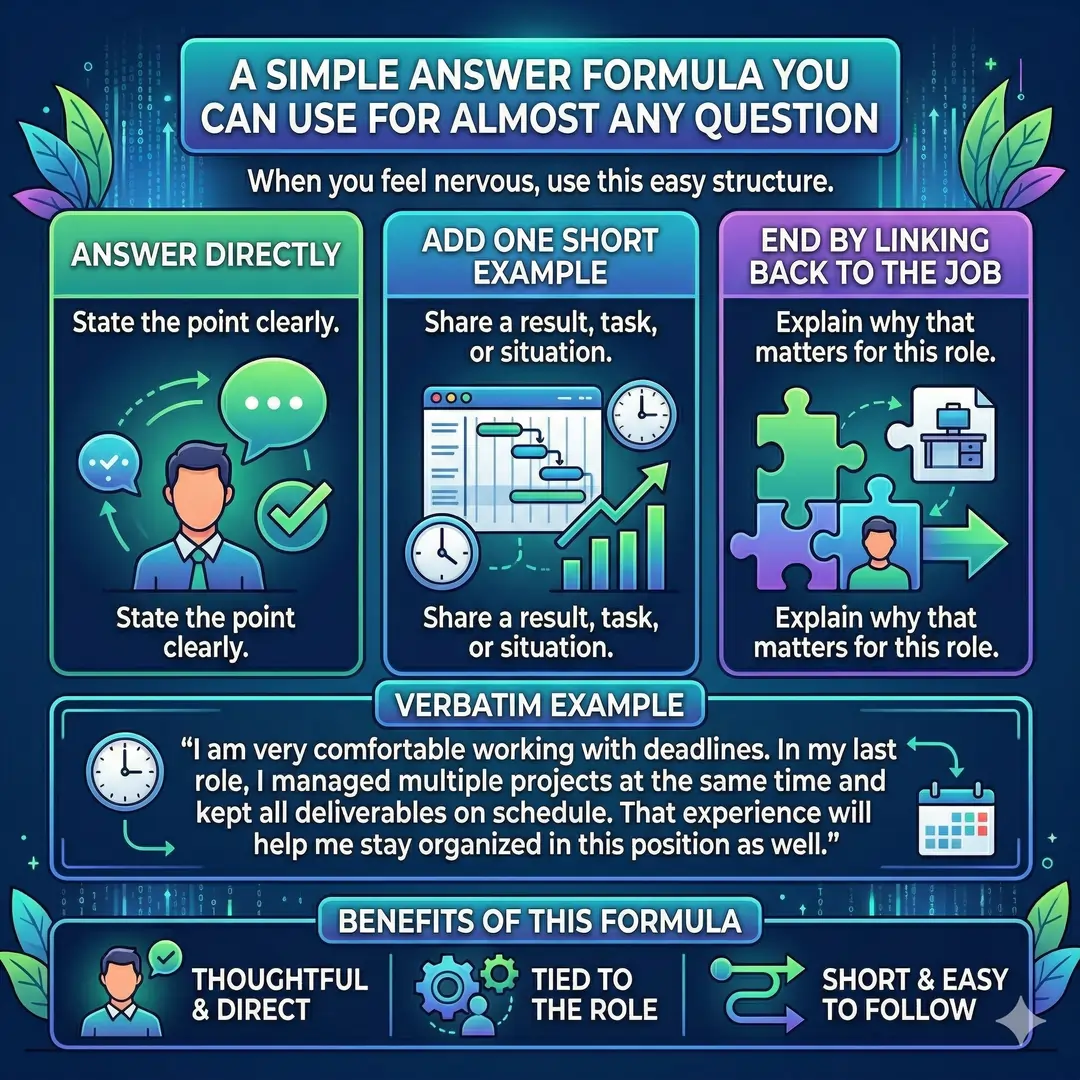
Example:
“I am very comfortable working with deadlines. In my last role, I managed multiple projects at the same time and kept all deliverables on schedule. That experience will help me stay organized in this position as well.”
This style works well because it is short, relevant, and easy for the interviewer to follow. That matches the advice from CareerOneStop and Indeed to keep answers thoughtful, direct, and tied to the role.
Sample Answers for High-Frequency Phone Interview Questions
| Question | Strong Sample Answer |
|---|---|
| Tell me about yourself. | “I am a detail-oriented administrative professional with five years of experience supporting busy teams. My strengths are coordination, communication, and follow-through. I am now looking for a role where I can use those skills in a more strategic way.” |
| Why do you want this job? | “This role interests me because it combines organization, teamwork, and client support, which are all areas I enjoy. It also feels like a strong next step in my career path.” |
| What do you know about the company? | “I know your company has a strong reputation for service and growth. I also read about your recent expansion, which made me even more interested in the opportunity.” |
| What are your strengths? | “My biggest strength is my ability to stay calm under pressure. I am also very organized, which helps me manage deadlines and keep work moving smoothly.” |
| What is your weakness? | “I used to spend too long polishing small details. I have worked on that by setting time limits and focusing more on the final impact of the work.” |
| Why are you leaving your current job? | “I have learned a lot in my current role, but I am ready for a position with more responsibility and room to grow.” |
| When can you start? | “I can start after giving proper notice to my current employer, which would be two weeks from an accepted offer.” |
| Do you have questions for us? | “Yes. I would like to know what success looks like in this role and what the team’s biggest priority is right now.” |
Best Practices During the Call
A phone interview is not only about what you say. It is also about how you manage the call itself. Indeed recommends speaking professionally, keeping your voice clear, checking your phone connection, avoiding speakerphone, not multitasking, and taking notes when needed. They also recommend calling on time, having your essentials nearby, and making sure your battery is charged.
Here are the most useful habits to keep in mind.
- Smile while you talk to make your tone sound warmer.
- Pause before answering so your answer sounds thoughtful.
- Speak slowly and clearly.
- Use short notes, not full scripts.
- Stay in a quiet place with no background noise.
- Listen carefully and do not interrupt.
- Ask for clarification if you miss part of a question.
- Keep water nearby in case your voice feels dry.
CareerOneStop also says it is okay to ask for a question to be repeated or clarified if needed. That is a helpful reminder for job seekers who panic when they hear a question too quickly. A calm request for repetition is much better than a rushed or confused answer.
What Not to Do in a Phone Interview
Just as there are strong habits, there are also habits that can hurt your chances. Indeed’s guidance is very clear on several mistakes. Do not multitask, do not use speakerphone, do not take the call in a noisy place, do not speak over the interviewer, and do not come across as rude or careless.
A few common mistakes are especially important.
- Talking too much and losing the main point
- Sounding unprepared because you did not review the job
- Being negative about a past employer
- Reading answers word-for-word like a robot
- Failing to ask questions at the end
- Forgetting to follow up after the call
Another quiet mistake is forgetting that the phone screen still counts as a real interview. Being casual is fine. Being careless is not. A kind tone, a steady pace, and a prepared answer can make a very strong impression. Indeed emphasizes that the interviewer cannot see your nonverbal cues, so your voice and words carry extra weight.
Questions You Should Ask the Interviewer
When the interviewer invites your questions, use that moment wisely. Asking smart questions shows that you are serious about the role and thinking beyond the basics. CareerOneStop and Indeed both recommend preparing questions in advance that focus on responsibilities, team structure, and the next stage of the process.
Here is a useful table of questions you can adapt.
| Category | Question to Ask | Why It Works |
|---|---|---|
| Role clarity | What would a successful person in this role accomplish in the first 90 days? | Shows that you are thinking about results |
| Team structure | Who would I work with most closely? | Helps you understand the work environment |
| Performance | What skills do top performers in this role usually have? | Shows you want to excel |
| Growth | What are the chances for training or advancement? | Signals long-term interest |
| Daily work | What does a typical day look like in this position? | Gives you a clearer picture of the role |
| Hiring process | What are the next steps after this interview? | Helps you plan follow-up timing |
| Team priorities | What is the biggest challenge the team is facing right now? | Shows curiosity and business awareness |
| Success metrics | How will success be measured in this role? | Shows a results-oriented mindset |
A strong question can leave a better impression than a generic one. Questions about the team, the role’s priorities, and success measures usually sound better than questions that could have been answered from the job posting. HBR’s interview guidance also highlights the value of asking thoughtful questions that help you assess the opportunity, not just impress the interviewer.
How to End a Phone Interview Well
The closing moments matter more than many job seekers realize. A confident finish can reinforce a good impression. Career guidance sources recommend thanking the interviewer, briefly restating interest, and confirming the next steps.
A good ending sounds like this:
“Thank you for taking the time to speak with me today. I enjoyed learning more about the role and your team, and I remain very interested in the opportunity. I look forward to hearing about the next steps.”
This kind of closing is brief, polite, and professional. It leaves the interviewer with a clear sense that you are enthusiastic and respectful of their time.
What to Do After the Call
After the interview, write down what was discussed while it is still fresh in your mind. Note the interviewer’s name, the topics covered, anything you want to improve, and any next steps they mentioned. Indeed recommends taking notes during the interview itself, and those notes become even more useful when you are preparing a follow-up message.
Then send a short thank-you note. CareerOneStop says a thank-you note should include appreciation, continued interest in the job, and a brief restatement of your qualifications or fit. This does not need to be long. It just needs to be polite and timely.
Simple thank-you note example:
Subject: Thank You for the Interview
“Thank you for speaking with me today about the role. I appreciated the chance to learn more about the team and the position. Our conversation made me even more interested in the opportunity, and I believe my background in [skill or experience] would allow me to contribute quickly. I look forward to the next steps.”
A Practical Phone Interview Mindset
The best phone interview mindset is not perfection. It is preparation, clarity, and calm confidence. CareerOneStop encourages honest, direct answers and reminds candidates that it is okay to take a moment before responding. That is a healthy way to think about the call. You do not need to sound flawless. You need to sound prepared, thoughtful, and professional.
Think of the interview as a short professional conversation with a purpose. Your job is to make it easy for the interviewer to see three things:
- You understand the role
- You can do the work
- You are someone they would like to meet again
That is why concise stories, relevant examples, and a strong closing matter so much. They turn a simple call into a real chance to move forward.
Final Thoughts
A phone interview is one of the most important early steps in the hiring process. It may be short, but it can shape your entire job search outcome. When you prepare your answers, study the job description, research the company, and speak with clear confidence, you give yourself a real advantage. The advice from reputable career sources is consistent. Be prepared, be professional, be specific, and ask thoughtful questions.
If you approach the call with a calm voice, a focused message, and a few strong examples, your chances of moving to the next round rise sharply. That is the real value of mastering phone interview questions and answers. It helps you turn first contact into a real opportunity.
Also, Read these Articles in Detail
- Top Interview Questions and Answers Guide
- Interview Questions and Answers for Freshers and Experienced Candidates
- Common Interview Questions and Best Answers for Job Seekers
- “Tell me about yourself” Interview Answer Examples and Tips
- Strengths and Weaknesses Interview Questions and Sample Answers
- Behavioral Interview Questions and Answers Using the STAR Method
- How to Answer “Why Should We Hire You” in a Job Interview
- How to Answer “Why Do You Want This Job?” with Examples
- Situational Interview Questions and Answers for Better Preparation
Article References and Key Citations
- Indeed Editorial Team. (n.d.). Phone Interview Questions and Answers.
Available at: https://www.indeed.com/career-advice/interviewing/phone-interview-questions-and-answers - Indeed Editorial Team. (n.d.). Phone Interview Do’s and Don’ts.
Available at: https://www.indeed.com/career-advice/interviewing/dos-and-donts-of-phone-interview - Society for Human Resource Management (SHRM). (n.d.). Transform Interviewing into Strategic Talent Selection.
Available at: https://www.shrm.org/topics-tools/tools/toolkits/transform-interviewing-into-strategic-talent-selection - CareerOneStop. (n.d.). Types of Interviews.
Available at: https://www.careeronestop.org/JobSearch/Interview/types-of-interviews.aspx - CareerOneStop. (n.d.). Common Interview Questions.
Available at: https://www.careeronestop.org/JobSearch/Interview/common-interview-questions.aspx - CareerOneStop. (n.d.). Get Ready for an Interview.
Available at: https://www.careeronestop.org/JobSearch/Interview/get-ready.aspx - CareerOneStop. (n.d.). Interview Tips and Preparation Guide.
Available at: https://www.careeronestop.org/GetMyFuture/Employment/interviews.aspx - CareerOneStop. (n.d.). Thank You Notes After Interviews.
Available at: https://www.careeronestop.org/JobSearch/Interview/thank-you-notes.aspx - CareerOneStop. (n.d.). Salary Negotiation Tips.
Available at: https://www.careeronestop.org/JobSearch/Interview/negotiate-your-salary.aspx - Harvard Business Review. (2022). 38 Smart Questions to Ask in a Job Interview.
Available at: https://hbr.org/2022/05/38-smart-questions-to-ask-in-a-job-interview
Frequently Asked Questions
FAQ 1: What is a phone interview, and why is it important for job seekers?
A phone interview is usually the first formal conversation between a job seeker and a hiring company. It is often used as a screening step to check whether a candidate is a good match for the role before moving to a longer interview stage. During this call, the interviewer may ask about your background, your interest in the job, your communication style, and your basic qualifications.
This stage is very important because it can decide whether you move forward in the hiring process. Even though it may feel less stressful than an in-person interview, it still matters a lot. Employers use it to see whether you sound prepared, professional, and genuinely interested in the opportunity. A strong phone interview can create a positive first impression and open the door to the next round.
FAQ 2: How should I prepare for a phone interview?
The best way to prepare for a phone interview is to treat it like a real interview, not a casual phone call. Start by reading the job description carefully and highlighting the skills, responsibilities, and qualifications that appear most important. Then review your resume and think about examples from your experience that match the role.
It also helps to research the company so you can speak confidently about why you want to work there. Prepare a quiet space, keep your phone charged, and have your notes nearby. A small list of key points, such as your achievements, questions for the interviewer, and the company’s name, can make you feel much more confident. Practicing your answers aloud is also useful because it helps your responses sound natural and clear.
FAQ 3: What are the most common phone interview questions?
Some of the most common phone interview questions include Tell me about yourself, Why do you want this job, Why do you want to work here, What are your strengths, What is your weakness, and When can you start. Employers also often ask about your salary expectations, your experience, and whether you have any questions for them at the end of the call.
These questions are asked because interviewers want to learn about your personality, your motivation, and your fit for the role. They are also checking whether you understand the job and can communicate your ideas clearly. Preparing for these questions ahead of time can help you stay calm and answer in a simple, polished way.
FAQ 4: How do I answer “Tell me about yourself” in a phone interview?
The question “Tell me about yourself” is one of the most important questions in a phone interview. A strong answer should be short, focused, and related to your professional background. You do not need to give your life story. Instead, start with your current role or most recent experience, mention one or two important strengths, and explain how your background connects to the job you want.
For example, you might talk about your work experience, your main skills, and why you are now looking for a new opportunity. The goal is to give the interviewer a quick summary that makes sense and sounds confident. A clear answer to this question sets the tone for the rest of the interview and helps the conversation move in the right direction.
FAQ 5: What should I say when asked about my strengths in a phone interview?
When an interviewer asks about your strengths, choose qualities that are truly connected to the job. For example, if the role requires teamwork, you might talk about collaboration. If it needs organization, you could mention time management or attention to detail. It is always better to give a few relevant strengths than to list too many vague ones.
You should also support your answer with a short example. This makes your response feel more real and believable. For instance, instead of only saying you are organized, you can explain how you handled multiple deadlines or managed projects successfully. This gives the interviewer proof that your strength is useful in a work setting.
FAQ 6: How do I answer the weakness question without hurting my chances?
The weakness question can feel tricky, but it is really a test of honesty and self-awareness. The best approach is to choose a real weakness that is not too damaging for the role, then explain how you are working to improve it. This shows maturity and a willingness to grow. It also helps the interviewer see that you can reflect on your own performance.
For example, you might say that you once struggled with asking for help too late, but you are now more open to communication. Another safe option is to talk about something you have improved over time, such as public speaking, delegation, or time management. The key is to avoid giving an answer that sounds fake or overrehearsed. A thoughtful, honest response usually works better than trying to sound perfect.
FAQ 7: What is the best way to talk about salary expectations in a phone interview?
When the interviewer asks about salary expectations, it is important to stay calm and professional. You should avoid giving a random number without thinking it through. Instead, research the typical pay range for the role, your experience level, and your location. This helps you give a reasonable answer that reflects your values.
If you are unsure, you can share a salary range rather than one fixed number. You can also say that you would like to learn more about the full role and benefits before discussing final compensation. This keeps the conversation flexible and polite. A thoughtful answer shows that you understand your worth while still being open to discussion.
FAQ 8: What should I ask the interviewer at the end of a phone interview?
At the end of a phone interview, you should always ask a few smart questions. This shows that you are seriously interested in the role and have been paying attention. Good questions may include asking what success looks like in the first 90 days, what the team is like, what challenges the role may face, or what the next steps in the hiring process will be.
Asking questions also helps you decide whether the job is the right fit for you. A good interview is not only about the company choosing you. It is also about you learning whether the role supports your goals. Thoughtful questions create a stronger impression and show that you are thinking like a serious professional, not just another applicant.
FAQ 9: What are the biggest mistakes to avoid in a phone interview?
One of the biggest mistakes in a phone interview is being unprepared. This includes not reviewing the job description, not researching the company, or not having your notes ready. Another common mistake is talking too much and losing the main point. Long answers can make it harder for the interviewer to follow your response.
Other mistakes include speaking too softly, sounding distracted, complaining about a past employer, or failing to ask questions at the end. It is also important not to multitask during the call or take it in a noisy place. Since the interviewer cannot see your body language, your voice and words must create a clear and positive impression. Staying focused and professional helps you avoid these problems.
FAQ 10: How can I leave a strong final impression after a phone interview?
Leaving a strong final impression starts with how you close the call. Thank the interviewer for their time, repeat your interest in the role, and briefly mention that you enjoyed learning more about the opportunity. A polite and confident closing can help reinforce the good points you made during the conversation.
After the interview, sending a thank-you note is also a smart move. Keep it short, polite, and professional. Mention that you appreciated the conversation and that you remain interested in the position. This small step can help you stand out from other candidates and show that you understand basic professional etiquette. A strong finish often matters just as much as a strong beginning.
