The modern recruitment process is more than posting a vacancy and hoping the right person applies. Today, it is a thoughtful, data-informed, candidate-friendly system that helps employers find the right talent, reduce bias, improve speed, and build stronger teams. In many organizations, recruitment now blends skills-based hiring, structured interviews, candidate experience, and technology such as ATS platforms and AI tools. The shift is not just about efficiency. It is also about fairness, quality, and long-term hiring success.
At the same time, the hiring market has changed a lot. Employers still struggle to fill roles, candidates expect clear communication, and many organizations are moving away from judging people mainly by degrees or job titles. Recent employer research from NACE, SHRM, OECD, and LinkedIn shows that skills-first and candidate-first hiring are no longer niche ideas. They are becoming mainstream hiring practices.
Table of Contents
What Is a Modern Recruitment Process?
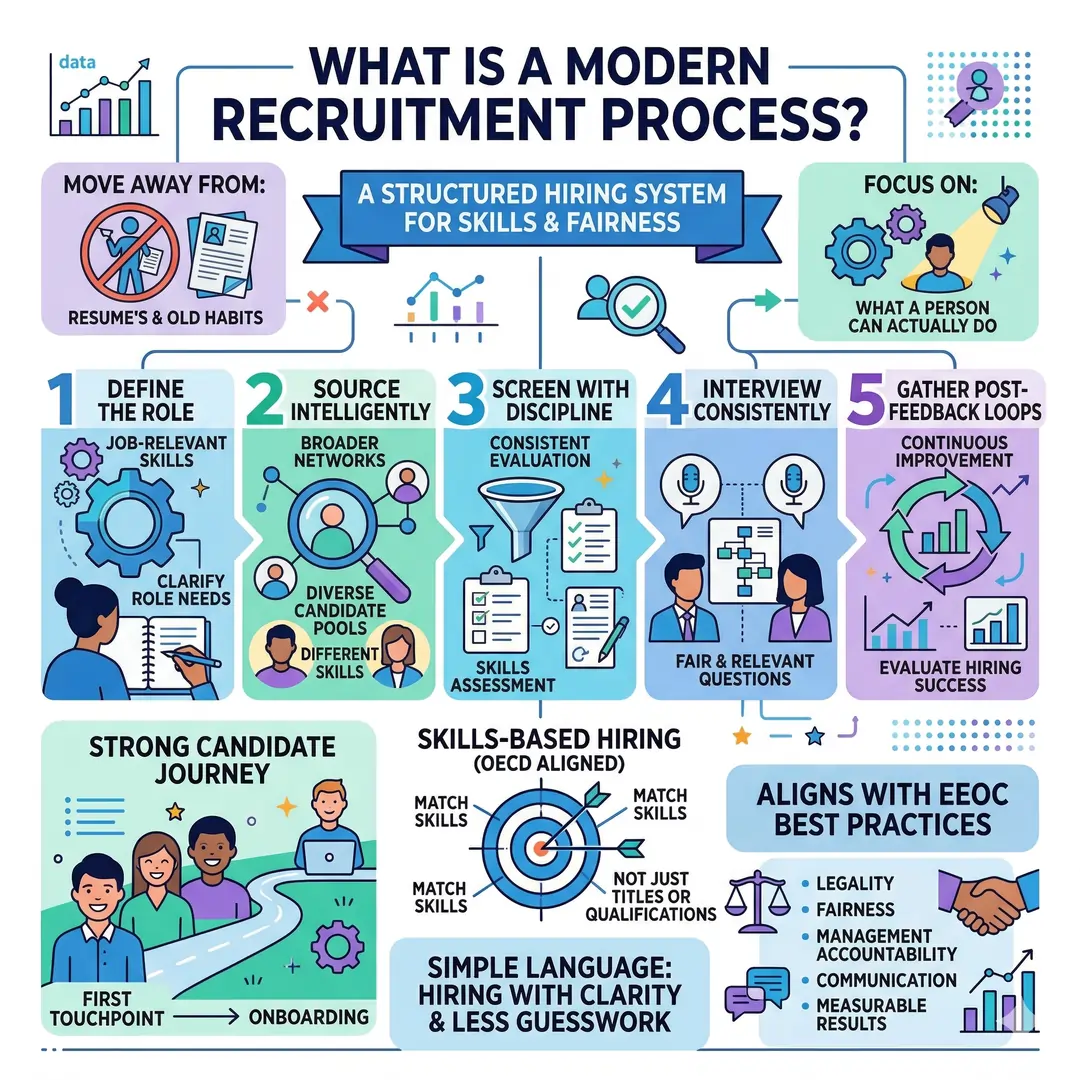
A modern recruitment process is a structured hiring system that focuses on identifying job-relevant skills, creating a strong candidate journey, and making fair, evidence-based hiring decisions. Instead of relying only on resumes or familiar hiring habits, modern recruitment looks at what a person can actually do, how well they fit the role’s needs, and how they will experience the process from the first touchpoint to onboarding. This is closely aligned with skills-based hiring, which the OECD describes as matching vacancies with candidates based on the skills required for the position rather than relying mainly on qualifications or job titles.
In simple language, it means hiring with more clarity and less guesswork. The employer defines the role better, sources candidates more intelligently, screens with more discipline, interviews more consistently, and uses better feedback loops after hiring. It is a process built around better decisions, not faster shortcuts. That is also why EEOC guidance on best practices emphasizes legality, fairness, management accountability, communication, and measurable results.
Why the Modern Recruitment Process Matters
The old hiring model often depended too heavily on prestige signals such as college degrees, previous job titles, or subjective impressions during interviews. That approach can miss strong candidates and can also increase bias. The modern approach helps organizations widen their talent pool and make more reliable hiring decisions. SHRM notes that skills-based hiring can broaden the pool and improve the connection between candidate abilities and job success, while OECD notes that skills-first systems help improve job matching across the labor market.
It also matters because candidate expectations have changed. Candidates now want clear communication, transparency, and respect throughout the process. SHRM has reported that weak candidate experience can reduce the chances of top talent joining, while LinkedIn defines candidate experience as the impression a job seeker forms across the entire journey, from job description to follow-up communication. In other words, recruitment is now also brand building.
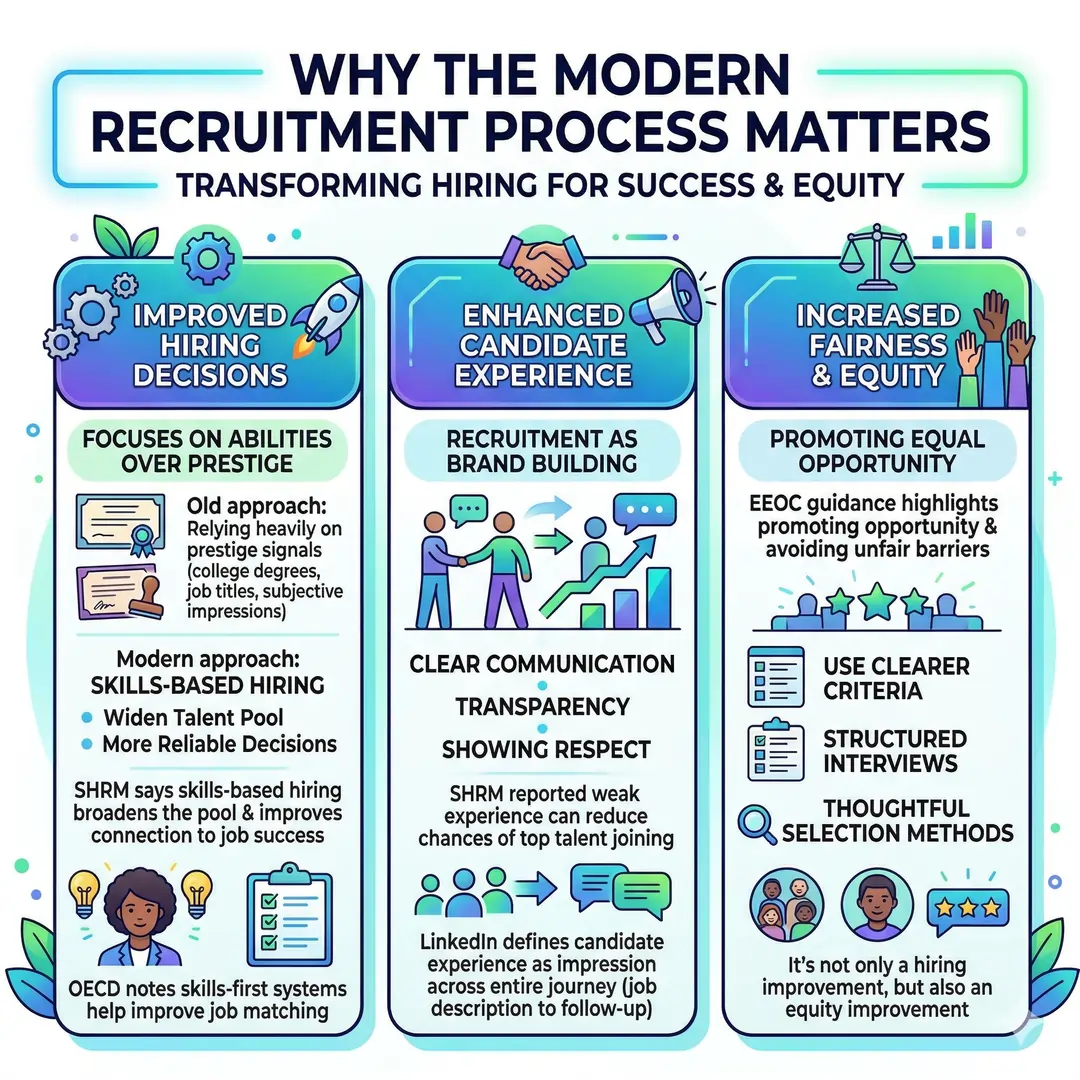
Another reason is fairness. EEOC guidance highlights that good employment practices should promote equal opportunity and avoid unfair barriers. Modern recruitment supports that goal by using clearer criteria, more structured interviews, and more thoughtful selection methods. It is not only a hiring improvement. It is also an equity improvement.
The Core Stages of a Modern Recruitment Process
A strong modern recruitment process usually includes the following stages:
- Workforce planning
- Job analysis and role design
- Inclusive job description creation
- Sourcing and employer branding
- Application and candidate screening
- Structured interviewing
- Assessments and work samples
- Selection and offer management
- Pre-boarding and onboarding
- Post-hire review and process improvement
Modern recruitment process at a glance
| Stage | Main goal | What happens | Best practice |
|---|---|---|---|
| Workforce planning | Understand hiring needs | Review business goals, team gaps, and future workload | Hire for real demand, not panic |
| Job analysis | Define the role clearly | Identify tasks, outcomes, and success criteria | Focus on skills and outputs |
| Job description | Attract the right applicants | Write inclusive and precise job ads | Avoid unnecessary barriers |
| Sourcing | Reach relevant candidates | Use referrals, talent pools, communities, and platforms | Match the channel to the role |
| Screening | Filter fairly and quickly | Review resumes, forms, and initial signals | Use consistent criteria |
| Interviewing | Compare candidates accurately | Ask structured, job-related questions | Use scoring rubrics |
| Assessment | Test actual capability | Use work samples or skills tests | Validate relevance to the job |
| Decision making | Select the best fit | Combine evidence from all stages | Reduce gut-feel bias |
| Offer and closure | Secure the hire | Present offer, answer questions, close quickly | Keep communication tight |
| Onboarding review | Improve future hiring | Gather feedback and retention data | Learn from each hire |
This table is a practical summary of what modern hiring looks like when organizations combine fairness, candidate experience, and skills-first thinking. It reflects EEOC best-practice principles, SHRM guidance on strategic interviewing and skills-based hiring, LinkedIn’s view of candidate experience, and OECD and NACE findings on skills-based recruitment.
1. Workforce Planning Begins the Process
Good recruitment does not start with a job ad. It starts with workforce planning. This means understanding what the business actually needs. Is the company replacing someone, expanding a team, covering a new project, or building a future capability? Without this step, hiring can become rushed and reactive. A modern recruitment process makes room for planning because bad hiring often begins with unclear needs.
A useful approach is to ask a few simple questions before recruiting:
- What business problem is this role solving?
- Which tasks are essential, and which are optional?
- What skills are must-haves, and which can be learned later?
- Is this a new role, or can work be redistributed?
- What would success look like after 90 days?
When organizations answer these questions early, they reduce unnecessary hiring, write better job descriptions, and interview more effectively. That is one of the biggest advantages of a modern process. It begins with clarity.
2. Job Analysis Creates a Better Hiring Target
A job analysis is the foundation of a good hire. It breaks the role into actual tasks, outcomes, responsibilities, and skill requirements. This is important because hiring becomes much easier when everyone agrees on what success looks like. SHRM notes that skills-based hiring works best when organizations identify which skills matter most and connect them directly to performance. OECD also explains that a skills-first view treats jobs as bundles of tasks that require specific skill sets.
In practice, a job analysis may reveal that a role once described as needing ten years of experience actually requires only a few core competencies, plus strong communication and problem-solving. That kind of insight can open doors for candidates who were previously overlooked. It can also save recruiters and hiring managers from writing unrealistic job descriptions that scare away strong applicants.
3. Inclusive Job Descriptions Attract Better Candidates
A modern job description is specific, welcoming, and realistic. It should explain the role clearly, highlight the real skills needed, and remove unnecessary barriers. LinkedIn recommends making application processes easier and reducing extra friction. SHRM and NACE both show that skills-based and competency-based job descriptions are now common tools in modern hiring.
A strong job description usually includes:
- A clear job title
- A short role summary
- Key responsibilities
- Required skills
- Preferred skills
- Location and work model
- Reporting structure
- A short section about culture or mission
- Realistic expectations about growth and workload
It is also smart to avoid outdated language that unintentionally filters out talent. For example, asking for a degree when the work does not truly require one may reduce diversity and shrink the applicant pool. Skills-first hiring is increasingly used because employers want stronger evidence of job fit and less reliance on proxies like credentials alone.
4. Employer Branding and Sourcing Work Together
In the modern recruitment process, sourcing is not just about finding people. It is also about convincing the right people that the role is worth their attention. This is where employer branding matters. LinkedIn defines employer branding as the way an organization proactively markets itself to desired job seekers. It includes the career page, social presence, employee stories, and the overall impression a candidate gets before applying.
Sourcing now happens in multiple places:
- Job boards
- Social media
- Employee referral programs
- Talent communities
- Professional associations
- Universities and bootcamps
- Internal mobility channels
- Direct outreach and networking
A strong sourcing strategy does not use every channel equally. It chooses the channel that matches the role. For example, a technical role may need portfolio-based outreach and community sourcing, while a frontline role may rely more on local networks and simple mobile applications. This targeted approach helps recruiters spend time where the best candidates actually are.
5. Candidate Experience Is Now a Hiring Priority
Candidate experience is one of the most important parts of the modern recruitment process. LinkedIn says it is the way a job seeker perceives the company throughout the hiring journey. SHRM reports that candidates expect clear communication, transparency, and respect. When that is missing, employers risk losing strong candidates.
A positive candidate experience usually includes:
- Fast and simple applications
- Clear next steps
- Respectful communication
- Transparent timelines
- Feedback when possible
- A smooth interview schedule
- A decision process that does not drag on too long
A poor experience can damage an employer’s brand, increase drop-off, and make top candidates accept other offers. That is why candidate experience is not a cosmetic detail. It is a competitive advantage. NACE and SHRM both emphasize that execution and authenticity shape employer brand and influence whether candidates stay engaged.
6. Screening Should Be Fast, Fair, and Consistent
Screening is where many hiring processes go wrong. Traditional resume screening can be inconsistent because it depends heavily on personal interpretation. Modern recruitment improves screening by using standardized criteria, applicant tracking systems, and skills-focused signals. NACE found that many employers use skills-based hiring at the screening stage, and SHRM notes that skills-based hiring often involves adding skills assessment earlier in the process.
A better screening process uses:
- Required criteria that are tied to the role
- Simple knockout questions only when truly necessary
- Resume review rubrics
- Work history and skills checks
- Screening notes that are shared consistently among recruiters and managers
The goal is not to overcomplicate screening. The goal is to make sure that every applicant is judged against the same job-related standards. EEOC guidance is clear that employment practices should not create unfair barriers, and selection procedures should be defensible and fair.
7. Structured Interviews Improve Hiring Quality
A structured interview is one of the most useful tools in modern recruitment. Instead of asking each candidate random questions, the interviewer asks the same job-related questions in a consistent way and scores answers against a rubric. SHRM describes interviewing as a strategic talent selection process, and EEOC materials on employee selection procedures reinforce the need for lawful, job-related, and measurable hiring steps.
Why does this matter? Because unstructured interviews often reward confidence, similarity, and conversational style more than actual ability. Structured interviews reduce that problem by making comparisons easier and more objective. They also support better documentation. NACE notes that many employers use skills-based interview rubrics, which is a strong sign that structured evaluation is becoming more common.
A modern structured interview often includes:
- Core competencies for the role
- Behaviour-based questions
- Scoring guides
- Multiple interviewers, when appropriate
- Clear documentation of strengths and concerns
Here is a simple example. Instead of asking, “Tell me about yourself,” a hiring team might ask, “Describe a time you managed a tight deadline with limited resources. What did you do, and what was the result?” That question gives the candidate a fair chance to show relevant ability.
8. Skills Assessments Make Hiring More Predictive
A modern recruitment process does not rely on conversation alone. It often includes skills assessments, work samples, case studies, or role-specific tests. This is because actual performance evidence is often more useful than background assumptions. OECD notes that skills-first hiring uses direct signals such as skills assessments, while SHRM explains that skills-based hiring focuses on the technical and soft skills needed for success.
These assessments can be very effective when they are:
- Relevant to the job
- Short and respectful of the candidate’s time
- Standardized across candidates
- Clear instructions
- Scored against pre-defined criteria
For example, a content writer might complete a short editing task, a sales candidate might prepare a mock pitch, and a customer support candidate might respond to sample service scenarios. These exercises reveal how a person thinks and works, which is often far more useful than a polished resume.
9. Technology Has Become a Core Part of Recruitment
Modern recruitment increasingly depends on technology. Applicant tracking systems, sourcing tools, automated scheduling, and AI-assisted workflows help recruiters manage volume and reduce manual work. EEOC testimony notes that companies are already using AI to anonymize resumes, support structured interviews, and analyze interview responses. That said, employers still need to make sure these tools are job-related and fair.
Technology can help in many ways:
- It speeds up scheduling
- It organizes candidate data
- It supports communication
- It helps manage large applicant pools
- It improves reporting and funnel visibility
But technology is not magic. EEOC guidance on selection procedures and AI makes it clear that employers must watch for adverse impact and validate selection tools where needed. In plain English, a tool is only useful if it helps make better hiring decisions without creating hidden discrimination.
Technology should support hiring, not replace judgment
This is one of the most important ideas in modern recruitment. AI can assist with speed, organization, and pattern recognition, but people still need to make the final judgment. LinkedIn and EEOC-based discussions both point toward a future where humans plus AI are more effective than either one alone.
10. Fairness and Bias Reduction Must Be Designed In
A modern recruitment process should not treat fairness as an afterthought. It should be built into the process from the start. EEOC best-practice guidance says good hiring systems should promote equal opportunity, address barriers, support management accountability, and avoid unfairness. This matters because biases can enter at every stage, from job descriptions to interviews to final selection.
Common fairness practices include:
- Using the same questions for every candidate
- Removing unnecessary degree requirements
- Defining skills before sourcing starts
- Training interviewers to recognize bias
- Reviewing selection outcomes for adverse impact
- Keeping records of why decisions were made
The EEOC has also emphasized that selection procedures, including automated tools, can still produce disparate impact. That means modern hiring teams must not assume that a digital process is automatically fair just because it is modern. Fairness still needs human oversight, validation, and periodic review.
11. Metrics Turn Recruitment Into a Manageable System
If a company wants better hiring, it needs measurement. Modern recruitment is data-driven because good decisions require visibility. HR teams often track metrics such as time to fill, quality of hire, offer acceptance rate, candidate drop-off, source of hire, and new hire retention. These metrics help leaders see where the process is strong and where it is leaking talent. SHRM and EEOC both emphasize accountability and measurable outcomes as part of better hiring practices.
Useful recruitment metrics
| Metric | What does it tell you | Why it matters | Typical improvement focus |
|---|---|---|---|
| Time to fill | How long do roles stay open | Shows speed and process friction | Better sourcing and scheduling |
| Time to hire | How long do candidates move through the funnel | Reveals delays in screening and interviewing | Shorter decision cycles |
| Offer acceptance rate | How many offers are accepted | Indicates competitiveness and candidate experience | Better offers and communication |
| Candidate drop-off | Where candidates abandon the process | Shows friction or poor UX | Simpler applications |
| Quality of hire | How well the new hire performs | Measures hiring accuracy | Better criteria and assessments |
| Source of hire | Where strong hires come from | Helps focus the budget and effort | Smarter channel allocation |
| Retention after 90 days and 1 year | Whether the hire stays | Shows role fit and onboarding quality | Better matching and onboarding |
| Interview-to-offer ratio | Efficiency of selection | Helps spot weak screening | Stronger pre-screening |
When these metrics are reviewed regularly, recruitment becomes easier to improve. Instead of guessing why hiring is slow or why candidates disappear, the team can see where the process breaks. That is a major advantage of modern hiring.
12. Common Mistakes in Modern Recruitment
Even with better tools and stronger intent, many organizations still make avoidable mistakes. The most common ones include overcomplicated job ads, inconsistent interviews, weak communication, and overreliance on credentials rather than skills. SHRM notes that organizations face challenges when updating job descriptions and gaining buy-in for new hiring practices.
Frequent mistakes to avoid
- Writing job descriptions with too many “must-have” items
- Using the same interview process for every role, even when it is not suitable
- Leaving candidates waiting too long without updates
- Depending too heavily on resumes
- Using AI or automation without checking for fairness
- Ignoring feedback from candidates and hiring managers
- Failing to measure the result of hiring decisions
A lot of hiring problems are not caused by a lack of effort. They are caused by a lack of structure. Modern recruitment solves that by creating a clearer path from need to hire.
A Practical Example of a Modern Recruitment Workflow
Imagine a company needs a customer success specialist. In an old hiring model, the team might post a generic job description, read resumes manually, and choose candidates based mainly on previous job titles. In a modern process, the team would first define what success looks like in the role, such as handling customer questions, solving problems quickly, and maintaining positive relationships. It would then write a skills-focused job description, source from relevant talent pools, screen for core competencies, and use a structured interview plus a short work sample. That process gives the employer a much clearer view of who can actually do the job.
The result is usually better in three ways. First, more qualified candidates see themselves in the role. Second, hiring managers compare people more fairly. Third, the final hire is more likely to perform well because the process focused on the right signals. That is exactly why skills-first and candidate-first hiring have grown so quickly.
Table: Tools and Methods Used in Modern Recruitment
| Tool or method | What it does | Best used for | Why it helps |
|---|---|---|---|
| Applicant Tracking System (ATS) | Organizes applications and workflow | Managing volume | Saves time and improves visibility |
| Skills assessment | Measures job-relevant ability | Technical and practical roles | Shows real competence |
| Structured interview | Uses consistent questions and scoring | Most roles | Reduces bias and improves comparison |
| Employer branding | Markets the company to candidates | Competitive talent markets | Improves attraction |
| Referral programs | Brings in candidates through employees | Roles needing trusted networks | Often improves fit |
| AI-assisted screening | Helps process information faster | High-volume hiring | Improves efficiency when governed well |
| Candidate portals | Gives status and communication access | Candidate experience | Improves transparency |
| Talent pools | Stores warm prospects for future hiring | Repeated hiring needs | Reduces time to fill |
| Work sample tests | Checks actual output | Roles with practical tasks | Predicts performance better than guessing |
This toolkit reflects the reality of modern recruiting. Hiring teams need both people skills and process discipline. Technology helps, but it works best when it supports a clear hiring strategy instead of replacing one.
What the Future of Recruitment Looks Like
The future of recruiting is moving toward skills-based hiring, better use of AI, stronger internal mobility, and more human-centered candidate experiences. LinkedIn reports that hiring teams are increasingly prioritizing skills, while SHRM notes that generative AI and skills-based hiring are shaping current talent acquisition trends. NACE’s recent surveys show that a majority of employers now use skills-based hiring in at least part of their process.
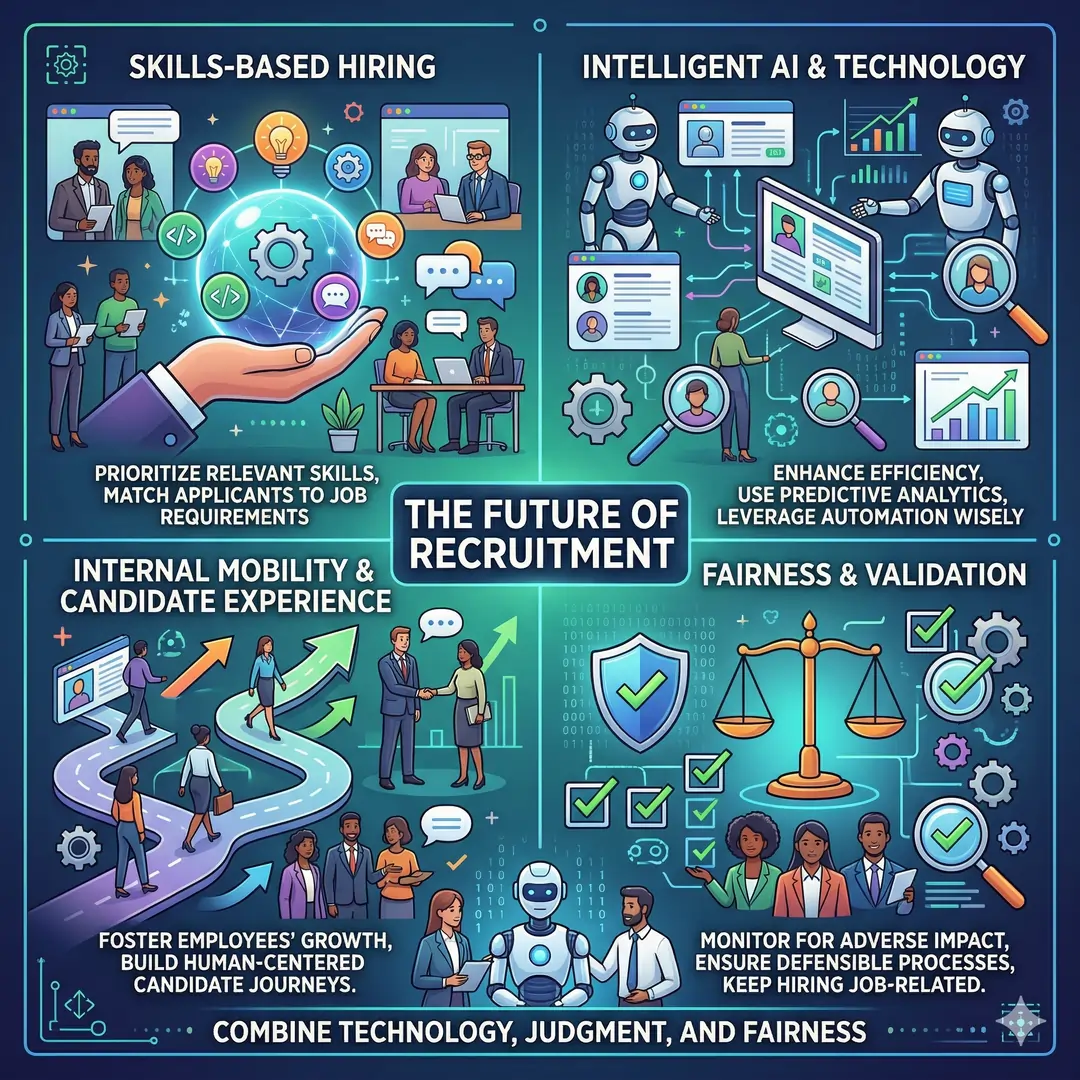
At the same time, the future will likely demand more care around fairness and validation. EEOC materials show that as AI and automated systems enter employment decision-making, employers still need to monitor for adverse impact and keep the process job-related and defensible. That means the best recruiting teams of the future will not be the ones that automate the most. They will be the ones who combine technology, judgment, and fairness the best.
Best Practices for Building a Modern Recruitment Process
Here is a simple set of practical best practices for any organization that wants to improve hiring:
- Start with a clear job analysis.
- Use skills-based job descriptions.
- Keep the application simple.
- Communicate timelines clearly.
- Use structured interviews and scoring rubrics.
- Add work samples when appropriate.
- Monitor selection outcomes for fairness.
- Train hiring managers regularly.
- Treat candidate experience as part of the brand.
- Review hiring data after every cycle.
These practices are not trendy extras. They are the core of a reliable hiring system. They improve decision quality, support inclusion, and make recruitment easier to manage over time.
Final Thoughts
A modern recruitment process is not just about hiring faster. It is about hiring better. It brings together skills-based hiring, structured interviews, candidate experience, fairness, and technology in one clear system. When done well, it helps employers find stronger candidates, reduces bias, improves communication, and creates a more positive experience for everyone involved.
For any business that wants to stay competitive, the message is simple. Hire with more clarity, evaluate with more consistency, and treat the candidate journey as seriously as the final offer. That is what modern recruitment really means.
Read These Articles in Detail
- Importance of Recruitment Strategy
- How to Write a Job Description
- Structured Interview Techniques
- How to Improve Candidate Experience
- Employee Onboarding Process: Strong, Confident, and Productive New Hires
- Recruitment Metrics and KPIs: A Guide to Measuring Hiring Success
- Best Recruitment Channels: A Guide to Hiring Better Talent
- Reducing Hiring Bias: A Guide to Fairer And Smarter Recruitment
- Employee Referral Programs: A Guide to Building Better Hires
Key Citations and Article References
- Equal Employment Opportunity Commission. Best Practices for Private Sector Employers. EEOC, United States Government. Available at: https://www.eeoc.gov/best-practices-private-sector-employers
- Equal Employment Opportunity Commission. Employment Tests and Selection Procedures. EEOC. Available at: https://www.eeoc.gov/laws/guidance/employment-tests-and-selection-procedures
- Friedman, B. Navigating Employment Discrimination in AI and Automated Systems. EEOC Hearing, 2023. Available at: https://www.eeoc.gov/meetings/meeting-january-31-2023-navigating-employment-discrimination-ai-and-automated-systems-new/friedman
- Society for Human Resource Management. The Rise of Skills-Based Hiring and Retention Strategies. SHRM. Available at: https://www.shrm.org/labs/resources/transforming-hr-the-rise-of-skills-based-hiring-and-retention-strategies
- Society for Human Resource Management. Strategic Interviewing Toolkit. SHRM. Available at: https://www.shrm.org/topics-tools/tools/toolkits/transform-interviewing-into-strategic-talent-selection
- Society for Human Resource Management. Talent Acquisition Trends and Recruiting Strategies 2025. SHRM. Available at: https://www.shrm.org/topics-tools/research/2025-talent-trends/recruiting-strategies
- National Association of Colleges and Employers. Skills-Based Hiring Trends Report. NACE. Available at: https://www.naceweb.org/talent-acquisition/trends-and-predictions/nearly-two-thirds-of-employers-use-skills-based-hiring-practices-for-new-entry-level-hires
- National Association of Colleges and Employers. Candidate Experience and Employer Branding. NACE. Available at: https://www.naceweb.org/talent-acquisition/best-practices/how-execution-and-authenticity-impact-the-candidate-experience-and-employer-brand
- Organisation for Economic Co-operation and Development. Skills-First Approach and Labour Market Implications. OECD. Available at: https://www.oecd.org/en/publications/empowering-the-workforce-in-the-context-of-a-skills-first-approach_345b6528-en/full-report/skills-first-in-oecd-countries-concepts-trends-and-implications-for-the-labour-market_0d6ba66f.html
- LinkedIn Talent Solutions. Employer Branding Guide. LinkedIn. Available at: https://www.linkedin.com/business/talent/blog/talent-acquisition/employer-branding
- LinkedIn Talent Solutions. What is Candidate Experience? LinkedIn. Available at: https://www.linkedin.com/business/talent/blog/talent-acquisition/what-is-candidate-experience
- LinkedIn Talent Solutions. Skills-Based Hiring in Practice. LinkedIn. Available at: https://www.linkedin.com/business/talent/blog/talent-acquisition/make-real-progress-with-skills-based-hiring
- LinkedIn Talent Solutions. Future of Recruiting Trends. LinkedIn. Available at: https://www.linkedin.com/business/talent/blog/talent-acquisition/future-of-recruiting-2024
Frequently Asked Questions
FAQ 1: What is the modern recruitment process, and how is it different from traditional hiring?
The modern recruitment process is a structured and strategic way of hiring that focuses on finding the right person for the right role using clear criteria, better communication, and fair evaluation methods. Instead of depending only on resumes, job titles, or gut feeling, modern hiring looks at skills, job fit, candidate experience, and long-term performance. This makes the process more practical and more reliable for both employers and candidates.
Traditional hiring often relied on basic job ads, manual screening, and unstructured interviews. That approach can still work in some cases, but it often misses strong candidates and can create bias. Modern recruitment is different because it uses job analysis, structured interviews, skills assessments, and sometimes technology tools like an Applicant Tracking System (ATS). It is designed to be faster, smarter, and more consistent while still treating candidates with respect.
Another major difference is that modern recruitment does not stop at filling a vacancy. It also supports employer branding, candidate engagement, and retention. In simple terms, the company is not just hiring for today. It is also building a stronger workforce for the future. That is why the modern recruitment process is now seen as a key part of business strategy, not just an HR task.
FAQ 2: Why is skills-based hiring becoming such an important part of recruitment?
Skills-based hiring is becoming very important because it helps employers focus on what a candidate can actually do instead of relying too much on degrees, job titles, or years of experience alone. This approach gives recruiters a better picture of real job performance. It is especially useful when hiring for roles where practical ability matters more than formal background.
For many companies, skills-based hiring also widens the talent pool. Someone may not have followed a traditional career path, but they may still have the exact technical skills, communication skills, or problem-solving skills needed for the job. This helps employers discover hidden talent and can also improve diversity in the workplace. It is a more open and more modern way of thinking about talent.
Skills-based hiring is also useful because it makes hiring more accurate. When companies define the core skills for a role and test them through work samples, interviews, or assessments, they reduce the chance of making the wrong hire. That often leads to better performance, better team fit, and better long-term retention. In many ways, this is one of the biggest strengths of the modern recruitment process.
FAQ 3: What are the main stages of a modern recruitment process?
The modern recruitment process usually includes several connected stages, and each one plays an important role in making a strong hiring decision. It begins with workforce planning, where the company identifies the business need behind the hire. After that comes job analysis, which helps define the tasks, responsibilities, and skills required for the role. These early steps are essential because they create a clear hiring target.
Next comes the creation of a strong job description. A good job description is clear, inclusive, and realistic. It should explain the role in simple language and focus on the most important skills and responsibilities. Then comes sourcing, where recruiters reach out to candidates through job boards, referrals, professional networks, and other channels. This stage is about finding the right people, not just more people.
After sourcing, candidates are usually screened through resumes, forms, or short pre-interview checks. Then the process moves to structured interviews and sometimes skills assessments or work samples. After that, the company compares finalists, makes an offer, and begins onboarding. The best modern hiring systems also include a review stage, where hiring teams look at what worked and what needs improvement. This helps the process get better over time.
FAQ 4: How does candidate experience affect hiring results?
Candidate experience has a major effect on hiring results because it shapes how job seekers feel about the company during the entire hiring journey. From the moment they read the job description to the final decision, every interaction matters. If the process is smooth, respectful, and transparent, candidates are more likely to stay engaged and accept offers. If it feels slow, confusing, or impersonal, they may lose interest and move on.
A positive candidate experience usually includes a simple application process, clear communication, timely updates, and respectful interviews. Candidates want to know what to expect, how long the process will take, and what comes next. When companies provide that kind of clarity, they show professionalism and care. That improves the employer’s reputation and increases the chance of hiring stronger talent.
Candidate experience is also closely tied to employer branding. People talk about their experiences, and those impressions can influence how others view the company too. A poor hiring experience can damage trust, while a good one can strengthen it. That is why modern recruitment treats candidate experience as a serious business priority, not a small detail.
FAQ 5: Why are structured interviews better than unstructured interviews?
Structured interviews are better because they make hiring more fair, consistent, and accurate. In a structured interview, every candidate is asked the same job-related questions, and their answers are scored using a clear rubric. This makes it easier to compare candidates based on relevant performance signals instead of personality or confidence alone.
Unstructured interviews often feel more casual, but they can be unreliable. Different interviewers may ask different questions, focus on different traits, or form opinions based on first impressions. That can lead to bias and uneven decision-making. Structured interviews reduce that problem by creating a more disciplined process. They help hiring teams focus on what truly matters for the role.
Another benefit of structured interviews is that they support better documentation. When a company can explain why it chose one candidate over another based on clear criteria, the decision becomes more defensible and more professional. This is especially important in a modern recruitment process where fairness, consistency, and quality all matter. Structured interviews are one of the simplest ways to improve hiring results.
FAQ 6: How do job descriptions influence the success of recruitment?
A job description plays a huge role in recruitment success because it is often the first impression a candidate gets of the role and the company. A well-written description attracts the right people, while a vague or overloaded one can discourage strong candidates from applying. That is why modern recruitment puts a lot of attention into writing clear, focused, and inclusive job descriptions.
A good job description should explain the role in simple language, list the main responsibilities, and highlight the most important skills. It should avoid unnecessary requirements that do not really affect performance. For example, asking for too many years of experience or a degree that is not truly needed may block qualified people from applying. Modern hiring works better when the description matches the actual demands of the job.
Job descriptions also shape the quality of the applicant pool. If the language is too confusing, too rigid, or too exclusive, the company may receive fewer suitable applications. On the other hand, a clear and welcoming job description can improve reach and attract more relevant candidates. In modern recruitment, the job description is not just an announcement. It is a powerful sourcing tool.
FAQ 7: What role does technology play in the modern recruitment process?
Technology plays a very important role in the modern recruitment process because it helps teams manage hiring more efficiently and consistently. Tools like Applicant Tracking Systems (ATS), scheduling software, candidate portals, and AI-supported screening systems make it easier to handle large numbers of applications and keep the process organized. These tools save time and reduce manual work.
Technology is especially helpful in high-volume hiring, where recruiters may need to review many applications quickly. An ATS can sort applications, track progress, and help hiring teams stay on top of each candidate’s status. Other tools can support interview scheduling, communication, and reporting. This makes the process faster and more transparent.
At the same time, technology must be used carefully. Modern recruitment should not depend completely on automation. Human judgment is still needed to review context, evaluate fit, and make final decisions. The best approach is to use technology as a support system, not a replacement for thoughtful hiring. When used well, technology makes recruitment smarter, but it should always stay fair and job-related.
FAQ 8: How can companies reduce bias in recruitment?
Companies can reduce bias in recruitment by building fairness into every stage of the process. One of the best ways to do this is to use a clear job analysis before writing the job description or screening candidates. When the team knows exactly what the role requires, it becomes easier to make decisions based on job-relevant criteria instead of personal preference.
Another important step is to use structured interviews and consistent scoring systems. When every candidate is asked the same questions and evaluated using the same standards, it reduces the chance that one person gets an unfair advantage. Companies can also use skills assessments or work samples to measure ability more directly. These tools often give a more accurate picture of talent than resumes alone.
Training also matters. Hiring managers and recruiters should understand how unconscious bias can appear in job ads, screening, interviewing, and final selection. It is also smart to review hiring data regularly to see whether one group is being favored over another in unexpected ways. Reducing bias is not about removing human judgment completely. It is about making that judgment more careful, more consistent, and more fair.
FAQ 9: What recruitment metrics should businesses track in a modern hiring system?
Businesses should track several important recruitment metrics to understand whether their hiring process is working well. One of the most common is time to fill, which shows how long it takes to hire someone after a role opens. Another useful metric is time to hire, which measures how long candidates take to move through the hiring funnel. These numbers help companies identify delays and improve efficiency.
Other important metrics include offer acceptance rate, candidate drop-off rate, source of hire, and quality of hire. The offer acceptance rate shows how often candidates accept job offers, while candidate drop-off reveals where people stop engaging in the process. Source of hire helps teams understand which channels bring in the best candidates. Quality of hire shows whether the new employee performs well after joining.
Retention is also a valuable metric. If new hires leave quickly, it may suggest problems with the role, the hiring process, or the onboarding experience. Tracking these metrics gives companies real evidence instead of assumptions. That is one of the biggest advantages of modern recruitment. It turns hiring into a measurable system that can be improved over time.
FAQ 10: What does the future of the modern recruitment process look like?
The future of the modern recruitment process will likely be shaped by a stronger focus on skills-based hiring, more thoughtful use of AI, and a continued emphasis on fairness and candidate experience. Companies are moving toward hiring methods that look at actual ability more than traditional credentials. This trend is likely to continue because it helps employers find talent more efficiently and more widely.
At the same time, technology will keep growing in importance. AI tools may help with screening, scheduling, matching, and analysis, but human oversight will still be necessary. Employers will need to make sure that these tools remain fair, transparent, and job-related. That means the future of recruitment is not just about automation. It is about a better balance between technology and human decision-making.
The future will also reward companies that build strong employer brands and treat candidates with respect. People expect hiring to be fast, clear, and professional. Businesses that create a positive experience will stand out in a crowded market. In the coming years, the best recruitment strategies will likely be those that combine clarity, fairness, speed, and human connection in one well-designed process.
