

Recruitment is much more than filling an open seat. A recruitment strategy is a planned, thoughtful approach to attracting, selecting, and hiring the right people for the right roles at the right time. It connects hiring decisions to business goals, workforce planning, candidate experience, and long-term growth. Trusted HR sources such as CIPD describe recruitment as central to a strong HR strategy, while also stressing that good recruitment is especially vital when labour markets are tight and when organizations need the right skills for both current and future needs.
In simple terms, a weak hiring process often leads to rushed decisions, poor fit, higher turnover, and wasted time. A strong recruitment strategy helps a business become more intentional, more consistent, and more competitive. It also helps organizations respond to ongoing talent shortages, skills gaps, and changing compensation expectations, which remain major hiring challenges according to SHRM.
Table of Contents
What Is a Recruitment Strategy?
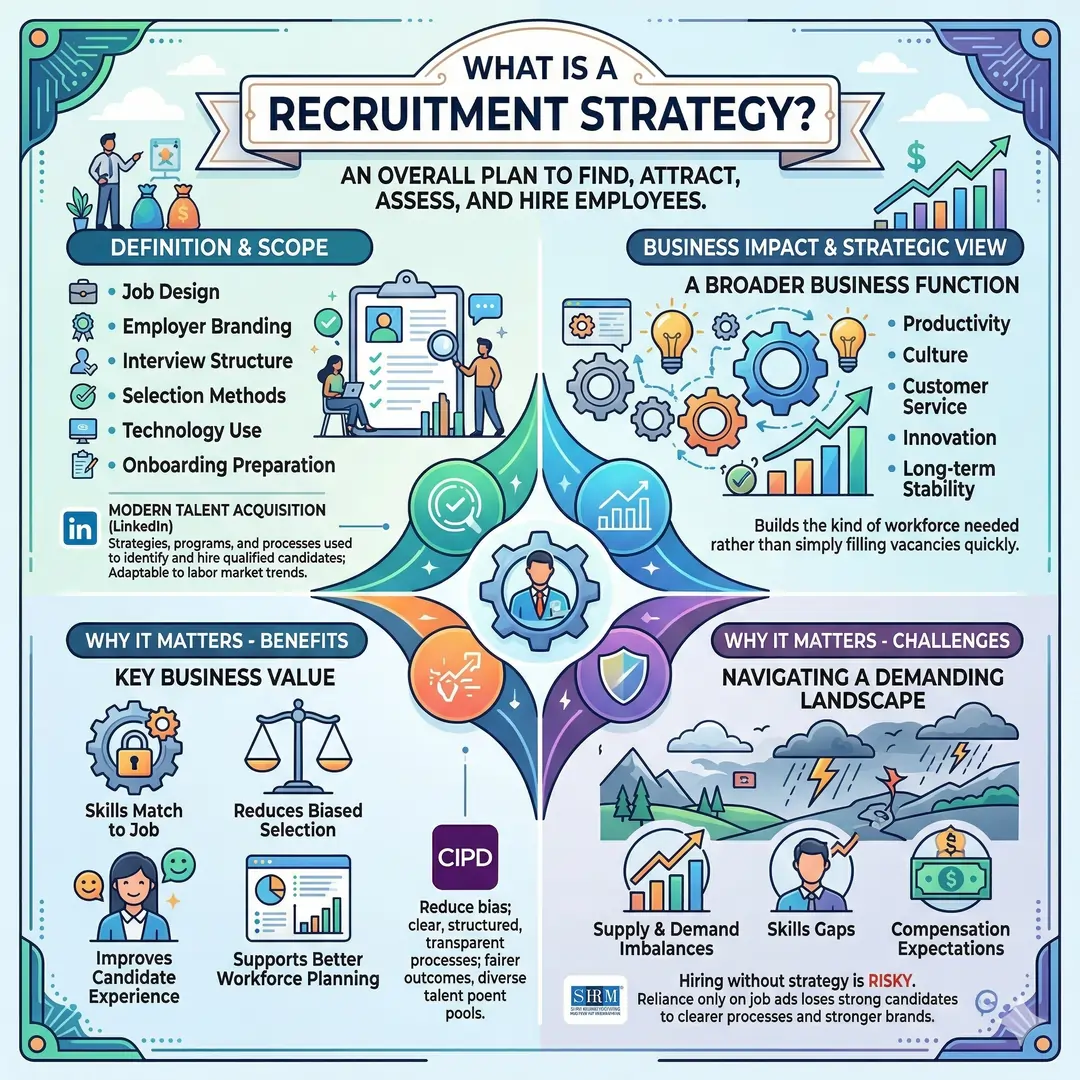
A recruitment strategy is the overall plan an organization uses to find, attract, assess, and hire employees. It includes everything from job design and employer branding to interview structure, selection methods, technology use, and onboarding preparation. LinkedIn describes talent acquisition as the strategies, programs, and processes used to identify and hire qualified candidates, and notes that modern talent acquisition goes beyond basic hiring to support growth and adapt to changing labour market trends.
That broader view matters. Today, recruitment is not just a short-term HR activity. It is a business function that affects productivity, culture, customer service, innovation, and long-term stability. When hiring is handled strategically, the organization is more likely to build the kind of workforce it actually needs rather than simply filling vacancies quickly.
Why Recruitment Strategy Matters So Much
A well-built recruitment strategy creates business value in several ways. It helps organizations hire people whose skills match the job, reduces the chance of biased selection, improves the candidate experience, and supports better workforce planning. CIPD notes that recruitment should be designed to reduce bias and that clear, structured, and transparent processes support fairer outcomes, more diverse talent pools, and better candidate experiences.
It also matters because the hiring landscape is becoming more demanding. SHRM reports that organizations continue to face hiring pressure due to supply and demand imbalances, skills gaps, and compensation expectations. In that kind of environment, hiring without a strategy is risky. Businesses that rely only on job ads and hope often lose strong candidates to employers that have a clearer process and a stronger employer brand.
The Main Benefits of a Strong Recruitment Strategy
A strong recruitment strategy offers practical and measurable advantages.
- Better quality of hire because job requirements, skills, and selection criteria are more clearly defined. LinkedIn reports that the quality of hire is increasingly important for talent professionals.
- Faster hiring because the process is planned instead of improvised, which reduces delays and confusion. CIPD also notes that organizations report improved candidate experience and faster recruitment when technology is used well.
- Lower hiring waste because the organization avoids repeated vacancy cycles, bad fits, and early turnover. CIPD says recruitment is central to HR strategy, yet many organizations still do not measure ROI well, which means strategic recruitment also improves accountability.
- Stronger diversity and inclusion because structured and objective methods reduce bias and expand access to a wider candidate pool.
- Better alignment with business goals because workforce planning guides hiring decisions rather than panic hiring. CIPD specifically links effective resourcing to current and future organizational needs.
- Improved employer reputation because candidates remember a respectful, transparent, and professional process. CIPD notes that interviews are also a chance to give candidates a positive impression of the organization.
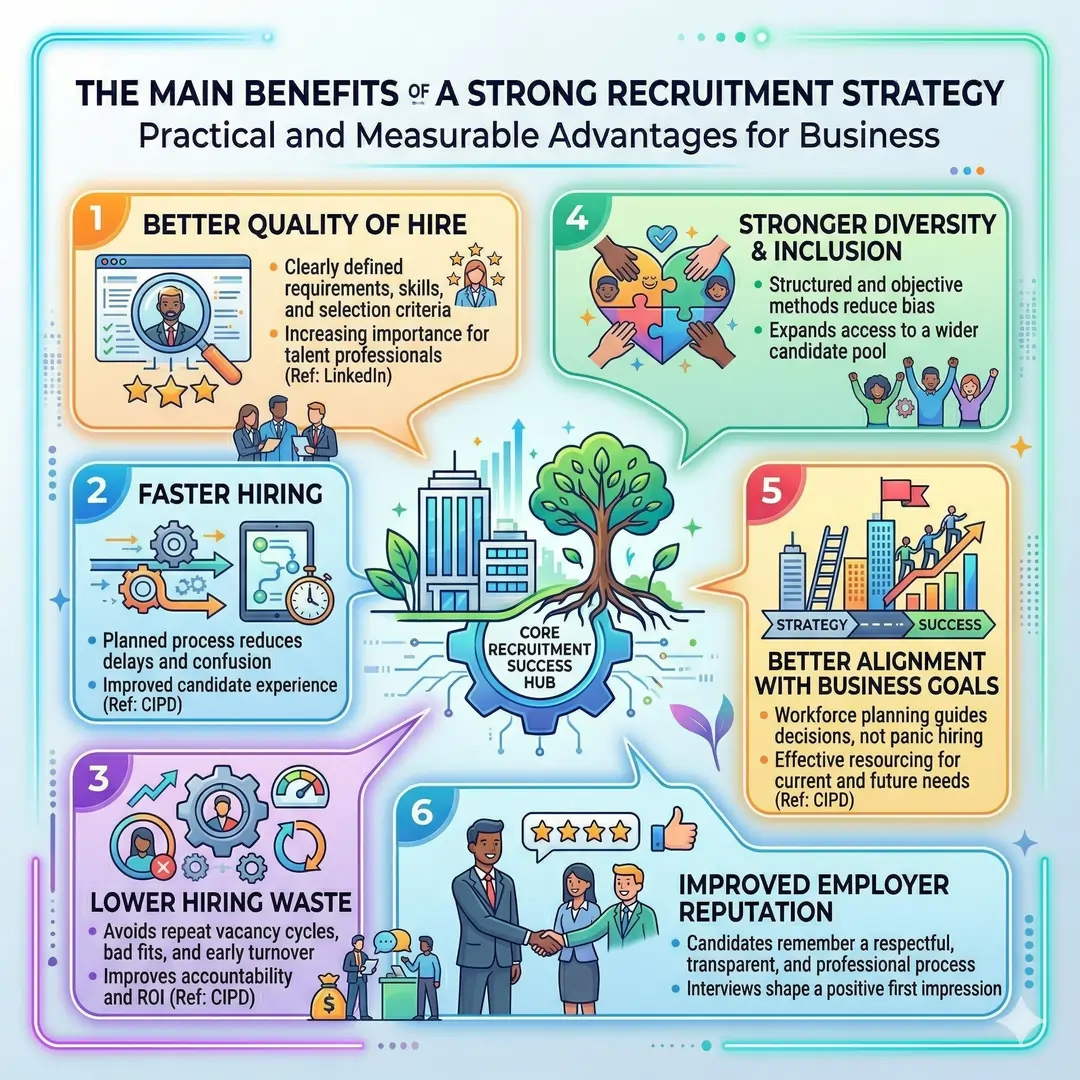
Table 1. Core Parts of a Recruitment Strategy
| Strategic area | What it means | Why it matters | Example in practice |
|---|---|---|---|
| Workforce planning | Predicting what roles and skills will be needed | Prevents panic hiring and supports future growth | Planning for a data analyst role before a new project launches |
| Job design | Defining responsibilities, skills, and outcomes clearly | Attracts the right people and avoids vague expectations | Writing a role profile that separates must-have skills from nice-to-have skills |
| Sourcing | Choosing where and how to find candidates | Expands reach and improves candidate quality | Using job boards, referrals, social platforms, and internal talent pools |
| Employer branding | Showing why people should work for the company | Strengthens interest from strong candidates | Highlighting growth opportunities, culture, and learning support |
| Selection methods | Choosing how to assess candidates | Improves fairness and quality of hire | Using structured interviews, skill tasks, and reference checks |
| Candidate experience | How applicants feel during the process | Influences acceptance rates and reputation | Sharing timelines, feedback, and clear instructions |
| Technology use | Using digital tools in recruitment | Improves speed, accessibility, and consistency | Automating screening or scheduling while keeping human review |
| Measurement | Tracking hiring results | Helps improve the process over time | Monitoring time-to-fill, quality of hire, and retention |
This table is a practical synthesis of the evidence from CIPD, LinkedIn, and Deloitte, all of which emphasize that recruitment today must be intentional, inclusive, data-informed, and aligned with business needs.
How Recruitment Strategy Supports Long-Term Business Success
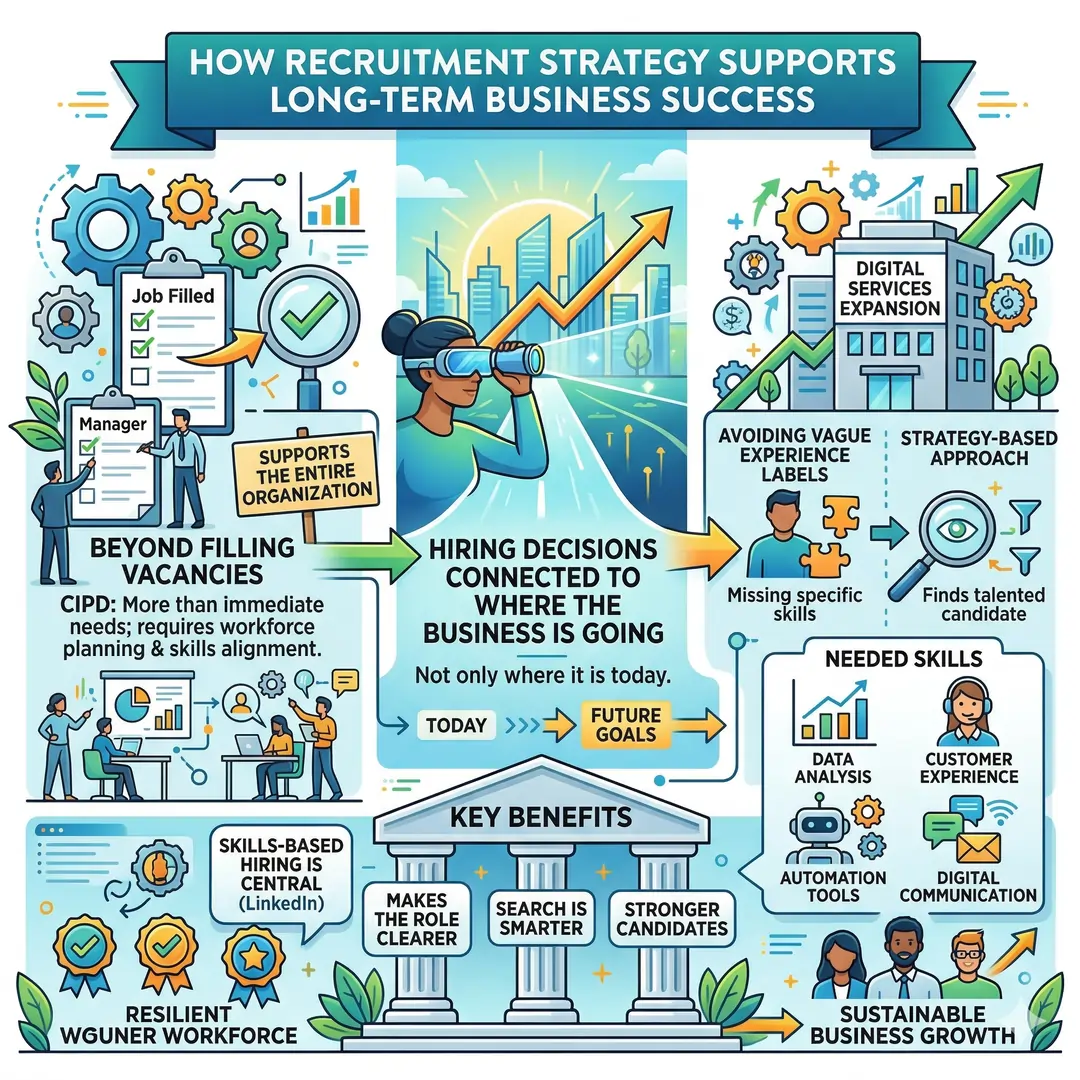
A good recruitment strategy does more than help a manager fill a vacancy. It supports the entire organization. CIPD explains that effective recruitment is not just about an immediate opening, but about long-term success through workforce planning and skills alignment. That means hiring decisions should connect to where the business is going, not only where it is today.
For example, a company that is expanding into digital services may need people who can handle data analysis, customer experience, automation tools, and digital communication. If it hires only based on vague experience labels, it may miss stronger candidates with the exact skills it needs. A strategy-based approach makes the role clearer and the search smarter. This is especially important now that skills-based hiring is becoming more central to recruitment, according to LinkedIn.
The Role of Structured Hiring
One of the clearest signs of a strong recruitment strategy is the use of structured selection methods. CIPD recommends structured interviews, consistent scoring, objective criteria, and multiple assessment methods to reduce bias and improve fairness. It also notes that structured interviews help panel members make more accurate and comparable decisions.
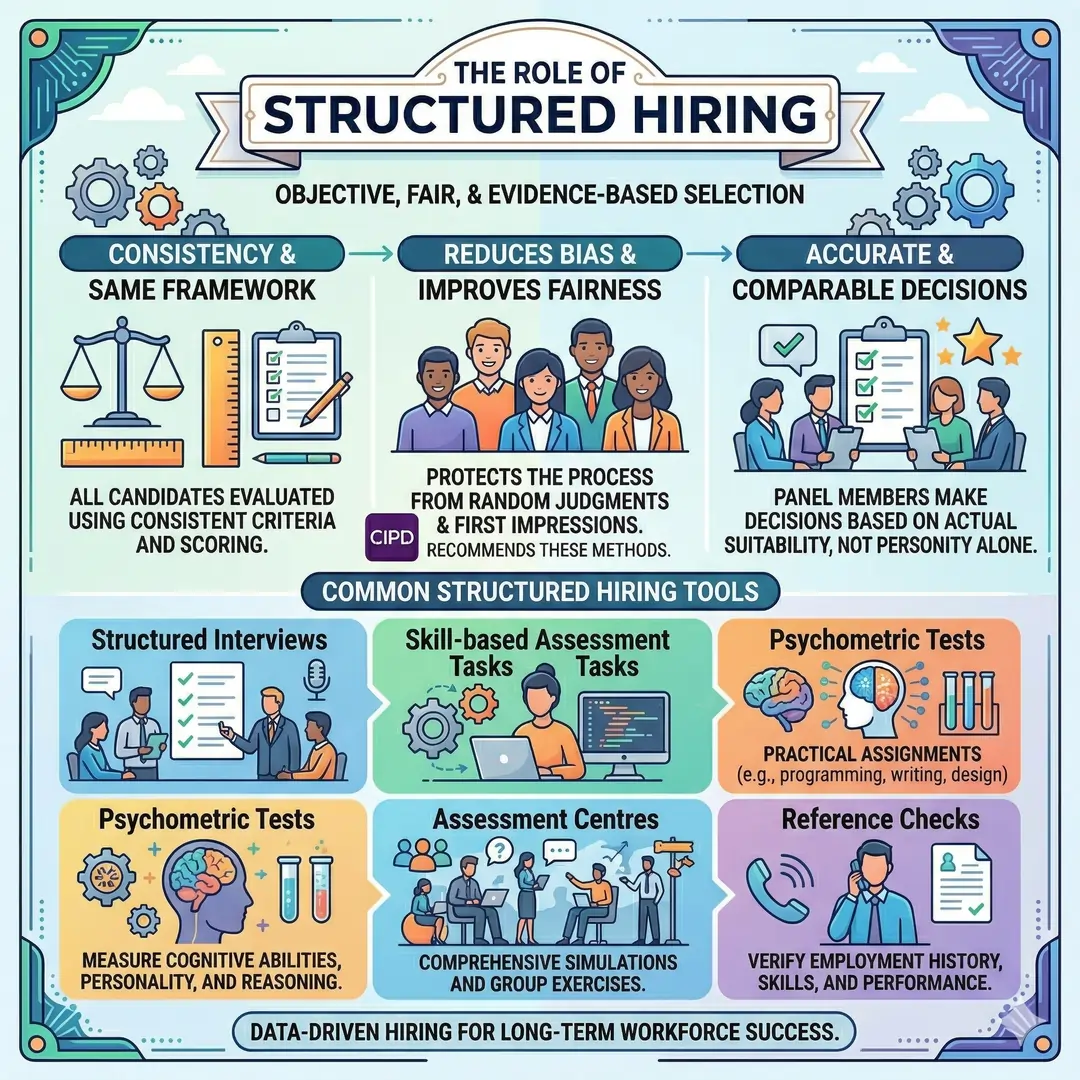
Structured hiring is valuable because it protects the process from random judgments. Instead of relying on personality alone, managers evaluate evidence. Instead of asking different candidates different questions, they use the same framework for all. This gives the organization a better chance of selecting people based on actual suitability rather than first impressions.
Common structured hiring tools include
- Structured interviews
- Skill-based assessment tasks
- Psychometric tests
- Assessment centres
- Reference checks
Why Candidate Experience Is Part of Strategy
Many companies think recruitment is only about the employer choosing the candidate. In reality, the candidate is also choosing the employer. CIPD points out that interviews help candidates understand the job, ask questions, and decide whether they want the role. That means the process itself shapes the final hiring outcome.
A strong candidate experience usually includes clear job descriptions, honest communication, realistic timelines, and respectful interaction at every stage. When this is missing, even good candidates may withdraw. When it is present, the employer becomes more attractive, and the organization is more likely to secure people who have options.
Table 2. Problems Without a Recruitment Strategy and How to Fix Them
| Common problem | What usually happens | Better strategic response |
|---|---|---|
| Rushed hiring | The company fills the role quickly but the person is not a fit | Define requirements before posting the job |
| Unclear job descriptions | The wrong people apply or strong candidates lose interest | Write role profiles with clear outcomes and skills |
| Bias in selection | Decisions depend too much on personal opinion | Use structured interviews and consistent scoring |
| Poor candidate communication | Candidates drop out or feel disrespected | Share process steps, timelines, and feedback |
| Overreliance on one source | The talent pool stays small | Use referrals, platforms, networks, and internal mobility |
| No measurement | Hiring problems repeat without being fixed | Track quality of hire, time-to-fill, and retention |
| Weak employer brand | Applicants do not see the company as attractive | Highlight culture, learning, and purpose |
| Ignoring technology | Hiring is slow and manual | Use automation carefully to improve speed and access |
These issues and fixes are closely tied to the guidance from CIPD on fairness, candidate experience, technology, and objective selection, along with SHRM and LinkedIn on strategic hiring, skills, and quality of hire.
Technology and Modern Recruitment Strategy
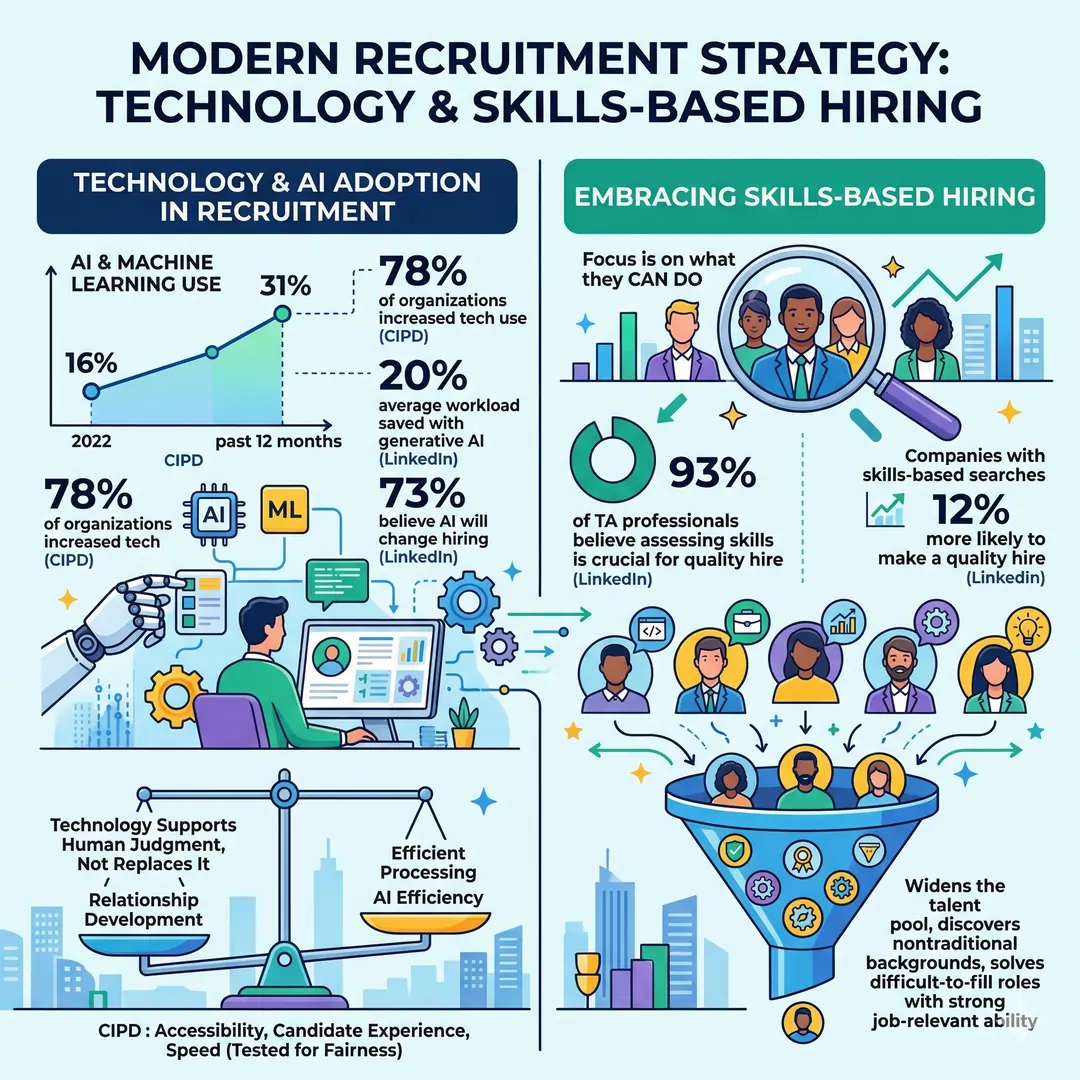
Technology now plays a much bigger role in recruitment than before. CIPD reports that 78% of organizations increased their use of technology in recruitment and onboarding over the past 12 months, and 31% used some form of AI or machine learning, up from 16% in 2022. The same source also notes that technology can improve accessibility, candidate experience, and speed, but only when it is tested for fairness and good user experience.
Deloitte also describes talent acquisition technology as a strategic imperative in a rapidly changing market, not just a convenience. Meanwhile, LinkedIn reports that talent acquisition professionals using generative AI say they save an average of 20% of their workload, and 73% believe AI will change how companies hire.
That said, technology should support human judgment, not replace it. The best recruitment strategy uses tools to reduce repetitive work, organize applications, and improve efficiency while still keeping people at the center of decision-making. This balance matters because LinkedIn also notes that relationship development is becoming more important in recruiting, which shows that the human side of hiring is still essential.
Recruitment Strategy and Skills-Based Hiring
One of the strongest trends in modern hiring is skills-based hiring. LinkedIn explains that this means focusing more on what a candidate can do than on where they studied or where they previously worked. The same report says 93% of talent acquisition professionals believe accurately assessing a candidate’s skills is crucial for improving the quality of hire, and companies with the most skills-based searches are 12% more likely to make a quality hire.
This matters because many organizations today are struggling to fill roles even when they receive applications. A skills-first strategy widens the talent pool. It also helps businesses discover candidates who may have nontraditional backgrounds but strong job-relevant abilities. That is especially valuable in a market where changing skill needs are common, and some roles are harder to fill than before.
A Simple Step-by-Step Framework for Building a Better Recruitment Strategy
1. Start with workforce planning
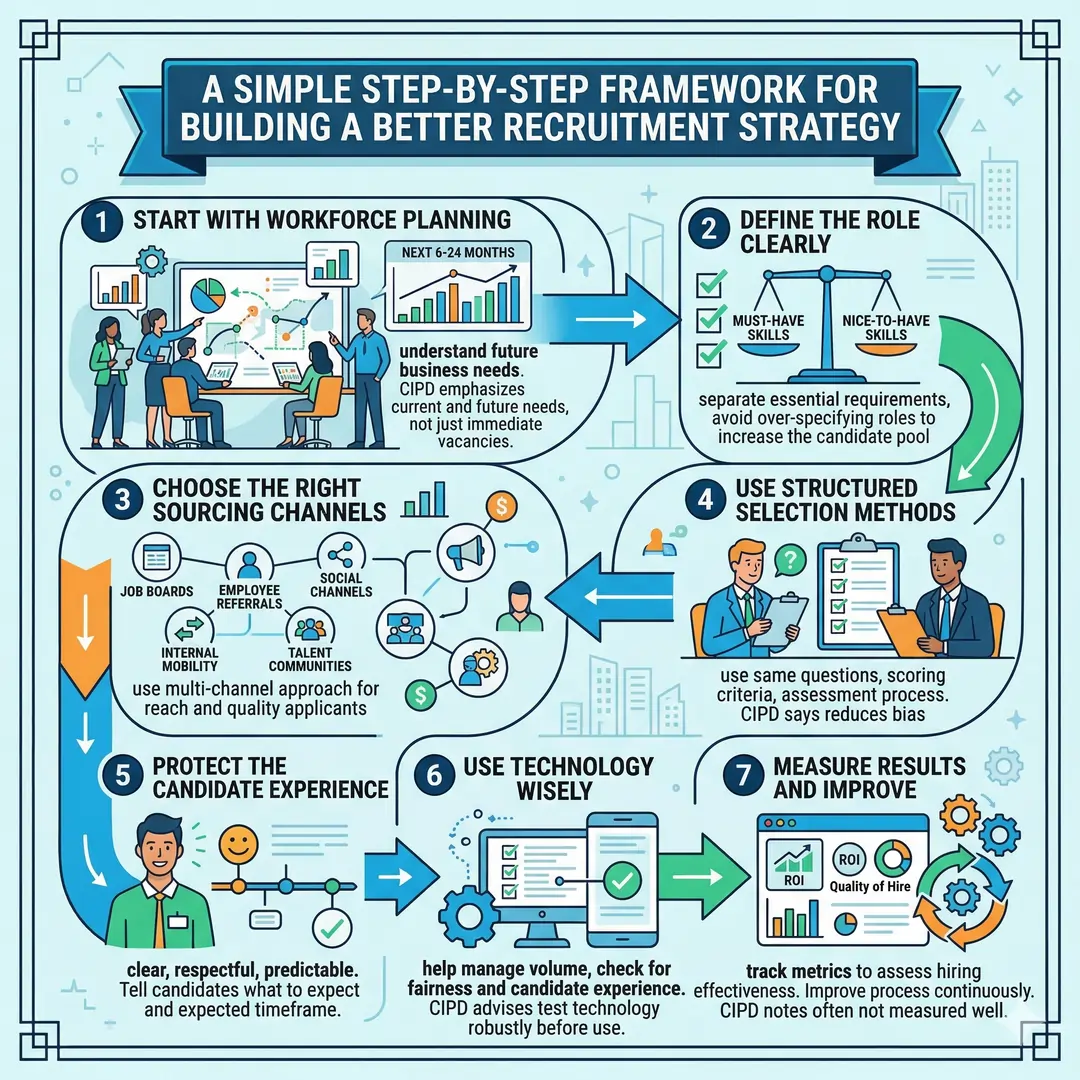
Before writing a vacancy, understand what the business needs in the next 6 to 24 months. CIPD emphasizes that recruitment should reflect current and future needs, not just immediate vacancies.
2. Define the role clearly
Separate the must-have skills from the nice-to-have skills. This prevents vague requirements and helps candidates understand the actual job. It also reduces the temptation to over-specify roles, which can shrink the candidate pool.
3. Choose the right sourcing channels
Do not depend on a single source. Use a combination of job boards, employee referrals, social channels, internal mobility, and talent communities. A multi-channel approach improves reach and gives the company more control over applicant quality.
4. Use structured selection methods
Use the same questions, scoring criteria, and assessment process for all candidates. CIPD says structured interviews reduce bias and help interviewers compare candidates more fairly.
5. Protect the candidate experience
Keep communication clear, predictable, and respectful. Tell candidates what to expect, how long the process may take, and what kind of assessment they will face. CIPD recommends telling candidates in advance about the process and ensuring it is not unnecessarily long.
6. Use technology wisely
Automation can help manage large application volumes and improve accessibility, but it should always be checked for fairness and good candidate experience. CIPD explicitly advises organizations to test any technology robustly before using it.
7. Measure results and improve
A recruitment strategy should never be static. Track the metrics that show whether hiring is actually working, then improve the process. CIPD notes that many organizations still do not measure recruitment ROI well, which makes continuous improvement even more important.
Table 3. Useful Metrics to Track in Recruitment Strategy
| Metric | What does it tell you | Why it matters |
|---|---|---|
| Time to fill | How long does it take to hire | Shows process speed and bottlenecks |
| Quality of hire | How well new hires perform | Helps judge hiring effectiveness |
| Offer acceptance rate | How many offers are accepted | Reflects employer appeal and compensation fit |
| Candidate drop-off rate | Where applicants leave the process | Reveals weak points in the journey |
| Source of hire | Where successful candidates came from | Helps improve sourcing investment |
| First-year retention | Whether new hires stay | Shows fit, onboarding quality, and realism of hiring |
| Diversity of applicant pool | How broad the candidate base is | Indicates whether the process is inclusive |
| Hiring manager satisfaction | Internal confidence in the hire | Helps refine job clarity and selection methods |
These metrics fit well with the evidence from LinkedIn on quality of hire, skills-based hiring, and the need to understand hiring effectiveness, along with CIPD on ROI, fairness, and candidate experience.
Real-World Examples of Recruitment Strategy in Action
Example 1: A growing startup
A startup is preparing to launch a new product line. Instead of posting a generic job ad for “all-round marketing support,” it maps the exact skills needed, such as content strategy, digital analytics, and campaign execution. It then uses a structured interview and a practical task. This approach is more likely to produce a strong hire because the strategy matches the real business goal. That mirrors the workforce-planning and skills-first guidance seen in CIPD and LinkedIn.
Example 2: A large company with many applicants
A large organization receives hundreds of applications per role. It uses automation to organize applications, but final decisions are still based on structured scoring criteria and panel interviews. This reduces bias, speeds up screening, and improves fairness. That approach reflects CIPD advice on technology, structured interviews, and inclusive recruitment.
Example 3: A business struggling with turnover
A company keeps rehiring for the same role every few months. After reviewing its recruitment strategy, it realizes the job description is inaccurate and candidates are not being assessed for the skills that really matter. By redesigning the role, improving communication, and measuring retention, it begins to hire more suitable people. This kind of improvement is exactly why recruitment should be treated as a strategic business function, not just an admin task.
Best Practices for a Professional Recruitment Strategy
- Align hiring with business goals
- Write clear and realistic job descriptions
- Use diverse sourcing channels
- Prefer structured interviews over informal chats
- Measure hiring quality, not just speed
- Make the process candidate-friendly
- Use technology with care and review fairness
- Support inclusive recruitment at every stage
Why Recruitment Strategy Should Be Treated as a Business Priority
Some organizations still treat recruitment as a background HR function. That is a mistake. The evidence from CIPD, SHRM, LinkedIn, and Deloitte all points in the same direction. Hiring quality affects business performance, candidate experience affects employer reputation, skills alignment affects future readiness, and technology is changing how hiring gets done.
When the recruitment strategy is strong, the business hires more intentionally, adapts more quickly, and reduces unnecessary risk. When it is weak, every vacancy becomes a guessing game. In a time of skills shortages, tight labour markets, and rising expectations from candidates, strategy is not optional. It is a competitive advantage.
Conclusion
The importance of recruitment strategy is simple to understand but powerful in practice. It helps organizations hire the right people, create a fairer process, improve candidate experience, use technology wisely, and support long-term business growth. CIPD shows that recruitment should be tied to workforce planning and fairness, SHRM highlights the hiring pressure organizations continue to face, LinkedIn shows the rise of skills-based hiring and quality-of-hire thinking, and Deloitte reinforces the strategic role of technology in modern talent acquisition.
A company that hires well usually performs better, adapts faster, and builds a healthier culture. That is why the recruitment strategy is not just an HR document. It is a blueprint for stronger teams, better decisions, and smarter growth.
Key Citations And Article References
- Chartered Institute of Personnel and Development. Recruitment: An Overview. Available at: https://www.cipd.org/en/topics/recruitment/
- Chartered Institute of Personnel and Development. Recruitment Factsheet. Available at: https://www.cipd.org/en/knowledge/factsheets/recruitment-factsheet/
- Chartered Institute of Personnel and Development. Selection Methods Factsheet. Available at: https://www.cipd.org/en/knowledge/factsheets/selection-factsheet/
- Society for Human Resource Management. Talent Trends and Recruiting Challenges. Available at: https://www.shrm.org/topics-tools/research/2025-talent-trends/recruiting
- LinkedIn Talent Solutions. What is Talent Acquisition? Available at: https://www.linkedin.com/business/talent/blog/talent-acquisition/what-is-talent-acquisition
- LinkedIn Talent Solutions. Future of Recruiting 2025 Report. Available at: https://www.linkedin.com/business/talent/blog/talent-acquisition/future-of-recruiting-2025
- Deloitte. AI in Talent Acquisition and Recruitment. Available at: https://www.deloitte.com/us/en/services/consulting/blogs/human-capital/ai-in-talent-acquisition.html
Frequently Asked Questions (FAQs)
FAQ 1: What is the importance of a recruitment strategy in hiring?
A recruitment strategy is important because it gives the hiring process a clear direction. Instead of filling jobs randomly, a company uses a planned approach to find the right people for the right roles. This helps the business hire candidates who match the job requirements, the company culture, and the long-term goals of the organization. A strong strategy also reduces mistakes in hiring, improves the quality of candidates, and saves both time and money.
It is also useful because modern hiring is more competitive than ever. Many companies are searching for the same skilled people, so a business that has a clear recruitment strategy often has a better chance of attracting top talent. In simple terms, it turns hiring into a smart business decision instead of a rushed activity.
FAQ 2: Why is recruitment strategy important for business growth?
A good recruitment strategy supports business growth because every company depends on people. When the right employees are hired, they help improve productivity, customer service, innovation, and team performance. A business with a strong hiring plan can fill roles faster, build better teams, and prepare for future expansion more easily.
It also helps the company avoid repeated hiring problems. For example, if a business keeps hiring the wrong person for a role, it may face low performance, early resignations, and extra training costs. A clear recruitment strategy reduces these problems and helps the company grow in a more stable and organized way.
FAQ 3: How does a recruitment strategy improve the quality of hire?
A recruitment strategy improves the quality of hire by making the hiring process more focused and structured. It starts with clearly defining the role, the required skills, and the outcomes expected from the employee. When this is done well, the company attracts people who are more likely to succeed in the position.
It also improves selection by using better assessment methods such as structured interviews, skill tests, and reference checks. These methods help employers look at real ability instead of relying only on first impressions. As a result, the business hires people who are more capable, more reliable, and more likely to stay longer.
FAQ 4: What are the main benefits of having a recruitment strategy?
A strong recruitment strategy offers many benefits. It can improve hiring speed, reduce unnecessary costs, increase the quality of candidates, and create a better experience for applicants. It also supports fairness in hiring by making the selection process more structured and less dependent on personal bias.
Another major benefit is stronger alignment with business goals. When recruitment is planned properly, a company can hire people based on current needs and future growth plans. This is especially useful when the organization is expanding, entering a new market, or dealing with skill shortages. A good strategy helps the company stay ready instead of always reacting to problems at the last minute.
FAQ 5: How does the recruitment strategy support fair and unbiased hiring?
A recruitment strategy supports fair hiring by using consistent rules for all candidates. Instead of asking different questions or making decisions based only on personal opinion, employers can use structured interviews, scoring systems, and clear job criteria. This makes the process more objective and easier to compare fairly.
It also helps reduce bias in areas like age, background, education, or personal style. When hiring decisions are based on skills, performance, and job fit, the company has a better chance of choosing the most suitable candidate. This creates a more inclusive hiring process and can also improve workforce diversity.
FAQ 6: Why is candidate experience part of a recruitment strategy?
Candidate experience is a very important part of a recruitment strategy because every interaction shapes how people feel about the company. If the process is clear, respectful, and well-organized, candidates are more likely to stay engaged and accept an offer. If the process is confusing or slow, strong candidates may lose interest and move on to another employer.
A good recruitment strategy considers things like job description clarity, interview communication, response time, and feedback. These details matter because candidates are not just being evaluated. They are also evaluating the company. A positive experience can strengthen the employer brand and make future hiring easier.
FAQ 7: How does technology improve recruitment strategy?
Technology can improve recruitment strategy by making hiring faster, easier, and more organized. Tools like applicant tracking systems, automated scheduling, and digital assessments can reduce manual work and help recruiters manage large numbers of applications more efficiently. This is especially useful when the company receives many applicants for one role.
At the same time, technology should be used carefully. It should support human decision-making, not replace it completely. A strong recruitment strategy uses technology to save time, improve communication, and improve access for candidates, while still making sure the hiring process remains fair and thoughtful.
FAQ 8: What is skills-based hiring, and why is it important in recruitment strategy?
Skills-based hiring means focusing more on what a candidate can actually do rather than only looking at degrees, job titles, or past company names. This approach is becoming more important because many employers now want people who can perform well in the role, even if their background is not traditional.
This method is valuable because it widens the talent pool and helps companies find capable people they may have overlooked before. It is also useful in fast-changing industries where new skills matter more than old labels. A recruitment strategy that includes skills-based hiring is usually more practical, more inclusive, and better aligned with real job performance.
FAQ 9: What happens when a company does not have a recruitment strategy?
When a company does not have a recruitment strategy, hiring often becomes rushed, inconsistent, and expensive. Managers may write unclear job descriptions, use random interview questions, or choose candidates based on instinct alone. This can lead to poor hiring decisions, low employee performance, and frequent turnover.
The company may also struggle to attract the right people. Without a strategy, it can become harder to build a strong employer brand or create a smooth candidate experience. Over time, this may damage productivity and increase hiring costs. In many cases, the lack of a strategy causes the same hiring mistakes to happen again and again.
FAQ 10: How can a business build a strong recruitment strategy?
A business can build a strong recruitment strategy by starting with workforce planning. It should first understand what skills and roles are needed now and in the future. Then it should create clear job descriptions, choose the right sourcing channels, and use structured selection methods to evaluate candidates fairly.
It is also important to measure results. The business should track metrics like time to fill, quality of hire, offer acceptance rate, and first-year retention. These numbers show whether the strategy is working or needs improvement. A strong recruitment strategy is not a one-time task. It should be reviewed regularly so the company can keep improving its hiring process over time.
FAQ 11. How does a recruitment strategy support long-term business growth?
A recruitment strategy supports long-term business growth by helping a company hire people who match both current needs and future goals. This is important because growing businesses often need new skills, stronger leadership, and a more adaptable workforce. When hiring is planned properly, the organization is not just filling a vacancy. It is building a team that can support expansion, handle change, and contribute to future success. A strong recruitment strategy also helps reduce turnover, which means the business spends less time replacing people and more time moving forward.
FAQ 12. Why should companies use structured interviews instead of informal interviews?
Structured interviews are more effective than informal interviews because they give every candidate the same chance to show their skills. In a structured interview, the questions are prepared in advance, and candidates are usually scored against the same criteria. This makes the process fairer, more consistent, and easier to compare. Informal interviews can depend too much on personal impressions, which may lead to poor hiring decisions. A structured approach helps improve quality of hire and reduces bias in the selection process.
FAQ 13. What is the connection between employer branding and recruitment strategy?
Employer branding is closely linked to recruitment strategy because it shapes how people see the company as a place to work. A strong employer brand makes it easier to attract skilled candidates, especially when the job market is competitive. People are more likely to apply to organizations that are known for good culture, growth opportunities, fair treatment, and clear values. When recruitment strategy includes employer branding, the company can stand out from other employers and attract candidates who are more aligned with its mission and work style.
FAQ 14. How can a recruitment strategy improve employee retention?
A good recruitment strategy can improve employee retention by making sure the right people are hired in the first place. When candidates are selected carefully based on skills, values, and role fit, they are more likely to stay longer and perform better. A clear hiring process also helps set realistic expectations, which reduces the chance of disappointment after joining. If new employees understand the job, the culture, and the goals before they start, they are more likely to settle in well and remain with the company for the long term.
FAQ 15. What are the signs of a weak recruitment strategy?
A weak recruitment strategy usually shows up in several ways. The company may struggle with repeated vacancies, high turnover, poor job fit, and slow hiring. Candidates may also complain about unclear communication, long delays, or confusing interview steps. Another sign is when the organization keeps hiring people who do not perform well or leave within a short time. These problems often mean the recruitment process is not aligned with the real needs of the business. A weak strategy creates extra work, higher costs, and lower productivity.
FAQ 16. How does a recruitment strategy help reduce bias in hiring?
A recruitment strategy helps reduce bias by using clear rules and objective methods during the hiring process. Instead of depending on gut feeling or personal preference, hiring teams can use structured interviews, scoring sheets, and skill-based tasks. This makes it easier to compare candidates fairly. It also helps ensure that decisions are based on ability, experience, and job fit rather than unrelated factors. Reducing bias is important because it leads to better hiring choices and a more inclusive workplace.
FAQ 17. Why is workforce planning important in recruitment strategy?
Workforce planning is important because it helps businesses understand what talent they will need in the future. Rather than hiring only when a vacancy suddenly appears, companies can plan ahead for upcoming projects, growth, retirements, or skills gaps. This allows them to hire more thoughtfully and avoid rushed decisions. Workforce planning also helps organizations identify which roles are most important and what type of people they should be looking for. In simple terms, it makes recruitment more strategic and less reactive.
FAQ 18. What role do job descriptions play in an effective recruitment strategy?
Job descriptions play a very important role because they tell candidates exactly what the role involves. A well-written job description explains the main duties, required skills, expected experience, and working conditions. This helps attract the right applicants and reduces unnecessary applications from people who are not a match. Clear job descriptions also help hiring managers stay focused on what the company actually needs. When this part is done well, the entire recruitment process becomes more efficient and accurate.
FAQ 19. How can small businesses benefit from having a recruitment strategy?
Small businesses can benefit greatly from a recruitment strategy because they often have limited time, budget, and staff. A structured hiring plan helps them avoid expensive mistakes and find the right people faster. Since small businesses usually depend heavily on each employee, hiring the wrong person can cause major problems. A good strategy helps them define roles clearly, choose the right channels for finding candidates, and improve the chances of hiring someone who will stay and contribute positively to the business.
FAQ 20. What makes a recruitment strategy truly successful?
A recruitment strategy is truly successful when it helps the organization hire the right people in a fair, efficient, and consistent way. Success is not just about speed. It is also about quality of hire, retention, candidate experience, and long-term fit. A successful strategy is flexible enough to adapt to changing business needs but clear enough to guide hiring decisions. It should also be regularly reviewed using useful metrics so the company can keep improving. In the end, the best recruitment strategy supports both immediate hiring needs and future business growth.
