A job description is much more than a hiring form. It is one of the first signals a candidate gets about your company, your expectations, and the kind of work they will do. A strong job description helps define the role, explain the duties, and guide both hiring managers and applicants toward the same understanding of success. It also matters for compliance and fair hiring because the essential functions of a role should be clear, especially when accommodation questions come up under the Americans with Disabilities Act (ADA).
In simple terms, a good job description should do three things well. It should help the right people find the role, help them quickly understand whether they are qualified, and help them picture themselves succeeding in the job. That means the language should be clear, the structure should be easy to scan, and the details should reflect the real work, not a fantasy wish list.
Table of Contents
What a Job Description Really Is
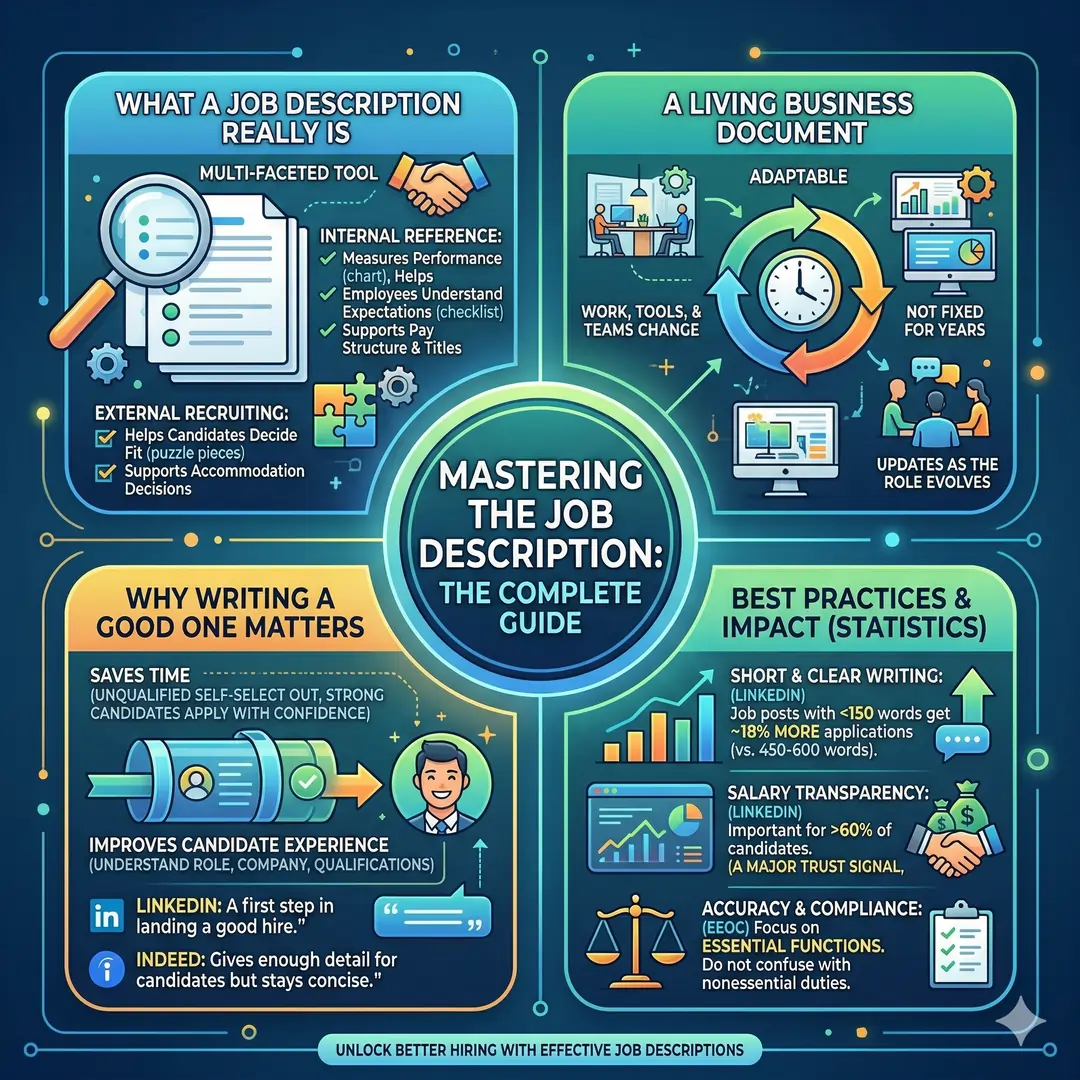
A job description outlines the tasks, duties, and responsibilities of a position. It is both an internal reference point and an external recruiting tool. In practice, it helps managers measure performance, helps employees understand expectations, and helps candidates decide whether the role fits their background and goals. Good job descriptions can also support pay structure, title clarity, and accommodation decisions.
It is also helpful to think of a job description as a living business document. Work changes, tools change, and teams change. That is why modern thinking increasingly treats job descriptions as something that can be updated as the job changes, rather than as a fixed page that sits untouched for years.
Why Writing a Good Job Description Matters
A strong job description saves time. It helps unqualified applicants self-select out and gives strong candidates enough information to apply with confidence. It also improves the candidate experience because people can quickly understand the role, the responsibilities, the qualifications, and the compensation. LinkedIn notes that a quality job description is one of the first steps in landing a good hire, and Indeed says a job post should give enough detail for candidates to understand both the role and the company while staying concise.
It can also improve the quality of applications. LinkedIn reports that job posts with 150 words or fewer saw candidates apply nearly 18% more frequently than posts with 450 to 600 words, which is a strong reminder that short, clear writing often works better than long, overloaded text. LinkedIn also says salary is one of the most important parts of a job description for over 60% of candidates, which makes compensation details a major trust signal.
From a legal and ethical perspective, accuracy matters too. The EEOC makes it clear that an applicant must be able to perform the essential functions of the job, with or without reasonable accommodation, and employers should not confuse essential duties with nonessential ones. That is why job descriptions should reflect the real core work of the role, not every small task that might ever come up.
Also, Read this in Detail: Importance of Recruitment Strategy
The Main Parts of a Strong Job Description
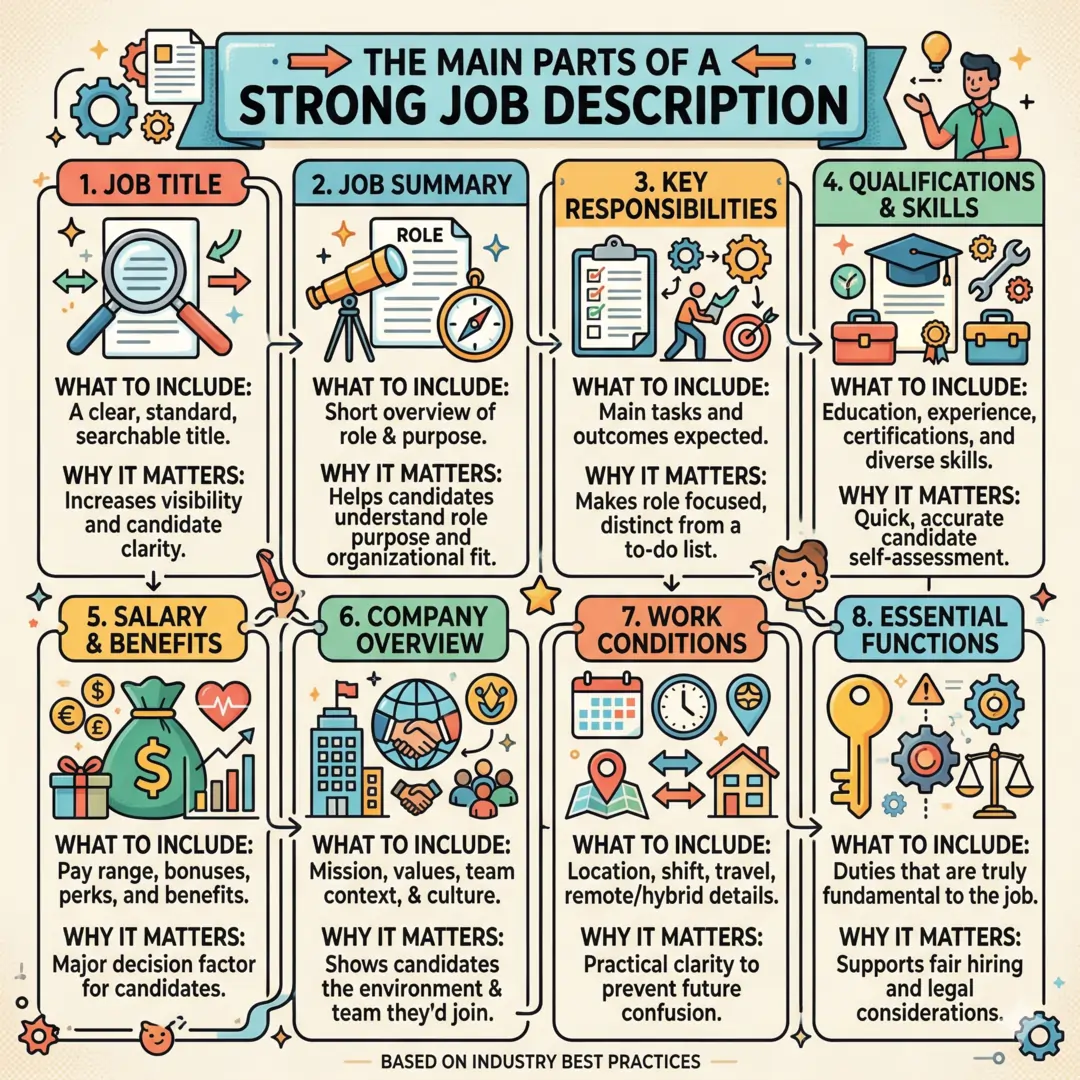
The best job descriptions usually follow a clear structure. Indeed says the core parts are a targeted job title, an overview of the company, a bulleted list of key responsibilities, and a list of required skills and qualifications. SHRM also recommends standardizing the structure and including key elements such as the job title, salary, and functions.
| Section | What to Include | Why It Matters |
|---|---|---|
| Job Title | A clear, standard, searchable title | Candidates often search by title first, so vague labels can reduce visibility and clarity. |
| Job Summary | A short overview of the role and its purpose | Helps candidates understand why the role exists and where it fits in the organization. |
| Key Responsibilities | The main tasks and outcomes expected | Makes the role feel focused and measurable instead of like an endless to-do list. |
| Qualifications and Skills | Education, experience, certifications, technical, and soft skills | Helps candidates self-assess quickly and accurately. |
| Salary and Benefits | Pay range, bonuses, perks, and benefits | Compensation is a major decision factor for many candidates. |
| Company Overview | Mission, values, team context, and culture | Shows the candidate what kind of place they may be joining. |
| Work Conditions | Location, shift, travel, remote or hybrid setup | Gives practical clarity and prevents confusion later. |
| Essential Functions | The duties that are truly fundamental to the job | Supports fair hiring and ADA-related decisions. |
How to Write a Job Description Step by Step
1. Start with a real job analysis
Before you write, learn what the job actually involves. Talk to the hiring manager, speak with people who already do similar work, and review internal expectations. SHRM recommends gathering information about the knowledge, skills, abilities, physical characteristics, environmental factors, and credentials needed for the role. It also suggests using outside resources such as salary surveys and the Occupational Outlook Handbook.
A job description becomes much stronger when it is based on how the job truly works. The O*NET system from the U.S. Department of Labor is a useful reference point because it describes occupations through the required knowledge, skills, abilities, tasks, and work activities. That makes it a helpful tool when you want to compare your draft against a broader labor-market picture.
2. Choose a clear and searchable job title
The job title should be simple, accurate, and easy to find. LinkedIn advises keeping titles straightforward and avoiding flashy words like wizard or ninja because they can hurt search visibility. It also says a good title should be self-explanatory, reflect the actual role, avoid exaggeration, and be free of age or gender implications.
A better title helps both humans and search systems. For example, Java Software Developer is more useful than Code Ninja because it tells the candidate exactly what the role is and gives search engines something concrete to index.
3. Write a short but meaningful summary
The summary should explain the purpose of the job in a few sentences. LinkedIn says this section should show where the role fits in the organization and what team or mission it supports. This is also where you can show the impact of the work, which helps candidates connect the role to something bigger than a task list.
A good summary is not a company brochure. It is a bridge between the title and the responsibilities. Keep it short, clear, and useful.
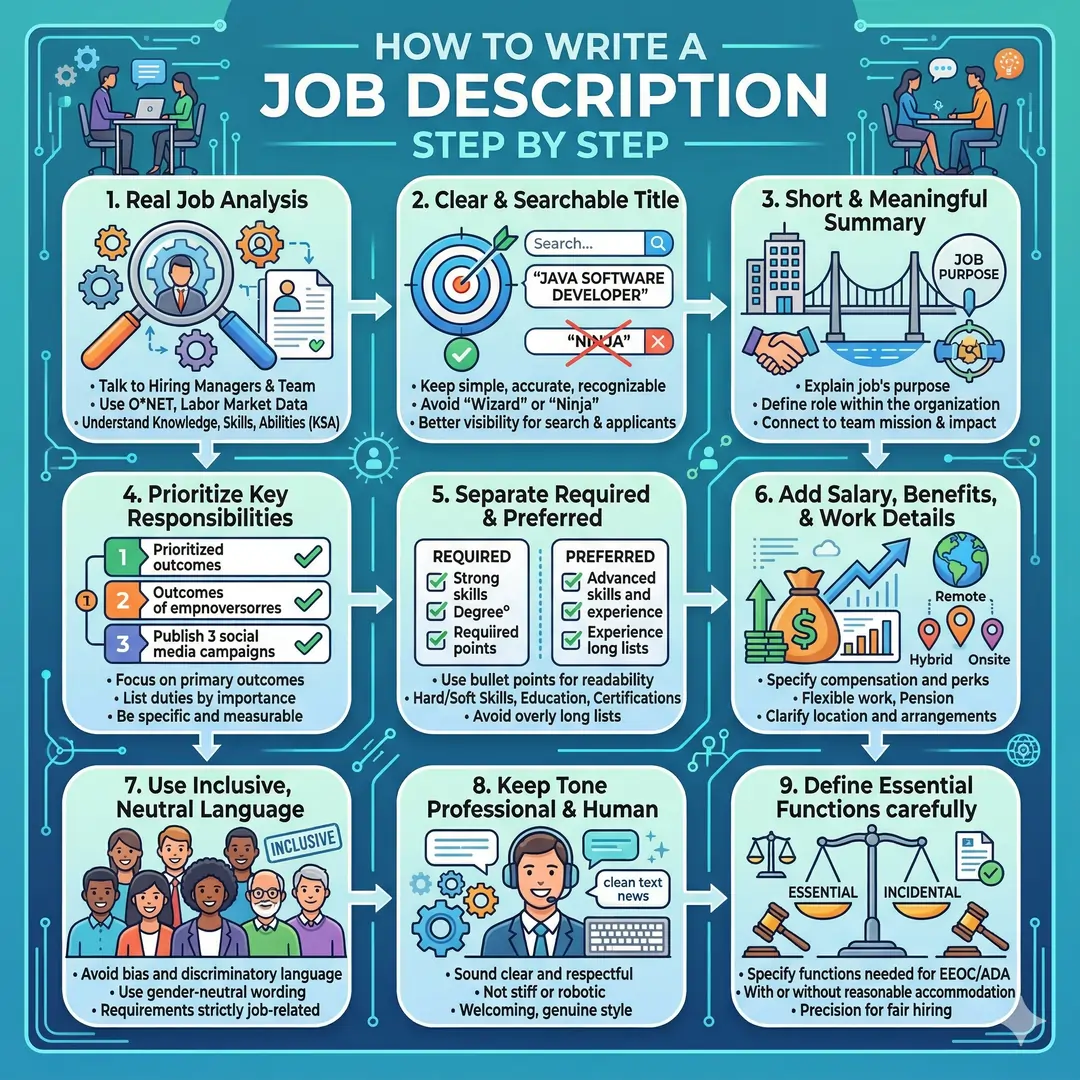
4. List the key responsibilities in order of importance
This is one of the most important sections. LinkedIn recommends focusing on a small number of clear goals and prioritizing what matters most. Instead of dumping every possible task into one long paragraph, turn the role into a short list of outcomes and core duties. That makes the description easier to read and much easier to understand.
A responsibility section should answer questions like these:
- What will the person do every day?
- What outcomes will define success?
- What problems will this role solve?
- What decisions will the person own?
A stronger version of a responsibility might look like this:
- Weak: Help with marketing tasks.
- Better: Plan and publish 3 social media campaigns per month and track engagement results.
The second version is better because it is specific, measurable, and easier to evaluate.
5. Separate required qualifications from preferred qualifications
Candidates need to know what is truly required and what is simply nice to have. Indeed recommends including hard skills, soft skills, education, previous experience, certifications, and technical abilities where they matter. Using bullet points makes this section easier to scan.
A useful rule is to keep the required list short and honest. Too many demands can discourage good candidates from applying, especially if they do not meet every single item. That is one reason many hiring teams are moving toward more skills-focused descriptions rather than overly rigid checklists.
6. Add salary, benefits, and work details
Candidates care about the practical side of the offer. LinkedIn says salary is one of the main drivers of job changes and that benefits such as flexible working or matched pension contributions can influence the final decision. Workable also recommends specifying compensation, perks, and benefits because clear pay information helps save time later in the process.
The same logic applies to location and work arrangement. Say clearly whether the role is remote, hybrid, onsite, or requires travel or shift work. The more real-world detail you give, the fewer misunderstandings you will have later.
7. Use inclusive, neutral language
This matters more than many people realize. Workable says job boards usually reject posts with discriminatory or biased language, and it recommends reviewing your text to make sure requirements are strictly job-related. It also suggests using gender-neutral language and focusing on what the candidate must actually do, rather than on protected traits or stereotypes.
Inclusive language is not just about compliance. It also affects who feels welcome enough to apply. When a job description sounds overly macho, overly casual, or full of hidden assumptions, good people may quietly opt out.
8. Keep the tone professional, but still human
LinkedIn warns that extremely casual job descriptions can reduce applications and even make candidates dislike the employer more. That does not mean the writing should be stiff or cold. It means the wording should be clear, respectful, and professional without sounding robotic.
A good job description sounds like a real person wrote it for another real person. It should feel welcoming, but it should still respect the seriousness of the role.
9. Define the essential functions carefully
This is especially important for fair hiring. The EEOC explains that an applicant must be able to perform the essential functions of the job, with or without reasonable accommodation, and that employers may not reject someone because of a disability if they can perform those functions with accommodation. SHRM also recommends identifying things like task frequency, consequences of not performing tasks, alternative methods, and possible reassignment.
This is where precision really matters. If a task is essential, name it clearly. If a task is incidental or occasional, do not present it like a core requirement. That distinction can protect both the employer and the candidate.
What to Include in Each Section
| Section | Good Content Ideas | Example |
|---|---|---|
| Title | Standard, clear, search-friendly | Customer Success Manager |
| Summary | Purpose, team, and impact | Supports the post-sales team and improves retention |
| Responsibilities | 4 to 8 main duties with outcomes | Resolve customer issues, coordinate onboarding, track satisfaction |
| Qualifications | Core skills and experience only | 3 years of support experience, CRM knowledge, strong communication |
| Culture | A few honest lines about your company | Fast-paced, collaborative, learning-focused |
| Compensation | Salary range or pay structure | Monthly salary plus bonus and benefits |
| Work Setup | Remote, onsite, hybrid, travel, shift | Hybrid role based in Delhi with 20% travel |
| Essential Functions | Must-do duties that define success | Communicate with clients, deliver reports, manage timelines |
Examples of Strong Job Description Wording
| Section | Weak Example | Better Example |
|---|---|---|
| Job Title | Marketing Rockstar | Digital Marketing Specialist |
| Summary | We need a person to do everything marketing-related | Lead paid campaigns, support content planning, and track performance for a growing brand |
| Responsibilities | Handle social media | Publish and schedule content, reply to audience comments, and report monthly performance |
| Qualifications | Must be amazing at communication | Strong written communication, 2 years of client-facing experience, and confidence with email and presentations |
| Salary Info | Competitive salary | Salary range of ₹6 LPA to ₹8 LPA, plus performance bonus |
| Culture | Fun, energetic, super cool team | Collaborative team that values learning, ownership, and clear communication |
These examples show an important truth. The best job descriptions are not the most dramatic ones. They are the ones that help the right person say, Yes, that sounds like me.
Common Mistakes to Avoid
| Mistake | Why It Hurts | Better Approach |
|---|---|---|
| Using vague titles | People cannot easily find or understand the role | Use a standard and searchable title. |
| Writing a giant wish list | Good candidates may self-reject | Focus on the most important duties and skills. |
| Making the description too long | Readers lose interest quickly | Keep it concise and easy to scan. |
| Using biased or coded language | It can reduce diversity and trigger job board rejection | Use neutral, strictly job-related wording. |
| Forgetting salary details | Candidates may move on to more transparent posts | Include pay and benefits when possible. |
| Mixing essential and nonessential duties | It blurs expectations and can create legal confusion | Define essential functions clearly. |
| Sounding too casual | It can reduce application interest and trust | Keep the tone professional and human. |
| Copying an old posting without review | The role may no longer match the work | Update the description whenever the job changes. |
A Simple Formula You Can Follow
If you want a practical formula, use this one:
Title + Purpose + Main responsibilities + Required skills + Salary and benefits + Work setup + Company context
That formula keeps the post clean and complete without making it bloated. It also matches what many trusted hiring resources recommend, including a clear title, summary, responsibilities, qualifications, compensation, and company story.
A Ready-to-Use Job Description Template
Here is a simple structure you can reuse for almost any role.
Job Title:
[Clear, searchable title]
Department:
[Team or department name]
Location:
[Onsite, remote, or hybrid setup]
Reports To:
[Manager title]
Job Summary:
[2 to 4 short sentences about the role, purpose, and team impact]
Key Responsibilities:
- [Responsibility 1 with a measurable outcome]
- [Responsibility 2]
- [Responsibility 3]
- [Responsibility 4]
Required Qualifications:
- [Education, experience, certification, or skill]
- [Second requirement]
- [Third requirement]
Preferred Qualifications:
- [Nice-to-have skill or experience]
- [Another nice-to-have]
Compensation and Benefits:
[Salary range, bonuses, perks, and benefits]
Work Environment:
[Shift details, travel, hybrid schedule, or physical requirements]
Equal Opportunity or Legal Note:
[A short neutral statement if your organization uses one]
This format is simple, flexible, and easy to adapt. It also helps keep your job description organized so candidates can scan it.
Tips to Make the Post More SEO-Friendly
A job description is also a search document. People often discover jobs by searching for a title, so the title should match common search terms rather than internal jargon. LinkedIn specifically recommends keeping the title straightforward, and Indeed says a title should be specific enough to target the right candidates.
A few practical SEO tips:
- Use the exact job title people are likely to search for.
- Put the title near the top of the page.
- Repeat the title naturally in the summary once.
- Use clear section headings like Responsibilities, Qualifications, and Benefits.
- Avoid creative words that do not help search visibility.
You do not need to stuff the page with keywords. In fact, that usually makes the post worse. A natural, well-organized description does a better job of helping both search engines and real readers.
A Practical Checklist Before You Publish
| Checklist Item | Done? |
|---|---|
| The job title is clear and searchable | [ ] |
| The summary explains the role’s purpose | [ ] |
| The responsibilities focus on the most important work | [ ] |
| The qualifications are realistic and job-related | [ ] |
| The salary and benefits are included where appropriate | [ ] |
| The language is inclusive and free of bias | [ ] |
| The tone is professional and easy to read | [ ] |
| The essential functions are clearly identified | [ ] |
| The post has been reviewed by the hiring manager | [ ] |
| The final version matches the real job, not an old draft | [ ] |
The Big Lesson
A great job description is clear, honest, and useful. It tells people what the job really is, what success looks like, and why the role matters. It also helps your hiring process run more smoothly because the right candidates can recognize themselves in the post, and the wrong candidates can opt out early. That is good for the company, good for the hiring manager, and good for the applicant.
The best descriptions are not overloaded with buzzwords or padded with every possible responsibility. They are focused, accurate, inclusive, and easy to read. They reflect the real job today, while staying flexible enough to evolve when the work changes. That is especially important in a world where job expectations are changing fast, and static descriptions no longer tell the full story.
Key Citations And Article References
- Society for Human Resource Management. Job Descriptions. Available at: https://www.shrm.org/topics-tools/tools/job-descriptions
- LinkedIn Talent Solutions. How to Write a Great Job Description. Available at: https://business.linkedin.com/hire/resources/talent-acquisition/how-to-write-a-great-job-description
- Indeed. How to Write a Job Description. Available at: https://www.indeed.com/hire/how-to-write-a-job-description
- U.S. Equal Employment Opportunity Commission. ADA: Your Employment Rights as an Individual with a Disability. Available at: https://www.eeoc.gov/publications/ada-your-employment-rights-individual-disability
- U.S. Department of Labor. ONET Program Overview. Available at: https://www.dol.gov/agencies/eta/onet
- Workable. Job Posting Guidelines. Available at: https://resources.workable.com/tutorial/job-posting-guidelines
- Harvard Business Review. A New Approach to Writing Job Descriptions. Available at: https://hbr.org/2023/10/a-new-approach-to-writing-job-descriptions
- Harvard Business Review. When Hiring, Emphasize Skills Over Degrees. Available at: https://hbr.org/podcast/2025/02/when-hiring-emphasize-skills-over-degrees
Frequently Asked Questions (FAQs)
FAQ 1: What is a job description, and why is it important?
A job description is a clear written summary of a job role, including the job title, main responsibilities, required skills, qualifications, and sometimes salary and work location. It helps both employers and candidates understand what the role is about.
It is important because it sets expectations from the beginning. A strong job description can attract the right people, reduce confusion during hiring, and save time by helping unqualified applicants self-select out. It also supports better performance management because employees and managers can refer back to it when discussing duties and goals. In simple words, a good job description works like a roadmap for the job.
FAQ 2: What should be included in a good job description?
A good job description should include the most important details a candidate needs before applying. These usually are the job title, job summary, key responsibilities, required qualifications, preferred qualifications, salary range, benefits, work location, and reporting structure.
It should also explain the purpose of the role in a simple and honest way. The best job descriptions are easy to scan and easy to understand. They do not overload the reader with too many details, but they still give enough information to help people decide whether the role is a good fit. If the job has special working conditions, such as travel, shift work, or physical duties, those should also be mentioned clearly.
FAQ 3: How do I write a clear and effective job title?
A job title should be simple, accurate, and easy to search. It should reflect the real nature of the role instead of using creative words that may confuse applicants. For example, Marketing Manager is better than Marketing Rockstar because it is clear and professional.
A good job title helps candidates find the role more easily in search results and job boards. It also helps them understand what the role actually involves before they read the rest of the description. When choosing a title, avoid vague, overly fancy, or exaggerated words. Keep it standard, practical, and aligned with how people usually search for similar jobs.
FAQ 4: How many responsibilities should be listed in a job description?
A job description should usually list only the most important responsibilities of the role, not every small task that might happen occasionally. In most cases, around 4 to 8 key responsibilities is enough, depending on the level of the position.
The goal is to show what success looks like in the role. Each responsibility should be specific, meaningful, and easy to understand. Instead of writing broad statements like “handle marketing,” it is better to say something like “plan and publish social media content, track engagement, and support monthly campaign reporting.” This gives candidates a much clearer picture of the work and makes the post feel more professional and useful.
FAQ 5: What is the difference between required and preferred qualifications?
Required qualifications are the must-have skills, experience, education, or certifications a person needs to perform the job successfully. If a candidate does not have these, they may not be ready for the role.
Preferred qualifications are helpful but not necessary. These are extra skills or experiences that can give a candidate an advantage, but they should not stop someone from applying if they are strong in other areas. Keeping these two sections separate is very helpful because it prevents confusion and makes the job description fairer. It also encourages more qualified people to apply without feeling discouraged by a long list of demands.
FAQ 6: Why should salary be included in a job description?
Including salary in a job description makes the hiring process more transparent and trustworthy. Many candidates want to know whether the role fits their financial expectations before they spend time applying or interviewing.
When salary is clearly stated, it can improve application quality and reduce wasted time for both sides. It also makes the company look more open and respectful. If possible, include a salary range instead of a single fixed number, because that gives room for experience and negotiation while still setting clear expectations. Adding benefits such as bonuses, paid leave, health cover, or flexible work options can make the role even more attractive.
FAQ 7: How can I make a job description SEO-friendly?
To make a job description SEO-friendly, use a clear and searchable job title that people actually type into search engines and job boards. For example, use Content Writer instead of a vague or creative label. Also include important keywords naturally in the summary, responsibilities, and qualifications sections.
It helps to use simple headings like Responsibilities, Qualifications, and Benefits because search engines and readers both understand them easily. Avoid stuffing the content with keywords because that can make the post sound unnatural. The best SEO job description reads smoothly while still containing the terms that candidates are likely to search for, such as remote, hybrid, entry-level, full-time, customer support, or project management, depending on the role.
FAQ 8: What are the most common mistakes to avoid when writing a job description?
One of the most common mistakes is using a vague job title that does not clearly describe the role. Another mistake is writing a huge list of responsibilities that makes the job seem unrealistic or overwhelming. Many employers also forget to mention salary, location, or work arrangement, which can reduce trust and lower response rates.
Other mistakes include using biased language, adding too many unnecessary qualifications, and copying old job descriptions without reviewing whether the role has changed. A good job description should be updated to match the current needs of the business. It should also sound professional, accurate, and human. If the language feels confusing or too formal, candidates may skip it even if they are qualified.
FAQ 9: How do I write a job description that feels professional but still human?
A professional and human job description uses clear language, honest details, and a friendly tone. It should sound respectful and real, not robotic or overly stiff. The best way to achieve this is by writing as if you are explaining the role to a strong candidate in a simple conversation.
You can do this by using short sentences, active verbs, and direct wording. Instead of saying the company needs someone to “support operational excellence across cross-functional touchpoints,” say that the person will “coordinate daily tasks between teams and keep projects on schedule.” That sounds clearer and more natural. A human job description helps candidates feel welcome while still showing that the company takes the role seriously.
FAQ 10: How often should a job description be updated?
A job description should be updated whenever the role changes in a meaningful way. That could happen when new tools are introduced, responsibilities are added or removed, the team grows, or the company shifts its goals. It should also be reviewed regularly to make sure it still matches the actual work being done.
Keeping job descriptions updated is important because outdated descriptions can confuse candidates, managers, and employees. A role may evolve over time, and the description should reflect that. Updating it also helps with fair hiring, performance reviews, and internal alignment. In short, a job description should be treated as a living document, not something that is written once and then forgotten.
FAQ 11: How do I write a job description for a role that has many duties?
When a role has many duties, the best approach is to focus on the core responsibilities that matter most every day. A long list of tasks can make the job description hard to read and can also make the role look more complicated than it really is. Instead of trying to include everything, think about what the person will spend the most time doing and what results the company expects from the role.
A strong job description should highlight the most important part of the work first. For example, if someone will manage customers, prepare reports, support a team, and solve problems, those major areas should be listed clearly. Smaller or less frequent tasks can be grouped in a short line. This makes the job description easier to understand and much more useful for candidates who are trying to decide whether they are a good fit.
FAQ 12: Why should a job description use simple language?
A job description should use simple language because clarity helps everyone. Candidates should be able to understand the role quickly without needing to decode long, complicated phrases. Simple language also helps search engines understand the content more easily, which can improve visibility when people search for jobs online.
When the writing is simple, the job description feels more natural and professional. It also reduces the chance of misunderstanding. Instead of using heavy business jargon, it is better to write directly and practically. For example, say “manage customer inquiries” instead of “drive enhanced client engagement through communication channels.” The second version sounds confusing, while the first one is clear and human.
FAQ 13: What is the best way to describe job responsibilities clearly?
The best way to describe job responsibilities is to make them specific, action-based, and easy to measure. Each responsibility should explain what the person will do and, when possible, what result is expected from that work. This helps candidates understand the job more accurately and also helps managers set clearer expectations later.
A helpful method is to start each responsibility with a strong action verb such as manage, coordinate, develop, support, analyze, or create. Then add enough detail to show the scope of the work. For example, instead of writing “handle reports,” you could write “prepare weekly performance reports and share key findings with the team.” This version is much more useful because it tells the candidate what the job really involves.
FAQ 14: How can I make a job description more attractive to good candidates?
To make a job description more attractive, focus on honesty, clarity, and value. Good candidates want to know what the role involves, what the company offers, and why the job matters. A well-written description should explain the purpose of the role and show how the person will contribute to the team or business.
It also helps to include details that matter to job seekers, such as salary range, benefits, growth opportunities, flexibility, and company culture. Candidates are more likely to apply when they can see a real reason to be excited. At the same time, the description should avoid exaggeration. People usually trust a role more when it sounds realistic rather than overly polished or unrealistic. A genuine job description often attracts better applicants than a flashy one.
FAQ 15: Should every job description include company culture information?
Yes, a job description should usually include a brief look at the company culture, but it should not become a long promotional story. Candidates want to know what kind of workplace they may be joining, how teams communicate, and what values the company follows. A short and honest description of the culture can help them decide whether they would feel comfortable in that environment.
The key is to keep this section practical. For example, you might mention that the company values teamwork, fast decision-making, learning, or customer focus. These details help set expectations without sounding too vague. Avoid overused phrases like “we are a family” unless you can explain what that really means in day-to-day work. Real culture details are always more helpful than general marketing language.
FAQ 16: How long should a job description be?
A job description should be long enough to provide important details, but short enough to stay easy to read. There is no perfect word count for every role, but the best job descriptions are usually focused and well-organized. They give candidates the key facts without turning into a huge block of text.
If the post becomes too long, readers may stop paying attention before they reach the important parts. That is why it is better to use short paragraphs, clear headings, and bullet points where needed. The aim is not to say everything possible. The aim is to say the right things clearly. A job description that is concise but complete will usually perform better than one that is filled with extra wording.
FAQ 17: What is the difference between a job description and a job posting?
A job description is a full internal and external document that explains the role, duties, qualifications, and expectations. A job posting is the version of that information shared publicly to attract applicants. In many cases, the job posting is based on the job description, but it is usually written in a more candidate-friendly and promotional style.
The job description is often more detailed and structured, while the job posting is usually shorter and written to encourage applications. Both are connected, but they serve slightly different purposes. The job description helps define the role properly, and the job posting helps present that role to the public clearly and appealingly.
FAQ 18: How do I write qualifications without discouraging strong applicants?
To write qualifications well, focus on the skills and experience that are truly necessary for success in the role. Many employers make the mistake of listing too many requirements, which can discourage great candidates from applying. A better approach is to separate must-have qualifications from nice-to-have qualifications.
Keep the required list short and realistic. Include only the things a person genuinely needs to do the job well. If a degree is not essential, do not make it sound like a strict barrier. If a certain tool or platform can be learned quickly on the job, consider listing it as preferred rather than required. This approach makes the role feel more open while still keeping standards high.
FAQ 19: Why is it important to mention salary and benefits clearly?
Mentioning salary and benefits clearly helps build trust with candidates. Many people want to know whether the role matches their expectations before they spend time applying. When compensation is hidden, applicants may assume the company is not being transparent or may decide not to apply at all.
Clear pay information also saves time for employers because it helps attract people who are more likely to be comfortable with the offer. Including benefits such as health coverage, paid leave, bonuses, remote work options, or professional development can make the job more appealing. Even if a company cannot list an exact salary, a range is often better than leaving the section empty.
FAQ 20: How can I review and improve a job description before publishing it?
Before publishing a job description, it is important to review it carefully for clarity, accuracy, and tone. First, check whether the job title matches the actual role. Then read through the responsibilities and ask whether they reflect the real work the person will do. The qualifications should also be realistic and directly connected to the job.
It is also helpful to check the language for any confusing, biased, or overly complex wording. A good job description should sound professional but natural. Make sure the structure is easy to scan and that key details like salary, location, and work setup are included if possible. Finally, it is wise to have the hiring manager or someone familiar with the role review the draft. A fresh review can catch unclear wording and make the final version much stronger.
