
Candidate experience is no longer a small detail in recruitment. It is a major part of how people judge your company, your hiring quality, and your professionalism. From the first time a person sees your job post to the moment they receive an offer, rejection, or onboarding support, every touchpoint shapes how they feel about your organization. Greenhouse defines the candidate experience as the full journey from application to interviews to onboarding, and notes that it strongly affects how candidates view a company.
A strong candidate experience helps you attract better talent, protect your employer brand, and reduce friction in hiring. A weak one does the opposite. Greenhouse reports that more than 70% of candidates will not complete an application if it takes more than 15 minutes, and SHRM highlights that candidate-first recruiting can reduce frustration and increase the likelihood that top talent accepts roles.
This article explains how to improve candidate experience in a practical way. It combines clear ideas, simple language, real-world examples, and evidence-based guidance from reputable sources so that the advice is useful, professional, and easy to apply.
Table of Contents
What Candidate Experience Means
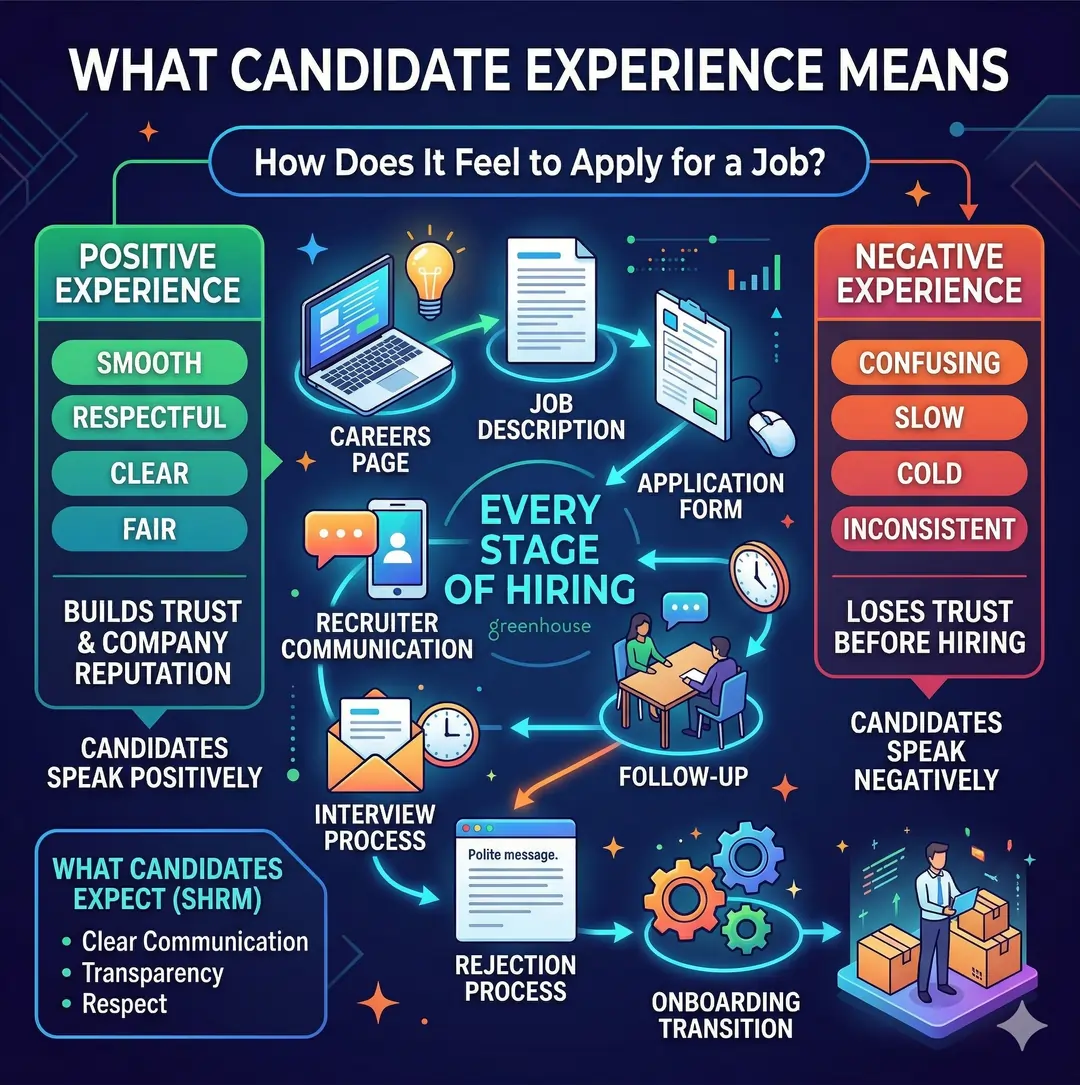
Candidate experience is the overall impression a job seeker forms while interacting with your hiring process. That includes your careers page, job description, application form, recruiter communication, interview process, follow-up, rejection process, and onboarding transition. Greenhouse says it covers every stage of hiring, and it can strongly influence whether candidates speak positively or negatively about your company later.
In simple terms, candidate experience answers this question: “How does it feel to apply for a job at this company?”
If the answer is smooth, respectful, clear, and fair, you are doing well. If the answer is confusing, slow, cold, or inconsistent, you are losing trust before a person even becomes an employee. SHRM notes that candidates expect clear communication, transparency, and respect throughout the process.
Why Candidate Experience Matters So Much
A good hiring process does more than fill roles. It shapes how people see your company in the market. Greenhouse explains that candidate experience influences employer brand, retention, referrals, quality of applicants, and diversity and inclusion. That means a better process is not just a nice gesture. It is a business advantage.
The cost of a poor process is very real. Greenhouse found that 52% of US candidates were ghosted after an interview, while SHRM reported that poor candidate-first practices can reduce offer acceptance and extend time-to-hire. In the UK, Greenhouse reported that 42% of candidates had been ghosted, and historically underrepresented groups were more likely to experience it.
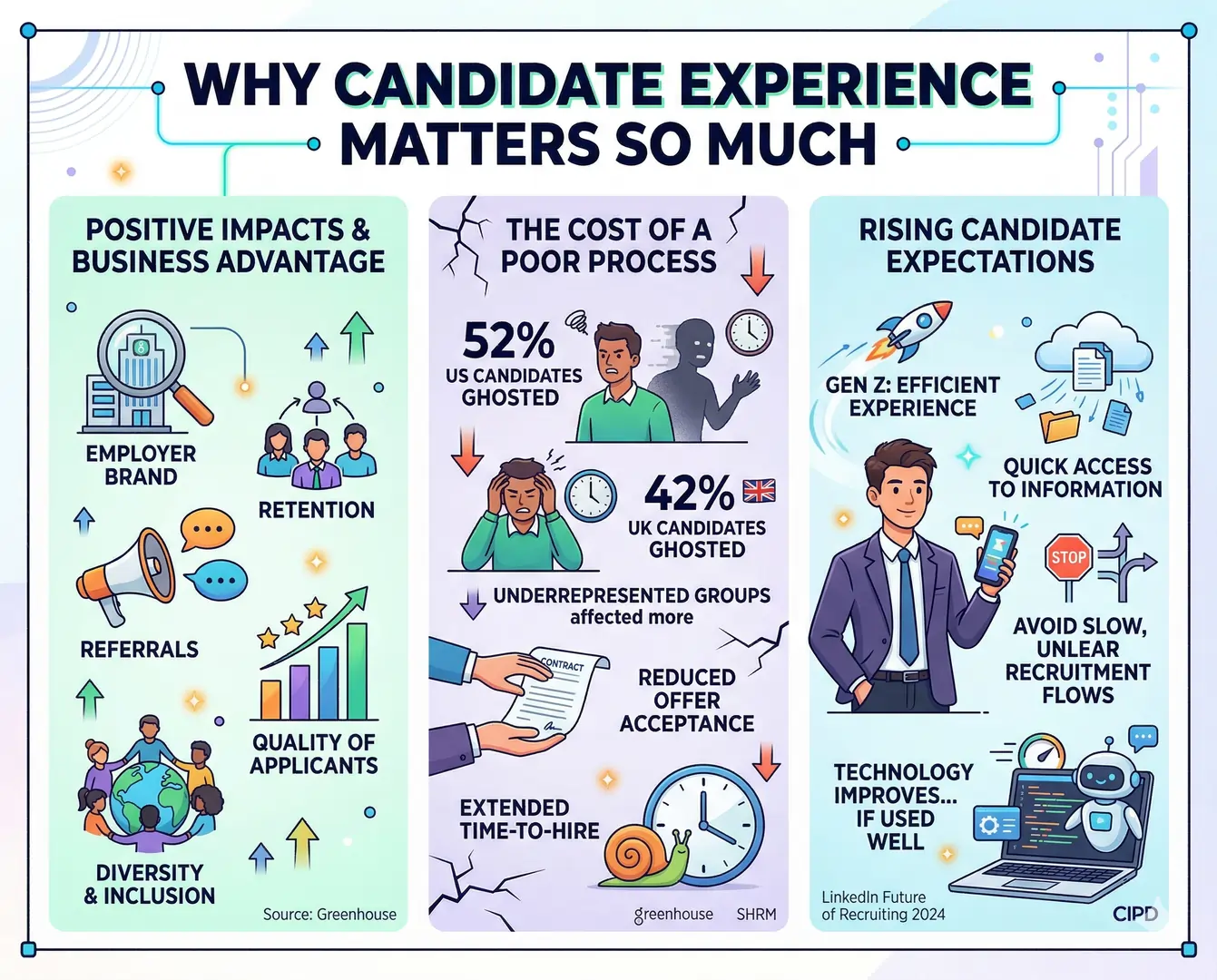
Candidate expectations are also rising. LinkedIn’s Future of Recruiting 2024 says Gen Z candidates expect an efficient candidate experience and quick access to information, which means slow, unclear, or clunky recruitment flows can feel outdated very fast. CIPD also notes that organizations increasingly report that technology has improved candidate experience and sped up recruitment, but only when it is used well.
The Core Principles of a Great Candidate Experience
Before changing tools or templates, it helps to understand the basic principles behind a strong experience.
1. Clarity
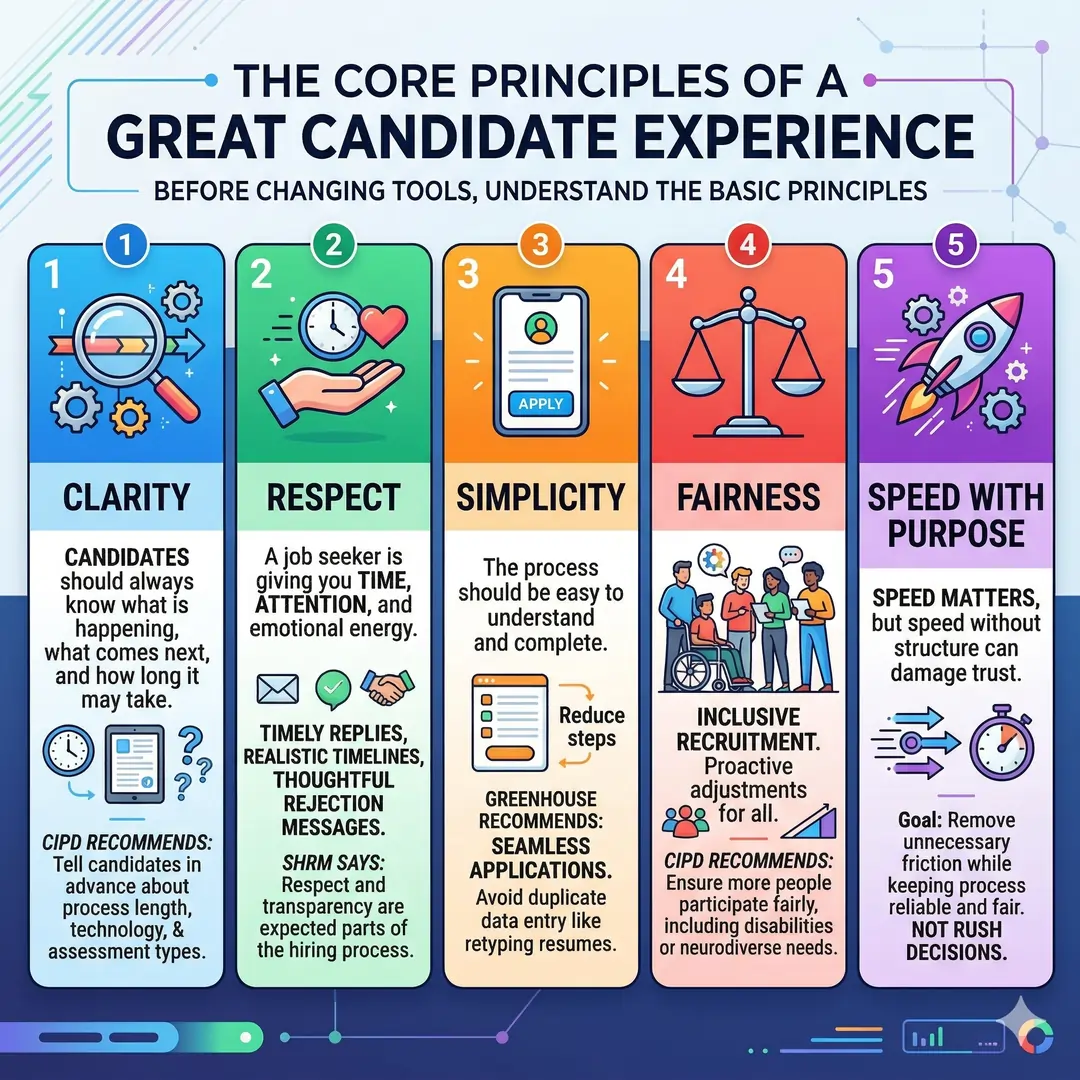
Candidates should always know what is happening, what comes next, and how long it may take. CIPD recommends telling candidates in advance what to expect, including process length, technology used, and the type of assessment involved.
2. Respect
A job seeker is giving you time, attention, and often emotional energy. Respect shows up in timely replies, realistic timelines, and thoughtful rejection messages. SHRM says respect and transparency are now expected parts of the hiring process.
3. Simplicity
The process should be easy to understand and easy to complete. Greenhouse recommends making applications seamless and avoiding duplicate data entry, like asking candidates to upload a resume and then retype everything manually.
4. Fairness
Good candidate experience is also about inclusive recruitment. CIPD recommends proactive adjustments during recruitment so more people can participate fairly, including those with disabilities or neurodiverse needs.
5. Speed with purpose
Speed matters, but speed without structure can damage trust. The goal is not to rush every decision. The goal is to remove unnecessary friction while keeping the process reliable and fair.
How to Improve Candidate Experience Step by Step
1. Make the application process simple
The application is often the first real test of your candidate experience. If it feels long, repetitive, or difficult on mobile, many people will leave before they finish. Greenhouse states that more than 70% of candidates will not complete an application if it takes longer than 15 minutes, which makes simplicity essential.
A better application should be:
- Short
- Mobile-friendly
- Clear
- Fast to complete
- Free from unnecessary repetition
Practical example
Instead of asking for a resume, cover letter, work history, salary expectations, location, and multiple repeated fields on one screen, break the process into the smallest useful steps. Ask only for what you need at the beginning. Save deeper questions for later stages.
Best practices
- Keep the form as short as possible
- Remove duplicate questions
- Let candidates apply from a phone
- Show progress if the application has multiple pages
- Tell candidates how long the form should take
Greenhouse recommends building the process so that candidates do not have to re-enter the same details they already provided.
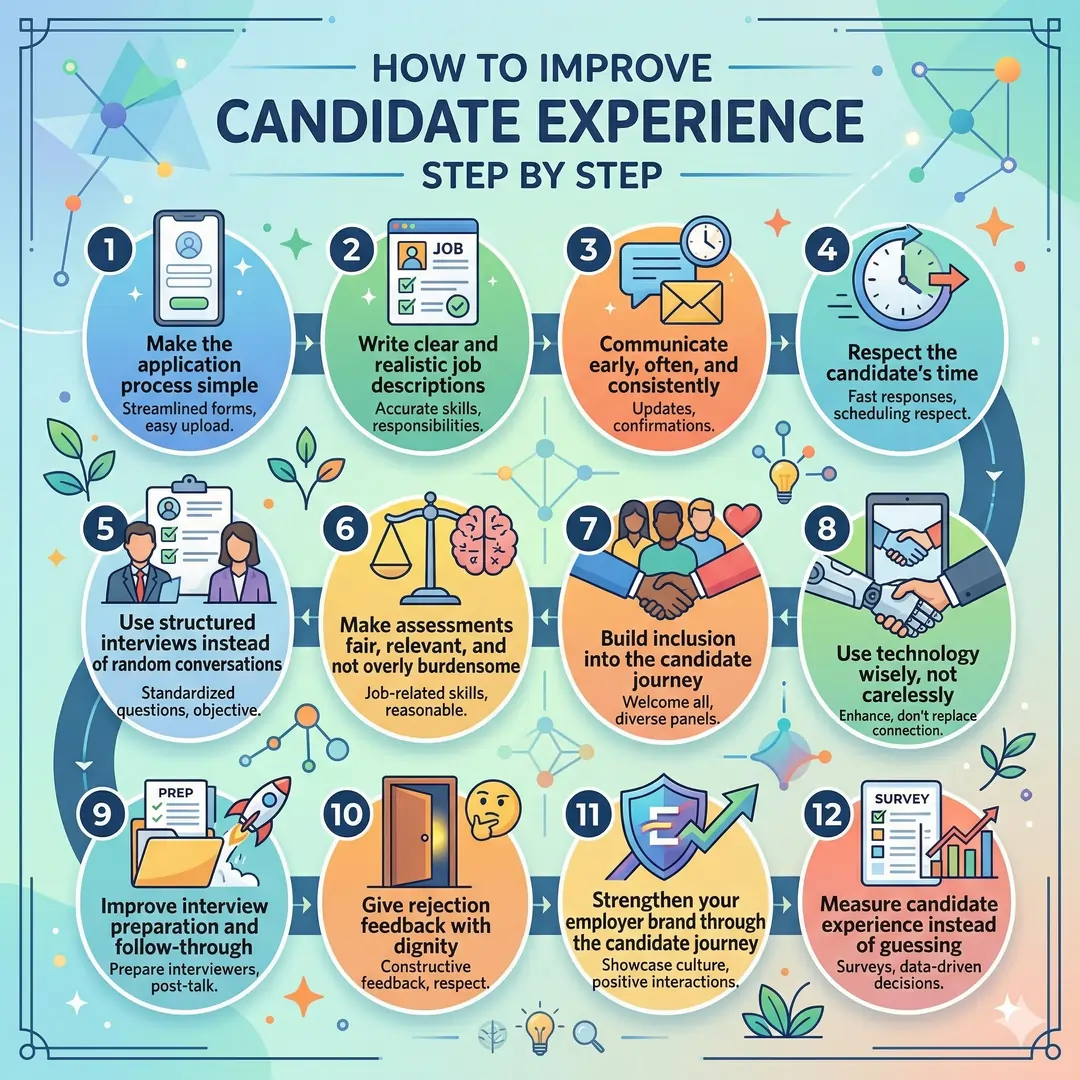
2. Write clear and realistic job descriptions
A poor job description creates confusion before the application even begins. A strong one helps candidates decide whether they fit the role, which saves time for everyone.
A good job description should explain:
- The actual responsibilities
- The must-have skills
- The nice-to-have skills
- The reporting line
- The work arrangement, such as remote, hybrid, or on-site
- The salary range, if possible
- The expected success outcomes for the role
Greenhouse says job descriptions should be clear and realistic, and they should highlight the crucial skills and expectations needed for success.
Example
Weak job description:
“Looking for a rockstar who can do everything and thrive in a fast-paced environment.”
Better job description:
“We are looking for a marketing associate who can manage email campaigns, coordinate with design, and report performance metrics weekly. Experience with HubSpot and basic analytics is preferred.”
The second version is specific, honest, and much more useful.
3. Communicate early, often, and consistently
This is one of the biggest drivers of candidate satisfaction. People do not expect every answer immediately, but they do expect to be informed.
Greenhouse says a great candidate experience always tells candidates what to expect next, starting with the “we received your resume” message and continuing through reminder emails, thank-you emails, and prompt responses. SHRM also emphasizes that candidates want clear communication and transparency.
What communication should include
- Confirmation that the application was received
- Timeline for review
- Interview instructions
- Interview format and duration
- Follow up after each stage
- Decision updates, even if the answer is no
A simple communication rule
Never let the candidate wonder, “What happens now?”
That one question is where frustration often begins.
Example
A candidate finishes a final interview and hears nothing for three weeks. Even if the company is still deciding, the silence feels disrespectful.
A better approach is to send a short update:
“We are still completing final evaluations and expect to share an update by Friday.”
That small message can change the entire tone of the experience.
4. Respect the candidate’s time
Respecting time is one of the clearest signs of a candidate-first hiring process. Greenhouse reports that 61% of candidates said it took 15 minutes or less to complete a job application, while the same report notes that many candidates abandon forms that take too long. SHRM also warns that poor candidate experience can extend time-to-hire and reduce offer acceptance.
How to save candidate time
- Combine interviews where possible
- Avoid asking the same question in multiple stages
- Use structured interview guides
- Start and end interviews on time
- Share prep materials in advance
- Avoid unnecessary assignment tasks
Practical example
Instead of scheduling four separate 30-minute calls with four people, consider one well-planned panel interview with a clear agenda. This can reduce fatigue and improve efficiency.
5. Use structured interviews instead of random conversations
A structured interview improves fairness and makes the process easier for candidates to understand. CIPD notes that recruitment often includes interviews, skill-based assessments, psychometric testing, and assessment centres, and it recommends telling candidates in advance what the process will involve.
Structured interviews usually work better because they:
- Ask the same core questions to all candidates
- Focus on job-related skills
- Reduce bias
- Make comparison easier
- Help candidates prepare more effectively
Example
Instead of asking one candidate about teamwork and another about hobbies, ask both:
“Tell us about a time when you solved a conflict in a team project.”
That makes the process more consistent and easier to trust.
6. Make assessments fair, relevant, and not overly burdensome
Tests and work samples can be valuable, but only when they are relevant to the job. CIPD says selection should include methods such as skill-based assessment tasks, and that recruiters should ensure the process is not unnecessarily long.
Good assessments are
- Relevant to real job tasks
- Short enough to respect time
- Clearly explained
- Fair to candidates with different backgrounds
- Scored using consistent criteria
Poor assessments are
- Too long
- Unrelated to the role
- Vague
- Hard to complete without unpaid labor
- A surprise after the interview has already started
Practical example
If hiring for a content writer, a short writing sample is reasonable. Asking for a full campaign strategy, a detailed content calendar, and a complete brand analysis may be excessive unless it is truly necessary and clearly compensated or limited.
7. Build inclusion into the candidate journey
Inclusive recruitment is not only ethical. It also improves reach and quality. CIPD recommends proactively asking applicants whether they need reasonable adjustments and providing support during recruitment rather than waiting until after hiring. It also notes that technology is widely seen to increase accessibility.
Ways to improve inclusion
- Use clear language in job ads
- Avoid jargon and unnecessary corporate language
- Offer accessible interview formats
- Provide reasonable adjustments early
- Include diverse interview panels where possible
- Review screening criteria for bias
Why this matters
A candidate may be highly capable but still struggle if the process is built for only one type of person. A better system helps more qualified people show what they can do.
8. Use technology wisely, not carelessly
Technology can improve candidate experience, but only when it supports the process instead of making it colder or more confusing. CIPD found that 78% of organisations increased their use of technology in recruitment and onboarding over the last 12 months, and 31% used some form of AI or machine learning. It also says technology is widely viewed as improving accessibility and speeding up recruitment.
Greenhouse says automation can keep candidates in the loop through real-time status updates, easier applications, and more transparent workflows.
Useful technology
- Application tracking systems
- Automated confirmation emails
- Interview scheduling tools
- Candidate portals
- Accessibility-friendly forms
- Automated reminders
Technology to be careful with
- Overly rigid AI filters
- Forms that break on mobile
- Chatbots that cannot solve real problems
- Tools that create more steps instead of fewer
Simple rule
Use technology to remove friction, not to hide the human side of hiring.
9. Improve interview preparation and follow-through
A smooth interview process starts before the call and continues after it ends. Greenhouse recommends telling candidates what to expect, and it also emphasizes reminders, thank-you messages, and prompt responses.
What candidates should know before an interview
- Who will they speak with
- The interview format
- Expected duration
- Topics likely to be discussed
- Whether there is a task or a test
- Any technical or access instructions
After the interview
- Send a thank-you note
- Share the next step timeline
- Keep the candidate updated
- Do not disappear
Example
A recruiter sends a calendar invite with no agenda, no names, and no explanation. The candidate spends the night guessing what the interview will be about.
A better approach is to send:
“Your interview will be 45 minutes with Priya, our hiring manager, and Sam from the team. We will discuss your experience in project coordination, stakeholder communication, and problem-solving.”
That is respectful and simple.
10. Give rejection feedback with dignity
Rejection is part of hiring, but it does not have to feel cold. SHRM notes that a considerate approach to rejection is a major part of building a positive candidate experience. Greenhouse also says rejection, thank-you, and reminder emails are part of a healthy process.
A respectful rejection should
- Be timely
- Be polite
- Avoid false hope
- Be clear enough to close the loop
- Include useful feedback where appropriate
Why this matters
A candidate who is rejected well may apply again later, refer others, or speak positively about the company. Greenhouse notes that good candidate experience can strengthen employer brand and keep relationships healthy over time.
Example
Instead of sending a generic “We have decided to move forward with other candidates,” consider:
“Thank you for taking the time to interview with us. We appreciated your experience, but we are moving forward with a candidate whose background more closely matches our current need for advanced reporting tools. We encourage you to apply again for future roles that fit your skill set.”
That feels more human and more useful.
11. Strengthen your employer brand through the candidate journey
Your hiring process is part of your brand. Candidates remember how they were treated, and they often talk about it online or in their network. Greenhouse says a strong candidate experience can build a positive employer brand, while a weak one can damage it.
Brand signals that candidates notice
- How fast you respond
- How clearly you explain the job
- Whether your process feels fair
- Whether your values match your actions
- Whether interviewers are prepared
Practical example
If your careers page says “people-first culture,” but candidates are ghosted after interviews, the mismatch is obvious. SHRM warns that companies must align recruitment tactics with broader workplace policies or else the promise made externally will not hold up.
12. Measure candidate experience instead of guessing
You cannot improve what you do not measure. Greenhouse recommends using candidate surveys and looking at data such as application process, time to hire, and communication metrics to find points of friction. It also advises reviewing feedback continuously instead of letting it sit unused.
Useful candidate experience metrics
- Application completion rate
- Drop-off rate at each stage
- Interview no-show rate
- Time to first response
- Time to hire
- Candidate satisfaction score
- Candidate Net Promoter Score
- Offer acceptance rate
- Reapplication rate
What the data tells you
- High drop-off may mean the application is too long
- Slow response rates may mean your process is too manual
- Low offer acceptance may signal weak communication or a poor fit
- Negative survey comments may reveal hidden friction points
Table 1: Candidate Experience Improvements by Hiring Stage
| Hiring stage | Common problem | Better approach | Example of improvement | Why it matters |
|---|---|---|---|---|
| Job post | Vague or exaggerated language | Use clear, honest job descriptions | Replace buzzwords with real responsibilities | Helps candidates self-select correctly |
| Application | Too many fields and repeated questions | Keep the form short and mobile-friendly | Ask only essential questions first | Reduces drop-off and frustration |
| Screening | Long silence after application | Send automated receipt and timeline updates | “We received your application and will review it by Friday” | Builds trust early |
| Interview setup | Confusing invites and no prep | Share interviewer names, format, and agenda | Add role-specific context and timing | Lowers anxiety and improves readiness |
| Interview process | Unstructured or inconsistent questions | Use a structured interview guide | Ask the same core questions to all candidates | Improves fairness and comparison |
| Assessment | Too long or unrelated tasks | Keep tasks job-relevant and concise | Use a short work sample linked to the role | Respects time and improves validity |
| Decision stage | No feedback or late updates | Close the loop quickly and respectfully | Send a timely decision email with clear next steps | Protects employer brand |
| Rejection | Cold, generic, or unclear messages | Write polite, specific rejection notes | Thank the candidate and give appropriate feedback | Encourages future applications |
| Onboarding handoff | The candidate experience ends at the offer | Continue communication into onboarding | Share a welcome plan and first-week outline | Creates continuity and trust |
Greenhouse and CIPD both support the idea that candidate experience spans the full journey and improves when communication, accessibility, and process clarity are built into each stage.
Table 2: Metrics That Help You Improve Candidate Experience
| Metric | What it shows | Healthy direction | Why it matters |
|---|---|---|---|
| Application completion rate | How many people finish applying | Higher is better | Shows whether your form is easy to use |
| Drop-off rate | Where candidates leave the process | Lower is better | Reveals friction points |
| Time to first response | How quickly candidates hear back | Faster is better | Strong indicator of respect and responsiveness |
| Time to hire | How long hiring takes overall | Shorter is usually better, within reason | Impacts candidate patience and business speed |
| Interview no-show rate | How many candidates miss interviews | Lower is better | Often reflects communication quality |
| Offer acceptance rate | How many candidates say yes | Higher is better | Reflects trust and process quality |
| Candidate satisfaction score | How candidates rate the journey | Higher is better | Direct feedback on the process |
| Reapplication rate | Whether rejected candidates return later | Higher is better | Suggests the process felt respectful |
These metrics matter because SHRM says weak candidate experience can hurt offer acceptance and time-to-hire, while Greenhouse recommends reviewing communication metrics and friction points to improve the process.
Table 3: Common Candidate Experience Mistakes and How to Fix Them
| Mistake | What it looks like | Why it hurts | Better fix |
|---|---|---|---|
| Ghosting candidates | No reply after interview or application | Creates resentment and damages reputation | Send updates and closure messages |
| Overly long applications | Repeating the same data in multiple fields | Candidates quit early | Shorten forms and remove duplication |
| Vague job descriptions | Generic wording and unrealistic expectations | Attracts the wrong applicants | Be specific about duties and skills |
| Unprepared interviewers | Interviewers ask random questions | Feels unprofessional and unfair | Train interviewers and use guides |
| Slow decisions | Weeks of silence between stages | Talented candidates may leave | Set decision timelines and stick to them |
| Inaccessible process | No accommodations or unclear format | Excludes qualified candidates | Ask proactively about adjustments |
| Generic rejection emails | Cold, copy-paste messages | Damages brand and trust | Write respectful, concise notes |
| Unused feedback | Surveys collected but never reviewed | Problems repeat | Review feedback and act on it |
Greenhouse’s candidate experience guidance repeatedly emphasizes communication, feedback, and removing friction, while CIPD highlights clarity, adjustments, and fair selection methods.
A Simple Candidate Experience Improvement Checklist
Use this as a quick internal audit for your hiring process:
- Can a candidate understand the role in under one minute?
- Can they apply without frustration on mobile?
- Do they know the timeline after applying?
- Do interviewers share the same structure and expectations?
- Are reasonable adjustments offered proactively?
- Is feedback collected and reviewed regularly?
- Are candidates informed even when the answer is no?
- Does the process feel human, respectful, and fair?
If the answer to several of these questions is no, there is room for improvement.
A Realistic Example of a Better Candidate Journey
Here is what a strong candidate journey can look like in practice.
A person sees a job post that clearly explains the role, salary range, work setup, and key responsibilities. They apply on a mobile phone in under 10 minutes. Immediately, they receive confirmation and a timeline. A recruiter follows up within a few days. The interview invite includes names, agenda, and preparation tips. The interview starts on time. Questions are consistent and job-related. After the interview, the recruiter sends a polite update. Whether the candidate is hired or rejected, they receive closure. If hired, the onboarding transition feels smooth and welcoming. That is a process people remember in a positive way. Greenhouse says the experience continues through onboarding, and that strong experience supports employer brand and candidate trust.
Final Thoughts
Improving candidate experience is not about adding polish for the sake of appearance. It is about removing friction, showing respect, and building a hiring process that feels clear, fair, and human. The best recruiting teams communicate well, keep the process simple, use technology wisely, and measure what candidates actually experience. SHRM, CIPD, LinkedIn, and Greenhouse all point in the same direction. The companies that win talent are the ones that treat candidates like people, not like paperwork.
A better candidate experience does more than improve hiring. It improves your reputation, your relationships, and your chances of turning good applicants into great employees. That is a result worth building carefully.
Key Citations and Article Reference
- Greenhouse. What Is Candidate Experience?
Available at: https://www.greenhouse.com/resources/glossary/what-is-candidate-experience - Greenhouse. How to Create a Great Candidate Experience
Available at: https://www.greenhouse.com/blog/great-candidate-experience - Greenhouse. Candidate Experience: Definition, Tips & Best Practices
Available at: https://www.greenhouse.com/candidate-experience - Greenhouse. Candidate Experience Survey Report (2024)
Available at: https://grnhse-marketing-site-assets.s3.amazonaws.com/production/greenhouse-candidate-survey-april-2024.pdf - SHRM (Society for Human Resource Management). Recruiting Strategies and Talent Trends 2025
Available at: https://www.shrm.org/topics-tools/research/2025-talent-trends/recruiting-strategies - SHRM. Candidate Experience Research and Insights
Available at: https://www.shrm.org/topics-tools/news/talent-acquisition/candidate-experience-talent-board-research-candes - CIPD (Chartered Institute of Personnel and Development). Selection Methods Factsheet
Available at: https://www.cipd.org/en/knowledge/factsheets/selection-factsheet/ - LinkedIn Talent Solutions. Future of Recruiting Report 2024
Available at: https://business.linkedin.com/content/dam/me/business/en-us/talent-solutions/resources/pdfs/future-of-recruiting-2024.pdf
Read These Articles in Detail
Frequently Asked Questions (FAQs)
FAQ 1: What is candidate experience in recruitment?
Candidate experience is the full impression a job seeker gets while moving through your hiring process. It begins the moment they see your job post and continues through the application, screening, interview stages, feedback, offer, rejection, and even onboarding. In simple terms, it is the answer to one important question: How does it feel to apply for a job at your company?
A strong candidate experience feels clear, respectful, and organized. Candidates know what to expect, how long each step may take, and what comes next. A poor candidate experience, on the other hand, feels slow, confusing, and impersonal. That is why candidate experience is now seen as a major part of recruitment success, employer branding, and long-term hiring quality.
FAQ 2: Why is candidate experience so important for hiring success?
Candidate experience matters because it directly affects how people view your organization. When candidates feel respected and informed, they are more likely to stay engaged, accept offers, and speak positively about your company. When they feel ignored or frustrated, they may leave the process early or share negative feedback with others. That can weaken your employer brand and make future hiring harder.
It also affects business results in practical ways. A better candidate experience can improve offer acceptance rates, reduce time to hire, and help attract stronger applicants in the future. Even candidates who are not selected may apply again later if they had a positive experience. In that sense, candidate experience is not just a hiring detail. It is a long-term investment in your talent pipeline.
FAQ 3: How can a company improve the application process for candidates?
The best way to improve the application process is to make it short, simple, and mobile-friendly. Many candidates drop out when forms are too long or repetitive. A good application should ask only for the information that is truly needed at the start. If the process can be completed quickly, more people will finish it and fewer candidates will give up halfway through.
It also helps to remove unnecessary friction. Do not make candidates enter the same details twice, and avoid asking for too many extra steps before they even know whether they are interested in the role. Clear instructions, progress indicators, and easy upload options can make a big difference. A smooth application process shows candidates that your company respects their time from the very beginning.
FAQ 4: What role does communication play in candidate experience?
Communication is one of the most important parts of candidate experience because it keeps people informed and reduces uncertainty. Candidates want to know whether their application was received, when they can expect an update, what the interview process looks like, and when a decision will be made. When communication is clear and timely, the process feels more professional and trustworthy.
Poor communication often creates the biggest frustration. Silence after an application or interview can make candidates feel ignored, even if the company is simply busy. That is why consistent updates matter so much. Even a short message explaining the next step can improve the experience. Good communication does not mean promising too much. It means being honest, responsive, and respectful throughout the process.
FAQ 5: How do job descriptions affect candidate experience?
A job description is often the first real contact a candidate has with your company, so it sets the tone for the entire hiring journey. If the description is vague, overloaded with buzzwords, or unrealistic, it can confuse candidates and attract the wrong applicants. A clear job description helps the right people decide whether they are a good fit before they apply.
A strong job description should explain the main responsibilities, the must-have skills, the work environment, and the kind of person who is likely to succeed in the role. It should also avoid exaggeration and unnecessary jargon. When candidates understand the job clearly, they feel more confident about applying, and your hiring process becomes more efficient. That is a win for both sides.
FAQ 6: Why is a structured interview better for candidate experience?
A structured interview improves candidate experience because it makes the process more fair, consistent, and easier to understand. In a structured interview, all candidates are asked a similar set of relevant questions. That helps create a level playing field and makes it easier to compare responses based on skills and experience rather than personal style or chance.
It also helps candidates prepare more confidently. When they understand the format, they can focus on showing how they fit the role instead of trying to guess what the interviewer wants. Structured interviews also reduce confusion and bias, which improves both fairness and hiring quality. For many organizations, this is one of the simplest and most effective ways to make the process better for everyone involved.
FAQ 7: What are the biggest mistakes companies make in candidate experience?
One of the biggest mistakes is ghosting candidates, which means leaving them without updates after they apply or interview. This creates frustration and can seriously damage your reputation. Another common mistake is making applications too long or complicated. If candidates must fill out too many forms or repeat the same information, many will simply walk away.
Other mistakes include unclear job descriptions, unprepared interviewers, slow decision-making, and generic rejection emails. These issues may seem small individually, but together they create a poor overall impression. The good news is that most of these problems are easy to fix with better planning, better communication, and a more human approach to hiring. Small improvements can create a much better experience very quickly.
FAQ 8: How does technology improve candidate experience?
Technology can make the candidate experience much better when it is used in the right way. Tools like application tracking systems, automated emails, and interview scheduling software can reduce delays and keep candidates informed. These tools save time for recruiters and also make the process feel smoother for applicants.
At the same time, technology should never make the process feel cold or robotic. The best use of technology is to remove unnecessary friction, not to replace human connection. For example, automated reminders, easy online forms, and mobile-friendly portals can make hiring more convenient. But candidates still need real communication, real feedback, and real respect. The best systems combine efficiency with a human touch.
FAQ 9: Why is inclusion important in candidate experience?
Inclusion is important because every candidate should have a fair chance to show their ability. A hiring process that only works for one type of person can unintentionally exclude strong candidates who need different support. That is why accessible forms, clear language, reasonable adjustments, and flexible interview options matter so much.
An inclusive candidate experience also helps companies attract a wider range of talent. When people feel welcome and supported, they are more likely to apply and stay engaged in the process. Inclusion is not only about fairness. It is also about creating a better talent pool and making sure your hiring process reflects the kind of workplace you want to build. A company that values inclusion usually creates a stronger and more trusted recruitment brand.
FAQ 10: How can companies measure and improve candidate experience over time?
Companies can measure candidate experience by looking at both data and feedback. Useful metrics include application completion rate, drop-off rate, time to first response, time to hire, offer acceptance rate, and candidate satisfaction score. These numbers help show where the process is working and where candidates may be getting frustrated or confused.
Feedback is just as important as metrics. Short candidate surveys after applications or interviews can reveal problems that data alone may not show. Once the information is collected, the most important step is to act on it. If candidates are saying the process feels too long, make it shorter. If they want clearer communication, improve updates. Continuous improvement is the key. Candidate experience is not something you fix once. It is something you keep refining as your hiring needs evolve.
FAQ 11: How can a company reduce candidate drop-off during the hiring process?
Candidate drop-off usually happens when the process feels too long, too confusing, or too demanding. Many candidates start with interest but lose patience if the application takes too much time or if they are not sure what happens next. A simple way to reduce this problem is to make every stage easier to complete and easier to understand. Clear instructions, shorter forms, and faster updates can make a big difference.
It also helps to review where candidates are leaving the process. If most people stop during the application stage, the form may be the problem. If they leave after the interview, the communication may be too slow or the process may feel unclear. Reducing drop-off is often about removing unnecessary friction and showing candidates that their time is valued.
FAQ 12: What makes a candidate feel respected during recruitment?
A candidate feels respected when the hiring process treats them like a person, not just a resume. This begins with timely communication and continues through every stage of the journey. When recruiters answer questions clearly, send updates on time, and explain each step honestly, candidates feel more comfortable and more confident about the company.
Respect also shows up in small details. Starting interviews on time, asking thoughtful questions, and giving clear next steps all send a strong message. Even if a candidate is not selected, a respectful process leaves a positive impression. In many cases, that respectful treatment becomes part of the company’s reputation in the job market.
FAQ 13: Why should companies give feedback to candidates after interviews?
Giving feedback after interviews helps candidates understand where they stand and what the company is looking for. Even a short, thoughtful response can make the experience feel more complete and less discouraging. Feedback shows that the company paid attention and took the conversation seriously.
It also helps build stronger relationships for the future. A candidate who receives helpful feedback may be more likely to apply again, recommend the company to others, or speak positively about the process. Feedback does not need to be long or overly detailed. It only needs to be honest, respectful, and useful where appropriate.
FAQ 14: How does candidate experience affect employer branding?
Candidate experience has a direct effect on employer branding because it shapes what people think and say about your company. If the hiring process is smooth, clear, and respectful, candidates are more likely to view the organization as professional and trustworthy. That positive impression can help attract better applicants in the future.
On the other hand, a poor hiring experience can damage your reputation very quickly. People often share negative experiences with friends, colleagues, or online communities. That means every application, interview, and rejection message becomes part of your brand story. A strong employer brand is not built only through marketing. It is built through real actions during recruitment.
FAQ 15: What is the best way to keep candidates informed during hiring?
The best way to keep candidates informed is to create a simple communication routine and follow it consistently. Candidates should know when they have applied, what happens next, and how long they should expect to wait. Even if there is no final decision yet, a short progress update can reduce anxiety and keep the process moving in a positive direction.
Good communication does not need to be complicated. Automated acknowledgment emails, interview confirmations, and short status updates can make candidates feel supported. The important part is consistency. When people are left guessing, the experience becomes stressful. When they are kept informed, the process feels more organized and more professional.
FAQ 16: How can hiring teams make interviews more candidate-friendly?
A candidate-friendly interview is one that feels organized, fair, and easy to prepare for. The first step is to explain the format in advance. Candidates should know who they will meet, how long the interview will last, and what type of topics may come up. This helps reduce stress and allows them to show their best work.
It also helps to keep the interview focused on the role. Interviewers should ask job-related questions and avoid turning the conversation into an unstructured chat. Starting and ending on time also matters. When an interview feels respectful and well-planned, candidates are more likely to trust the company and stay engaged in the process.
FAQ 17: Why is mobile-friendly hiring important for candidate experience?
Mobile-friendly hiring is important because many candidates search for jobs and apply using their phones. If the application form is hard to read, slow to load, or difficult to complete on mobile, people may give up before they finish. A mobile-friendly process makes it easier for candidates to apply whenever and wherever they are ready.
This matters especially for busy professionals, younger applicants, and people who do not spend much time on a laptop during the day. A clean mobile experience shows that your company understands how people actually apply for jobs today. It also removes a major barrier and helps more qualified candidates complete the process.
FAQ 18: How do reasonable adjustments improve candidate experience?
Reasonable adjustments help candidates take part in the hiring process fairly, especially when they may need support for accessibility, health, or other personal reasons. These adjustments can include different interview formats, extra time for tasks, clearer instructions, or accessible communication methods. When a company offers support proactively, it sends a strong message of inclusion and care.
This kind of flexibility often improves the process for everyone, not only for the candidates who request it. Clearer instructions, better scheduling, and more accessible systems create a smoother experience across the board. Inclusion is not just a legal or ethical issue. It is also a practical way to build a stronger, more welcoming hiring process.
FAQ 19: How can companies use surveys to improve candidate experience?
Candidate surveys are one of the simplest ways to understand what is working and what is not. After an application or interview, a short survey can reveal how candidates felt about the communication, the timeline, the interview quality, and the ease of the process. This gives hiring teams direct feedback instead of making guesses.
The most important part is to act on the results. If candidates keep saying the form is too long, shorten it. If they say communication is too slow, improve the update process. Surveys are only useful when they lead to real change. Over time, this feedback loop can help companies make steady, meaningful improvements in candidate experience.
FAQ 20: What does a strong candidate experience look like from start to finish?
A strong candidate experience feels organized, clear, and human from the very beginning. It starts with a job description that honestly explains the role. It continues with a simple application process, quick confirmation messages, and respectful communication throughout screening and interviews. The candidate always knows what to expect and never feels forgotten.
By the end of the process, the candidate has received feedback, a clear decision, and a sense that the company handled the journey professionally. Even if the answer is no, the experience can still be positive if the process was fair and respectful. That is the real goal of great candidate experience. It creates trust, strengthens employer branding, and helps a company stand out in a competitive hiring market.
