
An employee referral program is one of the simplest ideas in hiring, but it can have a big impact when well-designed. Instead of depending only on job boards, cold outreach, or large application funnels, employers ask current team members to recommend people they trust for open roles. That approach often brings in candidates who are easier to evaluate, more likely to fit the role, and more likely to stay.
In fact, SHRM has reported that employee referrals have long been among the top sources of hires, and recent benchmark reporting still shows referrals as an important hiring channel. Research also suggests that referred workers can be more profitable, less likely to quit, and beneficial to overall workforce retention.
What makes employee referrals so powerful is not only speed. It is trust. A current employee is putting their reputation on the line for a candidate, which often means the referral carries a stronger signal than a random application. That is why referral hiring is often discussed as a smart way to improve candidate quality, reduce time-to-hire, and strengthen retention at the same time. At the same time, referral programs need structure, fairness, and clear rules, because an unmanaged referral system can unintentionally narrow the talent pool and reinforce homophily, the tendency for people to refer others who are similar to them.
Table of Contents
What Is an Employee Referral Program?
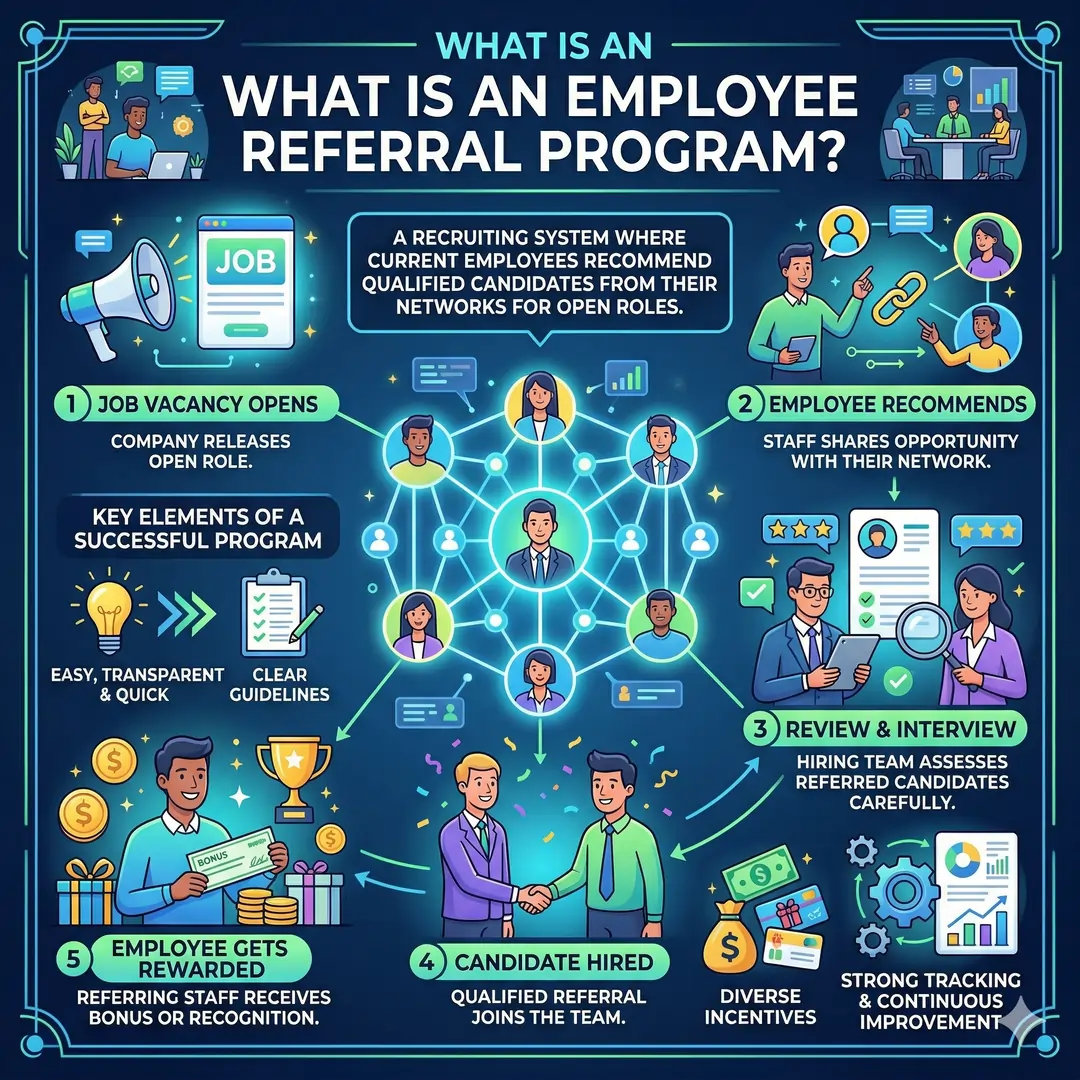
An employee referral program is a recruiting system that encourages current employees to recommend people from their personal or professional networks for job openings. In many companies, employees receive a referral bonus or other reward if the referred candidate gets hired and stays for a certain amount of time. Indeed describes it as a recruiting strategy that helps employers find qualified candidates through recommendations from current staff.
In simple terms, the process usually works like this. A company opens a role, employees share the vacancy with people they know, and the hiring team reviews those referrals with the same care they give other applicants. If the referral goes through the full process and is hired, the referring employee gets recognized or rewarded. The best programs make this process easy, transparent, and quick. Indeed also notes that employers should offer clear guidelines, diverse incentives, and strong tracking so the program can keep improving over time.
Why Employee Referral Programs Matter
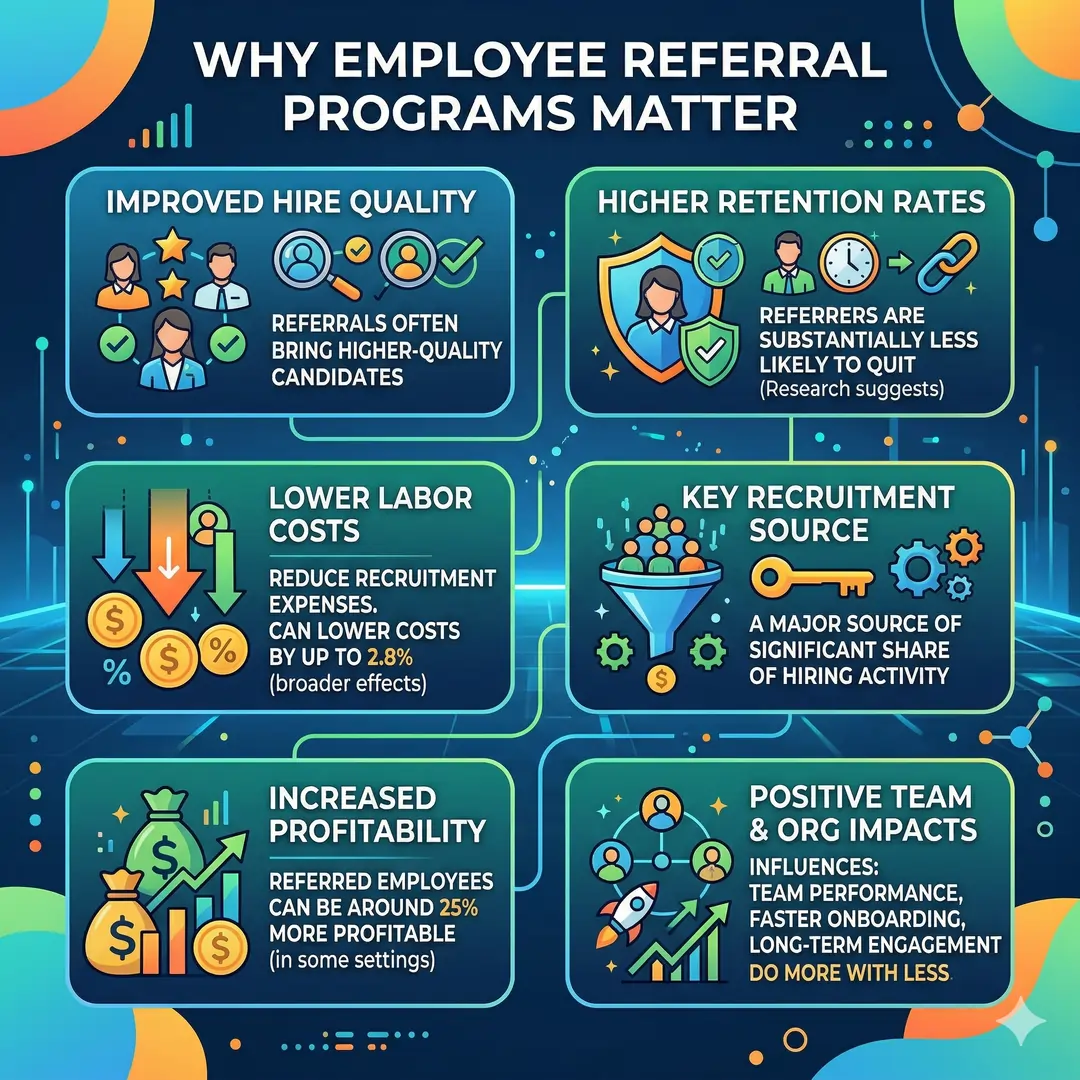
Referral hiring matters because it can improve several parts of recruitment at once. According to Indeed, referrals can improve hire quality and retention, while SHRM has highlighted referrals as a major source of hires. Academic research has found that referred workers can be substantially less likely to quit and can be about 25% more profitable than non-referred workers in some settings. Another study found that employee referral programs can reduce labor costs by up to 2.8%, with only a small part of that coming from the direct retention of referred hires and a much larger share coming from broader retention effects across the workforce.
The real value is that referral programs do not just fill jobs. They often improve the quality of the people entering the organization, which can influence team performance, onboarding speed, and long-term engagement. Recent benchmark data from SmartRecruiters shows that referrals and internal hires continue to account for a meaningful share of hiring activity, and hiring teams still treat these channels as lower-cost sources of hire. That makes referrals especially useful when hiring teams are under pressure to do more with less.
Main Benefits of Employee Referral Programs
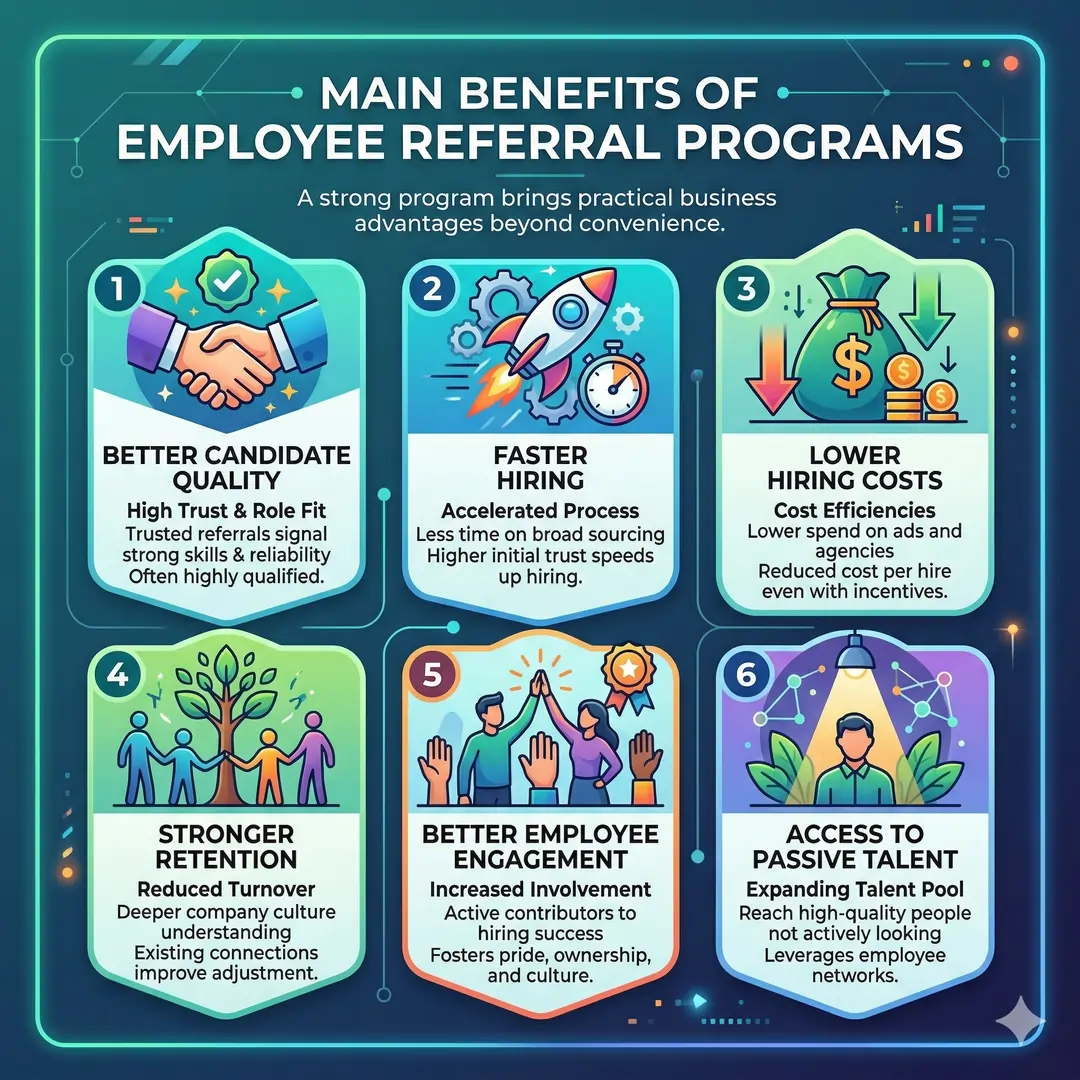
A strong referral program can bring practical business advantages that go beyond convenience. Here are the biggest ones.
1. Better candidate quality
Employees usually refer people they trust, respect, or have worked with before. That means the candidate often arrives with a stronger signal of skill, reliability, and role fit. Indeed notes that referrals can improve hire quality, and employers surveyed by Indeed reported that referred candidates were often seen as highly qualified.
2. Faster hiring
Referral candidates often move faster through the funnel because the initial trust level is higher. Recruiters spend less time on broad sourcing and less time screening weak matches. In a busy hiring environment, that time saved can make a meaningful difference. SmartRecruiters’ 2025 benchmark report also shows that companies increasingly depend on internal sources and referrals as part of efficient hiring systems.
3. Lower hiring costs
When a referral program produces strong candidates earlier, companies may spend less on ads, agency fees, and repeated screening rounds. Indeed notes that an employee referral program can reduce cost per hire, even after factoring in program design and incentive costs.
4. Stronger retention
A referred candidate often understands the company a little better before joining. They may know someone inside the company, which can reduce uncertainty and improve adjustment after hiring. Research has repeatedly found lower turnover among referred employees in many settings.
5. Better employee engagement
Referral programs can also make employees feel more involved in the growth of the company. Instead of being passive workers, they become active contributors to hiring success. That can support pride, ownership, and connection to the organization. Research on referral motivation also shows that incentives alone do not always drive behavior, so the program needs trust, recognition, and a strong culture, not just cash rewards.
6. Access to passive talent
Many high-quality candidates are not actively applying on job boards. They may be open to a better opportunity, but only if the right person reaches out. Employee networks are a natural way to reach those passive candidates. Indeed highlights this as one of the strongest practical advantages of referrals.
How an Employee Referral Program Works in Practice
A good referral program is not complicated, but it should feel organized and fair.
First, the company announces the open role clearly. Employees should be able to understand what the job involves, what skills matter most, and why the role is worth referring. If the role description is vague, the program will produce vague referrals.
Second, employees submit names through a simple process. That might be an ATS form, an internal portal, a quick email flow, or a referral software tool. The easier it is to refer someone, the more likely employees are to participate. Indeed recommends making the process easy and promoting the program regularly.
Third, the recruiting team screens the referral just like any other candidate, but with better context. The referring employee can provide useful details about the person’s strengths, work style, and likely fit. That extra context can help hiring teams make better decisions.
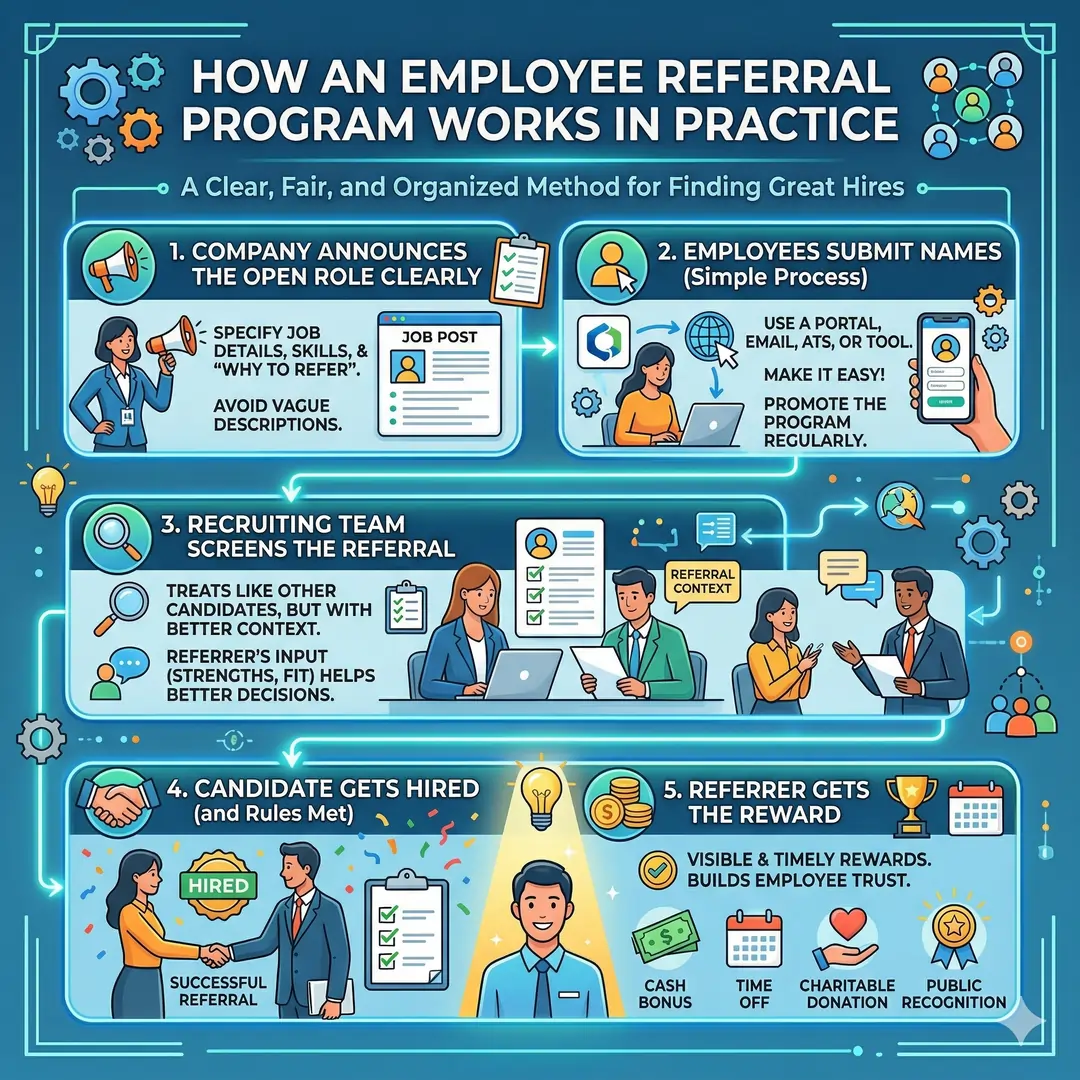
Fourth, if the candidate gets hired and meets the program rules, the referrer gets the reward. The reward can be cash, time off, public recognition, charitable donations, or another meaningful incentive. The key is to make the reward visible and timely enough that employees trust the program.
Core Elements of a Strong Referral Program
| Program Element | What It Should Include | Why It Matters | Simple Example |
|---|---|---|---|
| Clear job information | A precise role summary, must-have skills, and location or work model | Helps employees know who is worth referring | A sales role lists quota expectations, required years of experience, and remote or onsite status |
| Easy submission process | A short form, portal, or one-click referral option | Increases participation and lowers friction | Employees submit a referral in under two minutes |
| Defined reward rules | Clear eligibility, payout timing, and any hold period | Prevents confusion and distrust | Bonus paid after the hire completes 90 days |
| Fast candidate follow-up | A response window for referrals and timely next steps | Keeps candidates engaged and protects the employer brand | Recruiter replies within five business days |
| Tracking and reporting | Referral source, conversion rate, and retention data | Shows what is working and what is not | HR tracks referral-to-interview and referral-to-hire rates |
| Manager involvement | Hiring managers help promote roles and give feedback | Makes the program visible across the business | Managers highlight open roles in team meetings |
| Recognition | Public appreciation, thank-you notes, or leaderboards | Builds participation even beyond the cash reward | Monthly shout-out for top referrers |
| Diversity guardrails | Broader outreach, structured evaluation, and bias checks | Reduces the risk of homophily and repetition | The company asks employees to share roles with underrepresented networks too |
A table like this is useful because the success of a referral program rarely depends on one magic feature. It works best when process, communication, incentives, and fairness all work together. That design approach is consistent with guidance from Indeed, benchmark reporting, and academic studies on referral hiring.
Best Practices for Employee Referral Programs
A strong referral program should feel simple to employees and useful to recruiters.
- Make the ask specific
- Do not ask employees to refer anyone and everyone. Ask them to think about particular skills, industries, or job families. Indeed suggests a useful prompt, such as asking who they would work with again, because that tends to surface stronger and warmer referrals.
- Promote the program often
- Many referral programs fail because employees forget they exist. Share open roles in team meetings, newsletters, Slack channels, onboarding sessions, and manager updates. The program should feel like part of normal company life, not a hidden HR initiative.
- Make the reward meaningful, but not the only reason people participate.
- Research suggests that bonuses alone are not always enough to motivate referrals. Employees also care about social trust, fairness, and the chance to help their company grow. A good program combines reward with recognition and purpose.
- Respond quickly to referrals.
- Nothing hurts a referral program faster than slow follow-up. If employees send strong candidates and the company ignores them, participation will fade. Fast communication protects both employee trust and candidate experience.
- Use structured hiring methods.
- Referrals should not bypass normal evaluation. Structured interviews, scorecards, and consistent screening help prevent favoritism and keep hiring quality high. SmartRecruiters’ 2025 benchmark report highlights the role of scorecards and process discipline in efficient hiring systems.
- Track the right data.
- The program should be measured, not guessed at. You need to know how many referrals come in, how many are interviewed, how many are hired, and how long they stay. Indeed specifically recommends tracking referrals to identify improvement opportunities.
Reward Ideas That Employees Actually Care About
| Reward Type | Best For | Strengths | Possible Limitation |
|---|---|---|---|
| Cash bonus | Most standard referral programs | Simple, clear, and easy to understand | May feel too transactional if it is the only motivator |
| Tiered bonus | Hard-to-fill or senior roles | Encourages referrals for critical jobs | Can be confusing if the rules are not clear |
| Extra paid time off | Companies with strong culture focus | Feels personal and appreciated | May not work well in urgent hiring environments |
| Public recognition | Teams that value visibility | Builds pride and repeat participation | Not enough on its own for every employee |
| Gift cards or vouchers | Smaller programs or seasonal campaigns | Flexible and easy to deliver | Can feel less meaningful than cash |
| Charity donation | Mission-driven organizations | Aligns with company values | Not everyone prefers this option |
| Experience-based reward | Culture-heavy workplaces | Creates memorable appreciation | Harder to standardize across teams |
| Spot awards | Fast-moving hiring needs | Rewards action quickly | Needs a tight approval process |
Many employers use a mix of these rewards. Indeed notes that referral bonuses often fall in a broad range and that a mix of incentives can motivate participation. The best reward is not always the biggest one. It is the one employee who actually remembers, trusts, and feels is worth sharing.
What to Measure in an Employee Referral Program
| Metric | What It Tells You | Why It Matters | What Good Looks Like |
|---|---|---|---|
| Referral participation rate | How many employees actually refer candidates | Shows whether the program is visible and trusted | A steady rise after launch or relaunch |
| Referral-to-interview rate | How many referrals are strong enough to reach interviews | Reflects referral quality | Higher than the general applicant conversion |
| Referral-to-hire rate | How many referrals become hires | Shows whether the process is effective | A healthy conversion rate over time |
| Time-to-hire | How quickly the process moves | A strong referral process should reduce delays | Shorter than other sourcing channels |
| Cost-per-hire | How expensive each hire becomes | Important for budgeting and ROI | Lower than agency-heavy sourcing |
| 90-day retention | Whether new hires stay through the early period | Early retention is a strong quality signal | High completion of probation or first quarter |
| 12-month retention | Whether employees remain in the long term | Shows whether the hire was truly a fit | Better than non-referred hires in many cases |
| Source diversity | Who is coming through the pipeline | Helps protect against homophily and narrow networks | Balanced across backgrounds and teams |
These metrics matter because referrals are not just a sourcing channel. They are a business system. Benchmark research and academic work both show that referrals can influence hiring speed, retention, productivity, and cost. Without measurement, the company may see activity but never know whether it is producing real value.
A Simple Step-by-Step Way to Launch One
A strong launch does not need to be flashy. It needs to be clear.
- Step 1: Define the roles you want referrals for.
- Focus first on jobs that are hard to fill, have high turnover, or are highly dependent on trust and skill. Referral programs tend to work especially well when the job needs a strong fit and reliable performance.
- Step 2: Write a plain-language referral policy.
- Employees should know who can refer, how to refer, when the reward is paid, and what happens if the candidate is already in the pipeline. Confusion kills participation.
- Step 3: Make the referral link easy to find.
- Place it in the intranet, onboarding materials, manager toolkits, and internal comms. The less effort it takes to refer, the better the participation usually becomes.
- Step 4: Ask managers to promote it.
- People pay attention when their managers talk about a program. Managers should be able to explain the role, the team, and the type of person who would succeed.
- Step 5: Follow up fast.
- A referral should never disappear into a black hole. A quick thank-you and a clear status update make employees more willing to keep referring.
- Step 6: Review the data monthly.
- Look at participation, quality, diversity, and retention. A referral program should evolve, not just sit in a policy document.
Common Mistakes That Hurt Referral Programs
- Treating referrals like a shortcut
- A referral is not a guaranteed hire. It is still a candidate who must be evaluated carefully. When companies skip structured review, they risk poor hiring decisions and hidden bias.
- Using only one reward type
- Some employees love cash. Others care more about recognition or flexibility. A single reward style can limit engagement. Indeed recommends offering a mix of incentives.
- Ignoring diversity effects
- This is one of the biggest risks. Research and policy analysis have shown that referrals can reproduce existing social networks, which may disadvantage underrepresented groups when the program is left unmanaged. HBR highlighted the risk of pay inequities and a less diverse workforce, while PayScale found that referral systems can disproportionately benefit white men. The Behavioural Insights Team also found that targeted referral approaches can improve gender balance in referral flows when they are designed carefully.
- Not making the process visible enough
- If people cannot remember how to refer, they will not refer. Promotion matters as much as policy.
- Failing to give feedback
- When employees do not hear what happened to their referral, they feel ignored. Even a brief update can improve trust and future participation.
Employee Referrals and Diversity, A Balanced View
Employee referrals are often praised for quality and retention, but they need careful handling to support DEI, not weaken it. The concern is not that referrals are bad by nature. The concern is that people usually know others who are similar to them, which can narrow the funnel if a company depends too heavily on informal networks. Research and reporting have pointed to this risk repeatedly.
The good news is that referral programs can be designed to support broader access. The Behavioural Insights Team found that targeted referral nudges increased the share of women among referrals in a controlled trial, and the result did not create negative effects for other minority groups in that study. That means the real question is not whether referrals should exist. It is whether they are designed with intention. A company can ask employees to share openings beyond their immediate circles, track the diversity of incoming referrals, and use structured hiring methods to keep decisions fair.
A smart referral strategy, therefore, includes both reach and discipline. It should encourage employees to tap into trusted networks while also ensuring that those networks do not become the whole talent pipeline. That balance is what turns referrals from a convenience tool into a serious hiring strategy.
Example of a Good Employee Referral Program in Action
Imagine a mid-sized software company that needs to hire three backend engineers and two customer success specialists. The recruiting team writes short, specific role summaries and shares them internally every Monday. Employees can refer candidates through a simple form that takes less than two minutes. The company offers a cash reward after the hire completes 90 days, plus a public thank-you in the monthly all-hands meeting.
Because the company also uses structured interviews and clear scorecards, referrals do not bypass quality checks. The hiring team reviews them quickly, and employees get status updates within a week. After three months, the company compares referral hires with non-referral hires on retention, performance, and candidate experience. The result is not just more applicants. It is better hiring data, stronger trust, and a program that the team actually wants to keep using.
That is what a well-run referral program looks like in real life. It is not loud. It is efficient, consistent, and easy for people to use.
Why Employee Referral Programs Continue to Matter
Even in a world full of AI tools, job boards, ATS platforms, and automated sourcing systems, referrals still matter because hiring is still a human process. A recommendation from a trusted colleague can reveal things no résumé can show, like work ethic, communication style, and how a person behaves under pressure. Research continues to show that referrals can support better retention and stronger outcomes for firms when they are structured well. Recent benchmark data also shows that referrals and internal sources remain an important part of modern hiring systems.
The strongest companies do not choose between technology and referrals. They combine them. They use software to track the process, scorecards to keep evaluation fair, and employee networks to bring in trusted candidates. That blend is what turns an ordinary hiring approach into a scalable talent strategy.
Conclusion
An employee referral program is one of the most practical ways to improve hiring quality, reduce wasted effort, and strengthen retention. It works because it uses trust, not just traffic. When employees can confidently recommend people they would work with again, employers get access to better candidates and often a faster, more efficient hiring process. Research, benchmark reports, and HR guidance all point in the same direction. Referrals can be highly valuable when the program is clear, measurable, fair, and easy to use.
The best referral programs are not built around luck. They are built around design. Clear rules, strong communication, good incentives, fast follow-up, and diversity safeguards all matter. When those pieces come together, employee referrals become far more than a hiring tactic. They become a reliable part of a company’s long-term talent strategy.
Read These Articles in Detail
- Importance of Recruitment Strategy
- How to Write a Job Description
- Structured Interview Techniques
- How to Improve Candidate Experience
- Employee Onboarding Process: Strong, Confident, and Productive New Hires
- Recruitment Metrics and KPIs: A Guide to Measuring Hiring Success
- Best Recruitment Channels: A Guide to Hiring Better Talent
- Reducing Hiring Bias: A Guide to Fairer And Smarter Recruitment
Article References and Sources
- Society for Human Resource Management (SHRM)
Employee Referrals Remain Top Source of Hires
Available at: https://www.shrm.org/topics-tools/news/talent-acquisition/employee-referrals-remain-top-source-hires - Indeed Hiring Lab / Indeed for Employers
How to Create an Effective Employee Referral Program
Available at: https://www.indeed.com/hire/c/info/5-ways-to-create-an-effective-employee-referral-program - Indeed for Employers
How to Get More Out of Employee Referrals
Available at: https://www.indeed.com/hire/c/info/how-to-get-more-out-of-employee-referrals - SmartRecruiters
Recruitment Benchmarks Report 2025
Available at: https://ta.smartrecruiters.com/rs/664-NIC-529/images/Recruitment-Benchmarks-2025-Report.pdf - Institute of Labor Economics (IZA)
Employee Referrals and Worker Performance (Discussion Paper No. 7382)
Available at: https://ftp.iza.org/dp7382.pdf - Harvard Business Review (HBR)
How to Use Employee Referrals Without Giving Up Workplace Diversity
Available at: https://hbr.org/2018/03/how-to-use-employee-referrals-without-giving-up-workplace-diversity - Behavioural Insights Team (BIT)
Targeted Referrals Can Improve Gender Equality in Recruitment
Available at: https://www.bi.team/blogs/targeted-referrals-can-improve-gender-equality-in-recruitment/ - Wiley Online Library (Human Resource Management Journal)
Employee Referral Hiring and Recruitment Outcomes
Available at: https://onlinelibrary.wiley.com/doi/10.1002/hrm.21895 - National Center for Biotechnology Information (NCBI / PMC)
Social Networks and Hiring Inequality Research Study
Available at: https://pmc.ncbi.nlm.nih.gov/articles/PMC6545990/
Frequently Asked Questions
FAQ 1: What is an employee referral program, and how does it work?
An employee referral program is a hiring method in which current employees recommend people from their own professional or personal networks for open job roles. In simple terms, it turns your existing team into a trusted source of talent. Instead of relying only on job boards or outside agencies, companies ask employees to share openings with people they already know and believe could do well in the role.
The process is usually very straightforward. A company posts a vacancy, employees refer someone they think may be a good fit, the recruiting team reviews the candidate, and if the person is hired and meets the company’s referral rules, the employee receives a reward. A good referral program is easy to understand, easy to use, and designed to make hiring faster while still keeping the process fair and professional. Referral programs work best when the company gives clear role information, quick feedback, and a simple way to submit referrals.
FAQ 2: Why are employee referral programs important for hiring?
Employee referral programs are important because they help companies find candidates who are often more relevant, more reliable, and sometimes better matched to the job. A referral usually comes with a level of trust that a normal application does not always have. When an employee recommends someone, they are putting their own reputation behind that person, which can give hiring teams extra confidence.
These programs also help reduce hiring costs and save time. Recruiters spend less effort searching through large pools of applicants, and they can focus on candidates who already have some level of credibility. Another major advantage is retention. Referred hires often stay longer because they understand the company better before joining and may already know someone inside the organization. That combination of better fit, faster hiring, and stronger retention is why referral programs continue to be widely used.
FAQ 3: What are the main benefits of an employee referral program?
One of the biggest benefits of an employee referral program is higher-quality hiring. Employees usually refer people they trust, so the candidate is often a stronger match for the role, the team, and the company culture. This can make the hiring process smoother and improve the chance of long-term success after onboarding. Referred candidates may also come into the process more prepared because they already understand the company through someone they know.
Another important benefit is cost savings. Referral hiring can reduce the need for expensive job advertising, outside recruiters, and repeated screening rounds. It can also help improve the candidate experience because the process often moves more quickly and feels more personal. On top of that, referral programs can improve employee engagement, since team members feel more involved in the growth of the business. When a company uses referrals well, it creates value for both the employer and the workforce.
FAQ 4: Do employee referral programs really improve retention?
Yes, in many cases they do. A referred employee often enters the company with a stronger sense of what to expect because someone they trust has already explained the role, culture, and team environment. That kind of realistic preview can lower the chances of disappointment after hiring. It also helps the new hire feel less alone during the early stage of employment, especially if they already know a colleague inside the organization.
Retention improves because referred candidates are often more likely to fit the job and the company culture from the start. When someone joins a workplace with better expectations and a built-in connection, they may settle in faster and stay longer. This does not mean every referred hire will stay, but it does mean a thoughtful employee referral strategy can support longer-term success and reduce avoidable turnover.
FAQ 5: What makes a good employee referral program successful?
A successful employee referral program needs more than a reward. It needs clear rules, simple processes, and consistent communication. Employees should know exactly who can be referred, what types of roles are open, how to submit a referral, and when any reward will be paid. If the process feels confusing or slow, people will stop using it. If it feels easy and trustworthy, participation usually improves.
Another key part of success is fast follow-up. Employees want to know that their referrals are being reviewed seriously. Candidates also need to hear back in a reasonable amount of time. In addition, companies should track the program’s results, such as how many referrals become interviews, how many become hires, and how long those hires stay. A strong referral program is not just about collecting names. It is about building a reliable, measurable hiring channel that supports quality, speed, and fairness.
FAQ 6: What kind of rewards work best in an employee referral program?
The best rewards depend on the company culture and what employees value most. Many organizations use a cash bonus because it is simple, direct, and easy to understand. Others offer extra paid time off, gift cards, recognition awards, or charitable donations. The best reward is usually the one that feels meaningful to employees and matches the tone of the workplace.
Some companies use tiered rewards for hard-to-fill roles or for candidates who stay longer after hiring. For example, a company may pay part of the bonus after the hire starts and the rest after 90 days. This can encourage more thoughtful referrals and support retention. It is also important to remember that rewards alone do not drive participation. Employees are more likely to refer others when they trust the company, believe in the role, and feel that the program is fair and well-managed.
FAQ 7: How can companies encourage employees to participate more in referral programs?
The best way to encourage participation is to make the program easy, visible, and rewarding in more than one way. Employees need to see referral opportunities often, not just once during onboarding. Companies can promote open roles in team meetings, internal chat channels, newsletters, and manager updates. The more often employees are reminded about the program, the more likely they are to take part.
It also helps to make the ask specific. Instead of saying, “Refer anyone you know,” companies should explain what kind of person they are looking for and what skills matter most. This makes it easier for employees to think of good candidates. Quick responses, public recognition, and simple referral submission tools also help build momentum. When employees feel that referrals are appreciated and taken seriously, they are far more likely to keep participating in the program.
FAQ 8: Can employee referral programs create bias or limit diversity?
Yes, they can if they are not designed carefully. One of the biggest risks of employee referral programs is homophily, which means people naturally tend to know and recommend others who are similar to them. If a company depends too heavily on referrals without any guardrails, the talent pipeline can become narrower and less diverse over time. That is why referrals should never be the only hiring channel.
The good news is that referral programs can be designed in a more inclusive way. Companies can ask employees to share opportunities with broader networks, track who is being referred, and use structured interviews to keep hiring decisions fair. They can also monitor whether certain groups are underrepresented in referrals and adjust the program when needed. In other words, referral programs are not automatically biased, but they do need active management so they support both hiring quality and workplace diversity.
FAQ 9: How should a company measure the success of an employee referral program?
A company should measure both the activity and the results of the program. Useful metrics include the number of referrals submitted, how many referrals reach the interview stage, how many get hired, and how long those hires stay. It is also helpful to track time-to-hire, cost-per-hire, and early retention numbers, such as 90-day or 12-month stay rates. These measurements show whether the program is actually improving hiring outcomes.
It is not enough to count referrals only. A program may look active but still produce weak candidates or low retention. That is why hiring teams should compare referral hires with non-referral hires. If referral candidates are stronger, stay longer, or move through the process faster, the program is likely working well. Measuring the right data helps companies improve the system over time and make smarter recruitment decisions.
FAQ 10: What are some common mistakes companies make with employee referral programs?
One common mistake is making the program too complicated. If employees need to go through too many steps to submit a referral, they may not bother. Another mistake is failing to give timely feedback. When referrals disappear into silence, employees lose trust in the system and stop participating. A referral program should feel active, responsive, and easy to use.
Another major mistake is treating referrals like automatic hires. A referral is a useful signal, but it should still go through proper screening, interviews, and evaluation. Companies also make mistakes when they ignore diversity concerns or never review the data. A referral program works best when it is structured, transparent, and balanced. The strongest programs combine simplicity, fairness, speed, and measurement so they support hiring goals without creating new problems.
