A strong hiring process workflow is more than a list of steps. It is a repeatable system that helps a company define the role, attract the right people, evaluate them fairly, make a confident offer, and bring the new hire into the business smoothly. In practice, that means combining role design, candidate sourcing, application management, screening, interviewing, selection, offer management, and onboarding into one clear flow. Professional recruitment guidance from CIPD and SHRM shows that the best hiring systems are structured, consistent, and aligned to the needs of the role and the organization.
Hiring is also a compliance process. The EEOC warns that interview questions, tests, and automated tools can create discrimination risk if they are not job-related and fair, and the FTC explains that background checks have legal rules too, including written permission in many cases. That is why a good workflow is not just efficient. It is also safe, professional, and legally sound.
Table of Contents
Why a detailed hiring workflow matters
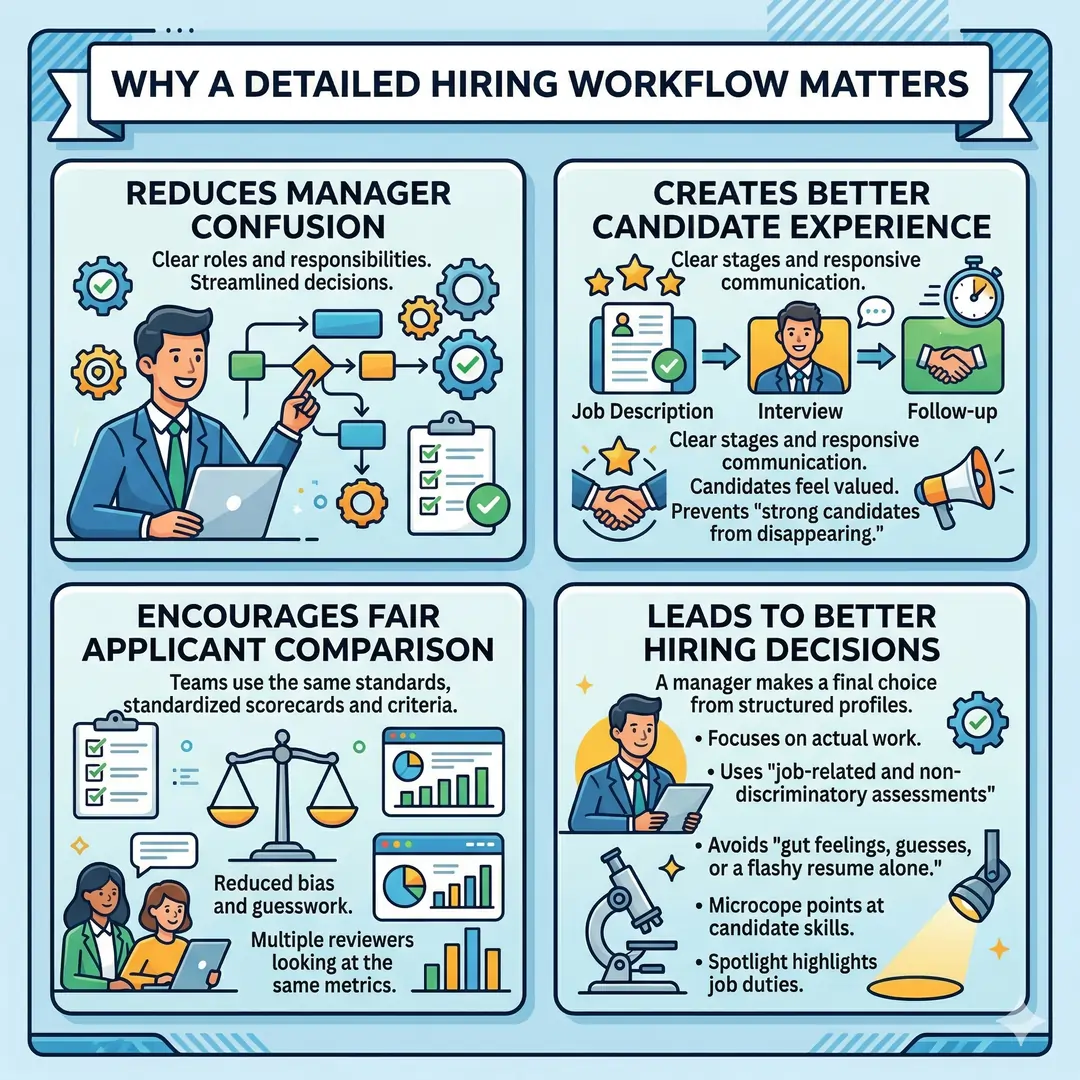
A detailed hiring workflow reduces confusion for hiring managers, creates a better candidate experience, and helps teams compare applicants using the same standards. LinkedIn describes candidate experience as the applicant’s perception of your brand across the job description, interview process, and follow-up communication, which means every stage matters. When the process is messy or silent, strong candidates often disappear. When the process is clear, responsive, and fair, the organization looks more trustworthy.
A structured workflow also helps with better decisions. CIPD emphasizes the importance of defining the role, attracting applicants, managing the application and selection process, and making the appointment. EEOC guidance on tests and selection procedures adds that assessment tools can be useful, but they must be job-related and not unlawfully exclude protected groups. In simple terms, a good workflow helps you hire people for the work they will actually do, not for a guess, a gut feeling, or a flashy resume alone.
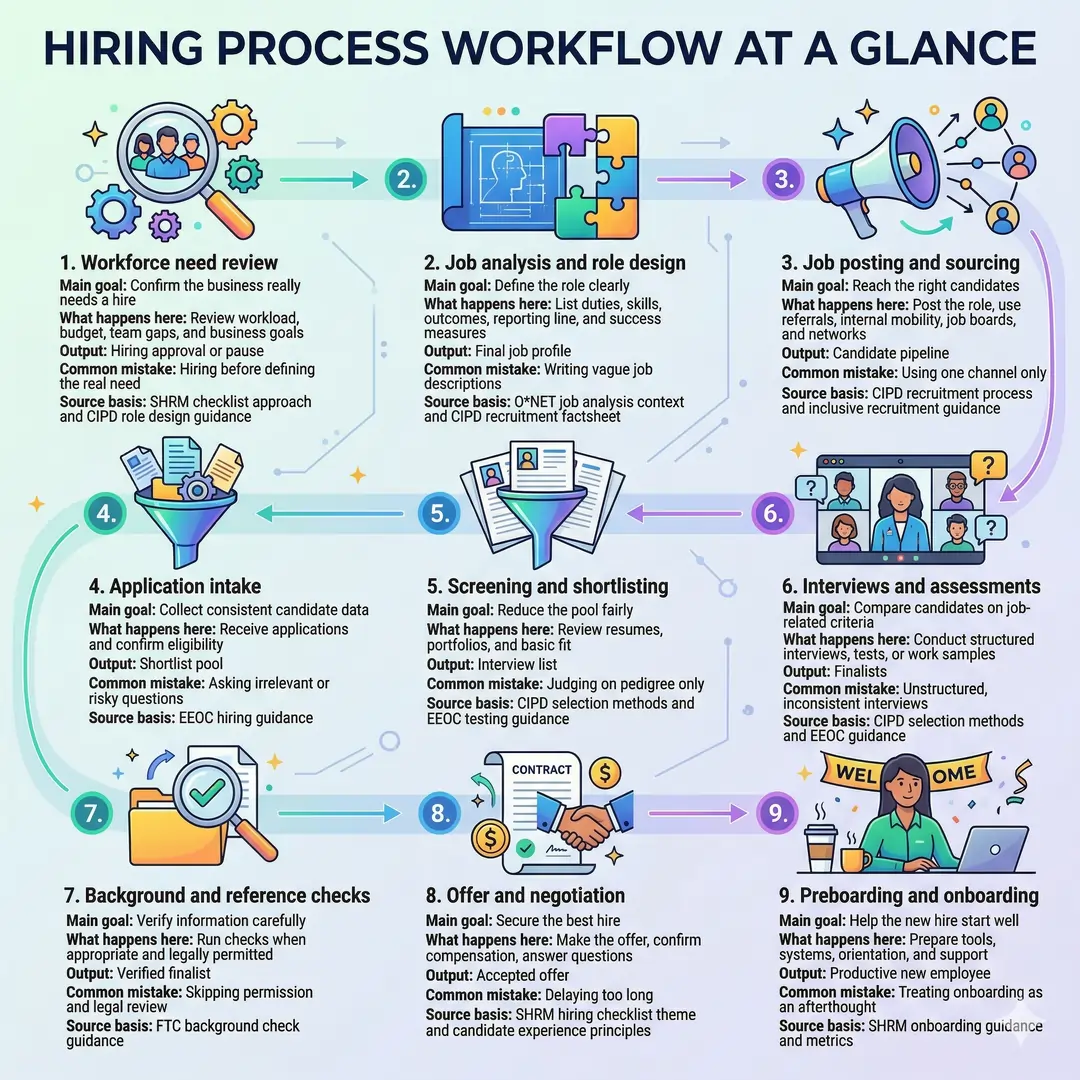
Hiring process workflow at a glance
| Stage | Main goal | What happens here | Output | Common mistake |
|---|---|---|---|---|
| 1. The workforce need review | Confirm the business really needs a hire | Review workload, budget, team gaps, and business goals | Hiring approval or pause | Hiring before defining the real need |
| 2. Job analysis and role design | Define the role clearly | List duties, skills, outcomes, reporting line, and success measures | Final job profile | Writing vague job descriptions |
| 3. Job posting and sourcing | Reach the right candidates | Post the role, use referrals, internal mobility, job boards, and networks | Candidate pipeline | Using one channel only |
| 4. Application intake | Collect consistent candidate data | Receive applications and confirm eligibility | Shortlist pool | Asking irrelevant or risky questions |
| 5. Screening and shortlisting | Reduce the pool fairly | Review resumes, portfolios, and basic fit | Interview list | Judging on pedigree only |
| 6. Interviews and assessments | Compare candidates on job-related criteria | Conduct structured interviews, tests, or work samples | Finalists | Unstructured, inconsistent interviews |
| 7. Background and reference checks | Verify information carefully | Run checks when appropriate and legally permitted | Verified finalist | Skipping permission and legal review |
| 8. Offer and negotiation | Secure the best hire | Make the offer, confirm compensation, answer questions | Accepted offer | Delaying too long |
| 9. Preboarding and onboarding | Help the new hire start well | Prepare tools, systems, orientation, and support | Productive new employee | Treating onboarding as an afterthought |
This table is a practical synthesis of the hiring and onboarding stages described by CIPD, SHRM, EEOC, FTC, O*NET, and LinkedIn.
Step 1. Review the business need before hiring
The first step in a strong hiring workflow is not writing the job ad. It is understanding why the role exists in the first place. Good hiring teams ask whether the need is permanent or temporary, whether the work can be redistributed, whether automation can help, and what success would look like six months after the hire joins. That is consistent with SHRM and CIPD guidance that recruitment should start with role definition and a clear business case.
A simple internal checklist for this stage can include questions like these:
- Is this a replacement hire, a growth hire, or a new capability hire?
- What business problem will this person solve?
- What would happen if we delayed the hire for 90 days?
- Which responsibilities can be removed, automated, or shifted?
- What budget, timeline, and approval limits apply?
When a company skips this step, it often hires too quickly and later discovers that the role was unclear. The result is poor performance, repeated rework, and sometimes an early resignation. Structured role design lowers that risk because the organization knows exactly what it is hiring for.
Step 2. Build a clear job analysis and role profile
A job analysis is the foundation of a reliable hiring workflow. O*NET describes its database as a detailed resource for job analysis and career information, and O*NET work descriptors are used in occupational planning and workforce decisions. In real hiring, this means the organization should understand the tasks, skills, tools, and outcomes tied to the role before it ever opens the application form.
A good role profile should include:
- Job title and department
- Reporting line
- Core responsibilities
- Must-have skills
- Nice-to-have skills
- Required qualifications
- Work location or hybrid setup
- Salary range or pay band
- Performance expectations
- The first 30, 60, and 90-day outcomes
CIPD places role design at the heart of recruitment, and its inclusive recruitment guidance highlights the importance of role design and the job advert as one of the main stages of recruitment. That means the hiring team should write the role for reality, not for wishful thinking. A clean job profile makes it easier to source, screen, and interview well.
Example
A company hiring a Digital Marketing Specialist should not just say “creative and hardworking.” It should say:
- Runs paid search campaigns
- Reviews weekly performance data
- Writes landing-page briefs
- Works with design and sales
- Improves conversion rate by agreed targets
That kind of clarity leads to better applications and more honest interviews. It also makes the process more defensible if candidates later ask why one person was chosen over another.
Step 3. Write the job description and job advertisement
The job description is one of the most visible parts of the workflow, and it should be written with care. CIPD recommends thoughtful role design and inclusive attraction, while LinkedIn emphasizes that candidate experience begins with the job description. That means the wording, tone, and structure of the ad influence who applies and who walks away.
A strong ad should be:
- Clear
- Honest
- Specific
- Inclusive
- Short enough to scan, but detailed enough to guide the right applicant
It should explain the mission of the role, key responsibilities, required skills, and basic working conditions. It should avoid overloading the listing with unrealistic wish lists that discourage qualified people. CIPD also notes that inclusive recruitment is about attracting diverse candidates and reducing bias across the process.
Practical example
Instead of writing:
“10 years of experience required for an entry-level support role.”
Write:
“2 to 3 years of experience in customer support, operations, or a similar service role preferred. Strong communication and problem-solving skills required.”
That kind of wording is easier to understand and more likely to attract the right pool. It also helps avoid unnecessary barriers to entry.
Step 4. Source candidates through multiple channels
Sourcing is the part of the workflow where the company creates a pipeline of potential applicants. CIPD identifies attracting applicants as a core part of recruitment, and its inclusive recruitment guide recommends attracting diverse candidates rather than relying on one narrow channel. That means the best workflow usually combines internal hiring, referrals, direct outreach, job boards, and targeted sourcing.
A balanced sourcing mix can include:
- Internal mobility for current employees
- Employee referrals
- Company careers page
- Job boards
- Industry communities
- University or campus channels
- Social media outreach
- Talent pools from earlier searches
A strong sourcing strategy should focus on both quantity and quality. More applicants are not always better if they are not relevant. The goal is to find enough qualified people while keeping the process efficient and fair. SHRM and LinkedIn both frame modern hiring as strategic and people-centered, not just administrative.
Step 5. Manage applications with consistency and fairness
Once applications arrive, the team should review them in a consistent way. This is where a clear screening rubric becomes extremely useful. CIPD says recruitment includes managing the application and selection process, and EEOC warns that employers must be careful not to ask improper questions or use screening methods that create discriminatory outcomes.
At this stage, a good team usually checks:
- Minimum qualifications
- Relevant work history
- Portfolio or work samples
- Required certifications
- Ability to perform key job duties
- Alignment with the actual role profile
It should not use irrelevant personal factors as shortcuts. EEOC specifically advises employers to avoid questions about race, religion, ethnicity, age, pregnancy, and family plans. It also warns against pre-employment questions that reveal disability-related information in an improper way.
A simple screening rule
Use a yes or no rubric for must-have requirements.
For example:
- Has a bachelor’s degree or equivalent experience? Yes
- Has at least 2 years of relevant work? Yes
- Has experience using the required software? No
- Has the right to work in the relevant jurisdiction? Yes
This makes shortlisting easier to defend and easier to repeat next time.
Step 6. Shortlist candidates with a structured method
Shortlisting is where the team narrows the field to the strongest matches. CIPD describes selection as involving shortlisting and assessing applicants to decide who should receive a job offer. A structured shortlist keeps the process from becoming a guess based on names, schools, or personal style.
A helpful shortlist template might score candidates on:
- Role-specific experience
- Required skills
- Work samples
- Communication quality
- Problem-solving ability
- Cultural add rather than vague “fit”
- Availability and location fit
The word fit can be useful only when it is defined carefully. The better phrase is often job fit or organization fit, because those terms are easier to explain and less likely to drift into bias. EEOC selection guidance also makes clear that tests and selection procedures can be effective, but they can create legal problems if they intentionally or disproportionately exclude protected groups without a job-related justification.
Step 7. Use interviews and assessments that truly predict performance
This is the heart of the hiring workflow. CIPD says selection methods include interviews, psychometric testing, skill-based assessment tasks, and assessment centres. The idea is simple. The more directly the selection method reflects the actual job, the more useful it usually is.
Best-practice interview methods
A strong interview process usually includes:
- A structured interview
- The same core questions for every candidate
- Scoring rubrics tied to the job profile
- Multiple interviewers, when possible
- A work sample or case exercise for job-relevant roles
- Clear note-taking and review rules
EEOC guidance says employment tests and selection procedures can be effective, but they may violate anti-discrimination laws if they are used in a discriminatory way or if they disproportionately exclude protected groups without sufficient justification. That is why structured interviews and job-related assessments are safer than casual, unscored conversations.
Examples of good interview questions
- Tell me about a project where you solved a difficult problem.
- How do you organize priorities when deadlines clash?
- Describe a time you worked with a difficult stakeholder.
- Walk me through how you would handle this customer scenario.
Questions to avoid
- Questions about religion, age, pregnancy, family plans, disability, or other protected traits that are not required by law or job necessity. EEOC explicitly recommends avoiding these types of questions during hiring.
Step 8. Handle accommodations properly
An inclusive hiring workflow should make space for reasonable accommodation when needed. EEOC states that job applicants can request a change or adjustment to the application or interview process because of a medical condition, and that the request can be made orally or in writing. The agency also says employers should respond expeditiously and engage in a flexible, interactive discussion to determine the appropriate accommodation.
This may include:
- More time for a written test
- An accessible interview location
- An alternative format for documents
- A sign language interpreter
- Another job-related adjustment tied to the application process
This is a good reminder that hiring is not only about selecting talent. It is also about removing unnecessary barriers so qualified people can show what they can do. That principle aligns with the inclusive recruitment approach promoted by CIPD and the accommodation guidance from EEOC.
Step 9. Use background checks carefully and legally
Background checks can be part of a careful hiring workflow, but they must be handled with precision. The FTC (Federal Trade Commission) says it is not illegal for an employer to ask about background information or require a background check, but when background information is used to make employment decisions, federal anti-discrimination laws still apply. The FTC also explains that when a background report is obtained from a background reporting company, employers must get the applicant’s written permission before running the check.
A practical background-check workflow looks like this:
- Make the conditional offer if that is the company policy.
- Explain what will be checked.
- Get written permission where required.
- Review the report in context.
- Avoid blanket decisions that ignore the job role.
- Follow applicable notice or dispute steps if the report causes concern.
This stage matters because background reports can include criminal records and other sensitive data. The FTC and EEOC both caution that employers must not use that information in a discriminatory way.
Step 10. Make a clear, timely offer
Once the team has selected the best candidate, it should move quickly. A strong offer process includes the role title, salary or pay band, bonus details if relevant, start date, reporting line, benefits, and any conditions of employment. A slow offer process creates room for second thoughts, counteroffers, and dropouts. That is why candidate experience matters all the way to the end of the hiring cycle. LinkedIn describes candidate experience as spanning the whole hiring journey, including follow-up communication.
A good offer conversation is:
- Clear
- Warm
- Confident
- Fast
- Honest about expectations
Example
A recruiter might say:
“We are excited to offer you the Marketing Analyst position. Your annual compensation will be within the approved range, and your start date is scheduled for Monday, May 6. We will send the written offer and next steps today.”
That kind of message feels professional and human. It also reduces uncertainty.
Step 11. Treat onboarding as part of hiring, not an afterthought
A great hiring workflow does not end with a signed offer. SHRM says onboarding includes important components such as preboarding, and it suggests inviting new employees to tour the facility, sending informational material, providing care packages, and assigning a buddy before the official start date.
SHRM also says onboarding should be measured using metrics such as time-to-productivity, turnover and retention rates, new-hire surveys, employee satisfaction and engagement, and performance measures. That means onboarding is not only a welcome gesture. It is a business process that should produce measurable results.
A practical onboarding workflow
- Send the welcome email
- Complete paperwork
- Set up systems and access
- Share the first-week agenda
- Assign a manager and buddy
- Explain key policies
- Set 30, 60, and 90-day goals
- Schedule check-ins
SHRM notes that onboarding helps new hires adjust to the social and performance aspects of their jobs so they can become productive contributors. That is why the onboarding stage deserves the same discipline as sourcing and interviewing.
Table: Detailed hiring workflow by stage
| Stage | What to do | What good looks like | Example deliverable | Helpful metric |
|---|---|---|---|---|
| Workforce planning | Decide whether the role is really needed | The team can explain the business reason for hiring | Hiring request form | Time to approval |
| Job analysis | Define duties, skills, and outcomes | The role is specific and measurable | Job profile | Quality of applicants |
| Job advertisement | Write and publish the job ad | The ad is clear and inclusive | Job post | Application rate |
| Sourcing | Bring in candidates from different channels | The pipeline is broad and relevant | Sourcing plan | Source quality |
| Screening | Review applications against a rubric | Similar candidates are judged the same way | Screening scorecard | Shortlist-to-hire ratio |
| Interviewing | Ask structured, job-related questions | The process is fair and consistent | Interview guide | Interview pass rate |
| Assessment | Use tests or work samples where appropriate | The method reflects the actual job | Case task or work sample | Assessment completion rate |
| Background checks | Verify information legally | Permission and compliance are in place | Background check authorization | Offer acceptance after check |
| Offer stage | Make and close the offer | The candidate gets a prompt, clear offer | Offer letter | Offer acceptance rate |
| Onboarding | Prepare the new hire to succeed | The person starts with structure and support | 30-60-90 day plan | Time-to-productivity |
This table combines the practical stages emphasized across CIPD, SHRM, EEOC, FTC, and LinkedIn.
How to make the workflow more inclusive
Inclusive hiring is not a separate process. It is a better version of the same process. CIPD says inclusive recruitment should help attract diverse candidates and ensure an unbiased process. The organization should therefore review role design, job ads, application forms, screening criteria, interviews, and onboarding through an inclusion lens.
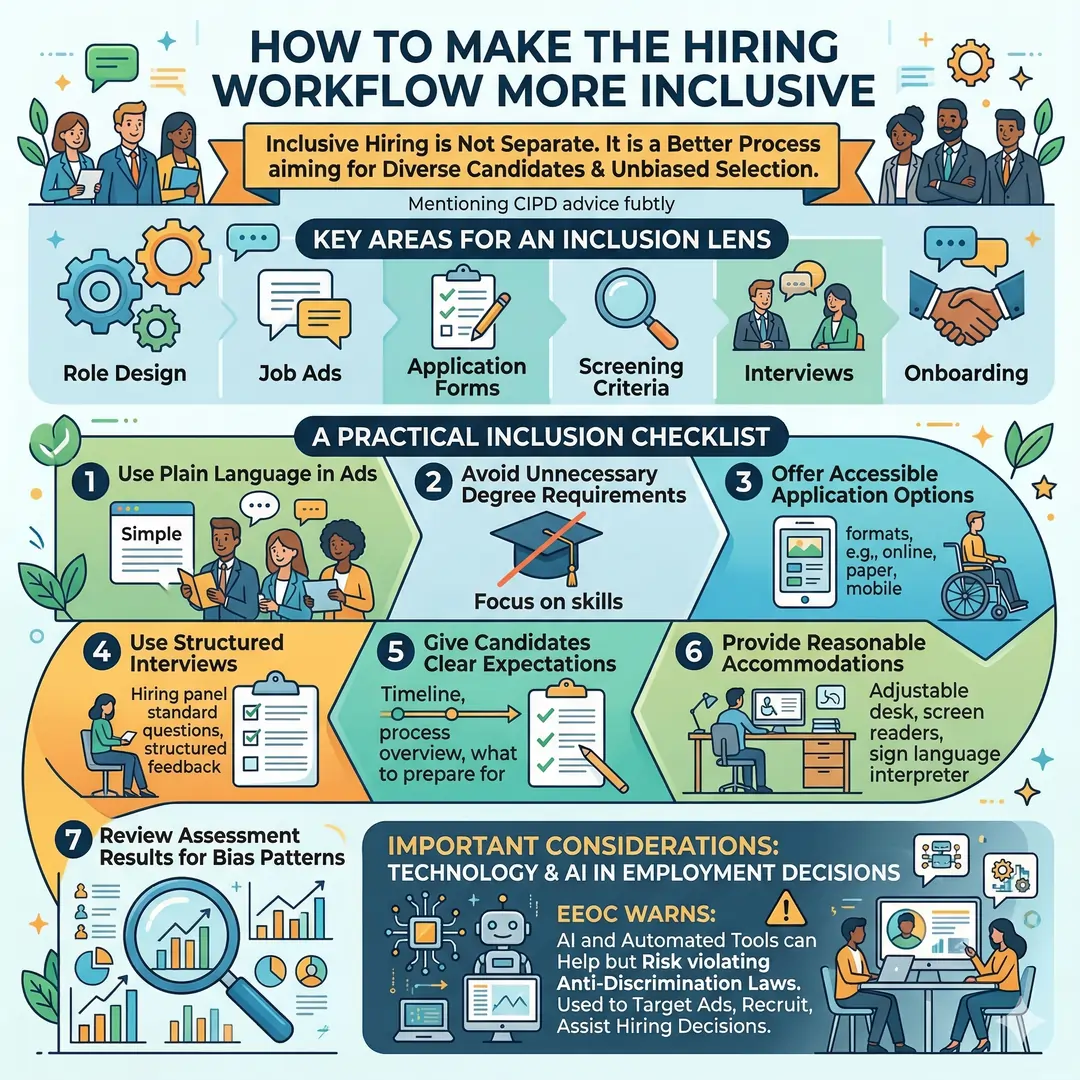
A practical inclusion checklist includes:
- Use plain language in the ad
- Avoid unnecessary degree requirements
- Offer accessible application options
- Use structured interviews
- Give candidates clear expectations
- Provide reasonable accommodations
- Review assessment results for bias patterns
The EEOC also highlights the risk of automated tools and AI in employment decisions. It says AI and other technology can help, but they also have the potential to violate anti-discrimination laws when used in employment decisions. The agency’s strategic plan specifically recognizes employers’ growing use of technology to target ads, recruit applicants, and assist hiring decisions.
What modern hiring teams should do about AI?
AI can speed up recruiting tasks, but it should never replace judgment without oversight. The EEOC says AI tools in employment can violate anti-discrimination laws, especially if they help exclude protected groups or amplify old hiring bias. That means employers should review any AI screening, ranking, or matching tools carefully and make sure they support, rather than replace, fair human decision-making.
A safe approach is to use AI for support tasks like:
- Drafting a first version of a job post
- Sorting resumes by basic criteria
- Scheduling interviews
- Summarizing notes
Then keep humans responsible for:
- Final shortlist decisions
- Interview scoring
- Offer decisions
- Accommodation handling
- Bias review
The broader hiring trend also favors skills-based decision-making. The U.S. Department of Labor announced a Skills-First Hiring Starter Kit in 2024, built around hiring and promotion based on skills and knowledge rather than relying on degree qualifications alone. That reinforces a modern workflow that values capability, not just credentials.
Table: Hiring metrics worth tracking
| Metric | What does it tell you | Why it matters | How to use it |
|---|---|---|---|
| Time to fill | How long a role stays open | Shows speed and process efficiency | Identify bottlenecks in sourcing or approvals |
| Time to productivity | How fast a new hire becomes effective | Shows onboarding quality | Compare across teams and roles |
| Offer acceptance rate | How often do candidates accept offers | Shows competitiveness and clarity | Review salary, timing, and candidate experience |
| Quality of hire | How well new hires perform | Shows hiring accuracy | Use manager reviews and performance data |
| Turnover within 90 days or 6 months | Whether the process picked the right people | Shows a mismatch between role and reality | Investigate job ads and onboarding gaps |
| Candidate drop-off rate | Where applicants leave the process | Shows friction or confusion | Simplify forms and improve communication |
| Interview-to-offer ratio | How selective the process is | Shows whether screening is too broad or too narrow | Adjust screening criteria and assessments |
| New-hire survey score | How new employees feel about the process | Shows onboarding and communication quality | Ask about clarity, support, and readiness |
SHRM specifically recommends measuring onboarding with time-to-productivity, retention, employee satisfaction, and feedback, while LinkedIn stresses that candidate experience affects the whole hiring journey. These metrics together tell a complete story, from first application to first success on the job.
A sample hiring workflow for a real company
Here is a simple example of how the process might work for a company hiring a Customer Success Associate.
Week 1: Role definition
The manager and HR decide the role is needed because customer support volume has increased and onboarding new clients is taking too long. They define the top responsibilities, tools, and success metrics. That follows the role-design-first logic described by CIPD and SHRM.
Week 2: Job ad and sourcing
They publish a clear job description, use referrals, and post it on the company’s careers page and selected job boards. This matches CIPD guidance on attracting applicants and inclusive recruitment.
Week 3: Screening
HR reviews the applications with a checklist. Candidates who meet the must-have criteria move forward. The team avoids irrelevant personal questions and keeps decisions tied to the job profile, in line with EEOC guidance.
Week 4: Interviews
Finalists complete a structured interview and a short role-based exercise. The same questions are used for all candidates, with scoring rubrics. That approach aligns with CIPD selection methods and EEOC testing guidance.
Week 5: Background check and offer
The company gets written permission where needed, reviews the report, and sends an offer. The offer is explained clearly and quickly to preserve a positive candidate experience. That fits FTC and LinkedIn guidance.
Week 6 and beyond: Onboarding
Before the start date, the new hire receives a welcome email, login details, a first-week schedule, and a manager buddy. The company then tracks time-to-productivity and early feedback, which reflects SHRM onboarding best practices.
Common mistakes to avoid
A hiring workflow often breaks down for familiar reasons. The good news is that most of them are preventable.
- Writing vague job descriptions that do not match the real work
- Using unstructured interviews with no scoring system
- Asking inappropriate or legally risky questions
- Relying too heavily on one source of candidates
- Running background checks without a proper process
- Moving too slowly on the offer
- Treating onboarding as paperwork instead of integration
- Ignoring candidate feedback and drop-off points
These mistakes matter because EEOC, FTC, CIPD, and SHRM all point toward the same principle. Hiring should be clear, fair, job-related, and consistent from start to finish.
Best practices for a professional hiring workflow
A polished hiring process usually follows these habits:
- Use one standard workflow for every similar role
- Keep a written rubric for screening and interviewing
- Train hiring managers before they interview
- Respond quickly to candidates
- Offer accommodations when needed
- Review hiring data every quarter
- Measure onboarding results, not just offer acceptance
- Update job descriptions when the role changes
EEOC guidance on anti-discrimination, accommodation, and selection methods, together with SHRM and CIPD process guidance, support a workflow that is structured rather than improvised. That is what makes it repeatable and scalable.
Final thoughts
A detailed hiring process workflow is one of the most valuable systems a business can build. It helps leaders define the role correctly, attract the right people, evaluate candidates fairly, comply with employment rules, and support a successful start for the new hire. The strongest workflows are not complicated for the sake of being complicated. They are clear, structured, and human. That is the balance recommended across CIPD, SHRM, EEOC, FTC, O*NET, LinkedIn, and the U.S. Department of Labor.
In the end, the best hiring workflow does three things very well. It respects the candidate, it supports the manager, and it serves the business. When those three parts work together, hiring becomes much more than filling an open seat. It becomes a long-term investment in performance, culture, and growth.
Read These Articles in Detail
- Importance of Recruitment Strategy
- How to Write a Job Description
- Structured Interview Techniques
- How to Improve Candidate Experience
- Employee Onboarding Process: Strong, Confident, and Productive New Hires
- Recruitment Metrics and KPIs: A Guide to Measuring Hiring Success
- Best Recruitment Channels: A Guide to Hiring Better Talent
- Reducing Hiring Bias: A Guide to Fairer And Smarter Recruitment
- Employee Referral Programs: A Guide to Building Better Hires
- Recruitment Strategies and Best Practices for Hiring Better Talent
- How to Find Employees: Hiring the Right People for Your Business
Key Citations and Article References
- CIPD – Recruitment Factsheet
- CIPD – Selection Methods Factsheet
- CIPD – Inclusive Recruitment Guidance for Managers
- SHRM – Hiring Process Checklist
- SHRM – Onboarding Overview
- SHRM – Measuring Onboarding Success
- EEOC – What Shouldn’t I Ask When Hiring?
- EEOC – Employment Tests and Selection Procedures
- EEOC – Job Applicants and ADA Guidance
- EEOC – Artificial Intelligence and Hiring Guidance (PDF)
- FTC – Background Checks: What Employers Need to Know
- FTC – Employer Background Checks and Your Rights
- O*NET Online – Occupational Information Database
- U.S. Department of Labor – Skills-First Hiring Initiative
Frequently Asked Questions
FAQ 1: What is a detailed hiring process workflow?
A detailed hiring process workflow is a step-by-step system that a company follows to find, evaluate, choose, and onboard the right employee. It is not just about posting a job and taking the first good candidate who applies. It is a clear process that helps the hiring team make better decisions, avoid mistakes, and create a more professional experience for every applicant.
A strong workflow usually begins with understanding the real business need, then moves through job analysis, job posting, candidate sourcing, screening, interviews, selection, offer management, and onboarding. Each stage has a purpose. When all the stages work together properly, the company can hire faster, hire fairly, and hire people who are more likely to succeed in the role.
This kind of workflow is useful because it keeps hiring organized. It also helps reduce bias, improve communication, and make the entire process easier for both the employer and the candidate. In simple words, it turns hiring from a random activity into a structured business system.
FAQ 2: Why is a structured hiring process important for a company?
A structured hiring process is important because it helps a company choose the right person for the right job. Without structure, hiring decisions can become rushed, emotional, or inconsistent. That can lead to bad hires, wasted time, and higher turnover later. A clear workflow gives the hiring team a proper method to compare applicants based on skills, experience, and job fit.
A structured process also improves fairness. When every candidate is screened and interviewed using the same core method, the company is less likely to make decisions based on personal bias or first impressions. That matters a lot because a fair process protects the company and also gives candidates a better experience.
Another major benefit is efficiency. When the hiring steps are defined in advance, managers and recruiters do not waste time figuring out what to do next. They know who approves the role, who writes the job description, who shortlists candidates, and who makes the final decision. This saves time and creates a smoother workflow from start to finish.
FAQ 3: What should be done before posting a job opening?
Before posting a job opening, the company should first understand why the role is needed. This is often called workforce planning or role review. The team should ask whether the role is a replacement, a growth hire, or a completely new position. They should also check the budget, reporting structure, and business goals linked to the role.
The next step is job analysis. This means identifying the actual tasks, responsibilities, skills, tools, and outcomes that the job requires. A well-written role profile should explain what the person will do, what success looks like, and what kind of experience is really necessary. This helps the company avoid vague hiring decisions.
It is also wise to decide in advance how candidates will be evaluated. A clear screening rubric, interview questions, and assessment plan should be ready before applications come in. When the team prepares early, the hiring process becomes more consistent, more professional, and much easier to manage.
FAQ 4: How do job descriptions affect the hiring process?
A job description has a huge impact on the quality of applicants a company receives. It is often the first serious contact a candidate has with the employer, so it needs to be clear, honest, and easy to understand. If the job description is vague or unrealistic, many good candidates may ignore it. If it is too long or full of confusing language, people may leave without applying.
A strong job description should explain the job title, main duties, required skills, preferred experience, work location, salary range, and any major expectations. It should also reflect the real work environment. For example, if the job is fast-paced and customer-facing, the description should say that clearly.
Good job descriptions also support better screening later. When the role is defined properly, the recruiter can compare each applicant against the same standards. That makes the process more objective and helps the company avoid wasting time on people who are not a real match for the position.
FAQ 5: What is the best way to screen candidates?
The best way to screen candidates is to use a structured and job-related method. That means reviewing each application against the same criteria instead of relying only on instinct. A hiring team may look at the candidate’s experience, skills, qualifications, work samples, and relevant achievements. The goal is to find people who match the role profile as closely as possible.
A useful screening process often includes a checklist or scorecard. For example, the company may mark whether the applicant has the required years of experience, knowledge of specific tools, or proof of similar work. This makes it easier to compare candidates fairly and avoid random choices.
It is also important to keep screening focused on the job itself. Questions or decisions based on personal traits that are not related to the role can create problems. A good screening system should always stay professional, consistent, and directly connected to the actual work the employee will do.
FAQ 6: Why are structured interviews better than casual interviews?
A structured interview is better because it gives every candidate a fair chance to show their ability. In a structured interview, the interviewer asks the same core questions to all applicants and uses a scoring system to evaluate responses. This makes the process more consistent and easier to compare across candidates.
A casual interview, on the other hand, can easily drift into small talk or personal impressions. That can lead to bias, where one candidate seems better simply because they are more confident, more familiar, or more similar to the interviewer. Structured interviews reduce that risk by keeping the focus on job-related skills and examples.
They also make hiring decisions easier to defend. If the company later needs to explain why one person was selected over another, it can point to the interview scores, notes, and job-related answers. That level of clarity is very useful for both quality control and fairness.
FAQ 7: What role do assessments and work samples play in hiring?
Assessments and work samples are very helpful because they show what a candidate can actually do, not just what they say they can do. A resume can list experience, but a practical task can reveal problem-solving ability, writing skill, technical understanding, attention to detail, or communication style more realistically.
For example, a marketing candidate may be asked to review a campaign and suggest improvements. A customer service applicant may be given a sample support scenario and asked how they would respond. A software candidate may complete a small coding task. These kinds of exercises help employers predict job performance more accurately.
Work samples are especially useful when they are closely connected to the real role. They should not be overly complicated or unfairly time-consuming. The best assessments are short, meaningful, and directly tied to the tasks the employee will handle on the job.
FAQ 8: Why are background checks used in the hiring process?
Background checks are used to verify important information before making a final hiring decision. They may help confirm identity, employment history, education, or other details that matter for the role. For some jobs, they can also provide extra protection by reducing the risk of hiring someone with inaccurate or misleading information.
However, background checks must be handled carefully. They should always follow legal requirements and company policy. The employer should get proper consent where needed, explain what is being checked, and use the results in a fair and job-related way.
It is also important not to treat a background report as the only factor in hiring. A company should review the results in context and consider whether the information is truly relevant to the job. A responsible hiring workflow uses background checks as one part of the decision, not the whole decision.
FAQ 9: What makes candidate experience important in hiring?
Candidate experience matters because it shapes how applicants see the company. Every interaction counts, from the first job ad to the final offer or rejection. If the process is slow, confusing, or silent, candidates may lose interest or form a negative opinion about the organization. If the process is respectful, clear, and timely, it creates trust.
A positive candidate experience also helps the company attract better talent. Strong candidates often have more than one option, so they are more likely to choose a company that communicates well and treats them professionally. Even people who are not selected may speak positively about the company if they had a good experience.
Good communication is a big part of this. Candidates appreciate updates, clear timelines, and honest feedback. When they know what to expect, they are more likely to stay engaged throughout the hiring process. That is one reason why candidate experience is now seen as a major part of modern recruitment.
FAQ 10: How does onboarding complete the hiring workflow?
Onboarding completes the hiring workflow by helping the new employee settle into the role and become productive. Hiring does not end when the offer is accepted. The real success begins when the person starts working and learns how the company operates. Onboarding gives them the tools, guidance, and support they need during this important transition.
A good onboarding process includes paperwork, system access, introductions, job expectations, training, and early check-ins. It also helps the new hire understand the company culture, reporting structure, and performance goals. When onboarding is organized well, the employee feels more confident and supported from the very beginning.
This stage is important because a strong hire can still fail if onboarding is weak. If the employee is confused, underprepared, or ignored, their productivity may drop, and they may leave early. A thoughtful onboarding process protects the investment the company made during hiring and helps the new employee succeed in the long term.
