

When Tim Cook took over as Apple’s chief executive in August 2011, many people wondered whether he could keep Apple’s magic alive after Steve Jobs. Cook was not a product-showman by style. He was a systems builder, an operations leader, and a CEO who believed that great companies are not built only on dazzling launches, but on execution, scale, discipline, and a business model that keeps getting stronger over time. Apple’s own leadership profile says Cook had already been responsible for worldwide sales and operations, including end-to-end supply chain management, before becoming CEO.
More than a decade later, the results are hard to ignore. Reuters reported in April 2026 that under Cook, Apple’s market capitalization rose from roughly $350 billion to $4 trillion, annual revenue nearly quadrupled to $416 billion, and the company expanded to more than 2.5 billion active devices. Apple’s 2025 Form 10-K shows total net sales of $416.161 billion, with Services alone reaching $109.158 billion.
That is the story of this article. Tim Cook did not just keep Apple alive. He turned Apple into a financial powerhouse by making the company more efficient, more predictable, more global, more service-driven, and far better at converting loyal customers into recurring profit.
Table of Contents
What changed under Tim Cook
Cook’s background matters because it explains how he led. Apple says he had already run the company’s sales, operations, supply chain, and service and support before becoming CEO. Before Apple, he also worked in materials management, inventory, and manufacturing/distribution at Compaq, Intelligent Electronics, and IBM. That is a rare résumé for a CEO in a consumer technology company.
That operations-first mindset did not weaken Apple’s creativity. It made Apple more scalable. Cook helped Apple become a company that could ship world-class products, manage a massive global supply chain, and keep converting product popularity into very high margins and enormous cash generation. This is partly an inference, but it is strongly supported by the combination of Cook’s operations background and Apple’s later financial performance.
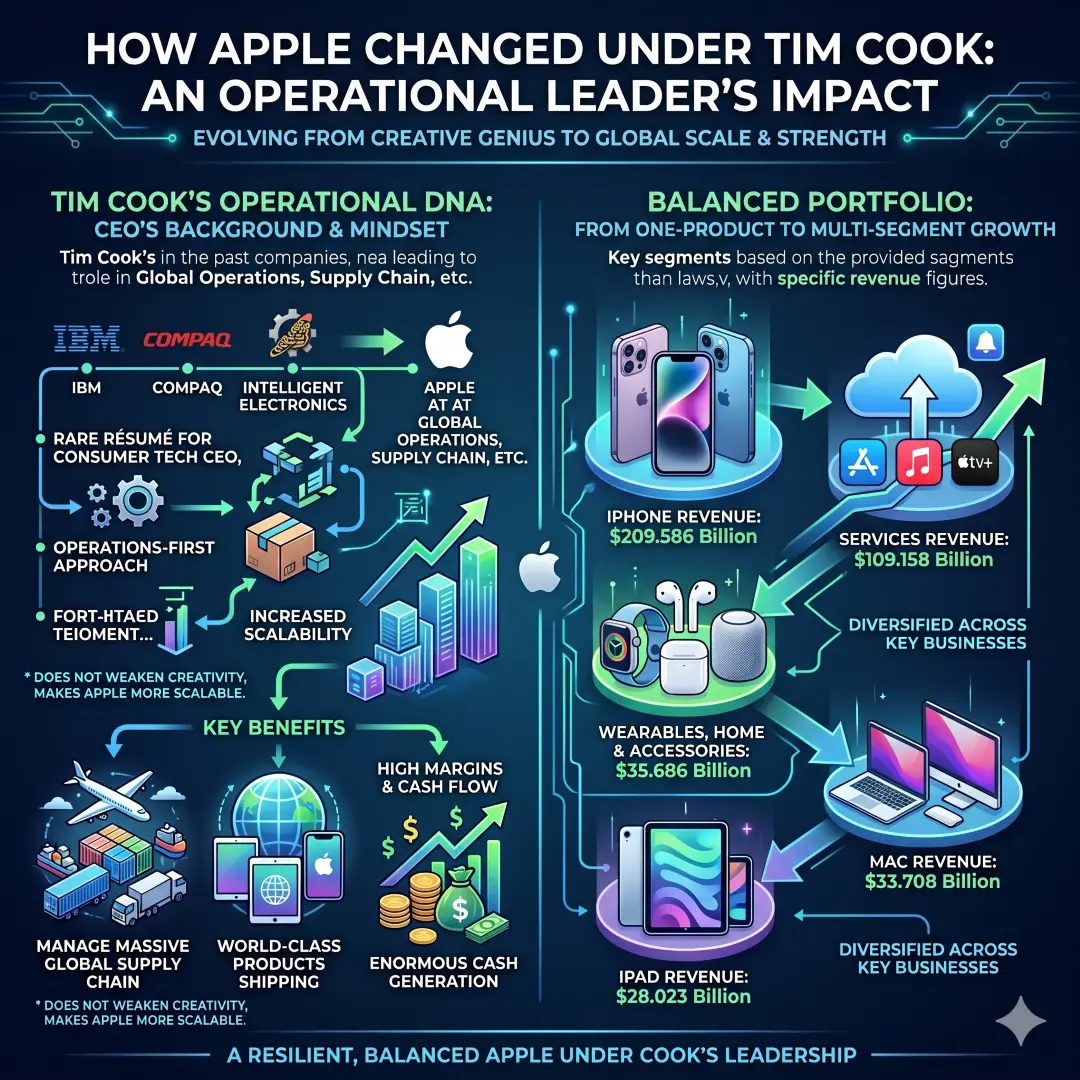
At the same time, Apple did not remain a one-product story. Under Cook, the business became more balanced across iPhone, Mac, iPad, wearables, and especially Services. In fiscal 2025, Apple reported iPhone revenue of $209.586 billion, Mac revenue of $33.708 billion, iPad revenue of $28.023 billion, Wearables, Home and Accessories revenue of $35.686 billion, and Services revenue of $109.158 billion.
- Reference Link:
Cook’s leadership style: calm, operational, and highly disciplined
One of Cook’s biggest strengths is that he treats operations as a strategic advantage, not just a back-office function. The company’s own leadership page says he was responsible for Apple’s worldwide sales and operations, supply chain, and support, and that he played a key role in building strategic relationships with resellers and suppliers. That is exactly the kind of work that makes a company steadier, faster, and more profitable over time.
- Also, Read this in Detail:
His style is also about consistency. Apple under Cook has been known for regular product cycles, strong manufacturing coordination, and a tight link between hardware, software, and services. Apple’s annual report shows that the company still faces intense competition and product transition risk, yet it continues to manage large-scale launches and transitions across product categories and regions.
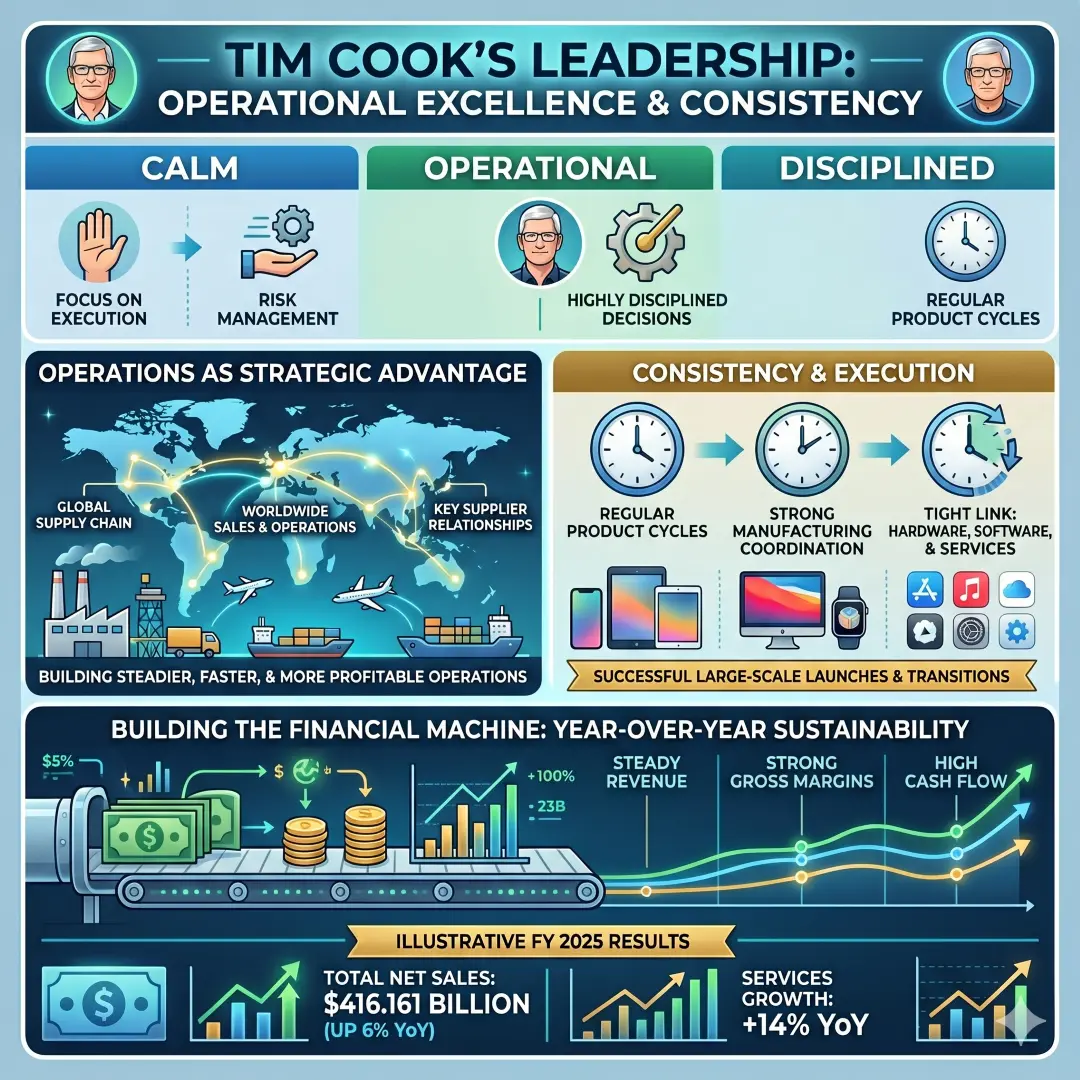
This matters because financial power is not only about making money in one great quarter. It is about building a machine that can keep producing revenue, gross margin, and cash flow year after year. Apple’s 2025 results show exactly that kind of machine. The company posted $416.161 billion in total net sales for fiscal 2025, up 6 percent from the prior year, and Services grew 14 percent year over year.
Table 1: The Cook era at a glance
| Milestone | Why it mattered | Source |
|---|---|---|
| In August 2011, Cook became CEO | Apple shifts from a founder-led era to an operations-led era | Apple leadership page. |
| Supply chain expertise becomes central | Apple gains stronger execution, sourcing, and logistics discipline | Apple leadership page. |
| Apple reaches $416.161 billion in FY2025 revenue | Shows the scale Apple achieved under Cook | Apple 2025 Form 10-K. |
| Services reach $109.158 billion in FY2025 | Reveals the shift toward recurring, high-margin income | Apple 2025 Form 10-K. |
| An active installed base exceeds 2.5 billion devices | Shows the strength of Apple’s ecosystem and customer lock-in | Apple January 2026 results. |
| Market cap rises to about $4 trillion | Confirms Apple became one of the most valuable companies in history | Reuters April 2026 coverage. |
The real genius of Cook’s Apple: turning hardware into a platform
Many people still think Apple is mainly a hardware company. That is only part of the picture. Under Cook, Apple became much more of a platform company. The products still matter, but the products now feed a much larger ecosystem that includes App Store, iCloud, Apple Music, Apple Pay, cloud services, advertising, and other recurring offerings. Apple’s 2025 Form 10-K says Services growth came mainly from higher revenue in advertising, the App Store, and cloud services.
This is one of the biggest reasons Apple became a financial powerhouse. Hardware sales bring in large revenue. Platforms bring in repeated revenue. When a customer owns an iPhone, Mac, iPad, Watch, or other Apple device, that customer often stays inside the ecosystem for years. Apple’s installed base crossed 2.5 billion active devices in January 2026, which is an extraordinary foundation for long-term monetization.
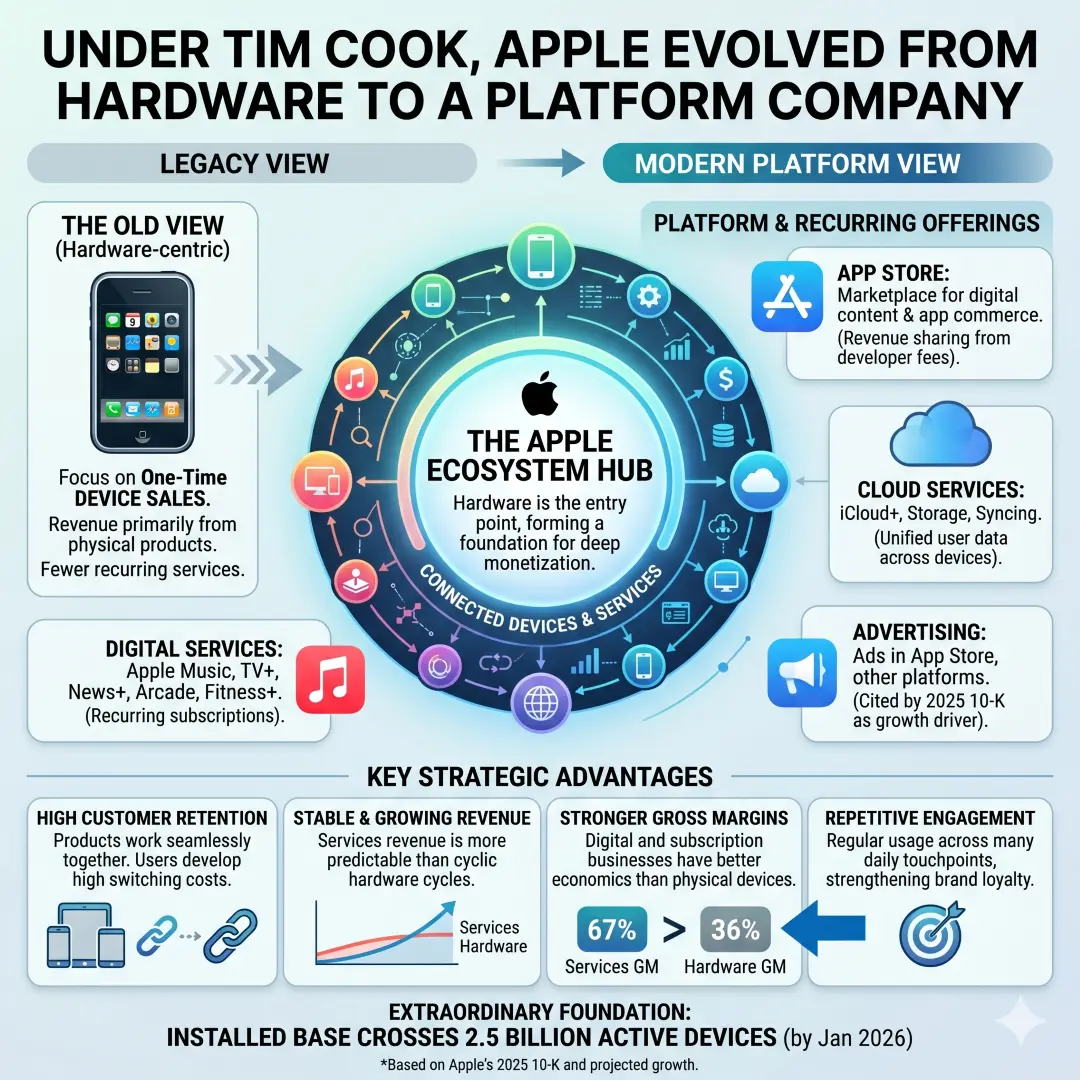
That ecosystem creates several advantages:
- It increases customer retention because people get used to Apple’s products working well together.
- It boosts Services revenue, which tends to be more stable than pure hardware sales.
- It supports a better gross margin because digital and subscription businesses usually carry stronger economics than physical devices. Apple’s report says Services gross margin rose in 2025 partly because of higher Services sales.
- It makes Apple harder to replace, because users are not buying one device. They are joining a system. This is an inference, but it is directly supported by the installed base growth and the services performance.
Table 2: How Tim Cook changed Apple’s money model
| Strategy pillar | What Cook emphasized | Financial effect | Example from the data |
|---|---|---|---|
| Operational excellence | Supply chain discipline, predictable execution, and strong logistics | Lower risk, better margins, smoother product delivery | Cook’s COO background and Apple’s scale. |
| Ecosystem growth | Make devices work together so customers stay longer | Higher customer lifetime value | More than 2.5 billion active devices. |
| Services expansion | Grow recurring services around the installed base | More stable and higher-margin revenue | $109.158 billion in Services revenue in FY2025. |
| Capital discipline | Return huge amounts of cash to shareholders | Supports valuation and investor confidence | $89.3 billion repurchased in FY2025. |
| Global scale | Sell and operate across many regions | Diversifies revenue and reduces dependence on one market | FY2025 revenue was spread across the Americas, Europe, Greater China, Japan, and the Asia Pacific. |
Why Services became the heart of the story
If there is one single number that shows how Cook changed Apple, it is the rise of Services. In fiscal 2025, Services brought in $109.158 billion, up 14 percent year over year. In fiscal 2024, Services had already risen to $96.169 billion, up 13 percent from 2023. This is not a side business anymore. It is one of Apple’s most important profit engines.
Apple’s report says Services growth in 2025 was driven by higher sales from advertising, the App Store, and cloud services. That is important because these areas benefit from Apple’s enormous installed base. Once a customer is inside Apple’s ecosystem, Apple can deepen the relationship without selling a new physical device every time.
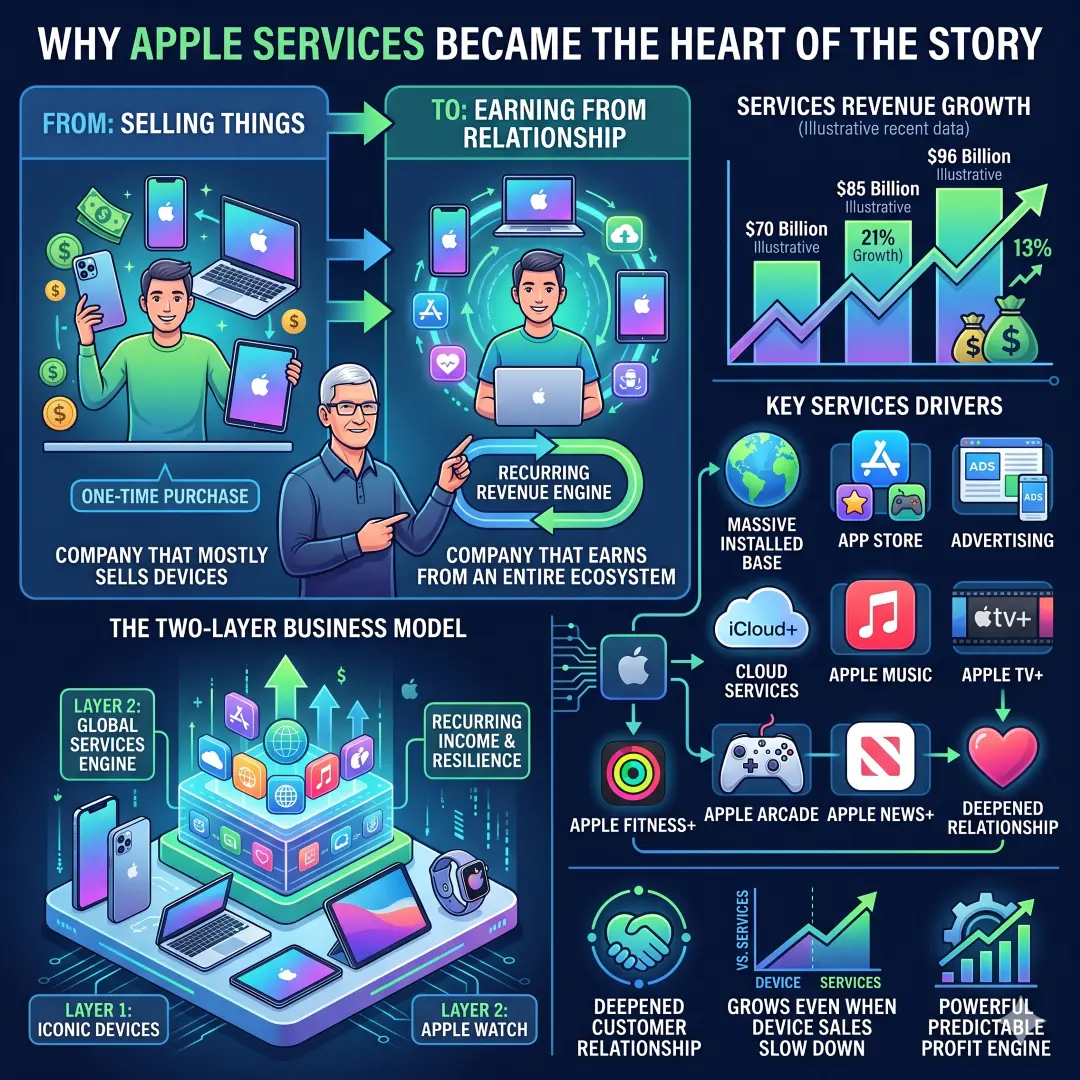
This is where Cook’s business thinking stands out. He did not abandon the product company’s identity. Instead, he added a second layer on top of it. Apple still sells iconic devices, but those devices now support a recurring revenue engine that keeps growing even when product cycles slow down. Apple’s 2026 first quarter results also said Services reached a new all-time high, which shows the trend is still active.
In simple language, Cook turned Apple from a company that mostly sells things into a company that also earns from a relationship. That is one of the strongest business models in modern tech.
Table 3: Apple’s revenue mix under Cook
| Fiscal year | iPhone | Mac | iPad | Wearables, Home, Accessories | Services | Total net sales |
|---|---|---|---|---|---|---|
| 2023 | $200.583B | $29.357B | $28.300B | $39.845B | $85.200B | $383.285B |
| 2024 | $201.183B | $29.984B | $26.694B | $37.005B | $96.169B | $391.035B |
| 2025 | $209.586B | $33.708B | $28.023B | $35.686B | $109.158B | $416.161B |
This table tells a clear story. The iPhone remains the biggest business, but Services is the fastest and most strategically important growth engine. The company is still large in traditional hardware, yet the money story has become much broader and more durable.
Capital returns: one of Cook’s quiet superpowers
Another reason Apple became a financial powerhouse is that it turned into one of the most aggressive capital-return machines in corporate history. In fiscal 2025, Apple repurchased 402 million shares for $89.3 billion. In fiscal 2024, it repurchased 499 million shares for $95.0 billion. Apple’s annual report also says the company continues to pay dividends and has an authorized repurchase program.
This matters for two reasons. First, buybacks can support earnings per share when done at scale. Second, they show that Apple generates enough cash to both invest in the business and return huge amounts to shareholders at the same time. Apple’s Q1 2025 results said the company had returned over $30 billion to shareholders in that quarter, while Q4 2024 results showed quarterly revenue of $94.9 billion.
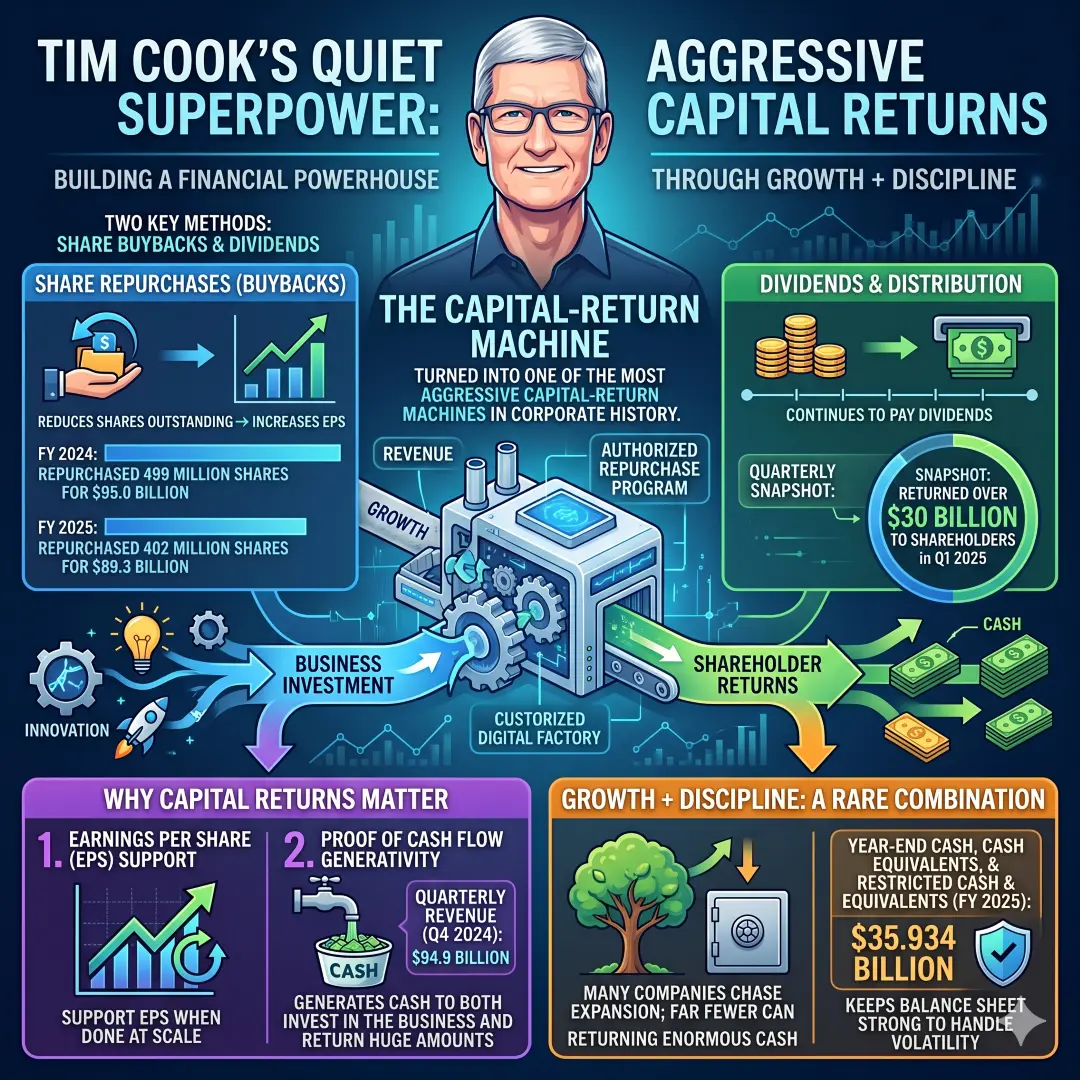
Cook’s Apple is not only about growth. It is about growth plus discipline. That combination is rare. Many companies can chase expansion. Far fewer can expand this much while also returning enormous cash to investors and keeping the balance sheet strong enough to handle volatility. Apple’s year-end cash, cash equivalents, and restricted cash and cash equivalents were $35.934 billion in fiscal 2025.
A practical example is easy to see. Imagine two companies with similar revenue. One reinvests poorly and keeps burning cash. The other produces strong cash flow, buys back stock, pays dividends, and still funds product development. Cook built Apple into the second kind of company. That is one reason investors view Apple as a financial fortress. This is an inference, but it follows directly from the company’s repurchase scale, cash generation, and revenue size.
Apple’s supply chain became a strategic advantage
Cook’s old job at Apple was not symbolic. It was the foundation of his leadership. Apple says he oversaw the company’s supply chain, sales, and support before becoming CEO. That background likely helped him build a business that could scale globally while keeping operational friction low. This is an inference, but it is a strong one because Apple continued to operate at a massive scale while growing revenue and margins.
The supply chain matters because Apple’s products are deeply tied to timing, component availability, manufacturing quality, and launch coordination. The company’s 10-K continues to emphasize competition, product transitions, and the need to manage inventory and ramp-up risks carefully. Cook’s Apple has repeatedly shown that it can do this well.
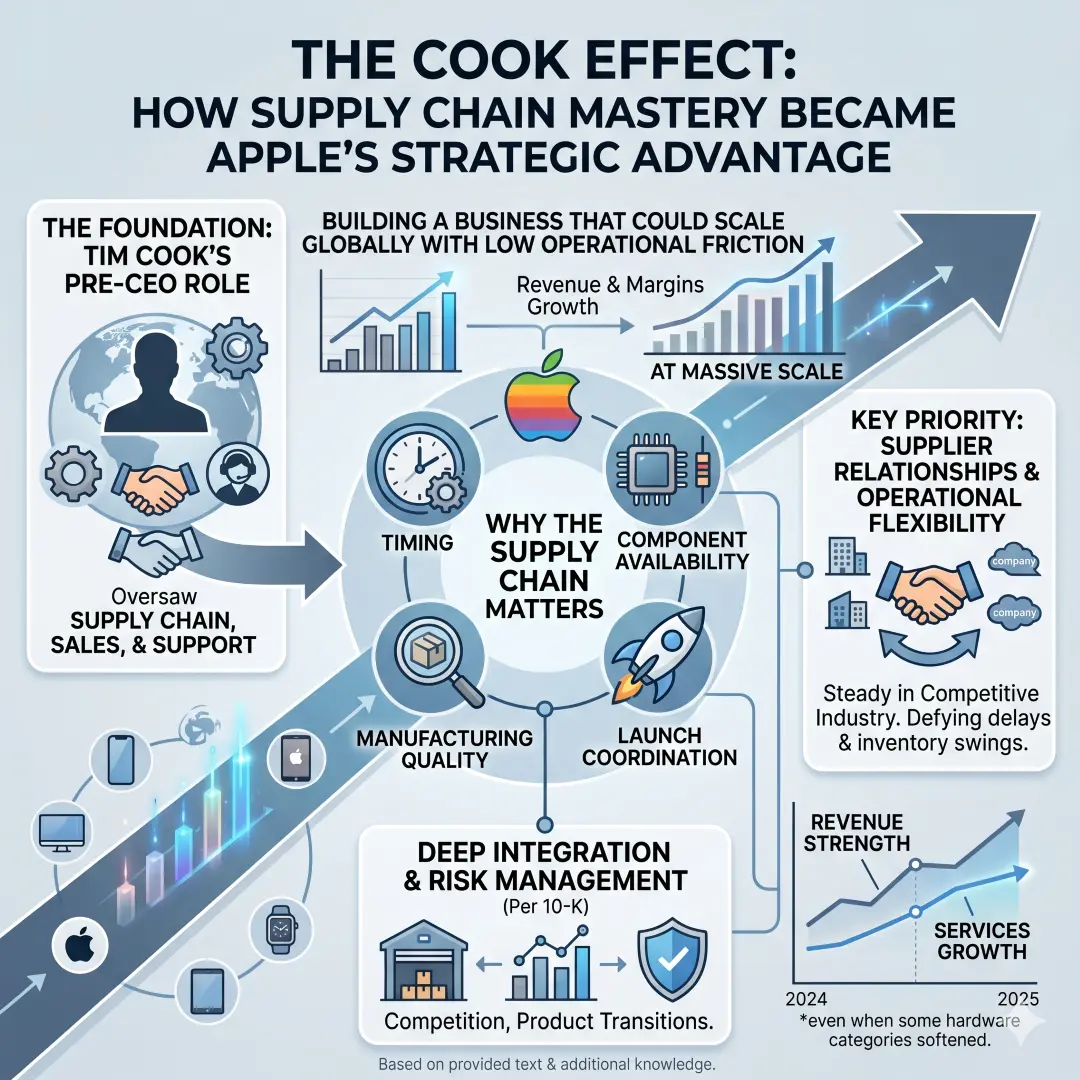
Cook also made supplier relationships and operational flexibility a business priority. That helped Apple remain steady in a highly competitive industry where other companies often struggle with delays, inventory swings, and margin pressure. Apple’s results through 2024 and 2025 show continued strength in both revenue and services, even when some hardware categories softened.
Table 4: Why the supply chain mattered so much
| Operational issue | Why is it important | How Cook’s Apple handled it |
|---|---|---|
| Component availability | Delays can hurt launches and revenue | Apple kept product launches highly coordinated. |
| Inventory control | Too much stock hurts cash and margins | Cook’s background in inventory and procurement helped here. |
| Supplier relationships | Good suppliers improve flexibility and quality | Apple emphasized strategic supplier relationships. |
| Global scale | Large operations need precision across countries | Apple continued to grow across regions while keeping revenue strong. |
Global scale, regional diversification, and resilience
A major reason Apple became so powerful financially is that it sells to the world, not just one country or one customer type. Apple’s 2025 Form 10-K shows total revenue spread across the Americas, Europe, Greater China, Japan, and the Rest of Asia Pacific. For fiscal 2025, revenue was $178.353 billion in the Americas, $111.032 billion in Europe, $64.377 billion in Greater China, $28.703 billion in Japan, and $33.696 billion in the Rest of Asia Pacific.
This regional spread matters because it lowers dependence on one market and lets Apple continue growing even when one geography is softer. For example, Apple’s 2025 report says China revenue was lower than the prior year, while other regions grew. That kind of global balance is a key part of financial strength.
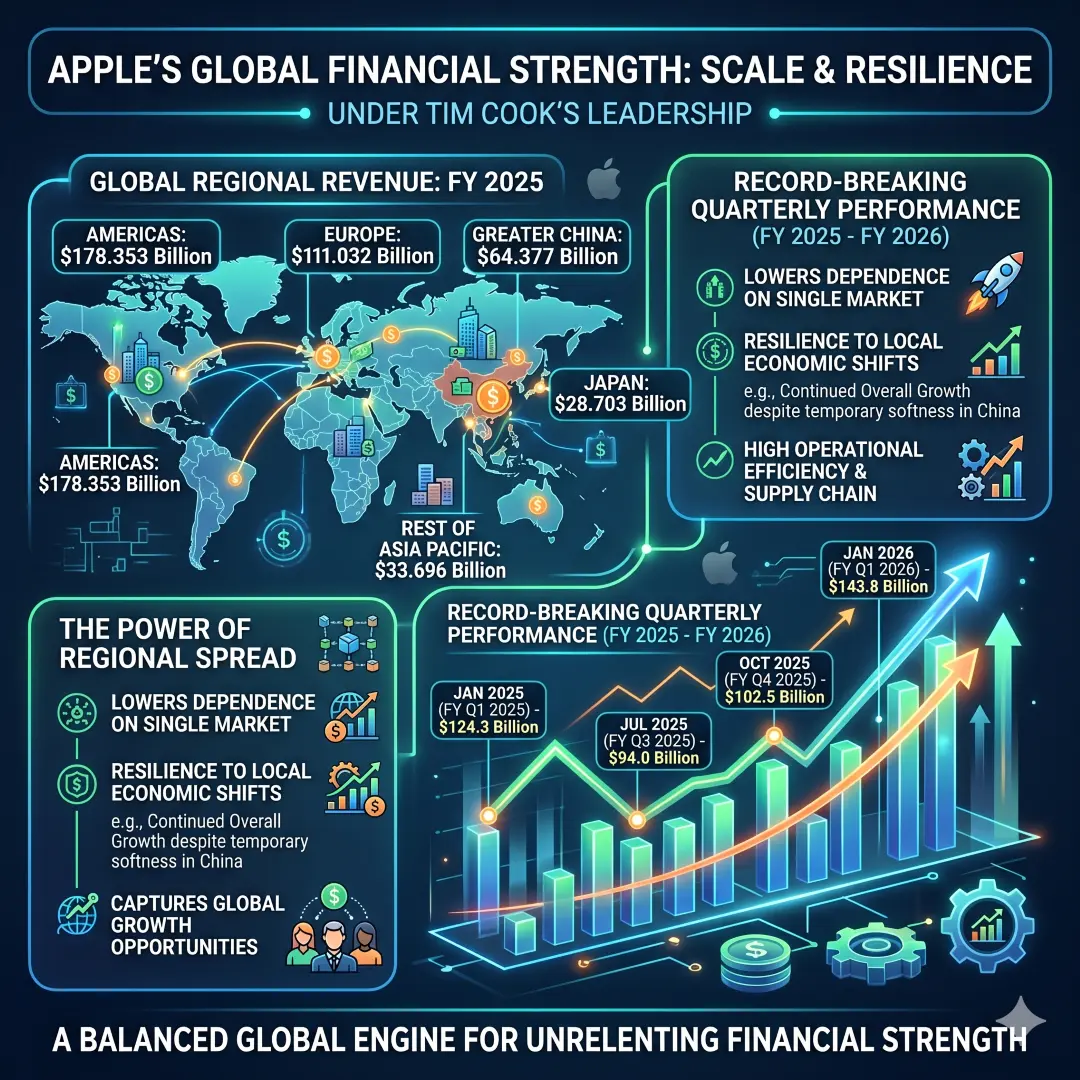
In 2025 and 2026, Apple also reported record quarterly performance. In January 2025, the company posted $124.3 billion in revenue for fiscal Q1 2025. In July 2025, it posted $94.0 billion for fiscal Q3 2025. In October 2025, it reported $102.5 billion for fiscal Q4 2025. In January 2026, it reached $143.8 billion in fiscal Q1 2026. Those numbers show that the company is not just large. It is still growing at a very high absolute level.
Cook and the power of the installed base
One of the most important financial ideas at Apple is the installed base. This is the number of active devices in users’ hands. A larger installed base means more opportunities for repeat sales, upgrades, subscriptions, services, accessories, and software engagement. Apple said in January 2026 that its installed base had passed 2.5 billion active devices.
That number is not just a vanity metric. It is a strategic engine. A larger installed base gives Apple more room to monetize Services, more room to expand user engagement, and more room to keep customers inside the ecosystem. Apple’s own earnings releases in 2025 and 2026 repeatedly pointed to new highs in active devices and services performance.
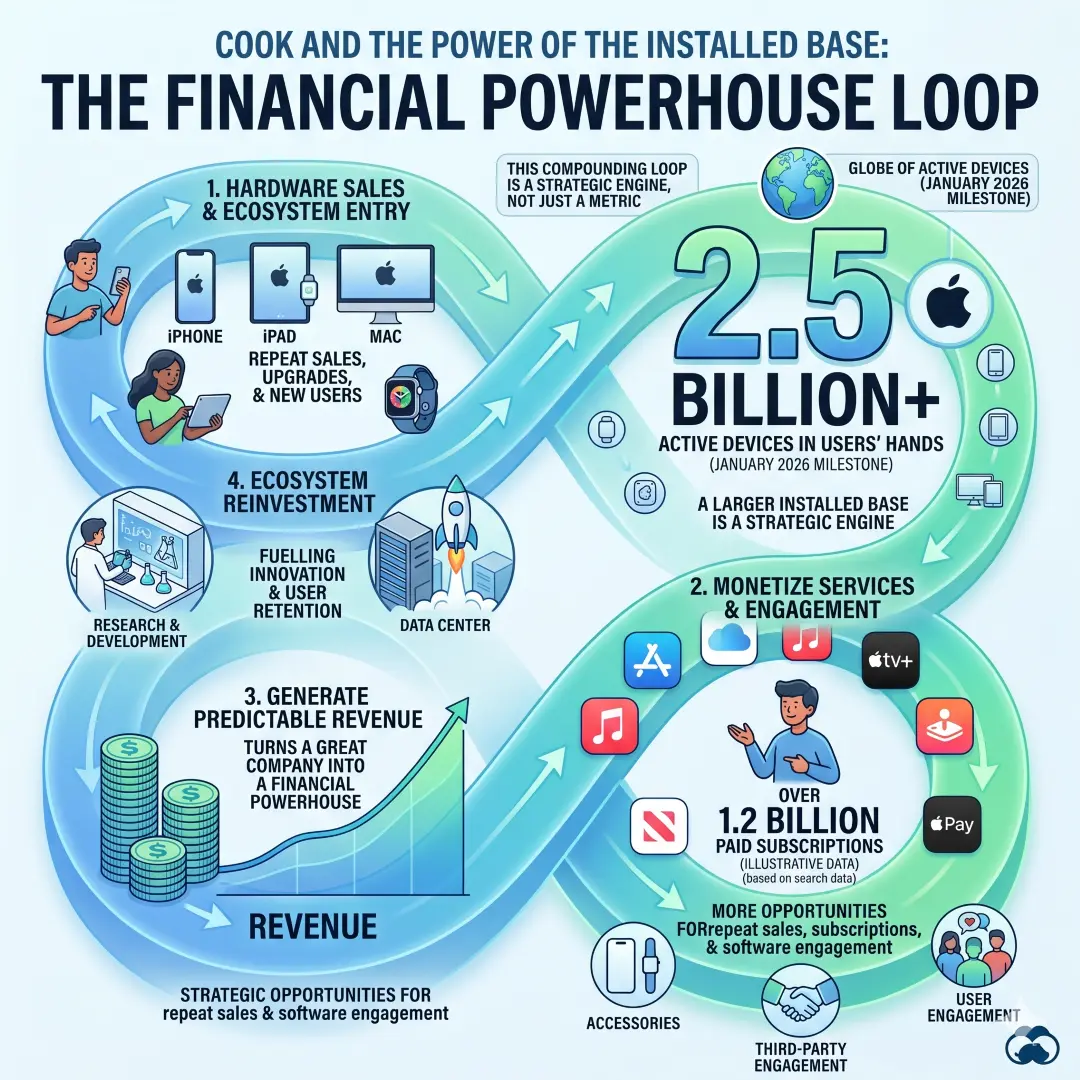
Here is the simplest way to think about it. The more devices Apple sells, the more users it can serve. The more users it serves, the more Services it can sell. The more Services it sells, the more predictable its revenue becomes. That is the kind of compounding loop that turns a great company into a financial powerhouse. This is an inference, but it fits Apple’s reported data very well.
Apple’s environmental push also supports the brand
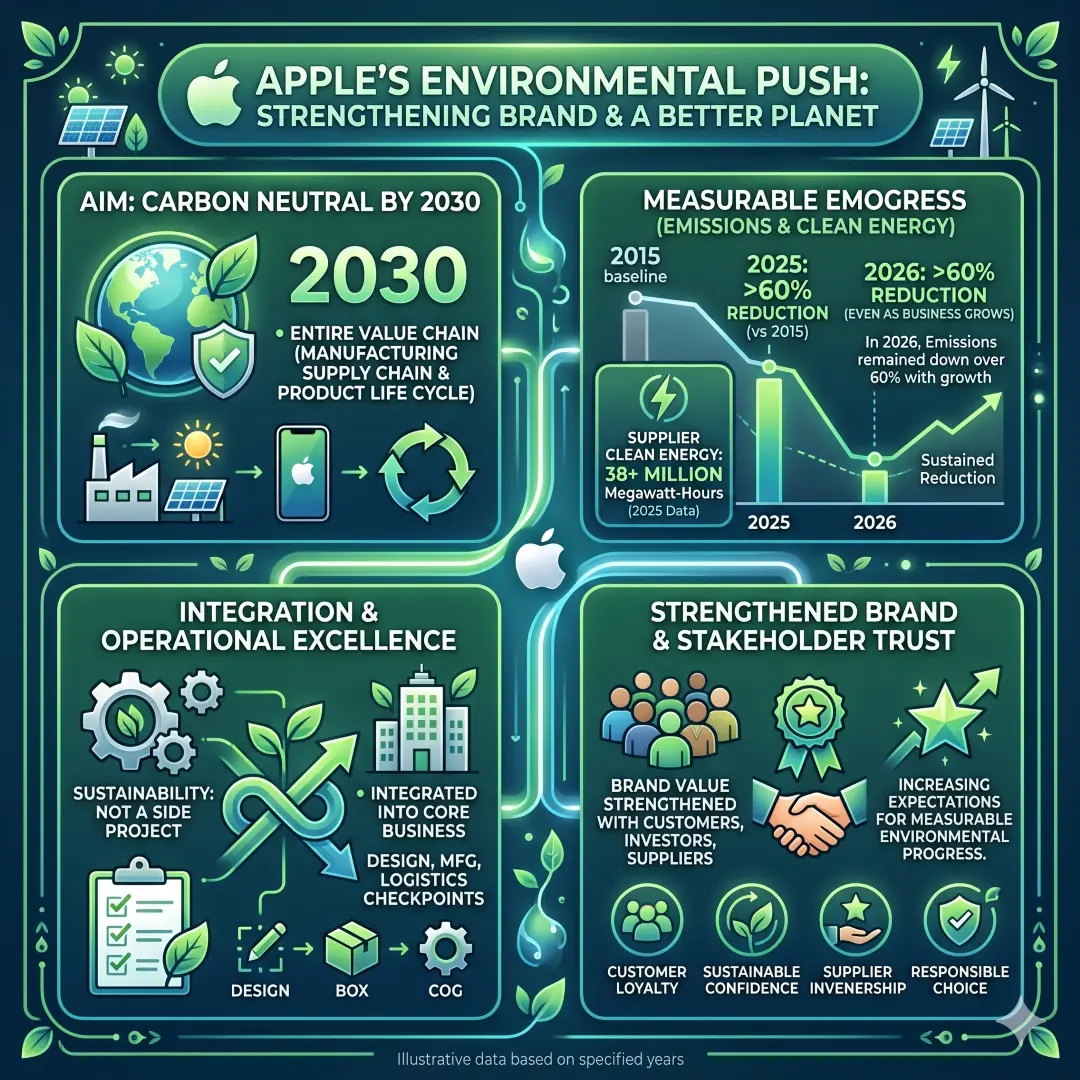
Cook has also tied Apple’s business story to a long-term environmental strategy. Apple says it aims to become carbon neutral across its entire value chain by 2030, including its manufacturing supply chain and product life cycle. Apple also said in 2025 that it had cut greenhouse gas emissions by more than 60 percent compared with 2015 levels, and in 2026, it said emissions remained down over 60 percent even as the business grew
This is important for two reasons. First, Apple treats sustainability as part of operational excellence, not as a side project. Second, it strengthens the brand with customers, investors, and suppliers who increasingly expect large companies to show measurable environmental progress. Apple’s environment pages also say its supplier clean energy program generated more than 38 million megawatt-hours in 2025.
A business example helps here. If two brands sell similar products, but one is seen as stronger on quality, longevity, and responsibility, customers often feel better staying with that brand. Apple has used that kind of trust very effectively. That trust then supports pricing power, loyalty, and recurring revenue. This is an interpretation, but it is strongly aligned with Apple’s public environmental and business reporting.
Table 5: Financial snapshot of Apple under Cook
| Metric | FY2024 | FY2025 | What it shows |
|---|---|---|---|
| Total net sales | $391.035B | $416.161B | Apple kept growing at a massive scale. |
| Services revenue | $96.169B | $109.158B | Services became a much larger profit engine. |
| iPhone revenue | $201.183B | $209.586B | iPhone remains the core product driver. |
| Share repurchases | $95.0B | $89.3B | Apple continues to return huge cash to shareholders. |
| Cash and cash equivalents, ending balance | $29.943B | $35.934B | Apple retained strong liquidity. |
| Active devices | 2.2B in 2024, 2.35B in Jan 2025 | More than 2.5B in Jan 2026 | The ecosystem kept expanding. |
Why investors rewarded Cook’s Apple
Investors like businesses that can do three things at once. They want growth, margin, and predictability. Apple under Cook has delivered all three for a long time. Reuters’ April 2026 reporting says Cook’s tenure helped push Apple from $350 billion in market value to $4 trillion, while annual revenue nearly quadrupled to $416 billion. That kind of outcome is not an accident. It comes from sustained execution over many years.
Apple’s own results show why the market kept rewarding the company. FY2025 revenue grew to $416.161 billion. FY2025 Services grew to $109.158 billion. Apple also kept buying back stock on a huge scale and maintained strong cash balances. These are the hallmarks of a mature but still growing elite company.
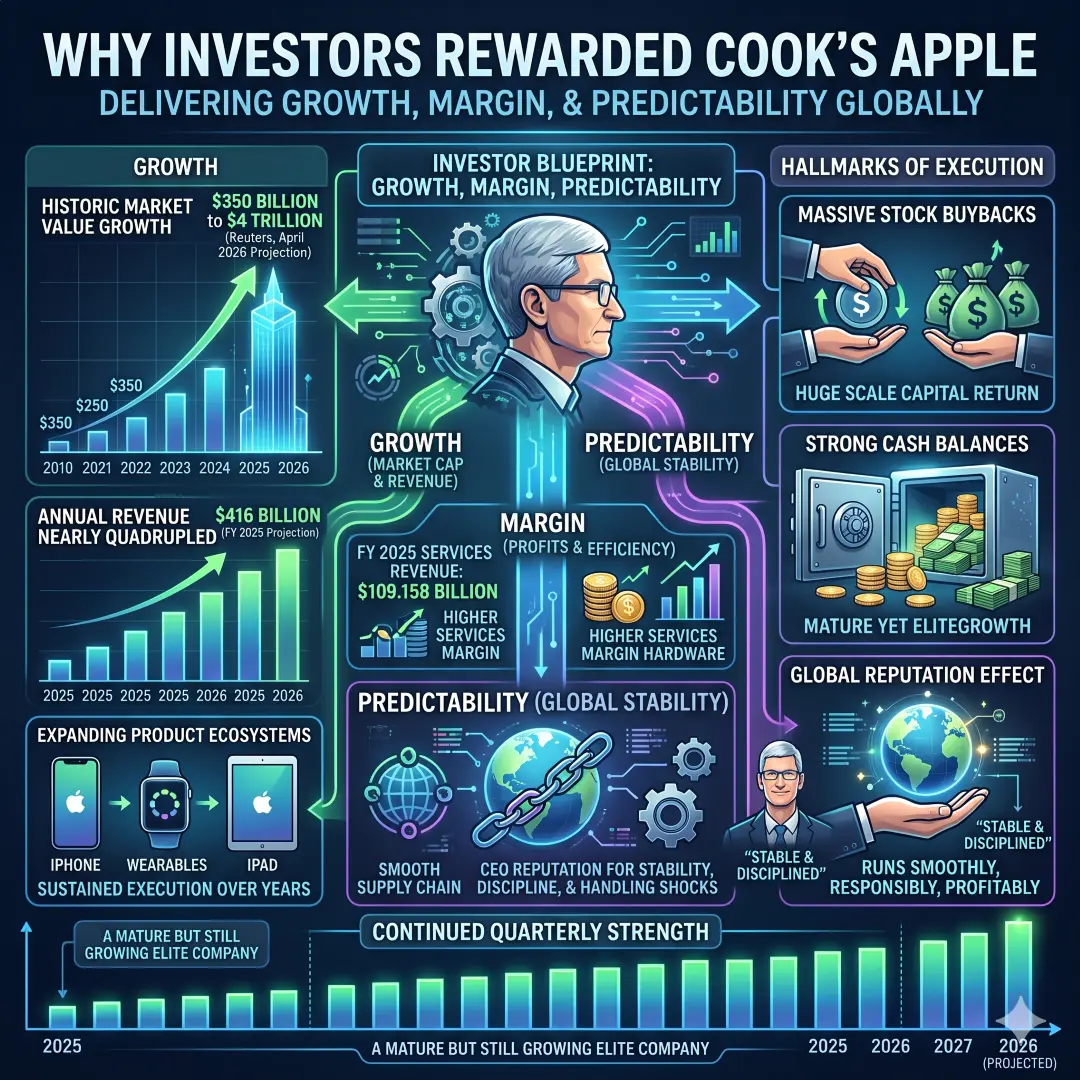
There is also a reputation effect. Cook is widely seen as the CEO who made Apple run more smoothly, more responsibly, and more profitably on a global scale. That reputation matters because capital markets tend to reward companies that feel stable, disciplined, and capable of handling shocks. Apple’s continued quarterly strength in 2025 and 2026 supports that view.
Table 6: The business lessons other companies can learn
| Lesson | What Apple did | Practical takeaway |
|---|---|---|
| Build an ecosystem, not a one-off product | Apple connected devices, software, and Services | Make it easy for customers to stay with you. |
| Use operations as strategy | Cook came from supply chain and sales operations | Efficiency can be a source of competitive advantage. |
| Create recurring revenue | Services grew into a huge business | Stability matters as much as hype. |
| Return capital wisely | Apple used buybacks and dividends at scale | Strong cash generation should benefit shareholders. |
| Think globally | Apple sold across major regions worldwide | A global customer base reduces dependence on one market. |
What makes Cook’s success different from a typical CEO story
A lot of CEOs are judged by a single product cycle or a single turnaround. Tim Cook’s story is bigger. He inherited a company that already had extraordinary momentum, but he turned that momentum into a structure that could last. Apple’s own materials show a leader who understood operations, inventory, supplier relationships, and sales systems before he ever became CEO. That kind of background is rare at the top of a company this size.
Then he helped convert that operational talent into a broader business model with stronger cash flow, stronger Services revenue, and stronger capital returns. Apple’s 2025 Form 10-K and 2026 earnings release show that the company remains enormous, profitable, and highly active across products and services.
Even Apple’s recent leadership transition announcement underlines how carefully the company has been managed. In April 2026, Apple said Cook would become executive chairman on September 1, 2026, with John Ternus set to become CEO. Reuters reported that the move was the result of long-term succession planning. That level of planning is itself a sign of institutional strength.
Conclusion
Tim Cook built Apple into a financial powerhouse by making the company stronger in the places that matter most for long-term business success. He protected Apple’s product excellence, but he also strengthened the company’s operations, expanded its ecosystem, scaled Services, pushed huge capital returns, and helped turn the installed base into an ever-growing engine of loyalty and recurring income.
The numbers speak loudly. Apple’s revenue reached $416.161 billion in fiscal 2025, Services hit $109.158 billion, and the active device base moved beyond 2.5 billion. At the same time, Apple remained one of the world’s most valuable companies, with Reuters reporting a valuation of around $4 trillion in April 2026. That combination of scale, efficiency, and recurring profit is exactly why Cook’s Apple stands out in modern business history.
The biggest lesson is simple. A great company does not depend only on inspiration. It also depends on discipline, systems, and the patience to build value year after year. That is what Tim Cook did at Apple, and that is why his leadership remains one of the clearest examples of how to turn a great brand into a lasting financial empire.
Also, Read these Articles in Detail
Article’s References and Sources
- Apple Leadership Profile (Tim Cook)
- Apple FY2025 Annual Report (Form 10-K)
- Apple FY2024 Annual Report (Form 10-K)
- Apple Q1 2026 Results (Newsroom)
- Apple Q1 2025 Results (Newsroom)
- Apple Q4 2025 Results (Newsroom)
- Apple Environmental Progress & Sustainability Goals
- Apple Carbon Neutrality Announcement (2030 Goal)
- Reuters Report on Tim Cook & Apple Valuation (2026)
- Apple Leadership Transition Announcement (2026)
Frequently Asked Questions
FAQ 1: How did Tim Cook turn Apple into a financial powerhouse?
Tim Cook turned Apple into a financial powerhouse by focusing on operations, efficiency, supply chain control, and long-term business planning. He did not rely only on big product launches. Instead, he built a company that could grow steadily, manage huge global demand, and keep customers inside the Apple ecosystem for many years.
One of Cook’s greatest strengths is that he came from an operations background. Before becoming CEO, he was deeply involved in sales, manufacturing, inventory, and global supply chain management. This helped Apple run like a highly organized machine. When a company can produce, deliver, and support products at a massive scale without losing quality, it becomes much more profitable over time.
Cook also helped Apple grow beyond hardware. Under his leadership, Services became one of Apple’s most important revenue sources. This included income from the App Store, iCloud, Apple Music, advertising, and other digital services. These businesses are important because they create more stable and recurring revenue than device sales alone.
Another major reason for Apple’s financial success under Tim Cook is the strength of its ecosystem. Apple products work best when they are used together. A person who buys an iPhone is often more likely to buy a Mac, Apple Watch, AirPods, or subscribe to Apple services later. This creates long-term customer loyalty and makes Apple harder to replace.
Cook also made Apple extremely strong in capital returns. The company has spent tens of billions of dollars buying back its own stock and paying dividends. This helps improve shareholder value and shows that Apple generates enormous cash.
In simple language, Tim Cook built Apple into a financial giant by making the company smarter, more disciplined, and more connected. He turned Apple from a great product company into a powerful business system that keeps growing year after year.
FAQ 2: Why is Tim Cook’s leadership style so important to Apple’s success?
Tim Cook’s leadership style matters because it is based on calm execution, discipline, and consistency. He is not known for flashy speeches or dramatic gestures. Instead, he leads in a steady, practical way that keeps Apple focused on results. This style has helped the company remain strong even in a highly competitive technology market.
Cook’s leadership is especially valuable because Apple is a very large global company. A company of that size needs more than creative ideas. It needs strong systems, excellent coordination, and leaders who can make sure everything works smoothly. Cook brought exactly that kind of leadership to Apple.
He is also known for making long-term decisions rather than chasing quick wins. That means he often supports investments that may not pay off immediately but help the company become stronger over time. This approach has supported growth in Services, better supply chain management, and more predictable financial performance.
Another important part of Cook’s style is his focus on people and partnerships. He values strong relationships with suppliers, employees, and customers. That matters because a company like Apple depends on many different teams working together across the world. Good leadership keeps those teams aligned and productive.
His leadership style also supports trust. Investors, employees, and customers often feel more confident when a company has a CEO who appears careful, disciplined, and reliable. That trust is part of Apple’s long-term strength.
So, Tim Cook’s leadership style is important because it combines operational excellence, strategic patience, and business discipline. Those qualities have helped Apple grow into one of the most successful companies in the world.
FAQ 3: What role did the iPhone play in Apple’s financial growth under Tim Cook?
The iPhone has remained Apple’s most important product under Tim Cook and continues to be the company’s biggest revenue source. It plays a central role in Apple’s financial growth because it is not just a phone. It is the main gateway into the entire Apple ecosystem.
When a customer buys an iPhone, they often stay inside Apple’s world for years. They may later buy AirPods, an Apple Watch, a Mac, or subscribe to Apple Music, iCloud, and other services. This makes the iPhone much more valuable than a single product sale. It becomes the first step in a long customer relationship.
The iPhone also gives Apple massive pricing power. Because the brand is so strong and the product is so deeply connected to the rest of the ecosystem, Apple can maintain premium pricing better than many competitors. That helps the company generate high revenue and strong profit margins.
Even though Apple has grown into many other businesses, the iPhone still drives the overall business model. In Apple’s recent financial results, iPhone revenue remained above $200 billion in a year, showing how huge the product still is. That scale gives Apple a major financial base to build upon.
Tim Cook did not replace the iPhone with another product. Instead, he used the iPhone as a foundation for broader growth. That is a major reason Apple became a financial powerhouse. The iPhone created the customer base, and the rest of the Apple ecosystem turned that base into recurring value.
FAQ 4: Why did Apple’s Services business become so important under Tim Cook?
Apple’s Services business became extremely important because it changed the company from a mostly hardware-driven business into a more balanced and recurring revenue company. Services now include things like the App Store, iCloud, Apple Music, Apple Pay, advertising, and other digital offerings.
This matters because Services usually produce more stable income than hardware. People may replace a phone every few years, but they often keep paying for subscriptions month after month. That creates a predictable flow of revenue, which is very valuable for a company of Apple’s size.
Services also improve Apple’s financial profile because they often have strong margins. Digital products do not require the same manufacturing, shipping, and inventory costs as physical devices. This helps Apple keep more of the money it earns.
Under Tim Cook, Services grew from a supporting business into one of Apple’s most powerful growth engines. In recent financial reports, Services passed $100 billion in annual revenue, which is a huge milestone. That shows how much Apple has changed under Cook’s leadership.
Another reason Services matter is that they help Apple stay close to users every day. A customer may use iCloud for storage, Apple Music for entertainment, and the App Store for downloading apps. Each service deepens the connection between the customer and the Apple ecosystem.
So, Services became important because they gave Apple recurring revenue, higher margins, and stronger customer loyalty. That combination has been a major part of Apple’s financial rise under Tim Cook.
FAQ 5: How did Tim Cook improve Apple’s supply chain and operations?
Tim Cook improved Apple’s supply chain and operations by treating them as a strategic advantage rather than just a support function. Before becoming CEO, he had already built a strong reputation as an expert in procurement, manufacturing, inventory control, and global logistics. That background made him especially valuable to Apple.
A strong supply chain is essential for a company like Apple. Apple products are sold worldwide, and they must be delivered with high quality, on time, and at huge scale. If the supply chain fails, product launches suffer, customers get frustrated, and revenue can fall. Cook understood this better than most CEOs.
Under his leadership, Apple became known for strong inventory management and tight coordination with suppliers. This means the company could produce the right amount of product without wasting money on excess stock. That helps protect profits and improve efficiency.
Cook also helped Apple build stronger long-term relationships with suppliers and manufacturing partners. These relationships matter because Apple depends on a vast global network to build its devices. Good partnerships make it easier to launch new products smoothly and maintain consistent quality.
Another major benefit of Cook’s operations focus is that it helped Apple scale without losing control. As the company grew larger, it still maintained strong discipline. That is one reason Apple has been able to grow revenue while staying highly profitable.
In short, Tim Cook made Apple’s operations a source of strength. His supply chain expertise helped the company become faster, leaner, and more reliable, which supported Apple’s rise as a financial powerhouse.
FAQ 6: How did Tim Cook help Apple become more profitable over time?
Tim Cook helped Apple become more profitable by building a business model that combines high revenue, strong margins, recurring income, and careful capital management. Profitability is not just about selling a lot. It is about making sure the money earned is greater than the money spent. Cook’s Apple does this extremely well.
One key reason for Apple’s profitability is its premium brand. Apple products are often priced at the top end of the market, but customers still buy them because they trust the quality, design, and ecosystem. That allows Apple to earn strong margins on hardware.
The second reason is Services. Since Services do not depend on physical manufacturing in the same way hardware does, they often produce better margins. As Services grew larger under Cook, Apple became less dependent on lower-margin sales alone.
Another factor is Apple’s disciplined spending. Cook is known for running a tight operation. He avoids waste and focuses on areas that create long-term value. That helps protect profits even as the company invests heavily in research, product development, and global operations.
Apple’s huge cash generation also helps. The company can invest in the business, buy back stock, and still remain financially strong. That level of control is a major reason investors see Apple as a stable and highly profitable company.
So, Tim Cook improved Apple’s profitability by combining premium products, strong Services growth, disciplined operations, and smart financial management. That mix is what turned Apple into a true money-making powerhouse.
FAQ 7: What business lessons can other companies learn from Tim Cook’s Apple?
Other companies can learn many valuable lessons from Tim Cook’s Apple. The biggest lesson is that operational excellence is just as important as innovation. A company may have exciting ideas, but if it cannot deliver them efficiently and consistently, it will struggle to grow.
One lesson is to build an ecosystem instead of relying only on one product. Apple sells devices, software, subscriptions, and digital services that all support one another. This makes customers more loyal and increases the lifetime value of each customer.
Another lesson is to think long-term. Cook did not focus only on short-term hype. He strengthened the business structure so Apple could keep growing for many years. That kind of thinking helps companies stay relevant and resilient.
A third lesson is the value of recurring revenue. Services gave Apple a more stable financial base. Other businesses can apply this idea by creating subscription models, maintenance plans, or digital support services that keep customers engaged over time.
A fourth lesson is capital discipline. Apple returns huge amounts of cash to shareholders, but it also continues to invest in future growth. That balance is important for any mature business that wants to stay strong.
A final lesson is to understand that scale matters. Apple succeeded because it could grow globally without losing quality. Companies that want to grow must build systems that can handle more customers, more products, and more markets without breaking down.
Tim Cook’s Apple shows that a powerful business is built through strategy, consistency, and smart execution, not just through great ideas.
FAQ 8: How important is Apple’s ecosystem to Tim Cook’s success?
Apple’s ecosystem is one of the most important reasons Tim Cook has been so successful. An ecosystem means that different products and services work together in a way that keeps customers connected to the brand. In Apple’s case, the iPhone, Mac, iPad, Apple Watch, AirPods, iCloud, App Store, and Services all support each other.
This is important because customers who use one Apple product often end up using more. For example, someone who buys an iPhone may later choose a Mac because it syncs well with the phone. They may also use iCloud to store files and Apple Music for entertainment. Over time, this creates a deeper and more valuable relationship.
The ecosystem also increases switching costs. That means it becomes harder for a customer to leave Apple because so much of their digital life is already connected to its products and services. This helps Apple keep customers for a long time.
From a financial point of view, the ecosystem is powerful because it creates repeat business. Instead of making money only when a device is sold, Apple can continue earning from subscriptions, apps, storage, and digital services. That is a much stronger long-term model.
Tim Cook understood this very well. Instead of treating each product as separate, he helped Apple connect them into one strong platform. That platform is a major reason Apple became such a financially successful company.
In simple terms, Apple’s ecosystem turns customer loyalty into business growth, and that has been a core part of Cook’s success.
FAQ 9: Why do investors trust Apple so much under Tim Cook?
Investors trust Apple under Tim Cook because the company has shown a long record of consistent growth, strong cash flow, high profits, and excellent execution. Investors usually like companies that can grow while still staying financially disciplined, and Apple has done exactly that.
One reason for this trust is Apple’s huge revenue base. The company now generates hundreds of billions of dollars every year, which gives investors confidence that the business is not fragile. It is large, stable, and global.
Another reason is the growth of Services, which gives Apple more recurring income and improves its financial stability. Investors like businesses that are not dependent on one-time sales alone.
Apple’s regular share buybacks and dividends also help build investor trust. These actions show that the company generates enough cash to reward shareholders while still funding future growth. That sends a strong signal about financial strength.
Tim Cook himself also contributes to investor confidence. His leadership is seen as careful, disciplined, and reliable. He is not known for reckless decisions. Instead, he manages Apple in a way that protects the company’s long-term value.
Apple’s growing market value under Cook is another sign of trust. When investors believe a company has a strong future, they are willing to give it a higher valuation. That is exactly what happened with Apple over time.
So, investors trust Apple because Tim Cook has turned it into a company that combines growth, profitability, stability, and smart capital management.
FAQ 10: What is Tim Cook’s biggest legacy at Apple?
Tim Cook’s biggest legacy is that he transformed Apple from a company famous for great products into a company known for sustained financial strength, operational excellence, and ecosystem power. He proved that Apple could remain innovative while also becoming more efficient, more global, and more profitable.
He did not try to copy Steve Jobs. Instead, he built on Apple’s strengths and made them bigger and more durable. He expanded Services, strengthened the supply chain, improved capital discipline, and helped Apple reach a level of financial scale that very few companies in history have achieved.
Another major part of his legacy is that he made Apple more resilient. The company is not dependent on one single product or one single market. It now has many revenue streams, a huge installed base, and a strong balance between hardware and software.
Cook’s legacy is also visible in Apple’s financial results. Revenue reached more than $416 billion in a year, Services crossed $109 billion, and the company’s installed base moved beyond 2.5 billion active devices. Those are not just numbers. They are signs of a business that has been built to last.
At a deeper level, Tim Cook showed that leadership can be quiet and still be powerful. A CEO does not need to be loud to change the world. Sometimes the greatest impact comes from discipline, focus, and long-term thinking.
His biggest legacy is this: he turned Apple into a company that is not only admired but also financially unstoppable.
Article Disclaimer
The information presented in this article, “How Tim Cook Built Apple Into a Financial Powerhouse,” is intended for general informational and educational purposes only. While every effort has been made to ensure that the content is accurate, relevant, and up to date, the article is based on publicly available data, industry insights, and general business analysis. It should not be considered as professional advice in any form, including financial, investment, legal, or business decision-making advice.
This article includes references to companies such as Apple Inc. and individuals like Tim Cook. Any opinions, interpretations, or conclusions expressed are based on general observations and do not represent official statements or endorsements from these entities. Readers are encouraged to verify facts independently and consult official sources or professionals before making any decisions based on the information provided.
Financial figures, growth trends, and business strategies discussed in this article are subject to change over time due to market conditions, corporate decisions, and economic factors. Past performance does not guarantee future results. Therefore, readers should exercise caution and not rely solely on this content when evaluating investment opportunities or business strategies.
The article may also contain forward-looking statements, assumptions, or interpretations regarding business strategies and future growth. These are speculative in nature and should not be interpreted as guaranteed outcomes. Business environments are dynamic, and actual results may differ significantly from the expectations discussed.
Additionally, this content is not intended to replace professional consultation. For specific guidance related to financial planning, corporate strategy, or investment decisions, it is strongly recommended to seek advice from qualified professionals who can provide tailored recommendations based on individual circumstances.
By reading this article, you acknowledge that the author and publisher are not responsible for any losses, damages, or decisions made based on the information provided. Your use of this content is solely at your own discretion and risk.
