

Tim Cook’s leadership at Apple is one of the clearest modern examples of how a company can grow for the long haul without losing its identity. Cook became Apple’s CEO in August 2011, after years of running Apple’s operations, supply chain, and global logistics. On April 20, 2026, Apple announced that Cook will move to executive chairman on September 1, 2026, while John Ternus becomes CEO, a transition Apple said follows a thoughtful, long-term succession planning process. Apple also said that under Cook’s leadership, the company’s market value rose from about $350 billion to $4 trillion, yearly revenue nearly quadrupled, and the active installed base grew to more than 2.5 billion devices.
That scale did not happen by accident. Cook’s style is built on discipline, operational excellence, trust, patience, and a strong belief that a business should outlast the personality at the top. Apple’s own biography of Cook says he was responsible for worldwide sales and operations, including end-to-end supply chain management, before becoming CEO. His leadership style reflects that background. He thinks in systems, not just headlines. He builds strength in the company’s machinery, then lets the products and services compound over time.
Table of Contents
Why Tim Cook’s leadership stands out
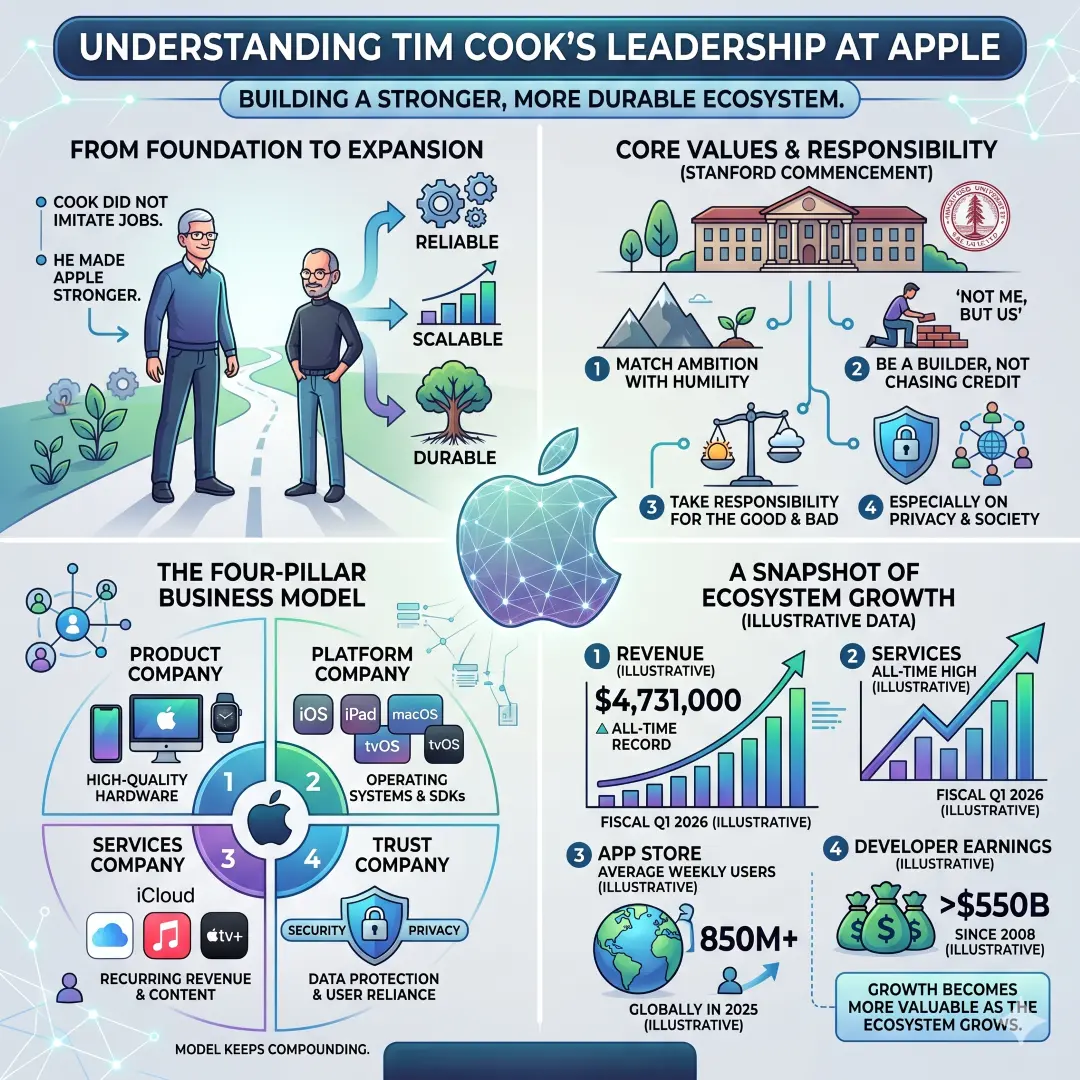
The most important thing to understand about Cook is that he did not try to imitate Steve Jobs. He did something harder. He made Apple stronger by turning it into an even more reliable, scalable, and durable business. In his Stanford commencement address, Cook argued that people should “match ambition with humility” and be a builder, not someone chasing personal credit. He also warned that if leaders want credit for the good, they must take responsibility for the bad, especially when technology affects privacy and society. That worldview shows up in Apple’s strategy again and again.
- Also, Read this in Detail:
Cook’s Apple is not only a product company. It is a platform company, a services company, a hardware company, and a trust company all at once. Apple’s recent results show how that model keeps compounding. In the fiscal 2026 first quarter, Apple reported $143.8 billion in revenue, an all-time record for the company, and said Services also hit an all-time revenue high. Earlier, Apple said its App Store had more than 850 million average weekly users globally in 2025, while developers had earned over $550 billion on the platform since 2008. That is the kind of growth Cook favors, a growth engine that becomes more valuable as the ecosystem gets bigger.
A simple timeline of Cook’s leadership era
| Year | Leadership move or milestone | Why it mattered | Business lesson |
|---|---|---|---|
| 1998 | Cook joined Apple | He brought deep operations and supply chain experience into the company | Great leaders often come from the part of the business that makes scale possible, not just the part that gets attention |
| 2011 | He became CEO | Apple began a new era after Steve Jobs | A strong successor does not copy the predecessor, they extend the company’s strengths in a new way |
| 2019 | Stanford speech on responsibility and humility | Cook explained his values in public, especially around privacy and accountability | Leadership is culture-setting, not only financial management |
| 2025 | Apple announced a $500 billion U.S. investment plan over four years | The company linked growth with manufacturing, AI, silicon engineering, and skills development | Long-term growth works best when capital spending, talent, and technology move together |
| 2025 and 2026 | Apple’s services business kept hitting records | Services became a major recurring-revenue engine | Revenue quality matters as much as revenue size |
| 2026 | Apple announced Cook’s move to executive chairman and Ternus’s promotion to CEO | The company showed that succession can be orderly and strategic | A durable company should outlive any single leader |
The core pillars of Tim Cook’s leadership strategy
1. Operational excellence before heroics
Cook’s roots are in operations, not showmanship. Apple’s leadership bio says that before becoming CEO, he managed worldwide sales, operations, and the end-to-end supply chain, while also helping develop strategic reseller and supplier relationships. That background explains why Apple under Cook has been so strong at moving products across the world with remarkable consistency. It is also why Apple can launch major hardware, services, and software products with a level of polish that many rivals struggle to match.
Apple’s supply chain page says “People come first” and explains that its products are designed in California but built by people all over the world, with an emphasis on high standards across the supply chain. This is a quiet but powerful point. Cook treats operations as a strategic asset, not a back-office chore. That means quality control, logistics, manufacturing partnerships, and supplier relations all become part of the brand.
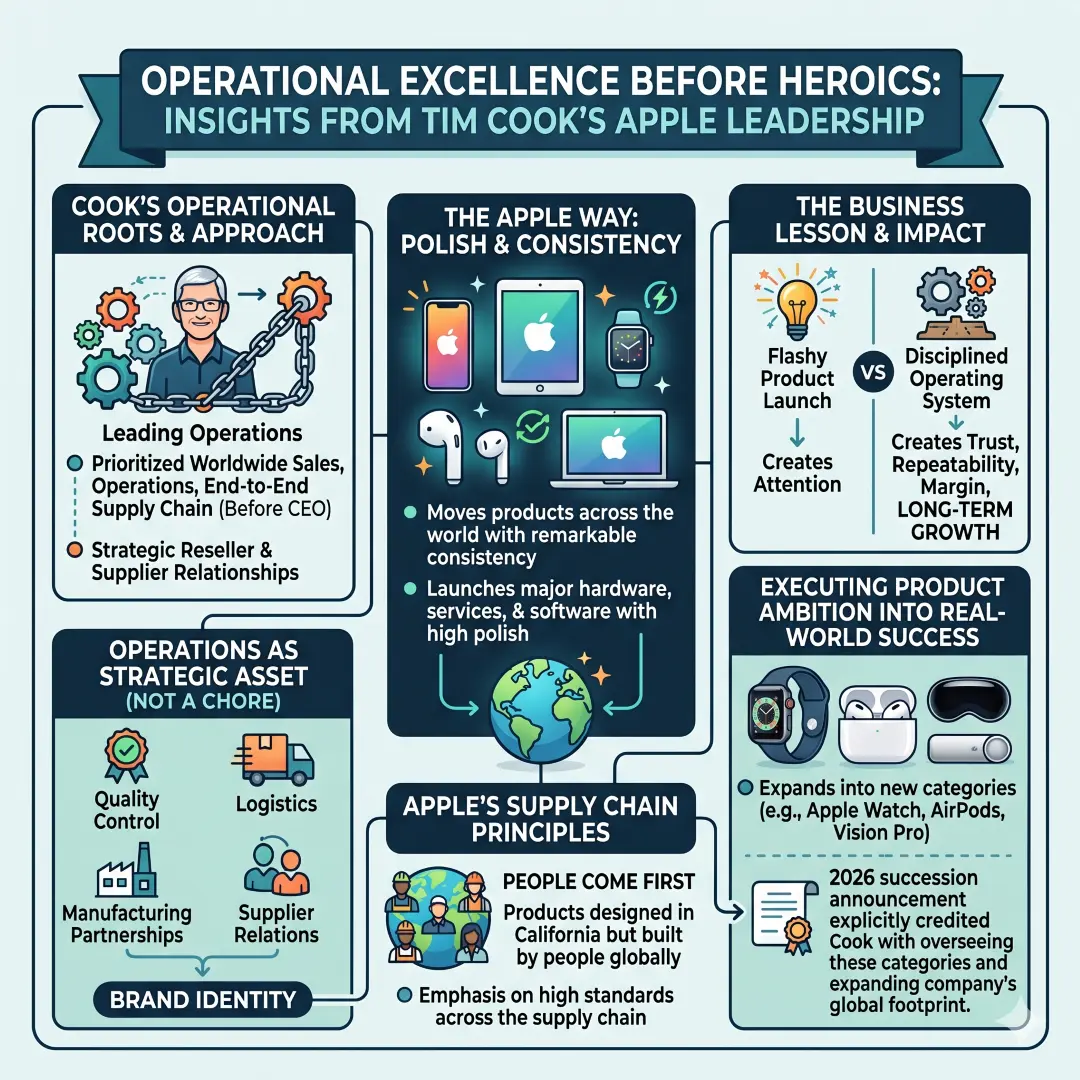
Business lesson: if a company wants long-term growth, it must make operations a source of advantage. A flashy product launch can create attention. A disciplined operating system creates trust, repeatability, and margin.
Example: Apple’s ability to support large global launches, keep a premium brand image, and still expand into new categories like Apple Watch, AirPods, and Apple Vision Pro shows how strong operations turn product ambition into real-world execution. Apple’s 2026 succession announcement explicitly credited Cook with overseeing those categories and expanding the company’s global footprint.
2. Build the ecosystem, not just the device
One of Cook’s smartest strategic choices was to deepen Apple’s ecosystem. Instead of relying only on iPhone upgrades, Apple built a broader mix of Services, wearables, payments, cloud, and cross-device experiences. Apple’s 2026 annual services update said the App Store had more than 850 million average weekly users globally, and that developers have earned over $550 billion on the platform since 2008. That is not just a store. It is a living business network.
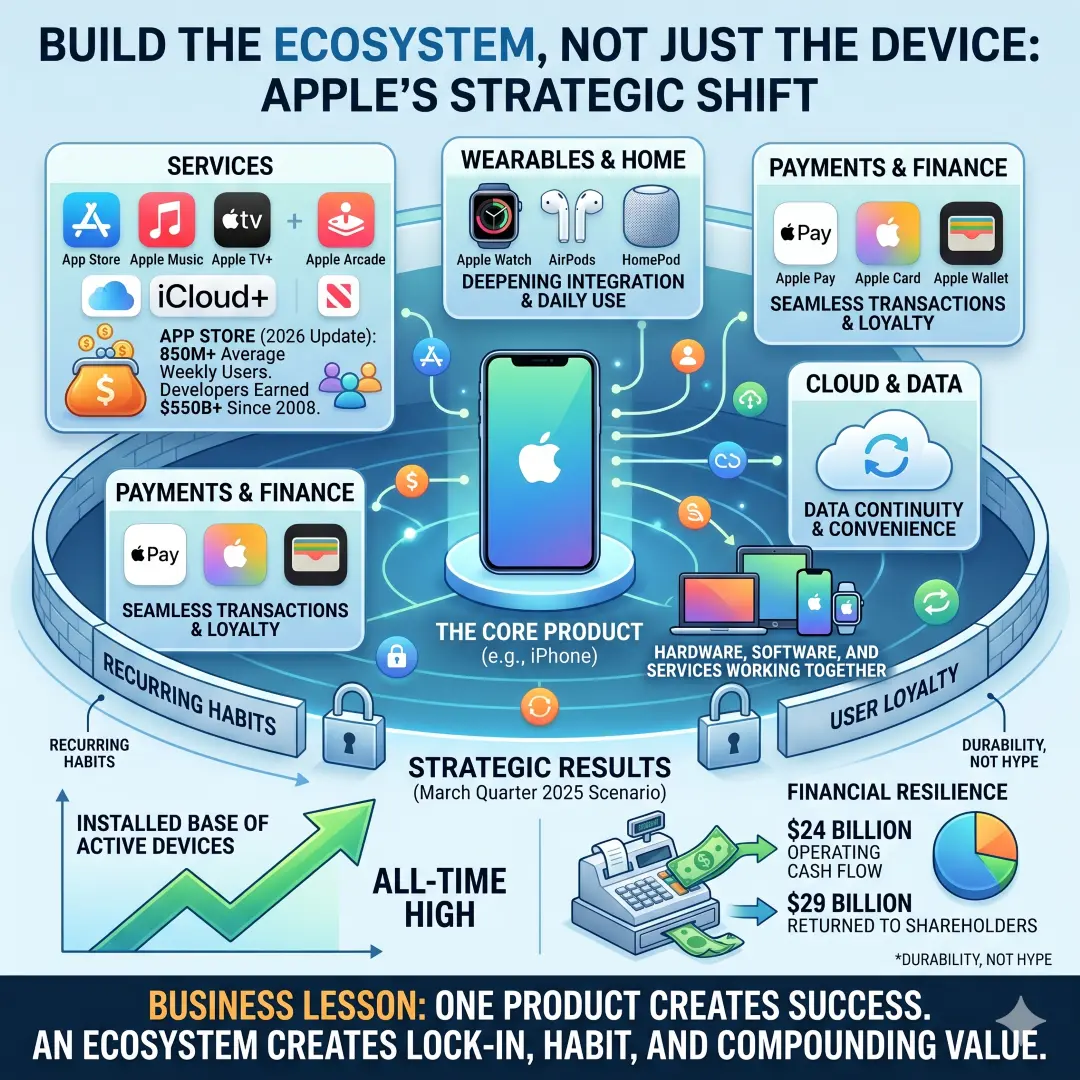
Apple’s recent results also show how the ecosystem supports financial resilience. In the March quarter of 2025, Apple reported $24 billion in operating cash flow and returned $29 billion to shareholders, while also noting that its installed base of active devices reached a new all-time high. That combination of loyal users, recurring services, and strong cash generation is one of the clearest signs that Cook’s model is built for durability, not hype.
Business lesson: one product can create success, but an ecosystem creates lock-in, habit, and compounding value.
3. Treat trust as a product feature
Cook has made privacy one of Apple’s strongest differentiators. Apple’s privacy materials say that Apple Accounts and services are designed from the ground up to protect privacy, and that Apple works to collect only the data needed to improve the experience. Apple’s privacy pages also emphasize protections against malware and ways for users to control what they share. (Apple)
Cook’s Stanford remarks make the philosophy even clearer. He argued that privacy is one of the areas where responsibility matters most, and that people lose more than data when digital privacy is weakened. He framed privacy as part of human dignity and freedom. That is not just a moral position. It is a competitive one. When users trust a company, they stay longer, share more selectively, and are more likely to buy into the ecosystem.
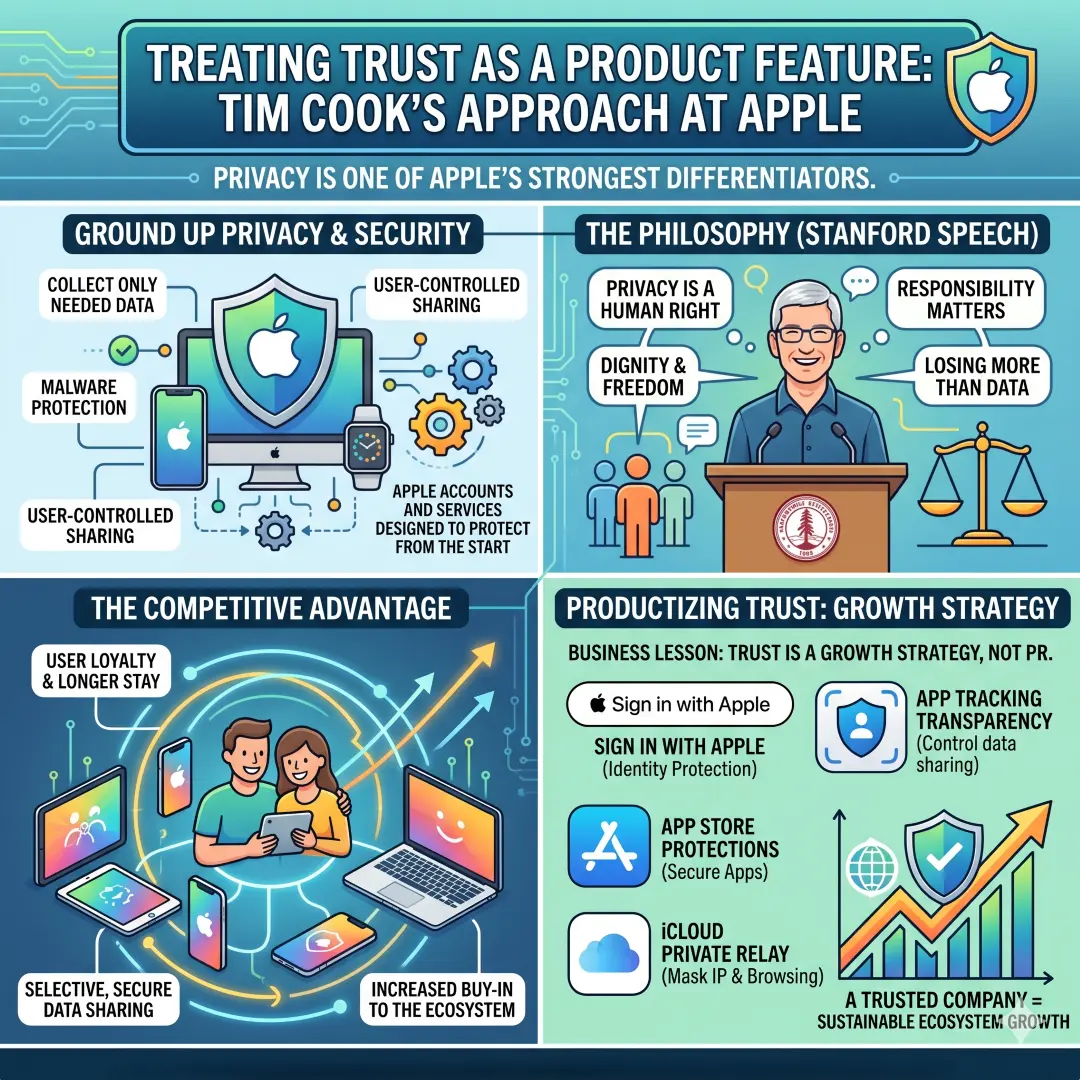
Business lesson: trust is not a public relations theme. It is a growth strategy.
Example: Apple’s emphasis on Sign in with Apple, privacy controls, and App Store protections shows how trust can be productized instead of merely advertised.
4. Make values operational, not decorative
Cook has often said, in effect, that a company should stand for something larger than revenue. Apple’s own values pages now connect Accessibility, Education, Environment, Inclusion and Diversity, Privacy, and Supply Chain as part of the company’s identity. This is important because Cook did not just talk about values in speeches. He embedded them into operations and decision-making.
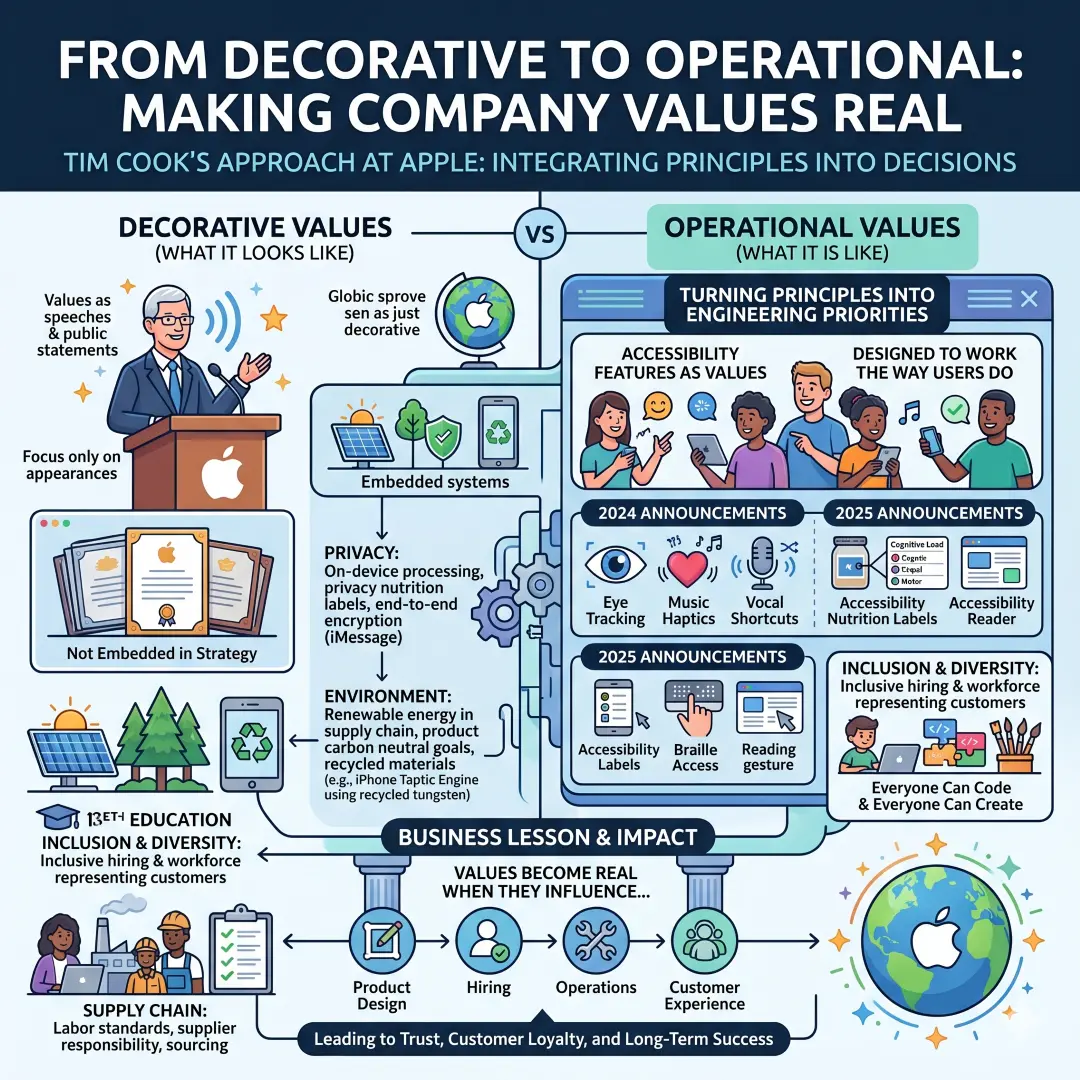
Apple’s accessibility work is a good example. Apple says its built-in accessibility features are designed to work the way users do, and the company continues to release new tools. In 2024, Apple announced features such as Eye Tracking, Music Haptics, and Vocal Shortcuts, and in 2025, it announced even more accessibility additions, including Accessibility Nutrition Labels, Braille Access, and Accessibility Reader. That is what values look like when they are turned into engineering priorities.
Business lesson: values become real only when they influence product design, hiring, operations, and customer experience.
5. Treat sustainability as a long-term operating discipline
Under Cook, Apple has made environmental performance part of its core growth story. Apple says it is working toward Apple 2030, a goal to become carbon neutral across its global footprint, with a plan to reduce greenhouse gas emissions by 75 percent compared with 2015 before balancing the remainder. Apple also says it has cut overall emissions by more than 60 percent since 2015, and that more components in its products now use recycled materials, including 100 percent recycled cobalt in batteries.
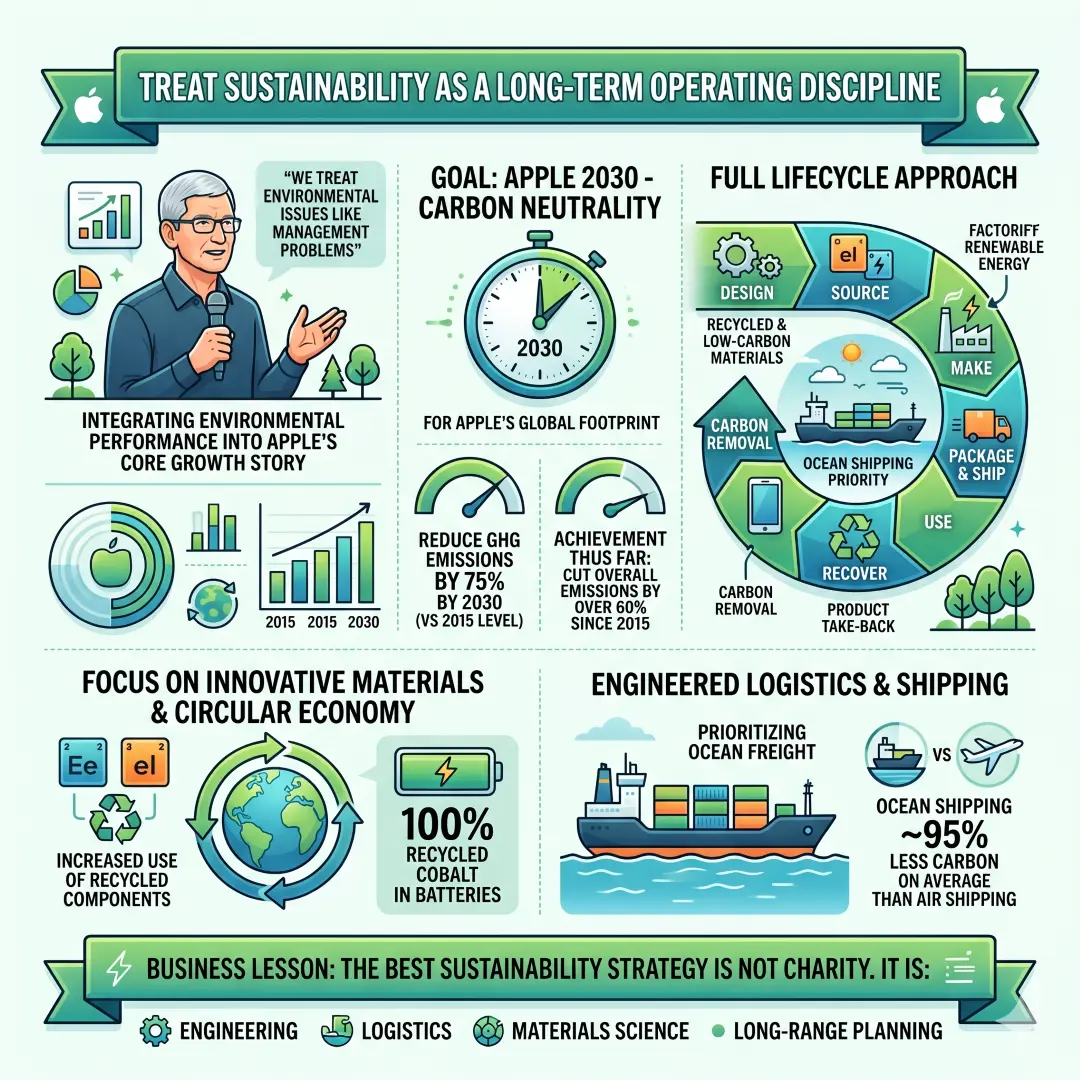
This matters because sustainability is often discussed as a separate, idealistic topic. Cook treats it like a management issue. The company’s environmental page describes a full approach from design and source to make, package and ship, use, recover, and carbon removal. Apple even says it prioritizes shipping by ocean, which emits 95 percent less carbon on average than air shipping.
Business lesson: the best sustainability strategy is not charity. It is engineering, logistics, materials science, and long-range planning.
6. Invest early in the next wave of growth
Cook’s leadership has also been defined by steady investment in future capability. Apple’s February 2025 announcement said it would spend and invest more than $500 billion in the U.S. over the next four years, with focus areas including AI, silicon engineering, advanced manufacturing, and skills development. That is important because it shows how Cook tries to link strategy to infrastructure before a market fully matures
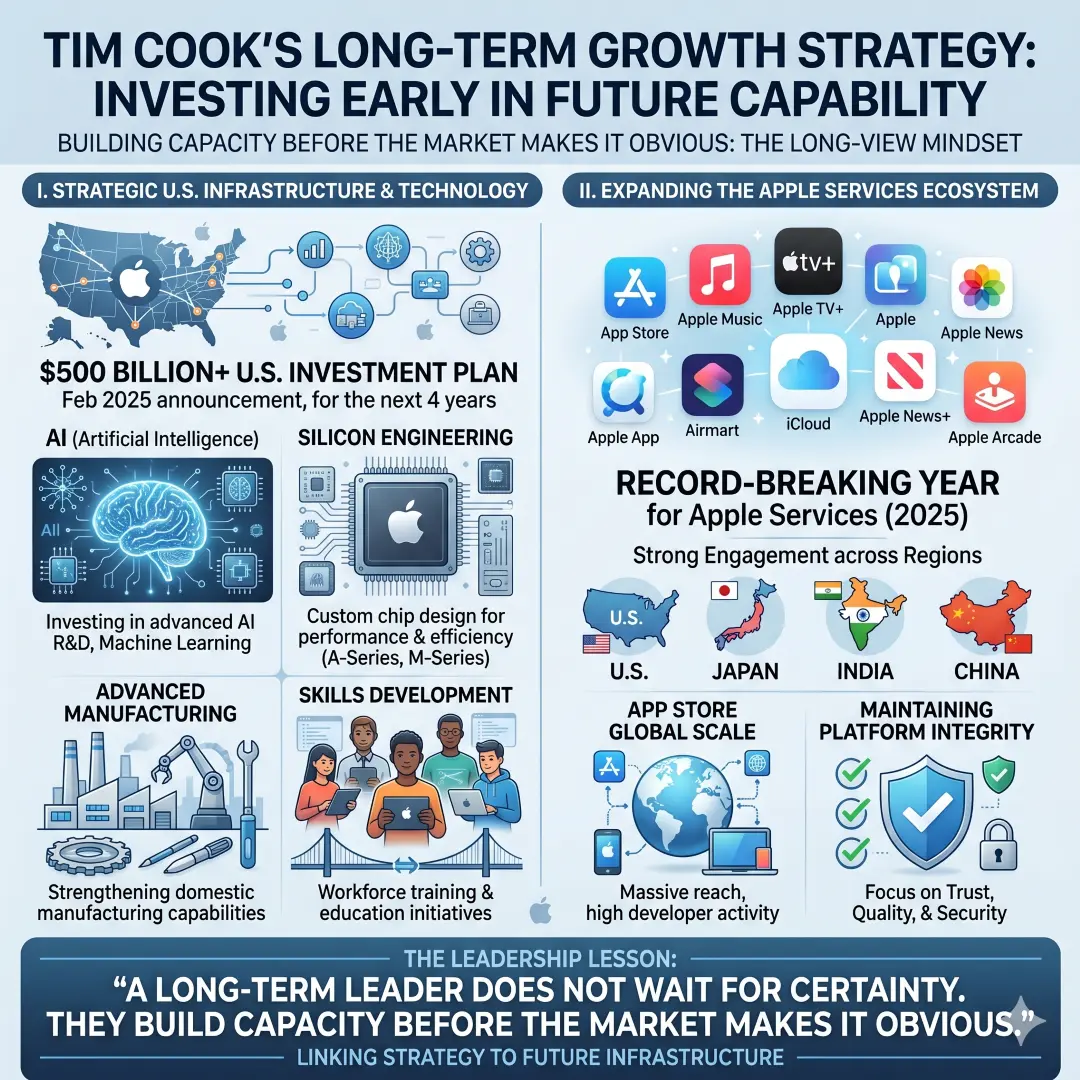
This long-view mindset is also visible in Apple’s services growth. The company said 2025 was a record-breaking year for Apple Services, with the App Store reaching enormous global scale and strong engagement across regions, including the U.S., Japan, India, and China. That is what happens when a company keeps funding its platform while maintaining trust and quality.
Business lesson: a long-term leader does not wait for certainty. They build capacity before the market makes it obvious.
Table 2. Tim Cook’s strategy, Apple’s proof, and the business lesson
| Strategy pillar | What Cook emphasizes | Apple evidence | Business lesson for other companies |
|---|---|---|---|
| Operational excellence | Scale, supply chain, reliability | Cook previously ran worldwide operations and supply chain, and Apple says its products are built with people across a global supply chain. | Make operations a strategic strength, not just a support function |
| Trust and privacy | Privacy as a human right and a product advantage | Apple says its services are designed from the ground up to protect privacy, and Cook said privacy is among the most important issues in technology. | Trust can be a moat if it is built into the product |
| Ecosystem growth | Services, devices, and platform value working together | Apple reported record services momentum, over 850 million average weekly App Store users, and more than $550 billion earned by developers since 2008. | Build connected products and services that reinforce each other |
| Sustainability | Carbon reduction and recycled materials | Apple says it has cut emissions by more than 60 percent since 2015 and is targeting carbon neutrality across its footprint by 2030. | Treat sustainability as an efficiency and resilience issue |
| Accessibility and inclusion | Design for more people, not fewer | Apple says its accessibility features are built to work the way users do, and continues to add major new features. | Inclusive design expands market reach and improves product quality |
| Succession planning | Long-term leadership continuity | Apple said Cook’s transition was part of a thoughtful, long-term succession process. | A great company should not depend forever on one person |
What businesses can learn from Cook’s long-term growth model
The deepest lesson from Tim Cook is that long-term growth is rarely dramatic in the beginning. It looks like careful execution, incremental improvement, strong hiring, reliable systems, and clear values. It also looks like saying no to distractions. Cook did not make Apple into a bigger version of a startup. He made it into a more complete institution. That is a different kind of leadership entirely.
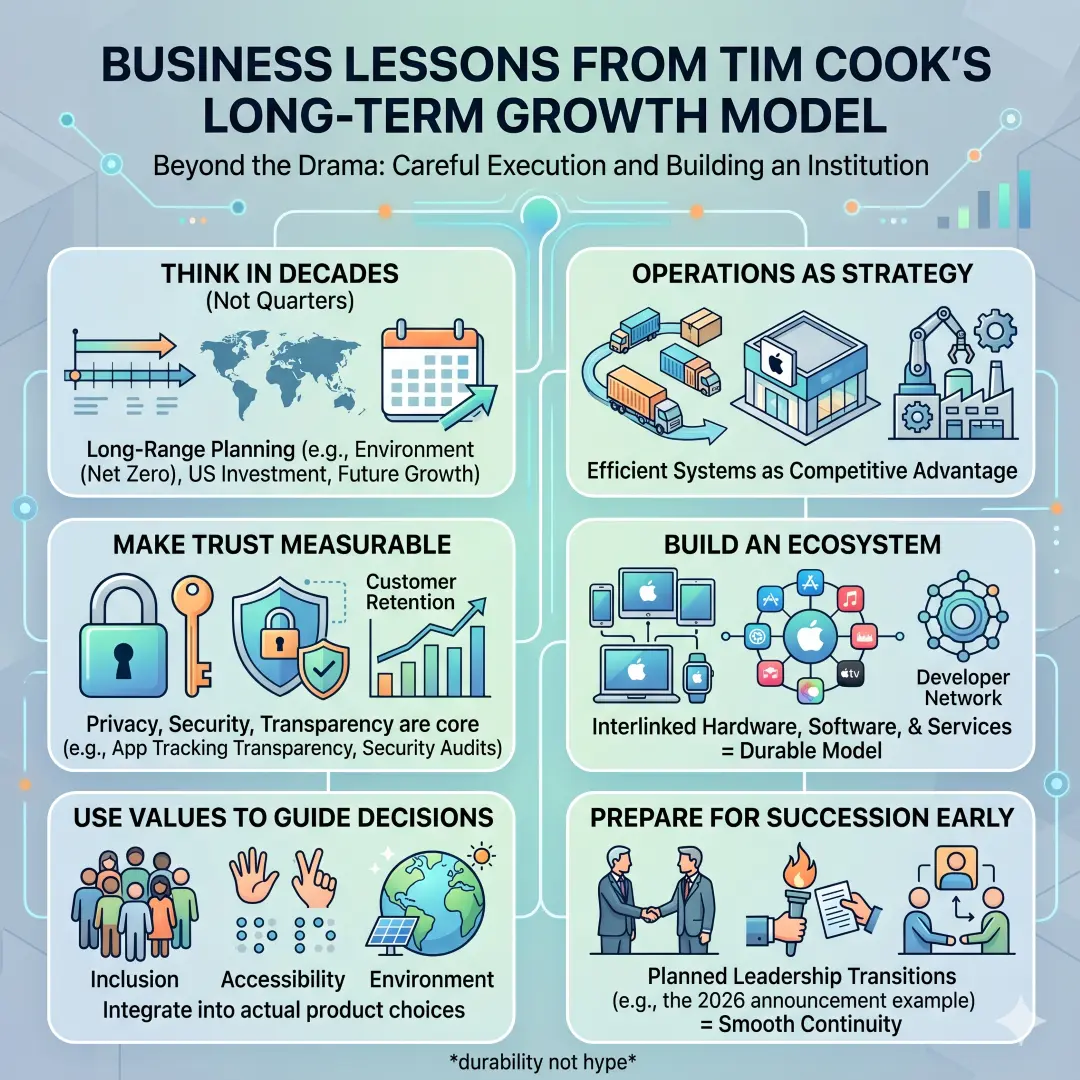
Here are the most important lessons:
- Think in decades, not quarters. Apple’s environmental targets, U.S. investment plans, and succession planning all show that Cook values time horizons longer than a news cycle.
- Turn operations into strategy. A great supply chain, retail network, and manufacturing system can be as important as a great product idea.
- Make trust measurable. Privacy, security, and transparency are not side benefits. There are reasons customers stay.
- Build an ecosystem. Apple’s services business, installed base, and developer network make the company more durable than a single-product model.
- Use values to guide decisions. Accessibility, inclusion, and environmental goals work best when they shape actual product choices.
- Prepare for succession early. The best leadership transitions are planned, not improvised. Apple’s 2026 announcement is a clear example.
A practical business playbook inspired by Tim Cook
| What to copy from Cook | How to apply it in a business | What happens if you ignore it |
|---|---|---|
| Calm execution | Build processes that reduce mistakes and improve consistency | Growth becomes fragile and chaotic |
| Customer trust | Protect customer data, keep promises, and communicate clearly | Customers leave faster when trust is broken |
| Long-term investment | Fund the next capability before it is urgent | Competitors define the future for you |
| Ecosystem thinking | Connect products, services, and support into one experience | Each part of the business stays isolated and weaker |
| Operational discipline | Measure supply chain, quality, delivery, and service performance | A great idea gets lost in bad execution |
| Inclusive design | Design products and services for diverse needs and abilities | You shrink your market and miss talented users |
| Succession planning | Develop future leaders before a crisis arrives | The business becomes person-dependent |
The human side of Cook’s leadership
What makes Cook especially interesting is that his leadership feels both disciplined and deeply human. He has repeatedly argued that technology should serve people, not the other way around. In Stanford’s speech, he reminded graduates that people should build things that matter across generations. That idea shows up in Apple’s product philosophy, privacy stance, accessibility work, environmental goals, and even its succession planning.
That is why Cook’s legacy is bigger than Apple’s quarterly numbers, even though those numbers are extraordinary. A company can be profitable and still short-term. It can also be profitable and durable. Cook has tried to make Apple a second kind of company. The fact that Apple can announce a leadership transition smoothly, while still posting record revenue and continuing major investments, suggests that the institution is stronger than any single moment.
Final takeaway
Tim Cook’s leadership strategy at Apple is really a masterclass in building for permanence. He shows that great growth does not always come from loud disruption. Sometimes it comes from better systems, stronger trust, deeper ecosystems, cleaner operations, and values that are actually enforced. Under Cook, Apple became more global, more profitable, more service-driven, more privacy-focused, more sustainability-minded, and more prepared for the future. That combination is rare. It is also one of the most useful leadership models in modern business.
If you study only one thing from Cook’s playbook, study this: long-term growth is not an accident. It is the result of patient leadership, disciplined execution, and a company culture that can survive beyond one leader.
Article’s References and Sources
- Reference Title: Tim Cook Leadership Profile: Apple Inc.
- Reference Title: Tim Cook to Become Executive Chairman, John Ternus Named CEO
- Reference Title: Apple Reports First Quarter 2026 Financial Results
- Reference Title: Record-Breaking Growth in Apple Services
- Reference Title: Apple Reports Second Quarter 2025 Results
- Reference Title: Apple to Invest $500 Billion in U.S. Economy
- Reference Title: Apple Privacy Policy and Data Protection Overview
- Reference Title: Sign in with Apple Privacy Features
- Reference Title: Apple Environmental Responsibility and Sustainability Goals
- Reference Title: Apple Supply Chain Responsibility and Operations
- Reference Title: Apple Introduces New Accessibility Features
- Reference Title: Apple Diversity, Inclusion, and Workplace Values
- Reference Title: Tim Cook Stanford Commencement Speech on Leadership and Responsibility
- Reference Title: Apple Investor Relations and Corporate Governance
Frequently Asked Questions
FAQ 1: Who is Tim Cook, and why is his leadership style so important to Apple’s long-term growth?
Tim Cook is the leader who helped guide Apple through one of the most important transitions in modern business history. He became CEO of Apple in 2011 after spending years building deep expertise in operations, supply chain management, and global logistics. That background shaped the way he leads. Instead of focusing only on excitement, public image, or short-term headlines, Cook built a leadership model centered on discipline, consistency, and long-term execution.
His leadership is important because Apple, under his direction, did not simply continue growing. It grew in a more stable and scalable way. The company expanded beyond the iPhone into services, wearables, silicon engineering, privacy-focused products, and sustainability initiatives. In other words, Cook helped Apple become stronger as a business system, not just a product brand.
One of the biggest reasons his leadership matters is that it shows how a company can succeed for many years without depending on one dramatic personality. Cook’s approach proves that long-term growth often comes from things that are not flashy at first, such as better operations, stronger planning, deeper trust, and careful succession strategy. That is why business leaders study him. His style is simple to understand but hard to copy. He focuses on what keeps a company healthy over time, not just what looks impressive in the moment.
FAQ 2: What is the main leadership strategy Tim Cook uses at Apple?
Tim Cook’s leadership strategy is built around operational excellence, trust, ecosystem growth, and long-term thinking. These four ideas work together. He believes a strong company should run smoothly, create products people trust, connect those products into a wider ecosystem, and continue investing in the future even when the market is uncertain.
The first part of his strategy is operational excellence. Cook understands that a great business must be able to deliver quality at scale. Apple’s products reach millions of users around the world, so the company needs careful planning, precise logistics, and reliable execution. Cook’s operations background helps make that possible.
The second part is trust. Cook treats privacy and security as core features of the Apple experience. This is not just a moral position. It is a business strategy. When people trust a company with their data and digital lives, they are more likely to stay loyal and keep using its products.
The third part is ecosystem growth. Apple is not only selling devices. It is building a connected world of products and services that work together. This includes the iPhone, Mac, Apple Watch, AirPods, App Store, iCloud, and other services. The more useful the ecosystem becomes, the more valuable it is for customers.
The fourth part is long-term investment. Cook is known for thinking years ahead. Apple’s investments in AI, silicon engineering, manufacturing, and environmental responsibility show that the company is preparing for the future instead of chasing only short-term gains. This makes his strategy powerful because it is both practical and forward-looking.
FAQ 3: How did Tim Cook change Apple after becoming CEO?
When Tim Cook became CEO, many people wondered whether Apple could keep its momentum after Steve Jobs. What happened was not a repetition of the past. It was a transformation into a different kind of company. Cook changed Apple by making it more operationally efficient, more globally scaled, and more focused on recurring revenue and ecosystem strength.
One major change was the growing importance of Services. Under Cook, Apple expanded the role of services such as the App Store, iCloud, Music, TV, and other digital offerings. This helped Apple reduce reliance on any single hardware product. That was a major strategic shift because services create recurring revenue and customer loyalty.
Another important change was the rise of wearables and connected devices. Apple Watch and AirPods became major categories and helped broaden the company’s product mix. This made Apple less dependent on the iPhone alone.
Cook also made Apple more serious about privacy, accessibility, and sustainability. These were not treated as side projects. They became part of the company’s identity and product design process. That helped Apple stand out in a crowded technology market.
Most importantly, Cook changed the way people think about Apple leadership. He showed that a company can be highly successful without being driven by constant drama. His style is quieter than Steve Jobs’s, but it is highly effective. It proves that strong leadership can be steady, patient, and still deeply transformative.
FAQ 4: Why is operational excellence such a big part of Tim Cook’s leadership?
Operational excellence is one of the foundations of Tim Cook’s leadership because it affects almost everything Apple does. A company can have brilliant ideas, but if it cannot produce, ship, support, and scale those ideas properly, growth becomes fragile. Cook understands this better than most executives because he spent much of his career mastering the systems behind the business.
At Apple, operational excellence means making sure products are available, quality is high, supply chains are efficient, and the customer experience stays consistent across markets. This is especially important for a company that sells products worldwide. Every launch, every shipment, and every support process must work with remarkable precision.
Cook’s operations mindset also helps Apple stay resilient. When global supply chains face pressure, companies with weak systems struggle. Apple’s ability to manage complexity has been one of its strengths under Cook. That strength does not always get attention from the public, but it is essential for long-term success.
The business lesson here is simple. A company does not grow only through big ideas. It grows through the systems that make those ideas real. Operational excellence turns strategy into results. That is why Cook’s background in supply chain and logistics is so important. It gave him the ability to see the entire business as one connected machine.
FAQ 5: How does Tim Cook use trust and privacy as a business strategy?
Tim Cook treats trust and privacy as essential parts of Apple’s value proposition. This is a very important lesson for modern businesses because many companies treat privacy as a legal requirement or a technical issue. Cook treats it as something much bigger. He sees privacy as part of the customer relationship.
When people buy Apple products, they are not only buying design or performance. They are also buying confidence. They want to feel that their data is protected, that the company is serious about security, and that the product respects their personal space. That trust creates loyalty, and loyalty creates long-term business strength.
Apple has reinforced this idea through product design and communication.
Features such as Sign in with Apple, app tracking controls, and privacy-centered device settings all help users feel more in control. This makes privacy visible, not hidden. That is one reason Cook’s approach works so well. He turns values into actual product features.
The lesson for businesses is powerful. Trust is not just a soft idea. It can become a real competitive advantage. When a company consistently protects user data and communicates clearly, it becomes easier for customers to stay loyal. Over time, that trust can help a brand become more durable than competitors that focus only on rapid growth.
FAQ 6: Why is Apple’s ecosystem such an important part of Tim Cook’s long-term growth strategy?
Apple’s ecosystem is one of the strongest reasons the company continues to grow under Tim Cook. An ecosystem is more than a collection of products. It is a connected system where each part makes the others more useful. Apple built this model carefully, and Cook has helped deepen it.
For example, someone may buy an iPhone, then later use AirPods, an Apple Watch, iCloud, the App Store, and other Apple services. The more products a customer uses together, the more value they get from the entire system. This creates convenience, continuity, and strong loyalty.
The ecosystem also helps Apple generate more stable revenue. Hardware sales matter, but services and connected products add a recurring layer of income. This is important because recurring revenue is generally more predictable than one-time sales. That stability supports long-term growth.
Another benefit of the ecosystem is that it makes switching more difficult for customers. When devices, apps, services, and accounts work seamlessly together, people often stay with the brand because it saves time and reduces friction. That does not mean customers are trapped. It means they are receiving enough value to remain loyal.
Cook’s ecosystem strategy teaches a key business lesson. The strongest companies do not just sell products. They create an environment that keeps getting more useful over time. That is one reason Apple has remained so powerful under his leadership.
FAQ 7: How does Tim Cook connect sustainability with business success?
Tim Cook has shown that sustainability is not separate from business growth. At Apple, sustainability is treated as part of the company’s operational and strategic planning. That matters because many people think environmental work is only about public image. Cook’s approach shows that it can also improve efficiency, resilience, and long-term brand strength.
Apple has made major public commitments around reducing emissions, using recycled materials, and supporting a carbon-neutral future across its operations. This includes product design, packaging, shipping, and manufacturing decisions. Those actions matter because they influence the entire business structure, not just one small department.
Sustainability also helps Apple build trust with customers and partners. Many consumers care deeply about environmental responsibility. When a company shows serious action instead of empty promises, it builds credibility. That credibility can strengthen brand loyalty.
There is also a practical side. Better material use, lower emissions, and improved logistics can help reduce waste and improve efficiency. This means sustainability is not always a cost. It can become part of a smarter operating model.
The business lesson is clear. Long-term growth works better when it is built on systems that are responsible, efficient, and forward-looking. Tim Cook understands that a company should be strong enough to succeed today and responsible enough to remain strong tomorrow.
FAQ 8: What can business leaders learn from Tim Cook’s communication style?
Tim Cook’s communication style is calm, measured, and purpose-driven. He does not rely on dramatic language or constant spectacle. Instead, he tends to speak with clarity, confidence, and discipline. This style reflects the broader way he leads Apple. He focuses on what matters, stays consistent, and avoids unnecessary noise.
One thing leaders can learn from him is that communication does not have to be loud to be effective. Clear communication builds confidence. When employees, investors, and customers hear a leader who speaks thoughtfully and steadily, it often creates a sense of trust.
Another lesson is that communication should match company values. Cook often emphasizes privacy, responsibility, inclusion, environmental progress, and long-term vision. That means his public message supports the company’s actual strategy. This consistency matters. When a leader says one thing and the business does another, trust breaks down. Cook avoids that problem by keeping the message aligned with the mission.
Business leaders can also learn from his ability to communicate in a way that is accessible without being shallow. He does not overcomplicate his ideas. He explains serious issues in direct, simple terms. That makes his leadership style both practical and respected.
FAQ 9: Why is succession planning such an important part of Tim Cook’s legacy?
Succession planning is a major part of Tim Cook’s legacy because it shows that he is not only building Apple for the present. He is helping prepare it for the future. In 2026, Apple announced that Cook would become executive chairman and John Ternus would become CEO. This is significant because it reflects careful planning rather than a rushed transition.
Good succession planning matters because no company should depend forever on one person. A strong business needs leadership continuity. It needs future leaders who understand the mission, the systems, and the culture. Cook’s transition shows that Apple values stability and long-term structure.
This is also a lesson for other companies. Many organizations fail when leadership changes suddenly. The reason is often not the departure itself, but the lack of preparation. Cook’s approach suggests that the best leaders create systems that can survive and thrive beyond them.
His legacy is therefore bigger than his personal achievements. It includes the strength of the institution he helped shape. A company with a clear succession plan is more likely to remain healthy, confident, and adaptable. That is one of the strongest signs of long-term growth.
FAQ 10: What are the biggest business lessons from Tim Cook’s leadership at Apple?
The biggest business lessons from Tim Cook’s leadership are about building a company that lasts. His approach shows that long-term growth comes from discipline, trust, ecosystem thinking, operations, values, and future planning.
One major lesson is that a company should treat operations as a strategic advantage. Great products matter, but so does the ability to make and deliver them consistently. Another lesson is that trust can be a powerful source of customer loyalty when it is built into the product itself.
Cook also teaches that businesses should think in systems. Apple’s success comes from the way its devices, services, software, and experiences all support one another. This creates more value than a single product can create on its own.
Another important lesson is that values should not be decorative. Privacy, accessibility, inclusion, and sustainability should influence real decisions. When values become part of the daily business process, they help a company stay respected over time.
Finally, Cook’s leadership shows that succession and long-term planning matter. A strong company should be prepared for the future before it arrives. That kind of preparation is one reason Apple has remained so powerful.
In simple terms, Tim Cook’s greatest lesson is this. Build a business that is useful, trusted, well-run, and ready for the future. That is how long-term growth becomes real.
Article Disclaimer
The information provided in this article, “Tim Cook’s Leadership Strategy at Apple: Business Lessons for Long-Term Growth,” is intended for educational and informational purposes only. While every effort has been made to present accurate, up-to-date, and well-researched content, the material should not be considered professional business, financial, legal, or investment advice. Readers are encouraged to conduct their own research or consult with qualified professionals before making any business decisions based on the ideas discussed in this article.
This article is based on publicly available information, general industry knowledge, and widely recognized business practices. Although the strategies and insights related to leadership, innovation, operations, and long-term growth are inspired by real-world examples, they may not be suitable for every organization, industry, or individual situation. Business environments can vary significantly, and outcomes may differ depending on factors such as market conditions, resources, and management capabilities.
Any references to companies, leadership approaches, or strategic frameworks are provided solely for illustrative and analytical purposes. They do not imply endorsement, partnership, or official association. The article aims to analyze and interpret leadership strategies in a simplified manner to help readers better understand complex business concepts.
The author and publisher of this content make no guarantees regarding the completeness, reliability, or accuracy of the information presented. While reasonable efforts have been taken to ensure the credibility of the content, there may be unintentional errors, omissions, or updates that occur after publication. Readers should verify key facts independently when necessary.
Additionally, this article may include forward-looking ideas, interpretations, or opinions related to business strategies and leadership styles. These perspectives are subjective and should not be interpreted as guaranteed outcomes or predictions of future performance. Business success depends on a wide range of variables, many of which are beyond control.
By reading this article, you acknowledge that any actions you take based on the information provided are done at your own discretion and risk. The author and publisher shall not be held responsible for any losses, damages, or consequences arising from the use or reliance on this content.
